Alexei Navalny’s lecture at the Tsvet Nochi club ("Color of the Night")
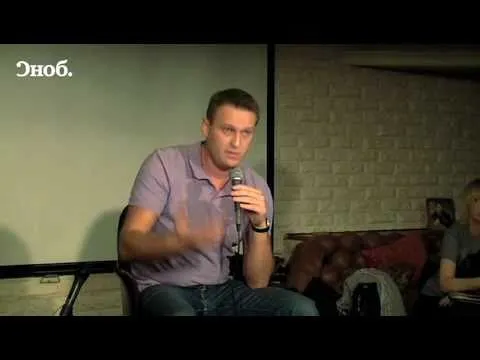
Overall, this is a rather unusual format for me
— this kind of appearance, when I come
and, for no clear reason, just talk about
something with people. In this format, for about
a month now, I’ve been speaking fairly often.
In full accordance... advice to see it.
My fifteen minutes of fame have sort of arrived.
In recent months, everyone started
going on about, “Navalny, Navalny”
Navalny
Lately, things have been working in such a strange way
that it leads to absurdity.
Navalny
“Come on then, expose someone, expose some crook.”
I really do love exposing people,
but doing it constantly, every single time,
is quite difficult. I can already see
that right now the most popular thing
to do is to read about myself.
Most people are already sick of it.
Navalny this, Navalny that — so once again
what I’ve done over the past few months is
I see that I gave an interview to Sobchak (Ksenia Sobchak, Russian TV host/public figure),
and to TV Rain / Dozhd and Silver Rain (Russian media outlets),
gave interviews to everyone — but at the same time I actually did
very little of anything else. So I
already understand that I need to appear on video
a bit more underground and
a bit less
in the spotlight, because that doesn’t really help at all.
Our farewell tour
this evening
is supposed to be a session of questions and
answers.
Before we move on to the Q&A,
I should probably say something about the schedule. We have
five minutes.
I’ll speak and try to answer
the two most common questions that
come up. First: why are you doing this? And second:
do you believe in your victory — in victory at all?
As for why I’m doing this,
I genuinely do not understand, not for a single second,
why everyone isn’t just as outraged by this as I am.
What is happening to our
country looks like this metaphor:
an old woman, half-dead already, is walking along
dragging her things,
and some teenage thugs come up to her.
A 13-year-old starts drinking from her bag,
they knock her down in the snow and take away
her cans and bottles.
No one stands up for her, and everyone
just sits there watching, commenting,
writing things like, “Well, serves the old woman right.”
“Too bad for grandma, of course, but then again...”
And then some representative of the liberal
intelligentsia says, “But they’re children,
they’re always cruel, they’ve always beaten up old women,”
“that’s just how history turned out.”
Maybe there’s some kind of
misplaced pathos in what I’m saying, but that is exactly
what it is: our country — this old woman — is being robbed by vicious
teenagers. All that needs to be done is to
drive these teenagers off and box their ears.
I absolutely believe that all of us should be doing this,
and all of us can do it. We are not
doing anything that absolutely any person
couldn’t do. No special
knowledge or organizational
resources are needed for this at all.
There’s a small office, 100 square meters (about 1,076 square feet),
and five people work there.
Lawyers’ salaries in Russia
are more or less known, so
you can calculate it with an accuracy of plus or minus 10
thousand rubles (roughly a modest monthly amount),
and absolutely anyone can do the same thing.
I sincerely do not understand why not everyone
is doing it. Do I believe in victory?
Let me tell you a short story here.
Half a year ago I was studying at a university in Kyiv
and doing an internship there.
I came back from there at the end of December.
There was a student from Tunisia there with me,
a guy named Fares Mabrouk.
A local opposition activist, a businessman, and so on.
We talked a lot, of course,
about the situation in Russia and the situation
in Tunisia. And this Fares was constantly terribly
jealous of me. He kept saying, “You can’t even compare it
to the situation in Russia. In our country,
the internet is blocked, we have neither
Twitter nor YouTube, and basically
we have nothing. So you Russians are so
lucky, you have it so good. In our country
there is absolute, total
control by the security services over everything. We are not
allowed to hold a single rally. Our
president is supported and loved by everyone,
and we also have this brazen elite
that spends all its time hanging out
in France, and it too is completely
oriented around the president. And we have the
highest standard of living among neighboring countries,
so nothing will happen here at all.”
He was invited there once even
to a blog event; he came along with me
and gave a presentation for students. I
was supposedly the invited star, while this
blogger was this modest little guy.
I was talking about Transneft (Russian state pipeline company), and he was showing
some videos from their protests.
I watched them and thought, “God, how pathetic,”
what a low level this was. All our
Marches of the Dissenters (Russian opposition protests) — they were
the last people who still believed that something
would happen. By mid-December, a month later,
all those super-cool presidents and the whole...
to beautifully load up your gold
bars. Look, as for the Volosovsky District, I don't
want to draw those analogies there
or extrapolations and so on. There are huge
differences. Why Tunisia for Russians, while for us
there isn't that kind of population concentration,
the population is older, and it's simply cold here.
It's impossible to protest for many days in a row
and so on, and so on. But I
absolutely believe in the final victory. I
understand that maybe this will provoke
sarcastic smirks and so on,
but the victory of good over evil is inevitable.
These evil little girlfriends who drink
Grandma dry and take her bottles away—well, sooner
or later, whether they like it or not, they
will run away. And I believe that my work,
modest as it is, with its problems and
shortcomings and so on, makes
some small contribution toward making these
guys get on a plane and
fly away. I don't know where, let them fly off.
Power in Russia will change as a result of
a hypothetical Tunisia or a hypothetical Egypt—that is,
there are two scenarios. In one,
these crooks themselves understand that
it's all over, and they begin, so to speak, to delegate
power—in the broadest sense of the word, to delegate
power to governors, municipalities, and
so on. Or a Tunisia happens.
That will become much more likely because
the delegation of power would begin to mean
that there is less money to siphon off there, and in the event of
an improvement in the financial situation, it is possible—
possible that there could be a soft landing for the regime.
And that would be
the best possible course of events, one that
would make it possible
for a hypothetical Putin and a hypothetical
Medvedev to preserve their lives and
health, and the safety and freedom of their
families. But
right now, of course, no one is
considering that. They all think that
everything is decorative window dressing, and I think
it's hardly possible, because this
vertical power structure is not capable of
doing it. In fact, it's simple: they
are rigid. Take any example where there was
a direct confrontation between the people and the authorities.
As soon as they got scared, they backed
down. Any more or less organized
appearance or protest by some
large groups of people
For me, leaving would mean losing, yes.
And not only that—I genuinely
and sincerely do not want to leave. I
just spent half a year in the States with my whole family,
and I discovered in myself absolutely all
the complexes of a Soviet person
that I'd heard about. That is, I
am irritated by the smiles, I'm irritated by the lack of
black bread, and so on. All of this
really means that life abroad
annoys me. In that sense, I am
an absolute Soviet relic, and I don't understand
why I should somehow leave. I mean,
I want to live in my wonderful Soviet-style
homeland. The only thing that poisons my
life in Moscow—if we take politics out of it—
and so on, aside from the traffic, it's a wonderful city
to live in. I really like it here. I am not
planning to leave; I don't want to go anywhere.
Leaving tactically and continuing my work
from abroad won't work either, because
when they tried there to open
a criminal case against me the first time, the idea was
precisely that I would get scared and not
come back. But that would make impossible
any real conduct of investigations. Of course, I
could still write
some angry posts on LiveJournal, but all
those angry posts only matter if they
are accompanied by the fact that I physically
go and file statements with the police
because when they review them, they are obliged to
take explanations. That is, if they haven't taken explanations,
they'll close the case at the very
earliest stage. So here you need
physical presence and going to
interrogations, giving explanations, and so on and so
forth. So I simply won't be able to do
this work.
As for life and all that, it's a very
small part of the same program. It is still
still about Transneft, and it will be sad for
months and years to come. It's still about Gazprom.
These are still three very
revealing, very promising, and extremely
painful cases for the authorities. First, the Daimler case:
they admitted everything—they paid bribes.
The Russian division said: yes, we paid
bribes. They handed over all the documents, including those of the chairman
of the state-owned bank. They have the documents; this is not
something they can just lose. Then there's the Hungarian case already—
a criminal case, people in custody,
the fact has been proven that all of this really happened, and this
Hungarian investigation, the Hungarian side,
will not give our people the chance to say that
nothing happened.
Then there is the so-called case of our
Japanese sailors, who were also
involved a little, when
four Japanese fishing companies
didn't just come in—they were paying tribute
specifically in connection with cost pricing and
They brought in new people — that is, they simply...
They listed the cost of the goods; we were paying...
bribes — every deal that came out noisily...
was paying; if you act on a paid basis, you're limited...
It's obvious — essentially, they were paying for everyone.
These are sums of millions of dollars.
Naturally, it will be very difficult for our side...
to say, "None of this ever happened."
Because, you see, the companies paid...
a fine for it — they admitted all of this, and...
we will deprive the patient...
to continue — as before, painfully, I repeat...
But I repeat: millions — people themselves are raising...
they won't imprison themselves, but nevertheless we will...
continue.
It is clear that the entire state...
mechanism is absolutely secured — yes, that's...
exactly how it is. But the driving force behind what...
exists now is a fairly small...
corporation, so to speak...
the "St. Petersburg group" (a reference to people from St. Petersburg) — of course that's an exaggeration, but...
that's essentially what it is: specific people, and we...
understand how they govern, what they...
do — we even understand who is stealing...
how many cars, and so on. In other words, these are...
completely specific people. There are not five of them, nor...
twenty-five — there are thousands of them. These people are...
the ones who have usurped power and who are carrying out...
lawlessness — and it is precisely they who...
have turned corruption into the main...
mechanism of governing the state. That is...
they created a system of delegation, that is...
they, downward through the hierarchy, conditionally to all...
levels of government, give people the opportunity to steal.
Somewhere below, from the bottom, they are supposed to...
send back political... political...
in my view, exactly 65 percent for United Russia (the ruling political party)...
to simplify it — this creates the opportunity...
for those at the top to skim off the cream perfectly well.
Right now there is a completely clear...
system of negative selection — that is...
you cannot become some kind of...
minister and so on if you are not...
involved in the system. It is simply...
impossible.
You won't — you can't even be...
a governor, because a governor is...
a person who gets things resolved; he...
needs to obtain, roughly speaking, a billion...
dollars in federal money in order...
just to build roads in the city, and...
therefore he is forced to court them...
so that his region gets something, rather than...
the neighboring ones. The transport minister asks...
him to sort something out with certain businessmen...
and he resolves the issue with those businessmen not...
for himself...
but for the city, in order to get that billion.
That's the goal he is solving for. And so, if you...
cannot exist there — no matter how...
wonderfully honest a person you may be...
you will be completely ineffective.
For the system to change, what is needed is...
simply naked political will.
It would take Putin or...
Medvedev, tomorrow, if they sincerely decided that...
everything should start changing — and the system...
of governance would rearrange itself by tomorrow...
and a completely real struggle would begin.
For that, there is no need for anything else...
nothing more is needed except...
their sincere desire. But they will not...
ever do it...
because the system is deliberately built this way.
The solution is that we must...
weaken the group that has usurped...
power, and force this group...
to announce honest, free elections. We...
will do this sooner or later. I call on...
people to take part in them — in the real process...
not as some kind of celebration. Simply join the urban...
protests — we all must create such...
"urban partisans" — so that the authorities feel uncomfortable.
It has to be fought.
Rifles and so on are not our...
method for now. But right now we can do...
specific things. These urban...
partisans can act quite...
painfully. A thousand people like me — that is, they...
would unsettle all of you in seconds.
Tomorrow the balance could shift entirely to the other side.
Simply to make that happen...
a thousand people should spend one month...
working on this problem.