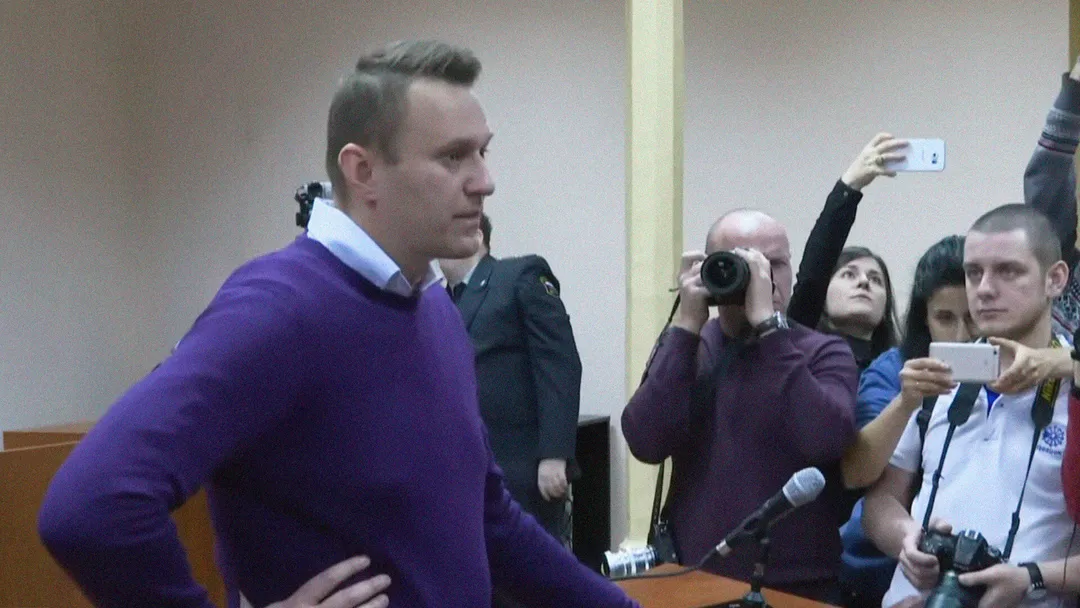
Retrial of the Kirovles Case. Court video recording. Hearing 1. Part 1
there is nothing
to worry about
to pass on
I’ll pass it on
familiar
story
fantasy
Here, here
we will
how, what
do it. All right, let’s go
sh
come on
all right, in a minute
hour
Hello, welcome
you. I see many new faces. Thank you
very much for being with us
Hello, have a seat
here
with
so, and
to whom
[music]
well
come on
Oh, great—where were you headed, on...
by train
and the broadcast participants, please take your
seats. We’re doing the broadcast too. And where to, on...
RAPSI (Russian Legal Information Agency), or...
for the sake of
[music]
both... all right, everyone
stand. Hello, please wait
please
The court session is now open.
The criminal case is being heard on the charges against
Navalny, Alexei Anatolyevich, under
part 6 of Article
334, Article 160... Pyotr Yuryevich... part...
Article... part 3, part 4 of Article
160... Secretary, please state... who is required...
The following have appeared for the court session:
the state prosecutors, the head
of the department of state prosecution and
appeals of the Kirov Region Prosecutor’s Office
Sergey Vladimirovich Bogdanov, prosecutor
of the department for supervision over compliance with leg
islation on combating corruption
of the Kirov Region Prosecutor’s Office, ...
Evgeny Nikola... Nikolaevich, representative
of the injured party; Larisa Yuryevna Agalakova
the defendant, Alexei Anatolyevich Navalny
Pyotr Yuryevich Ofitserov, defense counsel, attorney
Olga Olegovna Mikhailova, attorney; Kobzev
Vladimir ...vich, attorney; Svetlana Davydova
Viktorovna. Witnesses for this court
session have not
... The composition of the court is announced. The criminal
case is being heard by presiding judge Yurin
... Maria Vladimirovna... the state
prosecutors previously introduced
the secretary, attorneys Mikhailova and Kobzev
go ahead
go ahead, the representative
of the injured party. The participants in the court
session are advised of their right to challenge the composition of the court
the secretary, and counsel if any of them
is a relative or civil party...
civil plaintiff... in this
case participated previously in the capacity of
or is otherwise interested in any part of this
case... there are grounds to challenge the presiding
judge, the state prosecutor, or counsel
on circumstances involving their
participation in the proceedings of the case. Parties
...?
at this stage
No? Then the identity is established
of the defendants and the injured party
Pyotr, please stand
state your full name, date and place of birth, ... May ... year
city, nationality, citizenship—Russian
Federation, higher education, marital
status
wife, have...
year of birth
please
all right
Excuse me, 2006, 2008, and
2011, 23... and yes, ninety
seven—so one of them is
a minor, four are not
adults, one is an adult
adults—these are minors
yes
Are you employed? Yes... sole proprietor Ofitserov
You are not obliged to... no
No. You are registered and reside at
the address: Moscow, Ozyornaya Street, building 15
apartment 95, building 1
well, yes. So at present you are not
convicted
Yes. A copy of the indictment
was received during the consideration of the previous
case. Yes, yes. So, the time and place of the court
session then
Well, two notices came by mail
uh, last week, more than five days ago, yes
Mm-hmm
Please, Alexei Anatolyevich, stand up
please. Navalny, Alexei Anatolyevich
date and place of birth: June 4, nineteen seventy
six, Butyn village, Moscow Region
Odintsovo District. Yes, Odintsovo
District. Nationality, citizenship: Russian
Russia. Higher education. Marital
status: married. Two minor
children, born in
2001 and 2008
At present, employed as a sole proprietor
Navalny. Military
service-liable? Yes. Registered, residing
registered at: Moscow, Lyublinskaya Street, 175/15
and I live—I rent an apartment on Masterkova Street
Oh, I see
Have you been prosecuted criminally
yes, held criminally liable
more than once. Let's
write down which convictions are currently in effect
currently active
a conviction by the Moskvoretsky Court—what year
was it
For what
Moskvoretsky District Court
of Moscow
Decem—December, what
year, 3 to ... years suspended, and the article—here
please, which article
state it: Article 159, Part 4, Part 3
no, four under part four
the sentence, once again: 3 ... suspended for 3
and 5—that is imprisonment, uh-huh, and ... suspended
what was the probationary
term again
Mm-hmm, one active conviction. Yes. Ah, yes, that's all for you
the others, so to speak, have already been expunged
Mm-hmm. You also received the indictment
and were notified of this court hearing more than
5 days ago
yes
please. So, the defense side was
also notified more than five days ago, yes
the lawyers, yes
the rights of the defendants are being explained
as provided for by Article 47 of the Criminal Procedure Code of the Russian Federation
to know what you are charged with, to object to the brought
charges, to testify regarding the charges
or to refuse to testify
if you agree to testify
you must know that your testimony may be
used as evidence in
the case, including if you later refuse
to testify; to present evidence
to file motions
to challenge participants in the proceedings and to use the assistance of counsel
to review the order appointing
an expert examination and to put questions to the expert
to review the expert opinion and make, at your own expense,
copies from the materials of the criminal
case; to file complaints regarding the actions of the court
to object to the termination of the criminal case
to participate in the proceedings before the court of first instance and
the appellate and supervisory instances
to review the record of the court hearing and submit
comments on it; to appeal the judgment or
court ruling; to receive copies
of appealed decisions and to receive copies
of complaints and submissions filed in the case
and to submit objections to them
in accordance with Article 51 of the Constitution of the Russian Federation
you have the right to refuse to testify against
yourself and your relatives. Are your rights clear
yes
Yes. The identity of the victim's representative is being established
Please stand up
Documents. Agalakova Larisa Yuryevna
Head of the Property Management Department
of the Ministry of State Property
of the Kirov Region. I ask that it be attached
to the case materials. Please state your date of birth
and place—25, 25 May
1978, city of Kirov. Official address
city of Kirov, 69 Karl Rita Street
Mm-hmm, yes. I ask that it be attached to the case materials
an extract from the resolution of the government
of the Kirov Region dated March 17, 2015, on
the renaming of the department
of state property of the Kirov
Region into the Ministry of State
Property of the Kirov Region. I also ask
to allow me to participate in the proceedings as
the representative of the victim and
to attach to the case materials the power of attorney in
my
name
Does anyone object to attaching the documents
On the basis of Part 1 of Article 42
to admit as the representative
of the victim, the Ministry of State
Property of the Kirov Region
to you
to know that you may refuse to testify against
yourself
and your relatives; if you agree to testify
your statements may be used by the court as
evidence in this case, including
if you later refuse to give
that testimony; to present
evidence, to file motions
to challenge participants, to review the court's ruling on
the appointment of an expert examination, the expert opinion, and to receive
copies of the judgment and rulings; to participate
in the criminal case before the court of first
and subsequent instances; to speak in the judicial
debate; to support the prosecution
to review the record of the court hearing and submit
comments; to file complaints about the actions of the court
to appeal the judgment and rulings of the court
to know about complaints and submissions filed
Are your rights clear? Yes, clear
Please. The persons participating in the court
hearing are informed of the rules
of the court hearing as provided for by Article
257, namely: when the judges enter, all
those present in the courtroom
stand up. All participants in the trial
address the court and give
testimony and make statements while standing
an exception to this rule may be
granted with the permission of the
presiding judge
participants in the trial
as well as persons present in the courtroom
address the judge as 'Your Honor'
The court bailiff responsible for order in the courtroom
carries out the instructions of the presiding judge
The lawful demands of the court bailiff responsible for maintaining
order during the court hearing are binding
on all persons present in the courtroom
The parties are also informed of the measures
that may be taken for violating order
during the court hearing, as provided for by
Article 258. In the event of a violation of order during the court hearing
of the hearing, failure to comply with the orders
of the presiding judge or the court
bailiff, any person present in the courtroom
at the court hearing shall be warned about
the inadmissibility of such conduct, or
shall be removed from the courtroom
or be subject to a sanction in
accordance with Articles 117 and 118 of the Code of Criminal Procedure of the Russian Federation
If the prosecutor or defense counsel fails to comply with
the orders of the presiding judge,
the hearing of the criminal case may, by ruling
or order, be adjourned if this does not
prejudice the criminal case
At the same time, the court shall
notify the higher prosecutor and
the relevant bar chamber accordingly. The defendant
may be removed from the courtroom
until the end of the parties' arguments; at the same time
he must be granted the right
to make a final statement. In that case, the judgment
must be pronounced in his presence
or served on him against signature immediately after
it is pronounced. And in the courtroom
an audio recording of the court proceedings is being made
Representatives of the mass media are also present
who are carrying out photo
video and film recording of the court hearing
A broadcast of the court hearing is being conducted. Before the court hearing proceeds,
the parties are invited
to state their position on this
issue. Prosecution,
does anyone wish to speak on this issue?
to speak
wish
Defense side.
Defense, we have heard. Excuse me, regarding
this, we do not object. Or shall we speak afterward? Yes, we
support it. Support.
Unanimously.
Then members of the press are permitted to conduct photo
video and film recording during the court hearing
hearing.
However, without the use of flashes or
other equipment. So please turn off your flashes
in accordance with Article 271 of the Code of Criminal Procedure of the Russian Federation.
Do the parties have any motions to summon new witnesses, experts,
specialists, to request physical
evidence, documents, or opinions
as evidence?
Any motions?
Defense side: We do. We have a number of
motions.
In particular, given that we are gathered here
exclusively for the purpose of
implementing the judgment of the European Court
which found the previous
verdict handed down by the Leninsky District
Court of the city of Kirov unlawful, we move for
the termination of the criminal case and criminal
prosecution. Oh, please.
Thank you. We believe that the ongoing
criminal prosecution of Navalny and
Ofitserov, as well as the repeated judicial
proceedings on charges of
committing the offense предусмотренного
by Part 4
of Article 160 of the Criminal Code, are
arbitrary, unlawful, and
demonstrate non-compliance with
the judgment of the European Court of
Human Rights of February 23, 2016
which entered into force on July 4, 2016.
The European Court found serious
violations of the rights of Navalny and Ofitserov
the existence of which does not currently allow
the court to consider this
criminal
case. First, the European Court
established that Navalny and Ofitserov were
convicted for acts that were not criminally punishable
as a result of
the arbitrary application of criminal
law. It concluded that
the Russian courts found Ofitserov
guilty of actions
indistinguishable from ordinary commercial
intermediary activity, and Navalny
for facilitating that activity. The judgment of the European Court states
that the judgment of the European Court noted
that the case presented a situation in which
in particular, as stated in paragraph
115 of the judgment, the actions that were
characterized as criminally punishable
fell entirely outside the scope
of the article
under which they were convicted and did not
correspond to the original purpose of that
article. In other words, the criminal law
was subjected to arbitrary and unforeseeable
interpretation to the detriment of the applicants, which
led to a manifestly unreasonable outcome
of the judicial
proceedings. The above conclusions
indicate that the national
courts, by and large, failed to ensure
a fair trial in the
applicants' case. In addition to the above,
it may be
noted that
beyond mere appearances, a detailed
analysis of the arbitrary application
of criminal law in this case
is contained in paragraphs 110-116 of the Court's judgment
of February 23, 2016. It is included
in the case file, and attached to it, including
also the
translation. The European Court sufficiently
analyzed in detail both the actions
of Navalny and Ofitserov and
the activities of VLK.
The European Court analyzed the contract concluded between
the parties, with appendices for the supply of
timber products, as well as the separate
subsequent judicial consideration
of the criminal case against the former
general director, Opalev, in
separate proceedings under a special procedure
At the same time, the European Court found
The lawfulness of the applicants’ actions and
the arbitrary
NEZA has already established that, quoting the judgment,
the European Court found that the national authorities
had applied
criminal law arbitrarily and found the applicants
guilty of acts that
were indistinguishable from ordinary commercial
activity, in violation of Article 6
of the Convention, the European Court therefore did not consider it
necessary to examine separately
the question of whether the conviction of
Navalny and Ofitserov guilty of
committing the offence provided for in
Article 160 of the Criminal Code constituted a violation of
Article 7 § 1 of the Convention
(no punishment except on the basis
of law). Article 7 of the Convention
guarantees that no one may be
convicted for any act
which, under the national or
international law applicable at the time
it was committed, did not constitute
a criminal
offence. Thus, taking into account
the position of the European Court, we believe that
there are no legal grounds for
a new judicial examination of this
criminal case. The actions taken under the
arbitrarily constructed charges against
Navalny and Ofitserov for committing the offence
provided for in Article 160 of the Criminal
Code of the Russian
Federation. Second, it is perfectly obvious that
this criminal prosecution of Navalny
is still needed
by
Second, it is perfectly obvious that this
criminal prosecution of Navalny is still
needed by the authorities in order to
exclude him from public life, expose
the corrupt activities of senior
state officials, and remove him from participation in
elections. This criminal
prosecution was initiated in 2010
after Navalny published
an anti-corruption investigation into the
construction of the Eastern Siberia–Pacific Ocean
oil pipeline, which implicated
senior state officials.
The criminal prosecution
of Navalny would have been impossible without
the accusation against
Ofitserov. After decisions refusing to
open a criminal case, Navalny and
Ofitserov were charged criminally under
under
Article 165 of the Criminal Code of the Russian
Federation: causing property
damage by deception or abuse of
trust in the absence of signs of
theft. However, this criminal case
was terminated for lack of
the elements of a crime in their actions. Then
the decision to terminate the criminal
case was overturned, and the investigation
was assigned to investigators of the highest
investigative body of the Russian
Investigative Directorate,
the Investigative Committee of the Russian
Federation, following the direct public instruction of
of the Chairman of the Investigative Committee,
A great deal of attention was drawn to the investigation
from the public and the mass
media. Representatives
of the Investigative Committee, including its
chairman, regularly made statements in the media
that were condemnatory
toward Navalny, even before the circumstances of the
criminal
case in which the European Court found
a violation of the applicants’ right to a fair
trial.
In particular, the European
Court noted the following in its judgment:
it is impossible to overlook the fact that
the first criminal case in this matter was
opened on 9 December 2010, three
weeks after the publication of
materials implicating senior
officials of the Russian state.
Over the following two years, the criminal
case was terminated several times and then
reopened on the direct instruction of
Mr. Bastrykin, the Chairman
of the Investigative Committee. This surge
in the authorities’ activity occurred at a time
when the first applicant was conducting
an investigation into the improper activities
of Mr. Bastrykin himself, as a result of which
on 26 July 2012 there were
published reports that
Bastrykin’s commercial activities and
his possession of a residence permit abroad
were incompatible with his official
position. The judgment of the European
Court describes in detail not only the role
of the Chairman of the Investigative Committee,
who gave direct instructions to his
subordinates about the need for the criminal
prosecution of Navalny in the Kirovles
case, but also assesses the applicants’ arguments
regarding the criminal
prosecution as politically motivated. As a
result, the European Court reached the following
conclusion: it is obvious to the Court, as it should
also have been obvious to the national courts,
that there was a causal link between
Navalny’s public activities and the decision of the Investigative
Committee to initiate criminal proceedings against
him; there was a cause-and-effect
relationship.
Accordingly, the criminal
prosecution of Navalny and Ofitserov,
which was initiated not for
the purposes of justice but for
other politically motivated aims, should not
continue, but should be terminated.
terminated immediately
and the third point of our
motion reads as follows
It is absolutely clear that there are no
genuine legal grounds for
bringing criminal charges against
Navalny and Ofitserov, and there were none and there are none
at present in the materials
of this criminal case there is not a single
piece of evidence confirming
the existence of signs of embezzlement
of property, which indicates
the innocence of Navalny
and Ofitserov. Thus, the legal
position in this criminal case
is absolutely clear: the scope and purpose
of Article 160 of the Criminal Code of the Russian
Federation, taking into account the resolution of the Plenum
of the Supreme Court on judicial practice in
cases of fraud and misappropriation
and embezzlement, does not allow bringing
criminal liability for committing
theft against persons who acted in
accordance with the law; nor may they be
subjected to criminal prosecution on
political
grounds. Based on the foregoing, we
request, for the purpose of executing the judgment
of the European Court dated February 23, 2016
to terminate the criminal case and the criminal
prosecution of Navalny
and Ofitserov due to the absence in their
actions of the elements of a crime on
the grounds provided for in paragraph 2 of
part 1 of Article 24 of the Criminal Procedure
Code and paragraph 2
of part 1 of Article 27 of the Criminal Procedure
Code. I ask
that our
motion be entered into the record. Yes.
Support it? I do, Your Honor, and
I would like to draw attention to the fact that a similar
motion was made by us on the first day
of the trial, which took place 3 years ago, but
at that time such a motion could
have been perceived by many as having a certain
political character, although it was precisely the
political nature of the charges that was
obvious to everyone sitting in this courtroom, from
the prosecution to Judge Blinov. Now,
3 years later, we won in court—in
the European Court of Human Rights. This
was a great deal of
work; we presented all the evidence
and the European Court agreed with us, and with us
the Presidium of the Supreme Court also agreed
of Russia. Therefore, we have come here
now with a
final judicial decision that
was issued by Russia’s highest judicial authority
which agreed with the ECHR’s (European Court of Human Rights) ruling
which directly states that criminal
law was applied arbitrarily. Therefore,
taking into account the ECHR’s ruling and the position
of the Presidium of the Supreme Court, we consider
any further conduct of
these proceedings simply impossible. After all, everyone wanted
preclusion, didn’t they—according to your favorite
Opalev. Well then, excuse me, we have
preclusion based on the ECHR’s ruling and the Presidium
of the Supreme Court. So I repeat: we
consider the holding of this
trial impossible. Thank you.
Anything else? Yes, counsel for Ofitserov also
of course supports the motion. As you
can see, it is collective, it has been coordinated
between the parties. I want to tell you that
the violations identified by the European
Court of Human Rights really
make any further
proceedings impossible
because it is impossible to move forward
since the violations the
European Court speaks of truly
are irremediable. If the court now
begins considering the criminal case
on the merits, then the court will undoubtedly
commit the same violations, because I
will explain the position: the act
with the commission of which
my
client is charged arises from entrepreneurial
activity, and it cannot be turned into something else
The prosecutors will not be able, nor will the court be able,
to accept this type of indictment
Do you understand what the issue is?
He certainly will not cease to be a witness
the criminal case against him will not
cease to be a severed criminal
case, and nothing will change. The European
Court indicated
that
because this is tainted testimony, because
Opalev was not in any real sense a witness;
in reality, Opalev
was
a defendant. You understand, these irremediable
violations are not going anywhere, and in
the end, if the court conducts the trial
and then retires
to the deliberation room to render
a verdict, that verdict will be exactly the same
as the one we saw 3 years ago, with the same
same violations. Why do you think that? Because
nothing will change. Or do you
want
me to
speak? And you, Your Honor, will have
perhaps you, Your Honor, will have
the opportunity to express yourself in your
ruling, which you will issue in the
deliberation room. I think that in
this case, in this case, the decision
of the European Court can be executed only
in one way: by issuing today itself
a ruling terminating the criminal
proceedings in this case, since
nothing in the case will change, just as in
There were no signs in Officerov's actions
of the elements of a crime, so they still have not
produced the indictment that you have
in the case file. This is volume thirty-one, if
I am not mistaken. It cannot be
modified, because prosecutors
cannot do that; they cannot
alter the charges, and the court is bound by
the limits of the judicial proceedings.
Therefore, I ask you to enforce the ruling.
They have not even presented the charges yet; perhaps
they
will change them—they have the right to. If the prosecutors
drop the charges, we will only
... Then, then indeed we, we
will go our separate ways.
But you see, the point is that our position
has been stated, and I think it is clear to the court.
If the court has specific questions, I will
be happy to answer them. If you
would like to debate, please,
let's do that.
Any other questions? Other participants?
I support this
motion.
As for the indictment, in order to give my
reasoned opinion on the motion, I would need
time and, properly speaking, a copy of the motion.
I will read it.
A copy.
Take it. And one more copy for the victim
There will be one more copy so that later the same issue does not arise
for the representative
of the victim. How much more time is needed?
Half an hour. Then a recess is declared.
First
and for
how long? Listen, where are you going?
We couldn't find the link to the broadcast. Is this
a video broadcast that is being streamed on
the website, the website, the site?
Uh,
[music]
um
[music]
Well, honestly, I don't know how to entertain you.
There is not much to say. I already said all this
three years ago, so... And we
are getting dressed now. You can simply take all
those interviews I gave in
2013. Actually,
this is a rather strange
trial: all of you are bored, and all of us are
bored, and the prosecution is bored, and even the investigators are
bored, because they have already been through all this.
Exactly the same way, all those words that
will be said have, for the most part, already
been said three years ago. Only, of course,
each time we will add: and we also
won at the ECHR (European Court of Human Rights), and we have also already
proved in court that the entire process was
fabricated. Nevertheless, all of us
apparently will have to somehow
spend here, well, at least for
some amount of time for sure. What arguments do they have
to hold the trial again and
not
listen? They
are saying the same thing now as they did last
time—they said nothing, really. That is,
they will say: charges have been brought, blah blah blah,
therefore we must proceed on those charges. That is,
roughly the same thing happens at all my trials.
They say they have nothing
to add, that they have no comments,
and they keep pushing the case forward. Fine.
I understand that it is fabricated. We need, we need
to clearly
understand the main purpose of this
trial: to take away my voting rights
that have now been restored to me
for the first time in the last three years. And I
think I have no inside information,
no special intuition, no understanding of what
they want to do. But if
I look at it rationally, from the logic
of what is happening, then of course they simply
want to take away my voting rights again,
and that's all. Everyone says that
this was done specifically so that it would be given back to you,
well, maybe. But if right now
the prosecution comes in and says, 'We
are dropping the charges,' then, then
it really would look like they do not
want to do this trial over again, understanding
that afterward they will lose again. Then
we can discuss whether there is
some plan by the Kremlin
or someone else to restore those rights. But so far
there is nothing of the sort, judging by the outcome
of the proceedings, by the outcome
of the proceedings. If the charges
are not dropped now but carried forward, then
of course it will end in a guilty verdict.
There is not the slightest
doubt about that. There is no way that I
would win in the Leninsky District Court
against them the way I won at the ECHR (European Court of Human Rights); that is
out of the question.
[music]
As for established legal mechanisms, I don't know.
Maybe Olga can add something—what
mechanisms are available here to us. We have entered into
correspondence with the Committee of Ministers of the Council
of Europe, because from the outset we believe
that this judgment of the European Court has not
been implemented. And in December, as I
understand it, there will be a session of the Committee of Ministers, and
if this court does not accept our arguments today,
that is, does not grant our
motion, then accordingly we will
inform the Committee
of Ministers about it, which in fact
has the authority to monitor
compliance with judgments of the European
Court. That is the special body that
deals with this. At the same time, there is no
method of coercion; no, they will express
deep concern. Fine, the ECHR (European Court of Human Rights)...
will say: we have established that the Russian
judicial system is unfair, and that it
convicted Navalny again. Well, okay.
Did any of us doubt that? Will this be
sensational news for anyone—that the Russian judicial
system is unfair? It will not.
So again, if this case
ends in a guilty verdict, there is
not the slightest doubt that we will once again
win at the ECHR one more time.
But nevertheless, I will once again be deprived
of the right to vote for the next 3
years, as far as I
understand. So I will probably again
need help from a friend. This is a new trial.
It can end in any way at all.
As I understand it, this is a new trial.
They will read out the charges again, again there will be
witnesses and everything else. It can
end in any way, right? Well,
since the reversal was not, after all, based on
a motion by the prosecution, yes, which would have
argued that the sentence was too lenient
and so on—in that case,
of course a new hearing could
lead to a worse outcome. In our case, the situation is different.
We are here for a new
hearing in connection with the decision of the
European Court, and accordingly
there should be no worsening. I believe that, well, there
should not be.
Theoretically it could happen; legally
it is possible. In our country, anything
can happen, yes. And if the court now
reconsiders the case on the basis of the same
charge about which the European Court
said that there are no
criminal-law grounds for
bringing criminal liability, yes,
well, what can one say—anything is possible. What other options
are there? They can now send the case back to
the prosecutor's office for changes, they can
change the charges, they can return
the case to the prosecutor, they can terminate this
criminal case, yes. What, can they directly in
court simply change the article of the Criminal Code, or...
We still have not heard from the representatives of the
prosecution, yes, about what they intend to do. Maybe
they will drop the charges, and right now we will
throw a party in the courtroom
immediately. But purely theoretically, do you suppose
that he will give
testimony? Well, he was listed as a
witness, so theoretically he—well, I
don't know—should...
...use his written testimony? I don't
know; the prosecutor's office has to decide that.
As for the information that appeared in *Vedomosti* (a Russian business newspaper),
about the claim that—well, I know nothing
about that. I mean, what does it mean to give testimony
for the prosecution against me? It means
making up testimony against me. I do not
think that Belykh, even in the difficult
situation he is in, would really be ready
to give false testimony against
me. I don't
know, really.
This is the unfairness of this process, yes.
You have all pointed your cameras at me.
The only positive change is that
before, they used to shout something about children, children...
That is the only good thing that has come out of our
previous trial. But the absurdity, of course,
is still well demonstrated by the fact that they simply
dragged a person out of his
ordinary life again. He once again has to travel to
this wonderful Kirov (a city in Russia), and
once again face possible
consequences, ranging from asset seizures
and civil lawsuits to
imprisonment. It is simply unclear
why you ask about the cost of going to Kirov—how much
does it cost to travel there? Well, count it:
three people, airfare and a hotel. Well,
that is, it all added up. I am satisfied that
they paid me so, so promptly
the compensation awarded by the ECHR, but
they still owe me the 500,000-ruble fine (about 500,000 RUB)
that I
paid. Do you feel any
changes in the atmosphere compared with
then? It feels like they brought some people in from Moscow,
some of these... Last time
there was a huge number of police here,
but they were all somehow pushing people away. But even so,
it was not like now; now the police seem more to be
protecting them. They were running after me there with a
padded jacket, trying to throw it
gently over my shoulders.
And why? What was the idea? Well, on it, on the
thing, it said that the thief
belongs in prison, something along
those lines, and the police were clearly protecting them. Well, I do not
feel any—I cannot say
that I feel any particular pressure
or oppression or anything. Everything is still
quite polite in court. In general, that kind of
politeness is a distinctive feature here.
It is very different from the Moscow courts—much
more courteous, yes, yes. That is, compared
with something like the Zamoskvoretsky Court (a Moscow district court),
the Kirov court is simply
positively cultured, well, you know that perfectly well
from the working atmosphere. Everyone
is like that. They even issued accreditation for 3 years
to journalists.
All right, thank you very much. Let us
wait and see what the
[music]
prosecutor's office tells us. I...
...with Rom. And where are you?
Can you...
co...
No.
Interesting, I sent it to you on Twitter.
Right...
Can I take your...
The photo works, and those don't either.
It's working, please take a look.
No, no, no. It's just that my phone...
Why? The phone—no, the computer is turning on.
I don't know why. Do you have it? Hello, hi.
Can you read
[music]
how to?
...
the camera
oh
said that everyone is required
with
go
with
further
Alesei—Alexei—this is
posted a link saying that
[music]
were
have
yes
Sagra
please, I
exactly what you
wanted
oh
tomorrow, and she has
a power of attorney
about
ser
it is possible
will be
and
rubles
maybe, I agree, I
with
[music]
from
please, and you had no sound because
because there was... yes, they turned it off there. Uh-huh. It's just that
everyone is writing to me on Twitter; I just tapped it
they said eavesdropping is not good, right
thank you
ho
May I
here
12
in general
the practice is as follows
that unlawful use of resi...
compensation, that's all
Stas
we are updating the decision
...
still
...
members of the European Court of Hu...
of Human Rights, on February 23, 2016, it was
fully examined and studied...
of the Supreme Court, in which a decision was made
a decision on November 16, 2016, on
returning this criminal case
for judicial consideration from the stage of
trial proceedings. At the present time
the indictment has not been announced
the charges have not been presented to the defendants; those
circumstances of the crimes, uh, which
are imputed to the defendants, have not
been examined; the evidence has also not
been examined. Therefore, I believe that at
the present time, to say that
the actions of Navalny and Ofitserov
are of a civil-law nature, that they
constitute criminally punishable acts, uh
it is impossible to consider these arguments at the present time
Therefore, I ask the presiding judge
to deny this and continue consideration
of the criminal case under the procedure of Chapter Thirty-
Seven of the Criminal Procedure Code of the Russian Federation
of the Russian Federation. The court, having consulted on the spot,
I support the position of the state prosecution.
I insist on consideration
of the criminal
case. The court considers it impossible to resolve
the motion to terminate the criminal
prosecution filed by the defense before the announcement of the
charges in court and the examination
of evidence in the case, and therefore leaves it
without
consideration.
Yes, and also a motion by the defense. I
would like to hand a copy immediately to the prosecutor and
the representative
also to you
one
motion to return this
criminal case to the prosecutor to eliminate
obstacles to consideration on the merits in the city of
Kirov, in accordance with paragraph ... of part ...
Article ... the judge, upon a motion by a party or on
his own initiative, returns
the criminal case to the prosecutor to eliminate
violations committed in the drafting of
documents in violation of the requirements of this Code
which excludes the possibility of the court issuing
a verdict or making any other
decision on the basis of this
indictment. The defense believes that the criminal
case against Navalny and Ofitserov cannot
be considered on the merits in the Leninsky
District Court of the city of Kirov and is subject
to return to the prosecutor for the elimination of
obstacles to its consideration on the grounds set out below
below
Ground one: the indictment
in this case was drawn up
in violation of the requirements provided for
in part one of Article 220 of the Criminal Procedure Code of the Russian Federation, in violation of
the requirements of Articles 171 and 220 of the Criminal Procedure Code of the Russian Federation
the indictment in this
case does not contain a description of the mandatory
elements of the offense
required under Article 73
of the Criminal Procedure Code of the Russian Federation, which constitutes an irremediable
obstacle to the consideration of this
criminal case on the merits, since the court, by virtue
of the law, is not an authority
criminal prosecution and is not vested with
the authority necessary to clarify and
particularize the indictment
by virtue of the requirements of criminal law, as
embezzlement are classified such acts
which are associated with the consumption of,
expenditure of, or alienation of entrusted
property against the will of the owner for the benefit of
the guilty party or for the benefit of other persons
in the descriptive part of the indictment
page... On page 97 of the indictment
the criminal acts are described, and it states
the conclusion of the investigation that, and I quote,
quote: Opalev acted jointly with
Navalny and Ofitserov, using his
official position, out of selfish
motives, in the unlawful embezzlement of
another person's property entrusted to him
namely, the products of the KOGUP
Kirovles in the stated volume of cubic
meters for the stated amount of millions of rubles
that is, on an especially large scale, for the benefit of
third parties—that is, accomplices
in the crime—and the LLC VLK under their control
thereby causing property damage
to the owner of that property, Kirovles
that is, based on this conclusion, it follows
that Opalev transferred the property entrusted to him
for the benefit of Navalny and Ofitserov
as well as the LLC VLK under their control. However,
the stated conclusion set out in the indictment
which I have quoted verbatim
clearly contradicts the data that
the investigation considered established and
set out in the indictment when
describing the factual narrative of the act. The description in
the indictment of the act which
the investigation mistakenly considered a crime
clearly shows that Kirovles
did not
quote: Kirovles shipped to the addresses of
VLK's counterparties—this is on page 66
of the indictment
There is no data whatsoever that
the timber products were alienated
directly to VLK; in the indictment
when describing the act, there is no
such information; the indictment lacks
any indication that VLK
personally carried out any actions
to alienate
the products belonging to it, or when
describing the act in the indictment
there is not a single indication at all
including with reference to the date,
the quantity of products received,
or information about their subsequent sale
directly by LLC VLK to other persons, that
the products belonging to Kirovles
came into the possession of LLC VLK under a right of
ownership or another proprietary right
confirming the actual receipt of
these timber products specifically by LLC VLK is not
contained in the indictment
When describing the charges, there are no
indications as to what exactly
property benefit LLC VLK received
through the performance of the supply contract, and
also in connection with the shipment of
the products that belonged directly
It is also clearly contradictory
that the investigation states in the indictment
that
quote: Navalny, together with his acquaintance
Ofitserov, developed a plan to commit
the theft of Kirovles property by means of its
embezzlement in favor of the newly created
company, since in the indictment
when describing the criminal acts
it is directly
stated that the products, that is,
the property of Kirovles, mistakenly recognized
by the investigation as the subject of the theft, was immediately
shipped, that is,
alienated, and was never under their
control. Therefore, based on the cited
circumstances and the quoted excerpts from the
indictment, it is apparent
that there is an obvious
uncertainty in the
charges brought against Navalny and Ofitserov. This means
the indictment was drawn up in violation of
the requirements of part... article 17 and
part one of article 220
of the Criminal Procedure Code. Further, by virtue of criminal law, article
158, note... article 160 of the Criminal Code, as
embezzlement is classified as an act
involving the unlawful and
gratuitous alienation by a person of
the property in the criminal acts
quote: in the period from April 15 to
September 30, 2009, Opalev and Ofitserov
ensured the performance of the terms of supply contract
No.
01.29 dated
04/29 and the appendix to it, as a result of which
KOGUP Kirovles shipped
timber products
worth more than 16 million rubles to the addresses of
LLC VLK's counterparties, page 69/6
of the indictment
What is set out indicates a finding of
the fact that the supply contract was performed by its
parties, that is, by the parties who concluded it
taking into account the bilateral nature of the supply contract,
a finding that its terms were performed
[music]
means payment for the delivered
products was made
This is possible in none of the forms
of legal proceedings, including
criminal procedure
Therefore, the absence in the indictment
when describing the criminal acts
of any data on unlawful actions by
LLC VLK, while at the same time establishing the fact of performance
by the parties of the terms of the supply contract and
its appendices, clearly
indicates an obvious inconsistency
in the accusation of embezzlement of the products
which was the subject matter of the contract
performed by each of its parties
any data indicating that LLC VLK
unlawful actions with monetary funds
received from the consignees when
the description of the acts also does not contain, nor does the
indictment contain
any specific factual data
showing the infliction of
property damage on KOGUP Kirovles
in connection with the transfer of funds
by the consignee to the settlement account of LLC
VLK. At the same time, the use in the
indictment of the phrases
“the price was understated” (quote) as compared with
“the price” (also a quote) presupposes
the mandatory presence of numerical
indicators, and the absence of these
indicators in principle rules out
the possibility of establishing the fact of
underpricing or making a price comparison
of prices. However, the description of the criminal acts
unquestionably indicates the absence
in it of any specific
indications of the price of timber products. In such
circumstances, the statements in the indictment
regarding an understated price as compared
with “the price, the price” (quote) are nothing
but unsubstantiated
which the court subsequently will not be able to include in the judgment
all the more so in the judgment, when describing
the criminal acts, as an unsupported
assumption
The fact that the indictment
does not contain specific
information on the valuation of the products in
the context of equivalence, underpricing, and
so forth—and these circumstances fall within the
scope of proof in this
case under the Criminal Procedure Code of the Russian Federation—on the grounds that the
indictment, contrary to
the requirements of Article 220 of the Criminal Procedure Code of the Russian Federation, does not
contain the data specified in paragraphs 3 and 8
of Part 1 of Article 220 of the Criminal Procedure Code of the Russian Federation
Further, the absence from the indictment
in the description of the criminal
acts of data concerning the subjective element
of the offense
The acts imputed to the accused, under criminal law, as
complicity in embezzlement, may
be classified only where the acts
are associated, in particular, with
the unlawful gratuitous taking of
another’s property for selfish purposes
In the description of the acts, the indictment states that Navalny (Alexei Navalny)
committed the following
actions: the actual performance of the duties
of an adviser to the Governor
of Kirov Region on a voluntary
basis, and carrying out actions to
study and analyze the effectiveness of
the operations of Kirovles, visiting Kirovles,
obtaining information about the structure
and financial condition of Kirovles,
and becoming acquainted with
the structure of that enterprise
and the range of harvested
and processed products; the creation
and registration of LLC VLK; preparation of a contract
for the supply of timber products and appendices to it
signing those documents on behalf of LLC
VLK; concluding on behalf of VLK contracts
for the supply of timber products produced by KOGUP Kirovles
to buyers. At the same time,
the description contains no data that Navalny or Opalev were not
entitled to perform these
actions, including the registration of VLK and the contracts concluded
by that company, and in the description
of the criminal acts there is no such information. Under
such circumstances, bringing
Navalny and Opalev to liability for complicity in
embezzlement can be deemed lawful
only on one condition: the presence in the
indictment, in the description of the
criminal acts, of data confirming
that they committed the acts imputed to them
The description of the amended criminal acts does not
contain any data on the transfer
of the timber products produced by KOGUP Kirovles
for the benefit of Opalev or Navalny
or for the benefit of the LLC created by Opalev
VLK. In the description of the criminal acts there
is not a single indication that
the timber products produced by KOGUP
Kirovles became the property of VLK or
came under the control of that company
Thus, the data set out in the description of the
criminal acts do not contain
any information about the commission by
Navalny and Opalev of actions that
would have entailed the unlawful and
gratuitous transfer of it for the benefit of
VLK or for their own benefit, of the products
produced by Kirovles
The court is not entitled, when considering
the criminal case on the merits, to go beyond
the limits of the charges brought
under Article 252 of the Criminal Procedure Code of the Russian Federation, and
to independently establish elements of the
subjective element of the offense
that fall within the scope of proof under
Article 73, as well as to supplement the
indictment with
information that must necessarily be
set out in accordance with Article
220. Consequently, the absence from the
indictment of specific
data on the transfer of timber products, on the
unlawfulness of the defendants’ actions, and
so forth, is grounds for
returning the criminal case to the
prosecutor. Further, bringing Navalny
and Opalev to criminal liability for
actions
pre...
...
Accordingly, when rendering its decision, the court
must take into account the fact
that Navalny and Ofitserov are being unlawfully
subjected to criminal prosecution.
The defect in the indictment, to
which the defense draws the court’s attention in
this motion, will be difficult
to remedy because Navalny and
Ofitserov are being criminally
prosecuted for acts that are not
constitute
crimes, that is, socially dangerous culpable acts.
Under Article 14 of the Criminal Code, such acts
of the Russian Federation are not recognized as crimes,
and the indictment itself
is, for that reason,
nothing more than a product of the investigators’ imagination.
In its judgment, the European Court of Human Rights
of February 23, 2016,
in the case of Navalny and Ofitserov v. Russia,
found that, in the examination of the criminal
case against the defendants, there had been
a violation of Article 6, paragraph 1, of the Convention
for the Protection of Human Rights and Fundamental
Freedoms. Specifically, the European Court stated
that the courts found Ofitserov guilty of engaging in
activities
in commercial intermediary
activity, and the applicant Navalny of assisting
that
activity. In view of the above,
I will not quote in full
the passage from the European Court’s judgment; it
is reproduced verbatim in the motion, and moreover
it has already been cited by my
colleagues. In light of the foregoing, we come to
the conclusion that the indictment
which also formed the basis of
the prosecution in 2013
was drawn up through arbitrary
application of the law. Sending a criminal
case with such an indictment to
court for consideration on the merits
is nothing other than an attempt to hold
the defendants criminally liable
for acts that do not constitute a crime.
Consequently, the criminal prosecution of Navalny and
Ofitserov
is the result of arbitrary and
unpredictable interpretation
of the law. Thus, under these circumstances, the court
cannot consider
the present criminal case on the merits, and
the court should return the criminal case
to the prosecutor pursuant to Article 237 of the Criminal Procedure Code of the Russian Federation.
Further, the impossibility of considering
the present criminal case on the merits
separately from the criminal case against
Opalev. On October 1, 2012, from
the present criminal case, a separate
criminal proceeding was severed
in relation to the charges against Opalev in connection with
the conclusion with him of a pre-trial
cooperation agreement. From the judgment
of the Leninsky District Court of the city of Kirov
dated December 24,
it follows that he was found guilty of embezzlement,
that is, the theft of entrusted property
through abuse of official position, jointly
with others, on an especially large scale, that is,
the commission of an offense предусмотренного
by part 4 of Article 160
of the Criminal Code of the Russian Federation. The European Court of Human Rights
issued a judgment on the complaint of Navalny
and Ofitserov v. Russia, which was
published on the official website
of the European Court on 2
February.
It found a violation of the right to
a fair trial. At the same time,
the European Court noted that
the national authorities had engaged in
arbitrary application of criminal
law. Moreover, the judgment
of the European Court in this case
established a violation of the defendants’ right to
a fair trial
also because the cases against
Opalev, as well as Navalny and Ofitserov,
were considered
separately, and the judgment against
Opalev was used as evidence of the guilt
of Navalny and Ofitserov with respect to the acts imputed to them.
In particular, the European Court stated
that courts considering related
cases in separate
proceedings were clearly predisposed
to act in concert, since
any inconsistent
findings in such cases could call into question
the legal validity of two
judgments rendered by the same
court. Accordingly, in this case
the risk of mutually contradictory
judgments reduced the judges’ incentive
to establish the truth in the case and limited
their ability to administer
justice. The European Court also
agreed with the defense argument of the accused that
the wording used by the Leninsky
District Court of the city of Kirov in
its judgment against Opalev on December 24
2012 left no doubt
as to the involvement in the commission
of the crime for which
Opalev was convicted, and also of Navalny and Ofitserov. The court
in Opalev’s judgment set out its conclusions
regarding the factual circumstances
of the case and expressed its opinion on
the applicant’s involvement in the commission
of the crime in terms that
cannot be described otherwise than as
creating prejudice for the applicant’s case.
The European Court also noted that
the severance of Opalev’s case into separate proceedings,
in particular his conviction on the basis
of a cooperation agreement within
the framework of a simplified procedure.
legal proceedings
[music]
to undermine his conviction
was based on a version of events that
had been formulated by the prosecution
itself
circumstances
be supported by additional evidence with
taking the above circumstances into account, we come to the
conclusion that the consideration of the criminal
case against Navalny and Ofitserov
is impossible separately from the criminal case against
Opalev, who is identified in the indictment
as an accomplice
to the crime and in the list of persons subject
to being summoned to court as a witness for the
side of the
prosecution. It should be noted that
the ruling of the European
Court... Due to the fact that the criminal
cases against Opalev, as well as Navalny
and Ofitserov, were considered separately
this constitutes a new circumstance in relation
to the judgment that has entered into legal force
of the Leninsky District Court
of the city of Kirov, dated December 24, 2012, in
relation to Opalev, and grounds for its
reversal. Thus, the present criminal
case is subject to joinder with the criminal
case against Opalev, because their
separate consideration is impossible without
prejudice to the defendants' right to a defense and
the right to a fair trial. Moreover, taking
the above circumstances into account
the indictment's reliance on the testimony
of witness Opalev as a witness
the use of his testimony in court
is impossible in light of the above-mentioned
decision of the European Court. Otherwise
in the event of a retrial
of the present criminal case on the merits
this violation will not be remedied, but
will be even more
aggravated by what is set out in this
motion, complaint in this
motion. The circumstances
constitute lawful and sufficient grounds
for returning the criminal case
to the prosecutor in accordance with paragraph o
of part of Article 237 of the Criminal Procedure Code of the Russian Federation, on the basis
of the foregoing, guided by the requirements
of the Criminal Procedure Code of the Russian Federation, we request that the criminal case on the
charge against Navalny of committing
the crime предусмотренного under Part
3 of Article 33 and Part
4 of Article 160 of the Criminal Code of the Russian Federation, as well as
the charge against Ofitserov
of committing the crime provided for
under Part 5 of Article 33 and Part
4 of Article 160 of the Criminal Code, be returned
to the Deputy Prosecutor General
of the Russian Federation for the elimination of
obstacles to its consideration by the court. Dated
December 5, 2016, contains
the signatures of the defendants and their defense counsel
Please hand it over
please. Members of the defense, do we support it?
Do we support it? I do.
part
to say, under paragraph 1 of part 1 of arti-
Article 237. The court
shall return
the case if there are obstacles to its consideration
by the court if the indictment
has been drawn up in violation of the requirements
of this Code, which excludes the possibility
of the court rendering a judgment or
issuing another decision on the basis
of this indictment. In the opinion
of the state prosecution, such
grounds do not exist. In the charges with
which the defendants were familiarized
the amount is clearly and unambiguously stated
of the material damage caused by the crime
and there are no contradictions in
stating the amount of the damage. There is no
violation of paragraph 8 of part 1
of Article 220 of the Criminal Procedure Code in drawing up
the indictment. Nor was there any in
the indictment, which sets out
the evidence of both the prosecution and
the evidence relied upon by
the defense. In addition, the current
criminal procedure legislation
does not prohibit the defense from
relying, in support of its arguments, on
evidence collected by the bodies of
preliminary investigation and
set out in the indictment
as prosecution evidence, and also
to present new evidence, in
connection with which no violation of paragraph 6
of part 1 of Article 220 was committed in drawing up
the indictment
The defense's arguments that in the
indictment there is no indication of
information about where, when, and under what
circumstances Navalny entered into
a criminal conspiracy with Ofitserov and
it is not specified exactly how the role
of Navalny as the organizer of the crime was expressed
are also, in our view, unfounded. In
accordance with paragraph 3 of part
1 of Article 220, in the indictment
there must be indicated the substance
of the charge, the place and time of commission
of the crime, its methods and motives
its aims, consequences, and other circumstances
relevant to this criminal
case. All these circumstances are set out in the
indictment in a sufficiently specific form
to the extent established by the investigation
Moreover, in our view, it is
also premature, as is the defense's argument
for returning the criminal case under
Article 237 of the Code. Due to the fact that
by the European Court of Human Rights
the actions of the defendants
it was recognized that the actions had
a civil-law nature and
contained all the elements of a criminally
punishable
act. At present, the criminal
case, this criminal case, however,
by a ruling of the Presidium of the Supreme Court
of the Russian Federation from November 16, 2016,
was sent for consideration from the stage of
trial proceedings. The indictment
is not to be read out; the circumstances
of the alleged crime are being imputed.
In addition, the case against Opol was
justifiably severed from this
criminal case and considered by the court
under a special procedure due
to the conclusion with him of a pre-trial
agreement, that is, in accordance, in
full compliance, with national
legislation, Chapter 40.1.
At present, taking into account
there are no circumstances that would preclude
the possibility of the court issuing
a verdict or rendering another decision on
the basis of the indictment prepared in the case
.
[music]
I support the position
of the state. Your Honor, please,
forgive me, please, but I
have the impression that
state prosecutor Bogdanov has just now
analyzed and expressed a position not
on—first of all, in my motion there was no
mention, as grounds for returning
the case to the prosecutor, of a reference to paragraph 6
of Article 220, Part 1 of Article 220 of the Criminal Procedure Code
of the Russian Federation. If the prosecution
carefully looks at my motion, it will not find
that information there. Moreover, I did not
state in my motion, when substantiating
the need to return the case to the prosecutor,
that the indictment does not
specify the time, place, and method of commission
of the crime. That was not stated in
this motion; entirely different
grounds were presented for returning
the criminal case to the prosecutor. As I understand it,
prosecutor Bogdanov prepared for the hearing and
took into account the motion
to return the criminal case to the prosecutor
that we filed in April 2013
during the first consideration of this
case. Therefore, I would still ask
the prosecution to show some respect
for what the defense
is saying and to take a timeout
to carefully read the motion
that we have just submitted and express
a reasoned position, because what
the prosecution has just presented to us is not
so to speak, a statement on
the motion, an expression of position on
the motion, because they expressed that
position on the motion that
was not submitted at this hearing.
Moreover, we did not say that
the criminal case should be
returned to the prosecutor on the basis of the judgment
of the European Court of Human Rights in
the case of Navalny and Ofitserov. We cited
that judgment, saying that
in principle, Ofitserov and Navalny
are being unlawfully subjected to criminal
liability, but we did not, in
the motion that I have just
presented, say
that on the basis of that judgment
the case must be returned to the prosecutor. Please,
prosecution,
read it carefully and please state
an adequate, balanced
position, because we prepare for the proceedings
and would like to see the same
kind of conduct from
you.
[music]
but this is reflected in the conclusions, uh
we also find this argument to be reasoned and verified
in our view, and moreover, the defense's statement
that the references to the judgment
of the European Court of Human Rights
for returning the case also seems to me not
well-founded, since I saw and heard
that
those excerpts from the judgment, yes,
will be read out by the defense, therefore
I believe that in this case a reasoned
conclusion has been prepared
.
Your Honor, may I
say something? It is simply perfectly clear to me from here
that prosecutor Bogdanov read out
a printed text. That printed text could only have been
prepared before the hearing, and
our motion the prosecutors heard and
read only just now, so this
text could not have been prepared as a
response to the motion we submitted, because
when it was being prepared, there was no motion yet.
What does this affect?
It means that they have now stated a position on the
motion that was submitted back in 2013
and not the one submitted today, and they
differ from each other; textually
they are completely different, and the grounds there are
different. To oblige them to state some kind of—well, I
then ask the court to take into account that the prosecutors did not
have a position on the merits regarding the motion
that we
submitted.
Then the court will retire to the deliberation
room, approximately until 3:15 p.m.
Everyone, we reconvene at 3:15 p.m.
at 3:15 p.m.
We reconvene.
That is what was said.
he
really after 4
o'clock, let's go
then
la
or if 15, then this is
night from pro
about
Let's go now
we'll go, all right
come on
really to pee ti
image paper
I will read
I read it, and somewhere?
Russia, why are you without
squares, the very beginning of this
process
won in the European Court of Human Rights
and showed that the first case
and that criminal law existed, but
it is impossible to act arbitrarily, the process
then the highest instance of the Russian
judicial system, the Presidium, agreed with
this, and after sending the case back, it should have
happened. Just a formal— from, I should
there should be a process and the process should be terminated
the human rights court clearly decided everything
that's quite strange
and
and
with
with