Reconsideration of the “Kirovles Case.” Court video recording. Hearing 12. Part 2
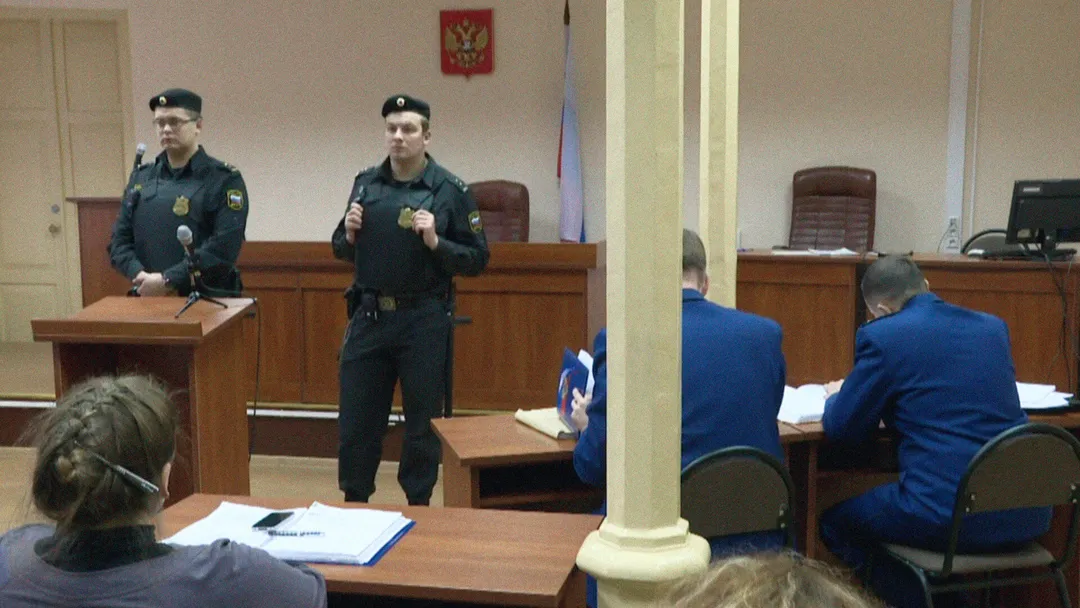
I ask everyone
to stand
please, goodbye
the defense wishes to proceed to
the examination and presentation of evidence
and wishes to begin with the examination of the written
case materials. Thus, pursuant to Article 274
the defense proposes examining the following
evidence. Volume
2, page of the case file
26–29, accountant's memorandum
appendices to the contract. Volume 3, section 21
income certificates of OLK employees for
2009
year. Volume... excuse me, I have one copy
it is mine. Volume... case file
24–26, ruling on the appointment of
a documentary
audit. Volume 27... additional
letter. Volume 5, case file 28–39, report
of examination
of the document. Volume 7, case file 1, request to
the Department of State
Property of the Kirov Region
Volume 7, case file 2, response to
the request. Volume 14, case file 116
notification. Volume 14, pages 128–129
ruling to file a motion
for the conduct of a search in
the bank. Volume 14, case file 130–131, ruling
authorizing the conduct of the search
Volume 14, case file 132–136, record of
the search. Volume 17, case file
59–60, ruling appointing
a forensic financial and economic
expert examination
Volume 17, case file 70–79, expert opinion
No. 6D/2012 dated March 6, 2012
Volume 23, case file 44–45
minimum price of forestry products, Nurss
forestry enterprise, 2008–2009
year. Volume 24
page 111, price of the Belaya Kholunitsa forestry enterprise
branch of KOGU Kirovles for that period
of time. Volume 25, case file 33–34, minimum
price of the Orlov forestry enterprise for the same period
of time. Volume 25, case file 33–34
Orlov forestry enterprise, minimum price for the same
period
of time. Volume 26, case file
59, letter from VLK to K... Gubki Fle
Volume 26, case file 60, letter from Gubki Rafs to
the address of
VLK. Volume 26, case file 61
–77 and case file pages 82–
86, this is correspondence between
regarding performance of contract No. 01/29 dated
April 15, 2009
Volume 26, case file 87, agreement on
termination of the contract
Volume 26, case file pages 89–90, report of
short delivery. Volume 27, case file
91. Volume 26, case file... yes
also from
short delivery. Volume 27, case file pages 114
–117. These are copies of payment orders
which were submitted by Ofitserov and
the investigation, concerning the transfer of funds
to Gubki RFS under the supply contract
Volume 33, case file
57, this is a payment transfer dated
February 18, 2013, concerning the transfer
of funds from VLK to KAGO ROF
Les
Volume 33, case file
58, Ofitserov's request to the bankruptcy trustee of
Ko Gubke Rakh Les
Volume 33, pages
of the case file
59–60
61, 63, 64
65, 66
67, 68, 69, 70
decision of the Commercial Court (arbitrazh court) regarding
the relations between OLK and Kogotki
Fres. Volume 33, case file page, case file pages
178–183, attorney's request
Volume 33, case file pages 184–
241, this is a specialist's opinion
No. 3S-13/d 529 dated May 20, 2013
with appendix
Next, regarding personal background
of Ofitserov. Next, documents regarding the personal background
of Ofitserov. Volume 34, case file 90
character reference. Volume 34, case file 31
attorney's
request on page 31. And the previous one was on page
90. Kristi
90, on case file page 90 in Volume 34
character reference for Pyotr
Yuryevich Ofitserov in Volume 34 on page
31 of the case file — this is the attorney's
request in Volume 34 from case file page
32–65 — this is the response to the attorney's
request. That is all.
May I clarify: Volume
17? Volume 17, case file pages 70–79, expert opinion
of the expert — was that your position on the part of
the side? This is an agreed position on
everything. Yes, we support the agreed position
on the documents that we want to read into the record
we do not object to the examination of the specified
documents, except, that is,
the financial expert opinion
since it was already examined
at
well, just a second, we will clarify
because according to our notes, we do not have it
we do not have the financial expert opinion
Just a second, we’ll clarify that now.
Right now.
Please уточни December 23.
All right, let’s... maybe I’ll go get the volumes.
Yes, take a look—I’ll check the notes. Yes, and then...
I... I do not rule out that it...
was examined, if it was examined.
Indeed, in that part we then will not...
write it down; I also have it noted that...
examined... Ah, well then.
Excellent. Then the motion to...
Any objections? No objections, then...
the motion to admit these pieces of evidence...
is granted. A 10-minute recess for...
just...
with.
[music]
After all, I’m from that generation, and you are too,
from the generation when Radio Liberty (the Russian-language service of Radio Free Europe/Radio Liberty)
Voice
of America—all of that was jammed, blocked out, and
we lived in a building on Petra Montin Street.
Above us lived my childhood friend Sasha
Boyarintsev, a very good boy; we grew up together,
and then he went to work at
the station that did the jamming there in Baku, near the stadium.
That was the service that
jammed foreign radio stations. So then,
picture it: the Baku heat,
summer, our...
courtyard corridor, like an Italian courtyard,
bare to the waist, next to him
a pot of compote,
and beside him a Spidola radio set—he’s trying to catch something on it.
And Sasha is running off to the evening shift, and
Yulik shouts to him across the yard: “Sasha, from 9
p.m., don’t jam anything, I’m going to listen to Voice
of America.”
And so at 9 p.m., contrary to all
the usual rules of the genre, in the city of Baku...
Well, there you have the difference.
From 9 until... while he was listening to Voice of America,
there wasn’t a crackle or a squeal. And at 10 o’clock
it started up again perfectly.
[music]
as
is.
TV channel.
What beauty.
said—didn’t say, really.
I ask everyone
to rise.
Please. And all of it in one box at once—
no, no need.
Excuse me...
I’m sorry to interrupt you,
a telegram was received for you. This morning I...
shall read it out now.
Reading it out: received by telephone, number 833
3248 9656, from Judge Yuri ... of the Moscow District Court,
Zhitnikov Yuri ..., who reported
that the criminal case on the charges against Dadayev
and others... February 2017.
I already know. Well, I didn’t have it in
Yes, please.
Volume of the case.
242 — these are Korolev’s performance results for the first
half of 2009, prepared
by the deputy general director.
Bastrygin was questioned as a
witness by the court.
At the court hearing: in the first quarter of 2009,
the enterprise recorded losses on its balance sheet.
Permission was obtained for installment payments
until the end of 2009. For the first half of the year,
the company’s revenue amounted to 61%
of the planned amount—340 million rubles (about 340 million RUB)—which
is 77% of the revenue for the corresponding
period of the previous year. Cash receipts
in the amount of 287 million rubles (about 287 million RUB)
amounted to 51% of planned income and 51%
of the actual figure. Due to falling
demand for products and declining market
prices, for the first time in many years the plan was not fulfilled
for product sales, and
accordingly, the planned
expected
income was not received. As a result, the enterprise’s
accounts receivable grew to 120 million rubles (about 120 million RUB),
including debts owed by buyers and
customers, which represented an increase of 64% over
the debt level at the beginning
of the year. Next, volume 2, case file
2629, an explanatory note to
the financial statements,
from which it follows that the enterprise
has both accounts receivable and accounts payable,
and
their
growth is observed. It is also stated here that the lack of
raw materials and timber products
led to an absence of sales, as a result of which
the financial result of current
operations amounted to
minus 38,621,000 rubles (about 38.6 million RUB).
[applause]
Next, case volume 7072, contract No. 0/2009.
Between KAGU and...
OLK; it contains sections on the subject of the contract,
quality requirements, the procedure for
implementation, acceptance...
goods, the procedure for settlements...
the obligations of the parties, force majeure
circumstances, additional conditions, and
final
provisions—a standard contract.
Popova. Volume 2, case file pages 70
-130, 73
-130: this is an appendix to supply contract
No. 0129, which sets out in detail the
terms
of delivery, shipping standards,
as well as the conditions for acceptance of the goods and the terms of its
payment.
Next, volume three.
So, in the third case file...
Oh, this is the Inspectorate of the Federal Tax
Service for the city of Kirov replying.
the Investigative Committee under the Prosecutor's Office of the Russian Federation
of the Investigative Directorate for Kirov Region
the Inspectorate of the Federal Tax Service of Russia for the city of Kirov
in response to your request regarding Vyatskaya Lesnaya
Company, hereby sends a copy of
personal accounts and income information in
Form 2 regarding the company's employees, and copies of
the balance sheet declaration for 2009, pages
of the case file 2–18 in Volume Three, certificates of
income of OLC employees for 2009
as well as income certificates for the employees
of VLK: Tayana Vlana
ma
ni Borisovich, Ofitserov P. Yu., Yukhina Elena
Dmitrievna, Ovsyanikova Elena
Alexandrovna, Vakhrushev Mikhail Viktorovich
ka, Evgeny Alexandrovich, Kapustina Elena
Romanovna
Potapenko, Makarova Lyubov
Sergeyevna
accounting records and the amount of personal income tax paid
at the rate of
13%
hereinafter, Volume
[music]
Volume of the case file
2426, order appointing
a documentary audit dated March 17, 2011
was issued by the senior investigator for
particularly important cases of the First Investigative
Department of the Investigative Directorate
of the Investigative Committee of the Russian
Federation for the Primorsky Federal
District, Colonel of Justice Yuldashev, based on
the inspection materials registered
on 21.02.21; the inspection was conducted with respect to
Navalny and Ofitserov, director of
Vyatskaya Lesnaya
Company
to whom the expert of the criminalistics department
of the Investigative Directorate of the Investigative Committee for Kirov Region
was asked to resolve the following question:
What were the sources of funds credited to
the settlement account of OLC during the period from April 15 of that year to
September of that year?
What were the directions
of expenditure of funds from
the settlement account of OLC? Were funds transferred from
funds from the set-
tlement account? The materials include accounting documents
of OLC and statements of transactions on OLC's account
held with Vyatka-Bank CB OJSC, as well as
inspection materials in three
volumes. Volume 5 of the case file
27. Thus, the deputy head
of the criminalistics department, Captain of Justice
Chernov, replies
to investigator Minikh
No. 4/21 dated
5.4.21 regarding the inspection materials in
relation to Alexei Navalny
Anatolyevich and Pyotr Ofitserov
Yuryevich. Volume of the case file 28–29, report
on document examination No. 4D/2011 dated
April 5
2011, based on the previously announced
order appointing an examination of
documents. The examination
addresses questions analogous to those set out in
the order. It specifies what materials
were submitted for the inspection
and they are analogous to the materials that
are listed in the order. Next comes the
research section; we move on to the section
of conclusions. On the first question, for the period from April 15
of that year to September 1 of that year, into
the settlement account there were incoming funds
in the total amount of 950,353 rubles, including from
the following sources: from counterparties
— buyers of timber products — in the total
amount of 16,901.83 rubles and 55 kopecks. It states: from
which specific counterparties? Namely: Les
Garant, Domy Stroitel, KMDK, Vlada, sole proprietor
Podgornov, Sovspil, Vel Tork Company, CJSC
Krasny Yakor, Match Factory Pobeda
OJSC Volga, LLC Krymskiye Zori, OJSC MTSBK, LLC
Borges, OJSC Ufimskie Spichki, sole proprietor Proskurin
CJSC PChP, LLC Ostrov, LLC Lestrans, LLC Divine
OJSC
AS. On the second question, for the period from the 15th
of April 2009 to September 1
2009, from the settlement account of VLK
funds were debited in the total amount of
14.
985,517 rubles and 5 kopecks, including by
the following expenditure categories: payment to
KOGUP Kirovles for timber products and
rail freight charges under contract No.
01/29 dated April 15, 2009, in the amount of
12,105,191 rubles and 2 kopecks, as well as payment
to suppliers for services and inventory
items in the total amount of
796,256 rubles and 93 kopecks. It specifies and lists
the list of suppliers and
the grounds for payment for services, as well as their
list. Tax and customs payments
were also paid by VLK in the amount of
329,237 rubles and 65 kopecks for shipped
timber products to counterparties
by the consignee; cash funds into
the cash desk for payment of wages and
business needs in the amount of
48,530 rubles; wage payments using
payment cards under
the agreement in the amount of 20,799 rubles; as well as
payment for bank services in the amount of 10.42
rubles; refunds to buyers in the amount of 981
rubles. This refers to buyers
of timber products, accordingly, which
were evidently under-delivered by the supplier
— these are LLC Ostrov, sole proprietor Proskurin, and
Vel Tork Company — as well as reimbursement for
expenses under an advance report, and also
for
delivery. The expert indicates that
the transfer of funds from the account
of OLC to Alexei Navalny
Anatolyevich for the period from April 15, 2009
from [year] through September 2009, not
established. Volume
So, that means volume [unclear], case file [unclear]. This is a request
made by an investigator for especially important cases
of the department for the investigation of especially important
cases of the Main Investigative Directorate of Russia, Justice Major by the name of
Akhmetov requests from the director
of the Department of State
Property of Kirov Region
Arzamasov, a request with the following content:
At the Main Investigative Directorate of the Investigative Committee of the Russian Federation, an inquiry is being conducted in accordance with
Articles 144–145 of the Criminal Procedure Code of the Russian Federation regarding the signing
of an agreement between KOGUP Kirovles and LLC VLK in
relation to Navalny and Ofitserov. In connection with the above,
I ask you to inform us
whether any audits or inspections were conducted
of the financial and business activities
of KOGUP Kirovles in 2009 and 2010, and if
such audits or inspections were
carried out, I ask you to provide their
certified
copies. Volume [unclear], case file 2 — this is a response to
the request. So, the response to the request of April 14
2011, signed by the acting director
of the Department of State
Property of Kirov Region, one
Oparin, addressed to Investigator
Akhmetov, states as follows: in
connection with your request, we report
the following. In accordance with Article 10
of the Law of Kirov Region dated
June 10, 2008 No. 287-ZO on the procedure for managing
and disposing of state property
of Kirov
Region, the annual review of the results of
financial and business activities
of KOGUP Kirovles, approval of the accounting
statements, as well as the exercise of control over
financial and business activities
is within the authority of the body
of the regional executive branch with sectoral
competence, that is, the Department of Forestry
Management. Inspections
of the financial and business activities
of KOGUP Kirovles by the Department
of State Property of Kirov
Region were not conducted. This concerns, so to speak,
the questioning of auditor Zagoskina and the allegedly
conducted review by her at the instruction of
Mr.
Arzamastsev.
Next, Volume 14.
Volume 14, case file page 128.
129. Oh no, sorry. Well yes, let's do it this way.
Volume 14, pages 128–129.
This is a motion to initiate [unclear]
proceedings for a search in a bank or other credit
institution, dated September 19, issued
by the investigator for especially important cases
of Russia, Akhmetov.
He resolved to petition the Basmanny District Court
of the city of Moscow for authorization to conduct a
search
at the above-mentioned address for the purpose of seizure of
documents,
cash funds received from the activities
of LLC [unclear], KOGUP Kirovles, draft notes, and
also other items and documents
relevant to the criminal case
located in an individual bank
safe-deposit box rented
by Alexei Navalny
Anatolyevich.
Next, Volume 14, case file pages 130–131, the ruling
of the judge of the Basmanny District Court of the city
of Moscow, dated September 21 [year unclear], on
authorizing the search, on the basis of
which the court ruled to authorize
the conduct of a search in the safe-deposit box at
the address: Moscow, Bolshaya
Polyanka Street, building 39, for the purpose of locating and seizing
documents relating to the activities of LLC VLK,
cash funds received from
the activities of LLC VLK and KOGUP Kirovles,
draft notes, as well as other items
and documents relevant to
the criminal case, located in
an individual bank safe-deposit box
rented by Navalny
Alexei Anatolyevich, case file pages 132
136.
This is the search record itself
dated September 26, 2012, at [unclear] Bank, for
the purpose of locating, as already indicated
earlier, documents
relating to Anatolyevich; it was
opened, and nothing was found inside the box
discovered. And the same Volume 14, case file
116: that is, the investigator of [unclear] under the Internal Affairs Directorate for
Kirov Region, Captain of Justice [Stov/unclear],
notification
to the deputy [unclear] of Kirov Regi
within the framework of criminal case
number
14003. The notification reads as follows:
I hereby notify you that
on January 12, 2011, by me, on the basis of your
statement concerning abuses by
the management of Kirovles, which entailed
economic damage to the enterprise and the regional budget,
a criminal case was opened, number
14003, against the general director
of KOGUP Kirovles, Opalev, on suspicion of
an offense предусмотренного by Part
1 of Article 201 of the Criminal Code of the Russian Federation, abuse
of authority, while also explaining to you
that if you disagree with the decision
taken, you have the right to appeal it
to the head of the investigative body, to
the prosecutor's office, or to a court on the basis of and in
the manner established by Chapter 16 of the Criminal Procedure Code of the Russian Federation.
Next, Volume
17 — oh, Volume 17, we've already decided not to use it.
Yes, sorry, now I need Volume 23.
The next box. It's just that Volume 17, we already
agreed that the prosecutor had already read out
the conclusion
of the expert examination. And this is the ruling, this is
Appointment. Yes, you have read it out. So yes, that's all.
I agree, you have everything. Yes, now let's move on to the next one.
the next folder.
[applause]
Please, Volume 23.
[music]
So, Volume 23, case file pages
44–45. So, the minimum price for timber
products for the Kiknur forestry enterprise branch
of Kirovles for 2008 and 2009.
Agreed by the general director
of Kirovles and approved by the director
of the Kiknur forestry enterprise accordingly.
The Kirovles branch. So, on page
44 of the case file, the minimum prices for timber
products for 2008 are contained; on page 45, for
2009.
It is perfectly obvious that
under the stated prices for timber products
they did not change significantly, with the
exception of prices for round firewood and for
softwood pulpwood, spruce, which changed in 2009
in the direction of an increase by 300
rubles. Next, Volume 24.
Case file pages 118–119.
So, here we see the minimum
prices for timber
products of the Beysky forestry enterprise.
Approved, agreed by the general director
and approved by the director
of the corresponding forestry enterprise. Turning to
these prices, we see that compared with
2008, in 2009 there was a decrease
in minimum prices for a number of items, for example
first-category softwood logs,
softwood sawlogs of first, second,
and third grade.
Volume 25.
Case file pages
[music]
33–34. These are the minimum prices for finished
products, agreed upon and approved
and approved by the director
of the Orlovsky forestry enterprise, a branch of KOGUP Kirovles
(a state regional unitary enterprise). Turning to the contents of these
documents, we see that in 2009
there was a decrease in minimum prices
agreed upon for timber products
of the Orlovsky forestry enterprise branch of KOGUP Kirovles.
[music]
The prices were
reduced by no less than 300
rubles in 2009 compared
with 2008. Next, Volume 26.
[music]
So, Volume 26, case file pages
59. Now we will read out
the correspondence between OOO VLK and Kirovles.
So, a letter to the general director
of KOGUP Kirovles, Opalev, from the general
director of OOO VLK, Ofitserov, according to
which OOO VLK, under supply contract
No. 02/2009, requests shipment to ZAO
Astrakhan Sea Port in June
2009 of sawn timber in
accordance with the technical requirements
according to Appendix No. C, and also
to inform them of the date
of shipment. Case file page
60. And the general director of Kirovles,
Ms. Bastrygina, replies to the general
director of OOO VLK,
Ofitserov. In response to the previously read letter, she
states
that the appendix provides for
the quantity of a specific size
of sawn timber in one specific volume.
According to the appendix, an order was placed
for the specification.
In the exact volume of any of the
sizes presented, the specification
is being worked on. On the basis of these
documents, we inform you that
the proposed division of the total volume
of edged sawn timber by volume into
specifically stated dimensions is impossible.
We additionally inform you that
under the production technology, achieving
the exact volume of a specific size is not always
possible. Now, moving on
to the shipment request under Appendix No. C
to the contract. Next, the general director of Kirovles,
case file page 61, Opalev, from the general
director of OOO VLK, Ofitserov. So, this is
a letter stating that OOO VLK requests, under the
supply contract, shipment also to
ZAO Astrakhan Sea Port of
sawn timber as well, in
the following assortment. Requirements are set out
for the packaging of the sawn timber, and
there is a request to inform them of the date
of shipment. Also, a letter on case file page 61
from Mr. Opalev to the general
director of OOO VLK.
In this letter, Mr. Ofitserov
— Ofitserov —
expresses dissatisfaction that on the part of
KOGUP Kirovles there has been improper
performance of obligations under the
contract, since the shipment
of timber products to ZAO Astrakhan
Sea Port
under request No. 7 dated June 1, 2009—the goods
were not
delivered. Case file page
63. To the general director of KOGUP Kirovles
Opalev, from the general director of OOO VLK,
Ofitserov. On the basis of this letter, OOO
VLK, under the supply contract, requests
shipment to OAO Match Factory
Pobeda of one railcar, in accordance
with the technical requirements according to the appendix.
Please inform us of the shipment date.
64. A letter to KOGUP Kirovles from OOO VLK.
Also, OOO VLK requests shipment to
Match Factory Pobeda and additionally notifies
them of the time frame for fulfilling
the request. Case file.
65. The general director of Gubke, Opolev, from
A. Ofitserov is once again notified
by Vcheni Olev that he needs to
ship match raw materials to the Pobeda match factory
in accordance with the appendix to the supply contract in
for the third time, Ofitserov notifies Toplivo about
the deadlines
for delivery. Case file sheet.
66. The general director of OVLK, addressed to the general
director of KOGUP
Kirovles, states
that Ofitserov notifies Kobro Les about
the need to ship
to
the consignee, Branch KSK-415, in
the city of Novorossiysk, in accordance with the technical
requirements, specifying what assortment
of products and in what volume must
be shipped to this
consignee. Case file sheet.
67. From Gerek Ofitserov to
the address of Olev
during delivery for sole proprietor Podgor
consignee: Branch K-415
Novorossiysk. According to the specification, there was
shipped timber products
not in the volume indicated in
the order
Ofitserov notifies
Opalev that he improperly
performed his obligations
According to clause 46 of the contract, he has an incomplete
duty
to compensate
for losses. Further on.
68. The general director
Olev Olev
responds
to Ofitserov that KOGU Kiros carried out
shipment of sawn timber to 415 in
the city of Novoro-
in accordance with the technical conditions and instructions of OAO
Russian Railways, and also explains why
the short delivery of timber products occurred
further in the same volume, case file.
69. Ofitserov informs
Opalev that in
view of the indicators for loading practice
of products into a railcar,
the quantity of edged timber
amounts to 7,783
m, therefore VLK does not consider the arguments
set out in the letter to be sufficient justification for
the short delivery of timber products
for failure to perform the obligations set out
in clause 46 of the contract
for supply. Further, case file 70.
to the address of Ufimskie Spichki
it specifies exactly what assortment of timber
products must be shipped and in what
volume; the deadlines for fulfilling
the order are also stipulated. Case file sheet.
71. From the general director of OLK, Ofitserov, to
the general director of Kirovles, Opolev
also, under the supply contract, VLK requests
shipment to Ufimskie Spichki. The document
specifies the assortment and its quantity; it also
for the second time, Ofitserov notifies Toplivo
of the deadlines for fulfillment
of the order. Case file sheet.
72. The general director of OLK, Ofitserov,
sends to the general director
of KOGUP
Olev a claim in connection with the fact that
there was a short delivery to OOO
Krymskie
Zori. Case file sheet.
73. The general director of OOO VLK, Ofitserov,
notifies the general director of KOGUP
Kirovles, Opalev,
that it is necessary to optimize
the supply of edged timber for OOO
Krymskie Zori, and reminds Ofitserov
of the quality in which
the timber products must be supplied, and what the conditions
of shipment are; they request that these conditions
meet all requirements
set out in Appendix No. 18 dated 1
June 2009
further.
74. Ofitserov sends to Opolev
a letter according to which
to the address
a representative is being sent for evaluation
of the timber products
the company asks that it be taken into account that if
all costs
related to the short delivery of timber are incurred by Les
and the delay in delivery of timber products
Les
case file.
75. Shipping order to ZAO Prich
prom, specifying
the assortment and delivery terms, as well as
the deadline for fulfilling the order. Case file.
76
And Ofitserov sends to Olev
a letter
regarding the impossibility of shipping railcar
freight at Balabanovo station, Moscow Region
to the address of ZAO ChPM for August 2009
and also reminds Topolev that
the July order for the supply of timber
products to ZAO
ChPM was not
fulfilled. Case file 77.
Also, Ofitserov sends—or rather, Opalev sends
to Ofitserov a letter stating
that it is impossible to ship
timber products to ZAO Prom and requests
that performance of this contract be temporarily
suspended. The letter is dated 16 July
2009
Further, Volume 26, case file sheets 82–86.
Continuation of the correspondence between Ofitserov
and Opolev within the framework of performance of Contract No.
01.29 regarding the short delivery of timber products, and on
case file sheet 82 there is a letter dated 22 July
in 2009, addressed to Opolev from Dene
from OOO VLK Director Ofitserov, according to which
under the supply contract, VLK requests
that timber products be shipped to Nodus in July 2009
timber products
and notifies of the time frame for fulfilling the order
under the supplementary
agreement. On July 31, 2009, Opalev
also replies
to Ofitserov with a letter of the following
content, referring to the agreement that on
Wednesday, July 29, 2009,
a meeting had been planned between representatives of VKO
and the forestry company KOGUP Kirovles
regarding the presentation of a batch
of sawn timber from KOGUP Kirovles for shipment
to the consignee of the buyer, OLK. According
to Appendix No. 35 of July 2009 to
the supply contract, the representatives of OLK
did not appear at the meeting. This fact is regarded
by management as a refusal of the specified
batch, and due to the strained financial
situation, this batch of materials
will be sold in the
near future. Letter No. 10 dated July 31
of that year, addressed to the General Director
of KOGUP Kirovles, Opalev, from the General
Director of OLK, Ofitserov, in which
Ofitserov expresses hope for
long-term, mutually beneficial
cooperation, while also making
a complaint that the company does not
consider the arguments set out in the letter
sufficient to blame it for the failed meeting
to inspect the edged sawn timber
intended
for shipment
VLK had been
misinformed regarding the route and
place
of the meeting concerning the shipment of timber
materials to the address of
the company
85. Opalev addresses a letter to the General
Director of OLK
Ofitserov. Opalev asks to increase
the number of vehicles for the delivery of pulpwood
species
for the pulp and paper mill. Further on
86. The General Director of KOGUP, Opalev, sends
a letter to the General Director of OLK
Ofitserov and notifies him that due to
the lack of raw materials, KOGUP Kirovles does not have
the ability to carry out shipment
of timber products in August, given
that the July shipment plan to OAO
Mari Pulp and Paper Mill will not be fulfilled in full
due to OOO VLK providing
an insufficient number of vehicles. This
concerns the bearing of transportation costs
Here we can clearly see that Opalev
asks Ofitserov to increase the number
of vehicles so that the shipment
could be carried out
further, volume 26 of the case file
87. Agreement on termination of the contract dated
September 1, 2009
between KOGUP Kirovles and OOO VLK. In
this agreement
the parties agreed to terminate Contract No. 0129
dated April 15, 2009, effective September 1
2009
and it is specifically stated that termination of the contract
is not grounds for releasing
either party from performing obligations
that arose during the term of the contract
thus, pages
of the case file
88–90. Here we have an underdelivery report dated
August 13, 2009, according to which
Kirovles failed to fulfill its obligations for
the supply of products to the counterparties of
OOO VLK, and
the underdelivery. The timber company
informs KOGUP
Kirovles of its desire to perform
the contract on the part of KOGUP Kirovles and
to recover from KOGUP Kirovles a penalty in the total
amount of
33,980 rubles
On page 91 of the case file there is also
Supply Report No. 2 dated August 13
2009, which states that there was
improper performance on the part of KOGUP Kirovles
of obligations under
the supply contract, and there was
an underdelivery to OAO Mari Pulp and Paper Mill
as well as to Krymskie Zori and Ufimskie Spichki
signed by both parties. The underdelivery report
underdelivery report No. 2
No. 2
further, volume
27, pages 114–1
of the case file
111–187 — these are copies of payment
orders for transfers from OOO
VLK of funds to Kirovles
under the timber supply contract
Copies of these payment orders were
attached by Ofitserov to the record
of questioning
dated January 18, 2013
Thus, these payment orders
confirm the fact of settlements and
the transfer of funds for
timber products
Also, in a number of payment orders
it is stated that
payment is being made for the railway tariff under
the supply contract for timber products delivered to
the consignee, a counterparty of OOO
VLK, and that payment is also being made directly for
the timber products themselves, which were
delivered to the consignee
the counterparty of
VLK. Further, volume 33
Volume 33 of the case file
57. This is the original payment order for
358000 8812
rubles from OLK to the address of
KOBS, payment purpose: debt
in favor of
Volume 33, case file
58 — this is Officerov's request addressed to
the bankruptcy trustee of KOGUP
Kiros, dated April 26, 2013
year; that is, Officerov
notifies the bankruptcy
trustee of the existence of debt
on the part of OOO VLK to KOGUP Keles and
requests that bank details be provided
to which OOO VLK can make
payment. Officerov notes that a letter
containing a similar request had been
sent to KOGUP Kirovles on April 12
2013. No reply to it had been received as of
the present time, therefore
Officerov was forced to make the above
request again. I note that
no reply to this letter was received by Officerov either
received. Next
case file sheet
59–60. This is a copy of the decision of the Arbitration Court
of the Kirov Region, dated October 18, 2012
in the claim by KOGUP
Kirovles against OOO VLK for recovery of funds
representing debt for delivered goods
satisfaction of the claims of the Kirov
Regional State Unitary
Enterprise KOGUP Kirovles was denied
also, from KOGUP Kirovles there was collected
the state duty into the revenue of
the federal
budget. The decision states as follows
between the parties
a supply contract dated
April 15, 2009, was concluded
the decision also states that proper
evidence of transfer of
the goods to the defendant, OLK, was not presented in the case materials
On this basis, the court
denied the stated
claims
61–63. November 2, 2012
The Kirov Regional State
Unitary Enterprise KOGUP Kirovles
filed claims against VLK
for recovery of debt under the contract dated
April 15, 2009, No.
01/29. The Arbitration Court ruled
to deny the claims of Kirovles
against VLK for
recovery of funds under the contract
also, from the Kirov Regional
State Unitary Enterprise
Kirovles, a state duty in the amount of 2,000
rubles was collected. The decision also states that
the basis for applying to the court was
supply contract No.
01/29. The plaintiff, naturally, insists that
the defendant did not fully pay the plaintiff for the delivered
goods. But since the plaintiff did not provide
documentary confirmation enabling
payment to be made
the Arbitration Court denied the
claims
case file sheet
64–65. Decision of the Arbitration Court of the Kirov
Region dated February 26, 2013
also, in the claim of KOGUP Kirovles against OOO
VLK for
recovery of debt under the contract dated
April 15, 2009, No.
01/29. According to this decision
the Arbitration Court ruled to recover from OOO VLK
in favor of KOGUP Kirovles
74,778 rubles under the contract
of supply. Next, case file sheet
66. Also, the decision of the Arbitration Court of the Kirov
Region dated September 25
year: plaintiff KOGUP, defendant OOO VLK, on
recovery of funds and enforcement of
supply contract No. 01/29 dated
April 15, 2009. The claims
of KOGUP Kirovles
were granted. Next, case file sheet 67
ruling of the Arbitration Court of the Kirov
Region in the claim of KOGUP Kirovles against OOO
VLK: KOGUP Kirovles's statement of claim was
returned due to
failure to comply with procedural requirements
established by Articles 125–126 of the Arbitration
Procedure Code of the Russian
Federation. Case file sheet
sheet
68–69. Also, the decision of the Arbitration Court
of the Kirov Region dated December 24, 2012
again in the claim of KOGUP Kirovles against OOO
VLK
for recovery of funds under supply contract
No.
01/29 dated April 15, 2009. The claims
of KOGUP Kirovles were
granted. Next, case file sheet 70. In this
same volume, the decision of the Arbitration Court of the Kirov
Region dated November 25, 2010, in the claim
of Kirovles against OOO VLK for recovery of debt
under contract 029 dated April 15, 2009
the claims were also
granted
Now, one second — Volume 33, case file sheets 178–183
this is an attorney's
request, an attorney's request dated April 25
2013, No.
56. Attorneys of the Moscow City Bar (Moscow Bar Association), Davydova and Mikhailova,
address the director of OOO Expert
Consulting Firm Ekskon
and ask for an expert opinion on
the following questions. First: what was the market
value of the forest products indicated
in the documents submitted with this request
in April, May, June, July
August, and September 2009, and also
the attorneys ask that the level
of deviation of prices for forest products
indicated in the submitted documents from
market prices in response to this request
Attached are copies of documents from
the materials of the criminal case against
Navalny and Ofitserov; this is a copy of
the supply agreement dated April 15, 2009
from Volume 2, case file pages 70–72, as well as
the appendix to the supply agreement, which
was also read out by the defense, and from Volume 2
starting from case file page
73 and
ending at
130, as well as copies of delivery invoices; they
were read out by the prosecution; this is Volume
Eight, Volume
Nine
and Volume Nine almost in its entirety
up to case file page 127
Further,
the specialist’s opinion is read out
No.
592, case file pages
184
to 214. This opinion was obtained
by the defense of Navalny and Ofitserov upon
requesting a specialist’s opinion
from Marina Vasilievna Kolobova, who has
a higher
technical education, specialty:
knitwear production technology
qualification: engineer; Moscow
Institute, 1989;
higher economic education
specialty: economics and management at
an enterprise; qualification: economist
manager; Vyatka State
University, 2004; professional
retraining in the specialization of valuation
of enterprise/business value
qualification: appraiser; Moscow
International Institute of Econometrics,
Informatics, Finance and Law, 2005;
professional retraining in
the field of forensic economic examination
in the specialty of forensic examination of
the valuation of intellectual
property and tangible assets
Institute of Law, Economics and Forensic
Examination under the Ministry of Internal Affairs of Russia, 2008
certified by the self-regulatory
organization of appraisers, the all-Russian
public
organization called the Russian
Society of Real Estate Appraisers; registration number
the certificate and date
of issue are indicated here
The expert also holds
membership in the all-Russian public
organization, the Russian Society
of Appraisers; work experience since
1982; work experience in an institution
conducting examinations since 2001; experience
in valuation work since 2002; experience as an
appraiser: 7
years; serves as deputy director
with the performance of functional
duties
of an appraiser
The defense submitted
documents for
the examination; the expert opinion
sets out the methods used
in conducting the
examination, what documents were
received, and what was examined
And according to
the opinion based on statistical
data from the territorial office of the
Federal State Statistics
Service for Kirov Region
the average monthly prices at which KOGU
Kirovles sold timber products
to OLK, in particular commercial timber, were
significantly higher than the average monthly prices at
which the same timber was sold
by other producers in Kirov
Region
The difference
according to the opinion amounted to 541 rubles 5
kopecks per
cubic meter, which is
79.6% in April 2009; 585 rubles per
cubic meter
— 105.6% for May 2009; 14.8
rubles per cubic meter in 2009
1,398.7 rubles per cubic meter
— 24.9% for July 2009. It also follows from the
opinion that
OLK purchased, in the period from April to July
2009, from KOGU Kirovles, commercial
timber in the amount of
7,644.3 cubic meters, which constitutes
more than 70% of the total volume of purchased
products at a price significantly
exceeding the average market price
for comparable products that
was charged by other producers
in Kirov Region during that period, according to
data from the Federal
State Statistics Service for Kirov
Region. In addition,
the opinion contains the conclusion that LLC
OLK purchased timber products from KOGU Kirov
les not at deliberately understated prices
but
at market prices, which, moreover,
for certain product groups
listed in this opinion
substantially exceeded the then-current
average market prices
of producers in Kirov Region
And all diplomas
and certificates attached to this opinion
confirm the qualifications of the specialist
conducting
who prepared this opinion, item
thirty-four
[music]
Your Honor, I misspoke — item 34.
The character reference for Ofitserov, it
is located in the case file.
Page 30. The handwriting is somewhat difficult to make out.
Unfortunately, no.
And a positive character reference for
Pyotr Yuryevich Ofitserov from the Russian
United Democratic Party
Yabloko (a Russian liberal political party), that is.
The chairman states
that Ofitserov is
distinguished by friendliness and
goodwill toward all citizens. His
distinguishing trait is a commitment
to observing rules and laws. He is
characterized by such qualities as gentleness
and modesty. He takes a particularly active stance
only in cases of extreme
injustice regarding the rights of
citizens. He tends to avoid conflicts
and is a supporter of peaceful
civilized dialogue as a means
of resolving conflicts. Pyotr's colleagues
note his calm temperament,
intelligence, and high
professionalism. He is the father of many children.
A father.
Signed by the party chairman
Mitrokhin.
Case file volume 34, page 31 — this is
a lawyer's
request addressed to the chief physician of the Central District Hospital
of Baryatino District, Valentina Kuzmich
Leonidovna. This is my request as attorney
Davydova; I am requesting Ofitserov's consent,
and copies of his medical history
and copies of his medical
records. Volume 34, page 32, in the same volume —
this is the response to the lawyer's request.
Accordingly, here the chief physician
of the aforementioned
hospital sends me a copy
of outpatient medical records for patient Ofitserov
and indicates
that he has been under a doctor's care since
1992, and his
diagnosis is listed. Next, the case file pages
33 to 65 contain a certified copy of the outpatient
medical record of patient Pyotr Yuryevich Ofitserov, and
also indicate that Pyotr
Yuryevich Ofitserov was regularly monitored by
the relevant specialist physician in connection with
his chronic illness.
Agreed.
Finished. Also, also, Your
Honor, I do not need that volume anymore.
I also ask that the following be added to the case materials:
a copy of the birth certificate
of Ofitserov's youngest son, Ofitserov's
Nikita Petrovich, born June 2, 2014.
This is
a copy. There is also Ofitserov's wife's passport, where he
is entered there as her child; we can
present it to the court for
inspection. You have it? Yes, yes, he is
listed there. Please include it.
The passport has the child's birth entry on it...
[inaudible]
Yes, no, with... [inaudible]
Any objection to admitting this
document? Does anyone have one? No.
I have none. Admit it.
Next, the defense is ready to proceed to the questioning
of our defendants. We will begin with Navalny
Alexei Anatolyevich. After Navalny,
Ofitserov will testify.
Ah.
[music]
...that generation. Yes, and you are of the generation when
Radio Liberty, Voice of America, the BBC were
jammed, drowned out, and we lived in a house
on Petra Montina Street, and above us lived my
childhood friend Sasha Boyarintsev, a very
good boy; we grew up together.
And then he started working at that...
the jammer, there by the stadium. That was
the service that
jammed foreign radio stations, and so
So, picture this:
the Baku heat,
summer.
In
the corridor of an Italian-style courtyard, bare to the
waist, next to him
a pot of compote, to the left a newspaper,
in front of him a Spidola radio, and he is trying to
pick something up on the Spidola, and
shouts, "They're not jamming it! I'm getting Voice
of America!"
He listens, and then at 9 p.m., contrary to all
the rules of the genre, in the city of Baku
it starts crackling again. That's the peculiarity of Baku
life: from 9 until... while Yulik listened to Voice
of America and
all that rasping and squealing, and then at 10 o'clock
it was wonderful again.
[music]
At...
Oof.
...there, that place is cursed — you stand there
and immediately... I can't remember, I'm unable to answer
because I don't understand your question. It's a terrible
place; not a single person has yet managed
to speak normally there.
During the trial.
No... no...
[inaudible]
[inaudible]
No.
On...
And what choice do you have?
...ce?
That's just how it is.
Everyone...
Amazingly, sitting here... yes, sit here.
The twelfth
time.
Of course not. You need...
Today is simply the first time.
today
no
well
I
No, well...
I mean, because
I am, but with...
what
I ask everyone to rise.
if there is no water
[music]
Are you ready to testify? I am ready. And what...
can you say on the substance of the matter
of the charges brought against you
regarding the substance of the charges brought
against me. I want to repeat the main point:
that this
accusation is absolutely false, completely
fabricated
and politically motivated. These
political motives
are obvious, and they are not just obvious, and I
do not merely believe so—they have also been proven
many times over. Your Honor, I would like to draw
attention to the fact that yesterday the prosecutor's office
wanted to add to the case file
various administrative arrests of mine, and
I asked that this be postponed until a decision
on exclusion was made. I hereby inform the court that
you can look at the website of the European Court
of Human Rights and see that in all seven cases I
won, received compensation, and in all
cases it was established that my rights
were violated, starting with the right to liberty and
ending with the right to a fair
trial. Therefore I
draw your attention to this and ask that it be entered into
the record that the court cannot
ignore the most important thing, which
the European Court also drew attention to:
the political motives behind this case. The court
avoided this the first time, unfortunately, as
it seems to me, and you are again avoiding an analysis
of this case. Next, as for
the actual substance
of this
process: I really was an adviser
to the governor of Kirov Region
on a voluntary basis. Not once in my life, not
for a single day, was I ever a government official. And
in particular here in Kirov Region
voluntarily
When Belykh was appointed governor at the
beginning of 2009, he formed
some kind of
his own team of voluntary advisers
because by that point, well, I was already
fairly well known for
analyzing the situation inside companies with
state ownership, under state
management; I dealt with corporate
disputes and litigated as a minority
shareholder, and so on. And he invited me
so that I could help him understand
what was going on here with
state property. And not a single person
working in Kirov
Region
or following politics had
any doubts about my
status, because my
arrival here was discussed quite widely
in the local
press, because my political
position was already fairly
well known at that point. It is rare for a person with
political views like
mine to advise a governor, so it attracted
attention. Everyone knew perfectly well who I was,
why I was here, and that I had no
formal status. So, Belykh as well
when we arrived here, he
held various meetings. This was
the crisis year of 2009
and a huge number of enterprises were not
paying wages. Everyone was running around clutching their
heads—horror, horror, everything
was falling apart. One of the main, main
ongoing headaches
for the region was the enterprise Kirovles,
which employed nearly 4,000 people, and
it was discussed at every meeting, including
because they simply did not have
the money to pay wages
and were taking out short-term loans from Sberbank
in order to pay salaries
As you know—and the representatives
of the prosecution
know this very well—at that time as well
the prosecutor's office had been instructed
to open criminal cases against those
enterprises that delayed wage
payments, and every governor
had such important performance
indicators as the payment of wages.
That is why Kirovles was discussed
endlessly; no one understood what was happening to it,
and one of Belykh's instructions
was for me to figure out what was going on with
the enterprise and provide some
objective data to the new team on this
I
was present at...
conducted by the deputy
...and at all the other meetings, right away
it was possible to establish—these documents
showed enormous
losses, enormous debt of more than 200
million
rubles, and it was
literally
for months persuading them, and at some point he
managed to convince them. Yes, he managed
to do it—he managed to convince the management that
the enterprise could still be saved, because
they
were saying that yes, of course, we have losses of
200 million rubles, but we have huge inventories
Inventory worth 100 million rubles, and we can sell it.
We can sell the timber, everything will be fine for us, and on top of that we have
a huge amount of accounts receivable.
On paper, it really was around 200
million rubles, and now they’ll settle those receivables for us.
We’ll sell our logs, and everything will
be wonderful. So let’s
immediately get involved in
the lease again, and over the course of just
a few months, everyone really thought that
Kirovles could be saved. I
analyzed its condition and studied
the documents that were brought, among others,
to the governor and to the deputy governor,
and I was probably the first to find out—well,
I worked on it more than anyone else—that nothing there
could be saved.
It was impossible. All of it was a lie: there were no
inventory reserves, and the accounts receivable
were not being paid off by anyone, and the
enterprise—well, it wasn’t even a question of needing to
bankrupt it; that would simply be its
natural outcome. It would go bankrupt, and
it did go bankrupt, after I had already
left here—several years after I
had gone—and that had absolutely nothing to do
with Ofitserov at all, absolutely nothing. It was
just parallel work during which
I
kept hearing: show us the figures for your
work.
They said: there’s nothing, nothing at all, help
us.
We have to save the enterprise.
At the same time, I found out—not only I, since this information simply could not be
hidden—that inside Kirovles there had effectively
been created
this kind of scheme.
They set it up on the territory of
Kirovles completely free of charge, and bought
it fairly expensive equipment
because they were specifically engaged in
planning forest plots; that is
expensive equipment, paid for at Kirovles’s expense, and so
on and so forth. So once all this
came to light, the question was no longer whether
It was perfectly obvious that he simply
deserved criminal prosecution. From the
very beginning I said that this was exactly how it needed to
be dealt with. It is absolutely impossible when
people simply set up a company with the same
name, placed it inside a
state organization, and then with themselves
also signed a contract for 35 million
rubles. It’s absurd.
And later, that was exactly what was used
against me, because this criminal
case was opened, among other reasons, at my insistence
against Opalev. And then,
when for political reasons, which I will
return to later, they needed something against me,
they had to quickly cobble together some kind of case, and the valiant
FSB officers (Russia’s security service) took Oleg by the arm
and said: we’ll close your case, the one in which
you’re guaranteed to go to prison—there all the
evidence was there: his son worked at that
company, his accountant was among its founders.
Much to my
regret, he had read Governor
Belykh’s appeals online. When Governor Belykh
had just arrived here, he wrote posts like
“Rebuild the Kirov Region.” This is
publicly available information online. You can
easily find it from 2009: “Come here,
all entrepreneurs, and we will make this the best
region for business.” So
I met with them. Opalev says that
he saw me having lunch with Ofitserov. Yes, I
spent whole days having lunch with various
businesspeople. They were coming to Belykh
in droves, and I had lunch with most of
them because I had to, and they all wanted to
say: tell us what’s going on with the timber sector. I
told him what was going on with the timber sector.
I introduced him to an official responsible for housing and utilities,
I met with an official responsible for housing and utilities. So
I was doing the kind of work that is, in
fact, called attracting
investment, and everyone on the governor’s team
does that. So, Ofitserov had read those
kinds of
posts, came here, and quite
officially came to see me in the
Government building. By the way, I’d point out
that I did not have my own office. I was
serving on a voluntary basis. There was
a special office there called
the adviser’s office; advisers
coming and going used it,
and I used it too. He came and said
that he would like to engage here in trading
activities, specifically in timber
business. And since before that, at every
meeting, we had been discussing saving
Kirovles, and Opalev was saying: help us with
sales—everyone cried out: excellent, Ofitserov,
that’s a very good idea, we all
really like it. We have this
enterprise, Kirovles, and it has huge
inventory reserves worth 100 million rubles. If you can
help move that inventory,
everyone will simply be
grateful to you and award you a medal for
services to the Fatherland, second class. And so
Ofitserov went off to Kirovles entirely
on his own, got to know them,
signed a contract, and there
did whatever he wanted with them
himself. I did not put any pressure on anyone,
but in fact that follows
from the wiretap materials, from
all the documents, from my correspondence with
Ofitserov by email—it directly
follows that no one gave any
instructions, and no one exerted any
pressure on anyone. We have
only one person who says that
there was pressure, and that is
And he claims my connection to Ofitserov is
proven by the fact that he saw me
having lunch with him, that’s all. And then, indeed,
when I was fighting with this KirovLes case/company,
I insisted that I be given
information from Ofitserov, because it was extremely important to me
since KirovLes was saying, “We have large
inventory reserves, we have an excellent
enterprise,” while Ofitserov was providing
alternative information saying that
there were no inventory reserves at all, because
as was read out today, for every
other letter of his saying, “Sell me
timber,” they replied, “We cannot
sell you timber.” Well, that’s
a very basic thing that was happening
that happens at all giant
enterprises that are poorly managed:
they simply wrote inventory into stock reserves. That is,
on paper they had products worth
rubles, and Ofitserov was exactly the person
who went around these forestry enterprises and came to the
government and said: there are no
reserves worth 100 million rubles, there’s nothing. There are only
directors who, for cash,
sell the products to whomever they
want, that’s all. Of course, he complained
like many other entrepreneurs did,
he complained and got angry that no one there
was establishing any
cooperation with him, that they weren’t selling. Well,
he really did start this trading operation there
and got a minimal volume of 16 million rubles. This
was never discussed at any
meeting because these volumes were simply tiny,
16 million rubles. But at the very least
Ofitserov told us for certain that from these
people it was difficult even to get
any product worth 16 million. This is an important episode,
just so you understand
why Ofitserov’s information, among other things,
was very important.
When he convinced everyone that he really needed
help selling the products, Ofi-
they sent him there, and he convinced Belykh (Nikita Belykh, then governor of Kirov Region) of this too.
He specially traveled to Perm Krai, to the city of
Likan,
to an enterprise that
was headed by
a guy who had worked with him before.
The director of the enterprise himself went there because
they were supposedly buying 50 a year from KirovLes
in pulpwood, and there they were shaking hands
and celebrating, and some notes were written
about what a great governor he was, how the timber industry, for someone,
had reduced a quota, opened a quota for ROF, and then
— surprise — ROF couldn’t
deliver anything. He told fairy tales: “We’ll
flood you right now with our wonderful
Kirov pulpwood,” and then it turned out that
they couldn’t deliver anything. Well, that’s
partly why this letter came about, because
by then something had to be done, and Belykh
was demanding it. He comes to me and says, “I’ve
arranged 50,000 of pulpwood, so go then,
go around Kirov Region and look for this
pulpwood, because otherwise I’ll look like an idiot — we
can’t do anything.”
We couldn’t deliver anything, and in the end no one
delivered anything anyway. Belykh looked
like a fool, nothing worked out, KirovLes
remained as it was, and I gave up and stopped dealing with them.
Then, a few months later,
I realized that nothing at all was going to work out, and
after being there just under a year, I went back
to Moscow, and then went abroad to study.
After I published a report
on
corruption in the
construction of the Eastern
Siberia–Pacific Ocean oil pipeline,
our wonderful Investigative Committee
and this whole gang, which, let me remind you,
stole $4 billion from the construction
of that pipeline, instead of
opening criminal cases there, started
shouting that Navalny himself was somehow
the bad guy. That was when the first vague
statements started appearing in the press about
how, well, he himself had something to hide,
and now we’ll find out what he had going on there in
Kirov Region.
I returned, and after
a year some investigators came to me,
questioned me several times; the case
was opened, then closed, then
opened again, closed again, and then
I received a document saying the case had been closed
finally, and that I had the right to
rehabilitation and to
— excuse me — an apology from the prosecutor’s office,
which I never received. And I didn’t receive it
for a very simple reason: because
Alexander Ivanovich Bastrykin took
a journalist from *Novaya Gazeta* into the woods, where he threatened
to tear his head off. And the *Novaya Gazeta* journalist
did not file a crime report.
But since this was a case of
dishonest prosecution, I filed a complaint.
I published it and said that I believed
the chairman of the Investigative Committee
should be held criminally liable.
After that, three days later, Bastrykin staged
his famous online tantrum — you
can look it up — where he hauled up
the head of the Investigative Committee for Kirov
Region and shouted at him, “Do you have
some Navalny there? You’re
closing the case against him?” The case was taken away from
the local chief
investigative directorate.
[music]
In the Investigative Committee group there were, I think, 10
investigators for especially important cases.
The FSB provided operational support. They carried out on me
a million
searches, starting with the bank and a bank
safe-deposit box and ending with searches at my relatives’ homes.
They confiscated everything from me everywhere, including from my parents.
all the electronic devices there were.
Several times, and they found nothing related to
Kirovles.
Nothing at all. But they needed some kind of case. And then, you know,
it was 2011, and you know what the political events were like then.
What did Kirovles have to do with any of that?
After I called on everyone to take part
in unauthorized protests, within a week
they opened criminal cases
not only against me, but against my
relatives as well. The timber case was the first to get this far.
It was obvious that this whole case
had no substance.
And here is the essence of the case. It is very simple:
I allegedly forced someone to sell something at a reduced price.
At a reduced price? No, you know perfectly well
that this is not true, and that is why I will not give in.
There are simply payment records showing that
Ofitserov paid for it. And now
you were just reading out the arbitration court rulings,
just five minutes ago, showing that Kirovles
sued him, and very often
Kirovles was denied; sometimes
the claims were upheld, sometimes denied, because
he bought timber for 14.5 million rubles and sold
it for 16 million, paid taxes, paid
salaries, and that was it. I have absolutely nothing
to do with any of this.
There is no evidence, neither direct nor indirect,
that I received even a kopeck from this, or
that I planned to receive a kopeck. But look
at the beginning of this
indictment: “With criminal intent, he created a group...”
registered a company...
Well, is there even a single
piece of evidence that I created some
company or had anything at all
to do with it? No one has ever been able to
prove that. There is not a single fact in the wiretaps,
nothing at all.
They needed me then only so that
I would simply stop exposing them,
stop conducting
investigations. Then, at the next stage,
they needed it in order to say:
“All right, this so-called anti-corruption
fighter stole all the timber in Kirov (a Russian region), and
for several years in a row, all television channels
broadcast that I was not an anti-corruption fighter
at all.”
And after I unexpectedly received, for the Kremlin, a high result
in the Moscow mayoral election,
they simply passed a law under which
convicted persons cannot take part
in elections. That is why I was
convicted, in a very remarkable way, truly.
You remember,
don’t you, how the prosecutor first demanded
that I be imprisoned for eight years, then they gave me five years,
and then—bang—the very next day
the prosecutor’s office came out demanding that I
be released immediately from custody. Once again,
thank you very much, I was very glad, very glad, although
there were an awful lot of
mosquitoes there.
But you must agree, everything that happened around
the Kirovles case was, at the very least, highly
unusual in Russian legal practice. This simply
had never happened before, to anyone. And it
also shows the political motives, and from the very beginning we
said that the case should be overturned.
It was overturned, but now what?
Now they would all have to admit that I was
right from the very beginning.
That is impossible. They would have to admit that I
have the right to run in elections. That is impossible
for them to do. So there is yet another case, and once again you
refuse to let us question defense witnesses,
once again we do not receive documents
from the timber self-regulatory organization, and once again I am saying from this
podium what I have said before.
[music]
I have no more
questions. Does the court have any questions overall?
Good Lord, more specifically, regarding
the circumstances of 2009. First question: how long
have you
known Ofitserov? I have known him for quite a long time.
Since perhaps 2006 or 2007.
He was a member of the Yabloko party (a Russian liberal political party).
As was just read out from
his biographical note, I was also
a member of the party. We belonged to different
organizational branches, but I
of course knew him by sight.
From your explanation, it follows that when the governor
of Kirov Region in 2009 instructed you
to look into the financial situation
that had developed at the enterprise, correct?
Please clarify: did you independently
request any information from
that enterprise regarding its
operations? I made requests myself. Opalev
came to see me himself, asked for the meeting himself,
because he understood that all of this would
be shut down fairly
soon. Mostly the documents were requested by
the regional administration, and I read them. I repeat, I did not
have a large number of formal
powers, but nevertheless I also
said, “Provide this document.” Sometimes they
sent it, sometimes they did not.
Do you remember the information that
was not
all there?
What interested me first and foremost was
this:
the basic financial indicators—
profit, losses, balances,
the enterprise’s debts, and, of course, the issue of lease payments.
As Opalev showed here,
Kirovles had 2 million cubic meters of forest under lease; it
was the largest lessee of the forest fund
in Kirov Region and in fact was
something of a monopolist, and it either did or did not distribute
timber to these workers in
the districts. And because it simply
He was subleasing it, roughly speaking, in 2008.
And in 2009, after that, the crisis hit very hard.
That is how it turned out, and therefore
and one of the main disputes around
Kirovles was whether to leave it those 2 million
cubic meters of timber or distribute them to small
business owners. So this, this particular
part I studied much more closely than
everyday, practical
policy as such. More precisely, this is the point:
At that time, in 2009, there was already
debt in terms of payments.
I think so. As far as you remember, were the specified
issues discussed at meetings?
Endlessly, endlessly discussed, because
as I already said, they had nothing with which
to pay for
payment, and they could not pay for
this timber. I mean, the enterprise
was deeply unprofitable—200 million rubles in losses (about a very large regional-scale loss at the time).
It was the most unprofitable enterprise in
the Kirov Region, and on top of that
it was state-owned, so of course
it was discussed endlessly.
Can you now recall who
took part in these
meetings? The entire government of the Kirov Region
was discussing it; it was discussed at
government meetings. The deputy governor
organized weekly meetings
on this topic, plus meetings at a lower
level in the forestry department. Well,
that is,
there were a large number of different
meetings, very frequent, and
working groups were constantly being set up
specifically on the problems of the enterprise, and on
the lease issue, I
remember—were any decisions made
or were any
solutions developed to get out of the situation?
As for whether there were any, as for devel-
what continued to be done—in the end, they
were not developed.
At least not while I was dealing with it,
because there were completely different
approaches. That is, I proposed acknowledging
the real situation and bankrupting Kirovles,
which is what ultimately had to be done. But Kirovles itself
naturally said there was no need
to bankrupt us. Leave us 2 million cubic meters of timber and do not
touch us.
That was one of the reasons why I
left, because no decisions
were being made. The state apparatus, as you
know, effectively does not work.
There is a problem, everyone holds 33 meetings,
and nobody decides anything.
In your explanations and testimony, you said that
that
Ofitserov, at the invitation of the governor
of the Kirov Region, arrived directly in
Kirov and, on an official visit, came to see you at
the administration, quite officially. That is,
he called and asked, “May I come?” That can be considered
official, why not. Please clarify your answer:
who exactly informed him about
the existence of such an enterprise?
I think he found out himself about
the existence of the enterprise, about Kirovles,
because Belykh (Nikita Belykh, then governor of the Kirov Region) wrote, as far as I
remember, in his posts that there was
such an enterprise as Kirovles, and he even
publicly looked for people who would buy
its products. It was, well, fairly widely
covered. Besides, as I understand it,
he did not simply
wake up one morning and decide to come here
to trade timber; he must have studied this
situation somehow.
So, as for the fact that he publicly
looked for
buyers for the products—do you mean Belykh, or do you mean that
Ofitserov publicly looked? No, it was
Belykh who publicly looked; Belykh publicly
looked for potential buyers, and Ofitserov
could have learned about Kirovles, including from
Belykh’s posts.
Did you personally visit the enterprise on your own?
Well,
I remember that the first time I went there was with
Chechko, when we were being introduced to
the enterprise. After that I went there
on my own as well, including when
there was this conflict—I was trying to get everyone to
come out there; I went there, as they themselves have stated here, and
I was given no documents.
Not very often, though. I was there
in Kirovles maybe three or four
times in total, of which I think maybe one
time
Again, I repeat: everyone knows that I was
an unpaid public adviser, and in
general I could not really order anyone around.
As I already said, they did not
listen to me either. So whenever I
went, I was always in the company of other people.
Do you now remember
during what period these visits
to Kirovles took place in 2009?
The first time I went there, I think,
was when we were being introduced to
the enterprise. I think it was winter. I went
there with Chechko.
Besides you and Chechko, was anyone else there? Well,
of course, there was some kind of delegation there. Well,
again, that is how things are arranged with officials:
you cannot just show up; a whole lot of
people arrive, they are all shown around,
everything is presented to them, they are served tea, and so on.
Did Kirovles, as far as you know,
have problems with
selling its products?
It did.
Enormous problems. In fact, they barely had any products to begin with,
and there was essentially a sales problem as well.
What was Kirovles, again? It was 36 to 38 leskhozes (state forestry enterprises)
that had always been leskhozes, throughout the Soviet period.
in the Soviet Union, and later under the Russian Federation
they decided to merge them
this enterprise, well, all of that
was merged
and there is a huge amount of timber there—2 million cubic meters, as I already
said, they harvest some part of it
they leased some of it out. And when 2009 came
there was a crisis, and throughout Kirov Oblast (a region in Russia)
there were enormous problems with sales
and in Kirov
did you have any proposals for
getting out of the situation that had arisen
I proposed centralizing it
constantly, but I proposed two things. First,
that Kirovles should try to sell on
an exchange; ideally, some kind of exchange-based
trading platform, or something like it, should be created here, and
incidentally, I think last week
or the week before, the current governor
has now done this—they announced that there would be
some timber sold on an exchange. It only took
4 years
Well, and of course when I realized that
Kirovles
was selling its products through 38
forestry enterprises and had no right to do so, yes
they told fairy tales about how they supposedly could
without forming a legal entity, without an account, without
a seal, trade—they could not do that
everyone turned a blind eye to it because they needed
to say
that this was illegal
business activity. I said they had to
sell centrally, the way it is supposed to be done
under the law, because otherwise
the prosecutor's office will come and all of you
will be punished
basically, everyone at the meetings—meaning
this was discussed at meetings
It was always a major risk that
38 branches were systematically violating
the law; everyone always understood that
there would be an investigation and they would look for someone to blame
therefore everyone said it was necessary
to centralize it; they needed to sell not for
cash but by bank transfer. Well, they in turn
said that they could not
for various reasons, that it was more convenient this way, and so on
the issue in question was raised
directly at all the meetings
that were devoted to Kirovles; Opalev
was present and discussed the issue
Opalev several
times with me, I think, yes, I think. Well, when I asked him
why they were not selling
centrally, this was discussed, and I told
him that it was necessary to create an exchange
platform. In his testimony he says that
he equated this idea of mine about an
exchange platform with VLK, but that in itself
is absurd, because it is impossible
to create any kind of exchange platform on the basis of VLK
because it requires
licensed trading operations, and so on
That is,
these are two completely different
[music]
ideas
when Ofitserov probably came at some point and
simply complained that they were not
getting
any cooperation, that
the governor had invited people to trade timber
then I probably would have
found out. Were you aware how it had been created
VLK? Vernalterov said that he had not simply
said so—he was quite proud of it, because
in accordance with the governor's appeal
he had not used a Moscow company
instead, he registered a company here
in order to pay taxes here; he hired
local people here and paid them
salaries, and tried to put this
idea—which turned out to be utopian—into practice
in practice. That is, he did exactly everything
Belykh had called for online: come to
us in Kirov Oblast (a region in Russia), register
your business here so that you pay taxes
here, create jobs here, and we will
provide assistance. So he did that
and is still helping to this day, while
he was made to look like a fool. Exactly like that
on
trial—please remember, at the present time
that
the problem was that they had
no product, that none of those
famous 100 million on the books was actually in stock
and Kirovles was unable to ship anything and
was refusing to sell it, although at the same time
at a lower price, simply for
cash. That was the part that interested me
because I demanded that Kirovles
sell transparently, by bank transfer, because
the revenues of Kirov Oblast depend on it, including
the budget, yes, of a state-owned
enterprise. They were selling for cash, and
that is why they refused to sell to someone
not just Ofitserov; in fact, quite
a lot of others. Wherever I
went, whatever region I went to
[music]
[music]
the spirit of justice is being tested
the spirit of justice is breaking through, sometimes
it breaks through
maybe still—how many more minutes? Well
20 minutes at least, yes
all right
now
as usual, somehow, something
do something
so that, well, as usual
mo
thank you
maybe just
[music]
[music]
Tell me, what are you taking photos for? You’re...
...with radio—then Alexei digitizes it and...
puts it on...
the radio broadcast. Alexei on... I was there when...
they were detaining people at yet another rally (public protest)...
another one. When you... Tanya’s phone...
was simply stolen.
[music]
...editorial office.
I don’t know what it is—they announced...
a technical break.
...
radio—he does photos too. I’m for Radio Moscow, and...
and you are...?
Andrei said that...
I...
Well, I’ll ask, but I won’t answer anything...
...acted within the framework of...
the Criminal Procedure Code, and then—now and tomorrow...
Well, if they say they need time...
to prepare, and they directly postpone...
they say... how much do they...
[music]
there, with...
afterward, it can be turned on.
Friend—Radio Svoboda (Radio Liberty), who are you? Yes, and you’re live...
broadcasting, and...
they—no, no, their delay is shorter than yours...
than yours. They have, they have, they have 38 seconds, which I...
measured three times today, and yours...
is kind of... and yours is something around...
15 to 20.
There, it starts...
to increase. Theirs is consistently...
40, consistently.
No, no, that’s it, I’m already done.
The question is the same as I already...
with...
what remains—they may...
take longer than opening...
just those...
I’ll return it—she opened it.
[music]
I’m not even...
sure Alexander I slept here, specifically...
when he was killed.
I glanced at that plaque—there were...
both Alexander I and Alexander II here, it’s just...
Alexander II at that time had not yet...
been... they can’t, they can’t...
Alexander—well yes, it says there in...
parentheses, like “the future emperor,” and...
so technically he wasn’t yet. No...
of course, still, it wasn’t... he pressed into...
the ranks under the tsar...
...provided that...
that the little ones by the cage, they from that...
time...
from that period.
Even Natalia N... was here.
[music]
[music]
[music]
About... are you sure...
you’re a specialist? Well, first, who is that...
because second, to take...
[music]
and this is...
not a very healthy atmosphere in the press...
place—don’t you really feel it or what?
Don’t you feel the pressure? See, I also...
said several times that I don’t remember.
Can I with you...
will you do...
what are you...
doing—a live broadcast?
Please tell everyone...
please, I ask...
everyone, when everyone...
was standing. Your Honor, are you finding with us...
we discussed...
this issue... As an example...
as an example, everyone...
it was quite convenient to say, “Why don’t you...
then sell to the enterprise that came to you...”
that came to you.” Another important thing I...
mentioned—actually answering this question, you...
asked whether any decisions had been made.
One of the reasons why no...
decisions were made regarding this was...
the audit. We had a working...
group. This working group decided...
to instruct Navalny to organize...
a tender...
to select an auditor for Kirovles. Because...
first of all, they were hiding everything, and...
it became clear they had produced some kind of...
completely...
bogus audit opinion saying that...
Ofitserov was to blame for everything, and with...
an unclear terms of reference. It became clear that what was needed...
was a truly independent audit...
inspection, and here we listened to...
my wonderful intercepted conversation with...
...you see...
the so-called Big Four companies—these are...
major auditing firms—and we asked...
them to take part in the tender and...
for one of them to conduct a proper, solid...
audit of Kirovles so that we...
would finally have objective data about...
what was happening at this enterprise. But...
this tender was never held; it...
never took place. That was one of the...
reasons why I said I would no longer...
deal with Kirovles, because...
if you don’t conduct audits, if everything...
is consistently rejected...
then there is no goal of getting to the bottom of it, and it will...
go bankrupt. And it did—it was like that in everything...
...right...
As for the court hearing, there followed...
written...
information.
By whom exactly was this...
inspection initiated, and in connection with...
what?
It is known it was initiated when I...
to squeeze out the project they had
set up for themselves
at the enterprise. Well, it had already turned
in a sense into a kind of war between that
part of the Kirov Region government
which believed that Kirovles needed to be
broken up, and I was probably, well, I don't
know, its main representative there, and that part
of the government—well, a small part of Kirovles itself—
which believed that they should not be
broken up and should be left alone
left with a million cubic meters of timber, and so on
and so they carried out this inspection, well, and
the written conclusion—they couldn't even
call it an audit opinion
—saying that, basically, all of the enterprise's troubles
at the enterprise
had been caused by VLK. And that is exactly why I
wrote about it. I took all the documents, didn't spare the effort,
sat down and reviewed everything myself, calculated everything myself
and saw
that VLK accounted for 3% of the timber turnover
and that this conclusion was, of course,
an absolute fabrication. That's what my note was about
please write that down
he told me that he had gotten acquainted with Solevoy
and, well, probably when Ozh was complaining that
they were not
selling, I learned that they had between
themselves
a contract. Then several times there was a situation
in which he was saying
that there were no inventories left. That is, when I
was monitoring and checking this, he was one of
the people who informed me about the real
situation, about the fact that they had no products
and about the relations between them. Well,
actually, Opalev even in his own
testimony says that he came to me a couple of times
and I told him something like
"resolve the issue with Ofitserov on your own; this is
your area of responsibility." He handled
things there; I was not aware of certain
specific details, and this, by the way,
again follows directly from the wiretaps
Question: Did you personally take part in
drafting the contract?
Supply
Do you know when and under what
circumstances the contract
between—It is known that
when, under what circumstances? Well, under
circumstances when...
Come on, they were simply making a scene there, and I
accordingly also said that the contract and
that was that. I mean, you can't force them
to sell you timber if they don't have any
so he terminated this contract. It only
was in effect for, what, maybe
a month. I know that afterward they had a long
battle in the courts—well, court proceedings, the usual
sort of process
Did you inform Opalev of information that would
Ofitserov
regarding
the obstruction of product sales to
VLK on the part of
—not only to VLK. This was discussed
at meetings, that Opalev was sabotaging
timber deliveries to VLK; it was cited as
one example, but there were quite a lot
of such enterprises. Again, whichever
district of Kirov Region he went to
Belykh would go there with the people who came
with him, people would inevitably come to him
—various businesspeople—and complain about
Kirovles, because Kirovles controlled all
the timber—those entire 2 million cubic meters—and
it was impossible to get a decent
logging plot without Kirovles's knowledge
so these complaints were constant, from
all the businesspeople, and Ofitserov was by no means
at the forefront. Well, given
as I already said, the small volume involved
The question itself is from the wiretap
The audio recording begins like this
with a phrase from a phone conversation between you and Ofitserov
concerning the trip
what could
I can explain
I can explain that he was trying
somehow, I don't know, to interact
in some unclear, tricky
interaction with an adviser
to get out of this situation. I have just
said that there were two camps
one was in favor of breaking up
Kirovles, and there was some group—Opalev was trying
to create a camp in favor of keeping Kirovles
in place. It simply lost for
objective reasons. So he
was looking for allies for himself. That was the
situation
Kirovles was created by a decision
of the previous deputy governor, Shaleev
they had their own reasons for it
which were in effect in 2008
according to a political decision
of the deputy governor, it existed
Then there arrived
Belykh. Well, the old vice governor resigned
and Opalev lost a kind of
his own—well, not exactly a patron, I don't even
mean a patron in any
negative sense, but rather an official who
supported the idea of this super-
enterprise, the one who had created it. And so
he ran around trying to establish
relationships within the government
Tell us, did you personally, through Ofitserov, for
Opalev, pass along any instructions for the purpose
of carrying out the contract? No, and I
was not interested in any contract at all
between the state unitary enterprise and VLK. What interested me was the fact
that they had no inventory left
Well of course—then why would I
pass through Ofitserov to Opalev
any instructions to Opalev when I
I saw Opalev almost every day.
Ofi
About this correspondence here, he called...
He wrote: since you know that I am a lawyer, can you...
take a look at the contract? If you...
see.
I ignored the request to look at the contract.
Because I did not have the time.
It was clear that you had no connection whatsoever to VK.
But from this same email
correspondence it follows that you were discussing with Ofitserov
financial matters,
marketing policy, the results
of joint
activity. You are misleading
everyone now. For example, what exactly am I discussing?
What is it, for example, that you would say you
mean by marketing policy and
joint activity? There was nothing of the sort.
There was nothing unusual in, for example,
my discussing this. It may be that Ofitserov...
As you could see, he was quite
a sociable person. He liked sending out
emails, and he sent those emails to everyone
indiscriminately. As you can see, I did not
reply to them. Well, what could I do? Well,
that was just the kind of person he was.
Also, he came here at the governor's invitation
and it was extremely important for him
to explain to the governor and the governor's team
that he had come here and that here he was
working as an entrepreneur, that he
had his own enterprise here, right here,
a Kirov-based one, and that he would pay taxes in
Kirov. So he told this not only to me but also to
everyone,
all the officials who had come here,
who worked here, in great detail.
He talked about what exactly he had done here
and that his company was called the Patriotic
Vyatka Timber Company, and that he had hired people
here, and so on and so forth.
So for him it was very
important; he told everyone about it. But I would draw your
attention to the fact that I did not write on this subject. Well,
All right. And from April to September 2009,
how
often, during the period from April
to September, that is, during the period when there was already
this hot phase
of the confrontation regarding the audit
review... he quite often gave his data
for preparing his papers, which Belykh (Nikita Belykh, then governor of Kirov Region)
asked me for. But I would not say that this
happened more often than with other
entrepreneurs. I was one of those
people who came from Moscow with him,
and all the entrepreneurs who came
here at his invitation—almost all of them—
I was constantly calling, having lunch, and
talking with. And not only me—all the other
advisers to the governor, and not only
advisers, but deputy governors and members
of the government as well. That was the essence of
the job. Let us return to the discussion
of the results of the audit review.
Can you explain what exactly was discussed at
that meeting? At which meeting, exactly?
The one where the audit review
was presented.
The results, the written information, the written
information.
Well, now I suppose I have to
say the classic phrase: I cannot recall exactly.
I think there was more than one such meeting.
I was, it seems to me, at least at
two of them. The main meeting was
when the confrontation had already become completely open.
So...
everyone was at odds with one another.
Belykh was there; Opalev had, I think, gone to Chechnya.
I was there, and...
and some other people as well. A meeting with
the governor's participation always implied
minutes being taken. Quite a lot of
the governor's people were there, I think.
Then there were similar meetings.
I requested these written documents.
That was a completely different audit review.
An audit costs money, and funds have to be
allocated. There was a working group at which
a decision was made to assign
Navalny to conduct the audit review.
There were many
meetings. As I already said, Churko had
a weekly meeting on issues concerning the timber
industry, and Kirovles was always discussed there
as item number one. At that meeting, yes, they
presented their report.
I am asking specifically about the meeting where
part took...
Well, I think that
the meeting in question seems to have been a repeat of
that meeting. No, I do not think so. All right, then at
some other meetings where this was discussed,
was Ofi present? I think yes,
Ofitserov was present at some
meetings with RKO when he was in serious
conflict. Naturally, with
Opalev, he was invited to meetings in order
to discuss this, among other things. There is
this conclusion, this official document, and in
that document it is written that this was an unfavorable
contract. This was officially discussed, and
Ofitserov brought his own documents and
showed that there were no unfavorable
contracts. Where Zagoskina was present, there was
a simple format: Zagoskina would say, here is
our conclusion,
the meeting participants would say something,
express their views—that is, a traditional
meeting, the way they are always
conducted. Do you remember who invited Ofi?
Ofitserov was not at that meeting.
You said at one of them—at one of them, I
think Churko's secretaries. Who else could have
invited him? That is how meetings were organized there: he
had assistants, and those assistants would invite people.
They invite [people] to the regional government in...
that
you will take part in a meeting; the minutes are there as well
Therefore, if he was invited
officially, through Secretary Chechko, then he
came
not that his presence was specifically required, no
he did not personally show any interest; why would he need a documen...
with the document, I can explain everything perfectly well
tell it once again; this is
important—Ofitserov and his role in this epi...
there was a major problem: these 2 mil...
cubic meters of timber, forestry operations
possible fires, Kirovles, the project that
was sitting on their sites, non-payment of
wages, procurement of equipment at
inflated prices, and so on. In other words, this was
a huge set of problems, and Ofitserov was
among
them. One last question
for you: were there also entrepreneurs wishing
to carry out
business in the area of products there, on
the territory, specifically in the field of
forest products
among those who do not live there—among those who do live
in Kirov Region
Kirov entrepreneurs approached us
constantly. That Chernik who spoke here
from KMDK was constantly complaining about
Opalev, that he was not supplying products, as I already
said, in every region, in every...
at every regional meeting—not in
every region, but in every district
people would come up and complain about Kirovles
as for those who
wanted to come from Moscow—well, some new
entrepreneurs, others, there were places where
they kept coming constantly. I am not ready right now
to recall the names, but we held all
the meetings on this subject, and other advisers
brought people in—Votinov, the same one, and
when Belykh had, for several months,
a romantic attitude toward
the Kirov forests. Meaning, now
some entrepreneurs will come and
set things right. And at the time when he was writing
posts on this topic, quite a lot of
entrepreneurs were coming from Irkutsk Region
which trades in timber there; for
some period of time they tried
to create even a trading platform somewhere in
Moscow. In other words, a lot of people on this issue
came, and kept coming constantly
of those who later made inquiries
as far as you know, who became
a counterparty? No, as if Kirovles
had nothing. Ofitserov was the only one
who got involved there; he got involved and got nothing
out of it. That is, Kirovles got five...
he simply got—yes, got 5
years for trading
That's all.
Thank you, excellent. This is simply
wonderful. Maybe you could ask me something
ask me—I don't know, like how I profited. And
why don't you ask me the question, Alexei
Anatolyevich, how did you get money out of
these 16 million rubles, where did you put the 16 million rubles
and everything else? No, well, you answered
it. I did answer. But they should be interested
in where it went. If I
stole it by embezzlement, then how exactly did that embezzlement
take place? What—did Ofitserov promise
me money, how did I pressure Opalev? All
the other things that—well, in other words, you
know they did not exist, but you still
put them in the indictment. Okay, not you, I know
perfectly well. In your mind, this
investigator Akhmetov in Moscow
wrote it up, and we—well, damn it, you are still
one system. Ask me about anything. Maybe
you
...worked with...
That's all.
[music]
please, just warn me—this is the kind of place where
I might
forget something
please. According to the...
Please tell us what you can
clarify regarding the charges brought against you
accusing you of committing theft by embezzlement
of Kirovles timber products in the amount of over 16
million rubles, allegedly with the participation of Navalny and
O... Well, I do not admit guilt in this, because
this crime did not occur. Moreover,
more than that, the district court
issued a ruling, and because this
verdict—the previous verdict—was on
similar charges and was overturned because
it was
based on ordinary
commercial
activity. Please tell us about
your relationship with Mr.
Opalev, about the conclusion of the supply contract
between the Kirovles state enterprise and VLK LLC
and the cooperation under that contract
of supply, about the circumstances
of work under the supply contract and its
termination. From the very beginning,
from the very
beginning: at the end of 2008, when throughout the
world the ruthless 2008 financial crisis began to rage
and in Kirov Region
Nikita Belykh was appointed governor,
of course all the channels started
talking about how, in our
country, everything was just great because
at last, in one of the cities, there was
a liberal governor and everything would
be fine, and accordingly Sergeyevich Belykh did not
leave television screens for months. Well,
for several months
And so, well, in the end this
interested me, and I decided to go
and see what was happening in Kirov in
actually
beforehand, with the help of the wonderful
features of the Yandex and Google search engines,
I studied
what the Kirov Region was rich in
and accordingly chose a direction
timber. On a cold February morning, I got off
the Vyatka train and took a taxi near
the railway station and went around
all the enterprises on the list that
I had prepared, involved in wood processing
and timber trading. They were located in different
parts of the city, and some production sites
were out on the way from the airport to Kirov,
that’s where they were. I don’t remember the rest because
I was in a taxi, and for me the city was
the city of Kirov—a new city
and unfamiliar, so I didn’t know my way around it well
at all. And I went to all these
enterprises, talked to people,
asked how things were selling, how everything
was going, how work was progressing, and whether or not it was possible
to get into this business. I spent the whole day on it, and then on the
evening train I went back, that is,
I don’t remember the name of the train
possibly it was a different one. So,
and after some time, in everyday conversation, the train that
I could hardly name—I found out that there was
an enterprise.
And the next time, dressed as
was proper—that is, in a suit,
a shirt,
and tie,
I had breakfast in a coffee shop not far from here, and
it’s closed now, by the way—and then I went to
Kirovles
And at Kirovles, there was a sad-looking
secretary sitting there, and she reacted poorly to
everything around her. I asked her where the commercial
director was; she pointed a finger at the door. I
asked whether I could go in, and she started
to enter; I went in, and Opalev was sitting there.
I introduced myself and said that I was
engaged in timber sales. Opalev was delighted
because, according to him,
Kirovles had no sales; there was
a complete, deep problem, and a feeling of
disappointment and lack of prospects
for the future, because there were no sales, since
there were two contributing factors. Factor
number one was the crisis of 2009,
when sales fell all over the world and
naturally procurement and raw material prices fell as well.
The second factor was the off-season—that is, in winter
any building material sells much worse
than in summer, and accordingly these two
factors led to the fact that they had
virtually no sales at all, that is,
they were very small—practically
nonexistent. Therefore Opalev, with great
enthusiasm,
began discussing how we might cooperate.
He spoke of it as a great enterprise and kept emphasizing
that they had the largest
workforce in the region, that a huge number of people worked there, and so on.
So we talked, and
agreed on cooperation, and I said
that I would come back a little
later, the next
time—not the next day, but for our next meeting I came
again.
He needed time to think. I came back after,
I think, a couple of weeks, and we started
talking again. I came, as before, in
a suit. And basically the main
issue in our cooperation, the one we argued over,
was this: he said, “Give me the money
up front, and then we’ll deliver the timber later,”
closer to summer, because right now it simply
isn’t available anyway. And I said, “Let’s do it
the other way around: first you deliver the timber to me, and then I’ll
pay you once you’ve supplied it.” And that was what we were
trying to agree on. Then he
suggested
during our conversation
someone arrived—
Andrei, I think.
And they were discussing that they were going to travel around the districts
and Opalev suggested that I go along with
them in order to see the great
enterprise for myself.
And considering that I was wearing a suit and
dress shoes, we set off
all across the Kirov Region, as far as
Darovskoye. That is, we went to Lino-
Darovskoye, Sovetsk, Kotelnich, and somewhere
else—we were in one more place too, I think.
It was a purely practical trip. I caught a cold,
and people came up asking
Opalev to give them timber to sell. Opalev
acted like an important baron and said, “I’ll
think about it.” At the same time, when you came
to the sawmills of the forestry enterprises,
either there was no equipment, or it was
equipment from the 1970s,
and the only good
equipment was
in, I think, Kotelnich and
in Darovsk. Darovsk definitely had
a good production line; in all the others, I think, there were
ordinary saws there from 1975,
or something like that—some model called F-75,
I think.
So what happened next? Next I left for
Moscow, and accordingly from
Moscow I began registering a company.
I went to a company; the company was called
something like Accounting Services, by the way.
It’s not far now from the building where the
Hill Hotel is, where we were sealed in until the 10th.
I forgot the company’s name. But anyway,
it existed, and I
signed a contract with them for
the registration of an LLC (limited liability company).
Next, through
a newspaper ad, I found
an office and also signed a contract with them for
payment by bank transfer, and started hiring.
employees, and accordingly, over the course of
uh, in March I hired almost 13 employees
uh, bought equipment, bought furniture
bought computers, and after 2 months
of bargaining, we finally reached an agreement with GUK
on the terms of the contract. How did
the signing of the contract take place? And considering that at
the time I started working with the timber
I had extensive sales experience because
my main job is to work in
sales, and
but specifically with regard to timber, there were
a number of specific features
that were connected with those parameters
of the timber: its moisture content, size, thickness
species, number of knots, and so on
and so on. In all of this, I basically
was still not very knowledgeable, so the signing
of the contract I completely handed over
to Naku, that is, accordingly, I said that
I would like to see certain clauses, and everything
else was already
Kirovles’s business, and Maria Valeryevna Bura
showed me the contracts they had
with other companies, and I said that, in
principle, everything suited me, but I wanted
to add one—well, two clauses. The first
clause: because by nature I am not
trusting, I do not believe in advance payment, and
because if someone demands advance payment
and promises to deliver later, then
uh, the probability that they will not deliver is very
high, which is what later happened, that is,
we trusted one company in Kirov
and we are still waiting for the money. So accordingly
that is what I mean
we also had a number of suppliers—well
the prosecution says nothing about this, but
nevertheless, they existed
Further, the second clause I mentioned
was that there also had to be—I would sign
that
only if there was liability for non-delivery of goods, and
also for
the delivery of low-quality goods. Because
because
when I traveled around these
market participants in Kirov Region, I
spoke with everyone, and everyone said
roughly the same thing: if you work
with Kirovles, then half a railcar
will always be full of all sorts of junk and trash
which, in fact, was later confirmed, and
therefore I said that if there was no subclause
in the contract on liability for
shipping trash instead of timber
then I would not sign the contract
I will emphasize once again: in the Kirov
State Unitary Enterprise (a state-owned commercial enterprise) that
was
Mr. Navalny spoke of as some kind of super-mega
super-enterprise, in reality it was
an enterprise that was huge in size, but in
essence dysfunctional. I will explain why. In
the city of Kirov, in Kirov Region, there are
dozens of enterprises that operate
in the region; there is a well-known factory, for example K
Yes, and factories like that in the city have turnover
of more than 1 billion rubles (about tens of millions of US dollars) and a workforce
of around a hundred employees, whereas Kiras
had almost 4,000 employees
and turnover of 900 million rubles (about tens of millions of US dollars). That is
a vivid indication that Mr. Olev
as a
manager was not qualified. And why were they
so happy about the contract with VLK? Simply because
under Marina Valeryevna there was what was called the
head of the commercial department
and she had two employees reporting to her. Employee
number one handled the preparation of
various papers, a set of documents for
shipping railcars. The second dealt with
contracts, which the prosecution talked a lot about
the accusation that it
that VLK was working there at some kind of prices, but in
fact, all the contracts that were taken by
LK
when
our trucks were used, it was three
times cheaper, exactly three times cheaper, than when
he hired a truck on his own. The
second employee—why was no case brought against him?
Why was the case not
opened? It is obviously clear
Further, they were not engaged in sales
which Vyacheslav Nikolaevich arranged, that is,
the procurement of goods, services, and materials
that is such a nice position at an enterprise with
that kind of money—you do not get hired there just
like that. So, further, accordingly, they
did not engage in sales; they were engaged in
servicing incoming requests, and
I emphasize that in 2008, sales
there were no incoming requests because the
global crisis was raging, which
continues in our country, and also it was
winter. In my company alone, I had
six salespeople who
made 30–40 calls every day in
search of clients, from Pakistan to
Africa, and of course throughout all of Russia. We had
contracts with Europe, contracts with
India, contracts
with Libya at that time, but not one of
these
these contracts, no matter how much we discussed them with
Kirovles, they would not even consider them for one
simple reason: they had no
timber because they had no capacity
to harvest it. Moreover, most
of them were engaged in trading for cash and without
documents, whereas we worked on principle
only officially. So,
returning to the point: when Mari Valena then
prepared the contract, we argued for a long, long time over
these two clauses. In the
end, when I said that
if these two clauses were not in the contract, then
We reached an agreement, and Opalev signed these points.
Now a few words about what he says
regarding the claim that he was pressured. As we
have already noted from his previous testimony
at the previous trial and at this trial,
a person's perception sometimes changes, and
as an example, at the previous trial
Mr. V.M.
Opalev kept presenting me as a man from
Perm.
Even though I had never been there once. I have been to many places,
from Vladivostok to Kaliningrad,
that was the nature of the job. But I had never been to Perm,
not even once, let alone born there. But Opalev
insistently told everyone that I was a man
from Perm. I understand that he had a
deep personal drama because
a new governor had appeared who was from
Perm, and so he thought that if I was from
Moscow, then surely I must also be from Perm.
No matter how many times I corrected him, eventually I just
gave up on it, because it was
pointless. So when he
says that he got a call from the
administration about the agreement,
he may not actually be lying, because there is
such a condition as paramnesia, when
a person invents memories for himself and then
believes in them. That is exactly the case with Opa-, because
the first time I met with him was in person,
the second time was also in person, and the only
time that, incidentally, is in the case materials and that
Opalev spoke about, when we
met at Navalny's (Alexei Navalny's) place, was when I
arrived
having already set up
the company. I finally managed to get through to Nava-
to him, which was practically
impossible. About five
minutes later I went into his office and started
talking with him about
the activities of Nikolaevi-
nov. Nikon is engaged in
Leni-. And we had already
become acquainted, and
had spoken. So at that
the joint meeting ended, for which
I was actually grateful, because
I had questions for Nava-. Then Ver-
kov signed, and then said:
"Here's the situation:
if you
hire Bura Mari, then we
will sign the contract; if not, well, then sorry."
He knew various grades and levels
of moisture content well, and could also quickly
make sense of material grades and other
terms, things like free-on-rail cars and so on.
So I agreed, especially since
the salary there was very small.
And accordingly, from that moment
the work began.
After that we began
working.
We signed the contract on April 15. But as
far as I now remember,
from mid-April to
early May, I think, they begin closing
the roads, unless I am mistaken. That is, during
that period, so as not to damage the roads,
they shut them down, and accordingly shipments
stopped altogether. And they could only
be carried out from a railway
station
with rail service. There were only a few such stations
at Kirovles's disposal.
Again, all of this reflected the absolute
absence of unified management, about which
the victims had repeatedly testified,
including Leskhov and Mr. Opalev himself. That is,
for example, when we ordered from them
a free-on-rail shipment at Kotelnich, where there is
a railway spur, they started hauling there
all the timber, as I understand it, by Zhiguli cars (a Soviet/Russian car brand),
just to fill a railcar. But we had not
asked them to haul timber from Luza to Kotelnich.
We were buying it in Kotelnich, but again
they started dragging it around, so
there were no shipments at all during that period.
And yet my employees
were looking for clients all over the world. We
were focused, among other things and primarily,
on foreign markets, because working
abroad was interesting
first, in terms of financial conditions,
and second, in general, it was simply
a new experience for me. So I had
employees with knowledge of English
who
worked with foreign
contacts.
And later, with a number of them, we worked
further; among other things, supplies were made not
by Kirovles, but by other enterprises,
because Kirovles was practically unable to supply
more or less decent-quality products
at all. Maybe three
forestries in total—Oparino and two others. But they
simply did not have
timber available for rafting. So, moving on, the
work continued. We worked with KOP for a fairly
short time. And how was the interaction carried out?
My employees, for example,
would call some client
and ask, saying that we wanted
to offer products. They worked according to
an approved script, with approved
responses to objections and so on, as is standard
in sales technique. Then they would obtain
the terms required by that
customer. For example, he would write that he
needed boards of such-and-such dimensions,
with such-and-such moisture content, with delivery
terms of one kind or another, and delivery
deadlines of one kind or another, a maximum volume
of such-and-such, a minimum volume of such-and-such. That is,
then we compiled all of this
into an order table, weekly and daily.
and sent them to the central office of KOGUP
so that they could make a decision on
them. Of the ten orders submitted, KOGUP
issued negative decisions on some of them, while for another portion
the decisions were also negative. They refused for
one simple reason: they did not have
the timber. In other cases, they were not satisfied with
the terms. And among those terms, for example, the most
common issue was not the price. The most frequent
reason for refusal was the inability
to fulfill that kind of specification. Well,
for example, there were many orders
for kiln-dried boards, but the state enterprise had only one
drying kiln, if I remember correctly, which was
homemade and handled only a very
small volume. And at Roskom there was one
more or less decent kiln, but it too
processed only a small volume. And what
else? Or, for example, they could not
maintain the required dimensions, and some forestry enterprises
that had their own
processing capacity were
also equipped quite poorly. For example,
some of them had saws from the mid-1970s,
machines mounted on
a concrete base, while others were
Chinese band saws that produced
an uneven edge. None of the serious clients
wanted that, except perhaps for settings
for low-grade scrap boards. That is why most
of the orders were not fulfilled: either they
simply did not have the timber, or some orders were not
fulfilled because they could not meet
the technical specifications, as they repeatedly
said many times during this process:
what VLK was ordering there, we could not
produce because we did not have the
capability. That is in the transcript, it is in the
case materials. So, essentially, everyone
said so, even Olev and his assistants,
Napura and others. So, uh, what
else? Moving on, there were three contracts left
that they kept for themselves because
they suited them in terms of, say, dimensions, and
also in terms of price. If the price did not suit them,
they would naturally also
refuse. Another ground
for refusal was that, for example, they
did not have the ability to deliver the goods to
the required destination. But, that said, since we
tried to work with large clients
abroad, in practice these were almost always
leftovers.
And VLK almost
never did.
Further, out of those three contracts
that were accepted for processing, which
were suitable in terms of dimensions, characteristics,
delivery terms, and price, they
took them into production. Of those,
they fulfi- well,
those that were profitable for them and matched their technical
capabilities, they overall
fulfilled, on average,
less; for a number of contracts, the total
came to 5% of the accepted orders. Moreover,
they constantly
tried to push low-grade timber.
As you may recall, throughout the entire
course of our proceedings, all representatives of
Gubki Les also said here that if
VLK would take low-grade
timber, it would be incredibly good for us.
At the same time, when Nikorena asked
what exactly counted as low-grade timber,
they started mumbling something
incoherent. In fact, everyone understands that
there are grading criteria, and there are criteria
for whiteness, and a company makes money
when it sells a higher-value
product. Accordingly, certain
by-products such as pulpwood, that is,
the tops of trees, which are usually
left in the forest and discarded so as not to
bother with them, though you could be fined by
the supervisory authorities, because that is not
allowed. The firewood they talked about, and also
also
there,
matchwood,
that is aspen. Aspen, by its very nature,
is poor-quality timber because
it does not last long; by about four years
it already starts to rot from the inside, so
most of it is simply left in the forest
so as
not to bother with it. But again, that
was collected and they demanded that it be
delivered.
Ponory
said: if VLK could sell our pulpwood,
we would be immensely grateful to you. We
believed them, despite my natural
skepticism, but nevertheless
we dealt with these issues. Of course, it was deeply
unprofitable for us. Again, I want to
stress: unprofitable, because
for example, Mari Pulp and Paper Mill,
which Marina
Valeryevna Bura so passionately claimed was their client. And now
I am even thinking maybe
of filing some kind of lawsuit too: if a client
was yours 10 years ago, does that mean it somehow still
remains yours, like a girlfriend? That is also, by the way,
something to think about. Because these enterprises—
Mari Pulp and Paper Industry,
KMDK, the Krasny Yar plywood mill, and so
on—have existed for decades, and
of course, any company that has existed
for decades probably worked with them at some point.
But in 2009, because
they did not know how to sell—and that was not their fault,
it was simply a matter of market conditions: sales
is a separate profession, and it needs to be
worked at. When there is a shortage, then
of course you do not have to worry, and your product
is in demand. But if your product is not especially
needed by anyone, then you have to know how to sell it.
to sell like this
so
we persuaded
in fact
that is why the pulp-and-paper mill, so that all these
RANS and the other nearby forestry enterprises could
supply Mari Pulp and Paper Mill with coniferous and
hardwood pulpwood. Moreover, under the
contract, as we can see, the mill ended up taking almost
a 3% loss on total turnover. Look, the mill
because all transportation costs
fell on us. That was when I realized that
Kirovles's transportation costs were three
to five times higher than the actual costs
because we found a transport company in
the city of Kirov that was carrying out, on
order, deliveries of pulpwood from logging sites and
to Mari Pulp and Paper Mill for a price three to
five times cheaper than what the companies
contracted by Kirovles were charging. So at the Mari mill
regarding pulpwood there—no, Opalev wasn't talking about that
another point was matchwood. Moreover, Opalev
kept constantly talking about matchwood, matchwood
matchwood. We signed contracts with
the Ufa factory, with the Panda factory,
with the Bansk match factory
because he said that if
you sold us matchwood, then we would
load you up with railcars all the way to the horizon
in the end, I think only
three or five railcars were shipped, because the promises
once again turned out
to be
to be lies. This is exactly what Alexei
Anatolyevich Navalny was talking about when he spoke of
the fact
that the paper stock, in reality,
was absent, and when shipments took place
each time it
was a real problem, because in
the railcar they would throw in—there is such a word, but it is
a bad one, you are not supposed to say it anywhere, but I
will say it: trash. Yes, really there was
half decent material, half something else
for the factory, only 45% of the goods that
could in principle be accepted
55% was firewood—that is exactly what
Marina Valeryevna, Bura, Opalev, Bastrygina
and several others were shouting about, saying that we were
buying from them; in every shipment
they slipped us some firewood. That is exactly what
the clause was about: if the goods did not
meet the order specifications, then we would
not pay for them. This upset Opalev enormously,
and it greatly upset some of the
directors as well, because when they
tried to slip us, instead of candy,
well, something that was definitely not candy
and played these games with
us
but these were all transactions
in which, imagine,
the goods in the volume
they were supposed to be supplied in
if they were not, then naturally we did not pay for them, and
if you supply goods that
you are supposed to supply at one quality level
but instead deliver as defective goods, rejected goods
those do not count either
then, because we were signing
contracts with serious
organizations that could handle
huge volumes of timber, for example
just the contract for
the company supplying through Poland to the EU
incidentally, to a friendly
for fence posts—they had to supply
40,000 pieces. A truck can hold about
that many pieces, so accordingly
when we signed this contract
we agreed with them on everything
there was just one thing
there was a shortage, even though the goods were very good
but even with such a simple product
[music]
then later, when we had already, incidentally, terminated the contract
with
that party—we terminated it on our own
initiative, because tolerating it any longer
was
was impossible. Every contract that we
signed with our clients turned into
a major
headache—again, that may not be the best way
to put it, but there is no other
way to say it—and it always led to the same thing:
that is, our
clients would call us and curse us out
because either a railcar full of trash and
debris arrived, or instead of the required 40 cubic meters
only 25 cubic meters arrived in the railcar, that is
so naturally they accepted all of it as 25, while the state enterprise
had documented it as if it were 40 as well
they loaded 40, and then on the way, out of those 40,
someone supposedly stole part of it. They were specifically hunting for excuses
then later they sent only 25 cubic meters
and they said, yes, it was 25, but we thought
we could pass it off as 40. So it was this kind of
constant hassle, and accordingly we
decided—rather, I made the decision
I made the decision after a meeting in
the office with the staff
and I decided that we would
refuse to continue. This was in July 2009. I
sent an official
letter. If this is of interest to you, you
can request it from the case file
it is there. And then something
surprising and
comical happened
Let's talk about the contract
there was no reply letter from them, well
that was that, and we stopped working with them
after some time passed, then
Ole
was removed
from office
sh
...
So,
but further on,
with calls demanding that we hand over all the contacts
of the companies to which they had failed to fulfill their
obligations.
They said these were all their old
clients. Which raises the question: why on earth did they
ask for the contacts?
We, for example, remember all of them, and their contact information
is also stored. But they didn’t have it. That
means, accordingly, it suggests that
Maria Valena took them. Moving on, let’s return
to this.
But they even re-signed a contract with
one of our counterparties, with the company
... and then, as you and I later
listened to the wiretap that was apparently
recorded completely illegally,
by the Federal Security Service (FSB, Russia’s domestic security agency), for
some disgraceful reason.
I don’t even know who that person
was. We were talking, and he was simply
trying to persuade me to ship to Inta
several truckloads that they had piled up there
of those poles. Why couldn’t they ship them? For
one simple reason:
the state enterprise, under the management of Ms. Banov-Lari,
I had far more of them, that is,
their accountant was handling only the bookkeeping
and paperwork, so we were able to send
truckloads of timber abroad, while they could not. It
was difficult for them. That’s why he
was persuading us to send those two truckloads
under a contract that had already been terminated.
Of course,
that’s where everything got tangled up, and I think if it becomes
of interest to the prosecutor, yes... but I won’t
digress into that now; it’s already the subject
of another
story—how I was later drawn into
this clan struggle
within it.
So after that, we no longer worked
with ROF. And everything I wanted—well, everything
I wanted to learn about the timber business—I
had already learned. I understood that working in it
would not be very interesting to me for one
simple reason: unfortunately, in Russia
there is no
[music]
processing sector on the scale needed
in the timber business. What is actively traded here
is sawlogs and various other
poorly processed goods, including for
export. But working with these goods is not
very interesting, for a simple reason. Remember
there was a woman here who said that everything had been
ruined and looted...
My wife says, “Come and see for yourself, if you want to know.”
So here’s the point: on that shipment
that we took at a loss, we
earned 750 rubles. That is, it was a huge amount
of work with a real product—negotiations,
shipping, all of it—for 750 rubles on
a railcar of matchwood logs. And on the one where this false
auditor
wrote that there was supposedly a 47% markup,
on a single railcar of junk sent to
a bathhouse/stove factory, half of it was trash,
and we earned on it—attention, pause—
8,000 rubles; actually a bit less, 7,900 and some kopecks.
That’s why I thought that, overall, this kind of
business was not very
interesting to me. What I wanted to achieve, I
achieved: we received a huge
number of applications, that is, enough to
exceed many times over the volume
the company had reached. But unfortunately,
for example, in Kirov Region
there was not enough timber that year, because
in 2008, people, frightened by the
crisis, stopped harvesting it. And
timber is prepared in winter so that it can be
sold in summer—it’s not as if they cut it in summer
and sell it right away. So I handed over management of the
company to my brother, that is, I instructed
him to sort out the state enterprise’s
debts to Kirovles, but on one condition:
as soon as the Kirovles state enterprise provided
the documents on which it was billing us. That is,
today we are all participating in a case
that was fabricated by, more or less,
Akhmetov under the watchful guidance of his
superiors. And in fact, yes, he
never hid that.
So in this case, we see that there is no
corpus delicti; there are no
documents confirming the accusations
or anything else. Moreover,
any documents that are in the case materials
actually confirm the opposite: that
there is no crime at all, and that we are not guilty.
The case practically falls apart. So if I
had paid KOGUP everything that I still have not
been able to pay, by the way, then right now I would
definitely be facing charges over real problems,
because the state enterprise has no documents. That is,
those arbitration cases that the state enterprise
filed against VLK in court over payment
of the debt—while money was sitting in VLK’s account
until 2013. There it
sat, frozen, and then
the last amounts were withdrawn under the decisions of various
courts. I don’t even know—maybe even now
some frozen funds are still sitting there and the banks are using them.
So what was the problem? One court—
one, yes, one or two courts—issued
a ruling granting the arbitration claim,
the arbitration claim, and ordering the transfer of money to the state enterprise.
But two other courts refused, for
one simple reason: KOGUP Kirovles
simply had no documents. That is, they
worked like it was some village operation: “Well, we
cut it and shipped it.” To whom? What exactly
did they ship? They don’t know. They issued no documents,
there was nothing. Accordingly, I
had a dedicated employee who
I was running around the forestry office, just trying to persuade them.
to hand over the documents, because Gena had them.
A prominent economist and business executive,
under whose leadership things had already become such a
remarkable example of economic management—there was an unbelievable
mess in the organization, and it was impossible to find the documents.
They still haven't been found to this day. So,
as of today, the remaining debt—
that is, the LK company purchased
[music]
goods worth rubles,
rubles, and the remaining amount
is rubles. We simply cannot transfer it
for one simple reason: there are no
supporting documents from the other side
so that we would be able to transfer the money. Nevertheless,
of course,
that did not stop the prosecution from slapping on a charge over the allegedly lost
16 million rubles. And the so-called victim, for that matter,
I also read, claims that 16 million was stolen from them.
Interesting logic—when a store...
counts the full purchase amount. Anyway, returning to the story:
after that, I handed it over to my
brother, and based on the documents that were
provided, he paid. The remaining documents still have not
been provided to this day.
In fact, LK is still
alive, duly filing its financial statements and waiting
for the forestry documents. The real documents,
not the forged ones that the property department
keeps sending us through the courts.
That is, as soon as any document
is provided, the money will be transferred. But well,
for some reason, there still isn't anything
to this day. So, on that cheerful note, I think
I can wrap up my remarks, and I am
ready to answer questions, if anyone has any.
Question: What was Volk's profit
from its operations, and how was it
distributed? I can answer that.
The VLK company operated 100% through non-cash payments.
We had no cash transactions at all. We even
paid 700 rubles a month there by bank transfer
for office supplies. That was my principled
position, because for me it was
partly an experiment: to see to what extent
a fully transparent, law-abiding business can survive in Russia.
People laugh at this, but in fact
very few can boast of it. All my
computers were properly licensed, and
everything there was licensed—there was not a single
pirated program. So,
the overall average
markup on contracts with the state enterprise was
around 7%—or rather, across the company as a whole,
not just with that particular state enterprise, it
ranged from minus 3% on the Mari pulp-and-paper mill contract, Your Honor,
from minus 3% on the Mari pulp-and-paper mill up
to about 7% on average. There were two outlier
contracts for matchwood,
where the markup was higher, but it was only two railcars' worth.
I'll explain why, because
costs had risen.
Over six months, where did the money go? The money
was spent, naturally. Most of it went
to taxes, because it was a company
on the general taxation system. That is,
it paid all taxes, including employee-related taxes,
as well as rent expenses.
For the premises, and, well, that was basically it—
taxes, rent, salaries,
and, yes, those kinds of expenses. And there was also
a contract, yes, with
the vehicle fleet that transported goods for the pulp-and-paper mill,
and that was all. No further questions.
How much time do we have—20 minutes? Ah, then it would be better
to finish everything today.
A week ago, I
made an appointment. Your Honor, excuse me, I
was also supposed to be at the doctor's today
to close out my
sick leave.
Proceedings—just a second. What is this? You need to see a
doctor? You are going? I need to see a doctor too. I am
sitting here in Kirov, and I need a doctor, but he is being
dragged out of the hospital. What is
this? We also have health problems.
Your Honor did not say what kind of appointment it was.
Maybe—though I doubt it.
He made a doctor's appointment, Your Honor.
Your Honor, well, this is somehow not right.
Why is it that I have to postpone my doctor
appointment, but you cannot postpone yours?
Can it not be tomorrow?
Please.
Fine.
Fine. I like that kind of
approach. So what, am I supposed to leave now or what?
And then tomorrow he won't show up? Well, excuse me, what kind of
thing is that? I have no words.
No, I don't.
We didn't have time.
Well done.
Well done. No, excellent, excellent.
All right, let's proceed with the hearing. Today we can work normally
from home.
No, I have a medical certificate. It says until
February 2.
[music]
I am barking.
The Investigative Committee is already broadcasting it everywhere.
Committee.
With a black eye—this is not
me. It's not me.
So, everyone,
for now, a comment regarding those ...000
euros.
As for
Oh, what's next?
What do you plan to do with the money?
Throw a banquet? I am not planning to do anything.
I am satisfied with the decision,
naturally, of the European Court. Before any payment is made,
there is still quite a long way to go. After all,
several months will pass, because
the Russian Federation usually appeals
such things. But of course, on appeal it
will lose. Well, I am glad that all the claims were satisfied.
seven of my appeals, and I hope these decisions
will help everyone who comes after me
to appeal similarly unlawful
decisions. But all we can do is deeply
regret that for the average
Russian citizen, the nearest fair
judge is... And how do you feel about the fact that on
the internet, a joke has appeared saying that this
money can be used to pay for
hotels, that it can be used for half of Russia—
what do you think?
Off the record, do you already have a plan
to proceed like this?
What kind?
What is the point of the pain, just so that days are
spent on a judge sitting for five hours
in deliberation, and today constantly...
Although I got the impression
that he decided to keep hearing the case until February 10, but
he probably has no clear instructions
— he is simply dragging things out. I say this
based on how our
last two court hearings went, that's all.
And tomorrow — what can we expect tomorrow?
Well, tomorrow we plan to continue the questioning of
the defendant officer.
Then there are a number of procedural
issues. After that, after discussing
these procedural issues, we will finish
the presentation of evidence. After that,
the prosecution has announced its
wish to submit certain documents. We
will see what they present and what
the court says about it. And from there
— based on that, we have
several options for further action. Either we
fully conclude the judicial investigation
and move on to the arguments, or we also
submit additional evidence,
or we file
a motion. That's basically it. We
are ready. All right, thank you.
Uh.