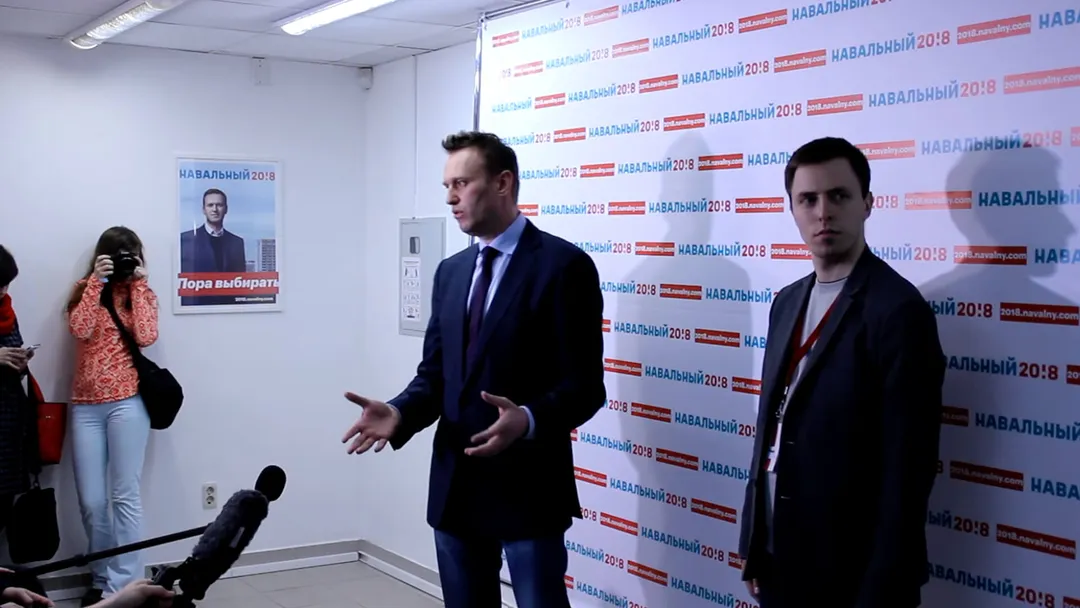
Text version
0:00
Hello. Thank you very much for coming.
0:03
And I’m glad to see so many of you
0:06
at this press conference in our campaign headquarters.
0:09
I won’t speak for very long.
0:11
Many of you were probably already at
0:12
the opening of the volunteer headquarters, and then at
0:14
the rally. And I’m happy that I finally made it
0:19
to Chelyabinsk.
0:23
It’s very encouraging for us. At the moment,
0:27
Chelyabinsk and the Chelyabinsk headquarters are
0:29
in fourth place in terms of the number of
0:31
volunteers, meaning they are ahead of Novosibirsk
0:33
and ahead of larger cities. In
0:35
the Chelyabinsk region, we have effectively
0:38
already met our minimum target
0:40
for collecting signatures. And we have
0:43
what, given the size of the city,
0:45
is an unusually high number of volunteers in
0:46
Magnitogorsk. So we are pleased
0:50
with how things are going here. We saw
0:53
that there were a great many volunteers today
0:54
at the meeting.
0:56
And I’m glad
0:59
that I was invited today to
1:01
the rally against the mining and processing plant.
1:03
We have something to say to the people of Chelyabinsk,
1:07
including, as I said at the meeting
1:09
with the volunteers, here we can — I personally
1:12
can say with satisfaction
1:14
the phrase: “I told you so.” And here
1:16
there are probably many people here, including
1:18
media outlets that wrote that I was wrong
1:20
to go after Governor Yurevich, wrong
1:23
to investigate him.
1:26
Wrong, they said, for me to make leaflets,
1:28
special materials directed against Yurevich.
1:30
United Russia kept defending him, defending him. And
1:32
where is Governor Yurevich now?
1:34
In London.
1:35
Well, either in London or in Israel. But
1:38
now United Russia itself and the authorities themselves are telling us
1:40
what a bad governor
1:42
Yurevich was. If they had listened to us then and
1:45
taken our words seriously, and if he
1:48
had been removed from office, then probably all
1:50
the corruption cases that are now being
1:51
talked about by the Kremlin, would not have happened. So
1:55
we were right, and this also matters
1:59
to every resident.
2:01
We can see that the authorities
2:05
understand
2:08
that our campaign here is developing
2:09
quite well. That is precisely why, ahead of
2:12
my arrival here, the head of our headquarters
2:16
was arrested. About 10 or 15 hours ago.
2:19
This is Kirill Artyukov, let me introduce him to you.
2:21
He is the deputy head of the headquarters. Regardless
2:24
of the fact that Alexei Tabalov
2:26
is currently under arrest, as you
2:28
have seen, we are successfully opening our
2:31
headquarters. Our meeting
2:32
with volunteers went very well. This shows that
2:34
they will not be able to decapitate
2:37
or somehow stop
2:39
this campaign in this region or in any
2:43
other region. The campaign as a whole
2:44
cannot be stopped by taking out one,
2:47
two, three, or twenty-three people. Well,
2:50
you arrest one person, but there are still
2:52
volunteers. Most importantly, there are
2:54
voters who want change. There are
2:56
voters who expect from us
2:59
what we are doing. There are people who
3:01
understand that over 17 years this government has reached
3:04
a dead end and can no longer say anything good
3:06
for itself. And we have answers to
3:09
questions, including those that concern
3:11
the residents of the Chelyabinsk region. We are conducting
3:15
an anti-corruption investigation, including
3:16
into your situation with the
3:19
construction of roads. You can see that
3:22
I’m no admirer of Yurevich, but under
3:24
the current governor, even compared
3:25
with Yurevich, the roads have become worse. Why?
3:28
Because the authorities keep consolidating
3:30
road construction contracts into larger lots. And there are clearly
3:33
signs of corruption. And, well,
3:35
the environmental situation today is simply
3:38
obvious — this problem is obvious.
3:40
And we heard a lot about this today at
3:43
the rally. I want to reaffirm once again my
3:45
position: yes, I support
3:48
the residents who are opposed to
3:49
the construction of this
3:50
mining and processing plant. It is
3:53
a lie to say that it will bring
3:55
some money or that it will bring
3:57
some kind of prosperity to the region’s residents. And according to
4:00
the statements of even the
4:03
builders of this plant, the Russian Copper
4:06
Company, over the entire course of its
4:08
existence it will pay 80
4:11
billion rubles in taxes. Even if we believe that figure
4:13
— though it will be several times
4:14
lower —
4:16
let’s look at the figure of 10,000
4:19
people diagnosed with cancer
4:20
every year in the Chelyabinsk
4:22
region. When we see how many more
4:25
people will develop
4:27
cancer and acute
4:29
respiratory illnesses, and this is
4:32
simple arithmetic showing that
4:34
the additional spending on
4:35
healthcare will eat up all the
4:39
additional revenues that
4:41
this project might bring. Therefore, we
4:43
support the residents in their fight for
4:45
the environment. And in Chelyabinsk this issue
4:47
is extremely acute. It is very unfortunate that
4:48
today neither United Russia nor
4:50
representatives of other parties came.
4:52
So, moving on to answering
4:54
questions, once again, I am very pleased with
4:57
how things are going here. I am very pleased
4:59
with the large number of volunteers. In the
5:01
Chelyabinsk region, we are going to have a big
5:04
and interesting campaign. There are many of us.
5:06
will support us here. I am confident that here we
5:08
will be able to compete for the majority of
5:09
voters. I am ready to answer your
5:11
questions. Raise your hands,
5:13
introduce yourselves. Yes, please. Sergei
5:14
Makovich today. Alexei, please tell us,
5:16
why exactly Tabalov became
5:18
the head of the campaign headquarters. Was there no more worthy
5:20
or suitable candidate?
5:22
The decision on appointing campaign headquarters chiefs
5:24
is made by Leonid Volkov. I do not handle that
5:27
work myself. We have a competitive
5:29
process. People send in their résumés, and people
5:32
go through interviews. We do not have
5:34
a system where we appoint members of the Progress Party
5:37
or people who are somehow close to
5:38
us. We have regions where there are
5:40
nationalists and regions where there are liberals. People simply
5:42
send in their résumés. And judging by the fact that
5:45
Volkov appointed Tabalov, I
5:47
trust Volkov completely. I think that
5:50
Tabalov will be a worthy head
5:52
of the headquarters. At the very least, everything that
5:53
Tabalov’s team has organized has been entirely
5:55
satisfactory to us. Next question, please.
5:57
Svetlana Grigorieva, Full House. And who else
5:59
will be a member of your headquarters?
6:02
Well,
6:02
Well, there you go, I introduced Kirill. Our
6:04
headquarters are volunteer-based. That is exactly why I
6:06
keep saying that we are opening volunteer
6:09
headquarters. In each headquarters we have two or three
6:12
positions where people receive a salary.
6:14
Everything else is simply volunteers. At
6:16
present, in Chelyabinsk Region
6:18
there have registered
6:20
2,000 people. Roman, yes, we already have 2,000
6:22
volunteers. That means we need an enormous amount of work
6:24
to coordinate
6:26
those people
6:28
who came and said: "We want to work
6:29
for free." So for now we do not really
6:32
have any need, generally speaking, even
6:34
to spend large amounts of money on
6:36
that. Yes, please. Ah,
6:37
Hello. Your campaign... first, please
6:39
tell us where you are from.
6:40
Young Teacher, the newspaper Young Teache.
6:42
Ah, the newspaper Young... Young, just Young
6:44
Teache. Well then, Young Teacher it is.
6:45
Excellent. In your campaign
6:47
you have many points about decentralization
6:49
of practical governance. Do you believe
6:52
that in the future, the future in general will belong
6:54
to, so to speak,
6:57
anarchism to some extent, that is,
7:00
the transfer of power to lower levels,
7:02
while the federal level will be, so
7:04
to speak, well, um, an additional
7:07
element, while power itself will still
7:10
be, let us not forget, self-government?
7:14
But that is not anarchism. I
7:16
have consistently argued that
7:19
the authorities, the Moscow authorities, this
7:21
notorious Kremlin, which has taken all
7:23
the money and powers and dragged them all into
7:25
Moscow, should stop hoarding them and
7:27
send money and powers to
7:29
the regional level and the local level,
7:31
to the cities. This is in no way
7:33
any kind of anarchism. It is a
7:35
normal system that works in
7:37
developed countries. Putin spent
7:39
17 years building a different system, and it
7:41
went bankrupt. In other words, he built everything
7:43
perfectly. There is no money in Chelyabinsk Region.
7:46
All the money is taken to Moscow. That is
7:48
the plain truth. All your regions
7:51
recently had another few percentage points taken away
7:53
from the corporate profit tax. But
7:56
has it turned out well that there is no
7:59
money here for anyone, and that you are forced to beg Moscow
8:01
for your own money?
8:03
No, it turned out badly. That is why we
8:05
look at the European system of local
8:07
self-government and understand that the money
8:09
that cities earn should remain
8:11
here, for the most part. And there is
8:14
nothing anarchic about that. On the contrary,
8:17
it is an excellent system that
8:18
works. That is not an insult.
8:20
Please, Sergei Leonov. Sergei Leonov
8:22
from Proru. Earlier you were talking about a flying
8:25
helicopter, and now you are talking about roads and
8:27
so on. Will there be ACF branches in
8:29
the regions, in particular in Chelyabinsk
8:31
Region?
8:32
Chelyabinsk Region is actually an
8:34
outpost of the Anti-Corruption Foundation (ACF),
8:36
because Valery Zolotukhin, who,
8:40
yes, who is even standing here, is a co-author
8:43
of most of our investigations
8:44
related to government procurement. And he, in
8:46
fact, lives in Chelyabinsk and works
8:48
from Chelyabinsk, not as some kind of,
8:50
you know, Muscovite. And so,
8:56
well, he works on the whole country. And in that
8:58
sense, one can say with complete certainty
9:01
that one of the most
9:03
qualified people who understands
9:05
government procurement lives in Chelyabinsk. It is just that we
9:09
cannot direct his energy only toward
9:11
Chelyabinsk Region, where he would expose everyone
9:12
immediately, because
9:14
the country is large, and he works on many
9:16
things, but also on
9:18
Chelyabinsk Region among others. We
9:20
will strengthen these areas of work in all
9:23
cities with populations over one million, and all the more so
9:24
here, where, as I already said,
9:26
we have more volunteers than in those cities
9:29
that have larger populations than
9:30
Chelyabinsk. So, as of today,
9:33
we have raised 40 million rubles. And that is enough for us
9:36
to run the campaign the way we
9:38
are running it, based on the strength
9:40
of volunteers. Funding is being
9:42
provided that way. How much does this cost
9:43
the premises per month? Around 60,000 rubles.
9:46
So what are our expenses in Chelyabinsk?
9:48
The premises cost 60,000 rubles a month. As
9:50
you can see, it’s decent. It’s right in the city
9:52
center, right? Well,
9:53
I swallowed wrong there.
9:55
Well, you understand that not all
9:58
landlords, when they hear “Navalny headquarters,”
10:01
are willing to cooperate or offer discounts. In any case,
10:04
we
10:06
pay for the premises, we have two
10:08
paid positions, and we have volunteers. Fortunately,
10:10
that’s a big advantage of our campaign
10:13
and no one else has anything like it. We
10:14
have a lot of people willing to work
10:16
for free. That’s why our expenses are
10:18
low, and we can run the campaign
10:21
relying only on the money
10:23
that volunteers send us. Next,
10:25
yes.
10:26
Agaryuk, Moskovsky Komsomolets (a Russian newspaper). Alexei
10:28
Anatolyevich, well, um, six people were
10:31
sentenced to fines as a result of
10:33
taking part in the protests on the 26th. Won’t it
10:36
turn out that in the end they’ll have to
10:38
pay that money out of their own
10:40
pockets? How will their situation be handled?
10:42
Second, what about the people who lose their jobs
10:46
as a result of
10:47
distributing your campaign materials? Well,
10:49
there seem to be quite a few of them,
10:51
Well, I don’t know, you would know better.
10:54
What is your position on them?
10:56
Our position is as follows. First of all, I
10:58
hope that everyone who was detained
11:00
was registered with our headquarters. We
11:02
are raising money, and of course we will pay
11:04
the fines through a general fundraising effort for everyone.
11:07
That’s the first thing. Second. You had a rally here
11:11
on the 6th, right?
11:12
Was it authorized or not?
11:14
No.
11:14
Did a lot of people come out?
11:15
A great many.
11:16
More than 3,000.
11:17
So there were a lot of people. And the authorities
11:20
were saying they would arrest everyone,
11:22
detain everyone, disperse everyone.
11:25
But in practice, what happened was that our poor
11:26
Tabalov was arrested just a few
11:29
days after the rally simply in order
11:31
to try to disrupt
11:34
my visit here. And even in Moscow,
11:37
despite all the horror stories and despite
11:39
the thousand people detained there, only
11:41
80 people were actually jailed for a few days.
11:43
The truth is that it’s impossible to
11:46
repress large numbers of people.
11:48
What they really do is grab one
11:50
person and then point to him as a warning to everyone else.
11:52
Look, we locked him up for 15 days,
11:54
to scare everyone else. Or they
11:57
make an example of someone by firing them, although in
11:59
reality there aren’t large numbers of
12:02
cases of dismissals or
12:04
persecution. On that note, I arrived
12:07
from Tyumen yesterday, where I was opening a штаб (campaign office). There
12:09
in Tyumen, there is a schoolboy who
12:11
was handing out leaflets, and the police
12:13
came to his vocational school, and apparently
12:16
raised the issue of expelling him. But that
12:17
matter was resolved successfully. We
12:20
protected him, and we will protect him, just as we will all
12:22
the others. But it’s important to understand
12:25
that, fortunately, this is not such a large
12:27
number of people. They frighten many by, uh,
12:30
going after one or two individuals. The real
12:33
capacity of the authorities for mass
12:35
arrests is limited. Again, fortunately, I saw your
12:38
nice paddy wagons, and when Lena Marus was approaching
12:41
the rally—Lena Marus, who is originally from
12:44
Chelyabinsk and is the art director of the Anti-Corruption Foundation (ACF)—
12:45
you see, those are close ties. She was walking and said,
12:46
“I didn’t know we had
12:49
paddy wagons here in Chelyabinsk.”
12:50
Well, now Chelyabinsk does have paddy wagons,
12:52
but there are only three of them. How many people
12:54
can you cram into them? When
12:57
thousands come out, it’s impossible
12:59
to fight them. And that is exactly what we
13:01
are counting on, because, well, go ahead—
13:02
repress all of Chelyabinsk, go on,
13:04
arrest everyone who speaks out against
13:05
the authorities. It’s impossible.
13:07
A question, again about the rallies.
13:09
Did you expect there would be this many people?
13:11
Because, well, by many estimates this
13:13
far exceeded expectations. And what
13:17
do you plan to do next with
13:19
this wave of civic activism?
13:23
Well, there’s one thing I don’t understand. I’ve heard
13:26
the question many times: did you expect it? I don’t
13:27
understand why you didn’t expect it. I
13:29
did something simple. I went into
13:31
the Chelyabinsk rally group and saw that
13:33
2,000 people had registered there.
13:36
And I understood that, well, roughly
13:37
2,000 people would come out in Chelyabinsk. I
13:40
am more surprised that we managed to organize it in
13:44
eighty cities. And that
13:47
goes directly to the question of repression and intimidation.
13:49
People wanted to come out, and they did.
13:50
So I was watching it. I understood that
13:53
the number of people registered in
13:55
the group roughly matched the number who
13:57
would come out, because people
13:58
were registering because they were ready to go
14:00
to authorized rallies. And as for
14:02
the protest wave,
14:05
it’s not some kind of wave
14:06
that I organized. It’s simply
14:08
what these people are feeling. We released our
14:10
anti-corruption investigation. The authorities
14:12
are not just ignoring it—they are demonstratively
14:14
ignoring everything. And they say, “Well,
14:16
we’re not interested at all in what you
14:18
think in Chelyabinsk or anywhere else.”
14:21
People come out. It doesn’t depend on me.
14:23
They come out against the authorities. They come out
14:26
against hopelessness, against this
14:28
general feeling that nothing can be
14:30
changed. They will keep coming out. I will be
14:33
part of this process. The next rally is
14:35
on June 12. Follow the groups so that
14:38
nothing catches you by surprise.
14:40
You're next now. Yes. Alexei.
14:43
Yes. Ah,
14:44
Alexei, it's commonly believed that in Russia,
14:47
if you control television,
14:49
just the TV channels, you control
14:52
public opinion and the country.
14:54
How much has the internet changed that situation?
14:58
Those videos got 20 million views, right?
15:01
20 million, probably even more already including Odnoklassniki (a Russian social network)
15:03
even more. I'd like to tell you that
15:05
the situation has changed, but that's not really true,
15:09
of course, to this day we have, so to speak,
15:11
punched a big hole in this wall of
15:14
censorship, but television is still
15:17
the dominant,
15:19
uh, the dominant way of delivering
15:21
information, yes, and millions of people are still
15:23
being brainwashed, but whereas before they had, say,
15:26
I don't know, 99%
15:30
of the information reach, and we were somewhere out there
15:31
in our blogs, uh, dealing with 1%,
15:35
that's no longer the case. We launched our
15:38
Anti-Corruption Foundation (ACF) programs of
15:39
online broadcasting, which in terms of reach already
15:41
rival the biggest radio stations.
15:43
When we broadcast the rallies
15:45
on the 26th, 4 million people watched them
15:48
people. That means we can already
15:50
compete with television. We, we
15:53
are going to develop this, we are going to build
15:55
similar, well, excuse the word, homemade
15:57
TV studios, including in the regions, and
15:59
and we'll experiment with it. Will
16:01
people watch local news of this
16:03
kind? But one way or another, let me say again,
16:06
the internet has dealt a major blow to
16:10
the Kremlin's propaganda machine. That's exactly
16:12
why, if you look, all the latest
16:15
legislative initiatives from the Kremlin
16:17
have to do with restricting the internet in one
16:19
way or another. But we'll fight here, we
16:22
won't give in that easily. By our tradition,
16:25
at every press conference, if there is a
16:27
willing representative of the
16:28
National Liberation Movement (NOD), I
16:30
give him one question. Please,
16:31
just one question. Thank you. Yes, I
16:33
will try to put this briefly now
16:35
all of this. My question is this. Tell me,
16:38
please, there are rules that
16:40
were written in 1993
16:42
for us by Americans,
16:44
with an organization called US...,
16:48
adopted by the people at the [bell]
16:50
referendum in 1993. That is,
16:51
the rules are
16:53
by the people of Russia,
16:54
which, of course, you can look up,
16:56
it's all publicly available. That is,
16:58
the rules are the subject, the governing subject
17:01
in relation to any
17:03
official, including
17:05
the prime minister and the president
17:07
of the Russian Federation. Accordingly,
17:10
all officials follow the rules. From this
17:14
I conclude that the rules are primarily to blame
17:16
first, and only then the people. That
17:19
is, people follow the instructions of a system
17:22
that was written long ago. And my
17:25
question is: what do you think,
17:26
are people to blame, or the rules? My
17:29
view is that first and foremost
17:31
the rules are to blame, and then the people.
17:33
Let me ask a clarifying question then.
17:35
Do I understand correctly that you believe
17:37
that it was American rules that made
17:39
Medvedev steal 80 billion rubles and spend them
17:42
on palaces? Do you think you could put
17:45
only Medvedev there? I think
17:46
you could put anyone in that position,
17:48
including you or me, and
17:51
and then pass it all off as something
17:53
Medvedev did. I see, I understand. And
17:56
then one question. I don't really understand what
17:58
rules you're talking about. Then why
18:00
do we need Putin? Why does Putin then
18:02
follow American rules?
18:04
Because the people adopted them in
18:05
1993. He cannot fail to
18:06
follow them. He is the guarantor of the
18:08
Constitution
18:08
and at the same time an American puppet.
18:10
No, he follows the rules that
18:13
the people adopted in a referendum. Do you understand?
18:15
All right. Okay, I understand the question. And then
18:17
I want to tell you,
18:18
you'll follow those rules too.
18:20
You asked a question, let me answer.
18:22
So, as a candidate for president of
18:25
Russia, I represent the part of society
18:28
that does not want to follow Putin's rules,
18:31
or American rules, or
18:33
French rules, or Zimbabwean
18:35
rules. Here in Chelyabinsk, I see
18:38
people who simply want to live and
18:40
work like normal people. Well, you're
18:42
probably a local too, right?
18:44
And I see people here who want
18:47
simple things, like
18:49
a higher minimum wage. I see people
18:52
who want, uh, a normal
18:55
environment. I see people who want
18:57
to buy apartments with mortgages not
18:59
at 15% annual interest, but at 2% a year, as in
19:02
Europe. So, of course, I have honestly
19:05
said to NOD many times: you
19:07
really ought to be my most
19:08
fervent supporters. I'm not against you.
19:10
I'm saying there is a situation, a system. You
19:12
just need to understand that.
19:13
So, well, when people want
19:17
to build a processing plant here and extract
19:20
ore, but the company is registered in the
19:22
British Virgin Islands. So I
19:24
think this is exactly some kind of
19:26
murky thing, and they are the real
19:29
foreign agents. I don’t like this
19:31
Constitution. These rules of yours—this is the
19:32
Constitution, after all. Right. Right. Let me once again
19:35
say that Russia’s Constitution is bad.
19:37
Under this Constitution, we have at times
19:39
elected governors, then appointed them, then who knows
19:42
what. Sometimes our mayors are elected. You
19:44
have a city manager now, right? First the mayor was elected,
19:47
and now it’s a city manager. All of it under this
19:48
Constitution. First four years, then six, then
19:51
consecutive terms, non-consecutive terms. I don’t like this Constitution,
19:52
just like you don’t. I very much
19:54
hope that Chelyabinsk will at least
19:57
vote for me in these
19:59
elections. Next, please. Thank you for the question.
20:01
All right, [applause]
20:05
two short questions.
20:06
Please tell us where you’re from?
20:07
Ah, Maryanova, the online outlet Otpustnoye
20:09
Razresheniye 100. First question.
20:13
What is the priority direction of judicial
20:15
reform? Yes, you’ve spoken about this more than once.
20:17
I have two points. First—
20:19
your attitude toward carrying
20:22
weapons freely. And the second point is the death
20:24
penalty. And the second question is
20:27
That makes four questions, or three.
20:29
The first one. And now the second question. Very
20:33
many people have completely different reactions,
20:36
but the question is the same. And as far as I know, you still haven’t
20:39
presented
20:41
an economic platform for achieving
20:43
what you’ve been talking about.
20:44
It has been presented.
20:46
May I answer?
20:47
All right, let’s start with—and if I forget any
20:50
parts, remind me. The death penalty.
20:52
I am against the death penalty. The Russian
20:54
judicial system is incapable of distinguishing
20:57
a guilty person from an innocent one. In
20:59
fact, 99% of our verdicts are convictions.
21:01
At the same time, jury trials
21:04
produce, uh, far fewer
21:06
convictions—60%. But jury
21:09
trials are being reduced, squeezed out, and
21:11
pushed aside. So, comparing
21:13
these things, I draw a simple conclusion. Our
21:16
professional judges imprison 30% of people
21:18
who are innocent. We have unproven guilt. And
21:20
if we allow these people tomorrow
21:21
to shoot people, then they
21:23
will start shooting left and right at those
21:26
who have committed no crimes at all.
21:27
As for
21:29
weapons, I believe that normal European
21:32
practice could be adopted here.
21:34
There’s no need to sell anyone
21:35
assault rifles, of course, but short-barreled
21:38
firearms for self-defense should be
21:40
legalized. And Russians in this sense are no
21:42
more foolish than Moldovans, people from the Baltics, or
21:46
residents of the Russian Empire before the revolution,
21:48
who could quite easily buy
21:49
pistols for self-defense. As for
21:52
the economic program, you are mistaken. We
21:55
have laid everything out in considerable detail, but
21:58
we will spell it out in even greater detail, because
21:59
the election campaign lasts a year. I
22:02
will come here a second or third time. It
22:04
wouldn’t be interesting for you if I told you
22:05
everything right now, would it? So
22:08
moving on, let’s just
22:10
Federal News Agency. What do you
22:13
think about Maltsev’s detention and
22:15
his actions? More generally, is he perceived
22:18
as a potential... Well, I
22:21
certainly view Maltsev as an
22:22
ally. I’ve said this many times, and
22:25
our political views do not
22:27
match 100%. We are not
22:31
politically identical, but what he
22:33
is doing now is opposition
22:36
politics. Maltsev created an independent
22:38
information channel, and that is
22:41
the main reason for the hatred toward him from
22:43
the Kremlin, because they do not
22:46
like it. A person goes on air every day, every
22:47
single day, and he is listened to by
22:49
120,000 people. They don’t like that. They
22:52
believe opposition figures are not supposed
22:54
to work with such large audiences.
22:56
As for his arrest, it is absolutely
22:58
illegal. And the way it was carried out was not just
23:01
illegal, but outrageous. In Saratov,
23:04
they sawed through the man’s door at night, staged some kind of operation,
23:07
with his whole family
23:09
at home, and for some reason they started dragging him under
23:11
escort to Moscow. And it turned out that he was
23:14
being held on an administrative detention. You cannot
23:17
saw through doors for someone under administrative
23:18
detention. This is absolute lawlessness and
23:21
precisely the kind of demonstrative lawlessness
23:23
meant to intimidate people. Next.
23:26
Yes, please.
23:26
Ah, Alexei, thank you for your
23:29
investigations, but I’m interested in one
23:31
question. Ah, Alexander Fotin, Civil
23:34
Media.
23:35
Here’s what I’d like to ask. You
23:37
recently released a video in support of
23:39
the protesting truck drivers. You,
23:41
accordingly, are speaking in their
23:42
support. But there are groups of people in
23:44
Russia who are in an even more
23:46
difficult situation. Women, for example. Recently
23:49
the Russian Federation decriminalized
23:51
domestic violence. And then there are, accordingly,
23:54
LGBT people, and, accordingly, from
23:55
Novaya Gazeta’s investigation, we know
23:57
what the situation for them in Chechnya is right now.
23:59
So as a presidential candidate, can you
24:01
outline your position on
24:03
feminism and rights,
24:05
So, LGBT rights?
24:06
In fact, you've named two
24:09
groups. In Russia, any social
24:11
group you can think of is, uh,
24:13
unfortunately, intimidated. In principle,
24:15
any people who see themselves as
24:18
a social group and put forward some
24:20
political demands are immediately
24:21
targeted by the authorities. As for
24:24
women's rights, well, of course, I believe
24:26
that the law decriminalizing domestic
24:28
battery is a terrible piece of stupidity. Uh,
24:31
what does domestic battery mean in Russia? Well,
24:33
today the state has effectively said:
24:35
"Well, you can beat her once, you can beat
24:37
her twice, and the third time it all
24:38
turns into a stabbing. This is the traditional
24:40
Russian pattern of domestic violence, where people
24:42
slash each other with kitchen knives
24:44
to death. And to decriminalize that is
24:47
absolutely the wrong thing to do. And in
24:48
that sense, I am of course in favor of
24:50
women's rights, but it even sounds a little
24:53
absurd to say that I am, well,
24:56
against women being beaten in the family.
24:59
But nevertheless, this is Russian
25:00
reality. But as for these
25:02
reports, I haven't studied them that closely,
25:04
but what I have read certainly sounds
25:06
frightening—that they are killing, uh,
25:09
people of non-traditional
25:11
sexual orientations.
25:13
And that the authorities approve of it—this sounds
25:16
simply monstrous, absolutely insane,
25:20
just insane. These are some kind of
25:21
legalized executions. Frankly, I
25:23
don't really understand why the authorities,
25:25
the federal authorities, are still silent on
25:27
this issue, but I will look into all this
25:29
information in more detail. Well
25:30
Can you say that you support LGBT rights?
25:33
Well, I support the rights of all people, and I
25:35
don't divide anyone into categories. In that sense, all
25:38
people, regardless of whether they are gay or not,
25:41
whether they love cats, whether they are women,
25:44
or men—all people must have equal
25:46
rights. There can be no other way.
25:50
Yes, please.
25:51
Ah, Alexei, could you please tell us what
25:53
you think about the reform of local
25:54
self-government in the Chelyabinsk Region? In
25:56
Chelyabinsk, we now have 170 deputies.
25:59
Mm-hmm.
25:59
Here, city mayors are not elected;
26:02
district heads are elected.
26:05
The reform of local self-government in
26:07
Russia now amounts to the destruction of local
26:08
self-government. Across the country, as far as I can tell,
26:10
I don't think there is even a single
26:12
major city left where the mayor is still
26:14
elected. Even at the level of
26:16
settlements, heads of administration are
26:18
hardly elected anywhere anymore. And, well, is that
26:21
good or bad?
26:22
Bad. We can see that appointed mayors,
26:25
these so-called city managers,
26:27
do a worse job than elected mayors.
26:29
An official who does not fear
26:31
public opinion works worse than
26:34
an elected official. Because how many voters does a
26:35
city manager have? One:
26:38
the governor. And how many voters does the governor have now?
26:39
One—the
26:41
president. That is what leads to the degradation of
26:43
the entire system. In fact, for example, in
26:44
the Moscow Region, something even worse is happening right now.
26:46
They are merging these, uh, local-government
26:50
entities. In other words, there is a complete
26:52
and total purge of this system underway,
26:55
because this is the only place where
26:56
at least some elections and
26:58
political competition remain. Of course, I
27:00
am strongly against it, and this is a major part of our
27:02
program for developing local
27:03
self-government. Please, and soon, as I understand it,
27:06
Sergei Udaltsov is due to become eligible for
27:09
parole. Will you cooperate with him
27:11
after his release, and referring back to the first
27:13
question, what about his views as a representative
27:15
of the communists?
27:16
Ah, well, you put that very nicely. I
27:19
hope Udaltsov will be released on parole
27:21
early. Yes. We can see that in our country
27:23
the practice is that political prisoners
27:25
are most often not released on parole
27:26
early. I hope Udaltsov
27:30
will be released as soon as possible, and with him, as with
27:32
any representative of the opposition, I
27:33
would of course always be in contact. Yes,
27:36
please.
27:37
Hello, Alexei. Uh, Boris
27:39
Zolotorevsky, from the publication Portfolio
27:41
Youth. Please tell me, this is
27:44
a question about lustration. Many supporters
27:47
are compiling lists of officials,
27:50
police officers, and judges. Some have even proposed adding
27:52
Judge Markova to them, who, in my
27:54
case, fined me 10,000 rubles for attending
27:57
the rally on the 20th.
27:59
Yes. But you say that
28:02
lustration should proceed not by
28:04
individual names, but by certain levels. That is,
28:07
it is a general process. So, could you explain
28:10
your position on this?
28:11
It's very simple. Look, what is
28:13
lustration? It is punishment without guilt,
28:16
when we simply say, for example, all
28:18
people in blue shirts,
28:21
you will never again be allowed to enter
28:23
headquarters. That is an example of lustration: punishment
28:26
without guilt. We say, for example, all
28:28
leaders of United Russia
28:30
will never again be able to hold top
28:32
public offices. That's one thing. But your
28:34
Judge Zolotaryova doesn't need any
28:36
lustration; she issued an unlawful
28:37
ruling in your case.
28:39
An unlawful one. I'm sure you will appeal
28:42
have already passed. Right now we're talking about the c
28:45
regional court
28:45
once you get through it, once you get through the appeal, we
28:47
will file an application to the ECHR for you. If
28:49
the European Court, which is part of
28:52
the Russian judicial system, issues
28:54
a ruling that in Zolotaryov's court it was unlawful
28:56
that Marko brought charges against you, and you, excuse me,
28:59
please, that Markova unlawfully
29:01
subjected you to criminal prosecution.
29:02
So what? We'll simply imprison her for
29:05
violating the laws currently in force. She
29:07
prosecuted an innocent person
29:09
for a crime. That is an active provision of
29:11
the Criminal Code. And all these people, all
29:13
these judges, all these organizers of
29:15
attacks, beatings, and everyone else,
29:17
no illustration is needed. They must
29:19
be held accountable simply under the laws currently in force.
29:21
That's all. My friends, thank you
29:24
so much. I was glad to speak with all of you
29:26
here. We just need to start making our way
29:27
to the plane. I was very glad to be
29:30
here in the Chelyabinsk region. I'm very glad
29:32
that everything went so calmly and well. And
29:34
even the police were today
29:36
super friendly toward our
29:38
campaign office. Unfortunately, though, one
29:39
campaign office chief was, I repeat, detained. But
29:43
otherwise they were very, very
29:44
friendly. Thank you very much. Very glad
29:47
to see everyone. I will come to Chelyabinsk again
29:49
many times. Thank you.