The show “The Constitutional Council Elections Are a Story We Made Ourselves.” Part 1
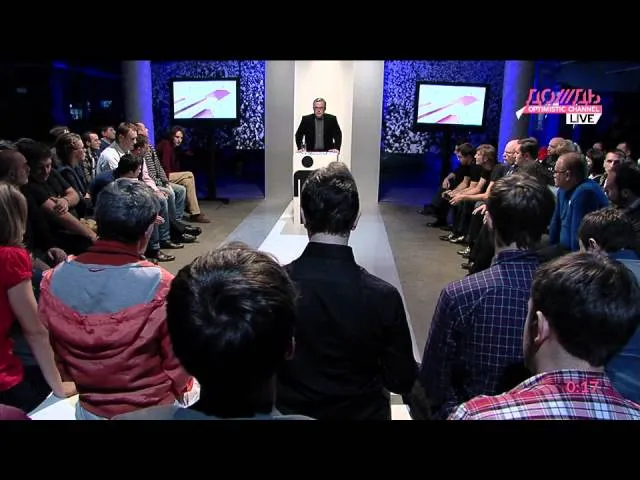
Debates on TV Rain.
Good evening.
My name is Yury Saprykin, and we...
I almost said...
We are continuing the debates on TV Rain, but no—the debates are already over.
What is more, the elections to the Opposition Coordination Council have also ended.
Today at 9:00 p.m., the chairman of the Central Election Committee
Leonid Volkov announced the results: 45 people
have been elected to the Opposition Coordination Council, 30 people
from the general civic list, five from the left-wing slate,
five from the nationalists, and five from the liberals.
The names of these people are well known.
You can see them on the CEC 2012 website.
And many of them are here in the studio today.
And in fact, what is happening here and now can probably be called
a discussion of what exactly the Coordination Council will do.
What it should focus on, and what it should achieve.
Let us try today
to draw up, live on air, a roadmap for the immediate next steps.
In our studio, in addition to
the candidates who made it into the CC, there are also
candidates who fell short by
just a few votes of getting into the Coordination Council.
And I congratulate the winners on their victory.
And to the candidates who did not make it into the Coordination Council,
I would like to say a huge thank-you for taking part in this election campaign.
I understand that your feelings right now
must be rather mixed, but
I think these are not the last elections.
And it is absolutely certain that the experience of taking part in the debates and the experience of taking part
in this election campaign
will not go to waste.
And let me add: these are not the last elections not only to the Coordination Council,
but, I hope, not the last elections at all.
In your political lives, and
today we will talk about several key issues
that the Coordination Council should address.
According to TV Rain viewers, whom we surveyed on Twitter
and who themselves suggested the main issues on which
the CC should concentrate in the near future.
And we will have the opportunity—
or rather, the candidates who did not make it into the Coordination Council will have the opportunity
to ask questions of the newly elected members of the Coordination Council.
whose election was decided today.
You can also post messages on Twitter with the hashtag elections.
CC; as always, the wittiest and most elegant ones
will appear on screen during this conversation.
And I suggest we begin with this.
Here I will make use of the host's prerogative.
And it seems to me that whatever the members of the Coordination
Council, the candidates, TV Rain viewers, Twitter users, and so on may think about it,
still,
in the situation as it stands today,
the most important and most urgent issue the Coordination Council will have to deal with
is the fate of those candidates for the Coordination Council and elected members of the
Coordination Council who are now behind bars.
In addition to the political prisoners whose names we compiled during the winter rallies,
in addition to those imprisoned in the Bolotnaya case (the criminal case tied to the May 6, 2012 Bolotnaya Square protest),
now, during this election campaign,
Daniil Konstantinov has been arrested,
one of the
organizers and active participants in the protest actions.
A man who was elected to the Coordination Council
from the nationalist slate.
His representative, Ivan Mironov, is here in the studio today.
Konstantin Lebedev has also been arrested, a member of the Russian Communist Workers' Party
and the Revolutionary Party of Communists, and a candidate for the Coordination Council.
And Nikolai Kavkazsky has been arrested in the Bolotnaya case, a left-wing social
democrat, LGBT activist, feminist, and anti-clerical activist.
And everyone is, of course, aware of the
monstrous story unfolding before our eyes with Leonid Razvozzhayev.
He is also a member of the Opposition Coordination Council,
one of the organizers and active participants in the protest actions,
an aide and adviser to deputy Ilya Ponomarev, who, as I think
everyone in the hall knows, was abducted in Kyiv by unidentified
men, is now being held in Lefortovo pre-trial detention center,
and was arrested by some kind of secret court under cover of night on Sunday
and, reportedly,
under intense coercive pressure, allegedly wrote
a statement saying that he was one of the organizers of mass
riots financed by the Georgian special services.
And this story will quite obviously continue to develop.
And I...
It seems to me that the Coordination Council
simply cannot remain detached from this in the coming days
in this country, and we will have to say something about it.
You will have to speak out, and you will have to act.
And I would like to begin with a discussion of this topic.
How can the Coordination Council,
how can the protest movement as a whole help political prisoners right now?
Is there an action plan for this?
What do you think should be done in response to these arrests?
The floor goes to Ivan Mironov as Daniil Konstantinov's representative.
A microphone, please,
a microphone, please, if you would be so kind.
Well, in fact, I withdrew from participating in the elections.
I said that I would support my comrade Daniil Konstantinov,
because, in my view, competing with one's comrades,
especially with those who are in prison,
in a place where I myself once had to be, would be immoral.
That is why I urged people to vote for Konstantinov.
This vote was supposed to become a kind of symbol
of unity and solidarity with those
and with those families whose loved ones gave up their freedom
in the name of the struggle.
That is what should be demonstrated.
What should the program for further action be?
The program for further action is this: first of all, do no harm.
By showing Kavkazsky on the monitors right now and saying that he is an
LGBT activist, you have done him a great disservice.
Because if this footage is his self-description from the CEC website,
those are the words.
If this footage now reaches his cell,
if those words
that he wrote about himself get there, then believe me,
there is a high probability that he could come out of there disabled.
The words he wrote about himself on the website while in custody,
which he sent here while in custody,
to the Central Election Committee—well, he has already identified himself.
That was a mistake, a real mistake.
So, for our part, what should our course of action be, what is our
program of action? It is that we must, after all, define a list
of genuine political prisoners who took part—without LGBT activists,
because otherwise we discredit the very idea
of support itself.
There are people—candidates for the Coordination Council
and members of the Coordination Council—who are under intensified pressure,
and protest activity must be intensified specifically around those who are being repressed.
those who are in prison, picketing the buildings of the Investigative Committee,
and the courts where they are, where they will be brought for extensions of their detention.
And most importantly, their surnames, their names, of course,
must not disappear—let them remain on banners, remain on our flags.
Thank you, Ivan.
Lyubov Sobol: I'd like the microphone, please.
Lyubov Sobol.
And what should be done about the political prisoners?
What actions can the Coordination Council take?
First, I believe we should all go out in one-person pickets.
Tomorrow, one-person pickets will be held outside the building.
It's working,
it will. We can hear you.
A one-person picket will be held tomorrow outside the FSB building.
Second, we must compile lists not only of political prisoners, but also of those
who were involved in the fact that they are now behind bars.
These are the judges who issued unlawful arrest orders,
and other individuals who testified, gave statements,
and so on for the prosecution.
Today there was a press conference with Putin and Yanukovych (former president of Ukraine),
if I'm not mistaken, and no one asked about Razvozzhayev.
I saw on Twitter that a number of journalists were writing that
whoever is there, please ask Putin this question.
And no one asked it.
We must draw attention to this, but... The question wasn't asked by the Ukrainian journalists.
Yes, they did ask it.
A Ukrainian journalist—their colleagues had asked them to raise that question.
We must always raise this issue; it must be at the top of the agenda
for the Coordination Council and for the Russian opposition.
The defense of the guys who are behind bars right now.
That means mass actions, pickets, rallies,
drawing up lists, publishing information about it, spreading information—this is
so that this issue is never lost among a mass of others.
This is an issue the Coordination Council must deal with.
Thank you, friends.
I'm not asking for a final answer right now, but...
Let's remember the legal
support that RosUznik is currently providing.
The Investigative Committee needs to hear this.
Lists are necessary, but that is already being done.
It's organizing press conferences, it's...
Meaning?
Alexei, please.
Alexei Navalny: We created the Coordination Council
so that we could do better, more effectively, and more powerfully
everything that had been done before in one way or another, and also do new things.
That means 1,000 people, and tens of thousands of people,
must take to the streets of Moscow to defend all political prisoners,
everyone whom we believe was imprisoned for political reasons.
There are people on the Coordination Council who can do
certain things better than anyone else.
So Nemtsov goes to PACE (Parliamentary Assembly of the Council of Europe) and pushes
for entry bans
into Europe and for the assets of those involved to be frozen.
And we know that both the executors—Bastrykin, for example—
and the ones who gave the orders—Putin and his inner circle—have assets abroad.
So we must begin this work right now.
Right now we must organize not only one-person pickets,
but tens of thousands of people taking to the streets.
That means the amount of money we raise will be
10 or 20 times greater.
For hiring lawyers.
Look at what's happening with the lawyers right now.
It's impossible even to understand how many there are, where they are, who is paying their fees, and so on.
On the one hand, everyone is concerned that
there is more or less just one lawyer, and we know who she is—that's absolutely true.
So every relative must be convinced that they will receive support from us.
Every prisoner must understand that their lawyer, or two lawyers,
and so on, will be paid for, and that there will be no court-appointed free lawyers,
and that the actions will be large-scale.
If Sobchak knows how to persuade celebrities
to sign statements in support of these people, then that's what she'll do.
Something like that.
Nemtsov will do what Nemtsov does, and Kara-Murza, sitting in America,
will run to the U.S. Congress with a list
of those investigators and judges who must be held accountable.
That is what we should be doing. These are practical steps.
Sergei PARKHOMENKO
Actually, I wanted to speak about what
Alexei has already mentioned.
The defense of a person who is
in detention depends to a large extent on the caliber of their lawyer.
I really don't want to offend Violetta Volkova,
but she certainly should not be the only one trying to cover this entire breach by herself.
We need serious, professional lawyers,
and expensive ones.
We cannot count on
people working purely out of enthusiasm or ethical considerations.
We know how much such a lawyer costs.
The bill runs to
at the very least hundreds of thousands of rubles,
and more likely around 1,000,000 rubles, since we're talking about tens of thousands of dollars.
And of course we will have to engage in this kind of political fundraising.
There's no getting around it.
And there is absolutely nothing shameful about it, because there is no
other way to provide them with high-quality legal representation.
And while I have the chance, I call on those who
we have not yet approached, but undoubtedly will,
to treat this reasonably, understanding that this money is not for undermining the state,
but money for the defense of
living people who, it appears, are under severe pressure.
Vladimir Tor.
The microphone, the microphone.
I think human rights advocates should have their say and play their role.
Each of the political groups has its own human rights advocates.
I think dividing up areas of specialization
will be fairly easy, and it will be easy to reach agreement within the council.
I would like to emphasize that we must not trail behind
the agenda being imposed on us by Putin's political regime,
when we spend our energy exclusively on defending those
who are being torn from our ranks; that is reactive behavior, reactive politics.
We end up running behind Putin.
That is wrong.
We need to impose our own agenda.
And in this respect, it seems to me it would be very timely
to develop a separate program.
No to arbitrariness: identify the judges,
prosecutors, investigators, and prison officials who violate the law.
In Russia, we need to push for the creation of lists
that will serve as the basis for future lustration (purges of officials associated with abuses).
And about rowers.
It seems to me that this is exactly the kind of agenda
that should be imposed in dealing with the regime.
Thank you, Nikolai.
BONDARIK: Very briefly, yes, very briefly.
I simply wanted to say that we cannot
shrug off our personal responsibility either—that is, the responsibility of each of us, the members of the Coordination Council.
For example, me.
Ideologically, I am infinitely far from Kostya—from Kostya Lebedev and Udaltsov.
Although that does not prevent me from having good personal relations with Kostya—for example, with Lebedev.
That is, yesterday I made a placard and went there.
What do you call it here? The Investigative Committee.
Like many people present here, right?
Well, no, that's enough for me.
What I'm getting at is this:
It seems to me that each of us must bear personal responsibility.
Every member of the Coordinating Council should at least remember—let's remind everyone—where
these pickets are now: at the Investigative Committee and at Petrovka 38, lane 4.
Yes? The Investigative Committee?
Yes, yes, yes.
Ah? So,
let me remind you once again that among the elected members
of the Coordinating Council, two are currently under arrest.
They are Leonid Razvozzhayev and Daniil Konstantinov.
And two candidates for membership in the Coordinating Council
have also been arrested on highly dubious charges.
They are Nikolai Kavkazsky and Konstantin Lebedev.
We wish you a speedy release.
And let us not forget all the other
political prisoners, whose number is measured in the dozens.
And I am afraid that count is far from over.
The topic that
has become especially widely discussed in recent days—the topic because of which
one of the candidates for the Coordinating Council dramatically withdrew from the election—is the topic of
let's call it, politically correctly, interaction with the regions, right?
That is, one of
the stories that the federal TV channels keep telling us endlessly
is that the Coordinating Council
is just some Moscow clique that somewhere out there
made arrangements among themselves on Facebook and elected itself.
And beyond that clique lies a huge country made up of people
to whom all of this is deeply alien and uninteresting.
And even if these people belong to the protest movement
or even if they do not like what is happening in the country,
somehow they were unable to take part in these elections.
Or the election organizers failed to do something that would have enabled them to participate.
The latter seems somewhat disingenuous to me, because
well, in my personal experience, registering a polling station
takes, roughly, a couple of hours,
regardless of what city you happen to be in.
But nevertheless,
there was not enough done,
the necessary effort was not made,
to ensure that the whole country, all the regions, would see these elections as their own.
How will the Coordinating Council interact with the regions, and what
can you do to prove to people living in Siberia, the Far East,
Altai, Kaliningrad, and so on, that this is their cause too?
And how can common ground be found with them? What
means of communication with them exist?
Let's talk about that.
Ilya Yashin, please.
Well, we need to understand that ours is a very
centralized country.
And indeed, the main political life,
as history has made it, takes place in the capital.
And since the capital is now Moscow, most of it happens in Moscow.
But I would not
exaggerate this either, because according to data from our Central Election Commission,
only one-third of the voters who took part
in the election were Muscovites; all the rest were from St. Petersburg and the regions.
So this problem must be understood, but it should not be overstated.
In general, I see one of the main tasks of the Coordinating Council as supporting
those regional initiatives that periodically
emerge but simply sink because no one supports them.
Indeed, people
who are trying to self-organize in the regions often need
that kind of federal support—some sort of umbrella that will protect them.
Take elections, for example, when there appears
some candidate in local or regional elections, for city office
or for parliament—they often need precisely that kind of support.
I think one of the key tasks is to help organize primaries
in such elections, and through open procedures in those primaries identify
the people who can most effectively stand up to
United Russia candidates, and then support them collectively.
Like those that took place on October 14, excuse me,
elections like the ones that were held on October 14.
A candidate emerges, goes through the primary process,
and we give that person all the support we can—organizational,
financial, political, moral, and so on.
And that automatically improves that candidate's chances compared with a
United Russia candidate—well, at the very least it levels the playing field and gives them a chance to compete
more or less effectively.
There are also anti-corruption campaigns.
We can take local problems and make them federal issues,
put them on the national agenda.
We have all the necessary resources for that.
So one of the key tasks, I emphasize, is supporting
regional initiatives.
Not simply to keep them from drowning.
And in that sense,
it seems to me that we understand how to structure this work in practical terms.
Maxim Katz, you have just returned from Kostroma,
where you were building ties with the regions.
So tell us,
if we are not talking about your urban projects, but rather
about what the Coordinating Council should do in general,
do you have an answer to that question?
How should one talk to people outside Moscow,
where should they be helped, and where should one stand up for them, and in what situations?
I really was in Kostroma; before that I also had an election campaign
in Omsk, and recently I observed the elections in Tver.
I do not really like the approach being put on the agenda here,
that is, how we are supposed to live with this, how we are now supposed to deal with it,
how we are supposed to figure out what people in the regions need and then help them?
It seems to me that we should not be trying to figure that out ourselves.
If people from the regions, as in the case of Omsk, come forward
and put forward some agenda that matters to them, as in the case of Omsk,
well, and invite us to take part in it somehow,
we can take part in it; we can also find
people there with whom we can interact,
as, for example, in the case of Kostroma.
And I am interacting with them there now.
But to go looking for regions where there is supposedly no activity at all
and then try to create or discover it there—I do not understand that way of framing the question.
I listen to the news in the mornings, and there is constantly some kind of activity there,
some kind of activity that we simply are not very used to paying attention to.
For example, today in the town of Baikalsk there was trouble at the pulp-and-paper mill.
It may seem unclear what that has to do with us—where are we, and where is Baikalsk?
What do we have to do with pulp production?
But nevertheless, one cannot say that
there is no activity, or that these are some other people with problems of their own.
I could answer here: what do I have to do with pulp production? So I do not know.
Tears make those very benches, and
they—well then, wait a moment,
and to the candidate from the left-wing curia: tell us, how should interaction be built
with politicians and with activists?
with ordinary people outside Moscow?
I think so. Good evening.
First of all, I want to congratulate everyone that these elections took place,
and thank you
to the commission that organized them. They handled it with dignity.
First.
Second, I think we now need to focus
our attention on prisoners of conscience, on our people who have been jailed.
As for these questions, they are of that kind.
It is a technical matter, and we will discuss it.
In a closed format,
because,
well, in principle, that's the universal answer to any such question.
We will have to discuss all of this with you in a closed format.
We will discuss it when there is a decision.
Let's keep it open for now.
Konstantin Krylov, please.
KONSTANTIN: Yes, this thing works.
This thing definitely works.
Yes, excellent.
So,
based on some experience of working with the regions, I can say that the two main
problems regional activists face are as follows.
As a rule, the regions differ from Moscow in one very simple respect.
There are few politicians there, and few politically engaged people in general.
And, on the other hand, the local authorities are very, very strong there and can crush
that entire small political crowd with one finger, and nobody will dare squeak.
So what can be done about this?
If a political activist in the provinces knows for certain that in Moscow
his activities are being monitored, that if they start going after him there
and putting pressure on him, then at least someone here will be able to speak up for him,
that his case will make it, say, to at least some federal-level outlets.
And, by the way, many of those present here have
access to exactly those federal platforms.
And if we do all this right now, at this very moment,
believe me, their confidence will increase sharply.
People need at least some support from here, from the center.
And in that respect, what damned Moscow can do for the regions
is precisely this.
From experience, I can say that sometimes even an article published on a popular website
about some provincial outrage can seriously frighten the local authorities.
It may be small-scale, it may be local.
But nevertheless, this is something we are at least capable of doing.
If we systematically provide this kind of support,
the situation in the regions will change significantly in our favor.
So now I would like to give the floor to Ksenia Sobchak.
That is,
working with the regions and protection,
well, if not of prisoners, then at least of people who are being persecuted.
In a sense, these are one and the same thing.
Yes, I would put it this way: people who are trying to do something.
You know, when we are defending a political prisoner, you can assume
that we are already too late.
What needs protection is a person who has at least begun doing something in a region,
because the pressure of the authorities immediately comes crashing down on them,
and it is much easier to protect them at an early stage.
You know, it's like treating cancer.
At the first stage it is still treatable, but by the fourth it is already difficult.
Thank you. Ksenia, please.
I believe it is very important to encourage and inspire people in the regions.
I can speak from my own experience,
when the well-known events in Astrakhan were taking place.
I believe that a huge role
was played by the so-called Moscow landing party, which came to Astrakhan
and showed people that they did not have to be afraid to take to the streets,
showed people that they really could
speak out,
that they did not have to be afraid to talk about what matters.
And I believe this is one of the main directions
that work with the regions should take.
Because, well, it is no secret that if we look
at history in retrospect, all the major events,
all the major protests took place in capital and other major cities.
That is why the regions need to be inspired by example,
and we need to work with them.
And speaking of elections, I believe that the Coordinating Council
can become precisely the structure,
the body that can finally put forward a single
opposition candidate in future regional elections.
I believe it was a major mistake that the work
on the regional elections that have already taken place was not carried through to the end.
And personally, I believe that one of the main tasks
of the Coordinating Council is precisely to nominate such a single
opposition candidate in all subsequent regional elections.
Because we ourselves saw, from the elections that took place,
how all this works, what political intrigues lie behind it,
how many spoiler candidates there are, what kinds of bargaining go on around elections.
So if the Coordinating Council can reach agreement on nominating
some such single candidate in all future regional elections.
If Yabloko and the Union of Right Forces can finally come to an agreement.
You know, in that sense the Coordinating Council is already quite a substantial body.
All right, briefly and specifically.
Proposals, first of all, on this topic.
First, we have a great many regional candidates.
They did not get through, for understandable reasons.
And first of all, I would propose
bringing into the Coordinating Council, say,
those candidates who did not get elected but received, say, more than 2,000 votes
with advisory voting rights.
That is, they could have the right to introduce initiatives, for example,
raise certain issues, and attend meetings.
That would not violate our principles in any way.
That is the first point.
And the second interesting proposal, again, came from St. Petersburg
and it is to hold elections to the Coordinating Council in the regions as well.
That would provide an additional incentive for local initiative, right?
And then perhaps, together within the Coordinating Council,
we could work out some kind of mechanism,
for, say, bringing into the Coordinating Council
those candidates
who succeeded in the regions by receiving a certain number of votes.
It seems to me a fairly interesting idea,
it is not my place to say, but I think this idea has merit.
And moreover, I apologize, but we need to move on now.
But I would like to draw the attention of the members of the Coordinating Council to the fact that you
now have in your hands a system called, what is it, Democracy-2?
Well, the very system by which you were elected.
And in fact, it is a tool that can be used.
Referendums can be held constantly on just about anything, right?
Well then.
The topic of working with the regions.
Has been covered partially.
And from here on, this question will have to be answered through day-to-day work.
And we move on.
We continue our discussion
with the newly elected members of the Opposition Coordinating Council,
and I also hope that at some point we will finally be able to bring in
the candidates who were not elected to the Coordinating Council.
Despite this three-week
marathon of debates, everyone still has a lot to say.
And one of the
topics that
is being discussed very heatedly.
Needless to say, over the last,
probably several months since March,
the issue has been
why rallies are needed.
Oh, these rallies are so exhausting!
Oh, how many times can people keep going to these rallies!
The same people stand there saying the same things.
And now we’ll go out again, and nothing will change.
And so on, and so on.
But fortunately for
us, for everyone, tens of thousands of people still
manage to overcome their doubts
and come out for yet another large-scale protest action.
But the fatigue from the fact that
these rallies all look alike and are
not really followed by anything—it can still be felt in the air.
It is clear that this is a necessary
part of the opposition
movement, a necessary part of the opposition movement’s work.
And as one of the candidates present here said,
you have to go to rallies the way you go to work—as a matter of routine.
It is clear that the authorities keep giving us more and more reasons
to take to the streets.
But nevertheless, it is now up to the Coordinating Council to decide
what these actions should look like, what these rallies should be,
what they should be for, what they should be against, and whether they should even be rallies at all.
Let’s talk about the protest actions you consider relevant,
necessary, effective, and workable in the near future.
I’d like to give the floor to Vladislav, if I may.
Vladimir, could we have a microphone?
Yes, of course.
Rallies are a fairly effective form of expressing protest,
but only if they are not held too often.
That is, there is no need to overdo it
with large protest actions, so that society does not start taking them for granted;
each time they should become a significant news event
and, if at a given moment there is no
major news trigger, they should be tied to commemorative dates.
For instance, one could speak of a rally on either 5
or 10 December, connected with the anniversary of those memorable events
of last December, connected with the falsification of the elections
to the State Duma (the lower house of Russia’s parliament), when a fundamental shift in public consciousness really took place.
Such rallies help maintain the momentum of public protest
and show everyone that the protest movement has not been defused, but is actually gaining strength.
In that sense, everyone really should come to rallies as if going to work.
Because even though there is no longer
the same spark that there used to be, no longer that sense of novelty,
that festive atmosphere,
still,
we must demonstrate resilience so that the authorities understand
that these people will not calm down until their demands are met.
As soon as the authorities understand that,
that is when we will win.
Sergei PARKHOMENKO.
In fact,
a rally has two faces.
A rally has two sides.
There are those standing on one side of the stage, and those standing on the other.
And no matter how much people may dream of them merging in some common impulse
and at some moment thinking
about the same thing and shouting the same words,
in reality it is perfectly obvious that there is
a huge mass of people who actually make up the rally,
and there is a certain number of people standing on the stage
who are trying to do something with that mass of people,
to impress something on them, explain something to them, lead them somewhere, and so on.
Frankly, it seems to me that this first side
of the matter—the people who gather, the people who constitute
the actual volume, the cloud of the rally,
is something far more important, something far more valuable.
And in that sense, those actions that took place this winter, which managed
entirely without words, entirely without a stage or a microphone,
seem to me, in some cases, even more valuable.
It is customary to laugh at things like the White Circle (a protest action in Moscow where demonstrators formed a human chain),
but it seems to me that the psychological and moral effect
they created
was extraordinarily important
and very long-lasting.
Those were the very batteries that powered many of the rallies that came later
and that slowly ran down and, as many believe, were eventually exhausted.
By this autumn, essentially.
It seems to me that we need to look for new forms and new,
if I may use the word, genres
of this street-level civic activity.
We suffer to a large extent from the fact that the palette is very limited,
from the fact that
this too is a form of political creativity.
And as long as this creativity is producing relatively meager results,
we undoubtedly need to broaden that palette.
And I think that, incidentally, one of the important tasks for the Coordinating Council
will be precisely to propose some
new forms of civic activity, including street action.
And that is simply serious creative work.
And we need, we need to know how to
inspire people with new ideas
and new proposals, while understanding one thing clearly.
What is extremely important is that it is impossible to control people in this situation.
It is impossible to drive them from place to place; it is impossible to force them
to do something they themselves do not want to do.
The idea is always that the rally’s organizers, the rally’s coordinators,
only create a kind of reservoir into which
the energy already present in people is poured; they only offer
a certain opportunity for these people to realize
what they themselves want, what they have, so to speak, conceived for themselves.
But even that must be done
I would say, with sufficient force and impact.
Oleg Kashin. I would like to give Oleg the floor.
On what topic, then?
Well, just repeat what I’ve just said.
Actually, I’m saying
that one can.
We can discuss rallies, gather for rallies, and hold rallies as much as we like.
What is important to understand
is that, as Saltykov-Shchedrin taught us, whether there are rallies or not does not depend on us.
And if the people, as happened on 5 December at Chistye Prudy (a boulevard and protest gathering site in Moscow), decide it is necessary,
that they need to go out into the street, well,
of course they will not ask either Maxim Katz or Mikhail Shats.
But at the same time,
well, however you like.
But if one of us happens to come up with
some idea like the big White Circle, which all of us find
brilliant, I see no reason not to carry it out.
But we must not forget, for example, that the next major action,
probably one that at least some of us intend
to hold on November 4, and it is called the Russian March.
So that should be kept in mind.
Nikolai, could we please have a bit of quiet?
And Konstantin, please.
Right. Well, first of all, I have to say that, from what I have observed, the potential of a rally,
even a completely ordinary rally, is still being used
by the protest movement at maybe 30 percent at best,
because unfortunately there are many things we simply did not do.
For example, the simplest thing: at a rally of 100,000 people, you could distribute, say,
100,000 printed items of any kind, whether a report on Putin
or anything else, even discs with Dima Bykov's speeches.
But that was not done.
I understand that there were other priorities at the time,
but going forward, frankly, mistakes of this kind should not be made.
A rally should be an event from which a person takes something away,
carrying away a certain amount of information,
and not only what they heard, but also something tangible they took in hand.
So this year, inviting Bykov to the Russian March
yes, of course, he is being invited right now. Right, now to St. Petersburg.
Now, second.
It really does make sense now to view all our events
liberal, nationalist, left-wing
and so on, as part of a common protest movement, in order to set a good example.
I really believe that, for example,
the Russian March should now be turned into a broader protest event.
I am extending the invitation, so to speak, in my own name.
Everyone is interested in this being specifically a protest event,
an anti-regime event, and so on.
On November 4, to the Russian March.
At the same time, it is not necessarily required to march together with the nationalists.
Just come, bring your own signs.
And if they are not signs for United Russia,
which is the only party we would not want to see,
then, accordingly, welcome.
Dmitry Bykov, the ball is in your court.
BYKOV: Konstantin is inviting you, and you do not want to, is that it?
But I'll be in St. Petersburg, so I'll come to you instead.
Well, then I suppose I won't ask it that way.
What am I trying to say?
You see, I think we somewhat overestimate
all this talk that rallies have run their course.
Strictly speaking, rallies are held not for us and not for our enjoyment.
Rallies are held so that certain very specific people
we often name them; well, we understand who is being referred to,
get angry, lose control, and do ever more monstrous stupid things.
Even that relatively small wave of rallies, overall,
that took place in winter and spring provoked them
into absolutely idiotic actions, and those actions are becoming more and more frequent
and increasingly go beyond the bounds of law and common sense.
As Shenderovich rightly said, the only language they understand is numbers.
As soon as a critical number of people, from their point of view, comes out to a rally,
they will start doing things that will inevitably lead to consequences.
Either a split
among the elites, which many talk about, or the dumping of some number of the most rabid figures.
In general, they are showing more and more clearly just how incapable they are.
So this great role of the rally, not as something provocative,
but, I would say, as something declarative, still cannot be discounted,
because after three more episodes of Anatomy of Protest (an NTV political propaganda program), the NTV channel could be shut down altogether.
Alexei Navalny.
I will support my colleague Bykov.
You see, there are many different kinds of activity: local elections,
campaigning, and so on.
But we need to be very clear about the fact that
what the people who have now seized power fear most
is the physical presence of people in the streets.
That is why this has been and remains the main direction of protest activity.
They are afraid that people will come out into the streets, because actual people in the streets
can drive them away, beat them,
remove them from power, throw them out of the Kremlin, seize the White House (the Russian government building), or simply
stand there for a long time and thereby change the political situation in the country altogether.
The other thing is that these actions have now indeed reached
a routine level, but they need to be prepared for longer and prepared better,
we really do need to invent new formats; it is no longer possible to just keep doing the same thing.
And every time say,
"Next Tuesday, everyone, let's meet by the Investigative Committee," and then a group
on Facebook brings in 30 people and 300 journalists.
Formats like that are also needed, but we need to get serious about it.
We need to prepare for large, genuinely civic actions.
Maximum: hundreds of thousands of people in the streets.
That is what we should be striving for.
Thank you.
We will continue our discussion about the future of the Coordinating Council right after the commercial break.