The show “Elections to the Coordinating Council — this is a story we made ourselves.” Part 2
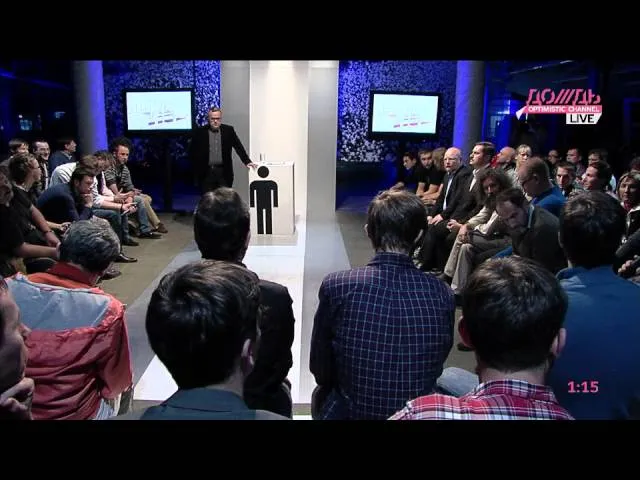
We continue our conversation with members
of the Opposition Coordination Council, whose
names became known here today.
Of course, not all of them are present.
There are 45 members of the Coordination Council, and
somehow their number is gradually shrinking, and
we also hope that joining the
conversation will be candidates for the Coordination
Council who did not make it through in this election.
But God willing, these will not be the last
elections. Friends, I think those of you who have
Twitter—those who have Twitter accounts and managed
to log onto this resource we all love so much after 9:00 p.m.
have already noticed
what, uh, ordinary Russian
citizens are writing about the election to the Coordination
Council. They write: oh, well, this is all
completely predictable. Yes, it is clear that the first thing
the members of the Coordination
Council will hear is a collective cry: you do not even
represent us. Oh, this is awful. Who
are these people? Where did they come from? What kind of
election is this? So this is, this is, and this is your
opposition, and this is your protest movement?
No, we are not that kind of protest movement, we do not
want to sit next to a protest movement
like that. And besides, among yourselves
you are all
political activists of different
stripes.
These are your allies, not your opponents, but
nevertheless, let us talk about
how viable this
arrangement seems to you,
and how, in this lineup, the members of the
Coordination Council can avoid
falling out with one another. The danger is, is it a dictatorship
of the liberals? Yes, in the CC the most stable
composition of the CC is one where you are taking on
much more, so to speak. No, I was simply
expressing my opinion, which I have the right to do.
I believe the most constructive composition of the CC is
when no single curia (electoral group) has
a dominant advantage. Then, whether we like it or not,
we will have to look for points
of common ground. The composition is already
clear now, yes. It is what it is at the moment.
Ideally, we should live with it
for at least a year. So how do we find a balance of forces?
How do we avoid starting to throw
chairs at each other, how do we avoid
ending up in bitter quarrels over common decisions? Yes,
I hope we will
be spared that. No, I am a peaceful person, I am not
going to fight, but the point is that
of course some kind of consensus is needed—say,
23 votes, for example. That is, we need
to develop some effective mechanism
for making decisions so that, after all,
the liberal majority does not crush everyone
with its sheer weight, because it is clear
that in this election, basically,
Echo of Moscow (a Russian radio station) and your channel were the main platforms, that is clear, yes, but
nevertheless, this is always how it is in the world:
wherever anything happens, Echo of
Moscow stirs things up. It may all be for the best, but nevertheless
they are terribly far from the people. Yes, we would still like
the balance of forces in the CC to reflect
the natural state of forces in society, yes,
where it is clear that both the left and
the nationalists are far more numerous than they are
represented in the CC, and this should be
taken into account. I think a normal mechanism is that
decisions should be adopted by two-thirds
of the votes. If two-thirds of the votes are not reached, we
put it to a referendum, again
among those people who were
verified. After all, we could hold referendums at least every month
on the main
issues. I think that would be the right
decision. Thank you, Vladimir Mirzoyev.
You are welcome. Well then, judging by what, judging by
the speech we have just heard, what is needed is
a very serious program
of enlightenment—first and foremost for certain
members of the CC, not to mention the population in
the regions, and so on. I am in favor
of the idea that
the council should develop a very serious
program involving television, cinema, and theater
that would engage in this educational
work. I think this
will somehow help
diversify both the content of rallies and
the understanding of engaged listeners of what is happening
not only in the council itself but in general with
the opposition movement. I think that without
such an educational
program it is impossible to move forward.
Without creating a cultural environment in the regions
and
in cities such as
St. Petersburg
which, as it happens, yes,
somehow are sinking into the
abyss
of provincialism—the Coordination
Council must focus precisely on creating a cultural en-
Of course. Because today one cannot, cannot
separate politics from
culture. It is a very
artificial, a very artificial
boundary in many ways, in many ways.
The fact that our political reality, or
pseudo-political reality, has broken away from the life of
culture has in many ways demoralized it.
We are not trying to seize the microphone, it is not
working properly. I want to respond
to two questions that were raised
by you, Yuri, and by Mr. Bondari here.
The first question is that you
do not even represent us. Yes, that is exactly it.
Yaroslavna's lament (a reference to a famous lament in medieval Russian literature) that is echoing across
the internet—well, in fact, we are not claiming
unlike the Churov-style State Duma (a reference to Vladimir Churov, the controversial former head of Russia's election commission),
to represent all of Russia
or all public opinion in Russia. We
represent exactly those people who
took part in the voting, that is,
precisely those 97,000 or so people who
registered, and the 82,000 people
who actually voted. We
represent the interests of exactly these people
—the vanguard of the protest movement, who
came out to Bolotnaya Square
and Sakharov Avenue, and to various rallies in the regions.
These are the people whose interests we
have undertaken to represent, and who
delegated authority to us so that we could
represent those interests. So here,
it seems to me everything is obvious and clear.
And as for the dominant
position of the liberals there—well, let's be
honest with each other: that's simply how it turned out.
The core participants in the protest demonstrations
consist, as it happens, of people with liberal
democratic views. At each of the
rallies, sociological
surveys were conducted, and each time around 50 to 55%
turned out to be people with liberal
democratic views. Well, basically,
yes, the voting results
essentially reflected that sociology. Therefore I
think we should organize our work
in such a way
that everything corresponds to the principles
of democracy.
And as for
—I mean, of course it is clear that
no one is going to forbid anyone from going
to the Russian March (an annual nationalist rally in Russia). But if someone there starts
making it their goal to secure mandatory
support for the Russian March from the
Coordination Council, then that will probably
provoke resistance. Therefore I
would like to propose in advance—today is the first day that the
Coordination Council has been elected—that we
focus on developing those
programmatic points that most definitely
unite us, because splitting
and dividing us is what our enemies will do, and we should not
give in
to that.
Ivan
Mironov: the most dangerous thing we must avoid
is when we turn very serious
key issues—such as the genocide of the Russian
people, the heroin war unleashed
against the nation, the replacement of the indigenous
population by an Asian element, yes, and
the formation of this new
citizenship, yes, with completely foreign faces,
with a foreign nationality that speaks
poor Russian—if we are going to, uh, if we are going to
turn this into empty theater.
We can talk all we want about how not to
quarrel with one another as members
of the Coordination Council. We need to define
a strategic direction and not
talk it to death. I will speak as someone who was forced
to solve this problem in practice
back in that early protest movement,
since I was on the editorial
commission and worked, excuse me, with Lev
Ponomaryov. That will make things clear to many.
So, I can say
the following: in order not to
get bogged down in wording, because I
know for certain that the same ideas,
expressed in different language, can turn out to be
unacceptable to two-thirds
of those present, or on the other hand
absolutely acceptable to the majority. I,
for example, am sure that what
has just been said is in fact
—let's take, say, the same topic
of migrants. Yes, indeed—for example, who
among us is in favor of Putin bringing in new
voters for United Russia? I think
no one is. So in this respect,
let's say, what is very important, I would say,
is correctness, a willingness, so to speak,
to hear one another, and a certain kind of, I would
say, editorial work. So,
second,
what will help us avoid quarreling?
Exactly right: focusing on what
unites us. What unites us first
and foremost is a common task: the democratization
of the country's political system. We are absolutely all
—why are we even here, after all?
We are here because we support this. Therefore, in this
respect, by the way, there is no need to think that
any of us is against it. If someone
were against it, they would most likely be welcomed
with open arms elsewhere. Well then, and actually
speaking,
last but not
least in importance: let's really
trust one another a little more. We are too
different for this to happen
by itself, and therefore it requires a certain
effort. Let's really
have a little more
faith in one another. I had a whole series of proposals,
for example, I very much wanted
—of course, in terms of strengthening trust—
to marry off Bandari,
but he's already married, he's already
married, I beg your pardon. Mikhail
Shats: for the Coordination Council not to
fall out immediately, I realized at once that we
have quite a year ahead of us—or however long it will be.
there, fate certainly won't leave us bored
yes, we definitely won't be bored, I can
say that despite the number
of words he speaks, if you listen closely to
them and pick out certain themes that
interest me, I'm sure—I, for example, at
those debates heard what I had wanted and was
glad to hear, for example
a position on judicial reform, and so
on. Mr. Bandari says this too
as, in fact, Mr.
Bondarik says—that basically what we heard today
was this. That is, I mean that each of
us surely has common
positions that we need to listen to clearly and
carefully, and I, for example,
am ready not to
say, well, you're this or that, you're such-and-such, you have
all that culture-schmulture, and you
have people being cut down and killed there. In general, that really is not
the best
path. If the Coordination Council manages
to concentrate on the things that
unite all participants, on which
constructive dialogue is possible, then thank
heaven, everything will work out. We
continue. The last question for general
discussion, and I ask everyone, if possible,
to be brief
in speaking, especially those people who
rarely took
the floor today. A forecast for the next 2–3
years: what will happen in the country? How will
the situation develop? What role in this
will the Coordination Council play?
Mikhail Gelfand
please. I don't know
Thank you, Vladimir Tur
actually, the night is darkest before
dawn. I believe that we—I believe
that the night is darkest before dawn, and
that two very difficult years await us
ahead. And catastrophe theory suggests
that things always break unexpectedly, all at once
right up until the very second—one second before
the catastrophe, nothing had happened, and then everything
begins
to fall apart, the system to pass into oblivion, and the new
system to seize the reins that will
slip from these hands. In this respect, I
want to say a huge thank-you to a person
who is absent here now, namely
Leonid Volkov, for all
his shortcomings
of the elections that have just taken place. Clearly
elections are never ideal
but this was a step forward. This step forward consists
not in the personal makeup of the current
Coordination Council, but in the fact that
an institution has been created, certain
rules, a certain
mechanism that can be used going forward
A question was raised here about how to work with
the regions: we need to connect our strong
points with the regime's problem areas
So, there is a system that makes it possible
to hold elections. Yes, let's hold these elections
to coordination councils in
the regions
this will bring in new participants and new
activists, and create new problems for
the political regime locally. In general,
this voting mechanism
should be used as often as possible. But not
to renew the council, rather to set
new tasks and to find out what people actually
think about this. Thank you
Mikhail. Still, where is all this
heading? Well, I really don't
know
I agree with the speaker: for two years it will be awful
everything will end well, but Putin still has time to
ruin many lives and spill a lot of blood, of course
Yes, and I think we need to prepare for the worst in
that sense. Dmitry
Bykov: I have a fairly firm
conviction that over the next
year and a half to two years at most, the atmosphere
will indeed keep thickening; then, in all
likelihood, there will be some kind of serious
external shock. Either the regime, wanting
to strengthen itself, will get into a big or small
victorious war, or a crisis will occur
or the Olympics will finish off the budget. Well, something
of that sort will happen. But what really matters
is what comes after these two or three
years, and here I will say something very
unexpected
Russia is not made up of fans of left-wing ideas
it is not made up of fans of 'Russia for Russians'
it is not made up of
liberals. Russia is made up of people in
whom civic consciousness is awakening
and our task consists only in making sure
that this civic consciousness
awakens, and ideally in 2–3 years
the Coordination Council will no longer be needed. That
is something I would drink to, if only
there were something to drink
Ksenia Sobchak
please. Well, you know, I think that
very difficult years lie ahead of us
I don't know whether it will be 2 years or 3 years
what matters is how we get through this time
how decently we manage to live through
this period, with what losses, and most importantly, with what
kind of
result. It seems to me that
it is obvious that only the growth of protest
the increase in the number of people who will
come out with these ideas
can change the situation—whether immediately
or in a year, or two, or three
The question is that we are facing a difficult
choice: on the one hand, we need to build up
the protest should engage in public education in
many areas, including through
culture, through various media resources
through campaigning, through rallies. But on the other
hand, we must not turn this into something
ordinary. Because if we
really go out too often, on every
occasion, gathering people in the streets, I am very
afraid that unfortunately our enemies will be able
to present this as our defeat. And unfortunately,
yes, to gather even more people—I believe
that we need to do everything possible so that we
carry out very professionally
planned actions—perhaps not very frequent, but
very large-scale ones—so that we can live through
these next few years, when the clouds are clearly gathering,
obviously.
with dignity, and so that in 3
years we do not find ourselves in a situation where we
once again have nothing to offer, when
we have failed to write a program for real
political reform, when we have failed
to do certain important and substantial
things. It is important that in a year, in
two years, in three years, we come forward with a concrete
program of action and get through this.
Just one small remark.
As many times as this is
said, that many times I will try
to jump in and remind everyone of
this: we cannot hold any
mass actions. It is the mass actions that can
carry us
forward, in fact. The initiative comes from the
other
side.
I would say it is form-generating, because
the content is formed apart from us, and our
task is to keep track of it, of this
content. It seems to me this is extremely
important. We should have no illusions, and so
to speak, I would say
we should not indulge in organizational arrogance
either, and experience clearly teaches us that. Thank you.
Akim.
[inaudible]
You know, like in forty-one (1941, the first year of the Soviet-German war),
when they marched into battle from Red Square, when
the fascists stood near Moscow, and I know that
we will win, because God is with us. Morning
is wiser than evening—I am sure of it. Everything
will be fine. Mikhail Shats,
please. You know,
I will gladly repeat Mikhail’s words,
because what these past weeks have taught me
when
the flat tax scale was changing and
the Ministry of Internal Affairs was [inaudible]
in Dagestan—in general, I really like that
quite sincere people have gathered here
to speak the truth.
And I will tell you honestly: I do not know what
will happen in the next 2
years, but what has already happened makes one
think about
bad things.
Whether the clouds are gathering or not gathering,
we have only one country. We have nowhere to go,
and we do not want to go anywhere. And some people do not even
have permission to leave—don’t speak for everyone.
So,
we simply know that this regime
is doomed, because it hates its own
citizens; it fights against those citizens,
and it imprisons the most active among them.
Therefore, here
and whether
it takes another month and everything collapses, or
33 years and only then we achieve some kind of
victory—but sooner or later, we of course
will win, because this is our country.
Thank you. I
must apologize to the candidates
for the Coordinating Council who
came here despite the late hour, and
I must admit that, all in all, we
perhaps did not expect such an influx of
people.
And I am afraid that we
do not have enough time for
everyone to speak, but let us
try taking questions for the candidates, questions
for the members of the Coordinating Council.
Please.
Cherva Chernyshova, thank you.
Thank you very much. The microphone, please.
The other microphone—that one is not switched on.
It works, yes, all good. And my suggestion is this:
complete openness in the work
of the Coordinating Council. And besides, well,
everyone should be informed about what took place,
the voters, that is. And besides, in our case
for example, as a municipal deputy,
there are provisions in our
municipal assembly that if someone misses
three municipal assembly meetings without
a valid reason, that person may be
removed from the municipal deputies. So
I propose that you introduce something like that,
so that people do not miss Coordinating Council meetings and
report back to their voters on what they
are doing.
[inaudible]
Please.
Hello. My name is Vladimir Malyshev, I am
a civic activist. I am probably one of the
most satisfied candidates, because
I received 910 votes. In fact,
despite everything, I am satisfied with the campaign.
But I would like to say this: just now I
listened to people, and there is something I do not like in
this whole story. Yes, I have not been in the protest movement for very
long, and there is one thing I do not like: everyone
says, for example, elections, we recommend
candidates, we do this or that—but for me
for example, it is completely unimportant who will be the
candidate. What interests me is that these
elections should be fair, first of all, that they should be
tools of influence need to be devised so that they
couldn't cheat us; we can nominate candidates
a thousand times over, yes, but they
will just bluntly... No, hold on a second.
the observer movement mechanism
has worked fairly well. But as you can see,
these are all just tools, yes; that is, there wasn't
a single person there who did this who was punished.
So we need to come up with some way
to punish them, some kind of lists, that sort of thing.
That's much more important. And one more thing I'd really
like to say: a great many people, yes,
civil activists, unfortunately, did not take part in
these votes, and in that I, for example,
disagree with them, yes, and I don't
support that, because they say
it's a Moscow тусовка (clique/crowd), and all the rest of it.
I also disagree with them, because
these are all worthy people, all very good people, and I
am in favor, but as a civic
activist I continue to act regardless
of the Coordination Council; that is,
it's not going anywhere. So, I have a question
for Mr. Katz. That is, I, as a
civic activist—well, as I said, I
continue to carry out my own actions, and right now I, I
am from St. Petersburg; it's my hometown.
So, as for what's happening there now,
what's going on there, yes—well, the governor,
is a complete boor, you've probably even heard,
and so I've decided to announce a campaign,
that is, to think it through from scratch. Yes, we have
tools, of course; we're waiting for somewhere
for the elections to be announced there, and then we'll start
doing something. But right now, out of nowhere,
I want to organize, so to speak,
the public in St. Petersburg, yes, and raise the issue of
electing a new governor—that is, to start
completely from scratch. That is, I kind of
have a slogan, yes, a slogan for us. I'm starting:
Let's make Ksenia Sobchak governor
of St. Petersburg. So, Mr. Katz,
how are you prepared to help? Is it possible—
No, we'll ask about Sobchak later,
when it's decided how to achieve that.
Why now? I see. In fact,
I can help in many ways in elections
for city mayors, governors, or
city councils, by offering what I
can offer: a fairly detailed
and constructive program for reorganizing
the city so that it becomes
comfortable to live in. This issue is very much
on the agenda right now. As for icicles hanging from roofs,
do you have any
technology?
Everyone can see, everyone can see that, in general, those
problems that exist
do exist, and one can
propose ways to solve them, and with that
you can go into an election. To answer the question—what
was the question again? Thank you, friends.
Otherwise we'll get stuck on this topic forever.
All right, Maxim Gongalsky.
Yes, I have a short question for Alexei
Navalny. Alexei, are you planning
to
are you planning to run for
the post of mayor of Moscow in the election that
will take place in three years? Because it seems to me
that the only person who
can compete with, say,
Sobyanin is you, among the members
of the Coordination Council. Well, actually,
it seems to me that United Russia has
a different opinion on that matter, but...
Moscow... Maxim, thank you very much for your
question. The authorities' candidate can only be beaten by
a people's candidate. I believe that this
model that we tested
—namely, holding primaries in which
tens or even
hundreds of thousands of Muscovites take part—this is exactly the kind of
mechanism that should be used to
choose a people's candidate. There should
again be primaries, again debates, only
this time substantive ones on urban
problems, not just about politics, but
specifically about Katz's benches and so on and so forth,
and so on. And through such primaries we
can and must—and I am sure we will—
choose a candidate who will beat everyone.
Whom?
Whoever it is. Thank you. Katz's bench versus
Kapkov's Wi‑Fi—the coming battle in the Moscow mayoral
election.
Please. Hello, my name is l...
Nikolai. I want to congratulate those who were elected,
those who ran, and of course
the voters. And my question is this: how
do you see the mechanism for working and interacting
with those candidates who were not
elected to the Coordination
Council? By the way, I can answer that, actually.
In fact, right now, before your very
eyes, I am ready to take on representation of
the progressive bloc of Pryanikov and
Smirnov and
to voice, and voice in the
Coordination Council, everything they wish to convey to me
by means of, I don't know,
mobile communication. I trust them; I've known them
for many years. Our broadcast was not in vain: the surnames
Pryanikov—the sacred surnames Pryanikov and
Smirnov—have been spoken. But, Nikolai, this is
a very simple thing: the Coordination Council
must do some practical
things. For example, we need to raise half a million
rubles (about 5,000-6,000 USD, depending on the period) for each prisoner.
The interaction will consist of this:
I’ll call you and say, Nikolai,
start raising money together with us, and I’ll rally the others, well,
and that’s it, I’ll talk to the left-wing people and everyone else.
Nikolai, likewise, by taking part in
the formation of election commissions
with the right to cast a deciding vote—that is
interaction. That’s the kind of interaction we need.
Well, first of all, I wanted
to thank the voters who
voted for me. Vasily Kandyba, candidate.
I would like to congratulate everyone
who was elected. And here’s my question: a large
part of the people elected to the current committee
are representatives of the former organizing committee.
That’s not all that many, really.
Quite a lot. Believe me, I attended the meetings
of the organizing committee. I don’t see, uh, I don’t see here
the people who were sitting there. Everyone speaks
in very vague terms about expanding
the protest, about how we need to defend
political prisoners. Will there be
a concrete program developed that
will be published, which...
The answer is yes. There are also some other...
Besides expanding the social base of the protest, our
main task
is
of the elected Coordination Council is that in
the next elections, participation should reach, well,
a figure close to one million, and the development of
civil alternative legitimacy
is one of the strategic goals of
this whole process. It seems to me that
a very important tool for this
is the development of feedback between
the elected members of the Coordination
Council and their voters. My question is this:
who is ready to be the first to support this idea
and open a club for their voters,
to communicate with them directly?
Frankly, I don’t really understand why
there’s a need to open a club if practically everyone
already has—first of all—Democratia 2 (an online platform),
and secondly, everyone has blogs there,
social media accounts, accounts on
social networks. Denis, every day I
spend about, well, 40 minutes
replying to messages that come in
through social networks, on Twitter—people
send them there. It seems to me that in this respect
some additional mechanisms—well, I
don’t know, maybe they are needed, but at least
for me, they don’t seem especially necessary.
All the social networks, by the way, were very helpful
during the election campaign, so
creating some special clubs
and piling things on doesn’t seem effective to me.
It’s just—like a constituency office, and that’s what it
will all end up as: constituency offices.
Vadim Korovin
please.
Vadim Korovin speaking. Excuse me, a question for
Rustem Adagamov, a person who did not
take part in the debates. There are also several
other people who did not take part in the debates.
What will your first initiative in
the Coordination Council
What will your first initiative in the Coordination
Council be? Now, come...
there, because I think—sorry, I’m forced
to withdraw this question because Rustem
asked... he came here.
All right, Adagamov then, come in somewhere into
the light...
to gather together first of all. I think that this
won’t be easy, because to gather
45 people, as I understand it, it will require
in general
applying
rather considerable
effort. My first initiative, I
think—Sergei Smirnov. I want to address
those who were elected, yes, to the
Coordination Council, and those who
accordingly were not elected. This
week, court hearings begin on preventive measures
for the prisoners in the Bolotnaya case (the criminal case tied to the 2012 Bolotnaya Square protest in Moscow).
I urge everyone to attend these hearings actively.
These people really need support.
The hearings start this very week, that’s all
from me.
Please, you go ahead.
Please. Grigory Kotskiy. First of all,
I want to congratulate everyone. It seems to me that all of us—
both those who were elected and those who did not make it
into the Coordination Council—are solving one common
task for our society, namely
establishing dialogue within society. People
are bad at talking to one another, and even
the fact that there were some
arguments here today—we are setting an example for the whole country.
Representing different groups in society,
different in education, different in
background, in income level, we are learning
to talk to one another and setting an example for the
rest of the country. This is very important. And I have
a wish for those who were elected: do not
forget about involving
those opposing the education law that is trying
to break the entire system of school and
higher education in the country. Thank you.
Please, your colleague.
Alexander from SRK. I also, of course, want to congratulate everyone
and say thank you to the 5,000 people
who voted for me. And my question is
very simple. I want
to ask: respected elected members of the Coordination Council,
will we now vote on speakers with
the understanding that we have a database
of verified voters from the Central Election Committee, or not?
Will we? The short answer is yes, we will.
Please. Hello, I wanted to
congratulate everyone who was elected. I am Pavel
Shelkov. I also thank the 15,000 voters
who
who cast their votes. There were quite a lot of complaints
during these elections. And unfortunately, well,
the fear that there would emerge, well, a kind of
Moscow clique proved justified, yes.
Because there were a great many people
interesting people from the regions, from Saratov
from—well, from very many places in general. I can even see among
the members of the Coordinating Council many interesting people
from the regions. Oleg Kashin is an interesting
person, but unfortunately from the regions almost
no one—Anatolyevna from St. Petersburg came to us
came.
Yes, yes, Alexei Navalny represents
the Moscow Region. Well, of course. Alexander
Vinokurov, who is absent here, is from
the Tver Region, from the very depths of Russia.
There are masses of interesting people from the regions. 70%
of the votes, after all, came from the regions.
And something like 80% from Moscow were—well, that is, no, well,
that is, so to speak, an objective reality. Well,
you can’t really argue with that. I just wanted to
ask a question. First of all, given
all those remarks about the elections, yes,
some candidates withdrew their
candidacies as well, as everyone knows, yes. And
do the members of the newly elected
council consider that the elections were optimal and
fair, let’s put it that way? And the second
point: of course, I would like those
bright, standout people who emerged, especially
from the regions, to be brought in. Well,
perhaps in an advisory
capacity, perhaps Andrei Piontkovsky’s idea could be implemented
of creating a Forum
of Free Russia, where everyone, let’s say,
both candidates and those elected and the voters could
communicate, vote there—well, that is,
that is my question. Navalny, please.
I believe that the elections that have taken place are our
shared, tremendous victory. Who could even
have imagined that a project of such
scale could be carried out
truly from the grassroots, without help from any
Kremlin towers (rival power centers within the Kremlin), without help from any
oligarchs, without help from any
factions—really, directly
from below. All of this grew organically, all of it was devised
by some programmers from Yekaterinburg
who built the system; hundreds of people went through the debates.
Was it optimal? Well,
of course not. But we came up with it ourselves,
all of it. We built all of this with our own hands.
By the way, in fact only 34%
of the people who voted were from Moscow. This is
truly a regional project.
At last, good Lord, for the first time in my life,
some person in Komsomolsk-on-Amur
where you can hardly even move at all because
the local FSB (Russian security service) has nothing better to do than
harass all political activists—was able
to vote and influence the formation
of some kind of opposition. I simply congratulate
all of us. This is a great trust, a great
responsibility for those who were elected. But
this is a tremendous victory for everyone who
took part in this process. We will make
it better. There were many mistakes; we must
get rid of them, we must overcome them.
But this is something that we built ourselves. We
owe nothing to anyone. This is something that
belongs to us. Over many years, the opposition
has done something that belongs
only to it. It is only its success, and we
must
be proud of it. So you believe that
it is fully legitimate? Yes, it is
elected, yes.
And
Excuse me, but in the next elections, will there, so to speak,
be changes made? This is what
concerns me, because
I would like, I would like to note
what is in my view one very important
injustice that occurred in
these elections. It lies in the fact that
in these elections there was adopted a deeply
unjust and
formula of ideological curiae—these are, these are, these are
specially reserved seats for
political invalids who had no
chance of being elected
in the normal way. Let’s not get into whether they had
a chance or did not have a chance to be elected, and
therefore special
extra little chairs were specially created for them in order to
create this artificial opportunity. I
very much hope that this decision was taken
for these elections, and it was
unfair. Nevertheless, it was
implemented very clearly.
I hope that
the work—I hope, I hope that the work
of this Coordinating Council, among
other things, will lead to that very important
decision that the next elections will be
held without these special
reserved places for various
ideologies. Two final questions. Elena
Rusakova.
Please. Thank you. Elena Rusakova, so,
I congratulate those elected. Many thanks
to the voters, that is, who voted
for me. Like everyone else,
I cannot help repeating that.
So, I have a question for Mikhail Gelfand
if you permit me.
For me, for example, this is a very
joyful takeaway from the election results:
that a person who is seemingly not a media
figure was able to place so high
in the rankings. But what I wanted to ask is this:
perhaps on this—well, your area is
science policy, science,
education. So, the other members
of the Coordination Council have not dealt with this topic
—or maybe they have, just not to
the same extent as you. So how do you see
this specific topic, this specific field—how
will the Coordination Council be able to help
solve this
problem? Well, first of all, in the area of—
in the area of science policy, most likely
it really won’t be able to, not because it is
difficult, but because, generally speaking, it
most likely will not be the most
urgent issue in the field.
As for education, I’ll confirm what
Grisha said behind my back there—
the problem there is much sharper, much
clearer.
And I can say what I’m going to do. So,
at the November meeting of the Public Council
under the Ministry of Education and Science
to which we were also elected, also
by a vote, though not such a
wonderful one, but simply on Echo
of Moscow (a Russian radio station), I
intend to publish the documents
that are sent to me for that
meeting.
And, well, to gather some points of view and then
try to formulate them. One of
them—well, there will be two
questions there. One is rather strange, about the image
of the teacher or something of that sort. That is,
in my view, meaningless chatter. And
the second is completely specific, about the Unified State Exam (EGE, Russia’s standardized school-leaving exam).
As for the EGE, I will
collect statements and
proposals and try somehow
to systematize them. It’s a fairly specific, local matter.
And beyond that, in fact, it’s all
the same. Yes, for example, if there is a law on
education, and if comments on it are sent to me,
then I will convey them.
Accordingly, the last question. Maxim
Sannikov.
Please, briefly. Yes, I just think
this should be said on air: we all, apparently,
have received a little message from Deputy Prime Minister
Surkov, who has just given an interview
titled “By My Convictions, I Am
Russian,” and he says that the constant terror
from idle
chatterboxes who have arrogated to themselves the right
to speak on behalf of society must stop. I think this
is about all of us, so we should keep it
in mind. We will stop the idle terror
in three minutes. And now I understand whom
we need to invite to the Russian
March (a Russian nationalist rally).
Hello, Maxim Sakov here, the very same
“political invalid” from the left curia (electoral group), for whom
someone nevertheless voted.
Thanks to those people. I congratulate everyone on
the election results, on the first honest
elections in the entire history of Russia as a
state. And enormous thanks
to Leonid Volkov for creating such a
tool and such a wonderful
platform. In general, it seems to me that he is a little
—many people underestimate the fact that
Democracy 2
can become a wonderful cradle
for democracy. The idea of direct democracy
is very dear to me, and the fact that a voter
can influence the decision of the Central Election Committee
through verified online voting
seems to me to be a very powerful tool
that should be used. In this connection,
I have a question for the candidates, namely:
how do you want to use this
extremely powerful voting tool? I,
for example, would use it across the board—that is,
the Coordination Council adopts
certain items for a vote: say,
we have an issue, and on it we have
ten positions, and the voters decide what
is more important. Briefly, on this question—
you have spoken more than anyone else, honestly.
Honestly, the devil is in the details, and
this mechanism cannot be launched
immediately in full. But it is necessary
to work in this direction,
to test the mechanism,
to put such questions more and more often until
it becomes an everyday,
easy, simple element. It is necessary
to expand the base of people who are
verified. And one of the main
tasks of the Coordination Council is that it is important for
goals to be set, overall,
to measure effectiveness as an increase
in the number of verified citizens. Yes,
because at the moment the number
is still laughably small. In fact, this is an enormous
breakthrough, but for now there are still very few people—there should be
not just 70,000 or however many there are, well,
100,000 voters, but in fact
the figure should be counted in the millions. Then
it will be a truly functional tool, and
that is what we need to move toward.
Thank you. I will allow myself to say the last
two words.
Today this marathon called
the election campaign
for the elections to the Coordination Council
of the opposition has just ended.
It begins with the fact that these elections took place, that
such a huge number of people took part in them
— that is a tremendous
achievement. And please do not forget
that now these tens of thousands of people
are watching you. They are watching you not
only when you are on the air on Dozhd (a Russian TV channel),
they are watching you all the time. They expect from you
that
you will be able to do something
they have not seen before, something
they may not even have expected
from you. They trust you greatly. Please,
for God's sake, do not turn the Coordination
Council into an arena for arguments about who is a cripple and
who is an enemy and who is a fool, and so on and so
forth. Forget everything you thought about one another
before walking through the doors of this new
organization. And do not forget that
tens of thousands of people are watching you. Do not
let them down. That is what I wish for all
members of the Coordination Council, and I
congratulate you on your victory.
Thank you.
Debates on
Dozhd (a Russian TV channel)