Alexei Navalny’s meeting with voters in Moscow’s Aeroport District
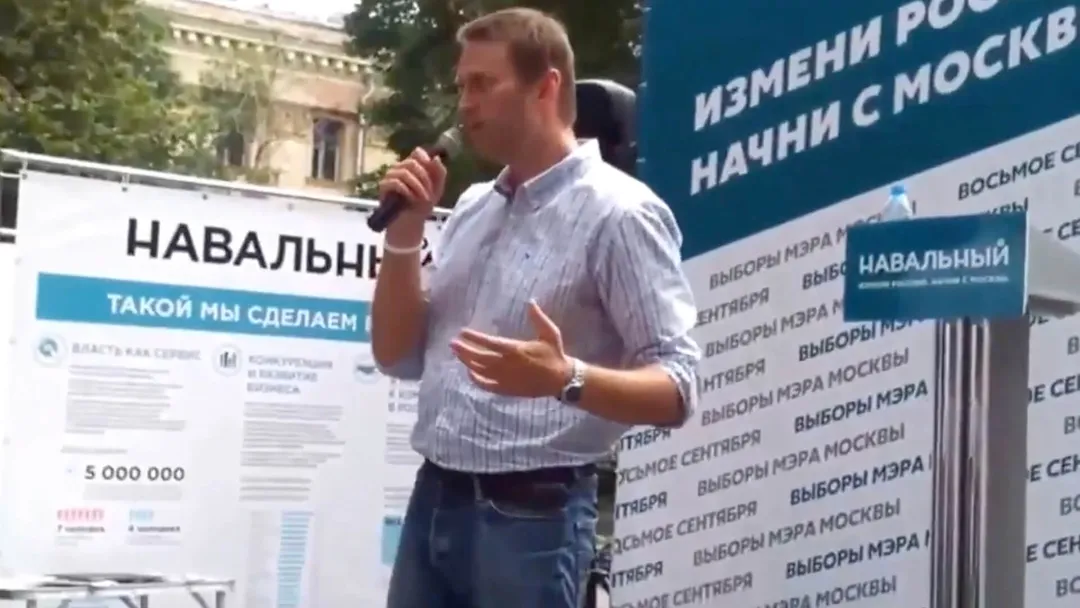
Well, it doesn't matter how many people there are, this is
the duty of any candidate. You know,
you may have heard the news today that
the incumbent mayor, Sobyanin, refused
to take part in the debates.
Who could have doubted it,
and they said they are not at all
interested in it. They said that the debates
of the other candidates would not even be
recorded and would not be broadcast
live. In this way, they are
showing that they don't care about Muscovites.
I and the people who have rallied around me,
who support me—we do care about
Muscovites, because we are
Muscovites ourselves. It is our duty
to hold meetings like this, and we will
hold them.
First, I would like to say a few words about
myself, and then I will gladly answer
any of your questions.
My name is Alexei Navalny, I am 37
years old, I am a lawyer, and I live with my wife and two
children in Moscow, in the Maryino district. I have
two degrees. My law degree
is from the Peoples' Friendship University. And
my second degree is in finance; as it happens,
I also graduated from the Financial
Academy under the Government of the Russian
Federation.
And for the past several years I have been
investigating corruption in
the largest corporations. You know that
the largest—if the sun is shining, we can move over.
And do you know that the largest Russian
corporations—those companies under
state control—
control up to 80% of the economy. These are
huge monsters that are supposedly
both private companies and state companies, and
no one understands what is going on. But
after spending several years dealing with these
corporations, I understand what is
happening there. First and foremost,
there is monstrous corruption. I have spent 8 years
working on this, because for me it is
not just an empty phrase, when I know
that over the past 12 years, over the
past 13 years, Russia has received from the sale of
oil and gas 3 trillion
dollars, I have a question: where did
that money go? And I have been—and continue
to be—engaged in investigating
exactly how they spend our money. And my
answer to that question is: they are
stealing it. I think you also know perfectly well
that the answer to this
question is the same, because if each of us
takes those abstract 3 trillion dollars
and calculates our own share, we will see that over
these years, each of us, each
citizen of Russia, accounts for about
$50,000. That means for
a family of four, like mine,
for example, that is $200,000.
So where is that money? What has our
country received in recent years from all
that money? We do not see it. In the Brezhnev era
(the late Soviet period), in Soviet times, the money
may have been spent well or badly—that can be
debated—but at least we saw some
results. A space industry was built,
a huge army was built,
we fed Africa, we fed
Latin America. Now we have
nothing. What can we be proud of—that in
Russia we rank second in the number of
billionaires? That our officials
buy all the most expensive houses in
London? That we have the fastest growth
in the number of billionaire officials?
That openly, in our country,
officials simply are—and
they, their children, and their spouses are openly
dollar millionaires and
multibillionaires. We certainly do not want
to be proud of that. I do not. That is why
for all these years I have been
fighting corruption in companies. My
colleagues and I created the RosPil project,
which monitors corruption in
public procurement. And we stopped corrupt
tenders worth billions of rubles. Now when
we talk about billions of rubles,
corrupt tenders worth billions of
rubles, it sounds like something abstract.
But I always suggest
calculating it in personal terms.
If we are talking only about Moscow, then in
Moscow public procurement amounts to 600 billion rubles, of which
even by official estimates
150 billion rubles are stolen. For
each resident of Moscow, that is 30,000 rubles per
year. We all need to understand very clearly
that from each of us, they steal
30,000 rubles a year through public procurement alone.
Now let's calculate it again for a family. I have
four people in my family—that is 120,000 rubles per
year. That is how much is stolen from my family
through public procurement alone. I do not accept that. I am
fighting it. I urge you to fight
it together with me. Why am I running in the
Moscow mayoral election?
Because I am just like you. I am
an absolutely ordinary Muscovite who has lived for 15
years in an ordinary apartment and
faces all these problems
personally. And my family faces these
problems too. And so when I run in the
election and talk about housing and utilities problems, for
me this is not some abstract
issue. Opinion polls show that everyone is
concerned about housing and utilities. That is why I say it
really concerns me, because
for my 78 sq. m apartment in a prefabricated apartment block
I get a bill for 9,500 rubles.
I know that I am not receiving services worth that much.
amount. And I know that this price will
keep rising, because there is a monopoly of the DEZs (municipal housing maintenance offices),
because there is quite simply a real
mafia. You probably saw a couple of
weeks ago that they even showed it on TV,
how they removed the head of my
district administration where I live. He was removed because
his wife, driving an SUV, ran into
some pedestrians. You probably
saw it. Well, if you paid attention,
it was some Range Rover with the license plate 999,
the district head who before that had been
the district head in the Lebeno district, and before
that he had been the district head in
Nekrasovka. The man has spent his whole life in
municipal service. In principle, he simply cannot
afford to live such a
luxurious life as he lives, quite
openly. I know this perfectly well. I think
you all know too that he lives such a
luxurious life precisely because I
get a bill for my apartment in the amount of
9,500 rubles.
When I run in elections and talk about
the problems of migration, I talk about it not
because someone brought me a report,
as they did to Sobyanin, but because I know that
the women in my building are afraid
to go outside in the evening, because
this statistic that
50% of serious crimes in Moscow
are committed by migrants, including illegal
migrants. For me, this is not
just statistics; for me, it is
the people who live in my building, whose
bags were snatched. For me, it is
the head of my local police precinct in
the district, who says: "We do not even
register these crimes; they are
pointless to fight."
For me, the problem of education is
not some abstract thing,
measured in numbers of schools
or thousands of students. For me, the problem
of education is my wife, who
is on the school’s parent committee. And
our school is being merged with the neighboring school,
and then both of them together are being merged with a
kindergarten. I think practically everyone
has run into this problem. And no one
explains anything at all, not even remotely, about what
is happening to these schools and why it is
happening. We spend colossal amounts of
money on education, but quality
education cannot be obtained even in Moscow
by anyone.
When I look at Moscow’s budget and see
the amount, the figure that goes to
healthcare,
my eyes nearly pop out, because I,
just like you, go to the
local polyclinic, try to use the
famous electronic registration system,
which Sobyanin keeps praising to us, and realize
that it is practically impossible
to get an appointment with a doctor. But at the same time, I know for certain
that for every Muscovite, just for their
outpatient clinic care, per year
20,000 rubles are spent. Again, everyone can
calculate that for their own family. So,
for my family alone each year, just on
the polyclinic, 80,000 rubles are spent. Now
just raise your hands, those who in the
past year have gone to their local
polyclinic, right? And conversely, who
has not gone even once to the local
polyclinic? Yet 20,000 rubles were taken from each person.
There is a sea of money in Moscow. Moscow’s budget
is 1.6 trillion rubles. We have
an enormous amount of money, and with that
money Moscow and Muscovites can
truly build for themselves a better
quality of life. With that money, Moscow
could have roads without traffic jams. With
that money, Moscow could have public
transport. With that money, Moscow could
have one of the best healthcare systems in
the world. We could have excellent
education, but for some reason we have none of
it. Where does it all go? The paradox
is that we all
understand it perfectly well. I think the residents
of the Aeroport district understand it perhaps
even better than others, because you
have this being built nearby,
the Alabyano-Baltiysky Tunnel. A bottomless
pit into which 5 billion rubles have already been poured. And
its opening date keeps being pushed back and
pushed back and pushed back. And we all
understand perfectly well that on this
Alabyano-Baltiysky Tunnel alone, so much money has been stolen
that
it would be enough to build polyclinics in five
districts and eliminate queues throughout the entire
Northern Administrative Okrug (district).
I spoke yesterday in the Cheryomushki district.
Exactly the same situation. There, they
are building the Southern Rokada. They are building it for 7.9
billion rubles. And everyone knows perfectly well, and all
experts confirm, that this is roughly
three times more expensive than such a road
should cost to build.
All we get is additional traffic jams.
We get endless brainwashing on
television. And these people skim money off every
construction project on a truly
colossal scale. For us,
the construction of one polyclinic,
fully equipped, even at an
inflated price, costs
400 million rubles.
In the construction of the Alabyano-Baltiysky
Tunnel or the Southern Rokada, enough money has been stolen
to pay for 10 polyclinics. And this is happening
completely openly. My friends, I am running in the
Moscow mayoral election because I believe
that I am not the only one who has realized all this. I
believe that in Moscow there is a huge
the number of people who understand this
fully and who are not prepared to put up with it,
who do not want to accept that in
a very rich city we simply live with
a very low, have a very low
quality of life. In terms of hydrocarbon sales
we rank first
in the world. In terms of quality of life, we
rank sixty-ninth in
the world. But Moscow is not even the whole of
the rest of Russia. If I were standing here,
for example, and saying that I was
running for mayor of the city of Kostroma, you
would say to me: "Come on, Navalny, we
demand that you build us
a school or that you build us
a clinic." And I would tell you: "Folks, I
understand everything, but unfortunately we have no money in
the budget."
But here we are in a situation where
I can tell you: "Folks, there is a sea of money in the city
budget, we can build ourselves
anything we want, but we are not building any of it
at all." Why? Because the current
government is interested exclusively
in corruption. It is interested in personal
enrichment, it is interested in
having the higher Kremlin authorities
keep approving it endlessly.
There is an alternative path of development. And I,
and the people around me, do not believe that
Moscow or Russia are somehow
doomed places that will never
be able to do anything. We have written
a program — the best program,
written by the best experts. We are ready
and we have answers to all the urgent questions
facing Moscow. When we are
told that it is impossible to get rid in
Moscow of migrants, we say — and we
back this up with calculations — that this is complete nonsense,
that there cannot be such an
abnormal situation in Moscow and in Russia,
when, for example, 40% of all young
men living in Tajikistan are
now already living here, in Moscow. They
have simply all moved here.
We understand perfectly well that they come here
not because there are
jobs here or because it benefits us, but
because they are being exploited here. They live
like slaves. Half of
their wages can be taken from them, and that is why they
live here. Anyone can do this
experiment that I did: go out into
the courtyard, walk up to your Uzbek janitor and
ask him: "How much do you earn?"
He will tell you a figure of 18,000–25,000 rubles.
Then you can go and look at
the official documents and find out that in
fact he is being paid around 35,000–40,000 rubles.
It is just that every day, every month, he
pays 10,000–15,000 to his bosses. Under
these conditions, migrants are recruited, and
they will keep recruiting them endlessly. And they will
live 30 to an apartment, because
they are simply being fleeced. We have drafted
a bill that prohibits
the use of foreign labor
where city or
budget funds are used. We have drafted
a bill that disqualifies
any contracting organizations that
use illegal labor. These
measures could be working tomorrow. All our
proposals on transport, housing and utilities, and
healthcare could be working
tomorrow. And in fact, I would not even
tell you that we have invented something
new or unique. All of this already works in
other cities.
By budget size, Moscow is second only
to New York. To New York, and slightly
to Shanghai. It is one of the richest cities in
the world. We do not need to invent anything. We
already have everything. We have an advanced
population. We have an enormous
amount of money. We simply have
a disgusting government that
robs that population. My friends, I am
standing here before you because, as I
have already said, I am an ordinary Muscovite, just like
you. I do not have the ability to brainwash
people through television. I
do not have the ability to use district
newspapers that you and I pay for. I
do not have the ability to work with
oligarchs and plaster the whole
city with outdoor advertising. But I absolutely
believe that by holding meetings like these
— I hold three of them every weekday,
three such meetings every weekday, and every
weekend five such meetings — I will be able
to get my ideas across to you. I am sure that
I will find support among many of you.
For some reason, it seems to us that
nothing can ever be changed. But the election
in Moscow is only one and a half million
people, taking turnout into account, who will come out and
change this government — and can change it —
and will change it if they want to. In Moscow there are far
more people than half a million
who know what is happening, who
do not believe television, who can
put 2 + 2 together and can make sense of
basic things in the Moscow budget.
These people exist. We have only one
small problem. We do not quite believe in
ourselves. We do not believe that it is possible
to change things. But I believe that the real
source of power in Russia is not
television, it is not money, but those very
people with whom every candidate and
every politician must speak. That is why
I am here speaking with you. I urge you
to support me. I urge you to support
yourselves. On September 8, I urge you
to go out and vote, and to make sure that
Moscow’s enormous budget and enormous
opportunities have in fact
given us a European quality of life and
a great city both for us and for our
children. Thank you very much. And now I’m ready
to answer your questions.
Thank you.
Go ahead,
Yes. Your question, please.
Let me, purely
hypothetically, ask you to imagine this. It’s hard to imagine. I’m going to
vote for you. Simply because
there hasn’t been anyone like you in
Russian politics since 1917.
Well, imagine, purely hypothetically, that
you won the election, that the wizard Churov (former head of Russia’s Central Election Commission),
and his magic wand broke. Well,
just imagine that.
Right.
And now imagine that a day later,
after you see the scale
of the sabotage you’ll be facing.
How do you actually imagine
that you would cope with that scale
of sabotage, with that sabotage?
What exactly would you do with the officials? And
second, you won’t argue that fear is
the strongest human feeling,
stronger even than conscience.
Psychologists have proven that.
You’ve surely seen the Italian films
Investigation of a Citizen Above Suspicion and Confessions of a Police Captain.
You know, these people
stop at nothing. Aren’t you
afraid they’ll simply kill you? Those are my two
questions: sabotage, and that. Thank you.
Thank you very much. I’ll start with the second question. I
speak publicly quite often, give interviews,
and so on. Believe it or not, the most
frequently asked question, going back to
the Committee for the Defense of Muscovites, which
I was involved with from 2005, when we were engaged in
blocking illegal construction projects and
fighting developers. That actually
was probably even more dangerous
than what I’m doing now. Developers
are straightforward people: for every day a construction site is shut down,
they might crack you over the head. And
I still get asked this often now. But,
my friends, here we all have to give
ourselves an answer. Why is it that we,
millions upon millions of us, are afraid of
what is literally a mafia of 100 families?
It’s not even just some kind of,
you know, clan or new aristocracy with
tens of thousands of people who
seized power. It is literally
200 or 300 people, their wives, their
children, their mistresses, who have
grabbed all of this for themselves. I’m not afraid of them. All sorts of
things can happen to any of us.
The risk of being hit by a car is very real.
A brick could fall on your head, and so on.
But in any case, no matter what
degree of risk we all face, I share that
risk together with everyone who
is here, in Moscow or anywhere else in the
country. Because this is simply my
country. I don’t have another one. Am I afraid? I
am concerned. Of course, the thought is unpleasant
that tomorrow they might, well, that something
could happen to me. It’s an
unpleasant thought, I won’t deny it, but that does not
mean that tomorrow I should give up and
let some gang of crooks rob us,
rob my children, and rob my grandchildren
as well. I will never allow that.
As for sabotage,
the special feature of Moscow is that,
as I’ve already said many times today,
there is simply a lot of money in Moscow,
so I’m not afraid of sabotage from the federal
authorities. And the budget process and
the tax code are structured in such a way
that the federal authorities cannot take money away from
Moscow. That is the main thing. So
the city can be governed. As for
sabotage by officials, here it is important
to understand that,
first of all, the city is run by
tens of thousands of people. Despite the fact that
I do like to talk about how everyone around us is
a crook, the truth is,
of course, that 85% of these people
are not corrupt, because they simply
have no opportunity to be corrupt,
there’s nowhere for them to steal from. They sit in positions
where there is simply nothing they can
steal.
Salaries at Moscow City Hall are
quite high. We do not have a situation
where I have to grab someone like you
and drag you in off the street: "Please,
please, come work at City Hall,
be an honest official." The salaries there are high,
and there are many people there
who are not involved in day-to-day
corruption. And the most important thing
that needs to be done is to create a City Hall leadership
that sends the right
political signals, that says
clearly that what is said will indeed
be the reality: that stealing
and being corrupt is genuinely
difficult and dangerous. And if you steal,
there will be inevitable accountability, and you
will be punished. Not like now, when you
see, yes, take Serdyukov (former Russian defense minister), our most famous
corruption case in Russia.
Serdyukov. Serdyukov has not even been
charged. The main defendant, Vasilyeva,
is sitting in a thirteen-room
apartment under house arrest. She is
regularly photographed as she
shops for jewelry in boutiques
and so on. That too is a signal
sent by the authorities. It is a signal
that if you steal, then steal. The main thing
Pay up. The main thing is to stay
politically loyal. Then everything will
be fine for you. Our task at City Hall, in
the country, anywhere, is to build everything
differently. And when the people in charge
are people about whom it is truly
known that they do not take a single kopeck,
people about whom it is truly
known that day after day they carry out
the instructions they are supposed to
carry out, instead of procuring
tomography scanners at ten times their
actual price. Then, relying on the 85%
who are not corrupt, we will crush the
15% who really are crooks, and
we will be able to change the situation. And this is
not something I just made up — not something I
scribbled on a piece of paper and decided
would work. It has worked in many
countries of the former Soviet
Union, in countries farther abroad, and so on,
including very corrupt Asian countries
like Singapore and Hong Kong — this has already
been done there. Are we really the stupidest or
most hopeless, the most useless, that
we cannot do it? We will do it. I am absolutely certain, and we
are ready to do it right now.
Next question.
Tell me, we don't have Russia anymore, we have a
multinational country. I served as security for
Brezhnev in Volochek, and nothing like this happened then. You could walk
around peacefully, but now you step out of your house
and someone says, "I'll stab you, I'll
stab you." An elderly woman made a remark, and he pulled a knife
and then blood was spurting from her like a fountain.
No one...
As I understand it, this is a question about migration.
Yes. No, in our country there is no connection between
Russia and crime, and so on.
They are threatening us.
You can't even go outside. I understand, I understand
the emotional reaction many people have. I
know that here in your district — I was simply
when preparing for this meeting — I
looked through, among other things, the crime reports
for the Aeroport District. I know that in
April several
people were detained — migrants, in fact — who,
threatening people with weapons, with knives, incidentally,
were snatching bags, and then even had the
audacity to state officially, on the record,
that they did it because they did not
like the local population.
No one
We have answers to all of this. We all
understand very well what to do
about it.
The situation really is absolutely
abnormal. It is not normal for whole
countries to simply up and move here.
As I already mentioned by way of example, 40% of young
Tajiks live in Moscow.
Moscow does not need that many
foreign workers.
What's more, we are constantly being fed the myth
that if tomorrow there are fewer
migrants, then there will be no one left to work
and we will all be buried in filth and everything
will fall apart. That is absolutely not true. In
Moscow, before 2003, there were practically no
migrants. There are a huge
number of cities in Russia that are quite
well maintained and rank first or
second in terms of urban upkeep,
like Cheboksary. Immaculate cities — there
is not a single migrant there. Once again,
this whole thing about migrants is just a big myth.
It is the Moscow mayor's office that draws migrants here. The mayor's office
of Moscow is the main employer
for these migrants, because they can be
kept in conditions like slaves, they can be
exploited in this situation. Just
imagine
a young man from Uzbekistan. He
came here to work construction. He
did not get the construction job. What is he going to
do here? He has no
guarantees, nothing. And what's more, suppose
he does get on a construction site and breaks his leg, and he has
no insurance, nothing. So
the only way for him to solve his
problems is to call his brother in
Tajikistan. His brother will bring him 300 grams of
heroin. He will sell those 300 grams of heroin
just to provide for his
survival. And I did not make this up. Here
official statistics show that
Russia is the number one consumer of
heroin in the world. In absolute heroin consumption
we are number one in the world. That is how it
works. Our solution to this problem
is as follows: as I already
said, first, if a company
that works with city money,
whether a state enterprise or a
private contractor, is caught
employing illegal
migrants, it is disqualified.
It will never again have access
to city money. Measure number two.
Within a year, we will ban the hiring of
foreign labor for those contracts and
jobs that are paid for with
city funds. If you have a private
business, then fine — if you want to hire
foreigners, migrants, or even
aliens, go ahead. That is your business, your
money. But with city money, we should not
be paying to create problems for ourselves. The third
measure, which of course can be adopted at the
federal level, but is absolutely
necessary, is of course the introduction of a visa
regime with the countries of Central Asia and
the South Caucasus. When we go to Germany, we
get a visa. We do not consider that
to be a humiliation, an insult, or that our
human dignity has somehow been destroyed.
No. If one of us goes to the United States, we
we’ll even have to submit fingerprints twice
— first at the embassy,
and then again at
the border. So why is it that any resident
of Tajikistan, Uzbekistan, or Kyrgyzstan
can simply buy a ticket and come here? And
stay here for as long as they want.
Let’s at least introduce a visa regime.
It’s a common situation: when you
travel to the United States, they ask you, "Please show us
that you have $10,000 in your bank account
that will allow you to live
in the U.S. for a month," and you
obediently bring the statement and show it. So why
can’t we impose the same
perfectly legal, perfectly normal requirements
on our former neighbors in the
Soviet Union. We can and should
do this. These are normal, basic
measures; there is nothing fascist
or discriminatory about them. They
are reasonable, and they are used all over the world. And
we will apply them, and we will significantly
reduce the number of migrants here.
Next question.
Please, go ahead with the questions.
One at a time, please. There are a lot of people. What
should be done to bring in
tourism, to make the city more attractive to tourists, because
nobody comes to Moscow. I’ll explain why.
That was the first question. The second question.
Please tell us, what will you
do about homeless children, of whom there are a huge
number in the city of Moscow? And the third
question: the Mausoleum. Should he be buried?
First question: tourism. Second question:
homeless children. Third question: the Mausoleum.
As for tourism, the best answer right now is this:
just try going to Red Square.
It’s fenced off. And trying to get into
the Kremlin is practically impossible. Red Square
is regularly closed off. And
it’s simply painful to watch those
unfortunate foreigners who bought
tickets. They try to get onto Red
Square, and there are some police officers standing there,
those awful metal barriers, and
it’s impossible to get in. That’s how everything
is arranged here — the whole city. It’s unclear who
it is even for. The Kremlin is a medieval
fortress.
Nowhere else does a medieval
fortress serve, for some reason, as the seat of the country’s government.
country.
The Kremlin, of course, should be open.
Tourists come here because they want to see something.
They should have the opportunity
to see Red Square. They should
be able to go into the Kremlin. They
should be able to see
the wonderful mansions that we have
which, for some reason, have all now been leased out and
placed under this heritage protection authority.
At best, they house
embassies; more likely, some kind of
government agencies. It’s impossible to see
any of it. So those
wonderful sites, first and foremost
the cultural monuments that already exist, we
simply need to open them up. Because
if someone comes here, flies 900
and can get neither into the Kremlin nor onto Red
Square, they will write everywhere, they will tell
everyone: "Don’t come to Russia,
it’s a pointless waste of time. Everything costs twice
as much, and on top of that you can’t see
anything." As for
homeless children — well, I think it’s
of course an exaggeration to say that in
Moscow there are enormous numbers of them. We
do see that there are substantial statistics on
homeless children. But here again, everything
comes down to money. Moscow has money.
Look, our program includes
a breakdown of the budget for education and
social welfare.
The amount of money allocated to
education and related areas
is unmatched anywhere.
It’s not just that we could place these homeless children
somewhere.
If we wanted to, we could even buy each of them a car.
The real issue is that the problem
of homeless children, of course, cannot be solved
simply with money. It is a matter of social
welfare. It is a matter involving parents. Unfortunately,
if a child’s parents are
alcoholics in another city, then no amount of
money will solve that problem. What is needed here
is a functioning social
welfare system, and it has to be built properly.
We have the money, and we have the resources
for all of this. As for Lenin,
that is an excellent question. And, by the way,
it is also a question about how the city is governed.
In general, I believe that the current system
of city government is structured in an extremely
ugly way. All decisions are made by one, two,
or three people whom no one
elected at all. No one really knows who they are,
yet they make controversial, scandalous decisions. It is obvious
that if tomorrow they start removing
Lenin, there will be demonstrations across the city for three months.
There should be a referendum. We should
put more issues to a referendum.
In many cities, in all developed countries,
it is normal practice to
hold district, citywide,
and national referendums. Do you know of even
one referendum that has been held in
Moscow? No? That’s because not a single one
has ever been held. We have a law on
referendums, but holding one
is impossible. Why? Because
the mayor’s office is afraid of the residents’ opinion. They think
people might come out, cast their votes somehow — how terrible —
so it blocks all of it. There is no need
to be afraid. We need to make sure that the mayor
was supposed to decide everything, all issues.
The residents decided it themselves; they held a referendum.
Excellent. It's their decision. After all,
a mayor is the person who
is hired by the residents and works for them.
Next question. Yes,
Alexei. Yes, why am I addressing you this way? You're
not a young man anymore. And in our Russia,
things are such that unless people address you by your first name and patronymic,
they won't take you seriously. Putin is whatever he is, but he's
Vladimir Vladimirovich, and you're just Alexei.
When they address you, even
on TV programs, I noticed, they don't use
your patronymic. Adjust to that, because these are
Western habits. I studied at Harvard myself,
you know. Not all of that works here.
Try getting people to call you Alexei Anatolyevich.
Thank you very much. The question is—or rather, this is
more of a suggestion—that for some reason
Alexei, you shouldn't just be Alexei. You
should be Alexei Anatolyevich.
Because there's Putin, Vladimir
Vladimirovich, while you're just Alexei
Anatolyevich.
Ah, well, listen, I guess there's probably
some truth to that, but honestly,
if I came out here in front of you and said:
"Well, hello, my name is Alexei
Navalny." But if I said, "Hello, my name is
Alexei Anatolyevich Navalny," that just
feels so unnatural to me I can barely
bring myself to say it.
Yes, please, your question.
Why don't you say
we've been hearing this kind of information, that
when will we finally begin? Are we Russians or are we
Armenians—for me, for our own...
Listen to me. You know, here in Moscow we have
an enormous number of problems,
real problems that need to be solved
every single day. We have a dreadful situation with
housing and коммунal services. In healthcare, for example,
in terms of the number of scanners, we rank
among the top in the world, ahead of London
and so on—one of the leading places.
And yet, in terms of the number of
cancer cases detected, and in terms of
successful treatment rates, we're in absolutely
ridiculous positions. So
let's discuss real problems. We have
this interesting thing going on: at
every meeting I hold,
people show up who have been sent by the district
administrations. That's Sobyanin's style of work. And
at every meeting, the supposedly most
pressing questions come from these
Sobyanin people: about gay parades, about all that
stuff. Folks, in our city we want
to solve problems that affect millions. I'm concerned about
public safety,
because my wife is afraid to go out
in the evening. And you're asking about gay parades.
Next question.
I
am one of those opposition supporters
who is on your side.
And of all the opposition figures who, yes,
speak out, my personal
sympathy is with you, because you
speak more clearly. And it seems to me
that, as they said, Alexei, you're closer
to us. At least, that's how
I feel. But the one thing
I want to say is: what do you think about
this system we have? You
are part of this system, well,
part of the opposition side of it—whoever you listen to,
Sobyanin too, everyone too. Everyone says nice
words, everyone says: "We'll build, we'll
do everything, there will be democracy." No one
comes out and says: "Elect me, I'll
steal, I'll line my own pockets." No one says that.
But in the end, it turns out that everyone says:
"Fine, Alexei, what do you
think too?" I honestly think that you are a very
honest person, but I have one
example in mind: my son was applying
to the Interior Ministry, uh, the police, and there,
to get in, he had to go through, three times, uh,
a psychology exam, and then other
tests. And I asked the psychologist a question. I
said: "It's very hard to get in there,
so how is it that after going through so many
trials, people later end up with stripes on their shoulders and...
how does that happen?" She said: "This system
breaks people." I'm simply asking you: are you
not afraid that once you become part of this
system, the system will break you too,
and you'll become the same kind of, well, representative
of this system in the future, because
the system is stronger, I think,
than individual people.
Thank you very much. But first, let me start with this: when
you tell me, "You seem closer
to us," to be honest, that actually
offends me a little. It's not that I'm closer to you—I
am exactly the same as you."
I mean, I'm not like Sobyanin,
who talks about various
Moscow problems while living on Rublyovka (an elite suburb outside Moscow)
and came to Moscow already as an official,
living on Rublyovka. I actually
have lived for 15 years in an 80-square-meter apartment in Maryino. My
daughter goes to the local school, my
son goes to the local kindergarten.
My neighbors, by the way,
state money. Thousands of people
send us anywhere from 500 to 200,000 rubles. You can
go to our website and see who earns what,
who does what. It's completely
transparent. No one has ever been able
to reproach me for somehow
spending money improperly. That is precisely
why, incidentally, the sponsors
of our election campaign, in effect,
are simply ordinary people. As of today,
I can tell you that we
have raised 20 million rubles. Those 20 million rubles are—
These are 10,000 people who
sent us small donations.
The same 200, 300, 500 rubles (about $2 to $5). And they
send this money because they
know that we won’t steal it, we won’t
skim it off, and so on. That’s why I believe
that I have the right to stand here before you
and make promises, perhaps even
more so than other candidates. And the most
important part of your question about
whether the system will break someone or not. Yes,
the current system will break anyone.
Absolutely. That is why the task of any
mayor is precisely to change the system. Right now
we have a disgusting and ugly system in which
two or three people control
a budget of 15 trillion rubles (about $150 billion); it is
not normal. You know, out of
Moscow’s 1.6 trillion ruble budget (about $16 billion),
how much money is allocated by local
deputies? The ones who were actually elected.
What do you think? Any guesses?
What percentage?
0.1.
But how much is that?
Five. Five.
5? 20? How much? 1%? 1% of 1.6 trillion is 16 billion.
That is what local deputies control. There is nothing like this
anywhere at all. It is an anomaly. It is
absurd. Moscow has 15 million residents, and
Moscow’s population is larger than that of the
average country. And when the system is set up
so that a handful of people
make daily decisions about
how to spend trillions. Well,
naturally, this system is prone to
corruption. That is why we believe that
power needs to be devolved downward.
People are normal, people are smart, they are
perfectly capable of
solving these problems themselves. So we must
create a system in which I am not the
only candidate who goes
to meetings like this in residential courtyards, so that any
incumbent mayor, or anyone
running for office, understands that if he
does not meet with people like this, and
if he wants to remain in office tomorrow, then he
must understand that if he can
really
be accused of corruption, then
zero people will come to his meeting, while
500 will come to someone else’s. He should fear
the residents. Our Constitution says many times
that the source of power is
the people of the Russian Federation. But we
ourselves do not believe it. When we change
the system in such a way that
it is truly the people who hand you your mayor’s credentials,
and you are obliged to run from meeting to meeting,
obliged to take part in debates—which
Sobyanin, as we know, refused to do today—and
so on. Then the system will be such
that it will not start pushing people into
corruption; on the contrary, it will
force candidates to be more
honest and more transparent. All that remains is,
Alexei. All that remains is to wish you luck.
Good health to you. But the police and the courts, where in the end everything is decided—
they are not under the mayor’s control, are they?
The police and the courts, where everything gets sorted out,
are not under the mayor’s authority. Correct.
The federal police and the federal courts
are not subordinate to the mayor. However, we
must remember, for example, that the system of
justices of the peace is subordinate to the mayor
of Moscow. And already at the level of the justices of the peace
a great deal can be done. In fact,
if we look at the statistics,
we will see that 85% of appeals—85%—
of cases involving ordinary people—not
criminals, just regular people going to court—these are
all handled by justices of the peace. Because what do
ordinary people go to court for?
Divorce, division of property, inheritance
cases, and so on. All of that goes through the justices of the peace.
And we can influence things so that these courts
are honest, so that judges are not appointed through connections
but are actually elected.
By the way, our program says
that they should be elected directly
by the public. That is possible. A judge accountable to you.
And most importantly, most importantly, that is why
it says right here:
"Change Russia, start with Moscow." We
understand that even at the Moscow level
it is impossible to solve all the problems
that have turned the country into
a space for making money
for a mafia-like group. But we know for certain
that if this government is challenged in Moscow
just once, then we will begin
to change the country.
You cannot change the country if tomorrow, with all
due respect to Vladivostok,
something changes in Vladivostok; the federal authorities will simply
crush anyone,
as is happening now in Yaroslavl.
But that will not work in Moscow. Moscow
is home to 15% of the country’s population. Moscow has
an enormous amount of money. All these
officials live in Moscow. Their families live
in Moscow. All the media are in Moscow. That is why
Moscow is politically the most important city.
If we push back against the mafia in Moscow,
if we show in Moscow that it is possible
to live normally, all of Russia will begin
to change. Next question. Yes.
What is your attitude toward inclusion and the merging of
schools?
Once again, your
your attitude toward inclusion and the merging of
schools, and education in general—what
is happening now.
I have cancer,
as I already said here. And for me,
for example, the merging of schools is not
an abstract issue. It is completely
a practical matter. My wife is on the
parent committee. Our school is being
merged with a neighboring school that has a
kindergarten.
Why are you filming? I say
at every meeting I get asked this
question, because everyone is dealing with exactly the same
thing. Yesterday evening at a meeting, people were
telling me: "Our school was merged with a
kindergarten, and the principal became the head of the
kindergarten."
Maybe in some cases that is
not so bad—extra funding and
so on—but no one even
explains it.
Education is the largest item in
Moscow's budget. We have the money
for truly top-quality schools. So Moscow
You know that Moscow teachers now
are paid quite well. School principals
in Moscow earn 200,000 rubles and
more. We absolutely do have the
money to pay for this. The only issue here
is explaining it to parents,
because, well, who is most
sincerely and genuinely interested in
making the school better? Parents. I
don't believe any parents would want
to steal from the school their children attend.
So we believe that things like this
simply need to be explained. Moscow has a sea of
money. We need to increase the role of
parent committees, we need to
publish all information on rankings,
assessments, and so on. What is needed here is simply
a little transparency and a great deal
of explanation as to why one thing or another is being done,
so that we can truly
improve education in Moscow.
You've had your hand up for a while, yes, with a question.
Can we get you a
microphone?
Go ahead.
Well, I don't really think that your actual
strategic goal is
to fight corruption. Yes, I think
that fighting corruption is,
most likely, the banner under which you're
running in the election. Well, that's something
everyone understands, all of us around here.
But what is the strategic goal for
Navalny, exactly? In other words, how do you
actually want to change Moscow and the country
politically?
My strategic goal is very simple.
It's actually very easy to explain. I
don't have another country. I live here; I don't have
another city. I live in Moscow, and my
children live here, and I plan to
keep living here. My strategic goal is
to create a city in which I, my
family, and my neighbors can live
decently—and a country where no one is
thrown in jail arbitrarily, where there is no lawlessness, where no one is dragged into the
police, where there is no situation in which
everyone knows that the boss is the chief thief
and everyone just puts up with it,
where there aren't so many migrants. I
genuinely want to make this happen, and I know that
we can achieve it.
That is the strategic goal. It
is very simple. Well, both simple and
complicated. Russia deserves a normal
life. Just think about this—especially those of you
from the older generation—think about this
terrifying figure. Thirty percent of young
Muscovites want to emigrate.
A third of young people want to leave for another
country. They say: "We don't want to live in
this country. We'll leave." This is
monstrous. It's a national catastrophe.
What's happening is a nightmare. That is why
my strategic goal is to live where I already
live. I'm happy with everything here. I'm
happy with the climate, I'm happy with the language,
I'm happy with the people. I feel perfectly
at home in this city. I simply want
to overcome the problems that really
exist, that get in my way, and for which
there is money to solve them, and
for which we know how to
solve them. That is my
strategic goal. Your question.
What is your position on self-defense? And
will anything be decided regarding
traumatic weapons and handguns?
Will they be allowed or not?
As for my position on self-defense, this is,
unfortunately or fortunately, a matter
that falls exclusively under federal jurisdiction. And
it has to be regulated by federal
laws. What does Moscow need?
It really needs greater
security. Here we run up against the
police. The police are federal. And these
police officers of ours, these rather
odd ones, cannot be changed
at the Moscow level. But many things can
be changed at the Moscow level. For example,
as I already said, the system of magistrate courts,
which constantly interacts with the
police. If magistrate judges
judge honestly and police officers know
that there is no such situation where you bring in
just any report and that's it—you've already won
right away. If our
operatives truly understand that they need to work
in court in a competitive environment, they will become
better. In fact, with
Moscow's enormous financial resources, we can very
effectively—I see you—very effectively
adopt the measures that are used
in countries all over the world. Look at London,
for example, or Singapore: through the use of
video cameras, they managed to
significantly reduce urban crime. And in
Moscow, what happened with the video cameras? In
our Rospil project, we looked into
cases. For several billion rubles,
they ordered video cameras. It turned out they were
all dummies. And they were broadcasting an empty
image. It was a huge scandal. The
newspapers wrote about it. So what? And no one
is in prison, no one was punished. It
keeps going. And why did this
happen? Because the tender, in
particular, the tender for these video cameras was
secret. So at the tender stage we
couldn’t get involved in any of it. So once again we
come back to the fact that corruption prevents
us from developing. If we installed a system
with the same number of
video cameras as in Singapore, the level of
street crime, at least in
Moscow, would drop significantly. That is something we
can do, and we absolutely will
do it. You’ve had your hand up for a while. We have
people working for us
I’m a lawyer by training. I have taken part in
commercial court cases. Have you had
any success in that? You can go
to, for example, the website. I also handle
commercial court cases. Unfortunately, when
we investigate corruption in
Gazprom, it is primarily connected with
criminal proceedings. If people commit
criminal offenses, then we proceed
through the criminal law route. And I am forced
to deal with these things. As for
successes, the numbers speak best. If you
go to the website of our project Rospil, we
have all the complaints listed there, all
the decisions of the antimonopoly authorities, and so
on. And there are figures listed there, specific
cases where we, for example, saved
billions of rubles of taxpayers’ money,
which were supposed to be squandered
through corrupt tenders. So
these cases exist, and the numbers speak better
than anything else, and the statistics speak best of all.
This is completely open information. I
am very proud that in this respect I
have something to show for it. Any more questions
at all? Go ahead, go ahead without the
microphone, yes, I’ll repeat it.
Ah, well, here are two questions for you. First,
is this a social problem or a family problem? Second
question, uh, touching on the political situation
altogether: United Russia forces people out,
makes them vote, and people
who don’t really agree with this, they
simply think that nothing can, that they can’t
change anything, so they still don’t
go.
The first question is about alcoholism. What
do you think should be done about it?
The second question: United Russia forces
people to attend rallies, while people think that
nothing can be done.
The problem of alcoholism and its causes are
best illustrated by
one simple figure, one simple example.
Do you know which product became the
cheapest and most accessible since the collapse of
the Soviet Union? Prices rose everywhere,
meat went up thousands of times,
bread and so on. Which product became
cheaper and more accessible? Only one:
vodka.
Only vodka. Vodka became the cheapest thing of all.
That is, if in the Soviet Union you
had to pay more in order
to get drunk and lie passed out on the ground,
now that is accessible to absolutely anyone.
That’s how I see it. I don’t want
to build any conspiracy theories here,
but this is a real strategy simply aimed at
getting the population drunk and stupefying them.
This government doesn’t need anything else. All it needs is
the oil pipeline. And let the population
drink itself into ruin, because the population is
nothing but expenses, nothing but pensions,
nothing but social benefits. Some people
go around demanding things. So, uh, in
the fight against alcoholism, we must
follow the path of many European
countries, including those that have successfully
fought this problem. Look at
Finland,
Finns are generally prone to alcoholism. And those of you,
probably, who have been abroad,
have seen how they let loose
when they get access to cheap
alcohol. There are mechanisms with which, with
which this must be fought, but first and
foremost we need to recognize the problem and start
doing something about it. Because if we
continue making vodka
the cheapest product of all,
we will never overcome this problem.
Your second question was about how United
Russia drives everyone to rallies, while we all
go to these rallies, people go to these rallies
without believing in themselves, and so on. Well,
my friends, that is exactly why I am
here.
And they have made us—not even that we don’t
believe, they have simply convinced us of it.
Through television, through these many years of
brainwashing, they have convinced us
that they are so formidable, so powerful, that they’ll
throw us all in jail, intimidate us,
repress us, and that we can’t do
anything. And so you get this situation: there stand
100,000 people who were herded to this
rally in support of Putin. They all stand there
cursing under their breath, shifting from foot to foot.
And who, really, is
forcing them? That is why I go around
courtyards and speak to people
just like me, ordinary people, because I
want to say that there is no force more
powerful than us. Tomorrow we
can change absolutely anything. We
just don’t quite believe in our own strength.
Everything can be changed. I’ve been put in jail.
and they released him the next day, because
people came out and demanded it. That had
never happened before. And it seemed that
something like that could never be done. And yet,
people did it—they came out,
they demanded it. There are also people sitting in the Kremlin
who worry about their own
safety, their families, their
money. If tomorrow they realize that
people pushed to the limit will
come out and say, "No," and then maybe
say something else too, then they
will immediately start changing the political
situation themselves. We simply allow ourselves to be pushed around.
It is unclear why—we have no reason
for it. Sooner or later, I
am sure, I will hold 50 of these meetings,
100, 150, and I will keep holding them as long as
I can. But I am sure that I
will be able to persuade many people. I will gain broad
support, and sooner or later we will believe
in ourselves. Your question. You have a pretty good
program. You have a pretty good program.
Thank you. [applause]
Thank you.
You have a pretty good program, but who is going to
carry it out? Who, for example, will become
the head of the Moscow city government
when you become mayor?
In other words, when you stop being
a lawyer and become a manager,
because running a city is above all about administration, about
the things you are talking about. First of all,
as for being a manager, this is
an important thing to understand: in fact,
the mayor of Moscow is a person who spends 85% of his
time cutting ribbons,
handing out certificates, and the rest of
the time he should use productively
to build
the right principles of governance. There are an enormous number of people in
Moscow. In a
city of 15 million people, there is
a sufficient number of decent,
competent people who can govern
and will not steal every day.
As I have already said, the salaries we offer are
quite high. And if right now around me
there is the Anti-Corruption Foundation (ACF) working around me,
even though I have no
budget funding at all, and if right now in
our election campaign we have signed up
10,000 volunteers. These are people who
hand out leaflets like these every day—you have
probably seen them near the metro—standing there for 4
hours, and they do not receive a single kopeck.
More than that, they even pay for these
leaflets themselves, and pay for the election
campaign. We have thousands, tens of
thousands of people who are ready to work
honestly simply because they, just like
me and just like you, want to live in
a normal country. That is all. These
people exist, and we will rely on them, and everything will
be fine.
as for the question, the question...
well, I mean, for ordinary city residents, where
are the free areas in the city...
I just...
chose the wrong thing again...
so my question is that your program
and second, I was late...
On what principle? You used to get money from
new construction, specifically
infill development, until it was turned into this.
Where will the money come from?
The question of where the money will come from, and the question, uh,
regarding garages and all sorts of other
local problems that send us walking from office to office
to the district administration and still get nowhere—this is
once again simply an excellent illustration of what
I was talking about. When a city is organized
in such a way that any local
problems—and garages are a typical
local problem—mean that you have to go around
wearing out your shoes at city hall, the
prefecture, and so on, then nothing will ever
be resolved. Local deputies and local
authorities are fully capable of
resolving these problems. My
program in this respect is
that on such local matters—
garages, where to put a lawn, where to
build a playground—you should not even
have to try going to city hall,
because city hall should not be deciding these
issues. A person who
sits at 13 Tverskaya and lives on Rublyovka (an elite suburban area outside Moscow),
on Rublyovka, cannot decide what
my lawn or children's
playground should look like in Maryino or here in your neighborhood near
the Airport district. It cannot and should not be
organized this way. Nowhere—in no
country, in no major
city—is it organized this way. As for
where the money comes from—you say that
Luzhkov made money from infill
development, and that this brought money into
the budget. That is not true. It was specific people who made money from infill
development,
not the budget. You remember perfectly well
when Luzhkov was removed not long ago, and on every
TV channel they were saying: "We are removing Luzhkov
because of corruption." They said
he had such a corrupt rating, and
oh dear, now we are going to remove them all. Where
is Resin now? Resin is sitting in the State Duma as a deputy from
United Russia. Before that, Resin
was an adviser to Sobyanin himself.
This entire criminal system
that profited from infill
development has remained in place. But in fact, the city's
budget is funded by you and me.
The Moscow budget, which is reflected here as well
in various figures and
charts, is money
from taxpayers, it is money
from businesses, and of course it is also those
the oil and gas dollars that
come from here. So to say
that someone did us some favor
by doing this, by cramming in dense development,
by putting up a high-rise in our courtyard, and
that therefore we should thank him for
the money—this is completely wrong.
Our natural resources earn that money, and
our own hands earn that money. That money
belongs to us, and no one will ever take it from us.
No one will ever take it away.
Let's take a question from this—this side. Let's
hear your question,
Please, sit down.
Why not? And
My neighbor's girl was collecting 2,000
for your, well, for your thing. She
convinced me, and I came today to
listen to you speak.
I wasn't exactly thrilled by your speech,
the girl is young. She worked for a week
to put together those 2,000. But you, I'm sorry,
have disappointed me. First of all,
the institute you graduated from—I can tell
the teacher who taught you was named
Ivanov. Please sit down, this is a meeting.
Natalya Ivanovna. Frankly,
I even feel embarrassed for you, that you are forced
to earn money this way. It's embarrassing
in front of everyone. You see, my friends, at my
first meeting,
At the first meeting they even brought
a person who threw a tomato at me.
At every meeting we get these
two aunties who just stand there and shout.
Sir, this isn't the first auntie
who's been sent to heckle you now,
Please, speak
which janitor are you talking about
calmly, calm
25,000—in Moscow not a single janitor earns
that much, not even on Red Square.
In summer you—and you came prepared—more than
10,000
At best it's 18,000, that's the ceiling for people—why
are you lying
what are you even trying to explain, do you mean that
you've now started
that's all
No, you need to look at this, it's important
it's important that you look at this
please [laughter] sit down
please, this is important, my friends, so that you
can see this situation
Work? Civil servant? Where?
Oh, listen, where do you work? Where
do you work?
And why should I work? You're the one who came out
on stage. Where do you work?
Tell us, where do you work?
Well, friends, I'm sorry you had to see this.
This is an example of the unique
political technologies being used
by Moscow City Hall. A person comes out and says:
"I'm a civil servant, I know about janitors—where
do you work?" Unfortunately, I understand perfectly well.
These meetings, this event,
are open to everyone. Anyone can
come, anyone can say: [laughter]
"They threw tomatoes at me, they sent Tajiks
who stood there with some kind of
placards, they sent some fake
campaigners standing with a sign saying
'Navalny, give us back our money.'"
That's what this is.
First these people refuse
to debate, first they refuse
to answer questions, first even for
the debates they don't attend, they
record them in advance, and then they send
us these wonderful aunties,
who, well, quite simply—this is
also a humiliating situation for our
city, when people are forced
to earn their living in such a
way. Poor women from municipal services
and housing maintenance offices are made to go to rallies
so that here they can
disrupt things and shout.
We should treat this normally, with
understanding. Part of my job is
to argue here with such people and
prove to you that I am right. My friends, I
just once again want to thank you very much
for—You can't treat people like this.
Why do you do this? You deceive
people. 'I'll do everything.' No, you won't do
anything.
Thank you very much. Thank you
very much. I'll see you today at
the next rally. You keep showing up
at one rally, then another. I already
know all your faces.
I bear you no ill will, and I feel sorry for you. I
am sure that in our new, better city
you will all be able to earn an honest living,
instead of doing what you're doing now.
My friends, as I already said, I hold
I'm stepping down from
I hold three such meetings a day. My
next meeting is at the Polezhayevskaya metro station.
I am very
grateful to you for coming on a weekday
and spending a whole hour
to listen to me. I very much
hope that with your help and your
support I will be able to break through—we together
will be able to break through this wall
this fog of brainwashing from these
TV channels, this endless lying,
this endless propaganda, and so on.
I believe that even without television, and even
without a lot of money, I will be able
to communicate through you with millions of people.
Thank you very much for your support. I
hope that I was able to convince some of you.
I hope that some of you
will tell your neighbors that you were
on a normal front with a normal
candidate. Thank you very much. We will win.