Alexei Navalny’s meeting with voters in Moscow’s Beskudnikovo District
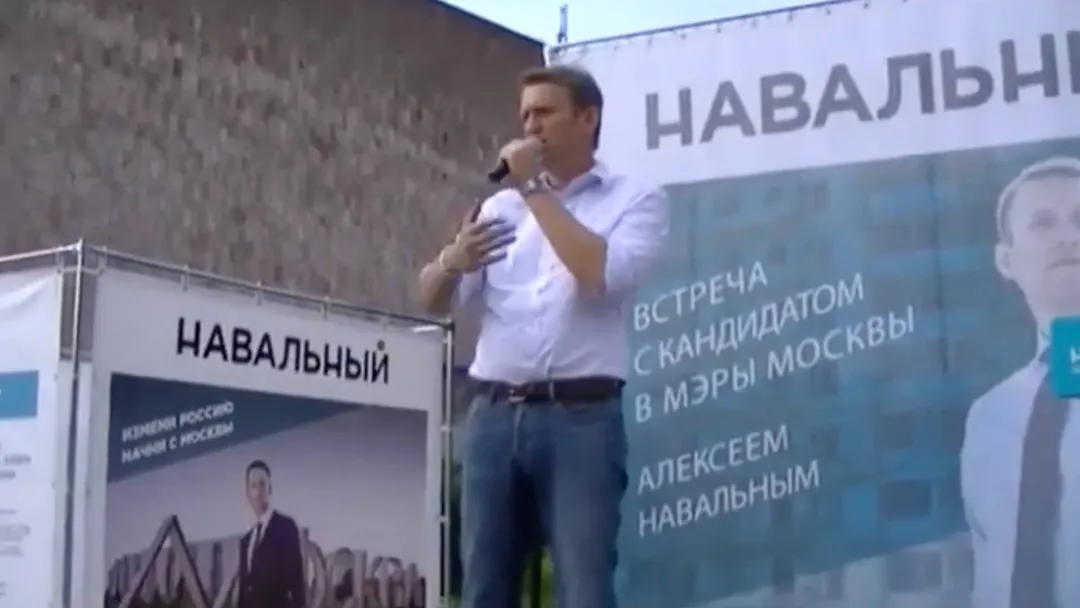
Hello, hello, thank you
very much for coming, please come closer
closer—nowhere closer to go. Well, that's fine, come up onto the
stage. Have a seat. I'm very glad that you
came to this meeting. We hold a lot of them,
and, by the way, this is my
milestone 70th meeting. I don't know—
when I was just starting out and held the first
meeting, I never even thought that someday
there would be a seventieth one. These meetings
are very different. Some are small, which
I actually like better because
there's more opportunity to have a proper
conversation. Some of them we've had
with hundreds of people there, and of course
there's no real conversation, although even in
such meetings there's a lot of value. We
hold these meetings because we asked ourselves:
what should a candidate be like?
Let's imagine an ideal
candidate—what would we want from a candidate?
As a resident, first of all, I
would want him to come to my courtyard,
stand in front of me, and answer my
questions—good questions, bad questions,
and that's something both I and my team are proud of. If there are no
objections, I'd structure the meeting like this:
first I'll talk a little about myself, then
I'll answer questions. No
objections? There's a question? Excellent, I'll
answer it a little later.
All right. Actually, that's an important, key
question. Where the hell did I come from?
No, that's normal, perfectly
normal situation, I don't know. My name is
Alexei Navalny, I'm 37 years old. Friends,
let's not argue, everything is fine, everything
is okay. It was a normal, fair question.
Well, you saw a person and asked,
"Where did you come from?" It happens, after all.
After all.
Really, I'm shown on television
quite rarely, and most likely
only in reports about how I
stole all the timber, so many people really
don't know me. As I already said,
I'm 37 years old, and I have a completely ordinary,
standard family by Moscow standards,
a wife and two children. My daughter is 11 years old,
she goes to an ordinary
school. My son is 5 years old; he goes to a completely
ordinary kindergarten.
I come from a military family, and all through my
childhood and youth I moved from one
military town to another. A military
town—and my parents still live
in a military town. Now I keep somehow
automatically addressing only you
and, by profession, I am
a lawyer. No, all right, wait, she's a perfectly
normal woman. Why are you scolding her? Let
her sit, everything is fine. By profession, I am
a lawyer. I have two higher-education degrees. I
graduated from the law faculty of
Peoples' Friendship University and the Finance
Academy under the Government of the Russian
Federation. If you're asking about Yale University, I
did indeed study there for one year, which
I'm very proud of. It's one of the best educational
institutions, and it was hard to get in.
If you've followed my activities over
recent years, what do you know about me?
Well, so you don't know anything, I
see. That I was released, that I stole all the
timber. Yes, you often hear that I was released,
that there was something, that he's fighting
corruption. Very often I'm simply known to people as
some kind of
person who's always making
demands of someone—there he goes, demanding
and demanding that Gazprom give him back
something, or saying that Rosneft
robbed me, and so on. Everyone asks me,
"Come on, do you really
actually think that you personally,
some guy named Navalny, were robbed by Gazprom?"
And I really do personally think so. Do you
think Gazprom robbed you? It robbed us.
We were robbed. And why do you think you were
robbed by Gazprom? Navalny robbed us.
Navalny robbed us. Well, all right, both
Navalny and Gazprom robbed us. Let's calculate
who robbed more. Okay, that's a good way to put
the question. Robbed us? Well, look—what does
Russia live on? Oil—oil and gas.
Exactly right. We extract oil and gas,
sell it to the West, and live off that money. Over
the last 15 years, during Putin's time,
Russia has received $3
trillion from the sale of oil and gas. Someone calculated—I was
recently told—that if you stacked $3 trillion
in bundles of hundred-dollar bills, it would
it would be 3,000 km high — hard to imagine,
but apparently that’s a huge
amount of money, and for each one of us — for
you, for me, for all of you — it comes to 640,000
rubles. Our share of the oil rent is 640,000
rubles per person.
Per person, per year. And not overall, not for all — for
all of the last 15 years.
So for my family of four,
that comes to 2.5 million rubles a year. What year?
I’m trying to understand. I go around to all these
state corporations, and when I say that Gazprom
stole something from me, I’m simply trying
to understand: where did they put my 2.5 million
rubles? Do you have any sense, any
understanding of where they put your share
of this oil rent? Did they spend it on Zenit (the football club), buy
football players, or something else? In Soviet
times, when we received that kind of money, we
understand that they built factories
plants, residential districts — they built
science, they created industry,
a great deal.
Where are these Putin-era petrodollars, which
are greater than the Soviet ones? There are, I don’t
know, around 100 people standing here, maybe 120. Who can
name for me any major industrial
enterprise that has been built in Russia
over the last 15 years? One. Not a single one. No?
Well, maybe there is at least one. Come on,
let’s remember. In Kaluga Region, they built
a logistics complex — what’s it
called? Well, that means — in other words, that’s
what they built. There are assembly plants — what do you
call them, screwdriver plants — small
enterprises. But still, any large-scale
enterprises, the kind everyone has heard
of? I ask this at every meeting,
I ask this at every meeting,
but please, don’t start fighting,
please don’t ruin my meeting right at the
very beginning.
Please — the opposition and the ultra-
opposition.
So, answering the question of what Gazprom
personally stole from me, I say that
Gazprom — all these people in all these
Gazprom structures — stole my factories
plants, healthcare, education,
railways — everything that should have been
built with that money, but wasn’t.
Rosneft is the same story, with the same
complaints. There’s a woman there, she’s
a vice president of Rosneft responsible for
legal
matters. And by the way, what do you think
her salary is? A state
company — Rosneft. What kind of salary could
a
vice president have?
Yours is 14,500, but hers is a bit higher.
I’ll say right
away: officially, 880 million rubles a
year.
Yesterday I was speaking in Zelenograd,
and when I said this, a woman in the front row
felt faint. She grabbed at her heart, and I was very
worried about her. But that’s not the point.
The point is that this person, with a
salary of 880 million rubles a year,
looks at me and says: Listen, why on earth
do you think anyone owes you anything?
That we owe something to you, to people like you?
That we have to explain anything to you, explain
where we put the oil, where we put the gas, at
what price — why should we?
We don’t owe you that. So leave us alone, please.
And at that moment, I understand exactly how
these people personally stole my 640,000
rubles from me, and 640,000 rubles from my child, and from
you, and you, and everyone. This is a real
problem, an entirely practical one, because
we have neither another life nor another country.
We all want this money, this oil rent,
what we dig out of the ground
and sell forever, to work for
us. I want to solve this problem. I know how
to solve it. I constantly bring them reform
plans, all kinds of
draft laws, rules on how one can
really fight corruption in
state companies. But no one is
interested. And so now, here, to
you, I have come as a candidate for mayor of Moscow,
who wants to earn your support,
count on it, and very much needs
that support, because I simply
want to solve the problems that I
constantly encounter in Moscow when I
live here.
Now tell me, from a different angle —
Moscow, the southeast — I’m concerned about
the problem of migration. Are you concerned about migration?
Yes? Is that a real issue here?
It is? When I was preparing
to speak in your district, I went to the website
of your local police precinct. The police are right here,
they won’t let me lie. What does it say there?
It says: there has been an increase in crimes
committed by foreign
nationals. Do you feel that? I, for one,
do, because two years
ago I didn’t know a single person
whose handbag had been snatched from their hands.
Now I have at least three women I know
whose bags were snatched out of their hands
by migrants. And I know that these migrants come
here to Moscow not because there are
jobs for them here, but because it is easy to
make money off them. Officials
make money off them. So that no one can
say I’m manipulating the numbers,
let me ask you: what is the salary
of a janitor? What is the salary of the janitor who
works in your courtyard? 11,000? 11,000?
5,000?
A janitor.
Wait, where did you say the janitor is standing? Ah—
Over there.
What?
5,000.
10, 12. You see, it's an interesting thing.
It turns out that if we take the official
approved pay standard for a janitor in
Moscow, then we'll see that there cannot
be a janitor whose sal-
ary is less than 30,000 rubles, but the janitors we
talk to all
tell us a different figure: 10, 15,
20,000. Where does the
difference go? It's a secret all of
Moscow knows: all these janitors—hundreds
of thousands of people—are brought here and housed in basements,
in rooms with 20 people each, in buildings slated for
demolition, in five-story apartment blocks.
They're relocated there because these janitors
kick back 10,000 to 15,000 rubles from their wages
.
It's a river of money. It goes to the management
companies, the district administrations, the prefectures,
hundreds of millions of rubles flowing there.
But I want to become mayor and fight this
because, like you, I see only
the flip side of this river of money. I
see crime, I see violence, I see
Moscow schools where there have begun to appear
classes where half the children do not
know Russian—you know about
this, because these children are not to blame for any of it.
They were apparently born in Moscow,
they've never seen any Uzbekistan in their lives,
they didn't specially come here.
Why are there kindergartens in basements, why are there
daycare centers for migrants there, what
... I'm glad that you already
...
Yes, that's right, you're saying everything correctly. You're
absolutely right.
Just wait, please don't be angry with
me, please, because that's exactly what
I'm talking about: migrants are brought here not
because there are jobs, but because
they bring money to all these people
because people simply profit from them. And
if we don't solve this problem now, then
in 10 years our children will face
the problem that hundreds of thousands of people are living in Moscow
who were born and raised here,
who will never go back to some
Tajikistan—they didn't come from anywhere.
They will never work
as janitors; they don't want to work
as janitors, but they don't have—they don't know
Russian. They didn't get a proper education.
They can't get into universities, they
can't get normal jobs, and
the only way for them to earn money
will be to commit crimes, and in 10
years our children will simply find this problem
unsolvable. I want to solve it
now. I came here to you because, well,
tell me please, in your
clinics, are there queues?
Yes? You get to see a doctor in two weeks? Well,
Listen, it's strange the way you're saying this.
A person with a disability gets to see a doctor in two weeks?
But I watch a program with Sobyanin on TV Center (a Russian TV channel),
and they tell him, you know, in Moscow
clinics there is electronic
registration, electronic
check-in. But it's no use.
I got sick and went there.
So you get sick and only see a doctor two weeks later.
Amazingly, you see,
my local clinic looks very much like
your clinic, but the clinic
they show on television does not.
And by the way, do you know that for
the healthcare of every Muscovite
four times more money is allocated
than for any other citizen of Russia? Do you
know that for outpatient clinic care alone
for each of us, there is an allocation of
20,000 rubles a year? For my family of four,
that's 80,000.
Just out of curiosity, raise your hands if you
went to your clinic in the last
year. A lot of sick people, thank you. And now
raise your hands if you did not go to your
clinic. There are still more healthy people among
us. But from the others, from each person, they took
20,000, yet the clinics don't work. I want
to become mayor so that these
huge sums allocated to clinics,
to healthcare, finally go
to general practitioners and therapists so that
people can see a doctor the same day they seek care.
Tell me, please, is it easy to get an ultrasound
done at your
clinic?
No. Strange.
Very strange indeed, you know. Because if you
go over to the metro, near the metro
there will be one of those things, an advertising poster
of Sergei Semyonovich Sobyanin, on which
it says: an achievement of candidate Sobyanin—
he bought 1,200 ultrasound machines for Muscovites.
He bought you 1,200 ultrasound machines—what a kind
man. No, no—but you can't, rightly,
No.
There are no specialists, and we at the Anti-Corruption Foundation (ACF)
know exactly why
this doesn't work, because we
looked into this program
for the modernization of Moscow healthcare
worth 100 billion rubles. We know that these
ultrasound machines and scanners were purchased at twice
the price simply so that people could
make money off them. They bought the most expensive
equipment, but there is no one to operate it,
and all these machines stand in the corner gathering dust; on
them no one works. To get an ultrasound,
you have to book a month in advance. Can you get an MRI at
your clinic? You wait half a year, half a year,
half a year—and yet by the number of scanners, meanwhile
incidentally, we outperform all European
countries; these are the most expensive scanners. I
want to become the mayor who will put an end to
the endless
sending people abroad to study in a bunker
so that at least in five years they can teach our children
properly, because
well, I don’t need a scanner that costs
At the clinic they give me a tour and show me:
“Here’s the scanner. We bought it for $5 million.”
So what do I care about those $5 million?
I want to become mayor because I and my
family need CT scans, ultrasounds, treatment, doctors,
and general practitioners. I will do this. I came here to you
because
I know exactly the size of
Moscow’s budget: 1.6 trillion rubles. Moscow’s budget
is second only to the budgets of New York
and Shanghai. You and I live in one of
the richest cities in the world. The richest
cities in Europe and the U.S. simply
cannot even come close to comparing with us. But at
the same time, here’s my question to you: what do you think, if
we are in third place by budget size,
what place are we in in terms of quality of life
among the largest
cities? You all seem somehow unpatriotic
in your thinking. You’re right. You probably know
the correct answer: 154th
place. 154th place. Even though our budget is enough for
third place, right now we have everything we need
to live normally. We have
money, infrastructure, an educated
population. We have everything. The only thing we don’t have
is one important thing: we don’t have faith
in ourselves, because we listen to these kinds of
stories about corruption. I am sure
that each of you could simply
tell me 100 such stories about
corruption. But we just shrug our shoulders
and think this is normal life, that nothing
can be changed. Yes, we are in third
place by budget and in 154th place by
quality of life. Russia, in terms of oil and gas sales,
what place is it in the world? First. And by
quality of life, what place? Sixty-
ninth. And we shrug our shoulders and think,
“Well, that’s just how life works. What can
you do? Sure, we don’t like it, but
what’s the biggest construction
project here? The metro runs through the district? No?
Well, they’re building the metro now, but road
construction—which ring road?
The North-Western Chord passes through here
here, right? Nearby. How much does
the North-Western
Chord cost? 70 billion rubles, and all the specialists,
all the transport experts, unanimously
say it costs twice as much as it
should. Newspapers write about it, it is
discussed, everyone knows. We all know that in the
construction of the North-Western Chord,
30 billion rubles will be stolen from us. That is enough
to build clinics and
schools all across Moscow, and kindergartens too, and we
would still have enough for more kindergartens. But we
just shrug our shoulders and say, “Yes,
it’s outrageous, of course. They’ll steal 30 billion from us,
terrible. But what can you do? Somehow
that’s how life is arranged.”
I came here to you with one
main idea, really: that
this is not the natural order of things; it is
an unnatural and perverse order of
things, and we can change everything. Our
problem is simply that we shrug
our shoulders. No one is forcing us. Show
me the OMON riot police here who are standing
there and will beat us if we do not
allow 30 billion rubles to be stolen from us on
the North-Western Chord. There are no OMON officers here;
there are three policemen standing there. I am sure they
agree with absolutely everything I am saying
from the first word to the last. It’s just
a government of crooks who rob us
every day. It is based simply on the fact
that we shrug our shoulders and think nothing
can be changed. And I hold these
meetings constantly because I am convinced of
the most important thing: even if people laugh at me,
I truly believe, just as it is written in the
Constitution, that the source of power
is the people. You are the source of power. Yes, on
television I am not there; on television they only
talk about what a terrible crook I am, that I
live in America, that I sent my wife to a
mental institution, and so on and so forth,
but I know there are people who do not believe
any of this. To elect the mayor
of Moscow, you need half a million people in a city
where 15 million live. In Moscow there are half a million
people who know everything, understand everything,
who can replace this government
with ease, each of whom even knows
that I exist, reads my—or has read
my platform, and knows there are answers to
all the questions. All of this can be done. Our
task is simply to bring these people to the polls
so that they stop shrugging
their shoulders, come out, and realize their power. We
can throw out any government, any
government can be brought in, and then thrown out again if
we do not like it. We are the source of power. I
am sure that through you, what I see before me
physically right now is maybe, well,
at most 200 people, maybe 150. But in
reality, that is no fewer than 10,000,
because everyone has friends,
acquaintances, relatives, neighbors on the
landing. Research
shows that the persuasive power of each
individual person is astonishing.
If you talk to ten people,
you will guaranteed—simply
guaranteed—persuade six of them.
People want to hear advice, and I hold
these meetings constantly, and I even calculated
that if I hold 100 such meetings, and I
I already said it: Yubileynaya, the seventies, and that's it.
In the end, things will be fine with me. After
I do, after all, carry it through,
And I will speak more or less personally, since with
you, with 1 percent of Moscow's voters,
that's a lot. Show me even one more
candidate who has spoken personally
with 1% of voters—there is no such person. I am sure that
by relying on you, I will be able, through you,
to reach those hundreds of thousands, even
millions of people. I am sure that if we
believe in ourselves,
then that long-awaited moment will come
when people finally come out to vote and
we will change this government, fix it for ourselves, and
elect the mayor who will work
for us, return power to the people, and
build a city for us and for our children.
Thank you very much. I'm ready to answer
questions. Thank you. Please.
A question. This morning I was listening to the radio,
and Echo of Moscow was reporting that allegedly you have some kind of
business in Montenegro
enterprise there.
They said on the radio that allegedly in
Montenegro there is something of that sort. In that regard, I am exactly
the person I claim to be, and you
will see all of that. Next question.
Please, where are my friends Nemtsov, Ryzhkov,
Yashin, Kasyanov, and all the others? Listen, I
am probably the only politician in Russia
who is on good terms
with everyone, from liberals
to nationalists. And these people do not
need, the people you just mentioned, any kind of
protection from me or legal
services—they are independent politicians,
they act independently. I came here to
see you because I want to find for myself
new, additional friends—you are my
main friends. There is no need to bring anyone here,
because I want with you, with all of you,
to become friends. I came here to
persuade you. Those various red people are there,
they act independently, but I
am an independent politician, and I am running in the election
in order to carry out my
program for you, in your interests.
Please. Mos... I see...
a lot of... well...
Briefly, who...
Mitrokhin—I don't see you... around Moscow...
There seem to be billboards for all the candidates, but I don't see
mine. Well, listen, if you probably
turn on the television, of course mostly you
will see Sobyanin, but the others
are shown a little too. You also won't see my
billboards, because we were refused on
all billboard placements—we were refused.
Avtoradio refused to place our
advertising. Odnoklassniki refused
to place our advertising. The mayor's office forbids
us from holding rallies, and so on. Well,
listen, all of this is understandable. It's not even that
I'm complaining—I have lived under conditions of
an information blockade for many years, because
for these people this is not just
an abstract thing. If Navalny wins,
that is something completely concrete. If
I win, very specific
friends of Putin—Timchenko and Rotenberg—
will lose Moscow contracts worth
billions of rubles. For them, my victory
means the loss of specific billions
that they are making right now.
That is why they will do everything they can to
block me from television, block me from
radio, even billboards, and the rest. But
listen, I understand that this is sad,
it's frustrating, but to be honest I did not
expect that they would allow it, so
from the very beginning—this is where I started—our
campaign was based to a large extent on
meetings with voters. They cannot take that away from me,
they cannot take away my right and
opportunity to come here and tell you all of this.
And I am sure that if today I can
convince someone, then those whom I
have convinced will work a hundred times
better than any billboards. Please, two
short questions. Will there be early
voting in Moscow—can one now
vote early? And second, if
you win, will you keep
anyone from the current team in office? Question
number one: early voting. Early
voting is possible. You need to go to
the territorial election commission
for your place of residence and say, 'I want
to vote early,' and in principle there they
should give you the right to vote early.
Question number two: will I keep anyone from
the current
team? What do we mean by 'team'?
The city is run by tens of thousands of people.
If we take the prefectures, state unitary enterprises,
municipal unitary enterprises, DEZs, and so on—all these people,
they cannot be removed, and in fact there is no need to.
Eighty-five percent of them, 85 percent of them, are in fact not
corrupt, because they simply have nothing
to steal; they are not in positions
where it is possible to pocket something. What
needs to be changed is, of course, the political
leadership—all those people who
are tied together like a mafia, each of whom
may work a little better or a little
worse, but they see themselves as a mafia. That
entire top leadership needs
to be removed. Working with these people
is possible, of course. Please... they will not
give you... they won't give it, they...
to you. A good question: ethnic
crime. It is indeed clear what
to do about migrants—I have
a program, and I can speak separately about that later.
About migrants. But what should be done about ethnic
crime committed by our own Russian citizens? Well,
you saw what happened at
At Matveyevsky Market, remember, Dagestanis
beat up a police officer, and in response
the Moscow government set up a concentration-camp-like facility
where they put
Vietnamese people. That was their original
solution to the issue. My solution to this
issue is that we need to
simply apply the law equally to everyone.
If there are three equally guilty hooligans there
fighting — a Russian, a Dagestani, and a Chechen — what
happens now is that the Russian gets locked up for 15
days, while with the Dagestani and the Chechen they start
taking them in and trying to figure out: what if
his father is a prosecutor over in Chechnya, and this one
has some police relative in Dagestan? How
would it turn out if we jailed him — wouldn't
someone come here with some Chechen
police officers and start a showdown? And they begin
sorting all that out. As long as our country has
these political
enclaves like Chechnya, where all the former
bandits have been handed security service IDs,
just go to the President Hotel,
go to Yakimanka — these so-called "basmachi" (a derogatory term for bandits from the Caucasus/Central Asia) are sitting there
just obvious gangsters, and
every one of them has an ID saying FSB major, all of them
sitting there with pistols. But this is
complete madness. Of course, this is an issue
at the federal level — fighting these
political enclaves. But my task as
mayor is simply to treat everyone equally.
If it's, say, a Chechen or
Dagestani hooligan, he will be jailed for
15 days exactly the same as a Russian, and they
won't start finding out who his uncle is, who his
father is, or what complications might arise
in Makhachkala — I don't care about that. My
job is to ensure public order
for you. That's the position I will
stand on.
Thank you. One person, one question, after all.
There are many of us here. I'd like to shift the focus a little.
Let me turn to something else.
We
are people who worked all our lives, we are pensioners, and I
have this question. You see, I have been
officially employed since 19[unclear],
but what does it come to? I worked my whole life,
I worked all my life, and as a lawyer you ought
to know and look into this matter. We worked our whole lives,
we received the status of Veterans of Labor
(an honorary Soviet/Russian labor title).
In due time we got our pension, we got
disability status, and then suddenly they tell us: aha,
if you're a Veteran of Labor, if you've received
disability status, then to hell with your Veteran of Labor benefits,
we're cutting you off, that's it, you're no longer a veteran.
Keep the certificate, keep the medal, but the phone benefit
we're taking away, the extra payment too — but you
still receive
it all because I ruined my health through my work.
Is that right? And suddenly I get
nothing — a fig sign, nothing at all — and
nothing. Is that right or wrong? Is that
the law or what is it? Listen, this is an obvious
thing. Is it right or wrong? Well,
of course it's wrong. At every
rally people come to me with this. I'll tell you now what to do about it.
At every rally, people come up with similar
problems — large families, and so on.
People with disabilities have problems not only
the ones you mentioned — with medications.
The problem is that it's impossible to get the medicine
you need; instead they give you substitutes.
At the same time, you know what needs to be done first of all?
Just look at the size
of the Moscow budget — it's gigantic. For example, in our
program there is a point saying that
we would immediately halt adoption of
the Moscow budget and its implementation for
2013, because we want
to double the Moscow pension supplement.
How much is the Moscow pension supplement now?
Four thousand-something, so that
the standard comes to 12,000, right? Yes, exactly.
That's right. We know for sure that in order
to raise it twofold, we need an additional
138 billion rubles to increase the Moscow
supplement twofold and make the standard
16,000. The money for this absolutely exists.
It's definitely in the Moscow budget. We know where
to get the additional money. I'll give you
a very simple example.
How much do you think is spent every
year on public procurement in
Moscow? 600 billion rubles, I'll tell you. And out of those
600 billion rubles, the Moscow government itself
openly says that 150 billion is stolen. Well,
they say we have enormous corruption,
150 billion rubles is stolen. What is 150 billion
rubles? It's 30,000 rubles for every Muscovite.
30,000 for you, 30,000 for me, for my
family of four that's 120,000 rubles.
I know exactly how to save that
money. In our Anti-Corruption Foundation (ACF),
we have already gotten
59 billion rubles' worth of corrupt procurement canceled, even though we
are not officials and have no
formal powers whatsoever. So, answering
your question in this perhaps rather long-winded
way: there is money in the Moscow budget
so that people are not simply humiliated
by taking 2,000 rubles away from them. Second, through
priority anti-corruption measures
that we know exactly how
to implement, we will free up additional
billions. And with that money we can
make social payments to everyone who
needs them in Moscow. Maybe in
other cities that's a problem, but in
Moscow it can definitely be done, and we will
do it. Next question, please. And
you know, I'd like to know how you will
fight this, and whether you will. We have this kind of problem — I'll repeat it
for everyone — we have this problem in
Russia, and in Moscow it is actually quite
large-scale: more than 50% of enterprises
operate with black and gray wages (off-the-books and semi-official pay).
Naturally, people here are not protected — there is no
paid leave, no sick leave, and then pensions are
tiny, and so on. I understand that this is
a multifaceted issue. The question of off-the-books and
gray wages — how can this be dealt with? Well,
of course, first and foremost this is a matter
of federal regulation. But Moscow
can also do important things. What can the mayor of Moscow do? And
in your opinion, in which sector
of the city economy are there the most
off-the-books and gray
wages? First and foremost, housing and utilities services. In other words,
it is actually the state itself,
the municipal services. We were just discussing all these
migrant workers here already.
Each one gets paid and receives half
of their wages in cash. So first and foremost
my
task
in city management
is that I have full ability to do this.
I understand how to do it. And
here we simply need, I don't know, measures of
basic oversight. It is fairly
easy to track everything. But of course, overall
gray wages are a matter
of federal regulation. As long as we have
such a crazy unified
social tax, as long as the tax system is like this,
then
it is impossible to fight this. This is
a matter of federal regulation. That is exactly
why we wrote on our poster:
Change Russia — start with
Moscow. A lot of strange and wrong things happen in Russia,
and all
change in Russia will either begin or not begin
depending on whether Muscovites want it or
do not want it. If Moscow elects
a mayor who truly relies on the opinion
of Muscovites, then for the first time a mayor will be elected
whom not the election commission
made mayor — not television, but Muscovites. I
am sure that we will begin change at the
federal level. Next
question: why won't this happen? They'll steal the votes.
They appoint us, they choose for us. Well,
listen — you see, this is exactly what I was talking
about. People here are simply
saying it won't happen, that you'll never
be elected. That's exactly where I started. We
for some reason
assume in advance,
we have programmed into our minds that no,
they won't elect you, and so on. But why not?
Why do we assume in advance that
nothing can be changed, that they will always
steal?
Right, because you voted for
one person, and do you know what they did to us?
We lived in the old building, and they... Let me
give you the microphone. Keep it shorter, shorter. We, we
lived in one building.
Uh, in '98 we were already in the new one, and
they took us to vote in
'90... And those people who, uh, in
'90 — we had already moved into
building eighteen. And what happened? All
our votes went to some other guy. Understood.
So then, your question is not about whether
I won't be elected. Your question is that
the votes
will be stolen. That's one important point. Yes, we have
a situation in which
a district has 100,000 people living in it, and three
women in the district administration rewrite the protocols for everyone.
Do you like United Russia?
No? Well, no. Fine, let's suppose
that even here, among those gathered, United
Russia is not liked. But what percentage
should its real percentage be?
For United Russia in Moscow — 15? 10? Well, 10–15.
Fine, let's say 30. And in the Moscow City Duma, how much of United
Russia is there? Ninety-five
95%. This is about the fact that we ourselves must
protect our votes. We have already
sent 25,000 observers and commission members
with voting rights. We are
mobilizing. I invite you — there is no need to
treat this as if they won't let us. Of course they won't
let us. We must take it ourselves.
Sooner or later, we will do it. Court
— we went to court over every polling station.
But before it gets to court, every polling station needs
to have 10 observers sent there. Around
each polling station there will be another 10
people standing by to back up
the observer. We have to defend
ourselves sooner or later. If someone comes up to you on a
trolleybus and says, 'Hand over your bag,' and
starts pulling it away, you fight that person,
don't you? It's the same here, exactly the same.
They aren't even pulling away a bag — they are
pulling away your pension for the next 10 years, they are
pulling away your money for healthcare,
education.
So why should this be any different? Therefore, a person who tries to take that bag...
...in the face...
Figuratively speaking, we'll hit them in the face. Next question.
Next question.
Please, you have outlined a range of problems. Roughly speaking, where
will you start? As I already
said, the increase in housing and utilities tariffs from August 1
is unjustified, it is absurd,
it is completely unclear what any of it is
based on. At every meeting, people ask me
a lot about housing and utilities. I personally
deal with Mosenergo and Mosvodokanal (major Moscow energy and water utilities).
This is nonsense. Tariffs in Moscow should not be rising.
We already pay far too much. Second, as
I already said, we will double the Moscow
portion of pensions so that
the minimum standard is 16,000. Third, I
will begin reviewing these
corrupt contracts. At every
construction site, people are making 200% profits simply
by skimming off the top. Wherever there were violations
of the law.
Fraud in the Moscow budget—these
are the three most important things. Next question.
Please, about housing. We've been
fighting over housing for two years. What do you mean
by housing? The waiting list? No—what about demolition, demolition
of the five-story buildings? Yes, and
the nine-story ones too. Look, as for the five-story buildings,
the issue is very simple.
The five-story buildings were built from 1962 to sixty-
eight. For how many years? For
25. They've already outlived their service life. My
position as a candidate for mayor of Moscow
is very simple: these five-story buildings make no
sense to maintain, it's expensive, they need to be
demolished, including the demolishable series, and the city will
benefit from it. If I'm a sensible mayor and
I look not at a two-year horizon, where I
need to spend money on rehousing and demolition, but
at a ten-year horizon, I see that this is
beneficial. Heating these five-story buildings
is impossible, housing and utilities are very expensive, and living there
is impossible. So we simply have to
demolish them if we want to govern
our city properly. So my position
here is completely unambiguous. Alexei,
Alexei, please. Ahem, I'd like to add
we're currently being relocated from a five-story building. I have
a two-room apartment, 45 sq. m. (square meters), and people
are being given the same kind of two-room apartment.
Why? Listen, by law you should
be given housing according to the number of people
registered there; they can't base it on square meters.
They should. Right now they've introduced rules under
which they allocate by floor area, but in fact
of course it should be based on the number of
families, and we can allocate that way. Well,
listen, under Luzhkov (former Moscow mayor) this all worked.
Under Luzhkov it was simply investors. All right, I understand
the question. Under Luzhkov, investors could even
make money from this. It's just that Sobyanin's
construction mafia makes money from
something else—it profits from the biggest
projects, like road interchanges. They put all the
money there.
My job isn't to make money
there or anywhere else. My job
is to serve Muscovites, so we can
relocate people from five-story buildings under a normal scheme,
settle people in the same municipal
district, and give as many apartments as
they are entitled to. These are not such gigantic
costs.
This is the next question, about housing and utilities. I ask that
since you have access to Putin, ask him
this question. I'm glad you think so. I
will try. The question is this: everyone is worried about
this accursed
housing and utilities system. Bring back the way it used to be—
the Ministry of Public Utilities.
Disband this whole
economist-accountant crowd. Just look at how many
people, how many people
are concentrated there—idlers. They do
nothing, and huge sums are involved. Put it all into one
fist: a Ministry of Public
Utilities, with city-level administrations
of public utilities, and district-level ones too, and
that will sort it out. Understood, the question. Well, first of all, I'm glad
that you think I can just directly
go to Putin—no. If you elect me,
I'll have a direct line, a helicopter line, I'll call
and pass it on to him for you, I will pass it on.
That's the first thing. Unfortunately, what you're
talking about is no longer possible.
The housing and utilities system has collapsed; it doesn't exist at
the federal level, it simply doesn't exist.
So at the level of the mayor of Moscow, this
cannot be established or restored. But
the main thing that needs to be done—you say
we should drive all these people out. That's right,
because this is a mafia-like system. Who
owns all the management
companies, the main maintenance offices—who handles
repairs? Who is responsible for
landscaping and beautification? Some subsidiaries of the main
district administrations, and so on. This is the most
genuine mafia system. Yes, this needs to be—
it's all happening completely out in the open.
This has to be fought.
Please, next question.
These days they say, we're installing
meters for you. I say, how much does the meter cost?
They say 6,000 rubles. I say, all right,
but do I need to install them? I already have
them.
They say, we don't deal with meter-related questions.
And why is it that, say, one person
living in a one-room apartment has to pay
for the whole building? You've just described the issue with
meters: they force a person—he had
one meter installed, then they say he needs another
meter, then they'll tell you this one isn't
a certified meter. Let's get a
certified meter, pay for the
certificate—I went through this myself, I installed a meter
myself. But this is just a typical
example of outright mafia and monopoly—they
just keep extracting money endlessly. Now you
know they've introduced a minimum
social electricity standard, and now
they're doing the same for water, and they tell everyone, well,
guys, you're using so much electricity.
Medvedev tells us: let's somehow
cut back, buy yourselves different
light bulbs, replace your stove
with an energy-efficient one. You all have
the money to buy a stove with a ceramic
surface, of course—absolutely no
problem at all. This is just an obvious, simply
a scam. It's done so that we
pay more for housing and utilities, because we
will exceed this social norm.
It's impossible not to exceed it if you have
two light bulbs on at home.
In that case, that's it—you've
already exceeded it. This is simply a mafia-like system that
has to be fought. Let's have one person,
one question. This concerns the issue because
Just look: the person works all
day long, goes to work—how could he possibly
use up so many cubic meters of water in a month while living alone in a
apartment? That’s actually very easy to explain.
They
First of all, let’s say they wrote off some new
losses, pocketed the money, and included it in your
utility rate. That water leaked out through old
pipes, and they simply spread the cost across the whole building.
So you paid less for your own
water, and more for the
water that leaked into the ground or
was simply sold off somewhere under some shady
contract. That’s all there is to it—you
are paying for other people. That’s how it
really works. That’s how
Moscow’s housing and utilities system is set up: we are constantly paying for
someone else. Look at the water rates—from
... to ... Why do some pay 50 and others 8?
And why are those who pay 50 subsidizing those who
pay 8? They’ve stuffed our rates with some kind of
absolutely astonishing
nonexistent items. They call it an investment
component. They keep telling us:
we built a new power plant, we installed new pipes everywhere,
so let’s raise the
rate. But that’s a lie, and
everyone knows it—none of it exists.
In 2011, Mosvodokanal (Moscow’s water utility)
made 3 billion rubles in net profit
off us, and then they say:
we’re raising the rate. They go to the Moscow city government
and say, we want to raise the rate even more.
And the Moscow government says, fine,
raise the rate. Guys, you just made
3 billion on this—where did that money
go? And why should you be paying a higher rate?
But no, they raise it. Moscow’s
housing and utilities system is a genuine
mafia-style system, and it has to be fought
like a mafia-style system. My friends, I have
another meeting ahead of me, and later this evening
I’ll be on Echo of Moscow (a Russian radio station) to discuss
migrants. I’m very grateful to you for
coming here. Thank you very much.
All other questions can be handled on an individual
basis. I would very much like to have your
support. I hope you will become
my campaigners and bring lots of
people to the polling stations. We will
definitely win.
Hooray!