Alexei Navalny’s meeting with voters in Moscow’s Bibirevo District
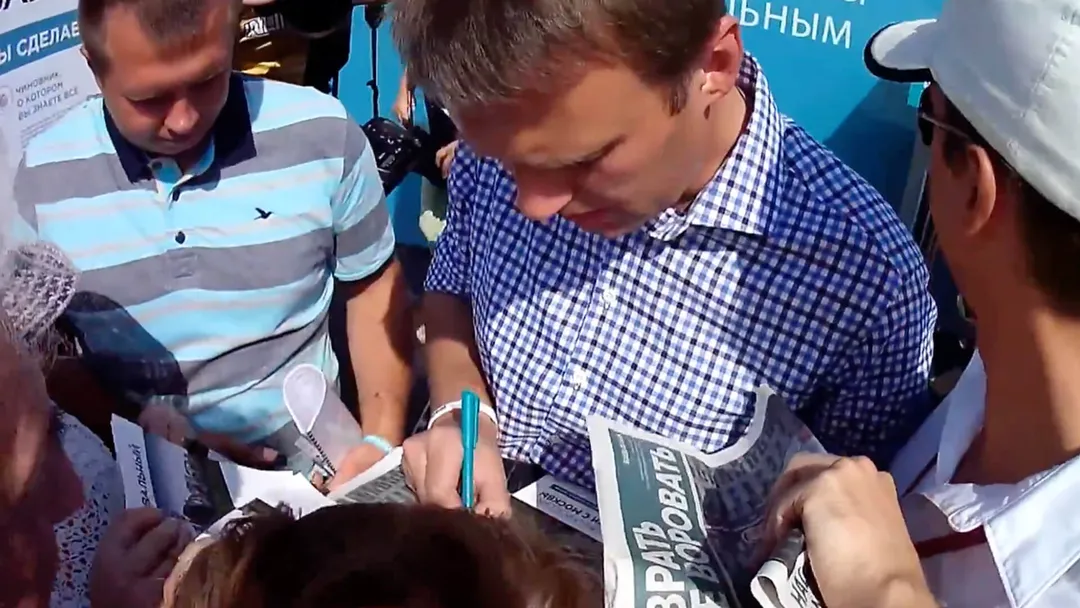
Hello. Wow! You have so much
energy in this heat?
We’ll have to roast a little. As
you can see from the tan on my face,
our rallies regularly take place
out in the sun. But in any case, that’s much
better than some
rallies in pouring rain. Thank you
very much for coming. It’s very
important to us that you come to meetings like this.
When all this was being planned and we were putting together
our election campaign,
planning how to spend our money and
what to focus on most, there was
a lot of skepticism. People said, "Come on,
what kind of nonsense is this, meetings with
voters? Nobody ever
does that. Let’s make videos instead,
let’s spread more things on the internet
or something." But we, and I personally, simply
tried to imagine, for ourselves,
you know, the ideal candidate. And what
should a candidate I would actually
like do? I would want my
candidate to
rely not mainly on paid campaigners
but on volunteers, so that his
supporters would work for free. I would
personally want my candidate to come
right into my courtyard and stand there
speaking in front of me. What happened?
Let’s all be friendly, everyone.
Thank you very much. And I tried to become
exactly that kind of candidate, one who
comes out, attends meetings like this,
answers residents’ questions. I hold
three such meetings every weekday and
five every weekend. And this is,
of course, not easy work, but this personal
contact is a wonderful part of an election
campaign. If I myself say that I
want Moscow to have transparent
government and accessible government, then
I have to be the kind of candidate whom
you can find on the streets of
Moscow three times a day and ask pleasant,
unpleasant, any kind of questions, look at him,
and listen to his answers.
If there are no objections, I’d like to start
by saying a little about myself, about
why I ended up here at all, and then
answer your questions. All right.
All right, then let’s begin. My name is Alexei
Navalny. I
have lived in Moscow’s Maryino district
for the past 17 years. I’m 37 years old, and I have
a completely ordinary, standard
Moscow family. There’s nothing unusual about
it. Just a typical wife and two
children. My son is five years old. He goes to
a regular kindergarten. My daughter is 11; she
goes to a regular school.
I come from
a military family, and throughout my childhood and
youth I moved from one military
town to another. And my
parents still live in one of the
military towns outside Moscow. By
profession, I am a lawyer
and I graduated from the Peoples’ Friendship University,
Faculty of Law, and from the Financial
Academy under the Government of the Russian
Federation, specializing in securities
and stock exchange business.
That’s absolutely right.
If you’ve followed what I’ve been doing over
the past few years, what do you know about me?
Nothing.
Nothing.
Nothing.
Well then, I’ll tell you. I do have
something to tell. You’ve probably heard
that I’m this scandalous
minority shareholder who sues everyone,
always making some kind of complaint,
demanding that these people be jailed, demanding
that those people be jailed. I say that Gazprom
is full of swindlers, that VTB has the wrong
kind of people, and so on. I don’t like any of it, and
I want them all in jail.
Uh-huh,
good for you. [laughter] Yes,
I’m glad that’s your attitude, but
people often tell me, "Good for you," but at the
same time they still ask, "Listen,
why do you get so worked up about this?
Why do you go after them so
aggressively? It’s as if
they stole all this from you personally and took it
away from you personally."
Why? It’s not as if it was taken from you personally. It was
all siphoned off somewhere out there,
at Gazprom or wherever. Who here has even seen the
Gazprom building, even in a picture? Not many
people. Still, it all seems like it’s on
another planet—this mysterious Gazprom,
something totally remote—why
bother with it? It has nothing to do with us.
I’d like to begin our meeting by answering
that question, because I think
it will make it much clearer to everyone why I’m
here.
I go after them—all these Gazproms,
Rosnefts, and all the rest—because I
truly believe that it wasn’t some abstract
theft from me in theory, but a very
concrete theft from me and my family. I even have
the numbers to show it. But first, tell me:
what does Russia actually live on?
What is Russia’s economy based on?
On—on the oil pipeline.
On the oil pipeline, on oil and
gas. Unfortunately, Russia has turned into
a kind of raw-material appendage. Not just now—this happened
many, many years ago. And it lives
by selling oil and gas. That’s
what it lives on.
And who knows how much, over the past
Over these 15 years, during Putin's years, Russia
sold how much oil and gas to the West?
Does anyone know? Who doesn't know?
We don't know.
Approximately $15 billion.
You think it's $15 billion?
Trillion—something like that.
$3 trillion. So over 15 years we
sold $3 trillion worth of oil and gas.
That money came into our country.
Is that a large sum or a small one?
Very large.
Very large. How do you know? Have you ever seen
a stack of money worth $3 trillion?
Can you picture what
a trillion is? I can't, but it's
much easier for me to imagine if I take it
and simply divide it among every citizen
of Russia. It turns out that each of us
— from infants to centenarians — would get
640,000 rubles. We've sold so much oil
that each one of us is entitled to
640,000 rubles. So for my
family of four, I calculated, that comes to
2.5 million rubles. Right? I go to
Rosneft, I go to Gazprom, I go to all of them
and ask just one question.
Maybe it's naive, but: guys, where are my
2.5 million rubles? Where did you put them? Well,
just explain it to me. Obviously, you're not
handing it out in cash, but if my share
of the oil and gas was sold, explain where you
invested that money.
There are older people here.
You remember that in Soviet times,
during the Brezhnev era, the Soviet Union
also received a huge amount of
petrodollars. We know how they were
spent. You can argue whether that was good or
bad, but we know exactly. All these
apartment blocks and residential districts were built
with Brezhnev's petrodollars, and apartments
were given out for free.
Huge plants and factories were built across
the entire country. They were built. Scientific
capacity was created. They created
the military-industrial complex;
it was built on those Brezhnev petrodollars.
Railroads were built, too.
The space industry was being developed,
money was being invested,
money was being invested—well, we know how
all of it was spent. The largest
army in the world existed. Remember there were
those so-called socialist-oriented countries?
We were subsidizing them all over the world—in
Africa, Asia, Latin America,
everywhere.
Right. Yes. Well then here's the question: if we know how those
Brezhnev petrodollars were
spent, then how were Putin's
petrodollars spent—especially since there were actually even
more of them? There are about 150 of you standing here,
I suppose. Tell me, please,
can you name even one major
industrial enterprise built in
Russia over the last 15 years?
No.
Sochi.
Sochi.
That's a pretty questionable industrial enterprise,
to put it bluntly.
The Zenit stadium. Well yes, an expensive, very expensive
thing.
Sick and tired of these Olympics.
The Olympics. People also often mention Skolkovo,
sometimes Rosnano.
The Ozero cooperative?
Ozero? The Ozero cooperative. I ask this question at every
meeting.
At not a single meeting has anyone given
an answer. What industrial enterprise?
Simply because not a single
industrial enterprise has been built in
Russia—not even an oil refinery
has been built over the last 15
years. So I ask all of them: "Well then,
where are my factories? Where are my plants? Where is my
new Russian science? Where is healthcare?
Where is education? Where are the railroads?
Russia builds as much railway in a year
as China builds in a week.
And China has neither oil nor gas. Where did all of it
go? What was all of it poured into?
I don't understand. And when I go
and ask questions like this, for example at
Rosneft, Russia's largest oil
company, which I am constantly suing
over lack of transparency, corruption, and
so on, there's this woman sitting there,
a vice president in charge of
legal matters. While working at
the state-owned company Rosneft, she has
an official annual income of 880 million rubles.
This is not an exaggeration; you can all
look it up. A state oil
company. And she looks at me when I
ask these questions and says, "What makes
you think that anything here belongs
to you at all?"
What makes you think that people like you
are entitled to any share of this oil
rent? Why did you even decide to come
bother us?"
We're one thing, and you're another. We are
the state, and you're just some people out there
who simply don't understand how serious
this business is. And so, going back to the beginning
of our conversation and the question of why I take
all this so personally—this is
exactly the moment when I understand that it is
very personal, because I can almost
physically feel their hand
going into my pocket and pulling out those
very 640,000 rubles that belong
to me.
At that same moment, a hand is shoved into my son's
pocket too, and pulls out his 640,000 rubles.
rubles. And probably 640,000 rubles for each of you,
because, just like me,
you probably cannot find in
Russia where exactly your share of
that oil money was invested.
They tell all of us, and they tell me: "Well,
Alexei, it’s not all that bad. There are
some rankings where Russia is moving
forward successfully." In what rankings is
Russia moving forward successfully?
Corruption.
Corruption. Are we supposed to be proud of that ranking?
Well, it’s not exactly something to be
proud of. What else?
In sports.
In sports. Well, it doesn’t really look like we’re
making huge progress, but in sports
we’re doing fine.
Well, there’s also a ranking, for example,
of billionaires. In 2000, we had
six dollar billionaires in the
country, and now there are 121. Let’s
be proud. Here we are, standing and sitting
in Bibirevo (a district in Moscow). Let’s be proud of how many
billionaires Russia has. Somehow I
don’t feel like being proud of that. I don’t
want to be proud of the fact that houses
in London worth more than a million
pounds are mostly bought by Russian
officials. That doesn’t really seem like a reason for
pride, does it, from where we’re standing
here.
And that is why, again, I take all of this very personally,
because I have
a strong feeling that we are moving so fast in the
billionaire rankings. And that
our officials are buying houses in London
because someone’s hand reached into
my pocket and took my 640,000 rubles—my share of
those very oil revenues.
And here before you I stand as a
candidate for mayor of Moscow, and I very much want
to earn your support, and I need
that support, because
I want to solve in Moscow the problems
that worry me, irritate me,
that I know about, that I want to, that I
understand how to solve.
And they concern me no less than
they concern you—perhaps even more. For example,
I think that if I were to ask you right now
what problems worry you, you
would say housing and utilities. Housing and utilities,
yes, yes,
worry me even more, because
for my apartment in a prefabricated apartment block
I get a bill for 9,500 rubles. And I,
as someone who has endlessly sued
all these Mosenergo and Mosvodokanal companies and
so on, simply know that into our
housing and utilities rates they cram things
we should not be paying for.
I want to become the mayor who finally
conducts an audit of housing and utilities rates so that all of us
can see how much there is in them that can be
thrown out, and that would reduce what we pay. Do you
know, for example, that when you paid last
year for electricity and
heating, all of us together paid for
300 million rubles in sponsorship for United Russia
(the ruling political party). It was included in our rates, and we
paid it.
Mosvodokanal, which exists for
us, for our city, in 2011
made a net profit of 3 billion rubles.
It sends that profit off somewhere, nobody knows
where, and then comes back demanding:
"Let’s raise the rates for Muscovites."
So why the hell should I be paying
so much for cold water?
I can see that this is our city
company. It has already made 3 billion off me and
off you. I am not going to pay
more, yet every year they still
raise the rates. I see very strange
things with the cold water tariff. It ranges
from 8 rubles to 50 rubles. And why is it that, in some
unclear and strange way, some people
pay 80, others 50, and we are subsidizing
someone else—but who is paying for whom?
I want an explanation. I want to become
the mayor who finally creates
a normal, transparent system in which
we will not be paying for cheap housing and utilities
for some ведомственные houses (agency-owned residential buildings),
holiday facilities, and so on. I want to become the mayor
who throws out of these
investment programs
all the nonexistent construction projects, all these
corrupt components. Then we
will see that in Moscow, housing and utilities rates should not merely
stop rising—they
should be going down. So when I
say that in my program
there is a repeal of Sobyanin’s decision to
raise housing and utilities rates from August 1—that is
not just a political gesture, it is
simply a calculation showing that
this rate hike is unjustified.
I want to do this because I simply
want to pay less. You probably
want to pay less too,
naturally.
Well, then I suppose I represent your
interests. I came here because it is
very expensive to live in Moscow. Is it expensive to live in
Moscow? It is.
Moscow is an expensive city.
I lived in the United States for half a year when I was studying
there. I can say that everything there is twice
as cheap, without exaggeration. Anyone who has been
to America knows it. Groceries there are
literally twice as cheap. Clothes there are
twice as cheap. Gas at a Lukoil
station in the U.S. costs less than gas at a
Lukoil station in
Russia. It is expensive to live here. And when they tell me that, well, for Moscow
resident, well...
A pensioner gets a pension of 12,000 rubles, and this
is considered normal, that you can live on that in Moscow, right,
it makes me laugh. I have a fairly decent
salary myself, and even so I know how hard and
expensive it is to live in Moscow. And I can see that in
the Moscow budget there is money available
to increase social payments. And we
can raise, for example, the Moscow
pension supplement. How much is the
Moscow supplement now?
3,700
from 4 to 4.5, bringing the social minimum to
12,000.
up to 12,000. I look at the Moscow budget and
together with our specialists, with our financial experts, I
see that it is possible to raise the Moscow
pension supplement twofold and thereby
set the minimum social standard
for pensions at 16,000 rubles. We calculated that
this would require 138 billion rubles a year. That kind of money
exists in the Moscow budget. I know where
to get it. I even know where to double
that money. Do you know, for example, how much
is spent in Moscow every year on
public procurement?
600 billion rubles. And the Moscow city government
quite openly, without any embarrassment, tells us:
"You know, out of 600 billion rubles
a year in public procurement, about 150 billion
gets stolen." As if, well, those are unavoidable
losses. And what is 150 billion? That's 30,000
rubles per Muscovite. So for you, for
you, and for me, 30,000 rubles are stolen
from us every year just through public procurement. For my
family of four, that's 120,000
rubles a year. I know exactly how
to fight this. At our Anti-Corruption Foundation (ACF),
despite having no official powers,
we got corrupt tenders
worth 59 billion canceled. Even though we have absolutely
no authority. I'm not the mayor now. I
just have ordinary lawyers working for me,
digging through paperwork, exposing
corruption and getting corrupt
tenders canceled. We've already drafted bills,
a resolution, and instructions. I know exactly
how to save those 150 billion. And I
know for certain that in the Moscow budget
there is money to make these
payments. And once again, it just makes me laugh
when people say there isn't enough. Do you know
how much a large family receives in benefits, a family
with four children in Moscow? Who
knows?
About 3,000 rubles. Now look, there are
six people in that large family.
From each of them, just through public procurement, as I
said, 30,000 rubles are stolen. And in return they are told:
"Here, for your large family
3,000." I know how to change that.
That is why I am running for mayor of Moscow. I came here
because I personally,
living in the southeast, am very seriously
concerned by the issue of migration. Do you here
have a migration problem?
Yes. So I wasn't mistaken. So I
wasn't mistaken, including because
when I was preparing to speak here, I
looked at the crime statistics brief
for your district and I see that
it confirms that 50% of crimes
are committed by migrants.
Even more.
Well, even by official figures it's 50%.
How much it really is, we don't know; we
can only guess. And we
do guess, because for us these are not
abstract numbers. For me, this
migrant crime means the women in
my building who are afraid
to go outside in the evening. For me, these crime
figures about migrants mean
people, women I know, whose
bags were snatched on the street. I think
almost everyone has acquaintances like that.
I am running for mayor because I know very well
that migrants come here in huge numbers
not because there are jobs for them here,
but because
they are an easy source of profit.
People simply make money off them. Let's
do a quick little survey right here
right now. How much does the janitor in
your courtyard earn? Who knows what the salary of
a Moscow janitor is? 12
10, 18
15
15
15, 12
12
Amazing, isn't it? Because we can take
the official calculation of the minimum rate
for janitors in Moscow and see that there is no
janitor in Moscow who
would be paid less than 30,000 rubles. But all
the janitors you talk to, just like the ones
I talk to, tell us different amounts.
They say 10, 15, 12. Where does the
difference go?
It's a kind of secret flowing into people's pockets. A secret
all of Moscow knows: that
these migrants are brought here, kept in
slave-like conditions, housed in basements, in
buildings slated for demolition, and so on, 20
people in one room, because
the migrants kick back from their wages
10,000 to 15,000 rubles. And this is simply a huge
stream of cash that pours
every day. A river, really. Hundreds
of millions flowing from the management company to the DEZ (district housing maintenance office)
from the DEZ to the district administration and so on.
I am running for mayor because what I see
is only the other side of that river. I
see violence, I see crime, I
see Moscow schools where in
some classes already more than half of the
children have a native language other than
Russian. These children are not to blame for anything
are to blame.
But in five years we will face very
serious problems, because they have already
grown up as Muscovites, more or less. Naturally, they
do not want to work anywhere. As
usual, you cannot just place them in the role of slaves who
hand over half their salary. They
are supposedly Muscovites, but they have no footing in
life. They speak Russian poorly. They
have no prospects at all. What are they
going to do in our city? They are not going back to any
Uzbekistan.
Many of them have never even been there once.
I want to address this problem now,
because I am afraid that when my daughter
turns 18, she will face
much more serious problems
that will be practically
impossible to solve. This worries me. I do not
know why this does not worry the future
authorities. I think the current
authorities are to blame. I think this worries you
just as much as it worries me.
I came here because over the past
few years I have devoted a great deal of time to
watching the Moscow budget, and I
know very well the size of Moscow’s
budget. Maybe someone can tell me,
how much is Moscow’s annual budget?
Half a trillion.
Six hundred; more precisely, 1.63 trillion rubles a
year.
In size, it is second only to the budgets of
New York and Shanghai. Paradoxical as it may
seem, you and I live in one
of the richest cities in the world.
The richest cities in Europe and the United States do not even
come close to comparing
with Moscow in terms of wealth. Now then,
a question for the audience.
By budget size, we are in third place. But in
what place, do you think, does Moscow rank
among the largest cities in terms of
quality of life? What do you think?
Tenth.
Eighth.
And last. That is the interesting thing.
Last. At every meeting I ask this
question, and not once has anyone said:
third as well. No, everyone says it is
last.
169th.
169th. Any other ideas?
99th, 99th.
You said 169th, probably
as a joke, but the correct answer is 154th,
very close. 154th place.
In terms of budget size, we are in
third place, but in terms of quality of life we are
154th.
Is that a normal situation? Moscow
has enough money to provide
excellent education, quality
healthcare, roads where we successfully
fight traffic jams, and a small number of
migrants on the streets. We have everything:
a city, infrastructure, an educated
population—which is actually rare
for large cities, to have that level of education.
What you and I lack
is only one
important thing: belief in ourselves. We simply
do not really believe that everything can be changed.
We think this is some kind of
proper system. Well, of course we do not
like it, but changing it
is impossible. After every meeting, someone
comes up to me and says, "Everything you said
was absolutely right, I really
liked it all, but admit it—right now,
without cameras, without people, without a microphone, you
understand that nothing can
be changed."
And all of this rests on the fact that
there are people who believe that
nothing can be changed. Russia ranks
first in the world in oil and gas sales,
but in terms of living standards it is in
69th place. We shrug our shoulders
and say, "But nothing can be changed."
As I said, Moscow’s budget is in
third place, while in terms of quality
of life we are 154th. Nothing can
be changed. Take any construction
project in Moscow, any road—what is
the nearest one here, the Northeastern Chord (a major highway project),
probably the closest construction site to you—it
costs 60 billion rubles.
And all transport experts, with one
voice, say that this is twice
as expensive as it should be. That means
we all know that on the construction of the
Northeastern Chord alone
30 billion rubles will be stolen. With that money,
60 outpatient clinics could have been built in Moscow.
We shrug our shoulders and say, "Well, yes,
it is lawlessness." But how is it that nothing can be done?
Lawlessness, right? Well, that is just how life works. For some reason we
believe that we will always be
deceived, robbed, lied to on television,
brainwashed.
All of this is rather unpleasant. We
discuss it in our kitchens, but we shrug
our shoulders, because nothing can
be changed.
But I came here because I believe
that everything can be changed. I believe that
this is the wrong system. It is
wrong, it is perverse. It
does not rest on violence or on
the police, but on the fact that we shrug
our shoulders. Where, show me—right here—
are the soldiers surrounding us? Where are the people
who are forcing us to give up our 30
billion rubles that will be stolen on the
Northeastern Chord? They are not here. I do not even
see an ordinary local police officer here. If
there is one, he is hiding.
Everywhere
everything rests on the fact that we shrug
our shoulders. It's a corrupt gang.
No,
its foundation is not power, not intimidation, nor
soldiers, nor the police. Its foundation is the fact
that we shrug our shoulders and think that
nothing can be changed. And we think
that power doesn't even come from us, but from
the election commissions. They'll count everything
wrong anyway, and they'll still deceive us,
rob us. I came here because I
truly believe that the source of power
is standing right in front of me. Maybe
[clears throat] it's easier to tell everyone something
on television? Which of you has seen me on
television in the last 5 years, other than
in a program about how I stole the entire forest?
[laughter]
So you have seen me after all? Well, the debates, the debates,
yes. But on the big federal TV channels
it's hard to see me. Even so, at
a trial—well, that's also a good place
at a trial to explain how I'm going to
change the government here. But I believe in the most
important thing: that through you, through people like
you, I can speak to hundreds and
thousands. I even calculated
it quite simply, and my campaign team calculated that
if
by the end, by September 8, by election day, I
hold 100 meetings like this, and if I
don't go insane in the process, then I will have spoken
more or less personally with 1% of the voters.
That's a lot. I've already held 57 meetings; this is
the fifty-eighth. That's a lot, really,
because each of you has
friends, acquaintances, relatives, neighbors
on your landing, and so on.
How many people do we need to bring together
in Moscow? In order to elect the mayor
of Moscow and win in the first round, I
need 1.5 million people. In Moscow there are
absolutely certainly 1.5 million people
who know everything and understand everything. There are
15 million people living here. There are 1.5 million who
know everything, understand everything, and each of them
could be brought here and would say exactly
the same thing. We simply need to work with these
one and a half million people.
Finally convince them that we are the power, that
we can change everything. We can
make anyone do it. We can make sure
that in the next election, in
the next election, I won't be the only
candidate running around
Moscow courtyards giving speeches. All
the candidates should do that, because people
want it. They want to see candidates
in person. That's right. There should be
discussion. We have to make it happen. We can
make it so that a candidate who
refuses to take part in debates is
immediately thrown out. All of this is within our power,
it all belongs to us. So we must not
shrug our shoulders, but remember
that when, for example, I like to
shout from the stage, at
rallies, 'We are the power here,' that's exactly
what it is. We are the power here. And I am sure that
if today, specifically at
this meeting, I can persuade someone, then through
you, through your friends, through your
acquaintances, I will find a huge number of
people. I will find those we can
rely on. Together with you, we will begin
changing power in the city of Moscow and will return
that power to ourselves. Thank you very much. I'm ready
to answer your questions. Thank you.
Please.
Early voting. What do you mean
by early vot-?
You can vote earlier in advance, right?
You can go to the territorial
election commission, say that I
am leaving town, and they should allow you
to vote early. Yes,
exactly. Well, it should be, exactly.
Please. What program do you
propose for pensioners?
What program am I proposing for pensioners?
As I was just saying, the main thing with regard to
pensioners is to raise the Moscow
supplement by two times. There is
money for that. It would require 138 billion
rubles. We calculated it. In order to
do this with the Moscow supplement, there are
2.8 million pensioners in Moscow. That works. In
the budget, there is money for it. And we
believe that the budget, the adoption of the budget
already for the thirteenth year, should be
halted until we increase
the Moscow supplement twofold. The money for this
exists, and it needs to be done. It will be
good for the city, because pensioners
will spend more, there will be more
demand generated. We will do it.
Please.
Do you think there is a situation in
Russia where those at the top can no longer govern
in the old way? They
has existed for a long time? No, for a long time
the question is whether I think there is
such a situation where those at the top cannot—or rather
do not want to. A classic revolutionary
situation, because that's how Lenin described
a revolutionary situation. Well, I wouldn't
say that it exists in that sense, because they
still can, for now. Just look at what
this power means in the literal
sense of the word. It's not some kind of tsarist
power. When Russia had absolute
monarchy, those people didn't even
engage in this kind of excessive consumption,
they just rode around, took parades
and built their estate-based state.
Now, for these people, power is
concrete billions of dollars and rubles,
that they siphon out of the Moscow
budget. Who is the main contractor for
road construction in Moscow right now?
Armenians.
Rotenberg. But that may be who
actually does the building directly. Well,
it’s true that many people from the Armenian diaspora
are involved in road repairs, but
the direct builder and client
are the Rotenbergs. The very same guys
who back in Soviet times were
Putin’s judo coach, and now they are
the builders of Moscow’s roads, and all
the roads cost two to three times more. For
them, losing power means losing
literal billions on every single project.
That’s why they will cling to it. I wouldn’t
say they can’t. They can.
They are robbing us. Look,
the North-Western Chord, the North-Eastern
Chord, the Southern Rook Road, the reconstruction of
Leninsky Prospekt. About every one of these
projects, everyone openly says:
"Billions will be stolen, but they’ll keep doing it until
we throw them out." That’s why
the top can’t rule when the bottom refuses.
That’s why I came here: to make sure
to motivate those at the bottom.
Please,
just very briefly. All right, easy.
Ah, [clears throat] Alexei, look,
my son got married, he’s a Muscovite
and he got married. If you were, say,
mayor,
what kind of apartment will my son live in,
a young guy?
That’s my first question.
Well said.
And the second question. We’d like it if right
here
they built a fountain.
[laughter]
Start digging.
Everything needed to build a fountain is already there
there, including the sewer lines. So, in short,
we’ll have to dig.
Do it. [laughter]
[clears throat]
questions.
Ah, well, I wouldn’t say no to a fountain right
now, because it is rather hot
indeed. [laughter]
As for the apartment, let’s start with
the apartment. So, have you read
my investigation into Sobyanin’s daughters?
It’s an astonishing thing. Look,
I live in my own apartment, it’s 73 square meters. I
wouldn’t say I earn a lot,
but I earn enough that in any
normal country I could improve
my housing situation through a mortgage
loan. In Moscow, it is possible to take out a
mortgage [laughter]
loan. Well, taking one out is possible,
but paying it back is impossible. The interest rates
are absolutely insane.
Exactly right, it’s impossible. But
for some amazing reason, our
authorities somehow have the ability to privatize
a 308-square-meter apartment, then buy one
of their daughters an apartment of 100—well, however many—
200 square meters in St. Petersburg, then 105 square meters on
Kosygin Street, and so on and so on.
So my task as mayor of Moscow here
comes down to two things. As for
free apartments, there will be
an absolutely strict and clear rule. Here it is:
I myself, as mayor,
if I become mayor, I will come to Tverskaya
13 from my apartment in Maryino and go back
to that same apartment. Why? For
a very simple reason. I am not entitled to
improved housing conditions. I have
four people and 70 square meters. And we know
what the standard allocation per
person is, don’t we?
18. And in a situation where Sobyanin
received a 308-square-meter apartment, how many
family members should he have?
About 50 people.
I will forbid this for myself, and I will forbid it
for everyone. And I will finally open up this
waiting list. Do you know how many people are on it
in the city? Nearly 400,000 people.
And can any of us do the simple thing of
going to some website
and looking at that list? Who is first,
who is second, who is four-hundred-thousandth? Can
you see that?
No.
Right, it’s impossible. Everything is closed off so that
they can keep squeezing in and squeezing in and squeezing in
their own people. That’s why whenever you look
at a Moscow official, he has just arrived
from Tyumen, and the next year he already has
a 200-square-meter apartment. And somehow that’s how the people on the waiting list,
the neediest ones, are supposedly getting housing. I will open
that list so that neither I myself nor
anyone who comes with me will have
the opportunity to cut into it. And all of this
will be absolutely transparent. And so that
your son can leave here as a man with a son and a
fountain, yes, yes, [laughter]
so that he can buy himself
an apartment, I will work to ensure
that our construction costs
go down, so that Moscow does not have
insane housing prices. Right now it costs
$8,000 per square meter there, with the Moscow average at
$6,000. But that is madness. Apartments in
Moscow cannot cost that much. [laughter]
It’s absurd.
How much?
What was that?
What do they cost to build?
Their construction cost is around
$1,000 to $1,200 per square meter. At most.
And they sell them for six. Plus
Mortgage lending is completely insane. It
doesn't work. It shouldn't work. Well,
of all places, Moscow has plenty of land.
We don't live in Hong Kong or
Singapore. We definitely have enough land. And
the workers we employ aren't
some kind of workers from Switzerland, but usually
ordinary laborers, at best not migrants.
So we need to reduce the cost of
housing and create a normal mortgage
system so that any person, any
family, as everywhere else in the world, if a family
has two people, each of whom
has a stable job, can take out
a mortgage and buy themselves an apartment.
That's what we should be aiming for.
Please,
tell me, about 30 years ago people came to us from
Mikolko, and there were janitors, and
there were construction workers. Why the hell do we need these
gastarbeiters (migrant laborers)? Where are we living, anyway?
We come up to a bus stop, for example. You can't even
fit onto a single bus. You walk around, and
there they are, these blacks, just standing there like this. You just
live with it.
When I was preparing to speak here, I
read a lot about how here you really do have
just one single office in Moscow
of the Federal Migration Service for migrants. How many
migrants are there in Moscow?
Almost 2 million people. And all of them, or even
if not all of them, of course, they
register, but if we assume
that 30% of them come here to this
single office, they will turn life
into hell. Right? That's absurd in itself. And
let's actually take a look
at what we should do about migration in Moscow. In
Moscow, Moscow ranks first
in legal migrants. Correct?
That's the right situation.
That's the wrong situation. I [laughter] have
three clear and simple solutions. What
should we do about migration? But first, a question for
everyone,
those gathered here: please raise
your hand if you've been to any
European country. Any one at all.
A lot of people. Thank you. Now raise your hand
if you sneaked into any of those
European countries without a visa.
How would you do that? By crossing the border illegally.
You didn't happen to cross the border
Well, in Soviet times you could get as far as Brest (a city in Belarus near the Polish border).
Sure, and on a tank you could make it all the way to
Paris, but under normal
circumstances, none of us can enter
a European country without a visa. Right?
Well, that's normal. We accept that; as far as
we are concerned, a visa regime applies.
If we travel to America, it's not just
a visa regime. We give fingerprints
first at the embassy, then at the
border. It's not a very pleasant
procedure. But we didn't die from it,
did we? Then explain to me,
please: if we ourselves go through
a visa procedure, why can any resident
of Uzbekistan or Tajikistan, even without
an international passport, come here with
a one-way ticket and stay here
for any length of time? Is this
situation right,
wrong. I'm often told in response
to this: "Well, these are former republics
of the Soviet Union, we need to pursue integration with
them." First of all, I don't
understand why we need integration,
especially now, under current conditions. And
secondly,
we have a visa regime with Georgia. We do.
Do we have a visa regime with Turkmenistan? We do.
Nobody died from that. So why are
Georgia and Turkmenistan
or rather, why are Uzbekistan and Tajikistan
[laughter] somehow closer to us than Georgia and Turkmenistan?
They're not. So the main thing we need to
start with is introducing a visa regime with
these countries at the federal level.
Nothing else will work. You can
build whatever kind of camps you want here,
all these camps.
That doesn't work, because in the end, if
we want to shove all illegal migrants into that
camp, then all the illegal migrants
will be sitting there: 2 million
people. And it would take 3 million people to
guard them. We need to make sure that
half of them leave. At least
half.
[inaudible],
well, it wouldn't fit into an embassy anyway.
Still, that's the first measure. The second measure is
that we must introduce disqualification for
those contractors who hire
migrants. Right now it's profitable for everyone to hire
migrants. The fine is small, and the savings are
very good. I would introduce
disqualification. And any company that
is caught employing illegal migrants
will be disqualified forever. And
the third measure is that we must ban our
organizations that work with budget
funds from hiring, with public money,
foreigners. As you rightly said,
there are a lot of myths on this subject. People often
say things like this—you've surely heard it:
"If all the Uzbeks leave Moscow, we'll
be buried in filth." Have you heard that?
They say that. Nonsense. I say,
utter nonsense. After all, we know that before
2003 there were no migrants in Moscow
to speak of. In most Russian cities
there are no migrants at all. In no Russian city
with a population under 500,000 are there
any migrants. There are no migrants in Belarus.
During the last financial crisis,
migrants were leaving Russia by the millions,
because there was no work. And we didn’t even
feel it. So there’s no need
to listen to these fairy tales. We need to introduce a visa
regime. We need to ban the hiring of
foreigners with public funds, we need
to introduce disqualifications. I will do this and
reduce the number of migrants in Moscow by
70% right away. Please,
just briefly.
I have a question. Uh, you have a daughter,
a son—starting this year, is it true that school
will be paid? And a second question. I’m
from Altai Krai myself.
When Yevdokimov was
governor of Altai Krai, he was
removed,
because he started putting things in order. Aren’t you
afraid of that? No offense meant,
but compared to all this, you seem like a tiny flea
against Sobyanin and United Russia
like a flea against an elephant.
First, about schools.
This is, once again, about the authorities deceiving people.
They say everything is free,
but you have to pay for extracurricular clubs. There are
surely people here whose children are
school-age, like mine.
Education is free under the Constitution.
Education is free under the Constitution. But
if you sign up for one club, then
a second, and then a third club, then
that one will be paid. Very often
children—say, a ten-year-old
girl or a ten-year-old boy—will,
naturally, sign up for 10 clubs,
and then drop half of them.
Well, kids are kids—let’s remember
ourselves—but the third club will already cost
money. And this is one of the things
that shows education
is gradually becoming paid, which in
Moscow is absolutely unacceptable given
how much money there is in Moscow. Does anyone know
how much a school principal in
Moscow earns?
80,000, 250,000—from 150,000 to 300,000.
Huge sums are allocated to
education in Moscow. Enormous sums. And with
that money, when they tell us
let’s introduce private paid classes for
parents, that is simply
completely unacceptable. We will, of course,
cancel it. So that’s what it comes to, you see? 19,000.
That’s it. There you go—
a professor gets 19,000. Meanwhile, janitors
core subjects are free.
Well, that’s a lie. They introduce what are also called
additional subjects. If you want
to study better, pay money. It’s nonsense.
It brings no savings to the budget
at all. It’s just a scheme, just like
this consolidation of
schools that is now happening all across
Moscow is a scheme. In your district too, they’re merging
schools. I know that my daughter’s school,
where she studies, is being merged with a neighboring school,
and merged with a kindergarten. All the moms
are up in arms; no one understands at all
why this is happening. My wife is on the
school parent committee, and no one can
explain it. Not the local deputies,
no one. That’s why in our platform we say—and
this demand of mine is based on
numerous meetings with teachers,
with school principals—we say that
it should be forbidden to merge a school if
parents and local deputies are against it,
because it’s absurd.
So you’ll separate them again or what? They’ve
already all been merged.
No, nothing of the sort. Not all of them
have been merged. We have only
successful merger decisions recognized only in Veshnyaki
as successful. A few [laughter]
schools.
They’re all in the process of being merged. I’m
talking about parents. Are you a parent?
A teacher. Well then, make the decision
together with the parents. You have a body
at the school that makes these decisions.
It should
they forbid us [laughter] to speak.
they forbid you to speak. And why do they forbid
you to speak? [laughter]
You see, otherwise—come on.
And tell me, please—you’re teachers, so
come up here. Can you explain
these school mergers—do you
understand the point of merging these schools?
Explain it
in order to reduce the number of
teachers in Russia; they say we have
200,000 surplus teachers. On this they want to
save money
for the state. That’s the point of the mergers.
And also, probably, to remove, to get rid
of older teachers.
Well, the teacher has just explained the reason. Do we
agree with that reason? Is it a reasonable
reason that teachers need to be cut?
Well, that’s nonsense. That cannot
possibly be a reason, especially in
Moscow. In Moscow, a sea of money
is allocated to education. And if
you talk to any official at City Hall and
ask them why schools are being merged—
and by the way, clinics are being merged too—
they’ll tell you one thing. Just
casually: well, Sobyanin in
Tyumen merged everything. He likes
merging things, so he’s merging things here too. It’s
all nonsense. I believe that this
concept—let’s attach a weak school
to a strong school and then the two schools
will both become strong—simply doesn’t work,
you must agree. It can’t work that
mechanically. If you have a Mercedes and
a horse-drawn cart, you can’t put them together
lump them together and say they’ll all go at the
same speed. Right? Because
a school is a very delicate working
collective. A lot depends on the individual
teacher, and a lot depends on the principal.
That’s why we run around different districts looking for
the best school, because we’ve heard, [laughter]
that it’s best to send your first-grader
to this particular teacher, because
they teach well. Right? Right. That’s how
it should work. So I believe
that these issues should be decided by
local deputies, the school’s teachers, and
parents. And right now, incidentally,
we do have a joint council. In theory,
they exist. Parents and teachers meet
together. But does this body actually work? No,
it doesn’t, because teachers have been silenced
and parents are afraid to speak up, because
afterward their child may be treated badly.
Yes,
right? That’s how it works. We need to
do everything differently, because in the
end, what do schools exist for?
For the district education office (RAONO), for Tverskaya 13 (the Moscow City Hall address)
do they exist? No, they exist for me and for you.
Take your family and [laughter] head
West.
Let’s answer the second question. Thank you
very much.
May I ask a question?
Well, yes, go ahead, ask your question.
Forgive me, it’s a bit of a tricky one, but
I’m interested in this as a history teacher.
Please tell me, after all, how are you
viewed in America? Do Americans
support you?
[laughter]
Would any Americans present please raise
their hands.
There is an American here.
That’s not what we mean.
What exactly do you mean?
Because America is always watching
our elections, our latest
developments.
America watches our elections, our
events. Well, to be honest with you,
I’ve been to America and studied in America, and
one of the biggest
disappointments for me was that absolutely no one
in America follows Russia at all. It’s
of no interest to anyone. What interests America
is China, Indonesia,
developing countries that
are actually doing something. With Russia, everything is clear.
Americans understand perfectly well that in
Russia, a corrupt leadership has come to power.
They know what to do with them.
They’ve all got them on the
hook. Now tell me, you’re
asking me how America
relates to me? That’s how I see it. But Deputy
Pekhtin, who owns real estate in
Miami, a member of United Russia, who is closer
to America? Me, standing here on this stage,
or the man who owns property there?
I don’t know.
You don’t know? I do. So when our
main seller of Russian oil,
that friend of Putin’s, Timchenko,
who gave up Russian citizenship,
a Finnish citizen, handling all that
Russian oil through his offshore
company in Switzerland,
these are people who were recruited long
ago. These are people who don’t even
remotely need Russia. People
who are on the hook. The problem is
that our officials really are
completely under the thumb of Western intelligence
services. It may sound strange coming
from me, but that’s how it works.
If he stole here and took it to
Switzerland, in Switzerland that is called
money laundering. It is a criminal
offense. And any one of these people
can be grabbed by the local intelligence services and
dragged off somewhere. So every one of these
people is completely subordinate to all
foreigners. I don’t know whether it’s
America or not, but I came here
to talk to you. And here I’m
not talking about America,
NATO bases, START II, and so on. I want
to solve housing and utilities problems. I want to solve the problems of
migration and your school as well. Do you think
someone in America is going to solve your school’s problems?
Hardly. So vote for me.
And you... come on, go ahead, go ahead, go ahead. You,
you, you, you, you — briefly.
I’d like to ask this question. Are there many
native Muscovites here at all?
Wow.
Well, [laughter]
About 60%, right? So, Alexei, please tell
me, if you raise
social benefits for Muscovites, while
the rest of Russia, as I understand it, is not
going to do the same, and the governors
of our other regions won’t either, aren’t you afraid
that people from all over Russia will come flooding
into Moscow?
And please tell me how you
plan to solve that problem. Because
people will need somewhere to live, and
for the most part it will be young people.
What’s your name?
Tell me, Vika, right now aren’t people already
pouring into Moscow in huge numbers?
And what’s happening now that’s any different? We
already have 15% of the country’s population living in Moscow.
And unfortunately, until
the situation in the country as a whole changes, people
will keep coming to Moscow anyway, because
life across the country is simply
unbearable.
So, dear Vika, look,
Please, over here. Right here, you see,
it says: "Change Russia, start with
Moscow." That is exactly why we are running under this
slogan in our election
campaign, because we know that
the country is structured in such a way that any changes
in Russia will either happen or not happen
depending on whether Muscovites want them or not
want them. That is how everything works.
Fragmentation will not bring change. I’ll answer now.
Please listen. That is why
we are running this election campaign in order
to finally, excuse me, see in
Russia’s leading city a victory for
a normal mayor, one who relies on
the people, one who for the first time will
truly work without corruption,
who for the first time will work
genuinely in the interests of the residents and
with the support of millions of those residents. And
only when we win in Moscow will we
make sure that this
corrupt, insatiable government, in the form in which
it exists now, is weakened and
or ceases to exist, so that
change can begin in other cities as well
too. Why can’t people live
normally in Kazan, or why can’t they
live in Yaroslavl? People can live normally anywhere.
It’s just that both Kazan and Yaroslavl
need the same things that we
need in Moscow: a fight against
corruption, proper courts,
lower living costs, and so on,
and so on.
which will not make people
stop coming to Moscow. That is
impossible. But I want to make it so
that change starts in Moscow and
life in your hometown gets better, and
so that no one comes here because
they can live normally there. How long
are you planning to keep talking?
Do you believe in the courts? In real justice,
the way it ought to be?
Do I believe in the courts?
That’s a funny question. [laughter] Who here believes in
the courts? Raise your hand.
The main thing is, you got a sentence.
Well, I didn’t fall from the moon; I’m constantly in litigation, I
spend most of my
time in court. So I know what
Moscow courts, and courts in general, are:
they are people who serve those in power. They are
simply a branch of the Presidential Administration
(Russia’s executive office). That’s all. So, you
believe,
it’s not as if the Moscow region will be like that too
to blame. Amazing.
Will I forever be at the mercy of those
courts that are judging me? Good
question. Well, you know that I have already been tried
once, don’t you? Yes, you probably even know
that I was even jailed
once.
And every time, whenever I am
asked about it, I tell the people gathered here
first of all: thank you
for getting me released, because
I was released thanks to you, thanks
to the fact that people were outraged. And for the first time
this system, which believes that
its main advantage and defining trait is that
it can jail the innocent and release
the guilty, backed down. And I am sure that
if I become a mayor who relies on
millions of Muscovites, they will not be able
to do anything to me.
Neither the judicial system nor
law enforcement, nor that Czech
agent Bastrykin, no one will be able to do anything to me
as long as you stand behind me,
as long as I continue to justify your trust. I
am sure I can do that. I
am sure I can rely on you. I
will be able to prove that I work properly and honestly.
I will never lose your
support. My friends, I have three more
meetings like this. Thank you so much for coming.
I’m sorry I didn’t answer every question.
It was very important for me to speak with you.
I would very much like to have your
support. I am sure that together we
will definitely win. Hooray!