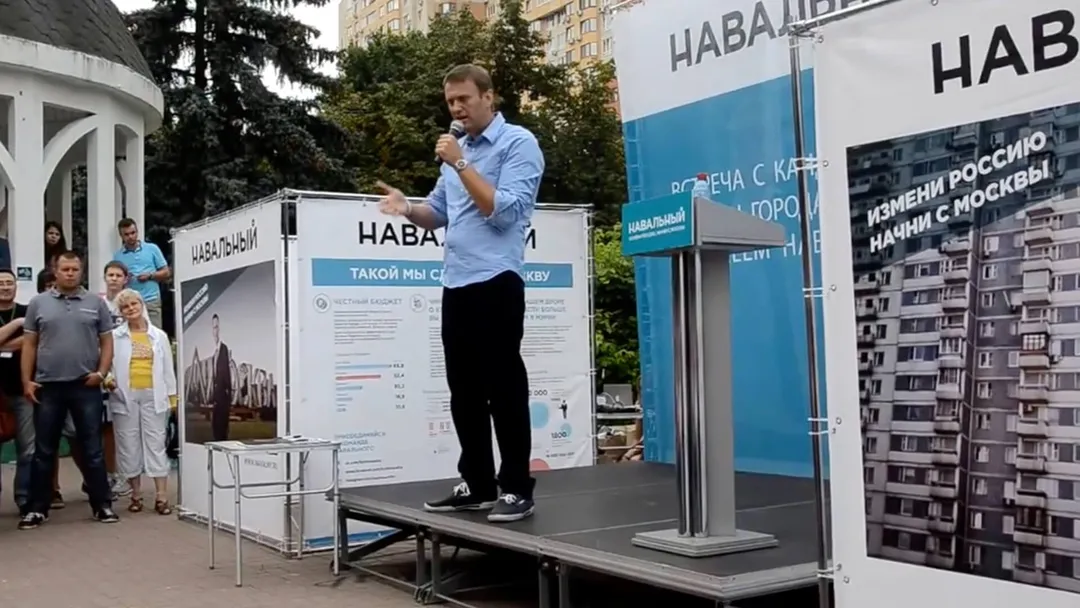
Alexei Navalny’s meeting with voters in Moscow’s Khoroshyovo-Mnyovniki district
So, you see—how much?
15.
Thieves from Uzbekistan
earn more than we do working here.
Wait, you see, you see what an interesting
thing this turns into. It's an open secret.
Could you come over here, please?
Please repeat the same thing into the microphone.
Just say it into the microphone.
Hello. I repeatedly ask
migrants, these guest workers, a question. And
their official salary is 25,000 rubles,
but since the housing maintenance offices are all effectively sold off,
and who knows who's sitting there, what they actually take home is
12,500. I've asked many of them about this.
The housing office takes 50%.
So that means they will, and that's why they will
rob us and rape us.
You see, this is such an astonishing
secret that all of Moscow knows. At
every meeting I conduct this poll, and
every time people tell me: 8,000, 10,000, 15,000.
But according to the official standard,
it is established that: "In Moscow there are no
street sweepers whose salary should be
less than 30,000." But all the actual
migrants we
speak to say 5,000, 10,000, 15,000.
And this really is
a river of cash that they
hand over every month
to the management company, the district administration,
the prefectures, and so on. These are hundreds
of millions of rubles in circulation,
that all these officials take. And all of this
is known to all of Moscow. I want to become mayor
in order to stop this, because
I see the other side of this stream of money.
Those very crimes that
are being committed,
they affect me too. I'm not going to
—I don't like living in a city
where at 8:00 p.m. you have to go to the metro
to meet your wife. That should not happen in a
normal city. I am standing here because
I follow very closely the processes
that have been taking place in Moscow
over the past few years. I know exactly
how large Moscow's budget is. Who knows
what Moscow's annual budget is?
6 billion, something like that.
1.6 trillion.
1.63 trillion. 1.63 trillion rubles a
year. In terms of budget size, Moscow is second only
to New York and Shanghai. We
must all understand very clearly
that we live in one of the richest
cities in the world. Prosperous cities in Europe
and the United States cannot even come close
to matching Moscow's wealth. And yet,
where do you think we rank
in quality of life among
the world's largest cities?
Fiftieth.
Fiftieth, eighth.
Twentie...
Fiftieth?
No, no. It's already
eightieth.
No need to guess any further than
154th
place
in the ranking of the world's largest cities by
quality of life, we are in 154th
place
With the money that Moscow already has right now,
Muscovites could afford
good education, quality
healthcare, and roads on which we
could successfully fight traffic jams, as well as a smaller
number of migrants. But we have none of this.
We seem to have a city,
infrastructure, an educated
population.
And what is stopping us from living normally? We are missing
just one thing, you and I. We lack
faith in ourselves. We lack faith that
we are capable of changing something. Answer
the questions, please.
Thank you. Please keep it brief with this microphone.
What do I want to say? I have the following
question.
You know,
to
run such an electoral
campaign effectively, as you are doing, you need to
support your convictions
theoretically. I heard that you have two higher education degrees,
but we, being Soviet people,
are used to understanding that today's
situation is roughly shaped by
two political science currents. These are
liberal democrats
and liberal conservatives.
I would like you to tell us
clearly,
which group you will align yourself with, and whether you will
represent only their interests.
Well, look, let me ask this:
raise your hand if you are, as you put it,
liberal conservatives.
One,
and the others—raise your hand if you are
liberal democrats.
There, two, four liberal democrats.
I've found six. Seven.
Listen, if I want
officials not to buy apartments for their
daughters for 100 million, am I a
liberal conservative, a liberal democrat,
who the hell knows. If I want to solve
the migration problem by normal, lawful
means, am I a liberal democrat,
a conservative, or maybe I'm left-wing, maybe I'm
right-wing, maybe I'm green—who the hell
knows. I represent one political group:
people like me—people like you. I
have felt all these problems firsthand.
I feel it. I want to solve these problems.
It doesn't matter whether I'm a conservative or a liberal. I don't
want them to stuff into my housing and utilities bill
a 300 million ruble payment
for United Russia. All of us, when last year we
paid for electricity and
power last year, paid 300 million rubles
in sponsorship money to United Russia,
which Mosenergo paid, and then charged to us
by including it in the tariff. Does that make me a liberal-conservative
or the other way around because of this? Hell if
I know. I just want to solve these
problems. I've had enough of them. That's all.
Please, I
I'll come over. Go ahead. Oh,
your hand.
I'll give you the microphone, but briefly.
I'll put my hand here.
Alexei, you said everything very well,
just wonderfully. But we all know perfectly well
that illegal migration, and also
our very poor healthcare. By the way, here
a nurse at our local clinic earns
12,000 rubles—a Russian woman from Moscow. All these
problems come down to one problem:
corruption. And all the officials are
tied to one another. They have long-standing corrupt
connections, and you're alone. And everything you say is right
—you think the way we
think. But specifically, how are you going
to fight this? What's your mechanism—do you
have a well-thought-out plan, will you fire everyone
or what?
Thank you very much. Well, first of all, I'm not
alone—I have a team, and most
importantly, I can see that here too I am
definitely not alone. The most important thing
is that there are hundreds of thousands and millions of
people with me who want to change the situation.
That's the first thing. Second.
Who runs the city? How many people
run the city of Moscow?
No, no, another one.
Hundreds of people, tens of thousands of people
work in prefectures, district administrations, in
state enterprises, housing maintenance offices, municipal enterprises, and so on. 85%
of these people, strange as it may seem, are
not corrupt at all, because
they aren't even in positions
where they can steal. These are
completely ordinary people who
earn decent salaries, who
value stability and a normal
life. I'm sure some of them are standing here,
including together with us. They want
a normal life. They want the same
normal local clinic, low
corruption, and so on. So my
task is, relying on that 85% who are not
corrupt by virtue of their natural
position, to squeeze those 15% who
cannot be changed. And most importantly, at the
level of the city's political leadership
we need to replace the top 30 people in order
to establish the right
personnel policies and principles. When I
say this, I very often
get told it's nonsense, that
principles are meaningless. "Give us names,"
they say. But let me give you an example after
which, I think, it will become clearer
just how important principles are. Tell me,
please, what is the main
corruption case in Russia right now?
Serdyukov.
Apart from Navalny's case.
Serdyukov. Serdyukov.
Serdyukov.
Yes, Serdyukov.
Serdyukov.
Then tell me this, please:
is Serdyukov in jail?
No.
Has Serdyukov been formally charged?
No.
No. Serdyukov still has a Mercedes assigned to him
by the Defense Ministry to this day. And he still has a flashing light
blinking on the roof, despite what they say
on television about how terrible he is.
Vasilyeva. Is Vasilyeva under
house arrest.
Under house arrest. How many rooms does she have
in her apartment?
13.
13 rooms. Everyone answers in chorus.
They know.
I know. She can go outside for 3 hours.
And she can go outside for 3 hours. How old are you?
10.
The child is 10 years old. He knows that
Vasilyeva is under house arrest. She can go out for 3
hours. During those
3 hours she is regularly photographed in
jewelry stores. What's more, lawyers
know—or maybe not everyone knows—that
her house arrest is a formal
restriction of freedom that will later
be counted toward her sentence at two days for every one day. And if
Vasilyeva is sentenced to 2 years, she will immediately
be released, because she has already, in effect,
served her time.
Is anything I've just said
news to anyone?
No. Even ten-year-old children know this.
If you conduct a poll, you'll see that
99.9%
of Russians are simply enraged by the situation with
Serdyukov. Just absolutely furious
about what's happening.
But this is a completely obvious
principle being imposed
by the state. They are saying: "Look,
everyone—officials and ordinary citizens alike—
this is how our system works and will keep working. You
can be incompetent,
corrupt, a former furniture store manager
who became
...became defense minister and looted everything. But
if you meet the main conditions, namely
loyalty, keeping quiet, and
kicking back your share, then everything will go
fine for you.
The principles have to be different. I will become
a mayor who follows a very
simple principle: if a person is suspected of
corruption, I fire them immediately. If
a person is caught taking bribes, I
put them in jail right away. This principle is not
theoretical; it is absolutely
practical, and it will force people
to work properly. If people believe
that this is not just rhetoric, not just
statements like these, if they know
that my own deputy, acting in my name,
is not taking suitcases full of cash in the next office,
then they will adjust and
the whole system will start working. After all, there is,
for example, the city of Singapore, populated by
Chinese people who, broadly speaking, are
inclined toward corruption. There was major
corruption there too. Then Lee Kuan Yew came in and
said: "In order to defeat
corruption, I jailed half of my
friends." He simply jailed those who were
caught. He kept jailing them until everyone
was convinced that yes, they really would go to prison."
It did not matter whether you were close to him or not,
a former classmate, a university friend, or a neighbor from the
dacha cooperative (a shared summer-home association) — you would go to jail, 100 percent. And everyone
started working properly. And I will jail everyone,
100 percent of those who deserve
to be jailed. And then things here too
will start working properly.
What if they are connected to Ozero Cooperative (a dacha cooperative associated with Putin's inner circle)?
If they are connected to Ozero Cooperative,
then how will you...
I will say: guys, maybe you are connected to
Ozero Cooperative, maybe you are not.
If you get caught, I put you in jail. There is
nothing else to it. Please, your question.
How am I supposed to ask it?
Friends,
...team. Good afternoon, everyone. My name is
Elena. The question about the team is a good one. Your
comrades are not very friendly. My question
is this. It is about honesty, yes, about what
you are saying, and about the situation that
made the news. Campaign materials — I think
everyone saw on NTV and Channel One
that illegal campaign materials were found
being distributed by a member of your
team. You have not explained anything. Why
are you staying silent? At least say what you have to say
to those who raised this issue.
He did not have time during the debates. He was given too little
time — just a minute to explain.
Did you see what the young woman is talking about?
May I...
Levichev? One second. Levichev announced
that we supposedly had some illegal
materials. They broke into people's apartment,
sawed through their door, found 20 stickers
that were completely legal, by the way.
Those people were jailed for 10 days
for resisting the police. There were no other
consequences after that. It is all
nonsense. Listen, fine, maybe right now
it is convenient to ask a question like that.
Is there anyone here who is planning
to vote for me?
Yes. Yes.
Then why would I be campaigning to you? I do not
understand at all. [laughter]
Every one of these people, every one of these
people can make a poster that says
"Navalny for Mayor." And it will not
say "paid for from the
election fund of the mayoral candidate."
It will be a poster that you made. And
by your logic, by Levichev's logic, they would need
to saw through the door, break in there, and
say: "My God, this is Navalny's underground
headquarters — a person drew a
poster." But our law states quite
clearly that everyone has the right
to campaign on their own as much as they want. You
can print flyers on a printer,
make posters, and so on and so forth.
That is our right, and the right of those people
who were in that apartment, to make
any flyers in support of me. And when
Sobyanin or Levichev tells me — well,
turn on, I do not know, TV Center or Moscow
24 — in every single segment, in every
single segment they talk about me; yesterday there was a segment about me
on TV Center that began by saying that not a single person
came to a meeting with Navalny,
not one person,
and at the same time they run stories about how
wonderful they are. And then they also
accuse me of illegal
campaigning. It is just ridiculous. Please,
your question.
Alexei, we are very grateful that you came to see us.
Thank you very much. Please come visit us more often.
I want to provide some information about why
there has been nothing about this either on the blog or on
the website. There is nothing there; today I looked,
and all my friends...
You know, I ran into this
problem back in 2003. The Ministry of Defense
in all military housing buildings that
fell under its authority at that time.
The way they cheat us and shortchange us there — it is all tied to
privatization.
The privatization law was never repealed, was it? No.
But for us it is still blocked.
No, no, no. The fact is, no one here can
privatize their housing. In '75 I, together with an initiative group, went to court...
I, together with an initiative group, in court...
It would be good if you would raise this issue of reopening
privatization. We got it reopened, and then
people followed, we drafted lawsuits, and then it
was shut down again. It is closed again for us.
The building has not been repaired since 1962, and I in this...
I live in this building. No repairs are being done here.
What’s more, we have Slavyanka (a Defense Ministry housing management company), and it won’t
even let us transfer to GBU DES, where
Sobyanin at least allocates some money for
repairs. Help us. What should we do? We will
vote for you.
You see, it’s an astonishing situation, isn’t it?
This is Slavyanka, where criminal cases have already been opened against all
of them,
and yet they continue tormenting people,
despite the fact that they are such
crooks, they do not allow people
to privatize the apartment in which you
have been living for how many years now?
Since 1962.
Since 1962. And this is
completely illegal. I myself grew up in
a military town. Well, we privatized
our apartment. My parents privatized
their apartment in a military town, because
it is every person’s right
to privatize, as long as it is not some kind of active military garrison
.
No, it’s an ordinary one.
So, you understand,
if I tell you right now that tomorrow
I will solve your problem, then I would be
a windbag and a liar. This problem
can only be solved by changing this
government. This Slavyanka we’re talking about,
they seem to be dragging it through the mud, Oboronservice and
so on; we know that they are all
outright crooks,
apparently. But nevertheless, even now, at
this very moment, they continue tormenting
ordinary honest residents. And against this same
background, Sobyanin, having privatized an apartment
in Tyumen, is privatizing a second apartment here
of 308 sq. m. Until we change this
government, which despises us so much
that it does all this openly, nothing will
change. Come to the elections,
vote. If I become mayor, I will solve this
problem.
Alexei, may I,
please, let’s do one person, one
question.
Will you help us transfer these
five-story buildings to the city?
Yes, that’s exactly what I was talking about.
These five-story buildings should—look, well,
this is just a strange situation. But these
five-story buildings—where are they located? In the city?
Well, of course the city should take them over.
It is a single housing and utilities system, a single
supply system. You see, this is
simply a war between the city and
the Ministry of Defense. The city says:
"We won’t take your five-story buildings without
money for major repairs." Yes, money,
That’s exactly what I’m saying. It’s absurd, because
the mayor’s job is to take care of residents. If
there are five-story buildings here where
people live, I will help you. I will solve all
these absurd problems. Naturally,
of course, I give you my word. Please. Yes,
ask your question into the
microphone.
Could you list the major
state-owned and private
corporations in which you are a
shareholder? And, speaking plainly,
could you explain what you have been living on for the last 5
years? Thank you.
As for transparency—can I
list the major state-owned and
private companies in which
I am a shareholder, and with what money I
bought these shares? I am a shareholder.
What do you live on? How do you support yourself?
I am a shareholder in
Gazprom. I am a shareholder in Rosneft.
I am a shareholder in Transneft. I
am a shareholder in Mosenergo. I am
a shareholder in about a dozen
energy companies that were formed
after the breakup of RAO UES. Altogether,
the shares I own are now worth,
probably, 200,000 rubles. Where did
that come from? Where did you get 200,000
rubles?
200,000 rubles.
A share costs 8 rubles, 20 rubles. I invite all of you,
my friends, to become shareholders in
Gazprom by investing 100 rubles. Come
along with me—you’ll be suing
Gazprom. It’s fun and costs very little
money. Next question, please.
Boris has a question.
How do you manage to maintain such a good
tan? And now a serious question.
Right now there are debates on M24, and we
see, so to speak, political passion,
politicking. Typically, the criticism is directed
at opponents. There is very little rational discussion, right.
I would like to know,
you have probably lived in Moscow for a long time already,
maybe you even saw Gavriil Popov (the first mayor of Moscow after the Soviet period),
but what do you think—after the change
from Luzhkov to Sobyanin, for
me it was a kind of characteristic time
of change, because Luzhkov once
said, why should I leave? I clear the snow,
everything is wonderful. Do you see
any changes now, after all, taking place in
Moscow? What positive things
would you take from that? And how do you
assess those positive aspects?
Thank you. As for the tan, well, as
you can see, I spend a lot of time in the
fresh air. Sometimes you stand there at
12 noon at a meeting, and in an hour you get so
tanned that it would be better not to
tan at all.
As for the second question—what good things were
done under Sobyanin? I do not want to
deny the obvious. When Sobyanin
replaced Luzhkov, he largely inherited
Luzhkov-style methods of governance, but there were
a lot of the right declarations. It was
announced that he would bring order to
the housing and utilities system. And it seemed they had started
to sort some things out. But two years passed, and as we
know, the day before yesterday — three days ago, rather —
MOEK was privatized. It was handed over
to Gazprom at an unclear price, and Sobyanin
is directly responsible for the fact that
a new monopoly has emerged, and now we will
be paying more for housing and utility services. Sobyanin
said that he would stop the demolition of
monuments, historical landmarks in
the city center. For a year they really were not
demolished. That did not
now they have started demolishing them again.
They are being demolished.
Sobyanin said that he had put an end to
infill development.
Infill development is still there in Moscow,
infill development,
but it remains. It is continuing.
Sobyanin said that he would conduct
a review. That was the right idea. I supported all
of that, a review of major
road construction contracts. But
who are now the main contractors for
road construction in Moscow?
The Rotenbergs. In Soviet times they were
judokas, sparring together with Putin.
And now they are building roads for us.
Who are the main contractors for construction
in the Moscow metro now?
Timchenko. Them too, and Timchenko. Timchenko is
the very same guy I am constantly
suing. The chief seller of
Russian oil, who gave up
Russian citizenship, a citizen
of Finland, living in Switzerland,
through his Swiss company,
which sold all our oil and made him
a billionaire in the process, is now building
the Moscow metro for us. And if before him 1 km
of metro cost 6 billion rubles, which is very
expensive, now 1 km of the Moscow metro
costs 9 billion rubles. So quite simply, he
quite obviously, from every
kilometer pockets a full 300 billion.
So, well, I can say this: yes, Sobyanin
built bike lanes, put bicycles in place.
I am not denying that. There are bicycles,
Sobyanin put them there, but I would still like
to see something more important,
more significant.
And it is not working for him, and none of this works
for one simple reason.
How many voters does Sobyanin have?
I want to win over half a million voters and
become mayor. For me, that is the only
way to become mayor: to gather 155 million
voters. But Sobyanin has just one voter.
And everything he does, he
does in order to please that one
voter. I need to please you.
Take the five-story apartment blocks into city ownership. Yes. I need
to please everyone by lowering housing and utility rates. I
need to please all of you by driving migrants out of
Moscow. I have a lot of work to do
if I want to be re-elected
next time. But for Sobyanin, in order to remain
mayor, he needs to hand contracts to
Rotenberg, he needs to hand contracts to
Timchenko, he needs to secure the financial
interests of this entire Putin gang.
That is why none of it works out for him.
That is why I want to become a mayor who has
155 million voters, and I do not want to be a mayor who has
only one voter. I do not want that. Mo,
please.
No, well, he is not asking,
why Sobyanin has never once raised pensions.
That, by the way, is a question that interests me
very much. It would seem
that this could be done even from the standpoint of
winning voter support. All of this can
be done. That is exactly why in our
program we explicitly included a point stating
that we would immediately halt the adoption of
the 2013 budget until
we raise pensions. Already in the
current budget
there is money to raise
pensions. Besides that, savings can be made on
a huge number of things in order
to raise pensions. A simple example.
Do you know how much money in Moscow every
year goes to public procurement?
600 billion rubles. Of those 600 billion rubles, according to
the city administration's own admission, every year
150 billion rubles are stolen. What is 150 billion rubles?
For us, that is 30,000 rubles per person. That means
30,000 rubles a year are being stolen from you, from me, from everyone gathered here
every year just through public procurement.
I know exactly how to stop this. At
our Anti-Corruption Foundation (ACF), we canceled corrupt tenders worth 59
billion rubles
already. I already have all the
laws, draft laws, and resolutions written out.
I know exactly how to save those 150
billion just by fighting corruption in
public procurement. And that money can also be
directed toward additional social
payments not only to pensioners, but to everyone
else as well. Do you know how much the benefit is for
a large family with four
children in Moscow?
5,000.
Three,
five.
Well, not for everyone, around five. I...
Five.
It comes to five.
All around five, right?
4,900. So then, how many people are in your
family?
Six people.
6 times 30 — how much is that?
A lot.
Please answer the question. 4,900 a
month.
There’s your answer. Where are we supposed to find
additional resources to
raise everything enough to pay
everyone in need? In Moscow, in such a
rich city, it’s simply unacceptable
that people here have to buy
their own medicines—people with disabilities are told,
"you have to purchase all of this yourselves." That’s absurd.
We have more than enough money, and we certainly
can afford it—we absolutely can
afford to raise pensions for retirees.
Another question, the young woman.
Please solve this,
as a father of many children.
Go ahead. Uh, I’m dealing with this
bureaucratic delay called
improving housing conditions. There are many
elderly people sitting here, yes,
who have been waiting 15 to 20 years for their own
housing. I came as a father of many children and
said, exercising my legal right: "I have this many
children, I’ve already heard that even families
with fewer qualify." They told me, "Well, first let us
recognize you as a low-income family. Go over here
to our, uh, what’s it called,
office. Basically, yes, if they recognize you,
come back to us. Then we’ll, uh, how do I put it,
put you on the waiting list."
Why? Just a question. And would you be able
to change this bureaucratic system
so that people can actually get apartments when
new developments are going up all over the city?
The question is that a person who is
part of a large family,
a father of many children, cannot even get
onto the waiting list. Right. And let me guess something else.
By law, you’re also entitled to a plot of land.
Have they given it to you?
I’ve been on the district administration’s waiting list for two years.
Two years. Is there at least any sign of progress?
No.
And there won’t be. Not a single family has yet
received one. Do you understand? We annexed New Moscow
(the large territory added to Moscow). Supposedly there’s land all the way toward Kaluga
there. Yet at every single meeting, a large
family comes up to me,
and they say, "We keep applying." And they’re told,
"There’s no land." How can there be no land?
Look at the map. It’s the size of
Belgium. For heaven’s sake, how can there be no land? And this
is happening because they can’t make money
off it. And as for the
waiting list,
will you be able to do that,
I will do exactly that. Look, when it comes to the
waiting list, the first thing—the simplest,
most obvious thing—I’ll do is this:
we have 400,000 people on the waiting list.
Can any of you see that
list? Who’s first on it, who’s second,
who’s four-hundred-thousandth? Can you
look it up? No. Nobody can.
Nobody can. I will be the first
mayor who finally opens up that waiting list
so that we don’t have situations where
someone like Sobyanin gets an apartment ahead of others, or
someone like Navalny gets one. Here,
we’ve had people on the waiting list like
TV host Vladimir Solovyov receive apartments. We’ve had
Andrei Malakhov receive a subsidized apartment
from the city, and so on and so forth. They
keep all of this hidden
because you don’t matter to them. They need
to cut into that line themselves. That’s why it
is closed. So I’ll do one simple thing
so that you can be sure that neither
TV hosts like Solovyov nor mayors like
Navalny can cut in. I’ll simply open it all up, and
we will all see who is first, who is second,
who qualifies for benefits, who gets special priority. And we’ll know for sure
that this is exactly how it all
moves forward, because that’s what’s needed
for accountability. Go ahead.
Briefly, please.
Briefly, yes. And what should we do right now?
Right now, you need to persuade your neighbors,
get them to come vote, and change this government,
because this government will never give
you either the plot of land you are entitled to
or the apartment you are entitled to. Maybe this
sounds utopian to you, but I’m saying
that until we change the government,
we cannot expect anything.
And we absolutely must change it,
because we are that power. My friends,
I hold three meetings like this every
day. I still have two more ahead of me today.
Thank you very much. I’m very
grateful that you came. It was
very important to me that you listened. I
would very much like to rely on you,
to have your support, and together with you
return power to the people. Thank you.