Alexei Navalny’s meeting with voters in Moscow’s Kotlovka District
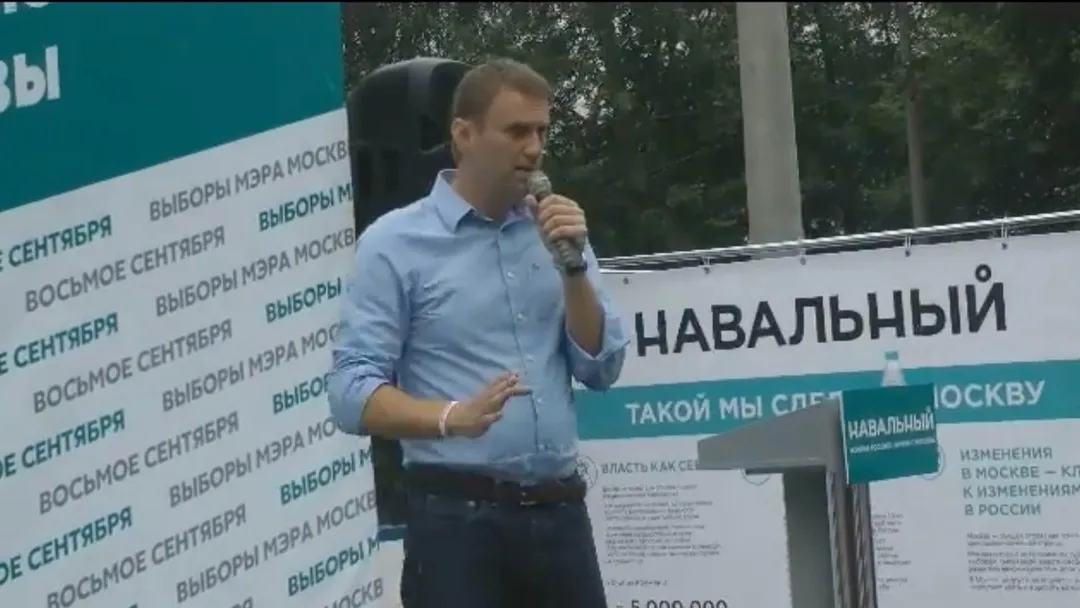
Hello, please come a little closer.
Please, have a seat, we still have some free
seats. Thank you so much for coming.
I understand that you probably have plenty of other things to do on a Sunday morning,
but nevertheless, here we are.
You came here to attend
this meeting, and for us that is very important,
because a very large part of
our election campaign is built around
meetings like this. I hold three of them
every weekday and five meetings every
weekend, because both I and my team,
which is running in this election with me, we
truly believe that any candidate
is obliged to hold meetings like this. A
person cannot want to become mayor, cannot
be an incumbent mayor, cannot run
in an election, cannot seek
power, if he does not meet with
people like this. And everyone must have the
opportunity during an election to always
meet the candidate in person,
talk to him, ask him questions—comfortable,
uncomfortable, any kind. First I wanted
to say perhaps a few words about
myself.
I am 37 years old. For the last 17 years I have lived in
the Maryino district with my wife and two children. In
that sense, I have a completely ordinary
family. My son goes to
an ordinary local kindergarten, and my daughter
studies at an ordinary local
school. By profession I am a lawyer. I have two
higher education degrees. I graduated from
the law faculty of the University
of Peoples' Friendship and the Financial Academy
under the Government of the Russian
Federation. I was born in a military
family and traveled around various military
towns. My parents still live in
one of the military towns outside
Moscow. If you have followed my
activities, or at least heard something about them
over the last few years, then you
probably know that I am that very
minority shareholder who gives no peace to
Gazprom, Rosneft, and all those
officials and corporations of ours. You have probably
heard that I created the Anti-Corruption Foundation (ACF),
which is engaged in
investigating
corruption.
And we constantly demand that criminal cases be opened
against these people who are
half officials, half
businessmen. We are constantly exposing their
corruption schemes, and so on. And I am
very often asked why I do this.
And every single meeting we hold, I
begin by answering that question, because
once I answer it, perhaps it will become clearer to all of you
why I am so focused on this
issue that is happening, that we all
know about, and which has an enormous
scale. I applied it to myself, and I will explain it with
simple
examples. Over the last 15 years, over these
fat Putin years, Russia from the sale
of oil and gas received approximately 3
trillion dollars. That is an enormous sum
that is very hard for us to imagine. Well,
because it is simply too large
for any person to fully grasp, but
we can break it down per person, for each
one of us. From this oil and gas wealth,
each of us gets about $50,000, or
about a million rubles, each of us from
the oil and gas sold to the West
is owed about a million rubles. So for my
family of six, that is 6 million
rubles, and I constantly ask myself:
where are these 6 million rubles of mine that
I am owed? I understand that they cannot be taken
as cash, but I would like to understand what
they have translated into. I see many
older people sitting here; you
remember very well how the Soviet Union
also received a lot of money from selling
oil, primarily in the Brezhnev era
(under Leonid Brezhnev, Soviet leader), but we understand where that money was spent.
We can argue about whether it was spent well
or badly, but we know for certain
where it went. We can turn
our heads and see the residential districts that
were built, and where apartments
were handed out for free back then. We see that
they built things; we saw the space
industry, they built railroads,
they built enormous
projects, they held the Olympics, and so on and so
forth. They built a gigantic army, they supported
African countries, they supported
Latin American countries, and so on.
And yet, in general, less money came into the Soviet
Union then than is coming into
Russia now, and I keep asking myself
this question: the money that we
have received now—where is it? Where are the railroads?
We build
fewer roads in a year than China does in
a week. Where is the space industry
that belongs to me and to you from these petrodollars? I see
space rockets falling. Where is
the infrastructure? Where are the new residential districts?
If new residential districts are being built, then
the apartments in them are sold; it is commercial
development. Where is our education,
our healthcare? I do not see any of it. I
understand that
I
cannot see where all of it went. It could not
have simply evaporated, and I think that
you, like me, have an answer to the question
of where it all went, because we
look at the list of billionaires in 2000
In that year, Russia had dollar-denominated
billionaires; in 2000 there were [so many] people, and
now there are 96 of them. It seems like nothing is being
built, nothing is being produced,
mil
lion [things] are being bought by Russian
officials. Our Russian officials
even at the lower levels live completely
open lives. These dollar-denominated
millionaires—and I understand: there they are. Where are
my 6 million rubles, and there is your half a million
per person that is supposedly due to you from
oil and gas revenues? These people simply took it.
All these people. That is why I
do this—because they robbed me.
It is as if they had reached into my
bag on a trolleybus—it is exactly the same thing.
When I see a situation in which
the main trader of Russian oil—who do
you think is selling it? Who is the main
trader overall? Who is the main seller
of Russian oil? Do you think it is
some state-owned enterprise? No.
The main trader of Russian oil is
a friend of Vladimir Putin who gave up
his Russian
citizenship and lives in Switzerland.
He trades our oil—my oil and your oil—
became a billionaire from it, and I understand
that he robbed me personally. I take this
very personally, and that is why toward
these people I
make my accusations completely openly.
Everyone knows about it.
They know.
I believe it is Timchenko and all
those Rotenbergs and all the other friends
and classmates who suddenly became
billionaires—they robbed me personally, and
that is why I am standing here on this stage before
you as a candidate for mayor of Moscow, first and
foremost because I am the most ordinary
Muscovite, facing the same
problems as you, and running in the election
because I want to solve these problems for
myself, for my family, and for you. I am standing on
this stage and telling you that I want to be
mayor of Moscow in order, for example, to
solve the problems of
housing and коммунal services (public utilities), simply because for my apartment in a
panel apartment block I receive a bill
for 9,500 rubles, and I understand that
that cannot be right. And this bill
keeps increasing all the time. This
amount of services is not being provided to me for such a sum,
and it just keeps growing and
growing. I think that here in the
Kotlovka district this is especially clear to you,
because you had that case—when I
was preparing for this meeting, I carefully
studied the material about your district, and I know
that in your district last year there was
an official from Kotlovka caught after 15 million rubles
allocated for beautification were transferred
to an intermediary company, and the money disappeared.
And they did not even open a criminal case. And
we pay for all of this in our utility bills.
I want to become the mayor who will carry out
an audit of tariffs, an audit of utility services, and
then we will all see that in this
piece of paper there are 9
rubles
for annual sponsorship aid to United Russia (the ruling political party),
200 million rubles are included as so-called investment
components, some supposedly planned construction projects
that nobody is actually carrying out. I
see that the only result of these
bills is that the head of the district administration
becomes
a millionaire. Maybe about
a month ago
they removed from office the head of the district where
I live, the head of the Maryino district. He was removed because
his wife, driving an SUV, ran into
pedestrians. It was all caught on video, and
that is why he was fired. You are nodding your head—
you saw it on television. But what kind of SUV was it?
You saw a Range Rover with the license plate
999. Stolen money bought that fancy plate, stolen money. You
know, I watched that report, and I also
thought something strange was going on with
this district head, because before that he had been
head of the district administration in the
Nekrasovka district, then head of the district administration in
the Lyublino district, then in my district, Maryino. That
is, he has spent his whole life in municipal
service. He has, generally speaking, a fairly large
salary, but nevertheless his
official income in no way allows him
to live that kind of life. Based on his official income,
he ought to live more modestly than I do,
but I can see that compared with me he
simply lives in absolute luxury.
He is an open dollar millionaire, and I do not
want to receive a payment notice from which
it is obvious that I am paying for his wife's
SUV. That is why I am running for mayor. I want to change this.
I am standing here on this stage before you because
I am 37 years old, and I too sometimes
go to the local clinic. I do not, unlike those on
Rublyovka (an elite, wealthy area near Moscow), live there—I live in Maryino and go to
an ordinary neighborhood clinic. And my wife
goes to an ordinary children's clinic with
the children. You can show me as many
television reports as you like about
this electronic appointment system—I have
tried again and again to book through the electronic
registration system, the electronic
reception desk—it is impossible to get an appointment.
So show me as many of these
reports as you want about how wonderfully everything works,
about what marvelous healthcare we have in
Moscow—I know that is not true, because
I have experienced it firsthand. I am running for
mayor in order to change the situation, and
looking at Moscow's budget, I understand
that Moscow allocates for
healthcare far more money than
than for any other citizen of Russia, well,
what do you think? Just guess, by how much
more
is spent on healthcare than on any
other citizen of Russia? By how much?
per
50? By
100? Three times more, three times more. I
will now give you the absolute figures. We will also
three times more is allocated for a Muscovite
than for any other citizen of Russia.
With
you wanted practical figures, so I’m telling you:
for outpatient clinic care
for every person sitting here,
for every Muscovite, 20,000 rubles a year are allocated
that means for my family of four
people, for example, 80,000 rubles a year. But here’s my
question to those present: please raise your hand
if you have been to your local district
clinic in the past
year. All right, I see. And who would
clinic
... I want to dwell on this because I want
to solve this problem, because a lot of money
is being allocated. I want to become a mayor
who will finally hire general practitioners,
internists, and so on, who
in 90% of cases are the doctors Muscovites actually need,
the most essential doctors. I will not
keep endlessly buying these scanners
and carrying out major
equipment purchases. Sobyanin likes
to declare that in terms of the number of
scanners, for example, we have surpassed all
European countries. But what good are these
scanners to me? I, for example, tried to get an MRI
done. I can see you’re all immediately
nodding — everyone knows that in theory there are plenty of scanners,
but just go and try
to get an MRI — it’s very difficult. And if
you go for a private MRI, you’ll have to pay
60,000 rubles. There are lots of scanners, but people
who are dealing with all this
cancer patients, they know that, well,
it’s a nightmare. We have no prevention,
no early detection, no effective treatment — but we do have
scanners. And in the program they write to me:
"Moscow has been given a scanner, I’ve been given
a scanner." If it’s impossible to get a scan
and people are not being treated, I want
to become the mayor who will make sure
that this money actually works. I understand how
to do it. I
... for me this is absolutely not an empty
phrase. Here, when I was once again
preparing, yes, I learned that last year
the whole district was in an uproar because here
a citizen of Tajikistan was caught
who had raped
a minor. I see the crime statistics
showing that crime is rising, and in your
district it is rising at an accelerated
rate. And where I live it’s the same, even worse.
In Maryino, women are afraid
to leave their apartment building entrance in the evening. So I want to solve
the migration problem, because it concerns
me and my wife.
I personally know people in my building whose
bags get snatched in the evening, and I
understand that migrants come to Moscow not
because there are jobs here, but
because it is profitable for the city. That is because
who is the main employer of migrants?
City organizations. Here’s a question: have you
surely all asked — who has asked their
janitor what his salary is?
How much? I heard
10
thousand.
[applause]
... and so on. I am telling you,
my dear beloved residents of the
Kotlovka district, that according to official standards,
if you even read interviews with Biryukov
and Sobyanin, you will learn that janitors
supposedly in Moscow do not earn less
than 30,000
rubles. But I asked my own janitor,
and all the real, actual janitors we
talk to will all tell you: 8, 9,
10, 15, well, 18,000 rubles. And all of Moscow knows
that these migrants are brought here because
they can be kept here in conditions like slaves
and 10,000 rubles can be collected from each of them
and this creates a colossal flow
of cash — hundreds of millions of rubles
that gets kicked up to the management
company, to the housing services, to the district administration, and so
on. And this river of money
flows off somewhere, while all we get
unfortunately is the rape of
minors, we get only
crime connected with this. I very much want
to solve this problem. It worries me, it
poisons my life. I know all these problems
not because someone brought a report
to my mansion on Rublyovka (an elite, wealthy area near Moscow), but because I have been dealing with
these problems for 17 years.
I am standing here because
that
... trillion rubles; in size it is second only to
the budget of New York. So, friends, we must
understand very clearly that we live in
one of the richest cities in the world. I mean,
in theory, there is an enormous amount of money
in the budget. In prosperous
European cities there is nothing even close to this
amount of money. With the money that
exists in the Moscow budget, we could have
quality education, excellent
healthcare, a small number of
traffic jams, and excellent development of
public transport. But for some reason we
do not have that. Instead, we have a different situation in which
all the giant, for example,
transport interchanges are built not because
they help fight traffic jams, but because
because they make it very easy to steal money,
very easy. The nearest one here is
transport infrastructure.
At the same time, all transport experts
say that it costs twice as much as
it should cost—twice as much.
Just think: on a single construction project
they will steal 3 billion rubles, and to
provide the Southern Administrative District
with additional outpatient clinics, you need less money
than they will steal on one
construction
project. We have everything we need for
Moscow to become a wonderful,
prosperous city. We just lack
one very important thing: faith in
ourselves. For some reason, we think—I hear this very often
at meetings like this—that nothing
can be changed. Well, we all understand that, we
know everything, and we can explain it all ourselves, and
we can get up on this stage and talk about
corruption—but nothing can be changed anyway.
They’ll somehow cheat us anyway, the elections
will be rigged, and on television they’ll
deceive us. I wouldn’t have come up on this stage
if I didn’t believe things can be changed. I do not
think we are the stupidest. I do not think
that we are somehow cursed or doomed.
We can change everything. We just need
to believe that power is given by the people themselves—not
the election commission, not Churov (former head of Russia’s Central Election Commission), not
the crooks in your election commission.
Power is given by the people, and we take it ourselves. In Moscow,
in order to elect a new mayor, given the turnout,
we need about a million people—just
about a million people.
Moscow has those million people
who know everything, who understand everything,
who have enough education,
enough life experience simply to
tell one thing from another. It’s just that
somehow we don’t believe, and we don’t go to the polls.
Why go vote? It’s all
meaningless anyway. But it all does matter. These
people stay in power and
rob us every single day—not because
they forced us to, and not because
there are millions of them.
They understand as well as we do—I’m saying, they’re people
just like us. These crooks stay in power
because we allow them to
remain in power. We can come to
the elections and choose a different government—a government like this,
a government that considers it its
duty to meet people in courtyards and
talk to them. Through meetings like these,
meetings,
every day I will
personally speak like this with
60,000 or 70,000 people. Sixty or
70,000 people—that is a tremendous force. We
can reach millions of people,
tell them that there is another
candidate, that there is a sound program, that there is
a program prepared by the best
specialists. We have everything we need
to solve our problems. We just need
to wake up just once and truly
make this government change, and then we
will build the city in which we will
live with pleasure—along with our children and our grandchildren.
But I have been talking for a long time now about what interests me.
Now let’s talk about
what interests you. I am ready to answer
your questions.
[applause]
Thank you. As for the team—
that’s an excellent question, thank you very much. What matters here
above all are the principles for forming a team.
First and foremost. But if I
became mayor, would you want me to build a team out of my
former relatives? That is what is happening now.
And my former classmates?
No? And my former university friends, like now?
Right now, we have a government of old university friends.
Look: judges, prosecutors,
the Investigative Committee, state companies, Gazprom,
Rosneft—everywhere you look, it’s classmates
and university friends, the Ozero cooperative (a dacha association linked to Putin’s inner circle). Yes, a dacha
cooperative. Is that what you want from me? No,
you do not. So the main thing is: I am not now
going to appoint ministers from this stage.
I am talking about the principles
of appointment
of people. I intend to become
the one who sets such rules of the game for
personnel decisions under which
all officials know that stealing is difficult,
stealing is dangerous; if you are suspected of
stealing, you are immediately fired; if you are
caught stealing, you are immediately
sent to prison. This is a very important principle, and it is not
theoretical. I will simply give you
an example after which you will understand that
declaring principles publicly is
very important. Please remind me:
what is the biggest corruption case in Russia right now?
in Russia?
Serdyukov. Please remind me:
has Serdyukov been formally charged?
No. And please remind me:
what is happening with Vasilyeva?
Is she in pretrial detention?
No, she goes shopping while under
house arrest. She is given three hours a day
for walks, and she is regularly
photographed buying jewelry
somewhere in stores. Well,
the person made money, so she buys herself bracelets,
rings, and all the rest.
By the way, I want to remind you of one thing
that many people do not understand, and only
lawyers do. This house arrest
is formally a restriction of freedom, and it
will later be counted at a rate of one day for two, and if she
is sentenced, for example, to two years of actual
prison time, she will be released immediately because she
will be considered to have already served a year under house arrest.
with arrests. Well, people have sort of already resigned themselves to it.
And that's it. And it's already time to
come out and say this directly to the authorities.
Like this: steal, skim off the top,
grab what you can, tear it all apart completely in the open.
The main thing is political loyalty.
Hang the right portraits on the wall and
kick back your share.
All right, another example—you've probably heard
about that teacher, Ilya
Farber. For some dubious and clearly unproven
embezzlement charge, they pinned 132,000 rubles on him
and gave him 7 years in a maximum-security penal colony.
And a month ago, we all saw
on television the trial of Iosif Khanov,
the former deputy prefect of the Eastern District.
For embezzlement of 360 million rubles, proven and admitted by him,
how much did he get? Four years
suspended. You yourselves tell me all this.
Everyone knows it. I'm not revealing any secrets here.
This is
completely
absurd. I want there to be different principles
of governance instead, principles that
[applause]
were declared in his city. Despite
the fact that Chinese people live there—people
quite prone to corruption, as he put it—he
said: in order to defeat corruption,
I jailed half my friends. I am running
to become mayor and
to establish this: whether you're my friend or whatever else, if you
did wrong and got caught, you'll go to jail, and I
will absolutely do it. I proved in my
Anti-Corruption Foundation (ACF) that I can
build teams. Not a single one—not
a single person who works for me now
did I know beforehand, but I have
people working for me who all graduated with honors.
Everyone works impeccably. For each
employee on the RosPil project, which
fights corruption in public procurement, we have
10 billion rubles' worth of corrupt
tenders canceled. Everyone works like crazy because
principle matters.
Vova, excellent question: if you became mayor, wouldn't
this system break you? Wouldn't you yourself become
the same?
[applause]
[music]
corrupt. The important thing is not that I would
stand here and tell you, I promise you, residents
of Kotlovka, if I become mayor, I won't become
corrupt. That's nonsense—everyone promises you
the same thing. So I promise
something else: my first steps will be to create
a system of power where you will immediately see if I
become corrupt, and you'll be able to
throw me out at once if I become
corrupt. I gave the example of that
company here in your district that
received 15 million rubles for landscaping
and disappeared, and no one can be
held accountable because
it's unclear who owns that company.
When I become
mayor, every ultimate recipient
of state or city
funds will be known. Right now, if you go and
check all your district contracts, you'll
see that they are won without competition by
companies owned by offshore
entities—that is, by who knows whom. Well,
actually, we do know.
We know that behind all these firms stand the husband
of the district head, the prefect's son, and so on, but
all of it is hidden, and nothing can be done about it.
I will make sure that every
kopeck is traceable, so we know exactly which
individual receives it. And if I
turn bad in six months or a year
and want to slip my relatives into
some position, you'll see it immediately. I want, in
principle, to reform the system of power so
that all power is not concentrated in one office,
so that the mayor does not have that enormous
amount of power that allows him
to be corrupt and pushes him
toward corruption.
Because, look, here's an excellent example:
Moscow's budget is 1.6 trillion rubles.
What percentage of that money do you think
out of that 1.6 trillion is distributed at the
grassroots level, where your local
deputies work,
municipalities—the people who
directly
deal with what is happening on the ground?
[music]
Any
ideas? Someone says 10? Who knows?
1%. Out of 1.6 trillion, 1%.
is distributed
at that level. In no country in the world does that
work, and it cannot
work in Moscow either. Who oversees it? Great question.
Who oversees it? No one.
No one can oversee it, because
Moscow has a population of 15 million people.
Moscow's population is larger than that of
an average-sized country, and no one
can keep track of things if everything is being
all
distributed from a single office.
This
must be transferred to the grassroots level,
where it will be overseen—by
you, by your local
deputies, and so on. I had
an amazing meeting with your neighbors in
the Zyuzino district, at exactly this kind of
stadium. I keep bringing up
this example.
A local deputy came to that meeting. By the way,
he is here now—Konstantin Yankauskas.
He showed
that there was a fence, basketball hoops, and
a lot of other equipment, and I and everyone else
The rest of us residents stood there and saw that
it was just a bare playground, there was nothing there, but
the acceptance certificates say that everything is there and that
everything has been paid for, and the officials say: you’re not
looking properly—look over there at the nonexistent gates
there must be something wrong with your eyesight, look here
at the paper—the paper says they exist
the gates. I don’t want to give you
some kind of slogan; I want a system in which everything will be transparent, a system in which
residents can immediately see what is supposed to
be built, how much money it is supposed to
be built for, and if it isn’t built the way it
should be, then any local deputy immediately
opens a criminal case against those who
stole those several million
rubles from a site like this. That’s why the system
has to be changed. We need a system in which
I will not be able to be corrupt
and if I can, then you will
...city. I live in this city and
I face these problems myself, that’s all.
Next.
[music]
Question.
Excellent question. If you became mayor, how would you
fight this hydra, specifically
in the sphere of public utilities
because it seems impossible to
cut it all off there—it’s so
corrupt. They stole those 15 million rubles
allocated for improvements. How exactly? Once again,
let me repeat:
transferring money to a shell company, setting up a com...
uh...
What I’m saying is that I will make it so that
it will be impossible to transfer money
to a shell company whose owners
are unknown to anyone. We will know
the specific individuals who are behind it
and
hold them accountable. I’m saying that if I
become mayor, I will make it so that if you
look out the window and see someone building something, you can
click twice on the internet and find out who
is building it, what they’re building, and with what money
who won the tender, how many workers there are
how many migrant workers may be working there, their migration
cards, and all the acceptance certificates for the
work. I know exactly how, for example,
to save money on public
procurement. Do you know how much money is spent in Moscow
every year on
public procurement? 600 billion rubles.
Of that money, the authorities themselves admit—these are
official figures—that 150 billion rubles a year
...
are skimmed off through public procurement. From you
30,000 rubles are stolen every year. Again, I
calculate that for my family of four, that’s 120,000
rubles just from my family alone.
By the way, at the Anti-Corruption Foundation (ACF)
we have been dealing with this problem for years. We
legally
as a small nonprofit organization, I have managed
to get corrupt procurement contracts canceled
worth 59 billion rubles. I know exactly which steps and
measures are needed—I have them written out down to the level of
draft laws—what needs to be done so that
those 30,000 rubles are no longer stolen.
The point is that many cities and many
countries have faced problems like this.
Countries have dealt with it, many cities have dealt with it.
Look at South
Korea—in the 1990s it was
a monstrously corrupt country, with
corruption so entrenched that it seemed impossible
to defeat, because people said crooked Koreans
would always remain crooked Koreans.
But no—they started introducing new rules,
and now it is one of the least
corrupt countries. I know exactly how
to fight this. What’s needed is simply
transparency. We need the head of the district administration
to answer to the people, we need
local self-government, and everything must be
absolutely open. Right now, go
and run a simple experiment tomorrow:
find any contract work around here
and try to obtain the documents for it.
Has anyone ever tried to do that?
I have, many times.
It’s impossible. You cannot get them.
You can spend a year trying and still not get the acceptance certificates for the
work. Here, at your site, we
simply have some guys here with me who came along
who specifically monitor
all these various improvement works
and compare how much money was spent with what
was actually built. They came up to me and first
said: on this site, the double
rubber
surface should not be there—they simply wrote off money for it
improperly, and technologically it was done wrong.
It will have to be redone, and already
there are holes near those gates—they cut corners there and
stole money through that.
What’s needed is a mayor who will
simply open all these documents immediately, and then
you who live in the neighboring buildings,
deputies, any concerned people, I don’t know,
even quarrelsome pensioners—they will all start
monitoring the authorities every day.
Once they start monitoring, it will be impossible for us—for them—to steal.
That’s how it works everywhere, and here it will work
the same way. We’re not any stupider than
everyone else. Next question.
Yes, how are we going to fight rising
gasoline prices? Unfortunately, gasoline prices cannot be tackled from the
city level.
That is a federal issue—excise taxes
and so on. My task as mayor is rather to fight
the cost of everything. You know that
Moscow is a very expensive city. In Moscow,
everything essential is very expensive. There are direct
calculations—not mine—made by various
specialists, who say that up to
30% of the cost of any
of a product, in a carton of milk, in a kilogram
of meat, in a liter of gasoline in Moscow, this is
the corruption component, all of it
everywhere, corruption drives up the cost
of any product by 30%, and there is
direct evidence of this. But these
weekend markets, again, while I was
preparing for your meeting here, I looked at
what people are writing about the weekend markets in
your district here. Everyone writes that each
spot costs 2,000 rubles. Formally it's 100
or 200 rubles, but in reality it's sold for
2,000. So do the math: the vendor
paid an additional bribe of 1,800
rubles for the spot, and all of that was built into your
kilogram of meat. That's all. So my
job as mayor is to make sure there are no
these middlemen who take 1,000 rubles here,
1,000 rubles there, 5,000 rubles here, and then we
end up paying for all of it. And I myself pay in exactly the same way
too. My wife buys the same meat at
the same market. I studied in the United States for six months; there
salaries are high, it's a developed country, but
all food products there are twice as cheap. So
how can it be that in Russia, where
low
salaries are low, where not everything is so expensive, all
products cost more
This is an anomaly, and this anomaly is simply
built on corruption. I want to become
mayor in order to solve this, including
for myself—I buy that same meat. Next
question. I think it's starting to rain
please, yes
for a long time, regarding support for large families
in particular, you promised plots for large
families, but some time ago, not long ago, the mayor of
the city of Moscow, on many information portals
and in newspapers, they write that there is no
land in the city
Land for large families—an excellent
question. And before that, please
be quiet, because you know perfectly well that I
am going to ask the audience a question. What do you think:
what benefit in Moscow does a large
family with four
children receive? 3,000
rubles. As I already said, they steal
30,000 rubles from each of us through public procurement, while
the benefit is 3,000 rubles. And with this land, it's
an astonishing situation: ahead of
the next elections, they said, "We will allocate land to all large families,"
and there seems to be plenty of land
indeed—if there's one thing our country has plenty of,
it's land. But they allocate it to no one. I
know this—mothers from large families came to me
and I dealt with this issue myself. Even in
Zelenograd, where there is much more land, it
is not being given out. Now we have New Moscow (the expanded territories of Moscow)
and in fact they are not giving it out, they are not giving it out because
they want to sell it. You understand the logic
of this government. Why did I end up on
this
stage? I know: I do not want to have a government that
wants to make money off everything. And they
will not give you anything for free. These people
didn't give before, and they won't give now. And
people on the waiting list get nothing for free either. So
take this: it's not just large
mothers and their land—it's a broader problem
of waiting lists. Can anyone go online right now
and see who, in what
order, is being allocated an apartment
which waiting-list applicants get them
It's impossible to find out where the waiting-list applicants are, where the
benefit recipients are—it's an absolutely opaque
system. And why? The lists exist, so go ahead
and publish the lists so everyone can
check them. Why? Because
apartments are allocated not to people on the waiting list, but to
some TV host like Vladimir
Solovyov, who gets an apartment as
someone in need on Novoslobodskaya, and is given
the opportunity to buy it there, I think, for 2 million
rubles when the apartment is worth 30 million rubles
Those are your waiting-list applicants. Andrei Malakhov
recently got an apartment on
Kropotkinskaya. That is how officials
take care of one another. I think we should hand out umbrellas
and raincoats for temporary
use. That is why I want to change this government
because the most basic, elementary
transparent things need to be made
truly transparent, and then everything will work
much better. Next question
please. The party that
votes as a minority during the course of
the year
so to speak, our problem is that it will block
the decision—whether it will be the Moscow City Duma. As for
the Moscow City Duma, indeed this is
an astonishing thing: in Moscow everyone knows
that United Russia is hated, and no one confirmed this better
than Sergei Sobyanin himself
who is running from United Russia—well, no,
he is running as an independent candidate, as if
he is a little embarrassed by his own United Russia and
so he is running as an independent. But despite the fact
that everyone hates United Russia, it has in
the Moscow City Duma 95% of the seats
95%, and that really is a major problem
for any mayor. But there are two things
that need to be taken into account. First, the elections
will happen in a year. And second, look
at these deputies: they have all been sitting there
for many years. They were once in Democratic Choice (a 1990s Russian liberal party), and
were great democrats, then they all
joined Our Home Is Russia (a 1990s pro-government party associated with Viktor Chernomyrdin)
then they all joined SPS (Union of Right Forces)
then they joined Fatherland, then they
joined Unity, and finally they
ended up in United Russia. In fact, these are not
really party-based deputies at all
these are, unfortunately, it must be said, simply
greedy opportunists and swindlers who will sit in
any duma, in any party, as long as they get to sit
in deputies' seats. And they will—well, this
may not be a nice way to put it, but that's how it is
They’ll be licking the boots of any authorities, and
so if there’s anyone I expect no problems with, it’s the Moscow
deputies.
They always take their cue from whoever is in charge.
Next.
Question. Yes.
Please, what will you do about nighttime
construction noise?
When I become mayor—I had a construction site right next to my home myself—
exactly the same thing, after
11 p.m. When I become mayor, I promise
one thing: I will
enforce the rules, including in cases after
that. Simply put, when I become mayor, there will be no
situation where builders bring
money to the district administration and say, “Just don’t
pay attention to the calls from residents who
are complaining about the noise,” and then nothing happens.
This too—excuse me, maybe
I sound like a parrot always talking about
corruption—but this is a typical manifestation
of corruption, because under the law
it’s absolutely clear: at 10 p.m., that’s it.
You’re forbidden from banging a hammer on rails, yet they
bang a hammer on rails. Well, not
for no reason—it’s because of money.
When I become mayor, they’ll stop banging
because they’ll be fined for it,
because I won’t have people working for me
who are taking money for that.
Next question. Yes.
Please, about benefits—will you raise child benefits?
For children? As I already
said, here’s a simple example, on the scale
of the Moscow budget:
30,000 rubles (about $340) are stolen from each person through public procurement alone.
From each person. Here, the two of you standing there—
you and your child—that’s 60,000 rubles (about $680) taken from you
just through public procurement, straight out of your pocket.
Moscow has enough money
to pay additional social
benefits to everyone who needs them. There’s money for
mothers with many children, there are additional
payments for pensioners, and it is absolutely possible to
cover medication costs for everyone, and so on, and so
forth. So with the money saved
through fighting corruption, I will raise
payments for everyone. Yes, next question.
Please, over here.
What do you think about... and what do you think about
your own
fate? What do I think about Khodorkovsky, what do I
think about my own fate? A philosophical
question. As for Khodorkovsky, I think he is
an oligarch who did the same thing as
the other oligarchs. But because he got involved
in politics, they
[music]
jailed him. If they want
to jail oligarchs, fine—I want
to see a trial where Abramovich
Deripaska, Potanin, and everyone else
on the list are in the dock. But they’re not in jail.
They’re living perfectly well,
and they’re on the list of the richest people
in the United Kingdom. Look at the list
of the richest people in the UK: the first
“British” surname there is Usmanov, and
the second “British” surname is Abramovich. I
would like the law to apply equally to everyone.
If people are prosecuted for
tax evasion, then let the whole
oligarchic crowd be held accountable. Instead, it was all just
some kind of sentence handed down from above,
and that was that. As for my
fate—well, I’m not afraid. To answer your
question, there already was that episode—you know
I was even jailed once already, yes, and
then people came out into the streets and I was
released. And at every meeting where people
ask me about it, every time I say
to the audience: thank you, my dears, for
getting me released, because it was thanks
to you that I was freed. I don’t have the ability
to rely on the support of some
security officials, oligarchs, or any groups,
but I don’t need that as long as I
can rely on your support, as long
as you trust me in some measure, I
am absolutely not afraid of anything. Next.
Question. Yes, please. First of all,
thank you for
your support. First question: do you plan
to form a government of people who
have—or should have—the knowledge,
skills,
and abilities...
As I just outlined, the general
principle is that it’s not about names; it’s about
how we recruit people. I have
people working for me at the Anti-Corruption Foundation (ACF)
whom I consider the best employees, and
about each of them, by the way, you
can go and find out their names, how much
they are paid, and what work
they are doing right now.
For each person, you can go online
and see what a given staff member
is specifically working on at this moment.
That’s simply the principle of the team: there are
normal, honest people in Moscow. City officials
are paid fairly high salaries.
We don’t need to drag someone in by force
and beg them, “Please, please come work at
City Hall because we need people.” There are
people. The main thing is to build the right principles.
As for the second question, about the security services
and whether I’m afraid of them: we know what happened
recently in
Yaroslavl, when they arrested and jailed the mayor
who had been elected against United Russia.
This happens in many cities
quite often.
I believe that won’t work in Moscow,
first and foremost because in Moscow, as
I already said, there is a very autonomous local public...
a large budget, and because of the specifics
of the Tax Code, it is impossible to take it away from
Moscow—you cannot take these funds away. And
most importantly, the mayor of Moscow, an elected mayor,
of Moscow, will rely on millions
of Muscovites. The peculiarity of our country,
the peculiarity of Moscow, is that any
political reforms in
if those in power want to change something, it
will change, and if they do not want to, it will not
change. That is precisely why, on our
poster, we wrote: Change Russia—start with
Moscow. That is how the country is structured: all, all
issues are decided in
Moscow, and the 15 million people living in Moscow
decide everything. And I am sure that if they
support a mayor who was elected
truly as a people’s mayor, a mayor
who was elected not through television and
the brainwashing of the population, but through meetings like these,
meetings
who governs in the interests of everyone, and not
in the interests of his own country-house
cooperative (a reference to an insiders’ circle of cronies), then they will do nothing with him,
nothing—no security forces, neither the FSB
nor the police. More than that, I am absolutely sure that
in the FSB and in the police there are many
people who are just as
fed up with what is happening as we are.
What is happening—85% of people, in fact,
officials, are not in positions
where they can steal something, and they
basically also want to live by the rules. Well,
they are ordinary people. As I said here
about outpatient clinics and housing and utilities—the same applies. They
have outpatient clinics and housing and utilities too; they all
want to live a normal life. When we
see that 200 families are getting rich and
receiving 90% of all oil and gas wealth,
everyone sees it—the FSB sees it, and the police
see it too. We simply need to believe again. You
change this government, and then this power will no longer
be able to—none of these 200 ghouls who
keep grabbing and grabbing and grabbing everything—they will not be able to do
anything to us. It just seems to us
that they are, you know, all-powerful villains.
What kind of all-powerful villains are they? Where do you
see troops with machine guns here that
are intimidating us? There is nothing like that. It is
simply that even workers in the Urals, I assure you,
Ural workers would drive out United Russia
faster than
support for United Russia in that same Nizhny
Tagil and in Yekaterinburg is much lower than
in Moscow. So they are not relying on anything
real—they rely simply on our
passivity, on the fact that we
stay silent. That is why I am standing here:
to convince everyone, my friends, that we are far
stronger than we ourselves think we are. We
can change everything, any government. We can
change it—we simply need to believe in ourselves.
When
it comes to us, we are a million times stronger than any
television set. Talk to ten friends,
ten relatives, acquaintances.
Talk to them. Call ten people, and
you will create your own personal little army
that will come to the elections and, in general, can
vote anyone out. That is why I am standing
here, because I believe that a gathering like this
is 100 times more powerful, in the end, than any
propaganda program on Channel One (Russia’s main state TV channel).
Friends, on my day off today, on
Sunday, I am holding four more such
meetings. I have to go to the next
meeting. I want to thank you for
coming. Thank you very much—it is very
important to me that you came. I truly have no one else
to rely on more than ordinary
people just like me. But I would very much like
to receive your support, your votes, your
help. I am sure that together we
will build a city that is comfortable for us, for everyone,
a city in which we, and
our children and our grandchildren, will live. Thank you very much.
Of course Putin has to be removed. I agree.
Thank you.
22, Kurskaya metro station. If there are any
questions about the work of the campaign headquarters or about your help,
you can come up to
me. Look, let’s do it this way: you
for now, because I need to
not delay Nikolai, and we
will then wrap up today’s meeting.
Yes, there is contact information there, at the bottom there are
phone numbers. This is the initiative group of three
buildings. If someone did not receive a newspaper,
you can take a newspaper. Thank you.