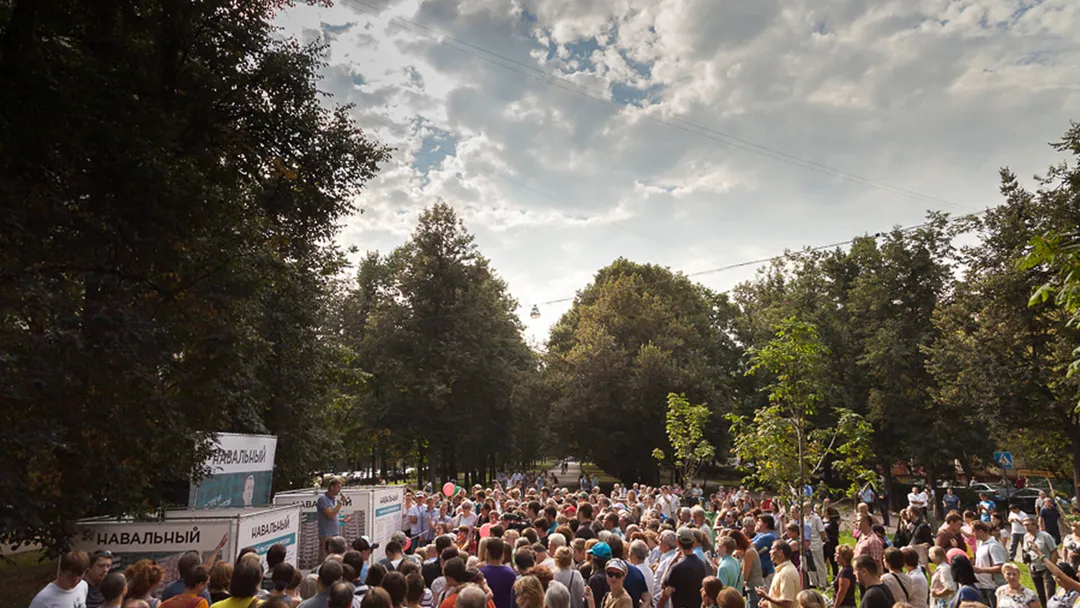
Alexei Navalny’s meeting with voters in Moscow’s Krylatskoye district. Part 1
Yesterday we rehearsed our
program at our campaign headquarters. And
we had these really cool slides. On
those slides there was infographics, we ran through all of
it, and then decided
to completely change and scrap everything, because
all those slides and that infographics
were all very impressive and very
serious-looking, but it felt a lot like,
well, a corporate presentation for people
who sell soap. They are very good
at selling it. They will prove to everyone that they
will increase soap sales from 5 to 17 percent in
the next three quarters, and so on, and
so forth. But we did not write this program
as soap salespeople—though of course there is nothing
wrong with selling soap. We
wrote this program for ourselves. So our
program, and what I am about to
say about it now, will be stories
about us, plain and simple. And I think
each of us will be able to recognize ourselves in
one of these stories. And the booklet you have
in your hands—you can simply
follow along. Does everyone have a copy of the program? I
take it that in this hall
everyone has one. Excellent. You
can follow the text and, at the very
least, see some more specific
proposals on the issues I am
talking about. And let’s try to make
this event as
informal as possible. So shout-outs, approval,
or disapproval, and so on, are all entirely
welcome. And we would be betraying
ourselves if we did not begin our program with
the section on fighting corruption. And here we have
a story about Lyuba. Hi, Lyuba.
One day Lyuba simply decided that it would be nice
to have flowers growing by the entrance to her building—she lives on
Nagatinskaya. Since Lyuba
works at the Anti-Corruption Foundation (ACF),
she knows for a fact that Moscow allocates huge amounts of money for
urban improvement and beautification.
She went onto the public procurement website and
found that, in fact, huge sums had been allocated
to plant flowers
near Lyuba’s building entrance. But the flowers
are not there.
That is why Lyuba is here with us today,
because our program
provides for oversight of all spending by
the city of Moscow. Our program
calls for the introduction of contract
monitors. And these are absolutely
hard-won points in the program, which
would have the right to monitor what is actually
being purchased, what is not being purchased, what
is being built, and what is not being built. And as if it were not enough that Lyuba
was left without flowers,
yesterday, when she was coming out of
the Yasenevo metro station, she was wading through knee-deep
water,
just like some of you, in fact,
who were near the Yasenevo metro station. And when
this morning she looked sadly
at her ruined shoes, she heard
on the radio a statement that
the Moscow city government was buying for itself
the newspaper Argumenty i Fakty for $100 million
.
And she knew that Moscow spends
half a billion dollars every year
on various media outlets. And no one asked
Lyuba, did not ask you, did not even ask
the deputies whether the city of Moscow actually needs
the newspaper Argumenty i Fakty. That is why Lyuba
is with us, because our program
provides that all such purchases
must be justified. All of this
justification must be absolutely
transparent. And any person who
simply looks out the window and
sees that someone is building something somewhere
in their building, near their building, in
their courtyard, will be able, by going online, with a single
click, to find out who is building, what
is being built, which workers exactly are on the job, and
how much it costs. This level of
transparency can be ensured right
now, and we will absolutely make it happen
when we come to power in the city of
Moscow. Thank you, Lyuba, for
being with us. [applause]
Now let’s talk about Alexei. Alexei is
a municipal deputy in the
Kurkino district. Alexei has a major—he has
a major problem: residents are constantly calling him.
Residents keep calling him because
he is their deputy, and in Kurkino there is
construction going on—they want to take away a vacant lot or
a small park where people spend their time. And he
cannot do anything about it. He is a deputy,
elected by these people. But the system
of power in Moscow is structured so archaically
that all decisions are made
exclusively at 13 Tverskaya (Moscow City Hall). And at
13 Tverskaya, in reality, no one will even
see any of what will be
built somewhere out in Alexei’s Kurkino, but
it will be built, the residents will be
unhappy, and Alexei will still be
getting their angry calls. Moscow’s budget—
we all know how much it is, right? 1.6 trillion rubles.
Do you know how much money
all
municipal deputies like
Alexei control altogether? It is 16 billion rubles. One percent of all the money
in Moscow is allocated where
people actually live, where they
face their everyday problems.
That is why Alexei is here with us today,
because he supports the point in our
election platform that says we will
redistribute both powers and
money to the level where people live and
where there are deputies who already
are now ready to deal with this money.
[applause]
And here is Zhora, whom I very rarely see
in a jacket. Everyone knows and loves Zhora, but
recently he committed a minor
offense and was brought to
administrative responsibility. He
was tried by a justice of the peace, who threw the book at him
and held him fully liable without even
examining anything. The police brought it in and
handed it over, and the judge sided with the police.
And Zhora is with us today because our
election platform includes a point saying
that under federal law
in Moscow, justices of the peace
can be elected either by the Moscow City Duma, as
they effectively are now appointed from the Kremlin,
or elected by the public. And we
demand that they be elected by the people,
because 70% of ordinary citizens who
deal with the courts, [applause]
are not criminals at all,
but are dealing with cases involving
divorce, division of property, or
minor offenses—all of that goes through these lower courts. And
the residents of Moscow can, and they are ready to,
absolutely choose them themselves.
Let’s talk about
Lena.
Lena is young and beautiful, as you can see,
and, incidentally, very law-abiding, and
even in her worst nightmare she would never imagine that
she might suddenly be taken away and locked up for, say,
a year and a half in prison.
That would be terrible, but unfortunately
if the government in Moscow does not change,
that is exactly what will happen, because every
Muscovite who lives in Moscow—if Lena
lives in Moscow for 30 years or more—will
lose a year and a half of life sitting
in traffic. A year and a half of life—each of
us, every one of us who spends 30
years in Moscow, will spend a year and a half
in traffic jams. That time will be taken
from each of us. Each of us will sit in this
little prison. That is why Lena is with us today
because our
program includes provisions stating that all
transport decisions
must undergo expert review. All projects
costing more than 3 billion rubles must
undergo international review,
so that we do not end up with a situation like
the Fourth Ring Road,
which they first built—you know,
it became the most expensive road in the world—and then
later declared it an urban-planning
mistake. All the people who made
that urban-planning mistake
are still sitting in City Hall, in the relevant offices, in
Moscow’s architecture department.
Lena is with us today because our
program provides for a strategy
for Moscow’s development. At long last, we must
decide whether we are relocating or not
the federal government bodies, where
we are building the parliamentary center, where our
major roads will go, and so on. Lena is with us
because she likes our approach,
which is based on calculations showing that we should not
pour money into giant interchanges,
but instead build a capillary
transport network in Moscow. Thank you very much, Lena,
for being with us today and supporting our
program. [applause]
Lena’s neighbor Roman, who is now doing
a tremendous amount of work, helping us with
municipal deputies, found out that
an Uzbek janitor earns 18,000 rubles.
Yet Roman reads in the newspapers that
the average salary of a migrant janitor in Moscow
is 42,000 rubles. And this janitor told him
that he works on the understanding that
he hands over part of the money to
the district maintenance office. The office passes part of these bribes on
to the local district administration, which sends it all on
to the prefecture. And this whole system also
shares with the police. That is why undocumented migrants
have come here and will keep coming here
regardless of whether there is any real
need for them, because they are simply
needed so that this whole
structure can endlessly suck money out of
these migrants. And Roman is here with us today
because he supports the point in our
program that says all migrants must
be registered, and all information about
whether migrants are present or not must
simply be published. You
go online and you see your
janitor, you see his salary. The
janitor himself and the janitors’ union understand
what their wages are, and no one can
deceive anyone. In addition, Roman
supports the part of our program in
the migration section, because he knows very well
that this janitor’s children, unfortunately,
have lived here, but they have not
gone to school, they speak Russian poorly,
and so they have no real
future here, yet they are already
Moscow teenagers. In order
to earn money, they resort to the
simplest method. Their
cousin comes from Tajikistan and
brings them 200 grams of heroin every quarter.
They sell it in Roman’s courtyard and
make money from it simply
to survive. And he supports
the point in our program that says the Moscow mayor’s office
must use every possible measure. We
have set out what measures are needed in order
to avoid creating these criminal
ghettos, where people live in basements here
30 to a room and are
forced—and will in any case end up selling
drugs simply in order
to survive. Konstantin Yankaovska, deputy
of the Zyuzino municipal district. He recently
was absolutely furious because
Konstantin regularly gets calls
from local residents complaining about high
utility and housing service charges. And he himself is unhappy about it. He
pays a great deal for his apartment. And
Konstantin was furious because in the
newspapers he read that the daughter company of
Mosenergo, the supplier,
which supplies heat and electricity, heat and electricity
to our apartments, had transferred to United
Russia 200 million rubles. Those 200 million rubles
were sponsorship money.
They were simply built into the tariff. And Konstantin
is with us today because he supports
the points of our program that say
that all expenses of utility providers
and district maintenance offices should undergo
a basic and public audit. That all
these so-called investment programs,
gigantic and mythical as they are. Once again
the monopolists hand us this huge tome
of paperwork about how, supposedly, they will invest
a billion dollars in their own development,
why tariffs need to be raised by that amount,
and yet in the end there is no development at all, only
new houses somewhere on the southern coast
of France. This can be checked with a simple
audit. Konstantin cannot achieve this on his own.
Together with us, he will.
Thank you very much to Konstantin
for joining us. [applause]
Who shall we talk about now? About
a woman named Yulia. Shall we?
Yulia has a family. Yulia has two
children.
Because of this, Yulia is concerned about the situation
at her local outpatient clinic in the district of
Maryino. Because every time
you need to go to the clinic even
just to get some certificate, you spend 3
hours there. At the same time, Yulia knows perfectly well that
for every Muscovite, as I told her,
24,000 rubles are allocated just for
outpatient clinic services. Thus
Yulia’s family has 100,000
rubles a year allocated to
outpatient clinic services. That amount
is allocated per person. I am simply
curious: please raise your hand,
those of you who have been to your local
outpatient clinic in the last year. And now raise
your hand if you have never in your life been to
your local outpatient clinic.
There you have it. And yet 24,000 rubles go toward
each person. Yulia is with us today. She
has, of course, another reason as well, but
among other things, [laughter] because she
supports the points of our program.
[applause]
The idea that the enormous sums of money available in
[applause] Moscow should be spent first and foremost
on increasing
the number of general practitioners,
family doctors. We have enough money,
facilities, and infrastructure to have
enough primary care doctors so that every
family would know its general practitioner
and could turn to them without difficulty
and receive a consultation the same day.
We have the money for this. There is
more than enough money that if we introduce
the provision in our program that
money should follow the patient, doctors at
outpatient clinics will be chasing after our
family, because we have 100,000
rubles that can be claimed. And Yulia
is with us today because she
supports the idea that we should not
keep pouring money endlessly
into healthcare bureaucracy, into this whole setup,
into buying scanners. In Moscow we have more scanners
than London does per
capita, and more than in
Berlin. We get neither better treatment outcomes nor
better prevention from this. What we
get instead is a $1 million bribe
built into every procurement of a
scanner. That is all. Thank you, Yulia,
for being with us and supporting our
program. [applause]
Since we have already talked about Yulia, let us
talk about Alexei, who is very
concerned that in Moscow the level of
secondary education is falling
catastrophically. Alexei has—I have
a daughter, she is 11 years old. Right now her school
is being merged with some other school. And
his wife, who is on the parent
committee, constantly complains that this
other school is worse. And no one understands the reasons
for the merger. I think most of you
who have children of school
age have encountered
this. More than that, a kindergarten is being
attached to this school as well, and overall
it is completely unclear what this is all about. No one even
explains why any of this is happening. Even though we
have enough money for secondary education,
among other things. That is why we are putting forward program points
that say: first,
full transparency in decision-making
on school mergers; second, full
transparency in publishing
Unified State Exam results and interim
results. In other words, a school reports
on how well its students are doing, and
funding is tied, among other things,
to that. And in our schools it is entirely possible
to introduce
the same programs, the same systems
for enrolling children in and withdrawing them from
schools that exist throughout
European countries and that are fully
transparent and can be used
by parents right now. [applause]
Vladimir. You all know Vladimir, but
some of you know him. Vladimir worked in
at a huge corporation and held a very
senior position. And then, for reasons beyond his
control, he was forced to leave
that corporation. You know, he worked with
the Anti-Corruption Foundation (ACF), and that became
an insurmountable obstacle to his so
bright and promising
corporate career. Nevertheless, he is
a wonderful person, everyone knows him, and
he [applause] could, with great
ease, go into business. But
when Vladimir decides which city in
Russia he could start a business in,
do business in, he would never
choose Moscow, because he looks at
the ease-of-doing-business ranking, in which
Moscow holds a shameful
30th place among Russia's cities. And
Vladimir is with us today because in
our poin— in our program there are
provisions on how to move Moscow from that shameful 30th
place to a leading
position. How to make sure that all
leases, that all premises
belonging to the city, are visible
transparently. You go online, and you
can see at what price city-owned
premises are being rented out, and to whom. And
you can check whether they are
being subleased. Maybe someone
rents them from the city for 1,000 rubles, and then
simply subleases them for 3,000. Just as
happens with 95%
of all municipal premises. And in our
program there are provisions on how to make it
easier to connect to
the power grid. How to make it so
that it is easier to obtain
construction permits, so that in Moscow
business can develop. Thank you,
Vladimir, for joining us.
Oksana, a wonderful member of our team,
who is currently running our
presentation, and right now she is, uh,
hiding under the table and talking on
the phone.
She's a wonderful young woman, but she con—
she has a problem. The thing is, in
Oksana's courtyard there is a dark passageway,
and she has to walk through this dark passageway
to get around. In this dark passageway
someone regularly gets their bag snatched. And
Oksana is a wonderful young woman, but with a build like that,
well, all sorts of thugs apparently think
it's fairly easy to take her bag.
There is a camera in that, in that passageway,
but Oksana knows perfectly well that this camera
— she learned this from us at the
Anti-Corruption Foundation — was
installed after a secret tender was held
for the installation of cameras, in which
one single company won. And all the cameras that were
installed are either fake — just
dummy units — or they simply produce
no image at all. And we will replace them everywhere
where this can be changed.
And the experience of Singapore, Hong Kong, and London is
fully applicable in Moscow.
Thank you very much, Oksana, for being with us.
And to conclude this part, I would like
to say that for everyone on
this stage, and probably for everyone in this hall,
we all understand that it would be completely
hypocritical to say that
we can tweak things here,
adjust things there, put up cameras here, and
that something will change without
any political changes. That is
absolutely not the case. We understand that not
a single reform will work without the basic
political conditions. In Moscow
those who were actually elected must become deputies
(legislators). We need fair elections. All
residents must have the right to
hold any public events under a simple notification procedure
without prior permission. There must be no censorship in
Moscow's media. And everyone standing on
this stage, everyone in this hall, I
think we all believe and understand that
when we begin to implement this in
Moscow, we will implement it across all of Russia.
Change Russia, start with Moscow. That is our
practical slogan.
We know exactly what to do. We have
a program. Our task is to bring this
program to Muscovites. I am sure that
when we come to them with these
right words, we will get what
we want from Muscovites: support and
victory. So for us there are no make-believe
elections. We are entering these elections with complete
seriousness. The question of power in Russia and in
Moscow is absolutely serious for us. We
understand perfectly well that Putin, Sobyanin, and
all the rest of the Kremlin and Moscow
riffraff do not want to let us into
the elections. They are afraid to let us into
the elections. Whether they register us or not,
we will carry on this
election campaign until September 8 and
beyond, until we have brought these ideas to
everyone we want to reach. For us,
an election campaign is not
about interacting with the election
commission, but about interacting with
the voters. That is what we will be doing.
Once again, I thank everyone who came.
As of now, our volunteer groups have already
signed up 5,000 people. Our task is
to learn. We need these people, all of us
sitting here, to learn how to properly interact
with these 5,000, and there will be many more,
if we organize them properly, then
we will have such strength that
in the face of it, neither
censorship, nor administrative leverage, nor
falsification will mean anything. Friends, thank you
so much. We will definitely win.
Thanks a bunch.
And so we have come to assert our rights.
Yes.