Alexei Navalny’s meeting with voters in Moscow’s Mitino district
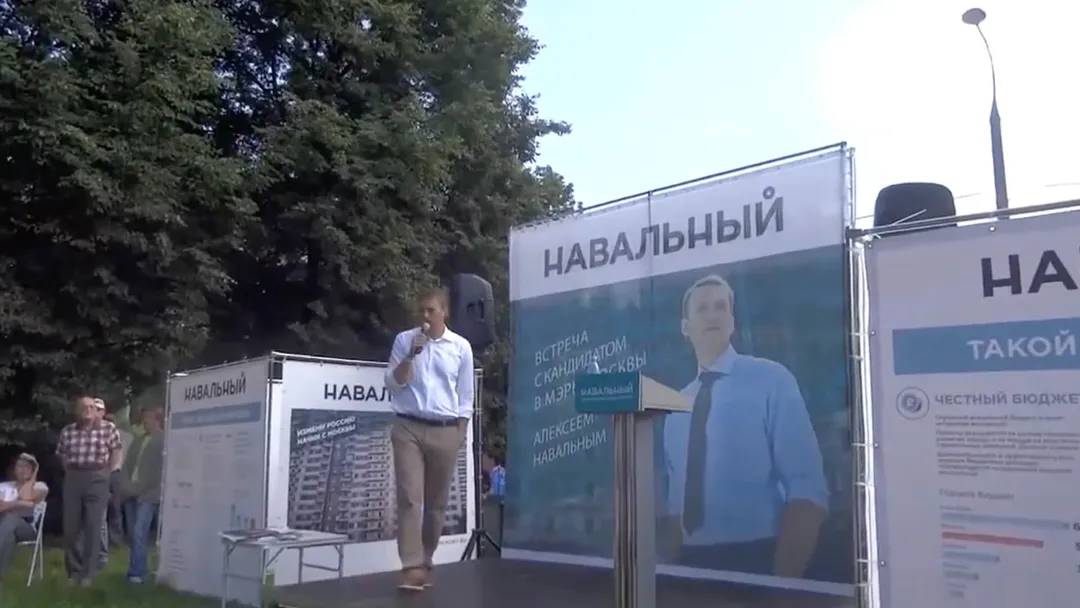
Who knows—who can name for me at least
one major industrial enterprise
built in Russia over the past 15 years?
I ask this question at every meeting.
Every single one. This is already my thirty-
fourth meeting like this with voters.
And at not a single meeting has anyone
been able to name one. Well, because such an
enterprise does not exist.
I want to see where the railways are,
built with Putin's money—with
our money, rather, received during the Putin era.
I know the statistics showing that Russia
builds as much railway in a year
as China builds in a week. Even though
China has neither oil nor gas.
Show me our modern
space industry.
All I see is a rocket that takes off and
crashes. Show me the science
that we are funding with those $3
trillion we received.
There is nothing. All I see is the reform of the Russian Academy of Sciences (RAN),
whose purpose is to take away from these
elderly academicians their real estate.
Where is the infrastructure, where is healthcare,
where is the education that belongs to me, my
children, and you. That is why I believe that I have been
personally robbed by all these people. I mean,
I can see this list of billionaires in Russia.
I see the statistics for the year 2000. Do you know
how many official
dollar billionaires there were in Russia? Six. And now
do you know how many there are? 121.
The main record that Russia has set
is the rate of growth in the number of dollar
billionaires.
The main record Russia is setting
is that all the homes in London
worth more than a million pounds
are being bought by Russian officials. Am I supposed to
be proud of that? No. I believe that
I have personally been robbed. It is as if
I were riding on a trolleybus and I had
my 640,000 rubles—my share of the oil
rent—and someone stuck a hand into my pocket and
pulled it out. They pulled it out of my family's pocket too, and
out of all of yours. That is why I will
never leave alone either
Gazprom, or Rosneft, or
Transneft, or all the rest. This
group of people that took the $3 trillion
received from the sale of our
natural resources and simply kept it for themselves.
And here, at this point, I am now addressing
you as
a candidate for mayor of Moscow who wants
to earn your support. I want to earn
your support. I want you to vote
for me.
I want you to tell others about
me. I came here to persuade you.
And I am telling you that I am standing here
first and foremost because I am the most
ordinary, simple Muscovite, living in
an ordinary apartment building, living the life of an ordinary
Moscow family. And all the problems
I am talking about here are not even just the
problems that you yourselves experience—
they are my problems. I want to solve the problems
that my family has
run into. I am talking to you here about housing and utilities services
not because I know that this issue
concerns you. It concerns me.
It concerns me. For my apartment in a
prefabricated panel building, I get a bill for 9,500
rubles. How is that acceptable at all? And I
understand that I am not receiving services worth
that amount. I understand that the tariff
keeps rising. I want to become the mayor who
will finally conduct an audit of housing and utilities tariffs,
so that we can finally understand: why are we
paying so much? Why did Mosvodokanal
a state-owned company, make
a profit of 3 billion rubles in 2011,
and then in 2012 still
raise the water tariff? They operate at a
net profit. Our company operates
with a net profit of 3 billion, and yet the tariff still
goes up. I want to conduct an audit
so that everyone can see it—you can see it, and I can
see it too.
the astonishing things that happen
when tariffs are set. Did you know, for example,
that when last year you
paid for electricity and heating in your
home, you also paid for sponsorship support to
United Russia in the amount of 200 million rubles. Mosenergo
transferred them a donation of 200 million
rubles by including it in the tariff.
They justify it; they come to city hall
and say: "Here are our urgent expenses,
without which we cannot continue to exist."
And there is a line item there: "Support for United Russia
200 million rubles."
I want to become the mayor who will conduct
an audit of this tariff and expose,
once and for all, all these nonexistent
investment components, these virtual construction projects
that are included there but in
reality are never carried out. I do not want
to pay for that. I am sure you do not want
to pay for it either. The example I
give at every rally about the head of my district administration
in Maryino. You may
have seen how a month ago he was removed from
office. He was removed because his
wife—you probably saw it on television—was driving a
jeep and ran into pedestrians.
The pedestrians recorded the whole thing on video. There was
a scandal, and the district head was fired. That jeep—
remember? It was a Range Rover with
the license plate 999.
And this man, the district head,
has spent his whole life in municipal service. He
was the head of the district administration in Nekrasovka,
then in Lyublino, then in my district of
Maryino. His whole life in
in municipal service. He has a decent
salary, but judging by his officially declared
income, he really ought to be earning less than
I do. But he openly lives the life of a
dollar millionaire, completely
without the slightest embarrassment before me, or
the residents of the district, or anyone. And I do not want
to pay for his millionaire lifestyle through my 9,500-ruble
utility bill. That is why I
want to become the mayor who will put a stop to all
of this. I came here to your district and
climbed onto this stage.
Because, just like you, I go to an
ordinary city clinic. And my
wife goes to an ordinary city
clinic
or to a children's clinic if she
goes there with the children. And, just like you, I can
be shown a TVC (a Moscow TV channel) report a million times,
with the triumphant, beaming Sergei
Semyonovich Sobyanin saying that we
have this electronic appointment system.
You come to this electronic registration desk and
you get to see a doctor right away. Well, that is
nonsense. I have been to an ordinary clinic. I do
not live on Rublyovka (an elite wealthy area near Moscow). You are all nodding
your heads, because everyone knows it. We, we
go to ordinary clinics,
but we cannot get in to see a doctor. And do you know
by how much
more is spent on healthcare for any
resident of Moscow compared with
any other Russian? By how much more
is allocated per Muscovite, what percentage more
is allocated for a Muscovite than for any
other person? Who knows?
By 70.
By 70%. Any other guesses?
Twice as much.
Four times as much. Four times
more is allocated for every person sitting
here than for any other
citizen of Russia. For every one
of you standing here, and for every Muscovite,
the amount allocated for outpatient clinic
care
is 20,000 rubles a year. So for my family
of four, that is 80,000 rubles.
That is a huge amount of money. And I am simply
curious. Please raise your hands,
those of you who have been to your local
clinic in the past year.
I see. Some of you have. And who has not been to their
local clinic? Aha. Let me tell you,
my friends, 20,000 rubles has also been written off
for each of you.
I want to become the mayor who will direct these huge
funds that are already being allocated toward
finally hiring general practitioners,
internists, and the doctors
that Muscovites need in 90% of cases.
Now just tell me, is it easy to get an
ultrasound in an ordinary clinic?
No.
You all tell me: "No, just go up,
please, to any metro station, and there is
one of Sobyanin's little campaign tents there." And in the section
listing Sobyanin's achievements, the first thing
displayed is: "Bought 1,200 ultrasound machines for Muscovites
". It gives the impression that he personally went out
and bought us 1,200 ultrasound machines. But I
know that it is impossible to actually get an ultrasound. We
are all forced to go to private
ultrasound clinics because getting one at a public clinic
is extremely difficult. I want to become the mayor
who will make sure that the huge sums allocated for
equipment are spent not on
buying that equipment at twice
the real price, but on making sure
that people can actually get an ultrasound. Because
sometimes my wife needs one, my children need one,
I need one. And apparently, as I get older, I will
need ultrasounds more often, like anyone
else. This is about caring for a normal life.
I am standing here before you because
the issue of migration does not just
concern me,
it has become part of my life. Because
when I was preparing for this meeting with you, I
looked at what people here were writing about
migration problems, all these outcries. You have
that former state farm here,
what is it called?
Teplichny.
Teplichny,
where for two years there has been an illegal camp
for migrants. I looked carefully at the history
of it, and several times
orders were issued saying it had to be
shut down, that all of it was illegal.
And yet it is still there. Funny how that works,
isn't it? What happened at Matveyevsky Market?
So, some Dagestanis beat up a police officer. In
response, the Moscow government
set up a concentration camp where
200 Vietnamese people are being held.
What is that supposed to be? Well, please,
go to this Teplichny place. I invite both
Sobyanin and everyone else to come to my district,
Maryino, and take a walk in my Maryinsky Park
after 9:00 p.m. Then he will understand
why the women living in my building
are afraid to go outside in the evening.
And then he will learn that for me this
crime statistics are not just numbers
on a piece of paper. I know this because I personally know
several people, several women, whose
bags were snatched by these migrants.
And I know perfectly well
why migrants come here. I want
to become mayor because I know that
migrants come here not because
there are jobs here, but because people profit
from them. Let us simply
take a quick poll. Who knows how much
their local street cleaner earns? Who has asked
a street cleaner what his salary is?
10,000. 10
7
10 10
4 21
10
10
15
15
Here’s an interesting thing. If we all
read together the interview
with Sobyanin’s deputy Biryukov, who
is precisely responsible for this area, or
just look at the official standard. I
have looked at it. The current official
pay standard for street sweepers tells us
that there are no street sweepers in Moscow
who earn less than 30,000 rubles.
Yes, the funny thing is that any real, live
street sweepers we
speak to give us figures like 10, 15,
8, 4, 5. My street sweeper told me 18.
And this is the kind of secret all
Muscovites know: these migrants are brought here
to be kept in conditions like slavery,
30 people to a basement, because
each of them, along with his salary,
each one of them, every month, simply
flows like a huge full river along the route
of the management company, housing services,
the district administration, the prefecture, the police station,
the migration service, and so on, and so
on. I want to become the mayor who changes this
because I do not need
migrant-related crime and
so on. This is my problem, one I
encounter myself. I do not live like Sobyanin, behind
the Rublyovka fence (an elite wealthy suburb outside Moscow), with reports brought to me.
No,
this is part of my life. I am standing here
before you because I follow
the budget process very
closely and carefully watch how
money is spent in Moscow. I know the size
of the Moscow city budget. Who can
tell me what Moscow’s annual budget is?
52 billion.
A 500 billion deficit.
1.6, 1.6 trillion rubles. Moscow’s budget
is smaller only than the budgets
of New York and Shanghai. All of us sitting and
standing here must understand one
important thing: we live in one of the
richest cities in the world.
And the richest cities of Europe and America
simply cannot even come close
to comparing with Moscow in terms of their
wealth. With the money we already
have right now.
Right now, Muscovites could already have good
healthcare, quality
education,
roads where traffic jams are successfully being dealt with,
traffic congestion,
fewer migrants on the streets
and all the other things enjoyed by
residents of major cities around the world.
They have all that there; they have problems too, but
they deal with them successfully. And I am standing here
before you because I have written
a program that the best specialists helped me write,
drawing on the experience
of how other cities successfully solved
all these problems. We can solve them all,
and we have the money
to solve these problems. You know,
if I were standing here
running for mayor of Kostroma,
and you were all residents of Kostroma, you would
say to me: "Navalny, here you are
running, and we demand that you build us
another outpatient clinic." And I would
say to you, my dear Kostroma residents, there is no money
in our budget. You will not get
that clinic; I will not make easy
promises that cannot be fulfilled. But I am
running for mayor of Moscow. So I tell you,
my dear Muscovites, in our
budget there is more than enough money for everything.
For us to live normally in
Moscow, we have the city, we have
the infrastructure, we have a very
highly educated population that
is capable of managing all of this. We have
everything. The only thing we lack is faith in ourselves. For some reason, we
have simply somehow decided that
nothing can be changed. At every
meeting, someone comes up to me,
shrugs, and says: "Well,
all of this is true. We know all this,
everything you’ve said is already known."
"But nothing can be changed."
But why can’t it be changed? I came here
because I believe it can
be changed. But why have we accepted
that there is this kind of system of power
that robs us, insults us, and
simply despises us,
and we just say, all right, that’s the way things are.
Show me—I don’t know—is there an army here
standing guard over us? No, I think there’s
maybe one police officer somewhere here
watching over us, and that’s all.
Here, through your own district, runs this
North-Western Chord (a major highway project), right? And about
this entire North-Western Chord, everyone unanimously
says that it costs 83 billion. And all
transport experts tell us
that, first, from a transportation
standpoint it is fairly pointless,
and second, it costs twice as much
as it should. Its original
estimate was 30 billion, and now it has risen to
83. But we all know that in the construction of
the North-Western Chord
so much money will be stolen from this one project
as would be needed to build
additional outpatient clinics and schools not just
in the North-Western
District, but across all of Moscow. We
We know all this, we understand it all. We shrug
our shoulders and say, "Well, nothing can be
changed." That's just how things are. But why
are they that way? Are we the stupidest people?
Are we the most cursed, the most
pointless inhabitants of the planet or what? No
— no. I'm standing here because I believe
that this is the source of power,
that people choose their government. And people
choose their mayor themselves. Not the Central Election Commission,
not television, not Churov. People choose.
This whole gang entrenched at the top
doesn't rule everyone through fear, but simply
through passivity. Because we
shrug our shoulders and think: "Well, nothing
can be changed." Everything can be changed. I
don't have the opportunity to appear on television.
I don't have the opportunity to plaster the city with billboards.
But you still came here
somehow. I did let you know about
my presence. I announced it in my
program. And the persuasive, campaigning
power of each one of you is
tremendous.
I believe that through you, through meetings like these,
I will speak to hundreds of thousands, to
millions of Muscovites. And in order to
elect the mayor of Moscow, we need 1.5 million
people. Moscow has a population of 15 million,
with 8 million voters. And in order to
elect a mayor, taking turnout into account, we need 1.55
million people. There are 1.55 million people in
Moscow who know everything and understand everything.
Each of those one and a half million people can
stand here with me and
say exactly the same things.
Our task is simply to reach those
one and a half million. I am absolutely certain
that, relying on you, through you, I
will speak to hundreds of thousands. If we
cast off this haze from ourselves, if we
finally understand that on the
North-West Chord (a major Moscow highway project), they are stealing not just
billions, but our billions, they are depriving
us of clinics and schools,
they are depriving us of roads without traffic jams, then
we can change everything. We just need to
realize our own strength. We absolutely will
realize it. I am absolutely certain that with
your help, we will put pressure on the authorities. We
will force them to change, and we will make sure
that the government in Moscow is worthy of its
wonderful residents. Thank you very much.
I'm ready to answer your questions.
Please. Thank you. Thank you. I'm very
pleased. All right, you ask, and then I'll
repeat it for everyone.
Well, I understand the question about the waiting list, about housing.
I understand.
I'll repeat it for everyone afterward. And so I
came
and they told me to go
outside Moscow. That's exactly what happened, I wanted everyone
...Alexeevna. I see. Natalia
Alexeevna has a question. Now I will
answer. Thank you. The question is that she
has the right to receive an apartment.
Natalia Alexeevna, there are just a lot of
people here. If I spend too long listening to
the question, then—yes, yes, please.
What should the president do, meaning Sobyanin,
so that he looks into it, and so Sobyanin doesn't write
telling me to go somewhere else.
Should that be brief?
Sobyanin told Natalia Alexeevna
that when she asked for the housing allocation due to her by
law, she should go
to another city and find housing there. Am I quoting
that correctly? Well, listen, you recently read
Sobyanin's statement that
we would build wonderful cities for
pensioners beyond the Urals and in the Russian Far East
.
Well, it's funny, yes, a funny thing, but it
simply illustrates how much they
despise everyone, if they can make statements
like that, after which they
should get zero votes, but they are not
embarrassed at all. And as for the issue that
concerns apartments, housing allocations, and
waiting lists, which I get asked about at
every meeting—here the matter is simple.
Tell me, please, can any of you
go online or to some
library, look at the list, and
see the queue? Who is first in line,
who is second, who is third? Can that be done
right now? No.
I want to become the kind of mayor who will do
one simple thing: publish the entire list,
so there is a list of everyone waiting, from first
to last, a list of beneficiaries, a list of
super-beneficiaries. And so that everyone can
see it and monitor it, because
we buy a huge amount of housing for beneficiaries,
a huge amount. Only all these
beneficiaries somehow turn out to be
city hall employees. Here, at a preferential
price, you know, TV host
Vladimir Solovyov, one of our 'beneficiaries,' bought
an apartment for 3 million rubles (about US$90,000 at the time), which is worth
around 30 million rubles (about US$900,000). And TV host Andrei
Malakhov received an apartment on
Kropotkinskaya. That's how this system of power works:
for some reason, TV presenters, as 'beneficiaries,'
get apartments even though they have their own
money. But you, Natalia Alexeevna,
are being told to go to another city.
And they would tell me the same thing if I
had the right to receive housing. And they tell
everyone that. So I want to become a mayor
who simply makes this transparent.
Just let everyone see it. Then no one will be able to
slip anyone into the line. It seems like
an elementary measure, but it's an obvious one. Yes,
just publish the waiting list—but no one
does it. And do you know why they don't? Because
just go ahead and look,
for example, to the city
election commission’s website and look there
at the list of candidates’ assets. Mine,
for example, you’ll see my assets. I have,
a 78 sq. m apartment in Marino (a Moscow district). You’ll see the car
my wife owns, some VAZ-2108,
which I bought back in 1996
and it’s still listed under my name
because I sold it by power of attorney.
It’s all there. Look into
me and my property, and then go to
the Sobyanin section, and you’ll see that
somehow Sergei Semyonovich
Sobyanin’s underage
daughter owns a 308 sq. m apartment.
I’ve never even seen an apartment like that
in my life.
Explain to me how a person
who has been in government service since 2001 can
buy himself an apartment in the city center on
Rochdelskaya Street, 308 sq. m in size.
If he came from Tyumen, an important
official came from Tyumen, then he should have been
given official housing, which maybe
he could later privatize.
Not his daughter, but he himself. But I think
everyone here has dealt with housing problems.
Remind me, please,
what is the housing norm per person?
How many square meters? 18.
18.
You’re saying it in unison. 18. So how many
family members does Sergei Semyonovich
Sobyanin have, that he got a 308 sq. m apartment?
That’s why the waiting list is opaque,
because they hand out apartments to themselves.
That’s all. I want to become the kind of mayor who
does one elementary, obvious, and very
simple thing. It could be done tomorrow:
open up the waiting list, and then it will be clear
who is actually on the list and who are these dubious
daughters with mysterious 308 sq. m apartments.
Next question. Please.
Please tell me, for a year now we’ve been going
to rallies over this chordal highway. Now
they’ve already started building it, and you
are already saying what a huge sum
has been allocated. If you become mayor, I have
two questions: will you be able to stop this
construction? Probably not. And
one more question is connected with these
events. It’s easiest of all to fight
this migration by shutting down all the markets. But
you understand that Moscow can’t do without markets.
Today I went to Vykhina (a Moscow district),
to the Vykhino market, where pensioners always
shop at the lowest prices
all the time. So if you become
mayor, what will your policy be on
this?
Question number one. Thank you very much.
Excellent question. Question number one: what
to do about the chordal highway? It’s being built. So if
you become mayor, what will you do about
the chordal highway? Question number two: what will you
do about migrants? We’re all
unhappy. What are we going to do? Let’s start with
the chordal highway.
Markets, not migrants.
Well, markets then. And that is connected with
migrants,
with the chordal highway, as with any other
construction projects. The chordal highways are not
the be-all and end-all. This one
is just very expensive, so people cite it
as an example. Yes, we all know the chordal highway
costs 30 billion rubles. There is also the Southern ROKADA (a major road project), which
costs 10 billion rubles. And everyone says that
it too is twice as expensive as it should be. On the Southern
ROKADA, someone will also pocket 5 billion
rubles.
The mayor’s job is to make sure the biggest
construction projects are approved or not approved
only after proper calculations. That seems like
an elementary, obvious thing, right?
If you take the newspaper Vedomosti from the day before yesterday
and read there
Sobyanin’s interview, he is asked:
"Sergei Semyonovich, what is your greatest
achievement?" And he answers: "My
very great achievement is that in
Moscow we launched three of the most
expensive construction projects in the world.
We’re building roads." And it was very hard for us to do
because there is neither
strategy, nor a plan, nor calculations.
I’m not joking, go read it. I’m not twisting
his words; that is exactly what he said. I want to become
the kind of mayor who, before spending
38 or another 83 billion rubles on something,
will first produce a strategy, calculations, and a plan. That’s
all. The mayor’s job is to make sure
the contractors are normal
construction companies. Who is currently
the main road construction contractor
in Moscow? Who knows?
Mostotrest.
Rotenberg. Rotenberg is that
Putin judo trainer.
Back in Soviet times he was a judo coach,
and now he is our chief builder
of roads in Moscow. And who is, remind me,
please, the main contractor for
metro construction in Moscow right now?
Timchenko.
Timchenko? You know everything without me.
Timchenko, the very same guy I’m
constantly suing. The main trader in
Russian oil,
a citizen of Finland, who gave up
Russian citizenship. A citizen
of Finland, living in Switzerland and
through his Swiss offshore
company selling Russian oil and
becoming an official billionaire with
an enormous amount of money, is now
building the metro for us and also, amazingly,
at twice the price it
should cost. So my job as
mayor is to make sure that construction
projects are properly justified, that first
everything is calculated, then those who want
to criticize can criticize, and we understand
what the real amount should be. Then
we hire a real, proper
contractor, not Timchenko and Rotenberg,
who win all these tenders
without any competition at all, and only then
start spending money. That's all. I mean,
there's nothing original about it, it's simply
how things are done in every normal city. There's
nothing to invent here, and no need to reinvent anything.
It's just that right now, decisions about
launching the biggest construction projects
are made not because someone decided
that the North-West Chord highway is actually needed.
No, they came into the office and said: "Your
budget is somehow too big, 1.6
trillion, let's cook up something
for about 80 billion." And so
they did. That's not an exaggeration.
Look at what's happening with
the reconstruction of Leninsky Prospekt.
First they said: "We're going to carry out
the reconstruction of Leninsky Prospekt; anyone
who's against it is an idiot." Now, with the election approaching, residents have
raised an uproar. Sobyanin came out
and said: "Fine, we won't do
the reconstruction of Leninsky Prospekt."
After the election, he'll say: "Let's go ahead
and do it after all." Is anyone doing the calculations? We have
Moskomarkhitektura (Moscow's architecture committee), we have
NIPI Genplan (the city planning institute), we have the construction
complexes. Is anyone calculating anything at all, or
are we some kind of village with just
chaotic construction? I want to become
the mayor who finally brings
order. A question about migration and
markets.
40% of all Tajik men in the world
male.
Wow.
Okay. Now raise your hand if you
have entered, without a visa, any
European country.
How did you manage that? You probably have
a passport of some other
citizenship, I suppose. Which country did you enter
without a visa?
Montenegro. Visa-free entry. In
Montenegro, yes. Poland is in the European Union. You need
to get a Schengen visa. So, look,
here's the point. A visa regime applies
to both you and me. Neither I nor you can
enter Germany or
France without a visa. If we travel,
for example, to the United States, we'll have to provide
fingerprints even at the embassy and at the
border. We do it, and nobody dies from it.
So please explain to me why
any Uzbek or Tajik, even without an international
passport, using only their domestic
passport, can come to Moscow at any time
simply by buying a ticket and showing up.
Why are Tajikistan or
Uzbekistan somehow closer to me, to us, than France and
Germany? Yes, they are former republics
of the Soviet Union. But we have a visa regime with Georgia
(the country). Do we have a visa regime with Turkmenistan?
Yes, we do. Nobody died from it. Everything
is fine. It works. So what is the difference
for us standing here between Georgia and
Tajikistan, or between Turkmenistan and
Uzbekistan? None. So the first measure
that needs to be introduced is a perfectly normal one. Don't
worry, we have plenty of balloons, we'll
give you another one. A normal, lawful
measure is to introduce a visa regime with
the countries of Central Asia and the South Caucasus. I,
by the way, am the only candidate who
openly supports this. All the others
keep wavering back and forth on it.
This is normal. They don't let me into
Germany without a visa. They don't let you in either. It's
normal if we don't let in
citizens of other countries so freely. That's how Germans
protect themselves, and that's how we should protect ourselves.
Measure number two is
a measure against those contractors and
companies for whom it is currently very profitable to hire
illegal migrants. Right now, if you hire
an illegal worker, their labor is cheap,
and if you get caught, it's just a small fine
or a small bribe. I have drafted
a bill stating that if a company is
caught using the labor of
illegal migrants, it
is disqualified. That means it will never again
get access to city
funds. This is a measure that will actually
work.
And measure number three. Within a year, we will
introduce a rule under which any
commercial or state
organizations that use
budget money will not have the right to use that
budget money to hire foreigners.
If it is a fully commercial
enterprise using its own money, that is not
our business. Let them hire whoever they
want. But all these contractor
organizations, these GUPs and DEZs (municipal utility entities), and so on,
and so on, that work with our
money, must use that money of ours
to hire Russian citizens. And they have the money
to do that, or even to hire Muscovites. The money for
it exists. We hear a lot of tales and
myths on this subject. You've surely heard
this one: "If all the Uzbeks leave Moscow,
we'll be buried in filth." Have you heard that?
Of course.
They say it all the time. Supposedly, if the Tajiks leave
Moscow, there will be no one to clear the snow.
Heard that?
Well, we've all been living in Moscow
for a long time, haven't we? And the truth is that
Until 2003, there were no migrants at all in Moscow.
There weren't any. In most
Russian cities, there are no migrants.
In Russian cities with populations under
500,000, there are no migrants at all. In
Belarus, there are no migrants at all.
Look at the ranking of Russia's most livable
cities. There are no migrants there. By
adopting these three basic
rules, we can seriously reduce both
the number of migrants and the number
of crimes associated with those
migrants. We will definitely do that,
because my job as mayor is to work
for Muscovites. They, as I said at the very
beginning, drag them here because they
kick back to me from their wages
10,000 rubles every month. Next question.
Yes,
you didn't say anything about the markets.
There are a lot of people here, so let's keep it to one
person, one question. Please choose the main one.
Could you give the microphone to the person asking,
so we can hear the question?
I'll repeat it for everyone afterward.
The first question is about the financing of the
election campaign. You know that
United Russia is constantly outraged:
"Oh, Navalny's election campaign
is being financed improperly."
It's true that in terms of the size of our
campaign fund, we are second only to Sobyanin.
Sobyanin has raised, I think, about 1.2 billion
rubles, while we have raised 35 million rubles so far. What drives them
crazy is one simple fact:
the sponsors of our election
campaign are ordinary people. Twenty
or rather by now around 25,000 people
have sent us 100, 200, or 500 rubles.
That is exactly how our
election campaign is financed. United Russia
simply cannot calm down. It just
cannot wrap its head around the fact that there are
people who sponsor an
election campaign, people who
send their own 500 rubles
for an election. We compiled statistics on who
is sending us money. You know, I myself
was simply amazed by this figure. Who do
you think it is? Just tell me: who is the
representative, the typical representative
of the population, in terms of gender and age, who
donates the largest amount on average
of money?
Young people say pensioners. But in fact,
for some reason, the average, typical
donor of ours is a 60-year-old woman.
They still give
small amounts, around 500
rubles, but they donate even more than
young people do. I am very proud of that fact,
because our election campaign is
the first election campaign in
Russia to be financed
by ordinary people in the true sense. That means a great deal to me,
because I
have spent many years
proving to everyone—to you and to myself—
that I can live by the same principles
that I demand from officials. Our
Anti-Corruption Foundation (ACF) is financed in exactly
the same completely transparent way. You can go in
and see who earns what salary, who
does what, their last name, first name, patronymic,
and each person's work statistics.
We have been doing this for many years.
It's difficult work, but in return people
donate money to us because they
are confident that we will use that money
properly, and we do use it
properly. That is exactly why people
continue to fund us now.
That is exactly why yesterday 35
internet entrepreneurs,
not especially big players, not especially
wealthy, but nevertheless they quite
openly declared that they support
Navalny and will also
help finance his election
campaign. Gazprom will not finance me,
and I don't need it.
And all those utility companies,
they finance Sobyanin and everyone else.
But naturally, what is a hundred times more
valuable and important to me are the people who
send me their small donations, and
the entrepreneurs who openly
are not afraid to support me. And the second
question was about my fate.
As I understand it, this is a question about all
these criminal cases and so on. Well, you
know that at one point I was even
jailed once, right? And yet here I
am standing before you, speaking. And at
every meeting where I am asked
about this, I say every time
to residents: thank you very much, because
it was thanks to you that I was released. It was
thanks to you, thanks to those who came out
into the streets, thanks to those who were outraged.
And for the first time in history, we showed
the authorities that we do not believe they have the right
to imprison anyone without due process
on the basis of any fabricated
charge. And we do not want things to
be that way. And something happened that I myself
did not believe in when they led me to the cell.
Of course, I understood that I was not going to spend
five years in prison, but if someone had told me
that people would take to the streets and that the
next day I would be released, I never would have
believed it. So my
fate—grand as that may sound—
is entirely in your
hands. As long as I have the support
of the people behind me, nothing can
be done to me. No one will jail me, and we ourselves
will put them all behind bars.
Yes, please. Go ahead, go ahead.
So, I want the microphones for you
to be turned on. Don't hide. So, many of our
residents and all Muscovites
want to know why Sobyanin publishes
decrees of his that don't work. I would like
to make sure this question reaches
Sobyanin. Ideally, I ask that it be conveyed
to him. If he issues such decrees and
they don't work, why are they published in
the press? Specifically, this affected everyone with water meters.
Everyone, all of us.
Specifically, it was published in all the newspapers
that water meters did not need
to be inspected,
that's right
Let Sobyanin answer us in the press or on
television why we should even go to vote for him
at all. And
What do you think, Lidia Petrovna, and everyone
gathered here—I will pass along Lidia
Petrovna's question
and that's it, because his people are here.
His people are here, yes, of course his
people are here. There are surely representatives of the district administration here
taking notes on everything,
filming everything, and so on. But, Lidia
Petrovna, the conclusion is: you're absolutely right. I, I came here
precisely because all these laws and
all this outrage—I share it with you as well.
The very same laws that don't work
for you also don't work for
me. But if our conclusion is that we should simply
not go to the elections as a sign
of protest against Sobyanin, that's like the story about
the rabbit: "Don't throw me into the briar patch."
Sobyanin is just waiting for you
not to go to the elections in protest.
Then he'll bus in his Kyrgyz migrant workers on
three buses, and they'll vote at
every polling station, and he'll say: "You know,
I won with 85%."
Muscovites have trusted me again. Muscovites
have placed their trust in United Russia. Thank you very much, Muscovites.
Are we really going to let ourselves be deceived like that?
That's all. Therefore, Lidia Petrovna, I share your
outrage, but this tactic of your fight is
the wrong one. Please.