Alexei Navalny’s meeting with voters in Moscow’s Novokosino district
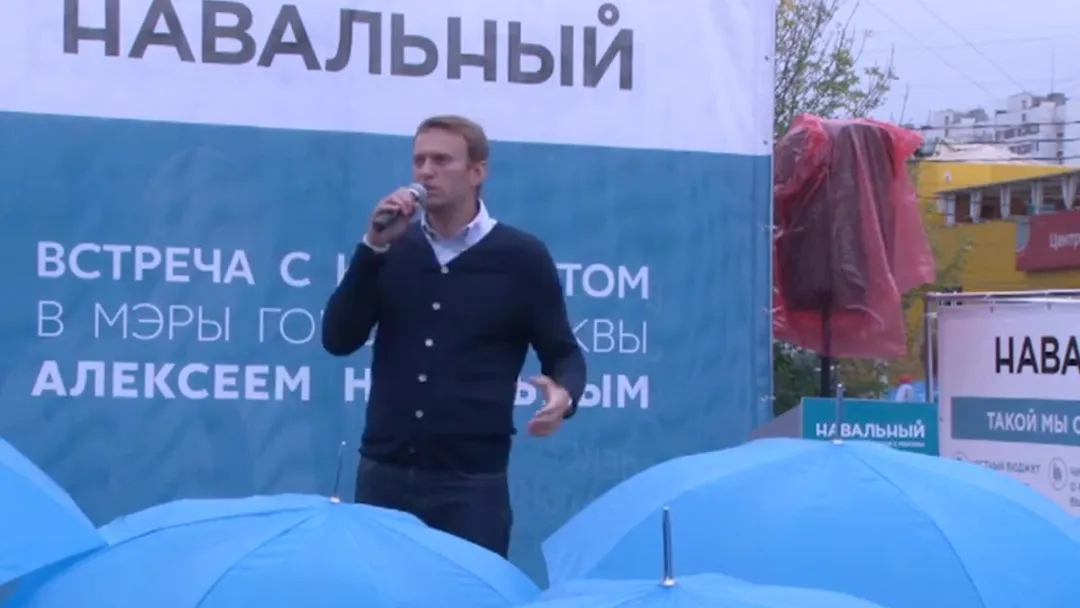
Hello. Thank you very much. I really didn't even
expect to be greeted right away with
applause. Thank you very much for
coming. I hope the weather cooperates and
we manage to hold our meeting. I used to
have my own idea of the ideal
candidate. I told myself that my
ideal candidate is someone who
comes to the courtyard next to my
building, stands in front of me, answers
all my questions, gives a speech, and then I
decide whether to vote for him or not
vote for him. And now I myself have become that kind of
candidate. And I hold a great many such meetings
myself. Three meetings every weekday,
five meetings every weekend. This is, by the way,
my milestone eightieth meeting.
Honestly, when I held the first one,
if someone had told me that I would be able to
hold 80 of them, I would have said, "No,
that's impossible." But all the same,
I keep doing them, because that is the job of a
candidate. If I am running in an election and promise
you to be an open mayor, then that means I
must be open and accessible as a
candidate too. You can find me three times a day
in one part of Moscow or another and
ask questions. I would start by
telling you a little about myself and about
why I do what I do, and then
answer your questions afterward. Any objections
to that format?
Excellent. My name is Alexei Navalny.
I am 37 years old. For the past 17 years I have lived in
the Maryino district of Moscow. It's fairly
close to here. I have a completely
ordinary family by Moscow standards.
A wife and two children. My daughter is 11; she
goes to school. My son is 5; he goes to
kindergarten. Just like everyone else.
I'll answer all questions a little later.
I come from a military family and, excuse me, spent my entire
childhood living in various military
towns, moving from one place to
another. My parents still live in
the Moscow region, in a military town. I
moved here to Moscow. By profession I am a
lawyer. I have two university degrees.
I graduated from the law faculty of
Peoples' Friendship University and the Financial
Academy under the Government of the Russian
Federation.
If you have followed my activities more or less
over the past couple of years or
perhaps a bit longer, what do you
know about me?
Kirovles. He stole the whole forest.
Yale University.
Yale University. Fighting
corruption. Most often, of course, the first
question I am asked is the question of
why I do all this. Why are you
spending years going after all these
Gazproms, Rosnefts, and everyone else?
Why do you think this needs to
be done? I begin every meeting by answering
that question, because it explains
why I am standing on this stage. I
am constantly suing all these
state corporations, fighting
corruption, and conducting investigations for
one simple reason: I
truly, personally believe that the current
system for managing resources,
is robbing me personally. It is robbing you
just the same, but first and foremost I am concerned
that it is robbing
me. Look, my math is
very simple, and perhaps it will
resonate with you too. What does Russia
live on?
Oil and gas. We sell oil and gas, and
that is how we make money. Over the past 15 years
we have sold $3 trillion worth of oil and gas.
That is more than the Soviet Union received in
the Soviet era, in the Brezhnev years.
Now, with those
Brezhnev petrodollars, the Soviet Union built
factories and plants, and supported a huge army.
It created a scientific and military-industrial
complex, a scientific base. Everything, everything
we built then is basically what we still have
and use to this day. In the Brezhnev years
Russia received $3 trillion in petrodollars,
and over the past 15 years Putin-era
petrodollars have brought in even more than in Brezhnev's time.
Do you have any idea where that money
was spent? I personally do not. There are
maybe 300 people standing here.
Can anyone remind me, recall whether
there is even one major industrial
enterprise in Russia that
was built over the last 15 years? The result
of your work in recent years?
I'll answer questions a little later.
Can anyone remind me of such an
enterprise, a major industrial one?
There isn't one. There isn't one.
I ask this question at every meeting, and
no one has ever answered me, because
the truth is that over
the past 15 years, not a single
major industrial enterprise has been built in Russia. We have not even
built an oil refinery.
There is only a pipeline through which
we sell oil and gas. And that is why, when
I think about Gazprom and Rosneft, I
think about corruption, about the theft of those
billions, and I understand that they were stolen
from me personally. That is my education, my
healthcare, infrastructure, roads,
railways. None of it is there.
Where did all that money go? I see
only one result of what
is happening in our corporations: the fact that
in Russia, in 2000, there were six
dollar billionaires, and now there are
121.
This is the only ranking. 131
I misspoke. The only ranking in which
Russia is rising—or rather, there are two.
The first is the corruption ranking: we have more and more of it.
The second is the ranking
for the number of dollar billionaires.
That is why, for me, fighting corruption in
Gazprom, VTB, Rosneft, and Transneft
is an entirely practical matter. And
what is more, I’ll tell you something quite
offensive that I always feel
firsthand. I come, for example,
to Rosneft and once again start proving to them
that they stole a huge amount of
money on construction projects, and there sits a woman,
the vice president for legal affairs. Well,
by the way, a question for everyone. What do you
think the salary might be for
an official at a state-owned oil
company? A million
A million.
That would be nice. There it’s 11.2
11 million.
11.2
11.2 million.
Any other ideas?
No, that’s in rubles, Rosneft per month.
Here’s the correct answer: 880 million rubles a
year.
The state-owned company Rosneft. When I
said this figure at a meeting in Zelenograd
a woman in the front row
felt faint. But it’s true. And not only that,
not only do they make that kind of money, but when I
come and present them with well-founded
complaints, they say to me: "Listen,
Navalny, what makes you think
that anything belongs to you and people like you?"
What makes you think that all of you can
come to us, the powerful employees of
Rosneft, people of the state,
with your pathetic complaints and
ask where we put our oil
rents. It’s none of your business, and
don’t stick your nose in here. And at that moment I
realize that this is something deeply personal.
There is some kind of mafia that is robbing me,
and apparently it is robbing you in exactly the same way
as well. That is why this mafia
must be fought. I am proposing a completely
concrete solution to all this. I write
draft laws, regulations, and frameworks
for how state corporations should operate
so that corruption is reduced. But they are
not interested in any of this. They are not interested
in solving the problems I am trying
to address. So I am taking another
route now—the political one. That is why
I have come here to you as a
candidate for mayor of Moscow.
And I am asking for your support. I very much
want to receive that support because
it seems to me that together we can solve
the problems that poison life in
our wonderful city. Well, it seems to me
that these are all the same problems.
Tell me, please, when it comes to housing and коммунal services, do you
pay a lot or a little?
A lot.
We pay a lot. And I have the feeling
that I pay a lot. I look at my
bill—9,500 rubles for an apartment in a
panel building. I simply do not understand
where all of this comes from. I want to become
the mayor who will audit housing utility
tariffs so that we can finally see what
we are paying for. Here, by the way, in
the Novoye Kaseno district, this sounds especially
remarkable. Your local head, Dza,
was disqualified because he
simply failed to disclose the required information.
That is, he was barred from this
profession. The only head of a district housing office
in all of Moscow. If we now
try to figure out the tariff, what
we are paying for, we will see nothing at all. We are
constantly told: "You pay too little,
Muscovites." How is it too little? Right now, for
housing maintenance, we pay 25 rubles
per square meter. How is that possible? In Kazan,
for example, they pay 18; in Yaroslavl they pay
15; in Astrakhan, 12. We pay 25, and we are
told to pay even more. We are constantly, we are
every year, having our water tariff raised,
for example by Mosvodokanal. I am constantly
dealing with Mosvodokanal. I
know that they make 3 billion rubles in net
profit. That net profit goes
who knows where. And then at the end of the year
they say: "Let’s raise the tariff again." Well,
how can this be? Where are you putting
this money? Mosvodokanal exists for
us—for me, for you, for everyone.
I will become the mayor who
will disclose the full tariff structure,
throw out the nonexistent so-called
investment programs, which in fact do not
exist, even though their cost is included. And then
we will see that in Moscow tariffs not only should not
be rising, but can actually
be lowered, because we already pay
far more than anyone else. I came here
because I am very seriously
concerned by the issue of migration. I don’t know if
it concerns you,
does it?
There are migration problems,
there are.
You know, for me it is a problem too. I
go out into the street and I can see that there are clearly
migration problems in Moscow. I want to become
mayor because the current authorities
tell me, entirely unconvincingly,
that we set an annual quota for migrants of
110,000 people. And that this solves the problem.
It solves nothing. After all, I
know, and we all know, that migrants in
There are between 1 and 3 million in Moscow. And we are told that
a quota of 110,000 people is somehow working. And I
am running for mayor because I know for a fact that
migrants come here not because there are
jobs available, but because people profit
from them. So that no one can say that
I am manipulating the numbers or
distorting the facts, tell me yourselves:
how much does the migrant janitor in your
building, in your yard, earn?
In our building, just 10,000.
10,000
unbelievable
they get 10,000
4,000 a month.
4,000
Absolutely. Who here has asked their
janitor?
101
6,500, 10,000-12,000. You see,
what an astonishing thing this is.
If we look at the officially
approved minimum pay standard
for a janitor, how much money the city
allocates for it, we will see that a janitor
cannot be paid less than 31,000 rubles. But all
the actual janitors, the migrant workers we
spoke to, gave us
different figures: 10,000, 15,000, 12,000, at most
18,000 rubles. It is an open secret throughout
Moscow that all these people are deliberately
brought here and housed in basements, in
buildings slated for demolition. In your district they live
in buildings slated for demolition. When I was preparing, I
read the materials; I know this for certain.
They cram 20 people into apartments simply
because they live here in conditions
close to slavery, and each of them kicks back
10,000-15,000 rubles from their wages. They bring them
here because it is a river of
cash. Hundreds of millions of rubles a
month are distributed through management
companies, district maintenance offices, and local district administrations.
But, excuse me, I want to become mayor
because I see the other side of this
river of money. I see rising crime.
Do you see it?
Yes,
and I see it too. I see rising social
tension. I see that Moscow
ranks first in the world in terms of
the number of undocumented migrants. I
find that unacceptable. I see Moscow schools
where classes have begun to appear
in which children who do not speak
Russian have become the majority. You
know all about this, don't you?
It does happen. Well then, I suppose this needs to
start being addressed now, because in
10 years, when all these children grow up,
it will be very difficult to deal with. Just
imagine it: in Moscow there will be
hundreds of thousands of people who were
born and raised here. They have never
laid eyes on Tajikistan or Uzbekistan.
They will never go back there.
Naturally, they will not want to work as
janitors. They are Muscovites too, but they
barely made it through school. They could not get into
anywhere. They have no prospects in life
at all. How are they going to
earn a living? How will they live here?
We saw this in Paris; they went through all this
5 years ago. Those unemployed
teenagers who are supposedly French, but
who are in fact descendants
of immigrants from Algeria, were burning
cars and rioting there. So
I want to become mayor in order to solve this
problem now, because in 10 years
it will be very difficult for my children and your children
to solve it. I came here to you
because
I know exactly the size of Moscow's budget.
It is 1.6 trillion rubles a year. Moscow's budget
is smaller only than the budgets of
New York and Shanghai. You and I,
as astonishing as it may sound, live in
one of the richest cities in the world.
The wealthiest cities in Europe and the United States
do not even come close. But here is
a question for the audience in that regard. What
do you think: if we rank
third by budget, then what place
do we hold in the ranking for quality
of life among the world's largest cities?
Third as well.
[laughter]
Fortieth
One hundredth. The correct answer is 154th.
In the ranking of the largest cities by
quality of life, we are in 154th
place. I do not like this disparity.
It is dubious, you know: third by budget,
but 154th by quality of life. We
have everything we need to— excuse me,
please, yesterday I spoke three, three times
out in the rain and caught a cold.
I do not like any of this, because we
have the money to change
everything. We have the city, we have
the infrastructure, we have educated
residents, and yet somehow nothing
seems to work out for one reason that, I think,
is the most important of all. We do not believe in
ourselves.
In reality, we simply think that
nothing can be changed. We listen
to all these outrageous facts that I
am talking about. I am sure you already knew
about them without me. But we shrug our shoulders and
decide that changing anything is impossible.
Well, that is just how life turned out. Somehow we
were just unlucky. So we live like this,
badly, grumbling.
We discuss it in our kitchens. We hear the fact that
Russia ranks first
in oil and gas sales, and by
69th in terms of standard of living. Yet when it comes to
city budgets, we rank third, while in terms of
quality of life we are 154th. Corruption here is
so blatant that we no longer
notice it, the way we fail to notice some enormous
elephant in the room. Take any
construction project, say
the North-Western Chord (a major Moscow highway project), just one of the projects
alone costs 70 billion rubles. And all
the builders say with one voice: "It is
twice as expensive as it should
be."
They discuss it on television, they
write about it in the newspapers. You and I know that
during the construction of the North-Western
Chord, 35 billion will be stolen from us, which
would be enough to build
outpatient clinics all across Moscow. But we
shrug our shoulders and say that nothing
can be changed. That is just how life
has turned out for us. That is just how our life
is arranged, as if this were its natural course.
We are deceived. We are robbed, then
deceived again and robbed again. I came
here to speak to you
with one main idea. I do not believe that
this is the natural course of life. I believe
that it is an unnatural and
perverse one. And most importantly, I
truly believe that we can change
everything. I hold meetings like this with
residents, and many people react to this ironically
for one reason: because I
believe that the source of power is standing
right in front of me. You can do anything.
You can elect anyone or
vote anyone out. Nothing is more powerful
than people. Yes, of course, the
authorities have television, they have the
election commission. I do not have the
ability to address people through television.
If you have seen me on television at all in the last five years,
it was probably in
reports about how I supposedly stole the entire forest.
Why?
Today on TV Rain (an independent Russian channel), on Dozhd.
But today on TV Rain, quite rightly,
I did appear.
But they cannot take these meetings away from me. Right now
there are already a lot of people standing here
as it is. I do not know, maybe
500 people, but to me this is not 500 people, it is
50,000. Because everyone has
friends, acquaintances, relatives, neighbors
on the landing. If we ourselves
realize our enormous potential, then we
can do anything. Just
think about it, consider the fact that no one
ever actually forces us or
compels us.
Where are those terrible troops or villains
who have surrounded us on all sides and
are forcing us, Muscovites, to hand over
35 billion to some crooks for the
North-Western Chord, money that we know for certain
will be stolen from us? It is all already
built into the system—they will steal it. Who forced us
to do this? No one. We simply shrugged
our shoulders and decided that this was the natural
order of things. When we realize our own strength,
when we understand how many of us there are, when we
take three simple steps to
bring our friends and relatives to the
polling stations, then we will understand
that we can elect anyone and
vote anyone out.
That is when a different life will begin, when
we bring the authorities under our control and finally
start building a city in which
both we and our
children will be happy to live. Thank you very much. I am ready to answer
your questions.
Thank you. Any questions?
May I,
please. And
do you agree with this
I will repeat it for everyone afterward.
wording?
It does not matter how people vote; what matters is how
the votes are counted.
The question is whether I agree with the
wording: it does not matter how people vote,
what matters is how the votes are counted. Well, I do not
agree with it. I simply see that it
works. Unfortunately, that formula does.
I am 37 years old, as I already said, and I have never once
seen free elections, but I would
very much like to see them.
We understand that every vote must be
fought for, and we will fight for every
vote we receive. Every vote
comes through hard work. We have already
appointed 2,500 commission members with
full voting rights. We are mobilizing
11,000 observers. And here, of course,
we need your help, because these are
our shared votes. Just think: in
Novokosino, 110,000 people live there. They
come and vote, and then three women
at the district administration office simply rewrite
the tally sheets for all 110,000 of them. But
is that normal? It is not normal. As long as we
tolerate it, that is what will keep happening. But when
a significant number of people sign up
as observers, when every polling station
has 10 observers present—and in this
election we will make that happen—then we will protect our
votes. That is the only way.
No one else is going to save our votes
for us.
And in connection with that,
will there be a rally?
Sorry, what?
There will be a rally on the sixth.
We have been granted approval for a rally on the sixth.
It will be a large rally. Apparently,
the rally-concert will take place on
Sakharov Avenue. Come, everyone,
I invite everyone and would be very glad to see you there.
What time?
Ah, at 5:00 p.m. I can't give the exact time right now
I can't say. Please.
I was asked, knowing that I would be here at the
meeting, to pass a question on to you.
How are you going to address the issue of
stray animals?
The issue of stray animals. It may seem like a narrow
issue, but in fact at a significant number of
meetings I get asked this
question. It really is a problem. Every year in
Moscow, there are recorded cases when
stray animals
attack adults and children and maul them
to death. The authorities' current policy
amounts to having animal catchers
capture these animals and either kill them
or sterilize them. Experience has shown that
this does not work. And that's not even my
personal theory. It's simply the long-standing
experience of European cities. The population of
stray animals rebounds
fully within two years. It does not
work. We do not need these animal abusers
at all. First, we need to build more
shelters for stray animals. Second,
we need to work with Muscovites so that they do not
get little dogs for their children and then
throw those dogs out onto the street. These
measures can partially reduce the number of
stray animals, and that is the direction
we need to move in. Next question.
There is a question here—simply a practical
proposal: simply raise housing fees
for people who keep dogs. I don't think
everyone will agree with that. There should simply be
responsibility on the part of those who
own them—people should clean up as well. I
used to have a dog; it died. We need
to introduce rules so that people go out
and clean up after their dogs, as
is done in European cities. Yes.
The question is about rules.
Hello?
is now asking a question
After the age of 50, it has become very hard to find
a job. If you become mayor, in this
area, what will you do?
After the age of 50, native Muscovites have found it
difficult to find work. What needs to be
done about this? But this concerns not only
native Muscovites; in principle, it concerns
the rather ugly and
opaque labor market in Moscow. We
officially have virtually no unemployment in
Moscow, but unofficially we understand that
unemployment is enormous. It is simply
very difficult, for example, for certain
categories of people to get jobs. After
50 it is hard in general. For women over 50,
it is practically impossible.
For people with disabilities, it is practically impossible
to get a job. So here we need to start by
acknowledging the problem. Instead of
simply hiding this unemployment in
statistics somewhere, we need to take stock of
how many such people there are. We need
to understand what jobs are available, and we need to protect
the labor market, including from migrant labor, so that
fewer people are pushed out. Of course,
people over fifty want very different kinds of
jobs. If you
want to become a designer after 50,
yes, it will probably be very hard to find that,
but jobs, for example, in housing and коммунal services,
public utilities, and so on, we can
provide if we take some
initial steps to prevent
millions of migrants, among others, from
flooding these sectors. If we protect
our labor market, more jobs will appear
for Muscovites. This is how it is done all
over the world. That is how we will do it too.
May I, Alexei,
please. Yes, go ahead.
In Moscow, plans are currently being made in the near
future to cut 20,000 hospital beds.
Hospitals have already been given plans showing
how many hundreds of beds in each hospital
will be cut. What do you think
about this?
A question about healthcare, specifically
about the reduction of so-called hospital bed capacity.
But this concerns more than just hospitals. Do you
know that there is an ongoing process of merging
outpatient clinics?
Tell me, do you have lines at your
local district clinic?
Yes,
Huge ones. Yes. So I needn't even have
asked. I have exactly the same kind of
clinic and exactly the same huge
lines. The problem with Moscow's
healthcare system is that
very large sums of money are allocated, but
they go toward fairly pointless
capital expenditures. Did you know, by the way,
that for the healthcare of each
Muscovite—every person here
present, every one of you—
four times more money is allocated
than for the healthcare of any other
citizen of Russia. For outpatient clinics alone,
for all of us, for an ordinary local clinic,
20,000 rubles a year are allocated (about the equivalent of a modest annual public healthcare allotment). In my
family there are four people. Just for my
family, 80,000 rubles are charged on paper to the clinic budget
(about four times that amount). Just out of curiosity, please
raise your hands if you have been to your
local district clinic in the past year.
Looks like everyone is healthy, more or less.
All right. And who has not been to a clinic in
the past year? You see, and yet for each person
20,000 rubles are written off. Enormous sums of money
and nothing works. You come to
the clinic, and this electronic
registration system does not work. What is needed there
get a ticket from one window and carry it to
another. You have to get in to see a general practitioner,
who isn’t even seeing patients, just to make an appointment with
some other doctor.
Nothing works. For example, when I was at the
Anti-Corruption Foundation (ACF), I analyzed the
program for modernizing Moscow’s
healthcare system. They allocated 100 billion rubles
and there was no effect at all. And I know why.
Because all that money was spent
on buying equipment at prices
two or three times above market rates. It was spent on
completely thoughtless procurement. Tell me this:
is it easy to get an ultrasound
at your local clinic?
It’s okay.
So is it easy or not?
You have to book it. How long do you wait for an ultrasound
appointment in line? Roughly
weeks.
All right. Is it easy to get an MRI? A scanner?
practically impossible. You see,
that’s the amazing part. Sobyanin, if
you even find one of his little campaign
tents, it says: "Bought
1,200 ultrasound machines for Muscovites." In every
interview they tell us: "In terms of
the number of scanners per capita, we’ve surpassed
every European country, but
it’s impossible to get either an ultrasound, let alone
a scan. There are no
doctors who know how to use this equipment.
They bought scanners for $3 million apiece.
It sits there covered with a towel. There’s no one
to operate it." The task of Moscow’s
healthcare system—my task as mayor—
is to
invest in people, so that there are more doctors—
general practitioners, family doctors,
doctors who know how to work
with medical equipment. There are too few of them in Moscow; in fact,
we should be sending them abroad by the thousands
so that maybe in five
years they’ll be able to treat not us, but at least our children
properly. These current mindless
capital investments in all this stuff,
in scanners and equipment, make
no sense except to enrich the people
who are procuring this
equipment. My strategy in healthcare is to
put an end to these stupid
clinic mergers. And second—
invest in doctors, so that there are
doctors who know how to treat people, so that doctors
are closer to patients. We can, in fact,
with Moscow’s budget, we can
for every 100 people in a neighborhood
rent an office where there will be
a general practitioner with an ultrasound machine who will
carry out primary examinations. There is enough money for
that, but as usual we have
a mania for gigantism. So instead, let’s take three
clinics and make one super-clinic out of them, and
buy it 10 scanners. And we’ll
still be standing in line, unable
to get either to a general practitioner or in for
that scan.
And are you going to close hospitals or what? How
can anyone close hospitals in Moscow? Look,
the last major
hospital here was built in 1980.
Our infrastructure—look, in
this district alone there are 110,000 people. They’re
building a second district, Novokosino-2. Here
the entire infrastructure is going to collapse—
transport, education,
and healthcare. How can you close
Moscow hospitals when their number was
planned for the city’s 1980 population?
Moscow’s population has doubled
since then. Why would we do that? What we need here is simply to
develop normal infrastructure. Not endless amounts of
equipment, but a system where
doctors are closer to people every day.
Next question.
Yes,
a question about how I plan to fight
United Russia. Well, you know, [laughter], my
relationship with United
Russia isn’t exactly great, but there’s one simple way
to fight United Russia. Tell
me, please, do you
support United Russia?
No.
Good. I assume that since you came
to meet with me, you were already somewhat
negatively inclined. But let’s just
look at the Moscow City Duma. United
Russia holds 95% of the seats there.
Does that reflect the political views
of Muscovites? No. How much support should United Russia
honestly have?
Well, 20%. Fine, let’s say 35%. My task as
mayor of Moscow is to hold free
and proper elections to the Moscow City Duma
next year. United Russia will take
the place it deserves and get 25%.
There will be an opposition to me as mayor. They
will constantly attack me. And
that’s very good. City Hall should be under
pressure. But it should not be
a political force that blocks
everything, simply because it does not
have the support of Muscovites. Fair
elections are the main remedy in
the fight against United Russia.
Please,
Anatolyevich, after you become
mayor, will you stop fighting
corruption on a broader scale,
Transneft, Gazprom, and so on? How
will that work?
Will I stop fighting some kind of
large-scale corruption after
I become mayor? Gazprom, Rosneft, Transneft,
and so on? Of course not. In fact, I’ll
tell you this: corruption right now in Moscow’s
construction sector, for example, is absolutely
no less large-scale than at Gazprom or
at Transneft. Look, as I already
mentioned, the biggest construction projects here are
interchanges. Billions are involved. Why have all these
Putin friends, these oligarchs,
Timchenko, who used to trade
oil, suddenly rushed into building the Moscow
metro and roads? The Rotenbergs, who
used to make money off Gazprom,
also rushed in to build roads? The margins are
bigger. Here you can absolutely
stuff yourself on any contract. And if on
just one interchange on the North-Western Chord (a major Moscow highway),
35 billion rubles are being stolen,
then there’s the North-Eastern Chord, the Southern Rokada,
the reconstruction of Leninsky Prospekt, and
the Alabyano-Baltiysky tunnels — all of this is
large-scale corruption. My task as
mayor, my top priority, is to restore
basic order. Just look,
who is now the main contractor for
building the Moscow metro.
Timchenko. This friend of Putin,
who gave up Russian citizenship,
who traded oil. If two years
ago 1 km (0.6 miles) of the Moscow metro cost 6
billion rubles, then after
Timchenko came in, it now costs 9 billion rubles. They
aren’t even embarrassed for a second —
they slap an extra 3 billion rubles onto every kilometer
— $100 million.
What’s needed here is simply some
basic things: break up the monopoly,
hold proper tenders,
bring in foreign contractors and
clients. That will reduce the cost of
both roads and the metro by half immediately.
Naturally, I will do that. For me, this is
a fight against large-scale corruption, because
all these major corrupt figures,
the Gazprom and Transneft ones,
have all latched onto
our budget here in Moscow and are siphoning money out of it.
So fighting them is my
top priority. Please,
Drugs. Will you shut down
the kiosks selling spice and so on?
Look, this is not even a question — it’s about whether
you will do what you are required
to do by law. The police should shut these kiosks
down. This is a basic matter where
the authorities simply must
put pressure on law enforcement agencies,
and law enforcement agencies
must deal with all of this. When here
in your Novokosino district, you are dealing, mainly, with
we mainly,
I know you were in Perovo too. Look,
your police are not fighting spice,
but when one of the activists
here in Novokosino hung a Navalny banner
on his balcony, the police came to him three times,
and three times they sent
Tajik industrial climbers to him, and they
cut down that banner. So their
priorities are different. Right here
half of your local police precinct is standing around
in plain clothes and in uniform guarding
the rally. Let them go fight these
spice dealers. When I become mayor,
my police will not be occupied with solving
political issues and fighting
political opponents, but with what
they are supposed to do. In particular,
shut down these kiosks selling
drugs.
Alexei, an umbrella. Take an umbrella, there is
an umbrella? Yes.
We need you healthy.
Yes, please.
The police are a federal service and have nothing to do
with local authorities
with any of that.
What are you talking about? A federal
service — with the first order, the prosecutor’s office and
the top bosses come running. Come on,
what are you telling me? You’ve spent your whole life
working with the police.
I’ll repeat the question for everyone. Dafika
I’m telling you, in local government. Not
for local government to send them. It’s just that
A question about the People’s Garages program. They were built in
Prilushkovo. Now they are standing abandoned,
and nobody is dealing with them. Well, listen,
the problem is this. The People’s Garage
program was never really a people’s
garage program. In my neighborhood, for example,
near my house they were building a People’s
Garage. I asked how much it
cost. One parking space there cost
$23,000. What kind of “people’s”
garage is that? That’s why they ended up abandoned.
So this problem needs to be reframed
in such a way that no one should be making money
off it. The city’s task is not
to profit from People’s Garages. The money involved is
tiny. So all the land and this
remaining unfinished construction
should be handed over to the districts. All
taxes there should be removed, all encumbrances
removed, and utilities connected at the city’s expense,
so that people can finally
finish building their garages and use
them. Because, after all,
who does the Novokosino district exist for? It
doesn’t exist for the mayor,
it exists for you. And the land around your buildings
belongs to you. And these People’s Garages
should belong to you. Everything here
belongs here. That is why we included in our
program a provision stating that
I, as mayor, must transfer both powers,
and land, and money here to the grassroots
level, because it is unnecessary and harmful
for everything to be run from Tverskaya 13 (Moscow City Hall). Well,
it is impossible, impossible to solve local
issues in Novokosino
for the mayor of Moscow. You must have both the money,
and the authority to resolve all these
issues. It works in all major
prosperous cities. There is not a single
city that did not have local
self-government. And in Moscow it will
work too. We are no less intelligent than
everyone else. Next question,
please.
No, he already said that all of this
has already been covered.
He has already mentioned a lot of it, and he has
programs on his website.
A question about migration. How would you
do that? You cannot ban everything with a single decision,
that will not work. Not with one decision.
That would all be too harsh. I believe that
it should not be done with one decision. I have three
measures that, I think, would quite
work. Are you really still ready to
sit here and listen?
Yes. Yes,
Are you sure? I do not want anyone
to get sick afterward.
Honestly.
So, before I give my three
solutions regarding illegal migrants, I
have a question for all of you. Please raise
your hands, those of you who have been to any
European country. Any one.
Excellent. Thank you. And who entered any of those
European countries without a visa?
How?
Montenegro.
Ah, Montenegro. Montenegro. Without
Belarus. At one of the meetings, a man
raised his hand and said: "I went to Germany
without a visa." I asked: "How?" He
said: "I was in the army, I went in on
a tank." [laughter] Well, that is not exactly
the right kind of example, is it? Still, we are
ordinary, normal, law-abiding
people, but you and I would not be allowed in without a visa
to France, Germany, or the United States.
Therefore, the first sensible and effective
measure would be to secure the introduction of a visa
regime with the countries of Central Asia and
the South Caucasus. Without this measure, nothing
will work. If the current head of our
Federal Migration Service says
that there are between 5
and 10 million illegal migrants in Russia, what kind of country is this
where 5 to 10 million people are simply wandering around,
and we do not even know how many there are, 5 or 10
million? The second measure is to introduce
disqualification for hiring illegal migrants, so that
instead of just a fine, contractors would be permanently
barred from city contracts. And the third
measure: within two years, even within one year,
we will make sure that enterprises
that receive municipal funds
do not use those municipal funds to hire
foreigners. They have the means
to hire Russian citizens and Muscovites. And
there is no need to believe these endless
stories that, you know, if all the
Uzbeks leave Moscow, all Muscovites will
be buried in filth. Have you heard that one?
Well, that is true. Obviously, it is not true.
After all, before 2003 there were no
migrants in Moscow. In most Russian cities there are no
migrants. There are no
migrants in Belarus. In no city with
a population under 500,000 are there migrants.
It is all a lie. And the measures I
have named will reduce the number of
migrants here by 70%. We do not need that many
migrants in Moscow.
We cannot support them all. Just look,
even here in your Novokosino. This is the most densely
populated district in Moscow. Here you have
the maximum population density. People
already barely fit here. So what
additional migrants could there be? No. And
that is why I say no to additional
migrants. These three measures really
will work. Next question.
Yes.
The pension issue is this. It is
important and very simple. People
ask me: "What are you proposing
for pensioners?" We have calculated everything
very clearly. So, the Moscow pension supplement
right now is how much?
4,500.
In order for the social standard
to be 12,000 rubles in pension payments.
An additional 138 billion rubles are needed
to raise the Moscow-funded portion
of the pension twofold. And for the minimum
social standard to be 16,000. This
money exists. We will use it. We
know where to get it. We will stop
the adoption of the budget for 2013
until we raise this
pension. We will definitely achieve this.
My friends, I admire your
heroism, but nevertheless, since I
do not want there to be an outbreak of
bronchitis and pneumonia in Novokosino tomorrow, I
thank you very much for coming,
for listening to me for a full 45 minutes under the pouring
rain. Thank you so much. I would very much
like to have your support and, through you,
to reach other residents. On the eighth,
we come to the polls, bring
our friends and acquaintances, and we will
definitely win. Hooray for Novokosino.
Victory, Alexei, good luck!