Alexei Navalny’s meeting with voters in Moscow’s Oktyabrskoye Pole district. Part 1
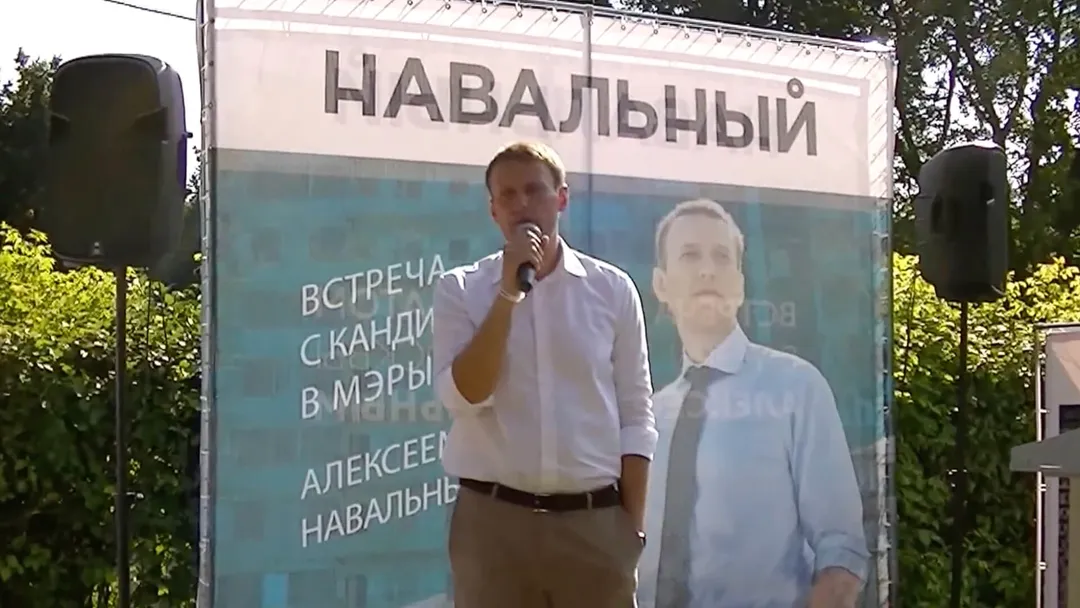
Yes, but let's just not
block those who are still
sitting down, so they can see.
I am very grateful that you came.
I’m very glad that people come to these
meetings. I hold a lot of them. I hold
three such meetings every weekday and
five such meetings every weekend.
People come, and by doing so they confirm that
our campaign team was right when we said
that this is the candidate’s main task.
A candidate’s job is to come and meet
with people. Maybe some think
that there’s no need to go around courtyards and
meet in groups of 80 people, and that
all you need to do is use television to
brainwash people. But I am absolutely
convinced that the most important duty
of a candidate who wants to gain
power is this: come and talk to
people. If you want power, then
go to those people. No one but them will
really help you.
I’d like to begin by
briefly telling you about myself, and then I’ll
be very happy to answer any
questions you have.
My name is Alexei Navalny.
Alexei Anatolyevich Navalny.
I am 37 years old. For the past 17 years I have lived in
the Maryino district with my wife. We now live
as a family of four: me, my wife, and our two children. In
that sense, we are a completely ordinary
Moscow family. My son is 11 years old, and
he goes to the local school. My daughter is 5
years old, and she goes to an ordinary local kindergarten.
By profession, I am a lawyer. I have two
higher education degrees. I graduated from
the law faculty of the Peoples’ Friendship University
and also graduated from the Financial
Academy under the Government of the Russian Federation.
I come from a military family, and throughout my childhood
I moved around various small military
towns from one place to another until
I moved to Moscow. And my parents still
live in one of the military towns outside Moscow.
If you’ve heard anything about my
activities over the past few years,
then you’ve probably heard of me
as that controversial minority
shareholder. Navalny sues
Gazprom, Navalny sues
Rosneft, Navalny demands that
Yakunin be held accountable. Navalny
wants to jail this one, Navalny wants
to jail that one. Maybe you’ve heard
that we created our Anti-Corruption Foundation (ACF),
which works on
monitoring public procurement. We challenged,
successfully challenged, and got canceled
corrupt tenders worth hundreds of, probably,
millions of rubles. And the exact figure, if
you count all the procurements, is 59 billion
rubles. And I’m very often asked: “Why
do you do all this?” Friends, could I ask this
section over here to move a little?”
Because I can see that over there, there are rows of people
sitting and they can’t see anything. There, that way
it’ll be more convenient for everyone. Thank you very much.
And I’m very often asked: “Why
do you do all this, and why are you always
going after them?” Well, everyone understands that
there is corruption everywhere, everyone steals, but you’re the only one
who keeps going around filing complaints against everyone with the
prosecutor’s office. The prosecutor’s office refuses, and then
you sue the prosecutor’s office. And it’s this endless
hunt for all sorts of
corrupt officials. What, do you need it more than anyone else?
Did someone personally steal something from you
or what?”
So I’d like to begin our meeting by
answering exactly that question
so that all of you understand why
I keep going after all these Gazproms,
Rosnefts, and government officials.
If I can explain that to you, then you’ll probably
also understand why I ended up here, on this stage
in the first place.
I truly believe that
they stole from me personally. I simply
calculated everything in terms of myself and my
family.
And it seems to me that if you now
do the math with me,
everything will become clear. Look,
Russia is the number one seller of oil, gas, and
basic processed metals. That makes up 80% of our
economy. Unfortunately, for the most part
we do little else. We sell
raw materials.
Over the past 15 years, from selling raw materials
Russia has received $3 trillion. During
these Putin years, that’s exactly the $3 trillion
we received. Is that a lot or
a little?
A lot.
Quite a lot.
Quite a lot. It’s actually hard even to say
whether that’s a lot or a little, because
the amount is enormous. But it’s also
hard for an individual person to grasp. I can’t
grasp it either. I can’t imagine
what $3 trillion really means. But there is another
figure I can imagine very clearly.
If I take those $3 trillion
and divide them among every citizen
of the Russian Federation, then we find out
that for each and every one of us, from
infants to hundred-year-old seniors,
the share comes to 640,000 rubles. That is the share
each of us has in the oil wealth
that was extracted and sold: 640,000 rubles.
And I took a calculator and worked out that
for my family of four
that comes to 2.5 million rubles.
And I go after Gazprom, Rosneft, and
the Russian government because I want
an answer to the question: where are my 2.5
million rubles
Well, yes, you can't collect them in cash at a teller's window
in cash. You can't just come in and
say: "Give me my share of the
oil and gas in cash right now."
You can't do that. But then I at least want to understand
where that money was spent. It was supposed to be
spent for the benefit of me and my family, and
for the benefit of you and your families. If we
calculate 640,000 rubles for each person, the total
will be enormous.
There is no answer. I can see people of the older
generation sitting here. You remember
how in Soviet times, in the era of
Brezhnev, the Soviet Union also received
a lot of money from selling oil and gas.
A huge amount of money—less than
now, but still a lot. Where
those Brezhnev-era
petrodollars were spent, we know. We can
argue about whether they were spent wisely or
not, but we can definitely
see the results. We can just stand up,
look around, and we'll see the remnants
of those Brezhnev-era petrodollars.
Entire residential districts were built with that
money, where apartments, by the way,
were given out free of charge. There were built
huge factories,
giant plants were built across the
country, Soviet science was created. And
these research institutes (NII, Soviet scientific research institutes), which are now
being rented out, are located all across
Moscow and throughout the country.
Railways, ordinary roads.
The army. We maintained an enormous
army, supported it, built it, armed it.
We subsidized the countries of the socialist
bloc around the world—half of Africa,
half of Asia, half of Latin
America. We know where that money
went.
But where have Putin's petrodollars gone,
the ones that belong to us? A question for everyone
gathered here. Who knows—who can
name for me even one major
industrial enterprise built in
Russia over the last 15 years?
I ask this question at every meeting.
Every single one. This is already my thirty-
fourth meeting like this with voters.
And at not a single meeting has anyone
named one for me. Well, because no such
enterprise exists.
I want to see where the railways are,
built with Putin's money—or rather,
with our money, received during Putin's
time in office.
I know the statistics showing that Russia
builds as much railway in a year
as China builds in a week. Even though
China has neither oil nor gas.
Show me my—our—modern
space industry. All I see is
a rocket that takes off and then
crashes. Show me the science.
The science that we are funding with those 3
trillion dollars we received.
There is nothing. All I see is the reform of the Russian Academy of Sciences (RAN),
whose purpose seems to be to take away from those
elderly academicians their real estate.
Where is the infrastructure, where is the healthcare,
where is the education that belongs to me, to my
children, and to you. That is why I believe that I was
personally robbed by all these people. I mean,
I can see this list of billionaires in Russia.
I see the statistics: in 2000, do you know
how many officially recognized dollar
billionaires there were in Russia? Six. And now
do you know how many there are? 121.
The main record that Russia has set
is the rate of growth in the number of dollar
billionaires.
The main record Russia is setting
is that all the houses in London
worth more than a million pounds
are being bought by Russian officials. Am I supposed to
be proud of that? No. I believe that
I was personally robbed. It's as if
I were riding on a trolleybus and had
my 640,000 rubles—my share of the oil
rent—in my pocket, and someone stuck a hand into my pocket and
pulled it out. They took it from my family, and from you, and from all of
you as well. That is why I will never
leave Gazprom alone, nor
Rosneft, nor Transneft, nor this whole
other group of people
that simply took the 3 trillion dollars received
from the sale of our natural resources
for themselves. And here, at this
point, I am addressing you now as
a candidate for mayor of Moscow who wants
to earn your support. I want to earn
your support. I want you to vote
for me.
I want you to tell others about
me. I came here to persuade you.
I am telling you that I am standing here
first and foremost because I am the most
ordinary, simple Muscovite, living
in an ordinary building, the life of an ordinary
Moscow family. And all the problems I am
talking about here are not even problems that
you experience—they are my problems.
These are my problems. I want to solve the problems
my family has faced.
I am talking to you here about housing and utilities services. Not
because I know that this issue
worries you. It worries
me. For my apartment in a
panel apartment block, I get a bill for 9,500
rubles. It's outrageous. And I
understand that I am not receiving services worth
that amount. I understand that the tariff
keeps rising. I want to become the mayor who
will finally conduct an audit of housing and utilities tariffs,
so that we can finally understand why we
are paying so much. Why does Mosvodokanal
the state-owned company made
a profit of 3 billion rubles in 2011,
and in 2012 they still
raised the water tariff? They operate at a
net profit. Our company operates
with a net profit of 3 billion, and the tariff still
keeps going up. I want to conduct an audit,
so that everyone can see it—you can see it, and I can
see it too.
The things that happen
when tariffs are set are astonishing. Did you know,
for example, that when last year you
paid for electricity and heating in your
home, you were also paying for sponsorship support to
United Russia (the ruling political party) in the amount of 200 million rubles. Mosenergo
transferred them a donation of 200 million
rubles, building it into the tariff.
They justify it, they come to City Hall,
and say: "Here are our urgent expenses,
without which we cannot survive."
And there is a line item there: "Support for United Russia
200 million rubles."
I want to become the mayor who will carry out
an audit of this tariff and expose,
once and for all, all these nonexistent
investment components, these construction projects
that exist only on paper, which they include there, but in
reality no one ever carries out. I do not want
to pay for that. I am sure you do not
want to pay for it either. The example I
give at every rally is about the head of the district administration in my area,
from Maryino. You may have
seen how a month ago he was removed from
office. He was removed because his
wife—you probably saw it on television—while in
an SUV, ran into pedestrians.
The pedestrians filmed the whole thing. There was
a scandal, and the district head was fired. That SUV,
remember? It was a Range Rover with
the license plate 999.
And this man, the district head,
has spent his whole life in municipal service. He
was head of the district administration in Nekrasovka,
then in Lyublino, then in my
district, Maryino. His whole life in
municipal service. He has a decent
salary, but by his official level of
income, he should, generally speaking, be worse off than
me. But he openly lives the life
of a dollar millionaire, without any
embarrassment before me, or all the residents
of the district, or anyone. And I do not want to pay for
through my 9,500-ruble utility bill his
millionaire lifestyle. That is why I want to become
the mayor who will put a stop to all this. I came here
to your district and climbed onto this
stage.
Because, just like you, I go to
an ordinary city clinic. And my
wife goes to an ordinary city
clinic
or to a children's clinic when she
takes the children. And just like you, I can be
shown a TVC (Moscow city television channel) report a million times,
with the triumphant, beaming Sergei
Semyonovich Sobyanin telling us that we have
this wonderful electronic appointment system.
Come to this electronic registration desk and
you will get to see a doctor right away. Well, that is
nonsense. I have gone to an ordinary clinic, I do not
live on Rublyovka (an elite, wealthy area outside Moscow). You are all nodding
your heads, because everyone knows this. We, we
go to ordinary clinics,
but we cannot get in to see a doctor. And do you know
by how much
more funding for healthcare any
resident of Moscow receives compared with
any other Russian? By how much more
is allocated to a Muscovite, by what percentage more
is allocated to a Muscovite than to any
other person? Who knows?
By 70.
By 70%? Any other ideas?
Four times as much. Four times
as much is allocated for every person sitting
here as for any other
citizen of Russia. For every person,
everyone standing here, and every Muscovite,
the amount allocated for outpatient clinic
care
is 20,000 rubles a year. So for my family
of four, that is 80,000 rubles.
That is a huge amount of money. And I am simply
curious. Please raise your hands,
those of you who went to your local
clinic in the past year.
I see. Some of you did. And who did not go to your
local clinic? Aha. Let me tell you,
my friends, 20,000 rubles was also written off for each of you
as well.
I want to become the mayor who will direct these enormous
funds that are already being allocated toward making sure
that, at long last, general practitioners,
internists, and the doctors
Muscovites need in 90% of cases are actually hired.
Just tell me this: is it easy to get an
ultrasound in an ordinary clinic?
You all tell me: "No, go
to any metro station, and there is
one of Sobyanin's little campaign booths there, and under
Sobyanin's achievements, the first thing listed
is: 'Bought 1,200 ultrasound machines
for Muscovites.' It gives the impression that he personally went out
and bought us 1,200 ultrasound machines. But I
know that it is impossible to get an ultrasound. We
are all forced to go to private, paid
ultrasound providers, because getting one at a clinic
is extremely difficult.
I want to become the mayor who will make sure that the enormous
amounts of money allocated for equipment
are not spent on buying
that equipment at twice the price, but instead
on making it possible
to actually get an ultrasound. Because sometimes an ultrasound is needed by
my wife, my children, and me.
And apparently, as I get older, I will need ultrasounds more often,
like any other
person. This is about caring for a normal life.
I am standing here before you because
the issue of migration does not simply
concern me,
it has become part of my life. Because
when I was preparing for this meeting with you, I
looked at what people here are writing about
migration issues, all these outcries. Here you have
that former state farm right here,
what is it called?
Teplichny
Teplich,
where an illegal migrant camp has been located for two years
of migrants,
and I looked into its history carefully
several times orders were issued
stating that it had to be
shut down, that all of it was illegal,
and yet it is still there.
Funny thing, right? At the Matveyevsky
market, what happened? Dagestanis
beat up a police officer. In response,
the Moscow government created
a concentration camp where 200
Vietnamese people are being held.
What is that supposed to be? Please, go to
that Teplichny place. I invite Sobyanin as well,
and everyone else to my district, Maryino,
to take a walk in my Maryinsky Park after
9:00 p.m. Then he will understand why
the women living in my building are afraid
to go outside in the evening.
And then he will learn that for me this
crime statistics are not just numbers
on a sheet of paper. I know because I personally know
several people, several women, from whom
these migrants snatched handbags.
And I know it very well.
Why do migrants come here? I want
to become mayor because I know that
migrants come here not because
there are jobs here, but because people profit
off them. So let us simply
take a quick poll. Who knows how much
their district janitor earns? Who has
asked a janitor what his salary is?
10.
10
7
7
21
4, 21
10
10
And how much is he allocated for that?
15
12
Here is the interesting part. If all of us
read together the interview with
Sobyanin's deputy Biryukov, who
is precisely responsible for this area, or
simply look at the official standard, which I
have looked at. The current official
pay standard for janitors tells us
that there are no janitors in Moscow
who earn less than 30,000 rubles.
Yes, the funny thing is that any real, live
janitors we
speak to give us figures like 10, 15,
8, 4, 5. My janitor told me 18.
And this is the kind of secret all
Muscovites know: these migrants are brought here
in order to keep them virtually as slaves
30 people to a basement. Because
each of them, out of his salary,
kicks back 10,000-15,000 rubles every month.
And this is a colossal—just imagine it—
river of cash. It is hundreds
of millions of rubles that simply every
month flow like a huge, full river.
Along the route: the management company, the housing service,
the district administration, the prefecture, the police precinct,
the migration service, and so on, and so
forth. I want to become the mayor who will
change this, because I do not want
migrant-related crime and
so on. This is my problem, one that I
personally face. I do not live like Sobyanin behind
a fence on Rublyovka (an elite area outside Moscow), with reports brought
to me. No,
this is part of my life. I am standing here
before you because I follow the budget
process very
closely, I watch carefully how
money is spent in Moscow. I know the size
of the Moscow city budget. Who can
tell me what Moscow's annual budget is?
1.6—1.6 trillion rubles. Moscow's budget
is smaller only than the budgets of
New York and Shanghai. All of us sitting and
standing here must understand one
important thing: we live in one of
the richest cities in the world.
And the richest cities of Europe and America
simply cannot even come close
to comparing with Moscow in terms of
wealth. With the money we already
have right now,
Muscovites could already have good
healthcare, quality
education,
roads where traffic jams are being successfully
fought,
a small number of migrants on the streets
and all the other things that residents
of major cities around the world enjoy.
They have all of that there; they have problems too, but
they deal with them successfully. And I am standing here
before you because I have written
a program that was prepared for me by the best
specialists, based on the experience of
how other cities successfully solved
all these problems. We can solve them all,
and we have the money
to solve these problems. You know,
if I were standing here
running for mayor of Kostroma,
and all of you were residents of Kostroma, you would say to me:
"Navalny, here you are
you're running for office, and we demand that you
build us another outpatient clinic." And I would tell you
— my dear residents of Kostroma — there is no money
in our budget. You won't be getting
a clinic, and I won't make easy
promises that can't be kept. But I'm
running for mayor of Moscow. So I tell you
— my dear Muscovites — in our
budget there is more than enough money for everything.
We have everything we need to live normally in
Moscow: we have a city, we have
infrastructure, we have a very
highly educated population that
is capable of managing all of it. We have
everything. The only thing we lack is faith in ourselves. For some reason
we've simply decided that
nothing can be changed. At every
meeting, someone comes up to me,
shrugs, and says: "Well,
all of this is true. We know all this.
Everything you've said is already known.
But nothing can be changed."
But why can't it be changed? I came here
because I believe it can
be changed. But why have we accepted
that there is this system of power
that robs us, insults us,
simply despises us,
and we just say, well, fine, that's the
way things are. Show me — I don't know —
is there an army standing here guarding us? No, I
think there's maybe one police officer somewhere here
keeping watch over us, and that's all. Meanwhile, here
through your own district runs this
North-Western Chord (a major Moscow highway project), right? Yes.
Yes.
And everyone says about this whole North-Western Chord
in unison that it costs 83 billion rubles. And
all transport experts tell
us that, first, from a transport
standpoint it's fairly pointless,
and second, it costs twice as much
as it should. Its original
estimate was 30 billion rubles, and now it has risen to
83.
But we all know that in the construction of
the North-Western Chord, this one project,
enough money will be stolen to pay for
the construction of additional outpatient clinics
and schools — not just in the
North-Western District, but across
all of Moscow. We know all this, we
understand all this. We shrug and say:
"Well, nothing can be changed." That's the course of
things. But why is that the way things are? Are we
the stupidest? The most cursed,
the most pointless inhabitants of the planet,
or what? No — I'm standing here because
I believe that here is the source of power:
people choose the authorities. And mayors are
chosen by people — not the Central Election Commission,
not television, not Churov (former head of Russia's Central Election Commission). People choose.
This whole gang entrenched at the top
doesn't rule everyone through fear, but simply through
passivity. Because we
shrug our shoulders and think: "Well, nothing
can be changed." Everything can be changed. I
don't have the opportunity to appear on television.
I don't have the opportunity to plaster billboards everywhere.
But somehow you made it here.
I did let you know about my
presence. I announced it in my
program. And the persuasive, campaigning
ability of each one of you is
tremendous.
I believe that through you, through meetings like these,
I will speak with hundreds of thousands,
with millions of Muscovites. And in order to
elect the mayor of Moscow, we need 1.5 million
people. Moscow has a population of 15 million,
with 8 million voters. And in order to
elect a mayor, taking turnout into account, you need 1.5
million people. There are 1.5 million people in
Moscow who know everything and understand everything.
Each of those one and a half million could stand here
with me and say
exactly the same things.
Our task is simply to reach those
one and a half million. I am absolutely certain
that, relying on you, through you, I
will speak to hundreds of thousands. If we
cast off this stupor,
if we finally understand that on the
North-Western Chord they are stealing not just
billions, but our billions — they are depriving
us of clinics and schools, they are depriving us of
roads without traffic jams — then we can change
everything. We simply need to realize our
strength. We will realize it, without fail. And I
am absolutely certain that with your help we
will put pressure on the authorities. We will force them
to change, and we will make sure that the authorities in
Moscow are worthy of its wonderful
residents. Thank you very much. I'm ready to answer
your questions.
Please. Thank you. Thank you. I'm very
pleased. All right, you're asking that, and I'll
repeat it for everyone afterward. So, I,
well, I've been fighting this for 19 years. This
North-Western... according to all their
documents, they took my apartment away from me
illegally, and my children were minors.
Uh, so they privatized it, and they
had me thrown into a psych ward, you know. No,
Well, the question is about the housing waiting list. I
understand.
No, not about the queue, but the thing is that
I'm on list number twenty-nine.
And I went to Churov, and they told me,
"Don't eat, don't drink, save up 3
rubles at a time and buy yourself a little house outside Moscow." So
that's how it was — I went to everyone. And, uh,
Natalia Alexeevna, I understand. Natalia
Alexeevna has a question. I'll answer
now. Thank you. The question is that she
has the right to receive an apartment.
Natalia Alexeevna, there are just a lot of us here,
a lot of people. If I spend too long listening
the question, then I’ll say it. And Sobyanin sent me,
well, the president sent me, well,
a letter to Sobyanin so that he would look into it, and
Sobyanin wrote back to me: "Why don’t you go to another
city of mine and look for housing there."
Sobyanin told Natalia Alexeyevna,
when she asked for the housing she is entitled to under
the law, that she should go to
another city and look for housing there. Am I
quoting that correctly?
Yes.
Well, listen, you recently read
Sobyanin’s statement saying that we would
build wonderful towns for
pensioners beyond the Urals and in the Russian Far
East.
Well, it’s funny, yes, a funny thing, but it
simply illustrates how much they
despise everyone, if they can make
statements like that, after which they
should get zero votes, but they are not
embarrassed at all. And as for the issue
of apartments, housing allocations, and
waiting lists, which I’m asked about at
every meeting—this is actually very simple.
Tell me, can any of you
go online or to some
library, look up the list, and
see the queue? Who is first in line,
who is second, who is third? Can that be
done right now?
No,
no.
I want to become the mayor who does
one simple thing.
Publish the entire list, so there is a list
of everyone waiting, from first to last,
a list of beneficiaries, a list of
super-priority beneficiaries. And so that everyone can
see it and monitor it, because
we buy a huge amount of housing
for beneficiaries. Only somehow all these
beneficiaries turn out to be
city hall employees. Here, at a preferential
price, you know, TV host
Vladimir Solovyov bought, as a beneficiary,
an apartment for 3 million rubles (about 30,000 USD), even though it was worth
30 million rubles (about 300,000 USD). Our TV host Andrei
Malakhov received an apartment on
Kropotkinskaya. That’s how this government works:
for some reason TV presenters, as beneficiaries,
get apartments even though they have their own
money. But you, Natalia Alexeyevna,
are being told to go to another city. And I
would be told the same thing if I had
the right to receive housing. That’s what they tell
everyone. So I want to become the mayor
who simply makes this transparent.
Just let everyone see it, and then no one will be able
to shove anyone into the line. It seems like
an elementary measure, but it’s an obvious one. Yes,
just publish the waiting list—but no one
does it. And do you know why they don’t? Well,
just go, quite simply,
for example, to the city
election commission’s website and look at
the list of candidates’ assets there. You’ll see mine,
for example. I have
a 78-square-meter apartment in Maryino. You’ll see my wife’s
car, some VAZ-2108,
which I bought back in 1996
and which is still listed under my name
because I sold it by power of attorney.
It’s all there. Look into me and my
property, and then go to the section for
Sobyanin, and you’ll see that, remarkably,
Sergei Semyonovich Sobyanin’s minor daughter
owns
an apartment of 308 square meters. I’ve
never even seen an apartment like that.
Explain to me how a person
who has been in public service since 2001 could
buy an apartment in the city center on
Rochdelskaya Street measuring 308 square meters.
If he came from Tyumen, an important
official arriving from Tyumen, then he should have been
given official housing, which perhaps
he might later be able to privatize.
Not his daughter—he himself. But I think
everyone here has dealt with housing
problems. Remind me, please,
what is the housing standard per person?
How many square meters?
18.
You all said it in unison. Eighteen. So how many
family members does Sergei Semyonovich
Sobyanin have, if he got an apartment of 308
square meters? That’s why the waiting list is opaque.
Because they give apartments to themselves.
That’s all. I want to become the mayor who
does one elementary, obvious, and very
simple thing. It could be done tomorrow:
just open up the waiting list, and then it will be clear
who is actually in line and who are these dubious
daughters with these mysterious 308-square-meter apartments.
Next question.
Please,
please tell me, for a year now we’ve been going
to rallies over this chord road (major arterial highway project). And now
they’ve already started building it. You say
that a huge amount of money has already been allocated. If
you become mayor, I have two questions. Will you
be able to stop this construction?
Probably not. And one more
question related to these events.
It’s very easy to fight this
migration by shutting down all the markets. But you
understand that Moscow can’t function without
markets. Today I went to Vykhino,
to the Vykhino market, where pensioners have always
bought everything at the lowest possible prices
all this time. So if you become
mayor, what will your policy be on
this?
Question number one. Thank you very much.
Excellent question. Question number one: what
to do about the chord road? The chord road is being built. So
if you become mayor, what will you do with
The chord? Question number two. So what would you
do about migrants? We’re all
unhappy. What will we do? Let’s start with
the chord. The markets and migrants.
Well, the markets. And that’s connected to
migrants.
With the chord, as with any other
construction project. The chord is not
the be-all and end-all. It’s
just very expensive, so people cite it as
an example, right? With the chord, we all know,
30 billion rubles will be stolen. There’s the Southern Rookada, which
costs 10 billion rubles. And everyone says that
it too is twice as expensive as it should be. On the Southern
Rookada, someone will pocket 5 billion
rubles.
The mayor’s job is to make sure the biggest
construction projects are approved or not approved
only after proper calculations are done. That seems
elementary, obvious even, right.
But if you take the issue of Vedomosti (a Russian business newspaper) from the day before yesterday
and read there
Sobyanin’s interview, he is asked:
"Sergei Semyonovich, what is your greatest
achievement?" And he answers: "My
very great achievement is that in
Moscow we launched three of the most
expensive construction projects in the world."
"We’re building roads." And it was very hard for us to do that
because there is no
strategy, no plan, no calculations.
I’m not joking, go read it. I’m not twisting
his words. He literally said: "I want to be the kind of
mayor who, before spending
38 or 83 billion rubles on something, will first make
a strategy, calculations, and a plan. That’s it.
The mayor’s job is to make sure that
the contractors are normal, legitimate
construction companies. Who is our
main road construction contractor
in Moscow right now? Who knows?
Rotenberg.
Rotenberg.
Rotenberg is one of those people from Putin’s circle—his judo coach
from the Soviet era.
Back in Soviet times he was a judo coach, and now he is our
main road builder in Moscow. And who, remind me,
please,
is the main contractor for metro construction
in Moscow right now?
Timchenko.
Timchenko? You know everything without me. He lives...
Timchenko,
the very same guy I’m constantly
suing, the main trader of Russian
oil. He gave up Russia,
a Finnish citizen, he gave up
Russian citizenship. A citizen
of Finland, living in Switzerland and
through his Swiss offshore
company selling Russian oil and
becoming an official billionaire with
a huge amount of money, he is now
building the metro for us. And, amazingly,
it also costs twice as much as it
should. So my task as
mayor is to make sure construction
projects are properly justified, that first
everything is calculated, then those who want
to criticize can criticize, and we understand
what the real cost should be. Then
we hire a real, proper
contractor, not Timchenko and Rotenberg,
who win these tenders with no real
competition at all. And only then do we start
spending money. That’s all. Well, in other words, nothing complicated...