Alexei Navalny’s meeting with voters in Moscow’s Otradnoye District
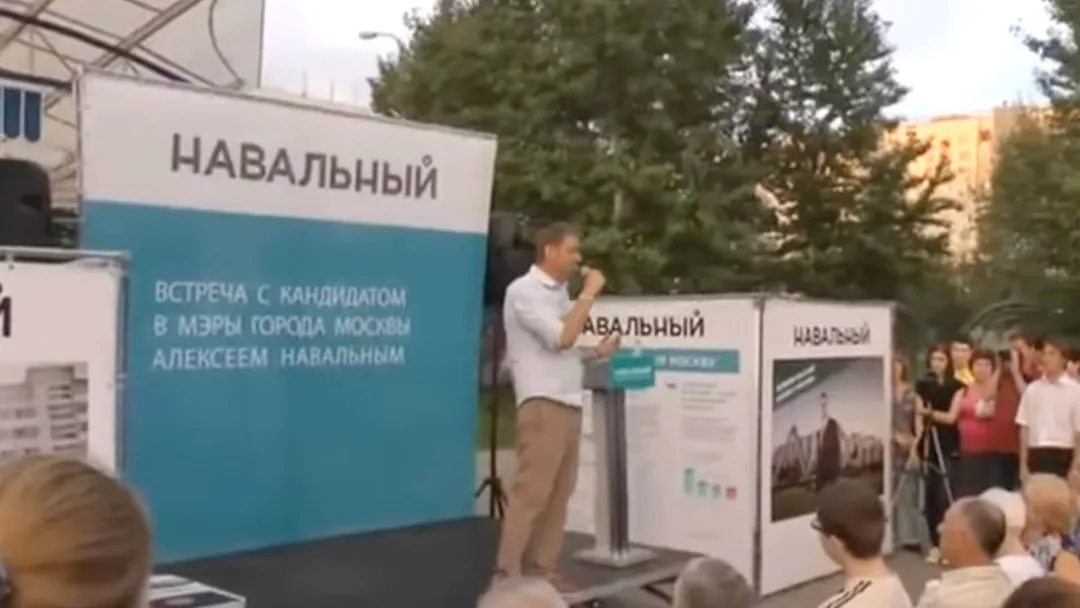
Hello. You've got quite a lively atmosphere here,
music is playing.
Thank you very much for coming. It's tremendously
nice, and tremendously important. There were many
skeptics. When we were planning our
election campaign, everyone said
that people wouldn't come to any
meetings. And that this whole strange
idea of holding courtyard meetings with
candidates was pointless. The candidates don't need it,
and the people don't need it either. Better to
put videos online or run ads on
television.
But since you are coming after all, that means
our idea was the right one:
that this is the most important part of an
election campaign: meeting with voters. This is
the kind of work every candidate
ought to do—meet with
voters so that they can
see him and ask him questions. And I
hold a great many meetings like this. I
meet
three times every weekday and five, five
such meetings every weekend.
This really is a wonderful
election campaign. This is my job.
I'm trying to do it well now,
to convince you that when I
become mayor, I will work
well too. I would
like to begin, if you don't mind, by
telling you a little about myself, and then I will
be happy to answer all your
questions.
You'll become president. Wait, let's
elect him mayor first. Still, thank you
very much.
My name is Alexei Navalny. It's almost
strange to say after that. My name is Alexei
Navalny. I am 37 years old. I live with my wife and
two children in Moscow's Maryino district.
It's in the southeast of Moscow. I have lived in this
same apartment for the last
17 years. In that sense, I have a
completely ordinary, typical Moscow
family. My son is 5 years old, and he goes to the
kindergarten in our courtyard. My daughter is 11. She goes to a
regular neighborhood school. I come from a
military family. And so throughout my childhood and
youth I moved from one place to
another. And my parents still live
in a military town. By profession I am a
lawyer. I have two higher education degrees.
I graduated from the law faculty of
the Peoples' Friendship University and
the Financial Academy under the Government of
the Russian Federation.
If you have followed what I've been doing in
recent years, what do you know about me?
He sues someone, he's always fighting with
someone, first he goes after Gazprom, then
Rosneft, then he calls United Russia members crooks
and thieves,
then with Bastrykin he dug up some kind of
residence permit in the Czech Republic. And he's always
going after everyone: VTB, Gazprom,
Transneft, demanding criminal cases
be opened and all that.
At every meeting—and this is already the forty-
sixth one—the first question I get is:
"
Why are you so fixated on them? Did they personally
wrong you or something? Everyone else is sitting
quietly. Some are calmer, some less
calm, but you've latched onto them like
a bulldog. Did they personally steal
something from you?"
Why do you take such offense at them
and keep insulting them, calling them names all the time?"
I wanted to begin our meeting precisely by
answering that question, because, it seems to me,
if you understand my motivation,
you will understand why I am on this stage
right now.
I genuinely believe, personally, that
I and my family have been robbed—not just
in some abstract sense, you know, not just that
we were robbed, but that I and my family were personally
robbed. I even have a specific calculation
for it.
Tell me, please, what does
Russia make its money from?
Oil. The sale of oil and gas. Exactly
right. For how much did Russia sell
oil and gas over the last 15 years, during
the fat Putin years?
3 trillion dollars. Is that a lot or a little?
Who here has ever seen a stack of 3 trillion
dollars? In
a dream.
In a dream. It's actually hard to tell whether that's
a lot or a little. It feels like a lot,
but the country is huge, so maybe
it's not. To understand for
myself whether that's a lot or a little for me, I
took that sum and divided it by the citizens of Russia
and realized that for each of us—from
newborn babies to hundred-year-old elders—
that comes to 640,000 rubles. That is my share of the oil and
gas: 640,000 rubles. And everyone here has a share of
640,000 rubles. So for my family of
four, that comes to 2.5 million rubles.
And that, in fact, is why I go from
Rosneft to Gazprom, from Gazprom to
Rosneft,
to VTB and to Transneft, first and foremost,
because I ask them: "Where are my
2.5 million rubles?
What did you do with my 2.5 million rubles? You pulled the oil
out of the ground and sold it. Sold it.
So where is it all? There are people here
from the older generations. You remember that
the Soviet Union in earlier times also
received a lot of petrodollars.
Petrodollars flowed into the country, and they were spent.
You can argue about whether that was good or bad, but,
at the very least, we can clearly see,
how they were spent. Let's just use our heads
for a moment.
Residential districts, apartment blocks. Exactly.
Apartments were handed out for free.
Huge residential districts. We built
a massive industrial sector, factories,
plants, enterprises.
We built roads. We built
railways. All of it with Brezhnev-era
petrodollars.
Science, industry, the akademgorodoks (planned Soviet science towns) still
lie scattered all across the country. That was
all those same Brezhnev petrodollars. Right?
The army, that enormous army, was maintained with
that money, and so was that giant space program.
Exactly. We supported countries,
the so-called socialist bloc,
in Africa, Asia, Latin America,
everywhere. In other words, we know how
the Brezhnev petrodollars were spent. Russia's
petrodollars were even greater. How were
they spent? How many people are standing here?
Probably around 400 by now. Can anyone
tell me, name even one
major industrial enterprise
built in this country over the last 15
years?
No.
Nothing at all. Well, Skolkovo was mentioned.
.
Not Cyprus.
You could hardly call that an industrial
Cyprus?
Cyprus, yes. Well, Cyprus isn't exactly it. I
said a major industrial enterprise in Russia.
That's all anyone could come up with.
Sochi.
Well, the Sochi Olympics, yes. A Winter
Olympics that cost three times more than a Summer Olympics.
Still, that's not really an industrial
enterprise. I
Russian Railways. Well, basically, what was
built in Soviet times, whereas what they've built
in modern times are fur vaults (a sarcastic reference to lavish corruption).
At every meeting I ask
this question, and not once has anyone answered it.
Simply because that industrial enterprise
doesn't exist. It just
isn't there. So I go around asking:
"Where are my factories and plants? Where is my
healthcare? Where is my education?"
Where is my space program? I don't want to see a rocket
that takes off and then crashes.
I want to see railways. Do you
know that in Russia, in a whole year, as much railway
is built as China builds
in a single week? And China has neither oil
nor gas.
And when I come with questions like these
to Rosneft, for example—well, I'm
suing Rosneft—I come to the
commercial court, and sitting there is this
woman, Rosneft's chief lawyer,
Kolanda, that's her surname,
right? Her official income—as the chief
lawyer of the state company Rosneft—
is 880 million rubles a year.
You can look up the official
declaration. 880 million rubles a year. And she
looks at me and says: "Nothing here
belongs to you here."
"And people like you have no claim
to anything here."
And at that moment I feel as if
someone is sticking a hand into my pocket and
pulling out my 640,000 rubles. And at that same
moment, they stick a hand into my five-year-old son's
pocket too and pull out 640,000 rubles.
And from each of us, at that moment,
they stick a hand into our pocket and pull out
our share of the petrodollars.
That's what it means when they say nothing belongs to us.
That is why I believe I personally
have been robbed. And that's why I call them
crooks and thieves. That's why I take this so
personally,
with that kind of, you know,
personal stake in it. With resentment, yes,
exactly, with resentment. It really hurts me.
After all, in theory, all of this is mine too.
And now here I stand before you as a
candidate for mayor of Moscow, and I want to earn
your support. I am counting very much on
your support,
first and foremost because I am simply
the same ordinary Muscovite as
you.
Someone who lives with exactly the same
problems and wants to solve them for himself and
for you. They are the same problems. I
don't need a list of problems in the Otradnoye district.
I know them all myself. Are you here
concerned about housing and коммунal services?
Are housing and utility services a major concern for you? Very much so.
And as a matter of fact, it concerns me too,
maybe even more, because for my
apartment in a prefabricated panel building, I get
a bill for 9,500 rubles. That concerns me
very much, every single month.
I don't understand what this bottomless
pit is that we can keep paying into forever.
We're not getting services. And I want to become
the mayor who finally conducts an audit
of housing and utility rates so we can ask: "So what
exactly are we paying for in these rates?" And we
will see astonishing things. We will see
that last year, when we paid for
electricity and heating, we also paid for
300 million rubles in sponsorship for United Russia
(the ruling political party). This is not a joke. Mosenergo transferred
300 million to United Russia and included it in
our rates. And we paid for it as part of the tariff.
Mosvodokanal, which raises rates for me and
all of you once a year, in 2011
made a net profit of 3 billion rubles.
They took that net profit and did who knows
what with it, and then raised the rates again—they
still didn't have enough money. I don't want
to pay for the net profit that
is being siphoned off. I don’t want to pay for
some people’s luxurious lifestyle. I want
to become a mayor who will make sure that
you and I pay only for the services
that are actually provided. This is my third
meeting today. Earlier, I first
spoke, then I was just in South
Medvedkovo, and before that in North
Medvedkovo.
And
when I was preparing for this meeting, I simply
looked at
the asset declaration of the local district head
whom all the residents accuse of
skimming money from housing and коммунal services. That’s what they
accuse him of—skimming money from housing and utility services. But
when I asked whether they had seen
the declaration, nobody had. In that
declaration there are four apartments, plus another eight
apartments belonging to his daughter, two cars,
four ATVs, and two jet skis. They
know what a jet ski is, but at
least they’re listed in the declaration.
And yet we put up with all of this. I don’t want to be—I
don’t want to pay for someone else’s jet skis. I
want to become a mayor who will make sure
that both you and I pay only for
the services we actually order.
I am standing here before you because
I go to a public clinic.
It happens to me. And the
clinic I go to
is very different from
the clinic they show me on
television. On TV they show me
a clinic that Sobyanin visits, and
they tell him: "You know, we have
this electronic registration system—you can
book an appointment without any problems and get seen right away—well, you
laughed, so you’ve probably tried
to book through the electronic registration system."
I know this because when I was preparing to speak
here, I learned that you have three district
clinics for a population of 175,000 people,
which obviously means that there are
terrible lines at the clinics. The same thing
as where I live. Exactly the same as where I live.
Where I live, there are two clinics for
a district population of 150,000.
So I suspect that you and I
go to the same kind of clinic, while
for some reason Sobyanin goes to some
other one.
But even so, I know how much
more money is allocated for healthcare
for Muscovites compared with
other residents of Russia. Does anyone know
how much more—by what percentage
more money is spent on Muscovites than on
ordinary citizens?
20, 15,
I think
30,
50,
50%—they give 50% more for Muscovites.
Four times more—your
healthcare, yes, gets funding that is
four times higher than
the healthcare funding for any other
citizen in the country. Just for
outpatient clinic care for each of
us, 20,000 rubles a year are allocated (about US$200). For my
family of four, that’s 80,000 rubles per
year (about US$800). Just for clinic care—that’s huge
money. Just out of curiosity, please raise
your hand if you went to your
district clinic in the past year.
A lot of people.
Good. Thank you. Now raise
your hands if you did not go to your local
clinic in the past year. Aha.
Yet 20,000 rubles were written off for each person. And I
want to become a mayor who will make sure
that with the enormous sums that
are allocated, they finally hire
internists and general practitioners
whom Muscovites need in 90% of cases.
They’re not there—those doctors simply aren’t there. Is it easy in your
district to get an ultrasound?
It’s difficult.
Difficult. In fact, often impossible.
And getting an MRI is completely impossible. Only
now, you know, here’s the interesting thing. It’s difficult
or impossible. But please go over to
Sobyanin’s campaign tent by the metro station. There
it says something completely different. There
it says that one of Sergei
Semyonovich Sobyanin’s achievements is that he bought
1,200 ultrasound machines for Muscovites. Well,
apparently his salary is high enough. And he has surpassed
all European countries in the number of
scanners per capita.
They cost 4,000.
Well
our Anti-Corruption Foundation (ACF) carefully
studied that very healthcare modernization
program for Moscow, on which
100 billion rubles were spent (about US$1 billion). So I know exactly
how those scanners were procured. I
know exactly how those ultrasound machines
were procured. And they were bought not in order to
treat people, but simply to
buy them at twice the price. And someone from
this modernization program for
healthcare became a billionaire. I
want to become a mayor who will make sure
that I can go to my clinic and
get an ultrasound if I need one, and
that those who need an MRI can get an MRI.
I
am standing here before you because I am
deeply concerned about the problem of
migration.
You react to that with, “Oh.” And I say:
“Oh, because they moved
Cherkizovsky Market (a major former Moscow market), and it’s not far from my home,
because this market is right next to me
"Sadovod".
And because for me, this
statistic that 50% of crimes
are committed by migrants is not an abstract
thing. It means that women in the evening
are afraid to leave their homes. It
means that bags are being snatched from people's hands.
A question for all of you. Do you know
whether crime has increased or decreased
in your neighborhood over the past six months?
Increased.
It has increased. The police aren't
working.
I am informing you, dear residents of Otradnoye,
that especially serious crimes in your area have risen by
47%, and robberies by 72%.
72%.
Illegal drug trafficking. An 82% increase
in your area.
And I want to become mayor because
I understand that
migrants who come here in huge
numbers and who, among other things,
drive up crime rates,
come not because there are
jobs here, but because they are
a source of profit for officials.
Tell me, please, who knows
how much the janitor in their courtyard earns?
What is the salary of a Moscow janitor?
Nine
25,000, 20,000
6,000–7,000
There you go
I always ask, is that
6,000–7,000, and then someone always shouts from the corner,
shouting: "Officially or unofficially?"
That's the kind of secret all of
Moscow knows.
And they live in basements.
And they live in basements or in buildings slated for
demolition. Yes,
and we all know perfectly well that they are brought here
and made to live in basements, in the
position of slaves, because each of
them simply kicks back part of their salary.
The official pay standard for a janitor
tells us that there should be no
janitors earning less than 30,000 rubles.
But all of them get 8,000 or 10,000
and each one, from their salary, every month
kicks some of it back. And just imagine, it's simply
a river of cash. It's hundreds of millions
of rubles just flowing from
the management company to the DES, from the DEEZ to
the district administration, to the prefecture, and so
on and so forth.
But you and I see the other side
of this river, this river. Sorry, what we see
is only a 70% increase in robberies. What I see
is only bags being snatched, and that is why I want
to change this. I want to become the mayor who
will change all of this.
I am standing here because I have spent a great deal of
time over the past few years
on
following all kinds of Moscow
governance processes, finances, and
the budget. I know exactly the size of
Moscow's budget. Who can tell me, what is Moscow's
annual budget?
About half a trillion rubles. One trillion
1.6, 1.63 trillion rubles a year.
By budget size, Moscow is second only to
New York and Shanghai. All of us need to
understand one important thing very clearly: we
live in one of the richest cities
in the world.
The richest cities in the United States and Europe can
only envy Moscow's budget.
They are nowhere close. Here's
a question for you. As I already said, Moscow ranks
third in the world by budget. In your view,
what place in the world does Moscow rank
among major cities in terms of quality of life?
Tenth? Fifteenth? Which one?
How many cities are ahead of us?
A lot, ninety-something.
In terms of quality of life, Moscow ranks among
major cities in
154th place.
We are third by budget, and 154th by
quality of life. Right now, we already have
the money to ensure that Muscovites have
quality education, excellent
healthcare, roads on which we
successfully fight traffic jams, and an absence of
migrants. But we are in 154th place.
Why? To change all this, we
have
a city,
we have infrastructure, we have
an educated population,
which is actually important, because
very few cities have such an
educated population. We lack
only one thing, but it is the key factor. We
lack faith in ourselves. For some reason, we
think that this is just how life works,
that nothing can be changed. After every
meeting, after every one, someone comes up
to me and says:
"You said everything right, well done. We,
to be honest, knew all this without you, but you
said it all correctly. But you
understand, deep down, admit it,
you understand that nothing can be changed."
That's just how it is устроена. Nothing can be changed
Nothing can be changed. We are in first place in the
world for oil and gas sales.
Just a second.
But we are in sixty-ninth place
in terms of standard of living.
We have a budget that exceeds
all the others many times over, but in terms of quality of life
we are in 154th place. They are building
the North-Western Chord. Do you know that
construction project?
You know?
It costs 70 billion rubles. And all the builders
and all the transport experts say in unison
that the price is inflated twofold.
And we all know that yes, in the construction of
the North-Western Chord, 35 billion rubles will be stolen.
That is more than is needed to build
clinics and schools across the entire
North-Eastern District. But somehow we just
shrug our shoulders. That’s just how it works,
nothing can be done.
Elections are rigged. Well, they always seem to be
rigged. They’ll deceive us. Well, they always seem to
deceive us. They’ll rob us. Well, they do rob us,
yes. They always have. And what can
you change? That’s just how life is.
But I came here because I believe that
life should be organized differently. I
believe this is not the natural order
of things. I believe this is
an unnatural order of things. What is
happening is a perversion. And I came here
because I believe in the most
important thing: this is the source of power. Not
the election commission, not television, not
this zombie box, but the people. The people are the source
of power. People can change everything if
they stop being afraid and believe in
themselves. Who is forcing us
to hand over half the cost of
the North-Western Chord to someone? Who is
forcing us
to pay for housing and utility services we do not receive?
Who? Well, there are no troops standing here—just one or two
police officers standing here. And, judging by
everything, they agree with everything I’m
saying.
No one is forcing us; it’s just that we
our shoulders.
That is exactly what this
government rests on. A handful of these crooks,
who have latched onto our budget and
our city, and who have turned all of this
into a way of making money, they
rely on the fact that we shrug
our shoulders.
I believe we can change everything. In
order to elect the mayor of Moscow, you need
half a million people. In a city where 15 million live,
there are half a million people in Moscow who
know everything, who understand everything, who
understand that Moscow’s problems are the same
problems other
cities have faced. Did other cities not also
have traffic jams or migration? They solved
those problems, and they can be solved. There are one and a half
million people who can read
my platform and see that it was written
by the best experts. It contains answers
to everything. There are half a million people, each of whom
could come up on this stage
and say exactly the same things I am saying.
The only question is whether I will be able to reach
those one and a half million people. How can I
convince them of anything through television?
Who has seen me on television in the last five years
except in reports claiming
that I stole the entire forest?
Well, yesterday, yesterday there was a debate, for the first time
it happened, right? And even there something about the forest
came up.
But maybe I don’t have television.
Questions later, please. Maybe I
don’t have television, maybe I
don’t have billboards, but no one can take meetings like this
away from me. I
have calculated it all. I calculated that if by
September 8 I hold 100 such meetings and
after that remain alive, then I will have spoken
more or less personally like this with 1%
of the voters. That is a lot. 1%
of the voters is a lot. After all, each person’s
power of persuasion is
tremendous. All studies
show that if you speak with
ten people, you will convince six of them
almost for sure. People
need guidance. Let’s give
the right advice. Let’s take
an active stance. Let’s make
the authorities change. And let’s become
the authorities ourselves. Let’s elect someone who
represents the people, who lives the ordinary
life of the people. I am sure, my friends,
that by relying on you, by receiving your
support,
I will be able to change everything for the better. I will be able
to form a team that will take
power in the city and turn that power to
our benefit, and make it so that we will
build a great city for us and for
our children. Thank you very much. Now I am
ready to answer your questions.
Please, you’ve had your hand up for a while. How do you
plan to change everything? Just now you
said a lot about, well, the problems,
yes, you listed them, but you did not give a single
solution.
I’ll repeat it for everyone. You, you
listed the problems, but did not say
what the solution is. All right.
Look, here is the problem with the North-Western
Chord. It is being built at twice the necessary cost.
The contract for the North-Western Chord
was handed to the Rotenbergs without
any tender. So what is the solution to this
problem? The solution is
that when I become mayor, roads
will be built by road builders, not by
the Rotenbergs and Timchenko.
There will be no billion-ruble contracts awarded
without estimates, without accountability, and
simply handed over to Putin’s friends.
This may seem elementary, but in
our system of power it is incredibly difficult,
because Sobyanin is a mayor
whose job is to hand over
construction contracts to the Rotenbergs.
Who were they back in Soviet times?
Judo coaches. And now they've become
road builders. And for you they are
building the Southern Chord. For you they are
building the North-Western Chord, the Southern Rocade, and
so on. I will be the mayor who
puts a stop to this. Do you know who is now
the main contractor for the construction of
the Moscow Metro?
Timchenko.
Timchenko. The very same guy I'm
suing. The main seller of Russian
oil, a friend of Putin, who gave up
Russian citizenship. A citizen
of Finland, living in Switzerland. He
became a billionaire trading Russian
oil through his offshore company. And
now he's building our metro too.
And of course, all the experts, both our own
metro builders and foreigners, all of them
say with one voice: "But, excuse me,
the price is twice as high."
The solution to the problem, this one in particular,
is that, yes, you should not
hand out construction contracts to your friends.
Let metro builders build the metro.
In order to defeat corruption,
you have to start fighting it. That's all.
We need to make sure that people
are held accountable. We need
to make sure that those under suspicion
are thrown out.
It's a simple solution. It just doesn't work here
because the authorities exist for
corruption. If there is a government
for the people, then we will fight
corruption, and I will do it. Next
question, please.
Alexei, I have two questions for you.
First,
if the election goes to two rounds and in the
second round
I'll repeat it for everyone afterward,
in the second round
the votes, so to speak, are
falsified,
and, so to speak, Sobyanin will be
declared
the winner, so to speak—what will your
actions be? That's one question. Second, if
you become, uh, mayor,
how will you build your relationship
with Putin?
The first question was: if they
falsify the election in the second round and
the mayor is declared to be Sobyanin, what will I do?
What I have to do is act before that. I will do everything
to prevent them
from falsifying the election. Votes
come to us through hard work. I'm not
complaining, but these meetings are
work. And the people who hand out
leaflets like these all over Moscow, standing
next to these campaign cubes, in our
volunteer groups there are more than 10,000
people. Not one of them gets
paid. Not one. Not because they love me,
but because they love themselves. They
want change. And of course, when we
win votes through such hard work,
we will do everything
to protect them. Already now we have
sent 2,500 people to the election commissions
as commission members with the right
to cast decisive votes.
We want to mobilize thousands of
observers. 14,000 at a minimum.
And here we will need your support,
because without you, of course, we won't be able to gather
that many observers,
but we will definitely make sure that
the situation of December
2011 (after the disputed Russian parliamentary elections), when the only
observer at a polling station was grabbed by the police
by the arms and legs and thrown out. There will be 10
observers at every polling station, and 10
people will be waiting next to the
station. But we all have to do this
together. In your district there are
175,000 people living there. And who is it that falsifies the entire election?
A secret organization?
A Masonic lodge? Three women in the district
administration just take the protocol and rewrite it,
overturning the will of 175,000 people.
Is that right?
So are we
ourselves going to let them do it or not? If
we finally come out and say that we will not
let this happen, we will fill every polling station
with observers, and we will not allow those women
to rewrite protocols on behalf of 175,000 people,
then nothing will be able to be rewritten. And we are
working on that.
The second question. How will your
relationship with Putin be built?
Well,
Putin,
it will not be an easy relationship. However,
many people think that I should immediately
start, or will start, a war with Putin.
Meaning, street-washing trucks and what else?
Bulldozers, graders, tractors rolling down
Tverskaya Street. Next to them march
street sweepers carrying rakes like
rifles. We are not going to do any of that,
at least not in the first few days.
A mayor must work by the rules. For my part,
I will carry out the duties
that a mayor is supposed to carry out.
When they ask me: "Navalny,
please hand the metro over to Timchenko." I
will say: "Sorry, we have a fair
tender." When they tell me: "Come on,
please, the Rotenbergs want to build another
interchange there." I will say:
"Excuse me, we have a fair
tender. Moscow is structured in such a way that money
cannot simply be siphoned out of it. That is, I
you can't deprive it of funding.
I have street-cleaning vehicles that
can be moved. So you can't be pushed around either."
And federal money—I'll answer that
question now. You can't strip Moscow of funding.
And most importantly, what I will need in order
to be able to act as
an independent mayor and carry out the
duties I am supposed to perform,
is your support. If
Moscow has a mayor who is elected
by Muscovites, who relies on
the support of millions of people, and who
for the first time in the country's history uses power
not for personal enrichment, but
to work, then they won't be able to do
anything to me. They won't be able to take away money,
or jail me. On the contrary, relying on your
support, I'll be the one putting them all in jail.
Your questions.
Do you understand that you're entering into a struggle with
officials, right? Say you become mayor, and
you start working honestly. God
willing. The officials will go on strike, and the judiciary
will back them. What will you
do?
The officials will go on strike, and the courts in power
will support them.
But what exactly would they be striking over?
How many—how many people run the
city?
Tens of thousands of people. Tens of thousands of people
run the city. Eighty-five percent of these people,
are not corrupt simply because
they have nowhere to steal from. They are in
positions where there is nothing to pocket.
They are people just like us. They have
fairly decent salaries. They do not
need to be persuaded. They want a normal
life. They are no different. In fact, if
there are, I'm sure, standing here
20 officials, they don't have light bulbs
glowing over their heads. They are ordinary people who just
like everyone else don't want to overpay for housing and utilities,
who want to live steadily, under law and
order. And relying on that 85 percent, I
will effectively crush the 15 percent who,
apparently, can no longer be reformed. I will
definitely do that. You're not raising your hand
to ask a question, but since you're saying
that it's all a sham, I'll hear your question. I
want to say, my
...
they won't give her one-time pension payment. She
died on the twenty-first. She received her pension
on the seventh. Why wasn't the pension
paid out?
Well, this person has gone through a tragic
situation. His daughter died, a grandson was left behind, and they are not
returning the pension that was
due to her.
Due, yes. Well
since she received it through the bank. I have to
go through all this bureaucracy and supposedly deal with it.
First of all, my condolences for
your loss, and second,
the system is set up in such a way that
for everyone involved, well, they simply don't care, it doesn't
concern them.
They are constantly saying they don't have enough
money for social payments. When I
look at the size of Moscow's budget, it's
simply ridiculous to say there isn't enough money for
social payments. That is exactly why, in
our program, we have already included
a provision under which we will immediately halt
the adoption of the 2013 budget and
increase social payments both to
pensioners and those in need. Now,
please tell me, does anyone know
how much support a large family in Moscow receives
if it has four
children?
That young man over there—
3,000 rubles.
3,000 rubles.
At the same time,
he said,
let me tell you this. Let me approach it from another
angle. Do you know how much is allocated in Moscow
for public procurement every year?
How much is spent on public procurement? 600 billion
rubles. And the Moscow city government itself
says that out of those 600 billion rubles
150 billion are stolen every year. What does
150 billion mean? For us, that's 30,000 rubles per
person. Just understand this:
from each of you, just through
public procurement alone, 30,000 rubles are being stolen. From you, from
your grandson, from that large family,
with six people including children—from each of them
30,000 rubles are stolen, and then they are
told: "Here, take 3,000 in return
and live on it, however you can." I
know exactly what to do about this. At
our Anti-Corruption Foundation (ACF), we have canceled
corrupt procurement contracts, despite the fact that
we have no official powers whatsoever, worth
59 billion rubles. We drafted all the laws,
resolutions, and instructions. We know exactly
what to do about it. I know exactly how
to save this money through public procurement alone
and increase payments to everyone in need.
And we will do it. Moscow's budget is enormous.
It just needs to be managed
prudently. We need to make sure that
the money doesn't get siphoned off by Rotenberg and
Timchenko, but goes instead to Muscovites
like you. Next question,
please. You say that
pensioners, so to speak, do not pay
taxes. You probably don't shop at
foreign stores like Auchan or Leroy Merlin. I
take the receipt—VAT is listed there. This much, that much,
this much, that much. One question: those are
taxes. In our stores they don't
write that or indicate it. Pensioners don't
know that they are paying taxes. Second...
question.
Instead of factories, they opened offices, and there,
basically, they are engaged in,
they collect,
I’ll repeat that for everyone later.
They charge rent. Excuse me, but
if I’m being charged rent, then
I include it in the price. That’s why
the price of many goods here is higher than
in Europe’s, and once again we are paying 140,000.
I understood the question. I’ll answer: they pay taxes.
And the first question was an interesting one about
taxes. They say that pensioners supposedly do not
pay taxes. But you really are, you are
absolutely right. We pay VAT, we pay excise taxes,
we pay indirect taxes.
So pensioners, non-pensioners, any
people who live in Moscow, they pay
a great deal in taxes. And the second question is about
the high cost of living. We have in our
platform
a special section on the high cost
of living. And I realized
that this absolutely had to be included in the
platform, you know, after I
spent half a year in the United States. I can
tell you that there all food products are
half the price.
Really, everything there is half the price.
Clothing there is more than twice
as cheap. Moscow is expensive to live in.
It’s just impossible. Even for a working
person, it is very hard to live in Moscow, not
to mention pensioners.
And indeed, there are simply calculations for everything
that show that in
everything, from a carton of milk
and a kilogram of meat to a square
meter of housing, 30% is a corruption-related
markup.
30%. So when people reproach me for
saying, “Navalny, you’re like a parrot, all you do is
talk about corruption, corruption, corruption,”
that’s exactly why I talk about corruption, because
I don’t want to pay that extra 30% for everything.
When I was preparing to speak in this
part of Moscow, I looked carefully at
what the vendors at the markets were writing, those who
sell at the so-called
weekend markets. Who here knows how much
a spot for a vendor at a
weekend market, at a weekend fair, costs?
Free.
Supposedly free — 200 rubles.
But in reality they pay 2,000 rubles.
Question: who pays the 1,800-ruble difference?
We do. The people who buy. I mean, my
wife buys the same products in the same
place. So by eliminating corruption, we
will be eliminating this high
cost. Because in my milk,
in my meat, in your milk, in your
meat, that corrupt surcharge is hanging there.
So to answer your question: yes, we
all pay taxes — pensioners, non-
pensioners — and we all must demand
a lower cost of living. Your question.
One moment, just a second.
I heard Zhirinovsky said, yes, yes, yes, that
supposedly when you were speaking in America,
you said that when you become
president, you will eliminate nuclear
weapons. Is that true or not?
Zhirinovsky spoke and said that when
I was speaking in America, I said that
I would eliminate nuclear weapons. Where did he
say that?
On television today.
Well, listen, Zhirinovsky says a lot of things.
If I just go around refuting everything
Zhirinovsky has said, that would simply be
ridiculous. Zhirinovsky is a funny,
amusing old man who is doing his job. For
You should sue for slander.
He, he, he dreams of my suing him
for slander, because then there would be
more attention for the funny old man
and he’d make more money. That’s his
way of earning a living. Well, of course, that’s
not true, but obviously I’ll be voting
for you.
Thank you. Next question,
please.
There is a common opinion among Muscovites that
Sobyanin is a good manager. And that you are supposedly a lawyer
and all that. Now quiet, quiet, quiet, quiet.
And that you are supposedly a lawyer and will be a bad
administrator.
There is a common opinion among Muscovites that
Sobyanin is a strong manager, and
some Muscovites immediately disagreed with
that. And that I am not a manager and therefore will not
be able to run anything. Yes,
well, listen,
who here has read my investigation into
the Moscow paving tiles?
I have.
Well,
a lot of people. For those who haven’t read it,
I can simply say: “They laid paving worth
2 billion rubles, then another billion.” And
we haven’t been able to find any trace of those tiles for
a year now. Who has read my investigation into
landscaping?
For those who haven’t read it, on Tverskaya Street
they install these marble planters,
each of which costs 9 million rubles. They are
strong managers in the sense that they
know exactly where and what to siphon off.
Put it in their pocket.
All these “strong managers” are about
registering 308-square-meter apartments in their daughters’ names.
That’s the kind of “strong management” they’re good at.
In fact, the mayor of Moscow
spends 90% of his time
cutting red ribbons and handing out
certificates of honor, like the mayor of any
big city. The job of the mayor of Moscow is
My task is simply to establish the right
principles for governing the city,
so that people are appointed properly.
You are right to talk about the team. For
that, all of you, and I, all of us must
understand why this person became
a prefect, while that one did not. Why did you
appoint this person head of the district administration? Why did you not
appoint someone else? We must have tools
of pressure so that if this one
has stolen, he gets thrown out. Or not just
thrown out, but imprisoned.
Principle is the most important thing. I want, with a simple
example, to say once again
how important principles are, because I often
hear people say, well, principles are nonsense,
we do not understand principles.
Tell me, please, what is the biggest
corruption case in Russia right now,
apart from Navalny's case?
Oboron...
Oboronservis. Correct.
Serdyukov is in jail.
Charges have been brought against Serdyukov.
He is a witness. More than that, Serdyukov is still
driving around in a Mercedes
assigned to him by the Ministry of Defense, and
the flashing official beacon on his Mercedes is still flashing.
His girlfriend Vasilyeva is under arrest,
writing poetry.
She is under house arrest in a thirteen-room apartment,
and she gets 3 hours
a day for walks. And during those
walks, she gets photographed
buying things in jewelry stores—what should we call it,
honestly looted, honestly
earned?
What is more, as a lawyer I can tell you that
Vasilyeva is under house arrest, and
that is a formal restriction of liberty, and
it will count toward her sentence at two days for every one. So,
when Vasilyeva is
sentenced to 2 years, she will be released immediately.
She has already
because she has already served her time. Is what
I just said news
to anyone?
No,
no, this is a principle being directly
demonstrated to all residents. I am sure that
if you conducted a poll,
99%
of Russia's residents would say that they are
simply furious about what is happening.
Absolutely furious. And yet this is being
imposed on them openly. They are being told,
go ahead: steal, skim off the top, be
a completely incompetent defense minister,
a former furniture store manager
who wrecked everything. The main thing is,
if you keep quiet and pay your cut, everything
will be fine for you. My task is
to introduce different principles. And then there will be no need
for any so-called strong manager; then everything
will start working. Please, your question.
Here, please. Yes, Alexei,
have you been invited to the Kremlin for a talk? They
usually like to do that, sort of
have you been invited to the Kremlin for a talk?
I have been to the Kremlin many times—on tours of the
Armoury Chamber, on tours of the
Diamond Fund.
I took my child to see the
Tsar Cannon. My mother took me to see the
Tsar Cannon and the Tsar Bell. But I have never been inside any of
those buildings where ordinary
people are not allowed. You mean
you were not invited?
I was not invited. And I am not going
there. The only people who can send me
anywhere are you. I hope that all of you
together will send me to Tverskaya
13.
About the verdict. About
the verdict. Yes, please.
The question is this: after the election, God forbid,
if things turn out not
for the better and
well, yes, if, God forbid...
Yes, say it plainly regarding
the election. If things go badly and
you somehow cannot bring yourself
to say, "they will imprison you," well, that is nothing
terrible—I have already been jailed once.
And rightly so, I was jailed. I am speaking before you,
speaking here. Every time I am asked about this,
the first thing I say
to the people gathered is: thank you, my
dear friends, that I have the chance to speak
before you. Because you
were outraged, I was released.
I know that nothing will ever happen to me
as long as I have the support
of the people behind me. That is the most important thing. I will do
everything I can not to lose
your support.
A question: what is your attitu...
wait, one at a time,
just louder, if possible.
Worked... well, 2 m... not...
give it here
about migration
migration
yes, the question, the question
we are already in migra...
what a long question
I do not understand
I understand the question. So, the first point was
a remark about the name of our
newspaper Do Not Lie, Do Not Steal.
Well, there are many opinions here. Some people like it,
some do not.
Do you like it when people steal?
No.
Do you like it when people lie?
No.
Well then, you should like not
lying and not stealing. I like it. Maybe
it may be that someone doesn't like what
is written there, but I believe the authorities should not
lie or steal. That is why our
newspaper is called exactly that. As for
migration,
let's first take a look together at the overall situation
here. What is
called
where does Moscow rank
in the world by number of undocumented migrants?
First.
In first place. Is that a normal
situation?
No,
this is not a normal situation. And it seems
abnormal to me. You know,
for example, that 40% of all
Tajik men in the world live in Moscow.
So the whole country moved here.
all these Kyrgyz, all of them.
And before I lay out my three solutions, I have
a question for you, for everyone. Please raise
your hand if you have been to any
European country, just any one at all.
Wow, that's a lot of people. Thank you. Now
raise your hand if you entered that
European country without a visa.
How so? Across the border
to Cyprus without a visa.
Montenegro without a visa. Cyprus,
to Cyprus without a visa, to Israel you can go without
a visa
Montenegro without a visa. Can you go to France
without a visa? Well, maybe somewhere
you can crawl under a fence. To Germany
can you?
if we go to the United States, any of us will be told:
"Please, first get a visa,
and while you're at it, submit your fingerprints
at the embassy and at the border."
Now then, please explain to me why
any citizen of Uzbekistan or
Tajikistan, even without an international passport,
can buy a one-way ticket and
come here? Is that a normal situation?
It is not normal. If a visa regime applies to us,
why does it not
apply to them? What's more,
you could say these are former
Soviet Union countries, and we need
integration with them. But we have a visa regime
with Georgia, we do. No one died because of it. We
have a visa regime with Turkmenistan. We do.
No one died. How are
Georgia and Turkmenistan any closer or dearer to us than
Kazakhstan and Tajikistan? They aren't. If
European countries protect their borders
from us, then we too must protect ours from
migrants. So the first measure is that I
will push for the introduction of a visa
regime. The second measure—thank you very much.
I know this has support. In fact, I am
actually the only candidate
who supports this tough
measure. Second.
Right now any contractor is happy to
hire undocumented migrants because
it's profitable, it's cheap, they provide
cheap labor
and cheat half of them.
And who will... but I'll answer your question now.
your question.
And when you're caught employing a migrant, an
undocumented migrant, it's a small
fine or some minor punishment,
or a small bribe?
I will introduce rules, and we already have
a draft law under which
any organization will be disqualified
if it hires undocumented migrants.
And this measure will genuinely
stop everyone. And third, within a year
we will introduce a rule under which any
organization working with budget
funds will not have the right
to hire
foreigners with that money. If you are
a private business, hire whomever you want. This
young man is shouting, "And who will work in
the stores? A commercial store
can hire whomever it wants with its own commercial
money. But if this organization
is working with our municipal
budget funds,
capital repairs, beautification, property management
companies, and so on and so forth, then they
must hire Russian citizens. And they have the money
to hire Russian citizens, and even
Muscovites. There are a great many
myths on this subject. This
young man has partly repeated one of them. You
have heard this before: if the Uzbeks leave
Moscow, we'll all be buried in filth. Have you
heard that? It's nonsense.
Listen, we've lived in Moscow for a long time.
We know that the truth is
that before 2003 there were no migrants in
Moscow.
There weren't any.
Muscovites worked as street cleaners. We know
that in most cities in the country there are no
migrants at all. We know that in all
cities with populations under 500,000
there are no migrants. In Belarus
there are no migrants, so we need to stop
believing these tales. And the three
measures I have outlined really
will work. They really will reduce
the number of migrants and reduce the number
of crimes associated with them,
the crimes they bring with them. Miss,
very much so, actually, yes, actually
a clarification to that question. And the problem of
migration
louder, please.
Our migration problem is mainly, in fact,
not with the near abroad (former Soviet countries). Our
main migration problem is our own
The North Caucasus, because of migrants.
Tajiks, in short.
Since they are completely illegal,
at least they work, say, in those same jobs as
basement janitors, because they
don't know that they can easily be thrown out. But how
can one legally get rid of this
dominance of the North Caucasus? Because
they buy [it] for 100 rubles. The question is,
that those migrants are foreigners, but
the tension, and many of the crimes,
are committed by our fellow citizens
from the North Caucasus, whom you cannot get rid of,
you can't expel them, you can't introduce visas for them
and so on. That's the question.
Yes. Yes. So how, how do we
get rid of them?
My solution is simple: law and order.
Just look at how the authorities have
responded now. Matveyevsky Market,
remember? At Matveyevsky Market
some Dagestanis beat up a police officer. In response
to that, the Moscow authorities created a
concentration-camp-like facility, where they put 800
Vietnamese people.
How is that connected at all?
How is that connected to preventing this from
happening? This is, of course, no longer a question for
the mayor of Moscow, but a federal issue. First
of all, there should not be these
political offshore zones in the country,
where certain people sit,
who are either bandits or police officers,
come here and commit crimes.
I will be a mayor who simply makes
everyone equal before the law. Here are three identical
hooligans: a Russian, a Dagestani, and a Chechen.
And the police grab them all the same if they
are causing trouble and put them behind bars. They
find out, with every Chechen, who his
uncle in Chechnya is, whether that
uncle is a prosecutor, or whether something will happen
in Dagestan if this Dagestani
gets caught, and so on. Look at what's
going on. I don't know, at the President Hotel.
There are just some bandits sitting there. All of them with
TT pistols, all with IDs saying they are
members of the special services, the FSB,
representatives of the Chechen Republic,
speeding around Moscow in Mercedeses.
The police salute them, because you never know
what might happen otherwise. I don't care what
happens in Chechnya. Under me, hooligans will be
caught equally. It doesn't matter whether he is Russian,
Chechen, Dagestani, Chinese, Arab,
Tajik, that's all. We don't need anything else
except law and order. If there is
law and order, everything will work.
Please, a question. First of all, an autograph.
Autographs at the end. Let's have the question
first. And when you become president,
what will your attitude be toward the Soviet
period of history?
When you become president, what
will your attitude be toward the Soviet period
of history? Let's start—let's take this step by step.
Yes, for now it would be good to get elected
mayor. Though I like your
optimism. My attitude toward any period of history
will be as toward a period
of history.
It should be studied. Listen, there were many
wonderful things there, and many
terrible things. I don't know, for example, my
grandmother had a sister who was exiled
to Irkutsk, and at the same time she was
an absolute fan of Stalin. She simply
didn't want to have conversations with me
about Stalin being bad. There were different
views; people felt differently. History should
be studied by historians. Our task is to teach our
children properly, so that they
know about the good and the bad, about
all the different things that happened during the Soviet
period. That was life, those were people, and it was all
different. And I will treat it—I won't—
the main thing I must not do is
rewrite history textbooks myself.
That is something I definitely will not do.
Please tell me,
what can we do at the Moscow city level
about education in Moscow? What are
our options? What is happening
is terrible.
Education in Moscow—what can we
do about education in Moscow? What
is currently the main problem facing Moscow
schools?
Consolidation.
These consolidation processes—no one
understands them.
This is a personal issue for me, because my
daughter goes to a school where they are
merging neighboring schools and also attaching a
kindergarten to them. And absolutely no one
understands why this is happening. I
spoke in some district, and they
told me they are merging a school and a
technical college. But that's complete nonsense. Why
this is happening, no one understands. My
wife is a member of the school's parent committee,
and no one understands. Local deputies
don't understand either. Huge amounts of money are being allocated
to this. Does anyone
know what the salary of a school principal in
Moscow is?
Ah, 100,000.
100,000. 120,000.
140,
170.
No, why are you laughing?
140,000
140,000—the salary of a school principal in
Moscow is from 150,000 to 300,000 rubles.
No one asks us what should be done,
so,
yes, I don't begrudge them that, let them earn it. The main thing is,
what do we want from schools? We want
a proper education. Yes,
and that is why, in my platform, I talk about
the fact that we must be given an explanation
of what is happening to schools. We must
increase the role of parent committees,
which should be able to block a decision on
a merger and take key decisions.
After all, parents are
the ones who certainly do not wish schools any harm.
We must keep a close eye on what is happening
with the finances there. Did you know that
the tender to supply all school
meals to every school in Moscow was won by
whom? Yet another friend of Putin's. I want
to become the kind of mayor who makes sure that
parents make the decision on mergers.
And that Moscow City Hall ensures that
tenders are won by those who provide the best
food, not by those who
once studied with Putin. That is the whole
point. This is our city, and we must
make sure that in education, in
healthcare, in every sphere, we
are the ones making decisions. I am going there, and I am standing
on this stage not in order to seize
power for myself, but in order to give
that power to you. That is the main
point, my friends. This is my third meeting
today. I have to run back to headquarters. You
have been listening to me for a whole hour, for which I am
extremely grateful to you. I apologize that I did not
manage to answer all the questions.
The pregnant woman—I can't, sorry.
Go ahead.
orphans are living here,
in an abandoned building.
What was it you wanted to ask?
There is a children's home that, as I
understand it, is barely surviving. So please,
just briefly state what
you want to ask, and then I will answer.
As the future mayor, speak up on behalf of
that children's home. I am pleased that you
already consider me the future mayor. And I
have said that I came here in order
to make sure that your interests are
represented there. I came so that
there would not be situations where people come to
someone who has absolutely no
authority and say to him: "Stand up for
the orphans. Here, in this place, there should be
a real mayor standing, and he should
be making the decisions he is supposed
to make. We simply all must together
force the authorities. We must change them and
make the government such that a real
mayor stands in this place. I will be
very grateful to you if you help me
become that real mayor. Friends, once
again, thank you all so much. It is very
important for me to rely on you. I have no one else
to rely on except you. But I
am sure that together with you we will do
everything we must do in order
to build a great city for us and
for our children. District No. 1.
Thank you.