Alexei Navalny’s meeting with voters in Moscow’s Pechatniki District
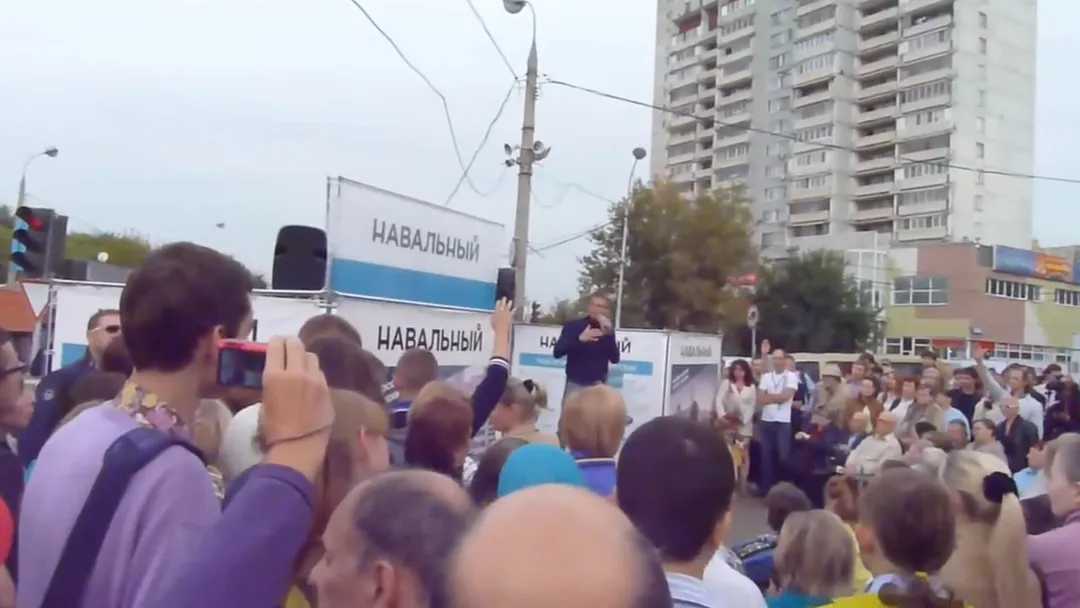
No one is going to come to this meeting! And what
kind of nonsense is this, anyway?
To run an election campaign and meet with voters?
Nobody ever does it that way,
and no one is used to it. But from the very beginning
we simply tried to imagine for
ourselves what the ideal candidate would be. I
asked myself what my ideal candidate looks like.
My ideal candidate would come to my building and speak
in front of me, answer my questions
pleasant and unpleasant alike. And then I would decide
whether I’m going to vote for him or not
vote for him. So I became that kind of
candidate myself. I hold a lot of meetings like this.
Three meetings every weekday and five
meetings every weekend. But on the other hand, when I
tell all of you that I want to build
an open government and be an open mayor,
well, right now I already am an open
candidate, and you can ask me any
questions. I’d structure our meeting like
this: first I’d tell you a little about
myself, and then I’d answer
your questions. Any objections to that
format? Great. My name is Alexei
Navalny. I’m 37 years old. I’m your neighbor; I live
in the Maryino district and spend an enormous
amount of time stuck in this traffic jam
together with all of you. I’ve lived there
for the past 17 years with my wife and two
children. In that sense, I have a
completely typical Moscow family.
My daughter is 11; she goes to school in
Maryino, to an ordinary neighborhood school. My son is 5
and goes to a regular kindergarten. I myself come from
a military town. My father was in the military, and
throughout my childhood and youth I moved from
one military town to another
military town. My parents still live in
the Moscow region, in a military town. By
profession I am a lawyer, and I have two higher
education degrees. I graduated from the law
faculty of the Peoples' Friendship University and
the Financial Academy under the Government of the
Russian Federation.
If you’ve been following my activities more or less
over the past couple of years, what
do you know about me?
You know everything.
I probably don’t even know everything about myself.
Sometimes I ask, what do you know about me?
People tell me: "You stole the entire
forest." We know that—we watch TV.
Yes, friends.
Most often, of course, what people hear about me is
that I’m some kind of scandalous minority
shareholder who makes claims
against various state corporations,
demands that something be returned to him,
and accuses them of having robbed him. And
most often, the first question I’m asked
at meetings like this, the one I’d
start with, goes like this: So,
Navalny, why are you telling fairy tales
that Gazprom could have stolen something from you?
Come on, nothing was stolen from you; you’re making
all this up. All these Gazprom, Rosneft,
all these corporations may be
good or bad, but you’re clearly
exaggerating when you say they personally stole something
from you, and so it’s completely unclear
why you’re suing them. I would
answer that question this way, and
then it will probably be clearer to you why I
ended up on this stage. I really do
believe that all these corporations I’m
suing,
stole from me personally. I mean not
in some abstract sense that they robbed all
Russians, but from me personally, because
there’s a very simple calculation. In general, how does
Russia make its money?
Oil and gas.
Oil and gas. Unfortunately, we’ve
turned into a kind of raw-material appendage.
We extract oil and gas from the ground, sell it, and
live off that money. Over the past 15 years, we
have sold about $3
trillion worth of oil and gas. Is that a large amount or
a small one? A large one. A very large one. And
somehow, for example, I don’t have the
feeling that I understand where those
$3 trillion went. We
remember that, for example, the Soviet Union
in the Brezhnev era (under Soviet leader Leonid Brezhnev) also received
a large amount of petrodollars. We
roughly know where that money went. There stand
all these apartment buildings, these residential districts
all across Moscow. All of that was built with
Brezhnev-era oil money. Apartments were given out
for free back then, right? Factories, plants,
all of it was built. Science,
the military-industrial complex. All of it
was built with Brezhnev-era
petrodollars: factories, railroads,
ordinary paved roads. Everything
was being built then. Remember, there were
countries of socialist orientation.
They were being supported all over the world. But now
you received $3 trillion during
the Putin years. That’s more than
the Brezhnev-era money. There are probably
about 250 people standing here already, maybe
even more. Please tell me,
who can name even one major
industrial enterprise built in
Russia over the past 15 years?
There isn’t one.
Nord Stream. A pipeline. It’s a pipeline,
an industrial enterprise. Nord,
there’s Nord Stream, there’s South Stream, and
what’s it called, Blue Stream, and all
the other streams they’re building. An industrial
enterprise.
You know, sometimes people mention
Skolkovo, sometimes they mention Rusnano,
sometimes they mention the Ozero dacha cooperative.
But so far no one has named a single industrial enterprise,
because the truth is that
we have not built a single major
industrial enterprise in the last
15 years. There is just a pipeline, and beyond that
there is nothing. So I go around, outraged, and
I say to all these Rosnefts and Gazproms:
"Guys, where did you put the money? After all, you
received it. You sold off my share of the oil dollars
and gas money. Explain
where you invested it. That money is supposed to
work for me, or at least for my
children, for my future. I do not have
another country, another oil supply, or
another life. I want it to work
for me now. And they look at me
with those eyes and say: "Listen,
what makes you think that anything here
belongs to you at all?" And it is not just,
you know, some random person looking at me.
For example, at Rosneft there is a
vice president for legal affairs.
What do you think, by the way, what
the official salary might be for a
senior employee of a state oil
company, a vice president for legal
affairs?
A million.
500,000.
200,000, 300,000.
What country, what planet are you from?
The correct answer is that her
official salary is 880 million rubles a year.
At a meeting in Zelenograd (a district of Moscow), when I
said all this, and this can be verified,
a man in the front row felt faint.
A state oil company: 880
million rubles a year. As of today, it was
announced that Sechin, the head of
Rosneft, who has been a state official
his entire life, bought Rosneft shares worth 2
billion rubles. Well, that is just how it happened, you know.
He was simply a government official
all his life. He spent his whole life in
public service, honestly drawing a salary, and
somehow, from somewhere, he ended up with 2 billion
rubles. And he bought shares with it.
Wow.
So
that is why
He took out a 2 billion ruble loan. Well, it would be nice
if all of us could take out loans like that
for 2 billion rubles. That is why I
believe they robbed me personally,
because, well, nothing has been built,
nothing has been done, yet there are
these absolutely colossal, gigantic
salaries, and I see no roads,
no railways, no education, no
healthcare, nothing. This is an entirely
practical problem for me, because I keep coming to
it again and again and bringing solutions.
Let us reduce corruption here. Let us
reduce corruption here. Let us create
more transparency so that we can
monitor your spending. They do not want
any of it. I will answer the question a little
later.
They do not want to do anything. They want
to pay themselves 2 billion and have
no oversight at all. That is why I am
fighting them. That is how it is. And let them come up with
whatever insult they like. I call them crooks,
and thieves, because I truly
believe they robbed me personally. And I
have reason to believe that many
of you also believe that you were robbed
personally. And here I come to you as
a candidate for mayor of Moscow, asking
for your support and very much in need of
your support, because I want
simply to solve the specific problems
that exist in our city, the ones
I encounter and that poison my
life throughout all 17 years I have lived here. I think
our problems are roughly the same. Do
you have problems with housing and коммунальные services (public utilities and building maintenance)?
Yes.
Do we pay a lot or a little for housing and utilities?
We pay a lot. But the Moscow government
for some reason tells me, and you as well,
that we pay too little, that we should
pay more, and that tariffs must be raised
constantly. But excuse me, I look at
my utility bill for an apartment in a prefabricated panel building: 9,500
rubles for an apartment in a panel building. And I
know that right now we already pay for
housing maintenance 25 rubles per square meter.
They tell me that is too little, but just a moment. In Kazan
it is 18 rubles, in Yaroslavl 15, in Astrakhan
12. We pay 25, and they tell us: "Pay,
pay, pay even more." As a shareholder,
I am constantly in court with these Mosenergos
and Mosvodokanal. I see their finances. I
see that Mosenergo transfers to United
Russia (the ruling political party) a 300 million ruble donation, and then
builds it into my tariff. Do you want
to pay for donations to United Russia
through your utility tariffs? I do not. I see that
Mosvodokanal, our state-owned
company, which exists for us,
makes a net profit off us
of 3 billion rubles. What it does with that net profit
is anyone's guess, and then it again
says: "Let us raise the tariff." And
the Moscow government says: "Let us
raise the tariff even more." And the question
arises: "Guys, where is all that money
going? You have already made 3 billion and yet you are
raising the tariff again. It feels as if
there were no profit at all. And that is why I want
to become mayor, so that at last I can carry out
an audit of housing and utility tariffs, so that we can see what
we are paying for, and so that everything we should not
be paying for, starting with these
departmental
sanatoriums and ending with cross-
subsidization, can be thrown out.
from the tariff, and we will do it. There are
a huge number of nonexistent
investment programs. If you look
at the paperwork, you might think that across
all of Moscow they built new
power plants and replaced all the pipes everywhere.
But none of that actually exists. It is a complete
fabrication that we are paying for. And every
time they tell us: "Pay more, pay."
We already pay a great deal, more than
everyone else. I want to become the mayor
who will lower this both for myself and for
you. We will see that tariffs in Moscow not only
should not rise, they can actually
go down. Enormous sums are already being paid. I
came here because, well, I live
in the same part of Moscow as you, practically
next door, and I have the feeling that
migration is a problem. For you
migration is a problem,
right?
A huge one.
You see, that is an interesting thing. You see,
I am running for mayor because I know for certain
that migrants come here in such numbers
— hundreds of thousands, millions — not
because there are jobs, but
because it is easy to make money off them.
They are treated like slaves, exploited for profit, and so that
no one can say that I am manipulating
the numbers or bringing in planted
people, let me ask you directly.
How much does a migrant janitor
working in your courtyard earn? Who knows?
38
12
nine
They have not been paid for three months.
The highest is 15. You see what an
interesting thing this is.
3, 9. The highest is 15. But if we
look at the officially approved
minimum pay standard for a Moscow
janitor, we find out that there cannot
be janitors in Moscow who
earn less than 31,000 rubles.
Amazing, isn't it? Because all the real
live janitors we
spoke with gave us different
amounts. Where does the difference go? These people are
brought here and housed in buildings slated for demolition, in these
five-story apartment blocks awaiting demolition, in basements,
apartments with 30 people in them, because they
kick back 10,000 to 20,000 rubles. They live
in conditions of near slavery, and it is profitable to bring them
here in endless numbers. And they
will keep coming here forever until this
is stopped.
And this is simply a river of cash. Hundreds
of millions of rubles every month that
remain in management companies,
that remain in district administrations and prefectures.
But you and I, my friends, see
the other side of this river. When
I was preparing to speak in your district,
I checked whether crime in your district had risen
or fallen. So what do
you think — has it gone up or down?
No,
It has gone up. Seriously, you think? We
know that half of the crimes in
Moscow are committed by newcomers. I want
to tell you: in your district, especially serious
crimes are up 158%.
Murder up 100%, hooliganism 200%, drug
trafficking 207%.
Over the last six months. Official data
from the police precinct website.
In practice, it is probably even higher.
You see, I am running for mayor because
two years ago I did not have a single
acquaintance whose handbag had been snatched.
I simply did not know a single
person like that. Now in my building there are three
women whose handbags were snatched by these migrants.
And I know janitors, migrants,
who come here. I do not know
whether they are janitors or not. I simply know
that Moscow ranks first in the
world in the number of illegal
migrants. Do you like that?
I do not like it either. I want to change
this now, because I do not want to see
this crime. I want to change it
now, because I, like you, know
Moscow schools where there have begun to appear
classes in which already more than
half the children do not speak
Russian. You know about these
classes, don't you? I know about them too, and I want to solve this problem
now, because in 10 years
for my children and your children and grandchildren it
will already be impossible to solve, because
hundreds of thousands of people will be living in Moscow
who were born and raised here. They
have never even seen Uzbekistan or Tajikistan
in their lives. They will not want to
go back anywhere, or there will be nowhere for them to return to.
They will not want to work as janitors,
because why would they work
as janitors? They grew up in Moscow, but
even so, they do not know Russian
or know it poorly. They cannot
get into university, they cannot
get into a decent vocational college. They
have no prospects at all. How
will they earn a living? What kind of
life will they have? But we saw this in
France five years ago. I want to solve these
problems now, because later they
will be impossible to solve. I came here to you
because I really love
working with numbers and I know the exact size of
Moscow's budget. It is 1.6 trillion
rubles. Moscow's budget is second only
to the budgets of New York and Shanghai. You and I
live in one of the richest cities
in the world. The richest cities of Europe and the United States,
they can't even come close to comparing.
But I have a question for the audience. Tell me,
please, if we rank third in terms of
budget, then in your opinion, what place do we hold
when it comes to quality of
life among the world's largest cities?
163
Those are not very optimistic
predictions.
154
Last place. Why? Why isn't anyone saying
third place too? After all, we're spending money as if for
third place,
seventy-fifth,
thirty-seventh.
Correct answer. You were close. 154th
place. In terms of quality of life among
the largest cities, we rank 154th
place. A bit of a disproportion there, right,
third in budget, 154th in quality of life.
After all, we have everything we need for
a normal life. We have a city, we have
a large budget, we have
infrastructure, we have very
well-educated residents. We have everything,
it would seem, except the most important thing.
We have no faith in ourselves. For some reason, we
think that nothing can be changed. All these
things I'm telling you about
you already know better than
I do. Well, at the very least, no worse.
But we really do think that nothing
can be changed. That's just how life is arranged,
somehow unfairly and badly, so that we
live much more poorly than we should.
Russia ranks first in the world in oil and gas sales,
but only
69th in standard of living; Moscow is
third by budget, but in terms of quality
of life it is 154th. Take any
construction project here, any major
building site. Take the North-Western Chord
highway. It costs 70 billion rubles.
All the builders say in unison: this is
twice as expensive as it should be. They talk about it on
television, they write about it in newspapers, everyone
admits it. I don't accept it.
We know that just on the
construction of the North-Western Chord
30 billion rubles will be stolen from us, which
would be enough to build
additional outpatient clinics all across Moscow
instead. But somehow we just shrug
our shoulders and say: "Well, what can you do,
they'll steal it, it's outrageous, they're scoundrels. But
there's nothing you can do." In elections
they rig everything against us, and on television
they'll fool us anyway.
The district administration will chase us away too. To do
anything is impossible.
And so we keep shrugging our shoulders
and thinking that somehow we really are
doomed. The main idea I came here with
is that I believe
we are not doomed. What are we, the stupidest,
the most helpless people, is there some kind of
black cloud hanging over Moscow? We can do
everything. A lot of people mock me
for going to meetings like this, but I believe
in the most important thing: this is
the source of power. The people are
the source of power, and they can change everything.
Just think for yourselves: who is forcing us,
all of us sitting and standing
here, for example, to hand over to some crooks
30 billion rubles on the construction of
the North-Western Chord? Who? Look,
the police officers there, those four people,
standing here, they agree with
everything I'm saying. Where are those terrible villains
who are forcing us or
coercing us? They aren't there. They don't exist. And
what do you mean, in the Kremlin? Maybe there are
villains sitting in the Kremlin, but those villains
rule us not with the help of the police, not
even with the help of television, but through
the fact that we ourselves shrug our shoulders and
say that nothing can be changed. Everything
can be changed. I calculated
that if I hold 100 such meetings before the eighth,
and this is my seventy-sixth,
and I will manage to hold 100. That is, if
I hold 100 meetings and still don't go
crazy by the end,
I will have spoken more or less personally, as I am with
you, to 1% of the voters. That's a lot.
Show me another politician who has
spoken with 1 million voters, with 1%
of the electorate. In order to win
the Moscow mayoral election. For me
simply to win in the first round, I need
only half a million people in a city
where 15 million live. There are absolutely
definitely those half a million people in Moscow who
are needed, who know everything, understand everything,
have read everything, each of whom
can come out onto this stage and
say exactly the same things I'm saying,
each of whom can read
the program and see that there are solutions
to these problems. Because these problems are
not unique to Moscow. Other
cities have solved traffic jams,
migration issues, and so on. These
people exist. We simply have to believe in
ourselves, believe what a powerful
force we are, that everyone has friends,
acquaintances, neighbors on the same landing.
We can elect any government,
re-elect it, and throw it out again if we
don't like it. Any candidate and
any politician can be made to come
to our courtyards like this and speak,
the way I am speaking now, because we are
the source of power. I believe that. I came
here so that you yourselves would remember
it. Remember how important you are, how
much your votes mean, how much
people you can actually bring
to the polling stations. There may
already be, probably, around 300
people here now. You alone can bring
20,000 people to the polling stations,
just those present here. And you can do
it very easily. It will take each of you
15 minutes. I believe that, by relying on you,
through you, I will be able
to speak to hundreds of thousands, to
millions. I believe that we will be able
to change this government. I believe that on the eighth
we will win and begin building
a normal city for us and for our
children. Thank you very much. Now I am ready
to answer questions.
Yes, please.
I’ll repeat it for everyone afterward. Just
speak up so I can hear.
The microphone
is far away.
The question
should go to the organizer.
He can rephrase it however he
likes. The micropho-
a question about social policy in Moscow
and
economic policy. And the question
next is about my court case. As for
social policy, our
approach here is very simple, and it
is based on the numbers. Moscow’s budget
is so large that we can pursue
a normal social policy. When
Moscow City Hall tells me that my
program is populism and that it is impossible to raise
the Moscow portion of the pension twofold, I
say that’s nonsense. In our program
right now—just a second, I’ll finish answering.
How much is the Moscow portion
of the pension now?
One moment. The Moscow portion of the pension
is approximately 4,000–4,500 rubles. In order to raise it,
so that the overall pension standard would be 12,000
rubles. Right? We need 138 billion rubles
to raise the Moscow portion
of the pension twofold and make the minimum
standard 16,000 rubles. That money exists
in the Moscow budget, absolutely
for sure. Listen, by the
city administration’s own official admission, they steal
150 billion rubles a year just through state procurement
alone. That’s 30,000 rubles per Muscovite. I
know exactly how to save that
money. Our Anti-Corruption Foundation (ACF) has already
had corrupt contracts canceled worth
59 billion rubles. And I’m not even an official, I
have no formal powers at all. Nevertheless,
we achieved that, and we will do it again.
So when I am asked about
the social priorities of the Moscow
budget, we can pay more money
to pensioners, we can increase benefits
for large families, we can, finally,
provide plots of land to large families
as required by law. We can,
finally, put an end to the disgraceful
situation in which people with disabilities cannot buy
the medicine they need.
We can introduce a proper insurance-based
prescription drug system, where you
receive the medicines you need. This
is paid for by the insurance company, and I will introduce
this when I become mayor. As for
the court cases, well, you know,
all these people are unhappy, all these
Gazproms and Rosnefts are unhappy that I
go after them, unhappy that I
hold them to account. That is why
court cases against me regularly
appear. Regularly they shout
that they’re going to jail me. You know
that they already jailed me once, and were
forced to release me because people
were outraged. I know one thing: if I become
a mayor who truly relies
on Muscovites, if I become a mayor
who serves Muscovites, and Muscovites
know that this mayor serves them, then they
won’t be able to do anything to me. If I
rely on the people, there will be no
court case, no one will
put me in jail. On the contrary, you and I will put them all
behind bars ourselves. Please,
How many bank cards do I have? Two.
How many bank cards? How much is in
the accounts? Please, you can go to
the election commission website and see there
what has been published: how much I have in my accounts,
how much my wife has in hers. I’ll answer you: I have
2 million rubles, and my wife has about 1.5 million rubles.
But
No, that’s all the money I have, and my wife has
about that much in total.
Great question.
No, no, don’t dismiss it, this is an important question.
Look, the question of property is very
important. At my previous
meeting in Tekstilshchiki, a man came
from United Russia and said, "So,
Navalny, you have a large income."
"Explain where your large income comes from." My
answer is this: "Guys, my income is
what it is, and all of you can
look at it. You all know roughly where I
live. You all know roughly,
probably, something about my family." Out of
curiosity, raise your hand if you have seen
a photograph of my wife, for example. There.
Thank you. And who has seen a photograph of
Sobyanin’s wife?
There, only two people have seen one. Well,
he showed her once, so everything about me
is clear enough. My declaration makes
more or less everything visible. I only have one question:
why didn’t Sobyanin include in his
declaration the 380-square-meter apartment
that he put in his underage daughter’s name
declare it? Why is it impossible to tell from Sobyanin’s
financial disclosure how he
having earned only 20 million rubles over the last 10 years,
bought two additional apartments for his daughters
each of which costs
more than 100 million rubles. These are the things we
must do. I want to become a mayor about whom
it will be absolutely clear
where his income comes from. I want to become
a mayor for whom, both for himself and for
members of his team, it will be
mandatory to explain where the
money came from. Right now, take, uh, the same
Sechin, whom I mentioned—he bought
2 billion rubles’ worth of Rosneft shares. Well, he bought them
and that’s that. He doesn’t have to explain anything.
I will introduce rules under which all of you
will be able to understand where the money
came from, how it is spent, and why certain
strange things do or do not
happen. Please, your question.
I can pass this microphone over if you keep it brief.
Hello, I’m district council deputy Maxim
Motin. Dear residents, I can inform you
that literally five days
ago, at 23 Yuzhnoportovaya Street,
opposite the cement elevator that
we fought against together, a new
illegal asphalt-concrete plant was opened.
And now, five days ago, they connected
gas to it, and it has already started operating.
There are no documents at all. This is an election-season
gift from Mr. Sobyanin to all
the residents of our district, for which
many thanks to him. They’ll be poisoning us
for a long time. Emissions from the Kuryanovo wastewater treatment
facilities. Every day there are
hydrogen sulfide emissions. Since 2006, we have
been fighting to get an air-monitoring station
installed. They did install one for us
recently—they installed the station last week.
The only thing they forgot to install there
was a hydrogen sulfide sensor. It
measures just about everything so far except
hydrogen sulfide. We’ll keep fighting.
I hope it won’t take another seven years. So
vote with both your heart and your head.
Thank you.
Thank you very much, Maxim. And I also wanted
to thank Maxim. He was one of the
first deputies to sign
in support of me as a
municipal deputy, back when
in fact no one believed I would be able to
run. That really is
important. When I was preparing to speak
here, I simply read about how every
time some enterprise is supposed to be moved out, or before every election
you are promised that an enterprise will be relocated,
you are told
that 70% of your district is industrial land,
so the industrial zone will be
reduced. But instead, they opened it.
and the land area will be repurposed for other
uses. Every time they promise it,
does it happen?
No, it doesn’t—they lie every time.
Why is all this happening? Well, you know
all about Biryukov. Why are construction projects being lobbied here?
Because Biryukov’s brother is the one building them.
Do you know why things like this
happen with your district head? Because
who is he connected to now, again?
Who?
Shu...
Yes, Shilukhin. He had them bring in this Tsybin,
who sits in the Housing and Utilities Department. So
this has literally all
turned into a mafia. It’s a mafia that
has already become interrelated among itself. So
that is exactly why the authorities must be changed,
so that all this stops, so that we
understand why this person became
head of the district administration. And if the only explanation for us
is, you know, that he brought one
person into the government, well, that kind of thing—
should that really be acceptable?
It should not. That’s why I’m running. I want to become
the mayor who finally changes everything.
Miss, please.
Let me give them the microphone there, but only
briefly.
A question about education.
First of all, I’m very concerned about children
of migrants in our schools who
come in and do not speak
Russian at all. And the problem of corruption in universities,
where it is impossible to get in, even if you have
top scores, honors diplomas, and
gold medals—it is impossible to get into
a prestigious university. And one more question about
housing. Uh, I work at a school,
I’m a teacher myself. In my class there are two
children who do not speak
Russian at all. I am supposed to
teach them. And the housing issue: that is, I
work as a teacher, and just to have at least
a chance of buying an apartment in my
city, where I was born, I have to either
change jobs or put my entire salary
into a mortgage. Something is clearly wrong with
that, specifically with...
We asked you to keep it brief.
Go ahead. And what will Navalny do?
Excellent question. Look,
We’re quiet here.
We started talking about, for example,
getting apartments in Moscow. Right. And
teachers, in principle, should be given them under
a special program. How many people are on the waiting list
in Moscow? Who remembers how many
people are waiting for apartments in Moscow?
90,000 families, almost 400,000 people. And
now a question for all of you. You
surely know there are many people on the waiting list; everyone
suffers and worries, and getting an apartment
is impossible. Is there any place on the internet
or in some public list where you can go and check?
and look at this queue? Well, who is in it,
who is first, who is second, who is thirty-
first, who is four hundred thousandth? There is
such a list. You should be able to see the queue.
No, it's impossible. Why?
So that, as it turned out
now, all these people from Tyumen brought in by Sobyanin
arrived and have all already received apartments.
All of them, you see, were supposedly on the waiting list. And
amazingly, within a year they all received
200-square-meter apartments in the city center. That is what
Navalny will do. Navalny
will finally make this queue public so that
we could see, so that you could see, that I, as
Navalny, did not worm my way into this queue, because
Navalny wants, at long last, to become
the first mayor who will come to Tverskaya 13
from his apartment in Maryino and
go back to that apartment in Maryino for one
simple reason: because Navalny is not
entitled to an apartment. I have four
family members and a three-room apartment. Am I
entitled to an apartment as someone on the waiting list? No.
Should I be put on the waiting list? No. I am
dissatisfied and furious about what
is happening now, when Sobyanin
privatized a 170-square-meter apartment in Tyumen.
Then he bought and privatized here in
Moscow a 300-square-meter apartment in his daughter's name. We all
know how many times in a lifetime the right
to privatize is granted.
Once.
Once. So why do they privatize everything 30 times over?
I don't like it. I
will make sure that I myself cannot
do this, and you will all see it. There will be
a transparent system. I will not allow anyone
to do this. As for the situation in
schools in general—well, universities, I just won't
talk about universities; universities are
a federal issue. As for schools,
you know that right now one of the most
enormous problems facing Moscow schools is
what? Consolidation. Have you heard about
the consolidation of schools? Yes, it's happening constantly. I myself
have
the school where my daughter studies is being merged
with a neighboring school and kindergarten. No one
understands why this is happening. My
wife is on the parents' committee, and she
doesn't understand,
the teachers don't understand, the local deputies don't
understand, even though enormous amounts of money are being allocated
to schools. Who can
tell me? Who can tell me what the current
salary of a school principal in Moscow is?
150.
200. You say 150–200. Exactly.
That's right, from 150,000 to 300,000 rubles.
That's the salary of a school principal in Moscow. And a
teacher,
a deputy gets 150. And you, as a teacher,
how much do you earn? 20,000.
30,000 is what the teacher sitting in
the front row earns. You see, we have some kind of
strange thing going on here. And then there are
these incomprehensible merger processes
whose underlying logic is
as follows: there is a bad school and a good
school. Let's attach two bad schools
to one good school, and
we'll get one big good school.
Well, you know, it's like taking a Mercedes
and two carts, tying them together with tape, and
getting one big beautiful Mercedes.
But that's nonsense. We know how
schools work. We know that this is a working
collective. If there is a good principal,
it works better. If there are good
teachers, it works well. If a good teacher leaves,
it works worse. Therefore
all these mechanical processes are not
needed. And the enormous sums of money that
we allocate should be spent under the oversight of
parents' committees,
local deputies, and local residents.
Because schools are a classic matter
of local concern. You cannot merge
schools from Tverskaya 13 (Moscow City Hall). I do not want anyone from
Tverskaya 13 meddling in my school in Maryino.
That is not how these issues are resolved.
All of this should be decided here. And my
program says exactly that. We allocate a lot of money.
And that is exactly how all of this should
be done. Please.
Go ahead.
Maybe I don't so much want to ask you a question
as ask for your advice. We have
a problem. We have the Ulyanovsky microdistrict.
All our migrant workers there have gone on strike. They have not been
paid their wages. The district is buried in garbage.
I, Anna Grigoryevna Bolkova, every
day go to Moscow Mayor Sobyanin's website
with photos, dates, times,
with everything documented. Would you believe it? Not once has anyone
responded. The district is drowning in trash, and people
are outraged beyond words.
We don't need migrants. Alexei
Anatolyevich, I'm asking you, here on this
flash drive I recorded everything. If you have
any way to get this across, please
be so kind and help us, please.
Thank you very much. I'm glad that you are so
optimistic that you are already handing flash drives to me as if I were
the sitting mayor. Well,
listen, people often reproach me, saying,
"Navalny, you're like a parrot:
corruption, corruption, corruption." But what
happened in your case is a typical
case. Money was allocated, then some
people took the money. I studied this situation.
No criminal case has been opened.
There really are people running around who
haven't been paid for several months,
the garbage is not being collected. This is simply
a criminal offense. And the person in
the management company or the district maintenance office should already
be in prison over this, but is not.
is in jail, because that's how everything is set up here.
That's how it works. Here, they can't jail the head of the
department. It's obvious why here
no one can put Serdyukov in jail.
So until we start taking basic measures
to fight corruption,
nothing will work properly. Until
we bring the management company under
the residents' control, nothing will
happen.
We'll wake up and not go outside. That's how it
will be.
Oh, the whole district. Yes, yes, yes.
Listen, this is also one of those open secrets
that everyone in the Southeastern District knows.
We have Prefect Zotov, and we have
the prefect's son, who
really is a shareholder in all the
management companies. Once again, this is
just a kind of family mafia that
operates completely openly. They
make money off our housing and utilities sector, they
make money off the management companies and
pretend that we just, well, that we
don't know anything. When Zotov is
asked about it, he says: "That's not
true." But we just look at the Yagula database and
see his son there. Do you understand? He really
thinks a million people are idiots,
incapable of figuring out
what is written in the registry. That's why I'm running in
the election. This government must be made accountable
to the people. It exists with such brazen arrogance,
it shows such open contempt,
you understand? It would seem, excuse me,
that maybe I'm taking too long to answer this
question. But this is important. It would seem that
Sobyanin is interested, and Luzhkov was interested,
in making sure people were not
outraged by the obvious corruption that
Zotov is carrying out in relation to
the management companies. And in theory he
should have fired him, because
his ratings would go up. But they care so little,
they simply don't care at all. They care so little
about the residents. They
really believe that everything will be decided by
television, and by the people who will simply
sit on the election commission
and rig things at the polling station. So that's the first, the second
part of the program. We have one task: to come to
this election and show that not everything here
is decided by television. Yes, please.
Medical workers
get practically nothing at all.
It's an absolute nightmare.
And they're the ones treating people.
How can they treat people if they have no money
to live on?
Excellent question. Is there money for
Moscow's medical workers?
Let me tell you, my dear residents
of Pechatniki, that for healthcare
for every Muscovite, for your
healthcare, mine, and the healthcare of
your neighbors, four times more money is allocated
than for any other
citizen of Russia. For outpatient clinics alone,
for each Muscovite
20,000 rubles a year are allocated. For my
family of four, that means
80,000 rubles are allocated. Just for
outpatient clinics. Is that a lot or a little? It is
enough. Just out of curiosity, please raise your hands,
those of you who have been to your
local outpatient clinic in the past year.
Everyone's sick. All right then. And those who
haven't been to their local outpatient clinic,
there you see, but 20,000 rubles are written off for every person
for each one. For every single person.
I want to become mayor because at my
outpatient clinic, I assume there are the same
enormous lines as at your
clinic. Do you have lines at your
clinic?
At mine they're absolutely huge.
You have to stand there for an hour and a half.
I want to become the kind of mayor who
will finally, instead of endless capital
investments, invest in doctors. I
want to become the kind of mayor who, with the
huge sums already available, will finally
hire internists, general practitioners,
and the other doctors who are needed
by Muscovites in 90% of cases. Tell me,
please, at your clinic is it easy to get an
ultrasound exam?
Not easy. Very strange. You know, your answer
surprises me, because
on Sobyanin's campaign billboard
it says that Sobyanin is such a
great guy, he bought 1,200 ultrasound machines for Muscovites
So that means every district should have
10 ultrasound machines.
He bought them. That's true.
Next question. Is it easy to get an MRI
where you are? Is it easy to get a scan?
Right. And at every meeting—this is the seventy-
sixth meeting—every time I
ask whether it's easy to get a scan,
people wave their hands and say, "Are you
out of your mind?"
But go ahead, look at Sobyanin's
interview. In the number of scanners per
capita, we've surpassed every
European country. We have more
scanners than anyone. I know why this
is happening. Because my Anti-Corruption Foundation (ACF)
analyzed this
program for modernizing Moscow's
healthcare system. They spent 100 billion rubles.
You say there's no money. 100
billion rubles were spent buying all this
equipment at twice the price, and now it
is sitting there now, covered with a cloth in the
hallway, and we can't get either
a scan or an ultrasound. What we need are doctors.
It would have been better if that money had been used to hire
doctors by the thousands and send them abroad to study,
so that in five years they could at least
treat our children, if they cannot treat us.
These endless capital
investments need to be stopped, because
they are only investing in
the enrichment of chief physicians. We need doctors,
we need to hire doctors, because if, God forbid,
someone faces the situation where a
relative has cancer,
well, we all know
detection rates have not increased,
prevention has not improved,
survival and recovery rates for cancer
have not improved, getting an MRI
is impossible, and getting treatment without bribes
is impossible. But they spent 100 billion rubles
on modernization. I am running in order
to become mayor, because I go to the same
public clinics as you do. I do not go to
a clinic on Rublyovka (an elite Moscow suburb), but to my own, in
an ordinary Maryino clinic, where first you have to
go to that electronic registration desk,
which does not work and through which
it is impossible to make an appointment. Then you have to go
to a general practitioner whose schedule is completely full,
just to get referred to another doctor.
That is what needs to change. That is where
the money should be invested. That is why I am running for city hall.
Please, you've had your hand raised for a while.
idiot, to change it.
I see. A question about guarantees.
Indeed, why does your program not have
a guarantee? Tell me, what kind of plan
can come with a guarantee? I can tell you
right here, folks, on my word of honor—would that
satisfy you?
No. I could say, like Yeltsin, "I will
lay down my head." He offered his head, and his hand
to be cut off, and everything else. Is that
a guarantee? No. So the main guarantee
you need, it seems to me, is that you should
believe not in me, but in those changes to the
system of government that I will make immediately.
So that I do not become a crook after
six months, in those first six months I must
change the system of power in such a way that it becomes
very hard for me to become a crook. And if I do
become one, you must throw me out immediately.
That is why, for example, we included in our
program a clause stating that there will not be a
single project costing more than
1 billion rubles that I will be able to
sign off on myself. All such
projects will undergo international review. Right now
the mayor can hand out billions left
and right with ease. I will be the kind of mayor
who puts a stop to that. I will be the kind of mayor
who transfers powers, money, and land
to the district level here. I do not want
my deputies at Tverskaya 13 (Moscow City Hall) dealing with
your parks and squares being handed over for development in exchange for bribes.
All of this is your
land. Under the Land Code and the
Urban Planning Code, it belongs
to the residents. That is why I want to change the system
of government so that if I become a bad mayor
after six months, you will notice it immediately,
so that independent media will immediately tear into me for it,
so that opposition deputies,
elected because there is no vote rigging,
will impeach me, and you will
replace me at the next early
election if I have become a bad mayor. That
is the only guarantee that you
need. No solemn promises. Although
I do give you my word of honor as well.
hand
there is not enough money for us. Everyone comes here,
gives birth for free, and so on. There is indeed such a
problem; it is connected with
migration, and it is connected with so-called
medical tourism.
People come here. All right then, since
you asked about migration, let me
answer about migration. Why do they
come? Russia ranks first in the world
in the number of illegal
migrants. Moscow ranks first
in the world. Is that normal? Do we
like that? Do you like that?
I do not like it either. I have three
solutions for this.
There are three solutions. Before I
name them, I have a question for the audience.
Please raise your hand if you have been
to any European country. Any one.
Thank you. Now raise your hand if you
managed to slip into any European
country without a visa.
There you go.
How?
Well, once I asked that, and a man
raised his hand. I said, "How did you do it?" He
said, "I entered Germany." I
said, "Like when he was in the army and rolled in on a tank.
Those are not exactly the right
examples. We are, after all, ordinary
normal, law-abiding people, but even so
neither Germany, nor France,
nor America will let us in without a visa.
Then please explain to me why
any resident of Uzbekistan or
Tajikistan, even without an international passport,
can come here with a one-way
ticket and stay for any length
of time. Is that a normal system?
It is not normal. So the first thing I
will push for is the introduction of a visa
regime with the countries of Central Asia and
the South Caucasus. Without this basic measure, nothing
will work. Second, we must introduce
disqualification for contractors who
hire illegal migrants. Not just a fine, but
a permanent ban from any
government contract. No more
major repairs, no beautification contracts for you. And
third, within a year we will make sure that
so that enterprises that receive
municipal money, our money, do not
have the right to use that money to hire
foreigners. If it is a private
company, let it hire whoever it wants. That is their
business. The main thing is that it be legal. But
if our money is being used, then let them
use that money to hire Muscovites and
Russian citizens. There is enough money. A lot
of it. There are a great many myths on this subject.
Thank you. You must have heard that at
the previous meeting, a woman came and
repeated this famous phrase: "You
are all against migrants here, but if the
Tajiks leave, you will all be buried in filth."
Have you heard that one?
But is it true or not? Well, it is nonsense,
because we know that before 2003, in
Moscow there were no migrants. We know that
in most Russian cities there are no
migrants. In no city with a
population under 500,000 are there any migrants.
There are no migrants in Belarus. These are all
myths. People come here because,
as we said at the beginning, people make money
off them as if they were slaves. And secondly,
because in Uzbekistan and in Tajikistan
there is poverty. Sooner or later, the whole country will move here.
It is simply very hard
to live there. There is neither education nor
healthcare, and there are no jobs at all.
That is why they will always keep coming here.
These three measures I am talking about, we will
introduce them, and we will reduce the number of migrants
by 70% over the next 2 years. Please,
public procurement. May I have the microphone?
Public procurement. I just want
everyone to hear. The Mayor's New Year tree 2013. I do not
know whether the mayor knew about this event. We
took part in this public
procurement. The winning company
did not lower its bid even a little: 40 million
rubles. The Mayor's New Year tree. And tickets for the Mayor's New Year tree
were being sold. Any show at all,
even on a large scale, would cost, well, no
more than a million.
40 million rubles. Where it went, I do not know.
Of course, the company that won was the one that had been working with
Moscow City Hall since 1998.
Later we analyzed it.
Thank you very much for this information. There is only
one mistake. You said, where it
went, I do not know. Yes, we do know where it
went. We know everything. Listen, the Mayor's New Year tree,
39 million was stolen from it, in your view? Yes. As I already said,
less, a little less.
All right, a little less. Look at how
the Moscow metro is being built after
last year the main contractor
for the construction of the Moscow metro became
Timchenko, Putin's friend...