Alexei Navalny’s meeting with voters in Moscow’s Profsoyuznaya district
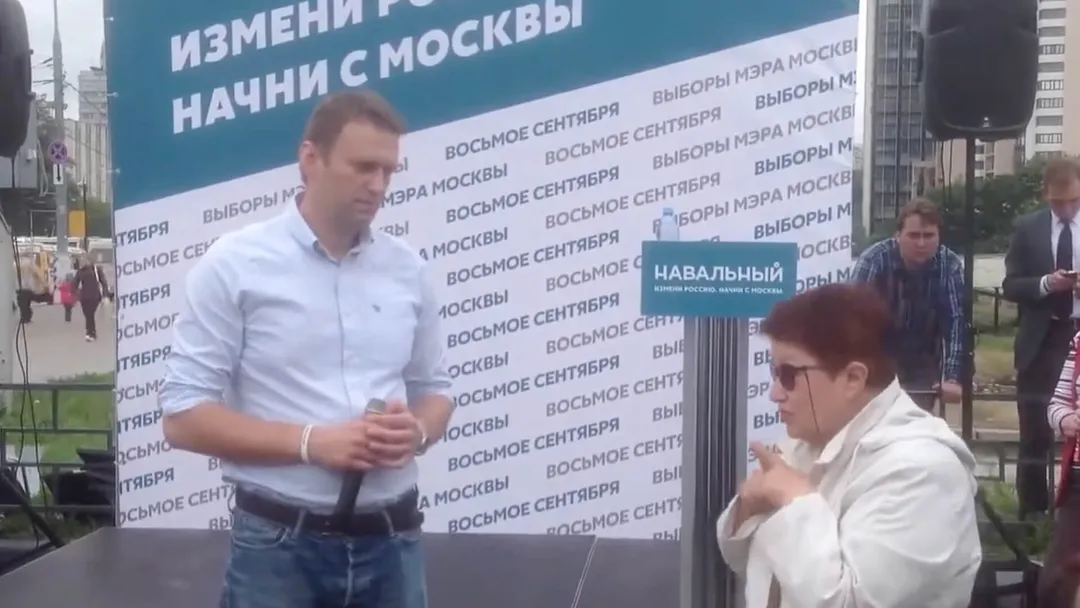
A question, a question.
How are you going to solve this problem, I mean—
our district, generally speaking, is located in
the most elite part of the city, but it’s neglected, and
my second question: are you following the Bolotnaya case
involving the 12 defendants, and what
is your view overall? So, two questions.
First: how can we make sure the district is
not as neglected as it is now? And the second
question is only about the Bolotnaya case.
The answer to the first question is very simple.
Let’s come back to this again: 1.6 trillion
rubles in Moscow’s budget—there is enough money
to create much better public amenities overall, and
there is already enough money
to make sure that this horror and nightmare
really would not exist in an elite district of Moscow.
There is a sea of money in Moscow. What matters is that this
money should not simply go to some
contractors. Just look at the budget and
you will clearly see where all the
money goes: giant construction projects, giant
projects accountable to no one, costing four times
more. Look—there are 400 billion
rubles allocated for road construction. That’s about 15
kilometers of roads over the past year. The average
cost per kilometer of road in Moscow’s budget
is $38 million.
An excellent German Autobahn
with four lanes costs three times less.
Here, everything is built at several times
the cost, and the result of this
economic activity, unfortunately,
is what we discover here for ourselves, while they discover it
for themselves in the form of
new palaces on the southern coast of France,
apartments in Miami, and so on. It
is all very simple. It’s all simply about
money that we should be spending on
ourselves, yes.
Probably the Academy of Sciences, city—
federal land.
Because people go to the courts over
all sorts of issues; the courts are really a matter for lawyers.
That brings us precisely to the second question, about
the Bolotnaya case.
Of course I’m following it. I do not have the right
to attend the trial itself. Many people
ask me why I’m not sitting in the courtroom at
the Bolotnaya case—but I’ve been listed as a witness.
If I go into the courtroom, then as a
witness I can no longer be questioned. But
of course I am following the Bolotnaya case.
Random people are sitting in jail over it, and it is our shared
responsibility to make sure that these
people, who are clearly being used for intimidation,
that these innocent people are released.
As for the Ministry of Justice—continuing the theme
of local improvements—this is why I say that
local deputies—for example, the local deputies
who are here—should, and you together with
the local deputies, should resolve such
issues. And that is why local residents should have
these powers, because honestly speaking,
no one at 13 Tverskaya (Moscow City Hall’s address) cares
about what is happening here. It’s simply
not interesting to them. Just to be safe, they
don’t permit you anything. In general, they are not
interested until someone suddenly
gets the idea of building a shopping
center here.
That’s when it becomes interesting to them. All these
issues should be handed over to residents, and
the money exists for residents to solve
these issues. And we have enough trust in ourselves
for all this—we are fully capable of
solving these problems.
United Russia has an enormous budget
as a party, probably billions. And you
probably do not even have one percent
Nemtsov doesn’t have one percent either, and
Yabloko doesn’t have one percent either.
Some have even less. Why don’t you unite?
Do you really not understand
that even with all our enormous sympathy for Nemtsov
and Yavlinsky, why—after all, you all want
the same thing. Do you really not
understand that if you do not unite, you will achieve
nothing, and in 10 years people here will still
be saying:
‘So how is life in Moscow? Not good.’
That last remark was not very
politically correct. So,
first: yes, United Russia really does have
huge amounts of money. As for me, I don’t have even
one percent—not even one hundredth of a percent.
Despite the fact that these 10,000 people,
as I said, have transferred 20 million
rubles—we have raised 20 million rubles so far for the campaign,
and that is still not one percent of what the other
parties have. But I have something far
greater,
a hundred times more powerful: you.
You, the people who want this. Maybe not all of you
support me, but at least you came to
listen to me. I am sure that if this
were a United Russia meeting here, then
people would be coming not in flip-flops but with tomatoes,
whereas everyone who came here came without tomatoes,
without rotten eggs. And that matters. Money does not
decide everything. It matters, but it does not decide everything.
And until we understand that ourselves, we
will achieve nothing. Everything is decided by whether
100 people who came to a meeting
tell 10,000 other people about this
meeting—and no television channel will wash
people’s brains that effectively. So money
is less important as long as there is popular support.
As for everyone uniting,
well, unfortunately we must remember that
there has never been a time when everyone
united. This is politics; there are personal
ambitions, and so on. You can look
at the opinion polls and see that
yes, Sobyanin is in first place, then perhaps
with a gap, but I am in second place, and
then, far behind, come all the
others. But even despite that, it would have been
Logically, they should support me, but they won’t.
They won’t do it. I’m not going to
criticize them here.
People are people. It will never work out so that
we can unite in a way that, first and foremost, the authorities won’t allow.
That means they will
push their own controlled, handpicked
pocket candidates. From the very beginning, the whole thing
Sobyanin’s campaign was
pre-programmed: there’s handsome me, Sobyanin,
and then there are some absolutely
worthless couple of candidates who aren’t
running any real campaign, and I get
75%. We managed to break that script. We forced them
to register us because
we started campaigning, and we
proved to them that no one would believe in these
elections. Maybe Sobyanin would have won with
a marketed 70 percent, but at the same time
turnout would have been 10 percent, and those elections
would have meant nothing. Unfortunately, it doesn’t work that way.
It would be good — I completely
agree with you. It would be good if
tomorrow I were the one single united
candidate and the election were Navalny
versus Sobyanin. Everything would be much
more useful, but that’s an unattainable dream.
People are people, they have ambitions, and that
has to be accepted. But then our task, as
voters, becomes more
responsible. That means we must
vote more carefully. Is that right?
Yes. Please, go ahead.
Is this Mikhail Prokhorov’s electorate?
Listen, look at me and at Mikhail
Prokhorov. Again, I’m certainly not going to
criticize Mikhail Prokhorov,
and I’m not going to put on some kind of
grand performance for you here. I’m simply
who I am. I’ve lived in the same place for 15 years,
in the same apartment. I’m absolutely a person
who lives the life of an ordinary Muscovite (Moscow resident)
every day, and my electorate is ordinary
people. It doesn’t matter whether they were for Prokhorov or not.
When I talk about how
money is stolen from the budget, that concerns everyone.
When I say that through procurement alone
30,000 rubles a year are stolen from each of us
(about $900 at the time), well, that concerns everyone. When I
talk about migration, that concerns everyone. It’s not
about Prokhorov. I just know that
in my building entrance — and I assure you that in
the southeast, migration-related problems are even
worse — women are simply afraid
to leave the building in the evening. I just know
this. What difference does it make whether those women
voted for Prokhorov, for someone else, or
even for Putin? Maybe they voted for him.
I just want them to believe
in my program, because I’m saying that I
will solve this problem. What difference does it make
who they supported before? I think Prokhorov
has probably never once in his life tried to book an appointment through
this electronic queue at a state clinic, whereas I
have — or rather, I tried to
several times. I know that
we supposedly have an electronic registration system, but
there’s a notice posted saying that appointments through
the internet and the electronic registration desk
are available every Tuesday and Wednesday from such-and-such
time at such-and-such window. It’s absurd.
That’s why I’m running in this election: to
solve the problems that I
face, that my family faces. My
electorate is simply ordinary
normal people. There’s only one question:
how many people will be able to learn anything at all about
me and my program in a situation where I
have no access to television. That’s why I came
here — to persuade you, and tomorrow
maybe you’ll persuade someone else. Your question?
Please tell me, why are these
meetings — their time and place — kept so secret?
How can people find out where they’ll
be held? As for the secrecy, I
can say this: first, this is a trial
meeting. We’re all very
anxious about whether it will work. No one
has ever done anything like this before. It’s an absolute
something new in the history of
political work in general, when people
simply organize meetings like this themselves.
Because the usual kind of politics is simple:
we take money from someone — either
oligarchs or the Presidential Administration —
and with that money we run ads on Channel One,
and that’s the whole of our politics. So
we’re very worried about how
this will all go, and whether people will come.
Will people come? As I already said, at
the first meeting with me there came
three people. And I spent an hour
talking with them, and then another
30 people came. Well, that’s my duty.
There’s no other way. If we publicize them widely,
there’s also this particular issue:
we’re the only ones who are actually running an
election campaign. The others, unfortunately,
really aren’t campaigning at all. If I were
to announce it loudly, there’d be 45
photographers running around here, and they’d prevent me from
talking with you. That’s why — everyone kept telling me,
“He’s not meeting voters, he’s just doing PR.”
So for now I’m notifying only residents
of the neighboring district, so that I can genuinely
meet with voters. Your
question now.
Let’s return to New Moscow (the 2012 expansion of Moscow’s territory), my view
and to Law 43 on expropriation. This is an excellent —
actually a brilliant example of the nonsense, chaos, and
corruption connected with it, which
are happening because they passed this
law on simplified land seizure, and now it’s
very easy to take land away from anyone
in order to move
federal government bodies there. But at the same time
they have already said that federal government bodies
will not, in fact, be moved there.
Then why the hell, why the hell did you pass
this law again? I believe that the issue we
have is that the concentration of offices and everything else in the center
is far too high. That is, we live in
our enormous country where, if nothing else,
there is plenty of land, yet we live packed together like sardines in a
barrel. But the issue of expanding Moscow is
really a matter
of architectural planning, at the very least
for a year. We need to calculate how much
the relocation will cost, how much
new public transport will cost, how much
people who will be commuting will have to pay.
This cannot be decided just like that, with us
simply deciding by popular impulse whether to move it or not.
All of this will cost us
trillions, and until the Moscow mayor's office
does what it is supposed to do and does not
invite the best experts here,
the best urban planners, does not calculate all of this
and does not show us these calculations so that we
can verify them, until then answering
this question is impossible. Let's simply
in two weeks.
There are a lot of you, a lot. Let's try
there, for those who haven't spoken yet, yes.
And now this store, it is now 20
meters
which are
at the moment the owner of the store, the owner
of the central store, is a company
registered in Ukraine, uh, LLC Max.
So now they have received permission from
and the store
with an area of 2,050
sq. m.,
with an underground area for 20 minutes
A person lives opposite it.
Where should they turn?
A basic case like this. Go ahead, go ahead.
I'll start answering. This is an absolutely typical
situation. This situation also perfectly
reflects how power is structured in
Moscow. A person lives across the
road, and downstairs there is a small store
which used to function as a small
store, but now they have received permission
to build a 2,500-square-meter
two-story building, 2,050 square meters,
and it will completely
poison life in that building again.
Why does this happen? Because all
decisions are made there, not here at the
local level, but somewhere out there.
Some obscure official
who does not even know what is happening here
simply received a small
bag of money and therefore signed
the permit to build the store. That's
all. And all of this can be resolved only
in one way: all authority over
approving or rejecting such facilities
that are located directly
next to residential buildings must belong to the residents,
including local deputies, so that
at least for small
projects there is none of this
interference from Moscow City Hall. We will help
you, of course, to appeal this once again,
to file complaints, and so on. But I want
to tell you that we will never solve piecemeal
issues, spot development, an individual
store, as long as power is structured in such a
ugly way, you know.
Naturally, here everyone, you know, about
the reconstruction of Leninsky Prospekt
nearby, they announced that they would
reconstruct Leninsky Prospekt.
When the residents raised hell, they announced
that they would not rebuild Leninsky
Prospekt. It is obvious that on September 9, after
the elections, they expect to win and
then start reconstructing it again.
Leninsky Prospekt. So we can
express our outrage and for a while
stop all this, but overall this
this
idiotic system, where some people
whom we did not even elect make
decisions we do not want, will
remain in place as long as there remains
this kind of power, this power of United
Russia, Sobyanin, and so on. Just a question
for the local deputy. I want to hear
from the person who is supposed to deal
with exactly these kinds of things.
Alexei Gusev, district deputy. Well, actually
my question was a little
different; it concerned the elections, uh, basically.
Can these elections be considered the beginning
of the campaign, including for the
2014 elections to the Moscow City
Duma, and will you
personally take part in them, and in what
capacity?
My friends, unfortunately, like any
independent politician, I perhaps more than
anything work in such a way as to try
to be useful to you and improve life
around us every day. But to make predictions
about 2014 is difficult for me. You
know, quite recently, basically,
I had such... I mean, there was that whole
they jailed him, then released him, and so on.
So as for 2014, I do not have
any plans. My task right now
is to bring politics back altogether,
to treat elections as an actual choice, so that
candidates finally emerge who
meet with voters,
who come and listen to pleasant
and unpleasant questions. When we achieve this
situation, when we make it so that
there are candidates like us, like
me, who will meet people in courtyards,
who will raise money from ordinary people rather than
rely on some oligarchs,
and so on, then we will win in
in 2014 or in any other year
right now our task is to make sure
that Moscow pushes back against United Russia
that Moscow pushes back against the Kremlin, and that Moscow
pushes back against this system in which 10
or 20 or 100 families have grabbed everything for themselves
the national wealth that belongs
to the country, and are giving no one any chance to live or
to resist
How do you feel
about fighting gay pride parades? What
kind of idea do you have of my fighting gay pride parades?
They walk, and I run against them? I’m answering
your question.
So, our task is to make sure that
no one is fighting anyone where
there is no need to fight. We all have the
constitutionally guaranteed right
to assemble peacefully and without weapons.
Left-wingers, right-wingers, gays, heterosexuals—
it doesn’t matter who they are. The authorities’ job
the job of Moscow City Hall
is to ensure everyone’s safety. Let them go quietly,
calmly—let them go. The main thing
is that no one beats them and they beat no one. If
someone there is running around naked or something else,
that is simply an offense
covered by the administrative code.
Detain them, fine them, and move on. Let’s not
try to control
every second of people’s lives everywhere. Residents are residents; they have
the right to gather, both those who want to and those
who don’t like them. The authorities’ job
is to make sure they do not
kill each other. Your question?
You mean the restructuring
of the Academy of Sciences. This is actually very important,
especially in your district, where
a large number of members of the scientific
intelligentsia and the institutions themselves are concentrated.
The thing is, as you know, the Academy
of Sciences has an enormous amount of
land and property; it is simply a very wealthy
organization.
And the authorities said: well, what is this—some
elderly professors, old men who
don’t understand anything, and they are managing
all this land and wealth worth
billions—why don’t we manage it
all ourselves instead? Well,
excuse me, maybe those old men are
very old and do not always keep up,
but at the very least those old men have received
Nobel Prizes—they are outstanding scientists. And
when I’m told: let’s have it managed not by the old men
anymore, but by some kind of
clever young men, these crafty fellows who
appeared from who knows where, these
phony managers—I say no. And if
they want to change the system for managing
the Academy of Sciences’ property, then let it be
transparent. Then let them create a system under which
we can know for certain, for example, in
this building—an office building, one of the largest—
what is being rented out and at what price,
and at what price it is then being subleased.
Let them do it that way. But they
simply want to take this property away from
the old men and manage it themselves. But
the old men have at least earned their place; we at least
understand where they came from. But we
absolutely do not understand where
this gang of swindlers came from, the ones who
say they are better. So I view this negatively.
There are things there that need to be changed, but
not in this way at all. Yes, your
question.
And as for the series of five-story buildings not slated for demolition,
as I already said, in your
district this is a less pressing issue.
But there are districts like Zyuzino where this is absolutely
a pressing matter. Simply put, these five-story buildings
were built in
the 1960s, and each of them had an
originally planned service life of 25
years. That service life has expired; repairing
them further is pointless—it will all be
more expensive. Yet they are being repaired now, and as I
already said, even the demolishable five-story buildings were illegally
removed from the program because
there is no more money to be made from them. There
used to be a scheme under Luzhkov (former Moscow mayor) through which they
simply made a lot of money
off these five-story buildings. But now there is no profit
in it, so they say: well, we won’t
demolish the five-story blocks because
we personally won’t earn anything from it. The city
most definitely has the money for
rehousing people from the five-story housing stock; it needs
to be resettled. That is my direct answer: they need
to be demolished and residents rehoused.
Alexei, well, I’ll say it directly too: I
fully support you. Just a big
human thank-you to you for what you are doing. I
wanted to ask about election observers, but of course we have
a certain magician, as we all know, and
the elections accordingly may come with a well-known
outcome.
So, regarding observers: when are you
going to
announce who will be able to become an observer?
By what criteria will you select
people, and will you be doing that—that is,
will observers go to the elections
through your campaign, from your side as observers? Because
we really can achieve a great deal,
and then the magical Churov (former head of Russia’s Central Election Commission) will come along
and twist his magic
switches, and all the votes will somehow
evaporate.
We took this very seriously
a year ago, when the presidential
elections were held, and thanks to that we now have
around 2,500 commission members in Moscow
with voting rights. Of course, we
remember the experience of the last State Duma elections,
when observers were literally grabbed by the arms and
legs, carried out of polling stations, and thrown out, and
And then, when it comes to these elections, I...
I won't get anything done here without you. We...
will announce a truly large-scale
recruitment drive for election observers. I'm sure we can
mobilize at least five to six thousand people
to cover all the polling stations
of which there are 3,200 in Moscow, and
here I will be relying entirely on your help
in this operation, because my
campaign headquarters cannot monitor every single station. This will be
the most important task, and of course we will fight
for every vote—we earn them
with such effort.
We go out, I go out, persuading people,
convincing them. Of course, we will not let these
people simply steal our votes from us, as
happens in every election in
Moscow.
Sorry for asking a second time, but the thing is
that a serious campaign has already begun against you—
or rather, propaganda and counter-
propaganda. Please tell us:
your internship at Yale University, and
it is said that this internship was arranged for you
by obvious enemies of Russia,
people like Genrikh and so on. Could you
explain that a little, please?
Please explain it firsthand, especially since
the media may amplify it somehow. This is
a very serious image issue, and
it affects trust in you.
He would be surprised if he even knew
that I existed at all. Indeed, this
negative brainwashing campaign has been going on
constantly, on television. I think that
in the last two or three weeks before the election
it will intensify dramatically, because they
can see, just as we can, that our ratings
are rising, that our election campaign
really is reaching voters, and they
will say even worse things on television.
As for my studies at Yale, this is really
just a question of whether
people should study at good educational institutions or
not, whether we value education at all or
not. I can tell you that at
Yale University,
60% of the students are Chinese, because China
realized that education is something
worth investing in, and China,
for example,
sends hundreds of thousands of students to
the best universities and pays for them
itself, so that they return and work, and
they have been doing this for many, many years.
And now even Chinese universities
unfortunately are far ahead of
our Moscow State University in the rankings.
In effect, they are trying to tell us on television
that apparently we should be
as backward as possible, never study
at the best universities, and anyone who
studied or went abroad to do something
is a spy.
It's especially funny to hear this
from people whose own children
study abroad. You may have read
my investigation into Zheleznyak
and those deputies, those loudmouths who are always
fighting 'foreign agents': one of them has
a daughter studying in England, another in
Switzerland. He pays for their education
more than he earns. They all themselves
live there, they educate their children
there, and yet they reproach me for the fact that I
spent half a year at Yale University. We
should be sending students abroad to study;
this has practical value.
For example, for Moscow: Moscow does not have enough
general practitioners. We can train them, but
medical education in Moscow is very poor—
indeed, in Russia as a whole.
Russian medicine has fallen 20 years behind
the rest of the world. We simply need to send thousands of
students abroad to study
so that they come back here and treat us
better. You see, we have
a paradoxical situation. For example, in terms of
the number of scanners—serious
medical equipment that
diagnoses cancer and other complex
diseases—we surpass others in the number of
scanners per capita; we are ahead of
London and ahead of European countries.
But if you try to go to a
clinic and sign up for an MRI,
you will wait two months. And if you pay for
an MRI, it will cost 60,000 rubles. No one knows how
to operate these scanners. We have
a lot of them, but our cancer diagnostics
are still just as limited, our
prevention is still poor, and our
recovery rates are appalling, like in Africa,
because no one knows how to work with the equipment. So, for example,
with doctors, we should simply identify
the best students and send them abroad,
pay for them, so that they come back
and help us. Why not simply improve
our education here? Why do we need
to send anyone anywhere? Is that easier?
You know, nothing can be done the easy way.
It has to be done properly.
If countries that grow by 10% a year,
for example China, have been doing this for many
years and have achieved success, then we should
do it too. Of course, we must invest
in our universities, we must invest in our
science, but unfortunately we see that
the only question that was asked about
science concerns how they want to take
property away from scientists and carve it up.
So we must not simply allow ourselves
to be fooled. This entire elite
is itself oriented exclusively toward the West.
If you look at what we can
be proud of, for example, among our
officials, there is this remarkable fact:
all the houses in London are more expensive than...
Russian officials are buying million-pound properties.
Officials. Right, right, right, right — here is the answer to your
question. Yes, please.
60,000 rubles
The question is that it is impossible to get a child
into a school. You either have to register them at an address here
or, yes, it can be done without registration, but for that
they ask a standard rate of 60,000 rubles — an absolutely
standard situation. More than that,
speaking again about problems — why do they concern me?
Those same schools. Do you know that
there is currently a process of merging schools?
Here, as far as I know, School No. 525 — I needed to check —
School No. 523 was merged with a kindergarten,
and the head of the kindergarten became the director.
I know these
problems because my wife is
a member of a school parents' committee
that is also dealing with the merger of neighboring schools with
a kindergarten. All the mothers are up in arms, and
no one is even explaining anything to them.
In fact, what is happening is illegal.
After all, in theory we now have open
electronic enrollment. And when someone
asks for 60,000 rubles to secure a place, well,
that is simply, you understand, this familiar
corruption. Everyone knows that a child can be placed
in any school for a bribe. Nevertheless,
this keeps happening all the time. And at the same time,
here in Moscow, we allocate so much money
to education, so very much
is available, that we could, without any
problem at all, fully staff schools. And teachers,
by the way, now earn quite
a lot. School principals, principals of schools,
receive enormous sums, really
200,000 to 300,000 rubles. So there is certainly no shortage of money for
providing for children in Moscow — there is plenty of it.
Now, if I were running here for
mayor of, say, the city of Kostroma,
and you told me, “We want schools or a clinic in our district,”
I would tell you:
“Guys, I understand what you want, but we just don’t have the money.”
But here we have the opposite, paradoxical
situation. I’m telling you, we have money —
simply a sea of it — and yet we still do not get
the schools children need, nor
the clinics, because instead they build some kind of
incomprehensible interchanges at three times
the proper cost. You could build the interchanges and
still have a huge amount of money left. Yes, go ahead, a question.
Please comment on your statement that
the price of goods does not depend at all on
corruption. You probably did not quite
understand me, because I did not say
that.
What I said was: this is how it will be in the city,
this is the kind of Moscow we will create. And when
we truly manage to change
this government, we really will make it so
that the price of products will not depend on
corruption, and there will be no corrupt
component. Living in Moscow is very expensive.
It is hard even for a working Muscovite to live here,
so what can we say about
pensioners? Everything in Moscow is more expensive, everything.
And these are not my calculations, but
the calculations of international companies and
various analysts, who say that
in the price of practically any product in
Moscow — a carton of milk, a kilogram of meat,
and so on — 30 percent
is a corruption-related markup. That is why, before
you, my friends, here I say: I do not want to
pay 30% more myself, and I do not believe that we
should have to pay 30% more. That is why I am
here. Because all of us can change
this. Because all of us must
come and say: “Stop robbing us. We
know how to do things differently, and we
will definitely achieve this, my friends.” I
want to thank you all. I have to
go to the next meeting.
I have three of them a day, three meetings a day. I
thank you for coming. For
me, it is very important that you listened
to me. I ask you to support me and
reach out to your neighbors however you can,
tell them about this speech, and help
me break this system of propaganda
that intoxicates everyone, that makes everyone
lose their minds. Thank you very much, thank you.