Alexei Navalny’s meeting with voters in Moscow’s Tyoply Stan district
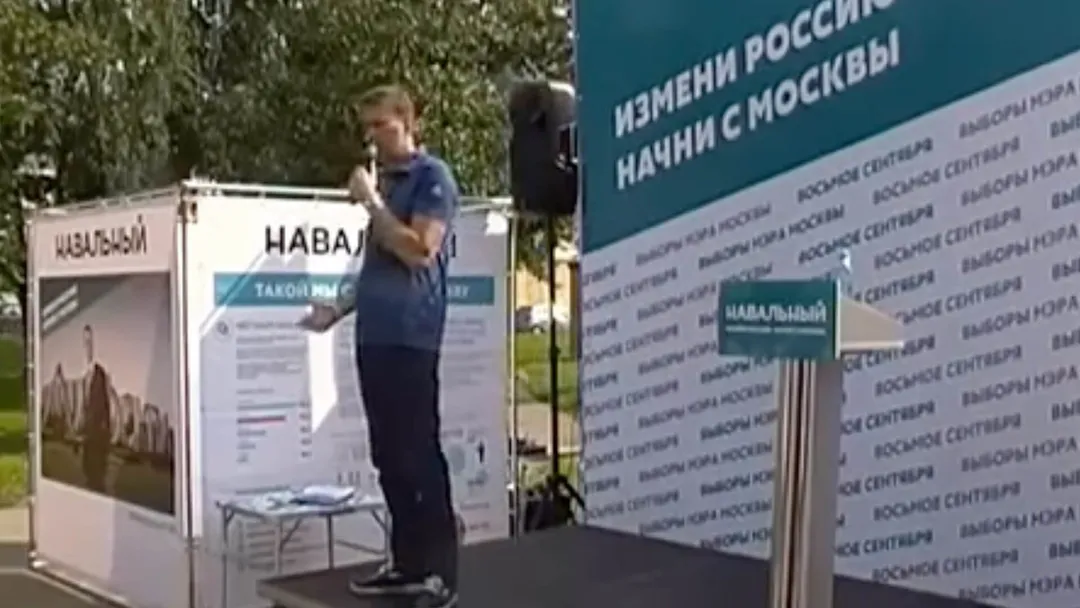
Hello, thank you very much for
coming. Please come a little closer.
Take your seats. Thank you for coming to this
meeting. It is very important to us that local residents come,
because I and the people who
support me in this election
campaign—the volunteers, thousands of volunteers
who are working—
we are truly building our
election campaign primarily around
meetings with voters, because we believe
that only voters truly grant
power, and that any candidate for mayor
of Moscow, or the incumbent mayor of Moscow, or
any person seeking to obtain any kind of public office—it is
their duty to go out and meet with
voters. This may be very
unusual for Russia, this way of conducting an
election campaign, and usually no one
dares to do it this way—simply meet people,
answer questions. But we believe that
it is simply an obligation.
If you act differently, then you are acting
with reliance on someone else—
maybe on television, maybe on
oligarchs, maybe on money, maybe
on your own self-confidence. But
we want to appeal to the people and
rely on the people. That is why I am at this
meeting and ready to answer your questions.
Now I would first like to say a little
about myself, and then answer any
questions—hopefully you have some.
My name is Alexei Navalny.
I have two degrees. One is in law;
I graduated from the Peoples' Friendship University of Russia,
which is not far from here,
and my second degree is in finance.
I graduated from the Financial Academy
under the Government of the Russian Federation.
By profession, I am a lawyer. I live with my wife and
two children in the Maryino district, quite
far from here. For 17 years now, in the same
place, in the same
apartment.
My main area of work is
investigating corruption in
state-owned companies. I am that very
troublesome minority shareholder,
that troublesome lawyer who keeps going after
Gazprom, Rosneft, Transneft, and so on.
And I am the person who regularly files
lawsuits against them and demands that
various managers be held accountable
for buying those very pipes at twice
the proper price, for carrying out construction at
three times the proper cost, and so on and so on.
And I am very often asked at meetings like this,
indeed in any interview,
I am always asked: why do you need all
this? There are 140,000 VTB shareholders, and they all
sit quietly, while you keep bothering them,
suing them, demanding that this person be jailed.
There are 200,000 Rosneft shareholders, and only with
you does Rosneft seem to be fighting, and you with it.
If you look at the database
of commercial courts, there is Navalny
constantly against Rosneft. My answer to this
question is very simple.
It is that I calculated everything for
myself and for my family. Today I will very
often return to this point: that
you simply need to calculate everything for yourself, and
then you will probably understand why I am
doing this. We all know, unfortunately,
that the Russian economy is currently structured
in such a way that we extract oil, extract gas,
sell this oil and gas, and with that money
we supposedly live. Unfortunately, we do not
produce or make anything else,
and we do not earn from anything else.
There is a simple, and at the same time
striking, fact: over the last 15 years, during Putin's time,
Russia has received $3 trillion from oil and gas sales.
That is an abstract figure, and it is hard for us
even to imagine such a number
in our heads, as ordinary people. What is 3
trillion, really? To understand it better,
you simply need to divide it. That means
$50,000 for every person,
about 1.5 million rubles per person, and for a family like
mine, of four people, that is 6 million rubles. So I naturally
ask myself: where are our 6 million rubles
that should belong to me, should belong to my
family? What form do they take?
Do they show up in newly built roads?
In new schools? In newly built
cities? None of that exists. I do not see any of it.
In Russia, the amount of railway built
in a year is what China—despite not having such vast
natural resources—builds in a week.
I see many older people here,
and you remember very well that a large
amount of petrodollars flowed into
the Soviet Union during the Brezhnev era.
A stream of petrodollars flowed then as well. One can argue
about whether those petrodollars were spent properly
or improperly, but at
least we can see them, and we
know what they went to. During the Brezhnev era, there was
the space program,
these residential districts and
neighborhoods in which we live were built. There was
an Olympics held, there was built
a huge army.
We fed half of Africa, half of
Latin America, supported regimes
all over the world, built universities, and so
on. Whether that was good or bad, whether too much money was spent
or too little—at least we can see how
it was spent. Everything around us—even
this asphalted площадка here—
was built in those days. And what have we
received now from an even greater
amount of money, even in the richest
In the Brezhnev era, the Soviet Union did not
receive as much money as it does now,
as it has been receiving in recent years.
Yes, we still seem to be trying to launch rockets,
but unfortunately we see
live on air how they fall. We try to host the Olympics,
we try to hold them. But even our Winter
Olympics, for some reason, cost three times
more than the Summer Olympics in other
places. We got nothing from all this
money, and neither I nor my family got anything
out of it. That is why I am involved in all this,
why I keep going after Gazprom, VTB, and Rosneft,
because they are robbing me personally, and personally
robbing my family. I have no other country.
I have no other city, and I understand that
the stolen money was taken from right here. Stolen
money was stolen from me, from my children. They stole those very
railways that I am supposed to travel on
and that my grandchildren will travel on.
They stole new schools. They stole community centers,
and so on and so forth. I
simply take this very personally,
very close to heart.
After all, these are mineral resources. These are resources that
belong to all of us. This is not some kind of
abstract thing. They take them from us, sell them
abroad, and pocket the money
themselves. I stand here before you now as
a candidate for mayor of Moscow, and I am addressing you,
trying to persuade you and hoping to gain your
support. Because I am the most ordinary
Muscovite, exactly the same as
you, someone who every day faces
the very same problems that
you face.
I want to solve these problems for myself, for
my family, and in the same way for you. I
stand here and say that I am running in the election
for mayor of Moscow because the problem of housing and utilities concerns me
not because I read about it
in a newspaper. Not because a poll
showed me that housing and utilities are a major concern
for Muscovites. It concerns me because
every month I get a bill for 9,500 rubles, but it
cannot possibly cost that much. I know that
perfectly well. I know perfectly well that the price rises
every
day. I know perfectly well that the quality of services
is not improving, it is actually getting worse. I know
perfectly well, just as all of you do, that our
district heads, our managers of the management
companies, are all funded by us. You probably
may have seen, some of you,
about a month ago,
a TV report showing how
the head of the Maryino district administration, right where
I live, was removed from office because his wife
in a luxury SUV ran over
pedestrians. Remember that Range
Rover with the license plate
999. And yet this district head
had spent his whole life in municipal
service. Yes, he may have a large
salary, but there is no way he can
afford the standard of living that he
openly enjoys. He should not be able to live like that.
In theory, he should be poorer than I am, because
my official salary is higher than
that of a district head, yet he openly lives
ten times better. And I know perfectly well that my
9,500-ruble bill simply
guarantees him that luxurious
lifestyle. I am running in this election
so that utility rates will be transparent and open. I am running
in this election in order to become the mayor who
will conduct an audit of housing and utility services, and then we will all
see how Mosenergo every year
sends 200 million rubles to United Russia,
which we pay for when we pay our electricity bills.
We are paying for United Russia. And then, when
I conduct the audit, we will see all
the things that do not exist, yet we pay for them every
day. I am running in this election because I
want to solve the problems of my family, of all
the people who live around me, and of your families
who also go, just as I do, to
an ordinary local
clinic. I do not live on Rublyovka (an elite residential area outside Moscow), I am not
assigned to a special ведомственная clinic for officials. I
go to an ordinary clinic like everyone else, just as
everyone else does. On television I hear talk
about how we have this wonderful
electronic queue system, which supposedly means
you sign up,
and receive medical care on the same day
you apply. I have gone to this clinic and
also poked at that
machine, and my wife went to the children's
clinic and also tried to make an appointment
through the electronic queue, and I know
perfectly well, as an ordinary Muscovite, that it does not
work. This thing does not work. But at the same time
I look at the Moscow city budget and I
see that just for outpatient clinic
care for each
Muscovite, a certain amount of rubles is allocated.
It comes to 80,000 rubles for my family for
outpatient clinic care. Where does it all
go? Why can I not get, for
this enormous amount of money, especially considering that I do not
go there that often, decent
medical care? Raise your hands, I am simply
curious, those of you who have gone to
your local
clinic in the past year. So, there are people. Raise your hands,
those who have not gone in the past year.
I can do this at every
meeting: those who have not gone are far more numerous
than those who have. But from each person they took
20,000 rubles. An astonishing amount of money,
with which it would be possible to provide better
medical care in Moscow.
That is why I want to become mayor of the city, so that
those enormous sums of money that
are allocated would actually go toward hiring
general practitioners, toward the training
of doctors, toward making sure that we have more
general practitioners so that we actually
receive proper care
overall, and not the way it is now
when Sobyanin and the head
of the healthcare committee say that we
should be proud that Muscovites, that Moscow
has surpassed all
European capitals in the number of scanners. Why should I be proud
of that? I know perfectly well that if you go to a
clinic and ask for a scan,
getting one
is impossible. If I want a scan,
a full-body MRI costs 60,000 rubles
and what exactly am I supposed to be proud of? That they bought
the scanners at twice the price and
made money off them? I don’t want to be proud of
that. I want to be proud that
Moscow spent those enormous
funds it has effectively, and that we
have actually seen an increase in
recovery rates. I look at the terrible statistics
for cancer and I see that neither
prevention nor
people whose families are facing tragedy—
people with cancer—know that if you
turn anywhere for help, everywhere they will
try to squeeze money out of you, from scans
to medication, and no one will treat you
properly, even though money is allocated for everything
—for medicines, for everything
money is allocated. I am running in this election because
I, like you, am concerned about the problem
of migration and the crime associated with
migration.
Here, probably—these words of mine
may sound sharper than elsewhere, because for me
in the southeast of the city this has turned into
something of a nightmare, and for me the words
“migration” and “high migration-related crime statistics”
are not something abstract. It means that women
are genuinely afraid to step out of their
apartment building entrance in the evening, and it’s the same here for you. When
I was preparing for this meeting, I
looked at the crime statistics in
your district. Do you know how much the number of rapes
has increased over the past year?
In the Southwestern District, Teply Stan is one of
the most crime-ridden neighborhoods. 50% of all
crimes are committed by migrants, including
illegal migrants. I am running in this
election because I know how to solve
the migration problem, because our
program includes simple measures. How
do we make sure the city does not keep drawing
all these migrants here endlessly?
Because the main employer for
migrants right now is the city itself.
Specifically, municipal services. Why
—have you ever asked your
janitor how much he earns? Do you have
any idea how much a janitor in
Moscow makes?
12,000, 15,000—basically working for food.
How much does he work for?
30,000 on paper. Officially, a janitor cannot receive
less than 30,000 rubles
at minimum. He is supposed to get at least 30,000, but
in practice, if you go up to him and
ask, they all get 12,000, 15,000, 18,000
a month. Every month they simply hand over half
their salary there—to the management
company, then further up, then to the district
administration, then to the prefecture. They
have simply created a system of these
migrants who generate every
month a huge flow of cash into
someone’s pockets, while all we get is crime.
All we get are these strange
things.
I want to solve these problems for myself, for
my own building entrance, because my wife and
my daughter walk these streets. They do not live on
Rublyovka (an elite wealthy area outside Moscow), and they do not go around with security.
That is why it is very important to me that
one of the candidates, that there be an իշխանություն
that would solve these
problems. I’m telling you here: right now
I will answer all your questions. I am telling you here about
the problems in education not because
I read about them in the newspapers, but because
the main scandal right now, the scandal
that all parents of school-age children are discussing,
is connected with the merging of
schools. The same thing is happening to me: my daughter studies at a
school that is being merged with a neighboring school,
a weaker one, and on top of that they are attaching
a kindergarten too, and it is impossible to make sense
of why this is happening. My wife is
a member of this school’s parent committee, and
even the parent committee does not understand
why this merger is happening, and even
the teachers do not understand why this
is happening. We allocate colossal
amounts of money to education, but we get
nothing in return. I am running in this election in order to
make the system transparent, so that
this—actually the biggest
line item in the Moscow budget
for education—would truly work for
us, so that every parent clearly understands
—and they will understand if I become mayor—
why a school is being merged or not
being merged, why some teachers are hired
and others are not, why the salaries are
what they are. Does anyone know how much a
Moscow school principal gets? Between 220,000 and 300,000 rubles
is what the principal of a Moscow
school earns. This is not made up—ask
your own school principal. I don’t begrudge them that—let them
earn it. Let them.
But why are only they paid? Let ordinary teachers
also get something, and let our
children receive a proper education in
Moscow. There is an enormous amount of money here. I am standing
here before you because I want
to change the power in the city. The wonderful and
very rich Moscow budget is 1.6
trillion rubles in size, second only to
Moscow’s budget alone is comparable to New York City’s.
There is enough money to
have proper housing and utilities services, one of the key areas where we
invest enormous amounts of
money, and to have a city with no
large numbers of undocumented
migrants, where the transportation
problem is solved, even though we pour unimaginable
amounts of money into it. You know how much
that interchange at
Profsoyuznaya Street costs—5.4 billion rubles. The Yuzhnaya Rokada (Southern Express Route)
costs, nearby, 7.9 billion rubles, and
transport budgets are burning right before our eyes. What
is spent on just one construction
project—more money is stolen from all of us there
than would be needed to build outpatient clinics
for the entire Southwestern
District. I am standing before you because I
have solutions to all these problems. We
have a program that was written
by the best specialists, because we
know that other cities—prosperous
major cities around the world—
regularly face these
problems and solve them. Money—I repeat—
today I’m going to talk a lot
about money. It exists. If I
were running for mayor
of Oryol, and you were asking me here to
build you a road interchange or
an outpatient clinic, or if there weren’t enough schools, I would
say: I’m sorry, but in Oryol’s budget
there is no money—for a school, for an
interchange, for anything. But since I
am running here, there is money for clinics, for all of it. This is a very
rich city, one of the richest
cities in the world, and I am standing here because
I am saying to you and to myself that the only thing
we lack in order to
truly start living better is
simply a little faith in ourselves. We are
actually surprised—even I am a little
surprised that these meetings are taking place. This
is very unusual for Russia—a candidate
standing here in person.
We need to believe in ourselves, and we must understand that we
must make every
candidate stand and answer questions before any
number of residents. At my first
meeting, on the first day, there were three
people. I stood there anyway. That is simply the duty
of a candidate. We must finally
believe in ourselves that
the only source of power is
the people, and this
applies in Moscow as well.
This is how things should be organized here.
We have a very high level of education in Moscow,
we have 77% internet penetration in Moscow,
everyone knows everything. I am telling you
corruption stories here,
but I am sure each of you could come up
here, stop me, and tell ten of your own
horrific stories about corruption. We understand everything,
we are aware of everything, but for some reason, year
after year, we allow this government to
fool us again, falsify
elections again, and then say, well, it just didn’t
work out—we’ll go on living as we have been
and keep looking at colossal
Moscow budgets while still paying for
supposedly free education, paying for
supposedly free healthcare, paying for
nonexistent housing and utilities services, and so on. If we
believe in ourselves and understand that
the mayor of Moscow is in fact elected by only
a few million
people, then to tear down this whole
mafia and elect someone else, all it takes is
people in Moscow—and they are there, they understand everything, they
understand it all, they want to remove Sobyanin
they want to remove
this mafia. We simply need to understand that in order
to counter television,
this propaganda and brainwashing, we
have a more powerful weapon: ourselves. Each
one of us can talk to someone. Each
one of us can get certain ideas across to a
neighbor. We can all do this. We just need
to believe in ourselves, my friends. Here I am
asking you to support me, asking you
to support yourselves, asking you to support me
as a candidate who will solve the problems
he knows everything about. Our
problems are the same. We live in
the same apartment buildings, go to the same
outpatient clinics, and our children go to the same
schools. I am just like you, and it seems to me
that the time has come when Moscow
should have as mayor a person who
truly understands the city’s problems and
who sees no other source
of power than the people.
That is why he meets with people. I
thank you. Thank you very much. Now I am ready
to answer any of your questions.
Thank you.
Please, I’ll ask a question from where I am, and then I’ll
repeat it so everyone can hear.
You outlined many problems that you
want to solve. Please tell us how you
want to solve the problem
I asked them: and how do you
issue permits? I said: come here,
get over here—right here are the leaflets from our
meeting, come up and you’ll see them, right here.
How could you solve the problem, Gennady
Nikolaevich, correct? Let me go
one by one, because we, Gennady
Nikolaevich—let’s simply all
think about it together. We know how to solve these
problems. Who should solve the problem? As
you said, the issue of vagrancy—the district administration and
the police, because when people lie around and
drink alcohol in a
public place, they are committing an
administrative offense, so
the police, when residents demand action, must act.
come and drive the homeless people away, eliminate the encampment
the homeless encampment. Why isn’t this happening now?
Because the police simply do not care at all about
what the residents there think, because
the district administration does not care either what
the residents think; they are not connected to them in any
way, to the local population.
And with us, even at the local level, Sobyanin (Moscow’s mayor) may
not even know about your homeless encampment, and he
will order it eliminated. That kind of showmanship does happen.
If, during an open hotline
you managed to get through to Sobyanin and asked him
a question, saying: we have a homeless encampment under
the bushes here — he would say: eliminate
the homeless encampment under the bushes in Tyoply Stan (a district in Moscow).
Some police officers would come running here and
clear out the encampment, but in 148 other
districts the encampments would remain. The solution
to this problem lies in the fact that in general
in a city where all decisions
are made in a single office at the top — let me give you
one small example. What percentage, do you think,
of the budget money, out of this
1.6 trillion-ruble Moscow budget
is actually allocated by local
deputies, by local self-government, at
the grassroots level? What do you think?
What percentage is allocated where
people live, where they deal with
homeless encampments, with schools — what percentage?
Thirty? Or — you probably read in our
program.
One percent. One percent — 16 billion out of 1.6 trillion
is allocated by all the thousands of deputies
across all
184 Moscow districts. This shows that
local government has neither power nor
authority, and a city cannot be governed
this way. No city and no
country is governed like this, because Mosc-
ow
is the size of a medium-sized country, and it is impossible
to govern Moscow from a single office.
When we devolve authority downward
to municipal deputies, when we
make the local police, your
district police officer, accountable to you and to municipal
deputies rather than to a federal minister,
then they will work, because
the local police officer will know that
the residents will throw him out, dismiss the district officer, and hire
another one if he does not deal with
the homeless encampment. This is how it works everywhere, in all
countries. Only here
the Moscow authorities say that the residents
of Moscow are too stupid to manage
this money themselves, that deputies in
Moscow are too useless to
control the money. But everywhere else
they do control it — in all thriving
cities this works, and in Moscow
it will work too. And sooner or later we
will be forced to do it. It does not work, it cannot
move — this tadpole-like thing with
a huge head and tiny legs in the form
of 1% local self-government — it does not work like that.
The sign fell down. That is a bad sign.
It was glued on badly, glued on badly, yes.
Alexei, right — and so this system in which
we vest local
authorities with powers, including the local police,
making it accountable one way or another to local
self-government, will make it possible to solve your
practical problems, so that you could call
and say: there is a homeless encampment — and the district officer would come
and, on the basis of the law, disperse the encampment.
Your question? The question is: where do you propose
to put these homeless people? They are not just “bums.” They, they
are socially vulnerable members of the population.
These are people, human beings — where should they go?
What do you propose? Where are they supposed to go? Why not
offer them shelters?
Create shelters for them — they are people after all, human beings.
People whom their children threw out, whom
their neighbors threw out, swindlers who
black realtors (fraudulent property dealers) and so on — you, you are saying
only what people want to hear about
migrants, about people from the Caucasus, about others, about
homeless people who must be “eliminated,” but the ways
to solve the problem must be something else.
What kind of specialists are you supposed to be? You
say “eliminate the homeless” — where are you going to
eliminate them to? What, just load them up and cart them away?
All right, the problem — you asked your question, and I
am answering you. If, if you know
the Russian
language, if you respect the people gathered here, then you
will be quiet for a moment now and let me
speak. Listen: in response to my question, I urge you
to respect those gathered here, do you understand? If
you understand the meaning of the word “eliminate,”
then to eliminate a homeless encampment means to make
sure that people do not violate public
order. No one is proposing to kill
homeless people. Young man, you should simply
take our program, open it, and
look at the breakdown of the Moscow
budget there.
The social budget — for social welfare,
healthcare, education, including
assistance to people who are without
a fixed place of residence, including
for social
institutions — billions, hundreds of
billions of rubles are allocated, enough for
everyone. If this person is suffering from
alcoholism, he needs treatment. No one
is saying that
their children threw them out. Well then, there must be
a law in force under which you cannot simply
throw a person out of an apartment just like that. And you know
that — I do not need to explain to you
that most of the scams and these
black realtors are connected with whom? District administrations,
social welfare offices, social workers — they deliberately look for
lonely pensioners and draw up fake
wills. It is a mafia-like system that
takes away apartments and money. We have the money for it.
so that people don’t think that in Moscow
there are millions of homeless people. There aren’t millions, but there are many.
There are thousands. Well, in order to solve
the problem, in order to provide them with housing
and shelters. We have the means. There is a well-known
public figure, Doctor Liza (Elizaveta Glinka, a Russian charity activist), and she
is engaged precisely in treating these
homeless people, helping them, and providing
social support. She has this miserable
basement near Paveletsky railway station,
and the city is constantly trying to drive her out of
that
basement. One institution for all of Moscow. And
there sit these officials, with those
expressions on their faces and with all those billions, and they
are pushing out the only charitable
organization. It doesn’t take that much money
to treat them all. Yesterday my campaign chief
ended up
in—well, he got overstressed, and they took him to
City Clinical Hospital No. 1, and I
stopped by to see him. My God, I walked through that hospital. I
just—since I’m currently holding
three such meetings every weekday and five
every weekend, I talk a great deal here
about healthcare and I know
the healthcare figures well. I
looked around and couldn’t believe it—where was I, in
Nigeria, or Rwanda, or Moscow, where we
allocate all this money to healthcare,
money that is supposed to be there so these people can
have surgery, even those people who have no
money at all. After all, we have free
medicine in theory, and a great deal of money is allocated
for everything. I already gave the example of
outpatient clinics: a sea of money, but
absolutely no services. That’s all. Any
problem—you don’t need to just throw up your hands like
that. Any problem
can be solved. To solve
problems,
there are large numbers of people with higher
education in Moscow. There are people who
understand all urban problems. There is
humanity has been governing cities for thousands
of years. We all know perfectly well how
cities work and all aspects of urban governance.
The money to solve these problems exists. Well, go ahead—
yes, your question please. Coming back to it—so,
if you become mayor of Moscow, will you be able
to build relations with our
law enforcement system? You said
district police officers should be appointed. You studied in
the States—do they elect sheriffs there or what?
In many states, sheriffs are elected.
Of course. I understand your question: how do you build
relations with the federal police? The federal
police—the head of the city police department doesn’t report to you,
no, no. How will you build those relations?
Excellent question. What can we do
about safety, the police, the FSB (Russia’s security service)? I’m answering
your
question. Let’s think about it.
What matters to us isn’t controlling
the FSB. Who here wants to run
the FSB? Yes, they won’t let you—there, two people.
All right. And who here simply wants
the streets to be
safer? Everyone does, and so do I. I don’t want
to run the FSB. I want my wife to
go out into the courtyard with the children and for there to be less
street crime. So even at the
city level, where the federal police do not report to you,
you can still do the things
that have worked in many cities
around the world—take London and Singapore. Volunteer patrols
—we’ll get to volunteer patrols. London and Singapore
introduced CCTV systems that
reduced street crime there by up to 80%.
There are tons of cameras hanging around, they just don’t work.
Brilliant. The man says there are tons of cameras hanging around
but they don’t work. I know that
better than anyone else, because in the
RosPil project (Navalny’s anti-corruption initiative) we were engaged in
monitoring those cameras, and when the city
allocated billions of rubles for cameras, we challenged
that tender because it was secret.
They said it was a state secret. Then
someone pocketed those billions, installed
the cameras, and a year later a scandal broke out
over the fact that the cameras were fake altogether,
or were broadcasting some kind of static
image. That’s
it. There are mechanisms—even if the police
do not report to you—by which you can make it so
that there is less street crime.
But I already told you: for example, install
a large number of cameras. But if
the people installing the cameras
just want to make money off it for
half the job—change what, exactly? Let’s—
let’s not get heated, and instead
let’s think together about what can
be done that has already been done in other
cities. As I said, solution number one:
there is no need to invent anything. In all
prosperous million-plus cities, this
works: the cameras there work.
Solution number two: if we cannot get
proper police officers who would do a very good job—
ideal police officers—and no one reports to us,
then we can use
the Moscow budget to hire a large number of
private security guards—not the kind of private
security guards who stand around in every shopping
mall scratching their bellies, but genuinely
people who
are accountable to citizens, accountable
to local self-government, who will not
have the power to put
handcuffs on anyone, but who will carry out
basic patrols. If they see
someone snatching a bag from someone else, then
they will intervene in that situation or
call the actual police.
They work, and they worked in London, they
worked in Singapore, and they will
work in Moscow too, if of course we do not
we think we're the stupidest people in the world, but that's not true.
I don't believe that the residents of Moscow, or me, or you,
are much stupider than the English or the Chinese
living in Singapore. If it works there, then it can work here too.
There are no methods
that will simply eliminate
crime overnight. There is no button
I can press and suddenly—
that's it. If you demand a fight for
public order, then you probably,
first and foremost, need to observe
public order yourselves. Because everything
starts with us. If someone comes to
a rally and starts disrespecting other
people, shouting—then that's where the problems begin. Your
question.
The cinema... or rather, if along this street,
if you walk along Profsoyuznaya Street, there has been no sidewalk for 15
years. That's it. So everyone walks along the side
nearby.
Yes, I'll ask
the question: people have been suffering, walking like this for 15 years. During that
time, there have been
four different heads
of the district administration. I've appealed to the mayor now,
and they're trying to bury this issue.
What should be done in a case like this?
I didn't even have time to open my mouth—
This government has to be changed, this power structure that
has arranged everything this way. You have lots of examples like this here.
When I was preparing for this meeting with you,
I carefully read the local district
press, the forums, what people are writing, and so on.
You have had absolutely
astonishing cases here—for example, in that park
money was allocated to inspect some kind of
amphitheater, even though the amphitheater had already
ceased to exist a year earlier. But money for its
inspection was still being allocated, and someone was
writing it off. I assure you that in exactly the same way,
money has also been written off for your nonexistent sidewalk and your
nonexistent streetlights.
Let me give you a completely
simple but very clear example. I
was speaking in the Zyuzino district, right there in the courtyards,
really deep inside the residential blocks, with apartment buildings
all around us, at a regular courtyard stadium,
a normal football field.
According to the paperwork—and a local deputy brought the documents—
this stadium was fully
equipped. On paper, it had a fence.
On paper, it had basketball
courts. On paper, it had goals, and
so on and so on and so on. And I,
and all the residents standing there, were turning our heads like this
and saw nothing except
a sunken, miserable field—nothing else. And these same
people, this same government, still have the nerve
to come and show us this and say: everything
is there. Look, here are the signed completion certificates.
We paid for all of it. But we
for some reason allow ourselves to be treated
this way: they show us these
pieces of paper, and we—I don't know—we just stay silent.
Well yes, of course they stole 10
million rubles from this sports ground, and we just shrugged for some reason
and somehow accepted it all. But it was stolen from us.
If we look at how much
money is allocated for
urban improvement, including the construction of
sidewalks, we know...
Let me give an example with this same road.
Look at how much the Northwestern Chord costs:
73 billion rubles. All the experts, unanimously,
say it could have been done for half that price.
Just imagine how much lighting
and how many sidewalks could be built with that money.
Try a very simple experiment.
Take Moscow's budget. If we're talking
about roads and their
infrastructure, look at how much
money is allocated for
reconstruction and what is planned to be built in a given year.
You'll see that every kilometer
of reconstructed or new road in
Moscow costs 28 million
dollars. A fine German
[music]
four-lane highway—we could
build two or three times more for
the same money. But for some reason we have permanently
accepted that any
construction contracts, any roads,
are driven not by the real needs
of residents, but by the fact that some
official in an office meets with a contractor and says:
Let's come up with something
so we can write off 10 billion somewhere. Sure.
And that's where things like your
interchange come from—the one all
transport experts have already said
will cost billions, while the traffic
situation will only get worse. And the same goes for the Southern Rokada.
This is where decisions like
the one affecting Bitsevsky
Park, which is near you,
come from. They call it "clarifying the boundaries."
Every time they "clarify" the boundaries, a little bit
of Bitsevsky Park disappears somewhere—into
development, commercial development, and
so on. It's an astonishing situation in the city:
the residents of the city and the city authorities
seem to exist in separate, autonomous
universes. There are residents who, at
every public meeting, say: at least build us a sidewalk along
the houses.
And there is a city government that
controls trillions and billions, yet somehow
quite openly and simply
takes that money for itself. What exactly are we supposed to be proud of in this?
Because of this, we now have a list of billionaires:
80 dollar billionaires. In 2001 there were
four of them, and now there are 96.
And all these billionaires come either from
raw materials, or
the budget, from officials—they are open, obvious dollar
billionaires. Or millionaires—who here has seen
them? Who here has seen my...
The investigation into Yakunin that I
recently published made many people ask, how can it be
that an official at the head of
a state corporation that appears
to be quite poor on the surface—everything there is
somehow falling apart; pardon me, but if you walk into some
train station restroom, especially outside Moscow,
it’s an absolute horror. Facilities run by
Russian Railways (RZD) are in disrepair even in Moscow.
As I said at the beginning of my remarks, we
build as much railway in a year
as China builds in a week. And yet
the head of RZD, together with his
sons and his wife, has simply
created a giant offshore empire. They
own billions. All of this is happening
out in the open. Until we change the government, we
will get neither new railways nor
streetlights nor sidewalks. Clear out the vagrants’ shelter—
Next question, please.
No one works alone as mayor; you
have to have a team. Please name
and briefly describe the people
you are going to work with. Well,
the key areas are headed by people responsible for
healthcare, education, housing and utilities,
and finance. Understood—the question is about the team. You
cannot run a city alone. How will you
form your team? Excellent
question. I want to say that a city
really is not governed by one person. In
fact, the mayor of any city
is someone who spends 90% of his time
cutting ribbons and
handing out honorary certificates. A city is
run by tens of thousands of people, and if
I told you all that tomorrow I would replace
tens of thousands of people, you would
just tap your finger to your temple, and you would be
absolutely
right. The main thing that needs to be done, from the point
of view of building a team in the city, is
to change Moscow’s political leadership
and simply establish the right principles
on which the team operates—the right
principles, which are that
people must carry out their official
duties, and that being corrupt must be
very difficult and very dangerous. Let’s
compare that with the signals
the authorities are sending us now. What
principles exist now? Remind me,
please, what is the biggest
corruption case in the country right now?
Serdyukov. Aside from the Kirovles case, Serdyukov.
Serdyukov. Exactly right—Serdyukov.
Remind me, please: is Serdyukov in prison?
And is Vasilyeva in prison, or is she under
house arrest? She is, she is under
house arrest in a thirteen-room apartment.
As you may recall, she is allowed 3 hours a
day to go for walks, visit
the doctor, and she is regularly photographed while
visiting jewelry
stores. Besides, I can remind you
as a lawyer that formally she is still
under house arrest; this
is called restriction of freedom, and it
counts at a ratio of one to two. So if later
after some time Vasilyeva receives
for example 2 years of actual imprisonment,
she will be released because she will have
already, so to speak,
served her time. This shows that the authorities
are sending a very clear signal as well:
steal, skim, do whatever you want, but just
remain politically loyal, hang
portraits
of the leaders everywhere, keep quiet when you need to keep quiet,
and
kick back money to the deputy mayor.
Khanov of the Eastern District—proven
theft of 600 million rubles (about US$6.5 million). That’s it. So
from the standpoint of building a team,
we need to stick to the principles that
if you are suspected of corruption—goodbye.
If corruption is proven—definitely
jail. Of these tens of thousands of people
who run the city, 85% of them
really are not
Let’s form the leadership on the right
principles, so that people follow
the rules and do not steal, and relying on
those 85% of people who are not
corrupt, we will be able to suppress and
change the 15% who really
need to be gotten rid of and who
really cannot be reformed. Your
question.
About the report on work done—
if you became mayor, how would
reporting on the work done take place: annually or
in some other format? Daily, and
every second. This is the most important part of my
program, including in the fight against
corruption. How should reporting on
work done happen? You
see that something is being built, for example. You
go online and within a second
find out who is building it, what is being built, how they
won the tender,
how many migrant workers are living there,
whether they are authorized for that construction site, the migration cards
of all those migrants, and all the certificates
of completed work. That is what
the mayor’s daily, every-second reporting
should consist of. If I simply once a year
issue a report this thick for you and
send it to all of you, describing
how wonderful I am—that is not a report. A report
is real daily oversight. You all
know my whole saga, probably, with
Sobyanin’s paving tiles. Well, many of you do. I’ll
just remind you: about 3 million
volunteers carried out inspections and saw
that in 180 places the tiles had to be replaced,
because they had been laid poorly, and in 150 places
there were no tiles at all, and for a year we sought from Sobyanin
We’re asking for one simple thing: just give us
the plans showing how these tiles were laid, down to the
meter. There must be acceptance certificates for the
completed work, there have to be, but they won’t give them to us and they won’t
because they’ve created this
murky situation where nothing is clear
and corruption thrives. Even if Sobyanin—Sobyanin
is probably annoyed that people keep bothering him about
these tiles—but sorry, he can’t do anything about it
because his deputies,
district prefects, heads of local district administrations—they all
still treat any kind of work, including laying tiles,
as a source of money. So that there’s no temptation for me, for my
subordinates, and so on
to get involved in these kinds of things,
everything must be absolutely
open: all completion certificates,
all spending—and more than that, the most important thing
that my colleagues and I wrote into,
or tried to write into, the new
legislation on the contract procurement system,
which we were pushing for at the national
level, is disclosure of so-called ultimate
beneficial owners. What does that mean? If you
go now to a district administration website or a
prefecture website and look at the local organizations
that win tenders for
landscaping, housing and utilities, or anything else,
take any organization and run it through the legal-entity
database, and it turns out to belong to offshore
companies. It’s unclear—in other words, it’s unclear
who they belong to. Or rather, it’s clear enough that all of this
belongs to prefects’ children,
the wives of district heads, the nephews of
management company bosses. That is, we understand
who owns it, but it’s all hidden.
When I become mayor, not a single kopeck
of budget, municipal, or state
money will go to a company if we do not know
exactly who owns it.
Everywhere, there must be a real individual listed—
a person with a full name and patronymic—so that
we know this is the person making money from it, that this is
what they do. These are the most important
anti-corruption measures, because then
we will immediately see how things are really arranged,
whose children are where, whose
nephews are where. And then if I want to, excuse me,
to appoint one of my own people and turn bad a year later,
some relative of mine—
a cousin, say. Do we need New Moscow?
As for New Moscow, by the way, no one
asked Muscovites. You can’t move all of
Russia to Moscow. No one asked me either.
I’m asking this question about New Moscow
just like you are, and
I actually do have some information
to think it through. Let’s
think about it. Remember why they announced
that New Moscow was needed? Why?
To move federal government bodies,
officials, and so
on. A few months ago they
said, no, we’re not going to move the officials
after all. It’s like—right now, take the striking example
of relocating one executive authority
body
from Moscow to another city. Does anyone remember?
The Constitutional Court was moved
where? To St. Petersburg, right. So in St. Petersburg they
renovated things for them—but also built a new building,
an entire palace. For every Constitutional Court judge
they bought an apartment in St. Petersburg,
for every Constitutional Court judge
they built a dacha in central St. Petersburg
in the very best part of the city, and now
the Constitutional Court
still holds visiting sessions of the Constitutional Court
in Moscow. So why did we spend those billions?
It’s the same with New Moscow. I simply do not
understand it. If I become mayor, it will never
happen that Navalny just up and
decides whether we’re relocating or not relocating something.
You can’t decide that so casually. An ordinary person
cannot make that kind of decision because
the question of annexation and expansion
of the city
has to be fully calculated. You need to
sit down and spend a year calculating how much construction will cost,
how people will get there,
whether there will be traffic jams, how much
public transport will cost, whether these officials
who go there will be able to pay
for that public transport, who will move
and who will not. This is a professional
question, a matter of calculation. First, you calculate everything,
then you publish it, and everyone who wants
to criticize it
does so, and then you bring all that criticism together
before spending the money. But right now we have the opposite: once again
we are moving toward a system where there are some
Rotenbergs or Timchenkos, all these
endless former classmates and ex-coaches
from judo who for some reason have now
become construction magnates. They come in and say,
‘Well, you’ve got a budget of 1.6 trillion rubles here,’
‘let’s come up with something so that
we can bury 20 billion somewhere.’ And so
they invent things: they invented New Moscow,
they invented Skolkovo, they invented Rusnano, and
so on and so on. You can
continue that list without me. Next question, please.
Yes, next question.
Pavel, if you become mayor of Moscow,
how will you build
relations with the current authorities? Will it be
conflict, confrontation, or
dialogue? Is revolutionary change even possible
within a single city when
the entire federal
machine is—thank you very much, that’s an excellent question.
How do you build relations with the federal
government? Because I assume that
the federal authorities won’t be especially fond of me.
Yes, if they
understand that
the Tax Code and the budget process
tell us that Moscow will retain
That amount of money, and the federal
government, won’t be able to do anything about an
elected mayor of Moscow, because he will
have a budget and, most importantly,
he will have actually been elected by Muscovites and will have their support.
Yaroslavl was a different
case. In Yaroslavl, first of all,
despite the fact that Yaroslavl Region
is a donor region (one that contributes more to the federal budget than it receives),
when it comes to public support, Moscow is completely
different. You know it yourselves: about
15% of the country’s population lives here, and all these
officials are here, and all the country’s political issues
are, unfortunately, really decided here — but that’s
how it works. In Moscow, Moscow decides
everything. As my campaign chief figuratively says,
and he is absolutely right: if in Moscow
I become mayor, all of Putin’s power
turns into a pumpkin — and not for nothing.
A victory in Moscow makes it possible to change something
in Russia. With all due respect to the
wonderful cities of Russia, if the mayor of
the mayor of
Vladivostok, Ryazan, or Yaroslavl
is a decent, honest person,
that person gets devoured,
destroyed — and we’ve seen this happen
many times. I think in Ryazan
they elected a Communist as mayor, a fairly
decent guy, and they simply shut off
the hot water in Ryazan for a month so that
the population would hate him. In Moscow, that
cannot be done. In Moscow, the mayor as a
political figure would effectively be
equal to Putin, and this whole political
system, which is based on deceit,
falsification, and lies, would collapse immediately
if that happened in Moscow. And it wouldn’t
mean some kind of collapse or catastrophe,
civil war, and so on. On the contrary,
this is the most proper way of peaceful
struggle for power and peaceful change
in Russia: specifically, a political victory
in Moscow. Next question. Yes, Alexei,
in your program there is a section on crime
.
It says there that in Moscow
roughly half of all crimes
are committed by newcomers, and of those
only about half of the newcomers
are illegal immigrants.
So everyone assumes that
the main 25% are people from our
“friendly republics” who are
Russian citizens rather than Muscovites. So
the question is: how do you deal with them? And the second
question: in that same section
you write that it is necessary to pursue
an integration policy for the children of newcomers,
yes, by placing them in kindergartens
and so on.
But you are now referring to examples from Western countries,
like London itself.
Yes, the examples of France, Britain, and Germany
show that integration policy does not work.
Doesn’t it seem that this won’t work? And as for the question of
migration in general, let me just say something about
migration, and in particular about crime
that is connected not with foreigners but with
our fellow citizens simply from other
republics. Let’s look at the situation as a whole.
Moscow is the number one city in terms of the number of
illegal migrants. We have surpassed the United States
in this respect. Is that a normal
situation? No. Forty percent of all
male Tajiks in the world live in
Moscow. Is that normal? No. They have
simply moved here from the entire
country. You’re answering all my
questions at once. First: the introduction of a
visa regime. That is a federal measure, but
nevertheless, we must push for it. It is
absolutely normal; it does not infringe on anyone’s rights.
If we go to Germany, we
get a visa; if we go
to the United States, we don’t just get a visa, we
give our fingerprints twice — first at the
embassy, then at the border — and that does not
particularly infringe on us. This is simply normal
rules, normal practice that
exists everywhere, and we should introduce it. Why should
we have to buy a ticket and travel, while any Uzbek or
Tajik can buy a ticket,
come here, and stay for as long as they want?
I have already spoken about what the real
reason is. It is not because there are jobs
for these migrants, but simply because it is a situation
in which it is profitable for all officials to hire
migrants, because migrants are
like slaves: you can yell at them, you can take
half their wages from them. This
will continue endlessly. The introduction of a
visa regime
and the blacklisting
of enterprises caught
using illegal labor.
Right now this happens all the time, and
they get off with a small fine. If you are
caught once with an illegal migrant worker,
that’s it — you will never see city money again.
Go into private business if you want, but
never again budget money. And third:
within a year, introduce a rule under which
with city budgetary
and municipal funds, it is forbidden to hire
foreign labor. If it is
private business, hire whomever you want — that is
your business. If you are
working with the city,
it is prohibited. We should not, with our own money,
create problems for ourselves, because
we remember very well that in fact it is
a myth that Moscow will be overrun with filth tomorrow
if there are no migrants. Before 2003,
there were practically no migrants in Moscow,
and in most Russian cities, including
well-maintained ones, there are no migrants.
They all live in Moscow and St. Petersburg.
people, including those in decent housing
There are no migrants at all, and everything is fine.
Nothing has fallen apart, so we, we, we
if we apply these three measures, we will seriously reduce
the number of migrants, among other things,
and reduce the number of crimes
committed by migrants. Now, to the second
part of your question, and this is an important question
specifically for your district. After all, you recently had
here, near this shopping
center, Prince—what is it called? Prince
Plaza—a fight, yes. Everyone there was a citizen
of Russia, fighting among themselves.
And recently that LDPR (Liberal Democratic Party of Russia) deputy was beaten up in your area,
LDPR
right? There is nothing new to invent here
except enforcing the law. There is only
one rule: the law must be the same for everyone. As long as in
Russia there are political enclaves
where the laws of the Russian
Federation do not apply, where, as if it were the Zaporizhian Sich (a semi-autonomous Cossack stronghold), you go there
commit any crimes you want, and then
return, and there is no extradition. Where any
bandits are given golden IDs and FSB
passes, and they drive around committing crimes
—you yourselves read about these monstrous
things they do, and at the same time everyone knows
that this gang is based right there in the
President Hotel, all with these weapons
that any passerby can see, and everyone
knows the bandits are sitting there, but no one can do
anything about it because
there is a political decision: it is an enclave, they
exist outside the legal framework. We allocate
huge amounts of money; they have created
their own army. In their regular schools, children
are taught only
a certain amount of religious subjects,
specialized
Islamic ones. Women are shot at because they
walk the streets in skirts—shot at with paintball guns,
after which the head of the republic says,
“That’s right, they should be shot at. I shot at them too.”
Until this federal problem is resolved,
nothing will ever change. It is necessary
to address it. That is precisely why, once again, we
wrote here: “Change Russia.”
Russia needs to be changed so that
the law is the same for everyone—Chechen,
Dagestani, Russian—so that everyone knows:
for you, there is the local police officer; for you, the Criminal
Code, and so on—absolutely equally
and identically. Your question—I wanted to ask
about how you think
the future is possible, for example, for scientific
enterprises in the city of Moscow, especially
those in the medical and biological fields,
because given that
the anti-advertisement for Skolkovo
is one thing, but the real institutions
have in fact now turned into empty shells.
The future of scientific
enterprises and the property of these scientific
enterprises—this, by the way, ties in perfectly.
I am often asked a question
about the reform of the Russian Academy of Sciences, which is directly connected to
property. I have spoken a great deal with
supporters and opponents of the reform there,
I studied this issue, and if we simplify
but speak broadly and accurately,
it looks like this: officials
declared that the Russian Academy of Sciences has
a huge amount of property, land, and
so on, including in Moscow, and these are
just some old men in their eighties
who are senile and cannot manage it
so let us, the fashionable
wonderful officials, now begin
to manage all this property. The question arises:
fine, maybe there are some
old men there. But these old men are all winners of
Nobel Prizes; at least we understand
where they came from. Fine, they
may not manage well, but they have
some right to occupy these positions. But
where did you come from at all?
Where did you all come from? How exactly are scientific and
innovative
industry and technology being built by our
government? We all know perfectly well. We
have already seen Skolkovo; we have seen Rusnano.
Therefore, the answer regarding the reform of the Academy
is this: if things there are being run opaquely, well, at least
they are being run by academics. That is bad, but
it can be dealt with. But we definitely do not want
to hand over the exact same closed and murky
management simply to some people
whom absolutely no one knows. Koval
heads the Institute
of Crystallography, and then this whole mafia
that appeared from nowhere is pressuring
the academics. Yes, maybe there are some
people there who are difficult to deal with, but they are at least
deserving people. Why should we
now hand over all this property simply
to some obscure bureaucrats who
literally came from who knows where? We
do not even know their names. Therefore,
the answer on reforming the Academy is: it must be reformed,
but on the basis of transparency. If
you simply turn your head here, you can see
these huge, remarkable buildings
further along Profsoyuznaya Street—there are many of them, these gray
buildings that belong to former some kind of
and so on and so forth. Are they being used for their intended purpose
now? No. What happened to them?
Everything has been rented out. And if
we look at how it was rented out, we
will see that it was leased for one ruble, while
in sublease it was rented out for $500 per
square meter. All that needs to be done here with regard to
this property—and the federal government
must do it, and the city must do it—
is simply to open all the data so that
any person going online could
see what area, at what price, and
to whom it has been leased. And then we will see
astonishing things in many cities.
By the way, this was done by the head
of my campaign headquarters. He is from Yekaterinburg, and in
the Yekaterinburg City Duma, he spent two years pushing through
such a law. They passed it, and in
Yekaterinburg, all municipal property
that is leased out by the city can all
be viewed: for how much and to whom it
is being leased. And then we will immediately see
that the head of some department leased everything
to his wife and his brother, and they then subleased it
at ten times the price. That's it.
More transparency will allow us
to control this revenue and direct it
into the budget so that
it truly works for us. My friends, I
hold three meetings like this a day. I
have to leave for the next one. I am very
grateful to you for coming. It is very
important to me that you came, because I
really—and this is not just a figure of speech—have no one
to rely on except you. I have no television,
I have no billboards. But I have something
more important: the opportunity
to meet like this with people, and that is something
no one can ever take away from me. I believe that
relying on you, on your support, I believe
that I have managed to persuade some of you. Today you
will tell your neighbors, and your neighbors
will tell other neighbors that there is
a candidate who considers it his
duty to meet with residents; that there is
a candidate who has
a real program for solving real
problems; that there is a candidate who
is just like you, who knows about all these
problems because he lives
the same kind of life. I hope that all together
we will finally believe in ourselves, unite, and
on September 8, vote and be able
to build the kind of city in which we will
truly have an excellent quality
of life, both for ourselves and for our children.
Thank you very much.