Alexei Navalny’s meeting with voters in Moscow’s Troparevo-Nikulino district
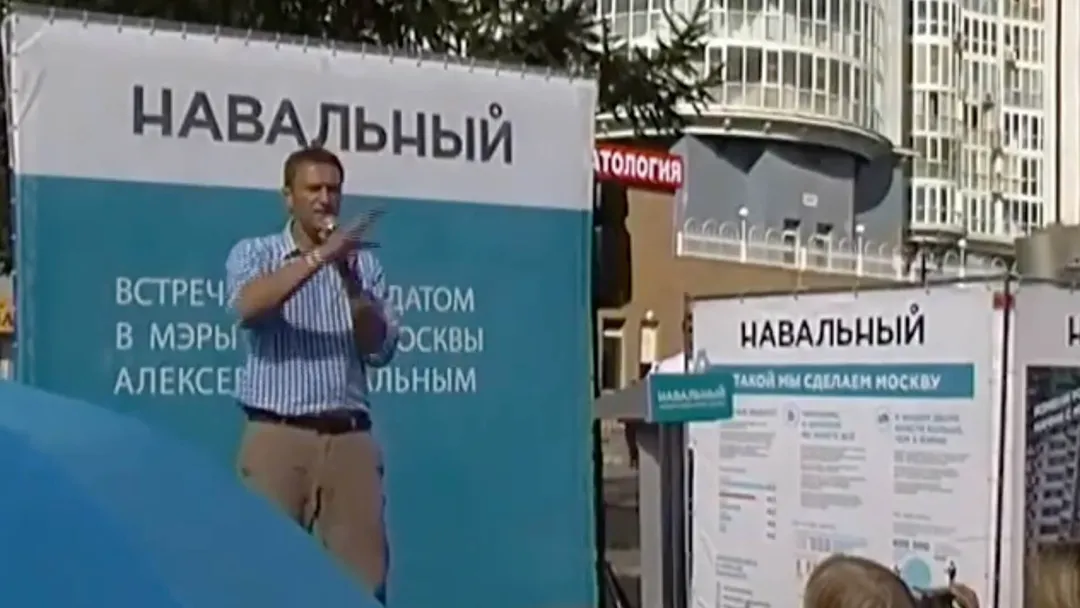
Our meetings are always easy to find. You just have to follow
the sound of the music. Hello. Thank you
very much for coming. Please come
a little closer. We are very, and I am very,
very pleased, and it is very important that you
come to meetings like this, because
when we were just planning them, a great many
skeptics told us that
no one would come, that no one is used at all
to meetings like this. What kind of strange
idea is it, during an election campaign,
to meet with voters? Has anyone ever
heard of a candidate, during
an election campaign, meeting with
voters? But we thought,
that,
probably, meeting with voters is an important and major part
of an election campaign,
and our campaign is built in many
ways precisely around this
approach. I hold a great many such meetings.
Every weekday, three meetings,
and every weekend, five such
meetings. I believe this is the best part
of an election campaign, and it is the job
of a candidate. A candidate is obliged to show up so that
people can run into him on the streets
of the city, so that they can
look at him, so that they can
ask him a question: a pleasant one,
an unpleasant one, a tricky one, a simple one,
any question at all.
That is why I try to do my
job as a candidate well, so that
among other things I can convince you that I will do the job
of mayor well later on. I would
start by simply telling you
a little about myself, and then I would gladly answer
any questions you may have.
My name is Alexei Navalny. I’ll start
from the beginning. I am 37 years old. For the past
17 years I have lived in the Maryino district of Moscow. It is
in the southeast of Moscow.
I have a completely ordinary
Moscow family: a wife and two children.
My son is 5 years old, and he goes to kindergarten.
My daughter is 11, and she goes to a regular school.
I have two university degrees. I
graduated from the Peoples' Friendship University of Russia
nearby. So the place where
I am speaking now is one of the
places in Moscow I know best, apart from
my own Maryino, because for five years
I came from the Yugo-Zapadnaya metro station or walked
on foot to my university.
And I also graduated from the Financial Academy under the
Government of the Russian Federation.
I come from a military family. Throughout my childhood
and youth, I moved from one military
town to another. And my
parents still live in a military town
outside Moscow.
If you have been following what I have been doing
lately, over the past several
years, what do you know about me?
Rospil.
Rospil. And you know, sometimes at meetings like this
people say, "You stole the whole forest," or something
like that. Besides the fact that I supposedly stole the whole forest,
which is reported quite widely on
television, you have most likely also heard about
me that I demanded that
Gazprom executives be jailed, that I demanded criminal charges against
people from VTB,
that I am fighting with Rosneft, with Transneft, with
all these largest commodity
companies. I am constantly hounding them and
constantly demanding something from them.
Constantly demanding that they return
some money to someone. And very often
meetings like this
begin with people asking me
the question: "Why do you even do this?
You are obviously not making money from it.
Why are you so fixated on it? Why do you demand
that some money be returned to you?"
Do you really believe that
some money was stolen from you? Because
you take it so personally,
you get upset, worked up, call everyone names
and so on. I would like
to begin our meeting by answering precisely
this question, because, it seems to me,
it will simply make it clearer to you why I am here.
I really do believe that
I was robbed personally. Quite literally, that
the money being stolen by all these
Gazproms, Rosnefts, and all the
rest is, in the literal sense, my
money that is being stolen from me, from
my children, from my family. I even have
a special calculation on this. I will
share it with you. But first I have
a question for everyone. What does
Russia live on, really? What does it
earn its money from?
Oil.
Oil and gas. Oil and gas. Exactly
right. Up to 80% of our budget is filled by oil and gas.
And who does it belong to? Oil and gas,
actually belong to the people. Yes, that is the view,
at least in theory, that they belong to the people.
That is how it should be. Exactly. And who
knows how much oil and gas we sold for
over the last 15 years, during these Putin
years?
Hundreds of billions.
Hundreds of billions, you say.
Trillions.
3 trillion dollars over the last 15 years.
We sold 3 trillion dollars’ worth of oil and gas abroad
over the last 15 years. Is that a lot or a little?
Compared to what budget? What is the country’s budget?
Yes, yes, those are the right questions.
What is the country’s budget? It is not clear whether that is a lot
or a little. Has anyone ever seen a stack of money worth
3 trillion? I have not. It is not clear,
whether that is a lot or a little. In order to
To get a better sense of it, you can, for example, take
this amount and divide it among every
citizen of Russia, from nursing
infants all the way to centenarian
elderly people. And then we will understand that
each of us—you, me, all of you,
every single one of us—comes to 640,000 rubles. 640,000
rubles is due to everyone. That is each person's
share of the oil and gas sold
in recent years.
That is, over 15 years. Which means that for my
family of four, the amount comes to 2.5
million rubles. So that is what I do:
I go from Gazprom to Rosneft, from Rosneft to VTB,
and so on and so forth. And I ask them
the same question every time: "So, guys, where did you
put my 2.5 million rubles?" I really am
interested. I understand perfectly well that in our
country there is no system where you can
walk up to a cashier and say, "Hello,
my last name is Navalnaya, here is my passport. There are
four people in my family. Please give me
my share—2.5 million rubles."
That does not exist. But if my share of the oil was
sold, and the money came in, then that
money must have been reflected
somewhere. So I am at least trying
to understand what that money
was spent on. I see people of the older
generation here. Do you remember the times when
the Soviet Union was receiving a lot of money from
the sale of oil and gas? In the Brezhnev era
(under Leonid Brezhnev), there was also a flow of petrodollars. We
may agree with how they were
spent, or we may disagree with
it, but at the very least we know exactly
how Brezhnev's petrodollars
were spent. We can look at the apartment blocks, and
the residential districts were built with those
Brezhnev petrodollars, and apartments in
them were given out for free.
Industry—factories and plants across the
country—was built with Brezhnev
petrodollars.
The space industry was
built. Science, which we are still
proud of to this day. And science towns are still
scattered all across the country. All of that
was Brezhnev petrodollars.
Roads, railways. An army
of enormous size, one of the
largest in the world. All of that was Brezhnev
petrodollars. We were supporting the so-called
countries of socialist orientation,
remember? In Africa, in Asia, in
Latin America too—with Brezhnev
petrodollars.
But now, Putin's petrodollars,
which are actually greater in amount than
Brezhnev's, what were they spent on? There are
about 120 people standing here, probably. Tell
me, please, can anyone
name even one major
industrial enterprise built in
Russia over the last 15 years?
Excuse me,
really, none? I'll answer your question later. But
please tell me, well,
are you a candidate for president or a candidate for
mayor?
If you would show some respect for
the people gathered here, then you wouldn't be wasting time. You are
either running for mayor, or
did someone tie you down here?
Tell me, please, do you have weights on your
legs, or is it just me? Were you tied to
the chair? If you're not interested, then you
don't have to stay here—just don't insult
everyone who has gathered here with your
shouting.
Right, I wanted to continue. Tell me,
please, can anyone here recall
a major industrial enterprise
that was built in Russia over
the last 15 years?
The city of Sochi.
The city of Sochi. That doesn't really fit, does it?
The Bureya Hydroelectric Power Plant was completed, but construction started
back in the Soviet Union.
I ask this question at every meeting.
And I have never gotten an answer, because
there is no major industrial
enterprise built in Russia over
the last 15 years. It simply does not exist.
That is why I am trying to understand
where all those roads of mine are, those railways,
where the industry is, where the space program is.
We turn on the television and we see
a rocket take off and then crash. Russia builds as much
railway in a year as China
builds in a week. And China, by the way,
has neither oil nor gas.
Where is all of it? Where is healthcare, where is
education, where are the residential districts that
are built and handed out for free? None of this
exists. And when I go to court with calculations like these,
which may sound funny,
say, against Rosneft,
there sits this woman, a vice president,
who oversees legal affairs.
Her last name is Kolanda, I just remembered. She has
She works at the state oil
company Rosneft.
Her official income is 880 million rubles a
year. You can check her disclosure
from the state oil company. And she
looks at me and says, "What makes you think
that anything here belongs
to you at all?"
What makes you think that you, and people
like you, have any claim to anything here at all?
Why are you all hung up on this oil,
gas, these mineral resources supposedly
belonging to someone?
Nothing here belongs to you.
So, returning to the beginning of our
conversation—why do I believe that I personally
was robbed? Because I believe that when I am told
says a representative of an oil company
with a salary of 1 billion rubles a year, that
that nothing belongs to me. I literally
feel that at this very moment
someone is reaching into my pocket and pulling out
my 640,000 rubles that rightfully belong to me
from the sale of oil and gas. And at that moment, from my child too,
and from each one of you, they are reaching
into your pockets and taking that money out.
Because, you see, we have neither another
country nor another life, and no one will ever
bring that oil back. All of this is our
healthcare, our education, it is
the future of our children, which someone has simply
traded away. And when people like that tell me:
"Listen, why are you always
going on about the negative, the negative? There are
all sorts of rankings where Russia is doing
well, setting records." What rankings are there
in which Russia is setting records?
Corruption. Billionaires, right? Exactly.
In 2000, how many billionaires did we have?
Six. And how many do we have now?
121.
Do we really want to be proud of rankings like that?
Personally, I do not. These rankings give me neither
pride nor do they fill my pocket
with those 600,000 rubles, with that very money. And
most importantly, they give me neither
factories, nor plants, nor clinics, nor
roads.
That is why I take all of this very personally—
my whole fight against Gazprom,
Rosneft, all these
corrupt officials, the United Russia party
and so on and so forth. And here, before you,
I stand as a person
who is running for mayor of Moscow and
who would like to receive your support
in this Moscow mayoral election, because
I
personally want to change the things in our
city that I really do not like and
that I know how to change. They may be
simple things, perhaps, but they get to me,
they irritate me. I want
to be a mayor about whom everyone will know exactly
where his apartments came from, and those of his
children. I want to be a mayor who, like mayors in all
other normal cities, moved from his
apartment in Maryino to Tverskaya
13, served as mayor, and then moved back to that same
apartment for one very simple reason. Because
there are only four people
in my family, and under the law I am not entitled
to an extra apartment. I will move back
because I am not entitled to one.
Because as mayor, I know that in
Moscow, how many people are on the housing waiting list?
400,000 people. Nearly 90,000 families. And
as mayor, I would never be able to do
something like privatizing, the way
Sobyanin did, an apartment in the name of his underage daughter—
a 308-square-meter apartment. That is impossible.
Who has read my investigation into the apartment
of Sobyanin's daughter? What,
did I come here to campaign to you? You already know
all this.
But this is absolutely outrageous. How
can that be? We are all people worn down by
the housing issue. How many
square meters per person are we entitled to
under the standard?
18.
18. We all know it. If someone woke us up in the middle of the night,
we would remember how many family members you would need
in order to be allocated
a 308-square-meter apartment. About 20.
A lot.
And I want to become a mayor who receives nothing
if he is not entitled to it,
because there are people on the waiting list who should be getting it. "I want to become a mayor whose
"I want to become a mayor whose
press office will not answer people
the way Sobyanin's press office answers me now
regarding
another apartment belonging to Sobyanin's daughter,
which she bought for 116 million rubles. They
say: "Why are you pestering us?
It's just a 116-million-ruble apartment. She is already
25 years old, this girl is a grown woman,
all grown up. She earned it. Maybe she has been working since she was 18
and bought herself a 116-million-ruble apartment.
Come on, do none of you have
even one acquaintance who, at 25, bought
an apartment for 116 million rubles? Not even
one? Are there really no exceptionally talented young people
among your acquaintances?
Well, we know at least one person.
That's Sobyanin's daughter. I want to become
a mayor for whom, both for himself and for his
subordinates, and for all officials, it will be
absolutely clear where their
money comes from, and it will be completely transparent how
they do or do not receive apartments. And
in the mayor's office
no one—not a single city official—will receive
an apartment illegally or have
billion-ruble accounts. It may seem to us that this is
some kind of revolution, but it is actually a completely
normal situation.
I want to become mayor, and I came here to you
because I go to public clinics, just like
everyone else. It happens to people, you know?
They go to a clinic. And
apparently, the older I get,
the more often, unfortunately, I will have to
go to the clinic. That is why I am very
seriously concerned, you know, by the fact that
the clinic I go to is very
different from the clinic
they show me on television.
On television, there is this wonderful
clinic they take
Sobyanin to, and they tell him: "Sergei
Semyonovich, we have this electronic
registration system where you sign up and
get to see a doctor with absolutely no trouble in
the same day you apply." I can see some of you laughed.
There are people here who have apparently used
the electronic appointment system recently.
Does the electronic
appointment system at your clinic work like that?
Our doctors don't know how to use
a computer, so
Our doctors don't know how to use
a computer,
so it's impossible to book an appointment.
There are no doctors.
And a lot of the doctors are already newcomers from
Asian countries.
The doctors are migrants from Asian countries. And do you
know, my dear Muscovites, what do you
think? Or rather, let me ask you directly:
by what percentage more money is allocated to
healthcare for Muscovites?
Compared with other residents of Russia.
By how much? What do you think?
200. Go on,
a lot.
You said 200 as a joke, but I'm telling you
the truth: 300. Four times more money
is allocated for healthcare for each
Muscovite than for any other
resident of Russia. For outpatient clinic
care, each of us gets
20,000 rubles a year allocated. For my family,
which has four people, that comes to
80,000 rubles. Just out of curiosity,
please raise your hand if you
have been to your local clinic in the
past year.
Who has been to the clinic? What, is everyone so
sick? All right then. Well,
now raise your hand if you haven't been to
the clinic. Well, thank God, there are still more healthy people,
which is better after all, otherwise I thought that by September 8
I'd keep campaigning to all of you and none of you would
live to see it.
Nevertheless,
clinic
nevertheless, you understand, 20,000 rubles were written off for each person
whether they went to a private
clinic or a public one, for each person
20,000 rubles were written off. I want to become
the mayor who will make sure that
finally, in Moscow, with the enormous
amounts of money that are already being allocated,
general practitioners and primary care doctors are finally
hired — the doctors people actually need
in 90% of cases when Muscovites seek care. Since
we're talking about clinics,
let me ask: is it easy to get an ultrasound
examination at your
clinic?
What are you talking about? No,
it's difficult.
They don't have it there.
They don't. A mon...
you say a month, months.
Three months. I don't believe you — three months?
Three months. Listen,
don't say things like that. Right here there's
a campaign tent for Sergei Semyonovich Sobyanin, and
under "Achievements" it says he bought
1,200 ultrasound machines for Muscovites. So
please don't lie here about three
months, because the tent
says otherwise. How is it possible
that 1,200
ultrasound machines were bought for Muscovites — about 10 per district,
roughly speaking, right? And yet you say three months.
I know why that happens. Because
our Anti-Corruption Foundation (ACF)
investigated this
Moscow healthcare modernization program
worth 100 billion rubles. We can see that these
ultrasound machines and scanners are being purchased simply
so they can be bought at twice
the real price. I want to become the mayor who
will finally make sure that
equipment is purchased so that
people can actually get ultrasound exams, rather than
so that chief physicians can become
millionaires off these procurements. I know
how to do it. We track these
procurements. I know where the excess needs to be
cut out. I know how to make sure
things are bought at market price. I came here to
you because I am very
seriously concerned, you know, about the problem of
migration. I don't know whether it concerns
you or not.
Interesting — does it concern you? After all,
50% of crimes here are committed by
migrants. And here's a question for you. While
preparing to speak here in your
district, I looked at the crime statistics
for the area. Does anyone
know whether crime here has gone up or
down?
It has gone up.
It can't possibly have gone up.
And by how much do you think it has gone up?
Tenfold.
The number of especially serious crimes has risen by 480%.
Over what period?
in the first half of 2013
you can check it on the website of your local
police department,
because we have markets here, you understand?
Because you have markets here, and I have
exactly the same kind of markets where I am, because we all
know, and I came here because we
understand
that migrants come here in huge
numbers. Not because there are jobs
for them here, but because they are being brought in
so that money can be made off them. They are
an easy source of income for
officials. Let's take a quick poll right here
so I'm not throwing around some
numbers I made up myself. Just
tell me: who has asked their
janitor how much he earns? What is
the salary of a Moscow janitor?
How much?
15,000.
6,000–7,000.
No, no, not six—they don't give them 17, they give them 30.
On paper.
You see,
and 15. Well, because he's Russian, from
Mordovia (a republic in Russia).
You see how it works out. Every time,
when I ask this question, I hear numbers like
5, 7, 15, and so on, and then someone
raises their hand, like you just did, and
says: "Officially or unofficially?
"
It's a secret known to all of
Moscow. According to the calculation for the minimum
pay for a janitor, there cannot be a janitor with a
salary of less than 30,000 rubles. It simply can't be
any lower. That's the minimum. And we all know
that hundreds of thousands of migrants who are brought
here are housed in basements, 20 people at a time,
put up in buildings slated for demolition, and so on—they're
brought here because they can be kept
in conditions like slaves and forced, each one,
to kick back half of their salary.
And these hundreds of thousands of people, every day,
every month hand over 10,000–15,000 rubles from
their wages. Just imagine
this river of cash that
flows every month—hundreds of millions
of rubles. The district administration, the prefecture, the management
company, the housing services, and this whole river of money
keeps pouring. But we can see—and I can see, just as you
can see here with your markets, just as I see in
Maryino (a district of Moscow) with my own markets, with the housing and utilities sector
and everything going on there. I see
the other side of this river; I see
crime. I know women in my building
whose handbags were snatched from their hands by these
very migrants. The thing is, you see,
they don't come here simply as criminals,
terrible people somehow naturally inclined toward
crime. That's how the system is set up.
A young man from
Uzbekistan comes here—and those who come are mostly
people from rural areas. He gets a job
at a construction site,
then comes down with pneumonia. Well,
he caught a chill—it happens, it happens.
There is no workplace safety at all. He is
thrown off the site, and his wages are not
paid. He's a powerless slave. What is he
supposed to do—die in a ditch? No, he's
a human being, he wants to live. He calls
his cousin in Uzbekistan, and the cousin
brings him 200 grams of heroin. They sell it
just so he can, well, survive,
rent a place for another two months. And this is not
something I made up; statistics show
that Russia ranks first in the world in terms of
heroin consumption. In terms of
absolute heroin consumption, we are
number one in the world. We are the world's main
consumers of the heroin that comes in with
these migrants. I want to become mayor
in order to change all this, because
I don't want this, and the people around me
don't want it either.
I want to become mayor because over
the past several years I have spent a great deal of
time studying and tracking
all of Moscow's governance processes.
I have spent a great deal of time studying
Moscow's finances. I know what
Moscow's annual budget is. Can anyone remind me
what Moscow's annual budget is?
3 trillion.
1.6—1.63 trillion, to be more precise.
rubles. Moscow's budget is smaller only than
the budgets of New York and
Shanghai. All of us together live in
one of the richest cities in the world.
Paradoxically, the richest cities in Europe and
America don't even come close
to Moscow in terms of wealth.
As I said, third place by
budget. A question for everyone: where do you
think Moscow ranks
among the world's largest cities
in quality of life?
At the very bottom. Listen, whenever I ask this
question, the first answer is always:
last place. But why don't you think
it should also be third?
So what place is it?
154th. Correct. I don't know what
the very last place is, what number it has, but
154th
is a truly astonishing paradox, but
it's part of our reality: by budget, by the
size of the budget, we are in third place, while
in quality of life we are 154th. In
Moscow, we have everything we need to build
an excellent city. We have the city itself, we have
infrastructure, and we have a highly educated
population.
Few cities have such an
educated population. There is only one thing we lack:
just one thing:
belief in ourselves, because we have, well, simply
somehow come to terms with the idea that this is
the natural order of things. That what
is happening is somehow normal. Well,
look: in oil and gas sales, Russia—I mean Russia—is
first in the world, while
in standard of living it is in sixty-
ninth place. And I don't even see anyone
being shocked by this fact. We just shrug
our shoulders. Alexei, you forgot how much. Compare it with
Norway...
We shrug our shoulders and say that this is
all just, well, a natural
thing. For example, what is the largest
construction project here
near Moscow, near your district?
Well, the reconstruction of Leninsky Prospekt (Lenin Avenue).
Let's take that one. It has been suspended.
How much does it cost? 40 billion rubles. And everyone
transport specialists say outright
that
in the reconstruction of Leninsky Prospekt
half the money will be stolen, and the cost
has been inflated twofold. We shrug our shoulders and
say: "Well, this
reconstruction of Leninsky Prospekt will see
20 billion rubles stolen. That's more than enough
to build
clinics and schools all across Moscow." But
we shrug and say: "Well,
yes, that's how they're building the North-Western Chord (major Moscow highway) for 70
billion rubles."
And everyone says the same thing in unison:
"Well, at least twice that amount, at least 35 billion
will be pocketed in the construction of the North-Western
Chord. Colossal sums. You could
double pensions for all
pensioners. But we shrug our shoulders and
say: "Well, that's just how life works.
It doesn't really seem possible
any other way."
I came here because I am absolutely
convinced that it can be different and
that it must be different. I came here and
I am speaking to you because I am
absolutely convinced that you are
the source of power.
It is not television that is the source of power, not
billboards on the streets, but people. And they can
change everything. And I am sure that
by talking to people, I can get across
the right ideas not only to you. Though
there are quite a lot of you, actually. I even did the math.
According to my calculation, if by September 8
I hold 100 meetings like this and
stay alive in the process—this is my fifty-
eighth one. And how much weight have you lost?
I've lost 5 kg. So there is still
some margin left, still room to lose more.
then I will have spoken to 1% of the voters. Is that
a lot or a little? It's a lot, actually.
1% of the electorate is a lot, considering
that everyone has friends,
acquaintances, relatives, neighbors on the stairwell landing.
To win
the Moscow mayoral election, you need 1.5 million
people. In a city of 15 million.
There are definitely those 1.5 million
people who know everything, who understand everything,
each of whom could stand up right
here and say exactly the same
things I am saying, each of whom
can read my platform and see
that it was written by the best experts,
that it contains answers to all the pressing
questions. And all these questions that we
ask ourselves about migration, transport,
health care—these are questions
that have been and are being successfully solved in other
cities. And we can do it too. We
just need to believe in ourselves, that we
are the power—not the television, not the election
commission. We are the ones here who appoint power
or send it packing. And we can do that.
We just mustn't shrug our shoulders after
every meeting, after each one. Someone comes up to me
and says: "Listen, you
said it all really well. I totally
agree, but to be honest, I knew all of this
even before you." But tell me honestly, deep
down, you do believe, don't you, you understand,
that nothing can be changed?
A lot of people say that. But I climbed onto
this stage because deep in my soul, and
even in the middle of my soul, and even on
the surface of my soul, I believe that everything can
be changed. What are we—the stupidest, the most
cursed, the most worthless country and
city on earth? We can do everything.
Show me where the troops are standing here
that have surrounded us and are forcing us to hand over
40 billion to some people for the construction of
Leninsky Prospekt. Where are the snipers sitting
on the sign of Snezhnaya Koroleva (a Russian retail chain)? Then I
don't even see a police officer here. He
is surely here somewhere just in case, but just
to be safe he stepped aside and hid there behind
the bushes.
Changed clothes
changed clothes.
You see, this thieving government,
inefficient and corrupt, survives not
because it intimidates us, but because
we shrug our shoulders, because
we ourselves think that it is impossible
to change anything. Everything can be changed, and we
will change everything. I am sure that through you I
will speak to tens of thousands, hundreds
of thousands, and millions of Muscovites. I
am sure that we will mobilize, we will come
to the polls, we will replace this government and return
power in the city of Moscow to the people so that
it works in our interests and
solves our problems. Thank you very much.
I'm ready to answer your questions.
A whole bunch of people shouted out. Who was shouting there?
Go ahead. Yes, please. We have the following
problem. Leninsky Prospekt. At one
point we managed to defend it. Now they are planning to build a similar
overpass on Vernadsky Prospekt
(likely Vernadsky Avenue). There were public hearings, and people voted
against it. The results of those hearings were
quite clearly falsified.
What are your thoughts on that?
My thoughts—I'll repeat this for everyone—my
thoughts on the fact that
the reconstruction of Leninsky Prospekt now seems
to be frozen, but there is
the construction of an overpass, which also did not
pass public hearings. My
thoughts on that.
To begin with, just a short quote.
Sorry if it seems like I'm always picking on
Sobyanin, but after all he is the incumbent
mayor. I would like to replace him because
he is a bad incumbent mayor. He recently gave
an interview to the newspaper Vedomosti. And in
He was asked: "What do you consider
your most important achievement as
mayor?" And his answer, almost word for word:
"My most important achievement is
that we launched the three most expensive
road construction projects in the world.
And that was very difficult. It was
very hard to launch them because we
launched them in conditions of, in conditions of
having no strategy, no plan, and no calculations.
I'm not joking—read the interview. All
these giant construction projects, all these
Northwestern Chords, all these southern
arterial roads, all these reconstructions of Leninsky
Prospekt—well, if you don't believe me,
go to the website of the Department of
Urban Planning Policy, the website
of the Department of Road Infrastructure, and
find even a single calculation. Just one
piece of justification for these
projects. They get approved simply
because they cost twice as much. All
these decisions are made like this:
someone walks into an office and says:
"Listen, your budget looks a bit too
big. Let's cook up something worth
80 billion rubles." And then they start
reconstructing the Northwestern Chord,
building the Northwestern Chord.
That is why my platform includes a provision
that I will ban the implementation of projects
costing more than 1 billion rubles without international
expert review. I will forbid it for myself. I will be
a mayor who will never be able to launch
a road or construction
project
costing more than 1 billion rubles unless there are
international experts who have calculated all of it.
Otherwise it's just, well,
complete nonsense. How can you build like this,
with no clear destination and no clear
purpose? And even when you argue with them, with
these officials, and say, "Well, show me
the calculations"—there are no calculations even for your own
Leninsky Prospekt. First they
shouted that the reconstruction was absolutely necessary,
then residents got angry. And they said:
"It seems the reconstruction isn't really needed after all."
Well, is there some kind of master plan for the city's
development so we can understand whether it is needed or
not? Nobody knows. And that is
completely outrageous.
Why is this happening? Tell me,
please, who are the main road builders
in Moscow?
Who is the main contractor?
Khusnullin.
Well, Khusnullin is an official, but
the actual main builders are
the Rotenbergs. The very same guys
who in Soviet times were
Putin's judo coaches, and now they are
the main road builders in Moscow. And
who is our main contractor for
metro construction?
Timchenko. The same Timchenko whom
I am constantly suing, who, being
a friend of Putin's, became the main seller of
Russian oil, gave up
his Russian citizenship, is
a Finnish citizen living in
Switzerland, and an officially recognized dollar
billionaire who became a billionaire
by selling oil. And now he is building
the Moscow metro for us. Before Timchenko,
how much did the Moscow metro cost to build?
6 billion rubles per kilometer, which is very
expensive—twice as much as in Europe,
6 billion. But when Timchenko won
all the contracts, it started costing 9 billion per
kilometer. So they are simply skimming 3 billion
off each station. I want to become
a mayor under whom construction
projects will be carried out only if there is
a calculation and a real need for them, not
simply because there are friends who
want to make money. That is my
position on this. Sorry for taking so long
to answer. Yes,
Thank you. You are talking about international
experts. Of course, all that is fine.
International experts, professionals,
but the problem is that we also have
Russian personnel too, including
Russian experts and Russian
officials. And they are not going anywhere. They
will remain—the ones who constantly steal,
constantly deceive us. Uh—they are not going to
disappear. Uh, maybe—when will our
Russian officials learn to work
properly?
The question is when our Russian
officials will learn to work normally,
instead of everything resting on international experts.
They will learn to work properly—or at least try to—when
there is someone who starts forcing them
to work properly. Just listen:
how many Russian officials will directly
receive bribes and money
from that same Northwestern Chord?
What is it, a million people? Of course not—five
people. One will get a billion there, and
two others will get, I don't know, 500 million each,
while all the rest will obediently
carry out orders. The paradox is that
tens of thousands of people are involved
in running the city, and 85% of those
people are not corrupt.
Simply because they have nowhere
to steal from. There is no such
opportunity. They have no chance to
pocket anything. And these people
earn fairly decent salaries. And they
want what we want: an ordinary,
normal, stable life, to earn
a decent salary, and to live normally in
our city. So the goal is not
to purge 100% of Moscow's officials.
It’s pointless. They will operate under
different rules if those different rules
are imposed on them. There simply have to
be rules. Let me now
give you an example, because very often
when I talk about
principles and rules, people say to me: "What kind of
nonsense are you talking? Some kind of
principles, rules. That means nothing at all.
It’s all just theory. Let me give you an example of why
it is not theory. Please tell me,
what is the main corruption case
in Russia right now, apart from Navalny’s case?
Oboronservis.
Oboronservis. Correct.
Yes.
Remind me, please, Serdyukov is in prison,
right? No,
no, he isn’t. He rides around with a flashing official car light.
He rides around with a flashing official car light. Yes. Has he been formally
charged?
No,
no, he has not been charged. Strange. And
is Vasilyeva in prison?
No.
No.
Well, she is under house arrest, after all.
Maybe she’s sitting in a cell?
How many rooms are in her apartment? The whole country already knows:
13 rooms in the apartment and 3
hours a day for walks. What’s more,
lawyers know that house arrest is
a restriction of liberty that is later
counted toward a sentence at two days for one. And when
Vasilyeva, if she is sentenced to 2 years
in prison, is sentenced, she will be released immediately,
because she will already have effectively served the time.
Is this news to anyone? Of course not, everyone
knows it. If you conducted a poll, it would show
that 99% of the country’s population is simply outraged
by what is happening with Serdyukov and Vasilyeva.
The whole country is furious. But
nothing changes, because this is precisely
the most important personnel principle,
one that is declared and demonstrated
to everyone, both to us and to officials: that in Russia
everything must be arranged so that even
if you are an incompetent former director
of a furniture store who has looted and
wrecked the entire army, nothing will happen to you
even if the public is
outraged, as long as you keep quiet and
pay your cut. This is the most important principle
that has now been embedded in public
administration. My task is simply to introduce
a different principle: if you are suspected of
corruption, you are fired. If you are caught
taking bribes, you go to prison. Kuan (Lee Kuan Yew, Singapore’s founding prime minister) introduced
this very principle in Singapore, a country populated
mainly by Chinese people, who are also not exactly immune to
corruption. He told me: "In order
to defeat corruption, I had to
put half of my friends in prison." And I
will succeed too, because all my
subordinates at city hall will know for certain
that what Navalny shouts from the मंच and
what he says on television is
actually true, that in fact she has
nothing except this apartment in
Maryino, that in fact not one of
his deputies can be approached with a suitcase full of
cash.
We will do this. This is not some kind of
unique situation. There are many cities
and countries where this works. And in Moscow
it will work too. There will definitely be questions.
Yes, please.
We can move on to the next one. Yes.
So, you are talking about such
high matters, but now I want to ask a question
that may be of interest to
tens or even hundreds of thousands of people.
So,
your party is financed through
Yandex wallets. The Yandex
wallet system is anonymous. That
means absolutely anyone — a Russian,
a foreigner, an American, an Englishman —
can transfer money to these wallets.
And in fact that is illegal. So
you speak of lofty principles, yet already in these
matters...
This is important. They come, they come to
every rally and say that my
campaign is illegal. Let’s hear him out.
He asked a question. There’s nothing wrong — he is asking
a question. Let him speak. So, you are practically
talking about fair elections, yet you are already
breaking the law if you accept
money into your Yandex accounts from foreign
donors.
Young man,
your question, your question. How can I explain this?
Look here. No, no, no, no,
my friends, this is important. I
deliberately — well, I can see these
guys, they are the same people who come to all
the rallies. I could simply not give them the floor,
but it is important to me that they ask all
their questions and that you hear them.
Please tell me, did you hear this
on television?
Please tell me,
am I the kind of candidate whom the election commission
loves very much?
Will the election commission protect me?
?
No,
the election commission will not protect me.
If there were any formal
violation of the law there, your election commission
would have documented that violation long ago.
But that is not happening. And I,
speaking about funding, find this
to be the question I genuinely
enjoy answering. I am very proud
that my election campaign
is funded by ordinary people. And I became the first
the candidate in the entire history of modern Russia,
whose campaign is funded by 1,000 people,
sending 100, 200, or 500 rubles each. That is,
what is actually happening. And more than that,
we saw statistics that I
was looking at, and it literally brought tears to my eyes
Here he is, standing here and
telling us fairy tales about anonymous
donations. But there are people here
who have sent me donations.
I am from abroad. Why am I appealing to you here once again?
You are not just voting,
you are also all sending me money. So
that is your foreign audience for you. Who sent
a donation? You know that you have to
provide your last name, patronymic, passport
details, and even your year of birth. In that connection,
who is the main donor to our
campaign? So who, in your opinion,
is the typical main donor to our
campaign?
A woman,
a pensioner.
A woman between the ages of 50 and 57. You
have annoyed everyone so much that even women
between 50 and 57 are sending me
300 rubles so that I can run this
election campaign. I
am proud that mine is the most transparent
campaign. I am proud that I am the
candidate people send money to. And
since, as it turns out,
there happen to be so many people here who
have transferred money to me, thank you
very much. Next question.
Briefly, please.
Mr. Navalny, I am addressing you
with a small request on behalf of most of
these residents, who, like the characters in
Molière's play The Bourgeois Gentleman, still do not even
suspect that they are
victims. What is this about? Well,
starting in 2000, the Moscow city government
quietly, without holding public
hearings and in violation of all laws,
carried out land re-parceling in residential
areas of the city of Moscow and took away
land that belongs to us
by law, without any
registration
procedures. And from every apartment owner
here, in our district, and
this block here was re-parceled
illegally in 2003, that one in 2007, and from
every building up to 40-50% of its land has been taken.
And they do not suspect this either as
apartment owners or as
car owners, while hanging over them is a very
serious threat, a real sword of Damocles. And
so the situation is this: we are not talking here
about matters of taste connected,
say, with whether some avenue
should be reconstructed. Some say it should,
some say it should not. Here we are talking
specifically about violations of the law, during which
on the re-parceling process alone, over
the course of 10 years, about
60 billion rubles were spent unlawfully. And if
you look at the matter in terms of
the value of the stolen land, then we are talking
about tens of billions of dollars. And
this issue concerns not only the residents
of these districts, but absolutely all
residents of Moscow, and even many
owners of acquired land. So I would like
you to make this one of the
central issues of your election
campaign. And there is also a proposal,
on the 28th-29th in the Moscow City Duma there will be
a roundtable devoted to this
topic. And there is an idea to invite you
there. Will you come?
I cannot say yet about the 28th or 29th,
because all my time
is taken up by meetings like this. Let me
say that my position on this is absolutely
clear. I am a lawyer, after all. I see the law, and
it says in black and white that
the land under a building and around it
belongs to whom? To the residents, under the right of
perpetual, free use.
And as mayor, I will immediately do what
all previous mayors should have done
long ago. I will give it to the residents, and at the city's expense
land surveying will be carried out in such a way
that the land belongs to the residents. And
for me, this is also a mechanism
for fighting corruption at the local district administration level.
Because right now, when it comes to land from your
property, any little piece of it, the district head
can bite off a piece, tear it away, and make
$100,000 from it, that is exactly why he does not want
to carry out proper surveying. He wants to have plenty of
opportunities to grab $100,000 here,
$100,000 there.
I will give all this land to Muscovites, to the residents
of the buildings and courtyards, and that will settle
the issue. And the surveying will be carried out
as quickly as possible at the expense of the city
budget. This is one of the most important issues of my
election campaign. So thank you
very much. Next question, please.
A question: no matter where you turn,
on the TV, now even from a kettle it's all Sobyanin.
I will repeat it later for everyone: Sobyanin. But are you not
planning to make some kind of general statement at the TV debates?
After all, you are all
in completely different positions now.
Sobyanin opens a clinic, a kindergarten,
a toilet, and so on, and gets coverage for it or not.
And a second question, quickly. Here we are
now in a very symbolic place.
Look at this monstrous
architecture, at these—this is a minor question,
but it matters—at these ugly shopping
centers that have flooded all of Moscow.
Someone at your debates also said that
Moscow is one enormous shopping mall.
What will you do with these ugly
sentiments when
you come to power?
The first question was about equal access to
the media, debates, and so on. Well, you know,
Sobyanin refused to debate.
And you know, you said it yourself:
every time you turn on the TV,
he’s opening a clinic,
opening a school, and so on. As for me,
they did recently air a segment about me on
TVC saying that Navalny came to meet with
voters, but it didn’t happen for one
reason: nobody showed up. I’m not joking,
it really happened. They just filmed some
empty spot and showed it as, here they are,
Navalny’s voters, an empty square. And
some random guy walked through alone at the end of the
segment.
So yes, I don’t have access to television,
and that’s why I’m here meeting with people, that’s why
I’m working with you. Of course, we will
file complaints, we have made official appeals,
but I fully understand that they won’t let me
onto federal TV for one very
simple reason. They don’t want me
to repeat there everything I’m saying here.
Who here watched the latest debate?
Yesterday, listen, a lot of people watched the debate too.
They’ll be on again this evening,
but they recorded the debate; it was
live, and then when they
posted the recording, they cut out the first
few minutes where I talk about
Sobyanin’s daughter’s apartment. So these
people are just petty crooks.
We’ll only wrest control of television from them when
political power passes to us.
That’s why we have to come out and vote,
because this is our television. We
fund it; we pay 3.5 billion rubles a year for Moscow 24
(about $36 million USD). We pay about the same for TVC
as well. We pay for all
the district newspapers, all the neighborhood papers.
If all these are our media outlets, and they work
against us, they’re not just going to hand over their platform
because they understand perfectly well
that if I become mayor, their specific
contractors, all these Rotenbergs and
Timchenkos, will lose very real
billions.
For them, this is all very concrete too.
It’s not just a case of Navalny
winning an election. What a dangerous situation.
It’s not just dangerous. It
means they’re left without those
billions. It means that if
right now Timchenko, Putin’s crony,
is skimming off money from every kilometer of the Moscow metro
to the tune of 3 billion rubles (about $31 million USD), not 300 billion,
he’ll stop taking it because he’ll be
thrown out of here. For them, all this is very
specific. But I’m sure that even without
television—who here has seen me on
TV in the last five years in any kind of
segment other than one saying that I
stole the entire forest? No. But somehow
you know I exist, right? You found your way
here somehow. Friends and acquaintances
exist, yes.
the Dozhd and Echo of Moscow channels. The opportunities
we have available, we will
use. I see the biggest opportunity
in persuading you
so that you persuade everyone
else. As I’ve said many times,
there are studies showing that
the persuasive power of each individual
person is simply enormous. If you talk
to ten people,
you will reliably convince six of
them. People want to hear advice,
so this will definitely happen. The second
question was about this construction.
Shopping malls.
As I said before, I studied at
the Peoples’ Friendship University. I used to come
from Kuntsevo on bus 68 to that
stop, walk over here, and then
either keep walking or take another
bus to the Peoples’ Friendship
University. I look at this,
this mess,
I look at what has happened now, well,
where are all these people supposed to park their cars? All
these buildings weren’t actually here before;
this area was already considered fairly densely
built up by planning standards, and yet they crammed
something into every last space—what even is
that thing standing there? It’s completely unclear
why they built it here. There isn’t
any need for yet another shopping mall. Is it
really needed here, do you?
There are statistics showing that
in terms of the number of shopping centers of this
kind, we surpass European cities.
You can’t buy bread anywhere at night,
and there are no markets where you can buy meat or
vegetables at a reasonable price, but instead they keep building
these shopping centers. A year and a half ago
they wanted to finish it, but it still wasn’t completed.
None of this is just some kind of blunder; it’s not
simply urban planning mistakes. It’s that
the prefect is sitting there, the district head is sitting there,
and they simply made money off this monstrosity—
their half a million dollars in bribes. I
want to become the mayor who will tear all of this
down, because everyone is sick of it.
Well, listen, of course a residential building where
people already live can’t just be demolished now.
But at the very least, this further
madness of overdevelopment, when they try to squeeze money out of every
square meter—
who needs that money? Even if
we assume that this money isn’t being distributed
as bribes and actually goes to us, well,
what are we supposed to do, eat the money? We
already have a budget of 1.6 trillion rubles (about $16.5 billion USD). What we need is
living space. We need somewhere to
take a walk with our children. We need
cars not to be parked everywhere like this. I
want to become the mayor who will change that,
because I feel exactly the same problems
myself—they really wear me down.
Please.
Did I understand correctly that all your good
initiatives will face
resistance from the federal authorities, from
those who take bribes? And
I’ll repeat it for everyone afterward.
How do you imagine that
resistance? How will you
fight it? And what should we prepare for if we
elect you? What should we expect in return?
Good question.
Your worthwhile initiatives will obviously
also meet resistance from
the federal authorities. How
might that happen, and what should we,
Muscovites, prepare for? Well, many people have
this picture in their heads:
Navalny becomes mayor, and the next
day street-cleaning trucks move in columns
toward the Kremlin, and the street sweepers,
dressed in military uniforms with rakes
slung over their shoulders, march too. And
facing them is the federal OMON (Russian riot police), while
on my side are these Uzbeks working in
municipal maintenance offices, advancing in wedges against
OMON, and somewhere in the rear there’s cavalry in the form of,
I don’t know, paving crews.
I will deal with them strictly
according to the rules. You know, it’s like
living by the law and living on one official salary.
Everything will be done by the book. If I
become mayor, I’m not going to start any war with Putin.
If he asks me
to give metro contracts to his
Timchenkos, I’ll say: "Sorry, we have
an honest tender here—let them come and
win it at a fair price. Let them take those
contracts.
If he demands that I hand over
the road contracts to the Rotenbergs, I’ll say: "Sorry,
come, win, and work.
There will be no confrontation, because
I will do what is required and
interact with them within
the law. And most importantly, to make sure
the experience of Yaroslavl or other
cities, where an honestly elected mayor
was pressured, is not repeated, I will rely on the most
important thing—not even on Moscow’s huge budget,
which cannot be taken away from Muscovites
or from me. I
will rely on the support of the people. If
it happens that I am elected
truly by the votes of millions of people,
I will know for certain that they support
me, and then with me as mayor,
it will be impossible to do anything. They won’t
be able to push me around or jail me. On the contrary,
I’ll be the one putting them in jail. And it’s no accident that we
wrote on this banner: "Change
Russia, start with Moscow".
Because all change in Russia can
either happen or not happen depending on
whether Muscovites want it or not.
That’s how our country is structured:
everything starts here.
If we want something—like that one time when we wanted
me released from jail,
I was released. If we want it, they’ll release
the Bolotnaya Square prisoners tomorrow. By the way,
one of the defendants in the Bolotnaya case
is here today, Boronova. Let’s
give her a round of applause.
If we want it, they won’t sentence teacher Farber to
seven years in a maximum-security penal colony.
If we want it, corrupt officials like
Serdyukov will be the ones going to jail. If we want it, there will be no more
things like what we saw two months ago,
when the deputy prefect of the Eastern District,
Riykhanov, for embezzlement that was proven and
admitted—360 million rubles (about $11 million at the time)—was given 4 years
suspended, with no fine at all. Everything is in our
hands. Moscow can change everything. This
city accounts for 15% of the country’s population. And we
can force both the Moscow authorities and
the federal authorities to do whatever
is needed if we recognize our strength and remain
persistent
in our demands. You can’t say,
as many do: "But we already went out
to rallies, and nothing came of it."
But the question is for all of us: did we
really overdo it? What percentage of our
potential did we actually use? Did we
do everything we could? No. Maybe
we used 5% of what we’re capable of. When we
do even 30% of what we
can, we’ll see how power changes,
how we change the authorities. And it will be
an unstoppable process. My friends, I
have three meetings like this today, with one more
still ahead. Thank you for coming.
I apologize for not answering all
the questions. Thank you very much. I really
need your support. I’m counting on it
very much. I’m sure that together with you
we will win this election. Thank you very much.