Alexei Navalny’s meeting with voters in Moscow’s Veshnyaki district
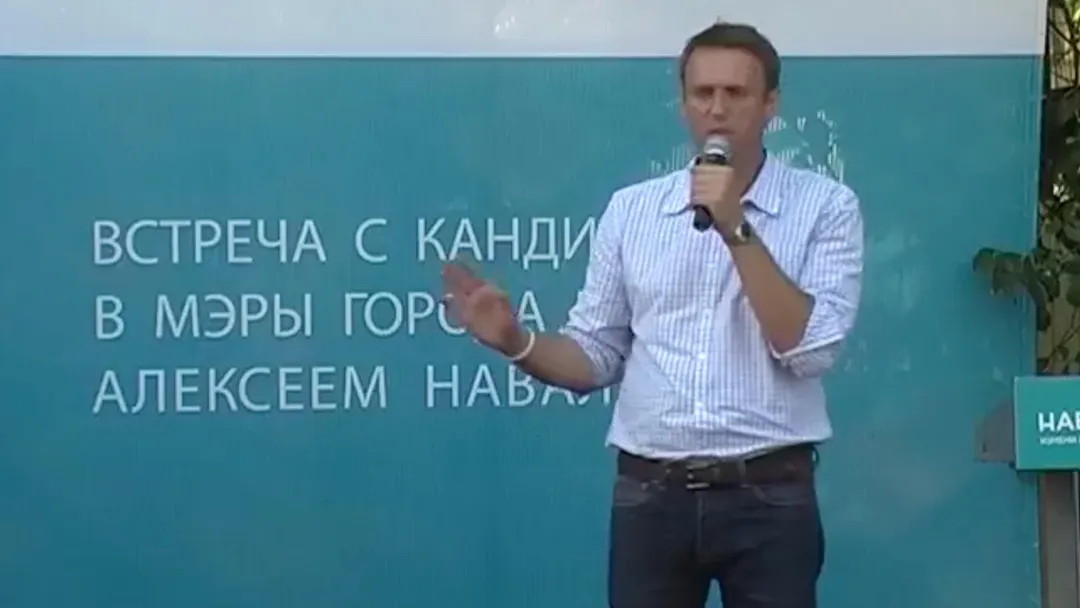
Hello. Hello. Thank you very much.
I haven't earned applause yet, but in
any case, it's very nice to be mistaken
there's some kind of fountain here.
Although today I started speaking in
Zhulebino, and we even had a United Russia tent standing nearby there,
so after that, a fountain
is nothing. Thank you very much for coming. It's very important to us
that you come to meetings like these.
The campaign is built around them
to a large extent. Because when we
were planning all this, everything we were going
to do, people told us: what kind of strange
idea is this, these meetings with
voters? Nobody ever
does that. Nobody runs election campaigns
like that. But we simply sat down,
I sat down myself and thought: "What would
the ideal candidate for mayor of
Moscow look like to me? What would I want from him?" I
thought that I would want this person
not to rely on paid campaigners, but instead to have
volunteers working for him. And right now, on our
campaign, there are about
10,000 volunteers. Not one of them gets
a single kopek. Not because they love me,
but because they care about themselves. They are
working on this campaign. I thought that
I would want to see a mayoral candidate,
if I were an ordinary voter. I
would want the mayoral candidate to be
accessible, to come to my
courtyard or somewhere nearby, so I could ask him
maybe a tricky question. If I had
some uncomfortable question? I
think there are people here who have
a tricky question. You should be able to bring that question
and ask it, and see
how he wriggles out of it here in front of everyone,
how he answers, and so on. So I became
that kind of candidate myself and I hold these
meetings. Three every weekday.
Five meetings every weekend—it's not easy,
quite demanding work, but nevertheless it is
the job of a candidate. And if I am running on
a platform that says I will become an open and
accessible mayor of Moscow, I want to show everyone
already now that I am
an open and accessible candidate. So
thank you very much once again. I would start by
telling you a little about myself, and
then we'll move on to the most
uncomfortable questions that surely
some of you have. My name is Alexei
Navalny. Patronymic. Most of all
Anatolyevich. Anatolyevich. I am 37 years old. For the last
17 years I have lived in the Moscow
district of Maryino, not far
from here. I have a completely
standard Moscow family: a wife and
two children. My daughter is 11; she goes to
a regular school near our home. My son is 5
and goes to a regular kindergarten. My
parents—
my father is a military man, and I grew up in a
military family. So throughout my childhood I
moved from one military town
to another and was always on the move.
And my parents still live in
the Moscow region, in a military town. I
moved to Moscow. By profession I am
a lawyer. I have two university degrees.
I graduated from the law faculty
of the Peoples' Friendship University and from the Financial
Academy under the Government of the Russian
Federation.
If you have followed my activities more or less
over the past few years, what do you know
about me?
I know everything.
I know everything.
Everything? Even I myself don't know everything
about myself.
Well, you've probably heard that together with my
colleagues I created the Anti-Corruption Foundation (ACF).
We investigate
corruption in government procurement.
You've probably also heard that I'm that
scandalous minority shareholder
who is always going after Gazprom,
hounding VTB, making accusations
against this one and that one, constantly demanding that someone
be jailed, constantly accusing people, and
all that sort of thing.
And very often at meetings like this,
the first question I get is:
"Why are you always going after all of them?
Why can't you just calm down? Everyone
else lives like normal people. We all get upset about
corruption. It exists, doesn't it? We know that
there is corruption in Moscow, in Russia. We all,
well, know it and live with that knowledge. But why are you
going after them? Did they
personally steal from you or something?"
And I would like to begin our meeting precisely
by answering the question of why I go after them
and take it so personally, worry about it, and
spend so much time on it. Because I
truly believe that all these
Rosnefts, Gazproms, and VTBs have personally stolen from
me. They robbed me personally, my
family personally—not in some abstract sense, but in a completely
concrete one. And I have a calculation on this
that I present at every
rally. I think it will simply make it clearer to you
why I ended up here if
I explain it—this calculation.
But first, tell me: what does
Russia live on?
Oil and gas. Up to 80% of the budget comes from the sale
of oil and gas. We sell them, and unfortunately
we have to admit that in many ways we are
a raw-material appendage. We simply sell
raw materials and live off that money. A question for
everyone: over the last 15
years, during this Putin era, how much
oil and gas have we sold abroad for?
2 trillion
3 trillion
3 trillion dollars. Exactly right.
That was the correct answer. 3 trillion
dollars. Is that a lot or a little?
Well, it’s actually hard to say. Maybe it’s
a lot, maybe it’s a little. Raise your hand if you’ve
ever seen a stack of money worth 3 trillion.
I haven’t eith—oh, but there’s one hand up.
You probably work at the Finance Ministry.
No,
in my dreams.
Good dreams. In any case, it’s not
a nightmare. It’s unclear whether 3
trillion is a lot or a little, but we can make
a simple, rough calculation,
take the average across the board,
take those 3 trillion and divide them
by the number of Russian citizens. And
it turns out that each of us—you,
me, an infant, a hundred-year-old
person—comes out to 640,000 rubles from
this money that we received over
the last 15 years. So, if I calculate it for
myself—just over there, without you, I don’t remember,
you don’t exist for the moment, there’s only me—then
my family’s share comes to 2.5 million rubles. My
share from the sale of oil and gas over
the last 15 years. So I go from
Rosneft to Gazprom, from Gazprom to
Transneft, asking the same somewhat
odd question: "Guys, where did you
put my 2.5 million rubles?"
It sounds like a funny question, because
there’s no cashier’s window you can walk up to
and say, "Hello, my last name is
Navalnaya, here’s my tax ID, here’s my passport,
hand over my 2.5 million rubles." There’s no such
window, unfortunately—or fortunately. But
the oil was real. They pumped it out and
sold it.
And the money came here. I want to understand
what the money was actually spent on. But it
must have shown up somewhere,
right? There must be some visible traces
of that money. I see
a lot of older people here, and we all
remember very well how the Soviet Union
received a lot of money from selling oil and
gas.
We may agree or disagree
with how it was spent, but we
can absolutely see how it
was spent. There are the apartment blocks, the residential
neighborhoods all across the country. That’s what
was built with Brezhnev’s petrodollars (oil export revenues under Soviet leader Leonid Brezhnev), and
apartments were handed out for free. Back then
plants and factories were built
by the Soviet Union.
Whatever their quality, they were built, and sometimes
they were actually quite good. Science was developed,
the military-industrial complex was created.
That’s it. Brezhnev’s petrodollars built the space
industry too.
They built railways, they built ordinary roads,
all of it with Brezhnev-era
petrodollars—education,
healthcare—they did things with it,
well or badly, but at least
they invested those oil dollars. It’s clear where
they went.
Now here’s a question for everyone.
Who here—I don’t know how many people
are standing here, maybe 350. Well,
it doesn’t matter, there are people here, right? Not just 10 people.
Who can name for me any major
industrial enterprise built in
Russia over the last 15 years? Gazprom?
Gazprom was, after all, built in
Soviet times.
Not a single one.
Sometimes people mention Skolkovo,
sometimes they mention Rusnano.
At one meeting someone told me:
Rosoboronservice.
Also a fine sort of enterprise.
At every meeting I ask this question, and
no one has ever named a major
industrial enterprise built in
Russia—not even an oil refinery,
because none was
built. So we received these 3 trillion
dollars. That’s more than the Soviet Union received in the Brezhnev
years. So
the question is: where are those plants? Where are
the factories? Where is the healthcare system? Where are
the roads? Where are the railways? Do you know
how much railway Russia builds in
a year? As much as China builds in
one week. And China has neither oil nor gas.
So where is all of it? Where is what was
built with my 2.5 million rubles and with
the 640,000 rubles of every person standing here? And
when I come with these funny questions
to Rosneft, for example, yet again,
and say that they’re crooks
and have looted everything,
and ask, "Where did my money go?"
There’s this woman sitting there, a vice president,
the vice president for legal affairs. She
works
as the chief lawyer of the state oil
company Rosneft and officially earns
a salary of 880 million rubles a year. I’m not
exaggerating. You can check her disclosure
statement.
Modest,
very modest, right? So, 880 million
rubles a year. And she looks at me and
says: "What makes you think, exactly, that
any of this belongs to you? What makes you
think that you—or people like you, all of
you here—are entitled to anything at all from these
petrodollars?"
This is our job. We are people of the state,
people of the state,
the rulers, as they like to say. We
know ourselves how to dispose of it. If
you don’t understand something and ask a question:
"Then get out of here. Neither you nor people like
you own anything." And at that
moment, it's really insulting, actually,
a very painful moment. It all becomes deeply personal. I
can almost physically
feel a hand reaching into my pocket
and pulling out those 640,000 rubles. And from me,
and from my five-year-old son, and from my
eleven-year-old daughter, and from every
person standing here—a hand reaches into each of our pockets and
pulls out those 640,000 rubles.
And that is why I fight these people in precisely
this way, because they personally
stole from me. Because I, like
you, I think, have no other country, no
other oil, no other life.
It has already been spent, and it cannot be brought back.
And I am furious with all these
people who rob us like this
and then still tell us: "None of this is
yours." They say to me: "Come on, Navalny, why do
you keep making a fuss? Russia has good
rankings, after all. In what rankings
does Russia place well?
In defense capability,
third place.
Third place in defense capability.
Fine, let's be proud of that ranking. I, for
example, am told that the ranking in
which Russia is steadily climbing is
the ranking of billionaires. In
2000 we had six of them, and now
there are 121. Are we supposed to be proud of that?
And corruption too. According to official
data, most of the real estate,
or rather, most of the houses
worth more than £1 million in
London are bought by our officials. Let's
be proud of our officials. I don't want
to be proud of them. I—I have a clear
sense that Russia is climbing
the billionaire rankings, and houses in
London are being bought by officials because
some hand reached into my pocket and
pulled out my 640,000 rubles, plain and simple. And
I have come here to you now as a candidate
for mayor of Moscow
and I am counting on your support and
would very much like to have your support,
because
Hello?
these are just as concrete and
practical issues for me that I want
to fix. I simply deal with them
every day. They irritate me, and I
would like to fix them in our city, and
I know how to fix them.
On the right, on the right.
Are you concerned about housing and utilities services? Very much.
Very much.
Very much. No, it's not just you it's troubling, it
troubles me, because for my
apartment in a prefab panel building, I get
a utility bill for 9,500 rubles. Yes, I am furious
when I see that bill, because
through my work, I know what
Mosenergo is, I know what
Mosvodokanal is, I know that they stuff into
this bill things we should not
be paying for at all.
I want to become the first mayor who
will finally conduct an audit of housing and utilities tariffs,
to turn all of this inside out. And
then we will all see what we are paying for. And
we will all see how inflated
the prices are. Do you know how much we pay in Moscow
for housing maintenance? 25 rubles per
square meter.
Yes.
In Astrakhan, for example, it's 12. In Yaroslavl
15, in Kazan 18. In a wealthy city, we
pay 25. And they tell us it's not enough. They
tell us it's not enough. They constantly raise tariffs for both me and
you. But I know
that Mosvodokanal, for example, in
2011 made 3 billion rubles
in net profit. If our company,
supplying us with water, has already made 3
billion in net profit, why the hell,
I ask, is it raising our tariff in that same
year? How is that even possible? It's an
endless pit. Either Mosvodokanal
exists for us and for our city,
or all of us exist for the owners,
for the managers of Mosvodokanal, so they can
bleed this money out of us. I want to expose
this tariff. I want to remove from it
all sorts of unclear
investment components, fake
transfers, and all the rest that they create. We
have cold water tariffs ranging from 8 to 50
rubles. And nobody understands why some
pay 8 and others 50. And with every
payment for cold water, you and I are simply
supporting a huge number of
freeloaders who have been put on the
minimum tariff. And nobody can
explain why these people pay
such a tiny tariff. Some kind of
commercial outfit, some
departmental holiday resorts, and so on, and
so on. I don't want to pay for that. I
think you don't want to pay for that
either. I have a clear sense
that there are 2 million people in Moscow who
will say: "Navalny, we don't want to pay for
this. Go become mayor and change all
of it." I am running for mayor to change all
of this.
I am running for mayor.
Clearly, you don't want to pay. I know
which strings to pull in your soul.
Do you go to the clinic?
Do you go to the clinic? I go to the clinic too.
Unfortunately, as we can see, like
anyone else, the older I get, the more often I
have to go to the clinic.
I know that for every Muscovite, for
more money is allocated to healthcare
four times more than for any other
citizen of Russia. But then why do I have
such a huge line at the
local clinic? Do you have lines at your clinic?
A line?
I know, I know, because I carefully
looked at the district's population, the number of
clinics, and read reviews on your
forum about clinics.
I don't understand why my clinic in
Maryino or your clinic here is so
different from the clinic
they show on television. On
television, they tell us: electronic
registration. Sign up, and on the very day you apply
you can see any doctor. It works
a month later.
Exactly. That's how it goes.
For every Muscovite, just for
outpatient clinic care, there is an allocation of
20,000 rubles.
Just out of curiosity, please raise
your hands if you went to your local
clinic in the past year.
Everyone has.
So everyone's been sick. All right, thank you. And those
who haven't gone,
are clearly much healthier.
But here's the interesting thing: whether sick or
healthy, 20,000 rubles are budgeted for each person.
That's a huge amount of money. It turns out that just for
my family of four, 80,000 rubles
are allocated for clinic care.
Question: is it easy for you to get an ultrasound
at the clinic?
It's awful.
That can't be. I don't believe it's hard
to get an ultrasound.
I don't understand why so many people
came to this meeting and are brazenly lying
to my face. It can't be that it's difficult
to get diagnostic testing. I mean, excuse me,
I walk up to Sobyanin's campaign tent, and
it says there in black and white, for all to see,
that Sergei Semyonovich Sobyanin gave
Muscovites 100 ultrasound machines.
You have to go beyond the ring road.
You have to go beyond the ring road.
And pay for it.
They merged several of our
clinics together.
I understand your outrage very well,
because, first of all, just like you, I can't
get an ultrasound at a regular clinic either, and
second, and most importantly, our Anti-Corruption Foundation (ACF)
looked into this
program for modernizing Moscow's
healthcare system, on which
100 billion rubles were spent, and we know that all these
procurements are carried out simply to
buy CT scanners and ultrasound machines at
twice the real price. I want to become
the mayor who will finally use those
vast available funds to hire
enough general practitioners
and internists so that Muscovites
can receive care on the same day they seek it.
These are the doctors needed in 90%
of cases. We can hire them in Moscow.
We don't need endless capital spending. What's the point
of buying all this equipment?
We don't have enough doctors. Sobyanin likes
to talk about how, in terms of
the number of scanners per
capita, we've overtaken all European
countries.
Is it easy to get an MRI at a clinic?
Impossible.
Amazing, isn't it? We've overtaken Europe, yet getting an MRI
is impossible. There it stands, that
MRI scanner they bought for $3 million,
and at best it's sitting there covered with
a tarp. There's no one to operate it. They
buy the most expensive equipment,
endless capital spending. But there are no doctors. The day before yesterday I
met with chief physicians
and asked them, "So what is it, where exactly
is the problem, what needs
to be done?" They all say that our
medicine is 50 years behind. We need
to train doctors, we need to
take them by the thousands and send them abroad to study
so they can come back and, at least
in five years, if not treat us, then at least treat our
children, because right now
it's impossible to get that scan,
even if we've bought the machine. What do we need? Do we need
a piece of hardware in the clinic
or do we need actual imaging? I want to become
the mayor who will invest only
where all of this will actually work. I want
to become the mayor who will
hire doctors first and invest in people
because, after all, it is doctors who
heal people, not ultrasound machines. I
came here because, after looking at
the statistics—ah, I seem to have lost my paper
somewhere on the way—the statistics on
crimes committed by foreigners,
by migrants in your district,
I learned that the number of such
crimes here has risen by 77%. Did you know
that?
So I assume that the issue of migration
is something that concerns you here. Yes,
it concerns me very deeply as well,
because I live in the southeast, where
we have all this—Belaya Dacha, they moved the
Sadovod market there, they moved the Moskva market there, and so
on. And for me, these statistics
showing that many crimes
are committed by migrants are not just numbers.
These are women in our building who
are afraid to go outside in the evening. These are
women I personally know
whose bags these migrants snatch from them.
And I am running for mayor because I know for certain that
that migrants come here in huge
numbers. Not because there are
jobs here, but because people profit
from them — they are easy money.
Just for interest's sake, let's conduct
a poll right here. How much does the janitor
who cleans your courtyard earn?
12,000
12, 7
10, 15
18
earns 25.
But officially, on the payroll, they only show 15.
Now you see, that's an interesting
thing. Every time I ask this
question, people start saying: 5, 10,
15, 18, and then someone, like that man
in the crowd just now, says: "Officially on the payroll
or in reality?"
It's the kind of secret that, you know,
all of Moscow knows.
Because we look at it — we're not idiots,
we can read, we look at the calculation
of the minimum approved
rate for paying a janitor in Moscow, and from it
we can see that there should not
be a single janitor who
earns less than 30,000 rubles. He simply
cannot exist. But all the actual janitors
we talk to — ordinary, real people — they
tell us 5,000, 10,000, 15,000 rubles. These are hundreds
of thousands of people being dragged here by others,
housed in basements so that they
kick back from their wages those
5,000–10,000.
And this river of hundreds of millions of rubles
in cash just keeps flowing
through Moscow all day long. And just imagine
how many people are involved in
this
keeping this river of cash going. I
want to become mayor because this river
of cash — and I see only its reverse
side. I see crime, I see
tension, I see a problem in schools,
where in some classes as many as half
the children cannot speak Russian
properly. Russian is not their native language.
These children are not to blame for anything. But this is
a problem we need to address now,
because in five years it will become so
big that by then, in five years, it will
be practically impossible to solve. And
that could possibly lead to violence and other
consequences. I want to change all of this.
That's why I'm running. I came here because
well, I generally like digging into
numbers.
And I remember very clearly the size
of the Moscow budget. Remind me, who
knows — what is Moscow's annual budget? 12
1.63, to be precise,
1.63 trillion rubles a year.
By budget size, Moscow is behind only
New York and Shanghai. Paradoxical
as it may seem, we need to understand
that we live in one of the richest
cities in the world.
The richest cities in Europe and America
cannot even come close to comparing
with us.
London has a smaller budget, and Paris
has a much smaller one. And
as for Tokyo, only
New York and Shanghai surpass it. You
can go straight to the website, if you
don't believe me — the Moscow mayor's office website — it
has the same figures posted there. But now
a question for the audience. Attention. If we
rank third in the world by budget,
where do you think we rank
in quality of life among
the world's largest cities?
Listen, here's an interesting thing, right?
I ask this question often, and everyone
starts shouting: "Last place." So why don't you tell me
that? Third?
sev...
twenty-sixth
67.
You're saying 150th — I assume you're joking.
But the correct answer is 154th.
We are in 154th place in terms of quality
of life. And that's not a joke. It's a harsh
reality, unfortunately. With the money
that is currently in the Moscow
budget, Muscovites could already have
decent education, quality
healthcare, roads on which we
successfully fight traffic jams, and a small
number of migrants. We have everything
we need for that. We have a great city,
and fairly good infrastructure left over from
Soviet times, and
an educated population, which is very important.
Few places have such an educated
population. There's only one thing that you and I
lack: belief in ourselves. We
somehow think that
well, this is the right
system, the proper system we live in.
And if it's the wrong one, then changing
anything is impossible. After every
meeting, some
person comes up to me as I'm leaving, grabs
my hand and says: "Listen, you,
Navalny, what you said was all absolutely right,
well done, but admit it — right now, without
the cameras, without people around, nothing can
really be changed, you understand that."
Nothing can be changed. And this is
the kind of order of things that
has taken shape and is unchangeable. You know, like the fact that
the sun rises in the east and sets
in the west. We just shrug our shoulders
all the time. We know that Russia ranks first in the world
for oil and gas sales, while
for standard of living it is in sixtieth
ninth. We just compared
the city's position, yes, third place and
154th. Take any construction
project. Here, they’re building, uh, this
Northeast Chord highway. Well,
the nearest construction site to you, the nearest
interchange, it costs
we don’t need it.
We don’t need it.
You say it isn’t needed. Even, even,
yes, let’s set aside whether it is
needed or not. It costs 60 billion rubles. And
all transportation experts say in unison:
"It costs twice as much as it should
cost." You and I, the entire population
of Moscow, know that in the construction of this
Chord, 30 billion rubles will be stolen from us. That is
more than enough to
build outpatient clinics all across Moscow.
But we shrug our shoulders and say, "Well,
that’s just how it is, it’s the natural order of things.
That’s how it works." It works in such a way that all
our mayors privatize 308-square-meter apartments
for themselves. It works in such a way that some Yakunin
from Russian Railways built himself an offshore empire
worth billions of dollars. There’s nothing
to be done. We know it, we’re outraged, but
somehow we just shrug, because this is
for us the natural course of life, which
for some reason we consider impossible
to change.
And I came here for the most important
reason. I believe that this is not
the natural order of things. I consider it
perverse and unnatural. I do not
understand it—are we really the stupidest? Are we
the most hopeless? The most cursed?
Is there some kind of vortex of a curse hanging
over the city of Moscow that does not allow us to live
a normal life? Indifference.
I am sure we can change all of this.
Where, show me—I don’t know—are there
troops standing here forcing us
to do something? No, there isn’t even a police officer here
here. And if there is one, then he’s hidden
somewhere.
Indifference is the problem.
Indifference. Exactly. All this
power rests not on coercion, not on
deception, and not even on television. It
rests solely on the fact that we
shrug our shoulders and say, "Well, what can you do,
nothing can be changed."
And we don’t go vote. We don’t go to
the polls. We think, why even go to
the elections?
We go
At every meeting I’m asked: "Well
you understand, it’s all pointless.
We’ll come, they’ll rig it, and if they don’t
rig it, then they’ll brainwash
the pensioners so thoroughly that it’s
completely impossible. You can’t break through." But sooner or
later, we have to break through. Sooner or later
we have to understand that here, we are
the power, just as we shout at
rallies—and I do like shouting that
phrase. But it really is true. I go to
these meetings because I believe that right here
the source of power is standing in front of me.
The source of power is the people.
And yes, I have no opportunity on
television to address you. And you
probably, over the last 5 years, have hardly
seen me on television, on television,
except in a program called
Navalny Stole the Entire Forest.
But most importantly, no one can take away from me
the opportunity, through you,
to communicate, to reach out to you. I
have calculated everything. I told you that I
love numbers. I’ve calculated it all.
I calculated that if by September 8 I
hold 100 meetings like this, and this
meeting is already the fifty-seventh, so,
if I hold 100 such meetings and at the same time
don’t go insane in the process, then I will
have spoken more or less personally, like this,
as I am with you, to 1% of Moscow’s voters,
which is actually a lot. After all,
everyone has friends, acquaintances, neighbors on
the stairwell, and so on, and so
on. There are studies that
show that the strongest campaigner is
not television, not a TV host, but
a person. If any one of you talks to
ten acquaintances, he or she will convince six of them
for sure. Even if you yourselves
don’t seem persuasive to yourselves, it’s just that
statistics show people need
advice. They want to hear advice.
That is why I believe that through you I can
reach an enormous number of
people. To elect the mayor
of Moscow, you need half a million people. So,
for me simply to win in the first round,
you need half a million people in a city where
15 million live. Moscow absolutely has
those half a million people who know everything,
understand everything, know that Moscow’s problems
can be solved, understand that other
cities have solved the same problems,
understand that we have a sea of money
with which we can solve these problems.
We just need to believe in ourselves. We need to,
finally, stop shrugging our shoulders,
and realize that nothing is more
powerful than citizens. And I would like
to rely on this most powerful
weapon there can be—on
you, on the citizens. I am sure that if I
can persuade some of you today, you
will be able to persuade other people, and all
together we will win this election and will
definitely build a great city for
ourselves and for our children. Thank you very much.
Now I’m ready to answer questions. Even the
toughest ones, please. Let’s begin
The microphone, but please keep it brief.
Suppose you become mayor. Yes. Tell
me, please, what you will do about
the numerous horde of officials,
the departments, prefectures, the mayor’s office,
who sit there, steal money, and do nothing
at all? I know, I’ve been dealing with this for five years
question. I’ll repeat, in case someone didn’t
hear: what will you do about
the numerous horde of officials?
How many people run Moscow?
How many? Tens,
tens of thousands of people. A great many.
Tens of thousands. In fact,
the political leadership is the
government. But then there are
departments, state unitary enterprises, municipal unitary enterprises, prefectures,
district administrations—that’s tens of thousands of people.
That’s right, oddly enough. Now, if
we say, “Let’s take all the officials and
shoot them or throw them out,” well, that would be
nonsense. It’s impossible to just shoot them or
throw them all out. Though many people would like to, I understand,
sometimes. The White Sea Canal (a Stalin-era forced-labor canal).
Belomor
Canal.
What I want to say is, perhaps many
people expect me now to say
“White Sea Canal” and so on, but I will say
something for which many people even criticize me. I
genuinely believe that 85% of these people are not
corrupt simply because they do not have
the opportunity to steal. They are not
in positions where they can
pocket something. These are ordinary people
who perhaps would like to grab
something for themselves, but they live ordinary
lives and envy those who have
the chance to grab something. But what they really
want is one thing—the same thing we do:
an ordinary, stable life with a decent
salary. They have a decent salary,
they want to work normally. And my
task in dealing with officials is to
change the political leadership of City Hall,
rely on that 85% who are not
corrupt, and put pressure on—send to the
White Sea Canal, perhaps—the 15%
who apparently can no longer be reformed.
That is the only way. They are people, ordinary people,
and, as they say, you know, a person
gets used to anything. If right now the principle is
corruption and inefficiency, if they
see that the mayor of Moscow—
Navalny—is shouting from the stage on television
that he is not corrupt, and that
in fact everyone knows that you cannot
deliver a suitcase of money to him through a deputy.
If I can impose such a
system and they start working properly, that
has happened in other cities and it will certainly
happen in Moscow too, because, as I’ve
already said, we are no more foolish, no worse—everything
will work out.
Well, there are a lot of them.
Yes, please. And will you take part in
the election debates? I was just
walking by, just like that, you know.
Let’s pass the microphone, but please keep it brief.
Let’s keep it brief. Go ahead. So,
I’m interested in how, uh, your program, uh,
differs fundamentally from the programs
of all the other candidates, and what
specifically you can offer
Muscovites? Specifically.
It seemed to me I had just spoken about that
at length.
I said, I was walking by.
You were walking by. All right. How does, uh, my program
differ from the other candidates’? You
know, paradoxically, in many ways you are
right. If you take my program,
Melnikov’s, and Mitrokhin’s, there will be a great deal
that is similar. And even, oddly enough,
there will be many things that overlap with Sobyanin’s program
as well.
There is only one difference: who will
implement this program?
How will we implement it? I am talking
about introducing anti-corruption
mechanisms. That is the most important part, my
strong point and the main part of my program.
And with that money, I know where to find the funds to raise
social benefits. For example,
how much is the current Moscow supplement for
pensioners?
100 rubles.
No, come on, what 100 rubles?
4,000. Exactly. To raise
the pension to 12,000 rubles. Right. Yes,
despite Sobyanin and
the whole Moscow mayor’s office shouting that
it is impossible to raise pensions any further, I
have calculated everything. Our program includes
a provision that we will double the Moscow supplement
and make the minimum
Moscow pension standard 16,000 rubles.
That costs 138 billion rubles. That money exists
in the Moscow budget. More than that, I know
how to even double that amount. Who knows
how much is spent in Moscow each year on
public procurement?
A lot. A great deal—600 billion rubles,
to be precise. And the Moscow government
openly, without embarrassment, tells me, you,
and everyone else that 150 billion rubles a
year is stolen. But they admit
that these are, you know, “combat losses.”
150 billion. And 150 billion rubles, by the way,
is 30,000 rubles for each one of us. So for
every person standing here, just through
public procurement, 30,000 rubles a year is stolen. I
know exactly how to change that.
You’ve really made up your mind.
Let’s catch someone who stole.
Blog. I’ll post on my blog right now saying that here I am.
Well, excellent, give it some publicity, then I have
my own blogs. If we in our foundation
anti-corruption measures worth 59 billion rubles were scrapped
procurement, without having any
authority, if we have already written all the
laws, draft laws, decrees,
instructions—everything needed to
reduce corruption in public procurement, I
will come to City Hall and cut it down. If you
record this on video, I’ll look straight like this
and point like this to the readers of your blog
with my finger. We will save this
money and direct it, among other things, to
social benefits. So, despite the fact
that the candidates are running on similar
platforms, because Moscow’s problems
are known to everyone, choose the candidate
who has proven through his actions
that he himself can live by those
principles. Then everything will be wonderful.
Please.
All right, hello. I have a somewhat more
everyday question. What
are you going to do with the city’s
parks as mayor? This is not really
a question about fighting corruption and all that,
but I like going for walks in Sokolniki
Park. It’s actually more or less
pretty good there. Nice, in fact. As a family
man, you probably know that too. And
a lot of serious money is being spent on it,
really a great deal of money.
What is your position specifically on
all this? Well, you don’t believe me?
My position on Moscow’s parks? What
should be done with the parks, and what is my view of
what is happening in Gorky Park, in
Sokolniki, and so on? Well, it would be
foolish to deny that in Gorky Park and
Sokolniki, good work has been done. These
parks have finally started to look like
parks. That’s great. I support
all of that. However, as mayor,
let’s say I am mayor. I look at Moscow’s budget
and I have a question: “Why is the park
near my home in Maryino not like that?”
Why is there, here in Vykhino-Zhulebino,
a dump in the Zhulebino forest? Why is it
being cut down? We have enough money
to establish a standard for parks,
so that it is not only affluent residents or
trendy young people in Gorky Park who get
beautiful bike paths built for them. We
need a standard for everyone, so that
any pensioner has, within walking
distance—not just a pensioner, but a young
mother, a young father, I don’t know, whoever
it may be. Maybe a person who,
well, since you can’t drink beer on the street, is walking with
a soda instead, could go
and have, within walking distance of home,
a park or recreation area
that meets proper standards. There is no need
to pour all the money into Gorky Park. We
have enough money to ensure that
Moscow’s parks are no different from
European ones. And we will do that. We just do not
need to. Who has read my investigation into
landscaping in Moscow?
I have.
Well, many have. Anyone who has been on
Tverskaya Street has seen this
marble planter with
a little tree and two bushes sticking out of it—it costs 8 million rubles. But
as long as this is how beautification and
landscaping are carried out, we
will never have enough money. With the money
we do have, we will improve things. Not
luxuriously, but well, and we will introduce a standard for
all Moscow parks. That is my
strategy. There was a question here a while ago. Yes,
please.
Briefly, please.
Engineers.
An engineer today is like a slave. He
an engineer is like a slave these days. He has no
opportunity to work effectively. He is being
crushed from all sides. There are taxes,
customs duties, and so on. I can explain in more detail.
That is, the work of an engineer—how
do you envision making it
more effective, so that a highly qualified specialist
like him has the opportunity
to work transpa—
How do I want to improve the work of engineers?
An unusual question, but again, as mayor,
I want to say that for me, the issue is not
the work of engineers specifically, but the work of any
person.
Everyone should be able to work normally, and
everyone should have a proper right to
work. As for me, for example,
if we are talking about engineers
working in the sphere of municipal
services, my key task is
to raise labor productivity in
the areas under my authority. If we
look, for example, at the housing and utilities system in
Russia and the utilities system in the United States, we
will see that our labor
productivity is 10 times lower. Where they
have one person working, we
have 10, which means 10
salaries are being paid. So my task, from the standpoint
of all these engineering-related issues,
is to increase labor productivity, so that
machinery is used, and so on,
because we are operating somewhere at the level
of the 10th century, and it is long past time to move into the
21st. Please,
the innovator, the engineer.
For a long time, the construction of a clinic in
Veshnyaki has been postponed.
They said the documents were still being prepared.
Now it is no longer in the plan. There are two clinics.
The population has grown significantly. There was space,
but they built a garage instead. Near Hospital No. 15
there is still some space off to the side. I understand
the question.
And one more small question.
Let’s start with the first one. For a long
time, the construction of a
clinic in Veshnyaki has been postponed.
They promised it, but they are not building it. The land was there, but it was handed over
for garages, for commercial development, and
so on. This is the standard pattern across
all of Moscow. Did you know that the last
major hospital in Moscow, and the last
decent clinic, were built back in
the 1980s.
Nothing is being built. And back then, all
those hospitals and everything else were
built for the size of Moscow’s population
at the time, and that population has now grown by nearly
double. That is why we have insane lines everywhere,
overcrowding, and so on. As I already said,
I find it ridiculous to hear that Moscow
does not have enough money to build a
clinic. On the North-Western Chord highway project,
30 billion rubles will be stolen. On your North-Eastern
Chord, about 30 billion as well. On the Southern Rokada
at least 10 billion has been stolen. Look
at who is now the contractor for road construction
in Moscow. Who is the main contractor
for road construction in Moscow?
Nberg.
Rotenberg. These guys were Putin’s friends in Soviet times
and his judo coaches, and now they are
building Moscow’s roads for us.
And all of this
— all of it, the Ozero dacha cooperative (a well-known circle of Putin associates). And all of it
is built at twice the proper price. My job
as mayor is to make sure that roads
are built by actual road builders at a normal
price. We will free up, we will free up a huge
amount of money that needs to be directed toward
the construction of urban
infrastructure. I myself live in a district with
a population of 250,000 and only two
clinics. It is impossible to get an appointment there. In
Veshnyaki there is a problem. And can you imagine
how bad it is? In Zhulebino, there are 220,000
people living there. In any district, really. As I
already said, this is my fifty-eighth
meeting. And every time, when I ask,
“Do you have lines at the
clinic?” they tell me, “Oh,
what a question.”
But the money is there: on one large construction project
they siphon off more money
than—well, one clinic in our case,
serving a large district, costs
about 500 million rubles fully equipped.
Now look: the 30 billion rubles
that Rotenberg siphons off from one project—that is
how many clinics?
Sixty. Did I do the math right? Right.
That is why I want to become mayor: so that this
kind of accurate arithmetic is no longer necessary,
so that allocated funds are actually used
properly. Then you will get your clinic in
Veshnyaki. That is all. You should have it
in the first place. It is your budget and your taxes.
A few more short ones.
Yes, a few more, but keep them brief.
May I ask one on behalf of the Veterans’ Council?
Wait, a question from the Veterans’ Council.
Yes,
many of the display stands are already outdated. Would you be able
to help with upgrading them?
The question is: would you be able to help with
the purchase of museum equipment
for the veterans? I am pleased that you are asking me
this question as if I were already practically
the elected mayor. And
I think I will be able to, of course. But first
let’s all come out and vote first,
please.
I have a question. Many people vote for
Sobyanin because they are afraid things will get
worse. Simply that under another mayor it will be worse.
You are not planning to cancel,
for example, travel benefits for pensioners
and students, are you? That is the first question. Second,
the only more or less sensible
transport idea is
to make the Little Ring railway work properly.
Will you, with
your oppositional stance, be able later
to negotiate with such a fine
man as...?
Excellent question. The question was that many
people are afraid,
many vote for Sobyanin because
they fear things will get worse, that social
benefits will be canceled, and so on. And the
second question was that Sobyanin’s good idea—
though in fact it is not Sobyanin’s, it was
already an idea from the Luzhkov era—to build
the rail ring. And how will you
negotiate with Yakunin if you
need to deal with that? First of all, in
our program we state absolutely
clearly that there will be no cuts to social
payments. More than that, as I already said
regarding pensioners, our position is
very clear: we will double
the Moscow supplement. With the money
we save by fighting
corruption, we can increase a great many things.
Do you know how much a family with
four children currently receives in benefits
as a large family?
800
3,000 rubles.
And as I already said, 30,000 rubles are stolen from
each person through public procurement alone. Here is
a family with six people in it. From them
they first steal 30,000 rubles from each person through public procurement alone,
and then give back to them:
“Here are 3,000 rubles for your large
family. Be grateful.” The money exists
to do all of this. As for
Yakunin and Putin, I am often asked
the question: “How are you going to interact with Putin?”
I will interact with him normally
according to the rules. How?
I have my powers, and they have theirs.
I have the authority. Within the limits of that authority, I
will act if necessary. I am not
going to start a war with them. I am not
going to send street-washing trucks into the streets
and storm the Russian Railways building or
lead them to the Kremlin or send armies
of street cleaners anywhere. No. Within the
rules, when they ask me for
something illegal, like giving contracts to our
guys, I say: "Sorry, no, I
don’t have that kind of authority. Even if I
wanted to, I no longer could. I came in and
changed the system of power so that I could not
be corrupt myself. I will
work with them within the limits of my authority.
It will all work out.
Please.
Please, if you become
Wait, let’s hear from this woman now, and
then I promise I’ll come to you. Yes,
over the past two years, Sobyanin has practically destroyed in
Moscow almost all small business. So
what will your attitude be, if you become mayor,
what is your attitude toward entrepreneurs
and small business in Moscow?
My attitude toward small business and
entrepreneurship in Moscow? My
position is very simple. I am not going to
interfere in the affairs of small business and
entrepreneurship. For me, small
business and entrepreneurship mean
jobs for Muscovites and their
ability to support their families. Therefore
I will do everything to make it easier for them
to support their families. Right now, one of the
biggest problems for small business,
which a mayor can solve, is that it is impossible
to rent premises. The cost of renting
space in Moscow is insane.
That is why prices in Moscow
stores are insane too, because everyone has to raise prices.
But look at how property is actually being leased out.
Everything is municipal or
state-owned, and they lease it to their
relatives for 100 rubles, and the relatives
sublease it for $500 a month. Here I have
a very simple solution. I will open up all
these registries, and you will be able to go online
and find out who is paying what,
at what rate, and when they pay rent. And
when you see it plainly on paper, you
will see that a huge building has all been leased
to some offshore company,
which belongs to the director’s wife, and
then all of it is subleased. And
that is when the prosecutor’s office goes there immediately and
sorts the whole thing out. Then we
immediately terminate the contract and throw them out.
A huge number of premises should
be handed over to small business, because
even for the city this is less a way
to make money. It is much more
about giving residents, for me as mayor, the opportunity
to earn a living. And that is the mayor’s job.
Yes. The question I promised to take.
What about Udaltsov? As you
know, he is under house
arrest. Against him
a criminal case has been fabricated. He
is under house arrest. There are also
other people under house arrest. We have 12
people imprisoned in the Bolotnaya case (the prosecutions following the 2012 Bolotnaya Square protest). We,
unfortunately, all these cases,
fabricated after May 6 and so on,
are continuing. We know that
there is one lucky
person who was released. And here I
want once again to say thank you all very
much for getting me released. I am
the only person who got out
thanks to you.
The only person on whom
this system stumbled—a system for which
the most important right they believe they have
is the right, the ability, to jail
the innocent and not jail the guilty. On me,
thanks to you, that system stumbled.
Our task is to build pressure on
this government, including by coming to
the elections and voting so that everyone
who has been illegally detained or imprisoned
is released—Udaltsov and all
the others, everyone in the Bolotnaya case,
everyone imprisoned in Moscow and everyone
imprisoned in other cities.
We were there,
let’s do one person, one question. There are a lot of us here,
after all. Please.
And will you pay attention to people’s
concerns about sports? Right now I’m interested in
Krylia Sovetov at least on the legendary—
and Krylia Sovetov has already for four years—
Will I pay attention to the problems of
sports? Well, apparently the question here is not
whether I will go jogging, but what
I will do for sports in Moscow. Here
the most important thing that needs to be done is
to finally separate this
endless mix of commercial and social
functions. Look at any major
construction project—the Dynamo stadium, who is building it for us?
VTB, with some kind of murky scheme
—and in Mitino they are building something together with
an administrative complex. Take any
stadium. Usually inside that
stadium there is some kind of, who knows what,
administrative building, some nonsense,
residents are up in arms, and so on, and so
forth. I have a clear view on this
issue. So: city budgets,
city facilities, social facilities,
stadiums—we build them separately with
city funds that we have. We
do not drag in any investors,
no strange schemes, no shady
businessmen hanging around stadium projects.
We have budgets, separate funds for
building construction
facilities. And anyone who wants to make money
for themselves from office buildings, from
luxury housing, and so on, should go and
separately, under a commercial model, build
their own office buildings, residential buildings, and
so on. There’s no need to mix these things up.
Then there will be enough money for everything, and then
there won’t be any scandals with residents.
That is my basic position on urban
development. Alexei, please, go ahead,
please.
Actually, my name is Alexei. I have two
questions. One is from local residents; I’m the last
person. One person. Fine. Okay.
A question from local residents. Yesterday I
and today invited people to this meeting, and
I very often asked myself this question.
So, Navalny comes to power,
why wouldn’t Navalny become just like
everyone else? Why, once Navalny comes in,
wouldn’t he change his policies and start
pulling money for himself and become corrupt?
Why couldn’t Navalny change?
The question of why Navalny couldn’t
change for the worse. Why is it that he
now—this is a fair question, thank you
very much. Right now you’re standing here making promises,
telling us you’re honest, decent,
uncorrupt, but how exactly are you
going to guarantee to us that you won’t
change? Everyone else, unfortunately,
does change. Yes, at least there are far more
examples of that.
There are two things I want to say, the most
important ones. First, as I already said, I would
never have stepped onto this stage or taken
the liberty of standing here before you
and speaking if my previous
work over many years had not proved that I
myself can live by the principles that I
demand of others. My Anti-Corruption Foundation (ACF)
is funded by 1,000 people,
sending 100, 200, or 500 rubles (about $1–$5). For every
person, you can see what
salary they receive, what they do, what
their work efficiency is, their performance indicators, and
so on. Everything about me is known. Where I
live, who my family is, who my
relatives are. Raise your hand if you’ve
seen my wife. Well, a photo of my wife.
A beauty.
Well, thank you very much. And who has seen
a photo of Sobyanin’s wife?
No one.
Well, they’ve started showing her from time to time, but
it’s not about a photo of someone’s wife. But you’ve probably
seen a photo of Sobyanin’s daughter in
Pomology. But that’s not the point,
that you absolutely have to show your wife to
all of us. The point is that a politician must
take on obligations. And if we
elect a mayor, we want to know who
he is; we want to be sure that his
relatives are not involved in some kind of
shady dealings. We must be sure that
his children are not taking part in
some murky schemes and so
on. This is a normal system
of restrictions. My daughter is 11 years old,
and she wants to get a VKontakte account (a Russian social network).
That’s a normal wish for a child. We don’t
allow it, because, well, people will start bothering her,
some people will harass her, and it’s very
upsetting for her, and everyone worries. But this
is a natural restriction that
a politician takes on. You want to gain
power? Then you have to accept these
restrictions. Sometimes it is painful and hurtful for the family,
but that is the only way to earn
people’s trust. That’s the first thing. Second,
the main reason why I should not go bad.
And I often think: “How can I make sure
to guarantee to everyone, and to myself, that I
won’t go bad later?” And there is only one answer here:
“I will change the system of power.” Right now all
power is concentrated in one office.
With a single decision, Sobyanin can hand out
contracts to anyone, can alter things, can
award them without a tender, can
throw billions around here and there. I will create
a system of government under which I will not be able
to do that. Not a single construction project
costing more than 1 billion rubles (about $10 million)
will be carried out without international
expert review and without public
discussion. I will not have the final
say.
Power will be transferred to the districts
in terms of authority. That is exactly what I need—
authority
and land will be given over to the residents of each district. I
will not have the ability, you know, even if
I’m mayor ten times over, even if
a million people voted for me. I will not
have the ability to go somewhere over there
and build a tower here in a public square
fifteen stories high. I simply will not
have those powers. They will all be
down here, at the local level. The main guarantee I
will create for myself is this fence,
which I will no longer be able to climb over,
in order to become corrupt. I will
know with absolute certainty: if I become
bad, you will find out about it immediately.
Independent media, which I will all set free and
will not keep on the public payroll, will
tear me to pieces. Opposition
deputies sitting in the Moscow City Duma, rather than
my own controlled ones, will pass a vote
of no confidence in me, and you will come to the polls and
throw me out of Tverskaya 13 (Moscow City Hall). And with
me, and with any other mayor, that is exactly what
must be done if he goes bad.
That is the only way, and that is exactly how I will change power.
Alexei, there’s another request.
Yes, please.
[applause]
At one time, probably about 15 years ago,
...back then, the SPAG company, don’t you remember? Which
company?
Putin’s company in St. Petersburg under
Sobchak (Anatoly Sobchak, former mayor of St. Petersburg). And when Kudrin was skimming off
the cemetery. Why am I saying this? When I
heard Putin being asked here
to describe you, he said that
they had jailed his associate there. Well, in
the SPAG company that existed, where
Putin worked, his associate was jailed abroad,
and at that very moment we elected him
president.
We didn’t elec...
We elected him president, and our and our
parliament at the time asked
for it to be investigated. They never investigated it. I’m
just saying this because no one was ever held accountable.
Thank you very much. Unfortunately, unfortunately,
to our great regret, we live
indeed in a country and in a city where
each of us knows plenty of quite
credible stories about corruption involving
Putin, where everyone knows, well, plenty of
credible stories about corruption involving
Sobyanin, Luzhkov, Serdyukov, and so
on, and so on. This is a kind of common
well-known, common knowledge, but it depends only on
us. Whether we will continue to live in
a country where we will simply
tell each other, as if it were some ordinary, not even
a joke, but a routine story
about the corruption of the people who
run the country—the largest country in
the world, where we live, where our
children live. It depends only on us, and it is in
our power to change all of this. My friends,
I have one more meeting like this
ahead of me. I’m very grateful to you for
coming and listening to me for a whole hour.
Thank you so much. I’m sorry that I won’t
be able to answer all the questions. I really
need your support. I would very much like to
have it, and together we will definitely
win. Hooray! Vyshniki!
Thank you very much.