Alexei Navalny’s meeting with voters in Zelenograd
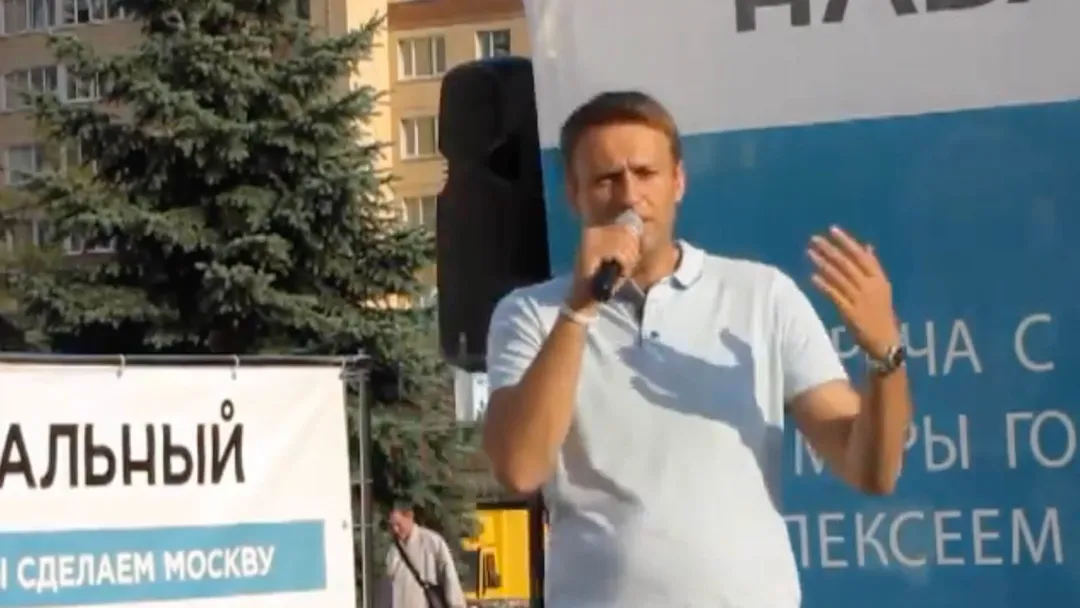
I’m very pleased to be speaking here in
Zelenograd, which, well, probably, if
I told you directly, “I’m one of your own,”
that would be an exaggeration. But my mother is
from Zelenograd; she studied here at
School No. 842 and worked at various
research institutes. So, as you can see, I have lots of
relatives here. Two of my cousins
live here with their families. They graduated from MIET (Moscow Institute of Electronic Technology), and
my grandfather is buried near Zelenograd. In
fact, since I’m also
a guy from the Moscow suburbs and spent my whole life
living in military towns, ever since childhood,
uh, the phrase “go to Moscow” more often meant
first going to Zelenograd, because
we would go visit relatives in the big
city of Zelenograd. Thank you very much. It’s important to me
that you came to this meeting. And
when our campaign team was planning the election
campaign, there were a lot of doubts. Here—
right here. Yura, please. There’s
my cousin. And the second one too. Hooray.
Great to see you, guys. So I’m
not—so I’m not lying, right. Ivan too. That
I really do have lots of relatives here. It’s very
important that you come to meetings like this,
because there were a lot of doubts, and a lot of
people told us, “My God, what are you
thinking? Some kind of meetings. I can see
more friends, relatives, and
acquaintances here too. Hi, guys. So what is this all about?
These meetings with voters—what kind of
complete nonsense is that? No one
is going to come to meetings, and there’s no need
to hold any meetings at all. And no one
runs election campaigns like that.”
“Better to put videos online, let’s
do more television instead.” But I and the people
on my campaign simply tried
to imagine an ideal
candidate for ourselves. What kind of candidate would I
want to see? I said to myself, “I’d like
my candidate to come to my
courtyard, stand in front of me, so I could look at him
and ask him questions—pleasant ones,
unpleasant ones, any kind. He would answer
those questions for me, and after that I would decide
whether I wanted to vote for him or not.” I
became that kind of candidate myself. I hold
a lot of these meetings. Three meetings every
weekday and five meetings every
weekend. It’s a wonderful part of the
campaign, although it is fairly
exhausting. But at least people
can see me, and they can ask me
questions. I’d start by
telling you a little about myself, and then
we could move on to questions and answers.
No objections to that
format? Excellent.
Great. Super. Thank you very much. My name is
Alexei Navalny. I’m 37 years old.
For the past 17 years I’ve lived in Moscow’s
Maryino district. It’s in the southeast of
Moscow.
I have a completely standard,
typical Moscow family: a wife and two
children. My daughter is 11 and goes to
school. My son is 5 and goes to
kindergarten. My wife was born and raised in Moscow, in
Olympic Village. That’s in the southwest of
Moscow.
All my life I moved around, as I already
said, between military towns, because
I come from a military family. And my parents still
live in one of the military towns outside Moscow
to this day. Professionally, I am
a lawyer. I have two university degrees.
I graduated from the law faculty of
the Peoples’ Friendship University and the Financial
Academy under the Government of the Russian
Federation.
If you’ve followed my work over
the past couple of years, what do you
know about me? That I’m great?
Well, that I’m great? Sometimes they also say I
get asked, and people tell me, “You stole
the whole forest.”
Some people think I’m great, some people
think I’m not. We believe you.
But most often people tell me, “You’re this
scandalous minority shareholder, you’re
always demanding something from someone,
making accusations, calling people
crooks and thieves left and right, and you’re constantly
dissatisfied and saying that something was
stolen from you.”
And very often these meetings actually
begin with people telling me, “Well,
you keep shouting that something was stolen from you. But nothing
was actually stolen from you personally.” Well, we
just can’t believe that Gazprom,
this huge giant Gazprom, which we
haven’t really even seen and can barely imagine—
has anyone here ever actually seen Gazprom?
Well, we’ve seen the building. How could Gazprom have
stolen something from you?
Do you think Gazprom stole something
from you?
Well then, I’ve ended up in the right
place, because I have a rather,
perhaps primitive, but I think effective
calculation that proves
that Gazprom—in the broad sense, Gazprom,
Rosneft, and all the rest—have stolen personally
from me. What does our country live on?
What do we exist on? Oil and gas.
That’s right. We sell oil and gas abroad
and use that money to fill the budget.
And that’s how we somehow get by.
Over the past 15 years, during this
Putin era, Russia has sold oil and
gas abroad worth $3 trillion.
Is that a lot or a little?
A lot.
A lot. Has anyone ever seen a stack of
$3 trillion?
No. It’s hard to tell whether that’s a lot or
small. We can simply take it and
calculate the average temperature across
the whole hospital, so to speak. Just
divide it up and we’ll find that each of us,
you, me, even infants,
gets this much from the oil rent:
640,000 rubles. For each person. That is our
share of the oil and gas sold to the West.
So for my family of four,
I calculated 2.5 million rubles. And I go to
Rosneft, Gazprom, VTB, and all the rest of them
with these simple, naive
questions. I ask: "Guys,
explain to me where you put my 2.5 million
rubles." Where exactly did they go?
You pumped the oil, sold it, and you didn’t
hand me the money. Fine, I get that. But
at least explain what you invested it in.
Because
I remember the Soviet Union. You remember,
and maybe some of you remember even
better than I do, that in the Brezhnev era
a huge amount of
petrodollars flowed in here. Right? Those petrodollars
were spent. We may agree or disagree with
how they were spent, but we
do know how they were spent. Just
look around and you will see a city
that was, in effect, built on
Brezhnev’s petrodollars. Right? Science,
industry — all of that was Brezhnev’s
petrodollars. Giant factories and
plants across the country. Brezhnev’s
petrodollars. Railways, roads,
space, healthcare, education —
all of that was those Brezhnev petrodollars. We
spent them, built an army. Remember,
there were the countries of the socialist bloc
(the Soviet-aligned states) — they were supported too. All of that came from those
funds.
But these Putin-era petrodollars are even
greater in volume than Brezhnev’s were.
There are probably, what, 250
or 300 people here. Can anyone
name even one major industrial
enterprise that has been built in
Russia over the past 15 years?
Sochi.
The Ozero dacha cooperative. What an
interesting idea you have of industrial
enterprises. Come on, can’t anyone
name even one?
Lkova,
Yes. They say that in Zelenograd your
zone was built, billions were buried there. Well,
that is, they sort of started building, spent the money,
but never actually built it. At every
rally I ask this question.
And every time people tell me: "The dacha
cooperative Ozero," they bring up
Skolkovo, they mention Rusnano." But
those are not industrial enterprises. And
the correct answer is that
in Russia over the past 15 years there has not been
a single major
industrial enterprise built — not even
one oil refinery,
we haven’t built a single one, just a pipeline and that’s it. Just
a straight pipe. And I go to all
these people and say: "Guys, where is my
education? Where is my healthcare?
Where is my space program? What have you
built for me with my money? Because, you
know, I have no other country and no
other life. And the money that
belongs to me and my children, I would like
it to work for my future and
the future of my children. And when I go, for example,
to Rosneft with questions like these,
the largest state-owned oil
company, there is this woman sitting there,
she is the vice president for legal
matters. How much do you think
she earns? A state-owned company.
1,300.
1,300
million.
Well, how much? More than that. How much?
A million.
A million.
10 million
$200,000. The correct answer is:
her salary is 880 million rubles a year.
You can look it up
simply in the income declaration. And
you see, she sits there, looks at me
and says: "Listen, what makes you think
that you and people like you are entitled to
anything at all? What makes you think that all of you
can demand something from us? We
are a state company here,
state power. We understand
state policy, and then you come along
asking us idiotic questions. You
have no such right. We owe you
nothing," Rosneft tells me.
And at that moment, coming back to
the question of why I believe that
I personally have been robbed, I literally
physically feel the hand of these
crooks slipping into my pocket and
pulling out my 640,000 rubles. And taking it from my whole
family too. And I have the feeling
that you feel it too, how they
take away your share of the oil money,
because it seems to me that you, just like
me, do not understand where it
was spent. And this problem is a very
big personal problem for me, because
I would like that oil rent that
our country has, and that we have been fortunate enough to have,
to be used to improve
my life and the life around me. This is a problem
that I know how to solve. After all, I have
submitted many proposals on how
to reduce corruption in state-owned companies, what
to do with them. We wrote draft
laws, bills, instructions, regulations, but
they are of no interest to anyone, because these
people only want to collect salaries of 880
million rubles and answer to no one. And
right here, right now, I am sitting, standing before you
as a candidate for mayor of Moscow
and I am counting on your support. And
I really need your support, because
I want to solve some problems
that have been tormenting me, that I have been
suffering from for all 17 years. And, probably, it seems to me
that my hypothesis is this:
you have these problems too.
Tell me, please, do you have a problem with housing and utilities services
?
Is housing and utilities a problem for you?
Do we pay too much or too little?
For my apartment in a prefabricated apartment block in
Marino, I get a bill for 9,500 rubles. I
look at it, and I do not understand who
calculated this rate. Because as an
shareholder in a company that is constantly
suing Mosenergo and Mosvodokanal,
I know for a fact that they stuffed into the rate
all sorts of things that neither I nor you
should be paying for. When Mosenergo
pays a 300 million ruble donation to United Russia,
they include it in the rate. And we
when we pay for heating and electricity,
are paying for sponsorship of United
Russia. All these nonexistent
investment components are shoved into the
rate. So much, as if all of
the Moscow region were covered with new
power plants. New pipes everywhere. What
is happening to me here?
I see people have somehow lost interest
in me and are looking somewhere upward.
Anyway, I look at my bill and
remember that, for example, the company
Mosvodokanal,
made a profit of 3 billion rubles two years ago
— net profit. After that they
raised our rates again. This is our
company, existing for us,
they made 3 billion off us, sent it somewhere,
then went to the Moscow city government
and said: "Let's raise their rates again."
The Moscow city government says: "Let's
raise the rates."
This is absurd. And I want to become the mayor
who will finally conduct an audit of housing and utilities rates
and who will finally throw out
of those rates everything that should not
be there,
who will finally simply sort out
what is in them. We already pay
far too much. Who can tell me how much
we pay for housing stock maintenance in
Moscow?
25 rubles per square meter. Talk politics.
Housing and utilities — that is my politics. People tell me
to talk politics. This is politics
for me. Listen, when I pay
25 rubles, and all of you pay 25 rubles for
housing stock maintenance, and then I am told:
"Not enough." Excuse me, but politics
is the fact that in Astrakhan
they pay 12, in Yaroslavl 15, in Kazan 18,
while we pay 25. And we are told: "More,
more, more, more." I want to become the mayor
who will make sure that we pay
only what we are supposed to pay, because I myself do not
want to pay that much.
I came here, and you say politics,
right? But I came here because I go to the
clinic.
Wait, there will be a chance to answer
all the questions. This is an important question, and I
will definitely answer it. But right now we
are talking about politics, we will discuss everything,
and then I will go home and go
to the clinic.
I go to the clinic and see that my
clinic is very different from the
clinic they show me
on television. On television they
tell me that clinics have
electronic registration. You book an appointment
and see a doctor the same day. I
see people laughing who have apparently
tried to do that. Do you have lines
at the clinic
two weeks long?
I do not believe it, because on television
they say otherwise. Apparently, you and I
have the same kind of clinic,
while they, those people on television,
have a different clinic. But I do know that
for every Muscovite, spending on healthcare
is four times higher
than for any other resident of Russia. Four times more
money. For outpatient care alone
for each
Muscovite, 20,000 rubles a year are allocated.
For my family of four, that is
80,000 rubles. Now, just out of curiosity, for my trips to the
clinic, please raise your hands,
those of you who have gone to your
local clinic in the past year.
Looks like everyone in Zelenograd is sick.
All right, now please raise
your hands if you have not gone in the past year.
So, after all, there are many more healthy people.
Nevertheless, 20,000 rubles were taken
from each person. From each one. I want to become
the mayor who, with those enormous sums of money
that are being allocated, will finally hire
general practitioners, internists, the kind of doctors
who are needed in most
cases. When I see
huge sums in the Moscow budget, and at the same time
I am told that in Zelenograd
once again there is no money for the construction
of a children's hospital — you know it yourselves, they
keep postponing it, postponing it,
and now they say it will be built in 2025.
Yes, it is laughable to hear that.
Because for the modernization program
of Moscow healthcare
spent 100 billion rubles. And we at the Foundation
for Fighting Corruption (ACF) worked on this
program. And we can see that these 100 billion
rubles were spent in such a way as to
simply purchase all these scanners and
ultrasound machines at twice the price.
And now they are just sitting there covered with cloth,
because there is no one to operate these
ultrasound machines. Tell me, is it easy for you
to get an ultrasound exam in
Zelenograd?
Yes,
not at all.
They shut it down.
They shut it down.
No, but here’s something interesting. And
you probably have one of those
little campaign tents near the station for Sergei
Sobyanin, the candidate for mayor of Moscow. Go up to
it, and you’ll be surprised to
read under “Achievements”: “Bought
1,200 ultrasound machines for Muscovites.” So,
you see, that’s the kind of thing it is:
some generous man supposedly bought you, out of his own pocket,
1,200 ultrasound machines, but neither you
nor I can actually get an ultrasound exam. I
want to become the kind of mayor who will
invest in people, in doctors,
rather than just buying hardware. We can
buy the most expensive scanners, and that’s exactly what we
did. Russia, in terms of the number of scanners
per capita, surpasses all
European countries. Is it easy
for you to get an MRI?
No,
it’s impossible to get an MRI.
Simply impossible.
There’s no one to operate them.
There’s no one to operate them. That’s why I’m saying,
let’s stop buying scanners
at twice the price for billions. Better to
send these doctors abroad
for training there, so that in five years they can at least
treat our children properly. Our
medicine is still stuck at the level
of the 1950s. We need to invest in
human capital. What we need are doctors,
good doctors, not machines,
because without doctors, an ultrasound machine by itself
doesn’t heal anyone. I know this is
happening because they simply want
to make money off this program. They
set up a modernization program for
Moscow healthcare. 100 billion
rubles. They pocket 50 billion. I want to become
the mayor who changes that, because
I need an ultrasound, I need an MRI, and you do too,
presumably, right? I came here because
I don’t know what it’s like here in
Zelenograd, but I’m very concerned about
the issue of migration. Does it concern you?
No.
Wow.
What do you think? You do know that 50%
of crimes in your
district are committed by migrants. Not even in Zelenograd as a whole,
according to official statistics, 50. Maybe
maybe in reality it’s 80. But
official statistics say 50. In
your district, not even in Zelenograd overall, but
just in your district, has crime gone down
or gone up?
It’s gone down. Gone down. I prepared for this speech
in your district. Let me report to you,
dear residents.
residential burglaries are up 37%,
fraud 29%, drug-related crimes 22%, and
robberies are up 86%. And you understand, behind
these figures, it’s not just
statistics — it’s someone’s cracked
skull.
And what about ethnic Russians?
Two years ago, I didn’t know a single
person who had had their purse snatched.
Now I personally know three women living
in my building whose purses these migrants
snatched. And I know that migrants
come here in these numbers, hundreds of thousands
of people, not because there are
jobs here, but because money can be made
easily from them. Now, so that no one
can accuse me of
manipulating the numbers or bringing in
planted people, tell me,
please, yourselves, what is the salary of
your janitor?
11
11,000 3
35
35
that’s what they actually take home.
There. You see, this is an interesting
thing. It’s a secret the whole of
Moscow knows. Every time, every time I
ask this question, people first tell me
8, 10, 5, and then someone says to me:
“On paper or in reality?” Yes, 35.
Because when you say 30
or 35, you’re right. After all, the minimum
officially established pay rate
for a Moscow janitor tells us that there
cannot be a janitor who
earns less than 31,000 rubles. But all
the janitors we know, real ones, yes,
not the janitors from television, but real
janitors, they all get 8, 10–15,000.
They are dragged here, housed in basements, 20
people to a room, in buildings slated for demolition,
because they are willing to kick back
10–15,000 rubles from their wages. And this is a river
of cash that feeds district administrations,
housing maintenance offices, prefectures, and so on, and so
on. Hundreds of millions of rubles a month.
But you and I see the other side
of that river. I want to become mayor because
for me, the other side of this
river of money is crime, it is
social tension. These are classrooms in
Moscow schools that have begun
to appear, where the number of children
who do not speak Russian exceeds the
number of children who do speak Russian.
These children are not to blame for anything. In their
families, Uzbek or
Tajik is spoken. They have never even seen Uzbekistan or
Tajikistan. They
were born here. But that is exactly how they speak.
And I want to become mayor because I
want to solve this problem now, not
wait 10 years until my children
are faced with a situation in which Moscow has
hundreds of thousands of people who were
born and raised here, do not know the language,
do not understand anything, cannot find
work. They do not want to work as janitors
either. They are ordinary Muscovites, exactly
the same as us. But at the same time they have
no prospects and no future.
And in order to survive, they will
commit crimes. I do not want to
wait for that. I want to solve this problem
now. And I know how to solve it.
I can answer that question right
that question, how
away. All right.
First, please tell me: who has been
to any European country? Any one at all.
Raise your hand.
Good. Now another question. Raise your hand,
those of you who got into any European
country without a visa.
Uh-huh. And how did you get there?
Across the border illegally?
No. No. With a visa, of course,
with a visa. No, sometimes at rallies I
ask this, someone raises
their hand, and I say, "How did you get in?" And he
says, "I drove in there on a tank while serving in the army
(a joke about military service)." Well, that is possible. But most often
we are forced to acknowledge that, as far as
you, me, and everyone gathered here are
concerned, there is a visa regime with every
European country. If we want to go to the United States,
we have to give fingerprints
twice at the embassy, and then again at the
border. So please explain to me,
if a visa regime applies to us,
why can any citizen
of Uzbekistan or Tajikistan, even without
an international passport, come here with
a one-way ticket and stay for any
length of time? Is that right?
It is not right. So the first measure
that needs to be taken is to demand
the introduction of a visa regime with the countries of
Central Asia and the South Caucasus. Second, we need to
disqualify all contractors
who hire undocumented workers. Not
fine them, but bar them from government contracts
forever. Third, what we will do within
a year, and for which we already have a
draft law,
is make sure that companies working
with municipal money cannot
hire foreigners. There are
shopping malls. That is private business. It is
none of our business whom they hire.
They can hire whomever they want. But if it is a
company working with city funds, with
our money, they should not be creating
problems for us using our own money. They
have enough money to hire
Russian citizens, and even Muscovites. There are a great
many myths going around about this. You have heard
this one, right? If all the Uzbeks leave Moscow,
the city will be buried in filth. You have heard that?
Is that true?
Of course not. We have not been living in Moscow
for just one day. We know that before 2003
there were no migrants in Moscow. In
most Russian cities there are no
migrants. In no city with
a population under 500,000 are there any
migrants. There are no migrants in Belarus. In
2008, when there was a crisis, migrants were leaving Russia
by the millions. There was no
work here, and we did not even
notice it. So there is no need to listen to these
myths. We need to introduce three simple things. I will
do them when I become mayor. And within 2
years I will reduce the number of migrants by
70%. I will do it. That is why I am
standing here. I am standing here because I know
the size of Moscow’s budget. Remind me,
who knows Moscow’s budget? What is it?
Half a trillion—1.6, 1.63 trillion to be exact. And then,
for example, next year, in
2015, it will already be 2 trillion rubles.
In terms of budget size, Moscow is second only
to New York and Shanghai.
Do you like that?
Third in the world. We live, paradoxical as it may seem,
in one of the
richest cities in the world. The richest
cities in Europe and the United States cannot even
compare with us in terms of
budget size. And here is a trick question
for the audience: if we are third in the world by
budget size, where do you think we rank
among the world’s largest cities in terms of
quality
of life?
Last.
Second to last. And why do you not
think it should be third?
Well, if it is third by budget, then here
it ought to be third too. See?
You said 156, apparently as a joke, right? But
the correct answer is 154.
We are in 154th place in terms of quality
of life, while by budget we are
in third place.
I know for certain that with the money
Moscow already has, we can have
a good quality of life. We can have
excellent education, high-quality
healthcare, roads where we
successfully fight traffic jams, a small
number of migrants. In order to
do this, we have everything: a city,
infrastructure, a very well-educated
population. In Zelenograd, it is
super-educated, excessively
educated, but even in the rest of
Moscow it is quite educated. We
are missing only one most important thing, you and I.
We have no faith in ourselves. We believe that
the life we are living, it
is natural. It cannot be changed.
Well, there are certain facts that make us
outraged.
Here we are in first place in oil
and gas sales, but in terms of quality of life, standard of
living, we are sixty-ninth. Budget
third place, quality of life 154th.
Take any major construction project in Moscow.
The North-Western Chord, a single
large construction site. 70 billion
rubles. And all the builders, transport specialists,
experts say: "It costs twice
what it should cost".
Newspapers write about it, it is openly
discussed. No one is ashamed of it. We
know that in the construction of just one
North-Western Chord, you and I will have
stolen from us
30 billion rubles.
That is enough to
build clinics and schools all across
Moscow. Right now, if you need to take a child to a
children's hospital, where do you take them? To
Mitino, 30 km away. Right? You could build 20
such hospitals with just the money
that will be stolen from a single
project. But we shrug our shoulders
and say: "Yes, they'll steal it, it's outrageous,
but there's nothing that can be done. Nothing
can be changed. They'll lie to us on
television, brainwash us, rig the elections,
rob us, and yet
nothing can be done." Something like that. That's just,
well, how life works. After every meeting
someone comes up to me and says: "You
said everything absolutely right, well done,
I support you, here, let me even shake your
hand." But tell me,
please, honestly, right now
without microphones, without cameras, you
understand that nothing
can really be changed.
I came here to you with the most important
idea, the one thing that I
truly and honestly believe: everything
can be changed. I truly and honestly
believe that the system we live in,
is not natural; it is perverted,
it is unnatural. But why should we
have to live like this? Are we really the most
foolish people in the world? The most hopeless, the most
somehow cursed in the world? Is there some kind of vortex, the most
patient one—though no, we don't seem especially
patient. Some terrible vortex hangs over Moscow
that suppresses us. Are we really being
forced by someone? Where are
the troops, OMON (Russian riot police), or tanks here that
are making us hand over to some crooks
30 billion rubles on the North-Western Chord instead
of building you in Zelenograd a
children's hospital? Who is imposing this?
Here, among all the law enforcement forces, I see
three police officers, and judging by their look they
seem quite in agreement with what I
am saying. No one is forcing us to do anything.
This crooked government stays in power
for one reason—not because of violence, not because of repression, and
not even because of television. It survives because
we shrug our shoulders and say
that nothing can be changed. I go to
meetings like this,
maybe some people treat them ironically,
but I know that everything
can be changed. I know that, relying on
you, I can change everything. How many people does it take
to elect the mayor
of Moscow? 1.5 million people. For me
to win triumphantly in the first round,
I need 1.5 million people
to vote for me. In a city where 15 million
people live, there are absolutely
1.5 million people in Moscow who know everything,
understand everything, read my platform,
know that I exist, despite the fact
that over the past five years on television
I was shown only in reports about
how I stole the entire forest. They know
everything, they understand everything. They understand that
the problems Moscow faces,
those problems have been solved in other
major cities, and we can solve them too.
We only need to realize our own
strength and power. We must
realize that this is the true source of power.
As it is written in the Constitution: the people
are the source of power. There is nothing more
powerful than us. Because right here
with me, in front of me, there are not 400
people. In fact, if I am
convincing enough and can persuade some of
you, then standing before me here are
50,000,
because each of you has friends,
acquaintances, relatives, neighbors on your
landing. And studies even
show that each person's power of persuasion
is enormous. If you speak
to ten people, you will definitely
persuade six of them. People
can be persuaded. We can do
anything. We can make sure that any
person is thrown out of Tverskaya 13 (Moscow City Hall),
send someone to Tverskaya 13 and throw them out again
if we do not like them. We only
need to realize how many of us there are
in fact, that we can do anything. And
I am convinced that through you I will be able to
speak to thousands, to hundreds of thousands, and
even to millions, that we can come
to the polls and, sooner or later, show that
we exist and that we are the power here, elect the
mayor we want, who will
serve our interests, not the interests
of the Ozero dacha cooperative (a group tied to Putin's inner circle). And that from September 8
we will win, whether in the second or in the
first round, but we will win for sure and
finally begin building a city for
ourselves, for our children. Thank you
very much. I'm ready to take questions.
[applause]
What is the siz
I'll repeat it for everyone afterward, yes.
How large is the team that
stands behind you?
How large is the team that
stands behind you?
How many people run the city of Moscow?
Tens of thousands. Tens of thousands of people,
because there are district administrations, prefectures,
municipal and state enterprises, housing maintenance offices, and everything else. Do I need
to replace them, to recruit 10,000 new
people?
That is impossible to do. And there is no
need for it, because the truth
is that 85% of these
people are not corrupt,
because they don't even have any position
where they could steal. They would like to sit
in a more comfortable post, but they are ordinary
people earning a decent salary,
who only want to have
a normal, stable life. Therefore
my task is not to bring in
a team of 10,000 people—that is impossible
to do—but to impose
the right principles of public service. I need
to bring with me the key 20 people. I have
them, and we will publish their names in the
second round.
And these people will enforce the right principles.
When I talk about principles at meetings like this,
someone in the crowd often
says: "What nonsense, principles,
we don't even understand what that means."
Give us names." Let me explain with a simple example
how important principles are.
I'm speaking with a pers,
what is the main corruption case in Russia
right now,
apart from Navalny's case?
Serdyukov,
Right? They talk about Serdyukov on television and
so on. Remind me, please, because
I've forgotten. Was Serdyukov jailed? No.
He was charged.
The last charge was recently dropped. More than that,
Serdyukov still has a Mercedes from the
Ministry of Defense and a flashing beacon on its
roof issued by the Ministry of
Defense.
His girlfriend Vasilyeva is serving time.
Well, she is under house arrest
in a thirteen-room apartment.
You're right about the boutiques. She has
3 hours a day for walks. And regularly
during those walks she is photographed
buying various pieces of jewelry
with honestly looted money.
As a lawyer, I can add that her
house arrest is a formal
restriction on liberty that will be credited to her
at a rate of one for two, a day counting as two. And when she
gets, for example, a 2-year prison sentence, she will
be released immediately, because she has already
served her time, already suffered. This
information is not new to you. The whole
country knows about it. And if you conduct
a poll, then 99% of the country's residents
are simply enraged by what is happening. Just
absolutely enraged. It would seem that
Putin should jail
Serdyukov immediately, and his approval rating would
rise at once. But that will never
happen, because this is precisely a principle,
the most important personnel principle, which
shows both us and officials how
everything works: that even if you are
a useless, incompetent former
furniture store manager who
wrecked everything and stole everything, nothing
will happen to you as long as you keep quiet
and pay your cut. And nothing happens to Serdyukov.
And this principle works; it is
the practice. Have you heard of the case of Ilya
Farber?
Keep it short: question, answer. Two minutes.
One second.
Well, excuse me if I'm taking more than 2
minutes to answer. This is an important point about
the team. The case of Ilya Farber. A teacher
was sentenced to 7 years and 1 month in a maximum-security penal colony for
embezzling 130,000 rubles (about $4,000 at the time). A dubious
embezzlement charge. And 2 months ago there was a trial
of the former deputy prefect of the Eastern District,
Reykhanov.
Proven and admitted embezzlement of 360 million
rubles (about $11 million at the time). What did he get? A 4-year suspended sentence, and
no fine at all. Those are the principles that
have been established and are being demonstrated.
And my task is to make sure that I, and you, and every
official of mine who works under
me, knows for certain that if he is
suspected, he will be fired; if he is
caught, he will be jailed. I will do this. This was
done in Singapore, it was done in South
Korea, it was done in Hong Kong, despite the fact
that these were very
corrupt countries. And I will do it.
But sooner or later, there must appear in
Russia a person who will not steal himself
and will forbid others from stealing. I want to be
that person. I will become him.
All right, let me answer your questions,
so that you don't embarrass us.
I won't hear the answer. The size of your
team.
We need to rotate the first 20. Yes, please.
What is your question?
Your attitude toward Yeltsin, toward his policies. Toward
Yeltsin.
Your attitude toward Yeltsin, toward his policies.
Listen, I came here. Who here cares about
my attitude toward Yeltsin?
Who here cares about my attitude toward Julius
Caesar?
Who here cares about my attitude toward housing and коммунal services?
The main issue.
What concerns you is migration,
healthcare. I came here
to talk about the problems that concern me
and concern you. You can ask me about
Yeltsin, about a gay pride parade, I don't know, about
something else, about aliens. I can talk about that
for a long time, but I came here to talk
about the issues that concern you.
Please,
let me give you the microphone, just
briefly.
Suppose you were elected mayor. What would you
start with? What would you
do for Moscow
first?
Suppose you were elected mayor. What would you
do first of all? Well, we have
this spelled out very clearly in our
platform. Decision number one: we
repeal Sobyanin's order raising
housing and utility rates as of August 1, because it is
unjustified, it's nonsense. We will conduct
a tariff review first. Decision number two: we
allocate the 138 billion rubles already in the budget
to double
the Moscow pension supplement. How much is
the Moscow pension top-up now?
4,000-4,500, so that the standard would be
12,000. We know for certain that the Moscow
budget has the money to raise
the Moscow rate. And the minimum
standard would be 16,000. Life in Moscow
is expensive even for someone who
has a job. So we know that this
138 billion exists. We know where to put it, where to
take it from. That's the second point. And the third is,
of course, personnel decisions that need to
be made. Fourth, I can name
a review of all those contracts
and procurement deals. If, if I am mayor and
half the money is being stolen from every construction contract
under my watch, well, I am obliged to
deal with it. And those billions
that we save through basic and
urgent anti-corruption
measures, we will direct, among other things, toward
social support. Next question,
please.
Let's do one person, one question. There are
quite a lot of us after all. Then over here,
yes?
Yes, go ahead, talk all day.
Ah, yes, in fact, the news just came in
that I may be removed from the election, not even on
August 30, but literally this evening.
Well, listen, they're worried. They can see
that this Navalny has entered
the race. At first they laughed and said, "Come on,
some blogger from the internet will get 3%."
Then, for some reason, around this blogger
from the internet, 14,000 volunteers appeared. Then
the poll numbers started to rise. Then they
saw that people were, one way or another,
supporting me. Now it has become obvious to them
that a runoff is practically inevitable.
For them, naturally, a runoff is
a catastrophe. They are not defending power in general,
but very specific
financial interests. Just understand this:
if I become mayor, then Timchenko
loses metro contracts—that's billions
of dollars. All these Rotenbergs and the endless
other friends of Putin, they lose
specific contracts, specific billions,
literally, that they would otherwise receive tomorrow.
That's why they are resisting. That's why they
spend all day making up
some stories about me—about how my wife is in a
mental hospital, that I have
property in Barcelona, that I have
property in Montenegro, and so
on. But even that isn't working. They
are afraid of a runoff, so now they are
seriously considering
removing me from the election altogether. But if
they remove me from the election, then I will
appeal to you directly and ask you
to come to the Moscow City Election Commission so that
I can be reinstated on the ballot. That's our right.
Whether you like me or you don't like me—do you
believe that I have the right to take
part in the election? Well,
in any case, I will do everything I can to
stay in this election and win it.
Please.
I believe that you have the right to take
part in the election, but anyway I have one
question—one person, one question. Are you
against Putin's police?
The question for me is: are you against Putin's
policies?
Well, listen, I don't know, maybe I
haven't been expressing myself clearly enough
or strongly enough. It seemed to me
that if there is, say, a line of
people—140 million of them—
then among those who like
Putin's policies, I would probably be
closer to the very end of those 140 million,
because as for getting along,
because the question is how I will
get along with it, because Putin's policies
are policies built on corruption.
They are policies built on enrichment
specific people—simply those in his inner circle.
His circle. It is literally 50 families who
have taken all the nation’s wealth. How
am I supposed to coexist with him? Excellent question.
Really, say you become mayor, and
there is Putin, and your relationship with
him is not exactly great, right? What should you do? Maybe
send street-cleaning trucks out into the streets and
drive them toward the Kremlin, or gather an army
of janitors and march them on the Kremlin? No, I
will do something very simple. I will
follow the rules. If the rules say
I am not supposed to hand all the metro contracts to
Timchenko, then I will have
fair tenders, and everything will work
normally. If someone calls me and
says, "Alexei, please, we
want our friends to build the roads in Moscow—
the Rotenbergs." I will say:
"Sorry, I do not even have the authority
to do that." I changed the system of government so that not a single
contract worth more than 1 billion rubles
is awarded at all without
an international review. I simply cannot
do it. And most importantly, we did not
put this on the poster for nothing—you can
see it here: "Change Russia, start with Moscow."
The country is structured in such a way that all
political change in the country
will happen—or will not happen—depending on whether
Muscovites want it or do not want it.
That is how it will happen. And I am absolutely
certain that if, in Russia’s main city,
where 15% of the population lives, there is
a mayor elected not by election commissions and not by
television, but by the people—a mayor
who relies on the people, serves
the people, and is supported by
the people—then nothing can be done to that mayor,
and Russia will change seriously
the very next day. Next
question, please.
today you were also asked by a Communist
Party
whether you are afraid that your support will once again somehow
be split—the question about the Communists
who are also running, and Yabloko is running too. Am I afraid
that the votes will be split? Well, look, in
the first round, I am not afraid, because right now
what I need in the first round is for
the Communists to get more votes.
Paradoxical as it may sound, I do not want them sitting at
their current 2–3% rating. That does not make me
happy. The fact that I have, you know, 21%
or 24% in various polls, while they have
three—this gives me no
sense of happiness, because I would prefer
them to have 7–8%, because that
brings the second round closer. And in the second round,
I know for certain that all those votes
will come to me, whether they endorse me
or not—those votes
will come to me. So I would prefer
for the Communists, Yabloko, and all
the others not to withdraw in my favor,
but instead to campaign more actively.
Their election campaign. Exactly the same way
I am speaking to you now, they should be out there speaking too.
The more they get, the closer the second
round. In the second round, everything is structured
differently. There it becomes a contest
of negative ratings. I know for certain that everyone
who supports me will show up in the second round.
But as for those who support Sobyanin,
it is unclear why they would. Please.
What is your specific attitude toward Russian
nationalism.
My specific attitude toward Russian
nationalism.
My specific attitude
depends on what problems I, what problems I encounter
in life.
Frankly, you see,
ideological clichés, ideological
labels—they concern me much less.
Many call me a nationalist,
others call me a liberal, and both
sides are very dissatisfied. The truth
is that I am probably
the only politician in Russia—or at least one
of the few—who can
find common ground with both
sides. Simply because I do not
stick labels on people, and I do not try to place myself
somewhere on an ideological spectrum. I
talk about problems. When I talk about
migration, everyone knows that I have the toughest
position on migration. But not because
I am a nationalist or not a
nationalist. It is simply a problem
that I want to solve in that way.
When I talk about housing and utilities, my positions
closely align with those of the liberal Mitrokhin.
When I talk about reducing corruption and
so on, some of my positions are close to
those of the Communists. I am simply trying
to be a person who
wants to solve problems. And it seems to me that this is what you
expect from me. You do not want
me to define myself right now on this
stage—whether I am a conservative,
a socialist, more left-wing, more right-wing. No, you
want me to come and build a hospital for you
here. So my task is not
to define myself right now, but to come in,
save money by cutting corruption, and build you
a children’s hospital here, among other things.
Next question, please. Alexei,
please tell us how you plan
to support small businesses,
entrepreneurs, young people who
are starting
how small businesses should be supported.
In my view, small businesses
need support of the following kind:
first and foremost, that no one interferes with them. These
endless regulations,
fire inspectors who show up with
sanitary and epidemiological inspections, licenses, and so on,
that is the thing that worries people the most.
And the second thing, without which
small businesses simply cannot develop
in Moscow, is extremely high rent.
It is impossible to find premises for yourself, simply
impossible. At the same time, in Zelenograd
this is especially obvious: you have
a huge number of former facilities that
are not being used for anything now. And what has happened to
them? They have been leased out. The directors and
owners are the state or
the city, and they lease them to their
relatives for, say, I don't know, 100
rubles per square meter, and then sublease them
for $300 per square meter.
I have a very simple
solution here. I will make sure that within
a month after I become mayor, all
this data will be completely open. You
will simply be able to see who is paying how much,
which company it is, who the beneficiary of that company is,
and which owner is renting the premises. If we
see that some huge property has been leased
to some Cypriot offshore company and everything
is being subleased, then that is simply grounds
for you and me to demand, and for me
to cancel and terminate that lease agreement
and rent it out at a normal price. I will
do that, and I will most definitely significantly
lower rental rates for Moscow-owned
property. That, it seems to me, is the most important
support for small business
that people expect from me: so that people
who want to run a small business
can find premises, settle in, and
start working. Please,
Alexei.
Your opponents very often use
the Yale University card. Could you
explain why, after all,
you studied there? Why does Fyodor consider you
an American plant?
A question about Yale University. Your
opponents constantly bring up
Yale University and criticize you for
Yale University. But probably here in
Zelenograd it is easiest for me to answer
this question, because I am in
a city where education has always been valued.
A question for everyone: do you value education?
Yes,
I value education too. I spent a huge amount
of time getting into Yale
University. I spent an extra year studying
English. It is hard to get in there.
I am very proud that I
got in. It is the best university in the world
for legal education. It is one of the best
universities in the world overall. So, after going through
a fairly difficult testing system,
which is actually available on the website—you
can look it up—I got in there and studied there.
Mainly, first and foremost, at the
law school. And I am very pleased
that I got in. By the way,
it was a revelation to me that 60%
of Yale University students are
Chinese. The Chinese understood long ago how
important education is. Every year, in the hundreds of thousands,
they take their students,
send them abroad, and pay for it themselves. They study
in America and then return. That is the right
approach. I want to become a mayor who values
education, who is not ashamed of the fact
that he had the chance, the good fortune,
to study at one of the best universities.
I want Muscovites to study at the best
universities, both in Russia and abroad, and
I want Moscow's universities to become
better. That is all. Education is our
everything. Next question, please.
Please tell me, our courts have basically become
a separate branch of the Investigative Committee.
What do you think we should
do about that? You have faced it yourself. The question is
that the courts have become a separate
subdivision of the Investigative Committee,
so to speak. Oh yes, I know that.
Many people do. Indeed, our courts
are basically just an office. We have
the Investigative Committee, the prosecutor's office,
and next door the courts. A few phone calls are made,
papers are stamped out, people are locked up,
and so on.
The mayor of Moscow cannot do anything about
the federal courts, unfortunately. Here, in fact,
we need to push for changes in the country
in order to change the system of
federal courts. And first and foremost,
the appointment procedure. Who becomes
judges first and foremost in our system now?
No. The main кадровый source
for judges is court clerks; in
second place are prosecutors; in third place
are police officers, and everyone else comes after them.
So naturally, these
young women who came straight from university to
work as court clerks in the evening program system,
having been trained for five years
to obey, then become exactly the same kind of
judge. At the federal level, we
must first of all change this
personnel recruitment system. But what can
the mayor of Moscow definitely do? He can
influence the system of justices of the peace. You
know that these are the courts
that ordinary people turn to in 90%
of cases. What kinds of cases are these? License suspension,
traffic accidents, divorce, division of property.
These are the issues ordinary people
deal with. And the justices of the peace are within
our jurisdiction. And our program
includes a provision to introduce elections for
justices of the peace. That is permitted by law.
Right now they are elected by the Moscow City Duma, which
is basically telling us, "You are all too stupid
to elect your own justice of the peace."
But that's nonsense. All over the world, they are
elected. In countries far less developed,
justices of the peace are elected. Are you really
not capable here of electing
a justice of the peace for yourselves? Of course you are. And for me,
it's important that you elect
a justice of the peace yourselves, so that he is not
subordinate to me, because for me and for
the members of my team, that would be one more
anti-corruption safeguard. If I know
that I can't call from city hall over here to
Zelenograd and tell the justice of the peace, "
Come on, make sure that I,
that everyone is afraid of me, that I beat everyone or
strip everyone of their rights or take away everyone's
land plots'—that won't be possible,
because you elect him in fair
elections." This is one of the most important things in
the political system. We will fix it.
Thank you so much for coming. For
me, it's very important that you came. I really
want to earn your support. Come
to the election on the eighth. Bring your families, your friends,
bring everyone—we will definitely win.
Hooray! Zelenograd!