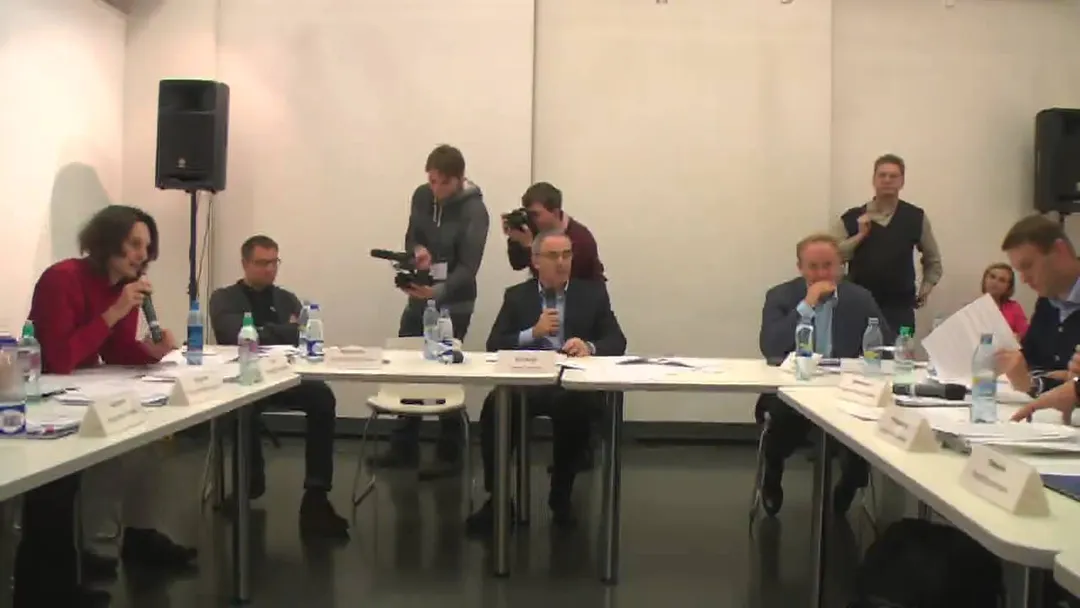
The Second Meeting of the Opposition Coordination Council
In accordance with.
In accordance with the decision we adopted earlier, we must first of all
elect the chair of our meeting,
since we agreed that we have
a principle of rotation.
At the moment,
as far as I know, our colleague Illarionova has nominated
our colleague Kasparov as chair of this meeting.
Any other nominations?
None.
I would like to nominate
our colleague Pakhomenko.
Thank you.
Thank you.
I expected
more.
First.
The very.
I am simply withdrawing my candidacy.
It seems to me that since we have not yet determined the rules of procedure
or the procedure, the most natural thing
would be this.
A person
practically. From. The floor.
I would raise the question, and that is why I am ready to serve as
chair of this meeting. He.
Considers.
Kasparov. Kasparov.
If you suspect that, then so do I.
Kasparov—three. Very briefly.
This is Gelfand's.
This is PAKHOMENKO's.
I am explaining to you how that is possible.
I would be interested to see how
the vote went.
Colleagues, nominations have been put forward.
Colleague Kasparov. Any others?
If not, then in the order received, please vote.
Who is in favor of Garry Kasparov chairing this meeting?
Please vote.
Dear friends!
Today we have
the opportunity, of course.
The first item on the agenda.
In fact, there are three of them.
And what. There will be defeats.
On the matter?
Why are they all like this?
They are all the same, because they do not really change much.
Only the order changes here.
Of how
all these
issues.
Because, essentially, this is the question we are
beginning to consider.
The issue of the march,
our protests, the December action.
I have a proposal to adopt
It seems to me that we should
give our voters the satisfaction of a concrete decision.
Then we can delve into procedural and motivational issues.
That is why I am, of course, proposing option number one, where everything
That is, the issue of protest actions.
Against.
Any others?
That is clear.
So you can?
Object?
The picture is authentic.
I. Even
if it already has.
All right.
What I.
No, I propose
to remove it.
The provision.
Here I am.
I was taking, that is, I was
discussing the draft statement.
Decision.
That the discussion among members of the
Coordination Council on this issue has already flared up,
taking on an unhealthy, harmful, and dangerous character.
Therefore, I propose
given the emotional atmosphere that has formed around this issue,
that we impose a moratorium on discussing
this matter and
I believe that this is quite a different structure,
one that may be exposed to a whole range of dangers.
The main threat is the obvious futility of
civil and political activists.
And a split—which we have gone through many times—arises each time out of nowhere.
Right now, it seems to me, the proposed resolution will most likely
create contradiction rather than lead to
our reaching a mutual understanding on this matter.
I understand that we have all read
about world revolution, and we all understand that first we need to divide,
so that later we can unite.
It has become customary for us every week,
Therefore, I propose a moratorium within the agenda.
I have
an appeal,
that the voters.
of the Revolutionary Council
and an undefined range of tasks.
In defense, undoubtedly, perhaps, they may.
Showed beyond the limits.
Leonid For.
The situation.
It is necessary to sacrifice the union.
All the advanced agreements that are now leading the way need
to continue drawing
a line, to pursue the line that has been pursued throughout this year.
I think it would be wrong to remove this text from consideration, and it can be adopted
as a basis and refined further; in my view, removing it would be wrong.
Thank you.
But judging by what has been said today, we are not ready
to adopt any innovations at this meeting.
This is a matter for a vote.
Or we could create a programmatic working group that would prepare a document
that would allow us to conduct a discussion
on a more basic level.
More.
But I emphasize,
the council is necessary.
There are two.
Different.
Drafts to adopt
to use one of them as a basis and then create an editorial,
which could
at the next meeting in a calm manner.
And for now I...
Modified by a majority,
that is, 30.
To postpone this matter. In...
I would like to state my personal position.
Unfortunately, I probably
do not know how to use email
and prepare,
I think the opposite.
As Boris said, we first need to create a second group and draft this resolution.
I see its merits, but there are also serious shortcomings,
since it says here that we,
we are then seeking to liberalize.
The work of creating something more or less...
Test it out, perhaps,
if somewhere along the way by next time this...
Carry it out.
I think that.
This document is, of course,
worthy. But
simply one that will define our activities for the coming year.
Therefore, adopting one of these drafts now
in this rushed way and
is not considered possible.
I believe a group should be formed in which representatives will be included
of various forces and...
This is a common project; it should be advanced.
A vote at the next meeting considers that right now,
if we adopt one of these drafts, an unacceptable situation may arise.
A number of members of the Coordination Council propose forming a group
or else remove it. Indeed, this issue today...
A good judgment.
Here is one of the options.
I am ready to join.
Yes.
Representatives: Igor
Dmitrievich Krivtsov.
I would very much ask
to show...
Because that way, in a row...
The regions. Have hit a wall.
A protest movement is already underway,
where the question is already being raised that it is necessary
Simply to demolish it entirely.
The entire political elite.
That was formed during Putin's
rule in Russia.
And today Ilya is causing today
a great deal of expert attention.
There, in the CC, he works on the board,
and there he is in the trade unions under...
Doubt by these...
Putin-backed appointees.
And he is not there.
There is one option proposed by Yashin: to remove the issue from the vote.
There is a proposal to put it to a vote.
I must put the question in the interpretation in which
Yashin is now putting it to a vote.
Everything else afterward.
Now, from the agenda.
I have another proposal: to change the agenda item and work on it.
Sorry, no,
sorry, that will be after the vote,
which will take place on the proposal of our colleague Yashin.
I have already been removed from the agenda as well.
Further, if the motion passes, then Yashin
will be able to submit his own; if it does not pass,
as I understand it, there is no agenda item in the form of a rule, if I understand correctly.
If there are no other proposals, if there are no others, all right, then,
who is in favor of removing it from the agenda
without discussion?
Also now,
during the telephone poll that took place on the 17th,
who is in favor of leaving it under the item of
consideration?
Question.
Next week it will be necessary
two by phone
to say. Yes,
quite frankly.
Twice.
To be.
Thus, the decision is to remove it.
Let us
formulate the proposal informally.
This has been said many times here by Navalny,
I hear from his colleague: please formulate it.
He started first; I have already formulated it.
to replace discussion of the CC statement draft with a provision on creating
a working group of the Coordination Council to formulate the statement
I proposed
to vote. It has been proposed on the grounds that
you want to push the problem
into the most revolutionary group.
For this to work, the group has to be smaller.
How much smaller can it be? Are there any definitions
of the principles by which it is formed?
A person can...
These ideas are real
groups, and which ones?
We know, in fact.
There is a platform.
We have been convinced of this again and again.
That this is
a useful thing.
So we think that rather than just pushing it into a group,
it should be transferred to a functional working group that will be able to help us
work.
Another matter is that it may well be necessary to decide that
the adoption of this document, its final adoption, should take place
perhaps as an exception and contrary to our usual approach
of a single vote at the next meeting, which most likely will not be tomorrow,
but instead by means of a poll or a vote.
Since this is about being able to circulate the document, it can be read
the documents can be reviewed, people can speak, and then it can be done more quickly.
It seems to me that this can be done as one package: the formation of a working group
and the procedure for final adoption
of such a document does not at all have to be reduced to something very...
Colleagues, I
am categorically against discussing the substance of the matter now.
For 20 minutes I have...
I condemn the Moscow terrorist attack.
I am also against twisting each other's arms.
I am against that, against it.
I apologize that it remains on the agenda.
before submitting the petition.
Everything we have to say, we will say during the discussion. That's it.
Now it's clear.
So, as for insisting on a vote, I support Navalny's colleagues
and I withdraw mine. My own proposal.
Withdraw the irony, and then
everything can be said.
Please note that if our colleague has withdrawn his proposal, then I will submit mine.
I will submit it.
Rephrase the agenda item.
Thus, create a working group for
discussion.
This is a statement on the situation in the country.
The task of the protest movement.
And a statement about this statement by the working group.
I understand how your draft differs from discussing the draft.
You can.
You can propose it so we can take a look.
A discussion?
And what's the difference? The proposal is as follows.
On the agenda of the next
protest movement in the country.
Who is in favor of leaving in force the one under which
was requested after the vote?
I do not think this issue needs to be addressed in every
discussion.
If people want to.
To formulate it and.
If they vote against,
then in favor of keeping the wording recorded during the discussion.
And to give
an answer.
Well then, we will continue voting.
Who is against?
Six votes.
From Civic.
Then associations with July also began to arise.
Then someone even remembered Hanukkah, the widely celebrated Jewish holiday.
And, of course, in my view, we drifted somewhat into a kind of constructive dialogue.
So my colleagues and I discussed this situation.
I propose that today we consider
the problems and a compromise
of the civic side.
The platform will support this as well.
And it will support it.
We have lost a lot of
time.
And extra time would not hurt right now.
Based on these pragmatic considerations,
not with the Jewish holiday, the first anniversary, your 1,000,000, or anything else.
I'm gathering the key questions.
I have a proposal
to set the compromise date for the march
as December 15, 2012.
That is a Saturday.
Again, we are taking the regions' views into account
this gives us an extra week
for preparation and, I hope, will remove all disagreements,
which, it seems to me, arose somewhat artificially.
Our main task now is to consolidate all efforts this year,
Therefore, regarding the date, I withdraw my proposals.
If, of course, my colleagues are also ready to support this, I hope.
Withdrawn.
I propose that we consider the consolidated date of December 15.
As for the format,
we have already discussed this same thing.
There is an understanding that the format of a march
without a lengthy rally is the most acceptable in the current situation.
People are tired of grand speeches.
We need to focus on action and movement.
Therefore, the format of a march without a lengthy rally
I consider not the most appropriate.
Possibly a short speech at the end of the march,
perhaps some kind of resolution could be read out.
I think this can be refined as a technical matter.
I propose the format of a march without a lengthy rally
under a title, because that is what appears on our agenda,
and I do not think this should become a stumbling block either.
I propose that we now adopt some decision and choose any binding title.
"March of Freedom" was mentioned here, for example.
I also voiced that initiative.
I am the заказчик убийства, freedom—for me, for example, and for many others
I already know that it will still be the March of 1,000,000.
As long as the liberals are sticking with the March of 1,000,000, I think yes
yes, yes, yes.
So, regarding the name, I propose
any acceptable title.
Let it be the March of Freedom, and then finally form
a working group on symbols
from representatives of the coalition council, which will carry out
technical functions, submission of the application,
negotiations with the mayor's office, and it should include
representatives of all the most authoritative forces
and informal associations that have emerged.
Those are my proposals.
I hope we will adopt a constructive compromise decision and begin
preparations in earnest.
Yes, I just wanted to say
that Udaltsov is a little behind the times,
because we have already proposed the date of December 12
in our draft resolution, on the grounds that, unfortunately, it is impossible
simply because we will no longer have time to prepare.
Some.
Time for.
Discussion of these drafts before we begin this discussion.
I would like to emphasize, because I believe this is important,
that from the group of citizens and
Alexei Navalny, and some of the people who also signed
and discussed this draft with us, 14 of us submitted a certain
final draft, which we propose
for discussion under the title "March of Freedom."
And at 15:00, I propose that this is the draft we discuss from our side
the one submitted jointly by us, and already
not discuss the previous proposals.
I regard this as our final joint version,
reworked from the concept for the ninth.
Questions for its
submission.
Yes, it has been submitted.
Please, 14 people, and so on.
Gelfand, Lazareva, Mirzoyev, PARKHOMENKO, Sobchak.
A chance against a blue background.
NAVALNY: This is a joint draft, based on
the draft from the debate, dated and titled "March of Freedom."
I propose it. There are many who want to speak.
I ask
that we stay within reasonable limits.
Maxim, Alexei, I still suggest that we turn to the document.
Let this be our project.
The direct author of this document
after lengthy discussions.
which is presented here
listed here, I tried, as far as possible,
to coordinate all of this with Kasparov, and through him, with our colleague Udaltsov.
So I apologize that I was not able, of course,
to coordinate this with everyone, but it seems to me that this draft
comes closest to some kind of compromise
and to a point of unity that will truly allow us to carry out an effective action.
I propose that we adopt it,
and form an organizing committee for the action that will resolve all the remaining issues
such as the route and so on. Thank you, Boris.
I very much
like the draft, and I like the name Freedom March.
I think everyone will stick with that name.
The only thing is, we need someone responsible for preparing
this very action.
I propose appointing Navalny as the person responsible for the preparations
and I propose including the draft,
which he in fact prepared himself.
Apparently, he was too modest to put his own name down.
I am not shy about it at all,
so I am happy to put his name forward and give him the opportunity to form
a group that, in his view, will work most effectively,
because in fact we do not have much time, and there are a great many volunteers.
In the end, this whole thing will be spoiled for us
by taking a vote on these points and making a decision.
At the moment, at least six such points have been proposed, let me remind you.
First, to hold an action timed to the anniversary
of the start of the mass protests in Russia in 2011.
Let me remind you that this
decision was already made at the first meeting of the Coordinating Council on October 27.
Therefore, in my view,
there is no need to adopt a corresponding decision by vote.
The four points that are here are the point on
the format of the action, the holding of the action, and the discussion of slogans.
And the last point is
the group responsible for preparing
the action; on each issue
we should hold a brief discussion before deciding.
Colleagues, since what was discussed on our mailing list was the substance
and specific questions related to organizing
the actions, on those points that Andrei Illarionov in fact mentioned,
and which are not present as complete documents.
But having encountered the fact that, one way or another, documents were coordinated for us,
I took those proposals that
I had expressed on the mailing list and also formulated them as a coherent concept,
and I apologize for the flaws in the way the document is formatted.
What you have now, beginning with the words, “I consider mobilization...”
For demonstrating the position of the protest community, this is exceptionally important.
The main emphasis
is an emphasis on
the defense of rights.
Political prisoners and the practical proposals connected with this,
aimed at reducing the scope for political repression.
And here I see two possible paths:
either we discuss specific concepts and vote to choose between them, or we...
IONOVA: We discuss it outside of any competition, and that remains an open question.
What can I
say?
Dear colleagues, I have one question:
when exactly are we...
going to hold it? Ours is connected
with the movement, and when events are held on Saturday
turnout is significantly higher than on Sunday, much higher.
Are we keeping this principle, or are we changing the concept?
We have been holding our actions on Saturdays up to now.
This is a question that can be put forward.
It is a strategic line.
In fact, most of the actions took place, remember,
on Sunday, or on Freedom Day, when there were public holidays.
There was momentum on those days too.
I do not object, but I would simply like us to settle this here.
Because when we kept saying, day after day, that
first question, second question—what I wanted to say was this.
I support a march in any form,
as it was at the March of the Millions / For Freedom, it does not matter.
I think the name is good, absolutely unobjectionable.
Because just now Sergei Udaltsov said that it would not be bad
if this march were held with some kind of
emotional note, a title—and then that should be thought through.
It may indeed not be a resolution; it may be some kind of
short performance, something like a concert, well,
perhaps, I do not know, Dmitry Bykov, who was saying, who shouted, “I’ll come out,”
the head of the Coordinating Council, a protest leader.
I will read it out.
Surely we cannot simply walk away from the march on the anniversary.
We cannot.
I ask.
Those are the words being said.
The proposal is to vote as follows.
That will be the case.
When it was rejected.
Because: who is in favor of approving the format
of the action as a march without a formal rally
for submission to City Hall?
Right, noted.
On holding the action.
That is, in favor of the action being called the Freedom March.
Simply that?
I mentioned it.
Excellent.
And for now there is a штаб (organizing committee),
which it has been proposed Alexei include, and some number of people may also...
Anyone who wishes may join the committee.
That is, there is no need to nominate or delegate anyone.
Simply whoever wants to.
Those ready to work on it.
I would like to see at least
Udaltsov.
That is it.
Yes? Thank you.
And others can join afterward.
Are there any objections to this committee configuration?
No, no, that is all; Alexei will explain the rest.
Let us vote.
Alexei.
We have...
It is not entirely clear whether people understand if it can...
This will still be discussed after all.
Yes, I think so.
Which question is that?
I... The question is
whether the organizational issue will be resolved.
Sergei Udaltsov’s position is also reflected in the document, colleagues.
DAVIDIS: There are other slogans as well.
So let us agree on the slogan.
I understand that we can change our slogans, and the banner too.
We have six.
Not all the slogans will fit on it.
Let's put it that way.
Seven or eight.
Words.
They are ready.
Vladimir Tor.
This is a proposal.
The slogan is "Freedom of choice and freedom of speech."
In my view,
it is completely unclear what this is supposed to convey.
The intelligentsia should send a signal?
That was my suggestion.
Which one?
It seems to me that they are extremely...
Necessary.
The one regarding which I expressed my view to you.
They are quite...
They chose in favor of freedom quite clearly.
Long-term.
Demands that hollow out our program
are one and the same thing.
That is already about the slogans.
It seems to me that it was absolutely rightly said that the main slogan
will be the one that comes first and, so to speak, contains the most.
Free.
We must not forget.
Including A as well.
I thought I would agree with the representative of the nationalist faction
and fully support Vladimir Tor's proposal.
I would not agree that
the majority is like that.
A matter of taste.
And the people there are actually much less inclined that way than most of us.
That is, do you know what there is there?
What is it that they want?
I mean that we should not.
Put up with it.
Second. The slogan in train cars.
Absolutely right.
These are representatives of the opposition.
And everyone else, like me, has seen this many times in discussions.
And they answered this question.
And third, I read
that the key slogan is the demand for a fair trial,
which, in particular, encompasses everything else within it.
And everything else, in my opinion, is very correct.
That's all for now.
That is not something automatic by default.
All three
previous actions.
Therefore, the slogan should be a demand for a rerun election, for early elections.
All of it is ours, close to home.
And the current appeals, the aggressive slogans—they are included by default.
Personally, I would join this march under the slogan
With the demand for a peaceful...
Procedure.
I would include that too.
When we were choosing these three slogans and...
A stylistic choice.
elections, freedom of speech as the key...
A bit more elegantly, for that reason...
There until the end of the year.
Maybe
anything one wants.
By default, we will support everything that has already been said.
And against Konstantin Krylov's proposal
arguments can also be made, since...
And songs.
will come out to these marches,
but put "Freedom for political prisoners" at the forefront.
And many people
we are persecuting.
We must speak.
Everything else follows from that.
As long as Vladimir Putin has not...
receive such a judicial...
Constitutional Court
with such social networks,
I would say, with a large number.
I have 109,000 readers.
I think a substantially larger number of people read Alexei Navalny
on LiveJournal, and it was also very easy, once this draft had been published in advance,
for a huge number of people to show up with the same question about this draft:
"Can I come out with a different slogan instead?"
It seems to me that all of them there should be told, together with
Navalny, methodically answered
the same thing.
Namely:
Whatever you consider right.
The slogans we are considering today are by no means
an exhaustive list.
of slogans.
Moreover, even if someone believes
that they should come out with placards saying "Down with dictatorship,"
"Down with dictatorship," and that is all,
let us treat it exactly as it is described.
The point is this.
It seems to me, of course.
Any.
Proposals.
Excesses are unlikely.
If we simply put forward
once again slogans of the "all good things against all bad things" type,
then that will be very—well, in my view, the disagreements in the main discussion are
absolutely stylistic, because the slogan "Down with dictatorship"
in effect now implies a demand for real elections altogether.
Because where there is dictatorship, there are no elections,
and where there is choice, there is no dictatorship.
And stylistic disagreements are probably already a matter of long-term development.
The only thing I wanted to say in response to colleague German was
that this turns a political slogan, a political rally, into a rally
for judicial reform.
Because today there is no one to carry out that reform,
and as long as things are as they are here in the Kremlin, there will be no judicial reform.
Is it really so hard to understand
that?
Representative?
So, dear colleague.
Valery!
Freedom of speech, the slogans
"Freedom for political prisoners" is...
Right?
This is a matter of principle.
Of this patriarch.
Which, in...
my view, concerns political prisoners.
Down with the dictatorship, early elections.
The upcoming elections are.
A political definition of the position
of the protest movement.
The reaction is moving into the first
group of political prisoners.
This is a living, real slogan.
Next.
How is that?
As if, in assessing it, we have a dictatorship,
And then the second slogan: Down with the dictatorship.
There is nothing accidental here.
Next, what are we demanding?
We demand early elections as a way to overcome the dictatorship.
Therefore, the proposed triad.
Freedom for political prisoners!
Down with the taboo and early elections!
Internally, they are logically connected.
Nothing here is random; support this proposal in sequence, or...
No, on February 23,
since those of us present in the hall were counted,
it simply cannot be considered.
Practically without consultations.
26, 27, 30, 30,
35, 36% out of 89 — I counted 39 people,
which means the chances are positive, and so on — 343 people
are in principle taking part in the voting process under the temporary rules.
I can't yet, for now.
We have
I counted 39, and that matches the votes we had.
It's 20% there.
It came in.
All right.
So, now then, I have a proposal,
to avoid voting on all the slogans right now.
Where do we have
democracy two?
Vote on each of the proposals.
There are already 12 slogans now.
For ourselves.
To hold a ranked vote
on the slogans.
The point is,
that, a brief remark.
The slogans will, once, at the core
such is
the party.
Which gives today's
flow of time.
Andrei Andreyevich, Andrei Nikolayevich proposed
perhaps it may seem too drawn out to you.
These are all questions. Please spare
the Poles.
I submitted a proposal on.
Early repeat elections.
Free.
What did I like?
Just a great recording.
Simply Alexei.
Then also.
Since you asked.
As the proposal to vote was made.
You want.
A package of slogans?
By conduct.
It is about procedure.
The beginning
of the revolution?
Yes, on.
Some kind of it already, still.
Freedom for political prisoners!
This is not.
Only.
It counts.
And 15 votes was not enough to pass.
You were given Nemtsov's colleagues' proposal
as a slogan?
For your freedom and ours!
As the first one.
Then I propose
so then.
To call for it directly.
Put it forward.
This to a vote.
No need.
So, in the opinion of the first speaker.
Dear colleagues, please do not take
the party.
Our rules currently stipulate that.
The word is 'security.'
In favor. The first time, in favor.
Once.
It can be prepared by the second day.
I would ask everyone who wants to support it, not yet.
11, 12.
13 — I am still reading
and I see there.
And let's be silent. This is.
Also very much.
In different ways. And.
Twenty each.
In principle.
Thirty voted.
Five, six, seven, eight.
Nine, ten
from. Two.
Next.
Two. And.
15, 13, 14, 16.
Again? That's all.
The same most
taking into account.
Votes
prepare four votes.
That is.
The last option, in my view, is the slogan.
This is the leader.
Which works.
Regarding these very glamorous, but overly
emotional remarks — excuse me.
First of all, I believe that slogans are precisely within the competence
of the Coordinating Council; this is for the working group, an application to include it in this.
Well, or you voted for the slogans.
That means those items that received more than 200 votes are considered adopted
by the Coordinating Council, and the group no longer has the right to add, to add.
That is the first decision.
The second is the vote for 'Down with the dictatorship.'
And that is important.
Friends, do you have any objections to what it is promoting or not?
It already exists.
You should step out.
Which one?
Alexei, as the head of the working group.
It is clear that all these slogans are supported by all of us.
Okay, we just voted on which words
or which combination of these words seems more appropriate to us.
All right, we're done with that.
It has no practical significance in preparing for the rally.
What, am I supposed to make posters using exactly those words?
The first banner—yes, the first banner, yes, the first one.
Everything else is a matter of—come on, we have
money,
we have everything; we could discuss it for a long time.
It seems to me that it is already more or less clear what
we are talking about.
Next, just yesterday, very briefly, we had with you 'Freedom'
for political prisoners.'
In the concept, those three words came out on top.
But note that even in the concept, it is in third place.
Therefore, if we go with the first slogan, 'Freedom for political prisoners,'
it will not be timely.
Our goal is mass participation. That is the main thing.
Not even the primary slogans are those accepted by the majority of the population.
'Freedom for political prisoners' is one of the main ones.
Only here is it in first place.
I just
categorically insist on this and propose supporting this point of view.
Two, two of our colleagues right now, and dozens,
and dozens, dozens of our colleagues.
I myself voted for it.
Andrei,
I would just like to remind everyone once again of what I said.
It was supported by the ranking.
In the vote, the slogan 'Freedom for political prisoners'
was supported by 35 members of the Coordination Council; the slogan 'Early elections'
got 25, and the slogan 'No to dictatorship' got 24; that was the maximum number of votes.
I propose that we draw a line under this discussion here.
We know when the action is taking place, we know its format,
and we have a working group headed by Alexei Navalny.
I hope that it
will fulfill its assigned duties by December 15.
Sergei, one more question, colleagues.
Still, the content of the demands is a very important point.
Not the slogans, but the substance of the demands.
And to leave all this up to the headquarters, which has assembled,
I would still emphasize, there was no decision placing them under anyone's leadership,
it needs to be decided here and now.
Sergei, regarding the slogans, I have specific proposals.
Let the Coordination Council confirm that we are keeping our demands.
All the demands formulated at the previous event remain in place
without any reduction.
Some local matters are not matters of principle; those should be decided by the managers.
This has been said many times already,
so I ask that it be put to a vote, unless anyone objects.
We had that march in late September.
There was a clearly formulated resolution,
created through the efforts of all our respected colleagues, many of whom are present here.
I simply ask
that we vote on it. Vote.
Exactly. All right,
we are keeping it. In favor.
As they were raised at previous protest rallies.
Are there any objections? If there are none, then no objections.
Therefore, the vote is as follows
that's it.
So this took up more of our time with these appeals than expected,
more than we would have liked.
And here the issue is that it was said the group had been formed,
the group has been formed—the group consists of Navalny, Parkhomenko,
Davidis, Udaltsov, and Gudkov. That group was voted on.
The personal composition of the group was voted on in that way.
Alexei, I want to emphasize once again that this group
can include anyone who wants to join and has something to contribute to it
and who has any resources they can bring to bear.
It is our common cause.
I wanted to ask, uh,
is this still on the agenda?
Yes, after such a
heated and emotional discussion.
Our fourth item will be
the Coordination Council campaign
many things, that
the statement has been made, to vote
for the decision as a whole, as soon as
for the decision as a whole—who was in favor of the December 15 action?
Let's vote. What else?
The decision as a whole.
And overall,
that on December 20 we will hold it in the format of a march, and we have a group
a working group; everyone has voted. Right.
But he, precisely, will not allow even the slightest violation of
the procedure, so,
the Coordination Council's campaign to include
opposition representatives in precinct election commissions
with full voting rights. The presenter is our colleague Alburov.
Dear colleagues!
On November 1, amendments to the legislation came into force
on the basic guarantees of electoral rights
and the right of citizens of the Russian Federation to participate in referendums.
According to
the amendments that have entered into force,
precinct election commissions will be formed on a permanent basis.
That is, the commissions that are formed will take part
in the election of the President of the Russian Federation, parliamentary elections, and in Moscow
they will take part in the mayoral election and the Moscow City Duma elections.
It is extremely important now to try to place our people there,
people who will be able to resist falsifications
and ensure fair elections by putting forward our candidates.
Special commissions may
parliamentary parties,
and non-parliamentary parties will also be able to send them.
Meetings of voters
can also become a permanent mechanism.
I propose an action plan
under which we can begin preparing
and sending people who will be registered
through the National Council to election commissions.
I ask everyone to review it and vote,
to adopt
this as the first responsible
second action plan after the discussion, which should create
public discussion.
It seems to me that everyone has read the document.
I have not heard any particular discussion about it.
Are there any comments or additions?
But for some reason
I want to support the proposal, because we have seen
election fraud, which, properly speaking, is one of the things to be monitored,
one of the issues proposed for discussion by vote.
So I think that if it is supported, then everything is fine.
I will leave that phrase for the final day.
Just a brief remark.
Colleagues, as you can see, there are lines in the plan marked “responsible persons.”
Everyone here loves discussing slogans, but when it comes to responsibility
usually no one signs up.
This campaign is very labor-intensive and very complicated.
So I urge everyone to fill in these slots themselves, as
I propose.
If there are no fundamental objections.
No. And.
Then let’s just vote.
Participate, take it on, and assign it to yourselves. Right?
Well, I think there are many of us.
We do not even need to count.
We have many
words, adopted laws.
All right, let’s move on.
And the majority of us are like that,
which is certainly one of the main things.
They should even be the same.
Yes, it is labor-intensive.
Under the rules, we first need to approve the procedure for working through the rules,
because this is the kind of headache we will have to get through
because of it.
So,
given that we have.
A very, very large number of amendments
here, then
there is the following proposal regarding the procedure
for working on the rules.
We have all seen that there are branching points
that gave rise to some discussion.
The proposal is that
I will call out the number of the amendment in the amendments table,
and its author will have an opportunity to speak.
There is no need to read out the full text of the amendment; one minute is given to justify it.
Then
the editor of the text
for the rules—in this case, most likely Maxim—
If it is his amendment, then Dmitry Gudkov may take the floor.
If it is an amendment by the proposer, the speaking time is one minute,
brief remarks on each amendment, after which I can
put it straight to a vote. If a very difficult situation arises,
there will most likely be one or two branching points where we will have to
discuss things quite intensively, in which case the time will be extended,
and members of the Coordinating Council will still have an opportunity to speak at greater length there.
So, as of today,
we need 23 votes.
Members of the Coordinating Council, while the temporary rules are still in force,
only an amendment that receives that support will be adopted.
Otherwise, it will be rejected.
Then the rules will be put to a vote and adopted.
As a whole, taking all changes into account.
If some kind of force majeure arises here, if it suddenly turns out
that we do not have enough time—I hope that will not happen—
then we will have to decide on adopting the rules as a whole,
without waiting to consider all amendments, and continue next time.
I hope that will not happen.
So, there is a proposal regarding the procedure for submitting them.
Comments, procedural matters.
This document,
point five of this document says that an amendment is considered
adopted if 23 members of the Coordinating Council vote for it.
In my view, this point should be changed, and amendments should be voted on
as alternatives to the provision to which they were submitted.
That is, not to consider it adopted only if it gets 23 votes in favor of
adoption, but to consider it adopted if it receives
more votes than the wording of the relevant point of the rules.
That was the original idea.
If it is 13 to 13
then in the original version it is different—whichever has more.
So, do I take it there are no objections?
No, I have not heard any objections. Right?
Yes, please.
I simply propose
to take the floor. Duma-related.
Amendments.
There, in the justification for the amendment, then one position
and one position against, as we call it.
Well, here, in fact, that is most likely how it will be.
Just considering that, so to speak, the author of the text, so to speak,
right? So, well, roughly speaking, that will not work then.
So,
there are about 20 of these amendments.
So, please, the text and the amendments
can be presented.
An important remark.
I am also in contact, intermittently and when I have battery, with a member of the National Council.
Let me remind you, he is in a difficult situation right now: they want to put him in prison, and he is effectively underground.
And he cannot follow what is happening here because the connection keeps dropping.
He asked how he could also take
part in the Council’s work.
We originally provided for the possibility of connecting both by Skype and by telephone.
So I ask the organizers to connect Suren Gazaryan to the discussion somehow.
Well, so
I can simply see what kind of
some gaps have simply formed—more quickly
suggestions: we need to speak less, right?
So
we already have all these rules and amendments.
Then I will simply go through the table that has been provided to us.
So, article 1.3 of the rules.
Sergei
Davidis: actually, this is article 1.
The point says, naturally, first of all.
Second, since after the amendments were introduced
it was revised, the first sentence should not be considered an amendment.
It is an addition to what is now written in article 1.2.
That is, on specific issues there may be held
Well, понятно, simply,
that is.
by the voters. Or.
To turn to them, and under certain
conditions
they may be.
Binding under certain
But to provide that, when making a decision,
or seeking recommendations for making a decision,
we may turn to our voters, seems necessary.
Otherwise, we seek their support but do not maintain constant feedback from them.
One second.
We have a procedure already adopted, says Maxim Katz.
Then four speeches—I support the amendment and propose removing it from
this result.
They can. It must be submitted,
under this.
I have no objection, I have no objection.
Sergei Neverov: Yes.
So that is how it turns out now, logically speaking.
I am on the same topic.
In fact, of course, the CC (Coordination Council) should make the decision.
Responding accordingly.
Therefore.
Advisory only.
Sergei,
I have a question for the authors of the amendment.
What does it mean to have unified rights to participate in it?
Could you clarify?
Are these people who are simply registered on Democracy 2, or is some additional procedure required?
There will be a special procedure so that,
to qualify for participation in this specific vote,
voters in the Coordination Council election were registered,
and they are the ones who have these rights.
Some of them are part of Democracy 2,
and some do not want to register for the elections.
As I understand it, legally,
these are overlapping sets
of registered Democracy users
and Coordination Council voters.
In fact, as Sergei correctly noted, these really are not,
as far as I know, many of them do not coincide one hundred percent.
You are referring to those who, within the framework of
the Coordination Council election, registered, since the procedure,
as I understand it, is still ongoing, while Democracy 2 is also registered,
in any case, this needs to be clarified and taken into account accordingly.
Ilya,
I would like to suggest that the chair appeal
to the Coordination Council so that they return to the hall
and I understand, of course, that this is not very exciting
and that this tedious procedural work can wait.
As for
the proposed amendment, I am against adopting it in this wording,
because it allows for an overly broad interpretation.
And I simply see room here for possible conflicts.
Perhaps the idea goes deeper, but in this wording it is unacceptable.
The last speaker, because Andrei.
I have the following proposal,
all these explanations about who is
a participant-user, a user of the Democracy 2 website,
should not be removed, but instead recorded
in the following wording:
the results may be submitted.
Exactly.
They may support it.
That is, this does not exclude the possibility that they may be mandatory.
And indeed, to express
may be of an exclusively advisory nature.
That is, it is perfectly obvious that we can vote for the amendment,
adopt it as a basis, and then our future
editorial commission can finalize it,
because trying to do it orally right now seems pointless to me.
I would like to say something else. An important point.
The point is that in this case it does not clarify
whether a decision of the Coordination Council
in this case may be made by people who are not members of this organized council,
that is, by participants who decide to redefine participation.
No, I
am proposing a merger at the urging of Garry Kimovich (Garry Kasparov's patronymic).
I simply want to make the early
general choice easier.
No coalitions or, in other words,
no substitutions are allowed,
either for the text as it stands, or
another amendment is introduced.
All right,
if that is the adoption procedure, then fine,
it can be kept.
So here a question arises.
I am now looking at two or three proposals
2.1 and 3.2,
that it is necessary to put 1 and 3.2 exactly
in the previous version?
No, well, that is what is required.
There is no need to do it that way.
Vote.
But is it advisable?
Perhaps there is no such need.
More and more.
More in favor than for cancelling, cancelling.
Let's do it this way.
The main thing is that we rejected the amendment.
Local authorities,
colleagues, well, this seems fairly obvious.
In the voting, we have a certain continuum
of candidates who received support,
that has formed.
It is known who received what level of support as a result of the vote.
That list exists.
And if, God forbid, something happens to one
of the current members of the Coordination Council,
then according to established practice, including parliamentary practice, that seat is filled
quite naturally.
It is filled by the person who ran in the same curia as the candidate.
Based on the number of votes received.
I see no grounds whatsoever for reducing the number
of members of the Coordination Council if someone leaves.
What matters here is this.
Possibly it does.
Meaning
size.
There may be a size of membership at which
the work of the Coordination Council makes sense,
perhaps, but not in the mechanism
that is currently being proposed in these amendments, which proposes introducing
a fourth point.
This is highly important in principle, because
it is very important
that a considerable number of votes is involved.
Let me suggest this,
everyone has heard the arguments, please vote.
So, there is an amendment.
Sergei Davidis: In favor of adopting it.
One of the votes
And who is in favor of keeping this article in its current form? I am,
I have more.
One, two, three, four, five, six,
seven, eight, nine, 10, 11, 14, 17.
That is all, no more than that.
More
than those who signed. That is it.
That is roughly how it turned out, because
this process for
As for Gudkov's wording, I believe it concerns the chair of the meeting.
And briefly, I would note that a permanent
elected official.
That is somewhat unclear.
If we do not gradually establish this,
the executive director and manager of the body will be the executive secretary.
We could observe that just now.
That is, this will be the only person who is constantly engaged in
some actual work and can make certain decisions.
Second, if we do not have a permanent chair,
the chair will not be able to prepare for meetings and
will have to go through some kind of approval process,
to state it in the article in this wording: not to elect one each time, but to elect a permanent chair
for the entire year.
What? Could this serve under the
rules of procedure as a whole?
So I am grateful.
Yes.
The amendment violates democratic principles,
of organization as we understand them.
No. We do not need that.
In the previous version, without the chair's involvement,
we would schedule the next meeting at the preceding one.
And it seems to me that...
If?
First.
Then it is not very clear here from
the rules of procedure whether the positions of chair
and executive secretary can be combined.
And in order to preserve democratic procedures, if such a person is to be chosen,
then let that person serve as chair for two or three months, or for two or three meetings.
That is the next question.
The chair.
Pavel.
If we now
if we elect one of our colleagues,
It seems to me that our colleague's amendment is actually quite dangerous,
because it would create personalization within the Coordinating Council.
Personalization within the
Coordinating Council will inevitably lead to an internal power regime.
And, Sergei,
it is impossible,
it will lead to internal distortions, and this is a dangerous amendment.
As for our colleague's assertion, it seems, that
the director...
Or the secretary
is a member of the Coordinating Council.
Then there would be
a merger of administrative functions that is politically genuinely dangerous.
Whereas when there is a bureaucracy that does not have political
barriers.
That risk is neutralized.
The final speech.
I see someone here, perhaps.
We will have a
chair.
That will remain in place.
We will have no problem at all with who will preside.
Therefore, I do not think it is advisable to elect someone and create problems for ourselves.
To multiply offices by decree,
and for what?
In favor of
preserving unity and accessibility.
Quite the opposite, in fact.
The chair is chosen by lot for a term of two to three months.
The point is precisely that it is fundamentally important to combine the positions.
I propose not electing an executive secretary
and transferring all functions to one elected leader.
I support the proposal
to transfer the executive secretary's functions to one of the leaders.
After that, he can appoint assistants for himself.
But I am categorically opposed.
Unfortunately, I propose, unfortunately,
to go by the amendment as it is written, excuse me.
But unfortunately, that is how they are written here,
and drawing lots resolves this issue.
All I can do is take another look.
Withdraw it.
I suspect that the version I submitted was not this one, if this is the one that was used.
If this is indeed how what was written was transcribed.
By the way, the wording is already written out at the beginning.
I myself called it something completely different,
so if it was entered incorrectly, that is not my fault.
The fault lies with those who prepared the document.
Let us take
the third one and consider it together with amendments seven and nine.
You, then,
let us go one by one.
Here we have amendment 10 and amendment 7.
And what you said next will be amendment 9; yours is amendment 7.
Who is in favor of adopting it?
You mean now?
I think—I'm simply asking: amendment 7.
There are people willing to put themselves forward for another year; everyone is making plans there.
Next, the following amendment.
Let us get to work.
But it is precisely in the same logic
that led us to reject the previous amendment on qualification grounds.
Strictly speaking, this would lead to distortions,
arising from consecutive terms.
The point is that there are, after all,
40 of us, and several dozen meetings will take place during that time.
Given that each member may serve twice, that means roughly a quarter
of the members of the Coordinating Council will be able to chair a meeting.
In that sense, consistently
and as a test,
the most important structures would be formed with great difficulty.
In that sense, it is guaranteed to be unreliable, and more than twice
we have every opportunity to do this at all.
I propose rejecting this amendment.
The limitation is clear.
All right, let us vote.
Did I state it specifically here, or
what I want to say is that
we have not yet faced this, but very soon we will also
have to search for people willing to take this on.
Those who want to can
This amendment was rejected for exactly that reason.
Right now, and later, once some time has passed, I assure you,
that among those who are willing and able, there will be, excuse me, only a few.
So there is no need to doubt that the abilities
of our colleagues have been thoroughly tested.
All right, who is in favor of adopting the amendment?
Sergei Davidis
I will add something further on this amendment.
Nine votes.
Let us do it once again.
One more.
The discussion is already underway.
Collected.
Who is in favor?
Against.
13 votes.
So,
has the accusation taken shape?
And on the question: before that, we voted again on this amendment.
Earlier conduct by Georgy.
Ivanov's text was handed out to everyone.
Another amendment on the same issue that was not included in the list
I propose that it should not be left online now either.
This is one of those that were brought in at the end,
because it was brought in at the very
radio from Poland and Slovakia.
Therefore, I can say that one is not entitled to write on more than two sides
of the CS in a row.
This is my
real surname.
Sorry, strictly in the order they are received by the archive.
Probably so,
not consecutively, with amendment nine.
VINOKUROV: Here are two speakers.
Accordingly, amendment five is worded exactly as I proposed.
I am trying to restate my point: to combine the positions of speaker
and executive secretary, to elect
the head of the CS for three months, for two or three months.
That is not allowed.
There is also confusion in the speech as to why the executive secretary
says that his amendment has been worded incorrectly?
Excuse me, but you should have prepared the documents together.
I will explain.
I am Alexander Nikulin.
As for the framework, excuse me, please,
regarding the amendment, only the arguments that have already been voiced can really be repeated.
It seems to me very dangerous, wrong, and harmful to combine
administrative, bureaucratic functions on the one hand, and political ones on the other.
Therefore, it is necessary
to effectively prohibit it.
A member of the Coordinating Council
is involved in politics; he is engaged in political work.
If at the same time he has unlimited functions, very dangerous things happen
I'm listening; let's proceed to the vote already.
In favor—let's do it at the board of trustees of deputies
I proposed supporting the idea that combining
the position of speaker and the position of executive secretary is unacceptable. Excellent.
So, a proposal has been voiced to combine it with the position of
Speaker of the State Duma (lower house of Russia's parliament); to adopt the amendment
one, two, three, three.
Everything, even the most...
in Article Three.
After all?
Chamber.
Included.
The question of the first meeting
in connection with the fact that there will no longer be a first meeting,
the first meeting was limited, and with this
issue, it is considered that it gathered only technical amendments.
I propose that we simply
remove it from the rules altogether.
I propose rejecting the amendment
and considering this CS's first meeting to be the first one.
The meeting after the adoption of the rules.
There is an important point there about discussing this.
We'll discuss it next time.
And I propose that we not abandon discussion of this matter.
I would like this question to
be raised carefully.
Who is in favor of supporting the proposal
of Dmitry Gudkov, and that the issue be ready
to remove this clause?
It needs to be worked out by the 26th.
And then take up the issue in a meaningful way.
And then it is all the same as 11.
KONSTANTINOV
And what if the amendments concern Articles Three and Five?
A paragraph with the following wording.
There should be, respected colleagues,
representatives of political prisoner Daniil Konstantinov.
This paragraph five is precisely what regulates
representation on the organizing council
of those CS members who cannot, because they are
targets of political repression, participate directly in the meetings.
But the text proposed in the rules
establishes a rather rigid framework: that each...
Imprisoned in Moscow
a member of the Supreme Council may delegate a representative only once
for the entire duration of the Coordinating Council's work.
But you understand, judge for yourselves,
what people and human relationships are like.
And will that representative always and in every case follow the line
that needs to be maintained?
That is true. Your amendment.
And. Remove it from.
I propose in parliament
the amendment, because otherwise
a loophole will open, through which
a new person may appear at every meeting each time.
And every meeting we will begin not with Konstantinov
and another person trying to represent an absent member
of the council, but rather there should be one-time responsibility for that appointment.
This is a very important, responsible matter,
and finding a replacement in the middle of the game should not happen.
Unfortunately, such replacements may be objectively necessary
not only because relationships may deteriorate,
but also because the person
delegated by the political prisoner may, excuse me, also be sent to prison.
Therefore, it seems to me wrong to impose restrictions here.
The arguments put forward by our respected colleague Konstantinov,
in my view, are rational and certainly should
be supported
in practice; one could also find, say, representatives for Artyom there.
It is difficult to come at the last moment, suppose, in some way.
In that way. To help.
I believe that the representative...
You may think that he said what I fear.
I was the author of this amendment to the original rules
and my reasoning was as follows.
That situation involving a political prisoner is indeed
absolutely exceptional.
But the last speech
practically does not convince me that this
solution now included in the draft rules is the correct one.
Because when a person chooses representatives depending
on whether they can financially afford to travel or not,
we will be forced every time...
To refuse.
And secondly, when indeed,
I can assure you that the Council’s decision, if it is entrusted to me,
and now it turns out that we are trying to adopt a much more
lenient procedure; that seems illogical to me.
Sergei
There is the procedure for issuing a power of attorney as such, and
without a doubt, it deprives the person granting the power of attorney of the right
to transfer that trust to a new person
entirely, and that contradicts the very institution of a power of attorney.
On what grounds, financial or otherwise,
do we have this requirement here for verification and firm confidence that
this person represents their principal?
That is quite sufficient so that, if a new person appears,
who is likewise guaranteed to be a legitimate representative, we can accept them,
if and when such a person does appear.
What I want to say is that, first of all, the institution of representation, after all,
may unfortunately prove important for us,
because no one is immune from ending up in places not so remote (a Russian euphemism for prison).
But there really are problems with impostors.
An alternative option.
And so I propose that we allow for the possibility that, in cases of representation,
let’s say, with mandatory voting and a card, it is necessary
for the CS, since this is
so personal,
therefore the attendant risks
will, accordingly, have to be taken into account.
I said very briefly that such problems
arise when a party delegates representation to an election commission.
And precisely one of the mechanisms for making this impossible,
I think, is that we should support
at the same time a simplification of the registration procedure.
Alexei, I still propose that we support Konstantinov,
because life is life, and people are people.
Today Razvozzhayev is on good terms with his representative, tomorrow they may have a falling-out.
Of course, no one is really to blame for that, and Razvozzhayev is not to blame either.
So this needs to be taken into account.
Unfortunately.
Orlova: I would also support this amendment.
The point is that the voters elected members of the Coordinating Council,
and not the authorized representative of a member of the Coordinating Council
of the city council, who has the authority to nominate one person or another.
Second.
We have even seen examples before our very eyes of refusals in court
because of one’s own lawyers.
So that possibility cannot be ruled out.
The amendment is put to a vote
on whether to support Konstantinov.
It received 20 votes in favor
and passed,
and the amendment passed, because amendment 12 was adopted.
Sergei Davidis
Dear colleagues,
this amendment, insofar as it concerns the rules of procedure, will still
concerns the substance of a fundamental issue
about involving in the active work of the CS
with all rights except the right to a decisive vote.
This would maximize the number of activists.
Who
are involved.
What kind of lawyers are these? I would suggest
that the amendment simply replace this advisory body.
So as not to
lose it.
If we are speaking about this in principle,
we should draft some provision describing what kind of people we plan to involve,
but some of the unsuccessful candidates have already created a certain body,
which has expressed its readiness to help us.
That is, around 20 people have approached us.
I think we will not be able
to meet all the expectations being placed on us.
Therefore, it is very important to include these people at least in terms of attendance.
That does not mean there can be an unlimited number; the question is in what quantity
and who exactly may be present at the meeting.
I propose rejecting this amendment.
In my view, something like this needs to be spelled out in much greater detail.
That is, not just: let’s create some kind of advisory body,
and then tomorrow someone will declare, as an advisory body,
150 people, and we will not be able to assess that straight away.
I suggest that for the next meeting you submit a more detailed procedure into the rules
for forming an advisory body, as Ms. Vesna is proposing now.
I propose rejecting the amendment, because the issue has clearly not been properly worked out.
First we need to adopt the relevant provision itself, and only then the rules of procedure.
This is not the Bible. We can come back to the discussion.
Gentlemen, this is simply unrealistic.
Just imagine: we have 45 people, right?
And another 150 on top of that.
And moreover, with rights, with all the rights of a member,
except for the right to exercise them fully, speak until morning, and so on.
No, I’m not right.
I’m voting.
On the amendments, if
they are to your
liking, then fine.
A new article immediately
for all
Articles 3–6: regular registration according to schedule,
fingerprints.
It should have been excluded; it was excluded.
An important matter.
To prevent its presence
here.
If we have registered and recorded who is present at the meeting,
then we have some understanding of the situation.
I agree, this is
there.
Then I support it.
It is important for us to show attendance statistics for Council members.
At least at first
we will have meetings.
At the same time, where
will we process all of this?
It should be, under the
new law by the end of the year.
That is the maximum.
Yes. A lot.
Because we have seen an increase in
the number of those who, properly speaking,
and not just 20 a year, who took something for something
to leave the council as it is, without including
one.
Two passed.
Naganov and PARKHOMENKO
on the matter.
I will be brief
and serious. This
adoption.
is completely unfounded.
Simply put, in my view, this showed precisely that
the elections mean that we must state our position in this way.
Move this to the questions for the presenter to state their position.
You are proposing to limit the discussion time,
that is, the time during which various questions may be put to the presenter.
As I understand it, they mean the time allocated specifically for the question itself, separately from the others,
that is also a contentious issue.
As for this item, I propose rejecting it, since the very
practice of limiting discussion time,
is highly problematic; it causes a great deal of
conflict.
Suspicion.
Quite a lot of suspicion.
After all, a full
15 minutes is already long enough; there is no need to reduce this standard.
Rejection.
Sergey Neverov: My logic is simply the exact opposite.
There are several such amendments, and Naganov proposes reducing it.
I propose increasing it.
As experience shows.
There will be cases when we will be discussing genuinely
important, fundamental matters, where it is not worth trying to save an extra 15
minutes on this.
Just to clarify procedurally,
to clarify how exactly we are voting,
simply one after another,
because you have authors here
whose proposals are directly opposite.
One option, it seems, and another option,
because these are two different amendments.
Please, later, Konstantin—perhaps, dear colleagues, it would be more sensible
for us to spell out in the rules roughly what exists in parliamentary practice
as limits.
In broad terms.
Speaking in favor of Parkhomenko’s version.
I believe that we should not rush anywhere.
We must allow sufficient time
for participation in the Coordinating Council, so that we do not make hasty decisions.
Therefore, as for the first part of the proposal, I suggest
rejecting it.
Konstantin.
In my personal experience,
there are situations when, for example, it is necessary to poll all members.
That will definitely always take longer than these time limits.
In this case, I propose that we not limit ourselves.
And, I would say, we should in no way impose this kind of cutting of time.
All right, then
let us vote.
First, it has been proposed that the first part
be voted on separately.
Who is in favor of supporting this first part,
the limitation to five, to ten, and so on?
The question is: who is in favor of adopting this amendment?
One, two, four, five,
five, five, ten. So?
As for the alternative version that was proposed.
Nine, ten, eleven,
twelve, thirteen, fourteen, fifteen, sixteen, seventeen—it did not pass.
Seventeen. And.
So it will remain in its previous form.
In general,
for non-parliamentary parties.
It is not so bad, so to speak, from a procedural point of view.
In parliament, all amendments are voted on by a simple majority of those present.
These are procedural matters that do not require a qualified majority.
Therefore, if the majority of contentious issues
have already been discussed under the new rules,
then the task of preserving the status quo becomes less
until a decision is made, but such a principle should remain
one, two, three.
Seven. The amendment with the fewest votes
in Oleg Parkhomenko’s version has been adopted.
Next, Article 3.6.
Representative—yes, yes.
This is Artemov’s amendment.
It simply follows from
the amendments just adopted.
If we are still increasing it to half an hour as a result of
the meeting, then it increases automatically, and there is a proposal
in general, for the meeting
to set it at eight hours, so that it does not happen that
all the time runs out, some questions are left unfinished, and they are dropped.
Eight hours pass, and we leave.
If we finish earlier, then we finish earlier, plain and simple.
That was my reasoning.
I propose rejecting this amendment.
And let me clarify that the stated 4:00 or the proposed 8:00 here
is not a rigid duration such that if we finish early, we simply get up and leave.
It is the amount of time planned for the Coordinating Council meeting.
And then, if we have not managed to discuss something,
we subsequently vote to extend the meeting time,
because, in my view, four hours is a good and proper amount of time.
I simply wanted to draw attention to the fact that this is not about a working day
of four hours or eight hours, not about the number of hours, but about a meeting held during the day among these meetings.
Perhaps,
a little less,
another four hours before the meeting and another meeting if necessary.
This simply means that further on
it may be done by phone,
and there may be no meeting at all.
I propose supporting the amendment for eight hours.
This does not mean at all,
that we are obliged to sit there for eight hours, but it spares us
the need to vote on an extension.
If we adopt this amendment, then the default will be eight hours.
At the same time, we may finish earlier—or, conversely, later.
I am against this amendment.
I am in favor of any marathon sessions.
Especially since there is no lunch break here.
So, it seems to me, this is childish.
We can decide for ourselves.
And the State Duma (the lower house of Russia’s parliament), after all,
is not a kindergarten, so we should not be limiting ourselves like this.
We need to sit and work nearly the whole day, for as long as necessary.
But this “no more than eight hours” idea—
We have there
that will be fine for now.
Let us vote,
please state your positions.
Four people should speak in favor, because they voted
to adopt the amendment.
One, two, three, four, five,
five.
So who is in favor of leaving it
in its current form?
The amendment was not adopted by a majority of the deputies.
Then, the 12th one as well, please,
colleagues propose rejecting the amendments.
Five minutes is too little; it is far too much.
We have 15 minutes, which is an absolutely optimal option.
So the only thing that’s clear is yes,
yesterday is too early, and tomorrow is too late.
This needs to be done properly,
we’re voting in sequence.
The first amendment, colleagues, is limited to five minutes.
Who is in favor of adopting it, one, two,
or is that too few?
So is there anyone who is supposed to adopt
such an option,
like a Tolstoy novel in 30 minutes?
The amendment passes
individually.
Apparently.
Simply.
Our colleague, its chair, believes
it is important to leave it as is and proceed properly
no need, no need.
It needs to be put to a vote.
The publishing house needs others, like everyone else.
That has already been said.
Please, go ahead and speak.
Even if you disagree. Right.
Three—if amendment 18.
Artyom,
so, this amendment also
is already connected with one of the amendments.
It is connected with the fact
that in the work of our body
it is necessary to provide every member with the opportunity
to express their point of view as fully as possible and to express the political will
and the opinion of those people who are interested in ensuring that this
does not develop in a spontaneous way.
There must be no mechanisms of direct pressure that could limit
the powers of our deputies.
Moreover, there is a proposal
that it would be worth bringing key issues
onto the agenda—agenda items, amendments, and additions.
There is also concern, by decision of the CS, that today
under the established procedure, proposals by CS members must be submitted
to the leadership of the council.
That is, a note from the executive secretary.
How many of you are there?
At the last meeting, a proposal was submitted by a colleague.
On the agenda
no, I think.
I ask you not to make comments.
Please, comments. According to my information,
for this meeting, dozens were submitted,
if not hundreds.
Of discussions.
Therefore, I propose rejecting this amendment and not
putting up for discussion, from any author, any
proposal by any CS member to discuss an agenda item.
And this should be decided
as established in accordance with the vote
in the strictest way in the text itself.
If we put a question to a vote, that does not mean there are 1,000,000 of us.
Naturally, there is voting here.
Briefly: I support Katz, and I believe that we have
a representative body that is like a choir, though solo performances are possible.
Any other comments,
who is in favor of supporting this? The question without—
Three, four
five, five, five
five, five.
Yes, we are in favor of keeping the status quo
as it is.
How so?
Next?
This is also a technical amendment that was accidentally removed
from the rules earlier.
So, these are three technical points.
First, debates are conducted from the podium.
That means that a person
comes up to the
podium and speaks on the matter at hand.
Second, the technical points are conducted in Russian.
Third.
I propose adopting this approach.
I stand by what I am proposing.
Dmitry, please tell us
about yourself.
Go ahead.
If there were a podium here, everyone would come up and speak from it,
and in any case I feel sorry for our future executive secretary,
who would have to bring that podium in every single time.
As for debates being conducted in Russian,
does that mean that if a speech includes
some English word, or even—
For example?
I propose rejecting this amendment not only as a technical one,
but as completely redundant and unrelated to the matter.
Who is in favor of adopting the amendment unanimously here
and specifically the speeches, and so on.
Next amendment. May I, on procedure,
Garry Kimovich, it would be proper if you
as chair refrained from personally evaluating the voting results.
Thank you.
Go ahead.
Garry Kimovich, this is not entirely a matter of variety.
Still, I insist, of course, I do.
That is logical; all remarks are accepted.
Right, item 18, amendment 19.
And it has already been said here
that we are a choral collective here.
Well then, so that it is clear who is singing and how.
That is exactly what this amendment proposes.
That is, CS members may demand
that a full vote be held
either open or secret,
so that it is clear who is voting by show of hands.
Therefore, I ask you to support it,
I support the amendment and propose adopting it
the amendment is interesting in substance and absolutely correct.
It seems to me. Why not support it?
May I have a clarification?
Aren’t all our votes roll-call votes by default, correct or not?
Exactly.
Personnel matters, which they can
personnel matters.
We are not electing anyone, after all.
A person
keeps asking us: how does the way we are voting now differ from a roll-call vote?
That is the difference.
In the minutes it is recorded, in the minutes we have it recorded,
for example, when we elect a speaker for the meeting,
will that also be by show of hands, or will that not do?
It may be requested.
That's correct.
Will all our voting, in general,
be recorded in the minutes one by one, showing how each person voted?
We've removed it because, colleagues, I can't imagine a situation in which we would need it.
Whether they voted or did not vote.
These are some formal structures where
a governing body is elected; only there is the secret-ballot procedure used
or in cases of dissolution or removal of certain leadership powers.
As for roll-call voting, I believe we effectively already have it; if necessary
to record it formally, then from a technical standpoint that is difficult and expensive.
It wouldn't even be limited to just one video,
it would be a very, very big headache.
Believe me, they are provided for.
I propose adopting roll-call voting,
because it is an important part of accountability to the voters.
As Sergei said,
the voting procedure we have now
is not truly roll-call voting in the sense that one can later review the meeting,
watch the video, and see how all 50 voted.
That does not mean we have roll-call voting, because roll-call voting implies
a formal record of how each person voted, one that can be made available for review.
Then, if there is such a requirement, we must vote on a decision
in the proper manner.
And I propose supporting this amendment,
because it expands the rights of Council members
by giving them the opportunity to vote in favor of
supporting this amendment.
One, two,
six, seven.
13, 14, 15, 17, 18, 19, 20.
The decision is adopted by a majority.
And now they are not recording everyone
to vote upon request
under Article 3 of the draft law in the territorial election commission.
So we can move on, because there is still a lot left.
There is another very serious issue that will require extensive discussion.
So let's keep moving.
Amendment 20 concerns absentee voting. I
am speaking here for the first time during voting as a member of the Coordinating Council.
To put the issue forward.
We ourselves can refuse
to proceed with it or change the wording during the vote.
I propose prohibiting members of the Coordinating Council from changing
the wording after voting has begun, and accordingly to establish that
once voting starts, no changes may be made to the wording.
Dmitry, are there any objections?
No, there are objections.
Any objections?
This is not an alternative, because
the substance has not yet been written out.
After the start of voting—that is, before voting begins.
It is entirely reasonable that some technical corrections or changes may be needed.
Possibly what is being proposed is effectively an addition, not a replacement.
Therefore, to set against each other
what is written now and Mr. Katz's proposal seems wrong to me.
Right? Nevertheless, there is a proposal
and we need to vote once again.
We are voting to replace one version with another.
Maxim Reznik: Yes, yes.
So who is in favor of adopting this replacement for paragraphs 4 and 5 of the article
and those amendments?
One, two, three and
five, six, seven, eight,
nine, 10, 11, 12, 13,
14, 15, 16, 17.
Who is in favor of
keeping it in its current form?
One, two,
three, four,
five, six, seven, eight, nine, 10, 11?
Fewer; adopted.
Let's continue considering the rest.
21. Katz. This concerns absentee voting; it is
the most important fork in the road, in my view.
Voting here
I won't read out the text, therefore; the point is to add that absentee voting
Voting.
should be conducted only on matters involving refinement of decisions adopted at in-person meetings,
as well as on organizational issues, in order to avoid a situation where some
critically important matter—such as holding a public action, or some other very important issue—
which the Coordinating Council should
resolve through discussion, statements of position, and debate, ends up being adopted
simply because it was put to a vote in which only a minority of Council members took part.
I propose rejecting it.
It seems to me that for us
it is fundamentally important to be able to put the maximum number of issues
up for absentee consideration.
For the person putting forward an issue, it is always fundamentally important.
If we discuss hundreds of thousands of issues only through in-person voting, first of all,
we will always be too late, because each time we will have to spend a very long time discussing them.
I completely agree with Alexei; let's be realistic, we will not be able to meet
once a week, while every day some event is happening,
someone gets arrested, God forbid. Right?
We need to respond.
And absentee voting gives us that possibility.
There is no need to restrict it.
I am against the amendment. I support the colleagues' position.
I want to say that discussion can quite well also be conducted remotely.
Anyone who does not wish to participate at all—especially by writing and reading—
what has been written on the matter; and in order to correct the shortcomings of absentee voting,
those connected with insufficient discussion, one can put to a vote
and, if necessary, next time submit a proposal
simply to revoke an absentee decision at an in-person meeting, as one may
speak on it.
No, on the contrary, I
support our colleague Katz on this issue, because if someone has been arrested,
we certainly can indeed respond and adopt some resolution, right?
But any serious, substantive issues should be decided
only in person, when there is a full exchange of views and proper discussion,
of course—excuse me—this is democracy, so let's do it this way.
Who is in favor of adopting
the amendment for a vote?
One, two, three, four, five,
five?
Who is in favor of keeping the existing version?
By a majority, and so on.
Now another amendment on absentee voting.
I propose adding a clause that a decision in absentee voting
is considered adopted if
half have voted in favor.
Or more than half of the total listed membership of the Coordinating Council.
This is needed now.
Colleagues, in principle I am not against this amendment,
but our rules provide that the platform is determined separately; today it is,
say, Demokratia-2, tomorrow it may be Demokratia or something else.
Perhaps we should not limit ourselves to a single platform.
For now, when we speak about it, we are speaking
about half or more of the total membership—that is around 22. Amendment 22.
There is an option; there were no objections.
We need support.
The absentee voting already conducted has shown that it is very important
that everyone should actually take part in the decision-making.
That is, 23 votes can be accepted in absentee voting, in our absentee vote.
That is, even more
an advanced half.
And there is no more than 1,000th composition,
to a lesser extent.
Therefore, half of it,
is most likely in favor of adopting the amendment.
But it is increasingly more than 20%.
And so on.
Amendment.
This is straight out of Orwell.
Voting may take place only for the good of democracy.
I am in favor of adopting the law.
So that we do not have any discrepancies,
as happened at the previous meeting, over whether they take place on Facebook or somewhere else
or elsewhere.
So, I...
I agree with our colleague Gudkov that...
This platform can be changed later.
But that should be done by a decision of the CS.
Now, since we have a CS decision on Democracy-2,
I propose allowing voting to be conducted only on these platforms.
The only question is whether this should be written into the rules.
I do not think it should.
I support Maxim's amendment.
I think it should be written down, and it is worth,
forgive me, finally getting the message out to all CS members so that they vote.
Democracy-2.
In addition, it is very important for democratic principles that all
voting is nominal by default, and it is possible to see who voted how.
This is very important.
But the text already states that voting is conducted on a platform.
By a specific CS decision, if for some reason the CS decides to reconsider its decision,
to hold voting on other platforms, why would the rules need to be changed?
That is completely unclear.
I withdraw it.
It is written.
I withdraw.
And I said: it is separately specified in our rules
in the decision of the Coordinating Council's first meeting that no,
let's still proceed; there is already an amendment, and I insist,
that I vote for the record.
If there is one.
I want to say that since absolutely any website can be
with relatively little effort by our opponents
within a short period of time
we may need to move quickly to another platform.
Therefore, I would ask that this amendment not be adopted in relation to Democracy-2 at this stage.
All right then. Voting.
We have 23, that voting
by members of the Coordinating Council may take place
only on the Democracy-2 platform.
Who is in favor of this amendment?
Question.
Of the rules.
Six people.
Who is in favor of preserving the status quo?
The majority.
Passed
the amendment.
So now,
all right.
Now
an important question, the most important one.
So, there is a CS decision, deputy Maxim believes.
This is yours, I beg your pardon,
Yes, the only thing is that when I submitted this amendment,
I had the impression that we might run into problems, contingencies,
that would make it impossible to work with it.
Accordingly, I would like to see
whether there is no possibility of making a decision by majority.
But given the current realities, as I see it, we do not have such problems.
Therefore, in principle, I would propose that this amendment, which I am now
considering, based on that...
Withdraw it, as
the proposer has the right to do.
No, wait, but nevertheless, we...
Because we...
What was the rule for absentee voting?
A decision is adopted if more than the listed membership has voted,
and the advantage in conducting it
our rules state that more than half of the members must do so
of the CS; our colleague withdrew the amendment, a new amendment may be scheduled
for this meeting.
Wording.
And to distribute information,
which, in the event of a violation,
well, in some way, right?
If we withdraw this amendment now, below,
then the next item on the agenda will be problematic.
And then we will never again be able to make a decision
on voting on all the problems in the city.
For us.
Therefore, I insist that we vote on this amendment; it is necessary.
Let us vote on whether to vote on this amendment,
and then I...
In all regions
I withdrew this amendment, and I do not believe
I cannot
I consider it the same as submitting it again.
Come on, let's still
we have had a lot of these purely formal votes here.
And, for example,
there was a decision that an amendment had been introduced.
Of course, this was about democracy, about electronic voting.
Nevertheless, it remains in place.
No, it is simply that this was
introduced, and it seems to be important.
That is, we...
Now, quite rightly,
every member has the right; do not hesitate.
Vladislav withdrew it, and I just said that he is introducing it,
and he is not on the editorial committee.
If Yashin's amendment remains as well, everything will work one way or another.
I ask you to speak on this once again.
Let us just clarify.
We separately adopted a decision on electronic voting.
There must necessarily be half of the CS membership there.
Now we are saying that the vote has ended, returning to that point.
So, accordingly, there is always the position of 23.
Or, say, a quorum of 30 people registered,
and about 30 people submitted amendments.
From another city
voted, then submitted an amendment, spoke out,
why it needs to be changed, even if it complies with these procedures.
Ilya, I can only repeat Kasparov's arguments.
It seems to me that
if we adopt, if we keep the decision as it stands in the current wording
of the draft rules of procedure, we create a situation in which
decisions can simply be blocked because someone stepped out or did not show up
and so on.
Therefore, we need to make it easier to proceed freely,
because they are very
good, as they currently stand.
Maxim should speak as well.
Did I understand correctly?
Under the rules, procedurally he speaks after our colleague.
In my view, this is the most important amendment under discussion today, a critical one.
Please note,
this clause stating that it is adopted by a majority of the full listed membership,
is important because it is the clause that always makes compromise possible.
As we remember, at the previous meeting,
the proposal made by Executive Secretary Nekrasova did not pass, and instead it was tied to the full listed membership.
We reached a compromise regarding the executive secretary.
Now it
serves to ensure that compromise is reached in the process.
In voting, and not otherwise.
A decision was made
on the basis of some small group, because someone did not show up.
Moreover,
if a majority of those present votes,
that does not rule out the adoption of two diametrically opposed decisions
by the Coordinating Council.
Today these 30 people came, and tomorrow a different group will, and accordingly,
we end up with 16 out of 45 people making the decision.
I strongly propose the amendment; I ask my colleagues regarding the amendment
not to adopt it, and to leave the previous wording: a majority of the full listed membership.
I would like to say that we voted against
the previous version, which said that voting should not
nominate candidates.
On one issue, we decided that we would have matters
put forward in any city, and in absentee voting as well, accordingly,
they must have equal standing for everyone,
and for them to carry equal weight, the rules for adopting them must be the same.
Accordingly, if we understand that 23 members of the
council are voting, let us suppose they voted, while for a decision
only 16 people are sufficient, then I believe that is wrong.
It is a terrible situation, because the decision will be ambiguous.
We must have rules.
As practice has shown, like-minded people voted for the adoption of
decisions that will have
the support of active voters in society,
which is much easier than ending up with a recording error in the vote.
I have stated my idea, dear colleagues,
to remind you that when all the rules are followed,
you get an Italian strike (work-to-rule protest), remember, that is how it is organized
in the State Duma (lower house of Russia's parliament). Today, if you recall, all decisions
were adopted by 12 votes, 15 votes, and someone simply did not show up.
That is his problem.
He can participate by phone, he can participate via Skype.
Otherwise, we will simply never make a decision.
Let us proceed from reality.
Therefore, I believe this provision should be adopted,
otherwise we will not even be able to discuss all the subsequent items on the agenda.
We will not be able to make a decision.
It seems to me that there are two different problems here that need to be
very clearly separated.
One problem is how many votes are required for a decision to be adopted
in the Coordinating Council.
My position is: 23 people.
The other issue is those 23 people,
who must be there, who are needed for the vote. They
are ready.
Or there are other ways as well.
To cast their
votes, for example by SMS or by phone.
Or transfer them to someone.
That is a separate issue, which needs to be discussed separately.
In any case, 23 votes must be obtained.
In any case, one can
see that this is the issue of the week.
Perhaps I am withdrawing the amendment.
I have been persuaded.
Send a proxy to someone else.
VOLKOV.
I spent half an hour on this.
Only you got paid.
Just tell me, please, do you know
how bad everything is?
No one can explain it.
I want exactly the same thing. That is all.
I am saying I have to follow the rules.
The same thing
I said.
I believe that, to the greatest extent possible, everything should be transferable.
So let us
bring this discussion to a conclusion.
It is important.
The next amendment is the same amendment.
Sergei PARKHOMENKO. Even so.
Not entirely.
The next resolution.
Alexei, I would like Davidis's visitors to step out for a smoke.
I think this can be adopted by
a majority of those present
Here. The question is.
Ksenia, one, two, three, four, five.
Alexei, colleagues, thank you very much.
I myself was initially in favor of our making decisions by majority vote.
But after our first vote, in which I, incidentally,
ended up in the minority, I want to say that now
I am absolutely convinced that we nevertheless need to seek some kind of consensus, even if
I am dissatisfied with the decision that was made on the slogans,
but now I know for certain that those slogans are supported by a majority of the members of the Coordinating Council.
That is impossible.
Every other decision we make is a declaration, a statement, and so on.
They are adopted by 16 people.
And among us, the members of the Coordinating Council, there may be people who are dissatisfied.
Either we seek a difficult, hard-won consensus and come to an agreement
among ourselves, adopting a decision that should satisfy the majority.
That is extremely important, it seems to me, politically speaking.
And I essentially support the idea of voting by a majority of those present,
but in the form in which the amendment has been introduced, it provides for
in effect two propositions: voting at a meeting by a majority
of those present, and absentee voting, which directly contradicts what we just
adopted.
That is, there we decided that a majority of the full membership is required.
Here it says half of 30 people.
Accordingly, these are different provisions that contradict one another.
Since we did not agree on the possibility of splitting amendments,
we will in effect be forced to vote on these contradictions as they stand.
Therefore, I am against it.
So the amendments can be introduced next time.
That's just how it turned out.
But still,
I wanted to say that I think this voting procedure is wrong.
A majority of those present, because even now
there is already a correlation between the fact that
people hold one position or another.
There is a group of people who always attend every meeting,
who write a lot and are very active for various reasons.
And because of that, people who want to vote so that
for this amendment
or for one proposal or another may simply not be present at the meeting.
We need to work within a system.
We also need to discuss and spell out procedures
for people who are not in the room,
but can still take part in the vote and collectively adopt one decision or another.
That means either 23 votes,
or provide for a procedure
under which people who are not with us can vote.
Otherwise there is no incentive.
You see, it's one thing
if Shans, Lazareva, or someone else is not with us right now, but there is still no incentive,
for these people to take part in the voting.
There was a proposal for the next meeting
to take this whole block of decisions two, three, and four
and spend some more time thinking it through and working it out
so that we can clearly define what kinds of decisions we have.
A CS decision, a decision on procedural matters, and some other kinds of decisions.
Because depending on what kind of decisions
are being proposed, the decision-making mechanism may differ.
For some, there must necessarily be three people; for others, perhaps,
a majority of those present is enough,
and then for some, absentee decision-making may also be possible.
So in our presence, to make a decision on voting
in absentee mode, specifically in the format of
Democracy-2 or somewhere else.
Therefore, there is a proposal, since this proposal has been withdrawn,
perhaps to vote on it now, but return to this issue later
in order to determine what kinds of decisions we have and how voting should take place.
So let's.
There is a proposal
to remove from the vote
these amendments 24 and 25 for the time being.
That is, there are two party-based approaches.
If a party provides for voting by majority, that is, with a quorum,
then a majority of those present can adopt any decision,
and anyone who wants to influence it has to be present.
There is a second, parliamentary practice, which provides for
various mechanisms such as certification, proxy voting, and so on.
So let's decide.
Let's take such a procedure as the basis
and after that introduce some agreed amendment,
so that we can actually adopt it and amend the rules of procedure.
I would suggest postponing amendments 20 through 25 for now
and refining this issue so that we can understand
whether we will vote as parties do, with a quorum and a majority of those present, or as
parliaments do, where there is a mechanism for proxy voting.
As the author of this amendment,
I tried,
I tried to frame it as the adoption of a resolution,
but I said there would be around 20 such cases.
The rapporteur is absolutely right.
These things are connected.
Indeed, if our rules of procedure already contained
the concept of two different categories, two different types of decisions,
a decision, an important decision, a resolution—whatever you call it—then the less important ones
could probably indeed be adopted by a majority of those present.
But since it all turned out to be
not yet worked out, and I agree that we need to do that,
and overall we need to develop this hierarchy
of several different kinds of decisions, several different groups.
So I know how this amendment was adopted
before these complications arose.
Maxim, by way of explanation: colleagues, you are talking about
different kinds of issues that should be adopted in one way or another.
Well, the rules already state that a CS decision is considered adopted
if more than half of the CS members vote in favor,
while a CS decision on procedural matters is considered adopted if
more than half of the members present at the current meeting vote for it; that is already allowed.
The amendment was introduced precisely in this form, concerning the adoption of agenda decisions.
And I propose that we keep the requirement of a majority of the full membership.
That is not enough.
Further work is required.
It can be refined and submitted next time.
I ask—listen, what,
tell me, I simply can't speak afterward.
The rules of procedure we adopt today will almost certainly be imperfect,
and like any other CS decision, we will be able to amend them.
Including absentee voting later.
Therefore, I propose that we adopt the stricter version now,
where half of the full listed membership is required.
If we realize that we will not be able to adopt
important decisions, we will then be able to
introduce the appropriate amendment.
The amendment is put to a vote.
Who is in favor of adopting it?
Here is the fourth point you mentioned,
in order to adopt it?
One, two, three, four, five, six, seven,
eight, nine, ten, eleven,
twelve, twelve.
So the status quo must be preserved.
There was a longer break that time,
more and more, more than 25.
A new article by Sergei Parkhomenko.
He wrote it
at the moment they are being withdrawn, withdrawn
and because they were submitted.
Please note,
23 to 26, three remain. The home stretch: 26, a new article.
Sergei Davidis, Maxim Katz, Sergei.
Well, it regulates the possibility
for at least 10 CS members to appeal
to ascertain the opinion of the Coordination Council's voters.
If three-quarters of the Coordination Council members do not veto this initiative,
then any 10 people, on matters within the competence
of the Coordination Council, have the right to appeal to the voters.
This seems important.
On the one hand, this is a feedback mechanism,
and on the other, a safeguard for the minority within the organized Council.
Question: if that is so,
please, Maxim, here is my alternative version for now.
I completely agree that the CS can put to a referendum
any issues within its sphere of competence.
However, I do not understand why it needs to be spelled out in such detail,
that it must be exactly 10 CS members and that three-quarters must not veto it.
In my view, if someone gathers support, let them bring it forward themselves.
Without a decision of the Coordination Council, amendment two needs to be made.
This allows it.
However, if the Coordinating Council, by its own
decision, decides to put something to a referendum,
that would effectively mean the Coordinating Council has authorized it. Therefore, I propose
leaving the wording as it is: that the Coordinating Council has the right
to put to a vote any issue within its competence.
I can say that organizing
support for the amendment, or for Davidis's version, are two options.
I have one question about the first amendment.
If, say, 10 people put this issue up for discussion
among voters on the internet,
is their position binding on the Coordinating Council?
That is the amendment.
This question does not concern it in any way.
Since also.
Colleagues,
it does not contain alternative options; they are not mutually exclusive,
They can be adopted, all else being equal, as the first proposal.
Second.
They may not be.
If there is no one responding, and there are no additional comments
on the vote, then no,
there are no more.
So perhaps we should adopt the new article in this wording?
Sergei Davidis
The second group
they are at one, two
three, four, five, six, seven
for. Someone among us
can adopt wording alternative to Maxim Katz's.
Ah, no,
this is the second, the second one.
One, two, three, four, five, six, seven, eight, nine, ten, eleven, twelve.
We can consider it adopted,
but there will already be
23. It was already clear there would be a majority.
So it is adopted in the new wording.
Article 5.1.
Sergei Davidis: Well, continuing the same concept
of integrating the maximum number of activists, in particular unsuccessful candidates
into the work of the Coordinating Council as experts.
What is envisaged here is an indication that these persons,
whom we will define by a separate provision—and I see no contradiction in the fact that
we now determine that those persons whom we designate
will be able to take part in the work, and then determine exactly which
persons, by a separate provision, will be able
to participate in this work. It seems to me that this is very important.
This is an important signal both to these potential experts
and to our voters that we do not intend to remain closed within our own membership
rather than reworking the rules later, regardless of
how we draft this provision.
It is clear that with the efforts of 41 people alone
it will not be possible to form a working body filled with competent people.
They will say
I propose that we reject this.
At present it is worded as follows: the Coordinating Council has the right to create
permanent and temporary working groups on specific issues
and areas of the Coordinating Council's activity.
I do not see the point in spelling this out now in the way it is presented here,
since it
does not set out any clear procedure.
It does not explain how this should happen, nor does it define
the people who may later join and participate in these working groups.
However, the draft is abstract,
in that it says that some persons, in some number, may participate at all.
This is a very dangerous thing,
because nothing would prevent someone from tomorrow declaring 200 persons.
And we would, as it were, find it difficult to reject
such an authoritative amendment.
As for the eighth amendment,
it proposes
that this provision on working groups
be placed in Article 2 instead of the text
that is currently written there and that regulates
the activity of the rules committee—sorry for the tautology—the rules committee.
I draw your attention to the fact that
in the main text of the rules
only the activity of the rules committee is specified.
Moreover, this activity is described very broadly.
The powers of the rules committee,
in my view, are too inflated, too broad; they are excessive,
and they partly overlap with the speaker's powers.
It seems to me that.
He is there.
Right.
Proposing either.
Specifically a budget for the working group.
That is, in effect, today we would already have to approve the provision on the working group.
It would be strange if the main group spoke thoughtlessly.
Therefore, Mr.
The same member of the Coordinating Council has the right to preside
at more than one meeting in a row; remove this word.
That is, perhaps this refers to two consecutive terms.
All right, I agree,
since under the rules, in order to
remove these words, that is, to allow
it to be recorded many, many times in a row.
Two to two.
Well, I think that
now
the most pleasant thing would be to adopt the rules as a whole
before that, to adopt the rules as a whole with our.
It will be adopted with 23 votes
most of all
for victory. Right?
Here are the rules of procedure,
there is a proposal to announce these two
That is unlikely. Perhaps there will be now.
Garry Kasparov: It won't work—actually, it will.
Let's just take a break.
Let's do it without one.
A break. Vladimir,
Excuse me, may I ask just a technical question
to begin with?
That is, in principle, there is very little time left,
and of course the hall can run over time,
but each additional part costs 15,000, just by the way, upon leaving the hall
let's save our voters' money.
Perhaps the very
without a break.
They are putting the question to us: what should we do?
Proceeding
without a break,
please continue—what now?
I have the following proposal.
Now, given that we have adopted rules that require us to adopt
any decision by 24 votes, perhaps we can still record this once again in that way.
To what extent re-registration will affect this.
Well, for now we’ll apparently have this rather specific kind of break.
And at the same time, perhaps our colleagues who are not currently here in the hall,
perhaps they will be able to join in now—now every vote, every single one,
since otherwise we’ll just be wasting time and not letting anyone leave.
There will be an executive secretary.
That can be counted there as well.
By the way, formally speaking.
We also need to specify that we count these votes cast remotely.
Well, unfortunately, we postponed that for later.
People started complaining that we have no registration procedure,
Many people don’t know this, but there are 25 of us.
For 23 votes
we have four.
The organization’s budget committee already...
Here’s the thing.
In my opinion.
That’s a lot.
The Ministry of Communications and Mass Media
you are not just citizens, but members of the council, after all.
And I simply saw it myself.
May I, as a council member, simply...
put it differently now?
I spoke with...
a judge,
I talked to them.
I spoke by phone.
There are 12 of us.
2,335 functionaries.
And two people.
One of them even
said that our next composition—that is,
the decision is still in effect.
He can come out now
in full. Skype,
but in any case we have 335, and four more people could still turn up here.
I believe that
your next question is an important one.
The next question.
The elections.
So, in fact?
But those that were approved, if you like.
Therefore.
It loses its jurisdiction.
In accordance with.
The regulations, which...
These are the elections.
They have been postponed.
For 20 days.
I believe that
there must be some reasons for this?
Let’s proceed.
If there is a specific person we can vote for here,
if we find ourselves at a dead end again, then it will be possible to communicate in this way,
if it seems impossible to do so in writing.
But it is roughly the same here.
I have a procedural question.
A candidacy has now been proposed: Dmitry Nekrasov.
He is here in person, so perhaps he could say a few words about himself.
Let’s put it this way.
Out of self-respect for Mr. Saakashvili.
It seems to me that they are the ones who should decide this issue.
They are proposing a vote on the candidacy.
If we try
if he wishes, then we will consider
the issue that has now appeared on our website.
But by then it will already be too late.
I ask that
first of all...
That is not the case.
Please explain.
Yes, I would like to nominate Alexei Navalny, since he has shown
the greatest...
Thank you.
I can.
Excuse me, I spoke with Yura.
Yury Saprykin is withdrawing his candidacy.
You know, our colleague Valery Vinogradov
in accordance with the adopted regulations
insists on a roll-call vote of the Council.
We are committing ourselves to catch up with the whole country.
No, accordingly, this should not be adopted without an alternative option.
We are now
let it be analyzed.
I’m afraid some kind of alternative may emerge.
Elena, you do not have the right to nominate yourself; nor do I, for that matter.
Excuse me, let’s nominate Alexander Belov.
If there is an opportunity, let’s not turn all this into a circus.
If we have no alternative, then this is a real circus.
If we have no alternative.
Please, no need for that.
If there are nominations, let’s put them forward.
Please.
Five representatives of these groups.
I proposed putting it
to a vote. The question is,
we discussed this.
There was an alternative.
Which did not go through.
It can simply be registered.
Not just that, but simply all of us.
Let me just clarify that there is no decision
to the effect that the regulations do not say that a member of the Coordinating Council cannot be secretary, which,
incidentally, is a restriction.
And as for an alternative candidacy, I think two weeks,
at the very least two weeks, is quite
serious.
There is one more quotation, the final point.
Is there a desire to nominate one of the members of the Coordinating Council,
who is present in the hall?
If there is such a wish, there should be.
No, everything has to be coordinated.
The discussion about what was being said has already been discussed,
as has already been noted.
All right.
All right, then let us be very
careful.
As for Nekrasov, I have
he has already been working in considerable detail on the regulations in recent weeks.
I want to note that I have worked with him and am very satisfied.
In my view, Dmitry did very high-quality work on the regulations
and on those technical matters that needed to be implemented.
I have a few questions and one request for Dmitry,
namely that in the future, if I vote for him,
the proper boundaries of competence should be observed and...
that he should not take upon himself
certain decisions that I do not believe
a member of the Coordinating Council should be making on his own. Other than that, I have no objections.
I support Dmitry Anatolyevich’s candidacy.
who voted to support Dmitry Nekrasov.
But. Under.
You, perhaps, and. You.
Who didn't ask who was against it, I did.
One, two, three
all of Oleg Shein's people.
And those who abstained.
One, two, three, four,
seven people.
Received mandate 28
and so
it turned out that also
as for Nekrasov, the candidate passed with ease.
That is why it is important that
we all
worked specifically on the voting procedure.
We have a technical issue, but it seems to me, it seems to me, a roll-call
can and should be determined through
voting.
Of course, the chair should say this—Navalny tomorrow, Larionov, and so on.
The voting procedure is laid out.
We insist that I conduct the round,
we held it, but in such a way that.
There were four; it is clear who the four will be,
and that's all.
The next issue is the budget.
Vladimir Ashurkov
At the previous meeting, a temporary budget committee was formed.
Some time ago, we sent everyone the regulations
on the budget committee,
but everyone has some basic points.
It includes three people, members of the Coordinating Council
Romanova, Ashurkov.
That is who is proposing it.
The budget provides the infrastructure for fundraising.
It covers expenses and.
The regulations on.
As for revenues, this is.
We propose adopting it.
A decision to recommend the amount of the
contribution.
Starting in November,
immediately this.
Three ways
to contribute funds to the budget: Romanova's Yandex Money wallet, and then
cash contributions by arrangement to any member of the budget committee.
And a bank account has been opened for Olga Romanova.
Here it is.
Now I ask you to note that compared with the previous version, the account details have changed
and this Yandex Money wallet will be used only for the activities of the PS.
We understand that members of the Coordinating Council are in different financial situations.
For those who find it difficult to pay the recommended contribution, it is clear
that we cannot oblige anyone to pay into the budget.
But we call on everyone
to take steps
to ensure that these funds are raised from their supporters.
Each person received at least 10,000 votes.
And. These Yandex
Money wallet and bank account details will be public.
That is, any Russian citizen will be able to make transfers there.
We will also regularly publish a financial report on income and expenditures.
At this point, funds for November have already been received
from 49 members of the Coordinating Council in total.
That is, we have 45 rubles.
That is, we understand that any working group
must be.
A source.
Of life, on December 15 we
did not even spare the effort; we voted in sequence on all the slogans,
so we know exactly which slogans enjoy the greatest support among members of the Coordinating Council.
Therefore, in the course of the discussion, it is clear that this will only be a discussion,
and it will surely continue in the editorial commission
that we will form, but we should probably approve some guidelines.
And that is the minimum we must do.
Because otherwise it is obvious that those
disputes in politics, which
have taken place outside the Coordinating Council itself as well,
in the media space, and those taking place today, will undoubtedly
lead any work into a dead end.
Therefore
whatever proposals there may be regarding the discussion process
of this statement and the formation of this very working group
or editorial commission, which will come about sooner or later,
you should still submit them for our consideration.
For our
decision, for our decision.
Alexei
Orlov
I propose not to adopt this project as is, because it is already obvious
that there are very serious disagreements even over voting for this platform.
I propose creating a working group, as was done
for other key issues that we discussed today.
This is the right
and, in my view, a compromise solution. Let us create a working group
and prepare some kind of compromise draft for the next meeting.
That will, in fact, be the joint work within the working group
to combine the versions presented to us today.
I believe that is how it was at
Solidarnost.
In this way, we address such a serious issue
concerning the tasks and goals of the Coordinating Council.
I believe that
this foundational document,
which will in part
coordinate all our actions over the course of the year,
let us put forward the question of forming a working group,
and within that working group we will resolve this.
So, excuse me, please, I just want to draw attention to the fact
that I went to the draft resolution website.
There are no alternatives.
I see only one draft resolution on the agenda.
So far we have one draft, and we still have to do something.
If we are to give the working group any guidelines.
And what did you mean when you spoke about drafts?
I, I ask you to answer what I said.
Including that.
It was said—not by me, I said that.
The first to say this was
Alexei Navalny. Boris Gryzlov, all right.
Especially in a situation that is practically
a choice of some project with no alternative.
Very strange. So let us not, generally speaking.
Why?
Well, because, first of all, we do not have any other draft.
Right now we are discussing whether or not to adopt this draft.
In that form, I do.
It is somewhat surprising, let us say,
that the lack of alternatives is being used as grounds for refusing to discuss it.
We had several proposals, including the one we discussed for creating this website.
This is, of course, the minimum
task we are discussing right now.
Nevertheless, the fact that only one resolution has been submitted
one draft, is not grounds for withdrawing it.
Therefore, I propose creating a working group
and, within that working group, prepare a new draft in the usual way.
At this point, I believe the question is whether, for the purpose of bringing it before
the Coordinating Council, amendments should be proposed on the basis of a single draft.
Personally, I do not think that is possible.
But in any case, the draft has been submitted.
And the discussion that took place before today's meeting,
as well as the discussion here, has shown that we have no unity on these issues,
and we cannot, hand on heart, adopt it in a final version
in principle.
We discussed it and agreed that it is necessary to create a working group.
And it seems to me that we should define the direction this working group should take.
If we have disagreements, we need to put on record what exactly they are.
In particular, the text we have proposed has its own logic,
and there are certain key positions that we would like to set down.
On the other hand, if there are objections, perhaps objections concerning this,
then the working group, which I hope we will form, should understand
what positions the members of the Coordinating Council hold,
what choices it will have, and what, perhaps,
imperatives—certain things that must be included there—
clearly.
Dear colleagues, this is a serious issue.
We have been working until four, almost five in the morning.
Let us approach this seriously and substantively.
I support Ksenia, but we need to create a working group.
This can be done, including with the participation of all interested
members of one faction and of the Nasha faction.
Our directions are defined quite clearly.
This is our resolution, which we have been preparing
since December.
And it is possible to produce a normal, adequate, sensible document.
The only thing we need to do, in my view,
is set a clearly limited timeframe for the working group so that this does not drag on
for, say, 10 to 12 days,
to prepare a version; it cannot simply be discussed off the cuff.
That is why discussion must come first.
It is a serious issue.
Of course, we must not drag this out,
but nor should we rush it just to tick a box, believe me.
If you want, we can take a very broad document as a basis without discussion.
And then entrust the working group with genuinely coming up with
and properly drafting a statement that will not serve for just a moment,
not for a single day, but will have a long-term perspective.
Nikolai Bondarik: Listen, gentlemen, after all,
this is a fairly short text; I have just read it for the third time,
and I believe it is perfectly sensible, quite good, and even
well written.
I believe that
if we are going to adopt it—friends, let us today
discuss it properly.
And I want to say right away: if we are going to talk about it, let us help.
I believe that a very good
speech was made by Daniil Konstantinov's representative.
Dear colleagues, I would like to draw your attention
to the fact that the elections took place quite some time ago.
We have the December protest action ahead of us.
And as for the question of why
the Opposition Coordinating Council exists, well, I...
I am not on yet.
Moreover, I would draw your attention to the fact that the recent
public debate
has prompted many observers and analysts to call into question
the very existence of the Coordinating Council itself.
Therefore.
Therefore, dear friends, I agree that
the document submitted for discussion certainly needs further work.
But at the same time, let us speak honestly
and openly: we all understand perfectly well what this is about.
The document contains
three or four key theses.
And any competent person can identify them immediately.
Although I...
I underlined them there.
The document contains three or four key theses.
And to assign work to an editorial group without first deciding
on those key priorities is, in my view, pointless.
Thank you.
First,
in my view, the argument that
the document has been presented without alternatives does not stand up to any criticism.
Nothing prevented any member of the Coordinating Council, or any group, from presenting their own version.
That is the first point.
Second, there is the simple proposal to adopt the text as a basis
and then work with it.
Yes, for...
thank you very much.
I completely agree with the substance of the second part of this document.
And I even consider the formula, known worldwide,
of revolution—a brilliant formula invented by Andrei Andreyevich.
But in terms of form, I do not agree with this document at all,
especially in the final part about Free Russia.
And it seems that all the founders of democratic Russia are declaring that
they consider themselves the founding fathers of a new democratic Russia.
Well, people will laugh at us.
And besides, this draft contains things against which
we have just voted.
Before the rules of procedure are adopted,
for example, those necessary for the current work of the members who have joined it.
Besides, let us simply read this document
and ask whether it answers the question of what the Coordinating Council exists for.
Is there anything here about the Coordinating Council's voters, or about promoting the creation of regional councils?
There are no answers here to the key questions.
A document like this...
A document like this is needed—very much needed.
Let us create a programmatic group and write an excellent document,
one that 140 members of the Coordinating Council will vote for,
a real document.
Here
I agree with Navalny; there are some additions to be made.
There is not a single answer here to why the Coordinating Council is needed.
That is perfectly clear.
And that should be stated explicitly.
The most important task will be to develop, as quickly as possible, a unifying
proposal that is respected by all, rather than adopting a highly radical one.
But the general idea is this: the Coordinating Council is needed to create a roadmap.
For the transition period.
That is a long process.
That means that in today's Russia
we are not dealing with the country as it actually lives now,
but acting as if we were somewhere in Warsaw or Washington, or somewhere else entirely.
We are busy drawing up a roadmap for the transition period.
And as for the present realities, let them fend for themselves, as if they can never achieve anything in real life.
That is a false and pitiful position.
Under no circumstances should it be adopted.
In order.
Perhaps, if there is
No, we are now, right now
finished, because expressing a point of view about
what needs to be done—we basically agree that there should be
an editorial group, a programmatic one.
What it is called is not important.
As I understand it, the fundamental question now is
whether it will discuss things from a blank slate, or whether it will be about
the fact that there is no such document.
What remains is
to consider whether it can be used as a basis for the work
of the editorial commission that will be created, if not only at the next meeting,
or will make it possible to maintain
from epithets like “destroy this complaint,” and still respect colleagues.
Even if you do not like what is written in this statement, it is the product
of the work of respected members of the Coordinating Council.
So, frankly, I would not want the discussion to turn into an exchange of words.
That is why I urge everyone to refrain from such things.
As for the issue, in my view, declarations in general
of any kind do not fulfill their role in the current situation.
And the supporters as well, conversely.
The style of the document, it seems to me, tends rather
to pit some groups of opposition supporters against other opposition groups and
to emphasize its contradictions.
Even before the election of the Coordinating Council, they were the future
National Council, which was being formed to organize protest actions.
And focusing attention on this, sharpening these contradictions,
is, in my view, harmful and simply dangerous.
A split in society.
That is precisely why, generally speaking, declarations have a short life
—just a storm in a teacup.
We are talking and discussing it now.
In two days, everyone will forget.
Therefore, it seems to me
that what we really need is to develop the roadmap mentioned here,
and talk about what exactly we are going to do, rather than once again
adopting declarations.
I have a proposal.
Discussion of the draft statement
of the State Duma, the situation in the country, and the movement’s tasks.
It seems to me that the discussion has already taken place, or it can be, or it can be extended further
—there is something to put to a vote.
I will now proceed as follows.
It is difficult to accept this document as a basis, because here
in the main part we need a roadmap
for the transition period, a roadmap for the transition up to the dispersal in August
—as was said, that is probably 90% of the document’s usefulness, the same 370 for.
There are certain turns of phrase that are obviously highly controversial.
The question is: this is not a failure.
I repeat, we are talking about
the main vector,
because it cannot be that there is nothing there.
Andrei,
dear colleagues, although it was announced
that we are discussing whether the document should be discussed,
nevertheless, the discussion, including
Navalny’s approach,
unfortunately, the content,
which in fact is convincing proof
of the need to hold such a discussion; in this way, citizens precisely
while arguing against this discussion, have already come forward with proposals
for a substantive discussion of this document, and that
only underscores the need for it.
As for the point that allegedly there has been no discussion,
no, that does not correspond to reality,
because the document was circulated almost two weeks ago
on our internal mailing list, and then it was published in the open
domain.
As you well know, it received quite
a large number of comments.
A separate version of the document was prepared.
Thus, the discussion is already underway, including internally.
This seems absolutely clear.
It is necessary to do what is referred to under the heading of statehood
in other formats—that is to say, an already political discussion
on the issues raised in the draft presented,
as well as, perhaps,
on related issues that members of the Coordinating Council consider necessary.
And this question is, in fact, the very question
that
our voters care about.
Therefore, in line with our colleague’s proposals, according to which we should
spend about 30 minutes discussing serious issues,
I do not see, at least, why we should not discuss this,
and adopt this decision to hold a discussion and debate,
whether using this document as a starting point or not using the document as a starting point, and thereby
essentially, as we can see,
each of us, together with
the Council’s overall picture, the possible options for further action.
Andrei, it seems to me that
those who are following our discussion, I think, have a fairly good
idea of the positions of the various members of the Coordinating Council in this dialogue.
Not entirely, because far from all Council members
were able to take part in the public discussion, and those who did not manage
to do so may use this manifesto, among other things, as an important argument,
which they have not yet had time to use, as was shown, among other things, by
our initial comments.
Therefore, it seems to me that such a discussion is useful in any case.
It is useful, first and foremost, for us, because it helps us understand, in fact,
what we will be doing together
and where the common denominator is that can unite each of us.
And there are things that may prove useful,
and that we will either work on or not work on.
It is a very simple thing: it is necessary for our further work.
If we keep postponing this discussion until the next time.
Postponing the most important, fundamental questions.
Answers.
Well, when it comes to programmatic documents.
Therefore, it seems to me that in a case where 23 people support
the actual document and 22 are against it, it will not be a programmatic document,
which, I am absolutely sure, is absolutely correct.
There is one side and the other
that are discussing it.
The only option may be to seek a compromise.
Trying to seek a compromise in this format already seems pointless to me.
Therefore, I propose that one side and the other
take part somewhere else as well and come to an agreement
specifically on a compromise, because a vote is unacceptable,
as I said, 22 in favor and 22 against
creates the ground for a split.
Well, I do not rule out that in such a case
a vote by the working group
of four to three would not reveal much either.
It is very likely that the people who form the working group may
and who vote will support a fairly definite position.
And it is perfectly clear that these positions are unlikely to change sharply because of that.
that they will speak among themselves not as representatives of their own candidate,
but as a group of seven, five, or even nine people
they will begin discussing rather than making decisions,
a decision will be made; it has to happen,
it seems to me, in order for the working group to function.
You have to understand, we should not be guided so much by either-or choices
then this working group will be able to function properly.
Thank you.
I am trying to recall some document,
that truly supports all 12 points of the document.
At the same time, we also have the resolutions from our rallies.
Let us work out a decision on this commission, even taking into account
the resolutions and all the events reflected in these documents,
which are in.
The purpose of the government's activity is.
Only
the first phrase
of the document, not only that.
Because
none.
And the discussion of the possibility of obtaining approval
for the interpretation of the documents for us
on your side is already based on a misunderstanding.
But I began with this.
To say directly: what is unclear here is already present.
There are things that need to be settled first, and then this can follow.
There will be discussion and
organizational work
in three or four minutes, if I may.
For clarity.
In any case, we will have to work.
The first point is this.
The illegitimacy of the authorities, the illegitimacy of the State Duma
of the Russian Federation, of the Russian Federation, and
the demand for early elections.
I think this point of view received support during the vote on the slogans.
Second,
the processes that
are taking place in Russia are a time of transformation and transition.
At this moment, we need to continue.
And this time,
there is clearly a will
among thousands, which has shaped our understanding.
This is a concept for.
In order to.
It was said here that.
The document addresses part of the transitional period.
That is indeed so: from the president's resignation to the election of legitimate authority.
But what will happen between now and November 26?
Before that day, without what?
This is discussed in the previous, previous paragraph.
That the instrument of a peaceful revolution
will be the штаб (operational headquarters).
which becomes
the organizing council, along with mass rallies and demonstrations.
Personal.
Development—I mean my activity, campaigns of civil disobedience
against the authorities.
For now, what is needed is a more substantial program for this transitional period
from today until,
perhaps.
But I will explain to you why
the second transitional period stands at the center here.
At first glance, the period before the election of a legitimate government,
for which a concept is to be developed,
is central to our success.
First of all.
All sociological studies in different cities that were at the forefront
show that the regime has only one line of defense left.
It works on people who voted for Putin.
They are very critical of him.
And the only
argument they are stuck on is: what will happen afterward, when Putin leaves?
There is no real basis for discussion in that.
Will it not be repeated?
Will March 17, 1999, happen again?
It is precisely this
entirely understandable
propaganda-driven
concern among people that is the main obstacle.
Why is it that?
And why are they ready to switch
to our side?
Have they really been pushed that far?
It is precisely the question
What happens next?
Therefore, developing a convincing concept of what we will do
is essential; this convincing concept includes supporters,
it must include all these
legislative initiatives.
In particular, we have set this out in the concept.
These are its first outlines.
Without it,
without working through all these
ideas by the end of the year, the issue is this.
We are proposing a new Constitution, under which
laws will be adopted. This activity becomes
a matter of the desired future, where the laws that will be needed are formulated.
Therefore, I repeat once again, the concept
is one of the key ideas.
But the emergence of a legal framework is
central to our work.
And the last, the fourth point, is, I hope, more obvious.
The concept.
The concept of the Free Russia Forum lies precisely
in the fact that we are implementing, implementing the principles
of cloud democracy.
All those people who voted for us must become the vanguard of participation.
This is not a revolution.
For me, there is nothing frightening in
seeing
them become the founding fathers
of a democratic Russia.
As for this, Vladimir Putin
has spoken, and I am speaking about him.
Since Igor Vladimirovich and his associates mainly work
in the regions, I once again affirm the concept set out in this document.
From the regions' point of view, this is the document we need right now.
Because the main
provisions that the leadership has just voiced are now
rapidly coming to the surface
of public political consciousness. In our regions, they are taking concrete shape.
Another series of pickets is beginning
and in Nizhny Novgorod Region we are moving toward major protest
events—protest rallies.
So if this is now discussed and approved
by the majority of participants,
of the KS, all these formulations.
These ideas can already be put into practical use.
I have a proposal: to divide the discussion into two parts.
The first part, in which there has never once been
a case where a vote failed to pass on creating a working group.
In my view, no one here is arguing about it; it makes absolutely no difference.
We are discussing the usual committees,
and this is one proposal from which I immediately
understood that.
GUDKOV: Well, never mind.
It seems to me, it seems to me, that they gradually overlapped.
There are two versions of the resolution.
Under the first, there is a proposal for discussion.
Even when we were discussing the rules themselves, there was a proposal to form a working group,
which would work
on some kind of text.
Now we will get to work.
Are there any objections to forming such an editorial commission, a working group,
Can we form it?
Of course, certainly.
Then we will decide what exactly it will work on, whether it is for the document or not. This is
in the order received.
What proposals are there?
First of all, as for the size, we need to decide on the number.
What are the proposals on the size of the working group? Up to seven people maximum?
I would suggest first seeing who wants to join, because those interested are
quite numerous, I'm afraid.
How many are involved?
I think it is fewer than 25 people.
Any other proposals on the number?
Given that there may be many volunteers here, are there any other proposals?
Let those interested raise their hands, and then we can estimate the approximate number.
There will be a representative of a fairly active
so that representatives are included
from all ideological directions and currents.
I propose that everyone interested... there is an appendix in Gazeta V.
There is a proposal for seven people.
If there is also a proposal for nine, nine people,
they are constantly putting matters to a vote at the request of five people.
One, two.
Well, that's too few, too few people, apparently.
People.
Many. One, two,
three, four, five, six, seven, eight, nine, ten,
eleven, eleven, twelve, fourteen, sixteen, seventeen, eighteen, twenty, twenty-three.
We will be voting for over a week at this rate, and we will be proposing
seven people.
And now the most delicate question.
I want to share some experience.
Seven people, seven people in the past.
Thus
Andrei Andreyevich, I am one of the authors,
I was included,
right? Vladimir,
are there any objections? In this case, I say all right,
Gennady Vladimirovich, the group.
Konstantin Krylov: Yes, yes. And.
Garry Kimovich, I also want to,
but that slightly violates the principle.
As if Belkovsky's opponents were included here
so to speak.
PARKHOMENKO
falls through, because we have
rather a lot of people.
Kiselyov is outraged,
which is excellent.
You know, once again: everyone who wants to, everyone who wants to.
Only PARKHOMENKO,
Konstantinov, Konstantinov, Davidis, Krylov.
Vasilyev's candidacy.
And others can also be nominated, perhaps,
Alexei Navalny and
those who are willing.
Let's choose after all.
I withdraw my candidacy.
I would like to.
Only in verse.
Possibly.
The thing is that 20.
Nemtsov, apparently, should also be nominated.
As is known, Alexei, who
also with us
is now on the council, make a note of it, I think they also
should have a say.
Yes, please.
I think that
it makes sense for the Coordination Council to consider the question of nominating someone.
But let us first start with those who are themselves genuinely ready to join,
and only after that, possibly nominate others,
if people are ready to do this work,
if they truly understand how they can be useful and what they will be doing.
We already have 12 names,
I know, 12 already, just wonderful.
I mean.
There is a proposal to limit the group's membership to those put forward.
But then.
Why?
The question
of the budget committee, prohibiting
all mass disorder.
And so on.
We are saying: let us consider our own decision that
a decision was made on the composition of the relevant editorial commission,
when the vote took place.
I have no other option.
There are 12 names here; I have procedural objections,
if there are vacancies and five council members,
that means each person simply has to receive 6.5 votes.
Out of 12
I am saying
I think it would simply be right for groups to assemble
of six or seven people; that is simply the right approach.
I cannot right now; delegate someone.
Why vote for someone and settle everything in advance?
But if supporters of one point of view have even a minimal advantage,
then it will be seen by all sides as...
I agree, I agree with you, with such a view
even as a stated hypothesis.
It rather undermines things.
Please, I propose a certain principle of political representation.
Well, exactly the same thing.
In fact, roughly the same thing.
There is, for example, the chess player Garry Kasparov.
That chess
opposition representative—perhaps the number should be increased to nine people after all.
It is logical that with six people, let us reconsider
our decisions; perhaps it makes sense in our decisions to have
five people.
One of the opposition figures will also be
ideologically correct.
Let us suggest that those colleagues who do not particularly want to be
in this group withdraw their candidacy from the working group,
because 12 people, it seems to me, are simply just
I think that
common sense tells us clearly that if there are different points of view,
they should be represented.
It is obvious to us, it seems to me, right?
And it is more or less clear which people represent which positions.
Which people there will be, which people.
I can start now.
In the ranked
vote.
Unfortunately, when I am actually still in, and voting for oneself
is always possible, yes, it is always possible.
A limited number are participating remotely in the ranked vote.
No, no, no.
Those who are not participating in
the chorus.
State them aloud.
Proposals on the procedure
still seem reasonable.
My procedural proposal is to say
that every
six members of the Coordinating Council may delegate their representative
without any voting and must join together.
Thus.
This can be done now, tomorrow, and in the regions as well.
This can be done at any time.
One can be guaranteed against political pressure.
Let us just not merge together.
Then it is possible.
Logically, it would make sense to do this as nine groups of five people.
Then, simply from a mathematical point of view, it will be much easier.
Probably.
Perhaps we should still hold a preliminary vote,
understand what is what, and that will resolve all the problems.
If, if, if there is—I agree—if some wild imbalance arises,
then I am prepared to agree that the democrats should be set apart
two maybe—not six, but five people after all should be chosen by the chair.
If there are fewer, one will have to give one's vote more often.
So then, the preliminary vote, in the order
in which the names were submitted: Yankovsky.
The distribution is obvious: five, six, seven votes.
Andrei,
I have here 11, 12, 13,
15, 16, 17, 18, 19, 20, 21.
Question 24.
Gudkov senior.
Oh, three, five
six, seven, eight, nine, 10, 11, 12, 13, 14, 15,
16, 17, 18, 19, 20, 20.
Ashurkov.
One, two,
three, four, five, six, seven, eight, nine, 10, 11,
12, 13, 14, 16, 17, 18, 20, 22,
22, 20, 10, 20.
Well, let us do it once again.
We have 427 votes.
I am afraid it is because of the phone.
Phone calls.
I was afraid of making a mistake.
One, two, three, four, five, six,
seven, eight, nine, 10, 11, 12, 13, 14, 15, 16, 17, 18,
19, 20.
Five.
Here you go.
Gelfand. Flanks.
20. PARKHOMENKO.
One. Five, six, seven, eight,
nine, 10, 11, 12, 13, 14, 15, 16, 17, 18,
21, 22, 23, 20.
20. Konstantin,
Nizhny Novgorod.
19. Trade union workers.
Of the former Soviet republics, including 10.
Exactly.
They are listening: seven.
11, 12, 13, 14.
16. Krylovoy
It is very difficult to compare.
25, 22, 25
Dolgikh.
Too few?
Three. Sobchak.
Ksenia, not a single vote.
The article does not give the surname.
Just lists of surnames.
I am going by the list
no, I am just voting. I.
There, one.
Two, three.
And take six, seven,
10, 11, 12, 13, 14, 16.
Six, 20
from Nemtsov.
I am sitting down to put
five, six.
16, 17, 20.
28. And vice versa.
He says.
Let it be so.
Finished. 29
that is Kasparov, Alexei, from our side
I did not understand—did he raise his hand?
I have a set: 13, 13.
Gaskarov so that
the mobilization of Gaskarov
to vote. No?
It worked out.
It had to be done.
Listen, so now
we have been appointed
and that is all
let us go into the hall.
We simply need
to be farther away from Oleg Shein.
There was also a vote regarding it.
Gaskarov. And?
So? How many did Gaskarov get?
Six each, six each.
Once again, Gaskarov. I will agree
with what must be done.
In exactly the same way, appoint 75 people.
And we were deprived of the students.
I believe that.
Then the first seven people out of 13
seven people then in order
received 28 votes each.
Then Nemtsov,
26, Gaskarov 20.
Five 25, Krylov,
24, Piontkovsky 23.
Piontkovsky is at 32,
because almost out of 23.
PARKHOMENKO
and 20.
29. Here, let me go over it once again
then the errors related to restoring order are read out.
Piontkovsky, Gudkov, Ashurkov, PARKHOMENKO,
Krylov, Nemtsov,
Kasparov.
Nine people; he is also mentioned next year
he may come in.
I’m just reading the question
whether, in the opinion of the CC, the group is balanced?
No, it in fact is.
In form.
Harry Kimovich, I propose setting up a working group.
It seems to me that all the active participants in the discussion
and the representatives of the political forces are represented in a balanced way.
There are representatives of the left and the right; the main groups are represented.
That’s excellent.
I propose we vote to approve it.
So, who is in favor of approving the working group in a composition of six?
I’ll list them:
Piontkovsky,
Kulikov, Ashurkov, PARKHOMENKO, Krylov,
Nemtsov, Kasparov.
A State Duma deputy.
The last question: what will be discussed within this framework?
We have,
which can be taken as a basis for discussion,
how to provide.
Guarantees,
naturally, if you have something to adopt
as the basis for the work, that is why the
working group has been formed.
In the State Duma.
The resolution
of the rally. There.
Could Boris Nemtsov be mistaken?
February 18?
There is nothing yet.
17. 19.
No, I’m just for three six
days, the limit on holding meetings
for a meeting is set by default at 04:00.
If the CC meeting,
provided for on the agenda, if a decision has been made to extend the meeting
and resolve the issue. Accordingly,
we now need to vote on extending the meeting.
If the extension is not approved, these issues will be moved to the next meeting.
Yes, in fact, all we have left for now are draft statements.
It seems to me they are not substantive in nature.
And it would be a pity if the agenda
introduced something directly prohibiting
us from extending our work even by an hour without going through a series of procedures,
so that we can still finish the agenda later.
We also still have the final protocol of the CEC,
we keep coming back to it.
I would like it so that at the next meeting again
we are not absent.
Questions.
Everyone is ready to extend the session.
We are ready to receive a mandate instead.
For a one-time stage.
Now I have a question for
Igor Artyomov’s representative about.
There, as I recall, there was,
well, there were many people, and in the end it appeared
so to speak.
The statement was submitted,
300 members of the CC,
So it appears there is something to register on that basis.
We adopted this important statement, a statement of fundamental importance
not only for the nationalist faction
but for our entire protest movement,
in contemporary Russia.
I’m just raising a procedural question; I fully support the statement.
This is a formal question, whether it was removed from consideration in the Federation Council.
No, no, no, of course not.
The State Duma, on October 21 of this year.
Prepared the bill for first reading.
For consideration, for now
for revision in the committees.
This bill has not been withdrawn.
Yes, yes. Please continue.
Then let us, due to technical reasons,
The fact that the bill was postponed does not mean there will be any revisions.
In December it will be adopted exactly in the form in which it was
submitted on the 23rd,
it will be discussed, but of course it will be passed,
because United Russia literally.
That is, it does not imply any rules.
Where you have some laws, right?
These are statements.
Civil
draft CC resolution on bill 2300.
131 out of 666
On amendments to the Federal Law On Citizenship of the Russian Federation.
You adopted this statement, and Artem Vladimirovich
wants to submit it for discussion by the CC members,
so to speak, to secure their support for it.
It sounds like this: I have a question
who has seen the text of this?
I have seen the law.
I
raised it.
Artem says it has been approved by law; it is not there,
but it has already been published on the website.
Question: perhaps it was not included in the mailing list
regarding the mailing, perhaps even
simply
it was handled in the explanatory note
in coordination with the CC.
But the text of the law itself,
I think.
That the situation.
With this draft law, the situation is indeed absolutely clear.
That is, the purpose of this law
is aimed at bringing onto Russian
territory illegal migrants.
We are already talking about tens of millions.
To estimate the number in the millions of so-called citizens
from among our former compatriots from the Soviet Union,
that is, citizens of the now-independent states of Central Asia.
Well, and of course the South Caucasus as well.
Naturally, the appearance
of such a large number of citizens
will change not only the ethnic makeup, culture, and economic landscape
of the Russian Federation, but above all
it will change the political landscape.
These will be citizens who will possess
the right to vote and will be ready
to vote in
elections and in all other procedures provided for
by law.
In democratic procedures where
citizens are allowed to vote, they will in fact
decide the fate of our society and state.
One can say this with complete confidence.
If you look at
the results of the most recent elections, when in Russia's regions
6% of voters turn out,
12% of voters.
come out to vote.
These people, having received
Georgian citizenship, will definitely vote.
Every last one of them.
And they will vote for the regime
that gave them citizenship.
So to me, this is all quite straightforward.
That is why in the resolution we are proposing not only an evaluative section.
But also a section providing for appropriate measures that should
bring Russian
citizenship legislation into line with international
and European standards.
Now, you have the text, so you may ask questions.
The question is this.
There is a resolution here,
and there is also one in Russia.
We are considering
an appeal regarding violations, the deputy says.
Then just tell us, perhaps you have something—we will not have time
to adopt it; perhaps we should issue an appeal instead.
That appeal was prepared.
The Ukrainian version.
In principle, I do not object to adopting both the first and the second.
Or, if someone has some principled
serious, substantive questions about the larger resolution, it has been proposed
to hold a preferential vote on a package
of documents that would satisfy the majority of the members of the Coordinating Council.
As well as considerations covering up to 12 points.
This does not
simply
deprive anyone of authority
—it is a puzzle I am not very prepared to address,
and the text of the bill against
me—this may be the legal result of this bill.
So what are the dangers of such an expansion?
Well, clearly,
there is a certain position held by people who know each other through the internet.
Unfortunately, I have to say that now we either need to postpone
the next round of talks regarding the voting data, but I, for example,
am in any case its initiator, though for now I do not know whether the documents are available,
I have a huge number of other bills being introduced,
and it is impossible to read them all—believe me as a member of parliament.
Therefore, if today we are discussing a bill that has been adopted
on the basis of the substance of the discussion, after which, of course,
a statement can be adopted, and I fully allow that the views
may be entirely right to support, but I would like first to see
the underlying texts we are talking about now, rather than, say, other texts.
To proceed on that basis.
That is not the issue,
because I am not trying to clarify that issue.
If you want to complicate matters—connections, just words—
I am not sure he will remain available for analysis all the time.
Let's proceed.
Sound, the floor—because today it is very important
to speak, unfortunately.
No. Then.
All the same, they
of course, asked for it.
In the summer,
if you speak, then I am very...
In terms of content, it is strange
and harsh, this text
and also in terms of nationality.
And the gentleman's last speech
in St. Petersburg,
which was distributed together with the trade unions
about the outrage over wages.
Thank you.
I am not against the authorities.
As it turns out, in fact, it must first
of all be said that I do not fully understand this.
These are officials, these are Russians,
living off this, and the realization of how, in this case, everyone saw it
and in the education system
they live like everyone else, although they are citizens.
I join in this and call on you to do the same.
Next.
Representatives of Daniil Konstantinov.
Dear colleagues, I would like to draw your attention to two circumstances.
First, I am apparently among the few who have read
the text of the law, the explanatory note
to the law, the financial and economic justification for the law
and the other explanatory documents submitted to the Duma.
So, I want to tell you the following:
this draft law has essentially nothing
to do with dividing people by nationality.
Its essence is that
the right to simplified, expedited acquisition of
Russian citizenship is granted to all
former citizens of the Soviet Union
and their descendants.
In the direct line
as well as citizens of the republics
that previously left the Soviet Union.
That is, here
there is no discussion whatsoever of nationality.
But what is the catch?
Yes, that is the exact blunt word.
What is the catch in this law?
Why worry? What has changed?
The change is that now, after this law is adopted,
new citizens of Russia will not be required to have
even a minimal knowledge of Russian—not even the bare minimum.
Nor will they be required to indicate
their means of subsistence in Russia.
Bribes will come pouring in.
Just one more brief point.
Could we have somewhat more coherent arguments?
Let's not let them in.
I had barely begun to say a few words when they said this was what it was about.
This is an important issue, and in fact the only issue
on which Daniil Konstantinov, who is being held in Matrosskaya Tishina (a Moscow pretrial detention center),
found a way to write and pass on
this appeal calling for a decision on this matter.
In his view, the behavior
I would like to remind colleagues who are concerned
that right now we are not deciding whether to adopt or reject this law.
Unfortunately, we do not have that authority.
To influence the adoption of this
resolution, issue, or appeal, or appeal
I forgot, so I was reading it.
I know very poorly what is good about it.
But in this case we are not discussing these resolutions.
It states here absolutely clearly what kind of law this is.
I don't know whether that's true or not.
The resolution says, in essence, that it discriminates against the indigenous peoples of Russia
and may even affect the Russian language.
And so
I think that
we, the peoples of Russia and Armenia, owe it to Russia.
This includes both Tatars and Ukrainians.
I do not want to, and will not, repeat myself now.
That is precisely why this appeal concerning the fate of the
bill seems entirely inappropriate.
Vladimir Putin signed it regarding the introduction of a guarantee,
that the time limits for the parties' speeches should be observed.
I understand the logic.
Adoption.
Until then,
it is not yet a subject for discussion for us.
But to make a decision
regarding an appeal about the law is not possible.
Therefore, the first proposal is
either for the person submitting the appeal or the resolution
to circulate it through the executive secretary of internal intelligence.
The package of documents on this law has been submitted to the State Duma.
First. Second.
I agree with our colleague Konstantin,
because this is a very important law, and as such it requires
first, the participation of all members of the Coordinating Council
and a roll-call vote on these issues, to put the matter to a vote
on these documents through Demokratia-2, so that it can be done by name.
After that, within or
10 days after the package of bills
has been sent to the members of the Council.
I believe that considering this appeal
is simply premature at this moment and creates a dangerous precedent,
one that would force us to consider any bills that
deputies have introduced,
who are present in sufficient numbers in the Duma
at regular intervals, and generate responses.
If we react to every single thing solely with our own actions and appeals,
they will simply stop growing.
We should consider only those bills that matter to the protest movement,
that have at least gone through, perhaps, a first discussion in the State Duma.
Right now we are discussing a bill that is supposed to.
Perhaps we really need to say that it will not get anywhere,
that it will pass there in a completely different form.
I completely agree that we do not need to discuss every single bill.
But the committee's decision
was that rules on the procedure for discussion should have been adopted,
that is, the position of United Russia within this draft.
Now?
I read this bill in December,
and it is quite, indeed extremely, repulsive.
I believe it is important that the Coordinating Council
at the very least begin condemning this bill.
Probably because most members of the Coordinating Council have not read it.
So I would indeed propose putting the matter to Demokratia for those colleagues
who find certain paragraphs in this appeal unacceptable to them,
those unacceptable paragraphs in the second and third sections.
And therefore, excuse me, with that,
since what Vladimir said has already been worked out, we will adopt this
statement.
A proposal has been made
to send it to Demokratia and
please vote within.
Two weeks.
But as of February 28, this is the momentous decision.
The President of Russia.
Broadcasts
then I also have a proposal, but all these materials
were received in advance; everyone has them in hand,
and on that basis one could have gone and read the bill.
I say once again: shall we spend another month studying the bill
and then take it to the European Parliament?
In fact, any very—so, this bill, in fact,
it is obvious that the chances of getting 23 votes will be greater when
it is precisely then that it wins.
The issue is being decided democratically.
Excuse me, those present here, they will not simply vote here,
and we would prefer to refrain from democracy.
Many opponents will not go
to the vote.
Today we have Article 3 of the agenda for each issue.
The draft agenda is decided by the Coordinating Council.
I propose putting the agenda items to a vote of the Coordinating Council.
So
there are now here
nationalists as well.
We demand that what has been adopted
today be in compliance with the rules of procedure.
Based on the voting results.
There are two points here.
One is a resolution, the second is an appeal.
We would like to give a response to the State Duma deputies.
Perhaps,
you can see that it did not set the task of carrying this out.
Excuse me, just a second.
Perhaps indeed, if someone present
has not read those.
His colleagues, think about it,
since this resolution.
Is intended, right now, for me to
leave someone out.
New
They were.
Recorded.
I was taking notes.
About 40 votes for the resolution.
Oleg's.
Some supporters of Oleg Lebedev,
Oleg Gudkov Sr.—I abstained.
I will support Oleg.
Gudkov Jr. supported it.
Romanova supports it, I support it,
I support it,
I support the fact that they are being detained,
support, support, support.
Next, it is filled in
there is a representative there.
It is supported, supports,
supports Udaltsov, gives
power
was, abstained.
To support and support,
to support, to support this provision,
to support, to support.
Namely.
Against this, against Oleg Tinkov, against
or against this bill?
For. It is clear who is for and who is against.
Separately, we need to fight, to support, to support.
Develop
trade unions.
I have spoken. In favor.
16 in favor, citizens,
who are fighting, accordingly.
Now the majority, the majority
14, 12, 13 were against it or abstained.
I apologize, Oleg's conduct has been explained to me.
I cannot speak, I do not support it, because he is asking—and to speak in favor of this
why is that? Different appeals will now be put to a vote.
Appeal
to the hall?
In favor, yes. In favor.
I abstained
and did not object.
And now the colleagues have been polled.
An appeal is the softer option here, the softer option.
I am sorry, that is what I thought before, judging by the appeal.
So may I here vote in favor of
here
the appeal
as if for the record?
Wait.
I will finish.
The details
are tomorrow.
In favor. This
that is,
I apologize, but it is a little strange to hear
a proposal to bring up and discuss democracy,
the plans of people who just explained that this should not be done.
You insisted.
Now there is a certain pie, and preserving it.
Why not?
Why not?
I did warn you, generally speaking,
that 23 votes would be needed once there were more.
Procedurally, consideration of the agenda item has not been concluded.
I propose moving on to the next item.
Although, unfortunately.
Nothing prevents us from putting this issue
on the agenda right now,
and in 15 to 20 minutes this issue can be back here again.
One can come with the proposal that was made regarding this bill
for all members of the Coordinating Council to consider all of this and put it forward themselves.
The Democracy platform: two paths.
Consideration of the idea
on this issue on the agenda.
I have a proposal to formalize the decision after all,
to invite the initiator of the project, send it out once again, and if within two weeks
to hold a vote on the Democracy platform's proposals
there was, us
that is me
we will support it, and then so that nothing gets in the way.
No, I am sorry, we can no longer do that now.
The thing is, if we adopted such a decision, that we are making a decision
about voting on the Democracy platform, we would have to say
we cannot adopt a decision of the Coordinating Council there.
We can only at the next
meeting of the Coordinating Council bring this issue up for that decision.
We need to ask you personally to do this.
We have finished with this issue.
Mr. Korzun, a question
So, the argument has resurfaced,
this can be done, but to make a decision on adopting
a fundamental substantive decision on the Democracy platform, at a minimum,
there are no obstacles to this in the rules of procedure.
We can vote twice.
I would draw your attention to the fact that among our colleagues
we can draft a new resolution, amend it, and put it to a vote.
Passed.
Next item
the action plan, which,
according to statements by members of the Coordinating Council,
at our first meeting.
It should
be clarified who exactly the rapporteur is
only on the direction that was together with Navalny,
even Sobchak's colleagues were there.
Accordingly, if by the logic of conducting
this body, indeed, anyone has something to say.
But first of all, I would like to note
that within the framework of the project it is limited, admittedly,
where the website is located, Central
moment, dot, machine, dot.
If.
He suggests downloading from that
material which constitutes a comparison
unjustly
with the sentence.
Not to mention some of the cases involving us,
such as what we are doing, that his
was not found in comparison with.
the defendants in the May 6 case (the Bolotnaya Square protest case),
who are effectively being held
in custody
and another 10
similar cases.
For this reason, I would like to ask the Council
about any opportunity to direct people to this website—can it be recommended on social media?
There, from Sergei.
Colleagues, to develop this topic further
let me remind you regularly, by the way, that back in June in the Duma, Roman will confirm this,
we called for people to come out periodically to the Investigative Committee,
the so-called opposition action at the Investigative Committee,
since it is the source of all these troubles,
they fabricate these cases on their own initiative.
Of course, the main source is higher up,
but formally the executors are sitting there, the guys from among our own
in the Anatomy of a Protest case, we continue this practice every week.
Throughout this month as well, people gathered in fairly large numbers.
I have a proposal, perhaps at least as a recommendation.
It seems that every Thursday evening people gather there, including the other members of the Coordinating Council,
civil activists, and there is always some media attention.
If you could find the time from time to time—it really is not much, not much at all.
You should come, if only for half an hour, to express your civic position.
And even better, if this is taken up,
it should be promoted in
the media, on your blogs, on Twitter, and so on.
All of this would be important, because one-person pickets
are really quite a weak form of protest, I would say.
They probably have an effect only very rarely.
So I ask that you at least pay more attention to this and gather regularly.
For now, this takes place on Thursdays at 19:00
outside the Investigative Committee of the Russian Federation every week.
Thank you.
Very briefly, I will speak about the part of the program for which I was responsible.
That concerns Razvozzhayev's lawyers.
As for the payment of the lawyers and the group,
that Nemtsov mentioned, it has taken on the obligation
to pay for Razvozzhayev's lawyers, Agranovsky and Stavitskaya.
That is the report, in fact.
There were fewer lawyers mentioned there
with me listed as responsible together with Vlasov,
since we are carrying out detailed work there, though perhaps this is not the right place to go into it.
But the process is underway, and everything is in order.
One more major
issue.
The implementation of the preliminary investigation
or the obligations for which responsibility had been assigned to
everyone, including Navalny, which I spoke about.
Previously.
As a volunteer,
I regret that, not having received
confirmation that it exists and that
it should be supplemented and expanded
further—the list, naturally.
I spent a long time looking on our city council website to understand how this was working.
It now contains 118 individuals who are implicated
in what happened there.
In the city,
there are photographs, a list of positions,
and the identities of these individuals, as well as, in addition,
the way in which they were involved.
And I will simply continue on this point.
There is already information
that
is being compiled together.
The issue of correspondence is simply a matter of time.
I very much hope that in December
there will be an adopted
joint decision regarding the U.S. Congress.
And, apparently, no delay is expected either.
Quite interestingly,
there have been changes in the process.
In the Senate version, it was fully reflected
as separate from the Jackson-Vanik amendment and from Russia as such.
In general, the issue concerns any country where rights are being violated.
That is, it was a general
stage; it
was quite unique.
The bill that passed refers to a country.
And which specific one
such a law applies to.
I think that in December it will most likely be adopted,
if Congress moves forward on Russia.
Although I was in favor of the idea that
there are strong grounds to believe that European countries will behave
more, let us say,
There is hope that in a number of countries belonging to
the same group,
there will be consequences for Russian criminal bosses.
I will simply add to this topic, since I had meetings
with Europeans.
Among others.
I can say
that a meeting took place in Europe
of the Council of Ministers,
which decided not to allow
the Magnitsky list within the European community.
A corresponding decision was made by the European Parliament,
and the last bastion of the Socialist Party fell,
which had in some way been holding back progress on this issue.
That is,
the European Council.
The European Parliament is holding a national forum to adopt this measure,
which also took place in parliament today.
But by and large, I think that the fate of this
after this process is completed in the United States as well,
when this
requires only one country of the European Union,
the adoption of this law will apply to all individuals
who are included in this so-called Magnitsky Act.
This is practically becoming inevitable,
including in the European community.
Dear colleagues!
Very briefly, I want to say something about Daniil Konstantinov's case:
the case is accelerating.
We expect that as early as January
the court will begin considering the merits of the case.
I want to say that Daniil is becoming the only one
among the members of the Coordinating Council—and indeed the only one among all those now considered
political prisoners—who is facing life imprisonment.
I am asking the Coordinating Council for real help.
I cannot manage this alone.
I ask that this issue be treated as a top priority.
And I am truly appealing to you
with a request: please help; perhaps what is needed is
money, lawyers, and informational support.
And this is the first indication of how this work
is being built.
Here.
And there is also the financial issue.
The final items on the agenda.
Consideration of the new law
and of the completed report on the work of the Central Election Commission,
as well as the financial reports on
was waiting,
waited it out
and is being sent
after all.
The Information Council, which I hold in high regard.
Thank you for taking your seats.
But we need to do this together.
To be honest, I have not really dealt with this issue.
Of the agenda
it is not realistic.
This is for us
a matter to be considered in the final protocol.
You know, even if
the financial report.
I will also have for you
information about the continuation of the work
of the CEC and, more broadly, all our plans for the future,
at least it is not very difficult for me to present it to you.
Five. Everyone is already working.
But I ask you to make the final phrase, which
well, let's begin,
I did not print out the final protocol for you afterward
or hand it out precisely because it has not changed.
That is, the fact that the CEC
published its report, it published its final protocol
an hour after voting ended on October 22. This is
the document; we consider our
final protocol on the website to be the same, it simply over time
did not change, although there are three known issues
with this document, this one, this one here.
These issues are reflected
in the general database
of voting results, which we also have.
We published it on Thursday, in line with common international practice.
It turned into a Moscow database where each voter can check.
How were the votes distributed?
In total, the distribution covered just over 1,000,000 votes,
and 8,000 voters, because of a
software failure that occurred on Saturday,
attempted
votes.
That is, our voting platforms at first
were delayed, new ones were added, sending
repeat
votes.
Do you have a certain number of entries?
A small number, around 100,
and they are all known, in Moscow.
As for the latter,
all those duplicate submissions were processed; they did not affect
the voting results, the allocation of seats, or anything else in any way.
That is, we could simply clean these duplicates out of the database.
The number of people recorded as having voted there increased by about 100,
and the results did not change in substance.
We believe there would be more questions if, so to speak, the calculated figures
were altered there by about 1%.
That is, if we leave it as is, the figure does not quite match what is there, well,
it is a kind of artifact that reminds us that technically everything was not 100%
perfectly done in our work.
The second problem is that, judging by what happened on voting day,
we made a decision about the criteria by which to disqualify
voters. Or would do so.
These criteria were approved in advance, before the voting results were finalized.
Under these criteria, about 8,000 ballots were recognized as valid,
and another roughly 8,000 ballots, which obviously
also belonged to the electoral district, under these criteria
were not declared invalid and remained in place.
Well, again, we believe that any change here is impossible,
it would be perceived in a certain way, because we proceeded through
the CEC and the resulting specific consequences.
Several such cases are known.
If we were to do it retroactively.
To exclude it more precisely
then there would have been
or they themselves would have passed, his
seat would also have gone to Nikolaevna.
But the CEC does not make such a decision and does not change its choice.
That is, we believe that once it was published, that is how it stands.
In accordance with this decision
of the court.
Once again,
I believe this matter is definitively closed for us.
That is the information regarding the final protocols.
That is, we
in the form in which it
was published within an hour after the voting ended.
Essentially,
that is all the information.
Moving on.
Now, as for the financial report and the work of the CEC.
I mentioned it to you,
and asked that hard copies be distributed to everyone.
There is a report,
and I want to draw your attention to a few things.
In my view, it is fairly detailed
and, again, I compiled it,
with some minor clarifications.
The point is that there were several adjustments of 1,000 rubles.
On the other hand, as a lawyer, regarding those issues that were discussed publicly
rather noisily and prompted various reactions.
And the total budget
of the elections, which, to my understanding,
amounted to 3,000,610 rubles, came from three
sources.
Candidates' organizational fees were the main source: 2,000,000 rubles,
plus voluntary donations from citizens and.
From those citizens who
verified their identity.
At the same time, it should be understood that many citizens made these payments
in amounts greater than
we had requested.
Thus, part of these payments also constitute our
donations.
In fact, if citizens, through making
payments—370, or rather 200,000 rubles, 205—
then of the 615,000, 240,410 in fact also counts as such.
We cannot, we do not have the ability to separate it with absolute precision,
but I think that for understanding, including the public support for our
it is important to understand that in fact
we raised 2 million,
1,000,470
of which were voluntary donations.
Of that amount, however, 700,000 rubles
was a targeted donation from one individual.
That person wished to remain anonymous.
And 770,000 rubles were micro-donations,
the smallest of which was 20 rubles and the largest 50,000.
The average
amount was about 1,000 rubles.
Approximately 500 people
contributed a total of 770,000 rubles.
At our disposal
was provided.
So that is how our budget took shape
in terms of income and expenses.
As a result, adhering
to what was discussed at the meeting of the organizing committee for protest actions,
we acted and spent more than
1,740,800 rubles.
So why did this happen?
Because from the very billion itself.
The cost of security measures should be calculated based on actual expenses.
As for the second point, it is impossible to say in advance.
The same applies to the figures and the workload.
How many times we paid.
That is why we tried to balance everything carefully.
Indeed, we did a fairly good job, though not perfectly.
We were off by 68,495 rubles.
And for now, that is the topic we were discussing.
So, how did it go?
What areas did we discuss?
Now, in general,
by categories of spending.
This amount,
is roughly half of the total budget, or about 700.
this is payment for the programmers' work
the website, the center, the system
for sending SMS messages.
They were discussed; decisions of this kind will be made.
All of this is fairly detailed.
As for advertising,
there was a campaign on the Dozhd TV channel (an independent Russian TV network).
Once again,
I repeat: we did not receive a single kopeck for airtime.
That is, the money we reimbursed Dozhd for,
was money allocated under an order from the federal service,
in the estimate for compensating the TV channel's additional expenses
due to the fact that simply 32:00
nighttime, 16 night hours,
all services were working, the operators, everyone
the cleaners and Dozhd,
and therefore also
then there were the Central Committee's administrative expenses.
The next major item
about 600,000 rubles in Central Committee expenses for rent
of the office where the employee handling the bank account worked.
Approximately the same amount
went to regional and provincial matters.
A month in advance, we discussed with the regional leaders
that up to 12,000 rubles under the approved estimate
we would cover their expenses
36 to 40 worked independently and.
36 worked independently and did not seek
while others asked us to cover part of their expenses and provide financial support.
We did this where it seemed reasonable to us.
The only exception was
those people
in Moscow, on Trubnaya Square, where the tents were set up
many tents.
There it was significantly higher
than 15,000 rubles, which was the upper limit
the price was set at 1 ruble.
Well, it was a good driver; it was the biggest surge.
The number of people who voted was high, and the square made for a good visual.
As a result, they really did,
that is essentially how things were distributed.
Our main item.
I noticed that
a substantial share of the money, almost 18%, amounted to
budgets at all levels, mainly in the form of
taxes and payroll charges.
We are on the verge of losing
any
colleague.
The CEC's financial report has been presented.
I am ready to answer the question of what I am asking of you.
I am asking you to do three things.
First.
Second.
to approve the overall budget as
69,000 rubles, which RosUznik (a Russian prisoners' rights support project) will provide.
And third, to raise this issue.
Such budgets are intended to make it possible
to find some additional resources in the form of programmers' time, for
developers who received a total of
about 100,000 rubles, to spend on work in the
equivalent of one person-month, in effect.
Well, because it is not just about lawyers
directly, in practical terms,
if we want the team
to preserve it for the future, then
of course, yes.
Once again, I want you to take an interest in this.
There is an opportunity to approve, at least as I recall,
the budget.
26 works were specifically related to this.