Alexei Navalny’s speech at the Forum of Municipal Deputies
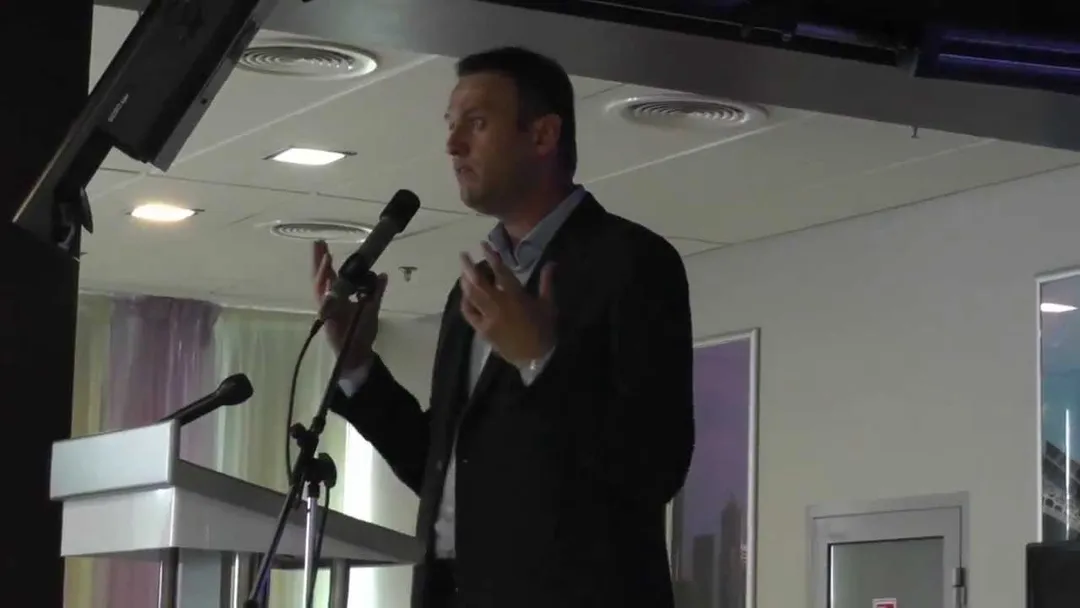
Hello. Thank you very much for giving me the opportunity to speak here.
And I’d like to begin my remarks with a reflection of sorts on
the important point Misha Velmakin made when he opened
this meeting. I respect him greatly and am very grateful
that he is involved in this event.
He said something that sounded strange to me: that we, municipal deputies,
used to be moths, and now we’ve become sparrows,
and ideally we’d like to become tits (small songbirds) — but for now we’re sparrows;
of course, we understand that we’ll never become eagles.
For me, as a Muscovite,
as someone who went to the municipal elections and voted as well,
— unfortunately, my candidate… in Maryino, where I live, it’s all United Russia —
— that sounds strange and even a little insulting.
I do not want to see moths and sparrows in this hall.
In fact, paradoxical as it may sound, in this hall I see
the only legitimate authority in the city of Moscow.
You are the only people
who were genuinely elected in Moscow, paradoxical as that may be.
In Moscow there is a small opposition faction; the rest is United Russia.
All the other elections in Moscow have always been some kind of sham.
And you are the only people who, in a real contest,
won this power and can rightfully claim it.
So you are absolutely not sparrows.
And that is entirely the wrong approach.
When we shout at rallies, “We are the power here!” — well, you are the power here,
in the most literal sense of the phrase, that is your slogan.
When Volodya Korneichuk says, “Navalny,
why didn’t you create a municipal Navalny?” — well, that’s strange,
when an authority elected by half a million… half a million
voters — that’s how many elected you here —
says, “Well, let Navalny’s nonprofit organization help us.”
We will help, and we are helping; we’ll do everything possible,
but as a Muscovite I am not satisfied with a situation
in which deputies are somehow in the position of having to ask me for something.
I do not want to hear the absurd phrase…
It was said: “Sergei Semyonovich (Mayor Sergei Sobyanin) heard our problems.”
Come on… What do you mean, Sergei Semyonovich heard them?
These are my problems.
Sergei Semyonovich heard what Muscovites think, and he will consider,
presumably, whether to solve these problems or not.
Sergei Semyonovich heard about the problem that my school is being merged with the wrong
other school, and for some reason a kindergarten is also being folded into it, and so on.
These are the issues my municipal deputies should be resolving
in my district — the people I vote for.
Deputies are constantly coming up to me and saying:
“There’s this newspaper project; you published a newspaper, so help us publish one too.”
I will help everyone.
But look at the Moscow city budget and see how much of our money goes
to publishing newspapers
in which elected municipal deputies cannot write anything at all.
It’s an absurd situation.
And I would like to say, and to call on all of you,
that we must now frame this as a political issue.
We have elections now.
All of you have been talking about the same thing; all these slides were about one thing —
that we do not have the authority we are supposed to have under the law.
We do not have enough money,
we do not have the powers that should legally belong to us.
When deputies elected by fifty or a hundred thousand people in a district —
that is a city, a huge Russian city; there are only about 20 cities in Russia
with populations over 100,000 — have absolutely no real powers, that is simply a disgrace.
There is no people’s power in Moscow.
So I call on you
to have municipal deputies, together with me and with other candidates,
take part in the Moscow mayoral election.
That means
that we need to
stop acting as this barrier and buffer.
City Hall and Sobyanin want you to serve as a blocking barrier in front of everyone,
so that he only has to compete against those he considers acceptable.
We all know the rest of the script.
Very low turnout.
Sobyanin wins in the first round.
On television he says, “I am now the father of all Muscovites.”
“United Russia has once again earned the public’s trust.”
It will win the next Moscow City Duma election.
It shows up, ballots get stuffed for it — and it wins.
They spit on you again, and they spit on me through you.
And once again you show each other slides about how you have no powers.
So I believe…
Petya, how many deputies are here? A hundred people?
— I’ll tell you exactly in a moment.
Then we’ll extend your time by a minute.
The numbers are in: 98 deputies.
Ninety-eight deputies from 55 municipal districts.
— Just the deputies who are here right now,
if they push just a little harder, are enough to get one candidate through.
The Communists have 200 deputies, and Yabloko has some deputies as well.
Together, we must do everything possible to ensure that all opposition candidates
are able to take part in the election.
So that Mitrokhin is on the ballot,
so that I am on the ballot, so that Melnikov is on the ballot — so that everyone is there.
Because Muscovites must be given their right to choose.
Because that is not for Sobyanin to decide, nor for the Presidential Administration.
And they have drawn up a little scheme for themselves:
these ones will run, these we’ll allow through, and these we won’t.
But municipal deputies must finally become political actors in their own right.
And they should come out and say: “We will coordinate
and we ourselves will decide whom to let through and whom not to let through.”
Until we start putting the issue in these firm political terms,
we will keep showing each other plaintive slides.
We must unite and win this election.
And having started with this election, we must then go on to win the Moscow City Duma election,
where 95% of the seats are currently held by United Russia, which represents no one.
Colleagues, I urge you to be active, not to be moths, sparrows,
tits (small songbirds), or anything else of the sort.
No one needs deputies like that.
What people want in deputies are representatives.
I can see that you represent my views, even if not in my own district.
I am calling on you to go into this election together with me and with other deputies.
I urge you to engage in real politics together with me.
Thank you very much. I am ready to answer questions.
— Thank you very much, excellent.
Two minutes have been saved,
so the Q&A will be seven minutes rather than five.
— I finished early on purpose.
— That’s clear.
So, I can see two people raising their hands.
Maxim Motin.
— Alexei, please tell us
specifically about your platform: who will be writing it?
Because information is appearing online.
So to speak, let’s hear it from the source.
We are writing the platform now.
I am very pleased and proud to tell you that the economic section of the platform
will be handled by the well-known economist Sergei Guriev, the best economist in the country.
To put it very briefly, the political platform will, of course, be
about decentralizing power.
I believe that in our city,
whose budget is five times larger than Paris's budget, an enormous amount
of both authority and money should be devolved to the district level.
What's more, we have an example of this.
In the final years of the Soviet era, we had district councils of deputies,
which had quite extensive powers
and functioned fairly effectively.
So the political part of the program
will be about decentralizing power, about transferring power to the local level.
The economic program will be presented.
As for the transportation program, it really will in many ways
overlap with what Maxim Katz and Mitrokhin have been talking about.
Well, you know that I came out of the Yabloko party and spent a lot of time working on this.
We will present it soon.
I am sure it will
match your idea of what a proper opposition candidate's platform should be,
because I am writing it based on what you are talking about.
— May I ask a question?
— Yes, all right.
— Since I got the microphone. Vladimir Garnachuk, Troparevo-Nikulino.
Well, since we've been discussing public procurement for quite a long time now.
But I have a rather unpleasant question, and it is connected precisely
with the problem of nationalism and illegal migration.
Because this is a sensitive...
a sensitive issue on which your opponents often attack you, Alexei.
And there are documents showing that a street cleaner in Moscow,
under a tripartite agreement between the Department of Housing and Utilities, the trade union of
municipal services workers, and the Moscow city government,
should receive, according to the calculations, no less than 52,000 rubles.
For 52,000 rubles, you could in fact hire
a decent Russian street cleaner...
— Vladimir, what is your question?
What exactly is the question?
— The question is: first, what is the connection
to illegal migration, and how will it be addressed in the program?
In line with what I was saying.
— Yes, what does Guriev think about illegal migration?
— Well, I don't care who is attacking me over this or what they think I should say on the subject.
I have my own set of views.
I believe that there are more illegal migrants, and migrants in general, in Moscow
than are needed here.
The main employer of migrants is Moscow City Hall.
Why that is the case is obvious.
I asked how much my street cleaner earns; my street cleaner earns 18,000 rubles.
It is obvious that part of his salary is being pocketed by officials from the DEZ (district housing maintenance office).
In my program, I will propose very simple measures.
Those companies that work under government contracts
and receive budget funds, if they are caught
using illegal migrants,
must be disqualified and stripped of city contracts.
I believe that the number of migrants, perhaps even their names and salaries—
all of this should be openly accessible, so that everyone clearly understands
how much the street cleaner working in their courtyard is being paid.
And the street cleaner himself should know it perfectly well too.
— All right, please... Next question.
— I don't have a microphone, they won't give me one.
— We are, we are, it's just that the microphone...
— I'm not offended.
Your views are more or less known.
So here is the question: if you become mayor, how will you fit into the vertical power structure,
will you fit into it at all, and if not, then what will you do?
After all, Moscow is not a separate country,
it is still part of Russia, and there are many different federal bodies in Moscow.
So what will you do?
— Did everyone hear the question?
So, Moscow is part of Russia.
If you become mayor, how will you fit into the power vertical?
Moscow is a unique city: it has plenty of money and depends on very few people.
As you may recall, Luzhkov quite effectively waged battles with federal ministers
and with presidents for many years.
When I become mayor, I do not intend to unleash some kind of holy war,
which would lead to a decline in Muscovites' standard of living or quality of life.
But that does not mean I will change any of my political views.
I believe there should be decentralization, which would in fact help Moscow as well.
It will reduce the mayor's powers,
and in doing so it will simply reduce the area of conflict.
— Good afternoon.
— Nikita Yankovoi, Ostankino.
— Good afternoon.
Alexei, please tell us, you haven't said anything about
what will happen if you pass the municipal filter but, for example, are not registered?
What kind of struggle will you continue then? Who will you join forces with?
— I think this is important, and Andrei Klychkov spoke about it today as well,
and everyone said it: we must not call for a boycott.
Naturally, there will be a very great temptation for me, for my supporters, and so on.
Prokhorov probably has a great temptation right now to say: well, they didn't let us into the election,
so let's boycott it, this is not an election.
What would that lead to?
Well, Sobyanin will win in the first round, as I already said, and will portray himself as
the father of all Muscovites.
If they remove me, the situation will not change.
So there you have it: they removed a candidate who passed the municipal filter,
who put forward a program—they removed him.
We will continue fighting them in the Moscow City Duma elections,
and we will decide which other candidate to support.
— Thank you very much.
Please do not seize the microphone on your own.
That is not how we do things here.
Galina Romanenko has been raising her hand for quite a while.
Please speak louder.
— Please tell us, Alexei,
how are we supposed to combine... you, excuse me,
do you intend to combine the party's municipal resources
in order to get through the municipal filter?
Do you intend
by the end of,
let's say, the first round of voting,
to consolidate the voters' mandates that will be given to various candidates?
So that afterward, regardless of who gets through,
who receives the largest number of
votes, that person would be able to put forward those proposals, those mandates.
— I understand the question.
Did everyone hear the question?
So, how are you going to coordinate...
As for the municipal filters.
The system is simple.
There are 100 deputies sitting here: some are Communist Party deputies, some are Yabloko deputies.
So, together we make one big Excel spreadsheet and fill it in:
who has enough, who does not.
And we pass support to one another.
If in your municipality you see that I am short,
and you have already given your vote to the Communist Party, you simply help out,
persuading someone else to vote for me.
Or vice versa.
That is the only possible way.
In effect, the coordination штаб for this work is sitting right here.
There is simply no other way this can be done.
As for the mandates, I think that is precisely why a second round of elections was devised,
with a two-round system—so that the candidate who advanced
to the second round could consolidate all those various demands,
take on certain commitments, and in return receive one form of support or another.
— Thank you very much.
Alexei, your time is up.
Let me remind you that democracy is a procedure.
Democracy is a procedure, dear friends.
Everyone had equal time for their remarks and for questions.
— Thank you.