Alexei Navalny’s speech at the Internet Freedom Conference
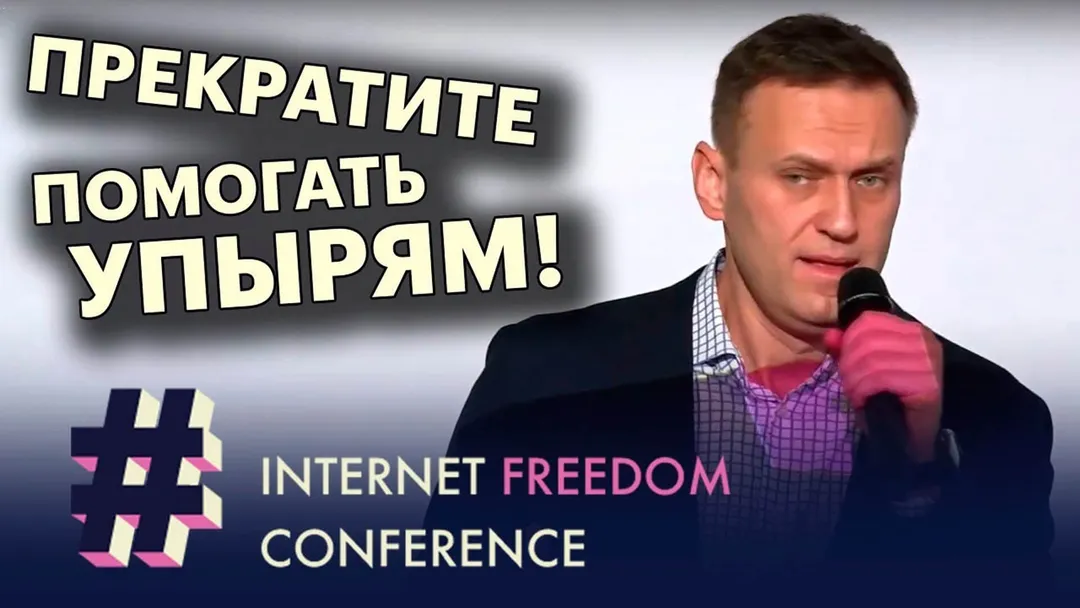
Hello, my name is Alexei Navalny.
Thank you very much for inviting me here.
And I realized what YouTube will look like
when it gets banned: we’ll gather in a
hall on Saturday morning and watch a 40-
minute video projected on the wall. Actually,
I want to start by saying that I
lost an argument to Leonid Volkov, because
of course I said that your entire
internet conference would be broken up to hell
and back. It’s strange that it hasn’t been shut down, although
well, maybe by the end of my
speech I’ll still win that argument
and people will come in who refuse
to obey. What was your formula there with
"Be nice to others!"
All the more so since I see here
Sveta coming in with her dangerous
Instagram too.
Same thing — completely impermissible at the present
time. While listening to Volkov, with these
three
three formulas, I realized that actually
in a certain sense, they apply
to the internet the same way they do to a dangerous person,
and in that sense, a conference on the defense
of the internet is somewhat like a conference on the
defense of political prisoners — exactly the
same thing. The formula is roughly the same:
first they try to buy a person,
then they try to intimidate the person,
intimidate them,
then they try to imprison the person. They
always act this way, with everyone. And with
the internet, it looks like this mechanism
works too. And
Sergei Boyko, speaking here, said that
all the speakers who follow should
try to answer the question of what
is happening, what really
defines the point we’re at
and understand what to do next. But the point
we’re at, it seems to me,
is that our romantic notions
from 2011 about
how, with the help of the internet, we would now
flatten the whole regime here — those ideas, of course,
obviously didn’t work. We saw that
the mechanism of buying people off worked insanely well.
They simply went out and bought up all the
mass media on the internet. They
just bought them. They didn’t torment anyone there,
didn’t torture anyone, didn’t twist anyone’s arms — it didn’t even get
to intimidation. They simply went and
bought them. All those once completely
wonderful outlets — Lenta.ru, Gazeta.ru, and so
on. Now we really do have
very few free media outlets
on the internet. The ones that
do exist are usually small, operate
from abroad, and in any case they’re
fighting for survival. It’s very, very hard for them.
I don’t want to take up much of your
attention. I’d rather draw it
to what needs to be done.
First.
It seems to me that what I’d like to address
specifically to the Society for the Defense of the Internet is this: we
desperately need a giant
I hope you will become a giant
lobbying organization that defends
the internet right now from the good people who
are breaking it. Help me out — who are those cool,
very pleasant, sweet people whom, from a
political point of view, you now very much
support, but who are badly breaking the Russian internet? Well, those cool
ones we all love. No, but they’re bad
people. The State Duma and the authorities are bad people; we
hate and despise them. But the good people —
that’s impossible. And yet they’re among you, they’re here,
in any case, they’re cool.
The company Yandex — they’re cool, we all
love them, they’re great, they’re like us. We
are them, they are us. But who created the main
instrument of lies — in fact the most widely used
one right now? What’s it called — Yandex News.
Yandex News and United Russia (the ruling political party), Yandex...
Yandex News is now the main, most widespread
instrument — far more widespread than
Vladimir Solovyov’s program. No one
watches it; nobody needs it, nobody
needs it. And RT (Russia Today)
— because they lie endlessly — no one else
watches them. But everyone reads Yandex News,
and the censorship in Yandex News is
precisely a colossal
instrument of lies, created by cool, very
pleasant and sweet,
normal people who always vote against
United Russia. How did that happen?
Hell if I know. It seems to me that for this
we need a lobbying structure that, first
and foremost, deals with the good people. Well, the bad
people won’t listen; you can’t persuade them.
But the good people can probably be
made to be at least a little
smarter. After all, Yandex
— it’s clear they were forced to make this algorithm
very strange, one that leads
to the result that Russia’s top news story is always
“Senator Pushkov commented...”
But they’re smart people; surely they could have
done something additional,
something clever — I don’t know — built into their famous
algorithm, included something so that the news
would look at least a little more like the truth,
right? They are smart. And so it seems to me that one
of the tasks of the Society for the Defense of the Internet
is to unite literally millions of people. Everyone
wants to defend the internet. Anastasia
Ivleeva asks Medvedev a question about
the internet, about YouTube — that has the
support of absolutely everyone. They need to be
brought together, including so that, first
and foremost, pressure can be put on the good
ones — on Yandex, on all domestic IT people —
and tell them to stop and to help.
Stop helping the ghouls on your own initiative.
Stop helping the ghouls like that.
Stop diligently helping the ghouls, but if they
force you to do something, then let
it break, let it not get done
as well as you know how. That’s the first thing.
And the second thing is more practical. Here you
have various different sections and groups.
And I was thinking that what’s needed is something
that perhaps you could initiate,
something invented and created so that
the internet, including the internet
necessary for normal
political development in Russia, so in order
to answer the question, let’s
look at this wonderful
young man in the white shirt.
This is Alexander Plyushchev. What is
Alexander Plyushchev doing together with his
colleague Michael Nacke, with whom he hosts broadcasts?
They host streams where they rather greedily collect
donations, and we all need to make sure
that they collect more donations and
earn more money. Why? Because
that is the point the state will strike at
most of all right now. They
understand that the internet is huge; in it
you can make money, and in it you can become
independent of the state, and that simply
drives them crazy—that there are some guys
who put a computer in their home and say things there
without asking anyone’s permission. It really infuriates them.
And that’s why they
you see,
the whole campaign against BK is built mainly on
this. They are trying to cut off
any ways of legally receiving money,
making payments, functioning at all in
some sense. Probably the actions
of the authorities
will lead to a situation where in a couple of years we
will all become quite sophisticated
guys and girls in the field of
cryptocurrency, and we’ll learn to use it
better, because they will
push us out of normal money. But I
just want to say that, as it seems to me,
now is a good time for
journalism, now is a good time for
making content.
Now is a good time to
earn money on the internet independently of the state,
but mechanisms are needed. That is,
in any case, if you earn money, you
have to receive some money and put
it in your pocket. Alexander Plyushchev and Michael
Nacke should, I don’t know, buy all the airplanes,
a yacht, and sail off somewhere racing each other.
In a race.
That’s the only way this works. So I’m simply
calling on your community
to devote serious attention to this. We
must—the state is pressuring users and
trying to squeeze them out and make them
destitute,
make them poor, make them
illegal. We need to invent methods such that
a person in Moscow,
a person in Tatarstan, or a blogger from Chechnya
can live normally and earn money,
earn, develop, have a large
audience, and do it in such a way
that the state cannot
crack down on them. It’s quite difficult, but only
this is the future. If you and I do not
manage to invent such a system,
set it up, and truly make it
mass-scale, it will of course take some time,
then the political internet is doomed
to slide into marginality. But we
of course will not let that happen. The last
thing I want to say, and from what
Leonid was saying, about the prospects
awaiting us from the point of view of the state’s offensive,
I would say this is my
personal forecast, looking, by the way, at our
latest video about Asker-zade and Kostin
on Kosmo.
Raise your hands—I’m just curious.
Excellent. That’s where donations were coming in.
I think that starting next year
all internet censorship will proceed under the
slogan of protecting privacy. Look,
not long ago our latest
investigation by my Rostov headquarters
was blocked by YouTube because
there were complaints about the inviolability of private
life. Any corruption investigation,
any claims against officials, one way or another,
can and will be framed as violations of their private
life, because showing their
photographs, photographs of their children,
their yachts, steamships, newspapers, and so on—this
will all supposedly count as private life.
So I expect
a legal offensive precisely
along these lines: you must not, absolutely must not,
you must not talk about Kostin and Asker-zade,
and you must not show private
life because it does not concern you.
Please: no faces, no children,
no passport numbers, no
names of offshore companies, and so on, and so on.
And so it seems to me that we need
right now simply to understand in advance that this
is coming and prepare for it, because all
of this will be done under the slogan, under the
pretext that, well, this is already how it’s done in Europe,
this is already how it’s done in the U.S., and so on.
Thank you very much. That’s all I wanted to say.
But in closing, I just want once again
to thank you for inviting me.
It’s great that you exist, it’s great that you
haven’t been dispersed, it’s great that for now
the state does not understand that the people
gathered here represent
a much greater danger to it even than those
who took to the streets of Moscow in the summer.
Well, as I understand it, it was you, and you...
have gathered here, and in the end
the internet will win anyway, and therefore
in a way, I am at a congress of future
winners. Thank you very much.
[applause]
[music]