Alexei Navalny’s speech at the Democratic Choice party conference
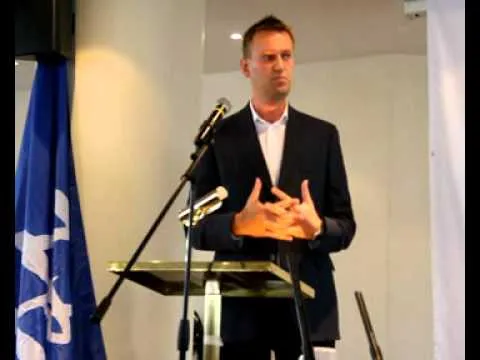
An event that we are holding for the second time already
Usually, opposition
gatherings are all held in order to
nominate someone at the end, support
some resolution, merge into a single
ecstasy over something, and, uh, events where
there is simply a substantive and
good-natured discussion of important issues.
They are very rare; they practically never
happen. This is the second time I’ve taken part with great
pleasure. Thank you very much,
Vladimir. Please, just
don’t quarrel with anyone.
Ah, about the authorities.
More than a year ago, speaking at a similar
conference, I began by saying that
there was no window of opportunity
at all. Yes, now I would like with
satisfaction to reaffirm this
thesis. There is no window of opportunity.
And to this we can add one more
generally positive point.
There is no need for us to rush.
So, uh, it has all happened. The authorities
have definitively confirmed that, on the one
hand, they have exhausted their capacity
for any positive change, that
there really was some reform-minded faction among them,
but that faction has suffered
defeat, unfortunately, to the great
and the authorities, and specific people within them,
have announced that in effect they
have openly said: yes, we will usurp
this power, yes, this power will
belong to us for life. And that
remarkable political
clarity is a big plus for
us, for everyone. And I believe that it is
always better when the guy who
holds real power is also its
formal holder. And finally, now
there is no longer that duality which
allowed many of us, some of us,
us
to take up certain
rather vague political
positions and created a certain confusion in our
ranks.
More importantly,
everything is clear with our authorities; the more
important issue, it seems to me,
is what the opposition should
do. The opposition.
It seems to me the time has come when the old
worn-out, but only correct
slogan
“honesty is the best policy” can absolutely
be applied to the opposition both as
an ideological foundation and as
an organizational one.
Right now, we can conduct any campaigning
only on the basis of
honest and sound arguments. In order
to persuade the public of something, in order
to run a campaign,
there is no need to lie,
or manipulate facts, or do anything
of the sort.
It is enough to explain fairly and soberly
what is happening. There is absolutely no need
to distort anything in order
to get the public to follow us. I
believe that in the near future, over
the next two years, the opposition should
focus on conducting
campaigns and on
building a new kind of organizational
structure. When I speak about campaigning,
it is most often perceived
in a negative context, because
people immediately drift into allusions from
the old “going to the people” tradition (a 19th-century Russian populist idea). Some
bespectacled university types going to the peasants
in the village, and the peasants beat them up and hand them over to the
gendarmerie (the tsarist political police). But all these
historical parallels are no longer
relevant at all.
And running campaigns now
really does
strike the authorities seriously and effectively. And
we can see that probably one of the
campaigns with which I am partly
involved, “the party of crooks and thieves,”
is spreading quite effectively
on its own. Why? Because it is
true. And I am absolutely convinced, and I will once again
repeat the point I made at the
previous conference: that Putin’s regime
is based on his real popularity.
That is, Putin does have real
support. But whereas before 2003 this
support was growing and was solid,
because the authorities had undoubtedly
achieved certain successes in governing
the country, after 2007 that support
has rested more on
media propaganda. And our task is to make
sure that every person in the country knows
about Gun. Our task is to make sure that
every person in the country knows about
Rotenberg. Our task is that in this country
everyone should know about the Kovalchuks, about Ramzan
Kadyrov, and about all these strange
things that are happening. And all the
technological means for this
already exist. Running this kind of campaigning costs us
0 rubles and 0 kopecks right now. And we can reach
millions of people. What we need is not—but rather we need to
finally stop talking about how
There is no such thing as online and offline. There is
some supposedly real, actual life, and then there is
virtual life on the internet. That is all
complete nonsense. Right now we can
reach, through the internet, once again,
spending 0 rubles and 0 kopecks, millions
of people, and they in turn will then
carry it into the so-called offline world, that is,
to people who have absolutely no
access. Time is on our side.
Internet penetration is growing. Therefore,
let me repeat, campaigning efforts
based on honesty, without any
distortion, without propaganda,
will bring us
serious, serious benefits and serious
serious impact in that they will
strike at the foundation of Putin’s regime, its
real popularity. And with
serious effort in this
direction, Putin’s approval rating will fall in
the coming years, I think, to below 15%,
which, broadly speaking, will seriously change
the political situation in the country. Second,
organizational development.
And I believe that the opposition—I think that
Vladimir Milov will not actually agree
with me here, nor will some
of his other colleagues. I believe that
organizational development should
proceed in fundamentally new forms, and
again be based on the principle that
honesty is the best policy. Let us
say frankly to ourselves: first of all, all
attempts to register
formal opposition parties have not
succeeded, because the opposition itself does not
believe that it has a real
60,000 people. Yes,
the opposition does not believe it, the authorities do not
believe it, and they know that the opposition does not
believe it, and so on. In other words, everyone
understands everything. And therefore, when someone
is not registered, well, they are not registered, and
no thousands come out into the streets.
We need to move away from this paradigm
of following the Justice Ministry’s instructions and
registering formats, forms—let us call them
proto-parties of some kind, right? And their main
goal should be to have
those proverbial 60,000 or
100,000 people, or however many
real thousands of people. And here I
will once again speak as an advocate
of electronic democracy systems. I think
that Leonid Volkov will speak about this today.
I believe that these systems
are beneficial and effective because,
first, they cost nothing, they are
organizationally accessible to us, people in them
are verified, and we will know for certain
that these people really exist.
Organizational development will, as I have already
said, involve very low costs. And what is
important is that we will finally be able
to switch
to new systems and formats for electing
leaders. What had been happening up
to this point? Simply by virtue
of the fact that there were technological barriers,
the only way to struggle for
leadership was, for the most part, intrigue.
That is, there are parties, there are party
congresses, there are delegates, and your internal party
struggle basically comes down to
scheming in order to win over
let us say, 150 delegates
out of 200. Now this is no longer necessary. There is no
need to waste time on it. And these
so-called opposition leaders should
be elected by thousands or
tens of thousands of people. Right now we have no
barrier that would explain why we
make all decisions
through congresses and conferences.
Now all the most important decisions can be
made by direct voting of all the people
participating in a given organization.
That is, thousands of people can
take part in this. And this can now be carried out
in such a way that no one has
any doubts that there is some kind of
falsification or anything else here. Absolutely
honest voting, and people are elected by
thousands of grassroots activists. This,
and this is no small thing, will also give
the opposition leaders the necessary legitimacy.
leaders.
2 minutes.
2 minutes. Thank you very much. Right now our
opposition leaders’ legitimacy
is based mainly on the fact that they
held some good positions,
high-ranking or lower-ranking, though most often high-ranking
posts in the executive branch, which,
naturally, is excellent and
constitutes
a good background, but it should not
be the sole basis for occupying
those leadership positions in the opposition.
What matters is the real support of thousands of people. That is what
will give us, well, that very table
of ranks—who is stronger and who is not. And,
finally,
we will move away from all this intrigue,
from all this squabbling. It is clear that
if you came in second place and you came in
third place, then that is the order in which you stand.
and sit on the presidium. And everyone is
fine with that. And then the following year you can
throw down a challenge to the guy
who came second, and end up not
third, but second or even first. That’s
perfectly normal. And that is exactly what we
need. So, uh, in closing my
remarks,
organizational development must be based on
systems of electronic democracy and
systems of,
let’s say, primaries and direct
voting by large numbers of people.
Let’s also, uh, admit to ourselves
that maybe the primaries that were
held by United Russia (the ruling political party), they were
absolutely awful, and maybe there was
50 percent fraud there, but in any case it was 10
times more honest than all the primaries
that the opposition had held up to that
point. That is an absolutely undeniable fact. And
until we ourselves—until our own
organizational development within
the opposition becomes an order of magnitude more honest,
more transparent than the authorities, we will
have no way of defeating them.
Honesty is the best policy. We must
show everyone a moral, if you like,
an ethical example. In order to
defeat them, we have to be better than they are.
I believe we are ready to move toward that. We
are ready to choose the best from among ourselves. And we
are ready ourselves to act and live by
the principles of democracy, the principles of
openness and transparency. There can be no
despondency. Frankly,
I don’t know where all this talk comes from
about everyone supposedly getting ready
to leave. Nothing has happened. We lived until
September 24, then they showed us something
on television, and we clutched our heads.
Oh, what a horror, we’re all leaving somewhere.
No one is going anywhere. I repeat, this
government will change. It will not change through
elections, but it most certainly
will change.
If we devote substantial
effort to this—honest effort, conscientious
effort—we will replace it within the next 3 years.
Thank you,
Alexei.
[applause]
Yeah.