Alexei Navalny’s speech at a rally in Galich (Kostroma Region)
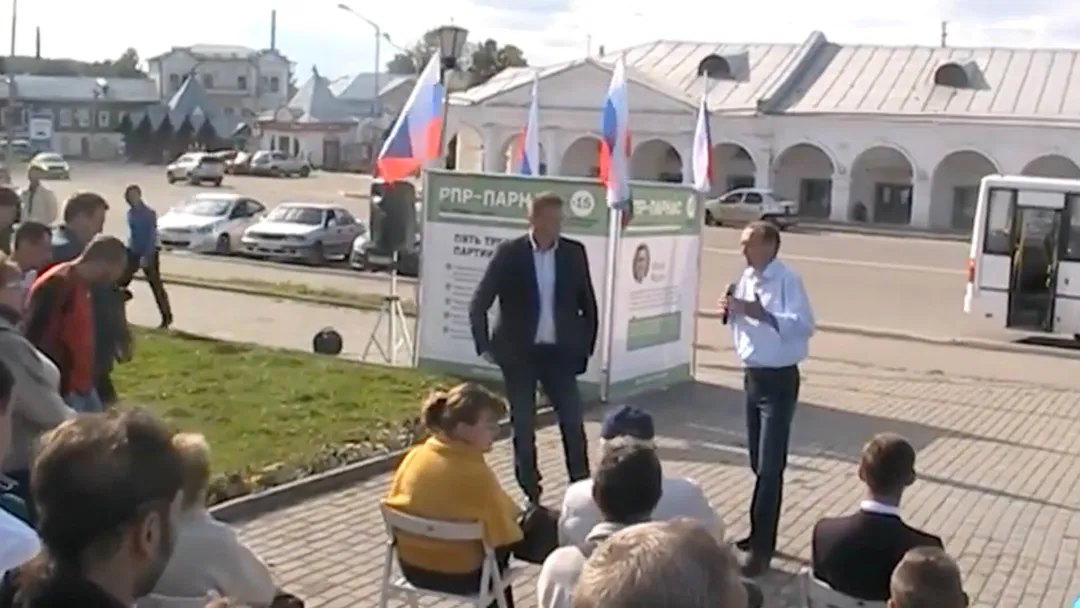
I look at Kostroma Region now,
where elections are taking place and which, for some reason, has suddenly
officially been deemed by our authorities to be one
of the poorest regions in the Russian
Federation. I keep asking all
officials the same question: why is it that
Kostroma Region is somehow
this uniquely poor place? Do you know that
your regional debt amounts to about
20,000 rubles per person, including the elderly and
children. People here seem perfectly normal, ordinary
people, just like in other regions: they live, they work,
they pay taxes, they earn wages. And yet all that they
have produced has somehow turned into broken-down
roads, which have become the calling card
of Kostroma Region, and debt of 20,000 per
person. That cannot be right. I look
at the budget, and you can look too. We know
that our country is the number one producer in the world
of oil, number one in the world
in gas production. I see that in
Kostroma Region, without any oil or gas,
a huge amount of taxes is collected, and I studied math
in school. I know
that 2
minus
3 equals 0. But in your case, 3 minus 3 somehow... Well, I came
here to campaign against the authorities
because the authorities have created a system
so perverse that everything collected on the territory
of Kostroma Region is simply taken away to
Moscow and nothing is sent back, while the
money that belongs to all of us
from oil and gas revenues is simply
stolen. And this is not just a figure of spee
People often say, “they steal, they loot,” but this is not some
theoretical idea. Over the past 17 years,
Russia has received from oil and gas sales
about 3 trillion dollars. An enormous sum.
Who do those 3 trillion belong to?
If they were taken out of the ground, then who—well, really—
who should they belong to?
To the people—to us, to you, to everyone standing here—just as
it happens in Norway, just as it happens
in the Arab Emirates. It is national
wealth; this national wealth
should belong to everyone. Where are the traces of this
national wealth?
What has been built over these 17 years? Where is your
share of the national wealth? And I see
that there are various rankings in which
our country stands: in the ranking of
life expectancy, we are falling;
in quality of life, we are falling;
in education rankings, we are falling; in rankings
of the state of housing and utilities services, we have already
collapsed altogether. I won’t even mention
the rankings for the condition and number of roads. But
there is one ranking in which Russia
is steadily moving forward. Who knows which one? Well,
corruption, of course. And what other ranking?
The number of billionaires per capita.
There you have it, there you have it—that’s the math.
It’s very simple: if the country is so poor,
as the government tells us, then why
are there so many billionaires? That is where
those 2 trillion went. They
carved it up among themselves that way. Well, some of it
spilled over into their pockets.
In the number of dollar billionaires,
we are second only to the United States. That is why there is such
poverty. That is why, without any fear
that they will open a fourth
criminal case against me, or accuse me of
slander, or once again say that I
came to Kostroma and incited someone to do something,
I say to you boldly that power in this
country has been seized by thieves. These thieves have
dragged everything away, and I came here to urge you
to vote against these thieves,
to vote for the party that will
hold all these people accountable. We need to begin
with oversight, because, just look
at these simple things.
What happens? The head of the state
company Russian Railways, Yakunin—you know, the former head now,
he left a week ago. It was our Anti-Corruption Foundation (ACF)
that produced those
famous photographs of his estate. It was
we who established that while he
was heading a state company,
one son lived in London, another son lived in
Switzerland, and both sons were officially
millionaires.
Officially. We look into his business,
and it turns out that the areas around railway stations
all over the country were bought up
by his son for some reason, who then builds hotels there
using Russian Railways money, and so on and so on. Well,
this is obvious corruption, isn’t it?
Really, tell any ordinary person—you don’t need
to be any kind of investigator. There it is,
corruption: take him, charge him with abuse
of office, and jail him.
Does that happen? No, it does not, because
someone has to keep watch over this; someone
has to deal with it; someone has to demand that
you put him in prison. It should not be Alexei Navalny
who demands it; deputies should be demanding it. But
look at our situation: the prime minister belongs to
which party? United Russia. In the Duma, which party
has the majority? United Russia.
Here in your region, who has the majority? United Russia.
Who does the police answer to? United Russia.
The prosecutor’s office? United Russia. The Federal
Security Service? United Russia. If
everything is United Russia, can it
possibly oversee
itself?
I may be asking a silly rhetorical question, but still
this is what is happening in the country we live in, and
before our very eyes Yakunin builds himself
some colossal estates. He was
dismissed last week. And
what did they do—put him on trial?
No. Punish him? No. Instead, Medvedev met with him,
shook his hand, and gave him
a certificate for excellent
his work
under a monopoly that is subordinate
Only United Russia is supposed to be in the Duma, but at least
you should at least get your Kostroma people in there
who will say these words without fear
When you talk to any United Russia member, well,
he says it directly, just like that
“Of course you’re right, Navalny, well done, you’re
right, but I can’t say that, I’ve got
the party to think about.” That’s why they stay silent
about all these obvious things that
need to be said from the podium, all of them, every one of them
and yet they stay silent. You have a party running here
I’ll repeat: I’m not even a member of this party, and
the candidate Andreychenko, who is standing next to me,
I only met him a few
months ago, but I came here to campaign for him
because when he was deputy
governor of your region under
Slyunyaev, he fought Slyunyaev
in court, he sued him and won those court cases
when Slyunyaev tried to bring
criminal cases against him and put pressure on him
his relatives were fired, and so on
but he still won all the court cases
Can you imagine winning court cases against
a governor in his own region? It’s practically
impossible. He did it. He was one of
the people thanks to whom Slyunyaev
not only fled from
the Kostroma Region, but even changed his
surname, and now in the city of
St. Petersburg he goes by
Albin. So I would like you, in the election,
to come out on the voting day and support the party
RPR-PARNAS and send Andreychenko and Yashin to
the Duma. These will be people who will not
just sit there nodding and saying
yes to every word from the governor
they will ask questions: Why
are utility rates so high? Why are our
Kostroma taxes going to Moscow?
Why are medicines that should be free being given to us for
money? Tell me, please, are subsidized
medicines from the approved benefits list easy
to get here?
for free? I ask this question in every
town in your region, and everywhere I hear: no,
they don’t give them out. Why not, if money for them
has been allocated? I want Andrey to go up to
the podium
and say: money was allocated for
subsidized medicines, so why are they being sold?
If someone is selling them, then the money
is being pocketed. That’s the kind of person we need, and
that’s why I came here to campaign for him
My friends, I’ll be happy to answer
your questions. For now, I’d just like
to hand the floor over to Vladimir so that
he can also say a few words to you
Thank you.
Thank you very much, Alexei. Good afternoon
dear friends here. Perhaps this is my second time
some of you were already at the meeting
when we were here with Ilya Yashin. But
a lot has changed over these two weeks, and
well, what I wanted to say is that I wanted to ask you
to forgive my opponents
from United Russia, who, excuse me,
are feeding you nonsense. We’ve just arrived, and
we’re told that locals are being told
that if you vote for PARNAS, and if PARNAS
wins, the truck crane plant
will be shut down. You know, that kind of
nonsense, that kind of rubbish—well, well,
probably not even a first-grader could come up with it
It’s just that, unlike perhaps
those now in power in Kostroma
in United Russia, I perhaps know better than they do
that the truck crane plant got a kind of new lease on life
when the Kostroma Region
was part of the “red belt” (a group of Russian regions known for strong Communist support), and Shershunov
was called a “red governor.” Yes, well,
it was under a “red governor,” after all, that
the investment project began
to be implemented. So this kind of
stuff and these tales they’re feeding you
this third-rate
dish, so to speak—it’s simply disrespectful
to you. It’s an attempt to play on
some foolish things. Naturally,
if PARNAS wins and gets into
the regional Duma, there can be no talk whatsoever of closing
the Galich truck crane plant
because it simply can’t be that
if seven years ago, while in office, I
met with Mr. Belov and he
shook my hand at the celebration of the anniversary
[music]
of the truck crane plant or whatever—it’s nonsense. But anyway
so, excuse me, don’t pay attention
to those pathetic people. But those
pathetic people, for example, won’t tell you
that your Vodokanal-Service
provides water supply services
and the water rates are probably the lowest in
the region—the highest, in fact. And where do you
pay? To the RCC, right? The RCC collects the money, and
Vodokanal-Service and the RCC are all managed
by the company Rusenergocapital
the same Rusenergocapital. And who is Mr.
Dmitriev? One of your own, from Galich
Yes, exactly, the very man who is now
running for the regional
Duma from United Russia in the city of Kostroma
there he is. But United Russia won’t tell you about that
they tell you instead that PARNAS will come and
Mr. Dmitriev will start feeling uncomfortable when
he has to answer why and how exactly
he sets the tariffs
for Vodokanal-Service in Galich, what those tariffs are
and why his company alone controls them. And
I personally know where this
RCC came from—it’s all a consequence of
that idea when municipal
settlement and cash centers were shut down and
this company was created instead, the one that
collects money from residents. They even
They tried with the city water utility 3 years ago to...
in Kostroma, the city water utility—this is what
they won’t tell you about. They scare you
with some mythical factory closures. We
do not want to shut down factories. We want
you not to be robbed. That is exactly why we
are going to the regional Duma. I have lived in Kostroma
Region for 30 years.
They are now saying about me, well, your own
fellow countryman, God forgive me, Lyosha Anokhin. Well,
Alexei Alexeyevich, now he
is saying that I am here stirring up
trouble and practically burning tires, but
he would never say that to my face. He
he tells that to veterans about this,
to some old ladies. But to my
face—he won’t even call me. He has
my phone number. He could call and say,
Yurich, what nonsense are you
doing here?
That is why
we want—our candidates, our list—we
want to go to the regional Duma only
to work. We do not want to be deputies as such. Look,
believe me. I spent 15 years in
government, and honestly, I have already seen everything there.
I’ve seen it all there; nothing can surprise me. My
having it written on my business card
that I am a deputy of the regional Duma—well, my
personal vanity will not grow
because of that. It does not interest me. But I have seen
other regional Dumas, the second convocation,
the third convocation, where the deputies were not
silent fish. Where people stood up and
asked the authorities questions, where they brushed it
the wrong way, where we officials, when
we came to the regional Duma, excuse me,
would sweat from their questions and from the tasks
they set for us. But over the last 10 years
nothing like that has happened.
In general, I believe this is
wrong. Since regional issues exist, they must
be discussed, and unchecked United
Russia should under no circumstances
have a harmful effect on your lives or on the
development of Kostroma
Region. So we are not enemies—on the contrary,
we are friends. And we are real patriots, not the kind
who write “patriotism” on posters,
“stability”—yes, they have stability.
The state debt was 8 billion rubles and became
16—consistently high public
debt, consistently equal to the region’s own revenues
of the regional budget. That means, basically, there is no money in the
region. We believe this must be
resisted. We want to
resist it. We feel your
support. We know that we are
not alone. And we know that if
we did not enjoy
people’s trust, they would not be launching
all kinds of smear campaigns against us now on TV channels and
they would not be saying that we are here planning
to eat babies. This is happening only
why? Because they are afraid. They are afraid
that we will keep telling the truth.
Right now they are hitting us for the truth, and we will
go on speaking this truth. But we are not
afraid. We are ready, and we will work
for you. Please support our
list, support the list of the RPR
PARNAS party, and you will choose, well,
worthy deputies who for you
over the next 5
years will fully repay your trust, and you
will not have to be ashamed of your choice.
Thank you, thank you very much, Vladimir. Now,
before we move on to questions, a man
already came up—he has a question. I just have
a small remark. I found your dialogue about
the water utility interesting. Yes, everyone
knows everything, everyone knows everything, and it is very
interesting. I have just arrived from Buy
where in the city there is simply such a
Leviathan—the mayor of the city owns
everything there: television, the newspaper, local
utilities,
roads, public services, housing and utilities—everything
belongs to him. I ask people: do you know this?
They say: we know, of course we do. We’ll
tell you everything ourselves right now.
A mafia that operates
openly, just openly. The residents of a sizable
town know that they are ruled by an
organized criminal group. And here, with your
water utility, when the ruling party itself
sets the tariff for itself and itself
controls itself—well, that is effectively
a crime, at the very least a conflict
of interest. Everyone knows everything, but they stay silent. And in
Buy, a woman then came up to me
and said: yes, we know, it’s the mafia. But you
have come now, and you will leave again. That is the plain
truth. But how are we supposed to fight
it? Well, then let him fight it.
Choose, yes, a person who will
fight. If he is now saying that I
will fight, and we know that he has fought
before, then let’s give him a chance, let’s send
him to the Duma. Let him go around and break up
this mafia. If he does at least something,
that will already be good. You had
a question. My friends, we are ready for questions. You
wanted to ask a question—go ahead, you speak,
and then I will repeat it so everyone can
hear. A microphone? Yes, give him one. Let’s give you
a microphone, yes. Briefly.
All right, let me hold it if you want. Here.
Personally, I am a builder, and I...
Porus
the house of the merchant Gromo... house
the head of the city district, Shpanov, this is
a museum. You Russians, you were wonderful
builders, wonderful...
...Litvinenko’s blood, you know? You know, yes, he is
gone now. Govorukhin wrote Russia We Lost
(Russia That We Lost). You...
[music]
lost it. Fools. I’ve been to Poland, to
Germany, and unfortunately I haven’t been to Muslim
countries, but they live perfectly well,
guys. But look, this is important.
I see, thank you. Please sit down. An important
point was just made, and I completely
disagree with you. That is, I agree that
it really is a wonderful town, but
this idea that “you lost it” — but who exactly are “you”
really? Who is the complaint aimed at? Look,
the problem is something else. The problem is that all
the money is being siphoned out of here. Galich developed and
was a real town when Galich’s money
stayed in Galich. But now we have
an idiotic system. And with what money
are people supposed to build anything for themselves or
make repairs when all the taxes
collected here are taken away? Kostroma Oblast
collects billions in VAT. How much do you
think of the main
tax — value-added tax —
that is collected in Kostroma Oblast
stays here? Any
guesses? Five percent? One? Zero? 0%.
stays here. That’s why we’re saying
something simple: fine, not 100% — leave us
20%, and there will be money to actually
do things, make repairs, and so on. After all,
what is the town of
Galich — founded who knows when — for?
So that people can live here. We need
to build ourselves a country in which we ourselves
can live normally. That is
the key national idea. And when
money starts staying here, then things will begin
to develop. As it is, it’s no surprise that
people drink themselves into ruin. Kostroma Oblast
is, of course, depressed; of course people
are leaving it. There are no jobs, no life,
no medicines, no way to get treatment.
It’s impossible — of course people leave. So
let some portion of the taxes remain
here, and let some other part go there.
How do we do that? That’s the question, because
right now the official position of the ruling
party, United Russia, is that everything should go to
Moscow. Your governor, for example, will come
here and say, “Damn it, Moscow took
all the money, we have nothing,” but
make him say it. “You’re the governor —
officially state the position: demand that
regional taxes be left here.” But no, no, sorry, I’m
afraid not a single United Russia member
will do that. There must be people
who will say it out loud. Andreychenko
will say it. I see a
question over there.
Please.
Of course. So, when you met with people around
the towns and so on, did you fight in the same way
when you were still in
power? Well, I’ll tell you honestly: when I was
in power, well,
I traveled around the region quite a lot, a great deal,
because at that time the authorities in
the Kostroma Oblast administration
believed that
the whole region had to be developed. Now they
tell you that what needs developing is
Kostroma, Volgorechensk — that’s where
technology parks and the like will be created. When I
worked there, we had a somewhat different
approach. Well, ours was somewhat — well,
sorry, I can’t speak for
the governor or the deputy governor. Yes, I
was at a somewhat lower
level at the time; I did what I was supposed to do.
So yes, I dealt with what Alexei
is talking about — I know it perfectly well:
relations with the Ministry
of Economic Development, with the Ministry of Finance,
under what conditions, what specific
requirements had to be met for funds from the
ministry to be transferred into
the regional budget. And if you don’t meet those
specific requirements, then
the region receives nothing at all under certain
programs.
So it’s hard for me to say that I
was out there fighting. Well, yes,
basically.
That’s why I believe — and my main
conflict with
him came after I had already
left my job, because, well, well, well, I know how this
system works. Yes, I’m not going to stay in the system,
so to speak, but I think it’s wrong. I
left the system and started telling him,
speaking openly and publicly as much
as was possible. So I know perfectly well
all the region’s issues and problems.
For example, now when I look
at the regional administration, I
get the impression that apart from
the governor, nobody there works, because
every day on the administration’s
website they write:
“the governor instructed,” “the governor gave
an order,” “the governor demanded,” and so
on and so forth. Everything is the governor, everything
the governor demanded. It creates the
impression that there’s nobody else there,
that he’s the only one. But my previous
protégé, so to speak — yes, he too, he
also gave orders.
They counted 12,000 of them over two years.
Twelve thousand orders. The result? The result was debt: 4
billion when this gentleman arrived;
now it is
16. Friends, can you imagine?
My friends, let’s — that’s an excellent question.
Let’s say I’ll ask it too. I met
Andreychenko two months ago,
but did Andreychenko fight the governor
earlier, fight the authorities earlier? I don’t know him
well; he’ll say something now, and I’ll try
to piece together that chain from what, well,
is openly written there in the newspapers about
I read about him in the newspapers too, when we
were deciding whom to invite onto the list, yes, that’s exactly
what we did. I see a headline:
official Andreychenko sued
Governor Slyunyaev. Was that fighting? Well,
to me, yes, he was fighting. Then I see: official
Andreyev won a court case against the governor. Was he
fighting? He was, and openly. Then I
read further:
Andreev continues litigating anyway. To
me, that’s fighting too, you understand. Maybe he
wasn’t tearing his shirt off in outrage, but how many
officials are there at all who
sue their own governor? Well, frankly
speaking, if I asked you to name three,
you’d hardly be able to name even one.
It’s more of a unique case, so I
know Andreychenko even less well than you do. I
think he should be sent to the Duma
now so he can keep fighting them there.
Next question. When are the documents—right now,
right now, right now.
Wait, the water—together with... Wait, one at a
time. Come up, miss, ask your
question. Could one of your people, just specifically on
let’s do it this way: who, who is specifically
from Galich? A question. Are you from Galich? Do you want
me to show my passport? Behind me, behind me
are all the women of Galich; behind him are all the women
of Galich. Shall I give you the microphone? Go ahead.
Yes, gentlemen. You’re lawyers, right? Yes. If you
teach the women of Galich how to get clean
water in Galich, we’ll make
all the men vote. Just tell us how, because
I pay 50 rubles for water, and for the filter I
pay twice a month: 60 plus 60, 120 rubles
Plus I buy drinking water, uh, 142
for the canister, uh, 280 rubles, so instead of 50 rubles for
water
it comes to somewhere around
500, and on top of that they shut my water off. They say they’ve
got some kind of cleaning going on, and then some
other thing as well. They don’t wash the streets, the lake—
the lake is right there, five minutes away, and
on my street, Lermontov Street leading to the hospital, they never
wash the streets. The dust rises higher than the houses, and we all
breathe it in. So do something. No, don’t
do it, don’t do it yourselves. Let your deputy
teach us how.
This is an astonishing question, really.
The town is, generally speaking, located in an
environmentally clean area on the shore
of one of the largest lakes. I live
one kilometer away from
an oil refinery, and for me that
would be a relevant issue. But the fact that in
Galich people are fighting because they
don’t have proper drinking water is
absurd. It’s very simple: to teach us, you need
to look at what the tariff is made up of, because
you pay it. You get a utility bill,
a housing and utilities bill, and included in that bill is, among
other things, the purification of drinking water. You pay
for that, but there is no one person
who will come right now and start digging into
what the tariff consists of, who is taking this
money, where the filter is at the station, and so
on. Why are you paying for pumps when they’re
old, and so on and so forth? I don’t
have a magic wand
that
will make the water in Galich wonderful, no. But I do
have a person who, on your behalf,
will come and look into what is wrong with
the housing and utilities tariff, and who is stealing the money
that is allocated to make sure the water is
clean. Are you local? Please, let the locals—
please, I’ll just add a little. The woman
who spoke, she
was
for... elections, for fair elections. First of all,
that’s what we need to fight for. That’s one point. And
the second point: Alexei, you are a rare guest in
our town, a very rare one, yes. So, yes,
therefore, well, I want to give you a little gift
and invite you to a photo exhibition:
“Galich at the Beginning of the 20th Century in Photographs.”
That is, Galich 100 years ago was
a completely different town, and perhaps it would be right
to also emphasize
that the money collected in the form of
taxes should, for the most
part, go into the local budget so that
the town can develop, can
build proper roads around it, so that it
can do other things as well. So now I
thank you.
Very much.
Thank you, that’s very nice. You came right up. Usually
they say voters are bribed, but here people
are giving gifts to candidates. Thank you very much,
I’m very pleased. Yes, please, yes.
Please, of course, yes. Go ahead, yes, you.
Alexei Anatolyevich, a question. I’m also a resident
of the town of Galich, we follow what you do. Thank
you for
that, and I have several
questions.
In our country, in Russia, life is very
hard in general. Aren’t you afraid of
this, so to speak, open terror
that has now been declared against
the opposition? That’s the first question. The second
question: will you run in
the presidential election in that
year? Third question, the third question:
explain this to me. You know, here
our pensioners, average residents of Galich, receive
well, up to 9,000 rubles, and basically the same
goes for salaries. How can anyone live, especially
a young family, on that kind of money? I’m
also asked this question constantly
by people in Galich, looking at how much our officials
earn. We were just sitting here
talking on the sidelines,
and it’s not 50 times more anymore, it’s probably 200 or
300 times more. This, this—this is
something we simply cannot understand: why?
That’s exactly how it seems all the time now.
that the Soviet Union is coming back, but back then in the
Soviet Union, a pension was 120 rubles, while
an official from the Party’s Central Committee
earned, well, 700 or 800, so it came out to a 10-fold
difference, certainly not 300 times, so that’s why
Please answer my questions.
Thank you very much. So, I’ll start with the first
question: am I afraid?
Believe me, it’s easier for me than for him, because
when I was jailed on a fabricated
case, people came out in my support, and I was released
the next day, even though they had sentenced me to
5 years. When there are constant
searches at my place or they put pressure on me in some other way,
a lot of people are watching what’s happening, and I
have a lot of support, which, all in all,
gives me strength. But for people like
Andreychenko, it’s 100 times harder. Because
when you’re somewhere in Kostroma or
even in some
Bui, right here his wife came up and said, I
have to deal with the local mafia here,
which gets money from that same
mafia — well, you know how all this
works, no need for me to explain it to you — and so
when I think about what happens to
those people on the ground who are fighting
crooks, I tell myself: what do you have to
be afraid of? They have it 100 times worse, and if you
get scared, they’ll crush them completely. That’s
the first point. Second, about the presidency. Well, I was
pleased that some of you applauded, but
at the moment, as someone convicted three times,
as a criminal offender, I am barred from taking part in
elections. That is exactly why these
criminal cases were invented: so that I would have no right
to participate in elections. I took part in
an election once and got 30% of the vote in
Moscow, the country’s largest city by population,
without money, without administrative
resources, without television coverage. They simply
realized that at the same time, during the
election campaign, I was jailed, and on
every TV channel they were saying, “A crook — there, he’s been
locked up,” and so on. Even so, every
third person voted for me.
So I know my rights. As a
normal, honest citizen
of Russia, I have the right to run for office.
That is why I will fight to ensure that I can
run for any leadership position —
whatever positions you trust me with, those are the ones I
will seek. I am sure that sooner or later, with
your support, I will either run myself
or I will support
someone else. Right now I am playing the role
I can play: I travel around and
support people like Andreychenko,
people I believe in. Third question.
A very good one, about how I keep reminding people
that it seems as if we are heading back to the Soviet Union,
but selectively. That is happening because
in the Soviet Union there was never
such a gap. The lowest-paid job was
80 rubles, and the highest-paid maybe
700 rubles — that’s what a cosmonaut or
a top-performing miner might earn. And now, what is the average
salary here, Galya, I don’t know — tell me, the average
salary in Kostroma Region is 21,000 rubles, but
it seems to me that here it’s lower,
lower.
Ten— because they follow us from city to
city. That unshaven guy was already in
Nerekhta and so on. It’s a whole
crowd of these
crooks — representatives of United Russia,
that’s who they are. And miss, you were
also in Nerekhta — they bring all of you there on
one bus, and this one was in Nerekhta too.
Look, friends,
my friends — once again, look, look how
this works. United Russia is afraid
to come here itself, so it sends these young clowns instead.
They paid them 1,000 rubles, and he comes here
and starts shouting. And I tell them: do you, do you
respect these people? Do you respect these
people? I am answering questions directly
right now, I am answering the questions
that local residents ask me. Whatever they ask,
those are the questions I answer. Young man, please move
over to that corner and don’t disturb the people,
including elderly people, who came
to listen to the answers to the questions
they ask me.
Now look, you see? He’s shouting. Why?
Why is all this being done? So that
the overall impression will be: some
opposition people showed up, and there was a scandal,
this one is yelling, that one is yelling — no need
to vote for them, they’re some kind of scandalous,
strange people. But I hope you will take all of
this in stride. You can see
the cowardice of these people — they are cowards,
crooks, and scoundrels, and that is exactly how they should
be treated. If you see that someone has come who is not
a local — like those over there — then that means they should
be treated accordingly. Once again, we see that
we see that
they are crooks. So, answering the question: you’ve arri—
why is it like this? I came here, and are you local? Are you
from Nerekhta, are you local? And are you from Kostroma?
Guys, you’re 1,000-ruble hecklers, you understand?
They paid you, you came here and started shouting, instead
of raising these people’s wages,
they’re paying you crooks over there
for this nonsense.
Tell me,
please. That is exactly what they want, my friends.
My friends, don’t pay attention to them. They
want this. They want you
to get angry, for some kind of fight to break out, and
so on. So,
I’ll continue. So why is there such a gap
between an ordinary salary and, for example,
the salary of a State Duma deputy? How much
does a State Duma deputy earn? Who knows?
450,000 rubles. A perfectly normal situation, right? So then,
My question to United Russia, Putin, and everyone
else: If you want to join the Council