Alexei Navalny’s speech at the opening of the campaign office in Novosibirsk
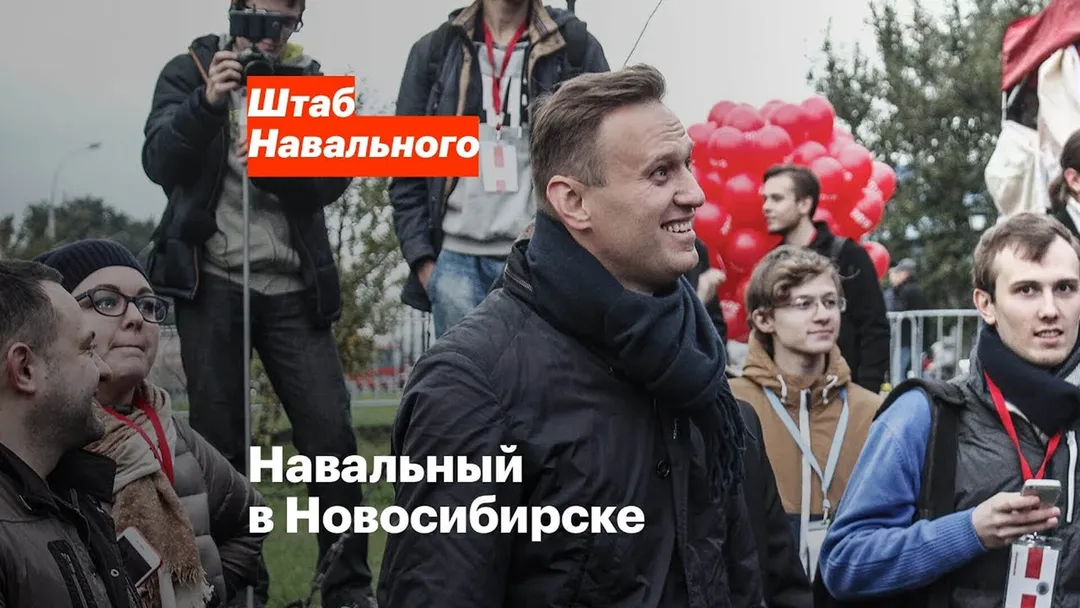
Yes, it is the third city, the capital
of Siberia. It is a city with a high level of
education, and so on. But most
importantly, it is a city they are afraid of.
And I say this without any irony and without
any exaggeration: they are specifically afraid of you
as well, because we saw it
quite recently in the elections. In the elections to the
Legislative Assembly, which does not really
decide much. We went there together with
another party, and where it was fairly
difficult to run an election campaign
and difficult to achieve major
political success, yet even there we
were not registered—because they were afraid of you
because they got scared, because they all
know perfectly well what Novosibirsk is and
what a high level of education means,
what a big city means, and what it means
to be a big city that understands it is
an example of this ugly
system where, yes, everyone was robbed there and
everything was dragged off to Moscow, the federal center.
They are afraid,
well, if you like, of what you might call—excuse the
hackneyed expression—the voice of Siberia. They
are afraid that people here will express
political views. You are very
frightening to them. I mean that completely seriously.
Probably the hardest thing is for you yourselves
to realize that, quite literally, in the
Kremlin they are truly afraid of you gathered
here. But it is a fact, and when you,
when all of us realize it together and begin
to use it, things will become much
better for all of us. Second, proceeding directly from
the first point.
Make them even more afraid,
even more. They are right to be afraid and
they should be afraid. We are running our campaign in
the regions, a real election
campaign, the kind all
candidates—normal candidates—are supposed to run.
And we are opening our second headquarters in Novosibirsk
after St. Petersburg, not in Moscow, because
we want this voice
of the regions to be heard, so that political activity,
political events, take place throughout the whole
country. Moscow alone is not enough for us to
put pressure on this government. No matter how many people
gather on Bolotnaya (Bolotnaya Square in Moscow, a major protest site), it will still
always be insufficient until
we generate a political
signal from here, from Siberia. You have it here,
perhaps even more than in
Moscow. Look, here you have
rallies in minus 30 degrees Celsius (−22°F)
against housing and utility services. At the last
rally, I heard there were about
1,500 people. In Moscow, issues like housing and utilities do not draw that many
people, and Moscow has 10 million
residents. In that sense, you have that signal
and that nerve here. What we want
is simply to make our headquarters into a kind of
wire that we will stretch from Moscow and
plug into the Krem— and it will hit everyone there
very hard with this high
voltage.
And ours is there in order to generate this voltage
here with your help. Uh-huh.
The third thing.
Right now, for the election campaign,
a total of 25,000 volunteers have signed up across the
country. In Novosibirsk,
already 405 people have said that they are
ready to work for free on the
election campaign.
And that is an enormously powerful force. Because I
can tell you that we have just
conducted
focus groups across the country. In
Yekaterinburg, here as well, in Novosibirsk,
in St. Petersburg, in Moscow, everywhere,
everywhere, everywhere. And we found out what
the main sources are from which people get
information about politics in general. Where do
people get their sense of how to vote?
Who shapes the political
picture in their minds? What do you think those
sources are? The media, Channel One,
Television, Channel One.
And what—what is even more important?
The internet. And what else?
Friends,
right,
right, in every focus group everyone
told us one crucial thing. Where do
you actually get your understanding of what is happening in
the country, of whom to vote for? Everyone
said: I have one friend who
explained everything to me.
I said this in St. Petersburg, and I am saying it
here. Here, it is probably even more important.
Each of you must become that kind of friend,
that kind of relative, that kind of acquaintance,
that kind of neighbor, that kind of, I do not know,
person who rides the elevator
with someone and says:
"Sergei, right now I am going to give you
a political briefing. And be sure of this:
no matter how much television brainwashes people,
no matter how much they watch
Solovyov, Kiselyov, and so on, even
if they seem like, I do not know,
absolute hardliners, what people often call vatniki (a derogatory term for aggressively pro-Kremlin patriots),
or people who, well, that is it, they
see nothing but Putin and do not want
to believe in anything else—talk to them. I
guarantee that you will persuade them otherwise,
because
most importantly, apart from counter-
apart from propaganda, they have nothing to set against us,
because the whole truth is entirely
on our side. Well, what can they really object to?
What substantive arguments do they have against us?
You are State Department agents, your Navalny stole
all the money. And besides that, well, like,
do you know, grandma, who is the youngest
a billionaire in Russia? Who is the youngest?
billionaire in Russia?
Kirill Shamalov, if you take Putin's circle. And do you know,
ma'am, that Russia ranks by number of
billionaires, again, second in the
world, even though 25 million people here
live below the poverty line.
And do you know, ma'am, just
tell me, I recorded a video, I'll release it soon,
about Novosibirsk, among other things.
The budget of the city of Novosibirsk—
tell me, who knows?
36 billion rubles. Shameful. What, you don't know?
You're running away.
And at the same time, at that very same time,
on Moscow's New Year holiday lights
how much was spent? I wrote: 7 billion rubles.
7 billion rubles were spent on light bulbs,
which hang there for, what, 3 weeks, 4
weeks, and it has already come out that the bulbs
were supplied by the Rotenbergs, and most of
that money was stolen. This is what we need to
fight, and nothing can outweigh it. No
propaganda, neither Solovyov nor Kiselyov, can
do anything about it. We just need
to go out to people and explain it. We will definitely
explain it, definitely tell them. Today I
held several—I'm wrapping up now—
moving on to questions—several
press conferences and several meetings with
journalists.
And almost all of them asked me: "So, well,
what is Putin's secret?" But he
has such high support. So
there must be some secret to him, and
something special. He knows something
we don't. Some hidden knowledge.
And the answer to that is: there is absolutely nothing there,
because this is no different from
Robert Mugabe's regime in Zimbabwe, which
stayed in power for 33 years and wrecked everything. You've probably seen,
photos online of people
hauling money around in wheelbarrows to buy
a Pepsi-Cola. The same thing in
Uzbekistan, the same thing in Tajikistan,
the same thing in Belarus. He's an ordinary
dictator, an ordinary authoritarian leader,
who simply lies through his teeth.
It's just that, well, he outdid everyone else,
because he lies more aggressively than anyone else,
because he steals more brazenly than anyone else,
because while others still, in some way,
in the Yeltsin years, were embarrassed to
turn their sons-in-law directly into billionaires,
but he wasn't embarrassed. Others
were embarrassed to make their friends from St. Petersburg City Hall
the richest and most powerful people
in the country. But he isn't embarrassed.
Lies. Control over the judicial system,
election rigging. There are no other
secrets. And to all of this we can
effectively oppose
the real truth and our real
program.
Every point in our program, I can simply
state here responsibly, in
focus groups and opinion polls,
is supported by more than 86% of people. From
introducing a minimum wage to introducing
a law on combating illicit
enrichment, redistributing money
back to the regions. The majority of
the country's population supports our
program. I can tell you that 100%.
All we have to do
is get started, go out, persuade people, and
tell them that this alternative exists,
that these candidates exist. And this is not Alexei Navalny's
campaign, but our common
campaign. It is Novosibirsk's campaign,
which will finally force Moscow
to do something useful for the country. I
am sure that I will be able to rely on you. I
will do everything so that you can
rely on me, and we will, without a doubt,
win. Thank you very much. I'm ready to answer
questions.
You said that this regime, so to speak,
has nothing to set against us. I don't
agree with you, because this regime
has, so to speak, beneficiaries,
to whom it has granted
fairly broad opportunities, that is,
legal invulnerability, the ability
to steal, and so on. Well, you
understand,
isn't that
significant?
Excellent question. Did you hear the question?
I'll repeat it. So, you said that this
regime has nothing to set against us, but
nevertheless this regime has given
a certain number of beneficiaries
unlimited opportunities to enrich themselves,
to have protection, immunity.
Excellent. And how many such beneficiaries are there?
1%, no more. That's exactly the point,
you see, these beneficiaries, the real
beneficiaries, amount to 1,000 families, or maybe
500 families overall at the federal
level, who have quite literally become
billionaires or multimillionaires,
who fly their dogs around on private jets.
Alexei, I disagree again.
Well, how many then? Fine, 1%.
I'm not necessarily talking right now about
members of parliament and so on.
Well, suppose
many people got a little bit, but a share nonetheless. And now they have already
latched on, and they don't want change,
because they are already major
All right. And what about big businesspeople?
Well, I can tell you for sure that
there are no greater haters of this regime
than major businesspeople. These
major businesspeople first
come and say: "Vladimir
Vladimirovich Putin, we want a fourth
sentence. Shorkhin recently said that." And then
they come out and curse them out in the strongest terms.
And I would simply point all of you to
a perfect example, yes, of
the vested interests that are playing out right
now before your very eyes. Who recently ran off to
Ukraine?
Maksakova. There you go. There they are,
the vested interests.
Huge money. I mean, an apartment on
Tverskaya Street—really,
a multimillionaire.
That woman danced—or whatever it is she
does, sings at the Mariinsky Theatre (a major St. Petersburg opera and ballet theater). An enormous
amount of money, a personal friendship with
Surkov. They are major vested interests,
but all the same, one thing
happened, and they ran off to Ukraine and
started saying that all this time they had been
suffering, that they were being forced, that they were miserable.
Actually, here’s something funny, I’ll tell
you a small, very Samara-style story.
When we had already started writing
about Maksakova and Voronenkov,
my investigations department came to me
and said: "What have you written? We got a lot sent to our
black box about them—there was
video of them sitting somewhere in Monaco and
in places like that, drinking something,
eating. And their acquaintances wrote too,
saying: here’s just a funny fact
for you to laugh at over at your Anti-Corruption Foundation
(ACF). Even when we were going after
Voronenkov and exposing their real estate,
they were discussing in their own circle that both
he and she were, it turned out, big
fans of the Anti-Corruption Foundation,
because, sure, they go after us, but on the
whole, it’s still nice that this scum—well, that someone—is
taking on the bosses somewhere.
That’s really what all of this rests on—a colossus
with feet of clay. Yes, at the top there are a thousand
families who are billionaires, yes, there is
some layer of people who are
beneficiaries of all this. Of course. But
overall, the gap between them and everyone else is so
huge that
the support base is tiny, because yes, here in
Novosibirsk, sure,
there’s the governor, and these
utility bosses who have just raised your
rates by 20%.
Nobody in Moscow, a little bit,
yes, except maybe a few. For a long time now in
Moscow—but otherwise there really aren’t any of these
vested interests. That’s the whole point. All of this
is sustained solely by the fact that we don’t
believe, and we sit at home, not
engaging in political action. It rests on nothing else.
One time in Moscow
people came out into the streets, and they immediately started talking about
political reform. Gubernatorial
elections were brought back, and so on. It’s just that
later people left the streets, and they rolled
all of it back. But in reality
there are so few of these vested interests that
even within the government no one is really
interested in it. Any businessman, even an
oligarch, will tell you—I’ve heard this kind of thing a million
times—my business is worth a billion right now.
And if it weren’t for
Putin, my business would be worth 3 billion,
because capital—because this
regime crushes the market value of all
enterprises. That’s all. It’s very important
to understand that clearly. And all these
vested interests—we will overcome them and move forward. Yes,
sorry, Alexei, I’ll just add a little
about today’s local reality.
We didn’t drag anyone here by the hand.
There was one email, and all people had to do was
click a button. Yes, and everyone knows that more than
100 people are here right now. But this morning
your vested interests showed up—there were
five of them, they stood around for 15 minutes and then
scattered because it was cold. That’s all of
Novosibirsk’s vested interests. Today they turned up
in the grand total of five people.
Sir, and who are you?
Sergei Bolko, coordinator of the headquarters in
Novosibirsk.
Well, they’re not exactly going to come at you with their fists.
A thousand families. They’ve got the cops, they’ve got the courts. What
are you even talking about?
What do you mean, they’ve got them? What does that even mean? It’s all
nonsense.
But Alexei, you do have a criminal conviction, don’t you?
I do have a conviction.
I have four convictions. So what?
And he has a conviction too, because
he was tried here. And naturally, well,
again, a thought experiment. You are
Putin, you have a billionaire son-in-law, you are the
absolute ruler of the largest
country on the planet. You possess a kind of
power that no one else has. You are
constantly on the cover of Time
magazine. The question is: are you ready? Well, some
people are making noise and saying, "Hey,
that’s enough, you’ve been in charge for 17 years, come on,
step aside." But would you agree
to that voluntarily—would you leave the first time you heard it?
Of course not. Of course you would
bring into play—as you said—the cops,
the prosecutor’s office, and the courts, naturally.
They use them. They always have. And
all these regimes have used them. But the history
of humanity shows that they
fall, these regimes, because this is,
again, forgive the grand words,
the classic struggle of good against evil. They
will resist, they will do anything,
whatever it takes, they will jail people and everything
else. But in fact, even
now, all of our political struggle
doesn’t look super dangerous.
Well, the people standing there on that
platform—you, well, Boyko still hasn’t been convicted yet
for now. I don't want to jinx it, but
being right on the very, very
cutting edge probably carries some
risks, but overall they rely
not even on the fact that they've
crushed everyone, but on the fact that we ourselves don't
believe in our own strength. The question sta-
my question is probably of a technical
nature. My name is Vladimir Tsivilizovich. You
said that this is not Navalny's campaign,
but all of ours.
Yes.
So here's my question. Why isn't there a list
of Navalny people already today that would
be promoted already now? In case
you personally are not allowed to run. But there could be
a number two, a number three, a
number four. We're ready to give our votes to
them too. And they would say that when we are
elected president, we will announce nationwide
popular elections for prosecutor general.
And here we have Alexei Navalny,
who
look, for me that's entirely... No,
look, look, this is an interesting
thing. And in a way, the authorities are
pushing us exactly toward this, because
they're saying: "Guys, well, we
won't let Navalny run," wink wink, so
let your number two be,
for example, Yavlinsky."
That's what I'm asking you. Do you agree with
No, you name your list.
So, this is an important point. Thank you for
the question.
You're welcome. The moment we
say, fine, we'll make
a list: if you remove this one, there'll be this one;
if you remove that one, there'll be another. At that moment
we've already lost, because we've already
agreed that this one can be removed, and they
will keep acting that way. If we have not
one but 100, then they'll start—they'll
conduct opinion polls, figure out that
the seventy-third person is really,
well, I don't know, weak, with a low
level of support, and they'll remove all 72. The 72
will be shot,
Of course they won't be shot; they'll just open criminal cases against 72 of them
and bar them from running.
And that's exactly the point of the campaign, again, why
it's easiest to explain this here in Novosibirsk
because in your elections here
for the first time in the entire
country's electoral history,
a candidate—not even "against all," but
the candidate "spoiled ballot" got
more than 5%. Nobody ever does that.
A person came to vote, and to do that you have to
deliberately spoil your ballot. It
cleared the threshold, and uh
amazingly, it should be sitting in
the legislative assembly, have a faction, you understand,
a spoiled ballot should have
a faction in the legislative assembly, because they
understood very well that the best
way to win elections is not
fraud, not lying media, but simply
keeping candidates off the ballot. That's all. That's what
we have to fight. And now, returning
to my chances: I have a criminal conviction.
And not just one. I can say that with
pride, because, well, as I
said, you are convicted too, or
thank God, stay unconvicted. Well,
under the Constitution, by law, by
right, by moral, by
ethical standards, I have the right to take part
in elections. I want to take part in them. I
will fight for the right to represent
all of you, so that this is not my
election campaign, but yours
election campaign. And I will not
back down from that. I hope you won't
back down either, right? There was a question.
You know this Kremlin-style
argument: "Do you want the 1990s again?" You
understand that if you come to power
and start changing this system, that
will inevitably mean upheaval for the country.
And inevitably, people who don't understand
cause and effect will, will
think that under Putin things were
good, things were stable, you and I were
being steadily screwed over, and we kind of didn't notice
it. And now you're saying: "Let's
change this, change that." And
they'll again say: "He's
to blame—not because things were bad for the previous 20 years
and now we're changing them, but because he
came in and started changing everything."
Excellent question. All right, let's
list these terrible upheavals. What
upheavals will happen? Fine. I come in
and I jailed
1,000 real crooks through a fair
trial, a jury trial—well, rather, not
jailed. A president can't jail anyone.
We put them on trial. And all these
characters—there's Shuvalov, there's Sechin,
all the relatives, this whole
gang—end up in the dock. Would people
be unhappy about that?
No. But there will be people who resist.
Well, there will simply be people resisting.
We'll suppress that resistance,
and people will be even more satisfied. Introducing
a minimum wage of 25,000 rubles. Introducing
a law against illicit enrichment.
This is important. Look, when
our big problem is the reforms
of the 1990s, right, because back then,
strictly speaking, no real reforms were
carried out—they simply divided up
the property.
Besides, in the 1990s everything was like that
because oil prices had fallen. But if
we go into the election understanding all those
mistakes; we are doing this because we are running in
the elections in order to truly
change the country, in order to
redistribute the national wealth,
in order to carry out these reforms.
There won’t be any discontent. I really don’t see any
reasons, in fact, for
any upheavals at all; there won’t be revolutionary sailors running through
the streets, and there won’t be
anything dramatic happening. Everyone will simply
do their jobs properly. And the Investigative
Committee of the Novosibirsk Region won’t be
assigning six investigators just to
put Volkov in prison, but will instead deal with your
wonderful bridge over the river, which
at first, as you know, was supposed to cost 93 billion
rubles, then 55 billion rubles. And somehow,
well, it’s considered, well, apparently normal,
that plus or minus 40 billion rubles a year
just disappears, and nobody pays attention. And
when the Investigative Committee—whether or not
we even need it is another question. We don’t
all the more so. So, when
the Investigative Committee starts dealing with
its own responsibilities, when the governor starts
doing his job, when the mayor
of the city does his job and,
for example, when the utility companies come to you
and say: "We’re raising the tariff by 20%." The mayor
of the city will say: "Guys,
please give me your investment program."
I’ll publish it. I’ll publish an audit of your
tariff, and then we’ll discuss it." What kind of
upheaval would that be? We’d just be beside ourselves
with joy. We’d be dancing in circles,
getting much more money, and everything
would be much better if, well, if
we actually dealt with these things. And for
me it’s important that there always be, well,
some counterbalance. They’re used to thinking: now we’ll
elect him, and that’s it, we won’t have to do
anything else, and he’ll do everything
for us. And all the others, all those who are sitting
there now doing fuck-all and collecting
a salary—our money—will just keep
sitting there too. And every one of them will have to be replaced.
You just took the words right out of my mouth.
It’s not enough just to elect a president;
after that, once you’ve elected him, you need to stand
behind him with that card, only
now with a whole stack of cards, holding them over
his head.
In other words, power corrupts
any person.
Never in human history has there been
a single case where someone stayed in power for more than 10
years and didn’t become corrupted. That has
never happened. And there is no such perfect
person to whom this wouldn’t happen. So
our task is to make sure that by
the tenth—or say the eighth—year
of a presidency, if he’s lucky enough to serve 8
years, and when he says: "Ah, maybe
I should get another term?"—then bang, you’re out
and it’s on to the next election and a new person.
So there won’t be any upheaval,
if the government actually
functions properly. Next question.
Yes. Right. Alexeivich, tell us,
please, what are you going to do about
mandatory military service when you
become president?
I didn’t quite catch the guy’s question.
Ah,
well then, before conscription is abolished, we’ll
send those who, apparently, should have served but didn’t
to do their mandatory service,
for example, Defense Minister Shoigu. Because when
I see the Kremlin starting to push the line that
everyone has to serve,
and that students are freeloaders, then I
served—
neither Medvedev, nor Shoigu, nor Putin—none of them
served their mandatory military service at all.
As far as I know, out of that whole elite, only Gref and
maybe Mironov served somewhere. They’re our famous paratroopers,
supposedly. But otherwise, basically none of them served.
All right, nowadays people may not serve
because there are deferments now.
But how they managed not to serve in
the 1970s and 1980s—that’s
the big question. Overall, I believe that
a professional volunteer army is more advanced and
more appropriate. I look at Russia’s budget,
and we spend almost 40% of the budget on national defense
and security. I can see quite clearly
that we absolutely can
maintain a professional army, we can
pay contract soldiers enough that
especially in the regions, people would join and
earn a decent living. And that’s the
direction we need to move in—toward
a professional army. Yes, some conscription-based
training camps are needed. Regular,
short-term work overall with
the population is fine, but overall the army
should be professional, and that’s the direction
we need to move in. We almost started doing that, but
then for some reason we gave it up and went back to
conscription. And then there’s this nonsense about
scientific companies. Just tell me,
here in Novosibirsk, with Akademgorodok (the city’s major science hub) and so on,
is it really possible to create a scientific company by
taking people, gathering them up,
shaving their heads, and saying: "You sit here,
please, in this barracks and
invent something."
That’s nonsense; it doesn’t work. So
that’s not what we need. Of course, the future belongs only
to a professional volunteer army.
Yes,
Alexei, some of your
supporters, among whom I count myself,
consider the most basic, fundamental
issue for everyone—or at least the most
pressing ethical problem.
Sorry, but still—Crimea. Could you
say something encouraging,
so that they could support you more actively
? You need to say: "And what would be
motivating for you?"
Well, look, this is a complicated problem. And
to say something motivating about it is
difficult, because this is an issue that divides society
radically. And even, I think, here
it will divide many people. That is why it was
invented. Putin needed
a split, a new split, yes, and that is why
this whole Crimea issue was created. And that is why now
there is a war in Ukraine. But I am afraid that
I cannot say anything especially motivating
about it. I can say what is real, how it
is going to be, because, well, if we look,
open a world map and you will see a lot
of territories like this, from Northern Cyprus to
the Falkland Islands. And our islands claimed by Japan
as well—they keep discussing and discussing them,
and every year before each delegation from
Japan everything gets discussed, and a peace
treaty is still not signed, yes,
formally we are still in a state of war with Japan. And
the truth is that this is
an unsolvable problem. Unfortunately, it cannot
be solved.
You will all become grandfathers and grandmothers,
those of you who have not yet, and your grandchildren may
become parents and grandparents themselves, and
the Crimea problem still will not be resolved.
Northern Cyprus, again—so, all in all,
what the best president should do is
come in and begin, at the very least,
a dialogue about holding a referendum. Well,
first, acknowledge that that so-called referendum was not
a referendum at all, it was nonsense.
A proper referendum needs to be held.
And then, after that, suffer through
decades of it. Will Russia return to
the civilized world in that case?
Well, it will.
One way or another, it will,
it will, it will. But look, there was
a similar situation between France and
Germany, when after the Second World
War, part of French territory, after
Germany's defeat, was transferred to
France, and then in the 1970s
a referendum was held and they rejoined
Germany. It was very complicated, very
painful for everyone. A whole lot of
politicians go crazy, the population goes
crazy, nobody likes giving up territory and
so on. But in the end they were reunited
again.
Was that after the First World War or after
the Second?
Not after the Second—Saar. Only after the First.
After the Second, only in 1955,
not in the 1970s, in fifty-
five.
The Saar referendum. Exactly. And
so Russia will undoubtedly return to
the civilized world, because it
is part of it. The fact that right now our
part of the civilized world has been
seized by some hellish barbarians
who are basically running around with clubs,
does not mean that we have ceased to be
part of the civilized world. Of course, we
remain part of it and always will. But
this issue, I do not know, apparently is not
very inspiring, judging by what I can see in
your eyes. Yes, please. And
Our goal is 10,000 signatures, and there are 400 of us.
That is only 25 per person. I think everything
will work out. And we do not have a question.
The next question: will you return the presidential term
to 4 years, or leave it at 6
years?
Ah, thank you for the question. First of all,
that is not really our main goal. That is our
technical goal. It is the minimum program.
I have no doubt that here in Novosibirsk
—how many signatures did we collect?
17,000. We nearly lost our minds. It was
very expensive, but it was 17,000
for the Legislative Assembly campaign, considering that
80% of people do not even
understand what the Legislative Assembly is or why
it is needed. So I have no doubt that
we will collect these signatures, but our task is
much bigger.
In Novosibirsk there will be no fewer than
3,000 volunteers. An enormous
number. Our task is to learn
to govern ourselves, and that will be
a tremendous force.
As for the term, the main thing that a
good president of Russia should do,
the main thing I plan to do is
cut back my own powers.
Russia is the way it is now,
and the government is so grotesque, because all
questions in the country are decided by the president. I
was reading before you came in.
The president approved the appointment of the
head of the Bolshoi Theatre.
The president made some statement about St. Isaac's
Cathedral. What is even going on? Really,
why is any of this necessary? The president
was dealing with that Kekhman business of yours and
everything else. This simply should not
be happening at all. It should not even remotely
be like this. So, more than 4 years for one
term? Under no circumstances. That is why one
of the first decrees will be to restore that law,
to reverse its repeal. And in general, many powers
need to be taken away from Moscow, and they need to be taken
away from the president as well. Here,
the president appoints the heads of
theaters, personally approves transfers from
clubs—Zenit, which footballer should be moved
where. In other words, he deals with everything,
he meets with cultural figures, he
gives writers reviews of their books, he
opens and closes stadiums. Do you
often see the president of a developed
the country, as he goes around cutting
ribbons at the opening of hospitals and all
sorts of other things. No, really, in
Novosibirsk, for example, you should have
your own money, your own governor,
whom you elected; he opened it,
they built it, cut the ribbon, and that's it. This
isn't the federal government's business at all.
So yes, absolutely, we are shortening
the term of office. That's the very least that
needs to be done to the institution of the presidency
for rights to start functioning.
Yes, a question nearby.
Here's a question. Most of the people gathered here
are
young people, and the volunteers are young
people too. And, roughly speaking, the people who watch
Navalny's bloggers are young people too.
What do we do about everyone else? I mean the older
population, for the most part, watches
television, and accordingly,
you can imagine the conclusions they draw from that.
And how do we get information across to them?
Well, where do young people come from?
May I give an example,
because there's always an example. Someone
wants to give one—I do. Go ahead. I
literally spoke with my mom the day before yesterday,
she watches TV, and she and
my dad really love Channel One (Russia's main state TV channel), all that
stuff. We were just talking. I simply
told her about Shuvalov and Miller, and
my mom said... And I said, "Well, of course,
nothing will change, because you're
going to go vote for Putin." My mom
was silent for a moment and said, "No, you know,
I'm going to go vote for Navalny. You
convinced me."
Thank you.
I expected your story
to end with—and I was already thinking
that she would say her mom said:
"No, I'm still for Putin." And then I would ask her:
"Well, ask your mother,
who does she love more—you or Dmitry
Kiselyov (a prominent pro-Kremlin TV host)?"
Once again.
All older people, people of an older generation,
have younger people in their lives. And no matter what
they may say, no matter how much you
argue with them about politics, you will
100% change their minds. One hundred percent—the polls
show it, sociology shows all of this.
That's the first thing. Second,
it's simply a feature of political
movements all over the world. And in Russia, in
particular, volunteers are always young.
But, for example, in the Moscow mayoral election,
where I got 30%, if there hadn't been
fraud, there would have been a runoff, in
which, I think, I would have won. We
conducted polling, and my 30% included
votes from pensioners.
That's simply a fact. And pensioners feel all the same
things too; it's just that you need
to get the information to them. In Moscow that
was easier; here it's harder, but it
can still be done. Besides,
pensioners are easier to persuade, because
all these issues with utility and housing service rates
hit them harder, and all these things about
wealth affect them more strongly, because
they are people from the Soviet Union, when
there was no wealth like this. And I,
for example, made some of my own
small personal observations.
Remember how Sechin's son
was awarded, at the age of twenty-four, the Order of
Honor, the Order of Labor, something like that. And
that really drove pensioners crazy,
because everyone knows that for a teacher
to receive a labor medal like that,
you need something like 30 years of work as a teacher,
teaching classes for a million hours, whereas here
some guy was just handed that
medal. So we simply need to
talk to them, to all these
older people, understanding that
they are older people, but we will definitely
win them over, because once again
the truth is the most important thing in our country
here.
One second, wait, I have
a technical request—there's just
no more room for people there. Let's move a little
closer this way if we can.
Let's squeeze in a bit,
okay? Thank you very much.
Could someone help organize the people?
Excellent. First here, then there. Yes.
Right. Oh, sorry,
what will happen to the Yarovaya package (a set of restrictive anti-terror laws)? Now
Leonid will probably—Leonid,
will probably add something. But who among you,
please tell me, signed
our petition about this law?
There. Thank you.
Thank you.
Seriously, everyone signed it?
Yes, yes. Yes.
Well, in fact, despite the fact
that the Kremlin is trying to disguise all this,
we did win, at least temporarily. What did they
do now? They postponed it for three
or four years. Why? Because even
the formal reason is that this
petition, once it reached Abyzov's commission (a government advisory body),
Abyzov, who profits from your
electricity. They made the decision that
they would postpone it. Lyonya, go ahead then.
That's right. Basically, while I
stole that glory, the signatures were collected.
The signatures were collected, the signatures came in.
Abyzov's commission didn't want
to consider it, so we took them to court. Through the court, we
forced them to review it, they
assembled the commission. And at that moment,
well, the telecom operators' lobby,
that, well, no one really wants to spend money on,
had already gained enough momentum,
to, uh, step into some
conflicts between other
groups that wanted to decide
how to carve up the money from this, uh,
packaging-related thing. And, mm,
so, using our petition as a battering ram
in a sense, they said: "Well, look
people are against it here too. Let's
put it off for now, since you still
can't come to an agreement. Whether Chemezov or
Sechin or, uh, Bortnikov or Patrushev
will be the ones, so to speak, spending that money
tens of billions a year there. And they
inserted that into the discussion very carefully. And so
right now the status is exactly this: it's been postponed for
about four years, and in 4 years Russia
will be completely different, right.
Let's take two questions from over there, and then
we'll come back to this side. Yes, please.
Alexei, I know that you have a
polling team. I think that's
great. Please tell us a little
about it. Well, just a correction. We do
have a polling team. We
publish our surveys, and our campaign headquarters will,
uh, use the best, the most
modern polling methods. This is important.
We tested it in the mayoral election. You
know, we proved that we
forecast the results better than anyone else
and everything else. For us, this is
very important. But what have we done now?
Volkov can add more as well. We rented
a new office for them and moved them into a separate space. And,
that means it will be conducting more
surveys, including
regional ones, and we will have
access to real data about
what people actually think. Yes,
I'd also like to add a couple of words, yes.
Thank you for the question, because we have
something completely unique in Russian
history that no one has ever done before.
The law
allocates only
40 days for a presidential campaign in Russia. I mean, you
know, in America they start
campaigning a year and a half to two years in advance,
they announce their candidacy. But in
Russia, by law, elections are scheduled
90 days ahead, then there's signature collection,
registration, all of that. And the campaign itself
is supposed to fit into 40 days. We have
a country of enormous size, right, and
just 40 days. So all of this
is built around some completely fake
campaign. In reality, you can't run any
campaign in 40 days. Alexei
announced his candidacy more than a year
in advance. And that is, basically, something new for
Russian politics. No one had done that before.
After that, everyone else also rushed to say
yes, yes, we're running too. And that extra year
was no accident. We
finally have the luxury, for me
as campaign manager, to actually
manage something, because even
the mayoral campaign started
suddenly. There were two, two and a half months until the election.
No one expected Sobyanin to resign
and trigger it. All the deadlines there were shortened
because the election was called upon
his resignation. And that was it. There, you had to, well,
China is bigger, China, China farther.
Basically, you just had to manage to hand out 20
million leaflets. That was, basically, all
you had time to do. Beyond that, well,
you run a poll,
it takes a week to conduct, a week to process
the data, two weeks are gone, and in the context of
a two-month campaign everything has changed, whereas
here we have a year. So we, we have
the luxury of making mistakes, we have the luxury of
correcting things. Soon we'll
understand: right now we have 122,000
sign-ups, people have simply registered on the website,
and we can already see
the regional distribution. Then,
they'll start coming to campaign offices. We
will understand which of these people are real,
which are fake, and how much we can
count on them. Then we'll
step up certain activities, we'll conduct
polling. Thanks to all these
tools, we'll have the ability
to manage things thoughtfully. Okay, here we need
to hold more events, in this
region, I don't know, maybe Alexei needs to
come again, speak again at a
rally. In that region, maybe we need
more online advertising or
to hand out more campaign materials. So in that sense we will have
an absolutely
modern campaign, and a campaign of a kind that
Russia has never had before, because
there has never been a campaign in Russia lasting
a full year.
Yes, let's send a question there too.
Hello, Alexei.
Hello. My question is this.
Will the Anti-Corruption Foundation (ACF) pay
attention to the company Sibeka in
Novosibirsk, or have you not even
planned to do that? And are you
aware of this situation,
about the 15%?
And even that, that was kind of
a little hurtful just now.
Who owns the company Sibega?
Abyzov. But that's been one of our longtime clients. We have been
watching it closely. Here's the thing,
the campaign office and our supporters here, the Progress Party,
they told me that you have
a delicate situation here, which
is that all the politicians
have now united simply against
the tariff, against Sibeko. And everyone said
already that now Navalny has come
in order to politicize our
issue, draw attention to himself, and so on, and so
forth. So I was asked to speak about this
carefully. Well, carefully—but since it has come up,
I’ll speak bluntly. Ah, well,
I, in the Moscow elections, ran with
a bill on auditing housing and utility tariffs. I
introduced it afterward. I believed then and still believe
that all energy-sector monopolists are
absolute crooks. And here, well,
it’s the classic story: some guy, damn it, worked at RAO
in Novosibirsk, and then suddenly
it turned out that all of Novosibirsk’s
energy sector belongs to him, and now he’s
also, damn it, a minister—and he won’t admit
that Novosibirsk’s energy sector belongs
to him. And they say: "Now you pay
20% more, but we won’t show you
the breakdown." And meanwhile, how much do they have,
Andrei, as ordered? 1.5 billion rubles.
Yes, 15 billion in profit. They say: "You
the public should pay us another billion, while
at the same time we have 1.5 billion in profit, with which
we’ll buy a yacht."
Of course we’ll look into it. Of course,
we’ll do all of this. We, well, it’s always
just a long process, because
simply, well, the fact that they’re crooks
and are pocketing money is already
obvious. But we need to show
something interesting. There are offshore schemes there,
it’s complicated and takes time. But the main thing
I want to say is that
you have a rally here on March 18, and
the tariff only comes into effect starting in July.
When in July everyone gets
their utility bill, people will get fired up. Before
that,
they won’t get fired up.
Well, listen, you already had a rally of 1,500
people in the winter.
You’ll gather a rally. Well, it would be silly to
play fortune-teller like Vanga (a famous Bulgarian mystic). But I
believe that when there is
a rally of 5,000 people in Novosibirsk, they’ll cut the tariff increase
to the permitted 4%, and that’ll be the end of it.
Look, let’s hold it,
let’s do it. And, well, in short, we’re working on this
very, very carefully. We
understand very well how
tariffs are structured. Lyubov Sobol at the
Anti-Corruption Foundation (ACF) worked on this
for many months. In short, we’ll expose everyone,
but you can achieve something
only by bringing people out into the streets. Yes,
Thank you. And quickly: I don’t want to add
a note of pessimism, but all of your
logic is built on the assumption that you
will win the election.
What do you mean?
I mean, you keep saying: "I’ll come in, I’ll change things."
That’s wonderful, I’m not
arguing. But what will you do if you’re
not allowed to run in the election, or if you,
say, don’t win? And the second
question: if everything goes well, how will you
interact with a completely
pro-Putin Federal Assembly?
I’ll start with the second part. A completely
pro-Putin Federal Assembly—we
will dissolve it, because it is not just
completely pro-Putin, it is completely
illegitimate. It was elected with
fraud, it was elected without
allowing many parties to participate, it was elected under
conditions of censorship. I am
a real person from real life. I,
of course, understand that no matter who wins
the election, there will always be in Russia
a substantial number of people who
support, broadly speaking, Putin or
Putin-style politicians. These people
will always have a significant faction, and with these
people it will always be necessary to have some kind of
dialogue. Well, we can see now
the confrontation between Democrats and Republicans
in the United States. We see confrontation in
Ukraine, we see confrontation in
France. In other words, it’s always this kind of
contest over who outvotes whom, who persuades more of the population.
As for what
I will do if—well, all right, tell me,
let me ask a more abstract question. Who
is planning to emigrate in the near
future?
Well,
if they let us out,
who needs us? What’s the point of that
anyway? And
maybe some people do, but most of
you, of us—I guarantee it—are not
I guarantee that. There’s a lot of talk on this
subject, but whether that sounds good or bad,
sad or cheerful: we were born here,
we will grow old here, here we will have
children, here we will have grandchildren, and
then one day we won’t be here at all. And this
is still our country. And I see this
again, forgive the pathos, as, well,
a kind of final battle between good and
neutrality. This is a political process
in which we, people who have
rights, who know and are confident in the justice of our
cause, are fighting those who, well, grabbed
power and who use that power for
personal enrichment. So these elections—
well, I am taking part in them. Whether I win or
lose, I will still remain with you, whether in the
minority or the majority. I don’t
think that all of us are going to change our
political views. We have always existed and
always will. We just need to build up
this “we” in order to win. I am confident in
victory. I wouldn’t be standing here, I don’t
know, climbing onto this stage if I
didn’t believe that it is possible to win, if
if I didn’t believe that we would win. I
just know, I can see that this regime
is doomed. But who actually needs it?
Really, I mean, who needs these dogs on
the plane? No one. Who needs these
Rotenbergs? Who needs this stupid Sibeka?
No one. The truth is
that nobody needs this at all, excuse my language,
not one damn bit. And this government is no longer
capable of doing anything good. It
really is the case that its main enemy is not Trump,
not the Americans, not ISIS, not anything else. Its
main enemy is the population. Right now
the main dynamic in the country is
the struggle between the authorities and the people. In
Novosibirsk, this is most visible. You have
a formally opposition mayor who supports
raising the tariff, your governor supports
raising the tariff. Your city council,
your legislative assembly supports raising the tariff. And
only the damn city of 1.5 million people
is saying: "No, we don’t have the money, we don’t
want to pay." That’s it. Still, I
proceed from the assumption that in a confrontation between 1.5
million people and 25 people who will
get some kind of kickback from this
tariff, sooner or later 1.5 million people
have to win. That’s why I’m confident in
success. Yes,
May I ask a very timely question?
Alexei, you are a professional
advocate, a lawyer, a human rights defender. I want
to emphasize that this is quite an
topical question. Most people, yes,
most of our citizens believe that changes
to the Constitution of the Russian
Federation are necessary. If you were president,
what changes would you make to
the Constitution—perhaps the most important ones,
the main ones?
I’m not one of those people who
really love this Constitution or
treat it like something sacred. You often hear
statements like that. And Putin
likes this line very much: don’t touch the Constitution,
let’s not change the Constitution. But
what good has this Constitution done for us?
This Yeltsin-era Constitution
created in Russia what political scientists call
a super-presidential
republic. The president is not even the head of
the executive branch, but the head of
state. He has immunity, and he
controls everything. Under this Constitution
he has been in power for 17 years. And then under this same
Constitution, the presidential term was extended
to 6 years. Under this same Constitution,
our governors stay in office for 20 years. Under
this same Constitution, city mayors—and
now in our country they are practically nowhere
elected. Do I need such a
Constitution? And do you? Yes, it is
bad; overall, it needs to be changed.
The Constitution should be such that it
100% guarantees the separation
of powers, freedom of the mass
media, and political competition.
So of course it needs to be changed. It
basically needs fundamental change. But
again, back to the question of the Constitution.
We open it up. What article do we have? Thirty-
fifth. No, the thirty-second, excuse me,
sorry,
it says there in black and white:
"The only people who may not participate in elections are people
who are in places
of deprivation of liberty (prison)." And under this same
Constitution, some mustached
Peskov, damn it, sits in the Kremlin and says:
"What was the quote? We are surprised by Navalny’s desire
to take part in the presidential
elections, because yes, it seems
strange to them." And that seems strange to me too. Well,
excuse me, damn it. To them
it seems strange. But to me, to me it does not
seem strange. What’s the point, when this
Constitution means nothing
and guarantees nothing? Of course it
needs to be changed. We need a new
constitutional assembly that
will make the basic law into a
proper basic law
and then comply with it.
Exactly. Follow your own
Constitution. Yes.
No.
Yes.
Oh, I wanted to ask: all right, we
win, we take over the top
of power, but there are, for example,
people like Maksakova, and maybe
the Maksakovs—both of them, right? Maksakov and
Voronenkov, Maksakov and Voro... They, they
are classic weathercocks. They ran away and
immediately changed their position. They started
saying whatever was выгодно to them.
When you come to power, you can’t
possibly lustrate everyone; we won’t
have any politicians left. What are we supposed to
do?
There will be some left.
Well, there’s you—you’ll remain. Right. I
understand the question. Good question. Yes,
what kind of infrastructure will you build so that
with this kind of opportunism, everyone could
join the struggle? Infrastructure or
opportunism—that’s a good one, look,
Look, that’s an excellent question. And indeed,
over 17 years—or really even
longer, going back to the late
Soviet Union—what kind of people
go into power? First and foremost, they are
hypocrites, vile
liars. That is the main trait. And
over the last 10 years, there has been negative
selection. That is, only
completely awful people make it to the top.
And my answer is actually simple.
Well, the top brass is finished; they need to be, so to speak,
finished off for good, of course by legal
means, naturally. But the bulk of the
apparatus
consists of ordinary people who live by
the principle, “when you live with wolves, you howl like a wolf.”
They accept the rules that are
imposed on them. And right now, our civil
servants are, fortunately, very well
funded. Their salaries are very
high in the regions; in many places, people
working in government service are the
most well-off people. That is why we have no
problem attracting new people into public
service. We have the money to hire
these people. And when the federal government,
the main authority, starts sending
the right signals and behaves according to
the rules, then the bulk of the apparatus
will change too. This is not just my
assumption or a slogan; we have seen
this many times: people do change. It
happened in Georgia, it happened in Singapore,
it happened in Hong Kong, it has happened in
many countries. It is happening in Africa now, in
some countries there. In fact,
Russia is already below Africa in terms of corruption,
and in terms of development it is below
many African countries. This
has happened in Latin America too, in Chile.
There was a junta there, some awful
classic, almost caricature-like
corrupt police officers. Now in
Chile the level of corruption is much lower than
in Russia. The same is true in Argentina.
Never.
I already said this today at the
press conference. And in general, an important
point is this:
we will not persuade a university rector, a deputy governor, or
a city mayor to be honest
if he sees that the federal
government is simply carving up billions, so that
it is just
horrific. But if
the federal government functions properly and
is accountable, then people will start
to readjust as well. When there is a free
press and you understand that if you do
something wrong, then the newspapers will
tear you apart and you will be forced
out of office because you
bring nothing but problems, then people
will start to change. A person gets used to
anything. Putin has accustomed these people to
bad things. We will accustom them to good ones.
You’ll set an example.
Yes.
Ah, thank you, Alexei. So, I have
a question about social policy. I have
four nephews and nieces; two of them are already
in school. And, well, as you already
said, a quarter of the country is below the
poverty line. So perhaps it would make sense
to introduce a subject like
financial literacy into the school curriculum.
But they are talking about that now, aren’t they?
Well, first of all, yes, they really are
talking about it. Second, well,
it is hard to say, you see?
If a person earns
17,000 rubles
and is below the poverty line in many
regions, will giving that person a course in
financial literacy make life easier for them?
No. And for their children? Possibly, they will learn
to spend those
resources more rationally.
Well, listen, I do not know how you can rationally
spend it, but I think the issue lies elsewhere.
The problem is something else. In fact, this is
a good question. The problem is the existence
of social mobility.
Because tell me, please,
does anyone now have even a rough idea
of how to become rich in Russia? Well,
not even rich, just comfortably well-off.
There is a top 5% of the most affluent
people in Russia. They are not millionaires.
What?
You need to be Sechin’s son.
Excellent. What other options are there?
Anything non-criminal is definitely out of the question already. So
there really is no such path, if we assume that. Of course,
an equal start is normal. But if you
want to become simply a well-off
person, very well-off, earning, I
do not know, say 300,000 rubles a month.
Then your simplest and most realistic option is
either Gazprom or becoming an official,
and taking bribes.
Neither business nor any other
normal avenues of social mobility are working.
We need to change the economy so that
business develops, small business develops, and in general
everything develops, so that people—your
nephews and nieces, for example—have the opportunity to become
wealthy if they have that desire,
that entrepreneurial drive. Or they should
be able to enter public service and
earn a high salary if they do not
have that desire. And there is a sea of money
in the country. That is exactly the point: there is a sea of money
in the country, but it is concentrated
entirely in the wrong places, not
distributed the way it should be.
That is why, in this respect, our
state currently controls 84% of the
economy.
Small business owners cannot
really operate, because all that is left for you
is to work on government contracts.
And that means going around and slipping someone
bribes, kickbacks, and everything else. In other words,
this system does not work at all. When
it does start working, then
financial literacy courses will be needed too, when people
actually have something to
I worked on this project, worked on it
this project. Well, maybe you won't
share all the secrets right away, but later
you'll tell us, right. And my question is about
the fragmentation of the opposition in society.
We all know that there are many different
political forces, but at the moment they are all
pulling in different directions. How do you
plan to cooperate with PARNAS (a Russian opposition party),
Maltsev, and all these other forces
in order to reach some kind of common ground?
Well, I love them all very much.
And
there are a few things to say. First, so far
we don't see any major disunity. There,
Khodorkovsky has supported me,
Solidarnost supported me at the conference.
Well, I hope that PARNAS
will support me too. But to expect Yabloko
to support me and withdraw
Yavlinsky, I think, would be naive.
You understand that yourselves. So again, we are
people living in the real world. Most of you
here are young, but still
you know the politics of recent years, you
follow it, and you understand perfectly well that
it's not going to happen that everyone simply unites.
The moment everyone unites, the Kremlin will—bang—
create a new party, bring us
the Party of Growth with Boris Titov, and say:
"Look, they didn't unite with you,
we'll somehow persuade Boris Titov,
hypnotize him. And then they'll create some other
party too." So first,
absolute unity is impossible. Second,
we shouldn't strive for it, because
we have fragmentation among these
liberal parties that, overall, do not
control that many votes. We
must overcome our disunity
by reaching out to people. In other words, if we can't
reach an agreement with Yavlinsky, we'll reach one
with his voters. But even more importantly, we need
to appeal to the voters of
the Communists, the LDPR, A Just Russia, and
Putin's voters. That's where
we need to invest our efforts, because
look, I could be here
at the opening of this campaign office, which is where I am, or
I could hold 144 roundtables in
Moscow discussing the problems of
opposition unity. Which path do you think
is more effective? I'd rather
open campaign offices in seventy-seven cities and
work with people than sit there
inside the Garden Ring (central Moscow) with those five
people who've been there, damn it, since 1989.
Literally. Trying to
unite. Alexei, can I ask a cynical
question?
Go ahead, a cynical one. A pessimistic one. Go ahead
with the cynical one. Yes.
What do you think: if you pose
a real threat to the authorities, then why
haven't you yet met the fate of
Nemtsov?
Oh, that's one of my favorite frequently asked
questions. Why haven't you been jailed? Why
haven't you been killed?
Well, I mean,
I don't know.
It's hard for me to say. No one
knows what's going on in their heads.
No one knows what their plans are. I
don't think there are any special plans
there. It's just that there is simply
a moment-to-moment struggle for money, for
holding on to this power. What exactly they've
come up with, what knives they've sharpened—that's
hard to say. I only know what I
am doing. I try to do it as
transparently as possible. I don't get tired of traveling around and
explaining things to people, answering questions,
responding to criticism, answering
pessimistic questions, cynical
questions. That's all I can do, and that's
what I'm doing. But sitting there thinking, damn,
why haven't they killed me yet? That's
basically a waste of time, yes.
If you are elected president, will the Anti-Corruption Foundation (ACF)
continue its
work?
Well, within the Anti-Corruption Foundation (ACF)
there are quite a lot of people who
have proven themselves so well
that I believe they could hold
positions in the state apparatus.
But I see
it as a self-contained institution. And I see the most important
task of state power as ensuring that
it—I, as president—encourages
the emergence of such anti-corruption
foundations that would, among other things,
scrutinize any government. In other words, such
organizations are necessary, and there should be many of them.
What is the Anti-Corruption Foundation (ACF), really?
In fact, it is quite unique, and
it can exist only in Russia,
because, well, somewhere like Germany it
simply wouldn't be needed. In 80% of cases, we do the kind of work
that is done by
journalists, by various
other civic organizations. But we
do all of this because there is simply no one else
to do it. We will free the media,
we will free all NGOs. Therefore,
in this specific form, as the Anti-Corruption Foundation
(ACF), it will probably cease to exist in that form,
but we
will do everything possible to encourage the emergence
of such organizations that scrutinize all
authority, including me. Otherwise
everything loses its meaning. As I already
said, power corrupts every person.
Anyone. Yes. There must always be someone
standing there and keeping watch. Yes.
And the first question: what will you do with the Russian Orthodox Church?
And the second question.
And the second question. What will you do
about the law on believers?
What is the law on believers?
The law on offending believers' feelings. It's awful.
What would I do with the ROC (Russian Orthodox Church)? Nothing needs to be done with the ROC.
Let it exist. The ROC. And
formally, 80% of people in Russia consider
themselves Orthodox Christians. Of course, they don't really
practice Christianity in any real way. They
go to church and so on. They're more like
Soviet-style Orthodox believers. And that's fine. Well,
if that's how it is, then that's how it is. Let the ROC
exist. Let it collect its, I don't know,
dues, taxes, fees, whatever, by all means.
It's just that they should not be given the right
to speak on behalf of the state. It is not
for them to decide who should be jailed
and who should not. And there should not be a situation
where some person
gets upset in church because he doesn't like
a stage production, and therefore we ban
that production. The state is separate from
the church. This debate will always exist.
There will always be believers who will
picket concerts. There will always be
activists who will curse priests
in the harshest terms. That's life. And that's how it
should be.
These are different views on, well, on basic
philosophical questions of existence.
Let it remain that way. The church should not
replace the state.
A law protecting believers' rights is unnecessary.
It's complete nonsense. I am a believer,
actually, but no one—even if all of you
started pointing at me right now
and shouting, "There is no God." Yes,
go ahead, that would not violate my rights
for even a second. My rights cannot be
violated by that. And there is no need for such a law.
For example, here's a specific case
to conclude my answer to this question. The
issue of St. Isaac's Cathedral right now in
St. Petersburg
has people at each other's throats, and so on. On the one hand,
yes, it is a religious building,
a house of prayer. Such buildings
should be transferred to the church. On the other
hand, we understand what is happening in St. Petersburg
(often called Piter). The fight there is not over St. Isaac's itself, but
over the 1 billion rubles it brings in
from the people—from tourists—
who come there. And we understand perfectly well
that the ROC cannot maintain
such a huge religious building. They
couldn't maintain it even before the Revolution.
So let's not engage in nonsense.
If churches want to take over new ones, then yes,
by all means, drive around Novosibirsk
Region. I'm sure there are so many
abandoned churches there that you can just take one and
restore it. So
let's separate these things and do it the way it should be done.
The church is separate from the state. They
will do just fine. Everyone else
will do no less fine. Yes,
I also have a technical question. You touched here
on the issue of emigration, and although
you said something along the lines of
"where you were born is where you belong." Nevertheless,
in the last election, voters
abroad—how do you get a residence permit?
No, no. In the last election, abroad
around 2
million Russian voters were registered,
Really? And turnout there was 4%.
And not every Russian citizen
there registers with the consulate.
For the presidential election, possibly,
especially if this audience is engaged
with—they have forums and so on there—
turnout may be higher.
Is the question being raised of placing observers in
embassies?
In embassies, as a rule, they don't usually
falsify the vote anyway. Look, if
everywhere voted the way embassies do,
PARNAS and Yabloko would win everywhere.
Yabloko.
Well, no, of course there is the embassy
in Belarus—rather, the Russian embassy in Belarus—
and there is the Russian embassy in London.
So, first, we are definitely planning
to collect signatures there, right?
Yes, out of our 300,000, we are entitled
to collect 7,500 signatures from citizens
living abroad. We will collect them. I
went to London and met with the local
local
campaign team.
I mean, I had
a talk there, there were 100 people, and all of them
said they would sign. That's not
a problem, by the way. But relying too heavily
on their turnout, well, you can't really
count on it. In reality, people
have embassies only in certain cities, people
live far away, some have, so to
speak, completely lost touch. Well,
historically turnout there is 4-5%. Even if it
reaches 6%, excuse me, that still won't
be enough to outweigh a large aul (mountain village) in Dagestan
turning out to vote.
A related question: is Navalny's becoming president
linked to the idea that
every citizen of the Russian Federation
will receive the right to a share in the national
wealth, specifically natural-resource rents?
There it is again, an awkward question. This idea
often comes from those who live abroad. Well,
for those who live abroad, it probably
concerns them to a lesser extent, but
thank you very much—there's the leaflet right there.
So, this is
a key point of the program. This is really all
about what our elections and our politics are about.
It is precisely about the fact that
there cannot be such a poor population in
in such a rich country that Russia can and
should live much better. And that is connected
first and foremost with the fair
distribution of resource rents. That is why I
talk about it constantly. Many people
call me a populist for it. Many believe that
it is impossible. But I absolutely believe
that it is possible, that it must be
done. And democracy is the best way
to distribute those rents. And as for
people abroad,
we would do better to raise money from them. They will not
come to vote, but they are citizens
of Russia, they have passports, they
are all used to donating money through
the internet. That is just part of life in
Western society. So we have a lot of
ideas tied to that for now, like, well,
there is a Russian community of 400,000
people living in London.
Let them send, let them send us
one pound a month, and that is already a substantial
amount of money that we would receive.
Yes.
And in addition to the question of why you have not yet
been jailed, are you aware that on the
internet people are building conspiracy
theories about how you are actually
a Putin agent, and as proof they
cite the fact that your rhetoric in many ways
overlaps with his. Back when he was running for
president in the 2000s, so how would you
comment on that?
Well, of course I am aware. I do read
what people write about me, but that is not the
worst thing they write about me. But as for the idea
that I am a Putin agent, a Putin
It is hard, damn it. Why would they treat their own
agent like that? People
who are mired in that kind of
conspiratorial thinking are extremely
hard to convince of anything at all. But
still, well, here is what I can say,
guys, I am not a Putin agent. That is
the first thing. Second,
many of you have had the chance
to observe my work over the course of
years. Those who have not can go onto
the same internet where this kind of thing
is written, and look at what I was doing.
in 2009, in 2005, and even in 2003,
and probably even in 2001 and 2000.
In other words, I cannot prove it by anything other than
my own work.
So I try to prove it precisely
in that way. And that is why I am having
this conversation with you and doing this kind of explanatory
work.
I would add,
we conducted a great many focus groups there
in the autumn, when we were preparing this whole
campaign. We had this
experimental focus group in Nizhny
Novgorod among people who do not use the
internet and have extremely low
incomes. Sitting there were, literally,
cleaners, kindergarten teachers,
that sort of thing, mostly older
women. And we were trying to reach
people who do not vote. So these were
low-income people who do not use the
internet and do not go to elections. The most
traditionally difficult, really difficult
electorate, as it is considered. And we
showed them the candidate, and none of them
knew who Navalny was. We showed them
his biography, described the platform, and they
all said: "What a good platform,
what a good man, we want change so badly,
we are so tired of living in this shit,
in destitution and poverty." He is so
good. If only Putin would come out and say
that he accepts him as one of his own.
So you can tell them that.
I heard it myself through the glass. Yes.
Yes.
I have two questions. First question.
Would you grant amnesty to Maxim Martsinkevich?
Second question.
I think 2017 will be quite a tense year,
because after all
people's political positions will
become sharper, right? Are you ready
to support certain flashpoints in the regions,
yes, fairly acute ones, like Novosibirsk,
including on housing and utilities issues,
by being personally present yourself?
Well, what else would I do? I am here, in
Novosibirsk. If you have a rally on March 18,
and if the organizing committee there, where nothing is
simple, decides that I
can speak there, then of course I will come and
speak. Well, provided we do not have
the opening of a campaign office that day. So, I mean,
of course, yes, as for amnesty for
everyone, and Martsinkevich in particular, but this is not
a question about Martsinkevich, it is a question about Article 282.
There are quite a lot of rather unpleasant people there,
including Martsinkevich and some
other thoroughly unpleasant people, but
nevertheless, for me they are all
political prisoners, because they were
not tried for what perhaps they
should have been tried for; they were not tried because
they are unpleasant people, but were tried simply
for certain political views.
Therefore, everyone imprisoned under Article 282 should, of course,
be released as political prisoners,
and not even merely amnestied,
but because this article should be abolished altogether and
should not exist. Right now, well, if you
have been following this, I am handling many cases in the
European Court of Human Rights. There is simply
a huge wave of appeals under Article 282. And again,
these are the kinds of people involved. A typical one writes:
"I was imprisoned illegally. I
just wrote a post on VKontakte. Well, I
was only criticizing bad Jews. Properly speaking,
I wasn't insulting Jews. I mean, damn,
just because someone writes all sorts of nonsense
or because they're stupid, or because they
hate someone, that doesn't mean
they should be locked up in prison. So,
of course, everyone convicted under Article 282 should be released.
Yes.
Alexei, hello. I'd like to ask
a question. What can you say about
the recent resignation of the head of the
Federal Customs Service, Belyaninov, and
the appointment to his post? Well, as
rumor has it, the former KGB man
Bulavin.
Rumors, sure — they're all former KGB men.
So what can you say about that?
Right, well, as for Belyaninov, we
filmed his house — you've probably seen it — we
posted it. I mean, we were tracking
this guy. We were looking at his
assets and comparing them, as part of our
campaign against illicit enrichment,
his legal income with his property.
Go to my Facebook account,
and you'll see how Zhora Alburov filmed
his lovely house with a drone. That
house is not something a person with his
salary could afford. Besides, the money
that wasn't seized from him there, but
was found during the search, of course,
shows that he was corrupt.
And of course, he wasn't removed for that, because
there was no criminal case, nothing. It was
some kind of internal infighting.
As for the new guy who was
appointed, I don't really even know yet
— we haven't looked into him yet.
You should take him on sometime.
Well, we will. Listen, we have one
problem: there are too many people we could
go after. It's not like we're
searching this system for the
worst corrupt official. It's more like
a queue — we'll get to him eventually,
because there are no others there.
And it's a big structure, it brings in a lot of
money.
I know. Yes. Well,
go ahead and take it on yourselves, feel free. I
can't,
Right? So here's a question. In
Novosibirsk, there are people who
support you, there are people who
support Putin. There are people who
support Zhirinovsky, probably. Well,
there are places like
Novosibirsk and Yekaterinburg, where there are
people you can persuade
to vote for you, and there are people who,
well, are probably hard to win over. But then
there are regions of Russia, mainly in the south,
the Caucasus regions, such as
Chechnya, Ingushetia, Dagestan. And there, everyone
is one hundred percent pro-Putin. They,
they've been like that for 15 to 20 years.
I understand the question. But that's not true. Not the people.
Huge numbers of people write to us
from there. Take Krasnodar, for example.
On the one hand, everything there has been
completely cleaned out. If anyone followed how we
went on that trip to Anapa,
you know what it's like there. I mean, it's total
lawlessness, the Tsapki gang, total trash. But at the
same time, judging by visits to my
blog and video views, Krasnodar is always
near the top. So it's Moscow, St. Petersburg,
Yekaterinburg, Novosibirsk,
something else, and then Krasnodar. So, well,
in Krasnodar, in the Kuban region,
Krasnodar Krai has a population of 5 million people.
It's a huge region, and people there are very
dissatisfied with everything, but what they're angry about is
these Tsapki-type gangs. The level of
lawlessness is such that everyone is afraid
to get involved.
They're more afraid.
They're afraid. Yes, more afraid. Because
remember when we released the film about
Chaika. It was a scandal. Everyone was writing about it,
everywhere. And then some guy in
Kushchyovskaya
decided to screen the film in a movie theater. He went
to arrange it. And we said, "Go for it,
good job," we encouraged him. But then he
said, "Will it be dangerous?" I said,
"Dangerous? Come on. The whole country is
writing about it, everyone's in an uproar. This is actually
the safest possible moment." But he went, and
on the way out he was hit on the head. So
I mean, it really is
total chaos there. In that sense,
Novosibirsk is still a very, very free
city. Cities like Novosibirsk,
Yekaterinburg — compared with what's happening in Chechnya,
we get huge numbers of appeals from there. All the
problems there are intensified
many times over. When
you see Kadyrov's motorcades like that,
with a hundred Porsches driving around, it infuriates you,
or at least annoys you, but in Chechnya there are people
living in utter poverty. And it infuriates
them much more strongly in all these
regions. So in some places,
we probably won't open campaign offices,
because it would simply be dangerous for
the people working there. Like in Grozny.
Will you be in Grozny? We won't be in Grozny,
because, well, we can't
guarantee safety. We have people who
want to do it, but we're not sure we can
guarantee their safety, so
we won't take on that kind of
responsibility. But the real support
there is very strong. And, well, just look at
videos from polling stations in Dagestan.
In practice, only about
14% of the population actually goes to vote. They
officially report turnout at 99%. There
Basically, no one believes in any
elections at all. But the number of people ready
to vote for an alternative is enormous,
very large in every
region. And in Grozny we would get
quite a lot of votes if there were
a chance to count them honestly there.
So we will work with all such regions
because people who are fed up with all this
are everywhere.
Let me add something very briefly,
very briefly. First of all, a ton of people write
to us from Grozny, Makhachkala, and
Nalchik all the time. So there
are people there who are ready both
to sign and to vote. It is very
hard for them to work there. We will help them
do that work. But still, it is possible
to work there. Second.
The idea that it is 100% pro-Putin there is simply
not true. And you do not have to go far
for examples, or even to the Caucasus. Right
next to you we have our own Caucasus, so to
speak, a rather specific one. Here are
some guys who came from Kemerovo,
right?
There they report 90% turnout and 90% for United Russia
year after year, and for 25
years Aman Tuleyev has somehow known how to
draw all that. Does that mean
people there support Putin 100%? No,
it does not. On the contrary, last fall we conducted
a comparative poll, comparing
Novosibirsk Region and Kemerovo Region; they
have the same population. What did that poll
show? In Novosibirsk Region, according to
official election commission data, 40% voted for United Russia. In our
telephone survey asking whom they voted for, 40%
said United Russia. In Kemerovo, 90% was fabricated
for United Russia. In the phone survey, it was exactly
the same, even a little lower. And
turnout was much lower too, because
yes, yes, yes, just like in Novosibirsk.
In fact, turnout was lower than in Novosibirsk.
Because when people know
the election results will be rigged, they simply do not go.
So there are people there, there are
supporters; that is not the problem at all.
The problem is that working there really is,
so to speak, difficult, because it is a tough region.
Accordingly, we therefore have a huge
task in training election observers.
We are starting. And we are selecting coordinators as well,
so once we finish here now,
we will have an interregional meeting,
because Novosibirsk is responsible not
only for Novosibirsk itself, but also helps
neighboring regions. That is how it works. So
the boldest people from Kemerovo, those who still have doubts,
we will train here as observers, send them there,
and see with our own eyes
what kind of
say, there is student, student
Tomsk, where everything
is relatively okay with elections and so on. We have
over there, somewhere, Alyona with brightly colored
hair, a kind of hipster girl, so to speak,
as coordinator. And from Kemerovo we had
four burly forty-year-old men come to us,
so to speak. Yes, we take the specifics
of the region into account, but everywhere there are people who
are ready to work.
Yes, guys, there is a question there. Okay. Okay.
Alexei Anatolyevich, regarding foreign
policy: you have said and written quite a lot about domestic policy
in your blog,
so what is your opinion on
the military presence in Syria, and what would happen,
for example, what would you do with
immigration policy toward the near abroad
(the former Soviet states)?
As for keeping troops in Syria,
here in Novosibirsk, do you see your
roads? Are they in good condition?
No. Do you think the priority for reconstruction should be
Palmyra
or Novosibirsk? Novosibirsk.
And that is my answer. Yes,
of course Russia should be part of
the international coalition fighting ISIS.
No question about that. Should we send
ground troops there and rebuild
Palmyra? There is no question here either. We
should not.
There is no need to do that. The wealthy
Americans, if they want, can carry out
a ground operation there, they can
rebuild Palmyra, they can
spend money there however they like. When in
Russia, when right here in Novosibirsk,
the average salary reaches 95,000 rubles,
then perhaps we can think about whether the time has come
to send some money to
Palmyra. But until that moment, absolutely
not. We join the international
coalition and, from time to time, I do not know,
send a couple of planes there. But when we see
that Admiral Kuznetsov aircraft carrier, which
sailed there and back, and it cost 7
billion rubles, a third of the city budget
of Novosibirsk, simply burned up. Completely
for nothing, and they even lost two aircraft there.
Sorry to interrupt you, all of that is
wonderful, but surely we cannot just dismiss
our influence, Russia's influence now
in the region where we are present.
Who is talking about dismissing it?
And what will happen if we simply withdraw
the troops from there? What are the forecasts? What will follow?
NATO bases there.
Right, yes, if not us, then there will be
NATO bases stationed there. So, there will be no
consequences. Our presence
there now means we are fighting on Assad's side, and from that
we are getting a huge number of
problems, because, to put it very
simply, in Syria there is a war
between Sunnis and Shiites, and in it we are fighting on
on the side of the Shiites, despite the fact that all
Russian Muslims are Sunnis, and
in general, most Muslims in the world are
Sunnis. So no one except the Iranians is
particularly happy to see us. And
Assad is very happy, but the rest of the
Islamic world, of course, is extremely
irritated. It is unclear why Russia is involved there
at all. ISIS in the form
it exists there cannot be defeated
the way they defeated the Taliban, because
these are just ordinary people. During the day, on their
donkeys they haul firewood, and in the evening they
pick up assault rifles. But as long as they
are not threatening Russia with missiles, taking part
directly in a ground operation
is not something we need. Besides, we do not have
the money. So, like most
much richer and
more influential countries in the world—Britain,
France, and so on—we should
take part within an international
coalition. The Americans put up the money, and we
also participate. But for the most part, all these
funds should be invested in
Russia itself, here at home. I see more
problems here. I do not think it is some kind of
nonsense that if we leave
Syria, some ISIS fighter will come running here tomorrow.
And this brings us precisely to the issue of
migration policy. We face far more
problems because we have
a visa-free regime with the countries of
Uzbekistan and Tajikistan—that is,
Central Asia. From there, arriving here, we get
young people from villages—religious
young people from villages. That is the main
source of terrorism and extremism. And these
people simply come here. They do not even need
an international passport. We are waging war somewhere,
while these people are coming here. Besides,
Patrushev, when he was director of the FSB and head of the
National Security Council,
said that from Chechnya alone, there have now
been 3,000 people who left to fight in Syria.
Why did they also go to fight on the side of the
Sunnis against the Shiites? That is the problem. Because
by getting involved in Syria now, we are
simply wasting money, and we are also making
the security situation worse, while saving
Assad. But he is not someone we need. So this is not
something we should be doing, and it is a pointless
waste of money. Overall, the main direction of
foreign policy for
Russia should be to become a leading European
power. On the territory of Europe, we have
a sufficient population and enough
natural resources
to lay claim to that role. That is exactly
what we should be striving for. There was another question
nearby. Yes. Well, officials' mansions no longer
surprise anyone. Everyone knows that Putin's friends
have secured comfortable lives for themselves. And then
once, after reading another ACF report,
the next thing I saw on the Echo
of Moscow website was a story by some woman about
how her child was effectively left to die in a rural
hospital. And the photo of that hospital was
just a little shack
—a collapsing wooden structure. So are you not
planning, or may I suggest,
conducting investigations not
only into palaces, but also into
huts? Perhaps on paper this hospital is
also some kind of
wonderful facility with innovative
equipment, except all the money was stolen by someone
and went into someone's palace,
because this contrast—
a palace, and next to it just a shed—
is more striking than a photograph alone.
What woman on the Echo of
Moscow website? Today I am reading that you have
opened the largest private
clinic in Siberia.
And at the same time I ask everyone: "But what about
ordinary district hospitals?"
Well, it is the same thing. It is a question of the shed
and the palace.
Russia declares itself to be a social
state. Russia guarantees them
free medical care. Russia
allocates a fairly substantial amount of money
for this, for all of it. They are constantly
boasting that in terms of the number of
tomography scanners per capita, we surpass
European countries. And yet, well,
in reality, all the hospitals simply look like
sheds. Exactly those kinds. We conduct quite a lot of
such investigations. They are
really not simple, these
investigations, because you need to
analyze them professionally. Right now we
have one underway—I will not reveal the details,
but there is an ongoing investigation. Still,
for example, when I ran for mayor of
Moscow, we examined the entire Moscow
healthcare modernization program—100 billion
rubles were thrown at it—and we broke it down
in considerable detail. This is an extremely important issue. And
I am counting on you very much.
For example, as for the situation in
Novosibirsk, we need to take specific
hospitals, and we will help with methodological
support in looking at how much money
is allocated to them. And then, yes, we will
do all of this, and once we do, it
will be posted online. Your task will be
to go and tell specific
people, the visitors to that hospital,
that, guys, everything should be much
better. It is just that this regime stole your
money. Yes.
Alexei, are you planning to make your way onto
federal TV?
Just sneak on, obviously.
Only if I, you know, put on a mask, like in the
films with Tom Cruise. Like that, snea
on Kiselyov's programs he does things like that, and
then I, well, I
a presidential campaign assumes that
they won't be able to deny me, at least in part,
participation in debates and so on, but that
of course
isn't much to count on for now; they have, they have
an interesting strategy on the federal
TV channels: if in 2011-2012
they were actively smearing me but still showing me,
now they don't show me at all. Well,
there was that film about how I'm an agent of every
intelligence service, and recently there was some other one too,
there was, yes, that one
someone made it, but overall, on the new
new verdict in the Kirovles case, there wasn't
a single word. That is, they realized that
it's better to stay completely silent so that nobody
knows anything. Because even now
a sufficient number of people, even
pro-Putin types, see that
someone is being smeared on TV and think:
"Well, obviously, if they're going after him, then
he must have done something right." And for now their
strategy is a total boycott, and we will
overcome it however we can. But no,
there's no need to appeal here. Let's
probably start wrapping up, maybe two more
questions. Yes, go ahead, Alexei. And
many of your supporters will
come out and show support, right? And you have
enormous experience; share with them how to behave
during a police roundup and afterward in
in what?
Well, when you're detained, and after that,
how legally
based on our experience working in Novosibirsk
after all, this isn't Chechnya here, not
Dagestan, and not even Moscow. The city
is fairly free. And believe me, I've held quite a few
street actions in Novosibirsk over the past 2 years
in Novosibirsk. Our police here,
well, that was in court. We're talking now
about the street. Our police are, to a
large extent, just like the people
present here: they go to the same
public clinics and live in the same city
and see the same roads. So
it's unlikely that we'll have any serious
problems on the street. At least
we haven't had any so far. Well, in every
regional headquarters there will be a lawyer who
will accompany the campaign, go out
to detentions if they happen,
provide legal assistance, and so
on. The safety of headquarters staff and
volunteers is an important priority for any
campaign. And we will be working on that.
May I ask a related question?
One second, let me finish answering this
question. So, uh, indeed,
Novosibirsk looks like
a completely trouble-free city from this
point of view. But if you're detained,
go calmly and relaxed to the police station,
fill out all the paperwork there, then file in
court, lose there, send it to me, and I'll win
another €10,000 for you at the ECHR (European Court of Human Rights)
for you.
That's exactly what I wanted to ask about. May I ask a question
a question about how to get rich
from this side of it.
Yes, yes, please.
Hello, Alexei. I wanted
to ask how you are going to ensure
the fairness of the election you plan to run in
with all these ballot-stuffing schemes, with
carousel voting, all of it, all of it.
An easy question to end on. How are you
going to ensure fair
elections? Uh
there will be no fair elections, there will be no
free elections, and there will be no fair elections.
That's a fact. But that is precisely why our
campaign now must first of all secure registration,
secure participation. Some fair elections,
right. If a person has to run a
campaign just to win the right to participate. But
overall, the only good thing is this:
there are 194,000 polling stations across the country, and we must,
we must deploy 100,000
observers, real observers.
Because what happens in every
election in Russia now? The Communists,
for example, say: "We deployed 90,000
observers," but you and I know who
worked at elections. Almost all of them. Very
often, especially in rural regions,
what do the Communists do? They hand over
their forms to the local administration, and
the local administration fills their quota
with its own people. So we must
deploy 100,000 genuine, real
observers. And only in this way
can we push for fair elections. That
is, there is no other way here. Yes. May I
for the upcoming presidential election,
are there any media personalities or
people with public
influence who would agree to become your
authorized representative? And perhaps, would it be worth
speaking with my fellow countryman, our
fellow Novosibirsk native who made
the film "Leviathan," Andrey Zvyagintsev?
I thought he was about to say, "The Safronovs."
A question. A second question. You know,
most of my friends and relatives
and acquaintances, colleagues, unfortunately
support Putin and consider you
an agent of the State Department. And this coming Wednesday
about 40 people will gather for my
birthday. I invite you to come and
hold
we'll all come.
And
thank you very much for the invitation, it's very
flattering to me, but then all the
other headquarters would probably
will be disappointed if they come, because
we have 77 campaign offices, and I have to visit
each one. And since you're all standing here, I
really hope that you... Let me
record a video message with your
greeting. You'll show that you
can energize everyone. They really
need only one thing: for someone to come
to them and explain what needs
to be done. 85%
of people, they don't really... well, they like
Putin because television tells them
that they should like Putin. When they see
a real live person who tells them, "You don't
have to love him—love Navalny, or
someone else," they'll, they'll follow that
example. I'm telling you this with complete certainty.
Just a little effort—
we need to invest in this, and everything will
work out. Friends, as I wrap up, probably
in just a second. For your friends,
your opinion is surely much more important
than the opinion of some random guy
from Moscow
from Moscow. Well, obviously.
Actually, actually, that's exactly how it is.
The most important thing you can do is
really just to campaign personally, yourself.
There is no more
powerful form of persuasion. Neither
my videos, nor leaflets, nor the most
brilliant creative work, nor the best slogans,
nor our wonderful signs can
compa... neither Kiselyov nor Solovyov (pro-Kremlin TV hosts), nor Putin's live call-in show
can compare in strength
to the persuasive power of a real live
person who tells others who they should
vote for, who has put up somewhere
a sticker—a sticker on a car, a sticker
on a laptop, or something else. That is the
most important thing. So, my friends, to conclude,
right now my most important task in all
the campaign offices is to convince you to feel
your own strength.
Don't treat this ironically, or yourselves
ironically. Some of you here are, well, older,
some younger. But I'm sure that not
one of you has ever seen a pro-Putin
or pro-government rally where people showed up
for free, in numbers
greater than the crowd gathered here, because
they don't exist. Sure, in Moscow there are about 10 million
people, and supposedly in elections about half
vote for Putin. But when they hold
pro-government rallies and don't pay people to come,
there are 20, 15, 40 people. There's nothing there.
Empty squares. If this government
really had genuine support, it
wouldn't need to bus in employees of
Russian Post and state employees to its
rallies. But they do bus them in. Not one of their
candidates
has any volunteers at all. Zero.
No one works in their campaign offices for free.
No one. And that is the most important thing.
Realize that.
We are a huge force, and we will definitely
win. Thank you so much. I
applaud you.