Alexei Navalny’s speech at a meeting of the Federal Antimonopoly Service (FAS) commission on public procurement
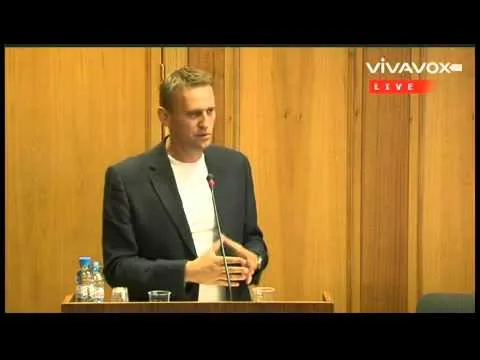
Thank you very much for the opportunity to speak.
And it is wonderful that the FAS (Federal Antimonopoly Service) organized this
discussion, because, well, at least
in my experience, 90% of all discussions
of public procurement or of Federal Law No. 94
specifically boil down to two things.
First, how terrible Law No. 94 is
for those supposedly innovative projects
and young scientists who cannot buy
reagents; and second, how terrible everything is for
those who supposedly cannot, through electronic auctions,
procure both pastries and road interchanges.
It seems to me
that Mr. Shakun quite accurately, very
characteristically, described this situation:
you are proposing that some soulless
robot paint a picture
by Raphael. I am absolutely certain that no one
is asking builders to paint a Raphael
masterpiece.
In reality, there is nothing uniquely, extraordinarily
or mega-special about what our builders do in 99%
of cases. Everything that is built in
Russia—yes, they built the Ostankino Tower once—
consists of entirely standard facilities
that are built in all countries and have been
built continuously in Russia as well for many, many years.
When the question comes up—ah, the bridge to Russky Island
which has already been mentioned today—and then
we use the bridge to Russky Island to explain
why we need to build, without a competitive tender,
a school in some settlement, and this is a very
important point: we need to understand that all
our construction, even these complex
interchanges, bridges, and tunnels, all of it
exists in a fully competitive
environment. If it is being built in large
regions near major cities with populations over one million,
there are always several companies
capable of building it. This is a completely
competitive environment. As for certain unique
facilities that cost a great deal—ports,
and so on—we have international
competition. So I think it is very
important, within the framework of this discussion,
to establish that construction—yes, it is important—but
there is nothing especially extraordinary or outside
the bounds of competition here, and in practice
nothing of that kind is ever built in Russia.
The second thing that we must also
recognize and say out loud is that, historically, between
our authorities and builders there have developed
certain special relationships. I am not even
talking about corrupt relationships right now;
it is simply a historical fact. Yes, they have
been friends for a long time, often belong to
the same parties, go on all sorts of outings together,
and so on. In other words, they simply have this
whole set of relationships. We have
a huge number of projects that are simply
built without designs, without
permits: we urgently need to build
a school for Semyon Semyonovich; we know him well,
let him go to the site and start building,
and then later we will hold the tender
and prepare the design documentation, and so
on. Therefore, these
relationships are important, but still
they are a subjective matter. Yet it is precisely this
that is the main driver
behind this entire discussion. I would like
to very briefly, since the topic
of today’s discussion is proposals
for developing legislation in the field of
construction, dwell on four
points that I would, so to speak, propose
for discussion and possibly for some
legislative solutions.
First: which builders actually meet deadlines? None.
Which builders stay within schedule? None. Which
builders stay within budget? None.
Which builders handle everything, including proper
documentation, correctly? None. They
all build more or less the same way, and the quality
of construction is the same for everyone.
Why, then, does a situation arise
where some are constantly given a pass, while
for others the supervisory authorities
practically never leave the construction
site? It seems to me it would be quite
right to strengthen in legislation a certain
obligation
on the part of the customer to fight for taxpayers’ money.
Because when the customer
says,
“Well, the contractor failed to do something, so we had
to pay them,” I ask: why are you paying them at all?
Who is forcing you to pay them?
Go to court—
take it to court. That means at the procurement stage
you should have broken everything down into stages,
monitored those stages. You have every right—go to
court, go to
law enforcement. In practice, this
does not happen. It is impossible to make them do it.
We keep trying
to make this happen, but it does not happen.
Second, what is happening now in procurement is
some kind of
confusion specifically over the subject matter of the contract.
Mikhail Yevrayev has already spoken about this: where do we have
design work, and where do we actually have
construction itself? Let me give
an example. One of the projects that
the RosPil project is dealing with is an interchange in
Yekaterinburg costing 6 billion rubles (about 6 billion RUB).
they put the design and
the construction out to tender and began looking into it during
the commission meeting; there was discussion about them
there is
test
if a project is such a gigantic
construction project, it in itself costs hundreds
of millions of rubles, but where do they have those hundreds
of millions of rubles floating around? Is there
working documentation? No. Is there working documentation?
A design? No design. This is, of course, a matter
for professional debate: is it necessary
to tender the design separately and separately
the construction? From my point of view,
it really should be done, but in
any case it must be described with absolute
clarity what is included. What does
turnkey construction mean, so that there are no
double
interpretations
which, strictly speaking, is what these projects are about
third, related to this, is the documentation from before
because in practice, with major construction—yes,
some interchange is being built, and the first
pre-design proposals for it were made back during
the Olympics, then there were some
surveys, then other surveys
then a third round; finding all of this
is impossible if you are not affiliated with
the official directly involved. A builder
will never find any of this data
what utility
networks are there, whether someone has already done work there
publication of absolutely everything that has been
developed on this subject, on the subject of
that specific construction project before the contract is awarded
fourth, something very important that no one
talks about: documentation afterward. Have you ever
tried, in open
sources, to find an already concluded
state contract or the documentation? For some reason
the system is set up so that it is impossible. We tried
to do a project: we simply took and found
roads that had been tendered. Well,
let's say, rather dubiously, with
a sole supplier and no price reduction
and tried to monitor what
they had actually built. But
the documentation is not there; it is impossible to obtain
All these concluded contracts should
be available, I don't know, on the Treasury website or on the
electronic platforms, but it is impossible to get them. You can
run experiments: in 90% of cases it
won't work. So what kind of oversight
public or otherwise, including from the side of
competitors, can we even talk about? Therefore, although
this is, generally speaking, already provided for now, but
unfortunately, there is no real effect
These are the proposals. If I may, one minute
for the complaints about our FAS (Federal Antimonopoly Service)
our wonderful agency—we can do it in a brief
response format, you can note it down and then
reply. I was saying that we should
compel our authorities to go to court
if
under a contract the customer fails to do something
or the contractor does. The FAS has an instruction
under which the FAS goes to court if
a contract is concluded
in circumvention of an order, and if it is worth more than
100 million rubles. We have
such a case in one region; it
happened in May. In May we wrote to you
a letter: please file suit. To this
day this has not happened. So it turns out we
have to run around and ask the FAS leadership
to file suit. Well, that looks strange
because if we impose such
high demands on some
contractors, then at the very least the FAS, as I
fully understand, has too few staff and
far too much work, but nevertheless this is
a major problem. But right now, excuse me,
we have to invent some hellish scheme just to
sue you in order to force you
to carry out your own order. We will
conduct an internal review, that's all. We have
an internal review if not
So, second: in the antimonopoly
service there is rather loose handling
when it comes to complaints and appeals. The practice is such
that if an employee wants to review it, he
treats our letter as a complaint; if he does not
want to review it—he has a lot to do there
or he is simply lazy—he treats it as a general appeal. Five
days or
it seems to be regulated, but in
practice difficulties arise here
The penultimate point is oversight of
territorial bodies. When our
complaint about, say, the Smolensk regional FAS office
is sent to that same Smolensk FAS office—well, that is
let's say, rather strange. And
last, but not least, there are all sorts of
small procedural issues. It is wonderful
it is simply great that there exists in the
antimonopoly service this quasi-
judicial procedure. It is not judicial, but
it is adversarial. But the procedure is undermined by everything. Do you know
what the hardest thing in the world is?
It is getting through by phone to the antimonopoly service
No one has managed it, depending on which
department, at least all the ones
we call. I don't know, maybe there are
some secret ones that actually have people
answering the phones, but most often it is impossible
to do. People wait there for hours
miss things, and so on. I understand that
these are implementation-level excesses, but nevertheless
they nevertheless this
adversarial in practice. Thank you.
a great deal of attention. Thank you very much.
So, I would like to propose, in conclusion,
to give the floor to three more colleagues. Yes.
one of those colleagues will be me. I’ll take number 5.