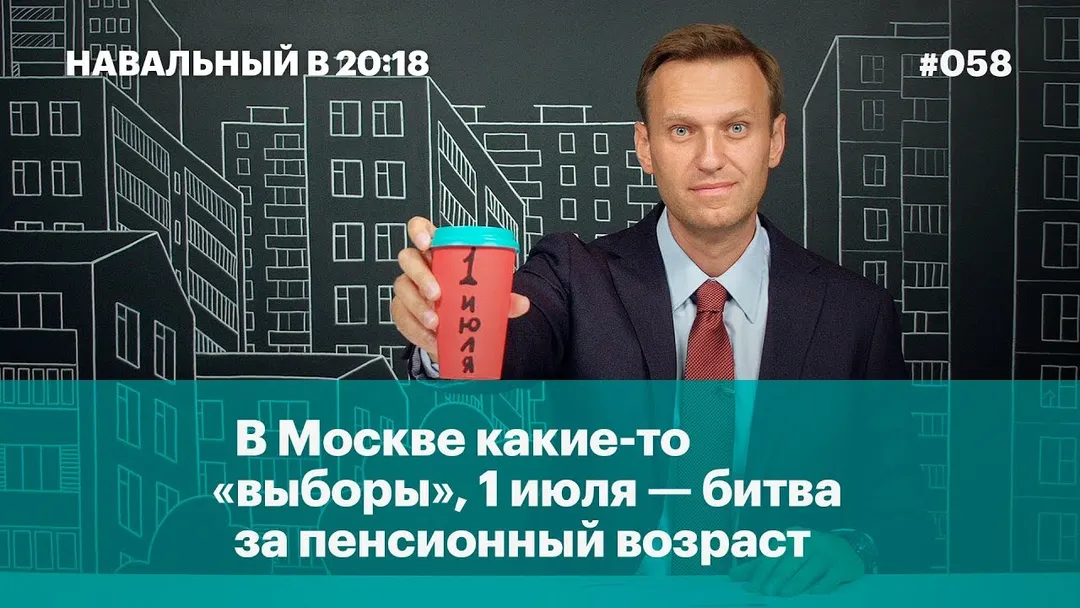
Some kind of “election” in Moscow, July 1 — the battle over the retirement age, still never showed up with the guys
[music]
Hello everyone. Moscow, 20:18. Alexei in the studio.
Navalny, or
a rebel, a rebel — that’s what
a certain political analyst, Sergei Starovoitov, called me. Hell if
anyone knows who he is, but he came up with this funny
quote: “We have entered an era
of vertical power. There is no more opposition,
there is only power,
there are rebels, and every one of
the political players has to decide
whether they are with the authorities or with the rebels.” And
decoded,
that means Navalny, terrorists, and others like them. So
make up your minds, my friends: are you with
the authorities or with the rebels? And of course I
am calling on you to come over to the side
of the rebels. Come join the rebels — we’ve
got cookies. On July 1, in 27 cities, and
on June 30 in Irkutsk, there will be protests against
raising the retirement age. In
the description of this video there’s a link — go
there, find your city, and take part. We’ll talk about this
about the retirement age, the battle over
the retirement age, a little later.
I want to start with the fact that it didn’t work out again.
On the last program I said that we had almost
reached the point where, for the first time in a year and a half, we
would have no one under arrest. One
person had been arrested, he was supposed to serve seven
days, get out, and by the next program I
would finally be able to say: everyone is free. And it almost
happened. But Vladimir Dubrovsky
let me down this time. He’s our coordinator
from Vladivostok. He had served — how long was it, I
don’t remember — ten or fifteen days.
He got out, and right at the threshold he was detained and
jailed again for ten — no, eight, sorry,
for eight days for insulting — for insulting
a police officer. When they started выяснять
exactly how he had insulted the police officer,
they told him — I’m not joking — “Right now, on
your VKontakte wall there is a song posted
that insults a police officer,
so it’s eight days under arrest.” That’s all. They’re
naturally
very interesting, and we’re just dying
of curiosity: what kind of song could that be
on VKontakte that could insult a police officer
so badly that a person gets locked up for
eight days. But
who knows — apparently they’re afraid, and
of course this song will instantly become
so popular that it will be on the wall in
everyone’s VKontakte account, including
police officers. I don’t know — chanson? What could it
possibly have been? Probably not chanson, because
the main consumers of chanson
in our country are police officers.
They listen to it far more than any
representatives of the criminal world,
former inmates, and so on. Anyway, I don’t know.
When our Vladimir Dubrovsky gets out,
we’ll ask him to conduct a careful
screening of his posts and music on
VKontakte so we can finally find this
super-song that in Russia gets you jailed
for eight days. In Moscow, some kind of election is going on,
some kind of election, and people ask me about it
and say, “Alexei, what do you
think about the Moscow elections?”
It’s very hard
to even notice that any kind of election is happening
in Moscow. I spent a month living in
“grandma mode.” What does “grandma mode” mean? It
means you’re cut off from the internet,
from social media, and from your quick-witted
grandkids who might come by and
tell you what’s going on in
the country these days. In other words, I was sitting in a cell, I
read newspapers.
I read all the newspapers. They brought in five, six,
maybe ten newspapers every day, and I listened
to the radio. Well, a grandma — what does a grandma do now?
She watches TV. I didn’t have a TV,
so all right, I was in semi-
grandma mode. And I want to tell you that in
semi-grandma mode
it is almost impossible to notice that in
Moscow, the largest city in Russia,
the largest city in Europe, some kind of
election campaign is underway. But sometimes on Echo
of Moscow (a Russian radio station)
they would report something like, well, Ilya Yashin has put himself forward,
and Sergei Mitrokhin with Yabloko (a liberal political party), something
or other, and there’s some kind of internal squabble going on.
At first it was interesting, then less so,
then not interesting at all, and no one
is following it. And probably I’m one of
the few people in Russia still curious
about what’s happening in the Yabloko party, because
I was a member of the party for many years.
I know all the people there, but even
I’ve stopped following it.
So that’s what it’s like: in Moscow
some kind of election is happening. I don’t really
want to praise anyone, and of course on this broadcast
if in the previous Moscow election
some other politician had taken part,
I would probably compare the current
election campaign and the situation to some
other person. But as it is, I’ll have to
compare it to myself, sorry, because I
was a candidate for mayor of Moscow four years
ago. And I ran a simple experiment. Today is
June 28, and on June 28 —
tomorrow my brother gets out of prison,
a bright day, June 29. So today is the 28th, and I
just went online and decided
to see what we were doing on June 28. Maybe
we had a lull then too, especially since four
years ago
the election was sudden, a snap election; it was
just suddenly announced on June 4 — on my birthday, no less —
they announced that Sobyanin had stepped down
from the post of mayor of Moscow in order to run
again
for mayor of Moscow, and so from the 4th onward we were doing something.
the 28th, and probably the other candidates too
who had been preparing for these elections for years
because for them this isn’t just another routine one right now
they should have done much more, properly
much more. In fact, not even on the 28th—on June 27, we
announced it. I’ll show you the news item now
so you don’t think that I
lied to you when I said we had already opened a headquarters for
volunteers. We got to work. These
photos are coming up—this is our headquarters for
volunteers, which we had built up over the years, and it instantly
started filling up with people. We opened it
on the 27th. So, well, I don’t know whether
any of the Moscow mayoral candidates now
have anything like that—a place where
people are swarming, volunteers are coming in, and everyone
knew the address: 22 Lyalin Lane. And now
you can easily google a million
of the coolest, most vivid
photos from there.
But right now I don’t see any
candidates
opening public campaign offices. But again, it’s not
that I’m trying to say, “I ran a great
campaign, and these people aren’t running campaigns.”
Actually, that is what I want to say: yes, we
ran a great campaign. I’m proud of everyone
who worked on my campaign, and these people now
aren’t campaigning at all—there’s absolutely nothing
noticeable.
Not even a little. I decided, out of nostalgia, it would be nice
to look back at what we did back then. They’re
all filing their documents now—I typed into YouTube
you can do the same—“Navalny
files documents as a candidate for Moscow mayor,” and you’ll
see this video. Let’s watch 38
seconds of me filing documents when
I was running for Moscow mayor exactly
four years ago.
[music]
4
[applause]
Oh, the signatures are falling.
I’m off to file them, and meanwhile you think about what
we’ll do if they don’t accept them from me.
[applause]
My team corrected me while the clip was playing: it was five
years ago, not four years ago.
Time flies.
But that’s how I filed my documents. Google it
now: “2018 Moscow mayoral candidate
filing documents,” and you’ll find a
photo like this of Dmitry Gudkov.
There’s a bit of a difference. It’s not
that I’m demanding Dmitry Gudkov
absolutely has to come with a huge crowd of people
and volunteers to file his documents.
The other candidates don’t even have
a photo like that. But it seems to me this is
a pretty vivid and obvious example
of the fact that they’re doing nothing, quietly—and that means
there are no real Moscow mayoral elections, to my
great regret. I absolutely am not
planning to, and definitely really do not want to,
boycott the Moscow mayoral election.
I really don’t want to boycott a second
election in a row, and we shouldn’t boycott
a second election in a row. But guys, if you’re not even doing
the bare minimum in the election itself
or in the political struggle, then I’d like
to see at least some political struggle from
these candidates against Moscow mayor
Sergei Sobyanin, because we know that
a significant number of Muscovites
are against Sobyanin, against United
Russia. Moscow is probably, in Russia,
the best city in which to run
an opposition election campaign.
I want them to run one. Yashin, up until
the point when he
realized that he still wouldn’t get through
the municipal filter (the requirement to collect signatures from municipal deputies to be allowed on the ballot), was running that kind of
election campaign on at least some
scale. I was glad about that, and on this
broadcast I always praised Yashin for it. But now, dear other candidates,
now, dear other candidates,
I demand that you engage in
political struggle, because closer to
the election I know what will start, it will start:
“Why is Navalny ignoring our
election campaign? Why
isn’t Navalny tweeting about us? Why
isn’t he doing this or that?” And after the election,
when they all get 2 percent each,
they’ll start whining, the way Sobchak did, the way
everyone else did after the presidential
campaign: “Why didn’t Navalny say anything
about us? We got two
percent because Navalny didn’t urge
his supporters to vote for us, because he did nothing.”
So here is an official appeal to
all Moscow mayoral candidates: I will
call on everyone to come, I will
call on everyone to vote. But guys, please
give us some political struggle.
Show the voters that you are
fighting.
Sobyanin, Sergei Semyonovich—it’s clear that
the municipal filter is impossible to get through
without help from United Russia.
But five years ago, every single day
I wrote a report on how many signatures
I had collected. I sat there with the phone myself
calling these municipal deputies.
At our headquarters we had this big wall chart hanging up—now
we’ll remind you what it looked like—on
which you could see how many deputies there were,
how many we had called, who had
promised us
their vote, who still hadn’t promised,
who we could approach and persuade,
and who was impossible. In other words, I myself, together with
the headquarters, together with our great team,
collected a large number of signatures.
So what’s the situation now? They say, “We’ll go
to United Russia.” Of course, go to United
Russia, demand
that it give you the signatures you need.
We don’t recognize the municipal filter anyway.
As for the municipal filter, who even cares who it is.
Where those signatures will come from is another matter, but I’d like
for us to get some kind of information about
what exactly you’re doing, right.
There are, like, around 8 million voters here,
and if you want to compete
for votes, give us something.
Nothing is happening. I don’t even know whether there will be
a candidate from the Yabloko party at all—this
weird situation where Mitrokhin is suing
his own party, and the party is suing Mitrokhin,
or they’re trying to remove him and not
nominate any candidate at all. Well, Rusakova seemed
to be a decent candidate for them, almost
I can’t really see what Gudkov is doing. Then there’s
that strange candidate named Krasovsky,
who is actually the most useful candidate, by the way.
The most useful candidate because, well,
he’s an absolutely hopeless crook and
a political hack, but still the most
useful candidate so far, because
we can look at the photos and
write down everyone involved in his
campaign headquarters, put them into some kind of
Excel spreadsheet called
“Disgusting Crooks and Their Crew,” and
never deal with these people again.
By the way, the overwhelming majority,
as far as I could tell, the overwhelming
majority of the people on that campaign are
former Sobchak campaign staff. In fact,
he himself is basically former Sobchak staff, and we can see
this pattern: if in the
presidential election
Putin needed a caricature
liberal candidate and they found Sobchak, then now,
one level lower—or higher, depending how you look at it—
well, no, not higher, but you know what I mean,
one level lower,
the Moscow mayor’s office needs a candidate who
is a parody of a caricature
of a liberal—and that’s Krasovsky for you. But
again, I’ll repeat:
the best, most useful content you can get is to
simply make an inventory of the most
disgusting crooks working in
his campaign. So I’ve gotten a lot of questions
about whom I’m going to
support, whether I’ll go, whether I’ll come
out to vote. My short answer is this, at the end
of my long ramble:
I want to go to the polling station, I
urge everyone to vote. These are elections
that could go to a second round, so in
principle, voting for anyone except
Sobyanin lowers his rating. The main thing
is to keep him from winning in the first round. I’m ready
to campaign for candidates, I’m ready
to talk about what great things they could do—
they just need to actually do those
great things. And I urge all of you
to put pressure on these candidates,
to tell them: guys, either you actually do something,
or we’ll consider you spoilers and stooges.
And the fight over the pension age—
it really is a fight. We can see that
this is the main political process in Russia
right now. Every day, even rallies not organized by us
are taking place. Today in
Novosibirsk there were more than 1,000 people;
yesterday there were crowds in Siberian cities, today in
Irkutsk. Across the country, despite bans,
there are rallies much larger than
there had been before. There are two very
important dates ahead. The first is July 1, when
there will be rallies in 27 cities
organized by us. On June 30 there will be a rally
in Irkutsk.
In some cities, the rallies are not
organized by us; there’s a list, and a link to the list
is in the description of this video. Be sure to
take part, because, basically,
the Kremlin’s plan—their strategy and tactics—
is simple. Look: they have put forward
the harshest, most vicious proposal,
raising the retirement age to 65 for men and
63 for women. Now they are waiting and
watching our reaction, and they’re waiting for July 1.
What matters is how many people
will come out, and
they care how many people will come out too. If
a lot of people turn out, then on July 18
they’ll probably introduce at least a somewhat softer
bill.
If, as it seems to them, not that many people
turn out, then on July 18 they’ll submit
the harshest version—the very same
bill—and then they’ll wait
until September to see whether the situation heats up by
September, whether any politicians will
join in, whether you and I will be actively
involved, and
whether there will be public outreach on these issues, resistance,
and defense of our rights. Based on that,
in September they’ll either adjust it
down to 63 for men and 60
for women, or, if we are not
active, they’ll leave this super-
predatory provision in place. Even 63 for
men and 60 for women is just as
outrageously exploitative—absolutely exploitative.
That needs to be understood.
We need to do explanatory outreach, and we are doing it
as best we can. I’ve been recording videos about the pension
age all day long. I
put out my video—you saw it, the one with
the funny beard. Vladimir Milov released
a video where he explains everything in great
detail and lays out our constructive
agenda.
Today Kira Yarmysh released a video
on what is actually a crucial topic,
namely that women are the ones who, to the
greatest extent, are being robbed
and
hit hardest by the increase in the pension
age, because
Why do we keep talking about men?
Men, generally speaking, don’t live to 64,
we won’t make it, while women will live to 64,
according to all the statistics.
But their lives will be very poor, and
women certainly cannot find
work in their 60s; at 55, and even at 50, it’s nearly impossible
for a woman to find a job, and that is where
the enormous deception lies. They
tell these unfortunate women,
who are supposed to keep working from 55 to 63,
they say, “Ma’am, go work,” but the woman
has nowhere to work. There are no jobs, even in a big city, and
in a small town, a woman will never
find a job at all. Ask your
grandmother, your mother—or you know it yourselves
perfectly well. Go to any website where
jobs are listed. That’s why we
will campaign against this. There is also a campaign being waged against us:
all the newspapers
are packed, absolutely packed, with
these websites,
with various articles about how
wonderful the increase in the retirement
age is. Or, by the way,
articles saying that these liberals,
that Navalny also once wanted
to raise the retirement age. And just
a couple of hours before our broadcast, this
one of the
online outlets, *CIT Journal*, published
a whole investigation. They
found—and wrote a whole piece about—
a company that is engaged in
placing this paid-for nonsense claiming that
Navalny also once supported it,
that Navalny was on the same side as Putin and
Medvedev, that he supported raising
the retirement age. It’s taken out of
context—a single phrase from
the platform of the Progress Party, the
People’s Alliance Party.
You should understand that all of this is, of course,
a complete lie. Over the last
year and a half, I’ve traveled all over the country, everywhere
I’ve spoken, and everywhere I was asked about
the retirement age. Our position is absolutely clear: we
unequivocally believe it cannot be raised, given
life expectancy.
As for the Progress Party’s platform,
well, there we wrote that it was necessary
to encourage a voluntary increase in
the retirement age—when a person
is told: you can retire now,
at 60, and receive 15,000 rubles, or you can
retire at 62 and receive more.
Voluntarily—decide for yourself. That is what we
proposed. In any case, these
proposals
were tied to an increase in life
expectancy. The proposal explicitly begins: when
life expectancy rises, then it will be possible
to do this and that. But
life expectancy is not rising. I’ve
recorded videos for 44 regions. If you
live in one of those regions, you will probably
soon see this as YouTube advertising,
where I speak. And this is for those
regions where life expectancy on average
is less than 65 years—that is,
the average man there does not,
in fact, live to retirement. And there are at
least four regions where men do not even
live to 60—the current
retirement age. Take, for example,
the Republic of Tuva (a federal republic in southern Siberia).
Fifty-eight—the average life expectancy for men is 58.
That’s a young man. And that is the average, the average
age at death. So we simply cannot
stay silent; people need to get involved.
Public opinion is completely and
entirely on our side. Absolutely everyone in the
country is against Putin and Medvedev’s plans.
And our task right now is to
bring these people out into the streets,
so that they speak out and express their outrage.
Please, let’s do this very
actively. Meanwhile, let me first
answer a few questions. I see Vorobyov
asking: Nikolskaya Street has been completely
closed off. Do you think this will change
the festive mood in the country and among fans,
including foreign fans who came for the World Cup?
Nikolskaya Street—
I was promoting it on Instagram,
I was talking it up on this program too, and
I myself was skeptical at first, when I saw the
photos and videos, but I went there a couple of times,
and it was the best thing to happen in Moscow in
recent years. It really was
a street-long celebration,
a spontaneously formed place where
huge numbers of both locals and foreigners
were bonding, hugging, and as you walked along, you
saw people from Iran chanting
their Iranian chants, here people from
Nigeria, over there Germans, over there Danes, and
everywhere among them Russians shouting
“Go Russia!”
and all the rest—it was
great. And today the news came that
the Moscow authorities—apparently the Kremlin’s doing, since
Nikolskaya is right next to Red Square—
well, as usual, stupid people
saw something good and decided
to break it. Nikolskaya has already been cordoned off,
there are metal detectors or barriers set up,
apparently there will be a line to get in. I mean,
what is this nonsense for, really?
This whole part of the city center
should be made completely pedestrian and
Red Square should be opened up.
A million foreigners have come here—what
do they want to do in Moscow? They
want to go to Red Square and take
selfies
with Saint Basil’s Cathedral in the background,
of course. And the city of Moscow should
to give them that opportunity in full
come by, take photos, and do it
by spending money, by buying beer, you’re putting that money
into our country’s economy
we love you, but damn, right now
our authorities are acting so stupidly that even
here it shows itself like this. Pio, Maksim
will sort you out. Again, we forgot about Denis
Mikhailov from the St. Petersburg headquarters. He is still
being held in a special detention center
forgive me for laughing, because Denis
Mikhailov is a great guy, and he really
has reached such a level
of confrontation with the crooks at the mayor’s office
of the city of St. Petersburg
that he practically never gets out of
the detention center. So Denis Mikhailov
is in the detention center — that’s become such a
constant for our headquarters. He has probably
served more time than I have, and more than Volkov
during
this election campaign. He’ll be released
in a couple of days. I hope that on
the next broadcast I’ll be able to say that Denis
Mikhailov is free and will truly continue
his fight. He has really locked horns
with these people. Well done. All residents
of St. Petersburg — Petersburgers, help
Mikhailov and our headquarters, because they are doing
great work. In a year, you’ll have elections
for local deputies, so let’s get to work
and do all of this together. And now let’s take some questions
from Twitter and see what people are asking there
write with the hashtag Navalny
2018
Dargod64 asks: might it be worth spending more time
drawing attention to the VAT increase and trying
to get it repealed? Dear Dargod, we
have discussed this quite a lot within our headquarters
A lot of people write to us saying, basically, why do you
keep talking all the time about pension
reform and say nothing about
the VAT increase
Even though that is also very important. Of course, it
is very important too: raising VAT will increase
prices across the board, and inflation will rise because of it
That’s not me saying it — the Central Bank says
they
they changed their inflation target because of
the VAT increase
But you can’t really build a broad campaign against raising VAT
because people don’t understand what
VAT is. To them, VAT is some kind of
strange thing, some tax
that some businesspeople pay
it’s not clear how. People who understand it
know, of course, that the specific feature of VAT
its economic meaning, its financial structure
is such that it is in fact a direct
increase in prices for everything at every stage
of a product’s production. So raising
VAT is a terrible thing altogether, which
the government has done from the standpoint of
raising taxes, despite the fact that during
the election campaign Putin
said that he would not raise taxes. But
it is extremely difficult to explain this to people
So VAT should be discussed
with businesspeople, with sole proprietors
with entrepreneurs, with people who
understand taxes. But with the broader
public, it probably doesn’t make much sense. But
rest assured, in two or three months
when all of this kicks in, people who do not
understand anything about VAT
will understand perfectly well how much
prices have risen because of its increase
They’ll go to the store for some milk
for food products the VAT is lower, but they’ll still go
to the store in any case for some kind of
food, goods, and so on and so forth
and then they’ll see — whoa, the prices
have gone up. And that’s when we will talk about
rising prices, we will talk about VAT
Of course, we will keep talking about this constantly
The word “pension” has become taboo
I saw a truly astonishing piece of news
from Stavropol, where they really did
in order to avoid public unrest, all media outlets
were forbidden from publishing any
critical articles about the increase in
the pension age. It is absolutely
astonishing. Even in the local
newspaper that belongs, as I understand it,
as far as I understood
to the administration, it is called
Blagodarnensky. There, a regional
government official first gathered the chief
editors and said, guys, please
don’t write anything
about raising the pension age, otherwise
there will be unrest here. But one editor-in-chief
said: you know, we already have an article here
already prepared
under the headline “Will We Even Make It to Retirement?”
It has already gone to print. Well, it’s out, nothing can be done
And the officials told him: well, what can you do
And they confiscated and destroyed the entire
print run of that newspaper because it contained
an article about pension reform
Can you imagine how afraid these people are
just imagine how much these people fear
any activity on your part, even the smallest
activity. You may think: well, at night I’ll
post some videos, some
posts, and they’ll be seen by
50 people on my friends list. And if I share it with
friends, then 500 people will see it. But how do you
think — does Blagodarnensky have
a much bigger circulation? No, these are the same
tiny
information streams. But from these
tiny information streams
a huge wave emerges that
cannot be ignored
That is exactly what needs to be done, and please do not
forget that. For the second or even
third program in a row, I have been
He asks about Shestun — he is the head
of the Serpukhov District in the Moscow Region.
He got into a very real battle,
and a highly unexpected one at that,
a battle with the FSB and people from the Presidential Administration.
And stubbornly, all through this fight, he records them
using some kind of hidden audio recorders,
and posts it all directly on YouTube,
telling the blunt truth, tearing into them, calling them all sorts of names.
They are basically just the governor
of the Moscow Region, Vorobyov,
whom he accuses of being,
well, a villain.
He accuses the Presidential Administration, he
accuses the FSB leadership, and this is really
quite something. You can see Vorobyov here now
in the photo — the governor of the Moscow Region,
who is now running for re-election, and before that
he controls all the districts and removes their heads.
He installs loyal district heads, and so he
tried to remove Shestun, but Shestun was one of
the few in the Moscow Region who said no.
And
he launched a full-scale war. What I
want to say about this is: I am not
a fan of Shestun. In fact, anyone who followed
the work of the Anti-Corruption Foundation
will easily remember the post
I wrote about Shestun
when he
started buying for his administration
some Mercedes at an absurdly
high price, and we went after Shestun
full force, making special
leaflets against him and distributing them
throughout the Serpukhov District. That is, we
were actively fighting against the head of the district administration, Shestun,
and generally speaking, we did not like him much.
And he also answered us rather brazenly. Let's
watch a 52-second video
where he says there is nothing
wrong with the car, and that he also needs
a helicopter and will buy one. I submitted to the council of deputies
of the Chekhov District administration
a request to purchase a car.
They are allocating the money for it now.
I asked for a Mercedes; that request was not approved.
We are now announcing a tender,
and I should already be choosing
the configuration. Why a Mercedes?
Because this car can handle a very
large mileage — it can do a million
kilometers, and I use it very heavily.
I can drive up to 100,000 kilometers a month
(about 62,000 miles), and on top of that I need
high speed because I
am constantly on the move, and
I need four-wheel drive as well.
I travel in winter too, whereas a Mercedes here
is rear-wheel drive. To be honest, I have even
thought about getting a small
helicopter, because sometimes in a single
day I travel around 200 kilometers
(about 124 miles) just within the district.
Why such injustice? That's why, when it comes to him,
regarding Alexander Shestun, I
am being completely objective now, because
there is a whole history of how we
fought with him as well. But I want to say
very clearly that I can see
that the case against him is fabricated, that the man
simply — I do not know who he is connected to,
some say that behind him stands the
Investigative Committee (Russia's main federal investigative body),
that he is protected by Bastrykin of the Investigative Committee,
and that is why he is not afraid to go after
the FSB brass. Others say that he
is connected with Kadyrov and with Chechens, and therefore
he is also not afraid to go after the FSB brass. The FSB
hits back hard, but I see one thing clearly:
the man wanted to run for re-election as head
of the district, and he has every
right to do so. Let him run in the election, let him
answer for his Mercedes too,
let him face uncomfortable questions,
let him lose the election or whatever else.
But apparently
the authorities realized he would not lose it, and
so they started brazenly removing him just like that. And I
hear the audio recordings — he
recorded them, you can find them on his channel — and there are
the deputy head of the Moscow Region administration
and people from the Presidential Administration,
in particular an FSB general,
who simply
says: you have to leave, we
have to appoint other people to your
position. And when he refused, his home was
searched.
He has now been arrested, he was arrested
obviously on some, well, laughable
absolutely laughable, completely
baseless grounds. But from this it is clear to me that the
system
just wants to devour him simply because he
refused to give up his post to some
people. More than that,
officials come to him and quite
openly say — as far as I understand about Shestun,
there are recordings, or at least he says so in an interview —
that they tell him directly,
well, we have promised your
position to the Podolsk people. So, do you understand?
An official comes to you — another official —
and
says, listen, you have to leave because
we promised your position to the Podolsk group.
Amazing, what can I say. It is like
one gangster on top of another, gangsters helping gangsters, and in
this gangster operation to make sure
that the Podolsk people seize the post of head
of the Serpukhov District, the FSB,
the Investigative Committee, and the judicial system are all involved.
Well, somehow this really
bothers me a lot. We should have a short video.
Oh, let's watch how FSB General
Tkachev
directly threatens him and tries to force him.
step down from office, and we’re at 44 seconds now
there isn’t any on the channel, I’m shocked, I can send a message
serves, and how is that a problem for you—for your wife?
this is a dictatorship, well, he doesn’t have long either
we’ve eaten
I’m not hosting
that’s not true, so the best
problems sometimes have the best solutions
paper
it gets resolved if you just leave it
the problem, the court, dying—this all gets resolved
it’s uneasy here, you sit calmly until
by September you step down, come on now
let’s wait, absolutely—how can this be here
like this, until the court’s decision, sort of
to back out of life then—the court lost, but
it’s clear that I’ve already lost completely
I’ll write it down on paper—it goes that the court and you
a win-win game
General Tkachev told us how
the judicial system works—well, come on
make it so the court and all of them come out winning
fine, you resign and become an adviser
you’ll be appointed, and if you don’t go, there will be
problems for your wife and your children
a general, you understand, says to an official, the head
of the administration: listen, want a problem
for your wife and children? Then right now we’ll
arrange it—you’ll lose in court, but if you
will
be a good boy and hand it over to the Podolsk group, then
you’ll win in court. I keep saying this, but
nevertheless, it must be said, well
what other arguments do you need
to fight this government? They’re bandits
bandits
idiots, crooks, con artists—a gathering of
some of the worst people—what the hell, damn it
some head
of the Serpukhov district administration, well
whether he gets elected or not
they remove him there in the course of a special operation
his family is being threatened, his children are being threatened, but what
can be said about that? Therefore
without question, Shestun—I couldn’t have imagined
that I could call him
a political prisoner—well, yes, a political prisoner
because he is imprisoned for political reasons
yes, he’s quite an unpleasant person to me
I would never have voted for him
in this election; I would have campaigned against him
probably, and if some
other candidate had come to me and said, let’s
work against Shestun, I would have said fine, he’s there
making improper purchases, buying things he had no business buying
sports Mercedes cars with
taxpayers’ money, but now he is clearly a
political prisoner, because for those
purchases he should have been held accountable precisely for
those purchases, and before his constituents. They
would simply not have re-elected him. But for some reason he
has to leave office not because of buying
Mercedes cars, but because the Podolsk group needs it
you understand—or I’ve established to get in touch with you
let me stay on a bit longer and answer questions, so
right, about VAT, I’ve already answered that—I see three
come on, show me what other
questions we have here about the historian Dmitriev
“Please say something,” someone is asking me
all right
well, it’s an absolutely monstrous story, really
a monstrous story is unfolding right now in
Karelia. I’m not doing a separate segment on it
because, generally speaking, nothing is clear
except that it’s lawlessness and a monstrous
story. There is the head of the local
Memorial branch (the Russian historical and human rights organization), Dmitriev, and he
goes around and
excavates
abandoned burial sites—he simply searches for them
the people who were once simply
shot—our fellow citizens
simply destroyed and buried somewhere out in the
forest, with no cemetery, no graves, no
information, nothing. And he has documented
the existence of several such burial sites
and documented that thousands of people
were executed during the Great Terror
and naturally, because of this
he had a serious falling-out with the local
security officials, who categorically do not like
his work, plus the fact that Memorial
is bold—and I like that organization
and so they decided to imprison him and
set about doing it in the vilest
way possible
they accused him of pedophilia, and since
now even the Supreme Court—good Lord—
the Russian Supreme Court acquitted him
on that count, and people around me are rejoicing
there was supposedly some pedophilia—some photographs
were found of his adopted daughter naked, and indecent
acts were alleged, that is, they
brought some monstrous
absolutely horrific charges against him, charges with which
it’s hard to find people who will
defend you, because people will think,
who knows, they probably wouldn’t accuse you of that
for no reason—better for us to
stay away from this case
as in a classic
FSB-style story, he was acquitted on those
counts, and the Supreme Court said that
it was nonsense, having reviewed all the case
materials, including a conversation
between a psychologist and his daughter, and all of these
materials were examined by the Supreme Court, which said
that no, this man should be released
this man, the historian Dmitriev, and he was released and
was free for about a week or two
and yesterday he was detained, and somehow
during the detention some police officers
stopped him on the highway and allegedly found
some belongings, and said, “Aha, these items were found—you
want to flee, while against you there is
once again the very same case under investigation”
and now they have arrested him for two
months
someone ended up facing similar charges over the same
materials—that is, they simply
want to show: we don’t care about
the Supreme Court, we don’t care about anything, we
want to rot you in prison. He is an elderly
man,
and he won’t survive prison, not for a long
stretch, and we understand what
a Russian prison is—especially in regions
like Karelia. We’ll rot you in
prison, and we don’t care about anything—and they are
carrying this out in a state of total lawlessness. This
man is being imprisoned.
And of course, this case needs to be watched closely.
Unfortunately, it is covered only in what
are called the liberal media, yes,
while in all the other media it is simply
forbidden to talk about such things. But, but
something monstrous is happening: they have brought
such charges against you that you know
you’ll carry them with you for the rest of your life. There will
always be someone saying: that’s the very person against whom
there either was a pedophilia case or there wasn’t,
whether it was pedophilia or all of it was made up—you’ll
spend your life running around proving to everyone: but I
really didn’t do anything. Well, somehow, maybe
it happened, maybe it didn’t—there’s no smoke without fire.
And on top of that, they just keep him endlessly in
a cell. And I watched the video of the arrest—
good Lord, the man is driving some kind of
tiny cheap foreign car,
and then they stop him, drag him out, put him in—
the whole system is occupied with this. For what? Well, this is what
we say to these people, by the way: we are going to
pay higher pensions to all these
investigators, prosecutors, FSB officers (Federal Security Service),
who are busy with nonsense instead of
investigating, there in Karelia,
corruption and actual murders,
real crimes. Instead, they chase after
this Dmitriev case, and later we will have to pay
for it.
With higher pensions—they retire early
and start receiving them ahead of time. So what is to be done?
I ask Valentinovich,
apparently: will you be meeting
your brother from the penal colony tomorrow? Of course I will.
I’ll meet my brother from the penal colony. I just don’t know—
they are always pulling tricks. Will they release him
directly from the colony, or will they
transfer him somewhere else and release him from there
so that the people meeting him won’t see him, as they
usually do—like they did with me. More often than not, they
do it even from a special detention center. The main thing is
that they release him. Of course I miss
him very much; the whole family misses him. The man spent three and a half
years behind bars simply because
he is my brother. He was held there in a fairly
harsh environment; they were constantly throwing him
into various punishments,
into solitary and
he went through all, all of those stages
of pressure that are laid out
officially in prison regulations—how
you can make a person’s life
worse. He went through that entire ladder. We
all, of course, miss him terribly.
So, our next topic is about one
person whom we were all waiting for
here in Moscow,
but he never showed up. There was a man
named Igor Kholmanskikh,
and to all of us—to me and everyone who came out to
Bolotnaya Square (a major Moscow protest site) and all the other
rallies, to huge numbers of people across
the country—this
Igor Kholmanskikh, speaking on Putin’s behalf,
said and shouted: I and the guys from
Uralvagonzavod will come and
break you all up there. Let’s watch this
legendary video.
At 31 seconds, once again, I want to say about
these rallies:
if our militia—or whatever it is called now,
the police—doesn’t know how to work, can’t
handle it, then we men are ready
to come out ourselves and defend our stability,
of course within the framework of Russian law.
Question, look.
The work of our police is clear because
of the events on the square. Come by—but not
right now, and preferably not for that reason.
And somehow we kept waiting for Igor Kholmanskikh with his
guys, wondering when he would arrive. And he was preparing,
and he created a movement called
For the Working Man, and of course he
was greatly favored by the authorities; he was
appointed presidential envoy. They simply took
some random nobody—he had been, what,
a shop foreman or something like that. Well, judging
by the way he speaks, an obvious fool—
and appointed him presidential envoy, that is, a person
who oversees the security services
and governors in a giant industrial
region. But all the locals,
even the opposition figures, didn’t really
have many complaints about him, because he
didn’t do anything—nothing at all—because
he was just, well,
a strange, not very smart person,
a random man whom they put in front of
a camera and told: just say that we,
speaking on behalf of the workers, say that all these
white-ribbon protesters, we’ll disperse them. So he
went out and mumbled this nonsense, Putin
boosted him, he was appointed, and he immediately
of course moved into some
main palace in the city of Yekaterinburg,
and lived in that envoy’s palace and basically
did nothing. And I remembered him—
why? Because he was removed from
his post. I mean, this is such an ideal
case—not even just a career, but
the whole context around that career is simply
perfect: a man from Uralvagonzavod
declares that he will come and disperse
those who are against Putin, and for that he is
appointed presidential envoy. He flies around on
on state charter planes
lives in a palace
a wonderful life in the meantime
Uralvagonzavod is literally collapsing
it has practically gone bankrupt, and the salaries there
are low
one of the most crisis-ridden enterprises
go to the arbitration court database and you
will see a huge number of lawsuits
that threaten to bankrupt
Uralvagonzavod; you can read all about it
the appalling condition
of the enterprise
by the way, in Nizhny Tagil
where Uralvagonzavod is located
male life expectancy is 62 years
that is, also
and there, men do not live to reach retirement, and
this man, who supposedly stands up for the common man
for the workers of Nizhny Tagil, he has not
done anything to improve
the lives of these people, while he himself, having first been
what he was, moved into a palace and flew around
on planes, and now he has been removed from
his post and appointed chairman
of the board of directors
of Uralvagonzavod, an enterprise whose
turnover is 132 billion rubles, and again I
read today on some local Telegram channel, and there
on some local one, yes, and it really captured
the right thought from Nizhny Tagil
they just took some random guy
who once blurted out some stupid thing and that was it
first they appointed him presidential envoy, and now to the board
of directors, where again
he will have private planes and a luxurious
life
secretaries, a huge salary there, a million
rubles a year—why? Because he
was just, you know, some clown who ran out
said something, and the tsar liked this clown
and so he had
a meaningless government career, but
once you are already in the inner circle, then you
simply have to be handed some sinecure
like Uralvagonzavod; you will sit there with this
board of directors, and you will have one this size
a leather chair, an office the size of 10
of these studios, an oak desk like
you know, in the movies, the kind from which planes could
practically fly in, and next to it a
small green table under which
two people can come up and sit down
you will have all of that
because, because you are
an incompetent person, but you really love
Putin and are ready to say all sorts of strange
things—that is what a Russian official is
the question is: can anything develop? No
how can anything in a country
develop with people like this? The question is whether
Uralvagonzavod will develop normally
of course not; how could this man, who
from being a shop-floor manager
to becoming a presidential envoy, failed at all the work there
and has now effectively become
the head of this plant—will he really be able
to manage it properly and competently? Of course
not, of course not. This is exactly the kind of
rule of the worst—negative selection
fools are promoted upward
fools are seated in these chairs and
given private planes; these fools rule over us
because fools publicly
say that those who do not want
Russia to be governed
by fools should be driven out. It is an interesting and truly
important topic, and follow it—I will
be watching how he manages this
Uralvagonzavod. There was also a great story
in Rostov Region—the funniest
the funniest story this week
happened in Rostov Region: there
an entire police precinct was dealing drugs
I mean, literally, police officers
were making dead drops, like the ones you see on
the internet in those funny photos, where someone
is walking around with some—what do you call them—
stash men, and yes, I know in quite a lot of detail
the method and how all this is done because
I am around such people all the time; they
tell me all these addict stories of theirs
I find it interesting, and I know fairly
well how this system works
so they go around burying things; I will not
go into detail—you can
find it yourselves if you want—but these stash
guys who were burying drugs and then
selling them over the internet—you
buy them and then go to some place
and dig them up—were police officers. Not one
officer, not two, but an entire police precinct
was involved in this, and they had
what was it they found there
seven kilograms of drugs and scales
special ones
that they used for all this
it was just like in a movie
like *Breaking Bad* or any other film
about drugs, with, you know, these tables
with powder on them, scales, and all that
and they are packaging everything into little bags—these
police officers were sitting there. Damn, I hope they
were doing it in uniform; I would really have liked to see
that video of them sitting there
Comrade Captain, please pass me
200 grams of batch number one, and you, Comrade
Senior Lieutenant, what is that, hashish, and
you have scattered it around—come on, do it carefully
this
and roll it into somewhat more
proper little lumps. Comrade Major, this time
said that we need to dilute
our heroin in such-and-such a proportion
and such-and-such, so come on, comrades, let us
do all this
more neatly—and there they are, sitting and doing all of it
and what I have just said is
Apparently, that’s not an exaggeration — that’s really how it was.
Probably, that’s how it really was: they called each other
“Comrade Major,” “Comrade Captain,” while
among themselves they called each other Vanya, Kolya, but
literally, police officers — an entire
department. Everyone in the department knew it. They
packaged drugs, brought in drugs, and
sold drugs to specific
users. They were caught because
the cops couldn’t help but realize that, after all,
some kind of operation was underway. Naturally, there
were drug addicts there,
and very often some of them turn out to be informants
or police agents. Someone ratted them out, and
the police came and arrested them.
They disbanded them, apparently, but what really
struck me was this: when I was reading about
it in an article, there was a comment there
from one of those high-ranking police officials
who said that “the question is being considered” of
opening a criminal case.
Seriously? “The question is being considered”? You catch some
16-year-old idiot with hashish,
one gram of it, and if he passes it on
to another idiot to smoke,
you drag that idiot off to prison for five years. You
do it simply to create so-called
performance numbers.
You catch these addicts, take them for
testing, lock them up for 15
days — I end up sitting with them afterward.
That happens instantly. But here, an entire department
was dealing drugs, and you’re “considering”
whether to open a criminal case? Come on.
The entire police force of Rostov Region should be
disbanded — and not just that, the whole Southern
Federal District: all of them should be thrown the hell
out. The entire central directorate,
everyone who deals with
drugs within the police system should be
dismissed for this. The scale of the scandal is
indescribable: a police department was selling
drugs. Who knows how long they’d been
selling them? Who knows, in the course of
this risky business, how many
people they may have killed, for example, or what else
they did? It’s always a business tied
to violence and all sorts of things like that. And they’re
“considering” whether to open a criminal
case.
No high-profile resignations, no
nationwide scandal — we see none of that.
But we should. This is just one more example
of what the Russian police are, and every
time something like this happens, it
goes beyond our idea of what is
even possible. Could we have imagined
that 400 kilograms of cocaine would be found at the embassy in Argentina
(about 882 pounds)? I
seem to recall people saying our Foreign Ministry was involved in that kind of
operation. Turns out it was possible. But you have to admit,
what a system: diplomats
supply the cocaine, and our cops distribute it here through
their departments.
“Distribute” is the right word. What a wonderful
state system — and everything is secret.
These ones have state secrets, those ones have
state secrets, and everything is kept inside
the state system, from wholesale
purchases
to those lower-level operators — it’s all run by
state employees.
And we pay them for it — with higher
and early pensions.
It’s the perfect system. I may sound like I’m joking now,
but who knows — maybe the very same
cocaine that diplomats were bringing from
Argentina was being sold too. Why not?
What couldn’t happen? What isn’t possible?
Anything can happen in the Russian system, because
the unbelievable is right there beside us. And this week I had
some absolutely
astonishing court hearings. First,
I was tried in the Simonovsky Court. You know
that I’m a twice-convicted repeat offender,
and so I have to report regularly to
the inspectorate.
Every first and third Thursday,
sometimes those first and third Thursdays
coincide with trips I have — for example,
I go on vacation with my family. Over all these years
that I’ve been reporting,
there were two or three times when I couldn’t make it.
My lawyer submitted a document saying that he
was on vacation, so he couldn’t come, but
the system is unhappy that it gave me
a suspended sentence five years ago, and now
those five years are almost over, and
under the law my suspended sentence
would expire, and that would be it — gone.
And then they wouldn’t be able to just
snatch me up at any moment and throw me in prison for five years.
They can, of course, at any moment
throw me in for three and a half years on
another case, but not for five years anymore.
That would have changed in mid-July, and so
these clowns arranged a special
court hearing for me — first the detention center, and then
this time they suddenly summoned me by subpoena. So
I hire a lawyer,
the lawyer falls ill, and
that’s a normal thing, just everyday life. I
come in and say: let’s postpone everything for
five days or so,
because my lawyer is sick. Actually, that’s not even
how it happened. I arrived, and the court already knew that
my lawyer was ill, because they had called her
and she said, “I’m on sick leave.” I come to
the court, I’m standing outside the courtroom, the room is locked,
then after a while someone comes
— a bailiff opens the room with a key. I
go into the courtroom, and sitting there is
this woman, in the place where
my lawyer should be sitting.
I ask, “Who are you?” And meanwhile a whole crowd
of journalists is coming in. And she says,
“I’m your lawyer.” Just like that: “I’m your court-appointed lawyer.”
Court-appointed. The hearing hadn’t even really started yet...
It hadn’t even started yet; no one had officially scheduled it at all.
From a formal
legal standpoint, the judge had not even yet
been able to consider the issue that
my main lawyer had fallen ill, that
the proceedings had not yet begun. I have no idea where
this lady came from—whether she had been sitting there already or came in
from the judge’s chambers through the deliberation room,
but something obviously happened.
The judge comes out, and I say, in utter
astonishment: here are the documents,
here is the medical certificate, here is everything you need.
We are postponing the hearing. Even the prosecutor
says, well, of course the hearing has to be postponed. No—
here is a court-appointed lawyer for you. Honestly,
I don’t even remember the last time I yelled at
a judge like that—and I really was
yelling. She couldn’t even have me removed
because she needed to carry through
this lawless outrage right there and then,
to extend this
probation period—which is what she ultimately
did, several times, despite the fact that
the prosecutor objected. The prosecutor
agreed that I should go to my lawyer,
my sick lawyer Olga Mikhailovna, who
was there
with radiculitis and simply could not move, and
bring back additional documents from her. No.
No, the judge said no and issued
an absolutely astonishing ruling. In the
absence of all the lawyers, there were a million
different violations.
She not only extended my
suspended sentence by a year,
she also ordered me to report to
the inspection office every Monday. That means I
now have to, every single week,
go there and check in, and I even
did the math for her there—this is absurd.
Look, it’s a 40-hour workweek in
Russia.
You want me to check in once a
week. That means five percent
of the workweek—but an hour there and an hour back
to the inspection office, I have to spend
just on traveling there. You understand
that this is impossible to comply with.
And you could read it right in her eyes:
I understand exactly why a ruling like this
is being made—so that you cannot comply with
our idiotic conditions, and we can endlessly
keep extending your suspended sentence so that you
cannot run for office,
and so that you are always on our hook; we
can put you in prison at any moment.
That was one astonishing court hearing. And the second hearing,
which I no longer made it to, was with
billionaire Mikhail Prokhorov.
I had prepared and brought for you
such beautiful things—red stripe,
blue seal, and look at these
great stamps here. These are notarized
translated Italian
documents that directly proved we were
right, and we understood that now we would
go in and win the case against Mikhail
Prokhorov, because we simply could not
lose it. We open them—you see, there’s a bookmark
placed there—and we see it says that
Mr. Khloponin, former deputy prime minister
of the government, first bought his dacha (country house) for
10 million euros,
11 million euros, and then sold it in
the next document, we see, for
35.5 million euros.
So there you have it: in one document it says
in black and white, 11 million euros,
and here it says 35.5 million
euros.
Obviously, if you sold your
house for three times its market
value, then this was not a market transaction.
It is obvious that this looks very much like
a bribe, and with these documents, basically,
we could quite reasonably have
hit Mikhail Prokhorov and the official Khloponin
over the head with it. But the court said that all the same
—and for the first time, this happened to us:
they removed
our lawyer Ivan Zhdanov from the hearing.
For what?
Well, he had various motions,
and he started reading them out. She said: read them all.
But by law, they have to be considered one by one.
First I ask the court for this,
it says denied; fine, then I ask the court
for that, it may deny it, and then about
something else—and that one may be granted. That is how
the process works. But the judge said: read
everything together. He said: I won’t do that.
So they ordered him removed from the courtroom, and he was removed.
Zhdanov was gone; one lawyer did remain, though,
and they issued a ruling under which I now owe
Mikhail Prokhorov 1 ruble.
Which is, of course, just wonderful. But that’s not all:
not only do I owe him a ruble,
I also have to record a special video for
Mikhail Prokhorov and post it on my
YouTube channel. It will be interesting to see how
the bailiffs will enforce
that—I don’t know. But quite possibly,
my friends, I may even record
this video myself—for Mikhail Prokhorov, for
Khloponin, for all these judges—in
accordance with the court ruling. But I have
a feeling that they won’t like my video
either. On June 30 in Irkutsk, and on July 1 throughout
the rest of the country, come to the
rallies against raising the retirement
age.
Our program will go on break until the end of
August or the beginning of September,
and we will try—in fact, we are already
trying to do something like a relaunch of the
Navalny LIVE channel, which we plan to complete by
September. But in any case, our
program.
As the show goes on vacation, I’m saying goodbye for
a longer time than usual,
but I hope you’ll come back to us in September.
Then we’ll once again be discussing
all sorts of serious, sad, cheerful, and
funny things on this program. Many
thanks to everyone. Goodbye.
[music]
