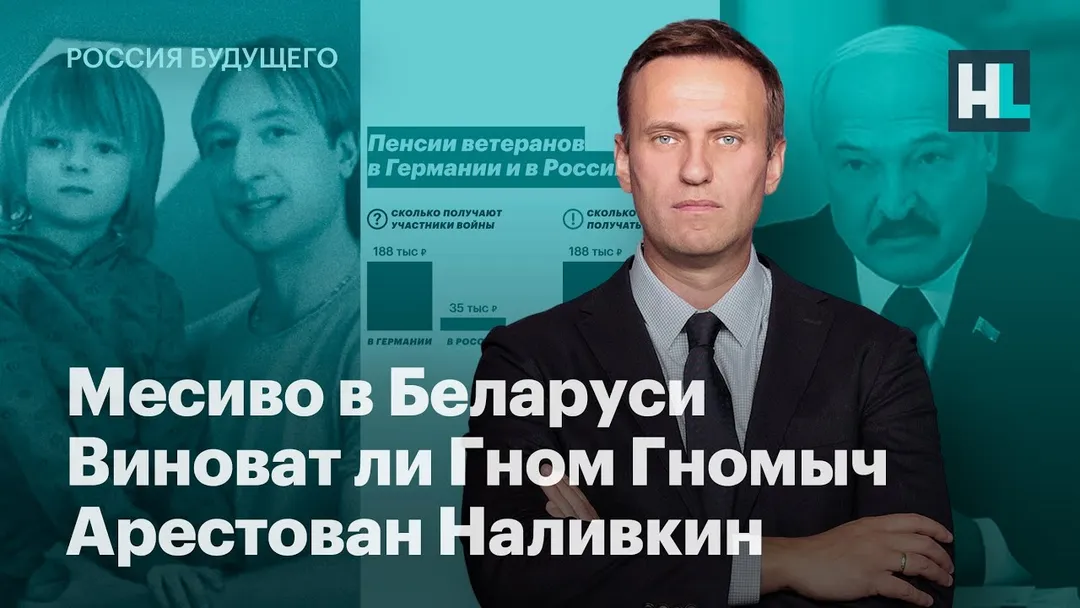
Chaos in Belarus, Is Gnom Gnomych to Blame, Nalyvkin Arrested
[music]
Good evening, everyone. In Moscow, it’s 8:00 p.m., which
means your favorite live
— or regularly watched — program
*Russia of the Future*, and I am its permanent host,
Alexei Navalny, or “the American shoelace”
as I was once again called by someone who appeared out of
nowhere — some random guy who crawled out of the woodwork
named Gabrelyanov. Remember the one who
ran that, and I think even owned,
that trash heap called *Life*
News.
And there he was, on the broadcast of my favorite blogger,
Vladimir Rudolfovich Solovyov, saying that
I’m an American shoelace. Six seconds, and the big
question is: “Lyosha, who the [__] are you, [__] hell?”
An American shoelace — interesting. In my opinion,
if anyone’s an American shoelace, for example,
it’s the son of that Gabrelyanov — Aram
Gabri-
-elyanov Sr., well, anyway, some kind of
younger Gabrelyanov, who also worked
in that whole operation, made money here from
placing all those commissioned
pieces, and then of course what did he do? He left
for America. Now he takes photos sitting on
the floor with the Brooklyn Bridge and Manhattan in the background,
and writes posts like, “Cool, I like America
very much,” writes young Gabrelyanov to us. But
for some reason I’m the American shoelace, even though
it was your money, which you paid in the form of
taxes, and then it migrated to
those two crooks, and they went there
quite happily — off to America.
Please send me your questions with the hashtag
#RussiaOfTheFuture on Twitter; your questions
will be put on screen, and I’ll answer them.
A reminder that you can become
friends and sponsors of our channel — you just need
to click the join button. There’s also
a link, and by clicking it you can
send all sorts of ducks flying across the screen. By the way,
speaking of which, have you noticed that in our
studio something has changed? Attentive
viewers are right: a reusable mug.
After every broadcast, people were absolutely
crucifying me
— environmentalists, I mean. I can see they’re already
putting messages up for me now. Bardak Obama writes to me:
“We ask you to switch to a reusable
mug instead of a disposable cup. We hope
we won’t see one on air anymore.” I have switched
to a reusable mug, and the disposable
cup will no longer appear here. That’s
the right thing to do. I can’t say that I’m,
you know, so advanced that I always
strictly follow
all the proper ideas, but there’s no need to
preach one thing and then demonstratively
keep putting in front of yourself
a disposable cup all the time if you can
use a reusable one. So yes,
I submit to your will, because
it’s a fair suggestion. I agree with
your fair suggestion. Twenty thousand
people are watching us live.
With that funny little lamp thing.
And remember, in one of the previous broadcasts I
was telling you — thirty thousand people are already
watching us live —
about Kalmykia, where it really looks like
— and this happens in all regions — they falsify
the numbers. But in Kalmykia they falsify them
— by falsify, I mean, of course,
the statistics on infection and mortality
from COVID. But in Kalmykia it’s just
the only region in the whole country where
completely unique people are in charge, and their
method of falsification is not that
they underreport or something like that — no,
it’s simply that nobody gets sick
on Tuesdays.
So I said that on a previous
program, and then I checked, and
the one Tuesday we had data for —
naturally, I went to look at
the next Tuesday too, and I saw that
the next Tuesday the numbers rose a little after
my previous broadcast, but then again
every time it’s Tuesday, it shuts off; every Tuesday
it shuts off. I really just want to
say to all the citizens of Kalmykia, and especially
especially to the Kalmyk
officials: are you
making fun of us? I mean, seriously,
the whole country is already watching this and laughing,
and you’re just bluntly making it look like
on Tuesdays in Kalmykia
nobody gets infected
with coronavirus. By the way, that is actually
an abuse of official
position — a criminal offense. But what’s more,
it’s done so ridiculously that it’s honestly
interesting who came up with exactly
this nonsense. Was there a meeting where they said,
“You know, in all the regions they just
knock 30 percent off and publish, I don’t know,
some figure,”
and then someone in Elista (the capital of Kalmykia) said, “No, we, we
will go our own way.”
We just won’t count Tuesdays.”
A lot of people are asking about Belarus.
About Belarus — we’ll talk about Belarus now.
But Sergey Volkov says: “I came across
your chance encounter on TV Rain (an independent Russian TV channel) on YouTube
with deputy Tokar from Perm,”
Trapeznikov.
“Tell us, how did Kont react to your
parliamentary inquiry about corruption at
Russian Railways?” Yes, that really was ages
ago — an interesting story.
Probably some — I don’t know, many — remember
that there was this worker, Trapeznikov, who
became probably the main face
of Vladimir Putin’s presidential campaign
and, generally, the main face of the conservative
movement after 2012, even
more than Putin himself, because he was a factory worker.
which was coming out—we're taking it, guys.
from Uralvagonzavod (a major Russian tank and railcar manufacturer), walking around with them.
Moscow hipsters, and we accidentally
somehow ran into this guy on the air at TV Rain (an independent Russian TV channel),
this turner. Well, I talked to him, all of this
was being filmed by journalists, and I said,
"I'm against corruption, I'm a man of the people,"
I told him. "But if you're against corruption,
then let's tackle corruption at Russian Railways (RZD) together.
At the time, since you had done a big
investigation—a lot of reporting—about
the matter of
Mr. Yakunin and where his fur coats were kept,
that famous story. And then Trapeznikov said,
"Of course, yes." Well, what do you think
it all came to? It came to nothing. I
am not even sure that he, in my opinion, didn't even
file a parliamentary inquiry back then. Today
something happened—a fairly important news item, and
politically very significant and instructive,
because Roskomnadzor (Russia's media and internet regulator) unblocked
Telegram. And how much talk there was—
remember when the FSB (Russia's security service) and
various anonymous and non-anonymous speakers
were saying that Telegram
was basically some kind of terrorist network,
and they were refusing to give us the keys
that would let us decrypt
everything we say, and therefore it would
be blocked. And so there began an almost
three-year, very absurd and very
pointless war by the state against
Telegram. And credit where it's due to Durov:
he was simply great—he said very clearly,
"I will not hand over any keys, and you will
go on blocking it.
I, meanwhile, will keep finding ways to evade you." And he
used various technical methods. I
won't pretend that I am
an expert, but this was a big
story, and Telegram's availability
kept growing. Many of us had
to switch to VPNs in order to
use Telegram, but in the end the authorities
gave up, and
so here we are: today
Telegram was unblocked. Three years—yes, it was
three years of struggle and three years of a fairly
uncompromising position, but they were
forced to unblock it because, well,
because they had no choice—including, by the way,
because it's a good service. All these, well,
all these—I don't know—Margarita
Simonyans, basically all
the Kremlin media that exist now,
where do they exist? In Telegram.
Because it's this separate,
special channel where you can't
post comments.
They really like that, because when
all sorts of propagandists—
really anyone, everyone who tries
to support Putin—opens an account on
ordinary social networks, there is
this thing called comments, and in those
comments people constantly show up
and write, "Well, you're lying here, and you're
lying here too," and basically no matter
what a propagandist posts, people come into
the comments and tear apart the propagandist's position.
But Telegram is very convenient
because it's like a one-way pipe: you
speak into it, but what people say back to you,
how they object to your words—you can't hear any of it. And
a huge
infrastructure has grown up there, or rather
an ecosystem of various pro-Kremlin
Telegram channels. They lived only on
Telegram, and that probably became one of the
reasons why they were forced to
unblock it—because they were all
sitting there the whole time.
Today there were several fairly
interesting articles saying that Telegram had been
blocked all this time, yet through
government procurement contracts
state authorities were spending
money to place information on
Telegram. So in the end this
absurd situation reached
a point where it simply could no longer
be tolerated.
So they unblocked it. And again, let's remember
how it all began: that same Margarita
Simonyan—show me her wonderful
wonderful—well, Margarita Simonyan's
wonderful—there, you see—
she wrote: "Guys, they'll shut it down
for sure, don't even doubt it." I mean,
this always happens when the authorities
do something like this: of course they have to
tell us that yes, any resistance is pointless,
boys and girls, of course
they'll shut it down, absolutely. You don't
understand—over at the FSB they have these
systems, there's this, you know, box
painted camouflage green, you press
the big Start button and that's it—Telegram
is blocked. Everything works, all done.
But none of it worked out, and already
today, of course, they immediately did a complete 180
degrees.
Margarita Simonyan is now writing new posts,
saying, "QED—exactly as was to be proved.
Congratulations to everyone on the lifting of the
Telegram ban—what a wonderful
event, everything is just marvelous."
You see? "And if you fight, then I
will bite"—but really it's just
a splendid Leopold the Cat (a Soviet cartoon character known for saying "Guys, let's all live in peace").
But really, it's simply because they couldn't swallow it, and
among other things, they couldn't because
there was substantial, broad public
support. Let's remember the rally, for example,
in Moscow in defense of
internet freedom—though the immediate reason for it
was, of course, Telegram.
[music]
By the way, remember how everyone laughed?
Like, why launch those paper
airplanes? I idiotically suggested back then,
let's throw paper
airplanes out the windows, and everyone was like,
what a stupid stunt. But in fact, the paper
airplane became a symbol of digital
resistance. People were saying: we are digital
resistance, and we are going to keep using
Telegram, and everyone was explaining to each other
how to use it, in a half-crazed
way, how to set it up, how to get access to it more cheaply,
so they could use Telegram, and in the
end the state backed down, because
in fact it always backs down when
a country is faced with this kind of
really, on the one hand,
resistance, and on the other hand,
the obvious illegality and
the usefulness of the thing they were
trying to ban. They were trying to ban
a service used by
several million people, and people said:
to hell with that nonsense, we are not
going to stop talking. Remember how there was
talk that they would practically inspect phones
to see who had Telegram? Everyone said:
no, we will not stop, we will keep
using it. And the audience kept using it,
it kept growing, and the state was forced
to retreat. So I congratulate all
the wonderful people I don't know personally,
who
many of whom you do know, who simply
worked on this campaign, supported
Telegram, or in any case did something,
wrote, spoke out, and refused to comply.
That is very important. So, now, about
Belarus. 'A State Department agent'
Comment on the situation in Belarus.
They say there's a velvet revolution there. How
would Lukashenko's overthrow affect Putin?
On the previous program I chose not to say anything
about it, because I don't want
to speak when I don't really
understand anything at all. I promised to look into it a bit,
figure it out, and explain here what
is happening, my point of view. But honestly,
as of this evening,
active events are still unfolding there right now.
It also has to be said that it's hard,
of course, for me to paint for you
any kind of complete picture or offer serious
expert analysis, because today in Belarus
there is, really, a full-scale mess going on
right now, just some kind of
political chaos, with arrests, torture,
detentions of basically everyone around. So,
what is it all about?
But let me say in advance, for viewers from
Belarus,
I am not claiming that I have some kind of
super-expertise here, that I am a great political scientist
who understands everything perfectly. And please, I will
try to say Belarus, but if
somewhere I say Belorussia, there's no need
to come running after me shouting, 'Navalny,
you're like the worst villain of all.' So,
the situation is this:
the last mass protests in Belarus
were quite a long time ago, in 2010.
The last elections, in 2015, passed
relatively calmly; there were no
mass protests. But it would also hardly be possible
to call those elections fair. Still, they
went relatively calmly because
my understanding is that, overall,
the country's residents kind of
understood that Lukashenko, against the backdrop of
what had happened with Crimea, would not allow
something like Crimea to be pulled off there.
He would not strike a deal with Putin, he would not let
the country be handed over, would not allow the country
to be annexed. So in 2015 there really
wasn't anything like that, no
protests. But time passed, and most importantly,
the economy
was collapsing. And now this
mass dissatisfaction with Lukashenko, which
obviously exists in the country, is of course
happening against the backdrop of an epidemic at the same time,
which President Lukashenko does not acknowledge
at all. We have different countries,
there is the Swedish model, and then in Belarus there is
the Belarusian model: the guy simply
doesn't recognize it, that's all. Says there's nothing,
that it's all nonsense.
So that factor played a role, and
of course the sheer destruction of the economy as well.
Any authoritarian leader who
has been in power for many, many years will sooner
or later find himself in a situation
where the economy is falling apart, even if before that
there had been some relative successes.
There were, but now there are no successes at all.
There were some points of growth there,
but now they will probably cease to exist,
like that famous
Belarusian internet sector and Belarusian
IT specialists. Many of you know about this,
or heard about it from the film about
Silicon Valley. There are astonishingly many
Belarusians there. They explain what it means
that this sector has been developing in Belarus.
So, the falling standard of living
of the population, economic problems, and
then suddenly, in these elections, a record number of
15 initiative groups are registered
to support nominations, essentially speaking.
That is the largest number
of initiative groups in the entire history. At the same time,
logically, polling in Belarus
is in practice, and in my view even legally,
prohibited. More than that, there were even
bans on
internet polls, because in
an online poll on any website, Lukashenko
gets something like 3 percent or 5 percent.
All the others are getting hit with lots of criminal cases.
Official polling also doesn't show those percentages,
in his favor, so for many years there
has effectively been a ban, and in fact no one really
knows the real numbers, and overall
the situation basically comes down to this:
there are three genuinely real
candidates there. One is candidate Tikhanovsky,
who is currently in prison, and
he would effectively have been seen as
the real candidate, but instead his wife became that candidate.
An interesting fact about Tikhanovsky is that
it turns out I know him — or at least,
on one of the channels there was
this funny video posted. Let's
watch: Tikhanovsky talks about
how he and I met, with
Alexei Navalny. He once even
ran into him by chance on a street in Moscow. We had
our office there nearby, and I knew he had an office there too.
I just literally ran into him face-to-face.
Whether he remembers it or not, probably not.
Maybe he doesn't remember. By the way, I told him
that I was planning to run for president.
I was joking then, but you see how it turned out, and how
he reacted.
Great. But he was shocked. I started talking to him like
to a friend, and he said, 'You don't know me.'
But I already knew him from some videos.
Well, that's how it seemed to me, but he
said, 'I don't. Write me an email,' and that was it.
Later I did write to him once. I made
a video message addressed to Navalny, and
no one replied to me. Well, it's a pity I didn't
reply, but the main thing is that when I
watched the video, I remembered — yes, really,
that did happen, near our office, I think in Taganka (a district in Moscow).
Some guy came up to me on the street — I don't
remember, I was on my way somewhere.
Honestly, people from Belarus quite often
come up to me. And there he was saying,
'Look, I'm going to run for
president,' and I thought, well, either he's some cheerful
guy, or maybe a little bit
crazy, or something like that. But then
it turned out I really should have
responded to Tikhanovsky and talked to him.
It's a pity that didn't happen back then.
It's just kind of a funny fact. Anyway,
this Tikhanovsky is an entrepreneur and
a blogger, and he basically built his whole campaign
and his whole public profile around the fact that
he traveled around the country in
some big vehicle and
just did live broadcasts, and people —
all kinds of people — simply talked about their
lives. Since censorship in Belarus
is much worse than in Russia, and
has existed much longer there than in Russia,
this had the effect of
a bomb going off. I mean, simply
people talking about their lives, speaking
the plain truth — the blunt truth — and that truth is
unpleasant for the authorities, but it is the truth, and
it resonates with everyone. That's why this all began there.
And in general, by the way,
YouTube
in Belarus is much more important and much
more distinctive than in Russia. There are
several opposition
YouTubers there, each of whom has several
hundred thousand subscribers, which for a country of 10
million people is a genuinely large
audience — a very large one, even bigger than
mine, for example. In Russia, even accounting for the country's
size, that's very significant.
And right now, one of the things
that is happening is that they are literally
jailing all these YouTubers. Those who didn't
manage to flee are all being imprisoned, and all of them are being
put under heavy pressure. And this is a very important
strategy of the authorities, an important strategy
of Lukashenko: to force them all into silence.
As for the situation with the Tikhanovskys, they
started locking people up — well, they did imprison him.
First, they opened
one criminal case against him, then opened
a second criminal case. They started arresting people,
harassing them, driving even people out of their jobs,
including those who had appeared on his livestreams. For example,
some woman goes on air and says that
'things are bad at our kolkhoz (collective farm),'
and then she gets fired from that kolkhoz. As for
Tikhanovsky himself, just
take a look and assess the degree
of this sheer lawlessness.
It keeps happening all the time. That's why the topic
is called 'Chaos in Belarus,' but here,
you're about to see the footage that
resulted in a criminal case being opened against Tikhanovsky.
Let's watch — 52
seconds.
[music]
[applause]
[music]
[applause]
[music]
You see, we
I myself have seen this kind of lawlessness many times,
in Russia too. I've been attacked at
practically every rally. Good Lord, no matter what
city I go to, at the airport they
throw eggs at me, some people come running up,
some provocateurs, and then they also say that
of course we beat them up, and then a criminal case
was opened against Volkov — you remember that happened.
It was opened.
They were shoving a camera right into his face like this,
he pushed it away, and then a criminal case for
obstructing a journalist's professional activity
was opened. But here, Tikhanovsky is literally just walking,
not touching anyone, and some woman comes up to him —
a provocateur — and starts trying to get a reaction out of him.
He turns away from her and walks off.
He understands what this is. They say, 'Woman,
you're a provocateur.' The woman goes up to
a police officer — or rather, I don't know, a militiaman (as police were traditionally called in Belarus and other post-Soviet states) —
and says, 'Look, see, he...'
The answer to my question is: this is a provocateur.
I mean, even there, in
lawless Krasnodar Krai (a region in southern Russia), it would be hard
to imagine.
After that, they start detaining Tikhanovsky.
Some police officer stages a scene,
throws himself onto the asphalt, and a criminal case is opened.
Today, on top of that, they opened yet
another criminal case against him — you'll laugh —
he is accused of, while collecting
signatures and running for president,
trying to seize power. You see?
That is, he used the signature collection
as a means aimed at changing the government, I mean,
it's not just absurd,
it sounds funny, but I stayed up late
and out of curiosity watched a couple of reports
on Belarusian television, and it
makes quite an impression — just look.
For example, any report there against Tikhanovsky —
Kiselev and Solovyov (well-known Russian state TV propagandists) are not just
standing off to the side smoking nervously, they don't even come
close. Even the Soviet Union
doesn't come close either. I mean, this is
I was just getting ready
to try to tell you something about
Belarus, and after those reports I literally
felt just how bad things are there,
how terrible everything is.
So, as of now, Tikhanovsky
has been arrested, all his associates have been arrested,
some for 15 days, some for 75
days.
Some people are genuinely being tortured.
His wife is constantly subjected
to pressure; they carry out all kinds of
obvious provocations, they conduct searches at
his dacha (country house), or at his mother-in-law's dacha, then yet
another search — three searches in all — and supposedly find
$90,000. Those $90,000
are shown everywhere. The second candidate, well,
I mean, it seemed to me, from a kind of
amateur's perspective, that Tikhanovsky was this
truly opposition-minded kind of guy, while
there were also some completely marginal figures, and there were
people who were more or less
connected to the authorities and were running
in the election, building their careers with
Lukashenko. In particular, there was
a candidate, Babariko, who is a former
head, the former head of the
Belarusian subsidiary of Gazprombank, and this
Babariko seemed like a completely
typical representative of the Belarusian
establishment. He had always been inside
the system and, until very recently,
had never expressed any
opposition views at all.
He has been arrested. What's more, literally 3
minutes
before I sat down here and wrote that I was going live,
I saw a tweet saying that even his
son had already been caught up in it — yes, his son is also
being held. That is, there they are simply going after his
campaign: they arrested him, they arrested
his son, they arrested members of his team,
they are detaining people — it all looks absolutely
monstrous. There is also a third
candidate, Valery Tsepkalo.
The very one who created that
Belarusian Skolkovo (Russia's state-backed innovation hub) — and quite successfully.
For now he is still free, but in general
most observers
believe that he too will be removed from
the election, because he is also very
popular, very popular as well.
These three candidates are being used
by the Belarusian people to
express their attitude, and in fact
that's why everyone in Russia suddenly started
talking about the Belarusian election.
That had never happened before; hardly anyone really
cared that much. I mean, those who followed it, followed it, but
for the mass viewer or reader to be paying attention —
that had never happened, because we all
saw these truly enormous
lines. Please show what
collecting signatures for candidates looked like — this was exactly
for, in my view, Tikhanovsky's wife. People —
I mean, during an actual epidemic, people
including informed, modern-minded people — they
understand perfectly well that there is an epidemic there —
formed lines stretching for kilometers, not only in
Minsk but across the whole country, just
to submit a signature. By the way,
this is important: the same thing, Tikhanovsky's campaign,
behind which stands a huge
number of people, which in a certain
sense
shook up this whole situation, was originally
a boycott campaign.
From the very beginning he said that he would be
for a boycott, because they would never register him.
I mean, you can watch his
videos. Nevertheless, all of this turned into
the very act of signing
turned into a kind of
act of civic courage, and for all
the other candidates as well.
Many people say that
any one of these three candidates, if allowed
to run in the election,
would actually have a higher approval rating than
Alexander Lukashenko. It is impossible to verify this
because there is no real polling.
And, frankly, hoping for any kind of fair
election there is absolutely impossible.
But why is Alexander Lukashenko doing all this?
Again, this is just my assumption.
I'm not some great political scientist, much less
an expert on Belarus. Quite recently, Putin
wanted
to carry out his own "reset" (a constitutional reset of presidential term limits),
to extend his time in office through the most
elegant, the neatest possible maneuver: through
union with Belarus.
Lukashenko did not let that happen in Belarus,
and it really was a brilliant move.
That option is much, much better than this one.
This whole clown show with the "reset" of term limits
doesn't appeal to absolutely anyone at all,
no one supports it, and people are questioning it.
It all looks ugly and pointless, but if there had been
a referendum on unification with Belarus,
then of course it would have looked much better.
Lukashenko refused that option. He understands
that Putin doesn't like him, and that Putin would
try to do something against him. And now
this whole Belarusian government is fairly
stagnant and outdated; all the people around Lukashenko
keep telling him, "Man, the whole world is against you.
The Americans are backing
Tikhanovsky, and the Russians are backing
this Babaryka — or maybe the Russians are backing
Tikhanovsky too."
And Lukashenko himself keeps talking
as if there is now a Russian threat,
not some kind of Western threat, and he
just started lashing out with completely unreal
brutality, cracking down and jailing everyone, and of course
it really does look bizarre.
It looks pretty wild. For me, there was also
also
a funny episode when Sobchak was interviewing
Lukashenko, and she asked him,
something like: if you had
your own Navalny... and as for Lukashenko, I said
this:
"If we had one, he'd be treating him
like a king — dusting specks off him, letting him live like cheese in butter (a Russian idiom meaning in complete comfort)."
"That Navalny would be living the high life." Let's
watch 43 seconds.
By the way, since we've started talking about
Russia bringing its own rules into Belarus,
would you jail Navalny? — No, I wouldn't.
I wouldn't jail him, no. I've said that before, and
I mean it sincerely.
If he were a Belarusian opposition figure,
never, never. Why would I?
What has he done that would justify jailing him? What has he
written about me? You know yourselves,
there's always something you can find, you can always
come up with a route through Kazan and Kirov (i.e., make a convoluted case), but if he asked you
for asylum — it seems quite possible that he
might flee to Belarus if something happened. Let's
imagine that. But better yet, let him come now,
so he doesn't create
interstate problems for me.
By the way, I always had
a backup option: if anything happened, to go to
Belarus — or at least
to hope that if I simply went
for a walk around Minsk, there wouldn't be
some strange people running after me
the way they constantly do in Moscow.
But of course this isn't about me. The point is that
a situation has arisen where, well, I don't really
know how appropriate it is to draw
parallels between myself and any of these
candidates, but they really are being jailed arbitrarily,
and that of course shows
just how far the authorities
have lost touch, are going mad, feel like
a hunted beast, and are simply ready
to devour and trample everything around them.
So of course I just want to express
my support for all the people of Belarus, and unfortunately I
think — people ask whether
a Velvet Revolution is happening there, but for now
no kind of Velvet Revolution is taking place.
I don't know whether it will happen. Belarus
is a country where there has historically been a very high level of
public acceptance — acceptance
of brutality toward opposition figures, and
whether that has now completely changed in every possible way,
I don't know. But I think
the country is, in a sense, facing fairly
unpleasant, perhaps dark times.
Because it's obvious that after actions like these,
all the achievements that existed —
Skolkovo-style tech growth, the IT sector — will come to an end.
There will be a new stage of mass emigration, which is already
huge as it is. I was in Warsaw, and
every other person on the street would come up to me
and say, "Oh, Alexei, hello, I'm from Belarus,
I work here." There are simply enormous
numbers of people leaving, and they will keep
leaving. There will be a brain drain.
A country that has jailed two or three
presidential candidates and imprisoned all their
campaign teams and so on, of course cannot
develop normally. It will be very
difficult. The last thing I want to say about
Belarus, and what I noticed — what I
paid attention to — seems to me very
important. It's an important thing that distinguishes
these protests from all the others that
came before, including those around 2010: this time
the opposition
there — well, it doesn't really
focus much on issues like
national symbols, the national
language, and all that symbolism.
Because before, all the opposition
leaders used to emphasize that
for them it was of fundamental,
fundamental importance — language, the
symbols. The main rally was the Chernobyl Path (an annual Belarusian opposition march commemorating the Chernobyl disaster),
so you can't say that
this was a nationalist position, and I'm by no means
saying that being nationalist is bad,
but they were very
focused on those issues. This time,
in fact, people there are more or less
indifferent about which language to speak.
Again, different people have different
views, and of course I have no
doubt that the opposition is
entirely patriotic, but
we can see that what is popular now are
more moderate candidates who
unite everyone, who don't fixate
on all these things connected with
symbolism. That is very,
very characteristic too. And by the way,
that gives Lukashenko something — but he uses it...
As far as I understand what he's saying and where he's going with it,
don't look at it as some kind of narrow position, because
in the past, our opposition used to be like this:
emphatically nationalist, these
of course, Russians are paying for all of this, and we need
to keep an eye on what's happening there.
Well then, I want to send my support to everyone who
has been unjustly imprisoned, to their families, their
relatives, and to those people who are, all the more often,
being subjected to various forms of torture.
Viktor Medved, please comment on the opening of the
Ministry of Defense cathedral. For what purpose did they decide
to fuse war and religion in one place?
And on top of that, this place is located in the middle of
an empty field where there are no parishioners.
Olya, Anatoly Dash, or Dukh Dash, and
please comment on Hitler's cap
in the main church of the Ministry of Defense. Seventy
thousand people—almost 69,000—at the parade, live on air.
Well then, as was recently said
on a broadcast: Stalin, the Gulag (the Soviet forced-labor camp system), yes,
we'll talk about that now, and about the disgrace. Let's start with
morality.
First of all, I lived there for much of my
life—half my life, really—in the place where
this cathedral was built. I lived in the settlement of
Kalininets, where the Taman Division is stationed.
My school was called Alabinskaya
Secondary School. All of this was built there.
So I really watched all of this
with a kind of fascinated astonishment.
There is literally nothing there, damn it. It's
an absolutely empty place, with just a few dachas nearby,
and a military town where
mostly military personnel live—people who, I assure you, do not need
this cathedral. And there they built
some kind of
gigantic monstrosity. And despite the fact that
now
the Russian Orthodox Church is trying to present this cathedral to us
as something—well, it's strange. I'm absolutely even ready
to put it more sharply, because when we saw
the opening of all this, it really looked like something
more like some kind of pagan
shrine, and they're trying to pass it off as
some kind of holy place, a new sacred
cathedral, with Patriarch Kirill strongly backing it.
All of this looks, to put it mildly, strange.
That is, as a local person and as an
Orthodox Christian, I want to say that, you know,
it seems that with this example
—show us some footage, maybe an aerial video of this cathedral or video of
a flyover above it, or video of how
it was opened—
with this example, they finally showed us
what kind of god they inserted into
the Constitution, the one they are asking us
to vote for.
This really is a god of war. It gives the impression
that this was not built in Russia
by Orthodox people, but by some kind of
—I don't know—Romans who came and literally started
erecting a temple to the god of war. And all
the symbolism, everything done there, consists of
endless allusions to that theme.
The idea is that we have a sacred Victory
that is as sacred to us as our
religion, and
that our Christianity is
roughly the same thing, in the view of
the architects and, apparently, those who
put this whole thing together. So let's combine them.
But you know, it seems to me that the position of
any normal believer,
any Christian, or simply any reasonable person,
is that, however sacred
Victory may be, forgive me, these things cannot
be compared under any circumstances.
Yet in official documents, with the help of lawyers,
they write things like
"altar of Victory." I mean, this
directly contradicts, forgive me,
the Christian religion. And to link and
directly compare Christ
and the soldier—that is blasphemy. That is exactly
the sort of thing that, back when
Pussy Riot were dancing and running around, remember,
all those bearded old men were shouting,
"Blasphemy!" Whatever word you said,
it was "blasphemy." My God, you were all
going on about believers' feelings—and yet all of this,
the way this cathedral was opened, the way it is decorated,
is an insult to believers' feelings.
Please show the photograph
of the Mother of God. We have the image—well, you can
see what's depicted here. It's a direct
copy of The Motherland Calls (the famous Soviet war memorial/statue),
it really is.
And they don't even deny it.
They say so openly: yes, we wanted to make
the Mother of God look like
a military symbol, like The Motherland Calls. But that is
real, genuine blasphemy.
And despite the fact that the famous poster
"The Motherland Calls" is
certainly one of the symbols of victory in
the war, something very close and familiar
to each of us, it is impossible
to compare it to the Mother of God, and it is impossible
to turn that into an icon.
This is real blasphemy. It's
some kind of utter nonsense, what is
happening there. And all this militarized
stuff—door handles shaped like swords and everything else—
this is supposed to be a church, a church of the Christian faith,
which is, fundamentally, about something entirely different,
about something absolutely opposed to war,
completely contrary to war.
Militancy, an altar of war, an altar
of Victory, the Motherland—this is simply what
is happening, and from my point of view the most striking thing is
well, it's simply
yet another direct indication that these
people don't believe at all. None of these people do.
And unfortunately, the top leadership of the Russian Orthodox Church,
which allows this, and the top leadership of our country—
after all, these are former CPSU members (the Communist Party of the Soviet Union), former
official atheists. Of course, none of them...
They don't believe in God; they absolutely don't care about any of this.
They don't give a damn — they just want to rinse
our brains with some made-up
sense of holiness. They constantly want
to generate some new sacred
symbols so they can surround themselves
with some kind of sacredness. But this isn't
sacredness — it's really idolatry, it's
just shamanic dancing with tambourines, what's happening, and
of course the peak of this shamanic dancing is
damn it, Hitler's cap.
Yes, they say there, well, you know, there's
a church, and then there's a slightly separate building —
that's the museum. So it's in the museum there, it
is kept there. But in fact it was presented in a
completely different way. Let's listen to Timur
Ivanov, the deputy minister,
deputy defense minister, who actually
was the one dealing with all this
construction. He says outright there that
this is a relic for us. We used
the most advanced technologies possible. This
applies to the internal engineering systems as well,
including the security systems in particular.
A special air purification system was installed
of the kind now being used in all
modern museums so that they can
preserve the exhibits, especially items
of particular value. This also applies to the one that
is located there, as well as
such systems are also located
directly in the Road of Memory itself,
because there are genuine
relics there, unique items, including
even
Hitler's uniform, which has survived to
this day. There's Hitler's cap there,
there are unique exhibits there that had never
before been put on public display. You
see — he's pleased, he's happy, he doesn't even
understand how strange and absurd this
thing is. Well then, go pray to your
Hitler cap. Hitler's cap
is a historical object in a history museum.
Put it in the Museum of the Great Patriotic War (the Soviet-German front of World War II)
or in the Museum of the Defense of Moscow, I don't know.
We have plenty of museums where you could
put or hang Hitler's uniform.
But no, we had been saving it in our
storage rooms.
In a back room, in a huge safe,
there lay
the relic — Hitler's cap. And now we've
built the Main Cathedral of the Armed Forces, and
it has this Road of Memory, and we
solemnly brought Hitler's cap there and
put it there so that now we can go and
pray and be in the vicinity of
these wonderful sacred objects. When a
person says "relic," and that this relic
is kept in a church, that means
a religious relic. Notice,
by the way, that Germany above all,
first and foremost,
and of course the USSR and Russia as well, have always
done everything possible to avoid creating any places
that could serve as sites
for worship of Hitler. That's exactly why
there is no grave of his, none of that.
And of course only in Russia,
you understand, could we make a place where some
kind of — well —
They're not breaking down our office door, are they?
It's just that one thing apparently happened:
people were simply outraged by the fact
that Hitler's cap was hung in a church. In
fact, now any
Hitler fan or deranged
guy has a place on planet
Earth where he can come and pray
to his damn Hitler, and this was done by the
Ministry of Defense of the Russian
Federation. Putin, Shoigu, and
Patriarch Kirill did this. Great job, really.
I mean, a church is a church, even if it's the
Main Cathedral of the Ministry of Defense. In the
Main Cathedral of the Ministry of Defense,
presumably military personnel and their relatives
go there — they live there — but there is no one
there, no regular parishioners. It's all so pointless, and
it's a gigantic structure that will
consume enormous amounts of money. Well,
suppose someone does make it there — he can
pray, he can perform
religious rites there, that is, he can
do there what Christians build churches
for.
But if you're building a temple of victory
or a temple of war, maybe that's a temple
of victory — that sounds cool — but damn,
then build a temple to Mars or Ares or, I
don't know, someone else. But this cannot be an
Orthodox church. So of course I
am sharply opposed to it, I am sharply
opposed to the military getting involved
in all these churches in the first place.
I am sharply opposed to the fact
that the top of the patriarchate
is indulging all this nonsense and, well, not
just that — it is obviously trying not to notice
that everything, literally the entire context, the whole
atmosphere,
is just some kind of genuinely pagan
frenzy.
That's how I feel about it. There, I've answered.
You're asking about the veterans — of course.
This whole thing
frightens me a lot. There are also many questions about
my new criminal case.
People are asking about Georgia; for now I can't
say anything about Georgia, I don't know anything yet. But
there are a lot of questions about the quarantine for
veterans, and yes, I really did want
to move on to that topic. 75,000 people are watching
live right now, because, well, look,
this is at the same time a kind of
multilayered madness that we need
to pay attention to, and it's a very important part.
75,000 people are watching us live
and over the next 24 hours even more people will watch it, guys.
This is exactly what everyone needs to hear about, because
they are constructing this kind of
protective dome of sanctity around themselves.
And all the rest of these crooks,
swindlers, or just idlers, they, as
I already said, build around themselves
sacred symbols: the war and the veterans.
That is a very important part of it, and so in
any shady business they get involved in,
as I explained in one of my recent
videos, they always insert
a veteran, so that if someone calls them
crooks and thieves,
they can say, “You insulted a veteran.” But at the same time, what
else can you call it but a beastly
attitude toward veterans? We know that Putin
announced his parade, which nobody
needs at all, but he announced it anyway.
And everyone around is shouting, “How are you going to
hold a parade during an epidemic?” But
it is absolutely impossible. Even if you
do not admit that the number of cases is now rising,
you should at least
acknowledge the fact that
the peak was only just recently. In Germany, though, the peak
passed long ago, and restrictions there have largely been lifted.
For example, Oktoberfest, one of Germany’s most important
festivals, was canceled, even though
the decision was made in April and it is held in October.
But here, apparently, we have to hold
the parade right now. Everyone understands that
the veterans are all elderly people. If they are actual
war participants, they are all 94 or 95 years old,
the youngest among them are around that age.
They will get infected
and die. But no, we are told that is all nonsense, that nothing
like that will happen.
“We will take safety measures,” they say, and
in practice those safety measures are taken
to protect just one person—
Putin. These veterans, whom they fuss over,
are in reality treated like
props,
like some kind of extras.
They were literally taken somewhere for two weeks and
kept there, packed together like sardines
in a barrel, like some kind of plague suspects.
They are deliberately holding them there for two
weeks because they will be sitting
next to Putin, so that all these old men
do not infect Putin. Right—they’ve put them in a
boarding facility, as the mayor says.
But seriously, how is that supposed to be good for these
elderly men in those care homes? Every one of you
who has seen a 95-year-old grandfather, think
for a moment about how well a 95-year-old man
would cope with being torn away from his
family and placed in a boarding facility.
Half of them—let me say it plainly—
barely understand what is going on anymore; they are at a very,
very advanced age. They can barely
walk, they can barely move, yet they were sent there.
Of course, no one kidnapped them, but
in order to sit with Putin, you have to
sit in quarantine so you do not infect
the great leader. But if you, great leader,
are so afraid that in order
to get to you, people have to go through
a special tunnel—and they say, fine,
let’s hold the parade, let the veterans come,
let everyone watch—but in order
to get to Putin, you have to pass through it. Show us
this special disinfection tunnel
so we can take a look at it.
[music]
So, on the one hand, the state
admits that the risk of infection
for Putin is very high, and
that in order for him not to get infected,
everyone has to be sprayed in a special
tunnel, and everyone who comes near him
has to be kept in isolation for two weeks.
Like some kind of camp guards in a concentration camp,
some kind of special—well, concentration
camp—they concentrate them there and watch them:
“This one is sick, this one has a fever,”
“send him back home, and all the
others seem fine, so keep them there.”
These are the kind of enormous measures needed
to keep Putin from getting infected.
And what about everyone else, then?
What about those who come, those who take part in
the parade,
and those who, the day after the parade,
will go vote—what about them?
This whole apparatus involves hundreds of thousands of people across
the country, and now they are
marching through the streets of Moscow, and we are told,
“Look, they’re wearing masks.”
Let’s look at how the parade rehearsal is going. But
they are simply walking with their masks on
their chins. You can understand why—
you cannot really march in a mask because
it is hot and uncomfortable. Watch—27 seconds.
It makes you clutch your head.
[music]
For them, everyone here is second-class—even
their beloved army, the one they constantly wave around,
the one building the Victory Cathedral, is made up of second-class
people. For Putin, everyone has to be
kept in isolation for 12 days, but for these soldiers—
just give them masks to wear on their chins,
and that same vulnerable area
will supposedly be just fine. And of course
we need to talk about this attitude toward veterans.
And this herding of them—well, it is simply
outrageous. And one very important
thing to remember in the context of
this parade is why it was invented in the first place.
Because the parade creates a sense of sanctity,
and the next day that sanctity is
transferred onto the vote. Putin’s calculation
was that there would not be
enough brave people, or
enough outraged people, to
say: to hell with all of this.
their beards, because society as a whole
has to answer that, as you said about
the parade—to hell with the parade, enough with the parade
this is our so-called spiritual glue
now we’ll tear this apart into St. George ribbons
but it turned out that none of this works anymore
and please read it—you can go to
the website of the well-known sociologist Belanov
sky, or maybe his Facebook page—he
conducted a very interesting and quite
sensational study, actually
he asked people specifically how they
feel about what is happening in Russia
this very strange parade in the summer—the May 9 Victory Day parade
it’s our tradition, we really want it—I
like parades too, May 9 is great, but I
have said this many times already, and I’ll say it again
next May
the world probably won’t end, and we can also
hold a parade then—why have a parade in June? But they
decided to cram it in because the parade is
supposedly everything to us
it’s not “everything to us” anymore, not at all, so he
conducted a poll, and it was precisely on these
sacred topics—let’s show slide 1
they asked how information about
the Great Patriotic War (the Soviet term for the Eastern Front of World War II) in
the modern media is presented, and it turned out that a large
share of people say that everything is distorted
that it’s all pure propaganda, meaning they
spent years, through all these TV shows,
telling people that only on Russian
television
only Vladimir Solovyov and Dmitry Kiselyov
and some of these strange, shabby
vagrants who are presented as some kind of
historians in their studio know anything about
the history of World War II, the Great
Patriotic War, while everyone else
is falsifying it because they’re scoundrels
Poles, Americans, and so on—but
it turned out that the majority of the population
says that on television they lie about
the history of the war. Next.
The most important slide: is it necessary to hold
a military parade?
72 percent say no, that is,
an overwhelming majority of our
fellow citizens
are saying the obvious, plain
common-sense thing: there is no need for any
of your parade—there’s no money in the country, there’s an epidemic
you idiot, everyone just spent two months
without salaries—what parade? What are you even thinking?
That’s 72 percent, after all this
hype, after Putin was saying
remember, like some supreme buffoon
commander-in-chief: “I order preparations to begin
for the parade,” and he thought
everyone would just fall over backward at once and
say, “My God, how beautiful this is”
“I order preparations for the parade to begin”
but everyone said, “Are you crazy or what? What kind of
parade? What even is this?” It’s unclear. 72
percent are against all of this, and the most
important thing, actually, is that there was a separate
study of 800 people in the 75+
age group, because Belanovsky proceeded from
the idea that people over 75 really
did experience the war in some form, even if
only
as children and teenagers—they listened to those
people whose memories of the war were
very vivid, and among them an even
larger share—turn it, please—do not consider
holding a parade necessary in this
age group: 89 people, and on average
7 EC2
consider the parade an outdated attempt
by the authorities to unite the people by means of past
victories
95 percent. And as for Lend-Lease supplies,
they simply lie a lot—81 percent
believe they contributed to victory, but
the key point is that 95 percent
of elderly people, pensioners, people who
had the closest contact with
the war—except for those who directly
fought in it—are saying outright that you
are using the apparatus
simply in order to, in fact,
trade on those past victories, which
is exactly what Putin does—he
endlessly trades on past victories and
uses those past victories in order
to defend his agenda and
persecute those who speak out against
that agenda. Actually, on
there are a lot of questions about my criminal case. I
don’t know anything—I’ll say that right now, I mean
there were press releases on the website of the Investigative
Committee
those press releases said that against Navalny
a criminal case had been opened, and so on
so far nothing has happened yet, but I
am absolutely expecting searches to begin, or
something else, definitely, because, well, as
this all started, there was a video—let’s
watch this video
from RT (Russia Today), because of which, basically,
the whole uproar started
We, the multinational people of the Russian
Federation, united by a common destiny on
our land, affirming human rights and freedoms
of the individual
civil peace and accord, preserving
the historically established state
unity
proceeding from the universally recognized principles
of equality and the self-determination of peoples
honoring the memory of our ancestors, who passed on to us love
and respect for the Fatherland, faith in goodness and
justice, reviving the sovereign
statehood of Russia and affirming
the inviolability
of its democratic foundations, striving
to ensure the well-being and prosperity
of Russia, proceeding from responsibility for our
the Motherland before the present and future
generations, recognizing ourselves as part
of the global community
we adopt the Constitution of the Russian
Federation
that vile [ __ ]-style video was made by
disgusting, corrupt—by disgusting
sellouts who know exactly what they are
doing. They put a doctor in front of us, they
put veterans in front of us, and everyone else too, and
they lie that we are supposed to come
for abandoned reasons, although there is only one reason
Putin wants to stay in power longer
Putin's inner circle wants to steal even
more. They want to stay there until they die, and
then, when they die, they want to leave their
children in power. Every person
should speak out against this, and I
certainly consider all the people who
are dragging us into this “reset” (zeroing out presidential terms) traitors and
scoundrels, all of them. But you see how
they set it up: they deliberately put a veteran there
so that if you say this
they can immediately say, “How dare you say that about
veterans?” It’s interesting that regarding
everyone else, they forgot that what I
called them then means, it turns out, in
personal terms, lackeys and traitors. So
everyone else—Artemy Lebedev and
some whole company of them and everyone else
there, you can see, basically, this tweet of mine
this tweet was not, as some people guessed, aimed at 12 figures
in a specific screenshot with that orphan
the Kremlin started pushing this very
photo with the specific screenshots
of this pensioner, meaning everyone else
and in the end it turned out rather pathetically that
the Investigative Committee basically acknowledged that
everyone else, then, turns out to be lackeys
and traitors, but you insulted a pensioner, so
a criminal case is being fabricated, a criminal
case, which is rather funny because
it was opened for slander, and if you
slandered someone, that means you knew
you knew for sure that Petya Ivanov
is not, say, the husband of Petrovа
and somewhere you make a statement and say
“You know, Petya Ivanov is actually the husband
of Anya Petrova, he is deceiving you.” That could
be slander because you mentioned
Petya Ivanov
you knew for certain that Anya Petrova was not
his wife because you are acquainted
with Zina
Ivanova, who is actually his wife
I’m getting tangled up in it myself already, and
then there is intent to commit slander here, but
good Lord, here it is an obvious fabrication
for what? So they can run headlines like
“Navalny insulted a veteran”
there is no doubt that this was cooked up by
Simonyan
and all those people at RT (Russia Today), and look
at Meduza’s big analysis, where they
write that they even found some
relatives of this unfortunate old man
who started writing angry articles about
how someone dared insult our
grandfather, while at the same time they even gave the old man’s initials
incorrectly. In other words, they took an old man
I have absolutely no doubt that he
did not understand at all what he was
taking part in, and now they are exploiting this old man
and there will be a criminal case, and they will
be chasing after me. Near my house, a couple of them stand there
regularly, two clowns come up
stand there like this with a sign
take pictures and leave, and then they write
posts saying “Navalny’s house is constantly
being picketed by outraged citizens”
outraged that
a veteran was insulted. But from the standpoint of
a criminal case, a search, and another
conviction, for them of course this is undoubtedly
a mechanism, especially since I have
one suspended sentence left there everywhere Katie
the Kremlin crooks keep writing
“Navalny was twice given suspended sentences”
excuse me, please, one suspended sentence
has ended for me, and the second has almost ended
therefore it is extremely important for them
to come up with something else, and they
opened a criminal case. Please note
slander
this is a so-called private
prosecution case, that is, if someone
slandered you—suppose on my broadcast I
published something, slandered some fellow
Vasya Ivanov
Vasya Ivanov goes to court—not to file a statement with the police
yes, he goes to court, and the court opens
a criminal case, a magistrate judge, and I
was once tried in exactly that way, I was even
tried three times, and in fact once I was sued by
a United Russia party member named Lisovenko
whom I once, on Twitter, wrote about
calling him a drug addict. He sued for
slander, said “I am not a drug addict,” and brought
a certificate saying he was not a drug addict. Well, I won’t
bore you with all sorts of
legal arguments which
prove that of course all of this was
fabricated. So the court tried me for that
and held me criminally liable for
slander. Here it should be the same
this old man should have gone to court, or
his representatives, of whom there are many, as we
understand—there are relatives there, there are
lawyers—he should have gone with a
complaint, filed a statement in court, but he
did not do that. I do not know for what
reasons—whether he did not want to, or
something else—and therefore
the Investigative Committee, by force, recognized him as
being in a helpless condition. But
a helpless condition is a child
who cannot speak, or a person
who is lying in a hospital and cannot
moving his arms and legs—he doesn’t say that.
In such cases, the function of protecting these
people can be assumed, in particular, by
the Investigative Committee, and on their
behalf it can, I think, initiate—start
the procedure for opening a criminal case,
because the people are in a helpless state.
But there, it’s not a helpless state—the grandfather is giving
interviews, saying that he felt unwell
after reading it, because
some aide—his grandson—told him
about my comment, and that made him feel
bad. There are lots of relatives,
lots of lawyers, but nevertheless the case
is being opened by the local committee.
We all understand that, but
listen, a search of your home or
the seizure of computers or something else
is of course unpleasant, but that too
I’ve been through many times. And most importantly, I
can see from people’s reactions, from everything
else, that this issue just isn’t gaining traction for them.
Everyone understands that they’re lying, everyone understands
that they’re using this unfortunate old man
and, overall, the main reaction
that I see is that everyone writes the same thing there.
The framing, the spin—everyone writes, well,
basically, that Simonyan is of course spinning it
and they’re simply, actually using this
unfortunate old man in order to
fabricate a criminal case, and that is
completely obvious to everyone. And in that sense,
from the point of view of the struggle for public
opinion, I’m even glad in a way
that they’ve started dealing in this filth,
because everyone can see it, and there will be this
trial, and there will be proceedings, and they’ll be running around there
after me, with their pickets and
some supposedly outraged citizens
who were given 500 rubles each (about $5–6) so that they
could jump around me somewhere, shout at me,
throw themselves at me—I know how all this will go.
And you all know how it will go, and it will be
completely obvious to everyone, obviously,
exactly what this is.
The meanness of these people, and their—well, not
their manipulation and use
their use of a veteran—this is simply
ugly, unpleasant behavior, yes, to engage in that.
If it had been someone else, some doctor or whoever,
had come out with a statement and some kind of claim, well,
then at least we could have looked into it,
you know, investigated what kind of
doctor that was, or dealt with something like that,
or said something about him, maybe. But
here they deliberately dragged out this whole
campaign, wheeled out in front of them
a 93-year-old man, and are pretending
that he is deeply outraged by something.
[music]
A viewer asks: please comment.
Please comment: Krasnov called the Prosecutor General’s Office
and the FSB the best fighters against corruption. Well,
how can I even—if I had
that kind of theatrical talent, I could
burst out laughing right now. It’s funny when you
read that and just clutch your head—the Prosecutor General’s
Office and the FSB as the finest anti-corruption fighters.
Anti-corruption fighters? Well, and Prosecutor General Chaika
and the joint business ventures
of the Prosecutor General of the Russian Federation and his deputies with
the Tsapok gang (a notorious Russian criminal gang), murderers and bandits—is that also
wonderful, and a manifestation of magnificent
anti-corruption work? But on the other hand,
what do you expect them to say? To say
plainly, you know: we at the Prosecutor General’s Office, of course,
for the most part we
spend our time
providing cover for corrupt officials,
covering for Kremlin corrupt officials, and also, well,
whatever we manage to grab for ourselves, we grab,
we destroy people, we secure business for our
children, and in the time we have left
we sort of open criminal cases
against opposition figures and jail
people for likes and reposts. But yes, the truth
is exactly that. You don’t, I hope, expect
them to tell you that truth. 83 people are watching
the live stream right now.
Someone asks: Alexei, is it true that your
rating among the 40+ generation is higher than
Putin’s? This is according to a poll conducted by Levada.
I don’t really believe those figures, but I’m
a real person, yes, I’m a normal
If the question—if Levada showed that, in
asking the question, “Whom do you consider
a moral authority?”—and people, in my view,
not even 40+ but 55+, say “Navalny”
in first place and Putin in second, I
find that not very realistic, simply because
we conduct our own
polls too, and I know that 40 to 50
percent of people don’t even know that I
exist. It’s just that we live in a kind of
information bubble too, where
there’s lots of information and everyone knows everything, but
a significant number of people don’t even
watch any news at all. How would they
find out about me? Even from all this
whole
nonsense written by local
committees, RT,
Russia Today, and everyone else—
basically, you won’t see any of it.
You never watch a single Russia Today program,
because nobody watches them; they don’t
exist for you. There are Telegram channels, and you don’t
read them, so half the people don’t even
know I exist. I strongly
doubt that, even in this
demographic,
I could somehow be more
popular than Putin, simply for
objective reasons. Sergey Blinov asks:
Alexei, is suing your employer
an effective way to fight
coerced voting among public-sector employees?
That depends a lot, Sergey, on who your
the employer, but we can see that right now
this is happening on a massive scale, absolutely
people are being forced to take part in
this vote, if of course there will be one
working in the Moscow Metro, but I
I’ll tell you honestly, well of course, I mean
years of service and everything else, or rather not
everything else, and that’s the end of it. So my
suggestion is simply to refuse. If a
person refuses, then most often they
are in fact left alone. This is, well, this is a
thing that always works. But
suing specifically over this—if you
well, if you have some broader
strategy, if there’s a reason you’re suing, and if you
have evidence that you are being
coerced, then that’s probably a good idea. But
it takes a long time.
The court would only consider your
application several months after
that very vote. So right now
you need to do two things. First, refuse
whenever possible. Second, tell everyone
around you that you’re being forced. And third, if
they did force you after all
and coerced you, then go and vote against it.
There are a lot of questions about my bill. I
This bill for
veterans really is something important to me. I’ve
been wanting to speak out about it for several years
because every time before every May 9 (Victory Day in Russia, marking the Soviet victory over Nazi Germany)
two feelings are constantly fighting inside you—they
were fighting inside me. On the one hand, well,
it’s a great holiday.
I’ve said many times that for my family
it has always been a very important holiday.
My grandmother signed her name on the Reichstag (the historic building in Berlin captured by Soviet troops in 1945), and there was always
a cult of victory in the family too,
a cult of military photos, songs, somehow
of fellow soldiers and comrades-in-arms—this was always
very important. So May 9 matters, but
how infuriating it has been, especially in recent years,
this kind of false and
hypocritical, ostentatious
love for veterans, which is
limited
to being performative, while in reality—well, I mean
you need to love them, you need to respect them, you need
to make nice TV programs about them, you need
to pay them pensions. I kept thinking
about how I should speak out about this, and
now I am, because a good moment for
this has come, because they really did
deliberately
organize this parade, which, which
will unfortunately, guaranteed—you have to
understand this—this parade staged by
Putin will definitely kill several
dozens,
maybe hundreds, I don’t know, and
hopefully not thousands, of actual participants in the
war. Hitler didn’t kill them, the German
army didn’t kill them, but this parade will kill them
and these events that they are driven to attend
during an epidemic. I mean, you
understand that the mortality rate among people
in the 95+ age group is, what, around
80 percent. So if a 95-year-old catches
coronavirus, then almost certainly, unfortunately,
they will die. And that is what they are doing,
and that is what absolutely drives me mad.
I decided to put this idea out there, I wrote it up,
the lawyers, Ivan Zhdanov, and the other guys
helped draft this bill,
which is very simple: let’s pay them.
Let’s just pay them properly, because
there are so few of them left, you understand, really very
very few. And if you keep using them for political gain
like this all the time, then at least
pay them a pension. I’m not hiding the fact, of course,
that with this bill I am proposing
that everyone support it.
There’s a link in the description to the petition, and
please sign it too. I’m going to send it everywhere.
This is a way to torment
United Russia every time they
so much as mention veterans, and of course later
every time when they
start talking about their patriotism or about
how much they value victory in the Great
Patriotic War (the Russian term for the Eastern Front of World War II),
you need to ask every one of them: did you vote
for this? Because why is a veteran’s pension really only
34,000 rubles a month? I’m not saying that this is
some wonderful, huge pension for a soldier
who was on the winning side. 96—56 seconds from my
video, for those who haven’t seen it,
did pretty well—it spent almost, almost
a day and a half in first place in YouTube’s trending
on YouTube. Here are those 56 seconds:
Here in Russia, war veterans receive
from 35,000 to 43,000
rubles per month—that’s their pension. In the United States, converted
into rubles,
they receive from 190,000 to 430,000 a month.
In France, 99,000; in the United Kingdom, from 140,000
to 630,000 rubles, depending on
service record. And those were the Allies—but what about the
defeated countries? Finland: 160,000 per
month. Japan: from 80,000 to 470,000 rubles per
month. And finally, Germany pays
Wehrmacht veterans from 111,000
to 630,000 rubles per month, converted
into our currency. That is what it means to respect
veterans. I wrote a very short
bill. Its essence is that a soldier
on the winning side should receive a pension no
smaller than those he defeated.
Now many people are asking how United
Russia reacted, how United Russia deputies
reacted—they’re staying silent. They genuinely do not
know how to respond, because they’ve been
backed into a corner from every
side. It’s a good cause—so do it. No one
is against it: liberals,
conservatives, left-wing, right-wing, anyone.
It’s a simple question: let’s raise the pension
so that it comes to 200,000, like in
a German soldier, and even, you know, people like that
liberal ghouls who usually say
that no social spending is needed
to increase it—even they would not oppose
this, because, you see, because in
principle, let me be honest here, for the
next two years, all those people who are over
94 years old will, unfortunately, very soon all
die. So let’s at least do something a little
symbolic; you can’t refuse
to do that, and so they cannot
say no, and they do not want to say yes for
various reasons, because I proposed it
myself. First and foremost because
in reality, they do not care at all about all these veterans
they do not think about them. Secondly,
they begrudge the money, because this
money—well, it could be used, it could be
given out in contracts to some of their own
acquaintances and friends. But overall, because
they simply do not give a damn about these veterans
At the beginning of the program, I was saying, yes,
how pensioners are being gathered together for Putin
in a camp so they can be monitored
to see whether they got sick, and then drag them over to
him for a photo op. But that is just
disgusting. So yes, they do not care, and
this is a very vulnerable point for them. Then
at every election, at every convenient
moment, they come running to us with their
‘sacred Victory’ (the Soviet victory in World War II)
And we will keep saying: all right,
guys, with all your sacredness, but what about
veterans’ pensions—how did you vote on that?
How did you vote?
That is exactly what they need to be hammered on for, for
that undecided sector, for
the electorate
for urban people, for people who do not
follow the news, this is a very important
thing, because they simply will not understand
it is impossible to explain to them why United
Russia blocked this bill
What will happen to it? Well, frankly,
I think they will be afraid even to bring it up
for consideration. Just imagine: they
vote against it, and I will say that United Russia
voted against raising
war veterans’ pensions. They probably will not even
submit it, but then I will say that
they refused even to consider this
bill. So if they were
really very cunning
they would simply introduce it themselves and raise them
and say: what do we need Navalny for? You know,
actually, back in April
of last year, we introduced such a
bill signed by deputies, so
we are passing it now—and Navalny, come on,
take a hike, Vasya, you’re free. But they
will not do that because, well, because
in reality
they do not even have a think tank like that
that could pull this off, because
they are all busy with other things; they
are trying to steal something. So, Oleg writes to us
that in our country voting
works like this: you
get a phone call—yes, thank you, your vote
has been accepted. Dmitry Prozorov asks what
is happening now in Dagestan, where
doctors flew from Russia, where now
the largest infection clusters are. Excellent
question. This is another great example of how
they made a huge fuss, held a meeting with Putin
then announced that doctors from Moscow
were flying out—Dr. Protsenko flew to
Dagestan to save everyone—and
then somehow it all just disappeared
and nobody knows anything, and nobody
is doing anything. Well, of course we will not
find out anything, because any
information only reaches us
when someone somehow manages to record a video
like it was from Kabardino-Balkaria
from Karachay-Cherkessia, sorry, they recorded
I showed it in the previous program
so
that this point of view needs to be laid out
after the debate
what should be done about the vote? Well, let us
let us discuss it once again
whether to vote or not to vote—back to square one
starting all over again. There really were
debates this week with Maxim Katz, and
he is, well, an active supporter
of the idea that we should go there now
no matter what
that it is very important, that it is practically the most important
civic act that one
can perform. This is a point of view
held by a significant number of
people; there is some argument behind it. I
spoke out, and he started challenging me
to a debate, and all of this basically
turned into what is supposedly the most
important discussion that should
take place in society
on this subject. It is very important. I did not want
to hold a debate, and I still believe
that all of this is absolutely harmful
Why? I will explain my position
and my argument. By the way, let me mention
I will show you a good post on this topic written by
Professor of Political Science Golosov. If you
use Facebook, subscribe to
Golosov
He is one of those political scientists who
understands what he is writing and actually
knows what he is talking about. He rightly wrote that
the best gift the opposition could give Putin right now
would be to focus
not on the real issue, but on whether to vote
or not. This question in itself
is meaningless; it is of interest
only to a small, opposition-minded
small number of politically engaged
Runet users, and that is all
my consistent position
Well, I can see that I’m saying exactly this, and
that’s exactly what’s happening. There’s my show here, and
people watch it in different numbers.
It gets anywhere from 800,000 to 1 million viewers.
There’s Maxim Katz’s channel, and those debates there
were watched by, I think, 600,000 people, and
this whole discussion—
well, honestly, it really feels like we’re just
I don’t know, wandering off into the reeds—going nowhere, basically.
Why should highly motivated people who
are deeply interested in politics—if you’re
here, if you’re among these 82,000
people watching live,
that means you’re in the top half-percent
of the most politically active people in
Russia, and you’ve already made up your mind
—and you made it up a long time ago. There are already very
clearly defined groups: some are in favor
of a boycott,
others are for non-recognition, as we are,
and a third group wants to go in and
try to persuade one another. That’s pointless
nonsense, because our task right now is this:
not to direct these 2 million people we have
inward, by holding some kind of
debates for, who knows, one and a half diggers (a Russian idiom meaning “hardly anyone”)
who are watching. I mean, I don’t want
to offend anyone.
If someone liked it, I’m glad. I saw
some good comments—people were writing how
great it was to watch a discussion. Well,
it’s true: there’s no real political discussion,
no debates, no interesting talk shows,
none of those kinds of conversations. People are interested
in watching that, but to spend
real energy on it is pointless.
Because not one of you who is watching
this program right now, not one of those who
will watch it later, not one of those who
watched the debates, is going to be persuaded otherwise,
and that’s impossible. Maybe three people out of
600,000. What we need to do is
use our reach. I try to do that
with my channel, and here I keep
saying: guys,
1 million people are watching. Our task is
for those 1 million people to reach 20
million more people, explaining
what this vote really is. The biggest
mistake
that many of us make—the biggest
mistake—is that we assume
and are convinced that everyone around us
understands that this vote is for
resetting Putin’s term limits. No—they don’t, and polling shows that,
everything shows it. No, no, and
no—stop thinking that everyone around you
understands politics as well as
you do. Of course they don’t. And so the main thing
we need to do now is go around and
tell people that this is a reset,
that this is an extension of Putin’s time in power, and once again
based on polling—our polling,
which I trust, and I hope you trust too—
we see that a person says something like:
“Will you vote for the amendments?” and confidently replies,
“I’ll vote yes.”
“Why would I vote against them?”
They’ll vote yes because on TV they were told
it’s about pension indexation,
something about animal protections, well, generally speaking
that they’re improving the Constitution—there was a Constitution,
and they decided to improve it.
Why vote against that? What for? And even
if this person is, that is,
skeptical of the authorities,
they genuinely don’t understand it, because
they don’t talk about it on television, not
in any brochure either.
In the information space where
60 percent of our fellow citizens live, the issue of
resetting term limits simply does not exist. It is not mentioned in
any form, in any wording, and
we need to bring that issue into that space. It
lowers Putin’s real approval rating, and it
weakens his position both strategically and
tactically. But this whole conversation about whether we’ll go or not
is pointless—and doubly
pointless now, under epidemic conditions.
Under quarantine conditions, I wouldn’t have gone
to these debates because they’re harmful, and
if Maxim hadn’t written a tweet saying
that, well, yes, okay, of course
coronavirus exists and many people will die,
but those people will mostly, of course, be
election commission workers,
and for everyone else it’s no more dangerous than
going to the store.
Well, of course, after that I decided to debate,
because from my point of view, this whole
situation with coronavirus—some of you
believe in it, some of you don’t, but I
can’t not believe
the actual facts. It is real, and right now
200 people are dying every day.
Can you imagine? Every day, 200 people die.
If a plane crashed every single day,
well, then probably if every day we
turned on the TV and saw: a plane crashed, another plane crashed,
the population of Russia wouldn’t be shrinking because of it,
and yet people would still act like it was nothing
terrible. None of my acquaintances was on
that plane, and then they’d say that, generally speaking,
only old people fly on crashing planes anyway.
But think about it yourselves: would you want to end up
on that plane? And most importantly, any
any vote,
especially a seven-day vote,
is the most massive public event
you can possibly imagine.
It will involve around 1 million
election commission members
who, over the course of a week, interact with
other people. In other words, it is an ideal
situation for the spread of corona-
virus.
The probability of dying is 2 percent—what are you talking about?
Do you want to end up in that two percent?
For you, a young man, it may be 2 percent, but
when you go home and infect your
grandmother, for her it is already, excuse me, 20
percent. And if your grandmother
also has chronic illnesses,
then for her it could be 60 percent as well. So yes,
of course, there is that line of reasoning here, but
the coronavirus will be with us for a long time, and in
September it will probably still be there during the elections too.
Coronavirus will still be around in September, but in September
there will definitely be much less of it. Right now we
have the hard fact that in most
regions this is the peak of the spread
of the epidemic, or even
well, either the peak has just passed, or
the peak has not even arrived yet. Let me show you
a report from Tatarstan (a republic within Russia), Tatarstan
where the entire information space has simply been
scrubbed clean — an absolute, total purge is underway.
A television channel that
is half-owned by the state authorities
gave us a six-minute report, but I will show you
two minutes of it. Let's watch.
The piece, which is only now being prepared for
broadcast,
has sparked such broad public
discussion. On Monday, your humble
servant published on his social media
page a short note accompanied by this
very photograph. But the attention
was drawn not by the photograph, and the discussion was not
about it. The author's text, quite
unexpectedly for the author himself,
provoked an enormous response. What caused
such a reaction? The answer is simple:
candor. People saw and heard what
they had long suspected, and what
it turns out they had been missing so badly: the truth.
An infectious disease hospital.
Hospital No. 7, the largest in the republic.
It has 440 beds and a medical staff of 355.
And the truth sounds simple: they are barely
coping with such a number of patients.
The number of patients has not decreased.
The intensive care unit of Hospital No. 7
city hospital.
There are 30 beds here; all of them are occupied. Thirteen people
are on artificial lung ventilation
machines. There are no free places here
ever. This is everyday reality.
Victory is not near. There is no light at the end
of the tunnel. Doctors, mortally exhausted by this
battle, do not yet see it. For us,
of course, if at first all this was something
unfamiliar, all of it was frightening, now
everyone has become so used to it — this is now our
work. No one runs from it, no one
hides. Everyone goes. And in the morning, when I get up,
I receive
the 6 a.m. report and already see that from
the morning I already have around ten people
coming in — the numbers are growing. Unfortunately, this information,
if society is lucky enough to hear it
today, should help all of us understand
that turning a blind eye to something is not
the best way to solve problems. There is
no theater here and no actors here.
This is the truth of life.
Tatarstan is overregulated,
censored Tatarstan — its
state television, 50 percent of whose shares
in this TV company
belong, as far as I remember, to the republic's
committee for property management,
and they produce reports like this.
There is no light at the end of the tunnel. This catastrophe
is real. We are living inside it.
We really are living this strange kind of life:
on the one hand, packed outdoor terraces and people
walking around, and everyone has already given up on masks;
nobody cares at all anymore. But there is no need
to fool yourself — anyone can end up in those
whatever-the-percentage-is.
People are dying every day. What kind of
voting can there be, especially for members
of election commissions, for those very
people who will have to
spend a week — every day for a week —
meeting and talking
with all sorts of other people? Remember,
Ella Pamfilova (head of Russia's Central Election Commission) said at the very beginning,
when they had only just announced that they would hold
the vote starting on June 25,
that it was absolutely safe, but just
in case, they would test
all election commission members — nearly a million
people. And what did they say this week?
That they would not conduct testing.
Why? Because what are you going to do
with the results of that testing? Out of that
million people, there are already guaranteed to be
— no doubt about it — asymptomatic
carriers, or carriers with symptoms. Would you
replace a million people? You would find
300,000 infected there, and what would you do?
Send them all into quarantine? No. So they
understand that among these election commissions there are already
at least tens of thousands infected.
They will inevitably infect other members
of the election commissions. People sit
at the same table, listen, decide, and then
stay together — that is how the meetings work. Because
most often you only see them when
they are sitting there producing ballots,
but before that they meet, they
run around, they prepare — they will infect one
another, and then they will infect everyone else. That is
what will happen with them.
And that is exactly why now there
many election commissions
— I saw reports today, well, not that
many, but some of them —
are supporting this, essentially a strike
by election commissions. And today an election commission
in Yekaterinburg, in Sverdlovsk Region,
all 11 members wrote that
they refuse to work under these conditions.
You simply refuse because
it's impossible, especially if 11 people
refuse, the full lineup is gone
there's a United Russia member sitting there, and
a member of A Just Russia, a person who
was appointed by the local administration, but
health comes first, and besides, many
people simply do not want to take part in this
campaign of mass infection
of people. One of the election commission members put it very well
from the city of
Novosibirsk, who resigned before this
from his post. Let's listen.
Good afternoon, I am Alexei Nikonov, a member of Precinct Election Commission
No. 1910
in Novosibirsk Region, and I am forced
to join the open letter
declaring a strike by members
of election commissions during
the vote on the constitutional amendments, and I have
two compelling reasons for this. First,
I joined the commission to conduct
honest, transparent, and competitive elections
in accordance with election law. What
we are being asked to conduct is very
far from the standards of that law. Come on, guys, we
didn't find ourselves in a dump; we have
a standard of work quality. If you want
to boost your likes, go and hold
a vote on VKontakte (a Russian social network).
But leave us out of it, please. And second, we are
in the middle of an epidemic. In a week,
a commission will interact with 1,000 voters
and will almost certainly become infected itself
completely, and infect many of
our voters, many of whom
are in high-risk groups. Some of them
will most likely even die. In this connection, I
demand that the State Duma (lower house of Russia's parliament)
make changes to the law on voting
on the constitutional amendments so that
the voting procedure is as close as possible
to a normal referendum
and, secondly, I demand that the Central Election Commission postpone
the voting procedure until the Single Voting Day
in September. By that time
the epidemic should have subsided, and it will be possible not to
risk human lives for nothing
And of course I call on all members
of election commissions to join
this strike.
You see, this whole discussion
is taking place in the context of a very important phrase:
"some of them, of course, will die." But
you must agree, that changes the situation somewhat
and our whole discussion about whether to go
or not to go vote is becoming
somewhat meaningless, because the heart
of the matter is this: are you
personally afraid or not? Are you afraid
for your relatives? That is what
must be answered before
calling on anyone to do anything.
And this discussion needs to stop. That is,
of course I have my own opinion, and
I have expressed it here. I can explain at length and
in detail why
I will not go there, but
this discussion, again, would make sense
if not for this whole epidemic, this coronavirus
situation. This question
will partly still exist
in September during regular elections, because
there may be a second wave or something
else, but
right now, when we know for certain that in
the regions things are happening, and in some regions
St. Petersburg announced today that
they had run out of hospital bed capacity. Beglov
came out and said that in the city of
St. Petersburg, the country's second-largest
city, there are no hospital beds left and
they have nowhere left to place patients
who are dying. So what kind of
mass call to vote can there be? This is simply
absolutely immoral. I would like
first and foremost to speak from
a moral position, and only secondly
from a rational one, already
choosing which tactic is better, and
and then, well, simply
let me repeat: the rational position is
not to argue among ourselves within one
percent, but to go out to this huge, vast
Russia, to tens of millions of people, and
explain things to them and tell them about
what this "resetting" is, what kinds of
election fraud are taking place. Look, this is all
really a crazy story from TV Rain (an independent Russian media outlet); they have
a report, and I think this report is even open-access
so you can watch it
open in the sense that you do not need to pay
money for it. Their correspondent, a man by the
name of Bayev, started investigating something
that I also wrote about
because people were sending information to my Telegram bot
saying that they were buying up
SIM cards in bulk, and
with those SIM cards you can
register and, essentially,
well, sorry, but then
to put it plainly, they are simply buying
votes. In short, it turns out that
one vote through these
SIM cards costs 115 rubles (about $1–$2 at the time)
and through people who are paid 70
or 50 rubles, they simply cast a vote in
this electronic voting system, and we
understand that in this way some
SIM cards and some people who did it
many, many times at 115 rubles each will amount to
simply a huge number of votes
This story developed in a remarkable
way. TV Rain released it, and we have
a clip from the report, we might even show it
though perhaps we do not have a clip from that report
from TV Rain. Pull it up and show it. But the story
developed as follows:
TV Rain (Dozhd, an independent Russian TV channel) released a report that proved everything there.
How this happens.
What was happening there that night, so then to her...
The police started arriving and are trying...
to detain this Bayev, dragging him somewhere, well...
That is,
the attack on TV Rain began because they
exposed the pipeline schemes in the second program.
Skobeeva's report, and the claim that this means...
that TV Rain's report is a complete fabrication, all of it...
just a fake, simply because they showed
how Putin would reset his term limits, and that is...
Even TV Rain's report should be discussed
not in the context of
whether it makes sense to go vote or not,
whether it makes sense to go vote,
but in the context of this: let's show
other people just how fake this 'resetting' is,
how fraudulent it is, that all of it will rest
on a massive number of fake SIM cards from
the registry, on SIM cards — that's what we need
to be talking about. This is a fundamentally important
thing. I understand that some, you know, well, yes...
a group of people believe that going to
this vote is the most important act
of civic action. Yes, many people
think that.
And so, well, it's like — damn, coronavirus and all that,
a bunch of new excuses — but people still have to go,
because it's very important. Guys, if
you think this is very important, then I
want to propose something even more important, something
much more real, which may
not sound quite as cool as, 'We'll all go
and vote against Putin,' but in
reality, to a much greater extent,
that's where actually going and voting against Putin matters.
September will come, and in 31 federal subjects (regions)
there will be elections — in a third of the country, including
Novosibirsk, the country's third-largest city.
How about this idea:
to crush United Russia
in the biggest city in Siberia and the third-largest
city in the country? Well, that idea
seems pretty sexy to me, or at
least no less sexy than
'I'll go, and for my own peace of mind
I'll vote against.' Let's, across
all these 31 regions,
vote against them. Or if you live in
other regions, if you live in Moscow,
make a small contribution to
the real voting in Novosibirsk, and
I'm talking more about Novosibirsk simply
because the situation there is unique.
A coalition against United Russia has been created in
Novosibirsk. United Russia had an alliance there
with the Communists, and in response there is now
a citywide coalition. It includes all sorts of
decent, normal people,
opposition politicians in Novosibirsk, and
all of this was put together by Sergei Boyko,
the head of our headquarters in Novosibirsk,
who recently came in
second in the mayoral election. So he is clearly
simply, just by the numbers,
the leading opposition politician there.
He created a coalition of different people. Maria
London, a very well-known TV host and
— I don't know if you can call her a YouTuber —
but in any case, a very well-known person in
Novosibirsk, also joined this coalition.
It's a great coalition, and as the election gets closer,
we'll see how they try to break it apart, how
they discredit it, how they put up
spoiler candidates against it, how the authorities
will fight it. It will be an interesting process, but
if we do everything right, we will
wipe out United Russia to hell
in Novosibirsk, in Cheboksary, and so on,
and so on, across a third of the country. That's why I
just — for my part, it really can
even irritate me, I would say, this
focus on how important it is for us
to go right now and vote against it
in a situation where you may vote, but the likelihood
that your vote will simply be stolen — I mean,
it's some kind of strange voting process. But
then people say regional elections are nonsense, like,
'Navalny, why are you pushing these regional
elections on us? Leave us alone with your regional
elections. Let's go take part now
in the nationwide vote.' No — that way we
won't achieve anything.
Because in September there will be
real voting, at real
polling stations, with real candidates, with
observers who will be there. Yes, they may
throw them out, but even so, let's
take part there. Boyko asked
to record a special 50-second message for our
broadcast about what is happening there.
Sergei Boyko.
The head of our headquarters and a representative
of the coalition against United Russia in
Novosibirsk. Let's listen.
In this building sits an incompetent mayor
who is incapable of running the city.
That's why in winter we drown in snow, and in summer
we breathe dust. This is also where the city council deputies sit,
who could
fire the mayor or at least bring
his work under control, but instead
they are busy solving their own business
issues and carving up the city's
assets. We are not satisfied with this approach, and
we have created a coalition of independent
candidates, bringing together people of the most
diverse views and political convictions:
community leaders, activists, and simply
people who care. But most importantly, the coalition
is built on principles.
Each candidate signs a document specifying
exactly how and on which issues they will
vote in the city council. We are also
building feedback mechanisms with
our supporters so that all disputed issues can be decided by vote.
Support us, and we will...
we’ll drive out the United Russia deputies from there too, and
we’ll kick out whoever’s been living off you there and give the city back
to its residents
That is, one does not prevent the other, of course; in
there’s no contradiction here. If you want to go and you’re not
afraid of getting infected and you’re not worried about
infecting your relatives, then go and
vote in the ballot. But here as well
take part—if you’re a resident of Novosibirsk,
please, by the way, go to
the link nas2020.ru and leave
your signature there.
But this is where the real struggle will be.
So when it comes to that, honestly, honestly,
I’ll say this: it really pisses me off when
some people come running up and say, “You’re
proposing that we do nothing.” You know,
they were proposing that people sit on the couch, while we
are proposing that people fight Putin. Yes, we
are running these campaigns all across the
country; in 31 regions we are rolling out
Smart Voting
real politics, a real opportunity
to win
against United Russia. That is the work, you understand. And
what really is sitting on the couch
is typing out comments, going once
to vote in some kind of nationwide
Russian ballot, and then
waiting another four years.
That is what sitting on the couch is. So
let’s just look at the bigger
picture.
Right now, in general, it is important to campaign to everyone
around us and explain that this is a reset of presidential term limits
—that is task number one. Task number two
is for everyone to get involved in the work and, in September,
do everything possible so that at a very
difficult and vulnerable time for United
Russia, we strike a blow—not, so to speak, in the back, but
not in the back, head-on. We will hit United
Russia. Here we are—83,000 people
are watching us—well, let’s say 82,000 people
are watching us. That shows how sick everyone is
of hearing this endless drivel
about whether to vote or not vote. I’m
sick of talking about it too, but even so,
these debates were, for me—81,000
people may even be watching us live, and people
are literally running away from this
toxic topic.
However, there were two topics that struck me.
After these debates, I realized
just how much—and this includes me,
I’m probably overconfident already, because
it seems like, well, you said it once, you said
it twice, and everyone understood. But in fact,
it turns out people don’t understand a damn thing.
In those debates, there was only a passing
mention at all
of the issue of whether these amendments have or have not
been adopted. And I’ve already spoken about this, but I see
afterward just a flood of comments:
“Why didn’t you talk about that?” “Oh,”},{
“what an interesting topic, but we don’t know,”
“we’re arguing about whether these
constitutional amendments have entered into force or not.”
And this topic, and the topic of monitoring and
election fraud,
somehow are not being fully and seriously
debated and discussed by people, or
many people genuinely do not understand. So
this is, of course, an important
thing. Apparently, for my part, I need
first, to speak more clearly and explain it better,
really explain it,
and second, to keep repeating it.
It’s a basic point, my friends: these
constitutional amendments have already been adopted, and
there is no debate about that. There may, perhaps,
be debate among people who
are just running around the streets or read
something somewhere, but among lawyers—and especially
independent lawyers specializing in
constitutional law—there is no
debate here. So, well, and in
principle, it is actually very interesting
that even among various representatives
of the authorities on this matter, there is no longer even—not just
a debate about it—they don’t say it outright,
of course, but it has all been adopted.
But it has so obviously been adopted that
they constantly let it slip themselves.
Ella Pamfilova
—the best-known example is that 35-second clip where she
says that the procedures are there because the law
has already been adopted, and we all already understand that
this is merely a procedure in accordance with the currently
effective Constitution, which
is taking place only to legitimize
the amendments that have already been adopted. It is absolutely
legitimate already, based on the fact that
the legitimately elected State Duma
and Federation Council, and our legitimately
elected legislative assemblies
of the constituent entities of the Russian Federation, by two
thirds, three quarters—by the required three- and two-
thirds majorities—
have already adopted this law, adopted these
amendments. This process in itself is already
legitimate.
Because this cannot be argued with: in
the Constitution, in the current Constitution,
there is a clear procedure for adopting
amendments.
That procedure is explicitly described, and it
has been carried out to the very last point. Putin himself
speaks and says, “Well, we
are beginning to implement some
norms, we are beginning to implement them.”
Why? Because it has already been adopted. Listen to Putin:
“There are three things we are already implementing
in practice even before the adoption of the amendments to the
Constitution.” And that shows
that the amendments that were proposed, including by the
working group,
are in demand—absolutely
in demand.”
the conditions of our life today
there you have it, that was Putin
the co-chair of the working group, well,
the woman, Taliya Khabrieva, who actually wrote it
and carried out all this rigging
but even she, when speaking, was forced
to say, you know, there is this legal
phenomenon: we are, sort of, still going to
vote
but the amendments are already in effect, they have already entered into
force. Listen, and here she is, the one who wrote all of this,
who wrote all this, introducing a new dimension, so to speak
and they have already proposed this formula, that is,
the amendments have already entered our
lives, and we are witnessing this unique
phenomenon when
a legal phenomenon, if you like: the amendments have not yet
officially entered into force, but they are already determining
the substance and content of legislation
you understand, a scholarly legal phenomenon
an amazing phenomenon being observed by lawyers
all over the world, though of course it has already been adopted in the first round, so to speak
well, and I don’t know what other, by what other
authority to cite here—Tamara
Morshchakova, a recognized
one of the leading specialists in constitutional law
a former judge of the Constitutional Court
who, essentially, was pushed out for
being too independent in her views. And in
her official letter there
to the cassation court, and in interviews, she
also says directly: guys, look,
if Article 136—please put it up—
Morshchakova points out that after
approval by two-thirds of the federal subjects (regions), it
enters into force, that’s it, it enters into
force
more than that, this is also completely
obvious: the Constitutional Court
reviewed these amendments and found them
lawful. But how could it review the amendments
before that? Okay, they had entered into force
it couldn’t have done that otherwise; it
reviewed them because they had entered into
force
this is this astonishing
legal riddle: the Constitutional Court was able
to take them up for review because
they had, in fact, already entered into force, that is,
they had entered into force. I mean, guys, you
drew up a contract, you and three of your friends
and that contract says that changes to
the contract can be made if we gather in
one room and vote. Then
some time later, one of you
suggests: let’s do it this way, we’ll
gather in one room and vote
and after that, let’s say,
someone does an erotic dance, and after that the
amendment will enter into force
well, sure, you can do that
and say that the amendments entered into force
that your contract took effect after
the erotic dance, but in reality everything
happened in accordance with your
procedure. You wrote it down that way, you
voted, and that was it—it entered into force. The same applies
here in the federal subjects (regions)
they voted, so it entered into force. And
really, again, this argument is pointless from
the standpoint of a person who
wants to go vote
for you, this should not matter
because if you say that for
me, going to this vote is simply
a ritual act—though I can see 80 people on
the live stream, people are dropping off
the moment I say this—but I’ll say it anyway
if for you this is about going there in order to
express your opinion, simply for yourself
to make up your mind, express personal protest, or
throw “against” ballots into the box because
you believe that falsification
won’t be able to outweigh it—we’ll talk about that now—
then go. For you, this is not—
that is, the fact that the amendments have already been adopted is not
a limiting factor. But stop
saying nonsense that they have not yet been adopted
they most definitely have been adopted
the second thing—actually, three things, even
though I was about to say the second thing—about
whether the authorities are suppressing protest turnout
there is this opinion, you know, everyone says
that I am supposedly some sinister agent
of the Kremlin because I am urging people rather
than calling on them to go, and that I am suppressing anti-
turnout, because the authorities are dragging their own supporters out, while
Putin’s opponents won’t come to these elections—
well then, let’s just
think soberly
let’s imagine we are the Kremlin, and we want
supporters of this vote to come out to
vote, Putin’s supporters, and vote yes
while those people who vote
against should stay home. What do we do
to achieve that? We drag to the polls
people in the national republics (ethnic republics within Russia)
people living in rural areas, people
living in small towns
older people, because they are
the most susceptible to
propaganda and the least
well-informed, right? It is obvious that
this is so. If we want to bring out the pro-Putin
electorate and keep the anti-Putin
electorate at home, we suppress turnout in anti-Putin
areas. That means under no circumstances do we
mobilize residents of big cities
especially not—we do everything
to make sure Muscovites don’t come, that residents of
St. Petersburg don’t come, that residents of
Novosibirsk and Yekaterinburg
and so on don’t come. Those are our worst enemies, and
of course young people too. Right now,
run a poll on any social
network—Instagram, wherever
VKontakte—everyone is against the amendments, so
there is simply not the slightest reason
we should not take a single step toward herding these people in
So what is happening in
practice? We can see that in Moscow
they are forcing everyone, regardless of whether it is a workday
or a non-working day, pushing them to go. They are
selling it in Moscow
rather than rounding people up, even public-sector employees, but only
because Moscow public-sector workers are against all of this
Nevertheless, they are not refraining from rounding up students
they are rounding them up; VKontakte is absolutely flooded
flooded with ads. If they were trying to suppress turnout
if they were against young people showing up
then why would they simply
spend tens of millions, probably hundreds
of millions of rubles, just
to advertise all of this on VKontakte?
Because they do not care who comes
They are placing ads on Instagram; under
those ads there are a million comments
and all of them are negative, but they do not care. What matters to them
is that you show up, because
the result can be falsified
but faking actual turnout is very difficult
It is not about legitimacy; it is about the fact that
they want Putin to have
100 million people, or at least 80 million
people, so that everyone remembers that we went to
these polling stations. But if few people came, then
everyone who did go, I mean, they would all
know, and people would be talking about it everywhere, on the radio and all over
it would be obvious: this was nonsense, there was nobody there
nobody took part in this vote
That is what he is afraid of. But again, if you
are set on going, if for you this position of going
is not an argument
fine, let it not be an argument for you, but still
at the very least we need to stop
lying that the authorities are somehow suppressing
the protest vote turnout. No, they are not suppressing it; they are doing
everything to make sure people come. Moscow in particular matters
because the picture from Moscow matters, and that in Moscow there were
crowded polling stations, despite
the fact that in Moscow everyone is supposedly going to
vote against, and young people across the whole
country will vote against, but
they are still being driven there, because
how exactly they vote is not of great importance, and
this is the third point. At the risk of losing the remnants of my
audience, I will continue on this topic
The third thing, the most important one, regarding
whether it is possible or impossible to falsify
whether it is possible to stuff in enough votes
to outweigh all the votes
against. For this, just to make it
more visual, I brought you an evil duck
It is evil because I no longer know how
to explain this. Honestly, I do not know how else to describe it. I am
going to explain it to you with ducks. It is very
simple, listen: this is an evil duck, and it
wants to rig the election, and
this evil duck found it fairly difficult
to rig things in 2011
and in 2013. Every time it
rigged something, people noticed, and there were
protests. And the evil duck assumes that
if it now throws in 40 percent in Moscow
worth of fake votes, the observers will
notice it. At every polling station there are at least some
observers, and there will be a huge scandal
That is why, when we talk about
how elections used to be before, forget what used to happen
in earlier elections: now there will be seven days for this
and this duck has a ballot box for
voting. And suppose— I feel
as if I am hosting a program for
toddlers, sorry to anyone who
feels like I am really trying to
treat the audience like little kids, but damn, I
do not know how else to explain it. There is a ballot box
for voting, and there is an observer at this
commission. Let us suppose that somehow some
observers managed to get in. We have
a Superman who, by some amazing
miracle, became an observer, even though
becoming an observer is almost impossible. All
observers
are from the Public Chamber (a state-backed civic body); the Public Chamber
does not issue credentials to any third-party
organizations. If someone tells you that it does
then ask them: how many actual
observers has Golos (an independent election-monitoring movement) or
anyone else sent right now? It is pennies, next to nothing, just a few
Still, let us suppose there is an observer there
who somehow got through, our super-super-super
duck managed to get through and became an observer
There is also a member of the election commission who
has always been there—let it be a punk duck—and
it is also supposed to keep watch there
none of them would like it
this very active behavior, I mean, but
nobody would like it if they started
throwing in ballots here in stacks. So the evil duck,
the election-rigger,
completely changes the rules. It says
that voting will last seven days. The
first day passes, someone comes, and
drops ballots in, then night falls
and the duck says: all right, our
election commission is closing, and these
two ducks go home. And this damn
ballot box stands there all night alone, unattended. In
normal elections, if you have been
an observer, or trained to be an observer,
or followed this, watch any seminar,
any video training: the first rule is
an observer at a polling station should go to the bathroom,
eat, charge their phone, and then sit there and
watch that box. Do not let anyone come
near it, do not allow outsiders there, record
any suspicious activity, and do not let the box
out of your sight
because only that way
can you understand anything. And that is basically it
Generally speaking, protests and election scandals
are connected with moments when there was
video footage, when someone came and
threw in a stack of ballots right in front of the observers
and the observer shouted, “My God!”
They catch him in the act and start filming.
Probably a scandalous protest video, and so on.
And so on. But here
with seven-day voting, it’s like in
the game *Mafia*: night falls, and these
“Please go home,” and then
the mafia wakes up, takes out ballots, and
drops them in. But the next day
when people come back at 8 a.m.,
if these observers notice that
there seem to be extra ones in there, they can
say, “Looks like there are more ballots now,”
and the answer will be, “No, no, it’s the same number.”
Then it’s daytime again, and then again
night falls, and once again they stuff in
ballots. Then night falls again, and
this goes on for 7 days and 7 nights.
This ballot box is completely outside
the control of any observers, even if
those observers are present. So this
process of falsification cannot be documented.
And that’s not all. During the day, once
July 1 arrives—the last day
of voting—when everyone is supposed to
come to the polling station, and these ducks finally sit there
at last.
And they say, “We’ll keep our eyes only on
the ballot box.” But then there comes an evil
and nasty duck-falsifier and
says, “Guys, here’s an order from
Pamfilova (Ella Pamfilova, head of Russia’s Central Election Commission).”
“Every hour, for 10 minutes, for disinfection,
you must leave, and no one stays here.”
That’s official. Before, every time
observers were removed from polling stations,
there was a scandal, police were called, everyone argued,
and some kind of group
would rush around helping observers
would head over there
and make a scene: “Why are you throwing out
the observer?” Here, every hour for 10 minutes,
observers will be made to leave. What do you think
is going to happen? And that’s not all: when all this
is counted, before there used to be at least
a small chance. In earlier
elections, they would open the ballot box,
dump out the ballots, and start
counting them and filling out the protocol. In
the protocol there are control ratios—
how many people are registered at
the polling station, how many people voted,
how many ballots were issued, and so on.
A lot of numbers. Those numbers are supposed
to match up—or, in the jargon,
observers use, the control
protocol either “checks out” or it doesn’t.
And if those control figures in the protocol don’t
check out, then you can say, “Ladies and gentlemen,
we’re talking about falsification here.” But this
time they even removed most of the
control ratios.
That means that even mathematically
it will be impossible to tell whether this stack was
stuffed in or not.
We might say, and they’ll reply, “Well, it seemed like
we saw it, or at least it looked to us like
500 people came and voted,
but there are 3,000 ballots there,” and the evil
one will say, “I don’t know, maybe you missed something,
who knows.” And there’s no way to verify it.
There are no control ratios, so
the likelihood that if you vote, your
vote will actually be counted—or that it can be
overridden by other people’s votes
against it—is very low. That should not
stop you.
Those who still want to falsify things
say, “Well, if we don’t show up,
they won’t even have anything to falsify.”
Fine, that’s a normal position. Go, if you’re not
afraid of coronavirus—again, go
and vote.
But just don’t be naive.
Don’t fool yourselves into thinking that
these votes will actually be counted. That is
a very important point. I’ve spent a long time
going on about this, saying that
there’s no point in having our
discussion in the style of “Well then tell me, [__]”
I spent an hour having that discussion, and now
I’m not even discussing it anymore—I’m simply saying
that I would like to destroy the three main
misconceptions about whether the
Constitution has been adopted or not, whether the authorities
care about protest or turnout, and whether it’s possible
to vote normally. You just shouldn’t
delude yourself. Your desire to go
and vote is your personal act
of civic expression—whatever your position, if you
think so, go vote. I have nothing
against that.
I’m not going there, because this
combination of reasons says that
it’s impossible. If I see that even
the regional branch of the organization
Golos (Russia’s independent election-monitoring movement), which basically—well, that’s
their job—they always want
to observe even the most flawed
and unfair elections; observing them is
their work—even Golos in Nizhny Novgorod
a region with serious problems when it comes to
falsification, issues a statement saying, “We
refuse, because it makes no sense,”
let’s watch the video.
The members of the regional council found in themselves neither
the strength nor the arguments to take part.
Many people are pointing to this; on the contrary,
we believe that an attempt to monitor
a procedure that is knowingly undemocratic and unlawful
does more damage to one’s reputation than
refusing to carry out those obligations.
That is precisely why we made this statement
publicly.
We must not give
people false hope. We will not be able
to protect the expression of the citizens’ will; we will not
be able to save the votes, because this
farce has no rules. Forgive us.
residents of Nizhny Novgorod
So you can go, or you can choose not to go.
Most importantly, do not treat this as legitimate,
and do not fool yourselves, do not live under
any illusions: there are no, and cannot be,
any parallels with other elections,
with the elections that came before, or with
the elections that will come after, because
in elections
there are observers, there is a ballot box,
there is a single voting day, there are procedures, there is a protocol.
None of that exists here, so do not
harbor any illusions. But if you want
to vote,
that is normal. I respect
people’s desire to go and vote, and
I even find it somewhat romantic.
The main thing is: in September, do not forget
that romantic impulse of yours when there are
real elections in September—do not forget
it. Send 100 rubles to a candidate,
go observe, support someone there
with a tweet, a retweet, a like, and so on.
That is where your energy should go. Everyone is tired
of hearing about these elections.
80,000 people are watching us live.
Dima Akhmedzyanov asks: Alexei, tell us about
the situation with your comment on Instagram
about Plushenko and his
video. Indeed, the situation with my
comment is funny. Let’s
talk about Gnom Gnomych
and whether Gnom Gnomych is to blame. Most of
you probably had no idea who Gnom Gnomych was.
To be honest, I did not know who Gnom Gnomych was either,
but he became, probably, one of the
main media figures, at least on
social media, on Twitter, over the past
week, because Gnom Gnomych’s parents
dragged him into a rather unpleasant
story. You see, the famous Olympic
champion figure skater Plushenko and the famous
music producer Yana Rudkovskaya—she
was Dima Bilan’s producer, as many
people know—and they have a child.
For some reason, they call him Gnom Gnomych,
which, well, is the parents’ right—they can call him whatever
they want. But for some reason
Evgeni Plushenko apparently decided
to do this because on his
Instagram they posted a video in
which, together with this Gnom Gnomych,
they call on us to vote for the Constitution—that is,
to vote for the amendments. Let’s watch the clip:
“Do you know what our Motherland is?” “Yes, I do.”
“Look how big it is compared
to little Austria. In our big country
we live, study, work, and raise
children. Each of us has rights. All
our rights are written down in a special book
called the Constitution.”
“The Constitution?” “Yes, the Constitution is
the basic law of our country, which
protects all our rights. And today,”
“training can wait—let your son
help make amendments to the Constitution.”
“Let’s vote at the family council.”
“Our choice is the future of our children.”
[music]
It was as saccharine as it was
disgusting, the way all of this happened.
Naturally, the internet exploded.
I simply went into the comments under
Plushenko’s post and wrote exactly what I thought:
it is very sad that this child ended up with
such shameless parents. I cannot see
how many likes it has now, but at its peak it had
somewhere around 100,000 likes,
my comment did.
Ah, now I see it—114,000 likes
this comment received.
Which is far, far more than
the likes, in fact, under Plushenko’s
video itself. And then, well, all the usual things followed.
People said it outright. Plushenko was terribly
offended by it and started scolding everyone.
First and foremost, of course, he attacked
me.
He wrote that I was an American stooge; he
challenged me to some kind of
competition or contest—to talk
man to man.
Then he appeared on Tina Kandelaki’s show as well
and said, “Why, why are you going after
my child, my family, my wife?”
“Leave them alone. You can
write all sorts of nasty things to me, but do not
touch my son, my wife,” and so on.
So he kept going on about how
internet users had insulted him.
And internet users really did react
to Plushenko and his family
quite actively. A very
funny parody of all this was made by
Ilya Sobolev,
the comedian. Let’s watch.
“Do you realize what kind of nonsense you were in today?”
“Daddy…”
“Yes, Sashenka, such a tiny little video, but with
such enormous consequences for our
beloved country.” “For Austria?” “No,”
“Sashenka, for Russia. By the way, this video,”
“Sashenka, is called campaigning.” “Campaigning?” “Yes,”
“Sasha, campaigning. And after this video, can I
skip training and invite
my friends over?” “Of course you can invite
them over, but I think after this
video, Sashenka, they will not come to see us for
at least the next two months, for sure.”
“And are you really going to stay silent while I still have
to post this video on Instagram?”
It is an excellent parody. Evgeni Plushenko
came out especially well. But I want
to comment on this thing he said—
he was all like,
“Come on, guys, why are you piling onto my family?”
And all of this is being presented
in such a way as if there were some kind of
villains, and they go after the family
of Evgeni Plushenko, and attack it
simply because they support the president
Putin
Dear Evgeni Plushenko, you are trading in
your family, this unfortunate “gnome”
gnome. Well, let’s be honest and say that
you, and all these other Instagram
people who agreed to take part—you
took genuinely stolen money. This
money was stolen from the budget, moved to
some PR agency, and that PR agency
paid you in cash so that you would
spread and publish this lying
disgusting filth. Not only are you
selling off the future of the whole country, you
are also selling off the future of your
unfortunate “gnome” child. But if you are
such a unprincipled person who
takes money for political advertising and
packages it all as, “Come on,”
“let’s vote for the Constitution, our great
beautiful Russia,” then why are you
dragging your child into it, and your wife too?
So if you are doing this, if you
are using your own
own family, your own
child, who will grow up later and
come up to you and say, “Dear Dad, well,”
“what a scoundrel you are, that you
used me in this advertisement and
made a little dirty money off me.” If you
use your family like this, then you should be
ashamed, and you certainly should not be
talking so much about how
“leave them alone.” No one is attacking
your family.
People simply want to draw attention once again
to the fact that, of course, when
parents are unprincipled and greedy, it is
their children who suffer, unfortunately. That is what I wanted
to say. I blame Plushenko a lot. Tell us more
about Sergei—where did all Burda go?
He is never seen; we never see Burov himself
working very actively, and yet we do not see
Burov himself.
But we do see the results of his work
constantly. One from Vakulenko for now
Comment on Nalivkin’s arrest, Alistar—what
do you think about the fact that Vitaly
Nalivkin was jailed for 5 days?
Libby, comment on the detention of our
highly respected trai—
chairman of the executive committee of the Ussuriysk
district, Nalivkin. We are worried about him.
Edward, Nalivkin has been arrested—what do you think? I
am worried too. You know, I think that
perhaps in some sense I have made a small
contribution, unfortunately,
to the fact that he was arrested, because
I have been quite actively showing here that
this is a very, very talented
kind of parody project, and
the actor who played Vitaly Nalivkin,
to whom I devoted the final parts of two or three of my
programs—and this is now the third program—
the actor who played Vitaly Nalivkin, he
has been arrested for 5 days, and in this situation
it is reflected, you know, as they say, in this
situation as in a drop of water
everything is reflected, blah blah blah. In
this situation with the actor’s arrest
what is really happening has been reflected—
everything that is happening in our country. An absolutely
disgusting government: some people
simply parody this government, and
this parody looks so true to life
that everyone takes it for actual reality,
absolute reality, while the government itself gets furious and
jails people for parodying it.
Nalivkin was arrested and jailed for 5
days for this very video clip, which I
used to end the previous program. Well, if
he was jailed because of it,
I will keep showing it, and you should show
it too, please—show it everywhere in the world.
Nalivkin exposes corrupt officials in
Ussuriysk. Investigators could not believe
their eyes when, during a surprise
search of the home of a high-ranking
Interior Ministry officer,
Lieutenant Colonel Alexei Andrei Chonko
they discovered hundreds of kilograms of cash.
To explain the origin of all these sacks
of money, Andrei Chonko flatly refused.
Helping us uncover the criminal scheme was
the chairman of the executive committee,
Vitaly Nalivkin. Goodness me, what a—
According to the chairman’s version,
Andrei Chonko was involved in the illegal
trade in wild natural resources
in the Ussuriysk district. It was he who issued
licenses for gathering wild plants and forest products
and received substantial compensation for it.
Andrei Chong kept all the money in his
home and was already planning to flee the country.
It turns out he had already
bought himself a plane ticket, so that with this
money he could disappear on his own.
At present, Lieutenant Colonel Andrei
Chonko is under house arrest. All
the cash has been seized, and soon after
it is counted, it will be transferred to the budget
of the Ussuriysk district for the further
improvement of its infrastructure.
We laughed, but in reality after this
the creators of the video simply became enemy number
one of the entire Interior Ministry in Primorsky Krai (a region in Russia’s Far East).
Nalivkin—the actor who plays
Nalivkin—was detained somewhere overnight,
held in a cell, and then jailed for 5
days. I asked Andrei Klochkov, who
is the creator of this wonderful
project, simply to tell us in more detail
about what is happening. Shortly before
the program, he recorded this video for us, and there
you can see it is already night in Ussuriysk, already quite
dark there, of course.
At 1 minute 43 seconds, what is really
happening around Vitaly
Nalivkin is exactly this kind of thing
— the kind of events everyone is writing and talking about.
About our chairman: he really was
taken to the police station after
the publication of our latest video.
A day later, they came for him.
They said, “Our task is to bring you to
the police station on the orders of our
chief.” They brought him there and kept
him there all day, locked in a cell.
So we went there to find out how
he was doing. They told us he had been detained for
petty hooliganism, supposedly. The next day,
they said he would have a court hearing where he would basically
either be fined or given something else,
or arrested.
And that is exactly what happened. The
next morning he called, while he still
had the chance to make calls, and
said they had given him five days
of detention, supposedly for using obscene language on
some street where he, in fact,
was not even present at that moment. From
a legal standpoint, they really could not
bring anything against him,
because he had done nothing illegal
there. The video was aimed purely at
corrupt officials and bribe-takers,
because these kinds of stories really
are constantly shown on television. So
basically, they decided to act in this
way. Later, we were told — I was told
by people who have connections to
the authorities — that there was a specific
directive to, so to speak, treat you this way,
to teach you a lesson, or whatever you want to call it. We
are reacting to this completely calmly. We
know the truth is on our side. We
did not commit any crime, and we
did not engage in any unlawful actions.
If they start doing this to us, we
draw public attention to it,
and attract the attention of the mass
media.
These people were simply making an entertainment
project on Instagram, and now you can
already hear the rhetoric: “We know that
the truth is on our side.” Usually, phrases like that
are used by opposition activists. I mean,
those are the kinds of phrases used by people who are being
dragged away, jailed, who end up behind bars.
They say, “We know that
the truth is on our side.” And the thing is,
this actor was simply
locked up, and a case was fabricated against him. But this is
just classic both of the Soviet Union
and of modern Russia.
They grabbed a person and said he had been swearing
obscenely — and gave him 5 days, just
to get revenge. Revenge for what? For the fact that
everyone knows that people in the Ministry of Internal Affairs (MVD, Russia’s police ministry) take bribes. But they absolutely
had to do this. That is the nature of this power.
And to wrap up the program: 80,000
people still watched it all the way to the end.
Thank you very much.
An amazing thing: today I went
to Vitaly Nalivkin’s website while preparing, and
I saw that he had, in fact, not only
foreseen this whole situation, but had actually described it.
When they were making sketches
about a corrupt police officer,
they had already made exactly this kind of
sketch — practically prophetic — about what
would happen to them themselves after some time.
How Vitaly Nalivkin, together with the
police, caught blogger Mark Chernosliv
... It was from this basement
room that the activities were being carried out
of popular Ussuriysk blogger Mark
Chernosliv, from whose page
unflattering materials were regularly posted
about me and about well-known Russian
government officials, in particular about
the chairman of the executive committee,
Vitaly Nalivkin. The scandal-ridden
blogger had been on the wanted list for more than a year,
but his
location was established only now.
You made that up — you would never find me, not even in your wildest thoughts.
I thought it was not the real chairman — there is a difference.
It happens.
He posted his provocative content and was
detained for publishing it on the social network
Instagram, on a page with an audience of 200,000
followers.
At present, the question is being decided whether to
open a criminal case over
insulting the authorities and spreading
fake news.
After all the equipment was seized, Vitaly
Nalivkin recorded a video address to everyone
who had been subscribed to this
blogger’s page.
From now on,
there will be no more posts from this blogger.
I will personally monitor this
page.
Pending sentencing, the Ussuriysk
blogger will remain in the local pretrial detention
center. According to Vitaly Nalivkin, the same
fate awaits other owners
of major information паблики (public social media pages)
whose pages publish content
of a similar kind. It is exactly the same — the only thing missing
is for the head of the MVD in Primorye
to put his own face on camera like that
and say, “I will now personally
control everything.” Stay close to Vitaly
Nalivkin — otherwise it is all the same. Thank you
very much to everyone who watched the program.
If you watched to the end, a special
thank you to you. See you next
Thursday. Freedom for everyone, and especially for Vitaly
Nalivkin.
[music]
[music]
[music]
[music]
[music]
[music]
[music]
[music]
[music]
[music]