U.S. President D. Trump: Is this good or bad for Russia?
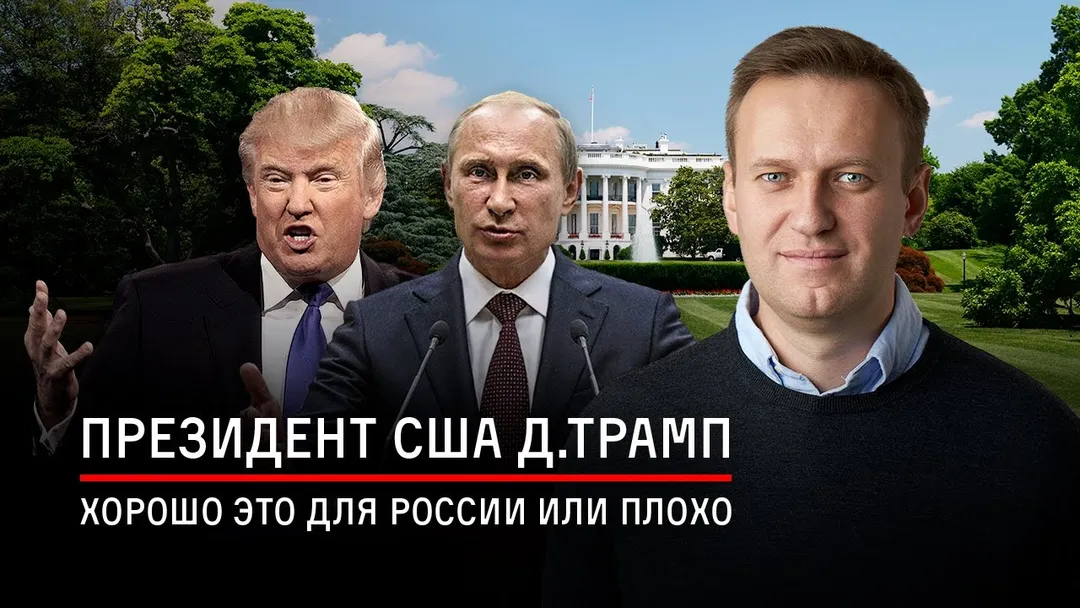
Donald Trump has, after all, become president.
In the United States, and now in Russia as well, of course everyone
is interested in one question: is this good or
bad, and how will it affect our
country? At the same time, for some reason many people
have a firm conviction that
Trump’s election is practically a gift
for Putin’s regime. I do not claim to be
some great political analyst or expert
on U.S. domestic politics, but nevertheless
I would like to give my opinion on this
topic. It does not seem to me that Trump’s victory
will bring any special happiness to the Kremlin, and I
do not think it will contribute to a quick
thaw in Russian-American
relations. Let’s look at the facts
from Trump’s campaign platform and from his
perhaps most important speech, which he
delivered on October 20 in the city of
Gettysburg. In the description of this video there are
links to Russian texts, so you can
read everything and verify it for yourselves.
The first and main conclusion we can
draw is that it is quite likely the president
of the United States, through his actions,
will lower the price of oil. He states directly
that he will remove restrictions on the extraction
of oil and gas in the U.S. And that country has
enormous reserves of raw materials; it’s just that all
previous presidents artificially
held back production and development. Trump
says outright that he will support
oil infrastructure projects such
as pipelines. And in general, he will not
be especially committed to fighting for new sources of
energy, which means that oil producers
in America will most likely find it easier to extract oil and gas,
including shale resources, and it will be easier to
export them. Until recently, the export of
oil from the U.S. was completely banned. In
the long run, this will most likely lower
oil prices. And I want to remind you, my
dear friends, that oil and gas
still account for up to half
of Russia’s federal budget revenues, and
already on the news of the election of
Donald Trump, oil prices began to fall
and the ruble, which depends on them, dropped. Second:
foreign policy and sanctions. On
Russian television, for some reason, they
say that Trump will literally start tomorrow
pushing for the lifting of sanctions imposed on
Russia. It is true that he
spoke about this, but only in 2014. But
in October of this year he already said
that he was reconsidering his attitude toward
Russian President Vladimir Putin. He
condemned the Russian bombings in Aleppo.
Moreover, he even allowed for the possibility that his
relations with Putin would be, quote,
“terrible.” Nevertheless, we can
assume that most likely
international ties between Russia and the U.S.
after Trump’s election will be free of, well,
at the very least, that kind of mutual personal
hostility between the countries’ leaders. Third:
the arms race, which simply
drains
money simply in order to maintain
military parity. In addition, the new
vice president-elect is already saying
that he will develop the program of
missile defense, which the Russian leadership
very much dislikes.
Fourth, as politicians in general, Putin and
Trump are simply complete opposites.
On almost every point of their programs, both
large and small. Look: Trump is
for reducing the role of the state and
the number of bureaucrats. Putin is building
state capitalism, and the number
of bureaucrats under him has grown
fantastically. The fight against illegal
immigration and the construction of a wall on the
border with
Mexico is practically the main point
of Trump’s platform, while Putin at the same time
is categorically opposed even to
the mere introduction of a visa regime with
the countries of Central Asia and the South Caucasus. The fight
against Islamization—Trump talks about it all
the time, while Putin even quotes some
nonsense about how Orthodoxy is in some
sense closer to Islam. Some
theorists of Christianity say that it is
in many ways
even closer to Islam than
to, say, Catholics. Trump says that he
will practically halt any migration from
Islamic countries where there are problems with
radical movements. Therefore not a single
citizen of Uzbekistan or Tajikistan,
for example, will get a U.S. visa in
the coming years. In Russia, meanwhile, they can
enter not just without a visa, but even without
an international passport. As for firearms in civilian hands, Trump is in favor,
Putin is against. Their positions on abortion are different.
Taxes: Trump said that
he would like to reduce taxes for a
middle-class family with two children by 35%. And
in Putin’s Russia, his government simply
constantly increases the tax burden
both on the middle class and on small business. And
the most important difference in their rhetoric and
their programs is corruption. Trump talks about
fighting corruption and government
lobbyists constantly; he built his campaign
on that. Putin, as you know, avoids the topic
of corruption because it
is simply the foundation of his regime. As for
Chaika (Yury Chaika, former Prosecutor General of Russia), and as for Chaika,
and as for, well, who else, who else—well,
never mind. And so on and so forth. These are
absolutely different politicians. From everything
I’ve just said, one might get the
impression that I have some special fondness for
Trump. But in fact, personally, I really
don’t care at all—it’s an American election.
of the people, and their problems—or, conversely, their successes
will belong to them. Today they elected
one person, tomorrow they will elect another. It simply
I
highlights the political views of Putin
and Trump, and how unconvincing
any talk looks about how
tomorrow they will be outright embracing
kissing and being friends. American
foreign policy, as indeed
European foreign policy, is not a race car
that can quickly change course. It is
rather like a huge loaded tanker
that, even if it wants to stop,
will keep moving by inertia along its previous course
for a very long time. To change
its direction, great
and very precise efforts are needed. And the result will come
quite slowly. Here, look at this example
a great one: in
1974, the United States imposed sanctions on the USSR
under the so-called
Jackson-Vanik amendment, and then the Soviet Union
collapsed, relations improved, and there were no longer any reasons
for the sanctions, yet they were repealed
only in 2012, 38 years later. And
that is why only here, because
one person decides everything. Today we are with
Turkey on friendly terms, tomorrow we are hostile toward it, and
it has stabbed us in the back, and
the day after tomorrow we have forgotten everything and it
is once again our best friend. In a country where there is
a system of checks and balances, this
simply does not work, and changes
in foreign policy are connected with
the long, painstaking work of the Senate,
Congress, the media, non-profit organizations,
expert institutions, and so on.
So my conclusion is rather banal, in
fact: Trump’s victory will bring us
nothing especially good and nothing especially bad. Neither
here nor there. The fate of Russia
truly concerns only us, while for
Trump and everyone else it will be only
the twenty-fifth item on the agenda. If
there is anything we should pay close
attention to, it is the fact that in America
the candidate everyone
pollsters, all experts, all politicians
said would 100% lose, has now won. Just
yesterday all the polls claimed that he was headed for
an inevitable defeat. Nevertheless, people
came to the polling stations, voted as
they wanted, and elected the president
they wanted. That is how it should happen
in real, honest elections. Let us
think less about America and
work to ensure that in our country
someday there are elections with
an unpredictable outcome
Subscribe to our channel. Here
they tell
the truth. Y