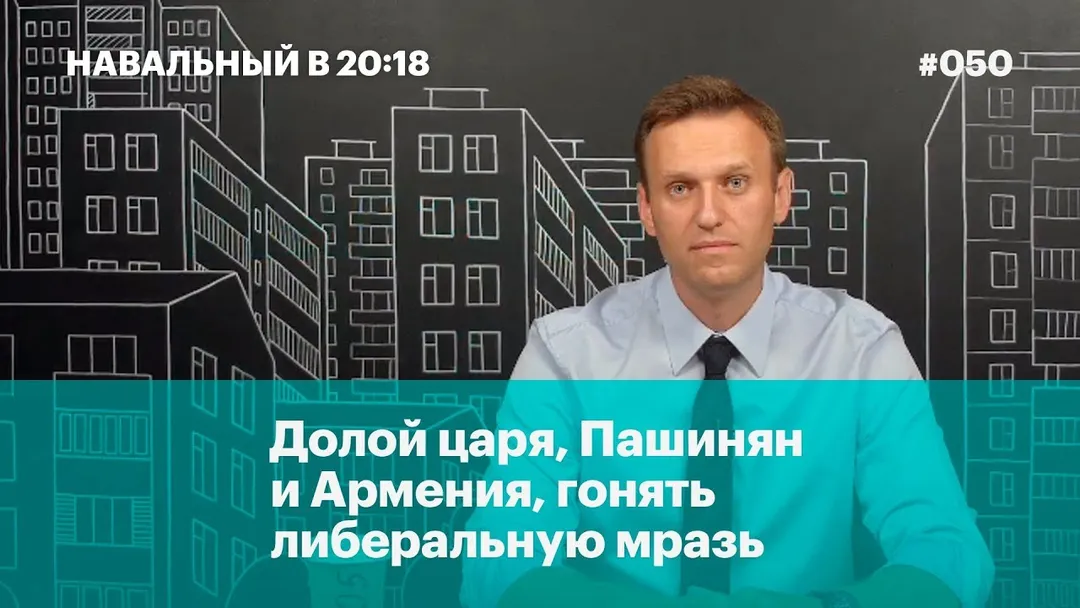
Down with the tsar, Pashinyan and Armenia, chase out the liberal scum
[music]
Hello, everyone. Please excuse the
minor technical glitch. Putin
tried to chew through our cables, but we
drove him off. It's 8:20 p.m. in Moscow.
In the studio is Alexei Navalny, or
the leader of the global conspiracy, as I was called
in Armenia's parliament. The leader
of the global conspiracy—that's what it's called,
"Start the Like and Boss program." The leader
of the global conspiracy—though my minute
of fame, and Saakashvili's too, didn't last long. There, the leaders
of the global conspiracy were said to be me and
Saakashvili, but that didn't last long, because
Nikol Pashinyan, the leader of Armenia's opposition,
exposed us and said: "No,
they are not the leaders of the Global
Conspiracy." Nikol, you handled that
completely wrong. How do you know? Maybe
I am the leader of the global conspiracy?
No need to make such hasty statements—are
Navalny and Saakashvili really not the leaders
of the Global Conspiracy? Maybe
we are, just a little. Check first,
and only then make such
sharp statements.
When I left the rally in defense of
the internet—well, the rally had ended, and I
left and went to have lunch with my wife, and
in a café I met a young woman. She
said, "Hi, I support you,
can we take a photo?" And I said:
"Sure, absolutely. See you on the fifth
at the rally." And she said to me, "Well,
I really want to go, but I'm afraid.
What if they grab me there and then
expel me from university?"
No one is going to grab you, and no one is going to expel you
from anywhere. And in general, there is no such thing
as an unauthorized rally.
On the fifth, across the country, in 97 cities
in Russia, including Moscow and
St. Petersburg, there will be fully
lawful, authorized,
legal rallies. It's just that in some
cities they have been illegally banned by various
crooks. And don't be afraid—you absolutely
should take part in all
these events. No one is going to expel you
from anywhere. Over all this time, I think
we've had maybe two cases where people
were expelled or are being threatened with expulsion. Right now
one person is being expelled, and we're
providing legal support. But broadly speaking,
any university that
tries to expel you for taking part in
a rally or some public event
simply doesn't deserve to have you
studying there. Finish online courses instead. That would
be better, in fact. All over
the world, one sign of a university's quality is that
its students take part in
political life. Smart students
always take part in rallies, always
take part in actions of all sorts
of political orientation—right-wing, left-wing, whatever
you like. But a person's desire to participate
in political life through public
events is one of the most important indicators
that this is an intelligent person, that
this is a citizen in the fullest sense.
It means they have something to say, and that they actually
think about things. So on the fifth,
please, everyone come. And these little
clips, these snippets from my broadcasts, are later
always shown in court, and they say—
trying to prove that Navalny committed
some terrible offenses. So, specially
for the future judge who
will be watching all this, I want to say very clearly:
Mr. or Ms. Judge,
I am absolutely calling on all
citizens of Russia to take part on the fifth
in the rallies. I personally will do everything
possible to take part in these
rallies. And I will go to the rally in Moscow,
which will be held at Pushkin Square. And
the area of our protest is Pushkin Square
and Tverskaya Street from Pushkin Square
to Manezhnaya Square. We understand that the authorities
may sometimes close off a particular place.
For example, if Pushkin Square is closed
or difficult to access, you don't need
to get into confrontations with anyone, and you don't need
to storm any police
barriers. Just stay anywhere
on Tverskaya Street from Pushkin Square to
Manezhnaya Square. In St. Petersburg,
I am, of course, calling on everyone to take part
in the action that will take place on Palace
Square. I myself would gladly take part
on Palace Square—with surroundings like those,
holding a rally there is
simply wonderful. And in all
the other cities of Russia, wherever
the authorities—that gang of crooks and thieves—have
illegally banned it, I call on people everywhere
to participate, because this is the most
important thing a person can do right now
to defend their country. That's that.
Well, I do a lot of things. We conduct
investigations, we have various
projects, and I try to take part in
elections, I support other
candidates, but I know for certain
that right now, as a politician, as
a person, as—I don't know—a husband, a son, and
a father, it is impossible for me to do anything more
important in politics than
simply physically showing up, specifically in
Moscow, at Pushkin Square, on
Tverskaya. There is no more important, more
meaningful political act than
this. Everything else is secondary.
Well, we'll also be talking today about
Armenia, but we can see, for example, from
the example of Armenia, and we have seen from the example of all
the other countries where there were some
positive changes, if there were any,
are brought about only by people who take to the streets.
I’m not even talking now about so-called
Orange Revolutions or Velvet
Revolutions or whatever else. Just take
the United States 60 or 50 years
ago and look at what the situation was like there with
civil rights in different areas.
There were court cases, there were all kinds of
movements, but in the end it was precisely
mass protest rallies that played
the key role. Strikes too—strikes were
just as important or perhaps even a more
important factor in the protest movement,
an important means of putting pressure on the authorities. But at
the present moment, of course, it’s the rally.
So if you’re sitting there thinking, what can
I personally do in order to
try to move our country in the
right direction, in order to
push off from the bottom—Olga Matei, by the
way, is getting this little thing of ours,
uh,
our hoodie, because she
won the contest for the tweet calling on people
to come to the rally—uh, calling on people to come to the protest
on the fifth. Right now you can see her
tweet: “The bottom is getting closer; it’s time to push off
and rise to the surface.” Exactly. If you, uh,
want to do something so that
our country can push off from the bottom and start
rising, come to this protest on the fifth
in your city—97 cities in all. In the
description of this video you’ll find
a link and, uh, you’ll find your city. Well, if
it so happens that your city isn’t on
that list, well, that’s unfortunate, really.
And
support it in some media-related way at least.
But in all more or less major
cities, one way or another, something is happening.
In some places it’s a big rally, and in others
it’s a small picket, but what matters less is
how many people there are. What matters is that you
show up and make your contribution. There is nothing more important
than that. There was a really great protest in support of
a free internet.
It took place on the 30th in Moscow. And
it really was an amazing protest.
Just in terms of the atmosphere, it was very
big, and in terms of turnout too. Well, there have been
larger protests, strictly speaking, in terms of
numbers, but in terms of atmosphere this was
something absolutely incredible, especially
because it was organized by completely
new people. It was the Libertarian
Party of Russia, and the speakers were completely
new as well. Uh, you simply couldn’t
see or hear any of those
politicians,
not just from the 1990s, or from
the early 2000s—there was none of that
political establishment. I’m not
necessarily saying that this is very
good. Different rallies should
in-
vite different people. But here
the Libertarian Party
made a principled decision
not to invite any
longtime political figures, let’s
put it mildly, representatives of the establishment.
And the result was a wonderful, genuinely
great rally in terms of atmosphere. I want
to say that despite the fact that
this was a rally in defense of the internet, and
naturally, the main, uh, theme of this
rally was Telegram and the attempt
to block Telegram, the most frequently chanted
slogans were: “Down with the tsar, he is not
our tsar.” “Down with autocracy.” That is,
it seems to me that this extraordinary
atmosphere at the rally was due in part
to the fact that people felt themselves to be, uh,
a single whole, and they were not deceiving
each other. There were no speakers there, uh,
there were no commentators who
would say something like, well, this very
tired old line that everyone is sick of, but which is still somehow
popular: “Let’s just
defend Telegram here, uh, but let’s not
criticize Putin. We’ve gathered here
to solve our little
internet issue, but we don’t want to get into
politics.” At this rally, people
were thinking and speaking absolutely correctly.
They were saying that right now the slogans—this was in
Mikhail Pozharsky’s Telegram channel—I read
this great thought: “The slogan ‘freedom for
the internet’ and the slogan ‘down with the tsar’ are one
and the same.” And all the speakers—and there were
a huge number of representatives of the
industry there—were talking about exactly that.
We want to defend the internet, but to do that we need
to drive out the tsar; we need to bring together people
who oppose this monarchy.
Just today, Communications Minister
Nikiforov said that they are already considering blocking Viber too
if Viber does not hand over
some keys to the FSB (Russia’s security service). And, uh, let’s not
deceive ourselves. We understand that,
of course, Telegram is currently fairly
effectively resisting Roskomnadzor (Russia’s communications regulator),
but I think that step by step they will, well, not
destroy it, but make life very difficult
for Telegram, especially without a VPN.
So everyone, install VPNs. It will become harder and harder for Telegram
to resist.
At the same time, they’ll nibble away at
Viber a bit. Then they’ll start
going after other social networks. And
overall, pressure on the internet—if
we’re speaking specifically about the internet—will
keep increasing, simply because that is
the logic of this government: because where do you criticize
this government? On the internet. Where do you watch
this program? On the internet. Where can you
write, “Putin is an idiot”? On the internet,
where you can write something more
substantial, for example, that Putin’s family and
his son-in-law are corrupt. They are stealing
our money online. The newspaper
*Komsomolskaya Pravda* won’t publish that,
and on television, on Channel One,
they won’t say a word about it. The internet
is viewed by this government and by Putin
as something absolutely harmful. Sure, there are
some useful things there, like
Yandex Maps or Yandex Traffic, or
some kind of, well, some
funny pictures. You can send each other
cat photos
and GIFs, but overall this
internet—if it didn’t exist, officials tell
themselves—it would be much, much
better. So let’s somehow
crack down on it. Like in China, or even more so,
because, basically, for them
it’s a source of problems. For us, though,
the internet is technology, it’s
an improvement in quality of life—those are different
things—but for them, objectively, put
yourself in their shoes: it’s nothing but problems.
That’s why they will fight the internet,
and they will fight everything else
too. I talked about this in the
last video. I’ll just add a couple
more words. Just look, I mean, simply
look objectively at all the initiatives
that have been announced in this very first
month of Putin’s new term in power.
The retirement age—we want to raise it,
let’s start the discussion. Introduce a sales
tax, introduce this tax, introduce that
tax, and restrict medicine imports—well,
some kind of, well, oak bark and
potassium permanganate will treat us. That’s what
they’re talking about in the very first month.
So in a year, half of these
initiatives will be adopted, and in two years
they’ll actually force you to treat yourselves
with oak bark. This isn’t a joke, this isn’t
an exaggeration. That is exactly how the authorities think.
So the only way to resist them is,
well, by going out into the streets. And
a lot of people say, “So what did this rally
in defense of the internet actually
change? Did you save your Telegram?”
all sorts of ironic dudes write on
Twitter.
Did we save it? No, of course we didn’t manage
to make Roskomnadzor (Russia’s state media and internet regulator)
capitulate,
but it very clearly showed that the entire
active part of society is against all
of this. Just notice even how,
well, government representatives joke about it.
Natalya Timakova, press secretary
to President Medvedev, my favorite, wrote on
Facebook to a United Russia deputy
when they were discussing
some internet-related issue.
So, Kostenko writes: “I’m not receiving
messages.” She replies: “Install a VPN,
it works almost all the time.”
The press secretary of the prime minister,
who oversees Roskomnadzor,
which is blocking
Telegram. By the way, what an amazing
exchange. I remember this
Kostenko quite well. She used to be
a correspondent for *Vedomosti*. Back when I was still
a member of the Yabloko party, we
used to chat on the phone regularly. She was
a nice woman, smart,
knowledgeable, a reporter with all the right
views. And there you have it—she sold out,
got herself a position in United Russia, and now
she sits there drawing a salary of 450,000 rubles.
Okay, I can see that some tweet has appeared
on the screen. Shouldn’t I be there, or am I
seeing something wrong?
Please tell me, write to me,
send your tweets and tell me,
please—studio, can people actually see me
on the screen right now or not? Sorry,
for this technical
uh, technical problem.
Can you see me, is everything okay?
Ah, everything’s visible, everything’s fine. S-sorry,
please, my screen here just went
dark. Well, that was a funny moment in our
broadcast. Anyway, one
former *Vedomosti* correspondent, another
former *Kommersant* correspondent. Both of them,
uh, are now corrupt, hypocritical people
sitting in government and messaging each other, knowing
that we can read it. They’re discussing how
they’re still hanging out on Telegram anyway, and will
keep using a VPN. Today
Roskomnadzor also kind of tried
to troll us. It said that if you’re for
fast internet, let’s do this
campaign: throw paper balls into
windows. In other words, parodying the action
Pavel Durov came up with involving launching
paper airplanes. And why are they doing this? Well,
behind these little jokes of theirs, behind
this trolling, there is fear,
an awareness of their weakness, an understanding that
all of society is against them, that any
decent person is against them. And rallies
are the most important thing for that. Well,
remember 2012. Back in
2012, all that riffraff was already
one step away from
switching sides. And that same
Timakova became famous for her
interview in which she said that, well,
of course, if we had known that so many
people would later come out into the streets, then probably
Dmitry Medvedev would have been bolder and would not
have handed over his post to Putin so easily as part of their little job swap
(the Medvedev-Putin power switch). And that’s why it’s important for
the elites, for the media, for people who don’t
follow politics but then suddenly—bang—see
a huge crowd out into the streets. Most importantly,
it is important for us ourselves to take part in such
events, it is important to take part in
rallies. And it is very important
not to believe the endless
lies from the authorities about terrorism and everything
else. I wanted to show you, well,
there were a lot of great
speeches there, and after the rally there was a
small scandal, because one of the
most striking speakers, one of the key
organizers of this protest, Mikhail Svetov,
gave a speech. We were wrapping up the
rally at the end—I spoke, and then he spoke—and he
really lit up the crowd with a fiery
speech. And somehow it turned out that even
good media outlets, which generally are not
known for improper
or biased coverage,
somehow censored—or rather, not
censored, but ignored—his
speech. There was even a small
media scandal over it. But I cannot
show Svetov's entire speech
in full. Let me at least show you 33
seconds, to restore
fairness. Mikhail Svetov at the
rally. And for now, we keep hearing here
slogans saying that we will not forget
and will not forgive, but so far all we are
actually doing is forgetting and forgiving. And I
urge you to remember the names of the people
who turned our country into the, into the
prison of nations that it is
today, into that unfree state. These
people have names. It is not only
Yarovaya, it is not only members of Roskomnadzor (Russia’s federal communications regulator), it is
the entire cabinet of Putin's government and
Vladimir Vladimirovich Putin personally.
So, you see, this is a rally in defense of
Telegram, a rally in defense of—uh—a rally
in defense of the internet. But what kind of speech was it?
The man was saying everything exactly right, and
people welcomed him. Probably
more than anyone else, and applauded the loudest. Although, in
broader public circles,
Svetov is not some super-famous
political activist. Nevertheless,
even in the format of a rally, which
usually implies more slogans,
yes, and less substantive discussion,
people assessed this very correctly and positively
and understand the direct link
between internet blocking and the total
absolute lies of all the other branches
of power, above all Putin and his
favorite security services.
And in this sense, a truly excellent
recent demonstration of just how brazenly
the security services—specifically the FSB (Russia’s Federal Security Service)—lie to us, and
how brazenly they distort the whole situation
with Telegram, was presented, among others, by
Novaya Gazeta, which published a great
piece—please read it.
Actually, not even just an article—they did a
study. It was long overdue to do this
study, because we regularly
see this. You turn on the TV, and they show
some people in uniform. They say:
"We prevented a terrorist attack." Hmm, like
an attack in the metro, or 10 attacks in the metro
or whatever else the terrorists wanted to do. And
it sounds like a significant thing.
They prevented an attack. The terrorists wanted
to blow up the metro. So we expect that
there will be an investigation, and then a trial. And we
expect that at the trial—you know, like in America,
where there are these trials with a whole lot of
reporters—and we will be told the details
about how these terrible terrorists
tried to blow up the metro, but there were
agents planted among them, and those agents recorded
something, and they were exposed, and there will be
screenshots and evidence showing that
the terrorists were using Telegram for all of this
—as the FSB tells us,
that terrorists are everywhere, ISIS (the Islamic State), our
terrorists are in contact with ISIS through
Telegram, coordinating everything. And you listen
all day long to stories about how they
prevented something, exposed something, caught an ISIS cell
here, caught an ISIS cell there. And
the journalists at Novaya Gazeta did a very
simple thing. They took the official
press releases of the FSB, the Ministry of Internal Affairs, the National
Anti-Terrorism Committee, and the Security Council
and counted their
statements about prevented terrorist attacks. Then
they simply compared that with the concrete
legal outcomes, which
cannot be hidden, because if, well,
a terrorist attack was prevented, then there should be a criminal case and
ultimately a trial. And it turned out—well, look:
the FSB, yes, made 3,500
statements saying that they had prevented
terrorist attacks. But convictions—uh, put that
back on the screen, please—there were 13 convictions,
and only 14 cases in total. Or
look at the Security Council: it made
236 statements saying that they had prevented
some kind of terrorist attacks. And you cannot find
anyone at all. And remember that
great story when the FSB, with
great fanfare, showed on every channel
some 50 members of Right Sector (a Ukrainian nationalist political movement),
detained somewhere
on the border with Crimea, allegedly trying
to crawl through and cut the main
arteries of the Crimean Bridge and carry out
terrorist attacks and, uh, turn our
peaceful life into hell. And there was this grand
sabotage group—they showed some footage
in some reeds or something.
Some indistinct people were supposedly running around.
And it was all so gripping that you think:
"Good grief, 50 people, just like
something out of a video game." And where did all that
go, and how did it all end? Back then, they
I think they supposedly deported the guy back to
Ukraine because their documents had not been
properly processed. So,
you know, first they told us
that these people were literally on their way
to kill all of us, and then they said, "Well,
all right, I mean, somehow we
deported them, we sent them back to
Ukraine." It's absolute, total
lies. These people—Putin and his whole
gang—literally make up
these terrorist attacks. They literally invent
nonexistent
terrorist cells. Are there
terrorist cells? Well, of course there are.
If we're talking about ISIS, then yes, of course,
terrorist attacks do happen,
terrible tragedies do happen,
fortunately not that often, but these
data from *Novaya Gazeta* show that in
most cases they really do just make them up.
They make them up to get
bigger budgets for themselves. They make them up
to earn promotions and rank. And
they make them up to achieve
their political goals. Right now they need
to block Telegram because
political activists use it,
our entire political network
uses Telegram. They need either to block it
or read their messages.
So they make up some nonsense.
ISIS terrorists are supposedly sending each other
messages: "Well then, show us these
terrorists. Show them to us, take the case
to court, present the evidence, and
then we'll see what kind of terrorists are
using what kind of Telegram." But none of
that exists.
It's complete fabrication, utter nonsense. And, uh,
this is just one more example that
you can't trust them one iota, and that we need
to resist all of this, because
the lies are becoming more and more
absurd. If the FSB has 3,500
statements, and on this side 3,500
statements, but on the other side only 13
convictions and 14 arrests, you can't
hide that.
A lot of people in Russia know this,
and yet they still lie. That's how
blatant it is. Just imagine how they
will lie a year from now. Imagine how
they will lie two years from now. And
imagine what political methods
they will resort to, relying on these
lies.
We often joke like this, right? Nineteen
thirty-seven, ha-ha-ha. Putin's era
isn't 1937. But what was
1937? It was when they grabbed
random people, beat them, and then announced
that they were Japanese spies or Polish
spies. They picked up some worker somewhere. He
worked there
as some kind of railway track inspector.
You beat him, and he writes: "I am a Japanese spy. I was ordered by
the Emperor of Japan, uh, that is,
to monitor train traffic and
send messages, which I wrote
in hieroglyphs, somewhere.
There were hundreds of thousands of confessions just like that. So how
is this, in essence—apart from the scale—
how is this really different
from what's happening now, when they
pick up Kyrgyz or Uzbek people?
In exactly the same way, they declare them to be
terrorists who were communicating
through Telegram, announce that something was
prevented, and then those Uzbeks and
Kyrgyz people—and whoever else—simply disappear
to who knows where, and there are no trials. How
is that different? Essentially, it isn't. If
they really want to fight ISIS and
terrorism, then introduce a visa regime with
Uzbekistan and indeed with all the countries of
Central Asia. Introduce visas.
Let's start with that, so people can't
move back and forth in huge numbers
so freely. But they don't do that. So
take note—Armenia.
When we talk about Armenia,
the next thing that needs to be said is:
we're rooting for you, we hope that
everything works out for you, because what
is happening in Armenia is, of course,
an example, uh,
of astonishing national unity, which
has proved that free people can
bring about change, that there are far more
free people. After all, two months ago Armenia
was a place where the approval rating of
Sargsyan was higher than Putin's.
A completely crushed, repressed society.
It seemed that nothing even remotely like this
could happen there. And yet
it did happen. And yet these
people are winning right now. And despite
the fact that the road is very difficult, we all
hope they will prevail and that this
will be a wonderful example for Russia, and
that it will, uh, lead to us having
a good, prosperous, free,
normally developing neighbor. Because
if everything goes well in Armenia, then
that will be good for us too. I just
wanted to remind you once again of the chronology
of events, which tells us precisely
how important persistence is, how important
the strong joint work of a leader is,
an opposition leader, an extraordinary
person—Nikol Pashinyan—and the people
who support him, who set aside
whatever, uh, disagreements there were,
which always exist in any opposition movement, and
simply united in order to
push this nomenklatura (entrenched ruling elite) aside. Just look
at what was happening there.
There were several days of protests, and they
were dispersed, people were arrested, and so on. Nevertheless,
gradually more and more people joined them. Armenia has, well, a population of 3
million people in total. That’s like three
administrative districts of Moscow. And yet,
hundreds of thousands of people took to the streets
to join them. Gradually, after some time,
the police, the military,
and various other parties joined in as well. And
they did join. But then
the matter reached parliament, and parliament
was supposed to, uh, reapprove the candidacy of the
prime minister. Now imagine this:
the same thing happened here, exactly the same thing.
A million people come out into the streets,
and everyone says: "So what, Putin deceived
us, he stayed on for another term, and
therefore we demand a change of power, which is
provided for by the Constitution." And, uh,
the prime minister has to be approved
by the State Duma. And United
Russia is sitting in the Duma. And in Armenia, the same thing
happened. Even though people in
huge numbers—the whole country—came out into the
streets and said, "Come on, make the change."
The local equivalent of United Russia, the Republican
Party, said: "Mm, probably not,
we’re not going to approve him." And they refused
to approve the obvious leader of this
protest movement. Clearly, by now
the de facto leader of the nation, Nikol Pashinyan,
they refused to approve him as
prime minister. And he fell short by
six or eight votes. We won’t, and that’s
that. Why won’t we?
A video tells us that very clearly.
After they refused
to approve him, Pashinyan—quite rightly—
called for protest actions,
called for acts of civil
disobedience. They blocked all
the roads, including the road to the
airport. Roads in Yerevan were closed.
And I saw a wonderful video.
Let’s take a look at it, please.
A car. Here we see a Range Rover,
I think, in front. Behind it is driving a
G-Wagen.
This is
one of the leaders of the Republican Party,
that is, the local equivalent of United Russia. This is how
he gets around the traffic jams.
And now let’s look at a photo
of the man who behaves like this,
who moves around the streets of
Yerevan in this way. You see,
gold epaulettes, medals, a proud and
self-assured look of a man who thinks he owns life,
who thinks, what’s the problem? The roads are
blocked? I’ll get into my, I’ll get into my
Range Rover and drive down the stairs. And behind
me, my security detail will follow in a G-Wagen.
And everything is fine for me, because this
very Migran Poghosyan, a major general of justice,
is even a little familiar to us too,
because when the so-called
Panama
Papers were published—that is, documents about offshore companies
belonging to government
officials in various countries—this
same Poghosyan was found to have three
Panamanian offshore companies. So
just think about it:
there sits this party,
like our own United Russia. Let’s
talk directly about our United Russia in the same
situation. And he thinks: "Aha,
right now my salary is 450,000 rubles a month
(about $5,000), plus
my wife works at a state corporation, where
through her, through payments to her, they are effectively
paying me another 3 million rubles a month in bribes" (about $33,000).
So that’s what I get every month. But if
the prime minister changes, or these people
from the street get their way, I’ll be getting
zero. I’ll be getting zero, because,
well, I’m not used to doing business.
I’m not much of an official, either. If they
throw me out of this chair, I’ll have
nothing. Of course I won’t end up begging,
because I’ve already stolen quite a lot,
but I don’t want to lose my income.
That is exactly what all the members of the
party were thinking. That’s why they
said to Pashinyan: "So, you there,
together with Navalny and Saakashvili,
you don’t have a plan for resolving the
Nagorno-Karabakh conflict,"
they told him, and did not approve him. And who
does have one? We all understand perfectly well that
the Nagorno-Karabakh problem cannot be resolved
just like that. No one has a realistic plan
for settling the Nagorno-Karabakh
conflict, neither in Azerbaijan nor in
Armenia. I mean a realistic one,
one that could be implemented tomorrow. No one
has such a plan. This is a territorial conflict
for decades to come. But nevertheless
they repeat exactly the same things
our United Russia people say: "The global
deep state, we are surrounded by enemies." It’s just that
Putin talks about America, while in Armenia
everyone talks about Azerbaijan. And we are
surrounded by enemies, so you don’t change horses
midstream.
And all these people running around the streets cannot run the country.
They have no positive program.
We’re not approving you. And here
is the key thing the Armenian opposition
needed—and it
demonstrated it: persistence.
That’s what I talked about in the previous program.
Again, who saved the situation? Was it people
who wrote op-eds,
super-political analysts with
mega-advice,
or, I don’t know, some kind of
constructive programs that had been written, or something else?
No,
just an ordinary person who walked out of
their home in the morning. You can see it: young
people came out and stood in the road. That is what
changed the situation. And now already
the Republican Party, after these
mass protests—the Republican
Party of Armenia, after these mass
protests and mass acts of civil
disobedience, when the entire city was
blocked, said: "All right, we
will vote for anyone nominated
by, I think, one-third of parliament, and Pashinyan has
enough votes." In other words,
people made it happen—an ordinary person who
didn't think, well, if I go out there, what if
they drive me away, what if I get fired, what if
they drench me with a water cannon. They
did use water cannons in Yerevan during the first
phase of these protests. And
back then, when people were only just beginning
to come out, they were told that it was
hopeless, that nothing would come of it. Well,
what's the point if I go and everyone else stays home?
And why should I bother—what do these rallies
ever change? After all, in Armenia's history over
the past few years they haven't changed anything, and
there have been no success stories. Even so,
people didn't think that way. They simply
thought: I have to go. They went
and achieved at least this:
power in Armenia is now going to change.
Of course, there will be a very, very
difficult period ahead. The reason I began
this segment by saying we're keeping our
fingers crossed for Armenia is because we really want it to work out.
We really want it to succeed. It will be even
harder there than in Ukra—than in
Ukraine.
Armenia is one of the poorest
states of the former Soviet Union. It is
horrendously corrupt. In fact,
Ukraine is still more corrupt
than Russia, despite the fact that Russia is
a black hole of corruption. Armenia is even more
corrupt than Ukraine. And oligarchs
control an even larger share of
the economy there than they do in Ukraine or
Russia. So what
the Armenian opposition, Pashinyan himself,
and Armenian society will face in the next
few months is precisely
all these oligarchic
schemes, all this shady maneuvering—twist it, turn it,
all to deceive. It's what we see in Ukraine,
what, objectively speaking, unfortunately,
very seriously hinders
Ukraine from moving in the right
direction, because yes, the people
won,
but the newspapers belong to oligarchs,
and journalists everywhere are still
completely bought off.
To strike deals with oligarchs—Putin knows how
to do that brilliantly with
any oligarch, Armenian or Ukrainian.
The Kremlin, through Gazprom, through
energy companies, through whoever
you like, will make deals without any problem and
settle any issue, always. And in that
sense, of course, oligarchic control
over the economy, and the fact that the main
political forces received money for years
from these oligarchs, is a massive
problem.
That is why in Ukraine—well, I
can't say that nothing is working.
It's just much less successful,
much worse than all of us
had hoped. And that is why, uh,
there is such a major threat in Armenia right now.
Some $100 million,
which for a Russian oligarch or for the Kremlin
is just pocket change, nothing at all. But with
that money you can buy up all the media in
that country, you can buy up half the
politicians in that country, and that is exactly what
they will do. And right now, in fact,
again, there is nothing that could
better protect this new
emerging democracy in Armenia
than ordinary people who come
out into the streets and stand there. That is the most important thing. And we
all very much hope that on the territory of
the former Soviet Union,
apart from the Baltic states, there will be one more
example of people rising up and bringing to
power an honest politician. Nikol Pashinyan
looks like exactly that kind of person. And
they will replace judges, carry out de-oligarchization,
what a word—de-oligarchization
of the economy. Uh,
they'll get rid of all these wonderful people in
gold-braided epaulettes, or at least
replace part of the nomenklatura (the Soviet-style ruling bureaucracy)
and elite, and establish a normal
democratic
system in which leaders
are held accountable, lose support, and are replaced,
different blocs are formed, different
coalitions. In parliament, some win,
others lose, and then
the reverse happens. Those swings appear:
first the left wins, then the right.
First more nationalists, then
more liberals. That is democracy.
That's how it works in prosperous countries.
I would very much like all of that
to work out in Armenia. While this is happening in
Armenia, in Russia they are hounding the liberal
[ __ ]
And what struck me was simply the sheer frankness
of what is happening
right now at the level of the Moscow city government.
You know that Moscow is now
heading into a mayoral election. And of course this
rabble—there is no other word for it—
that engages in political
support,
and the related programs tied to these
elections, and the frankness with which
they are being prepared
to resist them. Ilya Yashin
published a video—at first it was just
a story; he wrote about it on
Facebook, and now he has even posted a video
about it. Uh, a coach from one of the
martial arts clubs, his
name is Alexei Levkin, and he said that
someone approached him—and as I understand it,
his club
operates on some kind of public funding
or is a state-funded organization
or depends on some kind of
sports schools, but in any case all
sports clubs in Moscow
depend on the Moscow city government,
naturally. So an official came to him
from Moskomsport (the Moscow Sports Department) and said: "Come on, uh,
you train karate guys here, or whoever
it is, and we’ll give you money. You’ll
set aside some boys for us, and let them
walk the streets and chase off the liberal
scum." In other words, beat up Yashin’s campaigners,
to put it bluntly. Let’s
take a look. Here are 49 seconds of Alexei Levkin,
talking about what
a Moskomsport official offered him.
Please.
A man called, an employee of Moskomsport, and
offered me the following. Could I
put together a team of guys so that,
as he put it, they could chase around the liberal
[__] during the elections when they would be
handing out campaign materials? Campaign materials for, for
Ilya Yashin. They offered money: 20,000
for you, and the total budget for all this would be 150,000.
Well, I told them to get lost, of course,
to organize some kids to beat up other kids.
Even if I weren’t a supporter of
Yashin but a supporter of Sobyanin, it still
wouldn’t make any sense—hiring some kids
to beat up other kids, that’s
just insane. After that, it started—
threats and all sorts of things. They called,
threatened me, sent all kinds of garbage to my phone,
wrote to me on Facebook.
Alexei, I want to thank you. I
think you did a very good
and courageous thing, and it truly
deserves respect.
Do you understand what’s happening? I mean,
they’re not even embarrassed. I mean,
this is called bandits and banditry.
An official shows up, and we can see it,
where all these Serbs come from, and all the rest of it.
I traveled around the regions, and
there are always rallies somewhere, and there’s
a little group of thugs in
tracksuits standing there. Uh-huh, and who hired them? Who
pays them? Obviously, the authorities pay them,
the same authorities that hire them. And for what?
So that they commit
crimes. That’s how our
state works now: an official
who is paid with your tax money goes somewhere
and openly tries to persuade someone
to commit a crime, beat up some
campaigners or attack someone or
do something else just to
intimidate people. Beat one person up, and 100
others get scared. So, in principle,
well, it does work in a certain
sense. There you have it.
I mean,
this didn’t even lead to any kind of
scandal. In theory, when Yashin released this,
when he first published it,
Sobyanin should have come out and said:
"This is a lie, and I’m suing you, Yashin,"
or "Moskomsport is suing you, Yashin,"
because this is outrageous—you’re
accusing us of a particularly
serious crime, an organized
group of people, and so on and so forth." But that didn’t
happen. Nor did he come out and say:
"This was just, you know, an incident,
we had one crazy person working for us, but
we fired him immediately, and this won’t
happen again." They’re silent. Well, because
that’s exactly what it is: an organized criminal
group—the Moscow mayor’s office, these
direct operatives from
Moskomsport, and some people they’ll
ultimately hire with that money. They are simply
real gangsters. How else
can they be resisted? What
needs to be done? Write petitions against them?
Can they be embarrassed, frightened,
persuaded, somehow influenced
only by huge numbers of people
taking to the streets. As long as there are only
two or three people out there, these ideas will keep
coming into their heads.
Come on, let’s beat up the liberal [__]
Let me answer your tweets and your
questions that you’ve been sending me.
Please put the tweets up for me, and I’ll
respond to them.
All right, Kana, Kana. Alexei, what do you
think of other forms of peaceful
resistance in addition to rallies, from
paper airplanes to strikes? I think
any form of resistance is good. I
don’t have any ironic attitude
toward paper airplanes, white ribbons, or any
of those things. All of it is absolutely right. It’s just that
the main thing that needs to be done is
to come to mass events.
Strikes are the next form, but they
already require different kinds of
preparation. And,
well, it’s hard even to remember when
Russia last had a political
strike; there was an attempt in the early 1990s
to organize a political strike
and specifically truck drivers,
when the Platon system was introduced, you see.
And it almost worked. But then the Kremlin
managed, quite skillfully, well, once again,
to deceive and buy off these
leaders among the truckers, or
appoint some self-styled leaders who
gradually, more or less, convinced
the rest of their community that there was no need
to politicize things, that we didn’t need
to call any strikes, let’s
just take it step by step and everything will work itself out. Well,
of course, it didn’t work itself out. The
Platon system is still there, and the fees under the Platon system
will keep rising, and people will still
have to pay. So at this stage, strikes
on a mass scale look like a fairly
complex political action,
something Russia hasn’t seen recently.
But rallies are, of course, very important.
I have a positive attitude toward all forms of protest.
What I dislike is when
people sit around convincing themselves that everything
is impossible, that Russia will always be
some kind of horrible nightmare. Again,
look at Armenia. If anywhere seemed like
nothing could possibly be changed,
it was there. That country really is all the time
on the brink of war. And there really is
Turkey, which Armenians consider
a hostile state, and vice versa,
and, accordingly, Azerbaijan, with which
relations are extremely tense. And of course, politicians
used this
to say, “What democracy?
We could have a war tomorrow.” And even there, it
happens. So in Russia too, of course,
it will all happen. So, Inferni Overkill.
They’re the scum, we’re not afraid of anything. That
is the right attitude. Of course, it’s natural
to be afraid. But really, even if
we want to put it in completely cynical terms and
mathematically assess the odds
of getting into trouble at
a rally, they are extremely low. The risk of
leaving your house and getting hit by
a car is much greater than the risk of
being detained at a rally,
arrested at a rally, or being
beaten there. Dmitry Shchepyatkov asks:
“Alexei, how do you see your path to
the presidency? Which scenario seems
most realistic to you, given
what is happening right now? Well,
I see my path to the presidency as follows:
I win an election. That is
the optimal, normal, and probably
the only possible way to become
president. I am competing for the top leadership position
in the country. I claim that I can
do more than other politicians. I
certainly claim that my
program is better than that of other politicians.
I claim that I will be able to,
reach agreements with other politicians and
create the right coalition that
will do the right things. In order
to become president, you have to win
an election. That is what is happening. We keep
talking about Armenia right now because
that is what is unfolding there at this very moment. So,
of course, the election of
Pashinyan as prime minister is a set of
extraordinary events taking place
in the form of, well, essentially,
a revolution—yes, a very peaceful one, but
still a revolution. Funny enough, by the way,
let me digress for a second: everything there is happening
completely peacefully, fortunately. And
today there was this incident: taking advantage of the fact
that everything was blocked off and there was
a lack of control, there was an attempt to rob
a bank. Some people with weapons
ran into the bank, opened fire, and
it turned out—who do you think those people were
who took advantage of the revolution
to rob a bank?
Police officers.
Police officers
turned out to be the very people who
decided to do exactly what propagandists are constantly
telling us will happen tomorrow:
there’ll be a revolution and people will run around robbing banks,
shooting into the air, and so on.
So anyway, Pashinyan has now been elected in the course of,
or will be elected, I hope, in the course of
extraordinary events, but after that it
must be a legal process. New
elections, a victory for his party or for his
coalition in the parliamentary elections,
the formation of a new parliamentary
majority, possibly constitutional
changes, if they want to
return to a presidential republic or
keep the parliamentary republic.
But in any case, it is elections, and that is the only way
power should be attained. The other
issue is that in order to secure elections,
you have to take to the streets.
Do you support the idea of indefinite
protest actions in Russia? Valery Vakhmin
asks me: “Of course, I
support them.” And in recent years there was
one attempt to hold an indefinite
protest action in Russia. As you may remember, it was
exactly six years ago. In May
2012, all of that Occupy Abai (a protest camp in Moscow named after the Kazakh poet Abai Kunanbayev) and everything
else was, essentially,
an indefinite action. But who was
one of its main organizers? Well,
at the very least, I was—well, I didn’t
take part in it directly, because all that
time I was locked up in a special detention center, but
I was the one who initiated it. Another matter is
that some amazing, wonderful people
picked it up and carried it forward. But
it was an attempt to hold an indefinite
protest action. Of course, that is the right
thing. Indefinite protests
win. In Armenia, an indefinite protest won.
protest. Let’s move on to the next
question. Why didn’t you agree to
Sakharov Avenue? Nastya
Afanasyeva asks me.
Nastya Afanasyeva, and everyone else: you cannot
trust a single word the Moscow mayor’s office says.
No one offered us Sakharov Avenue at all.
And I personally saw that scrap of paper
that was sent to us from the Moscow mayor’s office.
It was basically a blank sheet, and on it
there was just a single paragraph of text. “Offering you
blah blah blah blah blah, Sakharov Avenue.” And we
understand that this is worth nothing. Then
the next time they sent us
some kind of note that, uh, had
neither a date nor a signature, also saying
that they were offering us a rally at
Komsomolskaya, that is, at the Square of Three
Stations, not even—well,
not inside the Garden Ring.
In the previous program, I talked about this in quite a lot of detail
and told you exactly how it was, right?
And I honestly laid out our entire negotiating position.
If there is a site inside the Garden Ring
on Sakharov Avenue, we will agree to
it. But, you see, to hold a rally
against autocracy, to hold a rally
against, uh, the fact that we are treated as
second-class people, and then hold
it at the Square of Three Stations—no, I
consider that impossible. Besides, I
guarantee you, as has happened many times,
if we had agreed to the Square of Three Stations,
they would have told us: “Oh, and who exactly
approved anything for you? No one approved
or authorized anything. It was just a piece of paper
without a signature.” So no. In Marino
and Shchukino, we
got formal approval from you every single time before
each rally. Guys, don’t let
yourselves be fooled, don’t be suckers either,
sorry for the expression. It’s the same
pattern of behavior every time. The same thing.
We file our request, and they suggest we go to
Maryino. Then they start endless
spin and leaks claiming that we proposed it ourselves there.
That we agreed to it ourselves, that we’re provocateurs, and
so on. And I can tell you
our strategy right now. Every time it is
the same. We request Tverskaya Street,
we demand Tverskaya Street. We
believe we have the right to march along
Tverskaya Street, especially since it is always used by
others. The Communists, the trade unions,
and United Russia all march there. If we are not second-class
people, then we have the right to march there too. But
we say that, of course, if you have
some actual arguments,
then give us another street in
the center. Explain why. We will still
be unhappy about it, and we will
consider it a violation of our rights. But
we will agree with you on another street in
the center. This happens every time.
Every time they wash your brains with talk about
some other locations, all this long
fuss meant to disorient you and make it so
that you, like Nastya, write me these
questions. So, Viktor Lugaev: at the rally
we need to hold a referendum. In all
cities it would be symbolic. Well, that’s already
more complicated, because especially in places
where rallies are illegally banned,
a referendum—as in a formal
procedure, with papers, signatures,
signature sheets, registration
forms—of course, is very
hard to carry out. Andrei Shpagin: “Putin will send in
the National Guard (Rosgvardiya) with batons. What should we do with them?”
Andrei, Andrei Shpagin. Andrei,
you don’t need to do anything. They bring them in
every time, this National Guard. So what? Just
come out. Your task is not to fight
the National Guard.
Your task is to come out in such numbers that you, that we,
outnumber the National Guard. To come out so that
Putin, his specific
National Guard troops, and everyone else can see
that there is a person like Andrei Shpagin in Russia,
who is not afraid, who comes out and
who will not let his country be dragged
further down to the bottom. That is the goal. That is
the most important thing. To go there in
a wonderful, upbeat mood,
even if the weather is bad. Unfortunately,
I saw the forecast for May 5,
and they’re predicting almost a downpour.
Okay, our country matters more to us than
wet clothes, so we need to come out even in a downpour.
Still, I hope the weather will be warm.
Uh, we need to come out and we need to
stay there. A rally—especially when
it’s banned—is always a kind of
strange event. Well, I am quite often
detained right at the beginning. Everyone else
stands there not really understanding what
to do. And at that point you just need to
relax and understand that you have already
done the most important thing. You came out and
became an honest and brave person. I remember
the rallies I took part in, back when
Russia was still a completely different
country. 2001, 2002,
and 2003—the rallies in support of NTV (the independent TV channel). It was great. I
remember them. It was the right thing,
the right thing for me to do then. I never
thought I would be involved in politics
all the time. I had just joined the Yabloko party
(a liberal political party), I had a car, and people
would say to me, “Could you maybe bring
some flags?” And I’d say, “Sure, I’ll bring
the flags.” I drove those flags there, handed them out
to people, just stood there. And, well, even then it was
all rather strange and
unclear. Some strange people
were speaking from the stage: “And we even have a stage
"there would be none." But I felt then, and I still
feel now, and I am proud that
back then I was doing the right thing. You see,
some people didn’t go out then, and, well, because of them
all this happened. And Putin swallowed up all
the mass media. That became
the first step toward his authoritarian
dictatorship, because of those who didn’t go to
the rallies back then. But I did go. And I am not
to blame for what is happening now.
And as a citizen, as a human being, I did
everything right back then, from the standpoint of
my civic convictions. And I am
proud of that, and I always will be. I’ll tell my children
about it, and I’ll tell my grandchildren, and
as you can see, I can
say with pride that I acted
properly back then. That’s it. And everyone should
act that way. And you, Andrei, should act that way too
so that you can simply say to yourself,
or to your grandmother, or your grandchild, or anyone at all,
"I did the right thing."
Konstantin Kornoukh. Alexei, what has to
happen for at least
a million people to take to the streets? Konstantin, you and I
have to go out first, and then
everyone else will look at us and come running. Well,
just like, again, sorry for repeating this
for the millionth time, in Armenia, and as it was in
Russia before—just as it was in Russia in the late
1980s.
The distance between
twenty dissidents, whom everyone said were
just local lunatics,
some men standing there in tattered
coats and fur hats, holding
little signs—and a rally of 800,000
people was actually very small.
There is simply a tipping
point when a lot of people come out. And then
the authorities immediately get scared and give in,
because they understand that the people are against
them. In Russia, tens of millions of people are
against Putin. We just need to persuade them,
we need to work with them. Otherwise,
if we do not do that, we will have
people burning corpses in a state of temporary insanity.
And that will lead nowhere. If
it seems to you that I’m talking
some kind of nonsense about burning corpses in
a state of temporary insanity, then no. Here is something else
that also shocked me: the Investigative
Committee, Bastrykin—you remember that Mr.
Bastrykin? Gold epaulettes, white
dress uniform, the whole package. An apartment in the Czech Republic, a residence
permit in the Czech Republic. So,
the Investigative Committee in the Republic of
Bashkortostan closed a criminal case
against a police officer. This police officer,
in 2017—that is, quite recently—
ran over and killed a woman with his car. He killed a mother
of two children.
He hit her, then took the body and, together with
his friend, he
dragged the body away and tried to burn the body
and his car.
He was caught, but now the case has been closed,
because the Investigative Committee conducted
an inquiry and found that this
police officer, you see, hit the woman
without committing any traffic accident.
He simply hit her because he could not
prevent the accident. And when he later
burned the car and that body—the body of the woman he had killed—
or tried to burn it as well, he was doing it
in a state of temporary insanity. Now, for those who are not
lawyers, let me say that this means a state
of extreme emotional agitation. In other words, when
you get into such an agitated state, yes,
someone attacked you or did something to you,
and in that state, without understanding
what you’re doing, you lash out at someone, beat them
or kill them or do something else—uh,
without controlling yourself. And that
does happen; experts examine it and determine
that people really do fall into
such a state. But here they concluded
that dragging away the body, setting the body on fire, setting
the car on fire—all of that was done in a state of temporary insanity. Do you believe
that?
I don’t. And now think about how
the children of this woman who was run over and
killed feel about this. Her relatives, her
husband, all the other people in
Russia and in Buryatia who know about this
situation. They know that there was
a police officer who hit her—I don’t know
the details, whether he was sober or drunk—
tried to cover up the crime, and he was
not even acquitted in court
through an amnesty or something like that, or because of
some medals, or
some other arrangement—if they wanted to let him
off the hook, they could at least have done it in some softer
way. No, they dropped the case. That is
a spit in all our faces. It is impossible, impossible
to tolerate this. As I said while speaking at the rally,
every day you read some
news story and think, "How can this
be happening? This is impossible to tolerate." I
am also going to the rally on the fifth.
I do not want things like this to happen in
my country. And absolutely, I do not
want what was described in that post
to happen in my country.
And now I’m going to show you a Facebook post
by a woman who described the story
of a man named Ruslan. As I understand it,
you should be able to see it now. He
is serving his sentence in Penal Colony
No. 7 in Omsk Region. And Ruslan himself
describes the intake procedure at this
colony. So, I apologize for reading out
such details, but I’m reading them
for those of you who may not be able to see it very well.
So, first they make you
with some specific spoon, well, so that
apparently, somehow, how should I put it
what they call making someone eat buckwheat as a form of humiliation. He
refused to eat it. After that, they push you
onto a special mattress with
a pillow soaked in urine on it. Then he
refused to lie on that mattress. They
pulled down his pants and started pouring
buckwheat porridge onto him in order to
inflict the maximum humiliation. Then they
started shoving a mop handle into
his anus. And then after that
they kept beating him. One of them, one of those
guards, fascists, I don’t even know what to
call them, those monsters, started urinating on
his wounds, saying it was necessary for
disinfection. This is what I want to say.
Can you imagine,
this is being done
by people in uniform. This is being done by officers,
by people who receive
their salaries from us, people who receive
preferential pensions from us, some kind of
awards, seniority benefits, official
apartments, who stand up
to Gazmanov’s song (a patriotic Russian pop singer), “Officers, officers,”
“your heart is under fire,” and then drink to
their so-called officers’ honor. And
obviously, this lawyer defending
this Ruslan says that
he is a completely real person who
is ready to testify, despite the fact
that apparently he has absolutely no
desire to come forward and tell people about
these monstrous things that
happened to him. Nevertheless, he
is prepared to do it in order to
stop what is happening.
This is real. And we understand that in
this IK-7 penal colony, well, there is a head of
regime operations, a head of security,
some colonel or lieutenant colonel.
And there he is, sitting in his dress uniform, a civil servant, with
some other major or
captain, and saying: “All right then,
let’s work out a plan like this. We’ll have
a mattress and a pillow soaked in urine, and
people will be brought to us. First we’ll
make them eat from some kind of, uh, spoon
that’s been ‘defiled’ (prison slang), excuse the
language, some buckwheat, and then,
if they refuse, then you, uh,
Comrade Captain, will shove them onto
this urine-soaked mattress. And you,
Comrades Senior Lieutenant and Major,
will yank down his pants, after which you,
Comrade Lieutenant Colonel, will take a mop and
shove it into his anus.”
That’s what they actually sit there and
plan. And they are state employees, and they, uh,
they are the state, they are the authorities. And,
you understand, they do things like this. They
are fascist scum, but at the same
time they believe they are above us.
And this state thinks that, well,
that they are above us. And they are supposed to receive
protection from us and from this very
Ruslan, who is being subjected to such
abuse. It doesn’t matter what he may have
done—maybe he committed
a crime, maybe he didn’t.
We know that the rate of acquittals
is 0.2%. So in any
prison, at least 10–15% of the people there
are simply innocent, locked up by chance. They
are subjected to exactly the same
humiliation. If you, uh, are not
involved, by the way, in political
activity, your chances of encountering
something like this are even higher than those of some
political activist, who at least will still
be watched. And this is
the state. And this too was
published, and I started watching, and thought,
my God, surely there must be some kind of response—
some inspection, the human rights ombudsman,
the prosecutor’s office—but nothing
happens. Nothing happens. I do not
want this to be part of the state.
I know that in all normal countries
the prison system, the penitentiary
system manages
without torturing prisoners and without humiliating
prisoners. On the contrary, I see that in those
countries where recidivism is lower and rehabilitation is higher,
that is precisely because
there is no torture and no degrading treatment.
So really, what should we
expect from people who in prison
witnessed this and were subjected to such
treatment? Are we supposed to expect that they
will come out of there as normal
people? No. Therefore, uh,
well,
this is why we have to come out, because this is
a legally existing part of the state,
which we are confronted with, which exists
and which cannot be tolerated. It is impossible
to tolerate this. Down with the tsar (a reference to authoritarian rule) and all these
bastards whom the tsar appoints to
various posts. On the fifth, wherever you
live, come to the rally, see you
there.
[music]
