Putin Backs Down, the "Golden" Zolotov, and an American's Mother Hates America
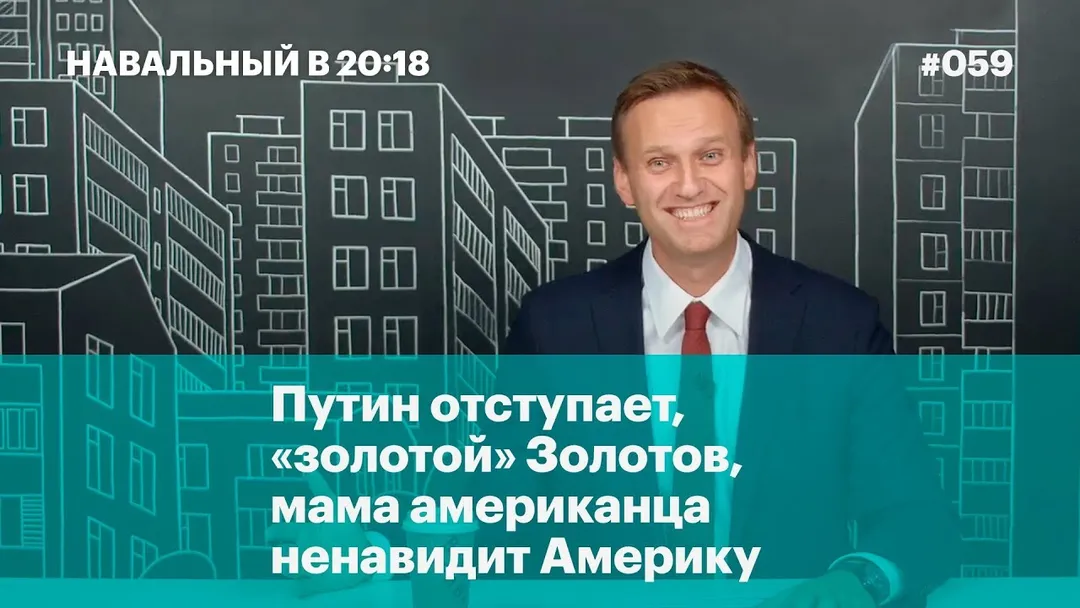
[music]
Well,
8:18 p.m. in Moscow. This is Alexei Navalny.
Or, "the self-proclaimed opposition leader," as
the Tsargrad TV channel called me.
We'll see—that's exactly right, because
indeed, no one appointed me,
but I do claim that role. And really, this is
television is a terribly interesting thing.
Even homemade television like
ours.
On the one hand, it's very cool
to talk to tens of thousands of
people, answer questions, and have
direct contact every day. On the other hand,
you become a slave to this television format.
Basically, I took a month and a half
of summer vacation, and during that time
every day people kept hammering me: why did you leave
the broadcasts? How dare you interrupt these
live streams? They're important. And, really,
to be fair, people do have the right
to make those complaints.
Because when you create some kind of
media outlet, a means of mass communication,
you've already created a kind of public
good, and your broadcast doesn't belong only to you.
Once you take that public good
away,
well, you're doing something unpleasant, not very nice,
to other people. It's interesting how this
thing works. Thank you very much to everyone who waited for these
broadcasts. Thank you very much to everyone who
criticized me for not doing them
for a while. But I will try
to do better, although
well, it really is a kind of
slavery of sorts: every
Thursday you have to do it, and you can't
just stop whenever you want—unless you have
a valid reason, like mine when
I was under arrest. Today, as I was
told, is not a very good day
to resume the live stream, because
right now, at this very moment,
a truly huge event is taking place in
the world of esports:
the Dota 2 final. Those who don't know anything about
this game or about esports at all—don't
rush to laugh, because the prize
pool for this match is $24 million.
Right now a Russian team
is playing an American one, and nearly 200,000
people are watching it live
on Twitch alone, not to mention Yandex. So
it's a major event. I wish victory
to the Russian side today. They're playing
the Americans—beat the Americans, our
esports players. But in the meantime, let's
discuss
the battle now underway in Russia. It is
the main political battle, and it's very
interesting that Putin, of course, is
a participant in this battle.
For now, he is retreating—and that's very interesting,
very curious. And we need to continue our
offensive. We need to drive this little
man farther and farther back. What
happened? Pension reform, of course.
Raising the retirement age. Putin has, in effect,
declared a kind of default by the state.
For many years, everyone paid
pension contributions. He said: there's no money; I
won't be able to pay you. I'll only be able
to pay those who survive and live
to 65 in the case of men, and 63 in
the case of women.
And I won't be able to pay anything
to anyone else. That is a real default,
because, after all, people spent their whole
lives paying these contributions on the
understanding that at 55 they would start
getting them back, at 60 they would start
getting them back. He killed that. It's a default. And
people are furious, and we are seeing a kind of
real war between the authorities on one
side and society on the other.
The authorities are using various tactics—
persuading, deceiving, talking on
TV shows about how great it is to raise the retirement
age, how pensions will grow. But
people aren't stupid either, and they can see that on
the one hand there is a law that spells out in great
detail how their pensions will be taken
away, while on the other hand there is no law
about how they will be increased, because
the government says: we'll raise
the retirement age and pensions will become
larger. They repeat this everywhere, all the time.
Please give us a legal act,
a government directive, a law, a plan,
a budget document—anything in writing
with an official stamp and officials' signatures
stating that pensions will be substantially
increased. There is no such thing. And so, naturally,
everyone is furious. And despite the fact
that they think they're so powerful,
that they have television and everything else,
and the National Guard (Rosgvardiya, Russia's internal security force), which of course
we'll talk about today, we can see that the guys are, of course,
slowly retreating. We expected this
would happen, and I said on this program
from the very beginning that most likely
this was designed deliberately, and the next
step would be that sometime in mid-autumn the government
would announce that it was slightly lowering this
retirement-age increase,
this rise in the retirement age. But they were
forced to do it right now.
First, a United Russia representative, one
of United Russia's leaders, Senator
Andrei Turchak,
known for the fact that
he was quite credibly accused of
organizing the attempted
murder of journalist Oleg Kashin, Turchak
then declared that United Russia is such a
great party, and suddenly United Russia
Russia—let's say thank you to it: it
has decided to soften this law and
will restore benefits tied to pension
age. What does that mean? For those who
are younger than 55 or
60 and don't really understand, this is important. Say you are
a single woman, you're 54 years old, you live
in an apartment. When you turned 55,
that used to be pension age, and you would start
paying less for housing and utilities, and there were various
other benefits as well, all connected to the fact
that you had reached pension age.
But since the pension age has been raised to 64,
that means this benefit has been delayed for you by 8 years.
You still have to pay for housing and utilities
as before, and in your life, essentially,
in your budget, in everything, it had been
planned that starting next year
you would pay less and save money.
Naturally, this caused outrage—
justified outrage. But as
had been discussed for many years, and now
United Russia (the ruling political party) has said—so far, said—that
this part
it is bringing back. It wasn't easy
for them to do, but nevertheless, under
pressure from society, which kept
continuing, in particular by holding
various mass events. My
last program was on July 1, on the eve of
the July 1 protests; I said
we should hold demonstrations.
They were held in more than 50 cities, and
different political forces all took part.
Despite the fact that this is not a very active
political season, and despite the fact that
there was obstruction everywhere, here and there,
there were large rallies, and
United Russia and Putin understood—they simply
realized they had to back down, and they
did.
A step back under pressure. Now, today,
the outlet Proekt reported—and I fully believe
this information—that next week
Putin will, of course, come out looking like
the hero in a white coat, all polished, saying,
"Well, perhaps we got a little carried away
with the pension age, but folks, let me
in the interests of the people adjust our plans
a bit downward, and for women the pension
age will begin not at 63 but at 60."
Again, we understood that most likely
they would do this under pressure, but
they would do it—possibly in mid-September
or sometime in mid-autumn—but they wanted to see
whether it would fly or not, as in
*Nasha Russia* (a Russian TV comedy show): whether it would work or not.
It won't work, and already this summer they saw
that it wouldn't work, that they needed to
back down once again. A great many
political analysts and journalists generally
often reason like this:
they say he is the sort of person who must never be shown
weakness, that he never retreats. He always
retreats if there is real pressure.
Remember the monetization of benefits (the replacement of in-kind social benefits with cash payments in Russia); there have been many
examples of him backing down under
pressure from society. By the way, that is not
weakness—it's his cunning, his strength. He retreats
if he sees that nothing can be done,
that people have come out as a united front.
Why is Putin doing this now? Because
all their tricks, all their deception, didn't work.
Even this didn't work: they
literally got everyone—all organizations, all
political forces that, in fact,
should have spoken out against
raising the pension age—but they
bribed them, pressured them.
They all completely supported the government's
actions. The most astonishing thing, of course,
in this situation is the trade unions. If ever there were
an organization that should have been
in hysterics, bringing people out, calling for
mass demonstrations, walkouts, strikes—
the trade unions should have done all that, and they
did nothing. And it's absolutely
stunning: at a recent
discussion of the pension-age
increase in the Duma (Russia's lower house of parliament), there was a speech by
the head of one of the independent trade unions—
well, that is, a completely bought-and-paid-for union.
As for the Federation of Independent Trade Unions,
they are rotten through and through.
They constantly support United Russia
and immediately supported raising the pension
age. There are different ones, and among them there is one
called Sotsprof, which claims to be
an independent trade union.
It says it is against the government, and then they
came to the hearing and said that
the pension age should be raised.
An amazing speech. Let's listen for 53
seconds, just to understand
how all the institutional
organizations in Russia, including the trade unions,
have of course become completely corrupt and do not
represent anyone's interests except their own,
that is, the interests of their corrupt leaders. Here are three
seconds from the Sotsprof association:
"Sotsprof has already been carrying out ongoing work on
discussing possible changes
to pension legislation. Today
we can confidently say that our efforts have not been
in vain—the authorities are hearing us." At the same time,
no one even mentions that the main
goal of the upcoming changes is to raise
pensions. Those who say that pension
reform came like a bolt from the blue
are openly lying. And no matter how much the so-called oppositionists
puff out their cheeks,
their level of analytical ability and
their calculations of the economic consequences are
certainly far below those of
the government. Today liberals and
democrats of every stripe
are calling people into the streets, but let's
remember: how many parliamentary
hearings on privatization, or what kind of market
the country needs—they brought in all that talk, and in general they didn’t
pay wages; salaries were delayed for months
they ruined the lives of tens of millions of our
citizens. We call on the opposition to stop
playing to the public and rocking the boat
a representative of the workers comes out and
everyone waits, thinking now he’s really going to let them have it, and he
says the authorities are meeting us halfway
the government knows better what to do, well
of course, they’re just so smart
and in the nineties it was even worse, but
what a spectacular ending, of course: enough
of rocking the boat—and then they bring people out into the
streets. That’s exactly what this corrupt crook
showed us—told us what needs to be done
so that Putin keeps
backing down. They’re now announcing that
next week, according to media reports,
Putin will announce a
less harsh version of this pension
reform, because on September 9 almost
100 cities
are taking part in our protests, and for us this
must be an absolutely clear signal
that we need to come out even more actively, we need
to bring out even more people. Putin is saying this on purpose
so that people won’t
go out, so that they’ll stay home, thinking, well,
it seems like, after all, they’ve already
backed off a little, so I guess I should
fall for that. No—we need right now to
put in even more effort, understanding that
they’re bending under pressure—that is, we need to drive these
guys further and further back, along with
their proposals, along with their
raising of the retirement age, along with
everything else. And there was also this
amazing shot, filmed
from the balcony of the State Duma (the lower house of Russia’s parliament), at these
hearings on issues related to the pension
age: there sit people earning
350,000 to 450,000 rubles a month (roughly several thousand U.S. dollars), and please show us
15 seconds of how the discussion was going
and how much attention the deputies were paying to it
leader
what was even going on with them at all
Sergeychuk, the rating of the Russian
public organization in Russia, really
given the price of everything else
Deputy Tatyana Voronina from United
Russia voted for raising the
retirement age and receives a salary of
400,000 rubles, and there she sits looking at something
at pictures. Well, of course, maybe the person needs
to eat; maybe she can sit there and look at pictures
I can sit somewhere too
looking at pictures—boring, and
it’s a meeting. But you came to a hearing on
the retirement-age issue, and this is
the main thing worrying your voters, but
you don’t give a damn about those voters. So
in order for this to concern Tatyana
Voronina
so that she’d be worried, so that she wouldn’t just be looking at pictures
like that but would actually be concerned, that’s why
this deputy from Voronezh, I think
I don’t have the note here, but I think from
Voronezh—so that she would somehow be more
concerned, so that she’d be scrolling through the social media
of her home region and looking at reports
about the rally—how many people came, whether they’ll vote for me
next time, what curses
they’re hurling at me on the forums of my
electoral district. That’s why on 9/09
we absolutely have to come out, and come out
in any case. Again, to the point: you
will see, there will be some actions on the second
and on the eve of it there will be posts, of course
the authorities will first of all try
to water all this down—we all understand that, it’s
a normal situation, it happens every
time. You need to go, and you must not be afraid to go
Here, of course, we just need to remember
the success—the unquestionable success—of the action called
the March of Mothers, which just
took place in Moscow
If you haven’t been following closely, there is this
case called New Greatness—you probably know it
when some unfortunate
teenagers and young people were literally
lured in through social media by an FSB provocateur (the FSB is Russia’s security service)
somewhere he
brought them together, told them how great it was there
come on, let’s go somewhere, to a training ground
we’ll train there, and handed them bottles
with incendiary mixture. They’re about 18—come on,
18 years old; life is interesting to girls
it’s interesting to hang out in this group with
boys, and for boys it’s interesting with
girls
and then there’s also a Molotov cocktail—wow
how romantic and cool. He listened to all this
the security-service provocateur organized it all
and now he’s had them all jailed. And there are two
girls there, one 18, another 19
The March of Mothers was an event that
was organized by several women
and they stated as a matter of principle: we will go
there, and we do not need either permission or
official approval. More than that, as you can see
in this post now
by Varvara Gornostaeva, who is one of the
organizers of this action, that we are not
submitting any applications at all
This march, this march is basically about fundamental
rights and basic dignity: we will go and
we will demand. There was pouring rain there
and about a thousand people gathered
That may not be very many, but that’s not the point
the tremendous success lies in
the fact that a situation arises when people
from the outset basically say: we don’t give a damn
about your approvals, we’re going
anyway. And at moments like these, the authorities
always sense it, and the authorities are always afraid
when people really, directly feel
inside themselves something important that matters to them
Well, okay then—if they detain me for
15 days, if they jail me, then
with their little antennae and false legs,
somewhere there in the Kremlin, they always
sense it. Once again: they are afraid of this. It is
very important, and I believe that our
attitude toward the protest against raising
the retirement age should be exactly
the same. We will, of course, do everything according to
the law; we will submit applications.
But we will not even enter into any negotiations
because either, under the Constitution, they give us
approval—or rather, not approval,
not approval: they simply must
respond, okay, because that is how the law
is structured. In any case, we will still go. And personally,
my attitude is this: fine, if you want
to come after me,
to lock me up for 30 days for
speaking out against raising
the retirement age, in the interests of
millions of pensioners and in the interests of
tens of millions of future pensioners,
then go ahead, jail me. But even so,
speaking rationally, from the point of view of
politics—fine, I would like it
to be like this: this whole corrupt crowd
of deputies,
and officials—they are for raising
the retirement age, while we are out in the streets, and
let them disperse us for opposing the raising of
the retirement age. Then we will see whom
the public sympathizes with. During the Mothers' March
(a protest in support of women and children facing repression), that was exactly how it was—they said:
well, if you want to disperse us, then disperse
the Mothers' March, the women who came out
against the fact that you are keeping an 18-year-old
girl, some miserable young woman, in a SIZO (pre-trial detention center),
when she is sick and crying, and
literally, in court, at those hearings,
she was crying and saying, 'I want my mom.'
Well then, go ahead and disperse us. That is exactly the kind of
attitude we should have.
And no other. Here we need to clearly
understand and clearly realize that, according to
any poll, 95 percent of Russian citizens
are completely on our side, and
okay,
we want to see that no one wants any
detentions, no one wants any of these
crackdowns.
But this will not scare us. Let the city
hall and the prosecutors issue whatever they like,
whatever they call these warnings.
On the eve of every event, some
police officers constantly catch me near my building entrance and read out
something from a piece of paper. One idiot stands there with
a camera like this, and another fool
reads: 'The prosecutor of such-and-such district
warns citizen Navalny...'
Honestly, I could not care less what exactly
he is warning me about—that I supposedly have no right
to speak out against you stealing my
future pension, or the pension of my
neighbor? No—I will speak out.
And I urge everyone: on the 9th, in the description of
this video, there are links to the Facebook
group and the VKontakte group
for your city. Join your local group and
take part. Putin is retreating; now we need
to keep pressing him.
Otherwise, they will deceive us again. And you see—hello,
probably many of you have already understood
what is going on. I want to talk with you
indeed about the investigation
that we released today. Of all
the many, this is probably my most
favorite: Vitya, Vitya Golden Head—he
is called the director, the director,
the commander-in-chief of the Russian Guard.
It is interesting, actually funny, that according to
the law it is in fact called
the National Guard, while 'Rosgvardiya' is some kind of
self-designation—just as, at the beginning, I said 'self-
proclaimed leader of the opposition'; likewise, they have
'Rosgvardiya,' though nowhere is it
written that way—it is simply the National Guard, according to its official registration.
Ukraine also has a National Guard, so in this
Russian political mythology there is
some supposed punitive force from the Ukrainian National Guard,
whereas in Russia, supposedly, there is no National Guard—in Russia there is 'Ros-
guard.' But in fact it is also called the National Guard.
It is the National Guard too. But this Viktor
Zolotov, Putin's former bodyguard—where did we even
learn about him? Simply because
this character is such a favorite of mine.
Because his entire story, and the story of
his political rise, is even
more striking than Putin's. We first saw this very man
for the first time—this man who is now
engaged in dispersing rallies—we
saw him at a very real
unauthorized
demonstration, in fact. So,
look: this young guy who is in
this corner—for me it is the right corner, for you on
the screen, whichever way you are viewing it—in short, in
the place where he is standing above everyone else—that is Yeltsin's bodyguard,
Viktor Zolotov at the time. He is standing, I think,
on a tank during an
unauthorized gathering
of extremists, because some kind of
GKChP (the State Committee on the State of Emergency)
—
set up by various ministers
of the Soviet Union—was the lawful
government. But nevertheless, they
went there and organized what today would be called, in those damned nineties,
as they would say now, in the 'wild 1990s,'
an unauthorized gathering and effectively
overthrew the government in the Soviet Union. And now
these guys—this Zolotov, for example—well, it is not even
that he turned 360 degrees, not even that he
changed shoes in midair; they
went tumbling head over heels, changing their
political views every second and
every second saying some new
things. And from that tank...
from the security detail of the man who organized
the most successful unauthorized
events in modern Russian history, he
turned into this kind of general,
with golden epaulettes, who now
lectures us about how he will
uphold constitutional order, that he will not
allow unauthorized gatherings.
Most importantly, he turned into a fantastically
rich man, literally just
a fantastically rich man, and his
official income—you can go and look it up,
his income there was, what, in 2016, 6
and a half million rubles (about $100,000 at the time), which is slightly
more than mine—I think mine was 5
in my last declaration, a long time ago, so
it's not a small amount. In any case, he has six and a half
million, also not a small amount. But at the same time we
did an investigation—you can look it up
on our site—his daughter has a 500-square-meter apartment (about 5,380 sq ft), I can barely even
say it out loud, a 500-square-meter
apartment. He also took for himself
a dacha that used to belong to Mikoyan
the legendary Soviet people's commissar (government minister) of the Soviet era,
who, well, I mean,
who served for a very long time under many
Soviet governments, as you understand,
throughout all those years in the leadership of the USSR.
Well,
uh,
he also secured a nice little plum property for himself.
It was state-owned; this dacha was not
private property before, but now
it has somehow ended up in the ownership of
this remarkable general.
And
his income simply does not match
his spending, his standard of living, and the
standard of living of his relatives, so for me
there's nothing even to prove. As
journalists say, we can't
make accusations without fact-checking, but for me this is
the fact-check: when I see that a
person has assets that, by our estimate—we
calculated them at 700 million rubles (roughly $11 million at the time)—while
his income is 6.5 million rubles,
well, that is the fact-check for me.
That's why I say, yes, I consider him
corrupt. There is not a single
rational explanation for where
he got that money. And this isn't even
just some random official, you know, some
agriculture minister.
He's the head of the National Guard, Rosgvardiya (Russia's National Guard), call it what you like.
This is a man from the security services who stands
as a guardian of public order and embodies
order itself. And order in Russia
apparently means that this powerful man
who of course could never have been engaged in this kind of
business, will sit on our necks all his life
receiving taxpayers' money,
while somehow ending up with property worth 700
million rubles. Today we released
a follow-up investigation that in many ways
explains where Zolotov
got this money. Many people could have taken it,
but I don't think this could have happened without
Zolotov knowing about it. Let's watch this clip,
about a minute and a half long, and see
a minute and a half excerpt from our video
so you understand what we're talking about.
Just a year earlier, food was being purchased from
different suppliers
depending on the region, and then
the bosses realized: this is a huge
piece of the pie.
They granted the company Druzhba Narodov Meat Processing Plant
("Friendship of Peoples")
the exclusive right to supply food
to Rosgvardiya without any tenders or
competition. But somehow the owner
of this enterprise, through a chain of companies,
turns out to be a former officer of the Internal Troops,
Boris Zaurbekovich Kantemirov.
Kantemirov is a direct subordinate
of Viktor Zolotov, the head
of Rosgvardiya. Rosgvardiya buys wholesale,
through billion-ruble contracts, food at prices higher
than what it costs in retail stores in
Moscow.
The most outrageous example we have is
cabbage, because here it costs
look, 14 rubles 89 kopecks, while they
buy it for 46. Fruit juice in
the store costs 76 rubles per liter,
they buy it for 87. One thing I know for sure:
the people robbing you are not
the people you beat with batons and shove into
police vans. It's not the people who go to rallies
who profit from what you eat,
selling you worse meat for more money. And when you
detain protesters, you yourselves are making sure
that
your bosses can go on stealing money even from
your food.
When the guys from our
anti-corruption team came to me and said, listen, we found
contracts showing that Rosgvardiya had somehow started
buying food at much higher prices than
last year,
well, I thought, okay, probably
inflation, plus they stole maybe 10 or 15 percent,
maybe 30 at most—let's take a look. And then
they said, no, Alexei, not 30 percent, they
marked it up and stole—you won't believe it—like,
last year, in November of last year,
they were buying onions for 16, and now
they've started buying them for 60. And I, just as a joke,
said to them, ha-ha, I bet they're even
paying more than the store price, like
I was joking. And they said, yes, they are buying
through billion-ruble contracts and enormous
wholesale batches at prices higher than these
same products cost in the store. Well, that's exactly what
I showed in the video, in fact. And of course,
look, it's clear that
corruption is everywhere, but the sheer brazenness and
obviousness of it—so many people know about it, right?
Rosgvardiya (the Russian National Guard) has 340,000 personnel there.
The accounting department alone has about 500 people.
Add another 200 FSB officers (Federal Security Service) attached to them.
They’ve also got some people in internal departments there,
internal control, checking them,
some other people—and there were documents,
and they brought them into this accounting office, and there
some kind of budgeting department handled these papers,
and people are sitting there, a woman accountant, for example,
there are 30 of them in the office, and they’re told, well,
we’ve decided to buy onions at four times
the normal price—but this woman buys
onions in the store herself, so she understands that now
she’s going to have to sign off on something, and it’s
more expensive than in the store. She perfectly well
understands that out of those two and a half
billion,
just under a billion will be stolen at a minimum.
She signs it, then probably tells her husband,
“Can you imagine? They stole a billion from us
through food procurement.”
And all those FSB officers know, everyone else
knows too, but somehow they just look at it,
shrug their shoulders,
or who the hell knows how it works in practice for them.
Because the scheme itself
is completely insane—Medvedev signed it.
By the way, that was our mistake: we forgot
to mention in our investigation
a very important fact, and the BBC reminded everyone of it today:
a secret government order,
classified as a state secret,
saying that some
Nikanor office gets all the procurement contracts
for Rosgvardiya’s food supplies, through
this one company. Everything is bought at three times
the price. Such crude schemes—
they probably didn’t even steal this blatantly in the 1990s
(the chaotic post-Soviet decade) . And now, of course, a lot of people
keep asking me a fairly direct question:
the video says that
either Zolotov
or Medvedev or Putin stole it, or some
combination of them—but personally, I think
who was the main one in this scheme, who somehow
took the biggest cut?
I’ll answer directly: I think it was Medvedev.
Based on the totality of the evidence,
and by the way, we didn’t include all of it in the video.
There’s also a very long post—read it.
The people who built this whole scheme are
directly connected to Medvedev. In particular,
this Kantemirov guy,
a former Rosgvardiya employee, a former
member of the Internal Troops, from which
Rosgvardiya was created—he was the head
of the archive there, which is funny in itself: the head of the archive
of the Internal Troops later became this kind of
businessman. So, he worked
as CEO in various, various
companies
that belonged to Vinitsky.
And we know this Vinitsky from our
investigation *He Is Not Dimon to You*.
He isn’t in the film itself, but there are properties connected to him
in the huge text
attached to the film. In particular,
remember that famous house
on the Bezborodko embankment in St. Petersburg,
with those super-luxury apartments and the elevator
that brings your car straight into the apartment?
Well, Medvedev-linked companies bought
that building from this very Vinitsky.
He’s also a graduate of St. Petersburg,
then Leningrad, University.
So yes, it’s indirect evidence, but
our whole mafia seems to have come out of there.
Besides that, this Kantemirov,
the formal owner of the meat
processing plant—more than that,
he
was buying land around one of
Medvedev’s properties, the so-called
Maslovo estate, also on Rublyovka (an elite area outside Moscow).
It’s in our long, detailed
write-up—take a look.
That property is there; right now you can see
an aerial shot over the village of Maslovo.
We didn’t include it
because the film was already overloaded. So the point is,
he was buying, essentially creating
a security buffer.
He owned the land around this
house, around this property,
which, as we believe, belonged to the Medvedev
group. And how do we prove it belonged
to the Medvedev group? More than that, there is even
a document from the Accounts Chamber, which
checked this and found that these
wonderful people—Kantemirov and the others—
bought it for 15 percent
of its cadastral value. So it wasn’t just
sold to them—one way or another, all of this
is connected to Medvedev. Medvedev
signed the secret order.
So personally, I absolutely believe that
Zolotov is of course making money from this, and
so are Medvedev’s people.
Does Putin know about it? Of course Putin
knows about it. But obviously there are some
special services, and in our country
everything is preserved that way, so it’s all one big
mafia. But these two people—Zolotov and
Medvedev, and Medvedev first and foremost—
are making a great deal of money off all this.
For us this is an important case, and
we’re asking everyone very strongly to
spread this information and get it
above all to those very fighters,
the Rosgvardiya troops, so that those people
whose brains are constantly being washed, those
people who are being told about what kind of
extremists are supposedly gathering—so that
they understand a little more about their
superiors.
They probably understand it already, of course, but
they can see everything—they’re not blind. But good Lord, they’re not
somehow out there over scraps of meat for these people...
You hear that conscripts are making money off this?
They really did raise it for them, and it’s not even...
the fat content, but the percentage of connective tissue.
They used to buy meat that had
8 percent connective tissue,
but now they’ve raised the price and are buying meat at
a higher price, and it has 14 percent
connective tissue — basically some kind of
cartilage.
What they’re actually serving them is some kind of meat
made up of scraps of cartilage that, well,
that they’ll later be fishing out
of their soup and tearing at with their teeth like this.
That’s how they’re stealing money, and I really
want that when these servicemen
are gnawing at this god-knows-what kind of meat with
their teeth, at that moment they understand who
the real extremist is, and who is actually
hated — and who it is they want to hit with a baton.
This is very important, so please help us
spread and get this
information out.
What’s interesting is that lately
sports media have become quite
political. It was noticeable during
the World Cup, and it’s especially
clear from such a great outlet as
Sports.ru, where recently some of the
best — and, I’d say, politically
sharpest — interviews have been coming out.
Last week, one of them really blew up
the internet, and I also really
liked it because it was given by
Svetlana Khorkina, a famous Russian
athlete.
She’s an accomplished athlete who, at the young age of 18,
became a champion for the first time.
She put up great results, and to our great
regret, for some
damn reason she joined United Russia (the Kremlin’s ruling party). Read
that interview — it’s very revealing.
First of all, you can tell
the caliber of the human material
that is engaged in lawmaking.
There’s no doubt that Khorkina is an
outstanding athlete. But why are you sitting in the
State Duma (the lower house of Russia’s parliament) if you basically
have no idea what you’re doing
and are just repeating this nonsense about how
Russia is now
respected, and Putin is so
wonderful, and yes, I sat in the
State Duma — well, I mean, all of
that is clear enough. This is really a story
about our State Duma: they’ve
packed it with athletes and entertainers, and they
are, to put it mildly, roughly like this:
they’re not exactly
the best lawmakers, frankly speaking. When it comes to
legislation, they operate at not
the highest level, and they don’t always
understand what is even happening around
them, what these papers are, and
what any of it actually means.
That’s the State Duma for you.
But that’s not even what struck me. What struck me
was how
Khorkina simultaneously
manages to make
the United States the object of her hatred and criticism. In
the interview, it just keeps coming up constantly.
I’m looking at it now — read the quotes yourselves.
Things like: “What about torture in prisons? You don’t
have information about the hundreds of
prisons in America.” They ask her about torture
in Karelia or the Komi Republic, and she says, “But in
America they torture people too — you just don’t know it.
Terrible things happen there.”
“African Americans are being killed in
the streets.” In response to something else, she says,
“People are being killed all over America, there are
school shootings,” and so on. “Do you want it to be like that there?
We have things very good here.”
How could Svetlana Khorkina
say something like that? And yes, to be fair,
American prisons probably are not
ideal, and
yes, there really are school shootings.
But if you hate it there so much, then why
did you, Svetlana Khorkina, go
to America to give birth and make your son
an American? Back in 2005, Komsomolskaya Pravda
(a Russian tabloid newspaper)
— my favorite newspaper, the one that tells
you how I eat lobsters — reported that
Khorkina went to the U.S. to give birth and
gave birth there. What does that mean? There are
countries with citizenship by blood, and countries with
citizenship by territory. Russia follows the principle of
blood: if you are a Russian citizen and your wife
is a Russian citizen, or your husband is a citizen
of Russia, then no matter where your
child is born, that child will be a Russian citizen
because they were born to Russian citizens.
In the U.S., the system is different: any person, even
if they entered the U.S. illegally,
or were dropped there from a plane with
a parachute, or
if you’re, I don’t know, a spy or whoever,
or somehow dug your way into the U.S. —
if you were physically born there, if the act of birth
took place on U.S. territory, then you are
a U.S. citizen. You can — that is, you can
renounce it, but you can also
be a U.S. citizen. And as the media again
reported, and as Khorkina herself confirmed in 2010,
her son is a U.S. citizen.
And let’s not kid ourselves:
when people are not abroad on a work trip,
not diplomats, not studying there, or anything
like that, and they specifically go there to give birth —
not just happen to be there and give birth in the U.S. — there’s nothing
terrible about it, but when people specifically go to the U.S.,
it’s obvious they are going there specifically
to give their child a
gift, and so that later they themselves
will have a simplified opportunity
to naturalize there, if they want to.
Emigrate—and Khorkina did it, come on.
Let's honestly admit exactly that.
And, basically, well, she absolutely could have.
To put it plainly there, honestly speaking, well, as for me, in
United Russia, I support Putin, but
our country does have shortcomings, well, like
our healthcare is bad; I work
in United Russia, and I'm trying to improve all this.
I draft laws in order to eliminate
some of the shortcomings that still exist in
our country, but for now healthcare
is bad, and for now things here are still not
very good. So I went and gave birth in the States.
No problem—I gave birth, that's all. There's nothing
terrible about it, for God's sake. It's not an act
of betrayal. No, there's nothing awful—you
did what many people could have done
themselves.
You said that healthcare in Russia is bad.
All 145 million people understand that.
You said that in
Russia things aren't exactly great, including
the maternity hospitals, quite often, and this whole
system,
the obstetric care system—millions of women know it
and run into these problems. You
decided to insure your future
child. So don't now
look us in the eye and feed us nonsense about
what a terrible America it is and what a
wonderful Putin is, while at the same time keeping
somewhere at home in a safe some kind of
blue booklet—I mean, maybe the child hasn't yet
been given a passport, but that
piece of paper that will let you
get that blue passport there, and he
will travel visa-free to Europe,
travel visa-free, and will be an American,
a U.S. citizen—this kind of hypocrisy
is simply disgusting, of course, just outright.
They lie even where there's no need to lie, but
who would even reproach her? After all, an athlete
generally implies a fairly
international lifestyle—you have to be
traveling somewhere all the time.
But no—even here they have to not just
lie, but also shame people. Read this
interview: the correspondent says, "You
have a negative view of events in
Russia—why are you telling me only negative things?"
And she goes on to shame us, saying that we
are doing something wrong. So basically, here's a mother
of an American who hates America.
It's very revealing—please read it.
When I went on vacation in the last
days of June, that was the last program,
I assumed that when I came back here
and
there would be a lot to say about the September 9 elections,
the Single Voting Day (Russia's nationwide election day).
On that Single Voting Day,
we are holding our protest action, a Single Day
of Protest against raising the retirement
age. But it seems that in Moscow
there are supposedly some elections.
What is there to say about them? Write to me,
please, with the hashtag #Navalny2018, about what
you would actually be interested to know about
the Moscow elections. Well, I see the metro plastered
with Sobyanin.
They've hung little screens everywhere that are
supposed to provide
some information to passengers, and there
it's just Sobyanin popping out of those little screens
nonstop. And this isn't paid for out of
an election fund—it's "information" about
how the city is developing.
Go into any
multifunctional public services center to get documents
or whatever else—there are little calendars
with Sobyanin, and Sobyanin is everywhere.
Everywhere, everywhere, everywhere—he's all over Facebook too.
You log in and there's advertising everywhere, arranged rather cleverly.
It's not advertising for Sobyanin—it's
advertising for that TV channel which
promotes itself with stories about how
our beautiful Moscow is becoming ever more splendid under
the leadership of Sergei Semyonovich, and this is
absolutely, definitely not campaign advertising
for Sobyanin. But the thing is, we
understood that this was exactly how it would be. They always
do this. These people have
administrative resources, they are cynical and
crooked, and naturally they will spend billions of rubles
from the budget on
promoting themselves. But we somehow
would have liked the candidates running
against Sobyanin to do something.
To at least be somewhat noticeable. I
have only seen one guy—some
figure from SU-155 (a bankrupt construction company),
an organization that cheated many
shared-equity homebuyers. He was let in on purpose
so that he could play the role of
the villain in this election, with ridiculous
slogans like "I'll whip everyone into shape." But overall, there's
nothing at all. Nothing is happening in this election.
Again, I have something to compare it to, because
it's interesting that at this same time,
five years ago, on August 24,
at our headquarters in 2013, we were celebrating
a milestone: by then we had set up
1,000 campaign cubes (street campaign stands), and
a couple of days later I held a rally
in Sokolniki at which there were several
thousand people. What are the candidates doing now?
It's not very clear. But again,
the thing is, you ask me the question:
do we go to the elections or not, do we boycott
them or not? I want to say once again:
to repeat:
there is no desire to boycott a second election
in a row. But let's be honest: an election
where there's Sobyanin and everything else is just
a competition for second place between
some, forgive me, Balakin and
Sviridov—
only an idiot would go to these elections.
Well, you’d have to be a complete idiot to
go to these elections, and here I’m very
interested in the position of all those
slightly odd people who, during the
presidential campaign, were running around us,
circling us, attacking us—political analysts and everyone else—
and telling us that you have to go to any election
no matter what, because voting is still a choice, and that’s good.
And that what Navalny is proposing—
a strike, a boycott of the elections—was
supposedly something terrible. But now
they’ve all gone silent, and I’d like them
to explain to me now why I should
go to the Moscow vote—what’s the point?
In the current Moscow elections, this is
where they keep repeating the same argument: you still need
to participate, it matters, it’s an institution, or that
candidates have an opportunity
to address the people. But with these
elections, they can’t even
repeat all that without shame, because
there is nothing here. And I’m not even going to
call for any boycott; I’m simply going to
keep saying: if you’re an idiot, then go
to these elections. But if you’re a normal
person and you want to take part in something
that is actually part of the country’s
political life, then on that day there is
a great opportunity in Moscow.
Please, come to Tverskaya, to Pushkinskaya
—come out. That day there will be a protest
against raising the retirement age. That’s where
there will be politics.
And at the polling stations there will be anti-
politics—just some kind of sham.
Let me answer some questions. Sokolova
Alexandra: “Alexei, what about the court cases in
Khabarovsk? They barred Alexei Vorsin.”
We really did have a great candidate
who would have won the mayoral election
in the city of Khabarovsk, but they didn’t let him run. That’s to the
question of how I’m supposed to feel about
elections when
our candidate, who collected signatures, is not
allowed in—he was registered and then removed
from the ballot for some completely
made-up
reason. I can even tell you exactly why
he was removed. There’s a form there,
an official document where he has to list
his property, his own and his spouse’s, and it
says there: “candidate’s (spouse’s)”
property. So he filled it out for himself, but he
is unmarried, so he filled it out only for himself.
And the election commission said, “Oh, but you
were supposed to take a pen and cross out the word ‘spouse,’
but you didn’t cross it out. That’s it, you’re not
a candidate, we’re removing you.” It’s insane. To which
he said, “Are you idiots? It’s your
form, your paperwork. Why would I be crossing things out on your form
when I don’t have a spouse? I listed
my own information, that’s all.”
It sounds wild. Of course he was removed, and we went to court,
and we’ll keep filing lawsuits, but you understand
what the courts are like. So in Khabarovsk there will be
no real mayoral election. There is a great
candidate there; he would have been a great mayor, but
there won’t be any real election there.
RK Protv asks me, writes: “Did Putin simply
decide to boost his ratings for himself,
like he’s going to appear now as some kind of hero,
the savior of the people?” He will try to
portray it that way. The question is whether he’ll
manage to fool everyone like that now.
To say, “Oh, I had nothing to do with it,
I’m not the one raising the retirement
age here at all. I’ll help, I’ll save you, guys,
from the bad government.” I don’t think that
will work very well. Polls show
that people understand Putin bears
personal responsibility for this. He is responsible, he
is pushing the retirement-age increase, and
our task, including during the September 9 protest,
is to talk about that. We have
7,000 people watching right now.
“Alexei, will you go to the court hearing for
Konstantin Saltykov on September 3 at
2:00 p.m.? The case will be heard on the merits,
and he needs our support.”
Konstantin Saltykov is a wonderful
young man who has already been kept
in jail for several months simply because
during my detention he somehow got caught up
in the middle of that mess, and they needed
to grab someone else and drag them in under
some charge, and so now he has been
held for several months, accused
of having
supposedly done something to police officers,
even though there is plenty of video evidence.
I can’t go to the hearing on September 3 because
I will be a witness, so for his case
I’m needed as a witness, because as soon as
I enter the courtroom, I’ll have been present at
the hearing.
Then of course they’ll say, as they always do, that
Navalny cannot be a witness
because he came in and
heard it all. But of course I urge everyone
to come and support Saltykov.
He is a genuine political prisoner.
Alex Bass asks: “What do you think about the
elections in New Moscow, in Shcherbinka?”
There are local elections there, for local
municipal bodies. As I understand it, there are some
good candidates there. Our party
supports these candidates, and they are
really in a difficult position, because
well, everything I said about
the elections in Moscow—don’t go—also
applies here. They were probably sitting there hearing even my
message and thinking, “Navalny is burying us now,” because
I called on everyone not to go, while for them
it’s important that people come and vote. Well,
that’s just how it is, guys. I can’t take
any other position. I can’t call on
10 million people to go to fake
polling stations just because in New Moscow there is
There are several good candidates, and to those who
live in New Moscow (the expanded administrative area of Moscow), I appeal to the voters:
take a look—if these guys are running
in your districts, come out and vote for
them in the local elections, for the municipal
assembly—but not in the mayoral election.
As for the elections—Dmitry Dmitriev, will you
provide legal and financial assistance
to those detained at the September 9 protests? We have always
provided it to those detained, and we will continue to do so.
What does financial assistance mean?
We pay fines that were imposed unlawfully.
Well, not exactly we pay them ourselves—we organize a system
for collecting money, where everyone chips in to cover
the fines. For all our rallies, for everyone involved,
we pool the money together and pay them. But
legal assistance is handled by our headquarters, and
everyone works on it. We will absolutely continue
doing that, and we already are. It’s just, guys, don’t
get too fixated on the idea of very strong legal
support. I’m a lawyer myself,
and lawyers are constantly with me—well, not
constantly, but yes, they go to court hearings, and when
I’m detained, two attorneys come out.
Has it helped me? Not at all. Every single time I was
jailed for 30 days.
No lawyers, no legal assistance
really work in Russian courts. Don’t
overthink that. You should be thinking
about the substance—you should be thinking about the fact that you need
to come out for this, that’s the point.
Ignoring everything else, and being ready
to be detained that day over this.
That’s what you need to understand. And when Putin
realizes that 100,000, 200,000, 300,000 people across the country are clearly
saying:
"Man, you want to steal our money, and
we don’t care what you’ve become or how much
you try to scare us with detentions—we’re going anyway,"
then fine, they may be able to detain 1,000
people. Maybe across the whole country they can
detain 3,000 people, 5,000
people—fine, let them. They can
put several hundred people under
administrative arrest; they can jail
people on administrative charges.
But you can’t jail 100,000 people,
so people still need to go out.
The chance of ending up among those couple
of hundred
who are detained or jailed for 10 days
is real—of course it matters.
But you still have to go, because otherwise
you won’t push back against this; there’s no other way to move them
or stop them, and they’ll go on robbing us
and stealing from us. And then, 10 years from now, when you’ve
lost several hundred thousand
rubles, or a million rubles (roughly thousands to tens of thousands of U.S. dollars),
you’ll think: what an idiot I was,
I got scared of some lousy 10
days in detention. I should have gone then; they wouldn’t have been able
to keep paying themselves proper money. It would have been better
if I had gone then and rattled this government—but
I didn’t go, I got scared, and now here I am,
ending up in this situation.
Alexei, people are asking: tell us who
is still participating in the elections in
the regions? We have someone running in Volgograd,
there are people in Tambov who wanted to run,
but they were removed; in Krasnoyarsk some remained at one point.
It’s all on the website.
There is information on our headquarters’ website and on our social media.
Accordingly, in the regional
social media pages as well. These are all small-scale
local elections where a few individual
people may be able to get through, but overall, in
what we might call major races—like the mayor of Khabarovsk
or the Tambov regional legislative assembly—we were running there,
but under outright lawlessness they removed our candidates because
we were winning those elections.
Unfortunately, they still won’t let us get access to the equipment.
What’s their latest excuse about the equipment taken from the office?
What’s the newest pretext on that issue?
Good question. They don’t even have a new
excuse—they just aren’t returning the equipment.
They simply took everything. The situation is such
that we can’t even demand from
any particular agency that our equipment
be returned, or even ask them to present, as you put it,
some fresh excuse—because
we go to court, and the court says:
you don’t actually know which organization
took your equipment. You show us
video footage of some men in plain clothes
carrying everything out, but we don’t know—maybe it was the Ministry of Internal Affairs,
maybe the FSB (Federal Security Service), maybe the National Guard,
or maybe you carried it out yourselves. We
don’t know anything, so goodbye.
Naturally, one of the main issues, one of the
main topics of discussion in this campaign,
this summer, has been VKontakte and all these likes
and jailings over reposts. I’ve spoken about this many times
on my broadcasts, many times, saying
that this would intensify. It already is
intensifying, and it will continue to intensify. I explained
that this is being done deliberately so that
you’ll be afraid to write anything. That’s why
it’s being done so demonstratively.
There’s no need to think that these are just some
idiots in power, just stupid
little cogs somewhere in Altai Krai trying
to jail
a young woman over her posts or reposts or
likes. No—this is a deliberate campaign so that
you look at this, and then before writing
"Putin is a thief," you think, damn, should I write it or not?
Should I post it? Damn it, I’d better not.
That is exactly what all of this is for. People often
ask me what my attitude is toward
VKontakte, whether I’m going to
leave VKontakte. So, for me there are
two things here. First: VKontakte
is unquestionably participating in the imprisonment of people.
It is participating directly. This is a group in which
there is Center "E" (Russia’s anti-extremism police unit), and there is VKontakte; there is
a connection between these people. Together they
consciously jail people—absolutely, that’s how it is. And
we—Leonid Volkov
published information about our people from
Ufa, our supporters
whose case files contain direct
evidence that even without a court
order, on their own initiative, simply
a police officer writes to the administrator of
VKontakte
and says, “Give me information on these people,”
personal information—and VK says, “No problem,”
“tell us what you need, we’ll send it,” and they do. Well, that is
quite simply a criminal violation, which
VK commits without even a court
request, by handing over information. So
it’s not just VKontakte—VK is part of
Mail.ru Group
which means Mail.ru hands over your
email, and VK hands over your correspondence
at the first request, without any court ruling. I
am sure of it; there is evidence
that
shows this. So they are certainly
helping put people in jail. Will we leave?
No, not yet, because
Facebook only works for
the biggest cities. When we create
groups for rallies in Moscow and St. Petersburg,
Facebook still works, and maybe in
large cities like Yekaterinburg and
Novosibirsk
but elsewhere it’s only VKontakte, so we are forced to
use it. But I simply urge you
to understand that everything you
write on VKontakte, all your private
messages,
whether you participate in certain groups or not,
whether you write or don’t write—all of it
is monitored, and at the first opportunity
can be handed over to the FSB and the MVD (Russia’s Interior Ministry)
and everyone else. In other words, this is absolutely not
a safe network, but a network that directly
works against its own users. We have to
use it because it’s huge, we are forced to work through
it. So, well, I know many people will
write to me saying I said
some nonsense here: first I said they
put people in jail, and then that we somehow
aren’t leaving. But for now, that’s how it works. I’m
telling you how it is. For us, what matters is
the ability to create these regional
groups on VKontakte
but at the same time we understand that they simply
behave like—excuse me—
they betray their users, they
help put them in jail. Whatever they are saying now
about changing something—they are doing it
because they have run into mass
outrage, outrage from their own
customers. But they will keep doing this to you
because they belong
to Usmanov, and for Usmanov the only
way to preserve his billions is
for Putin to remain in the Kremlin, and for Putin
the way to stay in the Kremlin
is to jail those who are outraged
by his prolonged stay there, including on
social media. Quite simply, everyone
involved has an interest in getting you jailed
for a like. And I apologize for
such a not very optimistic ending
to the program.
But I do have an optimistic
ending for you—about a happy man. There is
this journalist, Valery Fadeev
well, “journalist” is a stretch—more like a guy from
various TV talk shows, you see him there
all the time, on Channel One. He used to be
the secretary of the Public Chamber, and he still
is the secretary of the Public Chamber (a state-backed civic body)
he coordinates various things and
is a member of the central штаб of the All-Russia People’s Front
he holds various positions and speaks everywhere
in particular, recently—let’s watch these 13
seconds—how he talked about
the need to raise the retirement age
for 13 seconds.
And the retirement age objectively
has to correspond to average life expectancy, because the so-called
period of life after retirement—and excuse me
for these crude words—we have a lot of
people who live too long.
Do you know why he loves the government so much?
And why the government loves him? Because he is
a happy man for whom amazing
things work out—things that
you could never pull off. He is the editor-in-chief
of *Expert* magazine. It’s a terrible
trash heap of waste paper, I mean a magazine nobody
needs, where they constantly praise
Putin, of course. For a pro-Putin
propagandist like Fadeev, money was needed, and
so he pulled off the perfect scheme:
he got a bank loan
using their old unsold
magazines as collateral. That is, they printed
all this worthless trash paper with portraits of
Putin on the front cover
Well, nobody buys this waste paper—who
needs this junk? So it sits somewhere,
a million copies of these magazines sitting in some
warehouse, and he took out a loan against this
waste paper. Then he didn’t repay the loan, and
the bank went ahead and
seized these magazines, saying, “Okay, well,
if you’re not paying back the 35 million
rubles (about several hundred thousand U.S. dollars), we’ll take the magazines.”
But how much are they actually worth? As waste paper,
well, probably—what? Maybe
I don’t know—200,000 rubles total (roughly a few thousand U.S. dollars). But
he got 35 million for them. You know, it’s like
if we had some leftover
campaign materials from the elections—our newspaper print runs were seized
back then
a year ago—and now we’ve rolled them up and don’t
know what to do with half a ton of newspapers,
and if someone bought that half-ton of newspapers from us
for 35 million rubles
that would never happen for us. But for Valery
Fadeev, it did—and that is why this
a happy man who will continue
to go on television and tell us about
how it is supposedly right to raise the retirement
age, and how wise our parties are
and the government, while on September 9 we must
go out into the streets and tell him, Valery
Fadeyev,
we do not believe you. See you
next Thursday, thank you.
[music]
