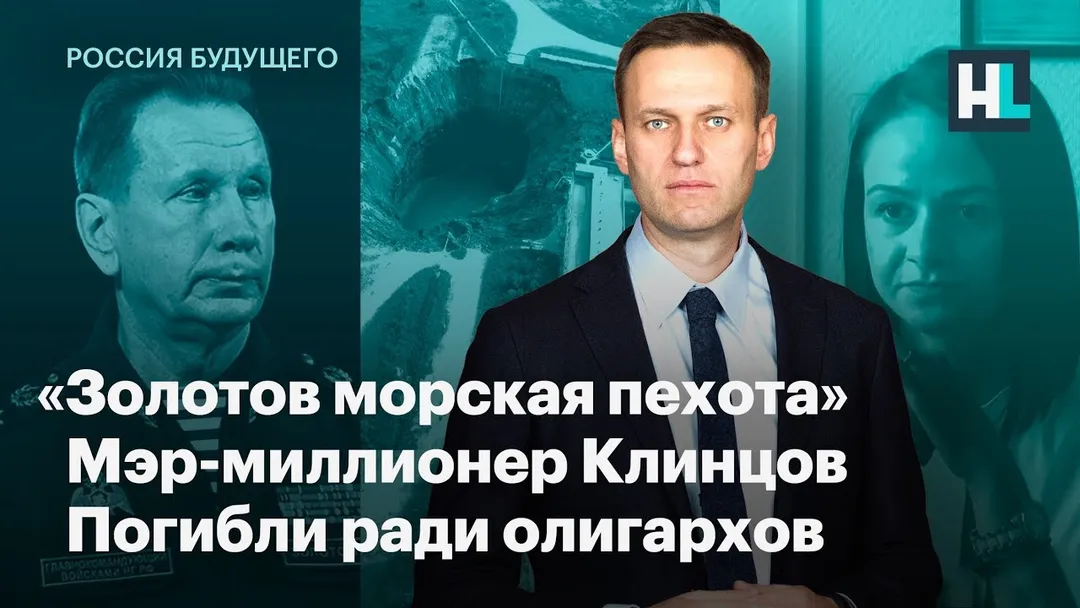
“Zolotov’s marines,” the millionaire mayor of Klintsy, died for the oligarchs
[music]
It's 8:00 p.m. in Moscow. Hello everyone, live on air
is the program *Russia of the Future*, and I am
Alexei Navalny, or rather,
well, I’ve had a lot of names this week. No one
from the long-banned Gazeta.ru
— better not even mention who exactly there —
called me “destructive elements
operating in the region.” That’s what
the Interior Ministry directorate for Rostov Region called me. Of course,
the best title — and the one that really topped it off — came from my
favorite, a regular guest on our
program, General Zolotov
who said that I am “this subject,” and that certain
individuals should be dealt with — and quickly at that.
We’ll take a brief look at that. I want to state, to examine
this “subject,” that my dacha (country house)
and what exactly his connections are — and besides, never
mind, yes, I’m doing this now from Omsk, on
Telegram, under the leadership of
the man who once again made our
country mighty and great, and I will do everything
to ensure that
certain individuals do not plunge us, do not
drag us back into the 1990s.
General Zolotov says he will do everything
so that certain individuals do not
plunge us into that. We’ll discuss him in some detail now.
I wanted to remind you that
you can ask me questions on Twitter
— please write with the hashtag #Russia
OfTheFuture, and I’ll try to
answer them. Zolotov, Zolotov, and rappers — rappers,
freestyle, Zolotov — these are probably the two topics I’ve discussed
more than anything else this year. It’s
some kind of nightmare. But if there was no getting away from one,
there was no getting away from the others either. And if rappers
were being harassed by someone, I was forced
to sort of defend them — a defender
of rappers, you might say.
But many of you probably didn’t really
understand who I was talking about — some
musicians being offended. But with Zolotov, the situation
is a little different. We have to
talk about him because, well, because he
is part of the state, because we pay
his salary. And remember how in *Alice in
Wonderland* they say, “There they go again,”
and Zolotov is at it again.
It’s already ridiculous. He just can’t let it go.
He recorded another video address. True,
this time he took off his red
dress cap with that
fantastic cockade, and before that
I thought, well, maybe he just got carried away
in the heat of the moment when he recorded it, or something like that.
I thought — and everyone seemed to agree —
that some PR people had advised him
to do it. But now he’s getting back into it again,
trying to remind everyone about himself and
argue with us, which suggests that he
apparently isn’t a very smart man. But still,
at the same time he is someone who
is very upset, because there is
probably no one left inside the Russian
Federation who would still be on
Zolotov’s side.
Because really, how can anyone
defend some fake general
who is also a billionaire and lives in a dacha
belonging to Mikoyan A.I. (Anastas Mikoyan, Soviet statesman)
and on top of that buys these products at
some unimaginable prices?
I think even his closest
friends, associates, I don’t know,
secretaries and aides, whatever
they’re called,
his military adjutants,
hardly support him all that strongly. But still,
someone is apparently advising him to do this, or
maybe he’s doing it himself — he recorded another
video address.
And I thought that maybe, after all, he had come up with
something, when I saw that
*Komsomolskaya Pravda* wrote:
“We accidentally ran into General Zolotov,”
somewhere, “accidentally met him in the corridors, and
spontaneously, spontaneously recorded an interview.”
This “spontaneous” interview looks like this: he
is sitting in exactly the same place, only now
behind him there are some of those guardsmen
or orderlies in the background, but at the same
desk, only now without the cap.
He addresses someone — you often hear
this: “What is this? Please tell us, Comrade
Army General...” It’s a seven-minute address.
Of course, I’m not going to show it to you
in full — you’ve probably already watched it
on YouTube. Interestingly, at first the comments there were
open, then the comments were
closed, and I’ll show some fragments that I
still think are interesting to analyze.
I’ll show them. And the main thing we need
to start with is this:
I thought he had figured out
how to finally explain to us why he
was buying products at twice the price
they sell for in stores. But actually,
once again, dear General
Zolotov, who will of course be watching
this video very carefully —
for heaven’s sake, answer us: why does cabbage
cost 25 rubles in the store, while you buy it
for 46? Come on, just tell us plainly. I don’t
know whether you personally sort it with Putin
or what,
and that’s why it’s so expensive, or whether
the National Guard is guarding the warehouse
and the cost goes up because of that. Because what
we heard before was just pathetic babbling
about logistics and warehouses. But the cabbage
sold near my house also
has logistics, it also has a warehouse, and
it’s brought from somewhere, and there are sellers who
sell that cabbage — and I still buy it
retail for 25.
And you buy it by the thousands of tons at 46, and
so I was waiting for when Zolotov would finally start
to respond, and he was even there with her
that kind of opening—well, let’s start with the main thing
let’s listen to a few seconds—37 seconds
Zolotov
blood and Rosgvardiya (Russia’s National Guard) in the past year
Mr. Navalny challenged me, here, on television
in your address, you spoke about me
you said that I put on the uniform
of someone who robs the personnel and the budget
go ahead, speak
ran around shops and vegetable stalls
pulling out
my photo and saying that he
is feeding off you—he, so to speak, wants to present
let’s go through the points that he
outlined—he challenged me on his
TV debate, so let’s go through
everything he mentioned; let’s start with the first point
he stated some kind of claim
so, Navalny insulted me—he ran around
vegetable shops and pulled out my
photographs. That’s absolutely true. Let’s
go through the points: Mikoyan’s dacha and
wait, wait—but there was
a huge, glaring point here called
cabbage at 46 rubles
please explain, because I was running around
the store—indeed, a Pyaterochka supermarket
I think right across from our
office near Avtozavodskaya metro station
and to this day, any of you, going into the
store, can verify that the products there
are sold cheaper than to Rosgvardiya (Russia’s National Guard)
please explain. And no, this is not
an explanation—there is no explanation for it
please explain why you chose
some obscure Crimean contractor
plant. Please explain why
the FSB now has the same complaints against you
regarding sausages, and somehow
General Zolotov
forgets about it and immediately moves on to
the Mikoyan dacha
let’s discuss Nemtsov’s murder, tra-la-la-la, and
somehow the cabbage disappeared, and I say, I’ve got
he called me a thief, and I have to say
well, what else am I supposed to call you, guys?
really, what else am I supposed to call you
if you buy products at twice the
price? So
I called—and continue to call—thieves all
those who take part in this scheme
and every one of them belongs in the dock
right now, and
and later we will abolish the statute of limitations on
this case, even when they are—sooner or later
because sooner or later such a thing will happen
when your Putin is gone or comes to an end
somehow—we will abolish the statute of limitations
and send everyone to the dock, and
we will finally enjoy
ourselves—we’ll really get into discussing the cabbage then
not other questions, and he himself also
gave a very interesting answer about the murder of
Boris Nemtsov, though he sort of laughed it off
but in fact it’s a sad subject. Let’s
watch 21 seconds. But in your video
about Nemtsov’s murder—you know, I want
to say that, generally speaking, even with all sorts of experience
let me at least say that I learned about Nemtsov’s murder
literally from the news
that came out, and naturally
I have absolutely nothing to do with it
these are baseless accusations
Sir, you were accused of Nemtsov’s murder
You know, that is a baseless accusation. I do not
have any connection whatsoever to it
that even sounds better
I have no connection whatsoever to this murder
but obviously others do
have a connection. I just wanted to clarify that
it was not I who accused Mr. Zolotov of this
let’s put it that way, because it was a Russian
court—I would even say a Putin court. A judge
of the Putin regime issued an official
submission addressed to General Zolotov
where he writes that it was precisely violations within
Rosgvardiya (Russia’s National Guard), failures to perform
official duties, that led to the fact
that the murder was committed by personnel of
well, then the internal
the Internal Troops, excuse me, which
were commanded by Zolotov. Therefore, I certainly
that is, the judge believes that Zolotov
is connected to this, and I believe that
yes, Zolotov covered for the people who
committed the murder and those who ordered
the murder, and helped them evade
responsibility in an active way. Therefore
without any doubt, of course, he is implicated in Nemtsov’s murder
Nemtsov’s case is a separate, really excellent
perhaps the best moment of this interview. I
really enjoyed it—it was about
350,000 bayonets behind General
Zolotov. It seems to me that his first
address—the one with the oversized cockade
—made so many people angry because
Zolotov appeared in the image of a
banana-republic general with his own personal
little army of up to 350,000 men
whom we feed, whom we have effectively put on
the payroll, and who exist on
taxpayers’ money. And Zolotov so
emphasized that this was his own personal little
army. And in this interview, where he supposedly
decided
to justify himself for the matter
of me calling him a fake general, I
know that among Rosgvardiya personnel
and among military servicemen in general, any kind
even police officers too, but
a lot of people don’t like it—on what
grounds did he become an Army General? Who is he
to suddenly be an Army General?
and so he needed to defend, well,
this rank of his, and this is how he
defended it. Let’s listen to a short
video that quite seriously called it into question
The title is very simple, Mr. Navalny.
After graduating from the academy, in fact, we...
At first, he was appointed deputy commander.
...post, pillar... them, command... what is behind my...
behind me stand 350,000 bayonets.
How did you become an Army General? It's very simple.
I was the deputy commander-in-chief, and...
then I became commander-in-chief. Behind my...
back were 350... 300,000 bayonets.
Be quiet.
Great answer. Those 350,000 bayonets are not standing behind you.
350,000 bayonets.
They are hanging around the necks of the citizens of the Russian
Federation—a small army.
Though, not really that small.
And we allocate an enormous
amount of money to this army, including for food,
which you embezzle. And behind your
back, no one is standing. You simply stepped out from behind
someone else's back—
Putin's—and just turned into some kind of
strange guy
in a peaked cap. And you know, at that moment
when I was watching the bit about bayonets, and it was very
interesting—pay attention, there is such
great camera work by
*Komsomolskaya Pravda* (a Russian tabloid newspaper). If you
watch the whole video, it's posted on the
YouTube channel
of *Komsomolskaya Pravda*. There, with Zolotov,
he is sitting there, and sometimes they show him like this, and
a chevron, a close-up... some blurred shot...
in the corner, yes, the eyes...
there, hands with a pen—so apparently this
editing
is meant to show the man's power. And I watched and
thought: I've seen all this before. The first
address was similar, and back then
it was compared to the famous character by comedian Sacha
Baron Cohen, who plays and
parodies those Middle Eastern and South
African dictators. Here it's about the same thing.
That is, here you have a person—
some man sitting in uniform, covered all over
with various insignia that he
didn't earn. He is asked one simple
question, something like: why are you buying
cabbage, or how did you get your name?
And he says: 350,000 bayonets. And I
remembered where this comes from: a person is asked
something simple, like
"Please pass the fare,"
and in response says: "Natalya, the Marines."
That very meme. I adore it. It's probably not
quite old, maybe many of you
today don't remember it, or have forgotten it, or
have never seen it at all. For a full minute
of airtime—I have watched it a million
times, this meme—but now you are seeing
General Zolotov before he became
an Army General and head of the Rosgvardiya (Russia's National Guard).
"Natalya, the Marines."
[music]
[laughter]
No, 200,000—excellent, all of that goes...
But you can't deny it—it's just a godsend.
He is pure Viktor Zolotov.
Absolutely. By the way, even from the city of
St. Petersburg—the amazing Natalya,
"the Marines."
It's exactly the same. Remember the first
address?
"I'll smack your backside," and here it's the same thing: if
I start shooting... And these same people
watched this YouTube video with
General Zolotov, and it is no different.
Well, maybe it's even
more comical, but unfortunately also
much more expensive, because the amazing
woman from St. Petersburg—we don't have to pay
her anything, but General Zolotov we
do have to pay
an enormous amount of money, and he spends
that money on his fantastic dachas (country houses),
in particular Mikoyan's dacha. I need to dwell on this
because Zolotov, well,
is of course awful,
and a brazen liar. And in this video of his
he said that the dacha where he lives
has absolutely nothing to do with that
old Soviet, legendary
communal dacha where Mikoyan
and Dzerzhinsky and all the others lived. A short
clip with Zolotov earlier—he stated:
About Mikoyan's dacha—so, I want to say, he
in a somewhat pompous style,
with such fervor, such pathos,
spoke about this dacha: "I want to state and
disappoint this individual: my dacha
has never had any relation whatsoever
to the dacha he is talking about.
It is located in a completely different place.
At that dacha there really did live
Dzerzhinsky, and... Voroshilov, and
Mikoyan. But once again I repeat: it is in a
different place. And as for
the property itself, this is
a continuation of the conversation about the dacha, and so
on. I want to say: he valued
my family's real estate there at 3.5
billion rubles—several times
higher than its actual price—and I want
to say that all the property was
declared before 2008, and has no
...
connection whatsoever to the budget...
absolutely no connection.
That's a great statement. Let's start with
the last part. When Navalny
said: he valued my property at 3.5
billion rubles, but in fact
he overvalued it—ah, so now we're already
haggling. So it turns out General
Zolotov disagrees with me about
the market valuation of his property,
but is no longer even trying to dispute that this
dacha—this very dacha—these hundreds of millions
worth of dachas, located in the most...
in elite parts of the Moscow suburbs belong
to his family, but he just says, well, well
this plot there is worth three-point-something billion, well
then let's
Comrade Army General, discuss how much
is there—a billion, 2 billion, 2.2 billion
well then, in any case, explain to us where
you got this billion from
returning, after all, to Mikoyan—a small
just a brief digression, let's move a bit to the right along
Rublyovka (an elite residential area west of Moscow)
or rather, not even along Rublyovka, but through this
settlement, Kolchuga—let's take a look
at what it looks like. So, all of this that
you see is that very Kolchuga, and
we studied everything there very carefully
we watched all the documentaries, and
there are many of them, about these historic places; we
read all the memoirs, spoke
with everyone who had been there, and I
assure you that we are right: there are basically three
groups of buildings in that whole forest there
you can see on the right the Zolotov group, and I
that group of buildings is what is now his dacha
Zolotov's private dacha, and what
is called Mikoyan's dacha; below is the former
what they call Shevardnadze's dacha—it was built
for Shevardnadze; now it is a property that
looks kind of semi-abandoned, and
on the left, with the largest
forest plot, is what is called
Stalin's dacha, and unquestionably that group
of buildings where Zolotov is located is exactly
the one that now belongs, by unclear means,
under ownership rights
to this Zolotov—that very collective
that is, one collective dacha there
has several buildings, though perhaps Zolotov
owns one and lives in another, but there is no
doubt that Mikoyan's dacha
was grabbed for himself. I could now
show you some documentary
films and compare the buildings and everything else; I
will show you one simple thing. So, Sergo
Mikoyan, the son of Anastas Mikoyan (a prominent Soviet statesman), that very
People's Commissar, writes in his memoirs:
"Since the time of Zubalov—Zubalov, that is,
what it used to be called—the Zubalovo dacha, the kitchen was in
a separate brick building about 35 meters from
the house; there was an ice cellar there
for ice, which we brought by horse
from the Moscow River in April, and it melted just
at the beginning of summer
because refrigerators did not exist yet. Now
with a wave of a magic wand, we see
General Zolotov's declaration, and what do we see there?
We see an ice cellar. Dear viewers, on the program
Russia of the Future—but this is probably not a very
common kind of property
real estate. You don't have an ice cellar, and neither do I
have an ice cellar
but General Zolotov does, and you understand
and Sergo Mikoyan had an ice cellar too, and it seems to me
there can be not the slightest
doubt that this very same ice cellar, which
was once in the use—and not in the ownership—of
the top leadership of the Soviet
Union—Mikoyan, Dzerzhinsky, Bukharin, even
others were there at this dacha, and so on
has now ended up in the personal private
ownership of our remarkable
Army General, with some unclear
income that he
tells us about. So once again
if General Zolotov wants to, well,
prove to us that I somehow, in some
way
am misleading people, that some other dacha
belonged to Mikoyan, then show us
come on, show it—make the same kind of
satellite image and show us where
the historic dacha is located
If you simply grabbed for yourself a piece of
elite land there that is worth
an unimaginable amount of money, and not the historic plot
of land that is worth an unimaginable amount of money
then show us where it is, where
Mikoyan's dacha is located. Better not
show it—and he never will, because
he is lying, just as he is lying about
his income. This is their classic
theme, with them
you know, the line is: I declared everything, I have
my son was in business, my son is in business
my son-in-law is in business
well then, tell us what kind of business you are all
actually engaged in. They all, all of them
do the same thing. Volodin, with his
85-year-old mother who bought herself
a 500-square-meter apartment, so apparently she too
was in business; Surkov's wife, too,
was a businesswoman. No matter where you look, they all
have relatives who are somehow
amazing businesspeople, and they take
mine—according to the declaration, we show an income of 200
million rubles from
explain to us where you got these 200
million rubles from
what kind of business are you in
if you tried to explain it, we would
see that there is no business at all, and this is
simply the legalization of stolen money, well
what you managed to do is
take the money you got in kickbacks from procurement
of food supplies, run it through somewhere, and
funnel it into some LLC 'Daisy' from 'Daisyville'
or 'Buttercup'—well done, you've arranged it all. In
Russia everyone knows how to do this, but that does not
make you businesspeople, and therefore
don't tell us here that just because
you declared something
it somehow stopped being illegal income
for you, or stopped being corruption
of course it is corruption, and sooner or later
it will be proven
one separate thing I want to say is that
I have already been discussing General
Zolotov for 23 minutes, and this is very important because in
At the very end, he said something important:
it struck me too, and I saw that in the
comments, a lot of people were writing about
this topic. It was about General Zolotov's grandson
who studies in England. 17 seconds.
Zolotov, let's take a closer look at this
individual. I'll ask: with whose money is
your grandson studying in England? My grandson really is
studying in England. I want to say, he studies
with top marks, and I'm proud of him.
His father pays for his education. In three years he
will return, and I'm sure he will be a good
and useful specialist. General Zolotov's grandson
studies in England, and that's what he tells us.
He says he'll come back and be a good
economist. And you know, here's what really
characterizes Zolotov:
the fact that his grandson studies in England means he is
a good grandfather, a normal
grandfather. He loves his grandson and
sends him far away from the monstrous
education system that Putin
has wrecked and destroyed. But the problem
is not that Putin—
sorry, I misspoke—not that Putin sent his grandson,
that Zolotov
sent his grandson to England. The problem is
that at the same time he sends his
grandson to England, and at the same time meddles in
all of our lives and tells us that we are, supposedly,
foreign agents. Here's from his
Let's watch a few seconds from
his first address, where he
makes some kind of complaint that we
go traveling around the Baltics again.
A few seconds more. Zolotov, so after all,
it turns out you have this kind of route through
the Baltics?
Are you meeting there with some secret sword-and-plow society
and discussing among yourselves the division
of parts of our state?
At first I didn't even understand what that
remark was about—'running around the Baltics'—and then
I realized: this summer I spent 10 days with my family in
Jūrmala, so apparently that means I'm 'running around'
the Baltics, meeting with someone there and
planning the breakup of Russia.
But when Zolotov sends his grandson
to study in England with stolen money,
that's perfectly normal. Just look at how
their minds are wired, and how clearly
this shows that all these
people do not connect their future at all with
Russia's future. Because here they
destroy education, here they tell us
that any connection abroad
is bad and unpatriotic,
while at the same time sending their children to
England. Send them if you want—just don't be hypocrites.
Good Lord, anyone wants their
grandson to study in England
given that education in Russia is poor.
Where would I want—though I don't have any
grandchildren—where would I want my children to study
in higher education? Well,
of course abroad, because I
open the university rankings and once again
see that Putin has been in power for 18 years, so surely
the position in that ranking
of Russia's main university
after 18 years can no longer
be blamed on the 'cursed '90s'—this is Putin's
achievement. Let's see where Moscow State University is in this
ranking.
153rd place. Can you imagine? Our
main university is in one hundred and fifty-
third place. Of course any
normal person would be happy if their
child got into any of the one hundred and
fifty-two places above it. That's a normal
desire for any parent. Everyone would want
their children to study at decent universities,
not here where—well, on the one hand—
it's a decent university, probably one of the best
or among the best in Russia, but come on—
if it didn't have a United Russia party member as
rector, if Putin's daughter weren't on the academic council of
MSU,
if MSU weren't involved in some kind of
dubious, endless commercial
development schemes under Luzhkov (former Moscow mayor) and
now, it would probably be much better.
It would probably be much higher in the
rankings, and then perhaps Zolotov
would want his grandson to study at MSU.
But he doesn't want that, and at the same time
they are destroying it. And what is happening
right now—today I
read a press release. There is a university in St. Petersburg,
ITMO University—the University of Information
Technologies, Mechanics and Optics.
And this university is known because its teams in
competitive programming
consistently place very highly—
first place, fifth place in the world.
Super talented guys, and we're proud of them. And
Rosobrnadzor (Russia's education watchdog) revoked the license of
one of its faculties. Do you know
why? Because their stadium doesn't have
an obstacle course. Seriously, I
am not joking. You can go right now
and read the press release: at the University of
Information Technologies, Mechanics and
Optics,
there is no obstacle course, so one of the
faculties lost its license. Are they
out of their minds? You're destroying
Russian education. Well, maybe
the rules say there has to be an obstacle course there,
but if so, just look at who studies at
Mechanics and Optics.
These people have glasses with lenses
this thick—they can live without an obstacle
course. Give them a Kuznetsov applicator
for scoliosis instead—that would be more useful than an obstacle
course. I mean, look, I don't want
to offend all programmers,
of course, but these are great, smart people.
who are right now winning for us
first places in Olympiads in
competitive programming, and you
come in and take away their license, you
are destroying Russian education
every day, every day, little by little, you
are making it worse and worse. Send
your children abroad, while to us
you make accusations because we, well,
are a foreign agent. You still are and always will be
a foreign agent. It’s just
some absolutely astounding
spectacular hypocrisy, and honestly
it’s impossible to tolerate. And I hope, I’m
sure, that’s why for 29 minutes of this
program I’m trying—I want more
people to take another look at this Zolotov
so that you understand how broken he is and
how beyond repair this whole system is. But
the guy doesn’t even
well, if he were a bit smarter, probably, he
wouldn’t have started talking on air about his
grandson in London. And, well, I would remember
he also went after someone there over the Baltics (the Baltic states)
or something like that. In those circumstances, I probably wouldn’t
talk so proudly about
London if I were making accusations
at someone over a ten-day trip to the Baltics (the Baltic states)
then probably he wouldn’t be saying so brazenly
that behind me stand 350,000 bayonets (troops), and because
people probably wouldn’t like that
because they’re the ones paying for all of this. But he
thinks it’s right. That’s why they’re
all beyond fixing—absolutely a gang of brazen
thieves, very stupid thieves, very
self-assured, very, well, that kind of
arrogant people, intoxicated by this nonsense
—these cockades behind my back, standing there. Well, Natalia
Marine Infantry
if you take this Natalia Marine Infantry
and put her in command, well, that’s basically what happened
—she did it, she became the head of the National Guard (Rosgvardiya), and
you got General Zolotov. So
folks, take part in Smart Voting
in order to fight these people.
I’m being asked—Krov Zeus asks me
the question: has it occurred to you that all this
Zolotov business is urgently distracting
attention from Putin?
From his stupidity with the rocket? No, I don’t think
that at this point it works in such a subtle
way. There is such a huge amount of
fantastic, varied, astonishing
stupidity happening there that Putin has clearly already
lost control—or if not Putin, then whatever
main information
conductor there is, he lost control long ago
over all of this. That’s exactly why
this is happening—it’s just some kind of
nonsense. Yesterday’s Putin says
that this rocket, which all
physicists are laughing at and saying is a complete fake,
is a New Year’s gift to the country. Zolotov
is spouting something, and then these
regional officials, some kind of
bureaucrats—all this nonsense is just pouring
out, because the regime is decaying. They’ve been
in power for 18 years; they’re physically
wearing out, they’re sinking into senility. I
spoke about this in detail on the previous program.
Guys, don’t take the issue of
senility off the agenda—they are senile
senile people, and no one can even
hint to them, like, what are you
doing here? No, because, well, they’re
like: we’re cool senile people. Well, in the
case of Leonid Ilyich Brezhnev (Soviet leader), the guy would come out and
be shown to the whole country
and he would say something completely incoherent, and he
would repeat the text. The whole country laughed
—people told jokes, did impressions, everyone did
but he was the General Secretary, he was the head of the largest
largest
country on Earth, while being in
a state of complete senility
and being completely incapacitated. Putin,
Zolotov, and all the rest of them haven’t yet reached the state of
Brezhnev, but the fact that they are already
quite deep into senility
is a fact. Just understand: it’s a fact. They are already
medically, mentally
senile, and unfortunately things will get worse
and worse. I’m being asked a lot about
what kind of envelope that is—I see people writing about the one on
my desk. No, that’s not money from General
Zolotov. It’s a postcard that will be received by
everyone who signs up by the end—everyone who is already
subscribed to a recurring donation, or
who signs up by the end of the year for
a donation to FBK (Anti-Corruption Foundation). These people
have supported us
and thanks, thanks to you, we have existed
all this time. And also, if you
sign up, we’ll send you a postcard and
these two cool magnets that you can
put on your refrigerator. And if
General Zolotov suddenly comes to your place and, walking
into your kitchen,
he sees these magnets on your
refrigerator, he’ll be very upset and
will most likely leave your home.
So sign up, arrange
a recurring donation, and there will be a magnet
that protects you from Zolotov
Klishas, and all the rest of them.
Let me answer a couple of questions. Yuri
asks: you managed to become a destructive
element in the regions—what is that, something
specific?
Well, I’m very proud that I became
a destructive element in the regions
because we have 42 headquarters in the regions, 42
YouTube channels, and throughout this year we have
spent a lot of time, energy, and money
to create this
broadcasting system, and we really
have succeeded—in every region, our
YouTube channel, in some places better, in others
Some do it better, some worse,
some worse, but this is still a significant
mass media outlet that
can influence local
politics, and I’m very proud of that, very
grateful to all the people in the regions
who help promote small
YouTube channels, not just mine. That’s
very important. And of course the local authorities
hate local YouTube channels because they expose
thieves in local government.
But obviously, to them we’re destructive
elements, and they hate us
intensely—possibly much more than
General Zolotov hates me.
Some local crook from Rostov
hates and fears our YouTube channel because
otherwise no one would pay any
attention to him. In their own region-level
media space, at the level of their region, they’ve
long since cleared everything out—no one dares peep
at all.
And then suddenly some Navalny guys
or just some guys on YouTube with
an audience of a few thousand people
show up and tell the plain truth anyway.
Of course, they’re extremely unhappy about that.
Two stories.
They were small, regional stories, but they were
very important, and this week I saw
that everyone was writing about them, all the media outlets.
Despite the censorship, they made it into the news on
Yandex.
Naturally, Twitter was flooded, social
media and everything else too. This is our old friend
Olga Glatskikh, the very one who said
that the state owes you nothing. But
it turned out that the state owes us nothing,
but apparently it does owe little Olya Glatskikh, some
strange young woman who, as we learned from a
recording we listened to,
was basically appointed minister while people were drunk.
Now, as it turns out, the state does owe her quite a lot. First,
let’s recall how she said that
the state doesn’t owe anyone anything.
As of today,
it has somehow come about that among young people,
among the rising generation, there is
for some reason this understanding that
the state owes us everything. No—it
doesn’t owe you anything at all, in principle.
Your parents owe you, not the state.
But the state didn’t ask your parents
to give birth to you.
As you remember, that statement was, let’s say,
pretty outrageous. It infuriated
the whole country. Everyone went crazy over it, even all sorts of
people were saying, well, who exactly are you
to say that? You hold a
government post, and you’re basically
some girl who came out of nowhere,
with no experience, no background, no
nothing, sitting in public office and telling us
that the state owes us nothing. She was almost
forced to resign, but because she is a member of
this rather remarkable
Russian phenomenon—a group of gymnasts in
politics—there are lots of them there,
all kinds of them. I don’t even know what they do there
or how exactly they earn
their various positions in government, but
this Olga Glatskikh turned out to be a rather
powerful young woman, and they couldn’t
remove her. I don’t know, maybe Alina
Kabaeva was backing her up, plain and simple,
or
Irina Viner, or some other heads
of this remarkable—I’d better choose my words carefully here—
so as not to offend anyone—
remarkable group
of rhythmic gymnasts. They couldn’t
remove her; she stayed in office.
She apologized, but then
right after that, now it has emerged that
the state does, in fact, owe Olga Glatskikh
something: Olga Glatskikh was placed
on the waiting list to receive an apartment.
At that point, everyone was stunned.
And then people rushed to look at her asset declaration—well,
which is what I always do: you run and
check the declaration, because
a declaration can often tell us a great deal
about what this official is really
like. In the declaration we see that she already has
an apartment of 116 square meters
(about 1,249 square feet), two land plots, a garage,
a Mercedes-Benz M-Class, and
so who exactly needs another apartment when they already have 116 square meters,
a Mercedes, and yet you’re put on
the list for a special subsidy—that is,
the state pays for you, as an
official supposedly in need of improved
housing conditions, 70 percent of an apartment.
Has that ever happened to you? Has a kindly wizard ever come to
you, or maybe a fairy godmother,
or whoever, and said:
“Life is so hard for you there in Kol—
or in Pechatniki, or Maryino (districts of Moscow),
let me pay 70 percent of an apartment for you”?
No? That’s never happened to you?
But with Ms. Glatskikh, apparently, it happens all the time.
The fact that she already has an apartment was explained away
by saying that the apartment is in another region,
so of course she needs one in this region too, at
the state’s expense. After that, of course,
everyone completely lost it.
This level of sheer impossibility, this level
of brazenness,
audacity, and nastiness from these
regional officials, and specifically
Governor Kuyvashev of Sverdlovsk
Region,
crossed every conceivable
line so thoroughly that she was finally thrown off the waiting list,
and a few days ago she submitted her
resignation and left her post. She’ll spend another month on the payroll
and receive her salary, after which
she’ll be gone, and I’m very curious where she’ll end up.
there’ll be this sense that we, too, are somehow involved somewhere
that comes with public service
or around public service, this whole
amazing mafia of rhythmic
gymnasts probably won’t leave her
without a source of income, that’s just
guys, in general this is basically
you have to admit, this is a strange setup
no one is saying that officials should
live on the street. If you work properly,
an official should have the opportunity
to buy housing, but this is a super crooked
scheme. It should work like this: we pay
a decent salary to any person—Olga Gladkikh
if she’s doing her job properly, a janitor, Petya, a doctor
a colleague, and everyone else—a decent
salary, and with that decent
salary they can rent themselves
decent housing, just like it happens
all over the world, or easily get a mortgage
and buy decent housing. After all, they’re
a working person, they pay taxes
they receive a salary and can buy
housing. That’s how it works in developed
countries, and that’s how it should work in Russia
but here what we really get is simply
a separate sect of some guys for whom
everything is bought for free
despite the fact that they already have
apartments, while for us a mortgage means
you’ll be paying some insane
interest rate. This really is nonsense, and
it seems that in the Beautiful Russia of the Future (a political slogan referring to a hoped-for better Russia), this
cannot exist, because, well,
a direct subsidy is always better than
an indirect one. If you want officials
to be able to buy apartments or
to afford them, then give them a salary, like everyone else
pay a decent salary, and from that
salary let them buy for themselves through
a mortgage, without all these
crooked schemes. And another very
interesting thing on the same topic that I
noticed: there’s a criminal case
under way in Tomsk against two Interior Ministry generals
from the MVD (Russia’s Ministry of Internal Affairs) who were gaming this same
system. You know what these guys did? In the case of the
former head of the MVD in Tomsk
Region—that is, a top general there—
and his deputy, they simply went and
bought an apartment located in
Kolpashevsky District, farther north
where northern benefits apply, meaning
these guys bought an apartment, registered there officially
and started receiving a pension with northern
allowances. And by the way, that pension—you
will never get anything like that
66,000 rubles a month
while the average salary in Tomsk Region
is much, much lower. I mean, you really have to
have some nerve: an MVD general deliberately
registering in some apartment without living
there. But this whole idiotic system
allows this kind of cheating, and that’s what
everyone does: they register themselves
in another region so they can say,
“Sorry, I don’t have housing in this region,”
and then they’re either given housing or their purchase is subsidized
with all these various
coefficients and other strange gimmicks. This
whole perverse system really
just needs to be abolished. There should be
a normal pension for everyone, simply a direct
pension payment without any tricky schemes
No one is saying that a general, a former
head of the regional Main Directorate of the MVD,
should get a pension of 5,000 rubles, but maybe
66,000 is what he should get—then just pay him that
and stop messing everyone around. But then the same
kind of pension should also go to a doctor
a teacher, a manager, a lawyer, and a sales clerk
at a small Pyaterochka grocery store (a major Russian discount supermarket chain), taking into account
how much tax they paid over the course of their life
they should have a normal pension, and
there’s no need for all this cheating around it
I said there were two topics that really
captivated everyone and made them furious, and it seemed to me that
the next topic, about the mayor of the city of Klintsy,
did so even more. For two days I
saw that Twitter was absolutely flooded
with this mayor of Klintsy. I went to Yandex
News—well, it’s a pretty specific
thing, I’m almost never there—and
Klintsy was all over it, because
a truly astonishing
situation had really happened in the city of Klintsy. A charity foundation
was operating there, and this
charity foundation was sending, supposedly,
sick children for treatment and recuperation in
Turkey, and it turned out that
along with some sick children, or
just ordinary children—the children of ordinary
citizens—
the children of all the local bosses went too, including
the mayor of Klintsy, whose annual
income is 67 million rubles. We’ll talk about that separately.
But first, let’s watch
a short video. When they were asked,
“Guys, have you completely lost it or what?”
they said, “Yes, everything is fine.” 1
minute 4 seconds
I’ll interrupt here. And the parents were outraged that places in these
very
trips somehow ended up going
to certain children only, the parents say
there was a real battle over it. But wait,
let’s stick to the facts: why were the children
of administration employees there?
The children of administration employees are not somehow separate from the city of
Klintsy. Jesus... Mochalov, how can you say that? The whole
work that was done has been
cheapened and vulgarized by this whole affair.
I’ll tell you that it was you who cheapened it
We see absolutely nothing improper here
nothing improper in the fact that these or those
children went. You understand, there are 7,000 children in
the city, and 50 of them went. Should
the administration’s children be forbidden to go?
Now it has to—no, it has to, you’re ill, it won’t happen.
to stay voluntarily—not, well, somehow.
After—after an event like that, that’s it.
Normal.
Your opinion—I lost them, no, not all of them.
all the same, maybe three of you, we subtract and—
with fastening, and then, personally, my opinion is—
none of that.
29,000 people for an inspection on live air.
On air—but this short clip that
appeared on some website
Bryansk Online—this isn’t even Bryansk
this is Klintsy.
It’s far away even from the city of Bryansk.
I mean, this is really—I don’t want to offend
the city of Klintsy—let’s just say it plainly.
It’s the kind of town that is, frankly speaking, in
the deep, deep provinces, naturally.
Of course, all this is just so you
can see where Klintsy is.
It’s definitely not Moscow. The Bryansk Online outlet
described it,
and the whole country went furious—and rightly so.
It went furious, but that fury
was only the first part of the outrage.
The woman—the lady from the video—was fired, but
the second wave of outrage came when we
found out that the mayor of Klintsy
apparently makes 6 million rubles, and I saw
that Twitter was absolutely flooded.
People were even stealing this post from each other,
but still getting thousands of retweets.
They were comparing the salary of the mayor of New York and
the salary and income of the mayor of Klintsy,
the U.S. president’s income and the income of the mayor of Klintsy, and in
all these comparisons, Klintsy confidently won.
In all these little contests, and generally, I mean,
that’s about US$1 million in income in
Klintsy.
How the mayor got that—by the way, nobody
wrote about it properly, nobody did
the simple exercise that I did.
I just went into the official database and
looked.
Where, exactly, did the mayor of Klintsy get his income from?
I’ll show you how I did it—I simply
told our guys there, the ones who
went into the database with me and looked, and I
said: one hundred percent, he’s some kind of
utilities monopolist living off markups
and government contracts. Let’s just
look at what the mayor
of Klintsy has or used to have. Here, you can see it all:
LLC Blagoustroistvo, Zhilkomservis,
Klintsy, Gidropro, Don-Stroy, Kommunalshchik, and
so on. In other words, we can see that one
of the companies is still
owned by the mayor of Klintsy; all the others
he transferred to some other people.
But we understand perfectly well that this
man basically owns the city of Klintsy.
He just, somehow—I don’t
know exactly how, I didn’t conduct a detailed
investigation—but this is simply a typical example,
absolute proof of what
the source of wealth for officials is, and
really the source of wealth in a
small, poor town like Klintsy in Bryansk Region
—a poor region. I think Klintsy
is a poor town even compared with
Bryansk. He simply owns the entire
utilities sector there; he basically controls
all of it, and everything is totally interconnected:
the budget of the city of Klintsy
and the companies that belonged, and
still belong, to our
wonderful, youthful-looking mayor,
who first, so to speak, took all the utilities
money from the residents of Klintsy, and
then also, using charitable funds,
sent his own children off—what staggering nerve.
The nerve of it—later you get 66 million from utilities,
and then from a charitable
foundation you squeeze your children into some
program and get them this
trip to Turkey. They surely travel
to places more interesting than Turkey,
but you just can’t do that, you understand, as they say.
That’s why they’re rich: they don’t spend their own
money. What, are they stupid, to spend their own
when they can travel on charity money?
And off they went. It’s just an astonishing example.
And he still didn’t resign, despite
the colossal public outrage.
Even all the officialdom rose up, despite
the fact that he was, in effect, discrediting his
local United Russia party (the Kremlin-aligned ruling party). Of course he is
a member of United Russia, and of course he didn’t
step down; his deputy took the hit, while
he himself stayed. Why? Because what’s at stake is
millions of rubles, a million dollars—that’s
66 million in official income.
Because maybe even if the governor
was outraged and wanted somehow to remove him or
demand his resignation—if you can’t do it directly,
with one decision in Klintsy, well,
they brought something there, and from those 66 million
they reluctantly peeled off 6 million for this one, 6
million for that one—and he stayed in office.
Because the scandal will pass and be forgotten,
but the utilities setup in the city of Klintsy
will remain. People will still
need hot water turned on, people
will still be paying
for garbage removal, landscaping, and so on and so forth.
Little by little, as the saying goes, the hen pecks grain—and then bam:
66 million in the declaration. Nice, very nice.
Our authorities have set themselves up nicely.
Our United Russia people have done very well for themselves. Let’s
look at a young woman in prison garb.
Even though Nadezhda
Tolokonnikova has long since been released from the
penal colony in Mordovia where she was imprisoned,
it’s still rather unpleasant to look at
this photograph. An innocent person
was shoved into prison. You’ll agree it would be
much nicer, so to speak, to look at if
instead of her, I don’t know, the mayor were here.
Klintsov or Zolotov or, or Klishas, about
whom I will still say a few
words today. But here, an innocent person is sitting in prison, and
when this innocent person was serving time in
prison in IK-14 in Mordovia (a Russian republic known for its prison camps)—the prison colonies there are horrific.
It's cold, a real nightmare. From there,
being a brave and selfless young woman,
she was not afraid that there, excuse me,
she might simply be stabbed either by the administration or
by cellmates or something else. A person in
prison is absolutely without rights. She
wrote letters saying that in our
penal colony there was slave labor. This was several
years ago. There was major attention to the letter then on
Lenta.ru.
It said: "I demand respect for human
rights, and I demand that people be treated
not like slaves. My brigade works
in the sewing workshop 16–17 hours a day,"
and when she wrote this, I remember very
well how the entire FSIN (Russia's Federal Penitentiary Service), all these brazen
faces, all these bureaucrats—they were like, this Ella Koni
someone who had insulted our
Orthodox faith, danced in a church, but
of course she's a shameless girl. And over there,
they don't work, they sleep on soft couches,
the shameless liar, and so on. They poured
an enormous amount of filth over her.
And in fact, nothing much there
really changed. There were all sorts of corrupt
journalists, pro-government bloggers,
and of course all the officials—no one there
could help her then. That is, only
her husband went to that colony, and Agora (a Russian human rights group) then
stood up for her, along with a
small number of human rights defenders.
Public opinion was on her side,
but only among those who knew what was happening. And
so Tolokonnikova wrote, and, and, and everyone
insulted or humiliated her. But this
week it suddenly emerged
and something absolutely astonishing happened.
The Investigative Committee literally stated—not even just
that they said there was slave labor in the colony,
slave labor.
They said verbatim that Tolokonnikova
was not so wrong after all, and that the facts she spoke
about had found their
confirmation. That is, the investigators came and
said: yes, it turns out that in our
colony there is slave labor, and people work—not
it doesn't matter that they are inmates—they are not inmates, but
slaves, they are slaves there who
sew, they say, off-the-books
orders of unclear origin from businessmen,
which then went on to be sold for profit. And
when Tolokonnikova was telling you all the same
thing, why were you all silent? And for me,
it's simply important to say all this
because it is a kind of restoration
of justice, I hope.
I hope they imprison that scoundrel who
ran the colony. And Tolokonnikova
hopes so too. And we have a little
exclusive: we called Nadezhda and asked
her to record a short video for us. She
recorded one that wasn't short at all—7 minutes—but from it we
cut out 2 minutes. Nadezhda Tolokonnikova
on what she thinks about what was happening
then and what has happened now.
Tolokonnikova: Hi guys, today I
want to tell you about a very evil and bad
man: Lieutenant Colonel Yuri Kupriyanov,
the man responsible for
building the system of slave labor in IK-
14 of the Republic of Mordovia, the penal colony where
I was serving my sentence. When I arrived, this
colony greeted me
with Kupriyanov's words: "You know, in terms of my
political views, I'm a Stalinist." Kupriya-
nov liked summoning me to his
office and telling me that no one
here would help me and that I was completely
in his power. But now, what is
astonishing in the recent news from the investigators
is that the situation is being turned
upside down. Now I am being heard, and I
am speaking about the crimes
of Lieutenant Colonel Kupriyanov, while
Kupriyanov himself may soon
be sent to prison.
So what exactly should he go to prison for?
The female inmates in IK-14 work entire
days, from 7 a.m. until 1 a.m.
The production quota is set at simply
inhuman levels. The question arises: where
did all that money go, the money that
the state apparently allocates
to somehow maintain and feed
the inmates and carry out repairs in the colony? By all
appearances, it all goes into the pockets
of Lieutenant Colonel Kupriyanov and the people around
him.
I very much hope that
Colonel Yuri Kupriyanov will answer all
these questions from the defendant's bench, and that
he will not be working on the title of his
little prison library, as Reimer is doing now,
and that's all.
And I hope someone will imprison him
right in front of a sewing machine and tell him: 'Sew,
Yura, sew.'
One can disagree with Nadezhda on only
one point. She says: we don't know where
this money goes. When she released her
statement, I also wrote about it, and I think
it was our investigations department that found it, and I
won't lie, maybe it was someone else
who found it, but I wrote that these
people, these businessmen, the very ones
who sell work uniforms that are
made by convict slave labor,
there was a group of people there, and they
of course immediately had, figuratively speaking,
apartments discovered in Miami. So the
money earned by the slaves—30
percent goes straight into people's pockets, and 70
percent, it turns out, is simply laundered.
Abroad, things really are very different.
I really want this very Kupriyanov
to end up not in a library
but working in a garment factory, and at the same time
to work exactly as much as labor regulations require
that is, eight hours a day with
a lunch break, vacation time, and everything else
he is entitled to. Our beloved senator
Senator Klishas, whose middle name now seems to be "cliché"
is now "I stole it and I'm proud of it." You’ve probably seen
my investigation into Klishas
our FBK investigation into Klishas
about this man who is trying
to steal the internet from us, to destroy
the internet in the literal sense. He introduces
the most disgusting bills. We
simply explained
a little more about who he is, how much money
he has, and where that money came from.
It seemed to me that this part
about privatization—I saw people writing to me that
the video dragged on, that there was too much detail, and
but privatization is important stuff to me.
It seems to me that for the opposition movement
it is super important to finally cross
that line
and stop being afraid to criticize
privatization and the 1990s, when at one time
we defended Chubais and said
that privatization was good because
we were afraid that Yeltsin’s government
would be brought down by some red-brown
coalition and Zyuganov (leader of the Communist Party) would come to power, so we all
had to defend Chubais and the loans-for-shares
auctions.
But
why should we defend that? Because
Klishas bought himself 20 watches, and because
Chubais
is a multimillionaire and works at
Rusnano, and now says that
privatization was great, but actually
it’s also very good when
the state owns everything. What matters for us
is simply to say that everything that happened in the
1990s connected with the loans-for-shares auctions, and all
those people involved in it, are
disgusting crooks. The opposition does not
like them, just like the rest of the people do not,
and we are not going to, for some reason
of politeness or because, say, Tanya
thinks they somehow don’t look like thugs
and speak more elegantly, therefore
we should love them. No, we do not love them, and
we consider it all robbery. Let’s
watch a short excerpt from my video about
Klishas—about one minute and thirty seconds
and after that I’ll say
a couple of words about it. Remember him well:
he is Putin’s chief foot soldier
in the fight against the internet. While still
a student,
he got his first job at
the Russian Federal Property Fund.
As a lawyer, he gave these schemes
an appearance of legality. That is where the main
work of his life happened: he handled the paperwork for privatization
—that is, he helped steal.
The state announced a loans-for-shares auction for Norilsk Nickel
at which the whole
of Norilsk Nickel was bought for
a laughable $170 million. Our
hero, much slimmer back then,
was the one formalizing all of this on behalf of
the state. And obviously his efforts were
properly rewarded, because immediately
after Norilsk Nickel was stolen from us
he left public service
and went to work
where? To Onexim Bank, to the oligarchs
Prokhorov and Potanin. We are approaching
the Swiss dacha (country house)
of the Russian
official. Before us are thousands of
square meters of precious
Swiss land, and on it a 432-square-meter house
(432 sq m).
The houses themselves are hidden behind trees; their total
area is about 2,000 square meters (2,000 sq m).
The total area of this plot is more than 13
thousand square meters (13,000 sq m).
1.3 hectares. This time the plot is even
bigger—six times bigger: seven and a half
hectares. The area of the building itself is,
hard as it is to believe, 9,000 square
meters (9,000 sq m).
Senator Klishas is not our bro,
not only because he is a crook,
not only because he is destroying
the internet, a little bit also because he
is obsessed with real estate, watches,
and dogs—fine, no problem, we have no complaints
about his dogs—but also because
he took part in this
entire privatization process and thinks that this is
perfectly normal.
When he was asked a question about
our investigation, he gave an absolutely
astonishing comment in its arrogance and candor.
Let’s read it: "I have a lot
of what
Navalny writes about—indeed,
much more. A Maybach, an offshore company,
expensive watches. In my collection
I have 32 tourbillons, which are kept in
a special safe next to my office, and
everything was earned legally, taxes paid." And
this whole watch issue matters, it
really matters. Let’s also just
watch a few seconds specifically about the watches.
Let’s watch. And it is precisely using the example of the watches
that I want to talk about Klishas. Klishas’s watches—this is
a special insert in our main
video, and now we are going to
simply scroll through photos of the public official
Klishas and count how much his
wristwatches cost. So, these ones
at the very bottom cost 12 million rubles.
Next in our hit parade is this specimen.
It costs 18.5 million rubles.
And this, on the wrist of our
"servant of the people," is a watch worth 20 million rubles.
"What a square monstrosity," you might say, but
you just don't understand anything. It costs
26 million rubles. And this one is interesting—
how much is it? We quickly find the answer: 28
million rubles. And these are almost as much.
And this is a Patek Philippe, by the way—
apparently the only brand name he could
pronounce himself. It looks modest, like, well,
but no—these are the most expensive: 32 million
rubles. But really, why shouldn't
a person who, on a government
salary, writes draft laws for you
buy himself a watch for 32 million rubles?
Let him buy it, everything's fine. In total, the watches
Klishas has—we counted—come to 63
million rubles on the table.
And that's far from all of them. Join in yourselves:
take the photos, compare them with sellers' websites,
and be jealous.
So, we found a certain number of watches
and say: all this is worth 162 million
rubles. And he replies: I have everything
—thirty-two pairs of watches like these. So you
can accordingly estimate the total value.
If it's the same thing, then it's a billion overall.
Everything's fine, I declared it all. I just
want to say that even if we
set aside the issue of how he privatized all this
stuff—even if we assume that
Klishas, I don't know, invented something
brilliant and has a ton of money, and can
he buy himself thirty-two pairs
of watches worth a billion rubles?
Yes, he can. Can he sit in the Federation
Council? No, he can't. Because
everyone, of course, has the right to go
crazy with their own money, but if you've bought
a billion rubles' worth of watches, you're sick, and you
shouldn't be in government.
It's impossible to imagine that even
in a super-rich country like Singapore or
Luxembourg, a person involved in
politics would own a billion rubles' worth of watches. Because
if you run for office, if you're
elected, if you sit in the Senate, it's assumed
that you're better than everyone else. I mean,
this is supposedly a person who said,
"Guys, I know better than you what should be done.
Elect me, and I'll pass laws for you,"
and everyone says, "All right, let's do it—he's
an example for us, we'll elect him, and he can sit there.
But he sits there, and he has watches worth
a billion rubles. Is he an example for us?
Is he the best Russian citizen? No. There's
something wrong with his head. Some kind of
complex, and this is how he's
compensating for it.
Or something else. Maybe someone hurt him in
childhood, or his life just didn't work out.
Well, each of us has our own
quirks, our own cockroaches in the head (a Russian idiom meaning personal hang-ups), but
damn—thirty-two pairs of watches worth
a billion rubles, and that's also
many, many millions of dollars, in a
poor country—something is seriously
wrong with you, and you cannot be in power.
The journalists in Krasnoyarsk are amazing. I
watched this report by Krasnoyarsk
TV—sorry, I couldn't quite make out the outlet's name—which came out today,
and I thought what a blessing it would be if
all journalists were like this. So there in
Krasnoyarsk, what did they do? They caught
Klishas off guard. As I understand it, today he
arrived—he is formally the senator from Krasnoyarsk
Krai (a federal region in Russia)—he came to Krasnoyarsk, and
let's take a look.
Just over a minute. Please comment
on Navalny's investigation. —No, I won't.
—Why? —Because there is no
investigation there. It's all declared—
property that has always been in
my disclosures. —Do you think it's normal that
you present yourself as a patriot,
yet you own foreign real estate, cars, and
what are you wearing now—how much do they cost?
One more time: what watch are you wearing right now?
And how much was it? Let us in on the secret—at least
an approximate amount.
So, in other words, you don't want to
comment at all?
Can we... canceled.
—And you... no? So you absolutely
have nothing to say? —What am I supposed to say?
—That you don't think this is a double
standard? —Look, I have property that is
declared.
—And what about the "godless West"
you talk about?
[music]
And about the "godless West," he still never
answered. You see, this guy isn't just
some random uncle being trolled
over his watches. He gets a salary from you. You,
the viewer of this program, pay him a couple
of kopecks a year so that he can receive, on top of
his own
millions and billions, another 450,000 rubles
a month, and you cover his expenses
when he flies business class from Moscow
to Krasnoyarsk.
You pay for that business class ticket. They ask him,
"So then, how much, roughly, does
your watch cost?" "Very expensive," he says,
walking along all pleased with himself: "I have everything
declared."
They've set themselves up nicely. This is exactly
what I was talking about at the beginning
of the program: they legalized this corrupt money
and now they're lecturing us about morality.
He says, "I have everything declared,"
as if that somehow made the money
honest.
A person like that cannot be a senator.
It's simply, simply staggering.
Such casualness, in the sense of: who are you, anyway?
Who are you at all? Just some serfs.
I, the great and mighty one, will write laws for you,
I’ll decide what to ban and what not to ban,
this program, your VKontakte (Russian social network), and your
messengers. I’ll write a law under which
you’ll be chatting with your grandma in
a messenger app, and I’ll have the right to
read it, because I’m such a big-shot senator. I’ve got
thirty-two watches, which means I’m important. I
drive around in a non-existent Maybach, too.
The sheer nerve is astounding. But then you
show up in that Maybach at the Federation Council
(upper house of Russia’s parliament).
You get photographed; Moscow traffic cameras
and municipal cameras also capture you driving around in
that Maybach. Then on the Federation Council website you say:
No, I don’t have any Maybach, it’s not in my declaration.
No, I registered it to some offshore company, I’ve got
nothing. I mean, sure, I arrived in it,
I use it, it should be listed
in the declaration, but it’s not there, and you
can’t do a thing to me.
You won’t be able to do anything because I’m such a powerful
senator—Klishas. We need to go after them, guys,
all of them. We need to talk about this.
Right now, this program is being watched by thirty-
one thousand six hundred people.
And over the course of the day, 700,000 people will watch it.
But people need to take at least one step,
spend just one minute helping spread
the information, and then instead of two and a
half million views, there’ll be 20
million views for this video.
So that your grandmother knows about Klishas,
so that your uncle, so that all those Putin lovers,
his fans, know and see this—this
face saying: yes, I have an expensive
watch collection, so back off.
What accusations? Everything’s been declared.
And then there’s Norilsk Nickel.
You see, Vladimir Milov has written a lot about this.
It’s the dirtiest
enterprise in Russia. I mean, on the one hand, it’s
a jewel, something we built there
that’s worth insane amounts of money, but
at the same time it’s the biggest polluter
in Russia, and it pollutes so heavily
because they cut costs on
treatment facilities, they cut costs on
capital investment. Why? So that they can
make quick cash.
And people pay for it with their
health, so that senators like Klishas
can have their watches, and somehow that’s considered normal.
That’s what passes for normal, apparently.
Continuing on a similar theme.
A much sadder story: nine
people died in Solikamsk, in a mine
owned by Uralkali, and I often talk about this on my program
because Uralkali is one of
those very telling enterprises, but also
an absolutely invaluable asset
that was created in the Soviet Union.
So, nine people died, and Uralkali
announced that it would pay each family
of each victim 44,000
U.S. dollars, that is, 3 million rubles.
Forty-four thousand dollars—I read that
and I was furious. How can you be such
shameless bastards? Those families won’t even be able
even in their regional center, in
the nearest major city, Perm, to buy
an apartment.
Not to mention that they’ve
lost the breadwinner, they’ve lost the person
who was the main earner in the family—he
died. And with $44,000, you can’t even
—
live on that money for any meaningful length of time.
And meanwhile, Uralkali—
let’s just look at it—
after privatization, it belonged to
Rybolovlev, and Rybolovlev became
a billionaire, worth $6.8 billion,
because he made his money from
Uralkali. Then it was owned by various
people. Kerimov owned Uralkali, and Kerimov’s
fortune was $6.4 billion.
Then there was another billionaire from the
Forbes list. Right now, Uralkali’s
main owner is the oligarch
Mazepin, who is closely tied to
Deputy Prime Minister Shuvalov; many believe
he’s simply a front for Shuvalov.
Mazepin bought Uralkali in 2014,
and Mazepin’s fortune in
2015 was, according to
the official Forbes list, $1.3 billion,
and in 2017 it was $7.7 billion.
In other words, Mazepin’s fortune grew
fivefold.
So give some money, you bastard, to the families
of those who died. After all, they’re the ones who
made your money for you.
You became five times richer, you’re a
dollar billionaire.
Give these people something. I’m not saying
you have to pay tens of millions, but
some standard level of insurance—as in the U.S.,
if a person dies in a mine, the insurance
company pays out a decent
sum. But here there’s no payout, do you understand?
It’s not enough for them just to become
billionaires—they need to be
billionaires who make money off
the poor, and when those poor people die so that
Mazepin can profit, and this is not
some kind of hellish populism or
anything like that. I genuinely believe this.
I’m not some wild-eyed populist; I’m a
market guy. I believe in the market, in the free market, but
what’s happening there has nothing to do with
the market. It has absolutely nothing
to do with business or with a market
economy. It’s just
plain and simple robbery.
That’s exactly how all these people became what they are.
They got rich off Uralkali because you
have seen photos of that hole many times,
that giant hole in the ground. The whole setup there
works in such a way that half of the
production cost consists of
taking this rock out,
processing it, extracting potash
fertilizers from it, and then putting the rest back.
That is called backfilling. It is
quite expensive, and they simply
stopped doing it after privatization.
They cut costs on that, and because of it
they enriched themselves fantastically, because
their production costs dropped sharply. They
sold these fertilizers abroad, and they
cost next to nothing because no backfilling
was being done. But then the years passed, and
bam — a hole in the ground.
The ground keeps collapsing and it keeps getting bigger because
for years they did not do the backfilling.
Already in the 2000s, the state
started pressing them on it, and the state
could no longer ignore it when, in the city of
Berezniki, there was a giant hole in the ground.
The state started giving them money for
backfilling, and again nothing
happened — the money was simply siphoned off.
Everyone around them became billionaires, while in Berezniki
there is a hole in the ground, and the families of dead miners are paid
44,000 rubles (about a few hundred U.S. dollars). You cannot buy anything with that money
substantial for a family, enough to
Of course, you cannot compensate
for a person’s death, but at least to somehow
stabilize their standard of living.
You cannot do that with this money. But they are all
billionaires. This capitalism that
exists in our country is not capitalism — it is
some kind of absurd, incomprehensible mess.
Something deeply unhealthy. These oligarchs are not businessmen, not
entrepreneurs, but simply a source of endless accidents,
along with brazen and shameless lying.
In our program, we appealed to
the management of Uralkali:
have some conscience, give these people
proper compensation, insure your
workers for a decent amount, so that if,
God forbid, something happens to them there —
they are killed, lose an arm or a leg, or lose
their ability to work — they would receive insurance
payments of the kind
that workers at the same kind of
enterprise in a developed country receive. Why
can’t this be done? It can be done — you simply
do not want to do it.
Mazepin might have ended up with
a fortune of not 7.7 billion,
but 6 billion. I mean, let’s be honest,
he still would not exactly be a poor man. But
the workers would at least be paid properly.
And then, somehow, in Berezniki or in
Solikamsk, the standard of living would rise. That is
what they should do. But I am afraid they will do
it only when our
Beautiful Russia of the Future (an opposition slogan about a better future for Russia) arrives, and
in the Russia of the future, they will not simply be forced,
but by perfectly normal market methods they will
insure people, they will pay
proper wages. My angry
remarks
somehow distracted me from the time — it is already
9:17 p.m., and there are thirty-one
thousand six hundred people watching us. I wanted to talk
about the “baby generals.” This is kind of
my last program this year, and
well, we need to sum up the year
and talk about some significant
phenomena. I mean, we discussed
all sorts of madness and all kinds of things,
we talked a lot about corruption and all sorts of
horrible, disgusting phenomena. But
the “baby generals” — it seems like such a small topic, and
almost nobody noticed it — but it seems to me
that it perfectly reflects what is happening
in our country and where our country is heading,
and it perfectly reflects what we must
fight against. Who are the “baby generals”? They are
Putin’s bodyguards
who became governors, and clearly this
so-called personnel reserve consists of people who, well, simply
worked as security guards. That is a perfectly
normal job. There is nothing
demeaning about working
as a security guard, nothing bad about it — it is a normal
ordinary job. But you should not
somehow become a governor after
that.
Let’s put it this way: if you went to work
as a security guard, you chose a certain profession.
That is perfectly normal, and you bring
benefit to society. But most likely you should not
end up becoming a governor. And, as you know, they become not only
not only
governors,
but great military commanders too, just like
General Zolotov (head of Russia’s National Guard). You can see on the
photo now
Yevgeny Nikolayevich Dyumin. He worked
in Putin’s personal security detail from 2006 to 2015.
Then, for a short time, he was
governor of Kaliningrad Region,
where he failed completely and could not even hold
a single press conference. Then
he went to the FSB, and now he heads
the Ministry of Emergency Situations, and just the other day an order was issued and he
received the rank of
Colonel General. And yet, only
recently — just recently — he was a Lieutenant General,
and now he has become
a Colonel General. Very impressive. In what war
did he win? What feats did he accomplish?
Was it years of service or what? What exactly are his merits
before the country, such that we should give him
a military rank? They appointed him head of the ministry — so why
couldn’t he just remain
a Lieutenant General?
Why did he need to become a Colonel General? I mean,
the fur hat has to be taller, all the insignia
have to be of the highest rank — I mean, that is how it works.
and shine ever more brightly. I myself simply
come from a military family, and I know that in
that environment there is, after all, a certain
attitude toward rank. Those ranks—they
should mean something, they should carry
some weight. You were a
lieutenant general and became a colonel general—
that is supposed to mean something.
Here in our country, unfortunately, in 2018
it means only one thing:
officer ranks, officer honor, and
the officer hierarchy mean nothing.
It has turned to dust—just window dressing for
Putin’s entire retinue. This retinue
has taken political office, and it
is now, in the worst traditions of the USSR,
when Leonid Ilyich Brezhnev hung medals on himself,
they are now starting to—they have imagined
themselves to be some kind of ultra-cool,
military leaders, commanders, and in general
figures of historical significance.
Such towering personalities that these little
generals have started appointing colonels general
in place of actual generals. Look at this:
Dyumin, 46 years old.
Governor of Tula Region, a lieutenant general.
Also one of Putin’s bodyguards. How did he become
a lieutenant general? Explain to me why.
Why the hell does he need to be
a lieutenant general? What is he doing there in
Tula Region—I don’t understand.
Has he built an army of, I don’t know,
geese or cows and is leading it against someone?
Or some miracle-workers from Tula’s factories? Why
is he a lieutenant general? Since when?
Why are all these people becoming
lieutenant generals?
Sergei Morozov, governor of Astrakhan
Region, 45 years old, a major general, also
one of Putin’s bodyguards. A major general—come on.
You can’t hand out major general ranks to people
simply because they used to walk
behind your back carrying a pistol. Fine,
let them have a military rank,
let them get a military pension—but why
general? Did they command anything?
Did they make some significant contribution?
Did they devote their lives
to the armed forces? No, they devoted
their lives to guarding Putin. It is important
to guard a high-ranking official,
of course—but that is not
a general’s job. Dmitry Mironov, 50
years old, governor of Yaroslavl Region,
a lieutenant general.
Why a lieutenant general? We do not understand.
Why lieutenant general? And this perfectly
reflects, in general, the essence of
where everything is heading: this brazen
elite. Once they can no longer become
more important, they compensate for it with watches,
with all these status symbols, and with
general’s ranks. In other words, Putin’s circle
will go on grabbing everything for itself.
It’s not cheerful at all. My outlook
for 2019 is not cheerful: they will
keep pulling everything toward themselves. Money and influence
are no longer enough for them—they want honors too. It was not for nothing
that Senator Klishas introduced a bill on
arrest for disrespect toward officials. They
will hang more and more on themselves—
trinkets, gold aiguillettes, a scepter and
orb, the Cap of Monomakh (a symbol of old Russian tsarist power)—they’ll have
some kind of invented ritual
positions for themselves, and we will be expected to
respect them for it. And this group will continue
to fashion itself as some kind of super-
elite, a new nobility. But we, friends,
in 2019 must do everything we can
to fight this advancing new
feudalism, this kind of
perverted version of nobility.
Because we are not serfs. I absolutely do not agree that
in Russia there should emerge, in this way,
some new aristocracy. I certainly do not need
any of it, and I do not need any nobility.
I do not need all these chamberlains,
falconers,
colonel generals, lieutenant generals—
when their only merit is that they
carried briefcases for Putin, handed
him papers, and held out his jacket so he
could put it on and not catch a cold.
These people are not our
leaders. In 2019 we must
continue explaining that to them. I want to
thank everyone who, in the past year, 2018,
in this now ending 2018, watched
this program, watched our videos,
subscribed to us, supported us,
worked in our regional headquarters, helped build
this YouTube media
empire of ours, which God knows how
actually functions, but has become quite
influential. We are a major force, and we
will keep working, will keep pursuing
our goals. Elections await us—regional ones in
September 2019. We will take part
in organizing Smart Voting,
and we know that Smart Voting will help
us
hurt United Russia. United Russia is not stupid either,
and it will resist. We
will persuade everyone to take part in this.
All of this is one of our main
projects. We will continue developing this
social direction—social
reporting
on our channels. We will fight
corruption and release investigations. I
hope that in 2019 you will be with us,
and we will be with you. And our
beautiful Russia of today—it is still
beautiful, in my view—will also be with us
and will surely, someday, become
the beautiful Russia of the future.
Thank you all very much, and sorry for my
rambling New Year’s address. Happy upcoming New Year!
Happy New Year to you!
See you next year. Bye for now.
[music]
