United Russia, get out of here!
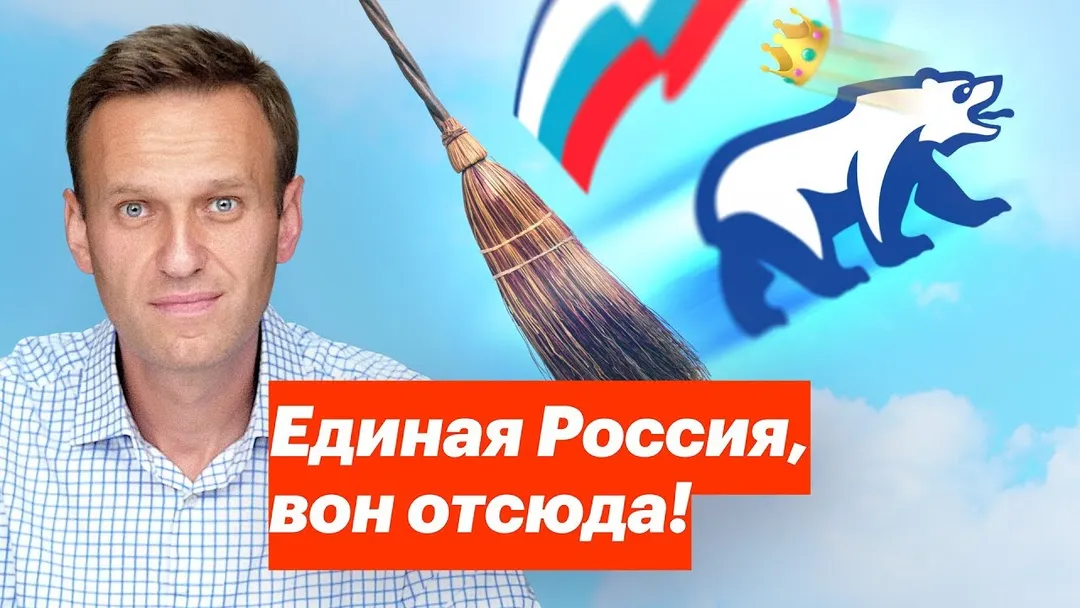
Hi, this is Navalny with an explanation of
what’s going on. Please watch
to the end and feel
the importance of this moment. So, there is Russia,
our beloved country, and within Russia
there is Moscow,
our beloved city, the one the whole
of Russia works for. That’s why Moscow’s budget
is enormous: more than 2.5
trillion rubles. That’s a colossal sum
even by global standards.
And for a Russian city, there’s
nothing to compare it to. It’s like, you know,
comparing
a wealthy landowner and a destitute peasant in
bast shoes.
Have a taste.
Don’t turn your nose up at it.
[music]
Krovushka Klovskaya.
So who decides how these wonderful
Moscow
2.5 trillion rubles are spent each year? You
might think: well, obviously, Moscow Mayor Sobyanin. And
you’d be wrong, because they simply
spend the money, but the one that decides how
it is spent is the Moscow City Duma. It
draws up the budget. What’s more, it also
oversees how the budget is spent: whether
it was spent properly, whether the people’s
money was stolen. Because it is the Moscow City Duma
that appoints the Audit and Accounts Chamber
of the city of Moscow. And as you all know very well,
Moscow is not only a fantastically
rich city, but also a fantastically
corrupt one. There is plenty to steal here.
This is where the juiciest pieces are, where all
the country’s money is. That is exactly why the family
of Moscow’s deputy mayor can easily
buy themselves penthouses worth 1.5
billion rubles, and the mayor can give
Larisa Guzeeva an elite 200-square-meter apartment
in exchange for promotion on Instagram.
In Moscow, it is very easy for officials to steal,
first and foremost because the Moscow City Duma
here does nothing but serve the interests
of those who steal.
So, in theory, here’s how it works: there are 45
seats.
Well, some of them go to United
Russia, some to the opposition. Moscow
is, after all, quite an opposition-minded city. I
ran in an election here and got, according to
the official figures, almost 30
percent of the vote. So that means there should be
some number of deputies who
represent the interests of people like you and
me. Grudinin got 12.5 percent
in Moscow, which means a decent
number of seats should go to
the Communists. And then, one way or another,
Zhirinovsky’s party should get some,
A Just Russia should get some. Then the whole
crowd gets together and argues, each one
defending the interests of their voters.
They adopt some kind of compromise
budget. The ruling party supports the mayor,
of course, while the opposition does not
support him and keeps watch to make sure the mayor’s people
don’t steal anything and that everything is done
properly.
You and I benefit from this political
competition. It’s great, because they
keep an eye on one another. Great.
But what happens in real life? Out of 45
seats in the Moscow City Duma,
United Russia has
38—28 of whom are directly members
of the United Russia party, and 10 others
are various subordinates
of Sobyanin—chief doctors and so on.
They call themselves independents, but in one hundred
percent of cases they vote with United
Russia and obey it. Five seats belong to
the Communists, but one deputy left to become
a governor, so 4 seats remain. Right now there is one
seat for the LDPR and one seat for the Rodina party.
Thus, United Russia controls
84 percent of the votes and makes all
the decisions in the main governing body of the largest
and richest city in the country.
The Moscow City Duma is run by two
people: its chairman, Alexei
Shaposhnikov, the former leader of the Young Guard
of United Russia, and only in 2000
was the Russian people able to make
the only correct and conscious
choice,
electing Vladimir
Vladimirovich Putin president of Russia, the national
leader of our country. Hooray for Putin.
The deputy chairman is Andrei
Metelsky, the leader of the Moscow
branch of United Russia. They run it
just fantastically. Please take a look,
it’s wonderful—a standard
scene showing what goes on there, and in the
presidium
you will see these two leading
United Russia figures, Shaposhnikov and Metelsky.
Respected Alexei Valeryevich, the board
lit up during the vote:
33 in favor, 3 against—so 36
people.
Count the heads and see how many
are present. I counted 26.
There’s no need for that—for counting we have
a special system in the hall, and I
trust it completely. Then your system
is not working properly, because
use your own eyes and count:
there are 26 people sitting there.
The existing system fully
ensures the Duma’s ability to function. But
you see, how can anyone expect these people
to fight for fair elections
or against corruption, or against
planting drugs on people, if
There are 26 people in the hall.
They say there are 36. The cameras are filming them, and they
understand that this will be shown across the whole country.
But without batting an eye, they say there are 36 people.
The system counts correctly every day.
They write about corruption in Moscow amounting to hundreds of
billions. How many times has this been discussed at
meetings of the Moscow City Duma (Moscow's city parliament)?
Zero times. How many times did they instruct the
Audit and Accounts Chamber to investigate
anything? Zero times. How many times did they raise
the issue that police at rallies in
Moscow are beating people? Zero times. On the contrary, they
pass a budget like this and give
Sobyanin the opportunity to hand out apartments to those
who are especially good at beating people. Why am I
telling you all this political theory?
Because there are elections in September, and I understand
that you're probably sick of hearing about it, but I’ll keep
bugging you anyway. We have
a completely practical task: we must
reduce the percentage controlled by
United Russia.
Yes, of course the elections will be unfair, but this is
Moscow.
Here, there are far more opponents of United Russia
than supporters, and it will be hard for the authorities—
very hard—
to falsify
the results on a large scale. If we
look at the results of the previous
Moscow City Duma elections,
we’ll see that in most districts, all we need
is to add, well,
just
5–10 percent to the opposition candidate for them to win
against the United Russia candidate. And it looks entirely realistic
to take many districts away from United Russia.
In the 2016 federal elections,
United Russia received
here
37 percent. Well then, their fair and lawful
result is that they should control 37
percent of the seats, not 84 percent like
they do now. And don’t tell me this isn’t
possible. More than a million people
will watch this video, and half of them
will be from Moscow. That number of voters
is enough to give one opposition candidate in
each district an additional
10–15 percent. And attention: this is very
important. Right now, without delaying a single
day, you need to give your signatures to independent
candidates running in the elections. In order
to take part, each of them
has to collect several thousand
signatures in Moscow, where in summer everyone
leaves town, where all apartment entrances are locked,
where nobody ever opens the door
to strangers. It’s very difficult, but
the signature collection procedure was actually
designed precisely to keep
independent candidates out of elections.
In the description of this video, there are the addresses of the campaign offices
of the strongest candidates. If they become
deputies, they’ll put an end to the easy life of
United Russia in the Moscow parliament, and
the Moscow city government will finally
learn what parliamentary oversight is
and what opposition means. There are only
a couple of weeks left for collecting signatures.
All you need
is a passport and to be at least
18 years old.
It often happens that you live in one
district but are officially registered in another. So,
for example, I’m registered in Maryina Roshcha, but I live on
Avtozavodskaya.
Of course, I’m too lazy to go to Maryina Roshcha
to look for the candidate there, their campaign office, their
headquarters, and give my signature for them. That’s why
we set up a special single
location in the city center.
We’re making it available to a large number of
independent candidates from all across Moscow.
Even if we don’t support a candidate, or don’t
support them very strongly, we proceed
from the principle that they all
have the right to take part in the elections, and in
fairness, we should help them too.
The address of the signature collection center is
10 Rozhdestvensky Boulevard. It is open
daily from 10 a.m. to 10 p.m.
The list of candidates is also in the description.
Our plan
right now is, first, to help these
candidates get registered for the election,
give them our signatures, and then identify the strongest
among those who make it onto the ballot in
each of the 45 districts, and for everyone
to vote only for that one person.
That will give them a very strong chance
of winning.
Of course, it’ll be a mixed bag:
independents, Communists, Yabloko members (from the liberal Yabloko party) — there will be
great candidates and less great ones. In some places
the mayor’s office will get scared and won’t allow strong
politicians onto the ballot — that will definitely happen. But
the main thing is: not a single vote for United Russia.
All of us together vote only for one
person in each district.
That is Smart Voting.
And finally,
those of you who don’t live in Moscow are now
saying, “Why the hell did I even
watch this? This has nothing
to do with me.” It does.
And directly so, because first of all, elections
will take place not only in Moscow but also in St. Petersburg
and in 20 other regions, and there too there will be Smart
Voting. And second, in Moscow they spend
your money, and you are interested, at the very
least, in making sure it isn’t simply stolen
the way it is now. So
at least support this
campaign informationally: Smart Voting, not a single
vote for United Russia candidates, or for United Russia candidates
disguised as independents.
Go right now and give your
signature to a good candidate — he really
needs you. Subscribe to our channel — here
they tell the truth.