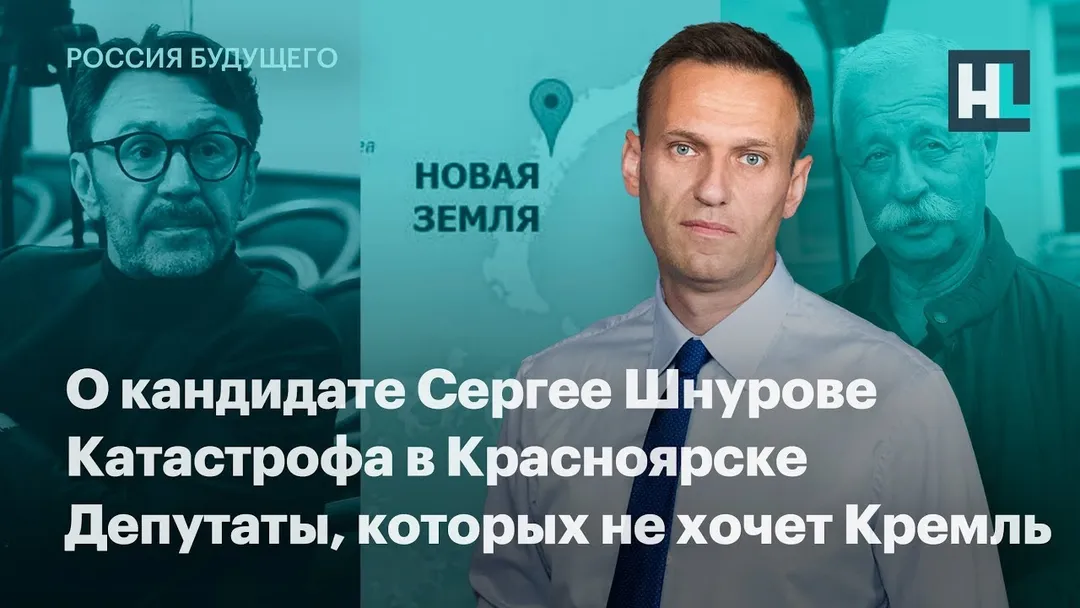
About candidate Sergei Shnurov. Disaster in Krasnoyarsk. The deputies the Kremlin does not want
[music]
Good evening, everyone. In Moscow, it's exactly 8:00 p.m.
That means we're live on air
with the program *Russia of the Future*, and I am its
permanent host, Alexei Navalny.
Or, as the Kremlin media called me this week,
someone who decided to make money off
supporting Sanders. For some reason, that's what the Kremlin media were calling me this week. I
wrote a couple of tweets saying that I
liked Sanders's campaign back in the day,
really liked Sanders.
For some reason, they think that I somehow
decided to profit from it. Send me
your questions on Twitter with the hashtag
#RussiaOfTheFuture, and I'll try to
answer them. Thank you very much for watching
the show. Last week's broadcast got
a million views in a week.
I think that's the third episode since the beginning of the year
to get more than a million
views. That's great, that's awesome.
It shows that people are coming to
YouTube, they're watching more and more
and more, and people are looking for truthful information.
That's great because, well, I still
allow myself to hope that my program is
not just a program, but a kind of
collective organizer. We're doing
important things here, and together with you we will actively
take part in and influence,
in particular, the upcoming State Duma elections
and regional parliament elections. We will do something
about this so-called referendum
that isn't really a referendum; we don't yet know exactly what,
but we do know that we will act. And it's very
good that so many people, in one way or another,
want to be practically
involved in politics. A bit later today we'll talk a lot more
about how many
different people are entering politics, like
Sergei Shnurov, and I'm sure we'll see
many more exotic characters.
But I wanted to start by following up on our
coverage of the Network case. This is the most important
political trial of recent years, and
it's very striking—encouraging, even—
to see that the outrage that
was enormous immediately
after those utterly outrageous
sentences in a fabricated case
based on testimony obtained
under torture—that outrage has not subsided.
Quite often, what happens is something like this:
we're very outraged on the first day, a little less
the next day, and by the third
day only the most
consistent people are still outraged, and after a week no one
remembers anything. That didn't happen here. This is
very good.
Apparently, this kind of blatant
inhumanity—the fact that innocent people
were seized, tortured, and then
sentenced to 18 years in prison—has simply
outraged all sorts of people, which is very
right. In the context of the Network case,
other cases are being discussed too.
Various ones. I can already see a question from Nila
Danilina, who's asking me for the second time:
the prosecution has requested prison terms for the defendants in the
New Greatness case in the Lyublino District Court, and then
the judge suddenly fell ill. The next
hearing is on March 3. Why might that be?
It's very easy to explain. Look at the photos:
a huge number of
people showed up. People are standing in one-person pickets,
and the Kremlin, which gives the orders
to fabricate these cases, is also watching
public opinion. What's happening now
around the Network case—and if
there are similarly monstrous
sentences in the New Greatness case—
that can't fail to worry them, at the very least,
because what have we seen over the past week?
Teachers wrote a collective
letter. Not just one or two
good people—people really weren't afraid.
Teachers from different schools across the country
wrote a collective letter. Doctors
wrote a collective letter. We've seen this before,
there was something similar with the Moscow cases,
but the Network case had somehow
still remained a bit
on the periphery before. Many people were frightened by the fact
that it involved terrorism charges.
But once people got a little more closely
acquainted with the actual facts of the case, they
saw just how completely
fabricated it all was. Let me repeat:
this is very important for all of us to remember:
there is not a single victim in
this case, yet people received sentences ranging from
12 to 18 years. There was also something completely unprecedented:
several bookstores
around the country—not all bookstores,
not hundreds of bookstores,
but several bookstores—
for the first time I can remember,
announced a one-day strike in
protest against all this. And if we look at
how many people are coming to
the one-person pickets for the Network case, it's
just an enormous line.
At these pickets—one-person pickets—
just to stand there for 10 minutes
in the cold, hundreds of people are waiting in huge
lines. What's interesting is that establishment politicians,
seeing all this—people who generally try
to avoid getting involved in things like this—
are also speaking out on the subject.
And today Gennady Zyuganov spoke about it. We can
be as ironic as we like,
saying, well, Zyuganov only said it because someone told him to,
or that he's being cautious, or that he used to
stay silent or didn't—but in any case,
however you look at it, he is the leader of the largest
opposition party.
It's a party that is sometimes not at all
oppositional, and sometimes quite the opposite.
Opposition or not, he really is
the leader of the largest opposition party.
and he publicly spoke out about it.
the Network case. Let's watch 35 seconds.
But perhaps the security agencies
are being overzealous in handling cases like this.
The sentences are clearly excessive, and the charges
are far from well-founded. In my view, we need
to look into all of this much more carefully
and not see every youth group
as conspirators or people preparing
to overthrow the system.
I absolutely do not like this criminal
oligarchic rule.
It is unnatural for our country, and
there is no justice in Russia here at all.
Whether you like Zyuganov or not,
whether you trust him or not, that's beside the point.
The Communist Party of the Russian Federation is a separate issue, but he did say it.
Good for him—the leader of the largest opposition
party. Many in the Communist Party—I saw Rashkin
recorded a video address and spoke on this
topic. And separately, what really
pleasantly surprised me was this: when I was a child,
in my youth, when I was little, I
adored the band Alisa.
I still really love their early albums.
I remember them all by heart. Konstantin Kinchev,
who actually, broadly speaking, is not at all
—you can watch his interview with Dud (Yury Dud)—
for example, and he has the kind of views where he
criticizes Russian
reality a little, but at the same time repeats
full-blown pro-Putin nonsense, like:
"We must unite around the leader,
because otherwise they will take away
our Siberia from us—the Americans." That's the kind of
core lie of United Russia, and all of that
Konstantin Kinchev unfortunately repeats.
Nevertheless,
let's watch 12 seconds. At one of the
concerts, he said outright that the song
was dedicated to the defendants in the Network case.
[music]
Yes.
[music]
What Kinchev did is very important.
I'll say it again: very important, because,
well, he has always belonged to a somewhat different
group—those who in recent years have, one way or another,
consistently supported the authorities. But here
these tortures themselves—
they really did torture people; their teeth were broken,
they were shocked with electricity—so
these were literally fascistic tortures to which
they subjected
innocent people—or people guilty only of
having created some kind of
ridiculous paramilitary group and
running around in the woods playing airsoft.
We can ask them, guys, what exactly are you
doing running around in the woods playing airsoft? What are you
preparing for there? If you are preparing for something
bad,
then let's have a logical conversation with you.
But they were beaten with electric shocks,
and then sentenced to 18 years, and nobody
likes that. I see people are asking me
about the Nemtsov March (a memorial march for murdered opposition politician Boris Nemtsov). Irina
Pavlova is asking me, please tell us
about the Nemtsov March—will you go?
Of course I will. I will go. Official approval has been obtained.
I go every year, and the topic of
the Network case, the New Greatness case, and in general
torture and the transformation of our state into
a state that tortures its own citizens
will be one of the main themes of the march
this year. So on the 29th at 1:00 p.m.,
everything has been approved—do come.
There will definitely be a procession there. When I
say that our state
is turning into a state that already
openly tortures its citizens, that is not
a slip of the tongue or an exaggeration. We have always
understood that torture existed in the Russian police.
People were beaten; at times there was a lot of it,
then supposedly less, but
now it really is a kind of state
policy, and specifically in political cases.
First of all. Second, we see that torture
is being used against certain groups
that emphasize, emphasize their
apolitical nature, which is very important.
That is what different people are feeling, by the way.
You may not be politicians, much less
opposition politicians, but when someone is
being tortured, you understand that it can
come for you too. And probably the best
example here is Jehovah's Witnesses and what is
being done to them. This is a subject
I would not call slippery; for me it is
completely clear. I just know that other
politicians—probably almost no one,
except Roizman, as far as I know—speaks out on
this issue.
No one says anything
about Jehovah's Witnesses, who are
being subjected to repression in our
country, and now even torture. For me, as
a religious believer, this matters because
Jehovah's Witnesses really are
a kind of sect, a distinct movement, but it is
certainly a movement of a Christian kind, and
in Russia right now, these very Christians
are being tortured.
There is a lot about them that is strange,
internally, and the main complaint against them
is that they prohibit blood
transfusions, which can accordingly lead
to the death of a person who follows
this branch of Christianity.
There is a lot of debate over whether they are Christians or not,
but mainstream
religious studies says quite
clearly that Jehovah's Witnesses are
a Christian denomination, and right now
these police officers are torturing them despite
the fact that Jehovah's Witnesses, for example,
It is clearly stated in their charter that they
are forbidden from engaging in political
activity—that is, they are prohibited from
speaking either against Putin or in support of
Putin. Nevertheless, some idiot decided
that across the country they should first start rounding them up
and jailing them, and now they are starting to seize them and
torture them. That is what, in particular, was done
by yet another bunch of fascists in uniform
in Chita. Let’s take a minute
to listen—look at what happened in Chita,
please. If you want to call them
sectarians, fine, let’s call them sectarians.
In Chita, these “sectarians” are modest, quiet people
living in a modest apartment
of their own. Why their door was broken down and why they were
tortured—no one understands, except perhaps
this strange state of theirs.
Let’s listen: “They broke the door and the lock. The thing was,
interestingly, it doesn’t even close properly anymore, and
they tried to... we didn’t even have time to do anything here.
They broke down our door and burst into our
apartment, threw my husband onto the floor, and
me as well.
Force was used against me today too, but I myself—I
sat down on the floor. They began putting pressure on me,
trying to get some kind of confession,
trying to beat some kind of
confession out of me,
asking me to testify against other
Jehovah’s Witnesses, trying to make me give them
names, surnames, and addresses.
I said that I would cooperate only
with the investigator in the presence of
my lawyer. Then they pulled
a hat over my face and drove me out to the woods, to the area by
the Yubileiny Stadium.
I asked everyone who was participating in this
medical
examination to identify themselves. No one gave
their first or last names, and they did not provide me with any
documents. When I started addressing
the person who had tortured me,
because I clearly recognized him, he
hesitated, and the escort immediately rushed me out, and
the medical worker hurriedly took some kind of
readings from me,
measured something with a ruler, and left.”
They live in Chita.
Quiet people. Fine, let’s call them
crazy sectarians—let them be crazy
sectarians. They sit quietly on their
little couch at home and study the Bible.
Originally, and in general, the name of this
sect refers to people who study—
a community of, I think, Bible researchers.
They sit there reading their
pamphlets and bothering absolutely no one. But
of course, someone there—same as always—wants
to earn another star on their epaulettes, so they need
to break down this family’s
door, rush in, take the husband to a stadium,
beat him, and say, ‘You’re reading the wrong book,
you’re praying to God the wrong way.’ In
the literal sense, they are beaten because
someone thinks they are not praying to God correctly. Well,
the parallels here are just completely obvious
with the Roman emperors and, therefore,
with the actual persecution of Christians.
And I think that, of course, we must
talk about this, because in Moscow, in the major
cities, among the generally educated
public, we talk about New Greatness (a Russian political case),
and rightly so; we talk about these
various other trials, these
political cases. But about how they persecute,
for example, Jehovah’s Witnesses, very little is said.
We need to talk about it. They are torturing people in the North
Caucasus.
In the North Caucasus, this is generally standard practice:
torture, fabrication of criminal cases on
made-up terrorism charges—this happens
constantly. In Ingushetia, for example—about Ingushetia
no one holds pickets, it is not covered nearly as well,
but they have jailed a huge number of
people there simply because of the rallies that
took place quite recently against
part of the territory being transferred to Chechnya. People
were simply holding peaceful protests in
their main square. They had every
right—they had every right—to ask
questions about why part of the territory
was being handed over.
They jailed them, and now there is a huge
number of people in Chechnya and in Dagestan.
It is an endless process: they seize
some young men,
torture them, beat confessions out of them that
they financed terrorism, after which
they are given monstrous prison terms. This
happens constantly, and this is, of course,
state policy. And I am very glad that
more and more and more
people
are becoming outraged by all of this. So we must not
stop being outraged. Let’s write
about it, let’s talk about it, let’s
come to the Nemtsov March and to one-person
pickets on this issue. Viktor Medved asks me:
‘Alexei,
please comment on the interview, friends.’ Well,
apparently he means the latest interview with
Andrei Kolesnikov.
He is quite a remarkable person.
Watch this interview—it is very
interesting, and I even included it in the plan for my
program. I’m going to show you two clips from it now.
Andrei Kolesnikov
is, well, the chief chronicler of Putin’s life,
a man who for 20 years has been the main
pro-Putin journalist, and for 20 years
has been writing these kinds of articles
where he describes some event involving
Putin and portrays everyone else
as complete idiots, while Putin is presented not exactly as
some super-cool guy, but rather as
the only remotely normal
person among a gathering of idiots.
which various officials represent
who, in Kolesnikov’s columns, are always
very cowardly and terribly afraid of the main
boss — I mean, that’s the kind of
supposedly ironic and
but always [ __ ] and his description of Putin
and he gave an interview, and it will be very, very
interesting also from the point of view that we can
understand how these people — and Kolesnikov,
who certainly used to be considered, and now
considers himself, in my view,
a very respected journalist, and basically all
of journalism — a very well-connected journalist.
Of course, he lies in the interview when he says that he
gets eight or ten thousand
dollars a month — he gets much
more.
For Kolesnikov, they even
created some nonexistent magazine.
He also presents himself as being with the magazine Mr.
I forgot what it’s called — some magazine. That is,
he works for the publishing house
Kommersant, and I think he has the magazine *Russian Pioneer*
there — Surkov once wrote a column for it,
Surkov.
Then Putin wrote a column there. All of this
is financed in some unclear
way.
And apparently it’s simply a structure
through which Andrei Kolesnikov is paid
a lot of money for his sycophancy. But I kind of
expected him to have some elegant,
ironic answer as to why exactly
he works as a lackey — but he just
he simply kept, in that interview,
acting like a lackey, really,
without even being embarrassed that
millions of people would see it. There’s an absolutely
great, marvelous moment where Dud
shows him those famous clips from those
hockey games where everyone skates away from Putin,
the defenders move aside, and the goalie
deliberately lifts his leg so that
the old man can slide his puck in, and
Kolesnikov, completely seriously, starts
saying: no, it’s normal, let’s take a look.
Who, as they say — whatever anyone says —
has a feel for the goal. There he is in the slot,
standing there waiting for a pass.
And then he scores. If you look carefully,
they’re very difficult goals. I’m
serious — you should watch.
And they’re like that — right into one top corner,
then the other — you can’t do that just in warm-up.
Trying to find a way out — something’s not working, yes, yes.
Yes, let’s watch this video here.
There he is — well, is this the goal, or should we replay it now?
This is typical Vladimir Putin, in the sense that
look, he’s skating,
the defenders are going in a completely different direction, and
the puck, with incredible difficulty, goes into the
spot that’s easy to cover. There’s no
top corner here, no upper angle — but you
see, the shot — is the shot really bad?
The shot is monstrous — it goes straight into the goalie’s pad,
and the goalie
with a deft movement at the last moment
manages to lift it
so it slips through. Come on, let’s
watch some more — no, like this, look, look.
There, there — he can’t lift the puck off
the ice, you see, he wanted to do it there,
but — logically — you just picked an unsuccessful
shot. That’s one unsuccessful one, maybe.
Maybe there’s one successful shot.
You understand, you can laugh at the cliché and
say, sure, like, grandpa decided
to play hockey and everyone is playing along with him.
In a normal situation, there would be nothing
terrible about that. But no — “what a great shot,”
“is the shot really bad?” Well, you picked
an unsuccessful shot, but in general it goes right into one
top corner, then the other top corner. But still,
everyone has seen this, everyone knows. But if now,
after 20 years, you’re working as one of Putin’s
lackeys, then you have to be a full-fledged
Putin lackey. No one will forgive you
if you say, “Well, no, as for
the hockey game, because now isn’t
the time...” They won’t forgive that — you’ll immediately
be cut off from the feeding trough and have to live on
just one salary, and you won’t be the editor-in-chief
of a nonexistent
magazine, *Russian Pioneer*, and no one will
pay you for this
nonexistent magazine. There’s also
a moment that separately just
delighted me. Kolesnikov is also very
much like that, just
you know, like: “Is the shot really bad?”
They’re discussing why there are no
fair elections in Russia, and Kolesnikov says something like:
“Of course there are fair elections, but they
lose in Germany, for example. And why
wasn’t Navalny allowed? Well, he was allowed
to run, and I don’t know why he stopped
taking part in elections.” Let’s watch 26
seconds.
I’m simply stating that when he was
allowed to run, in the Moscow mayoral
election he got more than 20 percent. If he had continued,
if he had kept going, taking part there in
elections — why he
didn’t continue, I don’t know. As for
Navalny, I agree with you that
Navalny got a lot of votes back then in the
election, and probably could have been in the
next one and the one after that, and
he was invited there — so why didn’t he go?
Once, twice — well, I don’t want to get into that at all.
He just tosses it out there, just like
he just said — “puts it right in the top corner”
with a goal — and here too: “But he was invited.”
Why didn’t Navalny go, really?
Why didn’t he go to the election? I mean, I was supposedly
invited.
And Ella Pamfilova was running after me, shouting,
“Alexei, Alexei!”
So, we let you onto the ballot, we allowed you to run,
and then why aren’t you going? It’s so strange—
to the State Duma and everywhere else, all the candidates
for the Moscow City Duma were practically being invited outright; they were told,
“Come join us.”
“We don’t have enough great candidates.” And we
just turned around and went off—some people to eat
ice cream, others shawarma—because for some
secret reason, we supposedly just didn’t want to.
That is, he says this with a completely
straight face, knowing that millions of people will see it.
It’s been up for an hour and already has four and a half
million views, this interview. Those of you
who haven’t watched it—maybe later you
clicked in, thought, “Some random weirdo,”
and decided not to watch—well, you should watch it.
It’s very, very interesting and
instructive.
Alright, 35,000 people are watching us live right now.
I can see these little icons flying across the screen,
with Medvedev in the corner of the screen—that means
that some people are going down below
to the links in the description and helping the Anti-Corruption Foundation
continue to exist.
We always need that. We need your
support, of course, so please take a look there.
VDK News 24 is asking me here:
“Please comment on the situation with
Yukos and the $50 billion.”
It really is a complicated situation. On
the one hand, it’s simple; on the other,
it isn’t. It’s simple in the sense
that we understand perfectly well
that the criminal cases against Khodorkovsky
were fabricated—especially the second
Yukos case, which was one hundred percent fabricated
for political reasons. If they had wanted
to punish Khodorkovsky
for taxes or something else, then
they would have had to jail absolutely all
the oligarchs, because Khodorkovsky didn’t do
anything that all the others
among Russia’s oligarchs weren’t also doing—those
with whom Putin kisses, embraces, and
makes richer and richer every year.
So yes, the case was fabricated, and the company
was taken away.
And Yukos went to arbitration in The Hague, and Russia—
the Russian Federation—
this wasn’t the European Court of Human Rights
or anything like that; it was an arbitration
court, essentially a tribunal.
Russia, as a state, said: okay, we’re
prepared to litigate in this court. So when
people in the Kremlin now say, “Well, we
won’t comply, this is some kind of
lawless outrage, this is all nonsense,”
that’s just empty talk.
Russia officially agreed to comply with
whatever ruling would be issued there; it
recognized that arbitration. But then the question arises:
what about the $50 billion? Obviously,
Russia is not going to pay it back.
All sorts of lawyers will run around trying
to seize property. But in the beautiful
Russia of the future, should we return
$50 billion to Khodorkovsky—that is,
who exactly would be paying it back? Would
we have to take money from every Russian citizen?
Take several thousand rubles from each person
in order to repay the Yukos shareholders, because
bandits—Putin’s bandits, Putin himself,
and his Sechin—took from Khodorkovsky
this company, which Khodorkovsky himself, back in the day,
had acquired absolutely illegally,
just like all the other participants in the loans-for-shares
auctions, simply grabbed it from all of us.
I saw a tweet today that, I think,
let me quote in full—it describes this situation
in the best possible way:
“A brief description of the Yukos case:
the Komsomol guys grabbed the oil from the people; the chekists (security-service men)
grabbed the oil from the Komsomol guys; and now
the people have to pay for the oil that was grabbed
—$50 billion—
to the Komsomol guys, and in the end the Komsomol guys
will have dollars, the chekists will have oil,
and we’ll have neither oil nor money.” That
really is a complete description of what
is happening. So I believe that the ruling
issued in The Hague was, of course,
based on law, but overall
we must understand, first of all, that everything
that was done during the first and second
Yukos cases
was total lawlessness, and all the
people who carried out that lawlessness
must be brought, lawfully and fairly, before a
jury trial and held criminally accountable.
We need, so to speak, to remove the basis on which
that ruling was made. But as for
the loans-for-shares auctions
—and not only the loans-for-shares auctions, but
privatization in general—
that all needs to be dealt with separately, in a
civilized way, first and foremost
through taxation. Because what
Russia’s oligarchs represent—
all these former Komsomol and Party
functionaries who simply climbed onto
huge factories—this is not business at all.
It has nothing to do with business, nothing to do with
entrepreneurship, nothing at all. These people
just stole everything, and then other people stole
it all from them. That’s all. 40,000
people are watching live right now. Send me
your questions with the hashtag #RussiaOfTheFuture
and I’ll try to answer them.
I see a question about Shiva Vihde—well, I’ll
say a bit about that later. I wanted
to talk about Krasnoyarsk. This is super important,
actually. There are really two parts
to it. Indeed, in
Krasnoyarsk, an environmental
disaster has occurred. I often, here on
my program, talk about this
special thing called
Krasnoyarsk’s “black sky” regime.
a unique city where they officially introduce
this "black sky" regime, which
is officially called a period of unfavorable
weather conditions, but of course all the residents
call it the "black sky" regime because
that’s what it is when the sky there is simply black
and that’s one part of the problem; the second
part of the problem is that it
is basically being completely ignored by all
the federal media, actually
and most federal politicians, in general,
ignore it all, and this time this
"black sky" regime was introduced
because something happened in Krasnoyarsk
some kind of extraordinary emissions, and
a buildup of these particles there, some kind of, well,
it was just hanging over the city—let’s watch the video
a short one that was filmed from
an observation deck, from this
observation point in Krasnoyarsk, this video was shot
from where Krasnoyarsk should be visible
in the best possible way—let’s take a look
let’s see what’s there—you
look at what we’re breathing
the city isn’t visible at all
[music]
to live
Krasnoyarsk is a city where, actually,
a million people live, and where there is
a huge number of industrial enterprises. These
enterprises bring in a great deal of money—to
oligarchs and to the state budget, well
that is, the residents of Krasnoyarsk, with their
lungs, their life expectancy,
their own health, are filling up
the oligarchs’ budgets and the state budget, and
basically nobody cares about them, and this time they
this time I just go onto
Instagram, into all sorts of text stories, and I see
it’s just flooded everywhere, everywhere, with people leaving
messages aimed at me so that I would see them
I see people tagging me, Dud, Shnur (Sergey Shnurov), any famous
people with big Instagram accounts, and
the city’s residents, driven to
desperation, simply started writing
to celebrities, even though they have
a governor, a prosecutor’s office,
a regional legislative assembly, a whole damn army of officials
there’s also the presidential envoy there, the federal envoy,
the chief federal inspector, and so on—that is,
there is a gigantic number of officials
they should be writing to them, not to Dud, Shnur, or me, and this is
just something truly monstrous
simply monstrous, and such disrespect
an insult to all these people, because
they simply have nowhere to turn, nowhere
to appeal, even though, once again, this is a city of a million
that brings in enormous amounts of money, and basically
nobody gives a damn about it. I asked our
coordinator Daniil Leongard in
Krasnoyarsk to record a short video for us
about what is happening there right now. Right now
this "black sky" regime has formally been
lifted in the city—let’s watch
Coordinator, tell us what’s happening
The "black sky" regime was introduced on February 14, and already
three days later, on the 17th, our city was in
first place in the global ranking for
air pollution levels. Smoking
coal-fired CHP plant smokestacks and the aluminum plant are
the main sources of air pollution
but the authorities blame everything on
motorists. All this time there was no
wind, and people were choking on chemical
emissions that had no time to
disperse: headaches, coughing,
sore throats, irritation of the mucous membranes
of the eyes—these were just a few of the symptoms that
healthy people experienced, while those who had
respiratory problems suffered
the most
This happens constantly, but this time
the situation reached a boiling point, and people
came out for one-person pickets and at rallies where
they handed out respirators and asked Yuri
Dud (a well-known Russian journalist and YouTuber) for help, and posts saying that
the federal media were ignoring the situation
were also shared by musician and poet Sergey Shnurov in
his Instagram. He expressed his opinion
in the form of a poem. The haze has now
cleared, and at last it’s possible to breathe, but
that’s thanks to the wind
and the local authorities, in terms of solving the problem,
traditionally did nothing
Well, this is what made me absolutely
furious. We have a city
whose environmental problems have not
been solved for many, many years, and here I
see Daniil Sologub writing: "Alexei,
what do you think, what is
the cause of the smog? Who is to blame for it?"
The cause of the smog is established there: it’s simply that
Krasnoyarsk is located in a kind of lowland, and
there are a huge number of industrial
enterprises and coal-fired boiler houses around it, and simply
the smog hangs over the city when there is no
wind, when there is severe frost—this is a known
fact, and the solution to this problem is also
known: all these oligarchs,
the owners of industrial enterprises
around the city, the owners of boiler plants—they should
install treatment facilities there, that is,
in the city of Krasnoyarsk, what needs to be done
is to make emissions much lower
than in any other large city, because
it simply has an unfavorable
geographical location
but basically nobody cares. All these people, all
these oligarchs—Deripaska and all the rest—
buy yachts, go wherever they please, and nobody
forces them to buy treatment
facilities. There is simply no pressure at all
the local authorities do not deal with it, nobody
deals with it, and the residents of Krasnoyarsk
run around writing to celebrities on Instagram
How could you humiliate the citizens of a
million-strong
industrial city even more, other than driving them
them to the point where they would run around
they were asking there
on Instagram, from Dud or from me
from Shnur (Sergey Shnurov) or from me. Shnur did well, he wrote
a poem—we’ll criticize it a little at the end
but in that sense I noticed
Peskov and the poem—locals are all rejoicing
some people are writing in blogs, but finally
they finally paid serious attention to us, well
that is, this shows the complete corruption
of the state system, its hostility
toward people—it just
once again, a very serious
proposal to the residents of Krasnoyarsk and
the Krasnoyarsk region in general: let’s
make sure it gets zero votes there
United Russia. If that happens
if we run that campaign, then the authorities will start
paying attention. Right now, the
working group on the Constitution is meeting—let’s
start a petition
I’ll support it and promote it in every way I can
let’s put it into the Constitution—if they’re
already writing whatever they want into the Constitution
at this stage
of Putin’s lifetime guarantees, then let’s
write into the Constitution that the residents of Russia
have the right to receive financial
compensation if their water and
air are polluted—so that residents
of Krasnoyarsk
could go out with a measuring device and say, “Oh, here
the maximum permissible concentration is exceeded by two
times. Please, Deripaska, from the aluminum
plants, pay me 5,000
rubles for every day that my children and I
have to breathe this air.” And then things will start
to change. That’s basically how it
will start working. We don’t, we don’t
necessarily have to apply some kind of
administrative pressure. But simply, if
you want to poison someone, then be
prepared
for lawsuits to be filed against you. Then everyone
will have to pay, and to avoid paying
you’ll stop polluting yourself. And United Russia
must get
zero, nothing. And every resident
of the city, if they don’t want to breathe this
filth, absolutely must
take part in Smart Voting and, in general,
in any campaign against this government
because there is also this demonstrative
contempt going on. In these very
same days, when Krasnoyarsk is under a
“black sky” regime, the governor, Uss,
who is an old acquaintance of ours from when we
ran campaigns and promoted
laws against illicit enrichment
and used his case, among others, to show
that
that his standard of living is completely inexplicable
the property, the houses this governor has are
in no way comparable to his
actual income. And on top of that, what
happened there? Governor Uss actually
officially owns a house in Sochi, and he decided
as governor to go to some
another pointless investment forum in
Sochi. Well, obviously he doesn’t want
to sit in Krasnoyarsk in February under a “black sky” regime
he wants to go to Sochi instead
hang out there, stop by his dacha, but
since it was an official business trip, they
actually had the nerve to
through public procurement
announce a tender and rent a room in
Sochi for 250,000 rubles, and the room in that
hotel is literally located
right here—you can see this room in the
Sochi hotel
it is literally 500 meters away
damn
from the governor’s house. And here, on the screen,
you can now see the map: the house and the hotel. What kind of
fantastic level of arrogance do you need
to have an official luxurious
fancy residence in Sochi, and still say, “You know,
I’m going to this investment forum, I’ll
stay in a hotel”
while you people here, coughing and wheezing,
walk the streets
pressing some rags to your face so that
you don’t cough your lungs out in a week—and you
please chip in for me so I can pay for
this hotel: 250,000 rubles.” They
are actually doing this
How much longer can this be tolerated? I—I don’t understand
one thing: how can even one person
vote for United Russia under these
conditions? How can even one person
vote for Putin, for Mishustin, for this whole
gang? It’s obvious they’re mocking us
because people keep
on voting, keep
voting for them. You could say that
pensioners have been brainwashed, they watch
television, they vote—but no,
not just pensioners. You’re all watching this
several tens of thousands of residents
of Krasnoyarsk will watch this video, so
let these several tens of thousands
people convince the remaining million residents
to vote against United Russia. Then
everything
will start changing fairly quickly. So, about
Prya-prya-prya—Videnny, I see
people are asking us about Videnny
there really is news, and something about
our Ruslan Shaveddinov. Let me remind you
that he is an employee of FBK (the Anti-Corruption Foundation) who was simply
kidnapped and taken to Novaya Zemlya (a remote Arctic archipelago) and
told that he would serve as a soldier, and
said that he had been conscripted into
the army. He was completely isolated, they do not allow
him to receive letters, they forbid him
from using a mobile phone
or any means of communication at all
despite the fact that even by their own logic he is
a soldier
he is not a prisoner; ordinary conscripts
have the right to write letters home, to their mothers
but he was not allowed to do that before, and now
as far as we understand now, we
filed a lawsuit, and then under video
camera supervision they handed him something like 30 or 50 letters
that they had simply not been giving him before, but
what is interesting about this court case is that in order
to make sure no one could get into this hearing
they are holding it not even simply in
Arkhangelsk—the court itself is located in
Arkhangelsk. If you want to sue
someone who is on Novaya Zemlya (a remote Russian Arctic archipelago)
since Novaya Zemlya has bears and
no judges, you will have your case heard in a court in
Arkhangelsk, and everyone goes to court in
Arkhangelsk. But in his case
it was specifically stated that there would be
an off-site hearing held on Novaya
Zemlya—that is, by special plane the court
and the court secretary will fly for two and a half
hours to Novaya Zemlya so that something can happen there
and no one can get in. But for example, I
did not receive permission to visit Novaya Zemlya
even though I have a power of attorney to
I have a power of attorney for
representing his interests
and officially submitted a request to the FSB saying, give
me permission—I need to come and
visit him. Can you imagine? Interestingly,
they refused me, but nevertheless
one of our lawyers does have such permission
and so I asked him in Arkhangelsk
Alexei Molokoedov, one of FBK’s lawyers, to record
a short video
a minute and a half long, about what is happening there now
and what will happen next. Let’s watch.
Good afternoon. I am standing in front of the Arkhangelsk
Garrison Military Court, where what is probably
the strangest case of my life is being heard.
As part of this case, Ruslan and I
are trying to challenge the actions of
the military unit’s command in banning
the use of a mobile phone and
the sending and receiving of postal
correspondence. Since Ruslan was taken away
at the end of December, we have not once
received any letters from him. At the same time, the command
of the unit submitted to the case file
a log of outgoing correspondence from
the unit, according to which Ruslan regularly
tries to contact us.
According to Russian Post tracking data, our
letters are not reaching him either. He is allowed to call
only a couple of times from the unit commander’s phone
and, yes, on speakerphone in the
presence of officers. We petitioned
to ensure Ruslan’s appearance here in court
in Arkhangelsk, but his appearance was not
secured. Now
the judge has ordered this sort of procedural
anomaly: an off-site court hearing on
the territory of the military unit. Now I
must go there, to the territory of Novaya
Zemlya. Today I will fly there together with the judge
to Novaya Zemlya on a military aircraft, and later today
late in the evening there will be
a court hearing. This rush is explained by the fact
that we can return only
on that same plane early tomorrow morning
and there is no other way. In any case,
I am glad that this evening I will apparently
see Ruslan, and you can wish
me luck.
So, you saw what our lawyer recorded
in Arkhangelsk. I very much hope that
Alexei has in fact managed to get onto that
military flight. A military plane was specially sent there
and is flying to Novaya Zemlya
to take the judge and our lawyer there and
to hold an off-site hearing on
the territory of the military unit. In general, such a
thing simply cannot exist in principle
it is completely out of the question, it cannot
exist.
There is not the slightest reason for it. Obviously,
it would have been much easier to bring him
to Arkhangelsk, as is normally required
to be done. But no—specifically so that
you would learn nothing
and hear nothing, what is happening will take place
at a hearing specifically on Novaya Zemlya. But I
hope that Alexei Molokoedov will get there
and that no
bears eat him on the way, and that we will find out what is happening with
Ruslan.
I see that we have received several similar questions
about this. For example, Innokenty
asks:
“Regarding the FBK case, they have started
summoning ordinary people who previously donated
money to you. What do you think they are
trying to achieve?” Also, Sanya from Yaroslavl
asks: “Alexei, please comment on
Meduza’s report that FBK sponsors
are being called in for questioning.”
There is nothing new here. I hope that you, the
wonderful people who support
FBK and send us money
after all, everything exists on your money
will not be afraid of this nonsense. This
has been going on for quite a long time. The first time
it happened was in 2012 and 2013
when I basically announced that
our organization, which at the time
was simply called RosPil (an anti-corruption project), and my
work would be financed
simply by people’s donations, and we
received our first several million
rubles, after which the Kremlin said: no,
that can’t be, several million rubles?
Back then no one was raising money like that; now everyone
raises money this way, but crowdfunding was
still rare then, and of course the Kremlin said that they did not
believe it—there must be some shadowy oligarchs
who, through a large number of
People under their control are sending money.
to Navalny, and then they interrogated them afterward.
for the thirteenth year of my supposedly vile organization.
literally thousands of people. First of all, across the entire
were interrogated.
Second, they asked them to write
a statement saying that I had, essentially,
fraudulently tricked them out of
that money. To this day, I am still very
proud that not a single one of those people
wrote such a statement, and several years later
they had to specifically
hire a crook who transferred
some money and then immediately filed
a complaint saying that we had deceived him
so it would be easier for the police to deal with us there.
Here they are doing the same thing.
They are sending people a notice. You can
first of all, not go at all and ignore that
piece of paper — nothing will happen. You
can also go and simply say:
"Leave me alone. Under Article 51, I’m not going to tell you anything"
or you can
tell it exactly as it is: I
transferred 500, 200,
100,000 rubles to Navalny, fully within my rights (about 1,100 USD).
Just say it like it is. We have
nothing to hide, and as I understand it,
right now all these FSB goons (FSB, Russia’s security service) and various
police officers
— in other words, this whole gang of idlers and
crooks — somehow has to
report back to Putin and say what they’re
doing. They went around telling everyone
that supposedly we have some kind of
secret foreign funding, and now they need
to show results. So now they simply have to
try to build a case for their
theory that we are funded by some
single huge sponsor. But again, they
will come to many people, I think, and those
many people will say: yes, I really
did send 100 rubles (about 1 USD) because they
really did send 100 rubles,
because indeed the FBK (Anti-Corruption Foundation)
and our entire structure, our network of headquarters,
is funded through donations.
And I have never taken a single kopek of that
money, and there has always been a Chinese wall
between the money you
donate and any of my personal
funds, and they will not be able to prove anything.
And once again they will simply lie on television.
So don’t be afraid of anything, and keep
supporting us. 45,000 people are watching
us live right now.
I can see Vitaly Kolesnikov, taking advantage of
his official position, writing on
Twitter: let’s tell the viewers about
the Russian courts. My case with Vitaly
Kolesnikov ended this week — his
well, sort of ended temporarily; he will continue
to litigate. You probably remember his court case.
The Kolesnikov case was about the fact that
Vitalik is one of our video
operators and editors. When you watch my
videos on the main channel and all those
funny or not-so-funny things pop up on screen,
Vitalik is one of the people
who does that. And something unpleasant
happened to him: he had
an apartment.
Somewhere in the Moscow region, he
sold it, and instead of immediately putting the money
in the bank,
he made the "smart" decision to keep it at home
for two days, and at exactly that moment
they came to search his home and took from him
800,000 rubles (about 8,800 USD) that were lying
there somewhere, hidden under a pillow.
Vitalik has all the documents:
the apartment ownership certificate,
proof of the apartment sale, the purchase agreement,
a paper showing that he
received the money and from whom, and
Vitalik took all those papers and went to
court, and for several months he fought for a hearing,
and then — bang — the court said:
the investigator has deemed your money
material evidence, therefore
it doesn’t matter that your name
doesn’t appear there anywhere, that it isn’t linked to you, that you
have all the documents — still, your
money will not be returned to you. A perfect example
of how, in principle, from anyone in our
country, absolutely anything can be taken away.
If you are not Vitaly Kolesnikov but a person
who sold a factory or a large
apartment, or for any other reason
some crook and thief in the authorities
or the security services knows that you can have
a million, a billion, or, I don’t know,
300 rubles taken from you — they can just as easily
come, take it, and then
the judge will say: the investigator deemed it
material evidence. Let’s talk
about what I think was the most high-profile video
this week. It was that
meeting between Putin and a woman with a disability
who asked him a question about whether, on a pension,
it is possible to live on 10,000 rubles (about 110 USD). It is
very symbolic, and that is why I wrote it
on my cup. That
dialogue had enormous, enormous resonance,
and it has been very interesting to watch.
And you know what I thought? That the Kremlin
with this whole thing about
the Constitution is making one big,
important mistake that is quite
advantageous for us. They need
to lure people in so that they
come and vote for the amendments
that will give Putin more power.
But nobody wants to give Putin more power.
So how are they supposed to attract
people to this referendum? They say:
you know, you are all so poor,
as it turns out, so let’s put into the Constitution...
guarantees that this will be done for you
the indexation of pensions, and in any case the indexation of
wages, or that your salary must
be no lower than the subsistence minimum, they
thought
and probably still think that this is
a great idea, and people will come and
vote in order to be less
destitute and less poor, and people
really will come and vote, and
this deception will work. However,
things turned out differently, because what they
did was come out and tell the whole country that we
already knew, something everyone understands perfectly well, but
this was, in effect, said out loud for the first time:
the whole country is poor, and we need to put into the
Constitution something that
would make us less poor. And they expected
that everyone would start bowing and kissing
their feet, but people are saying: we’re not beggars.
So maybe let’s discuss why
we are poor. And in that sense, this woman—
watch the video, let’s watch it again—
let’s look: she quite energetically
and rather bluntly, boldly, is shouting something there,
then she approaches Putin and very clearly, not by accident,
asks: please explain, how are we supposed to live
on these 10,000 rubles (about 100 euros / 110 US dollars), and around
this, in fact, right now
the main national
debates are unfolding. And that is very good, because
there is still no answer to the question of why, after 20 years
of Putin’s rule, a disability pension is
10,000 rubles (about 100 euros / 110 US dollars), and how is anyone supposed to
live on that? Let’s take a look.
Here, you try living on 20,000, and then—
[fragment unclear]
[music]
as you know from... you know who. [fragment unclear]
go to the store and buy food with that money
that is not
...thousands... the minimum... [fragment unclear]
and then there are children... [fragment unclear]
I don’t understand about the children, so
right now this program... [fragment unclear]
then, of course, accounting... I
what’s really striking is that this still
turns into something that I quite
understand—it’s just not simply difficult, it’s
I try, but not very often... [fragment unclear]
used it, started to learn
but less than two sheets... I was mistaken [fragment unclear]
someone was being coddled
sitting here together with us, and not... [fragment unclear]
2,700... could you live on that amount?
thousand
why is that the ceiling? If you don’t want to, you didn’t pay... [fragment unclear]
of course, and the specificity of the fact that
to move on
what a revealing dialogue that answer was
So then, could you live on that? Well,
of course not. And this is being said to him
by a woman who quite clearly had not prepared for anything
at all. But notice:
she is not afraid, and she quite
clearly asks the question: could you? And what is your
salary? “18,000,” the woman says to him, and
Putin says: yes, of course mine is higher
but there are salaries that are even higher. She
says, of course, you can’t live on that
And this is very important. Putin, of course,
is not as stupid as Medvedev (former Russian president and prime minister); he does not
say to this woman, “You know, ma’am,”
“3,800... because there’s no money. Well, in general, you
hang in there, there’s no money right now”
So instead, in a quiet, more
sympathetic voice, without idiotic smiles,
he says: yes, it’s impossible to live on that.
Yes, it’s impossible to live on that, and all of this
started being discussed because, because
the Kremlin suddenly decided to discuss it and
decided it was a good idea. Excellent—if
they want to discuss wages,
this is exactly the right time for it. All this
this
fuss around the Constitution and their grand lie
that something needs to be written into the Constitution
and then life will get easier—that’s a great topic
for discussion. Here they are luring pensioners
with the promise that, come on, let us have
a minimum wage that will be no
lower than the subsistence minimum. And then
journalists ask Peskov (Putin’s press secretary) today:
all right, the subsistence minimum—
but the subsistence minimum is, like,
10,000 rubles (about 100 euros / 110 US dollars). Can you live on that subsistence
minimum, our dear mustachioed Peskov? And now
Peskov says, you know, when he is
asked that question, “that question no longer
falls within my remit.”
“I will not answer it. This question
is rather rhetorical.” No, it is not
rhetorical. Twenty-two percent of our citizens
live below the poverty line; for them this is
absolutely not a rhetorical question.
They earn less than
the minimum wage.
This is not a rhetorical question. And it is
good that this is happening, even in such a
spontaneous way. These are exactly the kind of
debates that need to be forced onto all these people.
It is very interesting that all sorts of
show-business figures—they need
love, of course. What the authorities need most
is, of course, love. The authorities do not need
money, but they do seem to need
popular affection, and therefore
once in a while, every many years, they
end up saying something truthful.
And into these debates about poverty stepped
the well-known TV host Yakubovich,
who caused quite a mini-scandal because
he said a fairly simple thing,
addressing the labor minister, something like:
I have 23,000 rubles (about 230 euros / 250 US dollars), which is actually a very large
pension, by the way. How am I supposed to live on
that—on these 23,000? Maybe the labor minister
could try living on it—and then the labor minister...
He says something in response, and as for persuading Yakubovich...
to try it himself, and then, basically, "go to hell"...
"to hell with you, live on my pension, that's all."
People applauded Yakubovich, forgetting, by the way,
unfortunately, that one of the
reasons why Yakubovich and everyone else
Yakubovich — 23,000
while everyone else gets much less — that's one
of the reasons, and Yakubovich himself, in fact,
because he recorded videos like this
quite recently. Still, let's
spitefully remind one another of them. I
can put it this way: there is no alternative. But who
can you place beside him? Put any public figure next to him and
say: either this one or that one — and they
ought to be of equal weight, because
unfortunately, there is no equally significant figure.
By the way, I don't feel any urge to raise my
hands and applaud the fact that he agreed,
because the most important thing, in my view,
is finally to bring this country to
stability. This turbulence is beginning
to affect people's mental state, people who
are having a hard time — no one can endure it anymore.
No one understands what is happening. He is at least
some kind of guarantee that perhaps after
some time there will be no more of this
unstable situation. So I, of course,
that's exactly what I support, and
glory...
There is no other alternative, there isn't.
So, Leonid Arkadyevich, you said all
these things, and you understood that you were speaking in
the language of propaganda: there is no other
alternative, we need stability,
Putin — Putin provided stability, and
of course you have huge income from
Channel One (Russia's main state TV channel), but still, with
your stable pension, a very high one of
23,000 rubles (about $250–300 at the time), here you are now sitting and
and in his latest interview comment,
on this subject, I read that Yakubovich
is now literally saying that soon
people are still silent for now, but public unrest
and even revolution could happen because of pensions
like these. You see how it turned out: it seemed
they kept providing, providing
stability, and it seemed to us there was no
alternative. Sure, they stole everything, but still
there was no other figure of comparable scale.
And in the end, what did we arrive at? That
the pension is tiny, and a revolution will happen
not because of some villains,
but because precisely those who were supposed to provide
that stability simply drove the people
into poverty — and a revolution will happen.
And it will happen.
Because people live, they endure,
but they still cannot endure
forever. Sooner or later, all of this
will collapse and go completely to pieces, and our
Vladimir Vladimirovich, what can he
say to that? Well, we saw how he
was telling a woman, yes, yes, yes, "I
really sympathize with you," but in some more official format
he said that this
week, for the 15th time, he said it — for the 15th time, I
on my previous program, on this
topic, was sneering and joking about it.
It seemed as if at some closed-door dinner
he wouldn't say anything like that again, because
not only me — the whole country is laughing at
this. It had been said 14 times, but he did
it a 15th time. Let's listen. Therefore,
I believe that the current composition
of the government has absolutely no one with even a single
minute to waste getting up to speed — that's exactly what
they have no right to do.
He again said that there isn't a single
minute to waste, and this is absolutely,
completely, utterly unbelievable. Not
to mention that they're getting used to it. An update for you in
messages from our lawyer, who
is in Arkhangelsk.
Alexei Molokoedov reports that apparently
he is at the airport. Let's — I haven't
watched this video myself — let's listen. Hi everyone,
Hi, I'm currently standing at Talagi Airport
in Arkhangelsk, and in half an hour — that is, at 7:30 —
I'm supposed to meet here with the judge.
Obviously, the departure will be even later, and given
the estimated flight time to
Novaya Zemlya, which is a little over two
hours, the court hearing itself can only
be held sometime after midnight.
Under these circumstances, I don't really understand
how a sleep-deprived Ruslan will tomorrow
defend the Arctic frontier of our motherland
from northern invaders. Well, there you
have it, that update. I still hope
that our lawyer really will end up on
that remarkable military plane that
will take him to the closed, secret nighttime
court on Novaya Zemlya, on the territory of a military
unit, and so on.
Good Lord, I hope Molokoedov ultimately
makes it there, and that tomorrow we won't learn that he
was brought there only to
get lost and be drafted into the army too, in exchange
for an important legal case — we don't even know.
Does Molokoedov have a deferment from service or not?
They simply won't let him leave Novaya
Zemlya afterward, and that's how they'll gradually lure everyone
in — all our lawyers will go there
to litigate and be transported there, and then
gradually a whole unit will be assembled there
out of FBK staff. So, Pasha Bulakhov
asks me: if I transferred 500
rubles while being in America, would that
count as foreign interference? Pasha,
if you are a Russian citizen and you have
an account in a Russian bank, it doesn't matter where you
are located — as a Russian citizen, you have
the right, every right,
to donate to any Russian organization.
We would be very glad if you did that.
If you also have an account in a Russian bank,
if you try to do it through
if it's a foreign bank, then unfortunately we won't be able to
accept that money, because, well,
because we simply won't be able to
be sure that you are a Russian citizen.
But if you have a Russian passport, you
have every full right to
donate to whomever you want. Vovka,
they're asking about some strange developments in
the Golunov case: one person is accusing, another is
denying the accusations. I'm stocking up on popcorn.
In the Golunov case, indeed, one of the
police officers has testified. We
understood all along that the police officers
who planted drugs on Golunov
were acting on orders from their superiors,
the police leadership, and the police leadership
received instructions from the FSB (Russia's security service), from people in
the Moscow FSB directorate. And now, at
least, the first link in the chain has started
to unravel, and
the operative planted those drugs
because his boss told him to.
"Plant them." And now they're telling him, basically,
"You'll get five or ten—well, whatever—three years,
however many, they'll lock you up. So
you have to keep quiet." Well, naturally, he
sees that no one is going to save him.
The bosses will wriggle out of it, the FSB people will wriggle out of it,
so he testified and said, yes, I was
told to plant the drugs.
Now it's interesting to see when this reaches a higher
level, when the corrupt police officers
will have to admit
that their sources told them
to plant the drugs. Will there be
a split at that point, and will they give us
testimony? 50,000 people
are watching us live. We've been on air for almost
an hour already, and the main topic
of the day is this:
although in fact this has been discussed since
the beginning of the year: the Kremlin has finally started
bringing in some super-
famous people for its various
political projects, and Sergei Shnurov
has announced that he is joining the Party of Growth,
and everyone is discussing, discussing what
this means. What does it mean? It
means they are afraid
of Smart Voting. They are afraid that
in the State Duma and in the regional
parliaments this coming September
there will appear the kind of people who, in particular,
have already appeared in the Moscow parliament. That's why
—I'll explain later—they are building
a setup so that United Russia
gets more votes, and for that it needs
to create many, many satellite parties.
But first, let's sort of divide the question into two
parts. The question is: what kind of depu-
ties do they not want? They don't want any deputies at all—they
want their own mechanism.
That's why the Kremlin started
frantically trying to stage something. Because, you see,
when the chair of the Moscow
City Court, that villainous auntie I
have often talked about,
on this program, she
comes to the Moscow City Duma, and those deputies
whom you elected, whom we elected with the help
of Smart Voting, they simply
give her a real grilling. Let's
listen again to Deputy Sheremetyev.
I just love
the way he speaks every time when
Yegorova—who, in fact,
everyone used to be afraid of; I showed
a video here once of how they were kissing
her hand—all the United Russia deputies. She
sits there, and the United Russia people come up one by one
to kiss her hand. And then suddenly
people were elected who have absolutely no desire
to kiss anyone's hand. Let's listen. Well,
Deputy Sheremetyev, Alexander. The point is
that under your careful leadership
Moscow justice has turned into
a punitive system.
I am already, in essence, speaking plainly here, so I won't
beat around the bush: you must
resign. You see, the only reason
United Russia still has a shaky
but existing majority is what helps her, helps
save her. It's only thanks to that chair's
position as head of the Moscow City Court.
Otherwise, she would simply have been torn apart there.
But the United Russia members are just blocking all the very
proper questions that are being asked
to Yegorova. And in particular, Stupin did a great
job. Let's first listen to what
question he asked Yegorova, to which
the United Russia member Shaposhnikov allowed her not
to answer. Please, Deputy Stupin. Olga
Alexandrovna, civil activist
Konstantin Kotov was sentenced by Moscow courts
to four years
of actual imprisonment under Article
212.1, for repeated violations of the rules
for holding public events. Do you consider
it lawful to impose a real
prison sentence for taking part in
peaceful demonstrations and
marches, the right to which is guaranteed
to us by Article 31 of the Constitution of the Russian
Federation?
This question is not related to the agenda;
it does not have to be answered.
That was interesting, because
in that situation Shaposhnikov, speaking as
he did, can shut a deputy up and say,
"You don't have to answer his question." But then
our deputy, a normal opposition
deputy, comes to the podium. Let's hear what
he says: a situation in which
acquittals are handed down
by professional judges in less than one
percent of cases, while by juries in 50
percent of cases—in Moscow, I'm talking about now—is
an abnormal situation, accordingly.
to talk about someone admitting guilt
75 percent—well, sure, someone probably does admit it
but in the Network case (a Russian anti-extremism case), we can see how
those admissions of guilt
are obtained—and obtained through torture
you understand? Just read the case materials
about how people’s teeth were crumbling, how
a sock was shoved into their mouths—read it
you understand? Those kinds of
confessions are worthless
those responsible absolutely must be put on trial, even if not yet
the people from whom these statements were extracted, you understand
and the time will come when they will be convicted, so
I ask that you stop referring to these 75
percent of confessions; we
have seen perfectly well, especially in the
Network case, how they obtain them. Thank you.
Stupin is the deputy’s last name, by the way, from
the east—elected there, where it seemed that in eastern
Moscow
it seemed that absolutely no
opposition candidate could ever get through, but nevertheless
he got through, and he tells it like it is
he’s absolutely right—they’re not just
going after Shnur (Sergey Shnurov, Russian musician); they’ll pay whatever
money to whoever they need, just to keep people like this
from getting in, just so there won’t be
deputies who, well, who come down
to the people’s level, come down
to the level of ordinary people—that’s the wrong way to put it, wrong
expression
they connect with the people. So today I
just decided to take a look—I thought, where are the deputies now?
I’m going to talk about it on the program
and compare United Russia members and opposition politicians
what these opposition politicians are actually doing
I go on Instagram—Teplova, Inga, what’s going on with her?
she’s got photos there—they’ve basically taken over
and are holding the builder’s vehicles hostage, well
I mean, these people are genuinely doing the work of deputies
not afraid to sit there all night because in
somewhere in her district, within her constituency
on land meant for a children’s facility, they allocated
the land to some developer—sure, allocated the land
supposedly for the construction of
a kindergarten, and of course on that land
they’re building some huge
massive elite apartment building. She sits there all night
together with everyone else, sitting in a car
keeping watch. Of course they’re afraid of deputies like that
I wrote to Inga and asked her
to record a short comment for our program
a brief comment about what
is happening, just so that
well, so that once again we could see the kind of
deputies they’re afraid of, and what great
deputies you and I elect with the help of
Smart Voting (an opposition tactical voting strategy). Meanwhile
today in Moscow—well
now in our fight against infill development
it’s not only residents who are being beaten, but
even deputies of the Moscow City
today at Michurinsky 30B, defending
the residents, I
and a deputy of the Moscow City Duma
Yevgeny Super
people are fighting against infill development
people have the right to do that—why aren’t they being
heard by officials? Yes, now we have
deputies who defend people, who
stand with the people, and it doesn’t matter if they beat us
throw us to the ground, drag us around—we will stay with
the residents, we will defend them anyway
and
try to change the situation. Everything that
happened today happened right
before the eyes of our valiant police, the Internal Affairs Department
they saw everything perfectly well, heard our
calls and appeals to stop these
violations, to stop this
beating, when construction vehicles drive
into people. Several people
have been hospitalized, one with serious injuries
with a suspected spinal injury
some kind of lawlessness is happening
I have no other words for it. At least now
deputies have started to look like normal
people. You look at this deputy
and you understand—she’s just like everyone else, lives in the
building next door. People got together there
nominated her and elected her as a deputy, and
now as a deputy she is exactly the same as
before, sitting through the night together with everyone else in
a car in order to block
construction equipment that, instead of
a kindergarten, wants to build an elite
apartment building. Of course they hate deputies like that
and as for explaining what kind of
deputies they are—damn, of course I also
want to say something about the wonderful deputy
Bondarenko, a frequent guest here
a really great, cheerful guy who
just today—today was really
just
what you’d call absolutely on fire in his
city duma—well, no, in the Saratov
Saratov Regional Duma. Sorry.
The United Russia members decided to do
the same thing they actually did
with the Moscow deputies
changes to the rules under which they
simply won’t be able to say anything—they
are trying to shut him up, and today
Deputy Bondarenko won a victory over
all the United Russia deputies—he didn’t let them
adopt those rules. Let’s take a look
at what happened. Friends, hello everyone, my name
is Nikolai Bondarenko. This whole saga with
United Russia’s attempt to adopt a new
set of rules that would
deprive us, the Communist deputies in the Saratov
Regional Duma, of virtually all
powers, ban us from speaking, and
simply not give us the chance to so much as
open our mouths—this whole story has reached
its logical conclusion. We brought this issue
to the Saratov Regional Duma. I don’t
know—they must have thought that we would
to put up with being slapped in the face
and turn the other cheek—but no way,
that’s not going to work. Every attempt to shut us
up will be met
with the utmost fury and
outrage on our part. Igor, that
case was, of course, no exception.
Well, hello everyone.
So, they basically wouldn’t let us through—look at the colleagues
deputies and all that. We’ll see, let’s see
how much pressure you can put on
the rules. In April, they brought banners and a megaphone
and blocked the podium, but that’s exactly what
created an atmosphere in which
even the United Russia members (the ruling party) simply realized that
they couldn’t vote like that, because
their opponents—in this case,
the Communists—were not going to sit quietly like
they used to.
There’s the formal position: they sit quietly, and their
votes get taken away—but they don’t even need that, because
they stay silent. But these people can’t be silenced, and so
we need to elect more deputies like that, to make sure
they become the majority.
And that is exactly what United Russia is terribly afraid of. 52
thousand people are watching us live,
and here’s the explanation. Basically,
the question is: why would Sergei Shnurov
get in the way of people like Bondarenko and others
being elected? Well, because,
what’s so bad about Sergei Shnurov?
Nothing bad. I’m not blaming Sergei Shnurov.
At the beginning of the program, I said that he
supported the residents of Krasnoyarsk. We’ll judge
Sergei Shnurov by his actions. It’s just—
look, this isn’t so easy to explain
to a broad audience, but each of us needs to
understand it.
I may even record a video for the main
channel explaining why the Kremlin is
doing this now. It’s very important for them to
register several small
parties so that those parties
get 3–4 percent each. Why? The State Duma (Russia’s lower house of parliament)
is formed from single-member districts, where
you vote for a candidate by name, and from party
lists. Party lists are basically
like a pie—imagine a pizza
that gets divided up: this slice goes to the Communists,
this one to United Russia, this one to the LDPR (Liberal Democratic Party of Russia), and this one
to some small-time guys. But
there’s a 5 percent threshold. So this
fairly significant part of the pizza
gets into the State Duma only if
it cleared that 5 percent mark.
And what happens to all the other votes?
They get redistributed in such a way that
most of them go
to the winner—and the winning party, the one that
gets the most votes, as expected,
will be United Russia.
It’s fairly complicated math, I repeat.
Maybe I’ll describe it
in a separate video, but overall everyone should understand that
it benefits United Russia if there are lots of
unallocated votes. If there are 10
parties that each get 4 percent,
that’s an ideal situation for them, because
then as much as 40 percent of the seats will be
distributed in such a way that
United Russia gets the biggest share of them.
That’s why they now need to create
various parties that we’ll be talking about,
and then we’ll go and vote for
them. It works in practice too:
there seem to be normal guys there, and Shnurov too,
not some controlled puppet, supposedly—and yet
several such parties have already appeared.
A special controlled party has even been created
for those anti-Putin
patriots. That party is headed by
Zakhar Prilepin.
Let’s watch a few seconds—here
he is talking about this movement, “For Truth.”
It seeks power, strives for power,
has a right to power. I’ll even venture to say that
we are better than the authorities,
brighter than the authorities, angrier than the authorities, kinder
than the authorities—we’re like that.
Thank you. All right.
So there you have it: a party that is better
than the authorities, headed by Zakhar
Prilepin. He’s a decent enough person, a writer; I’ve
known him for many years, and at one point I even
worked with him on an organization.
Recently, by the way, I even called him
because he sits on the public council
under the Ministry of Defense, and I asked him to somehow
help with Svidetelny (unclear name) so that at least a letter
could start being passed along.
He wasn’t able to help—or maybe
I don’t know, I won’t lie, maybe he didn’t even try
to help, or maybe nothing came of it—but
in any case, this kind of party is being created:
a patriotic one. Obviously it won’t get 5 percent,
but whatever it does get
will help United Russia slightly increase
its share. Then another party was created,
called Direct Democracy, and the members of this
party will mess with the heads of people who
spend their time online. They say,
we’re the party of the internet.
It’s headed by the guy who made the game
*World of Tanks*, which millions of people play.
It’s probably a good game—I haven’t played it myself—but
they’ll try to lure those
people in too and pick up some
votes. Obviously, 5 percent is
far too much—they won’t get that—but once again
they’ll increase the number of mandates that
will be distributed mostly in favor of
United Russia. And today we saw
Sergei Shnurov, who for some reason joined
the Party of Growth. What is the Party of Growth? Well,
the thing the Party of Growth is best known for,
is that famous video. And
Titov—that’s the very man
who heads the Party of Growth, and his
the absolutely legendary video where he
flew over Moscow on a chair. Let's
remember that. Hello,
I am addressing you, Muscovites, people who are
active, independent,
professional,
with a proposal to become municipal
deputies. After all, the September 10 election has only
just ended, and the next one is already coming, but
this is a municipal election, which means it is also
the most important one. Almost 3,000 people are writing
and watching us live, and the question is:
can these hellish freaks
get even anything at all — what, five
percent, at least 2 or 3 percent? Of course
not. Could Sergei Shnurov — well, people may feel
differently about him, but at
the very least he is definitely not the kind of person
who dreams of joining some party
and getting 2 percent along with it. No
way. Could he have simply joined it
just like that? Of course not. Of course, this
strange spectacle that we saw, where
he shows up at the Party of Growth meeting,
they introduce him there — clearly,
Shnurov was paid a lot, a lot — in money and
maybe some medals too, I don't know what they could
have promised him. It's unlikely he wants to be the host of a
show on Channel One like Ksenia Sobchak.
I think Shnurov simply took the money
and after some time will release a song
about how he fooled everyone, how they are all
idiots, while he made 10 million
dollars or 20 million dollars. Let's
take a look, after all, at this strange
little scene at the political council where Shnurov says:
"I'll be useful to you."
The life of my
has taken such a strange turn that, in
my view, in the form of the Party of Growth, I
think I can be useful to you.
Absolutely, at the very least, down below
I can add bright colors, call things by their names, pay
the fines — with me it will clearly be
more fun. The general idea is that it will clearly be
more entertaining here: over there are the gloomy patriots, while
here there are some ecologists — they've already made
a fake environmental party,
where they brought in that internet artist Vasya
Lozhkin, who is supposed to attract
attention to these underground ecologists. And then
there's this cheerful Shnur (Shnurov), who will
curse somebody out and somehow make five
percent. This setup, too, most likely
won't get there. And if the authorities see
that they are crossing the five-percent
threshold,
then of course they will stop them by some
methods — and we know what kind of methods those are —
so that
Shnurov, too, pulls all of us by about 4
percent, 4.5 percent, and
just does a little work for United
Russia. How should we feel about this? Should we
denounce Sergei Shnurov, call him all sorts of
names? Well, no, there is no reason yet
to denounce him. A person should be judged by deeds.
So far, Sergei Shnurov...
Well, we should probably say: Sergei,
what are you doing in the company of the Party of Growth and
Titov? That's rather strange.
What we can denounce Shnurov for is that he
really did engage in outright
political prostitution when
he worked for Sobyanin's campaign, and when
Sobyanin was buying up absolutely every celebrity,
Shnurov sold out too and recorded
some absolutely disgusting,
vile clips. Let's remember that too,
and for that, Shnurov of course should be
condemned.
[music]
[music]
It's nauseating, absolutely — a song and unquestionably
a shameful stain on Shnurov's biography. Well,
the man simply couldn't resist. Here, for the sake of
fairness, it should be recalled that in this
campaign even Semyon
Slepakov took part, who by all appearances is a very
good person and does good
things, but he couldn't resist the money either. And so
Shnurov recorded this thing, and Slepakov
then answered him with his own song, and all of it
worked together for Sobyanin. It was all
quite revolting. All of it was
paid for with money stolen from us.
Well, fine, that happened. We understand that
Shnurov is music, musicians sing
for money, including for all sorts of
unpleasant people. But in principle, he did
stand up for the residents of Krasnoyarsk,
and maybe tomorrow he will say something
about political prisoners — that's good too.
That is a kind of permitted topic.
And in the near future, in fact, you and I will
see a whole parade of rather
unexpected people, and people whom we
might consider decent, or at least not
completely awful, who say
some normal things and who, within the
zone of permitted criticism — permitted
criticism means that you can say that
things in the country are bad, and
you can also say, in the harshest form,
that you support political prisoners,
speak in their defense — that is a permitted topic,
an important topic.
Very well, let them speak out at least
within the bounds of this permitted space. For example, they are
not allowed to speak in favor of what
those who are now
political prisoners stood for. For example, you cannot
advocate for free elections, you cannot
speak up for the reasons why people in the
Moscow Case (the criminal prosecutions following the 2019 Moscow protests) took to the streets.
But defending them is apparently allowed, and I think
this whole crowd will defend them,
say generally good things, and
All of this will be aimed at making sure that you and I
spend less time, so to speak, thinking about Smart Voting
and how to defeat United Russia
(the ruling pro-Kremlin party), how to make sure United Russia
is gone, and more time thinking, well,
Shnurov seems to be saying sensible things,
he’s eccentric, let’s vote for Shnurov—and then
United Russia says: these guys should
go ahead, vote.
He’ll get 4 percent, and all those votes
will end up benefiting us, because that’s how they
get redistributed. And of course this
is not a simple setup—it’s hard to explain
to people that they need to vote
differently somehow. But still, let’s see.
Maybe he’ll say some very good things.
Maybe tomorrow the Party of Growth
will put some good people on its list—well,
I’m being a little ironic here
on this subject, because of course it won’t.
It’s an utterly corrupt, sellout party, but
let’s not condemn Shnurov and everyone else
ahead of time. It’s just that we
must not let ourselves be fooled.
That’s all. And we need to understand ourselves, and
explain to others why all this is being done.
This whole scheme, by the way—Meduza
wrote about it on January 10, at the beginning of this
year. They published a very direct article
saying that the Kremlin is creating pro-Kremlin
parties, and among the leaders they wanted to see
Shnurov. I’m sure we’ll expose this, of course.
Of course they won’t succeed. A new
Shnur, Vanya—somehow they bought them, they’ll buy
many more different people. I’m expecting, of course,
some kind of women’s party, and there will be
some respectable women there speaking up for women’s
rights with a feminist agenda.
There will definitely also be some kind of
human rights party, one hundred percent—you’ll see.
They’ll buy off someone from among those who
were involved in the Moscow Case (the prosecutions tied to the 2019 Moscow protests), or
some supposed victim—something along those lines.
Maybe their parents, or someone from each group.
Look—politicians.
Let’s vote for them, because, well,
sure, they’re basically puppet parties, but still,
they do seem like politicians. That’s the kind of
cynical trick that will one hundred percent
definitely be used, I think.
There will also be some environmentalists popping up,
some other pseudo-opposition figures
will appear too, absolutely, because
the Kremlin needs lots of parties.
It will be interesting to watch. These
people—Shnurov and all the others—need to be
used, so to speak, so that
they say the right things. But if they’ve
said they’re going into politics, then let them at least
say something. So far, unfortunately, Sergei Shnurov
started disappointing people right from day one.
Very badly disappointing them. For example, he
deleted from his Instagram—I saw that
Open Media wrote about it—all of his
critical poems. You remember, there were
some great ones—he wrote poems about the guarantor
(a common ironic reference to Putin), about pension reform, about Putin.
And today it turned out that after he announced
that he was joining the Party of Growth and going into the elections,
he somehow went and deleted them.
Those critical poems were
fairly mild, harmless even, but still
he deleted them anyway. It was probably
part of the deal: we’ll give you not
this much money, but this much money
if you delete everything. Unfortunately, Shnurov
fell for it, but
I think he shouldn’t have done it, because
after all, his audience is the audience
he’s counting on.
They sense all this pretty clearly, and
of course over Sergei Shnurov—and over his
participation, and indeed over the participation of all
such people—throughout the whole time while they’re
trying to run in
the elections, there will hang, so to speak,
Sergei Shnurov’s own song, which has already
And today that was also such a
disappointing move, such a
disappointing act by Shnur—he
publicly declared that he was disavowing
that famous song of his about
elections. But I want to say to Sergei: Sergei,
that song—and especially the ending of that song—in
this situation, you won’t be able
to disavow it. You’ve only made it all
that much more relevant, even more relevant. We
very much want normal people
and normal candidates to take part in elections.
But what the Kremlin is doing is exactly what
you sang about. And at the end of the program, please take
your children away from your blue—in this case,
black—screens. Let’s remember
how brilliantly Sergei Shnurov described
exactly what the Kremlin is doing now:
The great day has come, I
was handed a ballot, I take it and
mark an X—I vote against them all.
[music]
I’m playing out of the flame.
[music]
I’m not choosing you.
[music]
The voting is underway.
[music]
Elections. Candidates.
Someday we will definitely achieve
a situation where there are normal
candidates in elections. And to Sergei Shnurov
I wish that he would conduct himself in politics in such a way
that we could support him without any hesitation
through Smart Voting, and we would certainly
be happy to do that if he turns out to be
a decent deputy. See you
a decent candidate first. See you
next Thursday. Bye.
[music]