Unboxing a 10-billion-ruble gadget
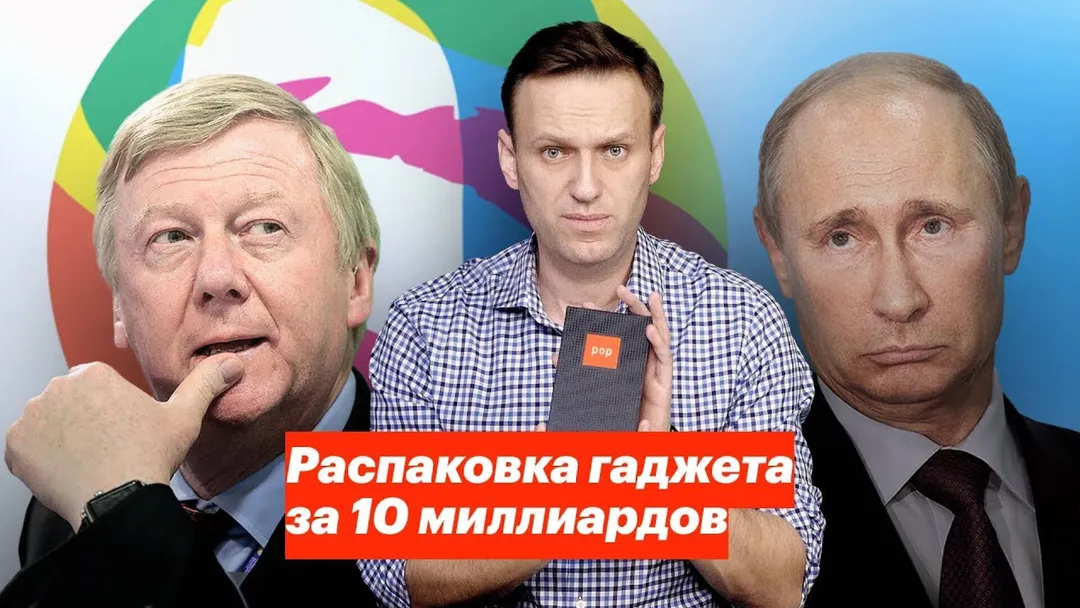
Hi, this is Navalny, and this is an unboxing video.
We need one too—people get tons of
subscribers from them, and I need subscribers.
You’ve probably seen 150 videos like this, where
famous bloggers—or really anyone—
take all kinds of gadgets out of their boxes and
examine them closely. So now I need
to do the same thing, but at the same time
somehow stand out, grab attention, and
that’s not easy, because some people, for example,
unbox an iPhone worth 500,000 rubles (about $5,500),
or a laptop worth 700,000 rubles (about $7,700), or
a phone worth $20,000. But I accept
the challenge. I’m ready for the competition, and if I’m going
to make my unboxing debut, then today I
will
unbox a gadget worth 10 billion rubles (about $110 million).
You don’t believe me, you laugh, and you say
there’s no such thing as a gadget like that, because
no one would ever buy it. Sweetheart, this is Russia—
not only do gadgets like that exist here, but
you bought it yourself, my unbelieving
viewer. In this little box are concentrated,
packed together, all the super-inventions
of Putin’s Russia. This is the cutting edge,
the embodiment of what Vladimir Putin
and his team have managed to achieve in the field of
high technology.
You know that Putin has this
chief special man, Anatoly
Chubais,
who is in charge of technology, in charge
of making sure we catch up with and surpass the West
in the most advanced industries.
That’s why Putin and Chubais himself created
a structure called Rusnano,
and over the ten years of its existence they poured
more than 240 billion rubles of budget money
into it. And when someone criticizes Rusnano,
this is exactly the thing they
show the critics, as if to say: shut up,
look at this, and die of delight.
Anatoly Chubais even compared this project
to a rocket: “We believe this project is now
sitting at the launch pad like a rocket.”
But how did this mighty
rocket end up in my hands, you ask? I can proudly
declare that this amazing little box was given in Russia
to two people: Vladimir
Putin and me. And it was personally given to me by
Chubais, the head of the state company
Rusnano. It happened during a debate where I
was trying to prove that Rusnano was a
useless outfit. Anatoly Borisovich
then pulled out this box and said, look,
Alexei, and be amazed—we do know how to
work. “This product you’ve called
meaningless, which you
don’t believe in at all—but that’s your right,
to believe in it or not, just as it is my
right to give it to you. So I’m giving it to you.”
Time passed. I kept the precious little box,
and now we know exactly what
happened to this project after that moment.
And today we will carry out Anatoly
Borisovich’s instruction. Ready to check? Let’s
check. So, we take the box,
look at it, and there is an important
explanatory label on it: “Phone case
Popslate with a Plastic Logic display.”
This is a Rusnano subsidiary
into which they invested 10 billion
rubles over four years—that is, they simply
bought
a stake in the British company of the same name back
in 2010 and then dumped all that money into it.
Why they did that is impossible
for a normal person to understand. By that time, the company
had already existed for ten years. It
had been trying to produce flexible screens like these,
but absolutely nothing
was working out. They tried to make tablets,
but then at some point the iPad came out and
all of it lost its meaning.
They tried to attach their displays to
all sorts of things, and they even opened a factory in
Germany, but things just weren’t
going well. Then in 2010 they got involved
right after the failure of their tablet launch.
Rumor had it the company was up
for sale, but there were no buyers. And then
grace descended upon the British boffins (a tongue-in-cheek reference to the Russian cliché about “British scientists”)
in the form of Chubais, with his billions from
the Russian state budget.
It was the largest one-time deal in
the history of the European venture capital industry.
Well then, let’s open it and see what
is inside, and what exactly
cost us—you and me—10
billion rubles. Now cue the bright, triumphant
music for this moment.
I’m opening it.
to do
[music]
Here’s what we see. First, there’s a big
ceremonial “RUSNANO” inscription
with their logo. This, in fact, is
the very case itself. Let’s
carefully—very carefully—
handle a gadget that costs 10
billion rubles.
A case that has... well, and you can
use the screen. On this side we
see what looks like a standard screen, like on
any e-reader.
Though, to be fair, it’s pretty crooked. I can see
with the naked eye that here there’s a kind of spot where
the Rusnano logo—and from this side there are some
bulging bits.
But overall it’s a standard screen, like
an electronic book screen.
On this side we have an indication that
the device works via Bluetooth.
Let’s see what else is in this
box. There is an instruction manual.
It’s fairly short—just four points
on how to start it up. But overall it’s also
made in that typical Japanese style.
This is a device where everything is supposed to be very...
...simple: you just turn it on and it works. And here we have...
...a cable. Let’s take it out right away — a regular...
...standard Chinese cable, all super...
Let’s pull out the little foam insert, the little foam insert...
...and check in case there’s something else tucked away inside.
You never know — otherwise later they’ll tell us that for 10...
...billion rubles (about $100+ million), there was some...
...tiny little part we failed to take out.
No, the box is empty. That’s everything there is for 10...
...billion rubles (about $100+ million), right in front of you. Let’s...
...try it.
And according to the instructions, to turn...
...this thing on, the manual tells us that...
...it needs to be charged. We charged it...
...for about 40 minutes before the start, before the start...
...of our demonstration. I’ll try turning it on.
So, let’s see: there’s one button...
...no other buttons, nothing else, just...
...a thing for...
...charging and a button. We press the button and...
...wait 3 seconds. One, two, three. Again: one...
...two, three.
Nothing happened. No, apparently our device didn’t charge.
So then let’s add to...
...our lovely white table...
...a disgusting gray dirty extension cord.
All right, now we have an extension cord. We take...
...the cable and plug it into the extension cord.
There we go, it’s on. Let’s wait...
...a little, and now let’s try again...
...to do the exact same trick, in full...
...accordance with the instructions: press, one, two...
...three. It worked. It’s showing — well, that is...
...something worked, and it’s showing some kind of...
...I don’t know what these are, some sort of headlines...
...probably, or some kind of stylization...
...made to look like newspaper headlines, like a newspaper.
Let’s try once more.
One-two-three. A short press. This is like...
...those kaleidoscopes people had as kids, I mean...
...what’s happening now looks like...
...you know when a broken e-reader...
...has one image showing through another...
...image? Right now, simultaneously...
...we can see a smiley face, and through it a geometric pattern...
...is showing through...
...the one that was there before, and underneath that you can still see...
...those same newspaper headlines.
A short press — sorry, oh...
...some kind of little chart has appeared...
...apparently something like a planner page...
...possibly. So apparently short presses...
...demonstrate the different features...
...that are supposed to appear, but in fact...
...it doesn’t really demonstrate them, because...
...you press it and one image gets layered...
...on top of another.
But all right, right now we’ve got...
...something showing through again. Let’s try...
...the next step and do something with...
...our phone. Here’s the phone...
...the very one...
...an iPhone 6. We...
...installed the app on it in advance...
...it’s there. We tap it and launch this...
...application. It loads and immediately asks us...
...to enter some personal details. Well...
...let’s enter them, put in an email. While...
...the registration is processing, let me tell you a little...
...about the company Plastic Logic...
...which is marked right here on...
...the box, and which is in fact the one that...
...absorbed those 10 billion rubles (about $100+ million).
This same Plastic Logic...
...was also supposed to produce tablets like these...
...for schoolchildren. You may remember — it was...
...a big story. But as soon as this...
...tablet with a screen like this was shown...
...to gadget experts, they called it...
...simply a stripped-down version...
...of a failed tablet from three years earlier.
And besides, neither teachers nor...
...schoolchildren were really able to use it...
...because the image was dim...
...the textbooks weren’t properly adapted, and the...
...tablet itself broke down more often than other...
...similar devices. At one point, screens using...
...this kind of technology were, by Chubais and Putin (major Russian political figures),
...declared something that should be produced in...
...Russia rather than imported — specifically at a new...
...high-tech factory in Zelenograd (a technology hub near Moscow).
Rosnano (the Russian state nanotechnology corporation) said in Zelenograd that it wanted...
...not just a factory, but also a research...
...and development center.
A wonderful idea: import substitution and...
...jobs for young specialists. And...
...look what a beautiful factory it is. Too bad...
...it’s only a drawing. So basically...
...the tablets, the textbooks, and the factory for...
...producing things like this...
...turned out to be needed by absolutely no one. It was...
...simply a complete failure of a project. It was...
...ultimately shut down.
Nothing was built, and by 2014 all...
...the major outside investors who had...
...financed...
...this project had exited it, and the stakes...
...remained only with Rosnano, which since...
...2015 has effectively been...
...the sole owner of the company Plastic...
...Logic, which is listed on this box.
One of the basic principles of all our...
...investments — and as of today we have 87 projects —
...is that we always...
...officially, we don’t just always...
...have a private partner, but a partner...
...who is the controlling...
...shareholder. And this is done for a reason...
...namely so that, as a result of...
...our involvement in any project, we can exit...
...that project. After this little case/device...
...failed spectacularly, showing it off...
...became rather embarrassing, and Rosnano...
...tried to distance itself from the project and...
...even issued a special press...
...release saying, essentially, that the manufacturers of the case/device...
...did a bad job and we had nothing to do with it, but...
Anatoly Borisovich himself is obviously not
in agreement with the press release, because
let me remind you, he thinks this is a rocket.
At launch, we believe that the project is now
right there on the launch pad, like a rocket, so
registration just keeps going and going and going,
it’s been continuing for a minute already, probably
somewhere on the other end, at the British
company Plastic Logic, they must have seen that
someone opened the app — well, not Putin himself,
and I can just imagine the kind of
panic they’re in. There’s probably a big commotion there — they must be thinking our
main sponsor has shown up, we’re waiting online.
Anyway, we entered several different
usernames, several different
email addresses, several different
passwords, and finally confirmed that
the app simply does not work.
It’s a dead app. It exists, you can
download it in the App Store, but
you can’t actually use it in practice,
you just can’t do anything with it, with this app.
So let’s finally just
insert the phone and see how all of this
works. According to the instructions on the back,
it says that you need to remove this
lower part here — peeling it off, the middle section comes off.
It peels off. We take our phone with the
installed app and insert it.
It seems to work. We close it back up.
Now let’s see what happened. So here
it’s all the same as before — just some kind of set
of incomprehensible symbols.
[music]
Now let’s try doing the same thing with
the phone — we’re trying to register with
a phone that has
Bluetooth turned on. From this side, there’s absolutely no sign
of any, any communication
between the phone and the app. Here
the same thing is happening:
registration is endless, it just keeps going on
and on, and basically regardless of whether
you have this device or you don’t have this
device, you won’t be able
to register, and you won’t be able
to use it, because all of this has long since
died.
Well, maybe there were once some
functions where the phone connected to
this thing, but we can see that, well, here
nothing works. There’s just
a screen through which you can see
several different pictures.
Registration here still doesn’t work.
So, essentially, 10
billion rubles were spent (about US$170 million at the time), and on the other
side there is nothing — even the mobile
app doesn’t work in this whole setup.
Let’s take all of this apart again. When
the gadget is disconnected from power, can it
be brought back to a working state, can it be restored
to any state? That is, nothing works anymore,
neither a short press nor a long press.
I wanted to make it display
that nice Rosnano logo,
but it disappeared here. So now I’m
trying to make it
show me that nice “Rosnano” inscription so that
I can — ah, there it is, it worked, and now I
can finally, with exactly this
inscription on screen, come to the conclusions of our video.
Because
well, here are the conclusions. This unboxing turned out
to be rather sad, because this
little box
could very well become a symbol
of modern Putin-era Russia.
10 billion rubles were invested in it (about US$170 million at the time),
a whole lot of people made very good money
off it, and it would be interesting to look at
Anatoly Chubais’s own income during the years
of active work on this project. From 2010
to 2014, he earned an average of
210 million rubles a year (roughly US$6–7 million annually at the time). We
ended up with less than nothing here, once again.
high
But you and I have neither tablets for schools
nor a factory in Zelenograd (a Russian technology hub near Moscow), nor innovative
laboratories — only this little thing
sitting in the storage room of the Anti-Corruption Foundation
(Alexei Navalny’s anti-corruption organization).
Well, you know, in the innovation sector
uncertainty is always high. It may be
that something being developed
won’t work out. That always happens, it’s
inevitable. And here, guys,
the choice is yours: if you want to keep living like this,
keep handing over your money for this, well then
support Putin and these kinds of his
“high technologies.”
If you’re sick of all this, then vote for
me. You’ll find a link in the description of this video.
Add your signature in support of my
candidacy.
If I become president, I will put an end to
the squandering of the budget and send to trial
everyone who stole from this, and
I will try to recover the stolen money.
Give this video a like,
send the link to your friends and
acquaintances, and subscribe to our channel.
This is where the truth is told.
