Putin has declared war on us, ministers decide nothing, Russia against history
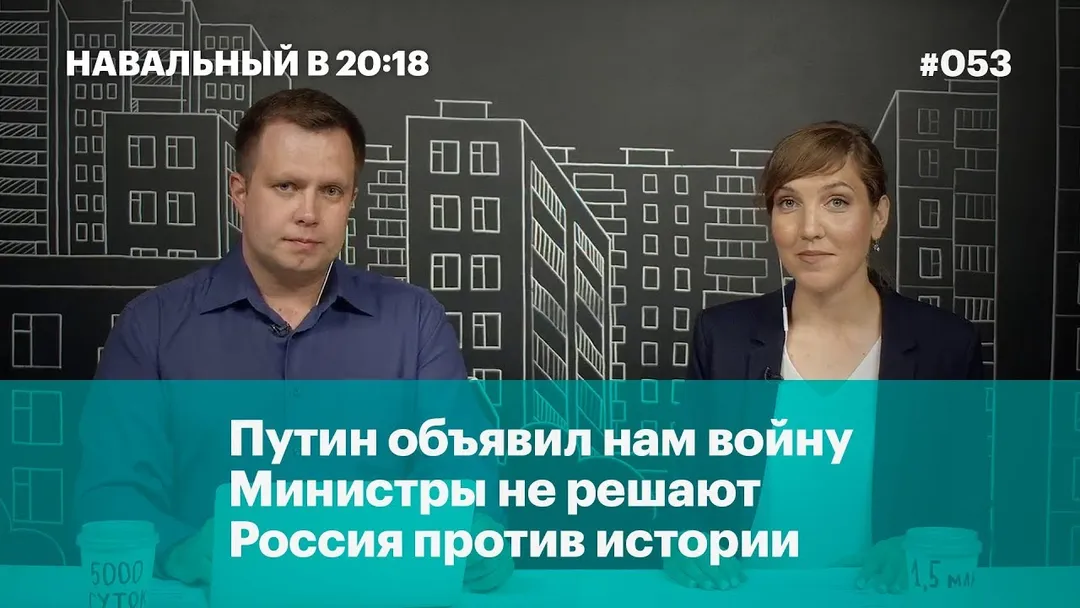
Regiment commander, good evening, good evening.
This is Navalny 2018, as usual every
Thursday in 2018, we were supposed to be with you today
Kira and Ruslan, but Kira and Ruslan
were detained, which we’ll tell you more about
a little later, so today with you are
Svetlana and Nikolai.
Nikolai, friends, but as for Kira, according to his
words, she was not detained for no reason, and this is a
large-scale
operation to round up coordinators in
the regions, to pick up the most active people
in the campaign. This is continuing.
Today we will also have more detentions, and the same
the most surprising thing is that all these
detentions began, essentially, many
days after the May 5 rally. Right away
several people were detained and
almost immediately released. Nikolai and I
talked before the broadcast and decided
that this is directly connected
to what? To the inauguration of our newly
inaugurated president. So our first
topic on today’s broadcast is called: Putin
has declared war on us—a war on the opposition and
a war on all Navalny supporters, including
supporters of our protest
action “He Is Not Our Tsar.” Apparently, it was precisely this
action that so deeply rattled Putin,
his bureaucrats, and the governors in the regions. They
were so frightened that people suddenly
started organizing, and some people
ignored the fact that their rally had not been officially approved
and went out into city centers
for unauthorized protests, showing
that they can gather, organize, and
lead large numbers of people in a way
that officials cannot control.
Yes, and despite the lawlessness and
total abuse on the part of the police,
the OMON riot police, and those who
are supposed to protect citizens but in fact
were attacking them and never once protected them, despite
all that, people were not afraid and came out. But
now we are paying the price for it, so
on our cups today you can see
some interesting inscriptions. Mine says
1.5 million—that’s the amount of money
the approximate amount, as far as we know so far,
that we need
to raise for fines, and today we will
also be collecting donations, so
send them to us—all the links are in
the description. And on Nikolai’s cup it says, on mine
it says 5,000 days, but that is the total
number of days, also
approximate,
for all of our coordinators and staff
at the campaign headquarters. But you have to understand
for example, I have a court hearing tomorrow, and tomorrow there is also a hearing for
Ivan Zhdanov, who was detained today,
and I am sure this number will keep growing
just like these figures, so
we still don’t know how much it will increase.
So for now, let’s stick to 1.5
million. If we raise more,
or less, that will depend on you
and on your level of activity. As usual, we
will thank everyone who
donates the largest amounts. Three people will
receive this interesting
calendar—an original calendar by
Oleg Navalny, Alexei Navalny’s brother.
Alexei says Oleg Navalny’s work is very
stylishly done, guys. So yes, as always,
a chance for those who donate to us
the largest amounts of money. Let’s move
directly to the detentions. This is not the first time. It
started with Sergei Boyko, our
supporter, and quite unexpectedly—well, unexpectedly
in a sense. Sergei held an excellent rally in
Novosibirsk, and that Siberian rally had been
officially approved, and Sergei spoke at it, so
that’s the “unexpected” part. And in Moscow he was
then detained. We already have this
running joke: a white GAZelle van with the Second
Operational Regiment—exactly the kind of
special van that comes by and
neatly scoops people up.
It’s like a corporate service; we’d like to opt out of it,
we keep leaving negative reviews,
but in the end they still haul people away.
That’s what it seems like, but they keep sending it.
Sergei, on Monday, May 21, was in fact
detained too; they drove him around and around there
and gave him 30 days of administrative arrest.
He was detained and kept there.
Next was Ruslan, Ruslan
Shaveddinov, and the situation with Ruslan
was absolutely unbelievable. Ruslan was supposed
to come to the morning broadcast, but he
never made it. For two hours there was no
sign of him at all, and we had no idea what
was happening. And of course, when a person
leaves home, goes off the grid,
and never arrives at work—what is that? That
is called an abduction. After
Ruslan was taken to the police station,
he was given a chance to make a phone call.
Naturally, we immediately began to suspect
that he was not just anywhere, but specifically at the police station.
We got in touch with him, and I, together with a colleague—
a cameraman colleague—went to
that police station
to film a report on what was happening there.
But the most interesting thing is that even before
we got there, Kira, Kira
Yarmysh, Alexei Navalny’s press secretary,
had already arrived there as an authorized
representative, with the proper power of attorney arranged.
She was representing his interests as a defender,
but as soon as she
crossed the threshold of that Tverskoye police station,
Kira was immediately detained as well. And so
when we arrived with the film crew,
there were operatives standing there, there was an officer
from the department,
some guy named Zhenya who did not introduce himself, but
He said, no, no, no, absolutely not to me.
Don't mention what I'm doing right now, there is
them, we won't mention anyone, Zhenya, so
and then this one says, what happened? I
said, well, what do you mean what happened? Our colleagues
were abducted, do you understand, abducted in broad
daylight, we know nothing, we want
to make sure they're all right.
He says to me, did they put a bag over their heads?
I said, no, they didn't. Well then, what are you
worried about, why are you panicking? So you
understand their logic: no bag over the head,
they weren't beaten,
well then, it's practically like they went off to
a resort, which means practically everything is fine.
Nothing terrible happened. The fact that you
will be without work, without communication, without
the support of loved ones, and locked up for no reason
for 30 days, that's nonsense. But these are the kinds of
methods they are now using to condition
probably everyone. In other words, well, nothing
terrible, of course, of course. It's this lowering
of the boundaries of perception that the authorities are now
creating, what the security forces are doing now,
this lowering of the threshold for perceiving
this lawlessness. And, well, it's true, just
a few years ago,
ten days under arrest was, well, serious.
It was considered a serious event altogether, even
overnight detention is unpleasant from the very start, for a long time
it's not pleasant when they grab you and take you somewhere,
especially without explaining why, as happened
including with our colleague Elena
Molotovskaya last week, when they
just came up and said, that's it, miss, we're
going. Identify yourselves. No, we won't
identify ourselves. Here's our car, get in,
climb in. The same thing happened with
Ruslan Shaveddinov, and what's more, it's even more
strange because she came as a defender, and
simply to help, and what was the result?
Ruslan got 30 days, and Lyubov Sobol got 25
days of arrest. And then tomorrow—today there was also
another detention, today, today there was
just an absolutely masterpiece-level detention, they detained
so cinematic, I'd say. There is even
video, well.
Let me start from the beginning. Ivan Zhdanov, the head
of the legal department of the Anti-Corruption Foundation
(FBK, an organization founded by Alexei Navalny),
Ivan Zhdanov is currently doing a great deal of
work on behalf of those detained and on
party matters and, in general, for the Anti-Corruption
Foundation. As he was leaving the Anti-Corruption
Foundation, not far from it, that's where they
detained him. He had simply gone out for a walk.
They detained him, shoved him into
a car, quickly drove him off, took him to the station on
Tverskaya. He's now being held there overnight in
the police station.
And tomorrow morning he will have a hearing in the district court.
Let's take a look at him and at what
he has to tell us, what kind of video greeting
there is. It's all part of something big and serious, and I would like
Defender, defender.
You understand, yes? Let's walk. Where are you taking him?
Where are you transporting him to?
But
here is the video of his detention, and
let's also watch another video, one of those
messages from Ivan, when he was already
at the Tverskoy District police station, and he
sent us his regards and explained
how it all happened. Let's
watch this video. Hello everyone, I wanted
to buy a shawarma with cheese and mushrooms, but I
didn't get the chance. Today police officers
detained me, and now I am at the
Tverskoye police station, and most likely
they'll keep me here overnight today. Tomorrow
I'll be in court. Hello everyone. He isn't losing heart,
he's keeping his spirits up, and today this ordinary sort of
thing—though, Ivan, don't say there's nothing unusual
about it—but it's necessary to remind people what
judges are now formally giving jail time for.
You won't believe it, but for a tweet. And if
you missed it all, the reason for the detention
of all our supporters, including Kira and her
Ruslan, and Sergei Boyko,
formally, was not organizing an event.
It was publishing a tweet calling on people to come
to a rally. What's more, in the case of Kira and
Ruslan, the publication came long before
the rally was declared unauthorized, so
in essence, as someone aptly wrote, it was for having
a time machine—as if
they somehow knew the rally would not be
approved and therefore called on everyone
to join this already, in advance,
unauthorized protest. Once
it's enough to publish a post on your Twitter
saying: come and express
your opposition to the current authorities, do not
agree with what they are doing, do not
accept their arbitrariness—and that's it.
As a result, they grab you, they
seize you in broad daylight, they don't even let you
eat—in Ivan Zhdanov's case, yes, they didn't even let him
buy that poor shawarma—and there you go,
they arrest you for 30 days. How this
will affect things later, we don't know, but one way or
another, there is absolutely nothing pleasant about it.
Nothing at all—not even a little.
Absolutely nothing. And if many people say,
well, guys, okay, at least they weren't sent to prison,
no, that's not how this should be viewed.
It absolutely should not be minimized; it is still
very serious, it is still very
unpleasant, and
what I liked in this regard was what
Leonid Volkov wrote on his Facebook:
that there is no need to downplay the significance
of this event, because indeed
you are allowed to use the shower rather
rarely.
You also get only one visit during all
that time, and in general, essentially,
you drop out of life altogether, in the spring, in warm weather.
for 30 days — for what, exactly?
for a post on Twitter. And I would also like
to add this: we devote far too little time and
attention to the judges who hand down these
sentences. I mean, of course, of course, we
as Alexei said, judges are basically just
mere "telephone receivers," that is,
they are simply carrying out someone else's will. There is, of course,
absolutely no illusion whatsoever that
it is the judges themselves who are making the decision. But
that is precisely why they should be known by name.
That is, these are, accordingly, the ones from Tomsk
and Brovko — these people, and we should
show them once again, right.
Orekhovo-Zatonskaya, Orekhovo-Zatonskaya.
who — I think that was her maiden
name, yes — the one who
handed down 30 days of arrest.
But in fact, the courts in Russia are supposedly
independent, meaning this is supposedly their own
decision: they have the right either to overturn it or
to punish — that is what a judge is there for.
But
that independence is fairly conditional
and exists only on paper.
And joining us now is Leonid Volkov.
We're speaking with him on Skype today, and now
we're planning to talk with him and discuss
all the recent arrests. We — well, we've
talked a lot about the detentions in
Moscow.
But he will tell us the broader picture overall:
how everything is organized, what the situation
is across the country with our
campaign office coordinators and our
supporters, how things stand. If we have
Leonid — Leonid, good evening.
Hi. You're aware of all
these troubles of ours, of course. What do you think —
is this a deliberate strategy, or just the authorities' stupidity?
Or what exactly is going on? First of all,
let's not treat this as
a misfortune.
What doesn't kill us makes us
stronger.
This is a stress test. And how are we going to
work when they lock everyone up tomorrow?
Nikolai, that's nervous laughter.
Nikolai is laughing nervously because
in reality, the entire leadership of all the headquarters —
almost half of all regional
coordinators and a large share of the
public-facing and managerial staff —
are under arrest in Moscow. Will we be able to work or
not? I believe we will, and we will show you
that we can work no worse because of it. And this
will be an important lesson for us and for them.
It's the only way to show them that
locking everyone up like this is
useless — to prove it through our work itself,
to prove that nothing changes and
to work even better. Secondly,
well, I mean, of course they don't think of it that way, but
again, they judge everything by themselves.
Since their system is built
entirely on manual control —
let's lock him up for 30 days —
that was done largely just to make sure he
wouldn't be around. They put the man on a bunk bed,
a two-tier bunk, and he got the lower bunk because he
is ill and simply can't climb to the top one. But
all of this, so to speak, is done out of deference to the boss at the top.
But for them, everything really will break down.
They're used to calling upstairs about every
issue — judges know whom to call,
investigators know whom to call,
ministers and governors — everything there is simple.
The whole thing will go to hell. But they also
project this, in a sense,
onto you as well. Why do they think
that everything on our side will also fall apart?
But that's not how it works. Plus, they are
trying to extract some kind of
benefits for themselves. They are very afraid of any
rallies on the eve of the FIFA World Cup
probably because they understand
that after the lawlessness of May 5, they
can't just detain people like that in front of foreign
fans and journalists — they can't
do it openly, because some kind of
incident might occur. So they are trying
to act in advance.
And of course, regarding the party: on May 19 we
were supposed to hold the founding congress accordingly.
As of tomorrow — sorry, please,
Nikolai, for bringing this up again, but I have to
say that as of tomorrow our quorum
will be assembled.
Tomorrow he has a court hearing, you have hearings, and out of
the seven members of the party's central council,
four will end up behind bars
at the same time, not counting its founders and
organizers — Alexei Navalny is already
there.
And Boiko as well. In short,
roughly half of them. Of course, this
is incredibly infuriating — you can't say it isn't.
This is clearly being done deliberately to
disrupt the party, or deliberately to
sabotage it. They have simply grown brazen from
impunity, because the courts now are
a very different thing even compared
with what they were just a year ago
or even a year and a half ago. What
they are now writing in rulings
would have been unimaginable a year ago. But at the same time
they also get a great additional
bonus for themselves, when someone like Kiriyenko
goes and coordinates it with Putin and
says: there is this idea —
let's just lock everyone up automatically
before the spotlight arrives.
We'll trade them party registration for silence during
the World Cup, so they won't make noise, and also
what else — how much more money can we squeeze out of them,
how much from those who are fined,
and so on. Well, all right then — let's act.
That's how it works here, you know — just like that.
This is what’s happening — all of this.
These additional bonuses come as part of it,
according to the usual formula, yes — and as things are unfolding, that really does seem to be the case:
they simply do this, precisely because
they can, and probably because they can no longer
offer anything else — that’s the main thing, they can’t
set anything against it,
against the entire structure that is now operating in
the country, the whole network of headquarters. Nothing
except this police lawlessness, well,
yes, and for them it then became a major
surprise — May 5, and now they look at this
with suspicion somehow. Well, almost no one
was there.
There were police dogs and all that, but overall
they didn’t really stop us from holding it, and overall
the fact that in dozens of cities there were
huge rallies with many thousands of people,
unauthorized protests — for them,
that was an absolute shock, a complete surprise. They
had somehow convinced themselves that, basically, after March 18
the issue was over, everything had calmed down, run out of steam.
They thought they’d shut down the volunteers and the old network,
close it all down, and so on — that was their version of events.
But it turned out that everything was still there, still working,
and working even better. In many
cities, the May 5 rallies were
larger than the ones on March 20 and even those on June 12
last year. That became for them
a real shock.
It scared them badly, and that’s why
they always respond with such a harsh
reaction. This reaction is unprecedentedly
harsh. Taken together, the Bolotnaya case (the criminal prosecutions after the 2012 Bolotnaya Square protests)
of May 6, 2012, was more frightening than May 5, 2018,
because back then there were criminal cases, but now, in
essence, they’re turning it into a network of criminal cases — or rather, handing them out to us
retail, one by one.
That’s one point, because these 5,000 days
that have already been handed down, so to speak, on paper so far,
and there will be more — arrests of up to 15 days — yes, that is
soon going to be comparable in total
to the sentences in the Bolotnaya case, approximately.
That’s exactly what it is.
Leonid, well, I don’t know — I’m sure our
headquarters will handle this calmly. I mean,
I’ve been talking to different regions,
all week, and I can see people have this fighting
spirit. Somewhere in Krasnoyarsk, for example, people
came out, and because of that it has become
an extra boost — they’ll work even better there. The momentum is on your
side, supporters are saying they’re joining in,
and everything will be all right for us.
And our projects will keep working. You’re right:
people aren’t stupid, and they see everything.
And in small towns, all of this
information spreads everywhere,
including places where nothing like this had happened before.
In places where there hadn’t previously been any
lawlessness, where this kind of
“Kubanization” (a reference to especially heavy-handed regional repression) has now happened too, and where justice and
the authorities’ attitude, and so on,
are perceived as a kind of shock — and people
know about it.
They do not remain calm about it. Though here,
we do need to be careful with the word “calm,” of course,
because on the one hand, I’m
proud that no one gave up, no one
quit, and that in order to
keep working steadily, every headquarters
has not forgotten that there is a key project
that each office has to carry out — they do something,
they keep that project going. Even if
the coordinator is in jail, or the deputy is sitting there too,
or the lawyer is tied up, the volunteers themselves
left one-on-one with the project
still carry it forward, and they do it very
well. And this composure with which we
continue working should not, at the same time,
extend to everything — we cannot treat
all of this calmly. Zero
tolerance for lawlessness: for the witnesses who are ready to sign anything,
who are ready to sign whatever is put in front of them,
for those who always say there are no grounds not to trust
a police officer, for the police officers themselves,
who lie in their reports, for the officers of the centers
who fabricate all these
cases — there can be no
tolerance. No matter how many such
cases there are, we must not sleep through this,
calmly, as if this were simply
how things are supposed to be, as if this were the only way things can be.
It is terribly dangerous to let the situation get to the point
where everyone gets used to it all and it becomes
routine, ordinary. That’s why today
today we recorded a video with Lyubov Sobol,
a big group worked on it,
collecting all the facts to remind people:
this cannot be treated calmly. What is happening is
a large-scale
political repression
by authoritarian, fascistic usurpers
who have seized our country and are not
going to give it back. And no normal person
can reconcile themselves to that.
As was written long ago in the headline
of Alexei Navalny’s article, no one has
the right to neutrality, and now that phrase
is more true than ever. Unfortunately, no matter how much you may want
to hide
in your little hole and say, “This doesn’t concern me,”
you have to choose: either you are with those
who imprison people,
or you are with those being imprisoned. There simply is no
third side here, sorry, however
unpleasant that may be to hear. Yes, that old line no longer
works — the one about “when they came”
not for me but for my neighbors.” They’ve already
come for everyone. That’s it.
Thank you very much. We’re just about to
show a short part of that video now,
with Lyubov Sobol, and it will include
mentions of all the coordinators. Thank you.
We’ll stay in touch. Best of luck
tomorrow — though of course it sounds funny to say that,
especially coming from me, since it just so happened that I sat it out here.
I mean, on the one hand, I feel
morally at ease, because my...
No one has managed to beat that record to this day.
I served a total of up to 105 days behind bars.
And even with these new sentences,
which are now being handed out to everyone—30 days at a time,
there are still three people on the other side ahead of me, so
it turns out I really am the only one
still at liberty from the list of 86. It was simply a list that all
the media published: detain them there. If it had been
Leski, or Zhdanov, or Sheredin—none of them
were even written about; they just talked about the country.
People were detained according to that list. I was on that list.
Women.
Local police officers went to people's registered addresses and
called, asking where they were.
I said I had gone away on business, on a work trip.
I understand that if I were at home, I'd be facing another 30 days.
I want to wish them a speedy return.
On the other hand, on the other hand,
I thought about what was really happening,
and in fact we will defeat them. Their condition
is one of hysteria, and
hysterical regimes do not survive for long.
Unfortunately, it's an unpleasant state, because
then it's like a mad bull,
a wounded one rampaging—it can
smash a lot of dishes around it
and cause a great deal of trouble. But
at the same time, there is no path to recovery.
We understand that, in any case, the raging beast
must eventually stumble and fall over something
very unexpectedly, collapse, and break
all its legs—and we'll make a tasty steak out of it.
That sounded rough.
A shawarma would sound better—I bought one for you today.
On that note, let's say goodbye
to Leonid Volkov. Thank you very much, and until
next time. You were detained—you did great.
Thank you, Leonid.
And now perhaps let's sum up
the campaign and move on smoothly. Yes, I suppose
I'll do exactly that now.
A slideshow from the video—Lyuba Sobol has
released a wonderful video today.
I think we have it in the description, so
watch the video through to the end of this stream.
There was a really wonderful montage
of all the coordinators—with fines, with ducks,
and Vanya is in it. I'm not there yet, but if
it's implied—maybe, maybe.
No one is immune. Let's watch, let's watch
the video.
[music]
[music]
[music]
[music]
[music]
And those are the results of May 5—the outcome of May 5.
The outcome of the party registration effort, though for now
these are only preliminary results; we don't know
what will happen next. In this connection, we
want to remind you that today we are raising
money during this broadcast—this amount here—as
the minimum we plan to collect. Of course, not
in a single broadcast—that's 1.5 million rubles
(about US$24,000 at the time), so send us donations and
support the opposition, support
resistance to this
essentially fascist government,
a usurping government that allows itself
to treat
our supporters in this way, absolutely
illegally detaining them and throwing them in jail
for 30 days, 25 days, even 10
days—that is still a very long time.
We just spoke about this with
Leonid Volkov. Send whatever you can—the links
for further support are in the description to
this video. And this is very important, because
besides jail time, the authorities think they can
intimidate people with fines, and for some people
those fines really are
more than they can afford.
We're talking about 10,000 to 20,000 rubles
(roughly US$160–320 at the time)—you can't always keep that in reserve.
It's not like: I'm going to a rally, and I already have
that money in my pocket. If we want the authorities
to understand that this won't work, then we need
to make this mechanism non-threatening,
so people must keep going to rallies.
Absolutely. And we need to understand that
if this machine suddenly turns against
you, then we will be able to provide support
and that we will be able to compensate for it. What's more,
the three people who send us the largest
amounts today—we will give all three of them
these lovely little calendars as a gift,
designed by Oleg Rebrov—a wonderful calendar.
We'll give them to those who send
the most money, despite the fact that
they're for 2018—they're exclusive.
It's original artwork, so there's plenty
to look at, and you can always enjoy
having such a calendar on your desk,
for example, at work. Now let's turn to Oleg
and talk about the fact that he, too, has
an update, so to speak.
In his prison life: on May 22,
he was placed in SHIZO (a Russian punitive isolation cell), and the reason for this
placement was, of course, completely
beyond common sense: he
was eating without a jacket in the dining area.
Thus,
he had supposedly gravely violated prison
regulations. You understand—the man simply
didn't put on a jacket. In our
so-called democratic state governed by law,
while he was eating. But we've said many times
that the FSIN system (Russia's Federal Penitentiary Service)
is, in essence, one that will
maim people; it is in no way at all
designed for rehabilitation. And
in the case of Oleg Navalny, this
is shown with maximum clarity.
Oleg is a person who is very
calm, very thoughtful. Many
of you, I'm sure, read his posts on
Facebook, where he talks about his experience
and about how his war there is going with
The head of this colony is waging a kind of "war"
in quotation marks over whether it should be possible to bring in
colored pencils. And just think: Oleg
is a creative person, he draws, after all.
But they forbid even that. They
bolt the furniture to the corners, they take away
his pencil, and they give him no way to express himself
freely, even though this is, in essence,
supposed to be a correctional system, right? That is,
in theory, after going through this
court-imposed term, a person should become better. But there are no
opportunities for that at all. And that is considering that
Oleg has very little time left; he is already supposed to
be released literally on June 30.
The year and a half is practically over already,
there is less than a month and a half left
before he is due to be released, and as a final blow
these scoundrels put him in the punishment cell ("ShIZO," a Russian prison isolation ward).
Never mind, as they say, it will all come back to them.
To wrap up the whole subject of our
arrests and detainees, this same week
the prosecutor's office, well, the prosecutor's office
requested
a change in the preventive measure for Konstantin
Saltykov. Kostya Saltykov is one of our
activists from the Moscow штаб (campaign headquarters).
He was
detained at the January rally; it is claimed that
he hit an OMON officer's fist with his face while the officer
was detaining him. And all of this is just mad, this
madness where once again some
police officer is supposedly injured in the line of duty.
It always somehow turns out that someone has to be injured, and yet
no police officers were actually injured, and now
the prosecutor's office has requested for Kostya
Saltykov to be placed under house arrest. Right now he is
being held in a SIZO (pre-trial detention center), and no—the judge said
let him stay in the SIZO.
And the conditions there are awful for him, packed in with
other people, with no investigative
actions taking place. It is absolutely clear that this is
simply abuse
and intimidation. Kostya is holding up bravely,
sending his regards to everyone through his lawyers, but
these vile
civilian judges, of course, will answer for this.
We already showed this at the start of the broadcast,
and you should remember them too—you know, if possible,
never end up before them. But
in our country, unfortunately, no one is
immune from that.
Also today, on our campaign website,
2018.navalny.com, there is a published
final report on the entire nearly
year-and-a-half-long campaign. We really
did a great job, and I especially want to
emphasize that, because the work was truly
massive.
What we accomplished over these year and a half
is something very few people have managed
to do at all, and certainly not in our country.
We have often spoken already about
the people and the headquarters, because probably
the brightest and most important thing that was
created was 81 headquarters—81 headquarters,
many of which are still operating to this day, and
no one else has anything like that. Practically the entire
country was covered—you can see the map now, right?
And there were also people's headquarters, meaning when people themselves
opened them. And we have many volunteers;
many volunteers are still with
us. They support the campaign, they are ready
to develop political activity
and civic engagement in their regions,
which of course makes us very happy.
We also have more than 700,000 signatories
over these year and a half.
And we raised 372 million rubles (about several million U.S. dollars at the time)—an enormous
sum. It is all wonderful. We have often
spoken about it, partly here on the program, in
the headquarters, and in all sorts of other formats.
Now it has all been brought together in one place, and you
can look through it. And if someone
asks you, "So what were the results
of Alexei Navalny's campaign?" then feel free to
send them this link, and all questions will disappear
immediately. It shows the real
results of the work, presented very simply and
concisely on a single page of our
website, 2018.navalny.com.
And all this work was built for one purpose:
to change the political system in
the country, so that Russia would have
a new kind of politician, so that ordinary people
would become engaged with political issues and
start participating more actively, and
maybe some
mayors or regional heads would suddenly start thinking
that they really ought to conduct themselves properly,
that they need to be accountable to
the voters,
that they need to speak normally with the people who
come to see them.
But for some reason, no. Though who was decent?
We have had some—there is Alexei Navalny,
and Yevgeny Roizman, who is precisely the hero of our
next segment. The mayor who—well,
the mayor of Yekaterinburg, if you didn't know,
the mayor of Yekaterinburg who really is
a real mayor,
a true people's choice, and moreover a resident
of the city—not someone who came from somewhere else,
installed by somebody, but a genuine resident
of the city, who knows his city, who
wants to make it better, and who did make
it better, in fact, for several years.
But today we received the news that
Yevgeny Roizman has resigned.
Why? Because they are not allowing free
mayoral elections. So, we got
this news—not today, of course,
but we are telling you about it today.
It was this week's
news.
Roizman stepped down from the post of mayor himself in order
not to sign a law under which
the residents of Yekaterinburg are now going to be stripped of
their right to elect
They want to install their own kind of mayor here.
Their own little man. There is a comment by Smoliy in
general—let's listen.
Hello everyone, this is Yevgeny Roizman speaking firsthand.
Firsthand.
Let me explain: a regional law was passed,
a regional law abolishing direct mayoral elections in
Yekaterinburg. This law is humiliating
for the city's residents and runs counter
to Yekaterinburg's interests. But after
this law was passed, it became necessary
to amend the city charter.
I warned everyone right away: never in my life
would I put my signature under these amendments.
The city charter states: direct mayoral elections.
Never in my life will I change those
words with my own hand. They started forcing
the situation and submitted the amendments
to the charter for consideration at a city council meeting, and I
had only one way left not
to take part in it:
to resign. That's it—from this moment on,
I have resigned.
I am no longer the head of Yekaterinburg.
Yevgeny Roizman is a real mayor.
It seems to me this is how it should be judged:
at the head of every city there simply ought to be
We hope that Yevgeny will find
a worthy role for himself. But more than that, we
hope that at least somewhere
this system of free
mayoral elections can still be preserved. It remains literally in
just a few cities in our country, but we are
losing it. So to speak, but I wanted
to say what seems to me the most important
point in this whole story: Yevgeny
Roizman showed that you can simply choose not
to go along with those
slick people around the president and
all those governors who
came up with this law under which mayors will now be
selected—appointed, that is.
And globally, this is not even about the law itself—it's
just that some incompetent person
came up with a harmful, destructive
set of rules.
It's the same with rallies: some
boss gives instructions to his staff
to detain an innocent person, gives the
order, then a judge convicts them, and so it goes
through every level of this whole scheme.
It spreads everywhere, and at every level people nod
and say, 'Well, what can we do?
We're small people, we're only following orders.'
Yevgeny Roizman showed you that it is possible
simply not to carry out an order—and the sky did not
fall, and the earth did not split open.
Yevgeny can calmly look his
voters in the eye. He speaks with residents, with
his fellow citizens, and in their presence
he can calmly record videos. I am
sure he will have no problem whatsoever
finding a new job.
Thank you, Yevgeny. And now, from such
good officials and good mayors, we
move on to crooks and thieves.
Slowly now—literally about a week ago,
it was practically Friday already,
a new government was formed.
Well, new—relatively new, that is.
Some new faces did appear there, but for the most
part the same old ones remained,
who, to put it mildly, have already become tiresome, and
who still decide nothing and
remain pawns in this enormous
system. It all looks very much like some kind of
orchestra from a fable (an allusion to Krylov's 'Quartet,' where changing seats changes nothing)—there was
a little reshuffle, but
as you can see, there are not many results.
Because they still, well, don't really know how.
So, let's take a look at these people
who will be leading our
government. There are a lot of them—
deputy prime ministers and federal ministers.
But what matters to us, who
we would like to single out among
these stars of our political
stage, of course, is
Vitaly Mutko. Vitaly Mutko is simply
quite a character. Everyone laughed at
him—everyone, even his own associates—
when he was appointed, when Medvedev
put him forward. What will he be responsible for now?
Construction, and
regional development.
He'll 'develop development' so much it'll make your head spin.
Just imagine: the man who was responsible
for building the Zenit Arena stadium will now be
in charge of this too, and now everywhere, in
every city across the vast expanses of
Russia, I suppose there will be seagulls like the ones
that pecked at the stadium roof and walls (a reference to the St. Petersburg stadium scandal), and even
the foundations will be poured badly.
And then again, the doping scandal—
it was simply a disgrace before the whole world, a disgrace
that brought us, well, problems with
the Olympics, and not only problems with
the Olympics in general,
but at the very least problems with our image.
It's strange—what is this, guys? How can it be
that all the athletes are on doping, and yet you
deny it and say that everything is
fine?
And yet this man is given
such a cushy post: here you go, regional
development—go develop it. But it seems to me
—I don't know, maybe this is exactly how it will be—
that the program money they promised
to send to the regions fits very neatly
with both construction and
regional development, and now
old Mutko will sit there and distribute the program funds,
deciding where
his own people should build their own
Mutko-style houses instead of what is actually needed.
Moving on, we have many more names,
we won't have time to talk about all of them, so very briefly,
very quickly, about probably the most...
High-profile appointments: Yevgeny Genchev.
Yevgenievich will now be put in charge of
the Ministry of Emergency Situations. What
do we know about him, about this man?
On the right—there he is, comrades, in a tie and
jacket. He’s had an astonishing career rise,
the kind you could envy beyond belief. He was
Putin’s bodyguard for almost 10 years,
from 2006 to 2015, and now he’s a minister. But before
that, he was also sent
to run Kaliningrad Region. They took
a man and just sent him there—it sounds easy, but
you have to understand
they took a bodyguard and installed him as
governor. We’ve already had several of those
security-men appointments.
Sure, why not? Doesn’t matter whether he can handle it or not,
whether he likes it or not. Not just “doesn’t like it” —
he simply doesn’t like it, it’s not his thing, and
he didn’t ask for it.
And yet he came out ahead: he was some kind of
governor, and now he’s become a minister — and
a very important one. After all, this appointment is the first
real sign that the reins of power are being handed over and, apparently,
someone is moving into the shadows. In other words, this
appointment weakens that whole system of
checks around him, if suddenly we’re talking about
some kind of clan war. There are two possibilities here.
Either there’s a paranoid Putin who decided
just in case that you need to place
your own man, your own bodyguard,
so that if anything happens, the bodyguard will protect him.
If there’s suddenly a fire in Putin’s house,
then naturally everyone gets sent there immediately. And if
all of Russia is burning — well, who cares?
What of it, honestly? After all, we have more than
that — according to statistics, every day in fires
30 people die, sometimes more. But that’s apparently not where
attention goes. Even as of today,
right now,
part of Russia is engulfed in flames, and another part of Russia
just a few days ago was buried in smoke so thick
that it was simply impossible to go outside,
people couldn’t even leave their homes — they were literally
trapped inside. And the Ministry of Emergency Situations
slept through all of it.
The ministry isn’t reacting. Right now there’s footage
of people trying to put it out with buckets,
with forests and fires blazing everywhere. This is completely
unacceptable. And now, at this very moment, they’re taking
a bodyguard and placing that bodyguard in the
post of head of the Ministry of Emergency Situations. They’re saying,
“Here you go, buddy — this is your domain now, deal with it.”
Another comrade we have to
mention is Dmitry Patrushev. He will now
head the Ministry
of Agriculture. What’s so
remarkable about this comrade, about
Dmitry Patrushev, besides the fact that he
is probably notable mainly because
he’s a Patrushev — a surname that speaks for itself and
is hard to forget. The former director
of the FSB (Russia’s Federal Security Service)
was Nikolai — Nikolai Patrushev.
His father was, in fact, the former
FSB director, and I think he cares very
deeply about his child and says,
as everyone does here, that we are getting rid of
crony corruption — don’t forget, that’s
the daily program of our country, after all.
That’s why we appoint our sons,
bodyguards, and various other friends. At this rate,
Putin and company will soon get to the dogs
and horses and start appointing them to posts
too. At this point, anything seems possible. It’s just that
Patrushev — Dmitry, again — before this
was involved in running
Rosselkhozbank (the Russian Agricultural Bank).
According to its charter, Rosselkhozbank
was supposed to provide money for the development of
agriculture.
Rosselkhozbank went bust; now it is
basically fully supported by the state, and
money keeps being pumped into it. Just recently another
five billion was poured into it — onward we go
for agriculture.
Much safer that way. Of course, he couldn’t handle the bank, but
surely he’ll handle a ministry then,
right? The logic is simple: why
not? And that’s exactly what I wanted to say about
this.
Agriculture may seem
to everyone like, well, just agriculture, but
according to various data and various estimates,
agriculture is one of the most
lucrative areas, and a very important one,
especially in terms of finances and rent-seeking as well,
particularly during this period of so-called
counter-sanctions, when now
more and more madness with these counter-
sanctions is being introduced in our country, and the influence on
our agricultural sector will be absolutely
colossal. So if he couldn’t
make enough money
running a bank, he’ll make it as
a minister — why not? Who else do we have?
Rogozin, our esteemed comrade,
will now apparently be added to Roscosmos (Russia’s state space corporation). That’s
today’s news, and it probably shocked
everyone who hasn’t been following these
developments, because after driving all the enemies
out of Roscosmos, I kept hoping until the very end
that maybe someone else would go there instead.
Please, Yurik, if you can hear us, answer our prayers.
I saw a joke today that, well,
apparently,
it’s obvious that aliens from Nibiru
have taken over the command center of the world — enough already.
The point is absolutely not that
he himself has never flown anywhere — it’s that no one at all
will get through now.
No one will be able to break through this
man. Soon we’ll be taught that the sky
is solid and the stars are nailed to it, thanks to
Rogozin. And I think that our new
ministry, which is now called not
the Ministry of Education and Science, but
the Ministry of Enlightenment.
Well, give it a little more time and there’ll be a Ministry as well.
A Ministry of Truth, and then we’ll really be living the life, right?
Then you’ll definitely be thriving—there’ll be plenty to...
...cover. Vasilyeva—who knows, it’s all a mess...
I wanted to bring some fire to this, dear...
So, our dear Vladimir...
Rostislavovich.
Yes, please tell us about him—there he is, right there.
He seems like such an intelligent, cultured person.
On the face of it, he has remained in his post, and that is, on the...
one hand, of course, something that can’t help but...
be pleasing—but it’s only pleasing...
from the standpoint of absurdity, because from every other...
angle it is wildly upsetting. Anyone...
at all.
All intelligent people, everyone even somewhat...
connected with culture...
prayed, hoped, and believed until the very...
end that for this position...
they would find someone more worthy, not...
the person they did find—with so much plagiarism in...
his dissertation, who wants to rewrite—or...
is already rewriting—history, and who...
essentially isn’t doing anything worthwhile.
I’ll just... right now...
A person from Dissernet—they came to me many times...
they came to see me many times.
Our friend Andrei Zaitsev—I was talking about...
Medinsky’s dissertation, and he says there...
there’s nothing especially pleasant about it; I mean, it even seems...
he may have written it himself—a person like that...
sat down and wrote nonsense. He said you could have...
just sat...
a monkey at the keyboard and it would have typed his words, and...
something would have come out. A person like that just...
wrote something that has absolutely nothing...
to do with scholarship and said that...
it was a dissertation, and then started defending it.
And everyone says: a dissertation, a dissertation...
and all these academic councils say: yes, it’s a dissertation, but...
what you said about history is exactly right: he...
started remaking it. That is, his...
dissertation is precisely about the history of Russia, and...
that’s exactly where it goes further.
Medinsky’s hands are now reaching toward history...
textbooks, which he can surely...
lobby for, and now we’ll be studying...
my history, not some other history.
My history—it’s alternative, but...
one way or another, let’s take a look at it.
Because he has already tried to do this.
And why does this personally...
upset me too? Because, as before...
money from the state budget...
was allocated to fairly bad films.
Good cinema was not supported.
If next year, as promised, is going to be...
the Year of Theater, then it’s trouble, real disappointment.
It really is, because thanks to...
such a culture minister, we will unfortunately have...
only the most mediocre, though...
“friendly,” so to speak, theatrical...
productions, while good theaters, such as...
Kirill Serebrennikov’s theater...
will, unfortunately, possibly suffer.
And beyond theaters, this whole situation is deplorable.
If we go back to his dissertation...
he behaves so boldly, in general.
As for boldness, it’s more like...
well, “intelligent” in the Russian sense (cultured, educated)...
such a person would not go looking for a fight like this...
and pick quarrels with everyone. But this is how...
a report was recently released saying that for...
reinterpreting history, for...
having the “wrong” view from the standpoint of...
the conservatives or those who control...
the general line on historical...
events, you can get a fine or a prison term—and this...
is already happening. We have a video from...
Agora (a Russian human rights group); let’s watch it right now, and there...
everything is explained in detail.
[music]
[music]
[music]
you
[music]
[music]
[music]
[music]
[applause]
For our dear radio listeners, let me...
explain that what you just heard was...
music. And I’ll explain: it was a video that...
we made ourselves...
based on data from an Agora investigation.
And now I’ll read out those figures.
So, over the recent period, 41 books were...
banned.
There were 17 criminal cases, and in 16 of them...
there was a guilty verdict.
There were also 6,622 administrative...
offense cases, mostly under Article 20.3, that is...
public display...
of Nazi symbols, including, among other things...
historical photographs, of course...
plus tattoos on the body, for example...
of some leader, and also clips from films...
that is, clips not even from historical...
films, but in any case they too were...
prohibited. The number of cases has risen sharply.
If in 2012 there were only...
238, now it is already about 2,063 cases...
in the past year.
So these repressions are being unleashed by...
foolish ministers who write some kind of...
mad dissertations, and then...
ordinary people are left to deal with all of it...
for reposting an image on VKontakte, by the way.
That has happened, including to one of our...
supporters.
The case ended well, but no one...
is immune from this, and we have to...
fight it.
Now, when we talk about history...
and politics, it’s probably very important...
to mention that lately, not without...
the involvement of our штабs (regional campaign offices), not without the involvement...
of the coordinators of our regional offices, various...
These processes have been taking on an increasingly
pronounced political character. Take the issue
of landfills, which both of us have spoken about a lot.
That is, these landfill sites are something we practically
always mention in the news, because
there is always news: rallies, protests,
the movement is not dying down, whether in Volokolamsk
or in other parts of the Moscow region. But in
this case, we want to talk about
Yaroslavl.
The wave of Moscow's garbage has reached
Yaroslavl, and we have to give credit to everyone in
Yaroslavl, to our Yaroslavl штаб (campaign office),
which
didn't back down there. Their rally was not approved, and they
held it without authorization. It turned out to be
very vivid, powerful, and sincere. And, importantly,
they said: we are not going to tolerate all
this. Especially after everyone learned
that the company that will operate these
landfills once again belongs to the son
of the Prosecutor General
— Chaika's son. And as has already been said, where there's garbage,
there are the Chaikas. Let's watch
a short video from Yaroslavl.
[music]
So why is it that we are forced, let's say,
to gather here today and understand
that Moscow's trash has already started pouring in here?
If one liter can be poured in, then two more can easily follow.
I would like to say, regarding the essence of
this event: he is absolutely right — this
issue needs to be politicized. It needs
a political response. All of this
was organized by the political party United Russia.
Well done, guys — it really was a very striking
rally and a powerful action, and thank you even for
such a successful video. And it's important to remember
that expressing your civic
position comes first, because no one
has the right to force you, as in Volokolamsk,
to breathe polluted air
from landfills. No one has the right to dump
garbage on you — especially from another region — if
someone at the top decided so, if
someone higher up was paid for it. Therefore,
if this problem affects your cities,
you should also come out and
organize yourselves. Get in touch with our
campaign offices — we are always ready to provide
support and any kind of help, because this is
truly a political process. It is
not only social and civic
activity, but also a fairly strong
political force. That's right. And here
people are even writing to us about political influence.
Vladimir from Kazan writes to us: "Push the party
forward, please." Today we have already
spoken a little about the fact that
over the weekend, the founding congress
of the party took place. This is indeed an important,
a very important legal stage. Now in all
regions there will be
regional meetings of the local branches.
And I really like the name — it
truly warms the soul: Russia of the Future. It's the most
successful name possible. So
there will be more politics in the regions, politics will
be more visible, more vivid. And now let's
watch a clip about how the
founding assembly took place in
Moscow. Thank you to those who gathered here —
people who understand that right now you are with
the country, not with palaces and whatever else.
Yes, we have proved that we are far stronger, that
we are the only real force that
can gather rallies, and despite
pressure, arrests, and threats, the party exists.
It exists in reality, and they simply
have no choice but to register it. Who is in favor of opening
the congress?
[music]
We are creating a real party that already has
real supporters, that has
regional branches, which have already for more than
a year been advancing the agenda.
It's wonderful news that you are not giving up
your attempts to register your party.
You really do have that right.
You truly do, and common
sense
dictates the need to register
this party and give it the opportunity
to participate in elections and pursue the
goals it has set for itself.
[music]
[music]
These happy faces — this is Russia
of the Future. Yes, and in the regions there will be even
more of them, and they will be even better. But
let me remind you again about donations: we
are raising money for fines. Friends, you
still have just a little
time left to get
the calendar, so that you can become
the owner of this wonderful
calendar. In the end, those who donate the largest amount
to us will receive it.
We are not raising money just because, as usual;
we are raising money for fines, and for everyone who
was arrested and who
was accordingly issued these fines for
the May 5 protest. The amount shown here on my
cup — 1.5 million rubles (about $16,500) — is
still far from the final amount; it
may change.
But for now it has already been set, so
friends, we have to support one
another, and over the next several broadcasts we will
be collecting money that will go into
a kind of fund for paying off fines.
And as for the party — it may seem
like such different things:
a rally in Yaroslavl and the creation of a party, or
the registration of a party. But this is
very important: any problem, any
problem in a region must be
resolved. Every problem has a solution.
It’s not easy, either technically or politically.
What they’re trying to do right now is being crushed.
Including what they’re trying to do in Volokolamsk, yes.
Listen, guys, without political will,
unfortunately, we have to admit it, we won’t be able to do it.
We won’t be able to push through, really, almost
any more or less important decisions.
That’s why the party
needs a party structure, and it already
exists — these headquarters, these party
structures. Now we just need to go into
elections and win where it matters, in these regions.
Where it matters, yes, absolutely, it will happen.
And even if they try to create some kind of
obstacles in order to ultimately
prevent registration — still, we are not going to
stop. Russia of the Future has been created,
and it will live on. And we have a winner —
in fact, we have four of them.
First place goes to Nadoelo ("Fed Up").
I’ll read them out and show the leaders of Nadoelo.
It’s always your... Next up is
Chelyabinsk, then Angry Siberia,
and beyond that as well.
Well, probably the numbers are about the same.
All these people — we will get in touch with all of you.
We’ll contact you all. Even plus one, plus one — that’s
excellent. And this was
Navalny 2018. Every
Thursday, watch 2018 — this is where people speak
the truth. Subscribe to the channel,
share this video, give it a like,
support
all political prisoners, go to
rallies, make politics happen in your region,
and we will succeed. We will win because
you and I are here for the Beautiful
Russia of the Future.
All right, everyone, bye. Take care.
[music]