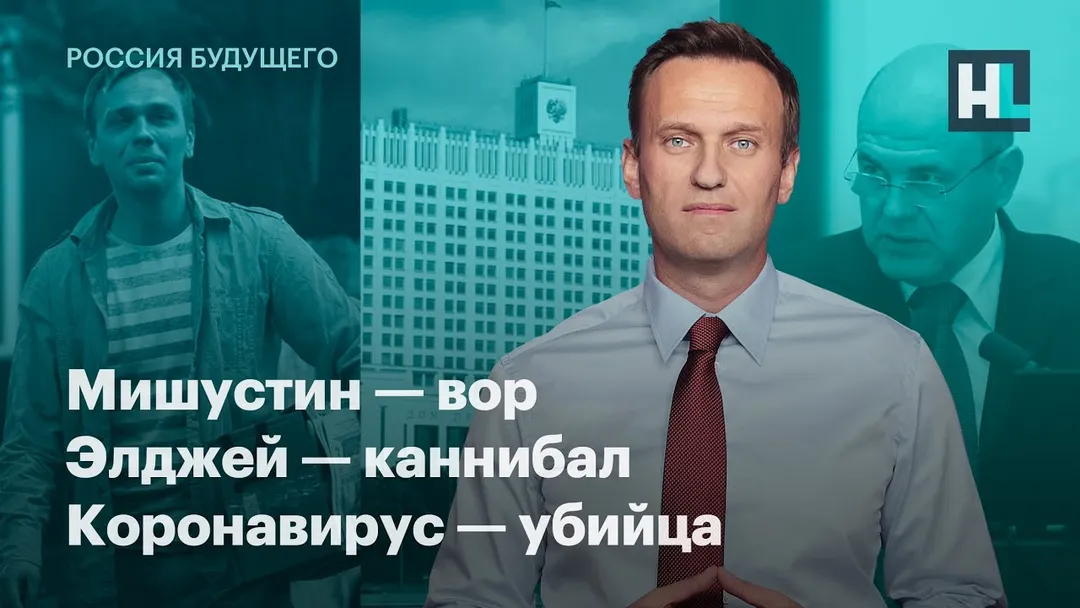
Mishustin is a thief, Eldzhey is a cannibal, the coronavirus is a killer
[music]
Good evening. You’re watching the live broadcast of the program
Russia of the Future, and I am its permanent
host, Alexei Navalny.
Or, as various Kremlin media outlets called me this week, a man who has stopped obeying
Western investors, as they described me this week.
That’s what they were calling me.
Various Kremlin media outlets. I forgot to mention
that it is exactly 8:00 p.m. in Moscow right now.
Please send me your questions,
suggestions, wishes, and complaints on
Twitter with the hashtag for Russia of the Future, and I
will try to respond to as much as I can. We have
a terribly funny situation going on with
the donations we collect through our
program. It really is quite an
important tool for us right now, when we are
constantly under attack. As soon as we
test some new system, they shut it down
— or, if they don’t shut it down, they come up with
some conditions that force us
to disconnect it ourselves. So today we have a new
system.
Let’s see whether it survives longer than one
broadcast. Please check the description;
you can send messages of support that will
float across the screen. Well then, let’s discuss
various events, insult our
officials, and remember that in
fact
we’re insulting them too cheaply.
Apparently, for the past couple of months
— because, interestingly, Vladimir Putin
today at the Human Rights Council
announced that he is instructing officials
to consider tightening
punishments for insults, first of all, and
second, to look at mechanisms for
refuting false information and for more
thoroughly prosecuting those who
violate the honor and dignity of various
people. But you understand, when Putin
talks about refuting false information,
he certainly does not mean refuting
Channel One or RT (Russia Today).
And I think in the next couple of
months we will see another wave of increased
liability for telling the truth — for the truth
that I, we, you — all of us ordinary
people in Russia — write online about
this government and these officials.
Because when you write the truth about
them, it really does, in a sense,
sound like an insult.
Because, well, they really are
crooks, thieves, occupiers — technically, that
could fit under all sorts of
definitions of insult. Before, the fine was
1,000 rubles (about $16 at the time); now it will be
10,000 or 15,000 rubles (roughly $160–$240 at the time).
That’s clearly where things are heading.
Nevertheless,
regardless of how much we may have
to pay for
speaking the truth, we will not give up
that right, and we will call things
by their proper names. And of course I want to begin
with this very important something-or-other that nobody understands,
nobody knows when it will happen, and in general
nobody knows what will happen — but everyone wants
me
to immediately explain, among other things, what
needs to be done about this unclear thing,
which is these constitutional amendments
that will apparently be introduced
on April 12 by means of some unclear
procedure. And when I say it’s unclear,
that’s not just a figure
of speech, it’s not an exaggeration — it really is
exactly like that. If I ask you right
now, guys, when will the vote take place?
you’ll say: we don’t know. Guys,
how will the voting be conducted?
You’ll say: we don’t know that either. We do know it is
not a referendum and not some procedure
equivalent to an election. It will be something
separate,
designed by Ella Pamfilova (head of Russia’s Central Election Commission) in such
a way that it will be easier to rig everything there
regardless of the actual results.
And what exactly people are supposed
to be voting for is also completely unclear. For example,
today —
or rather, last night — there’s this man, Pavel
Krasheninnikov, one of Putin’s գլխավոր lawyers,
a sellout lawyer. He used to be in
the Union of Right Forces party, was supposedly a great democrat
and a leading democratic legal theorist,
a legal scholar — and now, for
many years, for Putin and United Russia,
he has been helping cook up their disgusting
laws. So, this Krasheninnikov said
that it is possible
the Constitution, in terms of text, words, and letters,
will grow by 50 percent. In other words,
they really must be planning to stuff
something extraordinary in there. My hypothesis
is that everything most important —
that is, everything most vile and
directed against us — will be introduced
at the second reading. Especially since
Volodin has already said that by the second reading
some very “interesting” little amendments are being prepared
that we’ll talk about later.
The consideration of this second
reading had apparently been scheduled for
early February, the 11th or 12th. Now they
seem to be doing it in a way that piles in
a lot of assorted nonsense. You’ve heard, for example, that
they want to call Putin the Supreme
Ruler. Putin, through Peskov, rather
modestly said: I have no
connection to this initiative. He didn’t say,
I’m against being called
the Supreme Ruler. He said, well,
I don’t know, I have no particular attitude toward it.
So, I
I think, I assume, that the most hellish part
trash, satanism, and some genuinely serious things
that Putin wants to cram into
the Constitution in order to extend his
power indefinitely. They’ll be introduced
precisely at this second reading
when people are already getting tired of
discussing all this. So many analytical
articles have already been written, and that’s exactly when they’ll slip the most
interesting parts in there. But what,
really, are we supposed to do? I discussed this on
the previous program, and I’m discussing it again on this
program because the question
keeps coming up. Many politicians have already
announced full-fledged initiatives: vote no,
show up decisively for this vote
—whatever exactly it is, since that’s unclear too—and
vote no; that way we’ll keep it all under control.
None of this is very clear. There’s also a whole
manifesto by Citizens of Russia (a Russian civic initiative)—a good manifesto,
and all these Citizens of Russia people are great,
and it’s quite possible that participation
in the campaign is necessary. But I’m simply urging everyone
not to launch any initiatives yet while it’s still unclear what exactly will happen there. At the very
least, don’t announce anything right now.
I think that over the next couple of
months, all of you—all of us—are just going to get our heads
spun with the film *No*. Watch it—it’s
a good film.
It’s a film about the referendum that
took place in Chile, when that referendum
became the turning point that led to
the removal of the regime. Roughly
speaking, there was Pinochet, who had been president
forever, and then he extended his term.
He held a referendum with
one question: did you want
the term limits to be changed so that
Pinochet could run in the elections again? And
everyone assumed the population would say yes. But then one
fine day, people suddenly
got organized around that referendum,
made it happen, and they all came out and voted
no—and that became the beginning of the end of
Pinochet’s rule. Let’s watch a short
clip from that film. It really is
very good, and it’s important to talk about it
because everyone is going to endlessly
speculate about it—those who’ve seen it, those who haven’t,
those who understand what it was about, and those who
don’t.
They’ll all be shouting: the film *No*, in the film *No*,
everything was explained there—how it’s supposed to be done.
One minute of the trailer for the film *No*, excuse me.
They began—this is not a joke, but a hint at his
victory
[music]
This helped, relatively speaking.
[music]
His parents gave it to him.
Debates and slogans—I'll erase this in the same way.
By the ports, all the more so near the ravine.
And the website de jure from Morocco.
Uh,
It really is a great film.
You should watch it.
We even organized public screenings
of this film back in 2013, if I remember correctly,
during my mayoral campaign. Of course, it presents
things in a somewhat simplified way—just
a PR perspective: the main thing is to organize
a great campaign, come up with great
slogans and great visuals, and then everything
will work out. But the most important difference,
I’ll repeat once again, is that I still think
we genuinely don’t yet understand what needs to be done
in connection with these amendments that
Putin is introducing, because it’s unclear how exactly
he is introducing them. Even people
in the State Duma and the Kremlin don’t fully understand. The main
difference
—the fundamental difference between what
is happening in Russia and what happened in Chile—
is that there, there was a formal
referendum. There was a referendum with a question
asking whether you wanted Pinochet to
be able to run in the elections again, and you could
come and say, “No, I don’t.” If
the majority of people had said, “I don’t want that,” then
that would have meant he couldn’t run.
It was a formal procedure within which it was possible
to fight. What’s happening here
is something else entirely. As I said at the start, this is not
even clear—it’s some kind of vote to approve
amendments that by that point will already
have been passed by the State Duma. Besides that,
there will be all sorts of completely different
amendments there. Do you want—taking them all together—
do you want this? Do you want
pensions to be raised, pensions for retirees to be indexed?
We do—so we vote yes.
Do you want Putin to have more
powers? We don’t. Do you want some
stupid State Council? We don’t. So should we
vote no? But there are thousands of things like that.
They’ve already said there will be thousands of amendments.
All of it will be bundled into one package.
You’ll have to come and say yes or no, and
in fact, whatever you say
won’t immediately change anything, because it
will already have been adopted. For now, the
setup seems to look like that. If it
ends up looking different, we’ll make
a decision then. But right now there’s no need to run
ahead of the train. Putin has a plan
in his head, and he’s gradually
feeding that plan to his people, and they’re making parts of it
public. But we don’t know the full picture, and
we’ll find out soon enough, when
we actually see the object of the vote—the amendments themselves.
Then we’ll decide everything. But for now,
it seems to me these are fairly pointless
conversations. This is definitely not a situation
where we have to decide immediately, and if
we don’t decide right away, that means we’ve somehow already lost.
Nothing like that is happening. There’s no need, in that sense, to
rush anywhere. The main event
of this week—modestly, I’d say, in my
opinion—is of course our investigation.
What was published about Mishustin has
I think, extremely important
political significance. Why? Because
Putin's task in appointing Mishustin was to
charm and deceive everyone, and to play
on the contrast: there was Medvedev,
whom people supposedly liked just yesterday, but now
he has turned out to be
disgusting, ruined, and useless to anyone.
Bad Medvedev, go away, go away — it's safe
to say 'bad Medvedev.' But here he is,
good Mishustin, and look at him, he is
a technocrat, and he seems — well, Medvedev also kind of
looked like this funny
little guy, and that irritated a large part of
the population — his jokes,
his iPhone, Instagram, social media,
just generally some kind of strange and ridiculous
behavior.
Mishustin, on the other hand, seems like a more traditional
little fellow, a pudgy sort of guy.
They put him in as prime minister and immediately started
inventing a legend around him — that he is
a technocrat, that he did something
very right and proper in the tax service. And it
was fundamentally important for us to release our
film. We were really upset that for several
weeks — a couple of weeks after his
appointment — journalists started, well,
but we understood what choice to make:
to do the investigation, because we had
materials, a huge amount of material
on Mishustin. We had had it all along, ever since we
first came across him in one of our reviews,
and realized: this is our kind of target, and we started
collecting it. But yes, everything was clear — well,
the guy is a crook, that was completely obvious, and
we were just waiting for the right moment. He did not seem
important enough to talk about
— and then bang, he suddenly became very important.
But his corruption is so obvious that
journalists were publishing this part of our
investigation elsewhere
and then again.
But nevertheless,
we still have a lot to tell about him.
We've talked about it — let's watch a small
excerpt from our investigation. A reminder:
if you haven't watched it yet, watch it; if you
already have, please help
spread it. This is of fundamental
importance. Let's finish watching, and then I'll continue talking about it.
These are not just Mishustin's estates, but rather
a property with a fairly complex ownership
structure. All the documents are now
classified, but as I already said, in the past
these documents had long been available, and we have
the ability to unravel the whole tangle. Before
us are 2.6 hectares (about 6.4 acres) of land in the elite residential community
Cotton Way on Rublyovka (the upscale area west of Moscow). Here, behind
an enormous fence and even taller
pine trees, the Mishustin family's mega-dacha (country estate) is hidden from view.
We can see a garage of almost 300 square meters (about 3,230 sq ft),
a tennis court, a small
football field, and a main house of 861 square meters
(about 9,270 sq ft).
There are also two more houses of 450 and 250 square meters (about 4,840 and 2,690 sq ft), and here is
another small house of 150 square meters (about 1,615 sq ft), and
yet another house of 741
square meters (about 7,975 sq ft) — nearly 3,000 square meters (about 32,300 sq ft)
of various buildings in total. In 2005, this plot
and the huge 900-square-meter house on it (about 9,690 sq ft) were
registered in the names of his children, Alexander and
Alexei.
They would later become students at an elite Swiss
school. The next figures in our story are
Mishustin's father and mother, in whose names
this part of the dacha is registered — nearly 8,000 square meters (about 86,100 sq ft).
And this plot here
is the most interesting one: it is connected to two more
important figures in our investigation.
It now belongs to Mishustin's sister,
Natalya Stenina, and she assembled it from
ten plots, most of which
she received in 2009. Of the 12,000 square meters (about 129,200 sq ft),
9,000 — that is, 70 percent — were gifted
by a certain Alexander Udodov. Along with
the plots, houses of 741 square meters
and 147 square meters (about 7,975 and 1,582 sq ft) were gifted as well.
Because of the snow there, and those pine trees
that make it hard to get a proper look, maybe
someone got the impression that his estate doesn't look
all that impressive. But
believe me, this is truly super-
mega-luxury real estate in Nikolina Gora (an elite Moscow suburb): two and a half
hectares (about 6.2 acres), enormous pines — and this is
seriously expensive. So of course, as soon as
we found this plot and saw that
it was owned by the minister for taxes and
duties, everything immediately became clear about
Mishustin. That is exactly why it is so important
to spread this and talk about it, so that people
understand too. And we must not let
Putin play on this contrast and
spin a story that now
the government has become better: Medvedev was
bad, and now Mishustin is good. Absolutely not.
[__] a crook. Here is one of the biggest
schemes that was going on in
the country. You ask me whether I should talk about
public procurement,
or something else, some contracts?
Of course that matters too. But one of those
outstanding schemes that kept happening
and is still happening — I first heard about it
when I was still in college, and
it is still going on to this day — is the scheme
of so-called VAT refunds, and tax refunds in general.
As a matter of principle, with tax refunds in
Russia — I looked at today's
statistics, and even according to official
figures, Russia loses 17 billion rubles a year
— 17 billion rubles (roughly hundreds of millions of U.S. dollars).
That is the equivalent of four city budgets lost to these
VAT fraud schemes. The famous Magnitsky case
was about exactly this,
very roughly speaking. In primitive terms,
this scam works like this: you
You register some company,
then forge documents claiming that
your company paid VAT, and you go to
the tax office and say, you know, there’s
an official mechanism: if you sold something
abroad, the state budget is supposed to refund your VAT
to you. So you come in with
forged documents and say, we
exported goods,
please refund us VAT—1 billion rubles
(about 10.8 million USD), and crooked tax officials, if you’ve
made a deal with those crooked tax officials for
a share of the money, will
refund it to you. Hundreds of billions, I think,
in reality,
objectively, the amount was probably in the trillions
of rubles that were stolen through
these VAT refund schemes. This is
outright fraud, and involved in this
fraud are crooks like these—
businessmen.
But the key people, of course, are, logically,
the tax officials. Without them, this would be absolutely
impossible.
One of the people who
was involved in these schemes, at least
that’s
what the press wrote, and there was a criminal
case opened, searches were carried out—
was businessman Alexander
Udodov.
And this Alexander Udodov is the main
business partner of Mishustin.
His sister’s as well, and so on. So how can this
man be prime minister? They literally
didn’t even do it through
some scheme where, you know, you had to buy
furniture that cost 1 million rubles
(about 10,800 USD), but we buy it for 1.5 million rubles, or
you needed to build something,
the construction cost 100 million rubles
(about 1.08 million USD), but we spent 150 million rubles on it; 50
million was laundered. In this case, though,
they simply, literally, took money straight out of the budget.
All you needed was a piece of paper for a VAT refund.
Mishustin settles it, Udodov gets
huge amounts of money, and that’s how they
pulled it out,
pulled out this money. That money—
I didn’t mention the Magnitsky case for nothing.
What was the essence of the Magnitsky case?
There, the scheme wasn’t about VAT
but about corporate profit tax. Police officers,
together with tax officials,
seized companies—companies that were running
real businesses and paying large
amounts in taxes. They carried out corporate raids,
took over the firms, seized their incorporation documents,
and then, on behalf of those firms,
they sent letters to the tax authorities, came to
the tax office and said, you know, last
year we paid corporate profit tax
of 2 billion rubles
(about 21.6 million USD), but we paid it by mistake, please refund it to us.
If you went to the tax office like that,
they would first laugh in your face,
then, if you demanded they review it,
they would review it and never
refund you anything. People who
legitimately reclaim VAT
because they actually
exported something and want their VAT back—they
fight for it for months and years,
go to court, create scandals, and so on. In these
cases, people would come in and say, return
our billion, please—we
accidentally paid it in tax,
and it was refunded immediately.
And after that, in particular,
Olga Stepanova, one of the senior
tax officials, would buy herself another
country house,
or a place in Dubai, on Palm Jumeirah,
you know, that famous
luxury area with insanely expensive
villas. Or she bought a villa in Anapa,
cars, property on Rublyovka (an elite suburban area outside Moscow).
We did a major
investigation into this. In fact, the people with
whom Magnitsky worked were also investigating
this. There, all of them—
the police officers and tax officials—became fabulously
rich because of it.
So, Mishustin was operating at the very
top of this scheme. The police, some
Olga Stepanova—those were more like middle
management.
Those tax officials were working somewhere down here, while
Mishustin was at the very top, and his
businessmen were handling the biggest and most
important operations. They could not have been done
without him, without absolutely corrupt
security officials from the power ministries and everyone else.
So in that sense, the mafia came into
the government in a very, very
serious way. And that’s why it’s surprising that the Kremlin
let all this through. Now, as for the connection between Mishustin
and Udodov—they play hockey together.
These are people
like Udodov who, as we showed in our
investigation—well, you understand, he
doesn’t just carry over suitcases full of
cash. We may not see the suitcases, or
whether it was a GAZelle van or not,
or dump trucks, KAMAZ trucks hauling money—
you can’t trace that. A truck left, a truck
drove away—we didn’t see it. We can
only assume. But the guy simply gives
a deed of gift for land on Rublyovka
worth millions of dollars to the sister
of the country’s top tax official, and no
law enforcement agencies, no
security services supposedly noticed. Why? Because
it was all happening at the highest level. This was
corruption on a level worthy of Putin himself.
I repeat: this is simply a scheme by which, without
doing anything at all, you can take from the budget
as much as you want—just come in and say...
Please return the VAT refund paperwork to us, and then move on.
Fill it out for any amount, if you have
the head of the tax service there, he
says to issue a refund. From that, you received
many, many billions more, I think
than that.
Of course, Mishustin's involvement in these schemes
benefited both himself and many different people; it
played, in our corrupt system,
a very positive role for him personally.
Why was he appointed? Because he's the kind of
guy who's one of their own, a normal dude.
And separately, of course, there's the absolutely hellish issue
of Mishustin's sons' apartments, but
good Lord. You know, speaking about
him, he's this technocrat, a cunning man
who had things arranged there—but yes, a cunning man, okay,
supposedly a smart man, with a large
number of advisers.
So, he has children, and they were soon going to turn
18, and he wanted those children
to have apartments simply gifted to them by some unknown person.
He wanted them to have
apartments, but he didn't have an extra 400
million rubles (about US$4.3 million), so some
businessmen, to whom he had just signed off
on two billion there so they could steal it from
the budget, then later kick some of it back
to him in the form of apartments for his sons.
Well, somehow in his mind there remains
some clever scheme with offshore companies, fronts, something like that.
No problem at all: Udodov buys
the apartments,
hands them over for four months to the restaurateur, and then
the restaurateur Novikov gives one to one
and then the other to the other son. It's incredible, if you
noticed—we were genuinely delighted
when we found this. First Novikov had
two apartments, and he gives one to one son, and then
the other one a few months later, and we couldn't
understand why—why didn't he immediately
give the second apartment to Mishustin's second son?
The apartments there were mirror images, absolutely
identical apartments in the very same
building.
And then we simply realized that he—
that son, at that moment, Alexei,
no—Alexander, was not yet 18 years old.
If a child is under 18, then his property
has to be listed in the declaration of his father, the official, whereas
as soon as he turns 18, that's it—
no one will see the apartment. Well, not exactly no one,
because it's still visible in Rosreestr (Russia's state real estate registry),
it's visible everywhere; the chain is right there, and we
traced it. It's so obvious that it simply means
you were handed 400 million rubles (about US$4.3 million).
So don't doubt it: these
people whom Mishustin brought into
the government, they will carry things out
to the fullest. Right now they're
looking around there, getting settled, and they won't do anything else
except enrich themselves—they
they won't be doing anything else. There are 39
thousand people watching the live broadcast.
A reminder that there's a link below; by clicking it,
you can send in these wonderful
little donations, like the ones running along the bottom of the screen,
and support the Anti-Corruption Foundation
so that we can carry out these investigations.
Let's move on to the question about
I'm being asked whether we'll file again
applications to the court regarding the designation of
FBK (Anti-Corruption Foundation) as a foreign agent. We will keep
demanding, endlessly if necessary, that this label be removed from us—
this so-called 'foreign agent' label.
As I explained here, they sent us, through
some shady Spaniard of theirs who
didn't even know the name of the organization,
US$500. We returned it long
ago, and now they're basically just
making excuses. In any case, we're suing, we're filing in
court; there is a procedure for being removed from
foreign-agent status, and we have
fully complied with it.
We are not going to let this go, because
it is now very important for them, everywhere, in all
their articles, to say something like:
'Navalny from the Anti-Corruption Foundation,
which has been designated a foreign agent,'
'pseudo-investigations about Mishustin
were published by an organization designated
as a foreign agent.' And a person who
doesn't understand these things—a grandmother watching TV,
for example—thinks, 'My God, it's been declared a foreign agent,
that must mean it's officially a spy
organization.' That's exactly why
they do it.
Viktor Medved asks about the army.
A lot has happened that undermines
trust in the Russian army, from
hazing to kidnappings and other things we've seen, for example.
Share your opinion: what should someone do if
they are facing conscription, and in general
what is your attitude toward the draft? I've said many times
that I am categorically opposed to conscription. I
consider it nonsense. We need
a professional army, because today
the people serving should be professional soldiers,
because the equipment is complex, the weapons are complex,
and there is simply no need there for any
18-year-old louts.
But what can you do? Go study somewhere and get
a deferment on that basis.
And if they've taken you, then there's nothing to be done—
you have to serve. But overall, the army right now
is a tax on the poor. That is, if
you come from a wealthy family, you will never
be drafted into the army—you will find a way
to avoid it.
Only people from poor families go to serve, and that
makes poor families even poorer,
because a young man is torn away from them.
Now Pasha Bulakhov asks me, Alexei:
why is no one in Russia discussing
the term 'peak Z' abroad? It is
the official name for the current process. I
don't even understand—I have never heard that
term, for what it's worth.
I don't know what it means when 5,000 or 40,000 people are
watching live.
Let's move from the big picture to something smaller.
We were discussing the government, and yes,
the government has one main
task, of course: to make sure that
people's incomes rise, because Putin's
approval rating depends on people's incomes. They
aren't rising, and they won't rise. All they
will be able to do is manipulate the statistics. They
will simply tell you, "Guys, you
know, according to our data, your income
was, like, 10 percent higher last
year." And you'll say something like,
"Judging by my pockets, no, it's the opposite — prices
are rising, salaries are the same." "No, no, no, no,
this is statistics, this is science. Science
has proven that your income has increased,
so don't even argue." That's the kind of
dialogue we'll get. But overall, of course, all
this trash and impoverishment will
continue. I want to draw
attention to how important it is, and how possible it is,
to force the authorities to fulfill their obligations
and secure social guarantees for yourselves. You
know, we actively help trade unions. I
support strikes, and I cover even small ones.
I want to tell you now about a strike
that happened this week — a micro-strike,
I'd even call it a kind of blitz strike,
which happened and won. Because
the authorities, on the one hand, cannot
fulfill any social promises, and on the
other hand,
they are terribly afraid of admitting
the very fact that social promises are not
being kept. They fear the people who come out and
say, "Hey, pay us our wages,
do something." They fear those who
find the courage to say something about it,
and they instantly meet those
demands. This week there was
a strike in Bogdanovich — there is a town called
Bogdanovich
— yes, the stress is correctly on Bogdanovich —
in Sverdlovsk Region (in Russia's Urals).
There is a district hospital there, but as you
can naturally imagine, this
hospital is an absolute hellscape.
Despite the fact that Sverdlovsk Region
is not some especially poor region
by Russian standards, it's actually a fairly
wealthy region. But there, just about everything
is absolutely awful. For example, the sheets used to
wrap corpses were then simply
washed and dried, and then
some
actual living people were made to lie on them.
And there was much, much more like that. In the appeal
announcing the strike, these medical workers
honestly sounded simply
heartbreaking, because they even had
salaries of 11,000 rubles (about $120–$130). They talked about wages,
but the description itself — and why they didn't
act for 20 years — well, they endured it for many years, and
finally, thanks to the Doctors' Alliance,
many thanks to them, they simply decided
to record on video what everyone already
knew. Let's watch this — these
1 minute and 37 seconds actually helped
them win. And look — pillows, blankets,
they said there wasn't a single pillow that
was clean and white; none of them were in good condition.
And here they all are — the mattresses, just look.
Blood... How do you work in such conditions?
Everything is extremely hard. We work, but
we've ruined our health. I had surgery
for women's health issues, and it wasn't because of
anything other than washing in cold water.
Years of this — arthrosis, arthritis.
Both knees — I can barely walk, you understand me.
No, this isn't because of age; it's all because
of the conditions we're in, because we
walk barefoot through water. Our hands have arthritis,
our fingers are twisted.
It's just ужас (awful), impossible.
All these hands are bent and damaged. What kind of
life can you have on 11,000 rubles (about $120–$130)? It's impossible to live on that.
[inaudible]
My God, where can I get money? Someone borrows 5,000 rubles,
I'll have to borrow too. It's impossible, and it's such humiliation,
constant pressure, humiliation,
if not outright insults. So did this
woman tell us anything new? No.
It's a standard story of poverty and humiliation in
the Russian provinces, but she
told it, you see. We helped
spread this video, and it was seen by
hundreds of thousands of people, each of
whom basically understands it too, because in
essence,
if this woman had told this
story to you, or just to someone — you
know, "I work, our salary is 11,000 rubles,
there are no conditions at all." She's not even a doctor,
she's just support staff. We have to
wash in cold water,
we have absolutely no
conditions. I see a bus and I cry because
I don't have money for the fare. We have
some monstrous shower room, by the way.
Speaking of which, let's take a look — the bosses came running over immediately
to inspect the shower room. 43
seconds. "As laundry workers,
when you come to work, you are supposed to, before
starting your shift, take
a shower, and
after work I also have to take a shower. Here,
look at the shower room here for
the laundry workers.
Well, I understand that it's impossible, yes,
to use it — it's cold here, actually.
In summer, of course, maybe you can,
but it's very cold here. In winter it's
completely unbearable — we don't even open the door
you could say."
Go to your local district hospital and
ask them to show you the shower room for
the laundry workers—I have no doubt that
it will be roughly the same, even if in
Moscow, where you live, I don’t think it will be
much better. So, on the one hand,
there’s nothing new here, but people just, well, they
had already talked it all over, and then we
declare a strike. But it turned out that
in Bogdanovich, a town in Sverdlovsk Region,
even if it was just a few people who weren’t even
doctors and who were in
a terrible confrontation with the chief physician,
when they announced they were going on strike,
you’d think: what will happen? Everyone will laugh
in your face, you’ll be fired. No, no—it works
differently. And they came running right away—or rather, the first
thing the authorities did—what was it?
That’s right: they didn’t refrain from calling the police.
The police arrived and started blocking this
workers’ union, and then
later that night they were stopped when they
were driving to the neighboring hospital,
and simply prevented them from going because
they started saying that everyone there was drunk
and that they would conduct a
medical sobriety test; if you refuse now, well,
then that means 15 days in detention.
Come with us for the test—and they
forced them to go, making them lose a whole hour.
Naturally, they found nothing.
But that’s how the authorities act: they try
to intimidate you right away. But if you’re not scared
and you tell them, bluntly, to go to hell,
then all these poor women
said the same thing too: yes, and we immediately
went on strike—it’s unfair, mm-hmm, and we’re getting just a pittance.
And the next thing the authorities always do—
what do they do? They send in
the vice governor, who promises to allocate
money to these people right away, meaning
they talked about payments—and then they paid
wages for the forced downtime, and
they promised to fix everything; money is already being allocated
already in
administrative proceedings were already beginning
against the chief physician, and the chief physician
had started saying, “I’ll destroy all of you.”
The chief physician is already being held
administratively liable; they issued
him a reprimand, and the head of the health department
was immediately reprimanded as well.
The vice governor—let’s take a look—
is promising to pay the money.
And one more point, because this is
still one of the key issues
in terms of the comfort of people who
are staying in the hospital. Besides treatment,
there should also be certain
conditions, including food, which is by no means
a minor matter, and the quality of that
food, especially for people who
are ill. I have a proposal:
as quickly as possible,
determine the amount needed for repairs
to the hospital kitchen
and, accordingly, for replacing the equipment so
that we can use the governor’s reserve fund
to finance this work separately,
namely these repairs.
So, as I already said, the chief physician has been brought to
administrative responsibility.
The regional health committee
has also received an official notice. Why? Well, because
they can’t—you understand, you cannot
just crush a district hospital. You can,
of course, bring in the National Guard (Rosgvardiya), and you might even
be able to beat these women in
Bogdanovich,
but, first of all, it’s not certain that in Bogdanovich
there won’t be some kind of uprising, because
these people live there, and people go to
the district hospital—that’s just how things are.
Second, if you do that, then
you are admitting that you are incapable of
solving a single social problem.
That’s why strikes work. They work all over
the world. I’ve said this many times
before, and I want to stress once again that
there are simply statistics on how strikes have ended
not just over one year, not over
ten years, but over the last hundred years, and in 90
percent of cases—even 95 percent—
the strikers’ demands are met if
they are persistent enough. And to
continue on this topic, I’ve got a question from
a user with the amusing nickname “Cockroach Slippers,”
asking what I have to say about
the ambulance drivers’ strike in
Yekaterinburg. I don’t know the details,
but if there is a strike, I can say one thing:
let them strike. That’s right. They’re being paid
some laughable amount of money, the ambulance drivers.
ambulance drivers.
And as for the rest—I remember, I read that they
were being transferred from one contractor
to another, and they were being forced
to resign so that they would no longer work under
standard employment records but instead be registered as
individual entrepreneurs. Naturally, they’re afraid that they’ll
lose certain benefits and that it will become easier
to fire them.
They are absolutely right to strike. But
this is exactly about making sure money is allocated
for decent wages and proper
employment contracts. If you just lie there—well, as the saying goes,
water does not flow under a лежачий stone (a Russian proverb meaning nothing changes unless you act). I understand perfectly well
that someone watching me now is saying,
“Damn it, I’m a taxi driver—who am I supposed to
strike against?” Or, “I work as a designer,”
or “I’m a store clerk working for Makhmudov,”
“where exactly am I supposed to strike against Makhmudov?”
Of course, this mechanism of strikes
is not instantly available to everyone.
But for those who do have access to it—and that’s
millions of people—there is no
reason to earn 11,000 or 18,000 rubles and live in poverty
forever. If you do not demand more, you
will never be given anything. If right now you
work a little and, really, just a little...
in fact, by simply not being afraid of even one bit of pressure from
the authorities, you can achieve
much, much more. Timofey
Platonov asks me: Alexei, do you not
think that all this hype around
the virus was created deliberately to distract
attention from urgent problems? Let’s
discuss the coronavirus. Timofey, I don’t think so.
I really don’t. This is actually a genuinely
quite serious problem. Today,
economist Maxim Mironov calculated
and published a chart showing that if
the coronavirus trend continues upward—the increase is fairly linear—
the number of infected people is rising, and if
this continues for some more
time, then soon millions of people will be
infected with this coronavirus. That does not
mean they will all die.
But I see two extremes in the discussion.
Some say that basically we are all
going to die, it’s horror, a nightmare,
everything is a catastrophe,
and we must immediately put on
and wrap ourselves in plastic bags. The other
side—more often, really—is the brash
Russian citizen saying: all this is
nonsense, this coronavirus was invented just like
bird flu was supposedly invented not long ago, and so
on and so forth. In reality, that’s not true.
The truth lies somewhere in the middle, and it seems to me
that, first of all, we still need
to understand that this is quite a serious
situation.
For example, if I ask you, in relation to
this careless attitude toward the virus:
what was the worst catastrophe in
human history over the last 150
years? You’ll tell me: the Second World
War—20 million dead, or 25 million,
just in our country 30 million dead, or 40 million
by various estimates.
In 1945, in the Second World War, the First
World War, and
so on and so forth. But in fact,
the truth is that possibly
the greatest catastrophe in the history
of humanity—not even just of the 20th century, perhaps
in all of human history—was
the Spanish flu of the early 20th century. It killed
almost 100 million people. Well, now
no one can calculate it precisely anymore, but in
some countries, a third of the
population died. It’s interesting: we study
history, yes, we all know about war, we all
know about, say, I don’t know,
the Cuban Missile Crisis or some
political events, but most of us
know very little about this very
pandemic that simply wiped out entire
territories and significantly changed
probably even the course of
human development. We cannot assume
how things might otherwise have developed, but the impact
of that Spanish flu was absolutely
colossal. It was a mega, super, enormous
catastrophe that we do not know very much
about. Only those, only those
who are interested really know. This absolutely does not mean
that the coronavirus will turn into a new
Spanish flu. Medicine today is completely different,
some people say. But on the other
hand, now there are completely
different means of communication, and
the number of people constantly moving back and forth
is huge. Today they were in the city of
Wuhan, tomorrow they’re in Moscow, and then in
New York, and then somewhere else. The number of such
people is enormous. And in that sense,
it’s quite interesting to read the news that
the prime minister
Mishustin said that he was closing
the border with China in the Russian Far East,
and he did close it, but Moscow still receives
10 flights from China every day—even now, 10 flights
from China. In that sense, movement and contact
still continue, and on a massive scale.
The footage we are seeing from China is
quite, quite striking. For example,
this is what street disinfection
looks like in a city. Let’s take a look.
Uh.
[applause]
[music]
It really looks like some kind of
strange footage from disaster movies, and
there is a lot of this kind of footage now from this, from
the city of Wuha—Wuhan, or however it’s pronounced, I
won’t lie, I don’t know the correct
stress. It shows completely
empty streets, no cars. This is a huge
city, by the way. It’s not just
some kind of, you know,
little town or village you’ve never
heard of. It’s a very large city. I myself
noticed recently, when I was returning from
Thailand,
that there were Chinese people in every airport, in huge
numbers—especially in any Asian airport—and
in the airport, most of them were already then,
two and a half weeks ago,
wearing masks, and you could clearly see that they were
tense, even though those were only the first
initial steps. But even then, in fact,
Chinese social media was flooded
with these vivid, frightening
videos of how a person is simply walking down
the street and then collapses. And this is one of the
notable things about this coronavirus:
fairly young, healthy
people who do not particularly feel unwell
just suddenly collapse and die,
and after that, anyone approaching them has to
do so in full protective gear, as in
this video, for example.
[music]
Work.
[music]
[music]
Yes, people really were collapsing in the streets.
It looks frightening, it is
frightening, and at the same time
the New Year celebrations were also taking place,
the Chinese New Year, which stretches over a longer period.
Let’s watch 14 seconds. Here you can see
that in one place they are collecting bodies, and in
another place there are fireworks and celebratory gunfire there,
they are celebrating Chinese New Year.
Interestingly, one of the
news stories coming out against the backdrop of all this
whole situation
is terribly irritating all the Kremlin
propagandists. I wrote about this on
Twitter — they all started worrying
and getting nervous. It’s the news that over there
the Chinese are building a hospital, and they announced
that they would build one in seven — well, in ten
days.
One hospital in 10 days, the next
hospital in 15 days, and really, I mean,
this would seem to be positive news
for all of us. But interestingly, the whole
Russian
pro-government PR sector is not
just upset and worried, but because
of course the difference in the speed of construction is striking.
It’s clear that this is
an extraordinary situation there, but still
these videos — let’s watch 43 seconds
and see how simply a hospital gets built.
It is so different from everything
we have seen in Russia when
an extraordinary situation happens,
for example floods, and Putin tells everyone
to build housing,
and then a few years later it turns out that
they didn’t build a damn thing for anyone, or
they built something useless. This happens often.
Let’s take a look at
the hospital. Forty-three seconds.
[music]
Uh
[music]
Ah
[music]
Actually, when you look at this and look
at the previous video — that’s why I put
the two clips together — yes, here we simply don’t
have a situation where they were wrapping bodies and then
using some kind of posters or drying materials
to give them to ordinary
patients lying in beds, and
and this construction of a hospital in 10
days really becomes
frightening. What will happen in Russia
if there is an outbreak of this corona
virus here?
Well, let’s hope that doesn’t happen, and I
think that in principle the right and sensible thing
is not to get too nervous and not to worry too much,
but nevertheless to follow
all the reasonable recommendations that
are being given around the world, and in fact even
Roskomnadzor (Russia’s federal media and communications regulator) is giving fairly sensible advice. Essentially,
it all comes down to one simple thing: wash
your hands thoroughly, wash your hands, because
people sneeze; more polite people
sneeze into their hand, then they grab
a handrail in the metro, then you grab it, and you
touch, a million times during the day,
your face, your nose, your food.
So wash your hands very thoroughly,
preferably several times a day.
Don’t eat in places where the food might
raise any suspicions. In fact, in all the recommendations
this is one of the first things mentioned,
especially for those who
are in China: don’t eat anything
animal-based, don’t go near fish, and all the more so
don’t eat at markets, because
the main hypothesis right now about the origin
of this virus is that the Chinese
are fond of eating all sorts of things —
marmots, snakes, everything under the sun — and they prepare it
in rather questionable ways, and it is quite
possible that from some animal, like a marmot,
this strain — strain
of the virus passed to humans. Quite
possibly. This has not yet been proven,
but at least the main recommendation
is definitely not to eat anything
exotic.
Don’t eat in places where they prepare exotic food.
In general, for now it’s best to put the brakes on
any Asian street food or casual dining, and wash your hands.
If you happen to sneeze yourself, then in order
not to pose a threat,
there is an interesting recommendation: don’t
cover it with your hand. If you need to sneeze, do it like this.
Yes, I really did read that in some
guidelines. In short: wash your hands,
and if something like this is going on around you, put on
a gauze mask. That’s something you can
realistically do. Looking at what
is happening, I have no doubt that
humanity will defeat the coronavirus, but
nevertheless it is quite possible that this will be
a major story. Therefore,
I return to the question I was asked
at the beginning: this is definitely not
some kind of fake or
made-up story invented by
pharmaceutical companies or someone else
in order to make money. This is
a real thing that exists
entirely in real life. Pasha Balabol
Akhav or Bulakhov explains to me that “exit,”
a term I didn’t know, means a prolonged
carefully planned process of stepping away
from Putin’s position as president, with
a culmination in 2024. I would
argue about the “carefully
planned” part. What we are seeing
happening with the Constitution is not at all
something that looks like
a carefully planned process. That is,
probably — well, Putin somehow came up with it.
a framework in my head, and I talked about it
a lot in the previous program, but there
was nothing even remotely carefully planned
No, if it had been carefully planned,
there is no way Mishustin would have ended up at the head
of the government, because, well, it’s all obvious
with Mishustin—they would have found someone more
interesting, and some are simply
well, an obvious crook, and anyone knows that
any person driving past the fence
of his dacha (country house). By the way, speaking of fences, there was a funny moment
when we
were filming all this and took a photo
for the record by that fence, and then
a passing taxi driver stopped and ran over
to take a picture, wide-eyed—so this is where
this place is located. Let’s
take a look.
Come on, Volodya lives there, we know that.
Careful, pull in.
Okay, good—look at that, Zhora
got interested right away.
But this is a real feature of our
country: everyone around knows, it’s just that
a person works as a taxi driver, and he knows, yes,
that yes, they live right here. There’s nothing in the declaration,
nothing at all, but Mercedes cars are constantly driving in here
Mercedes—they live a luxurious life here
obviously spending millions, but he
pretends to be one of those honest servants of the people
That’s a Russian peculiarity, so this
government needs to be taken down, the way they took down admir
the notorious Chuvash governor—bring back
No, he took himself down. Mikhail Ignatyev
became famous at the beginning of this year because
first he said that opposition
journalists should be “wiped out,” and those people
who—this is already a legendary quote—
make money off various schemes, and I think
they need to be “wiped out,” as people say
they need to be wiped out. And this governor of Chuvashia was an incredibly brazen man
this governor of Chuvashia, now former. Our
team—I congratulate them on the fact that they
certainly, our headquarters in Cheboksary made
a contribution to bringing down this
Ignatyev. They fought him, made videos about
him,
for many, many, many months, but in the end they managed
to defeat him simply thanks to his own
sheer arrogance and stupidity. This
video—those famous four
seconds, four seconds that killed
the governor of Chuvashia. Let’s watch where
he made a dog out of an EMERCOM officer (Russia’s emergency services)
Well, it was a joke, sort of, supposedly a joke
they joked, had a laugh, but overall
I understand why it infuriated everyone, including
the Kremlin, which later tried to put on
a brave face in a bad situation, like, well, they
were outraged too—they expelled him from
United Russia, and then they removed him altogether from the post of
governor, because, well, this Ignatyev
he sort of didn’t say anything outright, but
he acted out the very essence of it all: you are
serfs, and we, you know, we kind of love you
pat you on the cheek, condescendingly, because that’s how we
treat you, all cooing and baby talk
we bought a fire truck, firefighter, and now you
get to drive around in a pretty vehicle
now jump a little—well, he jumped a little
they both laughed and went their separate ways, and it was so
blatantly over everyone’s heads
that it simply became impossible any longer
not to remove this governor, because they
understood that, for example, our headquarters in
Cheboksary next time would simply
destroy United Russia in the elections through
Smart Voting if they didn’t remove him
because we would simply
show this video, keep showing
it
and that’s it, we wouldn’t need any other campaigning
at all.
And that is exactly why the same kind of boorishness
that happened in Crimea
was nowhere on television, but simply
the officials themselves have become so, well,
accustomed to the role
of the kind master toward us, as if we were some kind of
you know, all of us rather dim-witted
simple folk, that they don’t even hesitate
and today Crimean officials
posted the photos themselves, literally
posted photos saying: look how kind we are
we came to congratulate them on the anniversary
of the lifting of the siege and Victory
There are only four siege survivors (people who survived the Siege of Leningrad) living in all of Crimea
and these are very, very elderly
people, and they brought them flowers
a medal from the Kerch City Council, and a loaf
of bread, and then, without any embarrassment at all, they posted
photos where four female officials, dressed in
fur coats, are standing next to an obviously poor elderly woman
and giving her
a loaf of bread. Can you imagine that?
I mean, the idea was apparently that
symbolically, we came to you, a siege survivor,
and gave you a loaf of bread
please, have something to eat. Again, this is
a demonstration of just how far these people
have drifted from reality, and they are not playing
at being masters in relation to us—they
genuinely believe that we are some kind of
people, some mass of idiots who
are always begging for something, and we
help them, treating it all in this paternalistic way
They have already announced that, of course,
they are being fired, expelled from United Russia
but again, why did this happen? Simply
because of social media, because on Twitter
people started getting outraged, then on Facebook
then on VKontakte—outrage works
the spread of information works
when the Kremlin, through its own
social media monitoring system, saw that
everyone had simply gone furious and they had to be removed
they remove them. But with Medvedev, all the same,
they sent him into retirement—that’s for sure.
It took a long time to set this up, but
people went furious, and it was no longer possible
to go into new elections with Medvedev.
As for Chaika, we proved that he was a major
corrupt official, and it was already impossible.
It still took years, but it was
impossible to leave him there.
They moved him and made him a presidential envoy to
the Caucasus, but he was still removed from the prosecutors' office.
But the more outraged we are, and the
more we speak out, the faster some kind of split will come.
It really works.
You just shouldn't think that
what we're outraged by is nonsense.
In fact, that's everything, because this is
the approval rating of this government; for them, everything
will collapse and fall apart if we all
criticize them out loud, publicly. But as long as we
stay silent, the reverse mechanism works.
When certain specific officials
subject people, not on a mass scale but individually,
to some strange, completely groundless
discussion of some, well, simply
random people—those people,
some well-known creative figures, they
really do get scared.
One individual official can intimidate such
completely different people as rapper Eldzhey
(Eljay), Ivan Urgant, and comedian Dolgopolov—they
just
literally showed us this January
how all of this works. Let's start with Eljay,
because that's the funniest
story of all. Eljay sings songs,
travels to different cities, and performs in
clubs. There shouldn't be any such problem with rapper Eljay, but
he definitely doesn't talk about politics; he doesn't comment on
anything at all. But there is always
some deputy who gets offended.
And really, so, there in the city of
Chelyabinsk, there's a deputy from A Just Russia
(a Russian political party). He is not a full-time deputy;
he works somewhere in a blacksmith
shop.
Well, fine, a person works in a blacksmith
shop, and he doesn't like Eljay—that's
normal. Some people don't like Eljay.
Let them listen to Klavdiya Shulzhenko (a famous Soviet singer),
singing 'The Volga River Flows.'
Such people have every right
to exist, everything's fine. My dad
turns on the TV, and if something like that is playing,
he says, 'What idiotic music, put on something
normal. These people don't even look human.' But
some people like Eljay, some don't.
But here the deputy is genuinely
nuts: he goes and files a complaint
in which he literally accuses
Eljay, and I'm quoting, of promoting alcohol,
drugs, risky
and dangerous suicidal behavior,
cannibalism,
I mean, the guy literally wrote
'cannibalism.' Eljay eats people? Eljay
is promoting cannibalism?
And that's not all. Cannibalism,
sadism,
debauchery, and also—good Lord—
the disinhibition of sexual urges and
various sexual perversions. He certainly 'disinhibits,'
apparently. There's supposedly this whole sphere
where people live, and then Eljay arrives,
disinhibits it all, and in Chelyabinsk people
suddenly begin en masse to engage in sexual
urges, various sexual
perversions, and cannibalism. I mean,
some strange deputy from a
blacksmith shop has every right not
to like Eljay.
But then the police actually get involved. First of all, they open
an investigation.
And secondly, everything in the country is already arranged
in such a way that if the chain starts with an idiot deputy,
the police will start carrying it out. If there is
an idiot deputy and a police force that
obeys an idiot deputy, then everything else follows.
It works: Eljay was banned from performing
in Chelyabinsk. Chelyabinsk is a city of over a million people,
a huge city. It's not even
some territory that's supposedly
emphatically conservative or
trying to present itself as super-conservative,
like Dagestan (a republic in Russia's North Caucasus). No, this is Chelyabinsk,
a completely normal city. Yet these
deputies and these police officers don't rush to
investigate why the air in Chelyabinsk
is unbreathable and everyone is getting sick with
cancer. No—Eljay brought cannibalism,
and that's what they act on. The same thing worked
with Urgant too. There was no real
mass outrage there at all. We saw
with the governor from United Russia (the Kremlin-backed ruling party) that this really
does work: there are a few
degenerates. They may be sincere
degenerates, or degenerates who are
just hypocrites wanting to use someone
for PR. Just a few people said,
'And Ivan Urgant...' Unfortunately,
I can't show you either his sketch or his
apology that he made, because
you understand, something like that could get the show shut down
or get him fired. Because despite
the fact that Urgant is one of the most
famous people in Russia, and probably
one of the most beloved people in Russia,
everyone adores him.
But in a clash where
a degenerate and a police officer are involved, even Ivan Urgant—well,
more precisely, a degenerate deputy and a police officer—
even Ivan Urgant can't win, and so he
runs to apologize. And with comedian Dolgopolov,
it was the same. Who was offended
by comedian Dolgopolov's sketch? Some
nut from Mytishchi (a city near Moscow), some guy
—basically a madman—wrote a complaint, and the police started
checking into the whole thing. And where is comedian Dolgopolov now?
Dolgopolov is in Israel, and for that
they didn't need any kind of popular masses at all.
There is no nationwide outrage at all—nothing.
All it takes is some degenerates, a police officer, and
working together in their little alliance, they can simply crush whoever
they want and whatever they want. If they don’t crush us,
it’s only because we’re not afraid, basically.
Usually, a normal person—like Eldzhey
or Urgant or Dolgopolov—they don’t want
to get involved with these people because
they’re afraid, or they just don’t want
to waste their time, and so on and so forth.
In any case, they’re not prepared
to go through what the Anti-Corruption Foundation is going through
and so they’re forced
to give in. And that’s highly contagious.
Just imagine: any deputy
sitting in the State Duma is already thinking, “Holy hell,”
“if this guy—good Lord—from Chelyabinsk, from the
Leninsky District Council in Chelyabinsk,”
“Andrei Zelenin, got nationwide PR
for driving the ‘cannibal’ Eldzhey out of Chelyabinsk,”
“then tomorrow I’ll file a complaint about something else too.”
But then along comes the wife of this
Ivleeva.
She says it’s offensive, that it’s a disinhibition
of the sphere of sexual urges, posts things on
Instagram—I’ll file a complaint against him.
PR from every direction, and then on top of that she’ll
apologize to me on Instagram.
There’ll be even more PR, and it just
keeps rolling along—more and
more and more and more. I talk about this
often on the show: this whole
theme where someone was supposedly offended, someone
pretends to be offended and demands that
people apologize to them—this is simply
the main political mainstream in Russia.
And by the way, as for Dolgopolov,
why did the police go after him so actively?
Why did they go after him despite the fact that
some obviously deranged person filed a complaint against
him over this joke? It wasn’t at all
because of the joke about Jesus. It was for jokes like this one:
Dolgopolov says, “For 19 seconds I’ve noticed that after the elections,”
“the entire population
of our country literally split into
two parts, because now on one side there are
people who support Putin, and on the
other side, people who know how to read
and write, you know, and do logical reasoning.”
That, in fact, is the main reason.
Everything else is just aggravating circumstances.
Because probably if he joked about
religion while also saying that
Putin is actually a great guy,
and that the opposition are just a bunch of losers and
freaks, he probably would’ve gotten away with it.
So, roughly speaking, it sounds pretty strange
when I want to pass along these words
of support to very different people, one of whom
I don’t even know personally—like Eldzhey, Urgant,
and Dolgopolov—but I still want to say it.
It seems to me that all of us should do this, regardless
of whether, in fact,
we like them or don’t like them, whether we like
their work or not. Both some and others have simply
run into a wave of idiocy
backed by the authorities, and they’re forced somehow
to apologize or change some part of their
behavior model simply because one
idiot
wants to get famous, and the state
is structured in such a way that it always
supports these idiots.
Today, probably the last segment of my program,
which has already
been going for 1 hour 3 minutes, with 58,000
people watching live,
let me remind you that there’s a link below
through which you can send donations
that float across the screen. So,
the very pleasant video we saw
this week—well, from the point of view
of a good Christian, I probably shouldn’t
rejoice at such videos and shouldn’t
rub my hands with glee, but damn, it’s very hard
not to, because today we saw how
those police officers were led in handcuffs through the courtroom
who planted
drugs on Golunov. Let’s watch these
wonderful
few seconds.
And how could freedom accidentally end up in your pocket?
[inaudible / unclear transcript]
[inaudible / unclear transcript]
at home.
We need, by means of distortion,
therefore the download is being carried out from 10 to
about restoring the channel’s seal and
graduate.
There are six of them today, and as of
right now, I think there are still two more
and the hearing is still going on. As of now, six
people have been arrested.
And all these police officers—
finding themselves in Golunov’s situation, or I’d even
say in the situation of any one of us,
a person who, without the slightest guilt, is dragged
off there for taking part in a rally—well,
it’s interesting to watch how they change.
They see this very system
that will now devour them and won’t
listen to anything. It’s even interesting that the one arresting
them is Judge Karpov, who once put me under
house arrest, who has an enormous
number of absolutely unjust decisions to his name.
He even appears in the Magnitsky case (the case surrounding Sergei Magnitsky).
This Judge Karpov—and they see this
system, and they sort of seem to be trying
to prove it; they were saying that
they are innocent.
One of the defendants says, “I believe
that I am absolutely not guilty, but I do not need
give me a preventive measure that is not
connected with deprivation of liberty, so that I do not
feel morally oppressed and can
prepare evidence of my
innocence.” He says all this to the court; he
also has a lawyer, and he understands that
Nobody gives a damn about his lawyer, or this whole
system in general.
If someone there in the Kremlin said that you can be
devoured,
you won’t get a single gram
of justice, whether you’re a cop planting
drugs or an honest person
on whom the cops planted drugs. But if he’s not
a journalist and journalists didn’t stand up for him, this
system works in such a way that it will just crush you.
Someone writes to me that five former police officers
were sent away for two months. The system will tell you
what it wants; it won’t even listen to you. The fact
that these people are guilty
doesn’t mean we feel sorry for them. That’s absolutely
true. But I saw people saying
it’s wrong to rejoice. At first I said that
it’s kind of un-Christian
to rejoice. But these eight seconds—
let’s look at how Golunov, being
an innocent man—these bastards,
they knew he was innocent, they planted
drugs on him, they wouldn’t let
his lawyer see him, they brought
him to court, they handcuffed him to a radiator and
kept him like that. His lawyer found him
in exactly that state.
Yes, let’s watch.
A person
should be handcuffed to a radiator there
and kept like that. When they
did this—and obviously we can
be sure he was not the first person they did this to—
by the way, even
the official charge brought against them
states that they
together with their boss created
an organized criminal group that
was engaged in planting
drugs on people. In Golunov’s case, they first obtained
the drugs from who knows where, then
planted them on Golunov. Well, if it was
an organized criminal group, then they
were obviously doing this regularly.
Their boss, who is now appearing
as a witness for now, yes—but with what
confidence he simply made up
the story about how Golunov was bringing in
drugs. I mean, now, from the vantage point of 2020,
when we know this whole story,
we can see just what an unbelievably
monstrous thing it was: people simply planted
drugs on a man in the street, and then on
television they told these
damn convincing versions of events, simply
inventing everything out of thin air. Let’s look at this
disgusting policeman who gave an
interview
to Vesti (a Russian state TV news program): “All we knew was the name
Ivan and a mobile phone number. According to
the information, this person was distributing
synthetic narcotic substances
on the territory of both
the Western District and the city of
Moscow in general, mainly in nightclubs. We
established that this citizen
regularly visits
foreign countries, that is, flies
to Riga—that is, to neighboring post-Soviet countries—
which gave rise to the suspicion that
the narcotic substances intended for
distribution could be transported by him from these
foreign countries.”
Just think what a lying animal he is.
And this was the same man—a high-ranking
official, the head of the department for
drug control at the Interior Ministry.
Golunov works for Meduza,
and Meduza is based in Riga, so of course he traveled there.
And they came up with this whole
story: he buys in Riga and sells in
nightclubs. Every word of it was a lie, from the first
to the last. And he says it so
convincingly. And there’s another
absolutely, extraordinarily vile scoundrel
who must be mentioned,
who unfortunately now sits in the Moscow City Duma.
Those of you who didn’t go out and vote in Smart Voting (an opposition tactical voting strategy)
—thanks to you, this
piece of filth is actually sitting there
now as a deputy on our backs, passing
laws. Let’s read the post he published
on the day Golunov was arrested. The same kind of
animal, making everything up completely. He writes: “I
spoke to an acquaintance
in the operative services, whom I’ve known since the ’90s.”
By the way, that’s just a marker: when
you hear a journalist or some
politician or anyone at all start
spouting this kind of nonsense—“I spoke
to an operative I know, and he told me
some insider details”—it is always a lie, one hundred percent
of the time. Any story about “an operative I know”
is always a lie. Please put the
post back up. And there he says that his
operative acquaintance told him that yes,
that’s how it was, they found everything during the search
of the apartment too, they did everything by the book.
Just sit there and wipe off the fingerprints. And now we
know that all of it was a complete lie.
There was nothing. The photo supposedly from
Golunov’s apartment was simply
a fake. There were no swabs, nothing was done.
It was a pure, absolute provocation.
Corrupt cops planted drugs, and the place
for them is prison. And the same goes for scumbag
journalists like this Medvedev,
who
simply saw that the system
had decided to devour an innocent man, but
you feel obliged to play along with that system. And nobody
is forcing you to say it, yet he invents
lies on purpose,
a story about some operative who
confirmed everything. Why does he do it? Well, because
he’s a scoundrel.
Because he’s—sorry for using so much
foul language on this program, but—
the last [ __ ] and now she’s in prison
Smart Voting is needed for deputies so that
that’s what [ __ ] is about—not electing them, you see.
A lot of people argued with me, saying, well, the Communists
there are bad ones and not-so-bad ones; you can support some of them
instead of others, but at the very least, people like these
scumbags who help put people behind bars—we
do not elect them. People like that run only from
United Russia, and we need to remember them, remember
them—and it’s especially important to remember this in the Golunov case.
But right now everyone is celebrating, and I’m
glad too that those corrupt cops
were jailed. But let’s discuss honestly
what the investigation is telling us.
It says they found that everyone who wanted to jail
Golunov was a criminal group of
police officers in Moscow’s Western District. The question is:
why did they want to frame Golunov? The answer
to that question—there is no answer. The answer
is that these people
planted drugs on him, but they were
just the executors, while the people who ordered it were
completely different people.
And those who ordered it were high-ranking
FSB officers who have now been completely
taken out of the line of
accountability. Interestingly, I read in
some media outlet—apparently one familiar
with the inside story—that
these six police officers were supposed
to be detained by the FSB.
But for several weeks, the FSB special forces
—or whoever handles arrests there—
the people responsible for such detentions,
kept saying, “Not now, we’re
busy, we can’t,” so it kept being postponed
again and again. In the end, they were
detained by the cops themselves.
So why didn’t the FSB’s Internal Security Directorate
want to make the arrests? Why? Because
the hit on Golunov was ordered
by the head of the Moscow FSB, and it was ordered
because the leadership of this
Moscow FSB office are corrupt and criminal
and make money, among other things, from this whole
funeral business that
Golunov wrote about. And even before a lot of people
started talking about it later, we
published an investigation.
It was about that very FSB officer, Medoev,
Medoev, an aide to the head
of the Moscow FSB.
His name came up immediately, and we
did the simplest thing: we just
went and looked at what kind of property
Medoev owns. Let me remind you of a few
seconds from the video we made back then.
Senior FSB officer Medoev bought in 2016
a 200-square-meter apartment in one of Moscow’s most
elite
and ostentatious residential complexes,
Italian Quarter.
One square meter here costs 1
million rubles, so his apartment cost
200 million rubles accordingly. Now we need
to walk another 200 meters along Kazakova Street
and we see a building where
the Medoev family owns a 180-square-meter
two-story apartment. One like that costs 80
million rubles. And now I’ll make the situation even clearer:
behind this building there is this
kind of
1,000-square-meter mansion.
An FSB father and son somehow
own property worth hundreds
of millions of rubles. It’s obvious how.
After that, I don’t even remember whether it was
after our investigation, but *Novaya Gazeta*
showed an entire settlement. Let’s take a look
at where Dorofeyev, the head of
the Moscow FSB, that same Medoev,
and representatives of this funeral racket live.
It’s just a cozy little insiders’ club—they
all split the money there together. Some
provided protection for the others, and when
Golunov started digging into it,
they turned to their protectors in the FSB and
somewhere over shashlik (barbecue) said, well,
“There’s some journalist snooping around the MKAD (Moscow Ring Road),
guys, take care of it. We didn’t buy all these houses
for nothing, did we?” They said, sure, no
problem, they’ll handle it. The drug control people,
the police in the Western District,
“Please go and package up
some guy there—we’ll send you
his details right now.” And off they went,
planting drugs on him. That’s exactly how it happened.
Let’s take a look at that little settlement.
[music]
[music]
So, to show how it all works: here live
the FSB bosses—Dorofeyev, Medoev,
the Moscow FSB leadership—and just over the fence, over the fence is
that very funeral mafia in GUP Ritual (the Moscow municipal funeral services company), where
they installed their own people, where there are huge
turnovers in the billions, and from those
billions they built themselves
houses and devoured anyone who tried
to get in there—like in the movies: “This is our cow,
and we milk it.” Can you imagine how many people they
really imprisoned—or, I don’t know, maybe killed—
people who were not some kind of
famous journalist? How many people like that
were there, like Vanya Golunov, except not journalists
whom others would stand up for, people everyone knew,
but just some Kolya Ivanov—and because of these
uh,
they could jail absolutely anyone like this.
“That guy is looking at my wife like that—
here’s $10,000, plant something on him.”
That’s it—they plant it, and the man goes away for seven
years. “I want to take over his business, and he’s
my business partner and doesn’t want to share—
here’s the money,” and that one goes away for eight years, while
this one gets the same kind of sentence. For
drug charges they hand out enormous terms. If
everyone hadn’t stood up for Golunov,
if there hadn’t been such obvious blunders,
he’d really get seven or eight years
they—they’d pin the whole thing on him
they showed photos from a different apartment
a whole drug lab, and all of that, of course
journalists found it out, exposed it—but if
this had been just an ordinary person, he would have
that’s exactly how it would have gone in court
this Pavel Karpov—the judge who
was issuing the detention order—he shouted and
yelled, “Guys, these aren’t photos, they’re not from
my apartment, I don’t know anything, there’s nothing in
my apartment—I’ve got wallpaper, and here, look,”
“in these photos there’s wooden
paneling or something on the walls.” And in court they told him
him, “Yes, I have no grounds not to
believe the investigators. Eight years in prison.”
That’s how it would work—and that’s how it
happens every single day to people
thanks to this government. And even though now these
police officers directly responsible, the ones who
planted the drugs, are being jailed, our shared
demand should be that
the people who ordered it should be imprisoned too, because they
are still working in the security services
and, of course, they are far
more dangerous than those who simply
plant drugs. Those are just
ordinary police officers—[ __ ] greedy crooks
but these people are genuinely dangerous
scoundrels who are ready to destroy
people’s lives with long prison terms for the sake of their rotten
dachas (country houses). And even more dangerous are the people who
know all about this, and yet
still keep in the leadership of the FSB (Russia’s security service) those who
do these kinds of things. And that person
—you know the name of that person—is Putin. He
wants to stay in power forever
at the head of Russia. We must fight
every day, together with you, and discuss our struggle
and coordinate it. Among other things, we will do that
on Thursdays through our program
Thank you very much to everyone who watched this
broadcast. See you next Thursday
bye
