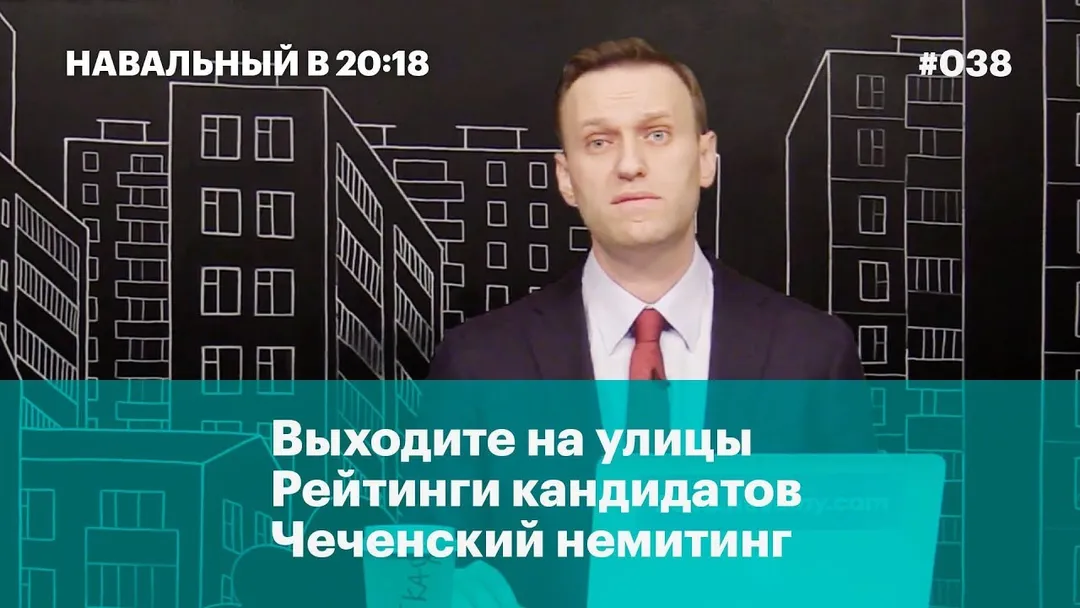
Take to the streets, candidate ratings, and the Chechen “non-rally”
[music]
[music]
[music]
[music]
[music]
Hello everyone. It's 8:18 p.m. in Moscow. Alexei Navalny is in the studio.
Navalny.
Or, as the man who supposedly longs to be
arrested—as I was literally called yesterday by the Russian representative to the European
Court of Human Rights.
Court of Human Rights.
I may well be arrested, but for now I'm
here, live on air.
Please send me your questions on
Twitter with the hashtag #Navalny2018. We'll
be discussing today's topics, and I
will be answering your questions. But to begin,
of course, I want to start with the fact that
I've been labeled that way, so that's where I'll begin.
I'll say what I very much want to say:
the most important thing right now is
what I really could be
arrested for. Yes, absolutely, I am calling on
all of you to come out to the rallies on January 28 in
Moscow and St. Petersburg.
Especially because in Moscow and
St. Petersburg, the authorities have become so brazen
that they have essentially declared that
they will never again
authorize our rallies, and instead offer us
some
completely humiliating alternatives like:
go to Sokolniki and protest in the woods.
So I want to state this absolutely clearly and plainly.
A big hello to everyone at City Hall who
just said a minute ago that
if calls to attend the January 28 rally do not stop,
they will appeal to the prosecutor's office.
Go ahead and appeal to the prosecutor's office, dear
Muscovites,
this Sunday, January 28, come out to the
protest at 2:00 p.m. on Tverskaya Street.
In St. Petersburg, come to
the wonderfully named Proletarian Dictatorship
Square at 2:00 p.m.
This is the most important thing you can
do right now. In politics, there are different things—
some more important, some less important,
different strategies, different kinds of effectiveness—but
one thing is absolutely certain:
and
it would be very hard to argue with
the view that the most important thing
every person can do right now is come out to a
protest rally. Because politics in
Russia today—where they don't let us onto the
ballot,
where the mass media won't let us in,
where it's impossible to win a court case against
an official, where even local deputies—
local deputies themselves—like Yashin and
the Krasnoselsky District council, who again applied for
Sakharov Avenue, and were denied.
Several dozen deputies
appealed to Moscow City Hall: allow
the January 28 rally—what are you doing?
But they still won't allow it. So in this
situation, when absolutely everything is forbidden to us,
the main thing every
person can do, and the most effective thing he or she can
do,
is go out into the street with a peaceful protest.
We have the right to protest, and let's
be honest: right now, all the other
things we can do—we should
write columns, of course, we can
engage in public education, we can
work on the foundations of civil society, and so
on. All of that is great, but it is also quite
secondary. If we want to achieve
results, we need to stand our ground, we
need to come out. That's how it works all over the
world, not just in Russia—even in
developed societies. I wrote about this in a post today,
and I'll repeat it: look at the United States, or
France, or the United Kingdom. Good Lord,
you'd think those people wouldn't need to go out into the
streets—they should just vote, and they
do vote. They have politicians
they nominate, and those politicians
are registered,
so it would seem there is no reason
at all to be out there in the streets doing anything. And yet
their mass media are
open, and there are many, many, many different
mechanisms for influencing public life: you
can form associations,
nonprofits, you can create
trade unions, workplace collectives, speak out
for something—and all of that happens, all of that is done. But the most important thing
is still this:
politics is made by people who go out
into the streets and declare their demands.
Only in this way will those demands
be heard, even by society itself.
Only in this way does society itself
become aware of what is actually happening within it,
of what is building up inside it.
Because, look, before our
March 26 rally, there was nothing at all in the public
conversation, on the agenda, about
young people, school students, and all the rest.
By the way, today is Student's Day (a Russian holiday also known as Tatiana's Day).
Congratulations to all students, and to all
Tatianas in particular.
Special congratulations to you. We held the rally on the 26th,
and quite a lot of
young people came out. We are proud that young people
support us. And look—Putin
suddenly started rushing around schools, and special
bloggers
are speaking in the Duma (the lower house of Russia's parliament), and whole targeted
programs are being adopted, and now Putin is making his
presidential campaign launch
not only at a factory, but also at a
gathering of volunteers, where mostly
young people were present. Everything changed. Why? Because
they saw it—this youth is here.
People took to the streets, so that’s probably what this is about.
We need to talk about it: it happened, it became
a fact of political life in 2012,
until, when we stopped taking to the
streets, all of it was rolled back. But
at first, it looked like there had been gains: it was announced that
gubernatorial elections were being brought back,
it was announced—and implemented—that
far fewer signatures would be required for presidential elections,
and that the registration process for
political parties would be almost
notification-based. It didn’t apply to everyone,
and it didn’t apply to us,
but if back then we had
held out longer—not just
for essentially one year, 2012,
but kept it going beyond that—
the consequences would have been completely different.
We just need to work persistently. This is
the political work of every individual:
to go out into the streets and demand what is yours.
If we don’t do that, we won’t achieve anything.
If you don’t come out to rallies, guys, then don’t
complain that your life is bad,
don’t complain that your salary is low,
don’t complain that awful Putin is jailing
someone over posts on VKontakte (a Russian social network), or
some film director. He does it because
he meets no resistance from society.
Society, society—they count only
rallies. Those guys in the Kremlin
—those crooks—
they only count rallies. Everything else
matters to them to a much, much lesser
degree. When pensioners came out to protest then,
against the monetization of benefits (the replacement of in-kind social benefits with cash payments),
they immediately got results. That’s exactly how it
works. And, in fact, the Kremlin itself
is making it very clear to us right now: yes, yes,
yes—this is the only thing we’re afraid of,
the only thing we take into
account. Because right now there are some
political events going on,
supposedly elections, but everything happening in
politics is the wrecking of our headquarters. I’ve
got a whole report here, but I’ll
just say that in only the last
few days we’ve had 38 real
raids on our offices, with seizures of at
least leaflets. Everywhere they’re looking for leaflets
inviting people even to authorized
events. That is, we have more than 100
cities taking part in the January 28 action,
this Sunday. In only a minimal
number of cities were we denied approval; in
95 percent of cases everything was approved. But
even leaflets for approved
events are being confiscated. Why? Because
they’re afraid. They want fewer people to show up.
It’s very important to them that the factor of
cold weather works, and the second factor is simply the lack of
information. That’s why there are real
pogrom-like attacks on our offices. You know, I’m going to
talk about this in detail—at even greater length.
A legal entity of ours was liquidated in a completely
illegal way—our legal entity,
through which we had been organizing
the voters’ strike earlier in
the campaign. Our campaign account was frozen
in a highly outrageous
manner—I’ll talk about that too. So we
have adjusted things here, and today I’m
announcing Operation Phoenix.
To bring us back, 2.3 million
rubles of your money are frozen in the account, and they
think that by doing this they’ve
eliminated our legal entity and that we won’t
be able to do anything. But, in fact, that’s exactly why
we
planned ahead and learned how to collect
donations here on YouTube.
So I set a target—I asked them to set
the target at 2.3 million rubles,
exactly the amount of money they
froze in the account. Over the course of probably
several broadcasts, of course, I
plan to raise it. So I call on all
of you to take part in this very Operation
Phoenix and show everyone that they will not succeed
in stopping us this way. The police
forces being deployed are, of course,
absolutely astonishing: dozens of police officers come,
they monitor our
activists and volunteers handing out
leaflets; entire squads follow them around,
whole squads.
You can see video now
from different cities showing how these
police raids are carried out, and it’s absolutely
astonishing. It’s not just confiscations—
there are also, of course, outright
arrests, and they are completely illegal.
They are meant simply to obstruct
the holding of our actions. Our biggest
personnel losses have been in Rostov-on-Don,
where there was a loss:
one person was given 10 days in detention,
another person 8 days. These losses are reversible,
fortunately, but even so they
are trying to derail these actions this way.
So, Rostov-on-Don, come out
without fail—this is how you answer all of this.
There are also various fines against us.
So far, the leader in detentions is
Omsk: eight people detained.
In Penza, three people. The most aggressive
administrations are in Pskov and
St. Petersburg: there, constantly, several times,
they come after our people. But we
are absolutely not afraid of this, and we
are absolutely not going to stop. And we
know and understand that if we do not
do this, if we do not
organize ourselves in order to go out
into the streets, everything will lose its meaning. Or rather,
no, that’s not quite right—by itself it won’t
lose its meaning at all, but
the effectiveness of all this will drop many times over.
By the way, remember the Coordination
Council, which many consider a rather un
successful project—the Opposition Coordination Council,
which was created in the wake of
those protest rallies in 2011.
When those rallies were taking place,
there were polls by the Public Opinion Foundation
commissioned by the Kremlin, and about which
we later learned from hacked
correspondence of Kremlin officials, who
were simply shocked that the polls at the time
their sociologists were conducting showed something like
20, 30, even 35 percent of people—and in some places almost
40 percent—were ready to vote in
elections for the Opposition Coordination Council.
Why was this happening? Because
rallies themselves change
public opinion. People sit there and
think, in whatever city they live in,
whether Omsk or Penza, “Well, here
everyone is for Putin, here everyone thinks these elections
are real elections, and I’m the only one here
in all of Omsk sitting around being clever and
thinking this isn’t really an election. But I’m alone,
so I’d better keep quiet. I feel that
if I speak up too much...” And then, bang—
a rally happens, and
several thousand people come out, a couple thousand
people, and any observer
realizes that things are not like that at all. If, in
freezing weather, under bans and
obstruction, thousands of people come out,
that means millions stand behind this idea.
So, folks,
this Sunday, come out in every city—well,
in every major city. Find the link in
the description, find your city, and join in.
Once again: Moscow, Tverskaya Street.
Any point on Tverskaya Street, from Mayakovskaya
to Manezhnaya. Come, or walk counterclockwise,
or, if you want,
if you want to gather somewhere, then at
the Mayakovsky monument.
St. Petersburg: Proletarian Dictatorship Square
also at 2:00 p.m. In
the description there’s a link—find your city there
and come. Now let’s discuss how
the big cities are going to vote.
Our polling service operates
thanks to the money that you
send us. Last time
we published the results of a nationwide
survey.
But now it’s important—very important—for us to understand
what is happening in the big cities.
Many people think—or rather, not just think,
it is partly true—that there is, broadly speaking,
this thing called Russia as a whole,
a bit backward, because there
most people mainly watch television, and television
is the main source of information.
And then there are more advanced cities. These advanced
cities ought to
vote quite differently,
in a rather distinctive way compared
with the rest of the country, and
they ought to think differently, they ought to
view elections differently, they ought to view
candidates differently.
That was very interesting to us, especially since
you and I are, broadly speaking,
the party of the big cities,
in the broadest sense of the term.
Because those who watch this program,
those who take part in our movement, are people
who live in cities and use
modern means of communication,
above all the internet. And we conducted
a survey in Yekaterinburg because it is
a typical city of over one million people.
Voting results in Yekaterinburg
are usually very similar to the results
in Moscow, and now we
will see what
Yekaterinburg tells us, and we’ll know what
the large, biggest cities generally think
about what is happening in these elections.
Let’s first look at slide
number one, about overall awareness of
the elections—how many people know about them.
Look: 91 percent. By the way,
it’s actually pretty funny.
We have an app both for
iPhone and for Android, and quite a lot of
people now—thousands of people—listen to this
program, and our channel in general, like radio, and
last time I showed slides but didn’t
read them out, and I got a lot of
indignant responses like, “Read them out! We
can’t see what you’re showing there.”
So I’ll read them out. Please bring back
the slide. So, awareness is very
high: 91 percent of people
know that there will be this
procedure that is called an election.
Eight percent have heard something about it. So
television has done its job, the electoral commission is working.
Next, we
asked residents of Yekaterinburg,
that is, residents of all major cities: whom
have they heard will be taking part
in the elections? And we see the results on
the next slide.
Ninety-one percent of people—that is,
almost everyone—know about Putin. In second
place is Sobchak, just as in
the rest of Russia: basically everyone
has heard of Putin and Sobchak; they
get a lot of airtime on television.
Zhirinovsky, Yavlinsky—and the same picture
as across the country emerged
in Yekaterinburg.
Every fourth person thinks that Zyuganov is running in the election,
and 22 percent of people think
that Mironov is running, though neither
one nor the other is actually running. But somehow people
still have that idea in their heads, so
we also asked here about Grudinin.
Grudinin is very interesting here, so let’s
look at the next slide.
We asked an open-ended question: who is running from
the CPRF (Communist Party of the Russian Federation), and 30 to 32 percent of people
say that it is Grudinin — they know correctly — but
13 percent of people still believe
that it is Zyuganov, while 51 percent
have difficulty answering and simply cannot
say who is running from the CPRF.
Let’s move on to the last two and most important
slides — the candidate ratings, essentially.
First, out of the full 100 percent of respondents.
That is, we ask:
“Who would you vote for
next Sunday if the election were held
next Sunday?” The most interesting thing
on this slide is what is written
in gray at the bottom: that possible
turnout is reported by 65 percent
of respondents. For the rest of the country
it is 75 percent. So we can see
that in large cities, already now,
10 percent fewer voters
are planning to go to the polls
than in the country as a whole. But all these figures
are inflated — people always, excuse me, lie
about their voting intentions,
because socially it is considered
the “correct” answer to say, “Yes, I will go to
the election,” even among those who
never actually go. But here we see
the same situation: Putin at 56 percent.
That is if we count from all respondents; Zhirinovsky,
Grudinin, and then further down, already within
the margin of error, Sobchak, Titov, and Yavlinsky
all have 1 percent each. And the final slide,
the most important from this point of view — on it
we see the real ratings. If
the election were held this Sunday, the big
cities — Yekaterinburg and Moscow —
would vote in fact almost exactly
the same way as the rest of the country. That
is what most
surprised me, and to be honest, these
data surprised me — they show that attitudes toward
the candidates in the largest cities are exactly
the same as in the country overall: 79 percent
support for Putin. Putin would receive 79
percent in his re-election bid.
Zhirinovsky and Grudinin would be fighting for
second and third place with results of
around — sorry — both of them at
7 percent. Then Sobchak, Titov,
and Yavlinsky are already within the margin of error, at 1
percent each, and “another politician” gets 4
percent. In other words, it is all the same. This
Putin re-election setup
leaves us with absolutely no
hope of influencing anything in these
elections. So there is no need to go there. These are
basically stand-in figures with
minimal ratings, bouncing around
around Putin and not even trying to
raise their own
ratings. We were interested
in looking at the results of an alternative
poll in the city of Yekaterinburg, because
at the same time as us, a local sociological
service was conducting a survey.
Let’s take a look at what they
measured there. We can see that their results are very similar:
they give Putin 77 percent, Grudinin 6
percent. Zhirinovsky is lower there; unlike us,
we give Zhirinovsky 7
percent, while they give him 3.8. Then
Sobchak gets 1.3 percent, Titov 1
percent, Yavlinsky 0.6. So all of this
is around 1 percent. So as we
can see — go back, please — as we can see,
the results are very similar to ours. But
very interestingly, they measured negative ratings (the share who would never vote for a candidate).
In our next poll, we will also
measure negative ratings. There are quite
interesting numbers here. This is the largest city —
Yekaterinburg — and Putin’s negative rating is 3
percent, Grudinin’s is 13 percent,
Zhirinovsky’s 32 percent,
Yavlinsky’s 24 percent, and Sobchak’s
negative rating is absolutely extraordinary.
It comes out to 80.5 percent
of people who say they would never in
their lives vote for such a
candidate. Quite interesting. Well,
in fact, this is probably
the main reason why it is specifically
Sobchak who is now being promoted on television as
the main opposition candidate,
because, obviously, these huge negative
ratings will lead to a very low
result, and then all of us will be told
how it happened that the opposition
candidate performed rather poorly. So if you want
to be part of all this,
go to the election and take part in
all the fuss around Putin’s percentages. If you want
normal elections, boycott them
and call on everyone to boycott. Demand
that all candidates be allowed to run.
Take part in the voters’ strike, and
of course, in connection with this, people write to me every
single day, and I can see that Twitter is already
full of this. Everyone says to me, “Alexei,
after all, people can come to the election and spoil
their ballots, cast invalid ballots, and
that can lower
Putin’s rating, because his percentage
is calculated from valid ballots rather than from the total
number. So why don’t we come and
vote — imagine half of all voters
showing up at the election and, in
a united burst of enthusiasm, following your powerful
appeal on the Navalny LIVE channel,
they come and spoil their ballots, drawing
crosses on them, writing obscene words,
or writing in Navalny’s name,
or drawing little faces — and that’s it, then there will be less than
50 percent for Putin. Let’s think about
how realistic that scenario is, so as not to
So I’m not just making empty claims, I even prepared some numbers for you.
I prepared them so that we can settle this
question once and for all. Let’s take a look
at how many spoiled ballots there have been in Russia’s modern history, starting in 1996.
How many spoiled ballots were there in
elections? Let’s look at this absolutely
remarkable chart. Up at the top, you can see
a dark blue line — that shows
what percentage the winner received.
That is, for 1996 we have
both the first round and the second round here — that was
Yeltsin, and everything else is Medvedev and
Putin, respectively. And below, you can see
a red line hugging the bottom of the chart,
and that is the number
of invalid ballots there were
in Russia’s modern history. Notice this:
in the first round in ’96,
there were 1 percent spoiled ballots —
1.43 percent.
In the second round, 1.05 percent of ballots were spoiled,
and at that time, by the way,
there was still a “none of the above” option on the ballot.
In 2000, fewer than 1 percent
of ballots were spoiled. In 2004 —
remember that election? It was such a dreadful
election. There were Khakamada and Glazyev,
and Malyshkin — Zhirinovsky didn’t run then,
instead it was Zhirinovsky’s bodyguard, Malyshkin — and still
the share of spoiled ballots was only
just 0.83
percent — eight-tenths of a percent,
sorry, in other words, a minimal number.
Then the “none of the above” line
was removed. And you’d think: if you remove
the “none of the above” option, people will start
spoiling ballots. But we see that in
the 2008 election, spoiled ballots still amounted to
1.36 percent. In the 2012 election,
1.16 percent, despite the fact that
many people were calling for ballots to be spoiled.
So, my friends, let’s
once and for all
settle this and not come back to it again:
the strategy of spoiling ballots does not work.
It has never worked. I can
call on you to do it, and I can
probably persuade, through our channels,
at most a million people to spoil
their ballots. But you and I will never persuade
the broad masses of people. And after all,
our task is not to operate within a single percent.
Our task is to persuade 30
percent of the population, 40 percent
of the population, to take part in something. They are not
going to spoil ballots.
If someone has already come to vote, they treat
that piece of paper, that ballot, as
something of value. It seems foolish to people
to spoil it.
I mean, it just seems absurd to come
to an election only in order to
spoil your ballot for some reason. It doesn’t work, it won’t
work anywhere, ever. So let’s close the subject.
Spoiled ballots do not achieve anything.
Of course, it would be nice if we could say:
let’s spoil ballots, and really
get big percentages that way.
But no one is going to do that except a few
activists whom I might be able to convince.
People will not do that. We will get
that same 1 percent again
of spoiled ballots, and of those
the overwhelming majority will simply be
people who made a technical mistake — voted in
two places, or otherwise
marked something incorrectly.
The ballot gets spoiled, and there will be 1 percent
of spoiled ballots. And they’ll tell us:
look, the opposition — this is what they got.
These are the percentages of those who voted for them, and
Navalny, Sobchak, and the others got around 1 percent each,
and spoiled ballots are also 1
percent. That’s their ceiling. So no,
we should not do this. The people in the Kremlin are not
idiots. When they were designing
the election so that the result would show
Putin’s vote at around 70 percent,
of course they thought about this too. There is no
clever electoral strategy
by which you and I, simply by going to the polls,
can outsmart them. In elections, there can be only one strategy:
if there is a candidate,
we vote for that candidate. If there is no
candidate, then nothing works.
There is no way we can outfox them.
We have to resist
in another way: boycott and go out
to rallies. So, that’s how it is.
Please, let’s not
discuss spoiling ballots anymore. I’m looking at our
questions now, and I see
a message from Jeffrey66 Blake:
“Please show my post. Dear
Muscovites, when you see that Alexei
is being bundled into a police van (an avtozak, a Russian prisoner transport vehicle), under no
circumstances let them take him away — surround the vehicle
and don’t let it leave.”
No, you must not do that. First of all, I am
more often detained near my home or, I don’t know,
on the way out from here. The last three
times I was arrested in advance, before
the rally. If it happens at a rally,
as it did on the 26th, do not try to
free me.
Don’t pull me out of the police van. Later on,
people were rocking the bus, pushing cars onto
the roadway — there is no need to do that.
The main goal of our rallies is mass participation.
You need to come, be there, keep moving,
so that it feels like a march. You should
be persuading people. If you
block a bus so it can’t go anywhere,
and all of that happens, people will say:
“We didn’t let Navalny go.” But the point is not Navalny.
The task is not to protect Navalny, not
to promote Navalny. These rallies have
their own purpose.
The purpose of these rallies is to demand fair
elections, so let’s focus
on getting as many people out
as possible. But don’t try to rescue me there
again—you’ll just give them an opportunity to open
a criminal case. But if they lock me up for 30
days, it’s nothing—I’ll sit it out.
Nothing will happen. You yourselves know what
to do. Inferno Overkill asks: will there be any more protests
after this? I’ve been going on for 22 minutes
and, Inferno, I still haven’t managed to get this
idea across to you. Of course there will be, because this is
the most important thing: holding rallies, bringing
people out into the streets. That’s the main thing. It’s
a fairly difficult task, especially in
Russia, especially in winter, but without it
nothing will work. So, good evening.
“Did you serve in the army?” asks
Khalifa. No, I did not serve in the army because
I had a deferment while I was at university.
That’s a very easy one to answer. So, I
did not serve in the army, just like our minister
of defense. So, hi—Volodya writes: you
said that the rally on the 28th in St. Petersburg
would be on Proletarian Dictatorship Square
in accordance with the law, but holding
an event on that square is prohibited
because it is directly adjacent
to the building where the court is located. Why not
Palace Square? Well, first of all, guys, Palace Square, by
your own logic, is outright
prohibited under your city’s
laws—rallies on Palace Square are explicitly
banned. There really was a refusal regarding Pro-
letarian Dictatorship Square because
as the judge said during the hearing,
“It’s right here nearby, and whatever you
shout there will be heard inside the court.”
That was one of the grounds for the refusal. Well then,
that means we need to gather and shout
so loudly
that inside the court they hear it
clearly and distinctly. It is impossible to ban rallies
on such grounds. We have the right
to assemble peacefully. It is guaranteed by
the Constitution, guaranteed by
the European Convention, guaranteed by
common sense—guaranteed by everything. We’re
not crazy people. We are not
planning to block off
Nevsky Prospekt (St. Petersburg’s main avenue)
or the city’s biggest streets all the time. No, we are ready
to reach a reasonable compromise with the authorities.
There are always places in central Moscow and central St. Petersburg
that are, let’s be honest, quite
suitable for residents to hold rallies.
But since they won’t give us those places, we hold them
where we think necessary. This time the strike
headquarters chose Proletarian
Dictatorship Square—so away with proletarian
dictatorship. I don’t know
St. Petersburg’s geography very well, unfortunately,
and I’m not going to give advice on that subject.
That’s a St. Petersburg decision.
Alexei, how do you feel about Ukrainians
who support you? asks Svyatoslav. I
feel positively toward everyone who
supports me. Thank you all very much for
your support. “Why, in your statistics,” asks
Saw Raz, “don’t you take into account your possible
rating in the event that you’re allowed onto the ballot?”
Do you think that with access to TV channels you could
change things significantly? As I understand it,
this means opinion polls.
We don’t include that because we still
don’t want to measure some hypothetical
scenarios. Right now there are
clear candidates who will obviously be
allowed to run in the election. There is public
opinion that sees those candidates on
television, and to include me there—or
to include, I don’t know, Harry Potter or
Voldemort—makes no
sense at all. We might get some data,
but its value would be zero.
We measure candidates’ ratings so that
you won’t be deceived, so that no one
tells you fairy tales that your
vote in this election determines
anything. It determines nothing. This is simply
a reappointment—a guaranteed Putin
70 percent. That’s why we conduct very
honest polls.
So that, overall, none of the others
can lie to you. So: only
boycott, only hardcore. Absolutely right.
After the election, will your headquarters continue
to function? Nothing will disappear, right?
Of course nothing will disappear. Nothing
can disappear, because this is not just
about premises—it’s about the people who
want to work in these headquarters.
But Putin has a high rating. Here’s
an excellent question from Transsexual
Gestalt: “Given his high rating in
your polling, that means there really are
a huge number of people
who support him.” Dear Gestalt,
of course there are a lot of people
who support Putin, absolutely
right. He has been president for many years,
he is shown on television constantly,
for 18 straight years, and even simply by force
of propaganda, many people support him.
And of course there is also
a substantial number of people who
share some of his rather crazy
views of reality. There are probably
plenty of people in your own circle
who, in response to any question,
reply with the phrase, “Have you seen the American
national debt?” There are such people, and they support
Putin. But the data we
show here is election-related, pre-election
sociology. It is Putin’s rating
specifically in a lineup with concrete
candidates. It is not Putin’s overall rating
—it is Putin’s rating in comparison with Yavlinsky.
Sobchak, Grudinin, Zhirinovsky, and Titov.
That is the whole point of the Kremlin's deception: if
there were other candidates,
including me—I am not the only candidate,
the world does not revolve around me, but all
candidates who have the right to be
allowed to run should be allowed to run. Then
compared with those candidates, Putin's rating
would be completely different.
Because those candidates—for example, I
intended to run an election
campaign, and I did run one for a year, and I would have continued to do so. I
would have driven down Putin's rating, just as I quite
effectively, together with my comrades, drove down
Sobyanin's rating back in the day.
And now we would be acting even more effectively,
because we would have had much more time.
But these people—the ones who
will now be on the ballot—are doing nothing
to bring down Putin's rating.
That is why he has
77 percent. Exactly for that reason, not because
there is some enormous nationwide
support. So, who banned *The Death of Stalin*?
There have been a great many questions on
this topic, and right now it is one of those
things everyone is discussing. You know there is
an American film called
*The Death of Stalin*, and this film was suddenly
banned by the Ministry of Culture, as
usually happens here, "at the request of working people"
(a Soviet-era stock phrase). And the Minister of Culture himself,
Medinsky, quite recently said
that they would not ban it, that it should be released.
It is just a film comedy—and now they have banned it.
Why? In children's programs—
those of you who follow my program
know why this happened: because for
several months now I have been saying here
that the main ideological
pillar of Putin's regime is becoming
this endless search for reasons to be offended. They are always looking for
some pretext
to take offense and feel insulted; they invent such a
pretext if none exists, and then
go on about their offended
feelings. We have already seen deputies and,
good Lord, some granddaughter of—
or grandson of—Khrushchev living in the United States,
a granddaughter, I do not remember, a granddaughter of Khrushchev or a grandson
of someone else—in short, some great-grandchildren and
grandchildren of Stalin and Khrushchev, for some reason living
in the United States, declared that they were of course offended.
And State Duma deputies are offended, and some
other people are offended, so the film
was banned. Today it was shown at the
Pioner cinema, in violation of some
some
rules, without a distribution license.
Some are admiring them—what a great job by
the Pioner cinema, really, well done.
The Ministry of Culture, having already dropped everything else,
is declaring: we will punish the
Pioner cinema.
They supposedly had no right to show it. But this is not as if
they screened a pornographic film
or something like that—they showed a perfectly normal
feature-length film that is being shown all over
the world. They are endlessly looking
for something to be offended by. Today the subject of their
offense is a film about Stalin's death. But I
wanted to say something else. A lot has already been
said and discussed about this; it is all clear enough that this
would happen. What interested me was
to see who exactly was offended—who
are, formally, these people who
came out before all of us, before 143 or 145
million people, and said: we are so offended
that none of you will be allowed to watch this either,
because it will offend you too. Look at
us—we are your representatives. It was some kind of
public committee under the
Ministry of Culture, where there are
all sorts of different people.
Most of them are rather strange. I
looked through the list of who these offended people were, and
whether it really looked like these were the people
who were so deeply troubled by this issue, and
I saw
the name of Igor Ugolnikov, for example. Those of
you who are older may remember that in the 1990s
there was a show called *Oba-Na! Ugol Show*; back then
it was fairly funny. I watched it then;
if you watch those episodes now,
to be honest, it looks a bit like
trash. But it is precisely Igor Ugolnikov,
who used to put out such
risky sketches, who is now, on our behalf,
speaking in our name,
claiming to be offended by the film *The Death of Stalin*. Let us
take a look: if Ugolnikov says
that we cannot insult leader Stalin,
then first I want to show a little excerpt
from one of his sketches from the 1990s about an even
greater figure, from the point of view of recent Russian
history: Comrade Lenin.
[music]
Excuse me, sir... good... gentlemen...
mushrooms... running... sitting... we with you...
comrades.
Organic—well, actually, liability...
limited liability—no, not
foreign, but limited
liability. What a funny sailor. I am
a soldier—it is all the same damn thing. Do not lie. No, no, no.
But a sympathizer—that is what I want...
And what, here out of necessity?
Out of necessity. Nothing, nothing, nothing, nothing.
Comrade, someday there will come a
moment when working people will not
be in need—whether small need or great need.
You see, not so long ago Igor Ugolnikov,
putting on a little beard and mustache and a cap,
was portraying Lenin, and there were these kinds of
toilet-humor jokes, and everything was
just fine. No one paid any attention to it.
By and large, no one cared. But now
several years have passed, and
Igor Ugolnikov realized and understood that you shouldn't
laugh at Dozhd (TV Rain, an independent Russian TV channel). Well then, why didn't you also
delete your Troshova and all those jokes
from YouTube? And if it's all so offensive, then you
thank you very much for preserving it and saving us from
a terrible film, but then please
save us from your own work.
That stopped being interesting several years ago.
As for Igor Ugolnikov, at the same time
he believes he was doing something right
and that he can sit on the public council
under the Ministry of Culture, and he
on our behalf
decided to take offense, decided for us
to determine what we should watch and what we shouldn't.
An even more astonishing character
declared that she was offended,
and therefore we would not get to see the film *The Death of Stalin*.
This is Sabina Tsvetkova. Right now you
can see her photo.
Guess who is in this photograph. This is
a person who sits on the public council
of Russia's Ministry of Culture on behalf of
the organization
"Officers of Russia." So before you stands
an "Officer of Russia" who, in your name,
does something or other at the Ministry of
Culture and, in your name, declares
that we do not want to watch the film
*The Death of Stalin*. There is such an organization,
"Officers of Russia," headed by a man
named Anton Tsvetkov. I don't know, I
strongly doubt that he was ever actually
in the military or that he is
an officer of Russia, though maybe he was. For
me, an officer of Russia is my father, who
served in the army his whole life, or my
classmates, all of whom—please put Tsvetkova back on screen—
especially Tsvetkova.
Or my classmates, all of whom serve
in the armed forces.
But for the state, for the Ministry of
Culture,
an "Officer of Russia" is Anton
Tsvetkov's wife,
the man who founded the organization "Officers
of Russia," and now this wife, on behalf of
the officers, tells us: you, Navalny,
and you, Ivanov, and all the rest of you, you will not
be watching *The Death of Stalin*
because that's what I decided.
So how else are we supposed to fight this?
You could fight it through parliament, and if we got
into the Duma (the lower house of Russia's parliament), we'd get rid of all these
so-called public councils, pass a law saying they are
not needed at all,
or else the mass media
—and in the mass media
they would be torn apart—or else
through the courts. We would sue this idiocy and
have the actions of the Ministry of
Culture declared illegal. They are obviously
illegal: they simply took away the film's distribution
license. We can't do that right now.
What we can do is take part in street
actions; we must take part in them.
That is why, among other reasons,
on the 28th, on Sunday, we need to go out into the streets.
Right now we have about—how much is it—146,
144 thousand rubles; we've raised 148 thousand
rubles as part of Operation
Phoenix. Let me remind those who have just
joined us: 2.3 million rubles
have been illegally frozen in the account
of our organization—the money you donated.
Over the course of several broadcasts, I will
try to raise exactly the same amount in order
to show that they will not succeed in
destroying our organization and
cutting off fundraising: I can also do it through
YouTube.
I'll still be able to raise something. Let's see what you're asking me here.
Let's see what you're asking me.
All right, there are a lot of jokes here about the film, and about this
"Officer of Russia," and about a vacation in Bali with
the hashtag "fairytale Bali"—Alexei,
a lot of people ask me:
does anyone know why the war in Syria is happening?
A gas pipeline from Qatar and so on—why are you
silent about it? Guys, that's complete nonsense.
There is a lot of speculation out there
that the war in Syria is being fought so that
some pipeline can carry gas from Qatar, but that's not
what it's about. Read up on it—there are
much
more interesting articles. That is not why
the war in Syria is happening. So, here is a photograph
of Putin naked and half-naked while
bathing. Well, I won't comment too much on it.
If he wants to bathe, let him bathe.
I don't know—whether in warm water or
cold water, what difference does it make? But many people
bathe in an ice hole (a traditional Epiphany practice in Russia); that already has little
to do with Orthodoxy—it's simply
a tradition. But thank God, at least they don't bathe his mustache.
So what will we achieve with a boycott? Well,
Putin will become president, and nothing will
change.
"Nothing will change," asks Shamil Khanov.
Shamil, this is not a guess.
There will be the election on the 18th—the so-called election on March 18.
It will lead to Putin
reappointing himself for the next six
years with a result of more than 70 percent. We
are boycotting the election in order
to show that we do not want to recognize this as
an election. We do not recognize as an election
a procedure in which candidates are not allowed to run. We
will criticize it, and we will call on everyone
not to recognize these
results. You have,
Shamil, the right not to recognize the results and
not to recognize this government if you did not go
to vote—there is no liar's vote in it—if from the very
beginning you said that this was a fake, not
an election. That is exactly what we are doing. A boycott by itself—
let me put it this way—
if we just say for a year that we're boycotting, then what?
Will this change whether it all collapses tomorrow?
Will Putin's regime collapse on March 19?
The answer is no, it will not. On March 19, Putin
will begin preparing for the inauguration and hold it
sometime around March 20.
There will be some new kind of red carpet,
soldiers with rifles will be standing nearby, and he will
go on talking about how wonderfully he
will spend another six years correcting the mistakes
of previous presidents, as if
the previous president—and the one before that, and before that—
had not been Putin himself.
Of course that is what will happen. Our boycott is
a political act of refusing to recognize
this sham as an election. If you recognize these elections, then
you recognize them; not going will be
your personal political struggle.
Danil Logachev asks: what should you do if
your parents will not let you go to the rally on January 28,
but you really want to?
Well, in cases like this I usually say:
if you are not allowed to, but you really want to, then you can. Danil,
it all depends on how old you are, after all.
Still, yes, if
you are at an age when your parents' ban
from your parents
plays a significant role, then you should
of course obey your parents. But I would
start by trying to persuade them.
Show them this program, show them
the rallies that have taken place in your city,
show them that in reality these events are almost
always completely safe. Yes, of course, there are
administrative detentions, certainly. I myself am
constantly detained, but okay,
they detain me, yet here I am sitting
here in front of you all the same. So just talk to
your parents, or better yet, bring them with you.
Parents and children together can
take part in this rally, and parents
will see for themselves that there is nothing
terrible about it. And on the subject of rallies,
parents, arrests, and so on, many people
have asked me how my trip to
the European Court of Human Rights
went. It went well. The main question being decided there
was this:
whether the arrests
I was subjected to at rallies
—there were several arrests and detentions—
seven episodes in five cases—should be recognized
as political. That is, those cases themselves
I have already won, and my lawyer and I—
many thanks to him—on all these
cases will receive compensation. In other words,
they have already been recognized, and the notorious
€10,000 for each arrest
has already been awarded because these arrests were recognized as unlawful.
That means Navalny was unlawfully detained.
For us now, it is very important that the court
officially recognize that this was done
for political reasons. Even though
it is obvious to everyone sitting here in
Russia that this kind of thing happens
for political reasons, it still has not yet been
recognized by a court. And the European Court
is extremely reluctant when it comes to
the idea of recognizing one case or another
as political. The last time
a Russian case was recognized
as political, and the so-called
Article 18 was applied, was in the Gusinsky case
(Vladimir Gusinsky, a Russian media owner). That was back in 2003,
many, many years ago. Since that
time, Article 18 has not been applied in a single case.
There is a major debate underway in
the European Court about whether this can
be done or not, and I attended a hearing
of the so-called Grand Chamber. This is
a fairly rare event for a country.
Over 20 years, Russia has appeared before the Grand Chamber only about 20 times,
and now this is
one of those hearings. There are many judges there,
it is very solemn, very interesting.
It is also quite stressful—you have to prepare.
It was very interesting for me to be there.
I am 41 years old, I am a lawyer, but this was
one of the very few times when I found myself in
a genuinely fair court. I am in court
all the time in different roles:
as a defendant, as
a defense lawyer, and as a witness—many,
many, many times. But in a fair court
I have found myself only one of the first times
in my life. Of course, that makes
a huge impression. In fact,
everything depends on you, on your position,
on your lawyers, on how well
you have built your case.
The judges really are independent people whom no one
can simply call on the phone.
It is a very solemn procedure.
Of course, it is very, very interesting. Unfortunately,
the decision will not come soon. People keep asking me,
'So what, the hearing has already
taken place—where is the decision, have they already handed you the papers?
Well, if it happens
in, say, nine months, that will be very
fast. So we estimate roughly
that it will take no less—absolutely no less—
than a year. We hope to win. The Russian Federation
is resisting very fiercely,
taking a very
aggressive position. Their representative there
said that I am a person
who likes being
arrested. He literally argued that everything
is wonderful with rallies in our country, that they are always
allowed all the time, and that they themselves
refuse to do everything properly, while everything in our country
is very good and very liberal.
Anyone who wants has the right to hold
their own rallies. And they were presenting
this with not even a legal but a political approach,
spreading their brazen propaganda
even in the European Court.
We will see how it ends, but we
of course hope to win, and we believe that
The law is on our side.
This will be very important for everyone
in subsequent cases if we reach the point
where the European Court, for the first time in
many, many years, once again recognizes Article 18.
Then, presumably, in other similar cases it
will continue to be recognized. Today we are raising
money for the Phoenix operation headquarters
in order to compensate for what
was, in effect, taken from us
stolen by officers of the FSB (Russia’s Federal Security Service), by employees of the
Ministry of Justice, and, unfortunately, by those at Alfa
Bank who joined them. Let me say a little about this
because there have been a lot of questions.
So, when we started running
the election campaign—well, obviously, I was
the candidate. When you open campaign offices in
the regions, you can’t open them
in your own name. I can’t sit there
signing a million contracts.
We set up a special legal entity
which, under the name Fifth Season Foundation,
was fully legal and operating
throughout that entire period, and it was through it that we
signed all these contracts, hired
people, and printed leaflets.
It was the legal entity through which
we did everything. When we
launched our voters’ strike,
the Kremlin got terribly frightened.
It saw that our
headquarters were not dispersing; they were filled with highly
motivated people who could not
simply be switched off by saying,
“We won’t let Navalny run in the election.” They had expected
that everyone would just go home, but instead everyone
said no, we will still go out, we will all
continue to speak out, we refuse
to recognize this as an election, and we will carry on
with the strike. So of course they decided
simply to shut down this foundation in order
to destroy our organizational base.
That does happen now—well, they are
generally trying to shut down
non-profit organizations in particular.
But usually, in virtually 100 percent of cases,
this is a process that takes
months—months. More than that,
the legislation is structured so that
we have at least a month. But look: the court
issues a decision to liquidate the Fifth Season Foundation,
and then one month is given
for an appeal. During that month,
the decision does not enter into legal force, which means
nothing can be done. We
can still continue working, and on appeal
such a decision may be upheld, but obviously
that would only liquidate it after a month. But what
did these crooks do? The bailiffs
acted on a decision that had not entered
into legal force, rushed in, and imposed
a freeze—and Alfa-Bank tells us
that, you know, your account with
2.5 million rubles (about $40,000 at the time), we
have blocked. And what is especially interesting about the block is that
they block it and then
write that the debt on this account is 1 trillion
rubles—as if to say, if you happen to have 1 trillion
rubles, deposit it and then everything will work again.
It was a pretty mocking situation.
It was absolutely illegal. That is,
there simply was no court decision in force, and on the basis of
a non-existent court decision, the bailiffs
blocked our accounts, while the banks
carried out these illegal orders. It would have been
very interesting to get some kind of
comment from Alfa-Bank in general.
It is a major bank, and, well,
it is interesting how easy it turned out to be:
the FSB wanted it, sent a piece of paper to
the Ministry of Justice, and the account was frozen.
Completely illegally. We may be a small
organization, but exactly the same thing can be done
to a big company, a large bank,
to anyone at all. You can, basically,
come tomorrow
and freeze 1 billion rubles
simply because someone feels like it, without
any court decision. And it was interesting
to hear Alfa-Bank’s comment, and
one of its deputy executives, Oleg Sysuyev,
shared his personal view
on the air of Echo of Moscow (a Russian radio station). Let’s
listen. “The other issue here is that, for me as a person,
it raises, so to speak,
serious doubts that this decision
was really adopted and then, within a day,
made its way from the court without the proper
formal issuance of the ruling. In fact,
the affected party in this case
somehow got it to the bailiffs very quickly,
and the bailiffs
at crazy speed delivered
the order to four banks.
That is an astonishing speed,”
he said. Well, there you have it:
even an Alfa-Bank executive,
though he said he was speaking in a personal
capacity, expressed, very mildly,
his bewilderment at how this could have happened so quickly,
how it could be that—just like that—the account was blocked.
Any of you who has dealt with the bailiff service
knows that these are people who
take months to enforce decisions,
years to enforce decisions. You generally
cannot get anything out of them. You go there to
see some miserable bailiff,
and a typical bailiff is
someone sitting there next to
a stack of files this thick,
all enforcement proceedings,
and he does nothing. If you
want to recover money from someone, unless you
bring him a bribe, he will not even
lift a finger. And in our case,
there is no court decision in force, yet everything is already
blocked. So there it is—even Alfa-Bank
admits that this looks very strange.
So the position is basically this: where are we supposed to go?
We have no choice — we have to comply, you understand, we...
more or less understand that this is illegal,
more or less understand that it’s a scam,
but we still have to carry it out. What kind of development can there be,
what kind of investment attraction can there be,
when anyone looking at our case can see
from our example that even
if you open an account at some bank
that falls into the top reliability category,
and some jerk there doesn’t like something,
or you do something they don’t like, then they...
You come to the bank, and all your money
has been frozen — and there isn’t even a court ruling. And that’s not all:
then you try to fight it, try to sue, and...
I mean, I was reading about this —
the Civil Procedure Code, and you...
you read it and realize: arbitration cases,
criminal cases — and this is impossible,
legally, it just can’t be done. But there it is,
the money is frozen just like that. So far we’ve raised almost 200,000 rubles
(about $2,200) as part of Operation
Phoenix. We’re trying to raise these 2
million 300 thousand rubles (about $25,000), which were
illegally frozen, in order to once again
send a big hello to Vladimir
Putin and say that he will not succeed
in cutting off our funding as long as
there are people who support us.
About the Chechen rally — let me
tell you. You remember there was this
remarkable story back during those
events in Burma (Myanmar), which really
did appear to be genocide and
the Muslim population was being slaughtered,
and there was this wave of outrage
all over the world. But for some reason, a separate
outburst of outrage emerged in
the Chechen Republic, and by the way,
it appeared and then disappeared just as suddenly.
They were making statements like, well,
we’ll even go fight in Burma, we’ll seize it,
we’ll destroy it, and so on. So first they
were outraged, made a scene, and then
it all just vanished. Apparently
the Foreign Ministry or
the Kremlin told them, basically, calm down,
this is none of your business. But as part of all this, there was
this amazing episode — a sudden,
spontaneous
rally outside the embassy in Moscow, which
was initiated precisely by the leadership
of the Chechen Republic, saying: come on,
all Muslims — I think it was
the Chechen leadership — come on,
Muslims, go to the Burmese embassy
and protest.
And there was a completely astonishing
moment there. Let’s
just refresh your memory — let’s watch 32
seconds here.
[music]
[music]
[music]
Well, what do you think — does this look like a rally?
It certainly does: people are chanting,
saying things, and even a police officer is shouting,
“Citizens, disperse.” Let me make this clear:
regardless of what they were discussing at
the rally, they had every right to
do it. These people — Muslims,
Chechens, Dagestanis, whoever —
have every right to file an application and
then go out and hold a rally. In this
case, there was no application at all, and under
Russian law this was
a typical unauthorized protest. But in my
view, they had every
right to do it. They can come out — preferably without
blocking the roadway — and express
their protest. But what interests us
is that we compare this to ourselves. Look:
in the city center they blocked
the street, the police are shouting at them, and they’re not
listening — and yet there are no detentions, nothing at all.
Everything is perfectly fine and proper, while I get locked up for
25 or 30 days just for this broadcast.
So we wrote to the prosecutor’s office:
hello, prosecutor’s office, explain to us — how
can this happen? Why is it that
we get jailed for this all the time, while here
nothing at all happens? And the other day we received
a reply from the prosecutor’s office — absolutely
astonishing. I’ll show it to you full
screen.
They inform us that this was not a rally,
because no notification for a rally
had even been submitted, so therefore
there was, strictly speaking, no rally, no violation
of public order — in fact, nothing at all
happened. And a rally is only a rally
if a notification is submitted. That is,
if I were to call on you, without submitting any notification,
to come out onto Tverskaya Street,
then apparently there would be no problem at all, nobody would
be detained, and the prosecutor’s office
would react exactly like this. So
you see what vile, brazen
crooks they are. They could at least have lied differently,
could have said something else — could have said:
it was unauthorized; we believe this
was an unauthorized event,
but it ended without any serious consequences,
and so, all right. In general, they
should have said: we don’t see any particular problem here.
What were the consequences? Well, there was a traffic jam,
fine, a traffic jam — but they didn’t cause anything worse,
they didn’t kill anyone, they shouted a bit,
and honestly it didn’t look all that great
for an ordinary Muscovite walking by,
but nobody died because of it, and there was no need
to detain anyone or jail anyone. That’s what they should
have written to us. What lying
frauds they are — and this is the prosecutor’s office,
the very prosecutor’s office that Moscow City Hall is right now
saying to Navalny:
if you keep calling on people to come out, we’ll
report you to the prosecutor’s office. There you go.
So the prosecutor's office can do absolutely anything, then.
Okay, what exactly is your complaint against me? But you...
Just look at this—tomorrow it's the prosecutor's office, after all.
This disgusting lie will be directed at me.
You have no right to issue a warning,
you have no right, Alexei, to do this.
And if you do go out into the street on the 28th after all,
we will take appropriate measures against you.
Measures? Go ahead and take them.
Whatever measures you deem appropriate—but I will not stop
doing this, because I do not want to live in
a country where this kind of thing happens, where
it is plainly obvious that there are two classes of people:
some are allowed everything. Kadyrov (head of Chechnya) decided to hold
a rally—please, go right ahead, no problem at all.
But if you are against corruption, or
against the fact that candidates are being barred from
elections, against this sham,
then we will ban everything for you. You are not even considered
people here—you are nobody. So let's come out
on the 28th—
Sunday, January 28. Rallies will take place across
the whole country. Let us come out and show that no—we
do exist. We refuse to accept that
we are nobody. And until you begin to
take our interests into account, we will
keep going out into the streets. This is the
most important thing, and right now nothing is more important
than doing this. See you on Sunday.
Moscow: 2:00 p.m. on the 28th, on Tverskaya Street.
Street.
St. Petersburg: Proletarian Dictatorship Square.
In all other cities,
check the description—the link is in the description of this
video. Find your city and come out. See you
on Sunday. Happiness will win.
[music]