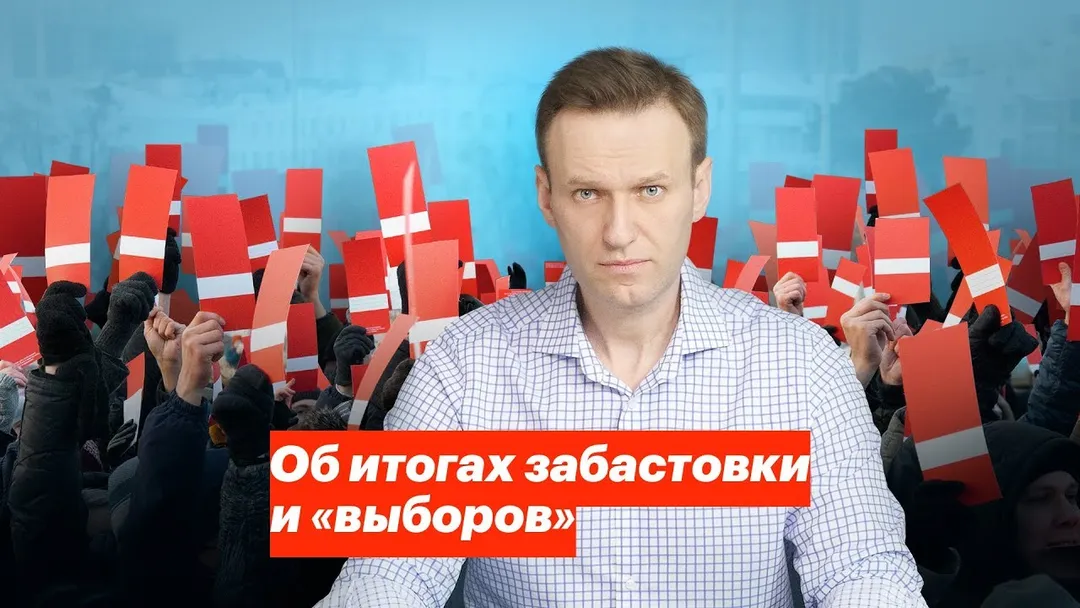
On the results of the strike and the “election”
Hi, this is Navalny. Well then, let's
talk about what we ended up with after
these 15 months since the moment when
I announced that I would take part in this election.
Putin got scared and barred me from running.
After that, you and I called for
a voters' strike and a boycott of these
elections. The voting was the day before yesterday, and yesterday
almost 100 percent of the ballots were counted.
So now we have the numbers, and the most
important question is this:
was the voters' strike effective? And my
answer is, of course, yes. And here you
ask me: how can that be, Alexei, when in
the last election
turnout was 65 percent, while this
time it was 67.5 percent—
that is, higher. Explain that to us.
How can you call that a success?
I'll explain. First, our strike was
successful because it turned out to matter more than
the election itself. That was the main
political confrontation. It wasn't Putin
competing with the puppets he
had put forward himself—that interested no one at all.
But you and I predicted many
months ago what the percentage
result of the vote would be. It couldn't have been
any different: Putin would get between 73 and 76
percent—that was my forecast. They would announce to you
that Putin had become president and received
something like 73 percent, 74 percent—more than 70 percent.
So what was the real political struggle? You and I
said: this is not an election, and we do not
recognize it. We will not go, and we will
campaign against it among everyone around us. And
Putin said to us: oh really? Then I will drag people there
by their ears, by their arms, by their legs—everyone.
I'll scare all the state employees and all the students. I will
hold school referendums,
parent meetings on Sundays, so that
children would bring their parents to the polling stations. Under
threat of dismissal, all
employees of state enterprises will go vote,
utility workers, postal workers—basically
everyone we can force, we will force.
And the whole country watched as in the last
months people really were being dragged to the polls
by the ears—from military personnel to priests (Russian Orthodox clergy),
everyone was made to come.
"I would like to call on
everyone, including Orthodox believers,
who at times may have had reservations
about the elections themselves, to take
part in the election. We absolutely must
take part in order to make
our contribution
to shaping the future of our country." From
every loudspeaker, the message was: come to
the election. On top of that, the entire state machine
came down on the headquarters of our strike. We had
arrests and seizures every day—
searches, confiscations, arrests. They were all focused
on those who had become
involved in it at that moment, or who were here in
those places where they were setting things up—and only
this was what mattered:
the outcome of the confrontation between you and me and
the Kremlin.
Second, now let's look at the numbers.
How did they—so big, so powerful, so
strong—manage to defeat us, so
small and weak? And right away
a question arises:
Vladimir Vladimirovich Putin, why did you
eat several million people? No, I'm
serious—I'm not joking. Look:
in the 2012 presidential election,
the voter rolls listed 110
million people. After that,
Crimea was annexed, adding 1.8 million
voters.
Plus, according to official data, Russia
granted citizenship to at least 600,000
adult people—mostly
migrants, our neighbors from Central Asia and
Ukraine. Plus,
every year, in every major
speech, Putin tells us that
Russia's population is growing
thanks to his wise policies, that our
demographic programs
have proven their effectiveness, and that we
will continue them.
"We managed to reverse the negative
demographic trends,
we managed to smooth out the effects of two
very severe demographic slumps that overlapped
one another.
"Our demographic policy has proven
its effectiveness." So that means that on
March 18, the voter rolls should have contained
at least 112
million people, and most likely more,
since the population was supposedly growing. And what do we
see in the final protocol of the Central
Election Commission? 109 million people—that is,
one million fewer than there were in the previous
presidential election. So where are the Crimeans?
Where are the migrants? Where is the population
growth?
So either Putin literally ate all
those people, or our dear little Russia
is dying out at record speed, or
the Central Election Commission falsified this figure in order
to reduce the number of
voters and thereby increase turnout.
Third: fraud and ballot stuffing. I could
show you these videos for a long time—
all of YouTube is full of them.
But you and I sent observers to
the North Caucasus, even to Chechnya, and there
we saw everything. Here's a typical situation:
polling station No. 427 in the city of Grozny—there are
our observers there, and turnout is 34
percent of voters in total. But polling station
No. 428, right nearby—there is no
observer from us there, and turnout is
96.4 percent, and across the whole country, we
deployed more than 33,000 observers,
and they simply sat there and counted. And so we
can see that in Tatarstan, the real turnout
as actually counted was 60 percent, while on
paper it was 74. In Mordovia, the real turnout
was 53 percent, but on paper it was 78.
In Dagestan, through real
observers, we counted 39 percent, while on paper
it was 87.4. For the first time in the country’s history,
it was completely unclear where as many as 6
million people suddenly appeared who wanted
to vote somewhere other than their place of registration
instead. You remember, we conducted
an experiment
and showed that this system
allows one person to vote
many times.
The Central Election Commission, of course, denied it,
but after the election, candidate Grudinin even
admitted that Navalny had been right, and they
recorded the same thing. Unfortunately,
Navalny was right, and voting
two or three times is possible, and we have such
examples in the Moscow region.
I repeat: the vote count, and indeed the entire
election procedure, was dishonest.
And what are these 6 million
virtual souls? That is 5 percent of the total
number of voters, and
of those who voted, it is a full 8
percent. A colossal figure, that’s all.
Take away what was obviously stuffed in, and you
will see that our strike was quite
successful: millions of people, on principle,
refused to go to the polls because they
did not recognize them, and Putin was once again forced
to falsify the results, because in a fair contest
he cannot stand against us. But most importantly,
what we have now, which we did not have
15 months ago, is each other. During this time,
we have created a living, powerful, and
unified political network across the entire country,
with more than 80 branches and tens of thousands of people
working in it.
We deployed observers—not just
more than all the other
presidential candidates combined, but
10 times more than all of them put together,
the presidential candidates.
And we did this under conditions of
pressure and intimidation, under conditions
of no funding. After all, you and I
raise the money ourselves, without oligarchs
and without state budget funds. They do not
recognize us, they push us out, they call us
the non-systemic opposition, but even so, we
are the biggest political force
in the country. No one should be confused or deceived
by this 76 percent for
Putin. It does not mean that Putin is very
popular. It means only that
Russia is, unfortunately, a poor, lagging, and
degrading country, and in all such
countries you will see presidents
with approval ratings even higher than
Putin’s. Almost the entire former Soviet Union is
like that, all of Africa is like that—wherever you
look, some kind of crook is sitting in power,
but that crook of a leader gets 90
percent in elections and stays in power for 20 years.
Look, in the Samara region right now,
Putin got 76 percent. And there was once
a governor, Merkushkin, a deranged
crazy old man—we made an investigation about him—
and he was getting
91 percent there. So what, are we now
supposed to recognize Merkushkin as
Russia’s national leader, the most
popular politician of our time? Of course
not. He is simply a crook, a thief, and a falsifier.
He was removed from office, and now
no one even remembers him anymore. And with
Putin it is exactly the same: people simply do not
see an alternative. For years, the TV propaganda machine
has been washing their brains:
only Putin, only Putin, only Putin.
Without Putin, the whole country falls apart.
In any case, Putin has a champion-level
approval rating, and I must say quite openly,
like a patriarch
who is called upon to speak the truth, that
an enormous role in correcting this
distortion in our history was played personally by
him. But they believe it, because their
only source of information is
television. Over these 15 months, you and I
have grown stronger, there are more of us, and we
have learned to solve complex, large-scale
tasks. These elections, in essence, were
just one episode in our shared struggle—
our struggle for a normal state where
people can live and work the way they live and
work in developed countries. And only we
can stand up to this Koschei (an evil, deathless villain from Slavic folklore)
who is dragging us into poverty, who
is turning Russia into a Third World country
simply in order to stay in power,
steal, and receive this very
phony percentage.
[music]
I want to say a huge thank you to everyone who
took part in our campaign in any way,
who campaigned, supported us, spread the word
on social media,
donated money, or worked as an observer.
You are amazing, and you are the best people in this country. But I
am not saying goodbye, because we will not
stop our work for even a minute.
From elections to rallies, from investigations
to court cases, we will do everything
to turn our country into the Beautiful
Russia of the Future.
