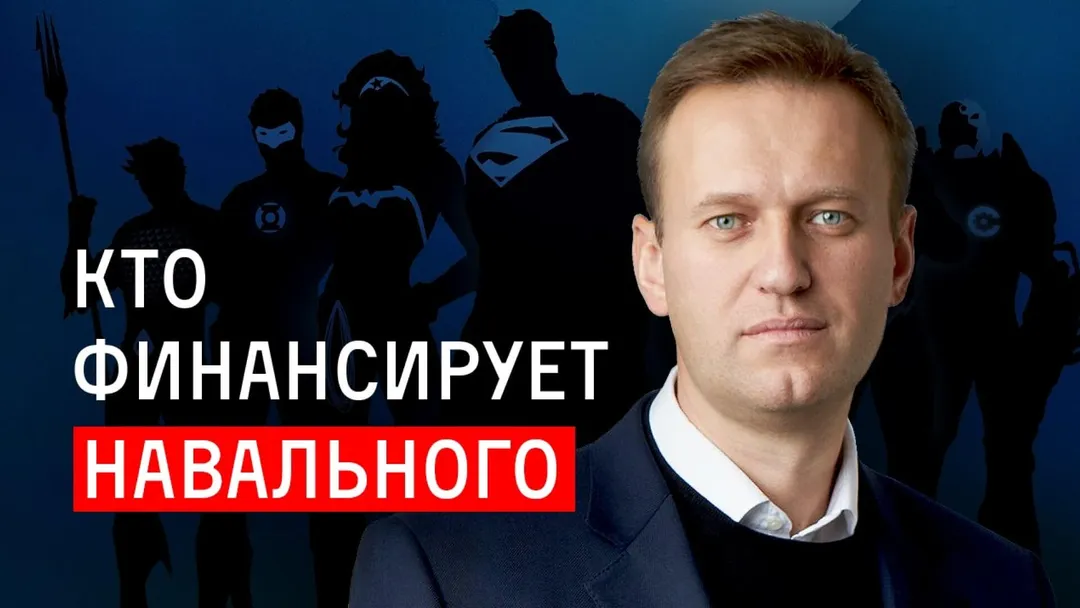
Who Funds Navalny
Navalny, you sure do love counting other people's money.
You go after Putin's daughter and her foundation, but
then tell us where the money for
your foundation comes from. Who is financing this
fight against corruption, and why? I've gotten the
impression that even in the Kremlin, especially in
the government, there are two towers (a Russian political metaphor for rival power factions), and one
tower is working together with American
intelligence services on behalf of Mr. Navalny.
There are lots of comments like that under our post
"How does the foundation
Innopraktika, owned by the younger
daughter of Vladimir Putin, make money?" And you know,
I noticed something: it wasn't just
some Kremlin trolls asking this,
but perfectly ordinary people too. They ask a
reasonable question: well, you're constantly
criticizing the authorities and denouncing them in the strongest
terms, doing investigations. But how
is it that anyone in Russia today isn't afraid to give
money for that? And anyway, Navalny, do you have the nerve
to tell us everything?
So now I'll tell you about the financial side of the FBK's (Anti-Corruption Foundation's)
fight against corruption, in full
detail. And by the way, these are very useful
tips on how to find money, and
personally I'll be very glad if you
can use them too somewhere in
your own city to finance
some useful project of your own.
First, let's figure out what exactly we need
to finance. The Anti-Corruption Foundation is
an official nonprofit
organization registered under
Russian law. We have an office in
Moscow, near the Avtozavodskaya metro station, and in that
office people work; all of them, with their names
and photos, can be seen on our
website. It's no secret at all. We don't have any secret
employees. To pay
salaries and rent, as you understand, we
need money. We need money, money,
money, and quite a lot of it—millions of rubles.
We raise it in the following ways, and
here is rule number one for anyone
who wants to raise money: you have to
just ask people directly, in plain
language. "People, I'm doing useful work. I
need money. Give me money." For
that purpose I have a special
magic red button, and it appears at the
end of every one of my posts, and I constantly
urge everyone to click it as
often as possible. And besides that button, I also often
simply write at the end of important
posts that we need money, that we
are raising money, and without your money
there will be no more investigations. And if
someone liked our investigation,
we immediately go, "Hey, maybe you can
give us some money?" That's exactly how
a post about Deputy Prime Minister Shuvalov's dogs
brought us
156,000 rubles. A post about my lawsuit against
Vladimir Putin raised 270,000 rubles, and
our investigation last year into
the corrupt family of Prosecutor General
Chaika was a record-breaker and brought in, in
the very first day alone, 1.55 million rubles, and then
the same amount again over the course of the month, even though
filming the Chaika documentary cost us only
250,000 rubles. In other words, we exposed the crook Chaika
with our film and raised
2.7 million rubles from it. Hollywood.
[music]
Second—and you can do this too—
a substantial amount of money comes to us
from our monthly mailings. That is,
once a month we send emails
to about 160,000 people and tell them:
over the past month we've done the following
work, here's our report, give us money
to keep our organization running. And people
do give. For example, last month we
raised 600,000 rubles that way; the
month before that, 400,000 rubles. The figures vary depending
on how good
an email we wrote. Third, and probably
most important for us, are the so-
called
recurring donations. People go to our
favorite section of the FBK website and tick
a special box saying they will make us
regular donations. That means they
automatically send us a little money every month
from their account, and that is our
stable income, and we are constantly
encouraging everyone to do it,
because obviously it's easier for us
to plan our budget if we know
what amount is guaranteed to come in
next month. Now let's
look at the real numbers—they're always
more interesting. At the time this
video was released,
2,844 people were making monthly
automatic donations to us, and from that
we were raising about 1 million rubles per
month. That is our main treasure.
Another treasure is the 2,079 people
who donate to us from time
to time this year, when they
liked one of my posts, or when
the current authorities had gotten on their nerves, or they just
were in a good
mood. How much money do they send on
average? I'll tell you that too. The arithmetic
mean donation size for us
is 720 rubles, while the so-called median
donation—those who were good at math
in school will understand—is 500
rubles. So as you can see, these are fairly
small amounts; it's just that thousands of people
from all over the country send them to us, and that is exactly what gives
the FBK complete independence. No one can
dictate to us or give us recommendations about
what to investigate and what not to, or whom
We decide for ourselves whom to criticize and whom to stay silent about.
We have quite few large donors.
And right now there is only one person
who sends us 50,000 rubles a month
rubles; one person sends us every month
100,000 rubles, and one person every month
sends 300,000 rubles. Good for them.
Thank you
very much. In 2013, we raised
24 million rubles; in 2014, 32 million rubles; in
2015, 39 million rubles. And now in
2016, which still has not
ended yet, we have already raised 39 million rubles so far.
This is the money the anti-corruption campaigners live on.
In the description to this video, there is a link to
our annual report. It explains in quite a lot of detail
exactly what we spend the money on. Our top
three expense categories look like this: 45%
of the money goes to salaries. The average salary
for employees at the foundation is 67,000 rubles
a month. You made me laugh. Another 25% is eaten up by
office expenses: rent and utilities.
12% goes to taxes, mainly payroll taxes, which
we pay very carefully, as a law-
abiding organization, I should note. By the way,
it is not only us who publish reports on FBK's activities
but also the Ministry of Justice, an organization
that is definitely hostile to us, so you can
double-check all our figures there as well.
Many of you probably want to ask
whether we can use PayPal in our work,
WebMoney, Bitcoin, and all sorts of other
cool things. Unfortunately, to our great
regret, we cannot do that because of
the idiotic law on foreign agents.
I think that if we were able to collect
electronic payments, we would raise
about 30% more money. But then we would not
be able to guarantee that every
kopek came from Russian citizens, and
right now that is exactly the case. And if you cannot
be sure of that, it is a direct path to
the crooks from that very same
Ministry of Justice rushing in and declaring us a foreign
agent. And we categorically do not
want that. So that is basically everything about our
simple accounting. We are always happy
to talk about it, because we want
the Anti-Corruption Foundation to be the most
transparent and easiest-to-understand organization
in Russia. If you suddenly just now
had the thought of becoming one of the
foundation's donors, then please do not
push that desire away under any circumstances.
Instead, find the link in the description, click
on it, and become sponsors of the fight against
corruption in Russia. And also
subscribe to our channel. Here
we tell the truth.