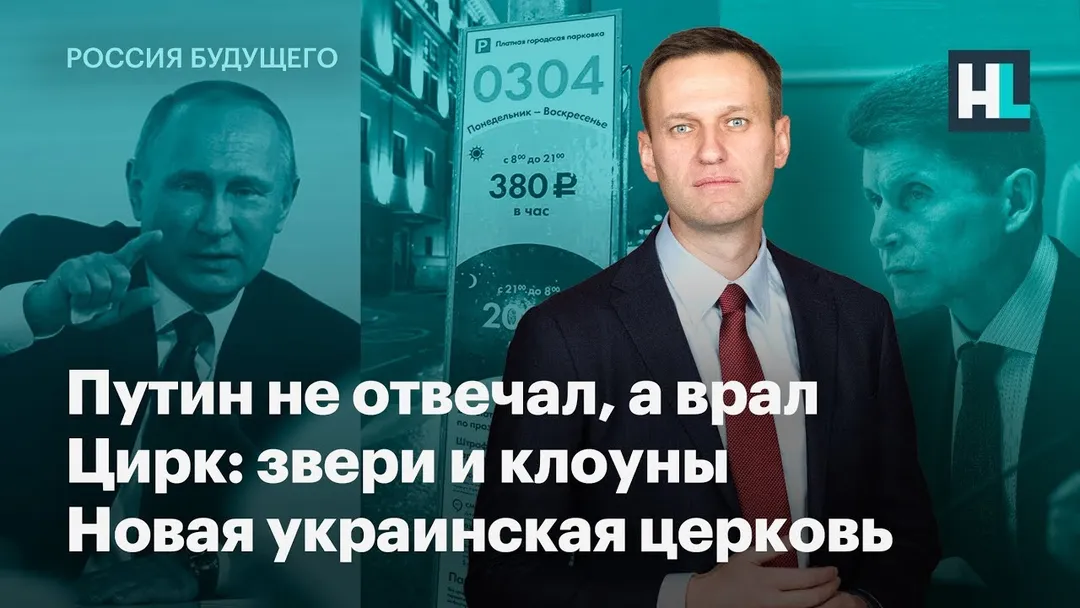
Putin Didn’t Answer—He Lied. A Circus: Animals and Clowns. The New Ukrainian Church
[music]
Hello everyone. It's 8:00 p.m. in Moscow, and you're watching live
the program *Russia of the Future*.
Its host is Alexei Navalny, or, as one
of the Kremlin's propaganda outlets once called me, a man
who will stop at nothing.
In a way, that was probably
partly true today, because
today I really did something
I'm a little embarrassed
to admit on air:
I watched all three and a half hours
of Putin's press conference. We were streaming it,
and I knew you'd be asking me
about it.
By the way, send in your questions with the hashtag
hashtag
#RussiaOfTheFuture on Twitter, and I'll
try to answer them. So yes,
I watched all three and a half hours, honestly,
from beginning to end, and it really was
quite a spectacle, of course.
First of all, what was striking wasn't even
just the usual spectacle of
bootlickers from all over the country gathering together,
but a battle of bootlickers. You had the usual
federal-level bootlickers who flatter
Putin 24/7
going head-to-head with regional bootlickers
who had come specially
from Vladivostok, Yaroslavl, from all over
the country. They come there in order to
say something like,
basically, to compete over who loves
Vladimir Vladimirovich more. Let's watch a few
seconds of a typical question—19 seconds
from Putin's press conference.
In one of your appearances at
a previous press conference, you said
something interesting: that you are
a collector, and that you collect emotions,
and that this is your wealth as the leader
of the country. So in that
emotional sense, what kind of year was this?
What do you consider the main event
of the year?
Vladimir Vladimirovich, collecting emotions...
Well then, tell us: emotionally, for you...
And separately, I just want to note this
guy, Kondratyev, the correspondent—I've been seeing him
since school.
Literally since school. I was a schoolboy, and he
was hosting some program there—Channel One, big news, whatever it was called then.
Back then there wasn't much else besides
the big news broadcasts. He was a correspondent in
Germany, then he was...
Then I became a student, then I got
married, had children, and now I host this
program—and once again I see this guy
standing there, gazing up ingratiatingly,
asking some little question like that,
so that Putin can say, yes,
emotionally this year was
difficult, but still very joyful, we...
Something like that. So what was notable about this
conference? Probably, first of all,
the fact that it wasn't notable
at all. He convened it in order
to answer questions—but he didn't answer any.
I even wrote on my cup: 'Did not answer.'
Because usually after
a press conference—and during it too—
Twitter periodically explodes,
people start posting, then
articles come out and everyone discusses it. That's because
Putin stages these events
in order to throw out some
interesting tidbit—maybe
announce a foreign policy initiative,
name some new enemy, or tell
some especially juicy joke about
a grandmother, a pillow, or a mother-in-law,
so that some of our fellow citizens will still think,
'Wow, what a man of the people.' Or
very often, someone supposedly asks him a tough
question—some specially selected
female journalist asks ten difficult questions in a row,
sharp questions on painful, pressing topics,
and then he picks one of them,
answers it, and that's that—as if the issue
has been addressed, like, well, Putin was asked about it.
This time there was none of that at all.
I mean, there was the traditional
flood of lies, the same things repeated
over and over that he's said many times before, and there was
nothing even to latch onto—no
funny trash, no
new insults, no new gimmicks, no memes,
nothing at all. I don't know—when a man has been
in power for twenty years, he can no longer produce
any improvement—neither improvement
in people's lives nor in the quality of the country itself.
But he used to at least produce
some side effect of interest; now even that is gone.
Just emptiness—an absolutely empty
press conference. And I don't think that's
just my opinion. From what I saw,
journalists discussing it also found nothing
particularly interesting. Traditionally,
the same Ukrainian journalist
asked a sharp question about Ukraine, and Putin
basically told him, 'You're all idiots.'
There was a question about Lev Ponomaryov (a Russian human rights activist),
and he said, 'Serves him right, he's in jail because he called
for rallies.' But even that lacked any real
harshness.
There was nothing like, 'Saakashvili is running around the streets'
or anything of that sort.
In that sense, he wasn't even trying to act tough,
or play the hard man.
Of course, that was connected to the fact that
there really weren't any proper questions.
We tried to ask one,
and our wonderful Dmitry Nizovtsev
got accredited, and the equally wonderful
camera crew went there too. Let's
watch a few seconds of Dima
arriving there with questions and a placard.
about the gold in Vo...
Well, nothing worked out. One more thing:
they approved our poster, and then they came up to us
they approached us and said, "Unfold it, show us your
poster." They looked at it closely, and the person wasn't
even looking at our second poster.
And then they went off to clarify something about us.
This man here—
Do you want to take the poster? Why are you
taking it away without giving any explanation?
There are plenty of posters here, and you're
taking mine specifically.
You know perfectly well that these posters
are a genre of their own. You have to
write something eye-catching to attract
attention, so Putin looks over and maybe suddenly
gives you a chance to ask a question.
The funniest poster this time
had a half-naked Putin on it
from that famous photo shoot in Khakassia (a Russian republic in Siberia), and it
said: "Putin, what a pike—just my type,"
I think. A journalist from Khakassia, apparently,
was holding that poster, but she wasn't given the chance
to ask a question.
As for Nizovtsev, he had planned
to ask about the gold in Vo... Well, we don't really...
It's not that we thought we had somehow fooled anyone high up;
we knew perfectly well that Nizovtsev hadn't fooled the system.
He had been arrested live on air
and jailed before, so of course we
knew he was on all the relevant lists,
which is exactly why they let him in.
But very pointedly, they confiscated posters only from him—
the only person at the entire
press conference.
They took his posters, and then of course they didn't
give him a chance to ask a question. And by the way,
I should note that Roman
Dobrokhotov, a journalist from *The Insider*,
wasn't allowed in at all to the
press conference.
So Roma ended up being treated like a journalistic outcast.
There were several moments in this
press conference that, well,
personally for me,
stirred up some emotions.
So I just want
to share with you, I guess, my
feelings—my outrage, first and foremost.
First of all, it's the question about
the bridge over the Lena River. Even if it
seems like some minor issue to you,
it's actually very important. Let's
take a look—here's a brief background.
To explain the situation: the city of
Yakutsk
is the largest city in Russia
—a major city with a population of 311,000—
that is not connected
by rail. In fact, you can't get there
by regular rail or road transport at all,
and during the period when
the river is freezing or thawing,
you can't get there at all.
There are hovercraft and
various boats, but in any case it's a major
problem.
A longstanding problem. And then a journalist from
Yakutia asks Putin: "Could a bridge across
the Lena River become a symbol of developing
the Asian part of the territory of the Russian
Federation?
I'd like to ask: should we expect this bridge,
and if so, when? Because
we really need it. Thank you."
"A symbol is always good. It's always
some kind of completed stage
of work and an opportunity for further
movement forward. In that sense, the Crimean
Bridge is both. I agree with you: it is both
a symbol of Crimea's reunification with Russia
and an opportunity for the development of
the peninsula.
"Precisely the opportunities for development—those are
very important. But the same applies
to the bridge over the Lena River. You said it
should be tied to development—well, that
needs to be calculated precisely."
The man has been in power for almost 20 years, and he's asked
a question about a bridge over the Lena, and he goes on at length
about Crimea and then says, "We need to
calculate it." Dude, then calculate it!
You've been sitting in power for 20 years and
you're acting like, "Well yes, we need to run the numbers."
Let's look at what Putin was saying
two years earlier with the governor and
—clip, 24 seconds.
Yegor Borisov met in Moscow with
Vladimir Putin. The head of the republic and
the country's president discussed the construction
of a bridge over the Lena. Borisov noted
the need to include funding
for the bridge crossing project in the draft
federal targeted program for the development
of Russia's transport system. The head of Yakutia
explained that the bridge was among the key
priority projects. It was a long report, and at the end of it
—a long report—and at the end of it
Putin says, "Well, in general, I
support the construction of a bridge across
the Lena River." Well, obviously—he had to
support it. That's 300,000 people, about 30%
of Yakutia's residents, and they are completely
cut off. He supported it two years ago, and
now, two years later, he says, yes,
it needs to be calculated. And the point is that here we
see from this example that Putin simply
says things, but in the bigger picture
he couldn't care less. Governors come to him
and say, "Vladimir
Vladimirovich, do you know how people over there
have to get around? Let's take a look—here are
35 seconds from 2014. A striking video of how
our fellow citizens, in the 21st century,
make their way to the city of Yakutsk, a major
city, the capital of a federal subject (region).
[music]
[music]
books
[music]
[music]
It’s freezing, there’s a huge crowd, and hovercraft are arriving
to carry people across. A ticket costs 1,000
rubles (about US$10–15), and people are storming these hovercraft. But that
was several years ago, and before the program I just
went and googled
what the latest achievement was in the area of
crossing the Lena River, and I found
a report from November of this year. You can
check it later—it’s still up on the
official
official Rossiya 24 channel. Let’s watch
35 seconds of how wonderfully
the crossing over the Lena is organized now.
Just look at this.
This is the latest video on the
official channel of Russian
state television. By the way, it’s called “A New Ice Crossing Has Been Established,”
“A New Ice Crossing Has Been Established.”
It’s not called “Total Trash, Horror, and
Nightmare in Yakutia.” It’s called “A New
Crossing Has Been Established.” So, the point is,
everyone clearly knows about this problem.
It’s Yakutia’s main problem. This
bridge has been discussed an endless number of
times, and the governor comes to him and
says, “Come on, let’s finally build the bridge.
After all, we have diamonds and gold here,
we seem to contribute something—maybe we could
get a bridge built somehow?”
So that in winter we don’t have to
cross through water and all that.” And it’s always, “Yes, yes, yes,
I support it,” and then it just vanishes
from his mind, as if
nothing happened. And then two years later
they ask him again about the bridge to Yakutsk,
and he says, “Well, we probably need to calculate it.”
You’ve got the Construction Ministry, headed by Mutko,
you’ve got a bunch of officials,
builders—you hand out a hundred medals a month
to some “honored builder” or other.
You’ve got design institutes, you’ve got the Rotenbergs (powerful Russian businessmen close to the Kremlin),
who love building bridges. Do the math. No—
well, because, basically, because they just
don’t want to. Because: to hell with you.
That’s why. That’s Vladimir Putin’s answer.
And this whole situation with the bridge over the Lena
really perfectly shows
that they proceed from the assumption that,
basically, the general public couldn’t care
less. They don’t know anything, and only
some especially curious people will go online
and look up what the problem is with
this bridge and with Yakutia. And to hell with them.
In two years everyone’s forgotten, so we’ll just
say some things during the live
call-in show, at this press conference, on the live line—
but it doesn’t mean anything. It
costs nothing. It has absolutely no
significance whatsoever, because it has nothing
to do with real life. And that’s it—his whole
answer is just
endless bullshit.
He had this phrase there,
“positive trends everywhere.”
Positive trends? He’s been sitting there for 20 years and hasn’t
done a damn thing. He lost all the oil money
and says we have positive
trends. There was also this great
line: “Well, we had an economic
crisis, and we were forced to spend our
oil money to support the population.”
Forced to—as if some unfortunate thing happened,
some unpleasant accident. There was oil money,
and of course they would’ve liked to keep it for themselves, but
instead they were forced to spend it on
supporting the population.
I also really liked the moment about
Brilev. I was wondering whether they’d let Brilev in
to this press conference, because after all
we proved that he’s a British citizen,
a British subject, and he confirmed it all, so
it seemed a bit strange.
And they endlessly milk patriotism,
endlessly going on again about how
Britain is the enemy. Putin clearly
said that the Skripal case
is being used by Britain to attack Russia—that is,
Britain is carrying out an attack on Russia. And so,
who gets to question Putin? A British citizen,
Brilev, at this press conference. 39
seconds.
And in this connection, I can’t help but pass on
my heartfelt thanks for being allowed to ask, and in this
connection I can’t help asking you about
the current state of affairs in
Russian-British relations.
Let’s start boldly, as it were. After
the G20 summit, Theresa May said she didn’t know
whether she had met with you or not, but you
did meet with her after all. How do you
assess these relations? And another
interesting question: do you see how
Brexit might affect Russia? Will it
affect it? Thank you.
As for meetings—at events like
the G20, there are very
many meetings; you can’t even list them all.
That’s just how it is.
So it’s this kind of schizophrenia: up stands a
British journalist
representing Russian television and asks
this kind of question—like, who exactly are you
talking to? A British journalist
is asking a question about Britain. But the best part
didn’t even happen at the
press conference. The best part
happened on Twitter. Anyone who isn’t following it
should, because they’re basically
trolling us with this Brilev thing.
And it became clear that they invited him
and decided to have a laugh at all of us, because
what you’re seeing right now, here
in this photo, is the official
Twitter account of the President of Russia, which immediately
after Brilev’s question—well, everyone there started...
Naturally, they laugh — ha-ha, Brilev.
He asks about Britain — ha-ha-ha, right?
It’s just that the president of Russia
puts up a photo of Brilev, like,
and as if to say, “So what? You decided again — why don’t you go to hell,”
to hell. That’s why the response from these
wonderful people was to laugh at us.
But considering Peskov, all the children
are foreign citizens; Putin’s children are there too,
his daughter lives — or used to live — there, lives in
the Netherlands; it’s generally unclear what’s going on with
them. They all have these strange
citizenships.
So that’s how they sneer at us.
They show Brilev, and they must have discussed it among
themselves, like, “Let’s make a little joke — they’ll
all go crazy over there.”
They came up with it: “We’ll give him the floor, and he’ll
ask a question about Britain, and then we’ll also
slam it onto Twitter afterward.” I mean,
it’s a kind of trolling art. Another important
point, and no jokes now, is the
statistics that were announced in
support of the claim that life in Russia
is very good, and that every year life gets
better. If it seems to you that you go
to the store and your salary is enough for fewer and
fewer products,
well, then something must be wrong with you. But in
reality, everything is very good. Putin usually
dumps a huge amount of statistics on
this subject. Let’s show you this strange heap of
all of it now — all of this,
numbers, numbers, numbers, for ten this, several that.
Then for the first time...
17 percent, the forecast for global development
for 2018.
Industrial production grew at a more
rapid pace.
Compared with last year, when it was 2.1
percent, for January through October of the current year, yes.
Let’s say 2.9 by the end of the year, while these
percentages in manufacturing industries
are growing even faster — by 3.2 percent.
For... well, never mind.
Investment in fixed capital amounted to 4
point-something percent, and retail turnover
and market trade volume were up 2.6
percent. I can’t make my way through this anymore.
This demand is, of course, noticeable; it is
a positive factor. After a long
break, a slight
but still positive trend has been recorded.
In real terms, Russians’...
According to the latest data, the population’s
will amount to... You see, the guy has
a special sheet of paper on which it says
there is proof that we have started living
better, and he just reads out these numbers,
talks and talks and talks, while everyone sits there and
understands that these numbers mean
nothing. Well, because — not only that —
Vladimir Milov spoke about this in great detail.
Vladimir Milov, who commented on this
press conference, seemed to me to have
commented on it very well in his program.
He talked about it there. The thing is that
Putin’s numbers are official lies. This
isn’t our assumption that he’s just
making it all up — it is officially
a lie. In particular, even Russian
statistical agencies, which of course
fudge the numbers, were recently forced to admit
that, for example, in agriculture they
had said that growth in agriculture
was 30 percent, and then
it turned out that all of it was simply
a statistical error, and the figures were reduced
severalfold. In other words, they simply
crossed out, literally,
tens of millions of tons of agricultural products
that had been added on paper, and all these indicators
had to be revised. The same
situation applies to industrial production.
He talks about GDP growth, industrial
production.
And the Gaidar Institute, which works for
the government and is actually a fairly loyal
establishment organization,
also officially says that all of this
is manipulation of statistics. They take
the official figures, and even with those
there is cheating. You can verify them — it’s all
lies. And in the end Putin really
said the main thing: after a long
break, real
disposable incomes of the population
have increased. Translated into plain language, that means
that your salary really has gone up —
not just nominally, but so that, taking
inflation into account, you can buy more things
than before. And at that moment,
naturally, the whole country says, “What?”
“Come on now, uh-huh, enough with the
fairy tales.” And they really are fairy tales, because
he said they had grown a little,
but even
official statistics already refute that and
say that real disposable incomes
actually decreased by 0
point one — one tenth
of a percent. So even officially
we have been getting poorer for the fifth year in a row. Our wages,
our ability to buy things,
is declining when inflation is taken into account, and that inflation
is nowhere near
the official 4 percent. Everyone has been getting poorer
quite significantly. And there sits a man
telling and telling and telling
all these endless lies about
statistics. The last thing that seemed really
important to me — and I’ll end on
this point about Putin’s press conference —
was a journalist from Primorye (Russia’s Far East region).
He really put on a master class there
in regional bootlicking. Basically, he
sort of presented Putin with a complaint
about the pension reform, in a long, long, long-winded way.
Putin was speaking, but at the end of each...
he offered New Year greetings and said...
perhaps as the key point, so to speak, in
this press conference. Let's take 39 seconds.
A journalist from Primorye (Russia's Pacific coastal region) congratulated
him on the New Year after all and wished him
strength, creative success, and all the rest, and
finally, the very last thing I want
to say. Guys, here Mr. Pin...
you see, said that thousands
come in there, but only
this information came through. Guys, I want to
I really want, bypassing all my own
requests that journalists want to
snatch.
I want to voice the most important
question: Vladimir Vladimirovich, please help.
There is
Vladislav Shestakov, three years old, he is ill.
From the Irkutsk region, from Cheremkhovo.
He simply needs to be transferred to Moscow
People have raised the money.
Please help with that.
And I have a question for this journalist from Primorye
and to all the other
journalists, and really to everyone:
good Lord, do you really not have enough sense
to understand the elementary connection between
the fact that he has been sitting there for 20 years, and you still
fawn over him: 'Happy New Year, I wish you'
health, happiness, and another 30 years
in power.' And by the way, here, before
the whole country at this press conference,
the only possible way to help
Vladislav Shestakov from Irkutsk
is to ask you, the president of the country,
to bring him to Moscow. There is no other
way. And Vlad Shestakov—I don't know,
if things get worse for him there or if something
bad happens to him while we, in this
manual mode, before the eyes of the whole country, are
already collecting money for him—then we will have to admit that
free healthcare simply does not work.
If in the Irkutsk region
money was raised for Vladislav Shestakov, but
it still wasn't enough, you see, even for a ticket—he needs
to be transferred to Moscow to undergo
surgery—well, please understand
this simple connection, for heaven's sake:
Vladislav Shestakov cannot receive
treatment in the Irkutsk region,
which is, after all, an industrially developed and wealthy
region, because Putin is in power,
because he destroyed
healthcare, because together with
his friends and relatives he stole
the money with which Vladislav Shestakov
at three years old should officially
and free of charge be treated first in the Irkutsk
region, and then, if that was not possible,
he should have been transferred
to Moscow at the expense of the insurance system,
from public budgets, because his mom and
dad
Vladislav Shestakov's parents work and pay
taxes, and in any case they are entitled to
some share of the oil pumped out of
the ground; they are entitled to some share
of the hydropower—that is, those very
Siberian rivers that in the Irkutsk
region
generate enormous amounts of
electricity—they belong, among others, to
Vladislav Shestakov's mother and father too, but
for some reason they get nothing, while everything
goes to our collective wonderful
Timchenkos and Rotenbergs. And well, did you see
Putin's face when he was asked that question?
Of course he did not like that whole
topic; obviously he did not like it. But
that is in fact the quintessence
of this entire system. And that gives me a nice
good
bridge to our next topic: the main thing
that happened this week was precisely in
Primorye, where that journalist came from, though
who
who was probably driven by
some noble idea that
this three-year-old Shestakov needed help.
He came from Primorye, and in Primorye
there occurred
remarkable things that explain, among
other things, why there was no money in
Primorye. In fact, many people
are disappointed and write to me: in your last
program you urged everyone to
vote against Kozhemyako, but he won in the first
round. But no—in Primorye everything
turned out great, because on the one
hand, this acting
governor Oleg Kozhemyako
did win in the first round, but we already have
a huge amount of evidence now,
including mathematical proof, that in fact he
lost the first round. So this cannot
be called a victory, because although
he became governor, nevertheless we
saw that Putin and Kozhemyako
and United Russia suffered a defeat in Primorye,
because they had built
a setup in which they removed all
the candidates, and Oleg Kozhemyako ran
an 'opposition' campaign; absolutely all the media
were pushing for him. I saw ads—
Odnoklassniki (a Russian social network) was running his ads, those very
same Odnoklassniki that, for example, always tells us
'political advertising? No,'
'no, it's prohibited on our platform.'
And yet there they were flooding it with
ads for Kozhemyako. Nevertheless,
people in Primorye came to the polls
and despite the fact that all the other
candidates were basically spoilers imposed from above, and
the LDPR candidate who came second had, in the previous
recent election, supported
the United Russia candidate, the people of Primorye came and said: no,
this Kozhemyako will not win in the first round.
and most of them voted
against him, and Putin had to rig the count
and in Primorye (a region in Russia’s Far East), you can clearly see that ballot stuffing took place
and in Gorny, you can already clearly see where
they stuffed ballots, how they did it, and at which
polling stations. Just look at this table
you can see it plainly: they were evening out
the percentages for different candidates, not just
for Kozhemyako
the probability that our
result would randomly come out with figures like that
is something like one in a trillion
quite a lot has already been written on this subject
there is not the slightest doubt, so once again I’m returning
to the topic I already raised
about our Smart Voting, and I’m going to
talk about it a lot, a lot. This is another example
of why it works, and an explanation of why
they blocked our Smart Voting
they blocked it, blocked it because by now
United Russia candidates can no longer win
well, here they did, yes, of course
falsify the results. He got 46, and they
stuffed roughly 170,000 votes in there
to boost his total, but even so
this still has to be done manually, and it is extremely
difficult to do for all districts, for all
elections. In Moscow, there will be elections to the
Moscow City Duma, and there will be 45 single-member
districts. In fact, that’s not very many
people needed
if we all simultaneously and in a coordinated way
vote, if we agree on whom
to vote for in order to defeat United Russia candidates
we will deprive them of their majority, and in other
cities and regions where elections are held, we
can deprive them of their majority. That’s why they
got so scared. So, friends,
be sure to take part in Smart
Voting — register
If it is blocked, we will find a technical
solution, but for now use a VPN
register, because they are already
look, they have several
factors on their side: Putin’s support
guarantees victory for them
administrative resources, lots of advertising, and so on
and so on, all of it. And none of these factors
will work — only through falsification
only through falsification can they
win. So the situation is really
shaking the authorities, and that is very
important. Well then, since I’ve already started talking
about this
I’ll say a few words about how
they blocked it, because this concerns not only
us, but everyone
with websites on the internet, because we saw
that the state has declared a major war
on the internet. It consists in the fact that they
really are going to block everything
completely arbitrarily. They told us
that we had personal data on
the website, and we simply took that personal
data and removed it all. When we went to court, in
court Roskomnadzor (Russia’s media and internet regulator) said, you know,
they have Google Analytics trackers on their websites
and Yandex.Metrica, and that too
is the collection of personal data, and all of it is stored on
servers in California, therefore
it should be blocked — and it was blocked
but the thing is that afterward several
people — there’s this wonderful guy
Alexander Litrifonov — it hadn’t even occurred to me
I wrote a post: guys, the same thing is also
on all their websites. How can they
block ours? He simply went onto the website
of United Russia, and there were the same trackers there
then onto Roskomnadzor’s own website
and there were the same trackers there too
he had already filed several complaints: come on then
now block them too, if Navalny’s
was blocked on these same grounds. But
today Putin, at a press conference,
also spoke about this, and he was
asked whether it was really necessary to
punish people so harshly for posts and so
on. He answered differently than before
because previously he would answer along the lines of
well yes, these are excesses by local officials
probably, freedom of opinion is necessary, it should exist
but this time he said
roughly the following, more or less quoting accurately
if the law is being broken, it is the same everywhere
what difference does it make where they
break the law — on the street or on the internet
it’s the same thing. To tweet, or out on the street
someone stabbed someone with a knife
or on the internet someone clicked like or made a post
wrote something bad about, say, the authorities
saying they are bad — that too is a criminal act
so even from this change in rhetoric
we can see that
there is going to be a major offensive, and we will
certainly survive it. And one of the reasons why it is necessary
to take part in voting is that if they are
attacking the internet, then the internet should
also
strike back. We’ll talk more about the internet today
but for now let’s talk about
clones; before we get to the clowns and the circus
let me answer a few questions
so, Andrei is asking me precisely about
this. The elections in Primorye clearly
showed that this government will not hand over even a piece
of power honestly, especially since for them all of this
is a matter of survival. Without a fight, no, they will not
give it up. Well of course, yes, Andrei, they will not
give it up without a fight, but it would be naive
to assume that these people would give up
not only power, but also the
hundreds of billions of rubles attached to it — tens of
billions of dollars. But there will be a fight, and
we need to give them that fight. It consists of
a multifront offensive. I’m not
saying that only participation
in elections and Smart Voting alone will bring them down
no, it has to be a combination of different things
One element is fighting them at
the elections through Smart Voting.
Because no other form of participation in
elections works anymore—rallies,
spreading information—well, in other words,
these are complex things, and this is a fight
that we will put up,
and a fight that they will sooner or later
lose. From that press conference, it was
clear that, well, they have nothing left to say.
They will lose, and all you need to do is
get involved. People very often tell me,
“Why are you pushing voting on us? Let’s
do something else.” But honestly,
guys, taking part in Smart
Voting takes one day a year—you’re not
exactly overworking yourselves.
If, on top of that, in addition
to some other action, you also
take part in Smart Voting, then
please do participate. Vladimir
asks what will happen if Russia
abandons the dollar. That will not happen.
No one is going to abandon the dollar, even
in Soviet times dollars circulated here
in limited quantities, and
even if he said so today, it is simply
impossible. Russia is now so tightly connected to
the international system that it is impossible
to abandon the dollar, and it will not
be abandoned—first and foremost, Russia’s Finance Ministry
and the state banks will not abandon it. In fact,
Putin himself and his friends do not keep anything in rubles.
Do you think their money is held in rubles? Well,
of course not. They will not abandon the dollar; that is not
going to happen. Next.
Adalin asks me: greetings.
Do you condemn participation in the HRC
—meaning the Human Rights Council?
Obviously, the discussion is about whether some people
joined Putin’s Human Rights Council
and whether we should shame and attack them.
No, we should neither shame nor attack them. It’s not
that I condemn it—well, except for the truly disgusting
crooks who are there. Yes, I condemn them, but
I condemned them before this too. That is, I
condemn them because they are disgusting crooks.
Some people, like Ekaterina Shulman,
decent people, joined it, and I do not condemn that.
It is probably useless, and joining
will of course change nothing there; they
will help no one, everyone will feel awkward, they
will talk about small deeds—well, okay.
They will not do any particular harm either—well, one could
say the harm is that it legitimizes the
system.
But really, on the whole, nothing especially
terrible will happen. They joined the council—so what?
Pavel Chikov, I think, is still
there. He’s a great guy; he
really does a lot of legal work
together with his wonderful
organization Agora. He’s at least doing something.
Is there any benefit from it?
Zero. Well, he does it, and he does it—fine.
We just should not spend too much time
on this. That is, there is no need
to single them out for criticism,
but there is also absolutely no reason
to praise them for these
appointments. So, Unicorn Geralt—well,
of course, when we have a question
from someone with the nickname
Unicorn Geralt, we should soon make
a unicorn the logo of our program.
Geralt, it is entirely logical to assume that
the authorities will try as much as possible
to restrict freedom of speech on the internet, and
what will we do then? Unicorn—well,
come on, of course the authorities will try
to restrict freedom of speech on the internet. Haven’t I
been telling you this for the tenth
program in a row about blocked
websites? They will keep restricting it all. What will we
do? Well, we will keep working. We
will use VPNs, we will install things, we
will use other
methods. Where did this program come from?
This program
came from the fact that they block websites on
the internet, and we decided simply to make
a program like this on YouTube because
for now YouTube is hard to block.
They can block all of YouTube,
but my channel specifically
they cannot block yet. So that is what
we will do, dear Unicorn—we will
keep inventing
different things. We will send each other
videos and notes in messengers.
Still, about the circus and the clowns—that
was a very important topic last
week.
Putin has not only a Human Rights Council,
which we discussed today, but also some kind of
council—I do not even know how to describe it—of
theater figures, artists, and other
rather pointless people
whose main activity is that once a year
they gather and, again, fawn over Putin,
bow to him obsequiously, and
beg for money for their theater or
for themselves personally—well, for their organization.
They will, of course, steal most of that money,
and no one will do anything about it
because they go there begging
and flattering Putin and all that. And it was
important—the key moment there was the move
made by the famous—I do not even
know how to put it correctly—
our famous director Edgard Zapashny (a well-known Russian circus performer and animal trainer),
who
told Putin—and Putin even agreed—that
we should basically start clearing out
foreign circuses so that our
plain old Russian circus can develop. This
matters because it concerns not only the circus.
Let’s watch a few seconds of it.
It takes 1 minute and 4 seconds.
Forgive me for criticizing my
Canadian colleagues—someone might see in this
a fight for market share, or sense
that. Absolutely not. Mr. Gutseriev
announced that in 2019, Skolkovo (a Moscow innovation hub)
would open a permanent venue
for a Canadian circus.
I believe this is unacceptable. I believe
it is wrong. No one is stopping them
from coming here on temporary tours.
They have already been coming here for more than ten years,
coming here regularly.
But this will definitely have a negative impact, and not
only on the Russian circus industry, but on
Russian sports as well. And here we are,
at a time when Canada is very actively
imposing sanctions against us, and
suddenly, for some reason, we become
welcoming to Cirque du Soleil from that country
on a permanent basis. Which is exactly what
Andrei Sergeich was talking about: this is, in essence,
a fight for the market. That is true, and
to throw the gates wide open like that—well,
I don't know. Of course, the audience wants
to see it, but I am most likely on your
side.
You know, it gives the impression that everything in
Russia exists for Eduard Zapashny
and to fill his circus with spectators.
Because, I don't know, apparently people are not going
to his circus if he is so afraid of
competition. As you know, I am a rather
simple-minded person, so I immediately
go and look at the declaration, yes, and there, respected sir,
sure, he may train his
tigers brilliantly, do whatever he does with them, and risk
having them bite his leg off, and tell them,
"And the tigers sat at my feet and looked into my eyes,"
and all that—but I look it up and
see that Eduard Zapashny receives from
the state budget, as a director, 10 million rubles
a year. Well, perhaps someone
that famous should perhaps be paid even more,
but still, man, that's 10
million rubles a year (about 100,000 USD). We're already
paying you, you already have a circus—leave us
alone. Let that Canadian
circus come, or a Chinese circus, or whatever circus
wants to come and build a venue. And can I
then choose for myself whether to go to Zapashny's
circus
or Cirque du Soleil? I went once in my life
to
[music]
a Cirque du Soleil performance, and it really
was impressive. Probably one of the
reasons I brought it up is because
it stuck with me—I had been to Cirque
du Soleil, and it was really something, really very cool.
Again, I am not trying to say that
our circus performers are somehow bad or don't do anything,
but we are in favor of competition, after all.
We are for the visitors, for these
children—let them choose. If they like
going to the circus, they can first go to Cirque
du Soleil,
and then go to Zapashny's, or
vice versa. But here there is simply an
element
not of competition, as they discuss with Putin,
but rather an element of some kind of
cult of personality: yes, we are supposed to gear the whole country
toward making sure Zapashny does his dangerous
thing with tigers—not even mentioning
that there is a separate question of whether we even need
circuses with animals at all.
There are many videos on YouTube on this
topic, and they are all quite unpleasant. I am not
going to show them to you—you already
know how animals are trained, what kind of
cages they live in, and what happens to them
in the circus. It is, well, a whole series
of horrific torture and sadism to which
these unfortunate animals are subjected
so that they will jump somewhere in the proper
way,
or give a paw, or juggle
something, or so that a bear rides a bicycle.
If you do not beat that bear
in the kidneys with an iron rod, it will not
ride a bicycle. And the thing is that
children's joy
is built precisely in this way:
the animals are terrorized, they ride
bicycles, someone applauds, Eduard Zapashny
gets 10 million rubles. I am not sure
that this is the right state of affairs in
Russia right now. Finally, I congratulate you all:
after 10 years of lengthy discussions, we
have passed—thank God—a law
on cruelty to animals.
It is called the law on responsible treatment of
animals. Well, they did ban petting
zoos, but by and large
ordinary zoos should also, of course, be
banned. Well, I mean—not zoos,
but these circuses, at least.
I assume that Mr. Zapashny
will watch my program and, in an angry
fit, write me a response
on Instagram or wherever, and say, "We do not
torment our tigers, we feed them
a portion of meat,"
Then install webcams there so that everyone
who wants to can see, or so that animal rights activists
can have unrestricted access at
any moment to the places where the
animals are kept, and at the times when these
training sessions
or drills or whatever take place, because
everything we have seen, including footage
from hidden cameras of animal training in
the circus, is a monstrous spectacle that,
once a person has seen it, they will never again
take joy in any circus with
animals. Therefore, before
Mr. Zapashny starts showing off like that,
So the idea is: let's just ban everything.
Let him first answer these important
questions—not only from animal rights activists, but also from
any normal person: are you training
your tigers, or are you torturing them? And
by the way, from there he goes on to
launch into a real flight of fancy.
And on this same subject he says,
"Why don't we open a branch of the Louvre, a branch of
La Scala here in Russia?" As if
that would be bad, and that it would destroy
the Hermitage. That it would reduce the number of people
who go to our theaters and our museums.
And then, quoting that logic: "Let's
slowly destroy everything that is ours
—everything Russian."
So he equated his tiger circus
and made it essentially identical,
forgive me, to everything Russian. As if everything Russian for us is
Eduard Zapashny, his tiger,
his 10 million rubles, and Vladimir Putin
who agrees with him. What the hell?
If in Moscow or St. Petersburg
a branch of the Louvre, La Scala, and
so on were to open, everyone would be happy—first and foremost,
I assure you, the visitors of
the Mariinsky or the Hermitage, and everyone else,
any cultured person. That would be
great if it opened. All, all
circus lovers would be delighted if
both the Zapashnys and Cirque
du Soleil and everyone else could coexist. But what we see is
that this mindset will always dominate.
Now there are certain people who have simply latched onto
the state budget—people like Nikita
Mikhalkov (the Russian filmmaker).
For them, the sign that you're a patriot and somehow
have special rights is that budget money
starts flowing to you. And immediately you
puff yourself up and say, "I am everything
Russian—don't you dare destroy me.
Support me." And this will keep going
further and further—you'll see, it will just
keep developing, developing, and developing.
I've received a lot of questions about
paid parking. It's such a
toxic topic: opponents of paid
parking all come running in and start arguing, and here
there really is something to discuss, because I believe
that by now we can already see
the final fiasco and failure of the entire
strategy of Moscow City Hall. All that nonsense about
how this is a modern city, and about paid
parking—
that it would somehow save something or
help with anything—because essentially
all of the Moscow government's measures to fight
traffic jams boiled down to paid parking.
We were told: look, people park
like idiots. That's true—people do park
everywhere, including on sidewalks.
That's true. They're idiots, they block parking and
park on sidewalks. Now we'll really hit
them in the wallet, and the situation will improve. But
they hit them—and then hit them again on top of that.
And they did it in such a way that, frankly, we ought
to hit back at them, excuse me. Even
if you're a supporter of paid
parking—I support paid parking
in general. In any normal
city in the world, downtown has paid
parking; you can't avoid restricting
cars in the center, and paid
parking should be used there. But if, before an election—you are
politicians, after all, officials—you declare
—look, on December 26 of last year,
Maxim Liksutov, our old favorite, about whom
we have done many
reports and investigations, and it has been shown
that he is a monstrous corrupt official, one of the
biggest corrupt figures
in the country—said that paid parking in 2018
would not become more expensive.
On August 1 of this year, he repeated
it, looking all of us in the eye before the
Moscow mayoral election. Everyone
was asking, because Sobyanin was running
his campaign, and he said:
"No tariff increase is planned in 2018.
Paid parking will not get more expensive." And then—bang—
it went up to 380 rubles.
Let's compare 380 rubles with other
cities.
And here we see the chart, and we see
that yes, London is even more expensive—but this is
when converted
into a single currency, into euros. In
London it's five and a half; Moscow is at
the level of Amsterdam, and more expensive than Paris,
more expensive than all the other European
cities, including expensive ones like
Luxembourg.
Well, okay.
Still, that number can't just
come out of nowhere. You can't just say,
"Let's make it a hundred thousand million billion."
Why not, then? There had to be some kind of
justification, assuming they didn't just pull
the number out of thin air. If what you really need is
to make sure cars simply don't
come there, then just ban parking
in those places—Neglinnaya Street, for example.
Ban parking there. But you won't do that,
because the Central Bank's cars are parked there,
the Prosecutor General's Office cars are parked there. They
don't care about any of that. Instead, on these small
sections where ordinary people can park,
they slap on 380 rubles—that's more expensive than anywhere else. Well,
come on, guys, you have to admit it's reasonable
to compare that with average salaries.
If the average salary in London is 340,000
rubles, and the average salary in
Amsterdam, where parking costs about the same as
in Moscow, is 280,000 rubles, while in
Moscow the average salary is 82,000 rubles
—and that's obviously a lie, too, because
the real average salary in Moscow is of course
lower. There has to be some kind of
Any sense of proportion at all—where are you even getting this from?
Who are these numbers even for, then?
There is such a city as Moscow—you just can't ignore it.
With these parking prices, what exactly were you trying to achieve?
To make it so that people would come there
only for a short time, or take the metro instead?
But instead, you're just setting a completely insane
price that basically no one can afford,
that no one can afford at all, and
most importantly, these measures haven't led to anything
at all.
We're looking at the latest international
study, which shows how much time
residents of each major city
spend in traffic jams, and we saw that
Moscow
is in first place by a fairly wide
margin. So it hasn't led to anything.
Your paid parking system—you can say all you want
that without paid parking
things would be worse, and maybe they would be worse, but
paid parking is just one element, one of
many things, and not the most important one when it comes to
fighting traffic. I'll give you a simple example
and just tell you what I think about it.
Here's another example I see all the time from
my window. I work at our Anti-Corruption Foundation
near Avtozavodskaya metro station.
We're based in an office center, and my window
in that office center looks directly out
onto a huge building under construction—some kind of
16-story building, pretty ugly,
a black rectangular block
that the hell knows why they built here—who even needs it
here? But I wasn't too lazy, so
because look—here you've got
the business center where we are, a shopping center,
residential buildings—everything here is packed with cars,
there's paid parking, there are already traffic jams,
and now they want this too. Avtozavodskaya isn't even the city center, and yet
they've started this. I go to the website of this
complex—it's a luxury development, and there
each apartment costs 160 million rubles (about US$1.7 million),
there are 232 apartments in total, and parking spaces
for only 80 cars. Come on, we're
reasonable people—we understand that in
a luxury building where each apartment costs
60 million rubles (about US$650,000), it's impossible not to realize
who is buying these apartments. In every
apartment there will be two cars, and more likely
three cars—and they're building only 80
parking spaces. They are simply
guaranteeing that around
this building there will be another 500 cars.
And then add the drivers, the deliveries,
the movers, all of that.
You can make parking there
700 rubles an hour, 800 rubles an hour
—whatever you want—it won't solve any
problem, because the real problem is
that the Moscow city government, Sobyanin (Moscow's mayor), and
his officials are still approving, for bribes,
the construction of gigantic
developments that attract traffic.
But you don't have to build a six-story building there—
build a four-story one, build five-story ones.
Instead, they keep putting up
shopping centers of unimaginable size,
office centers of unimaginable size,
and these buildings too—and there's another trick to it.
I go to the website, and they're selling
apartments—well, 'apartments'—then you open
the documentation and see that it's not actually a residential building.
I mean, it's an obvious scam.
You see, they just call it not an
apartment but 'apartments' because
they couldn't get it approved under the technical
requirements. So in essence, what we're seeing is a huge
illegal construction project where they're throwing up
their damn flats.
They call all of it 'apartments'; they just
carried suitcases of money to various
people and are condemning this little area around
Avtozavodskaya metro station
to decades of sharply worsening
traffic conditions. This
is happening everywhere. It happens
constantly. So as long as
the Moscow city government is filled with
bribe-takers, as long as crooks remain there who
approve the construction of these huge, unnecessary,
high-rise, ugly developments,
until that changes, there will be no
real, effective fight against
traffic jams. You can hire McKinsey,
someone from Amsterdam, I don't know, or any
other foreign consultants you like.
You can run whatever
super PR campaigns you want, telling everyone how
everything here
is great and fixed—it won't help as long as
the people sitting there keep taking bribes.
So once again: there will be elections in
September for the Moscow City Duma—let's make sure
United Russia loses, including over this
parking nonsense. Let's register
and vote out every single one of these
bastards who feed us lies
about fighting traffic jams while continuing
to build more buildings. Well, obviously
they're building a 16-story building because
you can make 20 million on it,
whereas on a four-story one you can make 2
million. So why make 2 million
if you can make 23 million,
take some of it to Sobyanin (Moscow's mayor) or
to some of his
people, and everything will work out for you.
And if there are traffic jams there—
who cares.
We all live abroad anyway, basically.
All neighbors of Sergey Brilyov (a Russian TV presenter) are in London.
That's it. That's how the system works. So
for all these things,
they need to be crushed. Let's talk—there isn't much
time left—about me, me...
the Russian-Ukrainian scandal, Katsyv and I
accidentally started it with one tweet, one...
I was just swarmed there by a huge wave of outrage,
by a huge number of Ukrainians, because
I wrote a tweet—well, I’ll show you what the tweet said.
It said: on Saturday, this happened—
today an event of historic
magnitude will take place: the council in Kyiv will complete the schism
and the creation of a national church in Ukraine; the Russian Orthodox Church
will lose up to half of its active parishes. Everything
that had been built over centuries was destroyed
by Putin and his idiots in four years.
Putin is an enemy of the Russian world (the idea of a shared Russian cultural sphere). That’s what it means.
Well, since I apparently didn’t explain it clearly enough,
to all the Ukrainians—
there were some, like we have here, [ __ ] there
and even more of them [ __ ], and they were
basically all going crazy,
saying, “What is this supposed to mean? They won’t let us
create our own church?” Of course,
it’s my fault—if nobody understood my tweet,
or rather, if everyone understood it that way, then I
must have phrased it badly. I’ll try
to develop my point, because in fact
this is important from the standpoint of Russian and
Ukrainian relations, and Russia’s
relations with other
countries in general. I absolutely believe that every
country has every right to create
whatever church it wants. It’s actually
ridiculous to think that Moscow could somehow
forbid Ukraine, or, I don’t know, Armenia
or Georgia,
from creating their own churches. That
is just as absurd as, basically, this
degenerate discussion on Russian
TV channels about whether Ukrainians even exist.
If there is such a thing as
a Ukrainian nation—open Russia’s census.
We have several thousand
elves and some number of dwarves listed there.
Nationality is self-identification.
If you want to be an elf, you’re an elf. If you want to be
a dwarf, you’re a dwarf. If you want to be Russian—what
exactly “Russian” means isn’t all that clear either.
In the 18th century, vast territories were
populated by Mordvins, Chud peoples, and so on,
and now everyone there is Russian.
Well, that’s how a nation works: it simply absorbs
people, and now that is called “Russian.” So
likewise now,
there is a huge territory where
tens of millions of people live, and they are Ukrainians.
They want a Ukrainian church—then let them have
their own Ukrainian church.
Register it however you want—it’s your
absolute right. What I was talking about was something else:
Putin keeps running around with this “Russian
world” idea.
He wanted the Russian Orthodox Church, among other things,
to serve as an instrument of influence,
a form of soft power. And generally speaking,
there’s nothing inherently wrong with that. Obviously, language,
cultural ties, including religious
ties, are a very powerful instrument of influence—
influence not in a negative sense, but
in a positive one as well.
It means we can be on the same wavelength with large groups of other
people, think similarly,
and reach agreements about things.
That helps.
And Putin is an enemy of the Russian world because he
destroyed all of that with his stupidity,
with his idiocy, with his war. All that
we got as a result of Putin’s
so-called brilliant geopolitics is a very
large, aggressive state that is negatively disposed toward us—
Ukraine, a huge country,
a huge state with a huge population,
which will now always vote
against us, will always get worked up,
go crazy, and jump on any tweet, and which
now, simply on principle, will
defend its own church and its own religion
in opposition to us. But
none of this belonged to Putin. This was
something people built
over hundreds of years. People paid with their lives; there were
major wars, there were—well, there was
suffering and torment, a whole history spanning
centuries, a history hundreds of years long,
all leading to the fact that, well,
within the Orthodox churches, we had
the largest Orthodox Church of all.
And now it’s gone. And now, because of Putin,
that blockhead, it’s over—this glorious
centuries-long history has ended. Because
the truth is that it
in Ukraine,
a larger share of the population lives in
rural areas, and accordingly there is a higher
level of everyday religiosity
among the population—people simply go to
church more often. That’s why I wrote that these
are “live” parishes. In Russia there are plenty of formal
parishes where nobody goes, where there are no parishioners,
but in Ukraine, in that sense,
the situation is different. And all of this is gone, all of this
we have lost. And it’s fairly hard for me to
blame
the Ukrainians, because for an Orthodox
person—I know many criticize me
for this, because they think it’s normal and that
a democratic politician should
necessarily be an atheist. I used to be
an atheist.
Now I am Orthodox, and I have
some kind of personal, including new,
religious, so to speak, crisis of some kind.
Because I don’t really believe—honestly,
I’ll tell you frankly—I don’t believe that the leaders of the Russian Orthodox Church
believe in God, judging by what they do.
I just can’t believe it. I see a board meeting of the
Ministry of Defense, and there sits Patriarch
Kirill—what are you doing there? There are so many
problems in the country. There’s that boy—what’s his name—
Vladislav Shestakov from Irkutsk,
who can’t get from Irkutsk to Moscow for
treatment. Please, deal with that
boy. No—instead, you have to sit at a ministry board meeting.
the Ministry of Defense, because here you’ve really got
some kind of shoulder boards under your cassock.
This is probably the first time I’ve spoken this harshly
about
the Russian Orthodox Church, but honestly there’s no other way. I talk
to many people there who
kind of correct me, someone like me,
a superficial Soviet-style Orthodox believer.
These are genuinely devout, church-going people, and they also
feel a great deal of irritation. But all
these stories about the watch—remember
that famous photograph, where right here on
the wrist there’s a watch,
or rather, the watch appeared in the reflection, even though it wasn’t actually there—
and then all this stuff with the Ministry of Defense,
this kind of super-aggressive
rhetoric, these statements—
well, this sort of super-... The Russian Orthodox Church has always
been tied to the state, of course, it has always
been connected to the state, it is
basically, well, effectively a ministry.
But damn it, there has to be some limit, because
then why the hell is the president of the country,
the president of a secular state,
—let’s watch 50 seconds of how he
so passionately answered a question about
this: the Ukrainian church was formed,
and the Ukrainian church is supposedly
a branch of Istanbul. Let’s
watch. Orthodoxy—what
is happening in Orthodoxy right now is
simply—
it’s beyond comprehension. It is direct interference
by the state in church and religious
life. Nothing like this has happened since
the days of the Soviet Union.
Unfortunately, in Ukraine right now
what’s happening is that they created this united
schismatic church of the Istanbul
parish. I like that—if there’s a Moscow parish,
then apparently there’ll be an Istanbul parish. I think
this was all planned out, and besides
that, of course, there were prompts from Washington.
So the Secretary called about this
issue in Kyiv and discussed the topic. But this
is absolutely outrageous.
An Istanbul parish, a prompt from
Washington—and already someone in the audience
is applauding: yes, yes, yes, well done, thank you. I’ve
said this many times, many times, and
I’ll repeat it, because it really drives
me up the wall as an Orthodox believer:
a KGB man
and Communist Party member has become our chief
Orthodox Christian and is now going to
teach all of us. He studied scientific atheism,
they went off together on student construction brigades (Soviet work camps),
and lived in a warehouse built from the remains of
blown-up churches, and told everyone
that religion was the opium of the people.
Listen, I myself, in the school library,
used to get little anti-religious booklets.
I would go to Ukraine, by the way, to visit my
grandmother, who was very religious, and I’d tell her
things like, “Look, Grandma, the Turin
Shroud—scientists have proved that it’s
a fake.”
And my grandmother would say... I used to pester her
with stories about how God doesn’t exist.
But it’s simply disgusting and revolting to me
that our leading Orthodox voices have become
these party functionaries, all these CPSU members,
the very people who blew up churches,
who destroyed priests,
who squeezed Orthodoxy out of public life—and now they
are going to teach us how to love our homeland
and how to believe in God. The last
topic I want to touch on concerns all of us,
and me in particular, because
this is also one of those bills
that obviously arose under the influence of
our activities—our rallies,
the investigations we publish.
This brings us back to the internet in Russia.
They are introducing deep packet
inspection of internet traffic, which will allow them
to analyze traffic and, in general,
block everything completely.
And they want to spend 20 billion rubles on this
—that is, for those
who don’t want to get into all the
deep technical details,
the idea is very simple. Right now, if they need
to block my blog, they write to the providers:
“Block navalny
dot com.”
But when they buy this equipment for 20
billion—naturally, they’ll steal 11 billion of it;
that’s one of the main purposes of
this whole thing—they’ll do it
differently. When you try to go to
navalny.com, that site sends you
a specific kind of traffic, like a fingerprint.
They’ll be able to analyze
the traffic and see: oh, this guy went to
navalny.com, even if you can’t see it directly.
They’ll dig deep into your traffic,
figure out that you went somewhere you weren’t supposed to,
and they’ll block all of it. And 20
billion, guys, 20 billion—
one moment they’re telling Putin
“Let’s get the boy treated,” and
“let’s transport him to Moscow,” and the next
moment it’s 20 billion. 20 billion is
five annual budgets of the city of Pskov. Have you been to
Pskov?
It needs
—like all other Russian cities, with the exception
of Moscow. Our country is
falling apart. That bridge over the Lena River
the mayor talked about—for 20 billion rubles
you probably can’t build the whole bridge,
but still, surely you could at least
provide some subsidies for those
little ferries so people wouldn’t have to pay
thousands of rubles, and so on and so forth.
We have plenty of places where money could be invested, in that
sense. Well, take the recent case...
Valentina Matviyenko's exchange at the Federation Council (the upper house of Russia's parliament)
She was discussing how, you know, we have
a huge number of schools where the toilets
are outside, and there isn't enough money. Let's
try to deal with it by 2020. Putin—
38 seconds from Valentina Matviyenko: We have
only three regions where this problem
has not yet been resolved. One region is the Republic of
Buryatia, and they promised that by the new
school year they will have no schools with
cold toilets. But two regions, unfortunately,
are still not managing to address
the situation, and by the end of the year they will not have
solved this problem. And of course, one school
differs from another, and the cost of insulating
a school toilet varies. But even so,
this is not like building a spaceport.
That's right, it's not a spaceport construction project.
Buryatia was mentioned here.
It's cold in Buryatia in winter. I can just
imagine my own children, including a schoolchild,
wanting to go to the toilet.
He has to go outside in -25°C (-13°F) and walk to
an outdoor toilet, which is obviously
cold. Let's not even discuss what it
looks like inside. And yet you spend 20
billion rubles just to
block my website and block
videos and block various other
information resources where Putin is criticized.
That is exactly what's happening. All school toilets
in Russia could be made
heated, and toilets in all hospitals could be fixed.
There would be no outdoor toilets in hospitals or in other
institutions if we spent on this
20 billion rubles. The same United Russia (the ruling political party),
when discussing an increase in child benefits,
tells us there is no money.
Let's hear Tamara Pletnyova for 46 seconds.
She explains that it would be nice, of course, but we do not have
money for children in Russia. This bill
is very complicated, although at first glance
it seems simple: let's just raise
the payment.
up to the age of three, and that's it. But when we looked at
how much money this would require—two hundred
thirty-six point eight
billion rubles would be needed for all of this.
And these are regional payments, at that.
The idea is simply wonderful. I voted for it,
you understand that.
But the main issue is still
the funds. That's why, as of today, they are not available,
and
the committee decided to reject this
bill.
You see, the idea is wonderful, but
there's no money. Fine, say 200 billion is needed,
but 10 percent of that amount—20
billion—we are spending on something completely unclear,
for what exactly. There are already blocks in place, Roskomnadzor (Russia's media and internet regulator)
is already doing it, but apparently that's not enough.
Let's spend another 20 billion. Just waste it
on nothing. And in the Beautiful Russia of the Future
all the people who voted for this and
supported it, and who in one way or another will
help allocate
20 billion for internet blocking, we will
send them out into the street, give them hammers and
nails, and they will
be insulating school toilets all across
the country. Thank you very much for
watching. See you in a week.
[music]