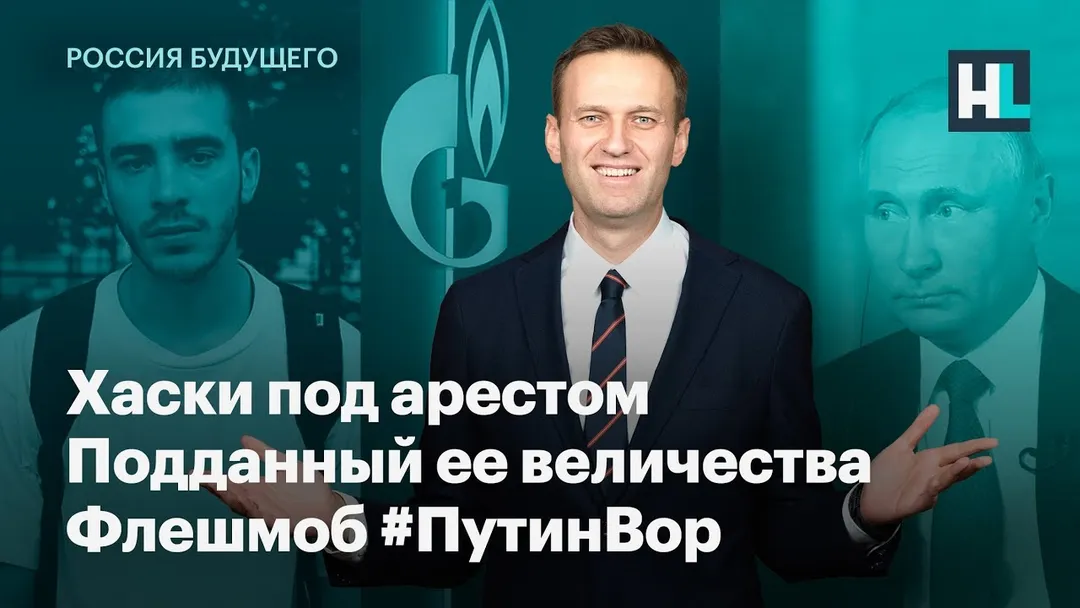
Husky under arrest, a subject of Her Majesty, and the #PutinIsAThief flash mob
[music]
Hello everyone. It's 8:00 p.m. in Moscow, which means
that if today is Thursday—and today is Thursday—then
we are live with the program *Russia of the Future*. In
the studio, it's me, Alexei Navalny, or the "coffee
liberal," as the Federal News Agency called me,
Prigozhin's news agency run by the restaurateur
—yes, the very same "Putin's chef". I'm glad that
Putin's chef continues to keep an eye on my
work. We'll keep going and do everything we can so
that people like him stay worried about
what exactly we're doing. Please write to me
on Twitter with your question and the
hashtag #RussiaOfTheFuture, and I will
try to answer those questions as we go
through the program.
So, here's the situation. The situation is as follows:
someone comes to another city
to perform, and the police and the authorities of that city
are unhappy. They put pressure on
the venues, all the venues refuse, and as a
result, the person whom people want
to hear speak or perform—this alleged
disturber of the public peace—well, they
gather somewhere, and the person still
comes out to perform, and then the police
detain him. What is this? Well, by now
the image, the spoiler, has already appeared—but no,
it's the wrong one. You'll tell me: well,
Alexei, obviously you're describing
your standard, typical trip to a
regional city: the venues
turn you down, you go out into the street,
stand up to the police—but no,
no, no, we're not talking about politics right now.
We're not talking about Alexei Navalny. We're
talking about rap. You may be surprised, my friends,
but we're talking about rap. We're talking about rapper
Husky, who at this very moment
is in an almost identical situation
to the one I so often find myself in. It's now 8:00
p.m., then 9:00 p.m., and at 11:00 p.m.
a judge will come out and say whether
this rapper, Husky, should spend the next 15
days in a cell, or whether
he will be released. They won't let him hold concerts,
because apparently
some deputies got upset and angry about rapper Husky,
some lawmakers who wrote letters everywhere.
If a deputy from United Russia (the ruling party) writes letters,
then the police have to
do something too. So when he arrived in
Krasnodar, our wonderful Kuban region,
where no laws seem to exist at all, all
the clubs first refused him. In Volgograd
he was also refused permission to perform; the shows were
canceled. When people came to the concert,
he came out to them, and someone said, well,
here, climb onto my car, and from there
—there were about 40 people gathered—you've got to do something.
So he came out and climbed onto the car, and there,
naturally, it was also a hundred-percent copy of
what happens when I travel to southern Russia:
some Cossacks (state-aligned paramilitary/traditionalist groups), some people
calling themselves Cossacks, some kind of
vigilantes—basically some strange
people who can grab anyone they want,
and nothing will happen to them. They
dragged him off the car.
They detained him. As I understand it, there are now
three administrative cases against him, and one is for
resisting the police—Article 19.3,
my favorite one; I've done time under it many times. And then
there's also refusal to undergo
a medical examination,
meaning they assume he was either drunk or
on drugs. And again, Article 20.2.2:
the unlawful organization of a mass
gathering of citizens in public places.
That's exactly the article under which I served my last
20-day and 30-day jail terms. And probably many people
think that right now I want
to gloat over rapper Husky,
because, let's be honest, the man has
views that are, well, not especially democratic,
and at one point
he supported that kind of
Putin-style aggressive policy; in particular,
he went to Donbas (the war-torn region in eastern Ukraine). He even recorded
a song with Motorola, or perhaps to lyrics by
Motorola
—that field commander from
Donbas—and so
he spoke up for all that quite actively, and
quite aggressively attacked those
who were against Motorola. In particular,
two years ago, in an interview with
*The Village*, he said: some bastards on
Patriarch's Ponds (a fashionable central Moscow neighborhood) think they have the right
to speak about him—that is, about Motorola—
negatively. Maybe, of course, they do
have that right, since we're all free
people, but I would gladly take that right away from them
once and for all.
That's what rapper Husky said two years ago.
And now he has found himself in a situation
where some unclear, unaccountable people think
that they too can, just like that, once and
for all, take away from him
the right to perform, to speak at all, to do
anything. But I absolutely do not want
to gloat in this situation. I can
say that I am, of course, unquestionably in this
situation on his side. In fact,
it's not even just his side—it's the side
of all normal people. He says
some things—strange things, good or
bad things; he says good things too, by the way.
For example, Maria Motuznaya from Altai—you
know, the young woman who became widely
known because criminal charges were brought against her
over posts on
VKontakte. He supported her during
that case. But in any event, this is simply a lesson
to everyone: we must stand up for freedom
always, regardless of what
rapper Husky says. And if rapper Husky
even wants to climb onto a car there in order to
to shout there, "Putin is great, we're for Putin"
someone is messing around with this machine, the machine has become
dragging him around means he is right, because he
has every right to perform with
concerts, he has every right to make
his own statements, he has every right
to release his music videos and everything else. I
really hope that after all this
mess, he gets out
and honestly, I'll say that two years ago I was wrong
when I said that some
people from Patriarch's Ponds (a well-known central Moscow neighborhood) — well, he meant that
we are supposedly serious people, while those are some kind of
hipsters and "liberasts" (a derogatory slang term for liberals) hanging around
at Patriarch's Ponds, so he needs to be shut up
because now they want, they
they want to shut everyone up altogether
absolutely everyone, and now rapper Husky
specifically — deputy Elena Drapeko has actually
said something just wonderful. Here's the quote:
"Before opening his mouth, a rapper should
think about what he is calling for, and what
will happen." So you see, here
in fact, Husky's quotes from
two years ago and those of the deputy
of the State Duma, Drapeko, right
now, are actually quite similar. And we must understand very clearly
that this government consists of people
who basically want to ban everything
or rather, it's not just that they want to ban things — in the course of
their work, they simply cannot
stop banning everything. That is their
job. They are our bosses
over us, so they sit there, they monitor
like some kind of evil teacher, and the task
of that evil teacher is simply to make sure these
children sit still, and when he notices
someone moving, he needs to take a ruler
and walk over — whack, on the head. And it doesn't matter whether you're
rapper Husky, or wearing a Motorola A1000 with rhinestones
at Patriarch's Ponds, or whoever else you are. And just
today, another deputy, Vitaly
Milonov, said that there should be a
comprehensive review of the activities of
rapper Eldzhey. And then, quote:
"A bomber jacket, a thick knitted cap,
damn, that's again a dangerous thing — a thick
knitted cap and unusual jeans,
a complete absence of pupils — the overall
picture undoubtedly looks threatening."
Do you understand? A State Duma deputy, with a salary of
450,000 rubles (about 4,900 USD) a month, looked us all over and said:
"I don't like your thick knitted
cap, and in general those unusual
jeans — all of it looks threatening,
so take off your jeans and your thick
knitted cap, rapper." They simply cannot
help banning things. They have nothing else to do in life
— these deputies. To them, we are not
people; we're a flock of sheep, or a herd,
a group of children
children who need to be constantly
watched, and constantly restricted in something
and pushed, forced to move
somewhere
They will do nothing else. I
have said this many times on my
program, and I'll repeat it again:
for the entire remainder of Putin's term, however
long he stays there — one year or ten years, that
already depends on us — but for most of that time
it will be about them
constantly
restricting us in one way or another and looking for
some kind of problem with your thick knitted
cap, or with some unusual
jeans, or with your pupils — something will always be
wrong. And it doesn't matter if someone thinks
that certain cultural figures — well,
they spoke out in support of Putin, or
went to the DPR (self-proclaimed Donetsk People's Republic), or something else — so they'll be
left alone. No, they won't be left alone
ever. And here's a wonderful example:
Yegor Kreed, whose producer is
the singer Timati — and it would be hard to find anyone in show business
more loyal
than that kind of representative of show business
He's already fawned over Putin and
Kadyrov, kissed up to all of them, loves them so much,
and still Yegor Kreed is not allowed
to perform in Makhachkala. Why? Because apparently it needs to be
banned. And then they said, well somehow
he has unusual jeans — there's no place
in Makhachkala for people in unusual jeans
and in general there are some people living there in
Dagestan who wanted to go to a nightclub
and
well, listen to calm, harmless Yegor Kreed — what
is so terrible about that?
But no, you can't, you're not allowed
We've decided for you — you must not do that
But of course, the argument
against Husky will be something like this. And
I'm sure that tomorrow
some Kremlin media outlet
or one of those federal news programs
will immediately write that Navalny
spoke on his program and once again, apparently,
defended drug addicts and drug dealers, because
rapper Husky supposedly promotes
drugs, and Navalny is defending rapper
Husky
Well, here's what needs to be said
Let's actually watch 18
seconds
of the banned video by rapper Husky, which
is called "Today's Business" on YouTube, and
actually — believe it or not —
from Husky's banned clip, 18 seconds, as I understand it,
which were the main
reason why it was banned
This is, after all, a program about banned
things. Let's watch. Do I like
what is shown there? Well, how should I put it — it's
life. I certainly don't like it when
people take drugs. I am against
people taking drugs. Well, that's
exactly what the song is about — it's about poor people
people who use drugs
because they live in poverty, they feel bad, and
everything is terrible overall. The state's task in
the area of drug policy is to make sure that
as few people as possible
use drugs, and that this way
fewer teenagers
would use drugs, because
drug addiction is now a problem
of the poor, mainly. A stereotype held by many
in much of society, people who are far removed from
this problem, is that, well, drugs
are somehow something consumed by the rich
and that it's people in nightclubs
snorting cocaine off each other and whatever else
with gold credit cards and all that
lines and so on. No, it's poor young people
who are using exactly this kind of garbage that
they bought for 500 rubles (about $5–6)
they stuff into a cigarette and then jump around on
those so-called salts or whatever and then out the window
it's horrible. So, deputies and
Deputy Drapeko and Deputy Milonov, they
should study the experience of a huge number of countries
where drug addiction arrived much
earlier than in Russia, earlier than in the USSR (the former Soviet Union), and
try to apply some measures
to fight drugs. There are
some softer methods, and if what's needed there is
tough anti-drug policy
fine, but then support Yevgeny
Roizman and his anti-drug policy
but you won't support him; more than that, you
hound him
then why did you find in the video by
rapper Husky? Besides, let's
be honest: if we ban
rappers' music videos about drugs, rapper
— well, not only them, not just about
drugs do they sing — but if we ban
rappers' music videos about drugs, then we
must ban all feature
films
feature films, especially from
recent cinema. Well,
let's remember *The Irony of Fate* (a classic Soviet New Year's film)
I mean, the main mega-hit that every
New Year they show us — we know this
film by heart — and it's about how people
got absolutely plastered, to an inhuman degree
and got lost somewhere within the Soviet
Union
*Peculiarities of the National Hunt*
*Shirley Myrli*
these are all films where, with a kind of
sympathy, people are shown as just
again, excuse the expression,
getting pig-drunk, and in
that pig-drunk state they did
all sorts of funny things
all right, but if it were the same thing except
they had gotten high instead, how would that
be different? From that point of view, vodka
is the same kind of drug — any addiction specialist will
tell you it's exactly the same kind of drug. But nevertheless
one thing is treated as some kind of
national peculiarity
or fishing trip — that's our Russian character
everyone got drunk and is lying on the ground, but
if someone poured himself something there, then for that you need to
ban the video, jail people. Both
are negative phenomena
and both should be fought
the arrest of rapper Husky will not in the slightest
help the fight against drug addiction
or the spread of drugs among
teenagers, first and foremost
on the contrary, first of all it will make all this even
more popular. Besides, once again it
shows us that there is basically no
rule of law in the Russian Federation, and even more so
in Kuban, in Krasnodar Krai (a region in southern Russia), here
just, by the way, in Krasnodar
Krai, I wasn't even able to
perform in Krasnodar because not
a single venue gave us
the opportunity to perform. I never
made it there during the presidential campaign
there is no law there at all — it is simply absent
well, there isn't much in Moscow either, but in Moscow there is
at least some semblance of something, whereas there everything is simply
replaced by these kinds of people
who call themselves Cossacks (paramilitary traditionalist groups), who
of course have never even seen a horse up close
and have nothing whatsoever to do with rural
life or agriculture — just some kind of
thugs and private security guys simply sitting on
the budget
some of these judges, and again Prosecutor
Chaika, the Tsapki gang — that's our whole Kuban
our Krasnodar. And when these people
are now trying to show all of us
that they are, supposedly, on the
side of legality — well, frankly, there is
no trust whatsoever. Well, I spent a full 16 or 17
minutes talking about rap — that's probably my
new record, and our program
will soon turn into a rap bulletin. So, questions
Alien John asks me: what can you
say about the nationalization of the
Central Bank of the Russian Federation? Right now
it belongs to the state, that is, it
formally is not state property
it is independent, but of course it is now
part of
the Russian Federation, part of the state
property of the Russian Federation. What other
questions came in?
while they're looking for questions, I'll move on to
the next topic. Our next topic is
that Putin has decided to hand over the Kuril Islands
and all of this is happening in some kind of
very strange way, because he
seems to be planning something and has made some
kind of
outrageous statement, and that's that. And it's interesting to me
to see that even these people have fallen into agitation
these representatives of the so-called
from the patriotic internet, but now all
those who usually go to bat for Putin, for
imperial policy, are now running around the
internet and shouting in horror, "Oh my God,
oh my God,
our beloved Putin is trying to give away the Kurils (the Kuril Islands), and
what is he doing—or is he not trying to? I wonder if there
is the same kind of behind-the-scenes maneuvering going on there.
And as for those propagandists who
are trying to feel out the line—how are they supposed
to explain to us now
that Putin is ready to hand over two of the Kuril
Islands, that this is somehow a good idea, that it is
the fulfillment of the international treaty of 1956,
and now Peskov has already said—first
he confirmed it, then denied it, and in the end
said—not in the end, the discussion is still
ongoing—he said there would be some kind of
compromise that would satisfy everyone. Let's
watch, 41 seconds.
Over these past days, over these days, we have all
already seen a very large number of
various political analyses
and speculations claiming that supposedly some kind of
backroom bureaucratic deal on transferring the islands
and so on has already been made. That is not the case. What will the
sovereignty be, how will they
be used,
what kinds of activity will
take place there, and so on—there are whole
myriads of questions that will need
to be answered. A compromise will undoubtedly
be required; that much can already
be said now. But it will be a compromise that will not
run counter to, or come into conflict with,
the national interests of either
side.
Well, overall it's unclear what
is really happening here, but generally speaking
it's obvious that these people are up to something,
and they are doing it in exactly the same way
as when they already made fairly major
territorial concessions to China, remember?
The islands on the Amur River were handed over,
despite the fact that there was an absolutely
unified opinion among citizens inside
the Russian Federation that this should not
be done. There had been fighting there, people had died there,
and nevertheless, in that same hush-hush mode,
they quietly worked something out, made some kind of deal,
gave away the islands, and told stories about how
beneficial it was for Russia,
what great investments would come, what
wonderful bridges we would build from one
bank of the Amur to the other.
Well, I was in Khabarovsk, and there's nothing there,
nothing has been built, and nobody got any
benefit from it. Here they clearly
want to do the same thing. By the way,
here's one domestic Russian example, also
very telling so far: Ingushetia.
Well, the people in charge there worked something
out among themselves, in some kind of back
room, chatted things over,
passed some money around, and then
presented everyone else with a fait accompli: here,
we exchanged
one territory for another, and people are running around
protesting. Putin, as far as we can
understand—and I think this would be the correct
interpretation—because in fact he
is in a state of foreign-policy
isolation. Of course, he can talk to
Venezuela and, say, some other countries,
or with countries in the Middle East, but overall, for
normal, developed, wealthy countries, he is
some kind of strange,
dangerous little guy no one can have
any dealings with. And it is very important for him
to break out of that and make some kind of
asymmetric move so that everyone would
love him again, so that at least one
country would lift sanctions,
start inviting him, and conduct
dialogue with him.
Putin wants to become a player again in
some part of the world, because, well, essentially
to put it plainly,
this whole supposed return of Russia to the
political stage exists only
on Russian television, but
we cannot really do anything else of that kind.
We just can't.
And as I understand it, he is trying
to strike a deal with the Japanese and actually
give them either two islands or four
islands, somehow in installments,
possibly in exchange for money,
possibly
in exchange for recognition of Crimea's status (i.e., Russian control over Crimea),
but one way or another he would like
to do it in the same way he handed over
the islands to China.
That is, they are not going to ask you and me,
but then again, who are we that they should ask us?
They don't even ask us about things far less important,
about what jeans to wear or what knitted
caps to put on—so why would they discuss the islands of the
Kuril chain with us?
Moreover, the Kremlin understands perfectly well that
public opinion is absolutely against it.
So that means public opinion simply
must not learn anything. It has to be
some kind of arrangement under
which they will tell us how
great and beneficial this is for us, how we somehow came out ahead,
how Putin outplayed everyone again, they will tell us,
because he fulfilled Khrushchev's
1956 agreement, and we will learn nothing more.
In that sense, I am reminded
of a great story that was told to me by
Boris Nemtsov—one of his favorite
stories.
It's described in his book, but he told it to me
personally, and in such vivid
detail, that it really shows, well,
Russian politics and the problem of the
Kuril Islands.
Yeltsin was once together with the prime minister
of Japan.
Nemtsov had come along on the visit, I think it was
Vladivostok. Anyway, they were out somewhere on a
boat, and Yeltsin was there,
the Japanese prime minister was there too, I won't
lie, I don't remember which one.
Nemtsov was there, along with some
member of the Japanese government, and the interpreters.
And the son of a bitch was drunk, I mean,
back to Yeltsin's alcoholism again: he got drunk and,
wanting to do
something nice for the Japanese—he was that kind of person,
impulsive—and at some point
he says to the Japanese prime minister, basically,
"Come on, bring the papers, I'll give you the islands." He was
a generous soul—what were a few islands to him?
"Take them all, I'll sign." Nemtsov
said that at that
moment he realized that we were
completely screwed—that this was the end.
If people found out about it,
they would tear us apart, the government would fall, and we'd never
get a single vote again. But
those were still times when they did, after all,
care about public opinion to some extent.
They thought: people will be unhappy, we can't
do this because people will
be upset. And Nemtsov said that at
that moment he did the one simple, only
possible thing. He understood that he had to
do something to prevent this
disaster—to snap Yeltsin out of it,
because drunk, he had simply decided
in a good mood to give everything away. He might have
gone on to hand over Sakhalin too. And he said,
"Right there in front of the Japanese, I dropped to my
knees before Yeltsin and said, 'Boris
Nikolayevich,
have mercy, this cannot be done,' and
still on my knees, 'I beg you,
stop talking this nonsense in front of the Japanese.' I mean,
for the Japanese, any kind of
emotional display or anything
outside protocol is a loss of face.
And at that level too—the president. Nemtsov
said that
the Japanese were just staring, genuinely
unable to understand what was happening. Yeltsin was stunned too.
"Naturally, I felt like
a complete idiot, but I understood that this was
the only thing that could be done at that moment
to keep Russia from
losing the four islands of the Kuril chain
simply because of stupidity, drunkenness, and
so that the public wouldn't just throw this
government out the very next day." And so
he did it. And now notice
how different the situation is. It's not that
I'm singing the praises of the 1990s, but I am definitely praising
a system in which the government
depends on the public mood, because
now nobody is going to fall to their
knees. If Putin wants to—well, those islands don't belong to you,
do they? They belong to Putin, apparently.
Everyone knows Putin won
the Great Patriotic War (the Soviet term for World War II on the Eastern Front), after all.
He bombed Berlin, he organized
the defense of Moscow, and he defeated Japan too, and all of it
belongs to Putin—so he can give away
whatever he wants.
And of course, if he gave away two islands, fine,
who would accuse him of anything?
And that's considered normal. Of course, we all need to
watch this situation and respond to
it so as not to let these
people make decisions like that. There should
be talks of some kind,
talks with Japan, but they should be conducted on
the understanding that these will be endless talks that
will never lead to anything,
because
this territorial conflict
cannot be resolved. Public opinion in
Japan unequivocally demands all four
islands.
Public opinion in Russia—roughly
speaking, the Russian people—says these islands
must not be given away. So that means
the government, carrying out the will of the Russian
people, should not give up anything. At the very
least, it definitely should not
be engaging in strange negotiations
and all sorts of unclear maneuvering, because
especially in a situation where Russia is
fairly weak economically—let's
be honest, extremely weak
economically. Okay, say we gave away two islands—
then tomorrow, of course, they'll say: hand over
the other two as well.
Then some political party in
Finland will say, well then, let's talk about Karelia
too—it was taken away as well, after all,
it used to be their territory.
An aggressive war was waged, and Karelia was
taken.
So what, are we supposed to start negotiations too
over returning every border change
that took place in the 20th and 21st centuries? Those are
the result of political decisions and
political events, wars—in other words,
some kind of grand global
upheavals. And these borders, in many ways,
from every side, were drawn somewhat arbitrarily.
Not perfectly, not fairly—there is always
someone unhappy with how the borders were drawn.
Therefore, the only possible path is not
to "solve" these problems, but rather the only possible
way forward is to move on and say:
we consider the current borders
inviolable, and we will never discuss
this again. Sure, for a moment it may seem
the Japanese are unhappy, upset, and
concerned, and every Japanese
government faces enormous pressure from
its own population on this issue. But we
have our own population and our own pressure too,
and we must hold to the position that
There is a border; it has been drawn, and we are not revising it.
But apparently, of course,
the Kremlin thinks otherwise and treats these
islands as its own personal property.
All right, let's continue. Ravshan Valiullin asks:
Ask me about the travel ban—I’ll explain now.
Inferno Vertela asks me:
Will you resume live broadcasts on Instagram?
I want to resume them, but somehow it just isn’t
working out. To be honest, I still
haven’t really figured out whether people actually watch live
broadcasts on Instagram. I mean, they do watch—there are
several tens of thousands of viewers there,
but it’s still kind of a strange format for
Instagram, so I can’t really tell
whether people need them or not.
So, Viktor asks a good question.
It’s a question that’s been bothering both me and Viktor.
Lately, honestly, if there is any
example of a country that is developing while
its institutions are degrading,
I can’t think of one, no matter how hard I try.
The courts, culture, the economy, education—everything
is either degrading or not. But, Viktor, the areas
you mentioned—well, yes, they are
degrading, because they simply cannot help but
degrade when an entire
sphere, indeed the whole state, is degrading.
And yet, look—the internet in
Russia is excellent. I’ve just come back from
Strasbourg, and Russia has great internet: fast and cheap.
You hardly find internet like Russia’s anywhere else in the world.
Maybe there are a few places, but
in most countries—even in California, in the U.S.—
internet is more expensive and worse than in Russia.
Mobile service in Russia is cheap.
Internet companies are developing; we have
a national search engine, Yandex,
which the state allows to exist. So yes, of course, there are
some sectors of the economy, some areas of life,
that are developing. But mostly this
happens where the state cannot
influence them, or where something happens
despite the state.
Life goes on: 150 million people live
in this territory, despite the fact that
deputy Milonov (a Russian conservative politician) looks at them and says
something absurd about their specific jeans or whatever.
But people keep doing things, they somehow
keep developing; they don’t just consume.
They use mobile phones, so
sales grow. In other words, life
still goes on—there is always life.
So some things do improve. But if it weren’t for
these idiots in the government,
who are just this oppressive superstructure,
everything would be developing and improving
much more. Now, about the travel ban—I’ll explain.
It was a very strange situation. Don’t ask
what that was. “Alexei, when they didn’t let you
leave the country...” So, I was supposed
to go to the announcement of the most
important ruling concerning me in the
European Court. It was a ruling recognizing
the political motive behind
all those various arrests of mine. So I was supposed
to go, and at the border they told me,
“You are not allowed to leave.” A strange situation in which
the border guards were standing there
glancing at each other—they had clearly been called
and told not to let me out. They didn’t know what
to say. They brought some strange
piece of paper, and it said that
I had been banned from leaving.
But they gave no exact reason. I know that I can have
problems with leaving the country,
so we always monitor the database for things like
debts or something else—some fine
might get attached and they won’t let me out. But there was nothing.
It turned out they had invented some kind of
fine for me in the Kirovles case.
And in fact, they had drawn up the documents
retroactively.
Fortunately, Yevgeny Chichvarkin had long ago
transferred money several months earlier
to cover just such a fine.
He transferred that money to my lawyer; he
was ready to pay that fine for me, for which
many thanks once again. So we passed on the
money, meaning we could pay it instantly.
We paid it, and the Russian authorities immediately
found themselves in a ridiculous situation, because
we could see that some people had said,
“Don’t let him out.”
And then other people started saying,
“You idiots, by not letting him out you’ve created
a scandal out of nowhere. Let him go.”
It would be one thing if he were just traveling with his family
to an exhibition. In fact, two weeks earlier
I had gone to an exhibition with my family, and they
let me out. But this time, don’t let him go to court?
How would that look in court? A ruling is about to
be issued on the political
motivation behind the persecution, and you won’t let him go to that
court? Idiots. In other words,
some idiots
—let’s say, the less idiotic ones—scolded the more
idiotic ones, and apparently that’s why I was
allowed to leave. I don’t have an answer to
that question. Everyone at the court was asking me,
like, “What on earth was that?” And everyone here
is asking too. I simply don’t know. I mean,
it was just sheer idiocy,
the stupidity of some people. But I don’t know—maybe
someone high up called the border service and said, “Don’t
let him out.”
And then, when all of this blew up, maybe
Putin said, “What are you doing?
Are you stupid? Why are you meddling in something that’s not your business?” I don’t
know. Maybe it wasn’t anyone important at all; maybe it was
some completely ordinary Vasya or Petrov-type
officials.
At a lower level. But I still
doubt that, because it couldn’t have happened
at that level for instructions to come so quickly
not to let me out, and then for them to be
canceled so quickly.
The Federal Penitentiary Service.
Even the bailiff service issued
a special press release saying
that yes, yes, yes, we had cleared him to travel.
It was a strange situation, but as for
the substance of the matter,
it really was a major victory.
Look, over the course of several
years I was detained several times,
arrested and jailed, or simply
detained, and in the European Court
I won several of those cases, but the
European Court
said that it recognized that my rights had been violated,
the right to liberty had been violated, but it would not
recognize, for its own reasons, that this had
a political motive behind it.
That political motive was completely
obvious to me, so I appealed to
the Grand Chamber, and the Russian Federation, in
turn, said: actually, we had every right
to arrest and detain him, so we also
filed an appeal, and we all submitted
appeals, so the case ended up before the Grand Chamber.
It’s a very solemn, very serious
thing. I went there and spoke, and as you can see,
I’m congratulating my lawyers.
We really did win after all, and when the
judgment was announced, honestly, all the lawyers
we had spoken to told us,
“Get ready: overall, you’ll
win. These arrests will still
be recognized as unlawful, but you won’t
get that Article 18 finding,”
meaning recognition of a political motive. Because the most important
thing for me was for the political motive
to be legally established, because
the court does not like doing that, and the court
doesn’t want to pick a fight with Russia. It looks
super scandalous.
It breaks with the court’s practice and
affects its future
case law, so they’ll come up with some
formula where you sort of
win, but the political motive won’t be
recognized.” And honestly, after
talking to the lawyers, I went there thinking,
“Why the hell did I even drag myself here?
There’s all this attention, they didn’t
let me out, and now yes, we’ll win, but
we’ll miss out on Article 18.”
And I’ll have to come out here and explain that
it doesn’t matter, that the whole
point isn’t in that article—I’d be putting on a brave face
in a bad situation. But
what happened was a truly major victory. The body
of evidence we presented
to the court was such that they simply could not fail
to recognize the political motive, because
my lawyers really did an excellent job.
My lawyers submitted all the documents.
In some of the cases—I won’t
bore you with the details—but there
the sequence of events was such that it was
impossible not to recognize it, and the court did
just that: it found a violation of Article 18. The position of the Russian
judge is very interesting,
the Russian judge at the European Court, because in
the first instance, when the political motive
was not recognized, the Russian judge, whose surname was
Dedov, wrote a separate opinion. I even posted
it on my blog and said, “My God, Russian
judges can write amazing separate opinions.” And in it
he wrote outright that of course there was
a political motive and that we had to recognize
that political motive—it was very important.
In other words, the judge knew the motive would not
be recognized, and that’s why he wrote that it needed
to be recognized. But this time he knew that it
would be recognized by the majority of judges, and he then wrote
a separate opinion saying he was categorically against it,
that this could not be done. Interesting, isn’t it—
he changed his mind so quickly and wrote a separate
opinion. But in any case, it was 14
votes to 3—we won. Judges voted
for me who, based on the usual alignment,
would never, in situations like this,
vote in our
favor. For example, the judge from Armenia
voted in favor.
And in that sense, this is a major victory not
just for me, and not even primarily for me, but for all the people
who are detained. That’s really great.
Onkrut asks what I think
about the proposal to refuse
imported medicines and
equipment. I’ll say more about that, but
in a word: it’s idiotic, obviously.
Andrei asks whether working in banks
is becoming a threat to employees’ lives.
I’m not sure why working in banks—well,
write to me in more detail, I don’t understand.
But for now, while you write in more
detail, let me talk about our dear Seryozhka
Brilyov. Today we released an
investigation.
You know that those who follow our
videos know we have a particular interest in Russian propagandists.
They are the most disgusting,
vile crooks, but to me, really,
people like Zolotov or, I don’t know, Shuvalov, or others like them
are no more repulsive than someone like
Solovyov, Kiselyov, or Brilyov, because
it is precisely these propagandists, on
their constant lies, that Putin’s
regime stands. These are people who lie
to millions and brainwash millions. This
works not only in Russia—it works
everywhere. Look at these absurd
strange regimes—you had Mugabe in
Zimbabwe sitting in power for 20 years because
he also had television and newspapers
telling everyone what a wonderful
Robert Mugabe he was. He was a completely mad
old man who managed to create
22,000 percent inflation there, and we have
the same kind of disgusting liars. We keep an eye
on them, and we’ve ended up with a kind of mini-
series. We made one episode about the Paris
Gabrelyanov’s apartment at LifeNews, we
talked about Solovyov and
his villa on Lake Como, and now Sergey
Brilyov is a case that, from my
point of view, is absolutely astonishing—not because
we found not only an apartment there for
a million dollars in London
but also because this man is a subject
of the United Kingdom. People confuse citizenship and
what it means to be a citizen of the United Kingdom
or a subject of a country. So if
Britain is a monarchy, then under a monarch you are formally
a citizen in Russia, but in Britain you are
a subject. Therefore,
Sergey Brilyov is a British subject.
Let’s
take one minute and 30 seconds—a brief summary of
our video for those who haven’t watched
it yet. Our mini-series *Propagandists* continues.
A legend of Russian political
journalism, the deputy general director of the VGTRK holding company,
Sergey Brilyov. We type the surname
Brilyov into the public database of British
legal entities, and there is only one
match.
A London company belonging to a certain Irina Brilyova
—that is Sergey Brilyov’s wife. We find the exact
Brilyovs’ apartment in London
simply by going through all the apartments in the building
managed by the company in which she has a stake.
Here is the building. A nice area,
a lovely, affluent part of West London with
the Thames, parks, and not far from
Heathrow Airport. And here is the property record for the apartment.
Owner: Irina Alexandrovna Brilyova.
Purchase date: February 22, 2016,
on the eve of Defender of the Fatherland Day (a Russian public holiday on February 23).
Price: £700,000. These unremarkable
books are a source of priceless
information for us—they are the lists of those who have the right
to vote in UK elections.
In other words, subjects of the United
Kingdom. We open the relevant page and
see that back in 2001, one Sergey
Brilyov
and Irina Konstantinova—that is Brilyov’s wife’s maiden name—
his wife’s maiden name,
were registered as voters in the district of
Notting Hill.
Here’s what I suggest we think about, because
citizenship—your relationship to a country—
is defined by a certain highest form
of loyalty. You become a citizen
of that country, or a subject of that country. Well,
that is, in itself
okay, you realized that you like Britain
more than Russia.
Your family lives there; in Brilyov’s case,
his daughter and wife live there permanently, and he
flies here every Saturday—or
conversely, flies to them for a couple of days.
That’s a constant. But you have determined for yourself
a kind of final form of loyalty.
Having weighed everything, you said that your life,
the future of your children, is ultimately connected
with Britain. That is precisely why admission to
citizenship—or, in this case, becoming a subject—
is surrounded by these, well, ritual
formalities. In order to become a subject
of the Queen, Sergey Brilyov
—already in 2001, while working
for state television, heading the
bureau of state television—you
are supposedly representing your country. On behalf
of that country, you go to
press conferences, raise your hand,
and say: ‘Sergey Brilyov, Russian
television, and here is my tough question for you,’
to a British politician who is there
making Russophobic statements,
asking why you believe this and that,
and so on—representing a side. Yet while being
a state TV journalist, you go
and become a subject, and you take
an oath—you recite not some vague
words, but specific words. You say: ‘I swear
to faithfully bear allegiance to Queen
Elizabeth II, her children, and heirs.’
‘I swear that I will be loyal
to Great Britain.’ In other words, this is you
standing there and saying those words. It is
a symbolic
and ritual act in which you
simply make a declaration: this country is
the main one for me, and all the other countries are
secondary. And the main country
for Sergey Brilyov is
Great Britain. And, well, agree, it is very
infuriating every Sat—
The thing is, he is not just a journalist—
he is a deputy general director at VGTRK.
At VGTRK.
That is all—not just the second
channel button; it is a huge structure. There are dozens
of regional TV stations,
dozens of radio stations, thousands—tens of
thousands—of employees. Their budget is
23.5 billion
rubles (about US$370 million at the time). So this guy, receiving
his salary from us, is one of the top figures
in Russian television, a deputy director. He
lectures us on life every Saturday. He hosts
the inauguration. And the inauguration—why is that, by the way?
By the way, I think—well, I allow for the possibility,
rather, let me put it this way: I allow that
the state system, all those webs of
checks and all the little officials who
are supposed to vet everyone,
may not know about Brilyov’s British
subject status, because the man
hosts every inauguration. It is a kind of
main broadcast.
There he is, Putin, walking in, so grand, and this
surely should require some special person.
Like in the old days, before sending
a cosmonaut into space, there would be some kind of
check—what if he had ‘enemies of the people’ among
his relatives? They checked the biography.
but he absolutely has to be a member there
of the party, and so on and so forth.
So even now, just some random guy can't be the one conducting the inauguration.
just some guy
We need to check that. I explained the whole thing—that
Putin's inaugurations, all this
patriotic nonsense—it's an obvious lie.
All those tough questions to foreign
leaders—all of that was being asked
all of that was being done by a citizen, a subject
of Britain, who swore his
loyalty
to Queen Elizabeth II, but he really is
offensive. I mean, did
Brilyov commit a crime?
Actually, he did. Sorry, it just occurred to me
just now.
I remembered—do you recall there were protests in
Volokolamsk over the landfills, and one of the
leaders of those protests, a guy named Artyom
Lyubimov, had a case fabricated against him
because the FSB sent over a piece of paper saying
that he supposedly had American
citizenship. And if you don't inform
the Russian authorities about your other
citizenship, then a criminal case is opened
against you. Lyubimov had to
run to the U.S. embassy and get
a certificate from them saying it was all fake and that he was not
some kind of citizen. The case was dropped.
But here we know for an absolute fact that
Brilyov
is a British subject. We know that he is
on the voter rolls.
He couldn't have ended up there by accident. His wife
and daughter live there; he stays there on a regular basis.
They simply have no other basis
for permanent residence there except
citizenship, the status of a subject
of the Queen. And, frankly, I'm almost
sure that he did not notify
the relevant authorities.
Which means he committed a crime.
A formal offense, but still a crime.
Let the FSB or whoever else
deal with him, but as far as all of us are concerned,
he acted in a simply insulting way—not
just a crook, but a lying
crook. Not just some famous official who
bought real estate abroad—
because apparently life here is bad, here
education is bad, healthcare is
bad.
That's why they all go there. But this is even more than that—
he actually took citizenship while serving as
a state TV correspondent. I mean, what kind of
bottomless hypocrisy is that? By the way,
now it's clear why Sergei
Brilyov
one of the reasons why he speaks so softly,
so gently,
such a propagandist—a propagandist of good
news—because if he were to go
in the style
of one of those completely deranged
types—say, Shenin (a Russian TV host)—
well, they probably wouldn't let him into Britain, just like
they didn't let Kiselyov (a Russian propagandist) in. And for him that would be
a problem, because then it would start
a whole investigation: let's not let
Brilyov into Britain—and then it would turn out we can't
not let him in, he's our citizen. There he is,
standing right here with us,
with a portrait of the Queen and all that,
probably voted for Brexit too.
That's why his program has this very
carefully evasive tone. But despite the fact that
he may not provoke the same kind of
raw, sharp emotions as
Solovyov, or that same Gabrelyanov,
I urge all of you to help
spread this video.
Because for 17 years—seventeen years—this guy has been on
state television, and he, well, he
has raised millions on his propaganda,
basically brought up an entire generation.
Putin has effectively been in power for 19 years,
and this man has spent 17 of them singing his praises. So it's very
important that everyone finds out now: yes, this is
the kind of guy he is—he swore
allegiance to the United Kingdom, and yet here he is,
sitting here telling us about
Putin. And my fundraising department will cut my head off with a chainsaw
if I don't now
mention—remind you about—the magical link
to FBK info; it's in the description. If
you like what we do, then
go there and sign up for
a donation, because investigations—
we do these great investigations, but
they do require expenses. We said so casually
today in the video: we checked and
found Brilyov on the citizenship lists. But that meant
days and hours that had to be spent
in that place searching. I mean, we
understood
that something was off there, and most likely
he was a citizen: his wife keeps showing up there,
his daughter keeps showing up there and lives there,
they have property there—so overall
analytically, we understood that
Brilyov is a subject of
the United Kingdom.
But it had to be proven, and that really took
hours and hours and hours of work.
And we put in those hours and do this work with your
money, so if you support us,
it will be easier for us—and harder for Sergei Brilyov.
Generally speaking, it will go worse for Sergei Brilyov.
And isn't it true that Sukhotsky got
12 days under the article for petty
hooliganism?
Well, 12 days isn't insignificant. We
don't get less than that. By the way, speaking of
cases like that—if they catch Husky (the Russian rapper) again
next time, he'll probably get
significantly more. Again, once more,
despite the fact that we obviously have different
I don't share the political views of this
remarkable rapper at all,
and I feel not a shred of schadenfreude. The fact that he has now been
unjustly convicted for something that should not be subject to prosecution is
wrong. In other words, we have to set aside, you know,
this whole context of what was supposedly wrong in his songs,
what he says there, and what he
said earlier about Donbas (the eastern Ukrainian region contested since 2014), or about Crimea,
or about anything else. He may have said things that were pleasant
to some people and unpleasant to others,
but he was jailed unjustly, and once again we have
been reminded that this government
will devour anyone simply because it needs
someone to devour.
So Husky got
12 days in jail.
Narik Maloyan asks: does Article 18 of the ECHR (European Convention on Human Rights) have any
practical significance?
How exactly will that give you
more room to act? Narik, if you get to the root of it, it won't. What
practical significance does it have? None. But it does have
legal significance, because
it establishes a fact. In the beautiful Russia of the future
— the Russia of the future —
when we put all of them on trial, from
Brilev
to these judges, it will make our case
more serious, because we will already have
simply
proof: a court will have recognized
that there was a political motive. So
to throw them all in prison, we
will need to make less effort.
In Russia right now, does it change anything? No. They will keep using
arrests at rallies, but
obviously they will, because they don't want
me taking part in them. They will keep
obstructing our work,
and they will do so because they
don't want investigations about
Brilev to be published. From a legal point of view,
for future court practice this matters; from the
standpoint of moral satisfaction
it matters; from the standpoint of other similar
cases it matters. From a practical standpoint,
they have the power, they run everything here,
and until we bring out onto the streets
a radically larger number of
people — until a million people
come out, until we can organize the kind of
intensity of pressure that will force
them to retreat —
then of course it has no
practical effect. Will someone refuse to
do something out of fear of this ruling?
There are plenty of examples. Will Putin refuse
to steal another billion
dollars? The answer is no, he will not. Good
question. William Eisenhower asks: has it ever happened
that your team checks an official
and he turns out to be squeaky clean — no
expensive real estate, no
huge bank accounts?
All the time. First of all, we very
often don't find anything, that's
natural. For the majority of
officials
we find nothing. And then, what does
"not squeaky clean" mean? This system is such
that many people in it simply cannot
steal. They would like to, yes, but they are not
close enough to the feeding trough. Some are afraid, some
simply don't have the opportunity. So we don't
say we've found someone squeaky clean. We
find that, say, he receives a salary
that is fairly high — officials now receive
large salaries — and more or less
lives on that salary, is not involved in business,
his wife doesn't run a business either, she doesn't have 10
expensive cars — so he lives
on, say, 120,000 rubles a month as an official, or
450,000 rubles as a State Duma deputy,
and we haven't found anything else major on him.
But that does not make him, for us,
squeaky clean, because he is
part of this government. He still bears
responsibility for what is happening.
So in that sense, we do not put him on a white
list; we do not place him on the list
of those who should be sent to the
defendants' bench. Leonid Novikov
asks: could the Communist Party of the Russian Federation (CPRF) in the future become
your ally, or do you think it is
gradually drifting toward being a tame
Kremlin opposition?
There's nothing for it to drift toward. The CPRF
is a tame Kremlin opposition party. At the same time,
I constantly support the CPRF.
During the last gubernatorial elections, on this
program I kept talking about candidates
from the CPRF and even from the LDPR, in the case of
Khabarovsk Krai.
Even though that is absolutely
a puppet, a pocket party. But that's the thing:
today they are tame, tomorrow
less tame. In any case, first and
foremost, we must act against the monopoly
of United Russia.
That is why I see nothing
wrong with this — people will start throwing tomatoes at me,
as Husky would say,
what do you call them, from the people of
Patriarch's Ponds (an upscale central Moscow neighborhood) to
— but still, what I'm saying is:
you can and should vote for the Communists
for rational reasons,
because in that case United Russia will lose.
Because, as you can all see, there is no
normal alternative right now. So let's
vote for the Communists so that we have fewer
United Russia people on the field, so that
their position weakens. That needs to be done, and we need to
stop endlessly agonizing: my God,
they're Stalinists, they're bad, they're
a tame opposition. Yes, they're Stalinists,
a tame opposition — but if we are
going to be a little smarter, we
understand that our task is to defeat United Russia.
lower it so they get fewer votes
controlled, because when they
control 90 percent, the Communists
a pocket opposition; when they
control 40 percent, the Communists
will stop being a pocket opposition, that’s it
and that’s all. I have a section called
“The Horrors of War in Their Heads,” and here
there’s a lot to cover. Let me race through
it at breakneck speed—I’ve already talked so much that
the program is already coming to an end, I mean
that is, over the week—I wasn’t on air last week
last week because this nonsense happened
First of all, Ms. Lakhova, a member of the Federation Council
said that when she
commented on a proposal by one of the
deputies that the subsistence minimum needs to be raised
she said that, basically,
all those who are unhappy with low
wages and the high cost of
the food basket should remember
the horrors of war. And you know, the conclusion
the main conclusion to draw from this is not
that Lakhova is crazy, nor that they
should simply disband the Federation Council—who
even are these people? Where did this
woman come from? By the way, 5 to 6 million
rubles a year (about $55,000–$65,000). I mean, I’m older, I remember
where she came from. There used to be a party called
Women of Russia in the 1990s; they were all over the place
and then they drifted into United
Russia. Now this nomenklatura functionary is getting five and a
half million rubles (about $60,000) and
is calling on those whom—well, she, she is
a senator from Bryansk Region, where the average
official salary is 26,700 rubles a month (about $290)
in reality, I think it’s around 20,000 (about $220), and this
person, earning 5 million, speaks on behalf of
the people of Bryansk and says: let’s remember
the horrors of war. What the hell? The war was 75 years
ago.
There were horrors—yes. But what does that have to do with low
wages now? Let’s remember
Napoleon’s wars too, let’s remember
the horrors of the Permian period, when
cataclysms happened and 90 percent of living creatures
on Earth died out. All our problems—what,
some rapper like Husky (Russian rapper),
some Brilyov (likely TV host Sergey Brilyov)—you’re wasting your time
remember the horrors of the Permian period
trilobites were dying out by the billions—that’s what
that’s exactly the same idiotic logic. In no
way does this Lakhova have anything
to do with the war, nor does she have anything
to do with its horrors, or with its victories
the only thing she has anything to do with is that
right now the salary in Bryansk Region is 26
thousand rubles, and so really, well
what more can you say, once again, about the moral
they are stupid, immoral people, and the entire Federation Council
should simply be kicked the hell out
and here we smoothly move on to remember another
one
prominent Federation Council figure, Valentina
Matvienko—my favorite
she’s just a marvelous woman. She
declared that imported medical equipment
is a sign of bowing down to the West. Meanwhile
Matvienko herself, two months
earlier, was asked: what do you
think about a law that would
ban officials from receiving treatment abroad?
And she said: what are you talking about, that’s
a violation of the Constitution. How can we
forbid officials from being treated
abroad? And then immediately, just
two months later, she says that if you
or your grandmother go and want
to get, say, a scan on a tomography machine
a proper one, meaning an imported one, then
unfortunately that counts as bowing down to
the West. This person is constantly draped in
luxurious fur coats, covered in jewelry
we even did a little
investigation: Valentina Ivanovna
has a Chanel watch
worth $23,000. Well then give it up, Valentina
Ivanovna. Wear a watch from the Zarya factory or
some Poljot watch or something else
domestic. Why such
bowing down to the West, and for
$23,000 at that? She’s decked out head to toe in
Mikimoto pearls—so what’s all that for?
Come on then, let’s bring out granite
feeding troughs, hang up some Russian birch bark
folk gear, wrap some kind of kokoshnik (traditional Russian headdress)
from the Bolshevichka factory—why Mikimoto, then?
Tell us, Valentina Ivanovna, isn’t that bowing down
to the West? But they’re brazen scoundrels
simply real brazen scoundrels. They
there they are, draped in Mikimoto, telling people
that you can’t use it, that it would be
unpatriotic to use imported
ultrasound equipment in a country where there really is
a “Gift Firewood” campaign, and every
year it happens, and every year it
honestly fills me with rage
It’s a charity drive where elderly people
are bought firewood, and a large number of people
receive it
have it delivered. Our level of gas supply
in rural settlements is up to 57 percent, and
there, one of
these activists runs this campaign
one of these pro-government activists, he
runs this “Gift Firewood” campaign. Good for him
it’s good that he gave away firewood, but to me
it seems that the governor and
the president of a country where a
“Gift Firewood” campaign exists should simply
sink into the ground from shame. But we are
one of the world’s main gas producers; we have
record gas supplies going there, record supplies
going here. Putin was just recently sitting there
with Mr. Erdogan opening TurkStream (the gas pipeline)
billions of money have been spent, billions, tens
of billions
but how much would it cost if we gave these people
they should have installed gas, or at least bought firewood
using budget money, really, well, just
it’s infuriating, and yet it’s being presented as this kind of
powerful official caring about the people
love me, people, I brought you firewood, right
it’s not firewood that needs to be bought, people need to
demand that Matviyenko step down
from the Federation Council
and her Mikimoto pearls, have they been handed over already, seized?
because that’s illegal enrichment, and with the
money raised, you could buy firewood for everyone, or
better yet, install gas. And as for this sausage thing, listen
I’ve already gone over by 2 minutes, and I wanted
to rant, of course, about the sausage excise tax, well
again, it even sounds idiotic, yes, and we’re
seriously discussing it, and
the idea of introducing an excise tax on sausage is a ridiculous
thing, but it’s just one more, yet another
tax on poverty
because, well, who consumes the most
of this kind of product? Well, that is,
the lower a person’s standard of living,
the more they consume these kinds of cheap
substitute products: cheap sausages,
cheap processed meats. Sure, let them pay more
then. Next they’ll need a campaign not just to
just ‘give firewood,’ but ‘bring water’ and
whatever else — they already don’t have the money
to buy firewood
so sure, let them pay another 30 percent
in excise tax on sausages. Well, these, these people
really are
objectively enemies of Russia. I can’t
despite the fact that I’ve run over time
help but support the coolest flash mob
happening in Russia right now. It’s the
‘Putin Is a Thief’ flash mob. A schoolboy in
Krasnoyarsk Krai (a region in Siberia) simply wrote on
the blackboard: ‘Putin is a thief.’ He was
scolded for it, and let’s go ahead and watch 1
minute of what exactly the teacher is accusing
the Russian schoolboy of for
writing the plain truth on the blackboard. One minute.
and to those who
[music]
[music]
already in dozens of regions across Russia
this spontaneous flash mob is taking place, where
people are writing on blackboards, ‘Putin is a thief’
on the board in their classroom
not all, but many teachers, I think,
would gladly put their name to that
some people are twisting themselves up over it, well, let them
let them squirm — it’s the truth, after all, and
let those letters burn their eyes, because
it’s because of people like this
old lady
who was shouting, ‘What are you doing? You’ll be
thrown in jail!’ Because of people like her, in
Russia they have campaigns like ‘Give Firewood’
because of her they introduce excise taxes on sausage, and
because of her we’re forbidden from using
imported medical equipment, while
we can’t provide our own, either. So
I fully support this flash mob
I’m wrapping up the program. I would, I’d end it with
because we started with the rapper Husky
who has just been jailed because
it’s believed that he promotes an un
healthy lifestyle, specifically
drugs. So, as for the healthy lifestyle
as performed by our authorities, as carried out
by the main state company, it looks very
impressive. So, in Tomsk
Gazprom Transgaz Tomsk held
a major sporting event
called a bike ride for Russia Day. They
organized a bike ride, people rode bicycles, and
however many were there, never mind
five sections of the road were closed off, everything was blocked
it was all very pompous, Russia Day and all that
but what I liked most was the
‘Healthy Lifestyle’ project
the event budget for the healthy lifestyle event
which included
some things that were apparently essential for
the bike ride, and among those things were 62
liters of vodka and 124 liters of cognac, and these
people are jailing the rapper Husky. In the beautiful
Russia of the future
during bike rides we will not be
drinking 164 liters of cognac
thank you very much to everyone who watched until
next Thursday
