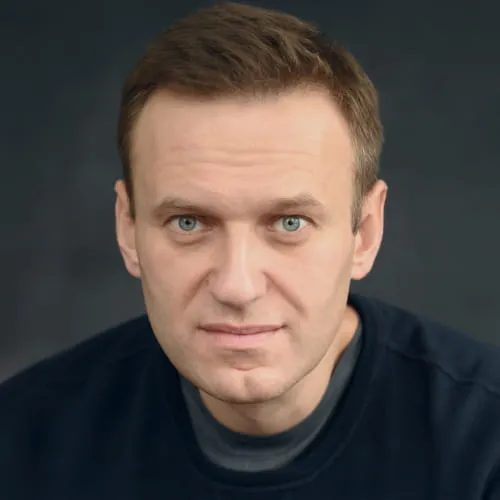
Navalny at 20:18. Broadcast #001, 20.04
Hello, good evening, you’re on the air with
the YouTube channel Navalny Live. Alexei
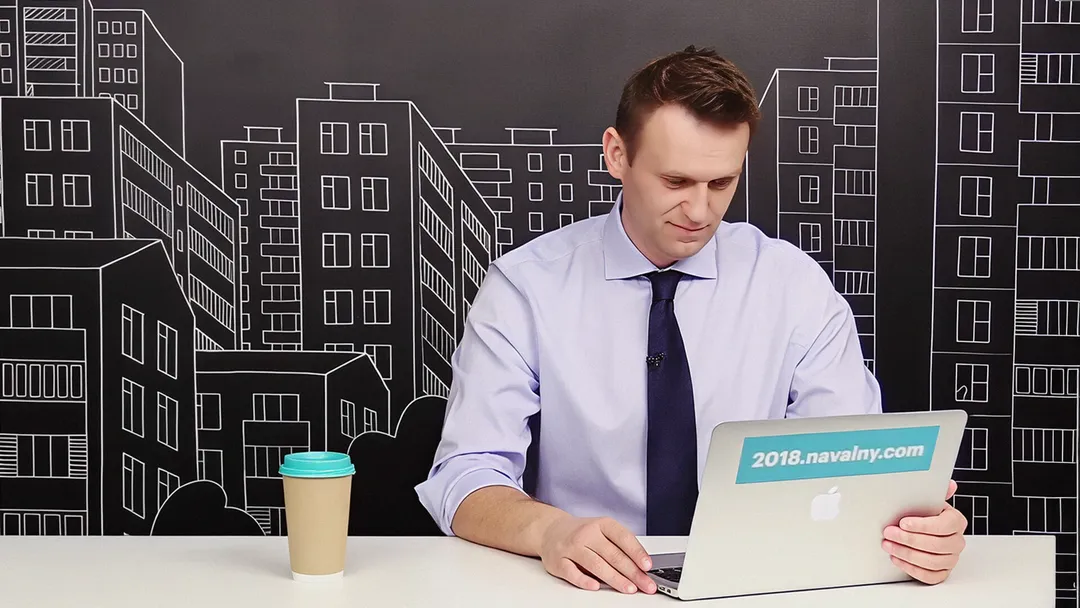
Navalny, in a shirt and tie, almost like a
real TV host. That means I’m finally
making good on a promise I made a long time ago
and from now on I’ll be hosting a weekly YouTube
show, completely live. Soon
we’ll finish setting things up — we’ll have calls here, we’ll
have Skype here too, but in any case
I’ll be answering your questions. This
program exists so that you and I can
talk and discuss the latest news over the course
of an hour. I won’t be able to escape your
tough questions. You can
really pin me down with them right here —
the trickiest ones, the most interesting ones. I’ll
have to answer them, because this is
live, and that’s basically
the whole point. Please don’t judge
me too harshly. This is my first
experience hosting a program. Who knows what
might fall apart here — the sound might cut out or something
like that. I’ll say right away, actually:
Insight is a pretty stressful thing. Sobol,
who hosts on the channel every morning,
is always complaining that she gets very tired,
and we laugh at her. But now I can see
that my heart is pounding and, overall,
it’s a little scary — but I hope it all works out.
Hi. I actually wanted to start by
introducing our channel, Navalny Live,
because it’s already working quite actively.
Our broadcast from the rallies on the 26th
was watched by 4 million people. That can absolutely
compete with big, real
television. But still, we launched it
in a kind of guerrilla way, and we also have
morning shows that are also watched by
an average of 150,000–170,000 people, and we’re very
pleased. Thank you to all our viewers. But still,
no one has really explained yet
exactly why we launched the Navalny
Live channel, and I’d like to briefly say now
that, first of all,
the main reason is that we have something to say. We
believe we represent a
significant part of society. We know that
on the other side of the screen there is already a huge
part of society that wants to talk
about the topics we want
to talk about. Yes, there are people who are
interested in fighting corruption. There are people
who are
interested in what is actually happening at the rallies.
There are people who are
critical of the government — and in fact
they are the majority in Russia — and they
have no television of their own, neither regional nor
federal. There are, of course,
the excellent Echo of Moscow and the TV Rain channel,
but overall, there is no real television
for these people, and we are trying to create —
to add to those few uncensored
islands of informational freedom
our channel as well. We know that people
want this. Second,
what is on television now is
not really Russia’s television — it is
television for some occupied
country, or, I don’t know, for some foreign
place abroad. You press the button,
turn on Channel One, Channel Two, Channel Three, Channel Four,
or even any regional channel,
and they’ll tell you about Ukraine — that’ll be
the first three news items — then about Syria, about
Palmyra, about Aleppo, what happened there at the
United Nations, how
terrible Europe is decaying, how they have
Islamization there, or some attacks,
or gays taking over entire countries. But where is
Russia in all this? Where are the news stories about Russia,
about what is happening here in our
country? Well, excuse me, but I see — I find online —
and I see thousands of
truck drivers in Dagestan, very much within
Russia,
literally fighting with OMON riot police.
I see a huge number of news stories about
our country. There is so much I want to know about
our country. But where can I watch that? So
I am completely dissatisfied with
the occupation-style television that exists in the
idiot box. And third,
we basically despise everything
that is happening now on official
television. It is television
made by thieves and crooks.
And we want to do our part. I’m not
afraid to use such a lofty phrase as
the destruction of this television. I understand perfectly well
— I’m not a naive person — yes, here I am
sitting here in a room at a white table, with
one camera filming me. This is not exactly
a direct challenge to central television and
the major broadcast channels, but still, we
want to do our part. We also want
to support and encourage many people
who are wondering whether they should start
YouTube channels, who are thinking about whether
they can organize
some kind of small-scale broadcasting in their own region. And we want
to show that yes, you can. It’s not that expensive,
it’s not that scary. And probably the symbol
of all this is the wonderful wall
behind me. Well, you know how it is:
usually when a TV host has
an evening show, behind them there’s this
cool, expensive backdrop, like a nighttime cityscape,
with lights twinkling everywhere, and everything
looks great and super polished. We don’t have
the ability to make a nighttime cityscape,
especially after, in particular, the police
quite recently cleared out this very room
and took absolutely everything that was
in it. But that’s all right — we drew
a city. It’s a perfectly decent city. There are probably
even some five-story apartment blocks here that will
to take down, and which we’ll also discuss later today
And, uh,
And in the background, there’s a stylish chalk drawing
I can certainly say a few words, actually, and
probably a lot of people will want to hear them
that’s what we’re doing all this for, so
Please subscribe to the channel
Navalny Live — we’re going to fill it
with news, and we’ll also be making
regional mini-channels like these, first and foremost
in cities with populations over one million
we’ll launch them, and we’ll be filling the broadcast
schedule — right now we already have regular
weekday morning broadcasts with Sobol
Sobol’s show, rather — and we also regularly
feature lawyers with their own
legal show, offering basic legal explainers
Leonid Volkov talks about what’s happening at headquarters, and I
will talk about anything that interests you
and we’ll keep building out this schedule — please write to us
and tell us who you’d like to see here
who we should invite, and what other
programs we can make for you. We’ll definitely
make them for you. Although, of course, in
general, this isn’t exactly what we do
professionally, but we’ll give it a try together
this is the kind of television we’re going to
build together with all of you. And Alexei
asks me — Denis Antonov asks — why are you
doing this on Navalny Live instead of on
the main channel? The audience there is much larger,
right?
Dear Denis, we have 125,000
subscribers here; on the main channel, around
850,000. But the formats are completely different here
it’s live broadcasts, nothing but live broadcasts
these are long videos, and we do a lot of broadcasting
so we want, ideally, to do this kind of broadcasting
24 hours a day. But on the main channel
we make short films — five
or at most ten minutes long — that’s the longest
they get. So they’re just completely different
formats. Besides, we want to grow
the audience — some people are interested in produced videos,
some people are interested in a talking head,
as they call it, right
A few
things I wanted to discuss — I just
looked at where I got the most questions
and of course the biggest number were about
Medvedev in the State Duma and yesterday’s speech
You know that Medvedev, as the head
of the executive branch, came yesterday to the Duma
for Government Hour, and
the idea was that the deputies would
really grill him there, ask him tough questions
possibly ask about our investigation
and you probably know that
they did sort of ask, but
only in passing, and Medvedev said he was not
going to comment on the investigation
or on the materials of some swindler. But actually, I
wanted to talk about something else. You know what really
struck me?
These deputies —
450 people, half of them elected in
single-member districts — which means they need
to travel back to their regions, meet with people
and many of them do meet with them. They
are involved in politics, at least in some way, they
want to make a name for themselves too, and all these
deputies basically fall into three categories
first, those who meet with
voters, with people, and say:
the government is very bad, but Putin
is good. The second group says:
the government is very bad, and about Putin
they stay silent. And the third say:
the government is bad, and Putin isn’t very
good either — the Communists, A Just Russia (a Russian political party), a little bit
at least. And then you get this one moment a year when
the Prime Minister comes to you, and
there he is, standing there, small and
defenseless at the podium — well, ask him
a question. Stand up, go out there, say something. But
the Communists, throughout the year, every — well, not
every day, but regularly — declare that
they demand the government’s resignation
they have no confidence in the government, and
so say it
Medvedev, resign, we do not
trust you. On any subject at all, just stand up and
speak to him on behalf of those millions of people who
earn salaries of 15,000 rubles a month (about $250 at the time)
get yourself noticed
for once, right? Do something
so that people notice you — and nothing. Absolutely
nothing. They were forbidden to ask sharp
questions, and they don’t ask them. That’s apparently how it was planned
and just think — people are surprised why
no one goes to elections. Why is that?
Why has institutional politics stopped
being interesting to anyone? Yes, that’s exactly why
it stopped being interesting — because you have
one day a year when you can
do what a deputy is supposed to do
convey what people think. If you are
an opposition party, then you should
voice an opposition view — and you
stay silent. It’s simply not interesting. What do
they feel — these healthy grown men?
Many of them bought their seats. They absolutely love
being in the spotlight; for that they submit
all kinds of bills so that the press writes about them
and they want, they really want
to jump in with some question, but they can’t
so they sit there, heads bowed
staring at the desk. It’s very sad
very sad, very depressing that
billions are spent on this Duma (the lower house of Russia’s parliament), that we
pay each of these deputies
a salary of 450,000 rubles a month (about $7,500 at the time) for
simply staying silent when
the head of government comes before him
As they say in cases like this, one
leader of a certain country once said sadly,
Hitler — let’s talk about Hitler
when the TV Rain channel (an independent Russian broadcaster) released the news
What this means is that the Presidential Administration
has created entire groups of some kind,
units whose job is to go after me,
to, as they put it, keep attacking me.
"Attack me like Hitler"—but everyone thought I meant
it as some kind of metaphor.
Like, they were just going to hit me really hard,
as if I were some huge villain. But
in fact,
a video came out yesterday. I watched it just now
before going on air, and it already had 1.6 million
views. A lot of money has clearly been poured
into promoting it—it’s being pushed through paid
sites. And in it, I literally am
Hitler.
And a lot of people ask me: how is that possible?
Why? What is this? Is it even legal?
There was supposed to be a picture appearing here next to me,
a still from
that film, and we were even wondering whether it was legal
to show such an image, because United Russia
has passed a special law banning
the display of Nazi
symbols, and they shut down websites and open cases against people
for posting
archival photographs
from the war years that contain swastikas. And here, meanwhile,
the Kremlin is putting out entire videos like this.
You know, this is not surprising to me at all.
First of all, they already did all this in 2011
and 2012, very actively. You’ve probably just
forgotten. When I launched the campaign
"United Russia is the party of crooks and thieves," they
responded to me like this. For example, they
said, "Well, you’re Hitler. You’re a fascist," and
they made these videos,
gave various interviews on the subject
quite often. I understand why they
do it.
Just think about the Presidential Administration.
Just picture the situation in your head:
who are these people, really?
The Presidential Administration
is made up of people whose actual direct
duties are to lie and steal. They
are responsible for making sure the press lies. They
send out talking points,
they make sure censorship is enforced.
They
appoint governors. If some
decent person appears, they make sure
that that decent person does not become
governor, and that instead the governor is
an indecent person, and so on and so
forth. In other words, this is a structure that
basically exists to lie and
create the conditions for corruption. So
they hold a meeting,
and there I am, Kiriyenko, sitting there saying something like,
"Come on, guys, we have to act
proactively. Look, Navalny
—we thought we had squeezed him out of the
information space, but no.
He can write some blog posts, sure, fool around on
Twitter, but then he releases
these films, and those films are watched by 20
million people. He tanked the approval rating of
our United Russia party leader,
Medvedev. Let’s do something."
And what can they do? They can only
throw someone in jail, or they can
use their lying media
to smear people. That’s what this fake is.
They said, "All right, he’s active on YouTube now,
so let’s allocate a lot of money,
make a video saying that he is
Hitler—can you imagine, Hitler—and pay
to promote it, and everyone will see that he’s Hitler, and everyone
will stop believing Navalny, won’t go to the
June 12 rally, and will stop watching his
investigations." It sounds ridiculous,
Shuvalov says. Yes, but in reality
I think that’s more or less exactly how it happens. And
most importantly, I don’t see how it could happen
any other way. They simply cannot argue with me
on the substance. No one can come out
and say, "Well, you
released an investigation. Now we’re going to
go through your investigation point by point
and debunk it, tear it apart, destroy it,
wipe the floor with you." No. What we saw from
—from Shuvalov, sorry, from Usmanov,
from Eliseev, from the people named in our
investigation—was just ridiculous. And
today Burov released a video where he
basically wipes the floor with Eliseev.
They have nothing substantive to say, not about
a single point of our program. So they
will of course make videos saying that
I’m Hitler, that I’m a foreign agent,
that my income comes from shady sources,
what else—that I’m some kind of
dubious figure. They’ve been doing all this
since 2007, even earlier. There’s
nothing else they can do. On the other end of
their toolkit, there’s also
jail. That’s something they can do too.
That’s all. And we’ll see it: the closer we get to
the elections, the more people watch these
videos, the more they will
spread their lies, and the more
budget money they will "spend," because
this also involves huge sums of money that, of course,
this whole crowd from the Presidential Administration,
together with contractors and
others, will happily carve up among themselves. So, I’m being
asked—I saw here:
"Reanimator 4: Why didn’t Roskomnadzor (Russia’s media regulator) block
the video with Navalny-as-Hitler
for the swastika?" Well,
because it was put out by the Kremlin, and Roskomnadzor
is, among other things, helping it stay up.
YouTube is not going to block anything.
YouTube blocks content when there is a violation
of the law.
So there would have to be some complaints. But
who is going to complain—me? I’m not going to
file complaints about this video. I’m for freedom.
Those words are certainly unpleasant to me, very much so.
There are lots of little jokes about Hitler, ha-ha, very funny, but I get no
pleasure from that topic whatsoever,
I truly don't. But I'm not going to complain about the video,
so YouTube doesn't care
if there are no complainants.
All right, the second question is from Ekaterina Shcherbatova.
What if we ask subscribers
to complain to YouTube
about the video in which I'm compared to Hitler?
But why? Honestly, tell me,
what for? That video, once again, at first
glance is funny; on second
glance it's rather unpleasant.
Would I like to be compared with
someone else? Of course.
Do you think it hurt me more, or
did it actually help me by showing what kind of
crooks, scoundrels, idlers, and louts
are sitting in the presidential administration? Well, I
am sure it's the latter. Look, by the way,
they disabled the comments. Did you see
that they turned off comments under that
video? Well, because people were writing everything
they thought. But there is also the number,
the ratio of likes to dislikes — dislikes are
10 times higher. That basically never happens,
normally. So they simply showed, uh,
once again, that they can't do anything. After all,
they're putting this on YouTube, not on Channel One
(Russia's main state TV channel).
On YouTube, there are people who more or less
understand what's what.
A short, small topic — a lot of people asked about this.
Today there was news that
schools are introducing special tests, well,
something like the Unified State Exam (Russia's standardized school-leaving exam) about the presidential elections, and that
just floored me this morning. When
I was arrested on the 26th,
I was sitting there, and for a week they brought me newspapers. I
read newspapers, including some pro-Kremlin ones,
and on every page there was an article
about how
Navalny uses children, Navalny
brings politics into schools, Navalny
politicizes our poor little children and
teaches them something bad. And these people,
the very people who accuse me of
politicizing young people, are now officially
and administratively introducing
tests about the presidential election in schools.
I won't even start talking about the fact that
our schoolchildren, it seems to me, are already
dying from the sheer number of tests as it is.
Just imagine: an 11th-grader
apparently has absolutely nothing else to do.
He doesn't need to prepare for the Unified State Exam
or the GIA (Russia's state school exams) or any other exams.
No, apparently he also needs to prepare for a test
about the presidential election and answer
questions like: what would be better for Russia —
to elect Putin president, or what?
Or to have a Maidan (reference to the Ukrainian protest movement) here and
buildings burning? That's apparently the kind of test
they're going to make. But honestly, this
outrages me terribly, of course. But I am sure of
one thing: all of this will infuriate
both the students themselves and their parents so much. Here's
yet another new test, maybe some textbook,
some new teaching guide or whatever, that they'll give me
even more votes.
Uh,
the next thing I wanted to discuss with you
is the five-story apartment blocks.
The five-story apartment blocks.
A huge number of questions are coming in
about the five-story buildings; people ask me about this
especially often because, as you know, I
headed an organization called the Committee
for the Protection of Muscovites and for several years was quite actively involved
in Moscow with issues of
development and development-related conflicts, even back in
the Luzhkov era (under former Moscow mayor Yuri Luzhkov) of demolishing five-story buildings.
So, generally speaking, uh, I know what I'm talking about here,
I would say. And my attitude toward what
Sobyanin is proposing, toward what was
passed today in the first reading, is for now definitely
negative. Let me explain: what is being proposed
now is essentially not even a program
for demolishing five-story buildings. It's a cunning little
Sobyanin-Khusnullin combination
to abolish construction standards in the city
of Moscow altogether. They simply want to make life easier for all
developers, and so far not that many people have
paid attention to this. I even wrote down
some notes here.
There are several points there.
In renovation zones, they declare a renovation zone
to be basically anything — both where the
five-story buildings themselves are, and the districts where
new housing is being built. There, they can deviate from
construction standards and sanitary standards —
epidemiological standards, and so on,
sunlight exposure requirements, everything else. This is explicitly
written into the bill that
was passed today, and all they need to approve are some
special technical conditions. And you
know, under the law this demolition
does not regulate only five-story buildings, and
certainly not only the so-called
first series of industrially built housing —
the very worst five-story blocks.
In fact, under this law, in a simplified procedure they can demolish
other
residential buildings too, buildings of any height, any
structures at all, in principle, that are located in
a renovation zone. They are making life easier for themselves.
They are loosening the technical requirements for themselves, and
we will see, I am sure, that all
this talk about demolishing
five-story buildings will in fact turn into
them choosing those nice,
juicy pieces of Moscow where they can
carry out profitable commercial development
and simply take advantage of the fact that there it's easier,
there will be a simplified legal regime, and
they will demolish everything there. They will
force property owners to sell cheaply.
to sell or give up their premises
they will deviate from the rules and will
make a huge, huge amount of money, and
one thing that shows me that
something is very suspicious about this
five-story apartment block program, because
there is supposed to be a vote, and they say
that, well, if people vote against it, then
that means we won’t demolish them. But the voting
will take place through the so-called system
*Active Citizen*—and I can state responsibly
that this simply means that all
these votes will be rigged
we conducted an investigation into
*Active Citizen*; FBK (Anti-Corruption Foundation) and Volkov looked into it and carried out
investigations into *Active Citizen*
Plushev from Echo of Moscow wrote a good post today
on this topic. So, *Active Citizen*
is a system for falsifying
public opinion. It was created by Sobyanin. As I
understand it, Rakova oversaw all of this
it’s simply a fake; it’s a tool
for saying that Muscovites support
this, and then doing any kind of nonsense and
claiming that Muscovites support it. And the fact
that all voting will take place
through *Active Citizen* really
bothers me. Today it was announced that in the
Khamovniki district—for those not from Moscow, that’s an upscale
district of Moscow—there will be no demolition of five-story buildings
there. If that’s true, then good for the residents
of Khamovniki—they defended their homes. Well, there
are a lot of high-ranking officials living in Khamovniki
so that’s probably part of it. Plus, there
are old five-story buildings there that are actually quite good
with high ceilings; nobody wants to
demolish them
But here’s what it comes down to
in Khamovniki, then
the Moscow city government said, well, fine, we won’t
demolish them—damn it, we’ll leave yours alone
but we’ll demolish them everywhere else. Then that
means there is something bad about what they’re demolishing, and
they clearly mean something bad. And
when I see that this law, again,
talks about relocation, I understand
what that bad thing is. They say, uh, you’ll
be given another apartment on a square-meter-for-square-meter basis
and if it’s in the Central Administrative District, then within
the boundaries of that administrative district. But
look at a map of the administrative
district: someone may have lived in Zamoskvorechye—there are
five-story buildings on Runovsky Lane, near the
Novokuznetskaya metro station
but within the same district, for example,
you could be relocated to Taganka, near
the Third Ring Road, or moved to remote
parts of Presnya, or relocated to distant
areas of the Basmanny district. Housing prices
can differ by a factor of three. So your
five-story apartment in the center could be three times
more expensive than the new housing they give you
and under the new law, you don’t even have the right to challenge that
in court. Under the new law, this is a gigantic
and enormous scam. The next important thing is this:
why many people wanted
to take part in Luzhkov’s program for five-story buildings
because, among other things,
communal apartments were being resettled. Because when
eight people were registered in a one-room apartment
they were supposed to be given
several apartments; people living in communal apartments were supposed
to receive separate apartments. Now
that’s not written there, it’s not included. If you had
a 40 sq. m apartment, they’re supposed to give you 40 sq. m
if you had a room in a communal apartment, they’re supposed
to give you the same amount of space. You don’t even
have a guarantee that you’ll receive
a separate apartment, so
I don’t understand how Sobyanin today
said he needs to be given an initial, I think,
93 billion rubles from the budget for
implementing the program, when it has only passed
its first reading. How are you going to do all this
if the law hasn’t even been properly spelled out?
At every public hearing I see
people completely up in arms
nothing is clear, and they’re already spending money on something
but for now, all I can see is that this is
one huge financial scam
and a swindle by Moscow’s construction complex
of Moscow
And here Pavel Frolov writes: I live in Solntsevo
they’re renovating the entrances of a four-story building
before demolishing it
Typical. Excellent, thank you very much
Pavel, for this example—it’s a typical situation
the construction complex needs money. It wants it, it
sees Moscow’s budget—2 trillion rubles
an enormous, colossal amount of money in Moscow
and of course that money has to be stuffed
into people’s pockets. So they take any building
and start renovating it without paying attention
to the fact that in six months it is supposed to be
demolished. Well, that’s such a typical
absolutely typical
position of the current Moscow city government
Is it planned that—White Lindon
asks me—is it planned that we
will work on the five-story building issue at FBK
in some organized way? Well, it is planned. For now
we haven’t started doing anything yet; the law has
only passed its first reading so far, yes
nothing concrete has happened yet, but
as it is currently being proposed, this is
a gigantic corruption issue
without a doubt, the Anti-Corruption Foundation
will be dealing with all of this
Now, regarding those detained at the rallies on the 26th—I’ve been
asked about this a lot
whether I stand by my promise
to file an application with the ECHR (European Court of Human Rights) for each person—yes
I confirm it. Of course we will file one for everyone, and
we are doing a great deal of work on this with our lawyers
I don’t have the exact figures here, but through our hotline alone
the one we organized here at FBK
there have been
674 people detained at the rallies on the 26th who contacted us
Across the country, we prepared for the events on the 26th.
We prepared and sent 321 appeals.
These people will go through the appeals process,
and after that we will be able to file
a complaint with the European Court. I confirm
that for every one of them, I and my colleagues there—my
partner Konstantin Terekhov on the ECHR project
—will prepare such complaints, and I
honestly have no doubt about the success
of all this. Not because I’m some kind of
super-mega lawyer. Well, I am a good lawyer,
a very good lawyer—sorry for the self-promotion
regarding the ECHR. It’s just that the ECHR’s practice is such that
for those utterly shameless
illegal detentions—yes, all of them—
there will, of course, be a ruling in our
favor.
There are indeed still many court hearings going on.
Yesterday I was a witness at
the Tverskoy District Court in the case of the RBC journalist
Sokolov and Kolegov, who have already spent two
years in prison for organizing
a referendum, and in the neighboring courtrooms
cases were being heard concerning detentions on the 26th.
For the most part, they’re just handing out fines to everyone,
left and right.
There really are criminal cases, and I
understand that at least four people
are currently behind bars. And I saw a very
good question here:
Why are so few people discussing the fact that there are people
who are being held under criminal arrest?
It’s an unpleasant thing, and there is
a specific explanation for it: because this
has stopped being news in Russia.
The illegal detention and illegal arrest
of a person,
the fabrication of a criminal case, has ceased
to be, unfortunately, in Russia
significant news. Every single
day we have news that someone has been jailed—
bloggers jailed for a like, someone jailed for
some Pokémon,
members of a religious group jailed—
absurd stories. They’ve already basically
become screenshots about how someone was brought to
criminal liability—a guitarist,
for example, who was playing guitar at home for himself.
That already gets filed under humor, however
monstrous that may sound. So, simply put,
political repression, criminal
repression—there has become so much
of it that, unfortunately, it stops being
important news. And that is precisely why
the main mechanism of struggle
for the release of political prisoners,
the mechanism for making sure there are no
political prisoners, for making sure people are not jailed
left and right, is to go out to
new mass demonstrations. That is, we need
simply to unite and still
go out, still keep going. Because they
cannot jail everyone, and the example of
the rallies on the 26th proved that once again. Yes,
terrible things happened—they jailed, what, 4
people, 5, maybe 10—but
there was all that talk: we, the tough guys,
from the Kremlin, will shut everything down in all
cities, disperse all rallies. But rallies took place in 84 cities.
They happened.
In a significant number of those cities,
in a significant number of those cities, the rallies
were what the authorities called
“unauthorized,” but in practice, at least according to what
we see, 674
people contacted us out of tens of thousands.
The truth is that they
really do carry out
targeted repression—they jail people—but
when it comes to large groups of people, they
can’t do anything. So when
all of us go out to a rally, we make the situation
safer for ourselves, and in fact
we are effectively fighting for those who have been arrested
as well. By the way,
the host on our channel, the co-host
of the program with Sobol, Nikolai Lyaskin,
has been released. He got 25 days of administrative arrest. Somehow
I walked into the cafeteria in that detention center
and saw some very, very sad
person standing there on the first day, in the morning, after my
first night. I look—it’s Kolya.
He says sadly, “I got
25 days.”
And that was the longest arrest term there. And
that, by the way, is also a demonstration
of the absurdity of it. You can drive drunk,
you can fail to pay fines, you
can do all sorts of things, and
the maximum arrest term for you will be
15 days. But if you go to a rally—
my God, that’s the most terrible crime
in modern Russia—then suddenly it’s 25
days, 30 days, maybe almost
up to 60. So Kolya Lyaskin got 25.
He is being released today, and I
congratulate him on that. Tomorrow he’ll be back on air. And
my partner on the ECHR project, Konstantin
Terekhov, was at the detention center today and
met with Maltsev. He asked me to
send his regards to all of you. And by the way, we
are also preparing an ECHR complaint for him. He’s holding up
well,
and he’s doing great.
Questions.
If you become president, will you do live broadcasts?
Live broadcasts?
As for me, the current format of Putin’s live call-in shows
where he talks for four hours
and
answers prepared questions—yes,
it has become clear that many of those
prepared questions are not at all
to my liking. I believe the president should not
be doing that. There should simply be
a free press, in principle.
The president should be accessible to
the press at press conferences, when he
when he goes somewhere, he should answer
questions. His press secretary is obliged
to answer questions substantively, not
like Peskov, our, uh, mustachioed corrupt official,
who says, "I'm not aware," or "I won't"
answer, the Kremlin isn't interested." They
are obliged to respond in substance. If
the press should, of course, chase after them, and if I
become president, I will be the kind of president
whom
the press will chase, and who will be forced to answer
the press's questions even without any live
broadcasts. But overall, I think some
such, uh, well, not four-hour-long
large-format Q&A sessions are
absolutely right. The main thing is that
the questions should not be prepared in advance.
And
"Greetings from the flour-covered headquarters in Krasnodar,
Cornelius writes to me. How can relations
between society and the Cossacks be improved?
As I understand it, the question is connected to the fact that
today our headquarters in Krasnodar was
raided by some kind of mob
of so-called Tatar-Mongols
who for some reason claimed they were Cossacks.
They ran in and started throwing flour at everyone.
I honestly don't understand what that was. What
symbolism is supposed to be behind covering people in flour?
They trashed the headquarters and ran off. I don't
know whether these people can be called
Cossacks. In my view, they are more like
hooligans, and there is no need to establish any dialogue
with those who carry out these raids,
because they get 500 rubles
from the administration of Krasnodar Krai
As for the Cossacks, we have a normal dialogue
already established. What are Cossacks? Cossacks are
ordinary people, ordinary residents
of Krasnodar Krai, Stavropol Krai,
and Rostov Oblast—they suffer from exactly
the same things. Are they against
the minimum wage of 25,000 rubles that
I am proposing? Are they against the fight against
corruption? Well, no, of course not, of course
not. They are ordinary people; they simply
signed up in this register, they like
observing the tradition—great, uh,
we don't need any additional dialogue
because they all support us anyway.
They can never—well, at least
not openly—support us, those
people who depend on the administration,
who receive money. If there are
Cossack organizations—well, they were given premises,
the administration gave them money, the administration pays them,
and very often they have some kind of
uniformed security contract awarded
by the administration. The administration tells them:
we'll take all your money away if
you run to Navalny's headquarters and dump
flour on it. And they run and do it. What kind of
dialogue can there be with them?
They cover people in flour, and then somewhere
later, when you're standing on the porch smoking, they'll
say, "Guys, you have to understand, it's not that we're
like this—life is like this, nothing personal at all,
we support you." That's how it always is
in reality. So dialogue with them
is already established; people just need
to be less afraid of this government, less
cowardly. And for that, we need to carry out
campaigning, simply talk to everyone.
Next, what I wanted to discuss with you: there are many
questions about Zenit Arena. So, about Zenit Arena—
today I published on the blog that we
managed to secure
the opening
of an antitrust case over one
type of work for which an additional
billion rubles was allocated to Zenit Arena.
And now a case has been opened based on our complaint,
and in theory some officials should even be
disqualified—that is, they will be banned,
for example, from serving as officials for
some period of time. And there was an interesting question,
I don't remember from whom, I won't find it now, so
many questions are coming in, uh. Well, some people
say you're putting spokes in Zenit Arena's wheels.
Is that good or bad? What if something
falls through? Well, guys,
Zenit Arena—let's call things by their
proper names—is simply a bottomless pit. It is
a huge round mechanism in the city of
St. Petersburg showing how people steal
billions. I can't even remember now
how much it costs; it is definitely the
most expensive stadium in the world by now. And you all
recently read interviews from
representatives, including from Zenit, and they
say that you can't train there,
you can't play there, the grass is already bad, the roof
doesn't retract,
for heaven's sake, they've already spent more than 30,
I think, billion rubles on Zenit Arena, and
nothing there works.
The question is not whether to put spokes in
the wheels; the question is that we must
somehow—someone must—bring
these officials, at least formally, to
account, or at least, as we do,
file complaints. We've filed many.
They reject them unlawfully. We've recorded everyone,
and at least we know whom we will need
to bring to criminal
responsibility in the beautiful Russia
of the future for the fact that, right before the eyes
of the whole country, not just the city of
St. Petersburg, they steal and steal and steal, and
keep stealing at this Zenit Arena.
There are no media outlets left—not even the pro-Putin ones—
that write about it without saying, well, somehow
Zenit Arena is costing us a bit too much, but
still, new contracts, new
contracts. This contract was awarded under
the emergency procedures, you understand.
A billion rubles is allocated to Zenit without
any tender because the contractor
for Zenit Arena because it's an emergency
situation. What kind of emergency is it? Did a meteorite fly by there?
A fire? Ambulances? Everyone got sick? No.
They just need to hand it over, without any tender, without
any competition, to some guys, a billion rubles
so that out of that billion they can kick back to you
some 400 million rubles in return. That's all.
That's the whole Zenit Arena story. Of course, people should
complain, but wow.
Please comment on the words
of Zhirinovsky about the need to abolish
the requirement for officials to declare
their income. But they dream about this, and
Vladimir Volfovich Zhirinovsky in particular
simply dreams of it. Why? Well, because
you probably remember our
investigation into how we found that his son
— supposedly also State Duma deputy Lebedev —
had an apartment
I don't even remember, was it 7 rooms or 12
rooms, in Dubai, and the official extract showed
that it belonged to Lebedev, and none of it
was declared. And obviously, to
maintain that apartment, you need
to have a foreign bank account to pay for
utilities, and there was nothing in the
declaration. And nothing happened to him for it.
It was all quietly buried. They dream of
a situation where there is no
oversight at all, so that you — and we specifically — cannot
even stick our noses into their affairs and
find out anything about their
property. Here's a perfect example of
just how much, in fact,
the Russian asset declaration system
doesn't work at all, absolutely does not
work. Why do they want to get rid of it? There is
this politician — formerly a deputy, now
senator Babakov — we've written about him many times
before.
Because there was this interesting thing
about him: on the one hand, he was literally
the poorest deputy. We called him
our Cinderella — like Cinderella, he had nothing
at all. He had the lowest income, he
showed no property whatsoever — truly
an orphan; you read his declaration and feel like
crying. But we found his apartment in
Paris, found his foreign real estate.
Everyone knows that he has
huge energy assets in
Ukraine, among other places. He simply did not
declare any of it, and for years we filed complaints
about him. For years we were told, well, your
complaints do not correspond to reality.
And then he moves to the Federation Council website, and in
his new declaration statement
he reports 312 million rubles
How can that be? If a person in
public service shows that he has nothing
at point A, then at point B he cannot suddenly
have 312 million rubles appear. By the way,
on this subject I've already come up with something:
we're going to conduct
a test for Natalya Poklonskaya. She
heads the ethics commission and, among other things,
the body that checks the declarations of State Duma
deputies. Babakov is no longer a
State Duma deputy,
but he did file declarations
with the State Duma, and now he has a new declaration in
which there are 312 million rubles. Poklonskaya
has repeatedly said that she is this kind of
tough prosecutor who won't let anyone off the hook,
very honest, and
that the image of Nicholas II (the last Russian tsar) will not let her
fudge anything in her decisions. So
we will ask her officially: Dear
Natalya Poklonskaya, I think she will watch
this video. Please find out: if
Babakov was lying all this time in his
declaration — and he obviously was lying, because
he didn't just find 312 million rubles lying in the street — then
that means he must either be held
accountable or at least
the State Duma must officially
— the committee headed by Poklonskaya —
must officially say: Guys, this
deputy lied, deceived people, and violated
the declaration procedure. We are very
much waiting for this. We will write an official appeal, and when
the State Duma reviews all this and explains
to us how exactly 312
million rubles can come out of zero. Therefore,
returning to the broader issue, the declaration procedure
unfortunately does not work, because
there are no enforcement mechanisms, no punishment. We
expose these deputies, but no one
punishes them, and nothing is done to them.
There are no pressure mechanisms, like the press and
everything else. But if we even abolish
what little exists now,
I don't know what they'll do then. They
are all just extremely rich people.
The country is getting poorer. For four years in a row,
what are called real
disposable incomes of the population
have been declining, and only by looking at the declarations
of deputies do we see that for them
things are getting better, deputies are becoming
richer officially, ministers and members
of the government are officially becoming
richer.
Members of the Federation Council have simply
gotten much richer over the past year. These
people have all the money; they belong to
that very 1 percent, half a percent,
that controls 84 percent
of the national wealth. If we
abolish declarations, then there will be
just
total chaos.
Erundistika asks me:
Alexei, if you become president,
how are you going to fight
the spread of pseudoscience in Russia?
I will fight the spread
of pseudoscience in Russia by funding
Supporting proper science is not the task
of the state to fight the spread
of pseudoscience. That is the task of the scientific community.
The scientific community in Russia now has one
problem: it has no money. If we
look at how much money Russia allocates
as a percentage of its GDP and compare that with
normal developed countries where there is
at least some real science, then we will see that
it is catastrophically insufficient. It
is not enough for any science at all. It is no coincidence that last
year, I think, Iran overtook
Russia in the number of papers published in
international scientific journals. Well,
that is simply a disgrace and a shame. Therefore,
Russian science needs money, first
and foremost, and also a normal
proper reform. But without money
nothing can be done, and the scientific
community, uh, should be the one fighting pseudo-
science. That is not the task
of the state authorities. Air just asked me:
if you became president,
what would happen to the law on insulting the feelings
of believers? I believe it is impossible
to insult the feelings of a believer. If you
believe, then how can you be insulted? That
existing law is simply
a repressive mechanism. Randomly
chosen people are thrown in jail because
they can.
Because in general, the policy now is:
let's put people in prison so that
everyone around is afraid. No law on
protecting believers' feelings is needed.
We need to stop being hypocritical, we need
to stop making it so that members of the CPSU
from, say, 1976 are standing in churches, being
broadcast to the whole country, and there they are
bowing to the ground, because for genuine
believers it is both ridiculous and embarrassing
to watch.
This law is unnecessary, just as Article 282 in
general is unnecessary.
There are a great many questions about the June 12 rallies.
My answer about the June 12 rallies: people need to
come out. Right now, if memory serves,
we already have around
60 groups on VKontakte (a Russian social network).
Last time, the March 26 rally involved
84 cities. This time, let's
make it more than 100 cities, and
let even more people come. So
there is no need to ask. If in your city there is already
an initiative group, then look in
the list published under each video,
join it, spread
the information, gather people for the June 12
rally. If there is no such group, create one.
Send it to us, and we will promote it.
Gather people. It is Russia Day,
an official public holiday, officially a day off.
And all we want to do is, under
Russian flags,
with some fine slogans
in support of Russia, go out into the streets very
peacefully and demand,
among other things, a fight against corruption,
to demand Russia's development, because
Russia cannot develop; corruption has
strangled it. And I think that, first of all, it
will not always be easy for the authorities to refuse us
permission to hold such events. But if we
are refused permission to hold them, then
just as on March 26, uh, in
accordance with the Constitution, well, we will still come out.
All right then, let them try to stop
us from coming out. Let them tell us, you know,
citizens of Russia, we do not allow you
to come out on Russia Day with Russian
flags. Let them say it—but we will still
come out.
There is no need to overthink this, and no need to ask
anything there. I will explain it many more times,
and apparently we will release [more information]. The main thing is:
come out, organize groups,
plan your participation, and attract
more and more people. There are similar
questions: will they be approved? Is it necessary
to get rallies approved? It is still
a bit too early, because the earliest an application
can be submitted is 15 days in advance.
Of course, you and I are law-abiding
people, law-abiding people, which means the entire
procedure will be followed: we will submit
an official application and say: give us
such-and-such a square; these are our
authorized representatives. We will send everyone the form of these applications
and explain everything.
And then the point is that this is
a notification procedure under the Constitution.
It does not require any approval. They
are supposed to tell us: yes, all right, folks,
go ahead and hold it; we will send police to you so
they can help you. We will send
an ambulance so that if someone there
has heart trouble or someone
steps on someone else's foot, that foot can quickly be
bandaged. That is the point of notification:
so that the authorities help those wishing
to rally. We will submit these notifications.
If they refuse us in an absolutely unlawful
way, we will act
within the law. If people in the city administration
make an illegal decision, well,
what, are we supposed to stay silent? No, we will come out
as is our right, very peacefully, and very...
And in fact, on March 26 we proved
that these are absolutely peaceful demonstrations,
that they pose no threat to anyone, and
that they only inspire and cheer people up.
And can the ROI platform be used
to hold Medvedev accountable?
Megafon asks me. Megafon, unfortunately,
it cannot, because the ROI mechanism
does not work. You know that I, and in general
our organization, the Anti-Corruption Foundation,
collected more signatures for this than anyone else.
Right, we collected signatures for a bill on illicit
enrichment, against illicit enrichment.
And for my bill banning officials from
buying expensive cars, and against
the Yarovaya law (a package of repressive anti-terror laws in Russia), people helped collect signatures.
That doesn't work in Russia now. Despite
Putin's promise: collect 100,000
people and
verify them, and the State Duma will consider it — not
once has anything even made it to the State Duma yet. Not
once has it been put to a vote. So
once again, they lied; once again, they deceived us.
So I think that now, here in
2017, it's not worth doing this anymore; we need
to bring all these people out into the streets. That's
what they're afraid of. Signatures on
the internet don't make any impression on them.
[music]
Nikita Misyukov asks:
he asks me a tricky question.
Alexei, you say that detentions
have stopped being news. Doesn't it seem
to you that by moving the next protest to
June 12, you're damping down the protest yourself?
You have to prepare. Yes, you can — you see, if there were
the will for it. I'm in favor of any rallies. If
someone wants to go out, they can do an opposition walk;
they do them every Sunday.
Good for them. I fully
support all of that. If there's a group of
people ready, once a week, to
organize rallies, once a week
to come out with their peaceful demands,
they don't bother anyone; they play
an entirely positive role. I
fully support that. But as for
our action — well, of course I think
we need to prepare well. We need, together with
you, more cities. Yes. We need more
people. Yes. We need to prepare better.
Yes. We need to broadcast not only from here,
but maybe from every region as well. Yes.
We need to make sure that in any
city, even a large one like Novosibirsk,
not 30% of people know that a rally
is going to happen, but 85%. That takes a lot of work.
So we're not postponing the protest; we're
simply planning certain actions
and carrying them out. That's very important.
Anton Lukin asks me, Alexei,
have you heard about the cancellation of the 15%
tariff increase in Novosibirsk?
Anton Lukin, I wrote a post about it. If
you're from Novosibirsk, I congratulate you, and
I congratulate everyone. And I want to say once again
that in Novosibirsk there really was
a cancellation of
an outrageous, unprecedented decision to
raise tariffs by 15%. And for
cold water, by 20%. Because
people came out to a rally. The point is that
you have to go out — this government isn't impressed by
anything else.
Signatures, I don't know, even videos or
whatever else — of course they read all that,
they discuss it among themselves. Many of them
are unhappy about being exposed. But what really
frightens and unsettles them, the one thing they always
react to, is people coming out into
the streets. In Novosibirsk, people came out
several times, and I know perfectly well that by
the fourth or fifth time, the talk had already started:
"Come on, how many times can they
keep coming out? They came out once — it didn't work.
They came out twice — it didn't work. Maybe we should
give up." That's the most harmful kind of talk.
That's exactly what leads to failure. When
the authorities hear that kind of talk, or
start it themselves, they're immediately delighted,
because they do respond to rallies.
You just need to keep going more persistently and bring
more people together. In Novosibirsk, despite
the fact that what was at stake there was, I think,
2.5 billion rubles (about US$43 million at the time),
that's how much they were supposed to squeeze out of the city. Out of those
two-and-a-half planned billion
rubles, several officials had already
prepared briefcases and suitcases for themselves,
into which they were supposed to load hundreds
of millions for pushing this
decision through. But no — they curbed their appetites,
and raised the tariff not by 15
percent, but by 4%, within
the rate of inflation, because people took to the streets.
Because everyone saw: wow,
these people — so tomorrow they'll gather, and then
when it gets warm — if they gathered in 30-degree-below-zero weather
(-30°C / -22°F), if there at -2°C
they gathered 4,000 people at the rally I attended,
then when it gets warm they'll
gather 40,000 people. Then they'll
start
becoming politicized. They'll demand
the governor's resignation, they'll march,
they'll go after United Russia — why would we want
that? Let's put a stop to it. That's how
the authorities operate. That's exactly why you need
to come out.
To rallies.
v3r GL, like in Star Wars, that
robot was called — I showed my grandmother, who watches
Kiselyov (a prominent pro-Kremlin TV host), the film about Dimon (a nickname for Dmitry Medvedev). After
watching it, she said she would vote for
Navalny. I don't think that's impossible.
Exactly. Because it works. People are constantly
saying it's impossible to win over
your grandmother or grandfather or
your mom or dad, because they're so
stubborn, they watch Kiselyov. Well, you
should try. Try it. In fact, it's fairly easy
to persuade a person.
People are generally rational; they can tell
black from white. They go outside and
see those broken roads. When you
explain everything to them and show them, they may
even keep grumbling and
saying, "No, I'm still for
Putin," but you'll still plant a big seed of doubt in them.
into the soul, and most likely into theirs as well
persuaded them—the power of persuasion
for a convinced person, it is enormous
and it should be used
You ask me whether I intend to
Daniil, yes, it absolutely must be abolished
residential registration
in Moscow
It is customary for politicians, when asked this question,
to say that no, registration should not
be abolished, because it is believed that
Muscovites are the only people in the country
who support registration. But nevertheless,
despite the fact that I am a Muscovite
and ran for office in Moscow, even then during
the election I said—and I want to say now—that
of course registration should be abolished. It is
an atavism, it is
a meaningless thing. It does not
work at all. I mean, what is this—there is registration in Moscow,
there is registration, and so what? There are several
million people here who are not registered
here
Several million people from other
countries, who came from the republics of Central
Asia, simply bought tickets and did not
need anything, and are not registered here—they simply
work. Registration is now a method
of extorting money; this method is a method
of creating headaches. You have to
run around somewhere to register—this is
a way of diverting police resources
and migration services to all sorts of
meaningless nonsense, and it is a method of extor
ting money. Near any metro station
what do you see? You see
some poor person there, either
someone who came from another region, or
someone from Central Asia, and there are two
policemen standing by him. And so he looks miserable,
understanding that they are rummaging through his documents and
that he will apparently be down 500 rubles
in the next few minutes
That is what registration really is
It has no other meaning, and
it is simply unnecessary
The questions are flying in at tremendous speed, so
it is honestly hard even to read them; we need
to come up with some other, probably
mechanism
Azaza Ahaha asks me, Alexei, what
should be done with a structure like
Roskomnadzor (Russia’s federal media and internet regulator) when you come to power?
Will it be reformed?
I want to say it is more likely to be
shot, but I will not say that, because
this is, after all, not an extremist
program
They are not needed at all; in principle they are not
needed. It is a harmful agency that
does what exactly? Some kind of videos on
the internet, and generally engages in who knows what
A bunch of idlers who are breaking
our internet, harming our internet
and, by the way, causing economic damage
to the country’s economy by meddling in
the internet—that is the essence of it
The internet is the only sector
that was created from scratch after
the collapse of the Soviet Union. There was
nothing at all, and then the Russian
internet was created by providers, by people who
worked actively and, by the way, did a fairly
good job. The internet speed in
Russia is high; in very few European
countries, or in the United States, can you buy
fast internet so cheaply. It developed well,
we have many great websites, we have
many programmers—this all works
and then in recent years, excuse me,
some Roskomnadzor came barging in
some idiots started messing with things
They are not needed. We will certainly fire them, and
those among them who were involved in
blocking websites—we will also jail them
because they made illegal
decisions; they engaged in censorship. If
there is child pornography or
there are, uh, things for which
criminal liability should apply,
then the police should deal with that
The police deal with that, and
the FSB (Federal Security Service) deals with that. These are fairly rare things
Well, if someone is selling drugs on
the internet, they need to be caught, they need to be
caught, obviously. And who should catch them?
Roskomnadzor? What, it is supposed to block
some websites and issue something? No. That is
what the police do, what the courts do
and Roskomnadzor, of course, should be
disbanded, eliminated
Alexei, when you become president, according to
what model will you carry out lustration?
Probably at 21:16 I should not have read such a
big question, because it takes a long time
to answer. I will probably only have time
to say that the question of lustration is
of course a question of national consensus
The newly elected Duma (Russian parliament) must make
a decision on whether lustration is needed or
not needed. My vote is certainly in favor of
lustration. I believe that without lustration
we will achieve nothing, just as nothing really
worked out for Russia in
the 1990s, when the very same
party officials simply repainted themselves as democrats
then they repainted themselves as something else, and
so they moved from one party to another
At first they were in the CPSU (Communist Party of the Soviet Union), then they
ran to Gaidar, then they ran to
Chernomyrdin, and then they ran to
Luzhkov, then they ran to Putin, and
they will run to God knows who else, because
they are simply sellouts who want only one thing:
power. And those people who sat there,
who were involved in corruption,
who made bad decisions and
harmed Russia’s development—many of them need to
some of them really do need to be subjected to it
lustration. But this is a major, collective decision
the president cannot carry out lustration
Navalny or anyone else, because
then we will get
the opinion of just one political force. There must
be both the left and the right, nationalists—whoever
it may be—a consolidated decision
on lustration. It seems to me that now
Russia in 2017 has matured to the point where
all real political forces
would support lustration
It’s 21:18 on our clock. Thank you very much for
being with us. I really hope that all this
time there was sound, and that I wasn’t just, well, talking
like a fish in an aquarium, and that nothing
crashed on us and everything worked out. Many
thanks for watching. Every Thursday
in 2018, tune in. Subscribe to our
channel. On that channel they tell the truth. And
here they tell the truth too. Thank you
[music]