Putin and Mugabe, a 92,000-ruble salary, and why YouTube matters
[music]
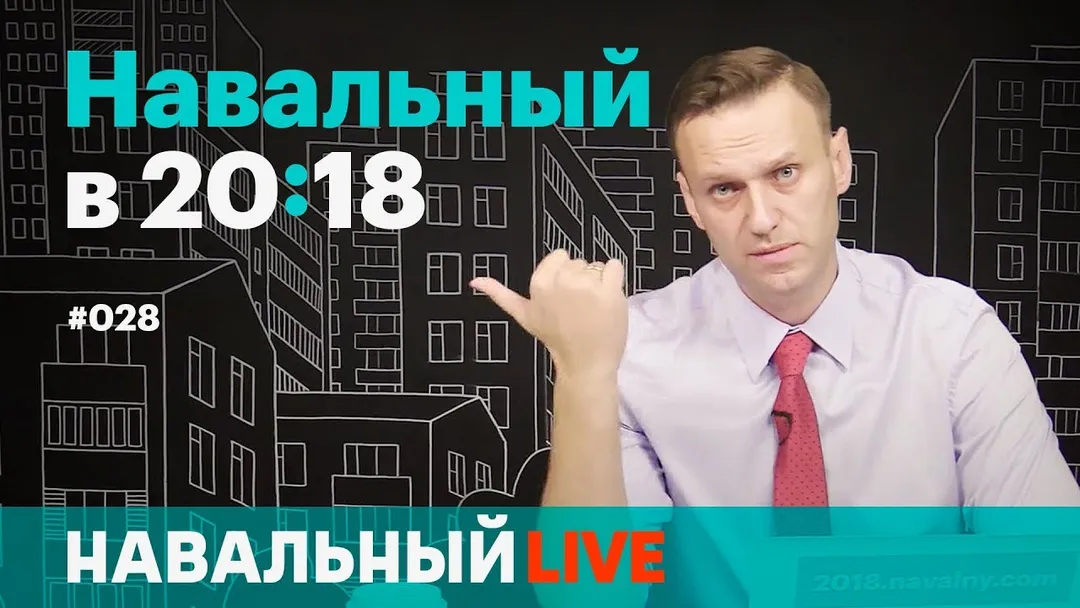
It is 8:18 p.m. in Moscow, which means that here in the studio
on Navalny Live, I am Alexei Navalny, and
to answer all your questions,
ask me whatever is troubling you.
I will tell you the whole truth, absolutely.
You can send me your questions on Twitter
with the hashtag #Navalny2018, and I have
everything set up here, and I will be answering your
questions.
I want to start with 92,000 rubles. That is the
figure that shocked me this
week. Zimbabwe, Putin, Medvedev,
Medvedev running for president again, and other
widely discussed news stories—
but for me personally, all of that faded
completely into the background compared with
the astonishing report on
the socio-economic situation in
the city of Moscow, which was published by Moscow City Hall.
According to this simply mega-
super document, it turns out that
the average salary in the city
of Moscow is 92,000 rubles. I wanted
to discuss this with you, and on that note
let me launch a poll right away
that will run on Twitter as well as
VK and Facebook. It is very
simple.
Whether you live in Moscow or not—
after all, a lot of people from Moscow are watching—
just tell me:
is your salary more than 92,000 rubles or
less than 92,000 rubles? Because I
live in Moscow, and I do interact with, well,
let us say, middle-class people.
Right now I am in a large office center
where there are office workers sitting around
who are probably also considered part of
the middle class, and even here I cannot
say that I see a large
number of people earning 92,000
rubles or more. That is higher than
the average salary at the Anti-Corruption
Foundation. It is higher than the average
salary in our election campaign.
So I am interested, because this
simple math shows that, yes, on the one
hand, we have the salaries of Sechin
and State Duma deputies, and on the other hand
the salaries of people who earn very
little. But for the average to come out to
92,000 rubles, the average salary in
Moscow—
that would mean that every third
person we meet
earns 100,000 rubles, 150,000
rubles. I do not know—maybe I have some
other Moscow or some different social circle, but I do not
see such people in large numbers, and
so I am very interested: do you see them?
Are you one of them? And what do you think
about this report? Officially, that is—
this is not just, you know, some
analysts or political scientists, my favorite
people, writing about it. This is Mosgorstat,
that is, official statistics.
When Mayor Sobyanin and Vladimir Putin
talk about what a wonderful
life they have built in Russia, in
Moscow, they will say that
the average salary in Moscow is 92,000
rubles.
The average salary across Russia, which
is now somewhere around 36,000,
will also be calculated based on
the fact that in Moscow
the average salary is 92,000 rubles. So
let us discuss whether this is true or not, and
also, right away, there is one
great fact there that simply
delighted me. Besides the fact that in Moscow
it is 92,000 rubles—meaning we are rich—
it turns out that from September to January
food prices overall went up by
and guess by how much:
one percent. In other words, they barely went up at all.
A quote from this document has just appeared on the screen.
So almost a year has passed, and you go to the store, and you
go shopping, and you should not
believe your own words, it turns out.
Food in Moscow is not getting more expensive.
Everything has stayed the same, only salaries are
excellent—huge salaries, 92,000
rubles. At the same time, the average salary in the field of
education
is 68,000 rubles, and the average salary in
healthcare is also 68,768
rubles. Some amazing Moscow—maybe
it is located somewhere else. I do not
really understand it, and for me it is very important
to talk about this, because, well, basically
I am running my election campaign with
a fairly simple—some might say
primitive—slogan: I want
everyone's salary to go up. That is actually
the main goal, really, of why a person
should go to the polls, why I am running in
the election: so that there is economic growth, and that
economic growth leads to
all of you having higher salaries. And no matter
what region I go to—you probably know,
those who have been to my meetings or
watched these videos—I ask everywhere,
and I always ask about these very
salaries, and
there has never yet been a case where
the officially reported salaries for a region even
roughly matched what people
say. If the official salary is 35,000, then in any region
people will tell you: the average salary in our
city—not even in the whole region, just in
our city—is 20,000. It is always like that, everywhere.
And in my view—well, I interact with different
people, again: with some in an
office center, with others I sit in a
special detention center—so in my view,
the average salary in the city of Moscow would be
is more likely approaching
more like 45,000 or even 40,000 rubles, but
it definitely does not correspond at all
to that 92 percent mark. Let me
see what you're writing here about getting past 92
92,000 rubles. If there are already any
questions on this topic
so, say 2,000 rubles—what are you going to
do about the enormous salaries, because
officials have huge salaries,
deputies and officials probably
make some kind of major
distortion in these statistics. The
thing is, officials and deputies
should receive high
salaries—though not as high as they are now, of course.
450,000 rubles for a deputy in the State Duma (the lower house of Russia's parliament) is
too much. Another matter is that we all
should be earning decent wages
so that the real average salary
would match this, in my view.
Why does this happen? Russia has a huge
shadow economy. The Russian government
says that a third of the economy is
in the shadow sector, and all these construction workers,
taxi drivers, salespeople—the entire service sector
—a huge number of people receive
gray or black wages, whatever you want to call them, and in any
case those wages are lower than the ones
paid officially, because
who gets an official salary?
People on the state payroll, because
only they, only those organizations,
are in a position to pay those gigantic,
simply gigantic and insane
payroll taxes—the so-called
insurance contributions and insurance fees.
I can see it even from our Anti-Corruption Foundation
during the election campaign: we
pay a gigantic amount of money
in payroll taxes, but we can afford
to do that because you send us money.
We get it just like that—we don't
earn it; you simply send it to us.
So we pay salaries and do it fully
officially, paying taxes in full. But no business owner
can do that. Take any
small business—say, Edik's place. If he paid
everything officially and in full, they'd go bankrupt.
And so this is what happens:
the salaries that go into these statistics are
those of police officers, naturally,
officials, deputies, state companies—all
the various Gazprom and Rosneft (major Russian state-controlled energy companies), and
all the other budget-funded
enterprises and government contractors.
In other words, those who get money from
the state, and for whom it is basically
not all that interesting or important
how much tax is or isn't being paid,
because it's simply money that was sent to them,
and in any case they will spend it and
pay out whatever amount of taxes
is required. This leads to a
massive overstatement of the average
salary across the country by
probably 30 or 40
percent on average, and of course that leads to
the utter meaninglessness of all our
Russian economic statistics. All
this talk about real incomes
of the population—they've been falling for years already,
year after year, but in reality, in terms of actual wages,
they are falling along a much
steeper
line. All the talk about economic
growth, about some kind of investment demand,
and everything else—it is all
calculated on the basis of this 92,000
ruble average salary in the city of
Moscow, and
1 percent growth in food prices.
Let's see what they have there for us,
whether the coordination has already started or not.
So, on Twitter we're being told that 20
percent
earn more than 92,000 rubles, and 80
percent earn less than 92,000
rubles. Quite a wealthy crowd on Twitter.
So please, that 20 percent
of Twitter readers who, who
earn more than 92,000 rubles, please go to
right now—no need to complain—
navalny.com and send us
please
900 rubles toward our election
campaign. Now, on VKontakte (a Russian social network),
7 percent say that they
earn more than 92,000 rubles, and 93
percent earn less than that. Now that sounds
true, that sounds true. Facebook has
similar numbers: on Facebook, 8
percent make more than 92,000 rubles.
[music]
And 92 percent earn less
than 92,000 rubles—that is,
if we assume these people are from Moscow,
of course, then these statistics from the Moscow mayor's office
just don't add up somehow, and
this matches my own sense
of how people in Moscow live, because
these are simply insane statistics. I don't
understand why the Moscow government
has this level of
audacity to publish this and not even
try to say, well, guys, there may
be some distortion here,
some disproportionality. Instead, they actually say
that yes, that's just how it is, that's
really the case, and we're all so rich,
earning 92,000 rubles. This is not
a technical issue, not a technicality at all.
It's not that I'm just nitpicking
statistics or arguing over some data.
This is a fundamental thing about Russia, a fundamental
thing about all of us:
we earn far less than we should
be earning in a country at this level.
of development, and we end up with figures that are actually much
lower than what the official
statistics show. Official statistics are lying, and
any further calculations, as I already said,
simply make no sense. So
every time you hear that, well,
Dmitry Medvedev or Putin likes to say
that people are, you know, continuing to get richer, that everything is fine,
that everything is going well — then please
remember those 92,000 rubles
a month (about 92,000 rubles). Those words are worth exactly
as much as these statistics. Next topic.
Yes, now I’ll answer a couple of questions.
Alexei, do you really not know the old
joke about the average temperature in
the hospital? No, it’s not even about the average temperature
in the hospital. It’s not that, you know,
one person has a temperature of 40°C (104°F), another is in the morgue, and
the average comes out normal. No, this is
simply about the fact that in this hospital
a significant number of people are not even
counted at all. They’re just not included — they’re not even
in the morgue yet, though they probably soon will be.
It turns out that about 30 percent of people here are simply
left out altogether, and the official
statistics are basically made up of public-sector
enterprises and various state corporations. In
our country right now, after all, the state
controls 80 percent of the economy, and
everywhere there are companies with state
participation. They pay official
salaries, their salaries are high, and that
is what makes up the state statistics. But
all those people — go to a construction site,
talk to the workers there, and ask
how much they earn — you’ll hear a completely
different figure. "Have signature collection rates slowed down?"
Kolya Chudo writes to me. No, they haven’t.
"Is it time for a new film in the spirit of *He Is Not Dimon to You*?"
Is something like that planned? Well, if I
could, you know, just say,
"Hey, investigations department, put out a new
film like *Dimon*," — but that’s not how it
works. We have a large number of cases
in progress. An investigation is
a major undertaking by a huge team of
people. If only
it were that simple. We already have a lot of things, we
have a lot planned, but it
is done in a much more complicated way than one might
imagine. As for making sure
the signature collection rate doesn’t fall — you can simply
take part in it personally. To be honest, we
were prepared for the fact that the rate
of collecting signatures would drop. After all, right now we have almost
700,000 signatures. We got through this
initial stage,
with the people who were immediately ready
to sign, and from here on it becomes
a big, painstaking job.
Alexei, why did you change the Bitcoin
wallet? Ilya asks. Was this
an attempt to hide the real income from cryptocurrency?
I’ve never, anywhere, had a personal Bitcoin wallet
— I never
declared one, never set one up.
Honestly, to my shame, I don’t even
really understand it very well.
People often ask about cryptocurrencies; I
have practically never used them.
Perhaps you mean the campaign’s wallet.
As far as I
understand, nobody changed it. When Volkov
comes into the studio, you can ask him.
Jacks writes: "In Moscow, a programmer
can easily make 150,000 to 200,000 rubles,
and I’ve received offers like that myself.
At that level, everything is expensive." Jacks, of course, in
Moscow a programmer can make 200,000 or 250,000
rubles, and there are quite a lot of people in Moscow
who make 500,000 rubles as well.
But let’s roughly estimate how many
programmers there are among us, what percentage of the population they are,
and what percentage of the population
earns those 150,000 to 200,000 ruble salaries.
I’m not disputing in any way that there are many people
— thousands, hundreds of thousands of people — with very
high salaries. But I repeat: for
the citywide average to be 92,000
rubles, that means that if not half,
then at least a third of the people around
us would have to be earning significantly
more than 92,000. It really doesn’t seem to me that
that’s true. Pavel Volodin: "Alexei, in
your platform you propose
a minimum wage of 25,000 rubles.
How is that supposed to be paid by small
business owners in the regions who have 12
employees and are glad to pay 16,000, because otherwise
their businesses will just shut down?" Excellent question.
Pavel Volodin, that is exactly why we
are proposing a comprehensive solution to this
problem. On the one hand, yes, absolutely, I
believe that for a full working day in
Russia, no one should earn less
than 25,000 rubles. That should be the minimum wage,
and that is the kind of minimum that is set
in any developed country. On
the other hand, small business owners
quite rightly say to me, "Come on,
you want me to pay 25,000
rubles officially, on the books, and then taxes will destroy
my small business. Or right now I pay
16,000; if I start paying 25,000, that will destroy my
business." That is why we are offering business
— especially small business — a different arrangement. We
are saying: guys, we will free you from
all taxes except the basic
patent fee, from all permits,
from accounting paperwork, from all sorts of
endless forms, from endless
administration of your business, which
costs you money, costs you
time, and distracts you enormously.
So this is a kind of new agreement
between the state and business: no one
earns less than 25,000, everyone receives
their salary officially, on the books, but we drastically reduce
payroll taxes, so that this doesn't
simply ruin you, and we
will free you from 99 percent
of the administrative burden. We will free you from
corruption, we will free you from bribes,
so they will stop going into someone's pockets.
Alexander asks Alexei: monetize your
videos—they're very popular. I would
actually be glad to; I'm ready to watch all the ads to the
end. It would be a decent donation to your campaign.
Thank you very much, Alexander.
We are thinking about it, but honestly
speaking, we're afraid. I don't know—if at the
beginning of this program there's an ad, and at the
end of the program there's an ad, and
one more in the middle—then everything here will just
be interrupted.
And there will be ads. Still, well, I'm running
for president, so I can't advertise
black caviar all over Instagram, I can't
do things that a
presidential candidate isn't supposed to do, and I can't
go around left and right selling some
product, saying as I sit here,
"This episode is brought to you by..."
"Likhvar Erlenberg should be jailed—and by the way..."
by the way, buy a plane ticket from
such-and-such airline." Well, that would
sound a little strange. But still,
we are not dismissing the question of monetizing videos,
because we do need money.
We have to maintain our studio, we
have to maintain our organization, and our
fundraising is being seriously hindered, so
we will use every method. On the
Navalny Live channel, sitting across from
me, is our producer Oksana,
and she has a notebook full of assignments. One of
her assignments is to run an
experiment with monetization. Maybe
it will be on *Cactus*, maybe on
Volkov's show, maybe on mine, although
I'm a bit scared. I'd rather they try it
on *Cactus* first—if it fails, then they
will be to blame for everything, not me. We'll
try it and see how it goes, but
honestly, for now we're just afraid.
We don't want to, because we may not raise
that much money, but there will be a lot of shouting,
a whole lot of outrage. So, I have a lot
of questions here. You know, about animal rights activists—
Katerina asks me: "Alexei, do you
know about the animal rights activists who are
on hunger strike near the State Duma (the lower house of Russia's parliament)?" I do know.
I know about the activists who are on hunger strike outside the Duma.
I know that
Igor Talkov's son came and played guitar for them,
and was detained. And there are quite a lot of
people there standing in solo pickets,
and
the authorities are constantly trying to
have "explanatory conversations" with them.
In other words, the police are acting against these
animal rights activists,
and I don't understand why, because the law
on animal protection was introduced a long time ago.
Public opinion in this country is absolutely consolidated
in favor of animal rights activists.
Everyone is against animal abusers; everyone wants them
to face criminal prosecution, and
frankly, it seems that even United Russia
is not against it, as far as I understand, and
Putin and Medvedev are all in favor of this animal protection law,
but for some reason it
has not been passed for years. This is, by the way, another
example of the sheer absurdity
and meaninglessness of the system: even when there is
a general consensus—when everyone
supports adopting the animal protection law—
the system nevertheless
works in such an idiotic way
that the bill just sits there and is not passed.
Animal rights activists come there,
go on hunger strike, and they are simply arrested there—
the police detain Igor Talkov's son.
It's harmful. But as I've said many times,
this system cannot do anything
good, even if internally a consensus has formed
that this should be done, that it is a
good thing.
They still cannot do it,
because it is simply no longer structured
in a way that allows it. Unfortunately. Alexei, were you
at the Depeche Mode concert in Moscow?
Boris Newman asks me. "Your answer to this question
is very important
not only to me, but to a huge
number of Depeche Mode fans in
Russia." Boris, I was at the Depeche Mode concert,
and I even posted photos from the
Depeche Mode concert on Instagram—there is proof.
So please, all you many
Depeche Mode fans,
vote for Navalny.
So, what else? There are 118 new
questions just in the last few minutes. So—
"Good evening, Mr. President Alexei
Navalny." I like being addressed that way.
Alex Bass asks: "Teachers are paid
92,000 rubles, while the children of pensioners
pay 120,000 rubles
for tuition. What should be done? And what about state-funded places?
I got it—this is a question about state-funded university places and
about
the cost of education. Indeed,
quite often we see situations where
the cost of education is fairly high, while
teachers still receive rather
little. Honestly, I believe
that the state's priority should be
free education for everyone.
And that is the right thing to do; it is beneficial
for the state in the long run, because
as I have said many times and will always repeat,
if people receive a good education, they
will pay more taxes tomorrow.
"Alexei, if they don't let you run in the election, what
will you do?" asks Andrei Shpagi.
So what am I doing? I’m demanding that they not shut me out.
Andrei, because when they don’t allow me
to run in the election, they’re not only hurting me,
they’re hurting you too, because you won’t have
your own candidate this time. More than that,
if you accept this,
you will never have a decent candidate.
That’s why we are demanding that I be allowed
to take part in the election, and we have every right
to demand that. On this same topic, Sergei Babichev asks the following question:
“Alexei, how would you assess
the likelihood that your candidacy will be allowed
to participate in the presidential election?” Look, I’m not
going to calculate the odds. I look at
the Constitution and see that it clearly,
in black and white, says that I have the right
to take part in elections. So for me,
the probability of being allowed is 100 percent. As for what
they think over there, I don’t know. Beka
Nurgaliyev writes: “Alexei, if you become
president, may I move to Russia? I’m from
Almaty.”
Just keep in mind, Beka, that I probably won’t be
very popular in your country. Still,
I do intend to introduce a visa regime with
the countries of Central Asia. But if you
come here and work properly,
welcome. People who come here
and work honestly will receive
all the necessary documents, and everything
else they need. If they pay taxes, they are welcome here.
Now, about Russian Post (the state postal service).
Neomara asks: “Although it’s a state-owned
company, what would you do about Russian Post?
”
Salaries there are very low—certainly not
92,000 rubles a month (about $1,500 at older exchange rates), and the quality of the postal
service is correspondingly terrible. Thank you
in advance for your answer.” Russian Post, first of all,
needs
transparency and an audit, like all
state-owned companies, because it’s
an absolutely monstrous feeding trough (a source of corrupt enrichment). Do you remember
the story about the former head of Russian Post,
who awarded himself a multi-million-ruble salary,
while ordinary employees there
have catastrophically low wages.
The salaries there are simply ridiculous,
and there are still wages of 15,000, 17,000, 20,000
rubles a month. Besides that, overall it is
a very, very
backward structure. But under the current
state, which is itself generally
backward, there is no way Russian Post
can really be developed. But it seems to me that we simply
need to look to best practices,
for example, Germany’s postal service,
which is state-owned yet works efficiently.
We need to see how everything is organized there
and do the same. Greetings
from Tbilisi.” Greetings to Tbilisi as well.
“Alexei, will you do a joint video with
Mikhail Svetov? It would be very interesting
to watch the discussion.” Svetov has appeared
on *Cactus*, and he came on Smirnov’s program,
if I remember correctly. It was very
interesting, and a lot of people watched the program.
We’ll keep inviting him in the future.
Yevgeny writes to me:
“Today RBC (a Russian media outlet) reported that the highest average
salary is in the oil refining sector—
more than 500,000 rubles a month. That says
a lot.” Well yes, it does say a lot.
The average salary in the oil sector is,
naturally,
quite high. It would be strange if it weren’t.
Of course there are people there who earn
more than 500,000
rubles a month. But I strongly doubt
that this is really the average salary in
the oil refining sector.
Because if that were true, then based on that,
quite a lot of people there would have to be earning
700,000, 800,000, even 1 million rubles a month.
It seems to me there still aren’t many
such people.
Though in general they should be earning
substantial money, especially those
who work in the far north and similar places,
so to speak. But still, we’re talking about
the average salary here, in
Moscow and in Russia overall. Of course, yes,
programmers can earn a lot of
money.
Some top-tier, highly advanced
engineers are earning a lot in Russia now,
architects too—not all of them, but some are.
The oil refining sector too. But I don’t
know—write to me on Twitter.
A chef in Moscow earns 1 million
rubles a month—yes, some do earn 1 million
rubles a month. But
still, how many chefs in
Moscow are there at that level—30, 50, or
even 300—in a city where 10
million people live? How many chefs would there have to be
for the average salary to be
92,000 rubles a month?
Kirill Tomana asks: “Please tell me,
what will you do about the company
Mail.ru?
The company is squeezing game developers dry,
and it has an almost complete monopoly on game
servers.” Well, if we see a monopoly,
we will break it up and fight it.
As for Mail.ru,
with Mail.ru, first of all we will
have a serious conversation about why
they are engaged in censorship on
the internet, why they are carrying out this censorship
online. We will clarify these issues with them.
But of course, we will be
careful and gentle with all
representatives of business,
including Mail.ru.
And understanding that this may sound a bit like
I’m asking out of idle curiosity, but could you
disclose what salary…”
you personally and your immediate
circle. Gleb Malyshev, really, you are not
anything like Dud (Yury Dud, the journalist/interviewer), not one bit, because to blow
in your interviews, you should either ask that of
people who are trying to hide it. You
can go to the FBK website right now and you
can see who works with FBK,
what they look like, see their photos,
the average salary there, and all
the other data: how much money was raised,
what it was spent on. But we are the Anti-Corruption Foundation
and we have to be transparent,
so we clearly disclose what our
average salaries are.
As for FBK, I do not receive a single kopek from it,
and never have. I am
a donor to FBK.
And I earn all my money as a lawyer. I have
my own sole proprietorship.
An individual entrepreneur. When in
court they always ask me things like,
"Navalny, place of birth, year of birth,
place of work" — I say, sole proprietor.
Navalny, sole proprietor Navalny. I provide
legal services, but right now I am primarily
focused on the European
Court of Human Rights.
If anyone needs those kinds of services for
money, come to me. For a lot of
money, I will write you an excellent complaint.
Vladimir Putin — let's talk about him. And
I got a ton of questions asking, well, when
is he finally going to announce his candidacy, what exactly is going on there?
Some very strange things.
The election is just around the corner — three or four
months away, and January, which
obviously doesn't really count. Vladimir Putin just
keeps silent. And just recently at Valdai
he was asked again: man, when are you going to
announce? What's going to happen? Are you
going to run a campaign?
Let's listen. We have about 17
seconds of his answer. Here it is:
"As you may have noticed, this year at the Valdai
Club we are not asking you the question that
used to be asked often at the Valdai Club:
"
"You know, Yegorov, are you planning
to...? We need to wrap up." Well, you see, it's all
so playful. You know, the president is acting strangely.
After all, there is an election, and it would probably be
logical if the voters — the citizens of
Russia —
knew a little more about the plans
of the country's president regarding
his participation in the current election
campaign. But he somehow doesn't want that; he just
keeps joking around — ha-ha, hee-hee.
And then there are these little tossed-out
bits of information which, in my view, are rather
ridiculous. What does it mean — Medvedev will
be blocked? They give you these kinds of
answers too. But it seems to me everything is much
simpler. All this intrigue around the
nomination and all these tricks has a
simple explanation, which is
this, my friends:
President Putin has nothing to say to you. He
simply doesn't. Because what is he supposed to say? When
he announces his candidacy, he has to deliver some kind of
programmatic speech. He has to present a
policy document. He has to
say: I have been president for the last
several years, these are my achievements, and
therefore I am running with another program for
a new term. In 2012, his
main idea was the so-called
May decrees. Who even remembers the May
decrees now? That was the thing about teachers and
doctors,
public-sector employees, having to receive salaries
no lower than the regional average salary, and
so
those May decrees were how they secured
their victory. They raised salaries; there was
room to do it. Just look at the price of
oil in 2011, 2012, 2013 — $120
per barrel. Huge amounts of
oil money were pouring in from every
direction, so they could do things like
that. But then the price of oil fell — not
catastrophically, but now it's around $62
a barrel, and that's it.
And that bubble burst. So
what can Putin say now?
If he tells the population, "Guys, I was a good
president, I was a good
president, and your salaries were rising
in recent years," then all those 145
million people — or at least the 80 million
who are actively working — will just grab
their hair and start screaming
in horror, because that is such an
obvious lie. The level of real household incomes
has been falling for four — now already five — years in a row,
and Putin has nothing to say about that.
He has all that stuff — war, Crimea,
and all that foreign policy — and he will
of course endlessly repeat the phrase,
the sacred line: "They started respecting us again in
the world," which does not correspond in the slightest
to reality. But that line
is fed so effectively to the public through
television.
But where people can tell
truth from lies,
when it comes to Syria, fine, you can spin all the tales you want,
you can show screenshots from a
video game on television and say,
"Look at what the Russian Aerospace Forces are doing there,"
or "Look how we took down the Americans," or
"This is proof of something, that
something is being done." But no matter how much
you tell a person that their
average salary in Moscow is 92,000 rubles (about $1,500 at the time),
they will simply tell you: no,
that's not true. I know that's not true because
here I am, here is my wife, and I have
Relatives—I know that’s not true. You
can say as much as you like, just like in the report, in
this one it says,
talking about how food prices rose by 1 percent
over the past year. But
anyone will tell you—well,
we all love you, Vladimir Vladimirovich,
thank you, Crimea, whatever, Ukraine,
Banderites (a derogatory Russian term for Ukrainian nationalists), but it’s not true. That 1
percent is a lie, and he has nothing to say
about the economy—he can’t say anything.
There has been no protection,
no support for entrepreneurship; none of it happened.
Nothing that was written in
those famous columns of his—remember,
in 2012 he wrote somewhere,
there was a column in *Vedomosti*, one in *Nezavisimaya Gazeta*,
some drivel in *Rossiyskaya Gazeta*,
and in some other newspapers there were various
campaign promises of his—and not a single one of them
was fulfilled. His last
presidential term was an absolute
failure. The earlier ones—you could say
they were failures too, just less so; there was
oil.
There was a lot of money then; he himself was
simply lucky, and that large amount of
oil money
led to some growth
in people’s standard of living. Now his
government has failed completely.
He has nothing to say, so Putin
will undoubtedly drag this
out until the very last moment. So I
don’t know whether it will happen in late November,
or in December, but they
will try to do it as late as possible
so that all of us spend as little time as possible
discussing his old promises and the new
promises, when he comes out again and says,
“We will remove administrative barriers to
business.” We’ll look at an article from 2012 and
see that this was already promised back then, and everything has only gotten
worse. When he says, “We will reduce
the share of the raw-materials economy, the extractive sector
in our economy,” we’ll see that
all of this was already being said quite recently, in
2012, and that it was all complete
lies. And he doesn’t want that discussion, he
doesn’t want those comparisons, he doesn’t want
us pulling out
articles from *Vedomosti* from 2012.
He doesn’t want pensioners discussing
his policy statement claiming that in
Russia inflation is supposedly 3 percent, even though
everyone knows inflation is not 3 percent.
People go to the store—it’s all lies and
manipulation. So, as I already said, they
will delay all of this as much as possible and will
try to talk about foreign policy.
There will be two things in this election
campaign: endless discussion of how
you got up off your knees and how the world now
respects us again, and there will be the endless Putin team
in every possible form. There will be
athletes,
hockey players skating around him
in circles, figure skaters doing
triple toe loops around him, and cultural figures
saying, “My God, what a
saintly man he is, everything is so
wonderful with our theaters.”
Like Alexander Kalyagin, who practically
said today—the head of, what is it properly
called, the theater union,
or whatever—basically the head
of the organization uniting theater
figures. Right now, when
Kirill Serebrennikov is under house
arrest,
and the director of that theater, Malobrodsky, is
sitting in a cell, he says to Vladimir
Vladimirovich, “You’re so great, the theater
community loves you very much and always finds
common ground with you.” In other words,
monstrous hypocrisy.
But that’s how it will be, and all these performers,
just famous people from television,
will be photographed with Putin in various
combinations, and everyone
will be discussing
foreign policy. That will be
the election campaign, and that’s why it
will be delayed. That’s why, by the way,
they announced something completely—well, anti-
constitutional.
They said that the federal address would be
delivered next year. That directly
contradicts the Constitution of the Russian
Federation. That cannot be done. That is exactly
why, incidentally, the lawyers of the Anti-Corruption Foundation
did a really smart
thing: they appealed to the prosecutor’s office so that
the prosecutor’s office would issue a warning—there is
such a formal procedure, a warning—
to Vladimir Putin, telling him that he does not
have the right, neither this year nor in 2017,
to deliver his
address in 2018, because it is supposed to be done once a year.
So let him do it—but he doesn’t
want to, because he has nothing to say. That’s
how it will be, that’s what will happen. The team—
all this talk about Medvedev, I see
many people asking about Medvedev—it’s
complete nonsense, it seems to me. Maybe I
don’t know, after three more programs like this I’ll
be saying, “Wow, they really are
putting Medvedev forward,” but I don’t believe it.
Putin’s team is being assembled, and it is being assembled by
the presidential administration. All these
hockey players are being dragged in there, paid for, and now
Kudrin has already joined this Putin team and
joined his campaign headquarters. In other words, all these
structures are being put in place there; it’s just that
right now they
are muddying the waters so there will be some other
context for discussion, so everyone starts discussing
Medvedev again, and some other things too.
They were discussing just how badly Putin
has failed over the past few years in
governing the country. Alex Boss, why
does Putin say that young people are the future
of the country, when tuition costs 120,000 rubles a year
per year (about $1,300-$1,500), and for young people studying for 3-4 years
there are no state-funded places? Why are they lying to us? Why
isn't he keeping his promise?
The promise from 2012. So Alex Bass, with his
question, explained why Putin does not
want to announce a presidential
campaign right now. But what will he answer Alex Boss?
He'll answer with nothing but his usual lies.
You've probably seen my video where
I showed a clip of him arguing with
a girl in Sochi at some
youth forum. She asked him exactly
the same question: why is the number of
state-funded university places shrinking? And Putin
without batting an eye said, 'You're wrong,
young lady, the number of state-funded places
is growing.' That's a lie. Everyone knows it.
Absolutely everyone. The official statistics
show it directly. But here's what he will
tell you, Alex Bass: he'll keep giving
the same kind of answer. He won't answer the question.
He'll say something like this:
'You ask me: tuition costs 120,000
rubles a year, people study for 3-4 years,
so why aren't you keeping your promise?
Young people are the future of the country. And he'll tell us: 'Alex, you
are wrong, the number of state-funded places is growing.
'We will increase the number of state-funded
places constantly, and we are proud of our
young people, and we will raise young people
despite the sanctions, despite the fact that
the West is tightening the noose around Russia, and no matter how much
NATO countries move closer to our
borders.'
'We still believe that young people are our
future. And in America they still lynch Black people.'
I'm simplifying, but watch any 'Direct Line'
(Putin's televised call-in show). He seems to have said there will be
another Direct Line sometime soon,
in the next few days. Watch it - that's exactly how it
will go. Any question about corruption
or broken promises will once again get
'And in America it's even worse.' That's all
it ever is.
Andryukha asks: what are you going to
do about parking in Moscow? Will you
abolish paid parking?
Andryukha, the paid parking system in
Moscow is simply implemented terribly - it's ugly and
wrong. But in a huge city like
Moscow, where 10 percent of the country's population
lives and space is limited,
of course
it's impossible not to restrict vehicle access
to the center. So paid
parking absolutely should exist - that's the experience
of every major city in every developed
country. You just have to approach it intelligently.
But paid parking in
the center is one thing. Near my home, in Marina
from my windows I can see
paid parking. But what for?
People park there - there are no traffic jams there, there is no
major problem there. Why is paid parking
needed there at all? It's just that in
Moscow City Hall there are people sitting there
who, let's put it plainly, have a rather peculiar
understanding of urban development and
a rather peculiar take on urbanism. And
besides that, they lie constantly. They
Why is the paid parking system
developing so badly, and why is the whole
system for fighting traffic jams developing
so inefficiently? Because they proceed
from the assumption that everything is fine for them, and
the Moscow mayor's office seriously tells us
that as a result of some of their measures
the number of traffic jams has decreased
by several percent. But that's a lie. It is
completely obvious to everyone that it's false. We
even did a special investigation
where we showed that the Moscow mayor's office
manipulates data and lies when it says
it is successfully fighting traffic jams. But
they don't just do the wrong things - they claim
that these wrong things are effective and
keep doing the wrong things.
So the lying is endless, and it
creates problems with parking.
So yes, paid parking - especially in
the city center - is necessary. It just needs to be handled intelligently.
That's how it should be approached. Alexander Babiy
says: 'I make 92,000 rubles. That's a tricky move -
everyone immediately thinks, so that's how much
people earn, while I'm just some
guy who has to not just work but
slave away.' I don't agree with you. That's
not how it works. More likely it works
the other way around: he thinks, 'Wow, I tried here
and I tried there, but somehow I can't find anything
for more than 65,000 at all.
'So it turns out people make 92,000 rubles.
'Better not work, not slave away at all,
I'll just go on a bender' - excuse the expression.
That's probably how it works.
There are a huge number of questions. Sorry, I'm
getting 50 new questions every minute.
And Mel Kerimov asks: 'Alexei,
in the Beautiful Russia of the Future
will the number of business inspections be reduced?' Yes,
Emil, yes, yes, yes. Right now in Russia, every year
there are two million business inspections.
Most of them are unscheduled. I honestly
don't even understand what they're inspecting. I would reduce
the number of business inspections by 500 times
at a minimum. You could cut them by 200 times immediately,
but the overall plan would be to cut them by 500 times,
because, really, what on earth are they
even checking? I don't understand. 'Alexei,
what will you do with all the
corrupt officials, and also with the deputies of the
State Duma (the lower house of Russia's parliament)?' asks
Mikhail Solomentsev.
Corrupt officials and deputies of the State
Duma are, broadly speaking, pretty much the same as
other people. As for corrupt officials, we will
do what is supposed to be done with them: we
will send them to the defendants' bench.
Now, on the subject of Putin, and one more thing about
Putin—a missed question related to
Putin. Let's talk instead about President
Mugabe, because, as in the poem by Mayakovsky
(a famous Soviet poet), when we
say one thing, we mean Putin;
when we say Mugabe, we mean him. What is happening now is a very
interesting thing that is happening
right now in Zimbabwe. There has been
something like a military coup, although
the current government and the military
are saying that no military
coup took place. Be that as it may,
Robert Mugabe, who had been in power for 40 years,
has been removed from that very power,
and, as far as we understand, has now been placed under
house arrest, and a new government has come
to power. Why is this so important for
Russia? Not at all because the same thing
could happen here too. After all,
comparing Zimbabwe and Russia directly
would be very wrong—they are different
political regimes, first and foremost. And
the role of the army there is completely different. In
Russia, even in the Soviet Union,
the army and the security services—although people did not talk much about it—
did not play a major
political role; they were not
some independent factor
in politics. Politics was always run by
the political nomenklatura (the Soviet ruling elite), and the army and security services
were subordinate to them, part of that
nomenklatura, but they did not play
an independent political role. In
Zimbabwe it is different, as in many
African and Latin American
countries: the army is a kind of
independent political force.
It could remove a leader. But for us, what matters now
is something else: the debunking of myths
about those very approval ratings. Because
at any meeting, in any conversation,
someone will обязательно tell you: well, how can you
possibly fight Putin? It's completely pointless. If you
run against him in an election, it's
meaningless—after all, 86 percent of people
support him, the whole country, it turns out,
supports him.
Of course, I don't know such people myself, but still—
look, everyone around him seems to support him.
The polling says so. More than that, we
conduct our own polling, and we
can get the same figures too. But right now,
when you ask a person a question like
"How do you feel about Vladimir Putin?"—"I approve,"
that is the expected answer, the socially
acceptable, socially approved answer.
Of course I support Vladimir Putin,
because you cannot say otherwise. And
the same thing was true in Zimbabwe for
many, many years. So let's
just—I'm curious—
what do you think Mugabe's approval rating was in 2015?
I have it written down here:
back then, his approval rating
exceeded 90 percent. In the most recent
election, how many percent did Robert Mugabe get?
A lot, a lot of percent—
far more than Vladimir Putin
got in 2016, and that was quite recent.
By the way, Robert Mugabe unveiled
a monument to himself, and we laughed at it,
the whole world laughed at it. But inside
Zimbabwe, just like our United Russia (the Kremlin-backed ruling party),
people said: how great, how wonderful. Yes, he
has the right to unveil a monument to himself because
people really do
support him; they have rallied around
their national choice. And in February
2017, President Mugabe's wife—
quite a character, and apparently one of
those responsible for what happened next, the
coup—literally said
that Robert Mugabe's approval rating
was so high that even if we
put his corpse on the ballot,
that corpse—dead Mugabe—would
defeat any living opposition candidate.
It was the same in Russia, and even more so, and all
the polling confirmed those numbers, and
it really seemed clear that with such
support, there was nothing you could do.
He had been there for 40 years, he was 90 years old, but in
fact people supported him, because
there were reasons for it: once, he
won the anti-colonial war, he drove out
the occupiers, and then drove out the white
farmers.
He was like our own version of repeated Crimea-style triumphs,
something like that, and so we all
support him because he is our
national leader; he led our country
to victory over colonial conquerors
and imperialists, and it seemed that everything
was great and that absolutely everyone
supported him. So what happened to
those ratings? Literally, not even in 24
hours—in six hours.
The army came, put him under house
arrest,
and where were the people who were supposed to
pour into the streets to defend their
president? Where was even that same
nomenklatura?
Because when this
coup happened—or whatever you want to call it—when
Mugabe had just been removed, he had
a party there, and he also had this
youth organization, which mainly
spent its time
terrorizing various opposition figures
and intimidating everyone around them.
These people declared that, well, we...
We support Bob—his league, yes, that’s right.
The people will support him; we will, to the very last
drop of blood, defend him to the death. And then what?
A few hours later, they said
they were already declaring that there had been no
coup.
Only corrupt
dishonest people who resisted
arrest were detained, and now they are in custody—that is,
that’s all.
This is all from a statement by the party that had just
sworn loyalty to Mugabe, declaring how faithful it was
to him and his wife. So, my friends, it is very important for us
to understand that these ratings
mean absolutely nothing, and these are
ratings of emptiness, ratings from yesterday,
from a day when they seemed to have everything.
But the population simply doesn’t see anyone else.
Because Mugabe sat in power for 40 years—for 40 years we
saw no one else, and you don’t know
any other presidential candidates.
We don’t know them, so we say: yes, we
support Mugabe, because he’s the only one
we know. With Putin, it’s roughly
the same thing. He has been in power for 18 years, but at
the moment something happens,
whether aliens abduct him or something falls on
his head—royal or otherwise—
or if he is placed under house arrest,
Sergei Kuzhugetovich Shoigu, or I don’t know,
Lavrov, or anyone at all—any person from
that same Putin clique of his—
United Russia will say the same thing, and
President Putin’s approval rating, do you hear me, will
instantly become zero point zero percent. Just like that.
That’s how it always happens. It has happened in every
African country, in every authoritarian
country.
So that’s why we should not be
intimidated or even impressed by these
ratings. They mean nothing.
Stop believing them, stop repeating after
all of them, because right now in our
country any official has ratings like that.
Look at governors’ approval ratings.
They’re all at 80 percent. Look
at the ratings of the presidents of Central Asia—
they’re all at 90 percent. What does that mean?
Nothing. There is nothing to fear in this. It
means that we simply have to do
our job. Their ratings will collapse
very, very quickly, because they
mean nothing. Just five days ago, the rating of
President Mugabe was enormous.
So enormous that the airport in the city of Ha-
rare
was named after him—that airport
after Mugabe. They did it with such ceremony,
and explained that, well, we simply could not
give the airport any other name,
because the president’s approval rating was so
huge, such an enormous rating, that everyone
had to accept it.
They had to, guys—the population wanted it so much that
they had to rename the airport, and
five days later everyone ran out and
painted over that new sign:
“Mugabe Airport,” because suddenly
there was no rating at all—the people were demanding
something else. Don’t believe these
fairy tales.
We need to mind our own business, and when we
do that work, these ratings
will collapse even without a military coup—
any of them—simply because, well, because
we are right. All right, I’ve been talking so much about
Mugabe.
Let’s look at your questions.
Alexei, when you become president,
will you strip Putin of his Candidate of Economic Sciences degree
(roughly equivalent to a PhD in economics)?
But does Putin actually hold a Candidate of
Economic Sciences degree? I know that he
had, so to speak, an academic dissertation, and they caught
him plagiarizing, but I’m not sure
that he is a Candidate of Economic Sciences.
But President Navalny would not be able to strip
anyone of an academic degree, even if it was
fraudulently obtained. That is still the job
of the specialized bodies that make up
the academic community. We will make sure it is done honestly, and
those councils that
will consider questions of plagiarism or
the complete worthlessness of certain academic
works—as in Medinsky’s case—
they will decide those matters there. Whether they rule on his case or not, that is
their, their, their business. Yulia Avdeeva asks:
An interesting thing—a schoolteacher writes
that her husband is a deputy (member of parliament),
and with his salary the teacher pays only for
her personal driver.
And she came to work at the school simply
so as not to sit at home, but to keep herself
busy with something. Well yes, Yulia, that’s right: deputies
have a great life in Russia, and that is why
well,
that is why they cling to power. And indeed, the average salary of a
deputy, and the average salary in
the country, and the salary of this
teacher—well, they probably give some average figure like
92,000 rubles (about 92,000 RUB)
—we simply need to understand how
that figure is produced, and understand that
in reality it is not like that at all, and we are not
satisfied with this situation—not the arithmetic of
salaries, and not specifically this
nice little arrangement: a husband who is a deputy and
a teacher with a personal driver. Alexei,
Rosario Agro asks: how will you
protect us from the corrupting influence
of the West? We’ll build a wall and make, what,
Poland and Belarus pay for it,
as old man Trump says. But no, how will I
protect you from the corrupting influence
of the West? Let
your family or your teachers protect you, if
some people think there is such a corrupting influence.
The first foreign trip in the capacity of...
the presidents of the United States and China, maybe Ukraine for
Ivan Ivanov is watching this very jealously.
Ivan Ivanov asks: I understand that
they are watching very jealously, so I
do a simple thing: I open the papers
and look at which countries we have
the largest trade turnover and the most important
economic relations
and cooperation with, and I see that it is
the European Union, so I think it is
I assume it will be one of the
European countries. And Ivan George Lynn
writes: December 1 is coming soon — pay your taxes and sleep
peacefully. What is going on with the tax
system? Property taxes and
land taxes arrived — instead of 15,000 rubles, they charged 30,000 rubles.
We dug up my father's old papers and it turned out
that for three years he has been paying for land
that is not his. Ivan, this really is
a huge problem. For example, I received
a notice for transport tax on
a car that has not been mine for many years. This is
not an isolated case now — these are extremely widespread
cases, and they are sending out tax bills
for taxes people have already paid: tax on
property, tax on cars, and so
on. This is completely widespread. Bozhena Rynska
came to this studio; she was also billed for some kind of
taxes as well,
from the Pension Fund, I think.
And she is waging a holy war there against
the Pension Fund, which really is
completely unlawfully issuing
additional charges. Moreover,
when you catch them
issuing these unlawful charges to you, they say:
you know, we have no compensation mechanism.
We cannot return it; that is not
provided for. So next
year we will simply credit it to you.
So basically: give us your money and we
will use it for free, interest-free,
and next year it will be
counted toward your taxes. This is a widespread thing the
state is doing now. They have already tried to explain it,
saying that all of this
is happening as a result of an error. I do not believe
in any errors. It seems to me that on
such a scale
it cannot be a mistake. Ilona Yudina
asks how I feel about the fact that in
educational institutions there is
anti-Navalny propaganda, where children are being told
that you are a thief, and that
if you became president of Russia, it would be
very bad. What do you think, Ilona, about this?
How do I feel about it? I support it, I like it
— well, of course I feel about it
negatively, and once again I call on
all schoolchildren and students who hear
such things
to film it — just film everything and post it online.
Whenever this comes to light, every time there is a huge scandal in that
educational institution. We
have even seen a teacher in Ivanovo Region
dismissed for this. So I feel
very negatively about it. It is absolutely illegal.
So let's just film it.
Campaign news: let me say a little
on this topic and thank everyone who
came to meet with me. Last week I was in
Volgograd, Izhevsk, and
Smolensk.
Smolensk was very interesting. There,
the stage was practically stormed by a United Russia member,
the rector of the local
[music]
local institute of physical education. We have
a very short clip — let's
watch it, of this man in Smolensk
running onto the stage and what he said.
Of course I will say it: here on this heroic
land,
this heroic land where every centimeter
has been soaked with the blood of our ancestors, our fathers, and here
this Mr. Navalny wants
to sow division in society. You see, in your
mind you do not even have an idea of what
the country could become
if it were led by such people.
Well, it was very interesting — you saw the audience's reaction.
The man ran off the stage fairly quickly
when I started asking him questions about
corruption — specifically, corruption
in his own university. And about his own corruption, one
could simply ask the man: well,
all right, we are standing on holy land,
Smolensk land really is holy, really
watered with blood — but why are you stealing
on this land? I am standing on this land
and speaking with people quite
openly. Some may be against me, they
may be for me.
You ran up here onto the stage; you also have
the opportunity to say your piece. But why are you
stealing here, on this land, from these people?
And just like that, he was blown away as if by the wind.
Very interesting. Thank you very much to everyone who
came. This week we are spending
several days working on the program,
so this week I will not have
any major trips. Next week we will have even more.
I will try, over
three days — Friday, Saturday, Sunday — to visit 4
cities at a minimum. For now I am not
saying which cities, because as usual everything
can still fall through; everything for us is still
very difficult and complicated. In Izhevsk,
we held a meeting on the grounds of a
homeowners' association. Great guys gave me their
space; I talked about this
in detail. And now they have all been
fined 28,000 rubles, and our coordinator
was fined too. And in
Volgograd, our coordinator was jailed for 15 days.
Our coordinator, Alexei Volkov, was jailed because
the meeting lasted 20 minutes longer than
the police thought it should have.
So everything is working against us.
More and more strongly. But we’re pleased with what’s happening,
because our campaign
is going better and better, and more and more people are coming to
the meetings. It’s already very cold now.
Right now we were planning a meeting there, well,
for example—I won’t say which cities,
but I’ll be going somewhere where it’s -15°C (5°F), and the question is: will people
come to a meeting in -15°C (5°F)? And
how will a two-hour meeting go
in -15°C (5°F)? Even so, we’re still going to
hold it, because that’s the job
of a candidate. However many people come, that’s how many
will come. Just dress warmly
so I don’t freeze you all out—that’s
very important. Let me—I've got one
minute, and I still want to say something about
the results of my one-million-ruble contest,
which we wrapped up today. We literally have
a minute and a half for me to
show you a clip from the video that was published today
about the winners of our
contest. I think this is very
important. Let’s watch this short
video, and then I’ll say again why it’s
so important.
Third place: 42 points and 200,000 rubles
go to the channel “Mari Govori”.
From Nizhny Novgorod. She currently has 27,000
subscribers—subscribe, let
that number grow much bigger. On this channel,
serious topics are discussed with a large dose
of irony, and sometimes they even sing.
If the one called tsar is in charge of the gang, then
the metropolitans are the richest here, and yet everyone is afraid
all the same... Second place:
43 points and 300,000 rubles
go to Arslan U.N. from the city of Chelyabinsk.
Literally a week before the announcement
of the contest results, the guy went through
a pretty sad situation: his
phone, which had the passwords to his accounts, was stolen. After that,
his channel with 30,000
subscribers was immediately deleted. But Arslan
isn’t giving up and started a new channel, where he already has
more than 8,000 subscribers.
Subscribe to Arslan. Hello, dear
Russians, my name is Arslan, and this is about the 20th time
I’ve started recording this video, because
it has to begin with the phrase that
I no longer have a YouTube channel, and I no longer
have a VKontakte page, because
someone deleted them today. And our
winner: 45 points and half a million
rubles go to the city of Saratov,
because that’s where the channel
“Interjections of Politics” is based. They already have 57,000
subscribers, and it should be much
more—they’re genuinely very cool.
I hope our prize and our support
will inspire the guys, and they’ll become even better.
This is what real urban
problems look like. This is Saratov: they built
an embankment, then a fire truck drove over it,
and this is what happened. The answer to the question of why
this is so important is simple:
just remember what was happening with Russian
media, the news media, two years ago or a year ago, and
what is happening now. And the answer is: everything has gotten
much, much worse—and it will get worse.
As Sergey
Smirnov likes to say in this studio, that’s because we can see that
the destruction of the media, repression against the media, is one of the
priorities of state policy. This
law about declaring everyone
foreign agents—now they’re going to
shut down all of them, all those—I don’t know—
TV companies or those who broadcast on
the internet, anyone who is in one way or another connected to
some kind of
foreign money. Or they’ll try—I have no doubt—to shut down
some good,
essentially Russian media outlets
that are simply based abroad,
like Meduza.
I have no doubt that they will pressure these
media outlets, they will destroy them.
As for television—even
internet television has practically
ceased to exist, even in the regions.
There’s almost nothing left. Not long ago there was, say,
something in Krasnoyarsk,
and television there was completely crushed. And the role
of YouTube channels, for all their drawbacks—I
understand, this isn’t real television,
it’s kind of makeshift and underground, and just people
talking heads speaking into a camera,
saying some strange things, and fairly
obvious ones too, joking with pictures the way
I do—but its role will
grow, because it will be
the only source of information,
the only source of truthful speech. And
what’s very important is that these people on the internet, on
YouTube channels, are not afraid. Unlike
many journalists,
even good journalists, they are not constrained
by this fear, by attachment to
an editorial office, by fear of lawsuits.
That’s why it’s very important to encourage things like this.
As best I can, I try to encourage them,
and I will keep encouraging them. That’s why I’m raising
this one million rubles. You can
take part—check my blog,
there’s also a Yandex Wallet, you can send money there too
so that these three
winners can receive this money, so that
they can build new studios and do
better work. And going forward, we’ll keep
encouraging everyone, because we can beat this
television machine, beat Putin’s ratings,
we can do it, and we can do it very
effectively. But for that, we need
tools, and a YouTube channel is
one of the most important tools of this
kind. That’s why I’ve supported all this, and
I will continue to support it. Many thanks to all
512 channels that took part in it.
the competition, and I warmly congratulate everyone
the winners, and especially the three finalists
thank you very much, I’ve already gone over
the time. Thank you for watching, and I
hope I answered some of your questions. I
did. See you next Thursday, bye
[music]