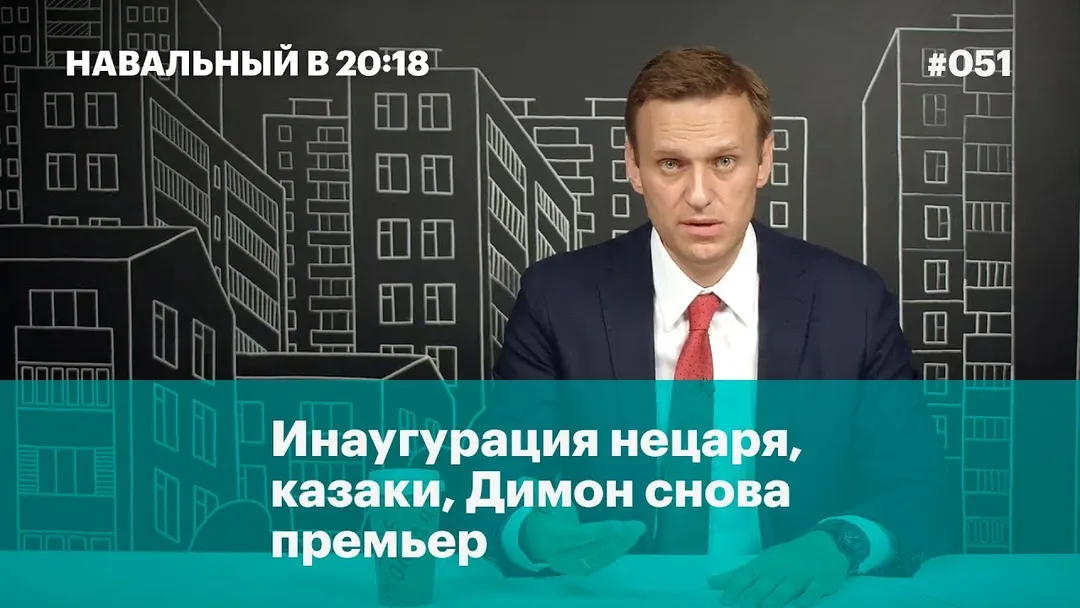
The Inauguration of the Non-Tsar, Cossacks, Dimon Is Prime Minister Again
[music]
Hello everyone, it's 20:18, and Alexei is in the studio.
Navalny, or the opposition-minded
gentleman, as Natalia called me.
Poklonskaya was very sweet about it — she took offense at
a photograph that I posted — or rather, not at
the photograph itself. I'll show it to you, and also
the caption I wrote for the photograph.
She was expecting Nicholas II, but all she got was
Vladimir Putin. That caption offended her, it
was the caption, and she said that this
opposition gentleman mentioned in vain
Emperor Nicholas II, who has been canonized
as a saint and is revered throughout the
Orthodox world. Well, that's simply
not true. I do not revere Nicholas II at all,
not in the slightest, although of course
I probably do belong to the Orthodox world.
Natalia Poklonskaya will have to take into account
that there are people in Russia who do not
revere
either Nicholas II or, for that matter,
Vladimir Putin, our new tsar.
The one we all protested against
on the fifth. Well done,
everyone. I wrote on the cups: everyone
did great, truly everyone did great, and I'm proud
of everyone who came out on the fifth. It was very
cool, it was wonderful. I may be tried
over it, but I do not regret for a
second that
I took part in that action. It wasn't that hard
for me — it was easy for me to
take part in it. True, I had to go through
a whole comic operation involving how I
ran from the police the day before, who were
watching me very closely. In recent
days, about twenty people were tailing me,
really — just like in the movies, all kinds of
surveillance.
Ketchup, a safe apartment —
and then I ended up at the rally. My time at the rally
lasted ten or fifteen minutes,
which, all in all,
was more than at the previous rally, and I'm glad
I was there. I'm glad I was among those
people who came out at that moment and
said: he is no tsar over me. Because what
the political struggle consists of now, guys,
is not half the country against
the other half, Russians against Russians, nor is it
30 percent democrats against
70 percent of these Putinists or non-
democrats. No, that's not how it is at all. Political
struggle is never
a confrontation between some kind of
main forces in society, as if the people had split into
two parts and one opposes the other. No.
There is
a tiny percentage of true Putinists,
the genuine ones, who make money from it,
who receive direct
benefit. They seized power, and through
control of the police, the judicial
system, and the media, they stupefy all
the rest of the population. And then there is us, a fairly
large group of people to whom all this
is unacceptable. And the task of the Putinists
is what?
To tell the people: guys, look,
everything is wonderful, everyone is happy with what's
happening, everyone is greeting the new tsar.
There is only one group
— not dissatisfied people, but those who are slightly
out of tune.
That's the parliament of Chechnya. They are unhappy
with the fact that everyone is merely greeting the tsar — they
want to lick his boots. They have now introduced
a bill saying: let's
allow Putin — not the president, but Putin —
to serve three consecutive terms. That is the only
kind of dissatisfaction. That is the message broadcast by
the authorities. We are broadcasting a completely
different message: we come out and say to the authorities,
to society, and to ourselves: no, this will not do.
This will not do, this will never stand, and we
will never agree to it. In Russia there are
enough people who
refuse to recognize this monarchy, who
refuse to kiss the boots of this
government. In Russia there are enough
people who will never tolerate
this rule of thieves. And in 60 cities our
action took place, yes.
And in fact, for the first time
in all of modern Russian history, we
saw the authorities use violence on
such a scale. I mean,
what happened in Moscow and in
St. Petersburg was a partially forceful
dispersal that probably even in
scale exceeded what happened on May 6, 2012.
And of course there was that whole story
with those Cossacks (members of a traditional paramilitary-style community), which I will talk about separately
in a moment. But one way or another, we
fulfilled our main task. As a citizen,
as a citizen,
I said this on the previous program:
what I wanted from myself, from myself personally, was simply
this: let me do it. I came, I went out, and
I saw around me a huge number of
other people who had also simply
come there to stand for a while so that
they would not feel ashamed before their own conscience.
So once again, huge respect to
all of you.
You are the country's only hope — those who
came out. Because many people do support you,
many people support us,
but for various reasons they are afraid,
they are apprehensive, or something else. And in fact,
that is exactly what everything this
government does is aimed at. It wants those who
might potentially come out to think: well, no,
I could be detained. And then to think: well,
no, I could be fined. And now they are
saying: let's make them
even more afraid, so they think: no.
Some Cossacks could beat me up there.
They could come and beat me up, and that’s how they
intimidate people. Unfortunately, there is a certain
number of people who do get scared,
who are afraid, think about their circumstances, and look for all sorts of
excuses.
They say:
“What about me? I’ve got my grandmother,
or I might have to go to an anniversary celebration, or
a barbecue, or maybe the dill hasn’t
been planted yet. Of course, I’m with them in spirit,”
“I really want to, damn it, but the potatoes,”
“need to be planted at the dacha (country house).” So they look for some
pretext. That doesn’t necessarily mean
they’re bad people or outright cowards, but let’s say
they’re simply not brave enough
to invest some part of themselves in
defending their own country. Those who
came out and were ready to do that are the best
people in Russia—I say that without any irony—and
no Cossacks are going to scare them, of course. I
should say a couple of words about this,
about this strange business, because, well,
to be honest, it made an impression on me,
because at first
I didn’t even notice it. I got to Pushkinskaya Square
from the side of the Pushkin monument.
I arrived there by taxi,
rather discreetly, from the other side,
walked up from the side street, and didn’t see any
trouble at all. Then suddenly—look—people are running,
men are swinging those nagaikas (Cossack whips),
shouting something—it was a real brawl,
and I immediately had a complete
flashback to what happened to us in Anapa
when we were there in May
just on a trip, basically.
At the same time, we held a strategic
session of the Anti-Corruption Foundation
in some rather remarkable interiors
in Krasnodar Krai, and in Anapa there was
a very similar situation: a huge
number of half-drunk
men, unshaven and clearly long unwashed, and they were there
shouting,
all kinds of things, right in front of
the police, in the main square by the airport,
and they attacked us there too.
And naturally, to this day there is neither
a criminal case nor anything else. What you’re
seeing now in the video loop
we analyzed frame by frame, truly
in real time, and by now there will be
13 crime reports filed regarding the actions of
police officers and these so-called
Cossacks. We understand perfectly well
that the authorities themselves brought them there, and they
will not punish them. But for us it is important
to understand and document all of this, because
sooner or later, sooner or later,
every one of these people will most definitely
be punished. They are relatively young,
so they’ll live to see it. We’ll abolish all statutes
of limitations and lock them all up—it doesn’t matter
how old they are—those who
were directly involved there, and most
importantly, those who directed them. There is already a lot of footage now;
we have footage showing how
they were gathered in advance at Mayakovskaya Square,
briefed there, and at Pushkinskaya Square
they were also assembled and instructed in advance.
There are officials from
the Moscow city government responsible for this, there are police officers
who covered for them, and of course there are
people in the Kremlin who decided all of this.
We will identify all of these people, and for that
we are now beginning the initial work. Sooner
or later, everyone will be identified, and everyone
will cry
bitter tears before the judge, saying,
“Guys, forgive us, we were deceived,” or “we were
forced,” or “we were bribed.” But we all must
simply never forget this.
As for
this—I can see there is an ongoing
discussion: are they Cossacks or not? And in
Krasnodar Krai, by the way, real Cossacks regularly
take part in our events, and Cossacks
come to our campaign office. So don’t
tell me that all these people are
tarred with the same brush. These are quite different
communities, in essence. These louts
who showed up in Moscow—what are they, really?
Come on, this is basically a private security
company—the so-called all-Russian movement
of crooks that calls itself Cossacks.
And in every city in the country we simply see
some kind of
antisocial elements—men
who weren’t even accepted into the police,
so they sign up for these so-called Cossacks.
There is always some chief crook there, and
in this particular case it’s some
former FSB general who simply
wanted to make money, plain and simple.
That’s all.
He created a private security company
in order to get contracts. It was easier for him
that way
to get state-funded contracts, budget money.
Naturally, all of this is dressed up in
patriotic packaging: “we will revive
the Cossacks,” and so on. They recruited a bunch of louts,
gave them sheepskin hats,
and went off to demand budget money from
the Moscow city government and the Russian government.
And they got that budget money. They
got a contract from Moscow to guard the courts,
they got money from the Ministry
of Culture, they got money from the Moscow city
government for organizing
some kind of training camps, and all the rest of it.
And I can say, by the way,
as someone who, well,
spent most of the fifth with
the police—after I was detained
and then sat at the police station for probably ten hours,
I can say that the police officers there did not
They don’t really like this whole thing very much.
Of course, they defend it, but they understand that this is
a police function: to protect people from these
vagrants and hooligans—but
they don’t really like it, because
it amounts to a kind of erosion of the monopoly on
violence. A police officer says: well, sure, I
can hit someone over the head with a baton,
but there’s another side
to this pleasant fact that the state
has allowed me to hit someone with a baton
over the head: I could, for example, be jailed, or
if you file a complaint, I have to write a report,
and anyway, if I detain you, I
have to fill out paperwork, I have to
do something.
My boss can reprimand me, I have
irregular hours, and right now I’m
stuck here until they tell us
we’re dismissed—the entire 2nd Operational Regiment
has to sit in buses and wait. And
these guys—what, they couldn’t get into the police? They’re just
some louts, vagrants, but they’ve got
whips—unbelievable. They can also beat
everyone left and right and bear no
responsibility. So those who say
that this whole
idea of these people attacking others
is somehow supported by the entire government, or
even by a large part of this kind of pro-
Putin public—that’s simply not true. But
Maksim Shevchenko
—well, our path downward, the path downward—just
right before the program, in the last election
he did support the Communist Party of the Russian Federation, but he is undoubtedly
someone who consistently
supports our authorities. And today he
made a real statement: he resigned
from the Human Rights Council as a sign
of protest against the fact that there has been no
investigation into what happened on May 5 in
Moscow. And I can see that even many
government representatives have reacted
very nervously to this, because
this is the kind of thing where the authorities
start hiring not even formal
groups, but just semi-drunk people
and licensing them to use violence,
saying: yes, you may beat certain people.
Well then tomorrow they may do all sorts of things—we
understand that their
motives are mostly not ideological at all; they
just want to make money. They’d rather
loot a liquor store much more
than break up some
demonstration. That’s roughly what this whole story is about.
And in conditions where our
state is deformed, broken—where somewhere
some crooked former FSB general
commands some kind of force units,
and here there are police, and there
an active FSB general, and here some
other security structures—but in the end
this will lead to
the emergence of—not exactly
small armies, but in a crisis
situation it’s obvious whom these
so-called Cossacks will work for:
whoever gives them more money,
whoever brings a suitcase of cash to this
former FSB man who organized them—
that’s who they’ll work for, always. More than that,
in my view, all it takes is for the former
one to get a suitcase of cash and tell his
ragtag men in fur hats: go break up that
demonstration over there. And then some
mid-level boss gets offered
more money, and they go break up
that other demonstration. That’s exactly how this works.
We have seen this repeatedly
in our country’s history, and
specifically, including with this very
notorious Cossack movement. So
we should treat this as something unpleasant.
Of course, we need to approach it
philosophically and understand that the authorities
have nothing else
they can do to strengthen themselves
except disperse us. Well, okay.
The Chechen parliament introduced some
bill—that may please them, of course, but
it does nothing directly to strengthen their power.
What they need is to suppress
everyone who is against them, everyone who says
anything against them. So of course, throughout
Putin’s next six years, they will
keep doing this with one degree or another of
aggressiveness. Yes, of course. Our task
is simply not to be afraid, simply not to be afraid.
There is no other recipe here,
no other method or anything else. We need
to work to ensure that more and more
people come out to these rallies. Alex RM
asks me: “Alexei, good evening, what
do you think about holding a protest during
the World Cup? Formally, during
the World Cup, to hold a protest
you need permission from the FSB. There is no
ban as such, but they passed a
law that is absolutely unconstitutional,
in my view, under which you must
obtain additional permission from the FSB.
For us, that makes no difference at all.
They don’t give us any permits anyway,
so if there is a reason, I see
no problem with holding protests during
the World Cup. After all, we are not
holding protests in order to
interfere with the World Cup—that would be
unacceptable. But if it is a protest for our rights,
then why not? A huge, huge
thank you, of course, to everyone—
the campaign staff, all our volunteers, our
coordinators—they organized all of this
in 60 cities. Despite all the pressure, we
had several people arrested before
the rallies, and now two more people have been arrested there,
and seven people are awaiting trial as of yesterday.
literally, the coordinator of our headquarters in Ufa
and yesterday, on the 9th, Lilia Chanysheva
the young woman was arrested for 30 days, but what happened in
Ufa
but everyone did great, once again, it was amazing
successful, and the marches too—so now they want
to take revenge
they want to show that they need to somehow
crack down on
just like they did with Katya, and that’s why Chanysheva was hit with
30 days—our coordinator there
Fyodor Telin was jailed too; they gave him
twenty-five days. In Chelyabinsk, a person
got 25 days. Right now, ahead of us are
Tyumen, a court hearing in Perm—there will be a trial there as well
it’s clear: they’re afraid. They have identified
us as the only real troublemakers
disturbing the peace. Look, the elections were held recently
where are the presidential candidates now, and what
everything’s supposedly fine—but what about Grudinin, the candidate from
the people? What action is he organizing? Where is
Grigory Yavlinsky? What actions has he
called for, I mean
in preparation for the inauguration? But after all, he
said, "I do not recognize these elections"
you would think there would be some kind of
public activity—authorized or
unauthorized—something. One percent voted for you,
so somehow
work with that one percent. Nobody
is doing anything, nobody is doing anything
that’s why they are pressuring us as
the only truly existing
political structure. But I am sure that in
our movement, all our people are good, honest, brave, and
unbending. That’s why I believe in our organization
I am confident, I am confident that despite this
latest wave of pressure, all our people will
hold firm; our network across the country will stand
help us, join us, and
together we will fight back. It’s very
funny—I saw their comments, all those
pro-Putin people explaining to themselves
why, on May 5, people came out across the country
but they were hoping for some kind of failure
because they live in a world where they believe they have already
scared everyone
and that no one would come to an unauthorized protest
right? In their minds, they have a button: declare a protest
unauthorized, and we will all immediately
get scared and stay away. And they believed that, and
then after May 5 they were baffled
discussing why people came out after all
on May 5. My prize for the best
explanation goes to one of my
favorite organizations—in principle, they
would always win prizes: the Putin Squads
who came out with an official
explanation of why people were going to the
protests on the fifth, and they said that
Navalny was handing out food
rations
from his warehouse in Mytishchi. Let’s
watch 1 minute and 22 seconds of pure
delight
of this story about the rations. Come on—here it is, Boykov
for Navalny’s young supporters
Mytishchi
according to our information, the headquarters of this whole thing
is located there, and that is exactly where
the food packages are assembled. What do they include?
[music]
why, this notorious and widely known
there’s even something about a truckload of oil
sunflower oil
yes, by the way, someone called about that too
[music]
Here’s what I want to say, dear
Putin Squads: if I were handing out, in exchange for
taking part in protests,
tea bags, packaged
buckwheat, rice, and canned meat
you, the Putin Squads, would be running to my rallies
in the front rows, because people who
sign up for organizations like that
would sell their own
mother for free food
because if I were handing out some kind of
food packages, all the inhabitants of
these pro-Putin dens—it would be worse than
all the Cossacks (paramilitary-style pro-government groups). Some
normal people came out on the 5th to Pushkinskaya Square
and then suddenly a rumor spread that
Navalny was giving away free food, and crowds of
these pro-Putin people would come running, sweeping everything
out of their way, trampling people
in search of free rice and buckwheat
so no, we are not handing it out—not
only because we do not have the money for it
and no desire to do it, but also
because we do not want to see you at
our rallies. And I am getting a lot of
questions about—I see there was a comment
saying, "Damn it, you’re cutting corners on us—where
is the 700 grams of buckwheat?" asks Kamenkov
Yura. Well, Yura, you didn’t get any
buckwheat. A lot of people are asking me about
the new bill that
United Russia introduced today on
liability for involving
minors in
rallies. They once again saw that
quite a lot of young people—students and
schoolchildren—are coming, and once again they
got worked up and
started trying to fight it. You remember
a year ago, after March 26, they began
going through all the schools, universities, vocational colleges
and so on, telling everyone how good Putin is
and how bad Navalny is. Now they are
trying to introduce administrative
liability for this as well. It seems to me that
the best thing said on this subject
was by Yevgeny Roizman, the mayor
of Yekaterinburg, who commented on the whole
situation and said: well then, let’s
ban everything altogether, and let
schoolchildren then, in principle, should
to accept themselves as slaves by default. As for me,
I feel more or less the same way about all of this.
When I was detained, there was also
a young guy detained along with me.
They detained us, dragged us onto a bus, and then when
we had already arrived at the police station,
I found out he was 15 years old. From his appearance, I would have
said he was about 22 — he looked completely grown-up.
He was 15, and they let him go there without
drawing up a report; his parents came to pick him up.
I talked to him, and he
was already like me. At 15, I wasn’t like that.
Not the same as I am now, of course — maybe I was more foolish — but
I was interested in politics, and I thought about
my future. It’s just that when I was
15, Russia’s prospects
looked completely different from how they do for those who are
15, 16, 17, or 18 now. So once again,
I can say absolutely clearly that
first, I am unquestionably proud that
young people come to our rallies.
I am unquestionably proud that I am
one of those politicians whom
young people listen to, and whose rallies
they come out to. I absolutely
believe that what distinguishes a smart person from
a foolish one, first and foremost, is that they
take an interest in politics, in
how they are going to live, how
their future will be built, what prospects
they have in this country. After all,
they understand very well that no matter how
well they study, no matter how hard they
try,
they have no prospects for a normal life
in a country called the Russian Federation
under this government, because their
salary — just their salary, leaving politics aside —
will by default be three times
lower than in any European country.
Because damn Putin, for example, has strangled
all these industries, and there are no real
prospects here.
Nothing is developing here because
they have crushed small business, because
there is no real production here. And if
a person at 15, 16, 17,
or 18 understands this, understands that
for the sake of their own future, they need
to go to a protest now, then that is a wonderful
person. I applaud them and say: well, you’re
smart. You’re going to a protest because you
can connect two dots, connect A and B.
That means you’re smarter than any of your
classmates; you’re smarter than some stupid
teacher — sorry, but there are teachers like that.
The entire internet is full of videos of them
saying: don’t go.
How can you oppose the authorities?
You’re not supposed to speak out against the authorities.
You must accept everything, you must
bow to them, you must agree with them completely. You’re
small.
You must be a slave. When you get older,
you’ll be an older slave, and then you’ll become
an adult, good, fully-fledged slave
who will slave away for this
state, paying unimaginable
Russian taxes, and they’ll tell you:
you’re paying far too little. Then you retire,
and become an impoverished slave. If there are
people who, at a young age, say:
no, I already don’t want to be any kind of
slave. I want to be a normal human being, and
I don’t understand why, in modern Russia,
we should have to live in poverty — that is
a wonderful person, and I am proud that
schoolchildren and students are coming out.
I see that in fact, in large numbers, it’s not just
students coming out — not just some kind of
spoiled rich kids, owners of
iPhones, or students from the best schools and
the best universities. Kids from
technical colleges are coming, kids from
vocational schools are coming too, because it’s the same
for them — they really understand it. For
me, this is a breakthrough: that we were able
to explain these things — or rather, no,
that’s not quite right, not that I managed to explain them. I’m not
inclined to think that it means I’m somehow so
smart and opened young people’s eyes. No, apparently
some kind of generational shift has happened
in which schoolchildren, students, young people
in general have simply become better at understanding this. I
probably didn’t understand it at their age, or
understood less. But now they, regardless
of what university they attend, regardless of whether
their parents are rich or poor, understand
these things better — they’ve felt them more deeply.
And it’s really great that they have felt that.
So it seems to me that any attempts by
United Russia (the ruling political party) to try to
crush
this sense of freedom and dignity inside
a young person will come to nothing. We’ll
see, of course.
To do this, the state will
lie twice as much, deceive you twice as much,
there will be twice as much brainwashing every day.
But will they be able to strip away the sense of
dignity from these people who are now
coming out to protest? I don’t think so. Well,
we’ll see how it goes. At the very least,
I will do everything I can to fight, on the other side,
against this brainwashing.
We finished the rally on the fifth. Send me
your questions on Twitter, and I’ll
keep responding on this topic throughout 2018.
Here’s a question from toupper
harley: Good evening, Alexei, what do you think
Russia will look like at the end of Putin’s new term?
Dear toupper harley, the inauguration
that has just taken place already perfectly shows
what kind of
joyless country Russia will be by the end
of Putin’s new term, because
the inauguration itself was bleak, joyless, and
made it clear that there would be no meaningful change.
This was a very significant event.
Very important and very symbolic.
For me, this event was simply
filled with explanations,
clarifications about what will happen next, how
the country will function—there, quite literally,
every second, every
minute, something was happening that
was telling us how everything would be arranged
going forward. But look at how it all began.
Putin arrived in a car from the Cortege series.
It’s a special kind of car that
everyone looked at and thought, oh, some kind of
Rolls-Royce. But this isn’t just
some Rolls-Royce-style thing.
It’s 12 billion rubles (about $190 million at the time) that were
allocated to a special program
to create a presidential limousine.
A limousine, understand? In Russia, where people
raise money for medicine through
charity foundations, where children’s operations
are financed through
charity foundations, they allocated 12
billion rubles (about $190 million) to build this thing,
and this vehicle during
the inauguration, as we later found out,
drove only 200 or 300 meters (about 220–330 yards) because
because
they were afraid to let it go
all the way from Novo-Ogaryovo to the Kremlin
because apparently they were afraid it wouldn’t make it.
So that’s how it is—business as usual, they spent 12
billion rubles.
This supercar can’t even drive 200
meters, meaning for most of the trip
Putin rode in his Mercedes Pullman,
and the last few hundred meters
he rode in this thing.
Well, just to somehow, at least a little, explain
where those 12 billion rubles went.
And of course, for those who watch
television, to pull the wool over their eyes—oh,
look, he arrived in a domestically made
car. No, he did not arrive in a
domestic car—he arrived on
12 billion stolen rubles, and that is
once again a perfect symbol of what
is to come. People were asking what would happen during
this term, during this Putin
presidential term. Russia, unfortunately,
will continue throwing away our
enormous sums on meaningless,
stupid projects like this Cortege. We
will spend tens of billions of rubles
on all sorts of, excuse my language, crap that will
lead to nothing except that it can
be shown on television as
some kind of propaganda effect.
We’ve seen Rogozin-style
robots, these Skolkovo (Russia’s state-backed tech hub) things,
that dachshund they dunked underwater—you remember.
That’s the kind of thing they’ll keep doing.
Huge amounts of money will be thrown away, and
that money will give us absolutely
nothing. The next thing is also very,
very symbolic. Now I’m going to show you 31
seconds from Putin’s inaugural speech.
It outraged many people, but when I
watched it, I thought: my God, how he
decided to send such a truthful signal about
what this would mean.
These 31 seconds are the single most important quote.
Putin, in his inaugural speech: “We need
breakthroughs
in all spheres of life. I am deeply convinced
that such a leap
can be ensured only by a free
society that embraces everything new
and everything advanced,
and rejects injustice, stagnation,
reactionary backwardness,
and bureaucratic deadness—all that
binds people, prevents them from fully
unfolding, from realizing themselves and their talents,”
“and therefore limits the country’s drive
toward the future.” This man
just recently, with budget money—well, two
days ago, with budget money—deployed
the very symbol of backwardness
and reactionary conservatism. He simply opened
a history textbook and looked at what, over
the last hundred years, in the historical
memory of anyone who has read that
history textbook, is a symbol of
reactionary repression. Ah yes—drunken,
unshaven men with beards and
whips dispersing students in the cities.
That is the symbol of backward, reactionary repression.
And after that, he and his speechwriters
included in the speech this part about how only
a free society can achieve
breakthroughs, and we must not follow the path of
reactionary backwardness. Everyone said,
my God, what a liar, what a hypocrite. And I said:
thank you.
It’s clear to us—we understood the signal.
The hint could not have been clearer.
It is clear to us that Putin said that in the
course of the
next six years, of course, there will be
no breakthrough at all, because a breakthrough,
as Putin himself understands—he said it—is
connected with freedom.
A breakthrough is connected with something new, but nothing
new will happen, because I rely on
reactionary backwardness.
And there simply won’t be one, exactly like that. Besides,
I will continue lying in every word and
being hypocritical in every sentence—that is what
that part of the inaugural speech symbolized.
It’s very clear: over the next six
years they will lie twice as much, be seven
times more brazen, and today they will do
one thing, and tomorrow they will do the complete
opposite. That was a very important
part of the inauguration. But what came next?
One of the most widely quoted
promises the next day was
Putin has signed new May decrees.
He said that Russia would enter the top five
largest economies in the world, and everyone was like, well,
the small remaining share of independent media
in Russia, and people who still have at least
a little memory, said:
Good grief, what on earth is this?
Over the past 11 years, he has said this six times
literally, literally in almost every
major speech of his,
in inauguration speeches,
before parliament, before the Federal
Assembly, at every kind of gathering where
he gathered his entourage and, in
large numbers, had them brought in
to appear on live broadcast. He says that
in the near future, over the coming years,
Russia will make it into the top five
economies in the world. It won’t. It hasn’t over
these 11 years while he has been promising it, and it
won’t, of course. And, well, do you really think
that Putin is so far gone that he forgot
that he has promised this many times? But
after all, he does read what they give him so that he
whatever kind of mental disconnect he may have, or
then there’s the popular version that there are doubles, not just one.
However many there may be,
each of those doubles has already, several
times, promised that Russia would enter the top five
largest economies, so each of
them must at some meeting
have said, well, how can we possibly
keep promising this? People will laugh at us. But
that wasn’t the signal they were supposed to get. The proper signal was
to explain that over the next
six years we will be fed promises that are knowingly
impossible to fulfill. And the economy—
the economy of the state of California is larger than
Russia’s economy. Naturally, there can be no
entry into the top five largest economies
in the world without new technologies,
without development. None of that exists. See
the previous point about backward, archaic conservatism
.
What exactly will get us into the top five largest
economies? I mean, we have to overtake
someone to get into the top five. Someone is
currently in fifth place, someone in sixth,
and we’re somewhere around seventh or eighth. We
have to push someone out to get into the top five.
And by means of what, exactly? Please tell me—by
selling
Cossack whips, sheepskin hats, or
chrome leather boots? No, those are not the
drivers of economic growth that
could get you there. So this too
was an important part of the inauguration:
it explained that nothing is going to happen here.
There will just be more nice promises.
And of course, the thing that finished everyone off, especially
United Russia members, though I had no doubt that
Medvedev would be reappointed—I got
enormous pleasure from it.
I mean, I just completely relaxed and enjoyed it.
I specifically went on Twitter and read
the accounts of all those Putin supporters, what
they were writing about Medvedev’s appointment. There was
howling: “Vladimir Vladimirovich, how could
you? We had such hopes for you. You’re so
cool, so strong, and you break up rallies,
too,”
“and you’re ready to start a war, and in Syria too,”
“and you fight all these enemies,”
“so how could you appoint that Medvedev again?”
Well, he did appoint him.
He appointed him, dear Putin fans, and
that perfectly shows that the next six
years will be just as useless and
drained out of our lives. And if they sit it out
to the end, compared with the previous term it will
be even worse.
Just look at the composition of the government.
Golikova was put back in charge of healthcare.
Golokova was returned to healthcare, and
she had previously been removed because the whole country
called her, if you remember,
“Madam Arbidol,” because during her time
when she oversaw healthcare,
she lobbied for her family’s interests.
There were practically inspections of pharmacies
to see whether they stocked Arbidol, which is not
actually a real medicine. It was simply that
businessmen close to her were pushing it and
producing it in enormous
quantities, and it was purchased with budget money.
Good Lord, there isn’t a clean spot on her record.
.
We did an investigation into Golikova and
her husband, Khristenko, who, by the way, is also a former
deputy prime minister. Just look at
Golikova’s house in Pestovo,
by the Pestovo Reservoir, next to a golf
course. With what money was all this bought?
They have both been officials their whole lives. And her home is in
Ostrov Fantaziy, an elite
part of Moscow. You can see there that one
of these properties—there’s no way
a single building in this super-elite part
of northwest Moscow
could belong to Golikova legitimately. We did a special
breakdown; we calculated what their
official income was.
It’s fairly large, though it’s unclear where it comes from,
but even that official income
doesn’t come close to matching how much they
spend. Where does all this come from? And this is the person
they are dragging back into healthcare, supposedly to help
those very people who stand there
counting their money, elderly women standing in pharmacies
trying to buy some medicine, who
stand in these enormous lines, who
if, God forbid, they are diagnosed with
some kind of cancer,
know that getting treatment for free
usually won’t work out for you in most
cases. In most cases, of course,
it may be free there in Moscow, in a wealthy
city, it may be free there, in
in the region, never — I mean, for free, yes.
I mean, you could just end up dying very
quickly. Everyone knows that, and this man
will be put in charge of healthcare.
Oh God, by now even everyone — even Vladimir
Solovyov
was cursing Mutko out, I remember, shouting there
about when he would finally resign.
They appointed him, and it was, of course, an astonishing кадровый choice.
When Medvedev says that we
are going to appoint Mutko — there’s this little
thought — and United Russia members laugh because
what other reaction could there be? Maybe
they didn’t believe it for a few seconds. Let’s
watch it. It’s 40 seconds, but
57 seconds, but it’s wonderful, I think.
There is another interesting idea that
exists: taking into account experience and taking into account
personal characteristics, while at the same
time bearing in mind that we try
never to bend under external
circumstances.
There is a proposal to appoint
Vitaly Mutko as deputy prime minister so that
he can deal with construction issues
as well as regional policy.
He is an experienced man; let me remind you, he worked in
the region, in St. Petersburg.
For them, it sounds like a joke.
He’s just like that — he says it all so slowly,
speaks as if he’s actually
telling a joke, building it up,
building it up, and then suddenly — bang — the punchline:
“in the field of construction,” and then, still, ha-ha
ha — Mutko in construction.
This is the government of a country where
145 million people live, and he says that
we’ve now taken the most pointless
idiot
you could possibly imagine,
who failed at everything, who disgraced
our country before the whole world with these
“toppings” (a mocking reference to the doping scandal), who just talks
complete nonsense — and we’re appointing him to
construction on somebody’s say-so. Let’s
remember how he was one of the
overseers of the construction of Zenit Stadium
Great choice. Of course they
burst out laughing, because, well, what
other reaction could there be? But this is the government.
He’ll have a black Mercedes with a flashing beacon, he’ll
hold meetings on this
construction, and among other things he’ll
be handing out billions, and in the course of this
construction he’ll wreck and botch
everything, of course. Thanks to Mutko, Russia will, among other things,
become even stronger.
And fall even further behind the top five largest
economies in the world. Meanwhile, by the way, while we
were watching this amusing footage, I was
written to and corrected: “You’re mistaken,”
“Alexei, Russia has long since stopped competing
with the state of California in terms of the size
of its economy — only with the state of New York.”
They’re not competing with a city yet, but with
the state of New York.
So thanks to Mutko, we will all become
a little poorer, and many will become even
more destitute.
They laugh and discuss it there, but anyway,
an important part — the symbolic part
of the inauguration — showed what kind of
government this will be: a government of failure and
theft. Theft is the key word, you
think?
But they’re not appointing Mutko just for laughs.
Why is Mutko such an unsinkable guy?
He was sports minister, and he totally
failed. I mean, what happened with the Olympics?
How they dragged us through the mud there, rubbed our faces in it
— all the sports officials — but it was
just some kind of utter disgrace, with all this
doping and everything else. They’ve already acknowledged
a significant part of it officially,
officially acknowledged it.
And yet after that he became deputy prime minister. This
one photograph explains everything. Let’s
please take a look at the photograph
with Comrade Mutko.
Where does his career come from? He’s from
the St. Petersburg mayor’s office, and if there’s a photo with
Sobchak (Anatoly Sobchak, former mayor of St. Petersburg), show that one too — even if it’s not in color,
from who-knows-what year. Mutko is
unsinkable because they were stealing
together with Putin
back in the St. Petersburg mayor’s office, skimming money.
They sat like this, facing
each other, pulling out this envelope full of money,
stuffing it here and there — they were super
trusted people.
Putin trusts Mutko like almost no one else.
They’ve been stealing money
together for 40 years. I’m 40 — 40, that
would make it 1976. I’m 40 years old — well, over the
last 25 years, they could have a coat of arms
for Putin and Mutko together, with the caption: “25 years
of stealing money together.” That’s probably a super
way to describe a person — nothing would offend
this gang of St. Petersburg officials more.
After all, they’re mostly people who came out of this
St. Petersburg mayor’s office — they’re just
bandits and crooks. Why are they all so tightly
bound together? Well, because they were
carving up money back when Putin was arranging
the sale of precious
metals in the early 1990s — you know, that famous case.
It all comes from there. They were all there together
running their little schemes, and they’re still
running them now. How could he possibly give up Mutko? How
could he give up that very
Vitalik who used to bring him things and say,
“Vova, here’s your share.” They were dividing it all up into
their pockets even back then. They’re doing
the same thing now, and they’ll keep doing the same
thing. So this is a great symbolic
thing that showed us just how grandly and
powerfully they will steal
during Putin’s new presidential term.
Therefore,
it seemed to me that the inauguration, in
that sense, went very, very successfully
because it showed us how everything will be. I
hope—I could probably spend another half hour
answering that question, but it seems to me
the cards I’ve been dealt are giving me both
questions from LR. I’m being asked: what do you
think about the New Greatness case
—an FSB provocation, where they jailed very
young people? I’ve been following this case,
of course. I believe today they extended
the detention terms for the older girl there.
The situation really is, how should I put it,
outrageous, but as of today it is typical.
The Center for Countering Extremism
—that is, a legally existing
organized criminal group in Russia—
whose purpose is supposedly to report that it
is catching some kind of extremists, but in reality
they themselves organized some people online.
There were several meetings where
it wasn’t just a recruited person, but an actual
undercover employee from the Center, and
from the case materials it is clear that he himself
suggested: let’s create this kind of
organization. He proposed that they adopt
a charter and everything else. And when they were like, well,
all right, fine—heard the proposal and resolved to adopt
the charter,
he ran off, filed a report, and everyone
was arrested. They said,
they created an extremist group, they have
a charter, look—they even held a meeting there.
And all of this was organized by the police themselves,
that is, it was purely a provocation in order to
simply imprison random, absolutely innocent
people. But this is how they will operate.
In the city of Sochi,
there was also an astonishing
incident today that shows what
things will look like in the future.
Those of you who follow our
work probably know that in our investigations
department we have the amazing Georgy
Alburov, a wonderful person, and
while he doesn’t work for us full-time, he is our regular
consultant. And Vladimir Dolnikov, a volunteer activist
who is now very actively
involved in the whole situation with
Telegram, also serves as a consultant on the site,
one of the, well, leaders of the movement for a free
internet in Russia. They were in
Sochi today on various matters and were sitting in a café
when at some point
some men approached them—six people—pulled out
pistols and said—broad daylight, really,
in a café on the embankment, people come up
to civilians, pull out weapons, and say:
you must leave immediately, or we’ll
take you to the mountains and kill you. Alburov was supposed
to send a short video—1 minute 20 seconds.
I haven’t seen it myself yet; I’ll watch it
with you now, and he’ll tell us what happened.
Let’s watch. Georgy, can you
We, together with Dolnikov, are in the city of
Sochi.
Today we were having lunch in one
of Sochi’s cafés when
about six to eight
very solid, muscular guys approached us.
They weren’t Caucasian; they were more like
the type you’d associate with some kind of special forces.
Well, we’re here on work-related
business, and it’s obvious they were tracking us.
We must have been flagged
when buying tickets through various systems
that monitor ticket purchases and
through cell tower data, and somehow
they found us in this exact
specific place. They put pressure on us,
trying to force us to leave Sochi.
They said that if we didn’t leave, they would
take us to the mountains. They displayed weapons
that they had specifically brought for this.
They threatened to beat us and generally
put every kind of pressure on us, threatening
violent retaliation.
If we did not leave—which is why we filed
a complaint against them.
It states everything as it happened,
what took place. They did not want to accept it
at first. They said we had to go to another
district to file it. Then they said,
why are you even filing this? No one will
be found. Then they said that if they were found,
those people would say that it was we who
attacked them, and then we’d be jailed. So we
spent quite a long time persuading the police officers,
and in the end we did manage to file
the complaint. So now we’ll wait
for a response and hope for Russian
justice—that these people who, in broad
daylight, threaten people on the streets of Sochi with
weapons—will be found.
It’s May, Sochi is in resort season, there is a huge
police presence, and it is supposed to be
one of the safest
cities in Russia at this time. But we
understand that this is Krasnodar Krai (a region in southern Russia), we
understand there are certain local peculiarities,
but still—for six men simply to come up in broad
daylight with pistols, six
people, and take away their phones—
though of course when
some people come up, pull out a pistol, and I
know Alburov,
he still had a phone and started filming all of it.
They took their phones and said things like, we’ll kill you,
not stab you—these were
some Russians, and indeed, judging by everything,
they were most likely the same police officers,
anti-extremism officers or FSB guys whom we
looked up in the database—aha, people have arrived
to Sochi, so that means they’re up to something,
that’s all.
Well, or something like that. This is a threat
to national security.
if they expose some kind of product
well then, look—raise the alarm
raise the red flags, launch a signal
flare rocket, the special FSB group
changes clothes in the armory
gets weapons and goes to protect these
these thieves need to be thrown out of Sochi immediately
and Sochi
these two troublemakers here
and off they go, not even embarrassed, with
pistols—and how can this even be happening?
could we ever have imagined that
this would happen so openly? I mean, in Chechnya
this has been going on for quite a while, and in
Dagestan something like this can happen, but in
Sochi
three years ago it would have been hard to
imagine
now it is happening, and again this is about
how they are going to protect themselves, well
and by the way, this is already a good
a good way to understand what
has become of Russia under today's rule
the "cursed '90s"—the "cursed '90s"—and you'll get
an idea of what the "cursed '90s" were like
it all comes down to roughly this:
some people in a café with pistols—that is
what is happening now, and we understand that
once these people were allowed
in civilian clothes to show someone
their weapons, well then in
a few hours, a few days, or
under some other circumstances they will
simply, excuse me, while drunk in some
similar café, be showing all this to ordinary tourists
because someone looked at them the wrong way
or said something wrong—that is exactly how it
works, and it cannot work any other way
but if you tell a police officer from above
to go and do something
that is criminal, illegal
that is, to go commit a crime
and some kind of
police boss told them to do it
that a crime can be committed here, then
next time I am guaranteed to be
covered for after another crime, because we
my boss and I are committing
crimes—one hand washes the other, that's how it
works. But credit to the people from Dolinka
for not just quietly leaving
with their things packed, but instead making the situation
public
they went and filed a report
with the police. I fully understand that this will lead nowhere
to nothing
but nevertheless it is an important
fact—it simply shows that we are not afraid
well, obviously, when someone is standing there with a pistol
you won't exactly charge at him, right? He might also
shoot you and then say that you attacked
him with a fork. But what matters is not bravado
whether you're afraid or not, but that at least you're ready
to make the situation public, because
from now on, the further this goes, the more for
any little thing like this, a mayor
a governor, anyone at all will be after
you, trying to bring
criminal charges against you even if there is no
politics involved. A lot of people sit there and think, well
okay, that's understandable—he's an obvious enemy
of the state, from the FBK (Anti-Corruption Foundation), so against him
they take such measures. But what does that have to do with me?
Sure, maybe I'm against the authorities too, but I'm an ordinary
person, or I'm unhappy about a broken road
but I'm not political, so nothing will happen to me
—it won't happen to me. Well, let's see. An interesting
situation happened in the city of
Yuzhno-Sakhalinsk, in Sakhalin Region
there, a man was simply unhappy with the road
and recorded a video. Let's watch these 50
seconds: on Lenin Street—a new kind of mess
there it is
quite something. And well done, they even
came up with this—nailed it down so the boards wouldn't
be stolen
and that's how it is all along Lenin Street
thanks to our esteemed governor
every bit of this idiocy
must have been put together by complete idiots
a respectful request: please share this video
maybe our
esteemed Kozhemyako (the governor) will finally grow a conscience—I don't even
know what to call him anymore
what's happening here is just embarrassing
it shouldn't be like this. Here you are walking on a
sidewalk like this, right? And do you realize that you live in a
very rich country? On Sakhalin they extract
oil and gas there—the region is incredibly rich overall
in theory, the region ought to be. There are also
LNG facilities there
and oil companies there; a huge number of people work there
extracting
enormous amounts of money from the land you live on
and so you walk
with your own feet on the ground
under which there is a pile of money; from that
money people get rich here, yet you are walking along
a sidewalk like this, through the mud. So what can you
say about the mayor and governor? But that man
said it absolutely honestly—we censored it
so that you wouldn't hear all the
full honesty, though you can easily find on Twitter
the uncensored version of this video
so what did he say wrong? Absolutely
nothing—he said everything correctly. If in 2018
in a country that claims it wants to join
the world's top five economies, a sidewalk like this
exists and has to be patched with boards or
whatever it is lying there, then he has every
right to say so. What happened after
that?
Did the mayor, shamed by the public, immediately go
and pave everything? No. Did the governor immediately
go there personally and, with
the regional TV cameras rolling, himself
pour some gravel and say, 'We'll fix all this
right away, of course, because'
It's outrageous, outrageous what's going on—well, he did it.
He made it look as if he hadn't known about it, and...
as if he expected the governor to come and fix everything, so he filed
a complaint with the Investigative Committee (Russia's main federal investigative authority), and
the Investigative Committee launched an inquiry.
Because, you see, the crime wasn't that
someone had done such a terrible job—I'm already
starting to say it myself—you tell me I need to hold back,
the crime, supposedly, was that
a man was walking through the mud, got outraged, and recorded
it. Yes, he was swearing, but the way you have to swear when you can't
help swearing—when swearing is exactly what the situation calls for.
There are simply no other words
to discuss it. And that, apparently, was his crime: he
insulted that very governor,
Oleg Kozhemyako.
A United Russia party member—meaning, one of the bosses.
There he sits, with Putin's portrait hanging behind him—well, would you look at that.
Some [__] serfs, apparently, are unhappy
that they have to walk there on
planks laid over the mud. They're unhappy
that billions are being written off as road-repair spending,
while all they get is this...
Throw them in jail—wow. If they start
opening their mouths against us, that won't lead to anything good,
either. Look, it's a sign of the times.
Not that long ago, this would have been impossible.
Back then, Kozhemyako would have said something like,
'I don't know, go pay the guy some money
so he takes that video off the internet.'
Some PR people would have handled it. But now
it's different. Now this big red mug
is a symbol of power.
You sit there, you've got a party behind you,
you've basically got a license to steal, so you
have to crush everyone who's against it.
That's why people need to go to
rallies. Sorry that I turn every topic into
the same point—but how else? How else?
How else can you protest this except by
spreading it around? The man asked
for this video to be shared, and I honestly
shared it. And now I'm asking you
to share it too. I respond to requests like that.
If they hold a rally, I'll support
that rally, because there is simply no other way
to stand up against this outrage, just
impossible otherwise, because no
other methods work on them anymore. And
our task is simply to gather more and more
people. Let me answer
some questions from Twitter. Alexei,
what about registering the new party?
About party-building?
About expanding with deputies at different levels?
Hold on, you've jumped straight to expansion already.
We're supposed to have a congress on the 19th,
and I will be there—unless I get
locked up tomorrow. If they do
lock me up, then in any case
the congress will still go ahead, and we will continue
to demand registration of our party, although
I understand perfectly well that Putin has
absolutely no desire to register it.
Another question: won't all these arrests
interfere with the party congress?
We understand, and all our coordinators understand,
that they detain us,
they arrest us. That's why we're gathering
people who aren't easily scared,
people who are ready to work with us. As for the elections
in Moscow—what's your view? Someone asks me
something here that's garbled, but anyway,
it was addressed to Navalny—so, regarding
the Moscow mayoral election, I see one candidate
for mayor of Moscow: Yashin, who is actually
doing something and
running quite an active campaign.
He's meeting with volunteers; I was at that
meeting. Good for him, I support that. I see
other candidates who say
they want to take part, but they are doing
nothing, to my great
regret and disappointment. And I keep repeating
my position: as a voter, I demand
primaries.
I demand that everyone who wants to take part
in the Moscow mayoral election and wants
my support as a politician and my
support as an ordinary person—my vote—
must hold a preliminary
vote with debates, so that I can choose
the best one together with you and vote
for that person. That's all. Yashin, by the way,
is also demanding these primaries, but all
the others are not. Alexei, wouldn't you like
to meet with Pashinyan,
asks Aleksandr M.? Well, I would like
to meet with all interesting people,
certainly including Pashinyan, but I
think that, first of all, he has other things
to deal with, and second, any possible meeting
with me would simply be perceived by the Kremlin as—well, they
would go into hysterics. So Pashinyan,
being a sensible person, naturally
understands that one way or another his job
as the country's prime minister is
to build relations with Russia,
regardless of what kind of
government Russia has—you still have to
maintain relations with it. Meeting with me
would be of no use to him in that sense.
What time is tomorrow's show trial?
My show trial is tomorrow at 11—actually, two of them.
Two trials. Tomorrow they'll try me for
disobeying police officers, and they'll also try me
tomorrow for organizing
a rally. On the first charge I face 15 days in jail;
on the second, I face 30 days. Those
could be added together, so overall I could
get 45 days. But honestly, I don't really
understand the logic lately,
because they still haven't tried me yet
for the previous rally.
Usually in a situation like this, they immediately
arrest me, hold the hearing, and send me straight to a special detention center,
but this time they let me go.
I don't understand whether that's because...
to support this Kremlin talking point
Look, they're jailing everyone, but not Navalny
they're not jailing him, so that's why they're doing this
measure—whether it's ahead of
the European Court, I don't know, and it seems to me
it's pointless to speculate
none of this really matters much
naturally, Putin and this whole crowd
are disgusting—they do everything they can
to hold on to power, in order to
go on stealing and have the ability
to punish those who are unhappy with them. Our
task is to resist them
to unite people around us
to persuade people, to campaign. The most important thing is not
the main thing is to be honest people. On May 5, I
tried as best I could to be an honest person
if they put me on trial tomorrow, okay, that means
I'll be tried for trying, at that moment,
to be an honest person. If I could
turn back time to May 5, I
would do exactly the same thing, only I would try
to stay in that square a little longer
together with you. Once again, thank you very much
to everyone who came. See you next
Thursday. Bye
[music]