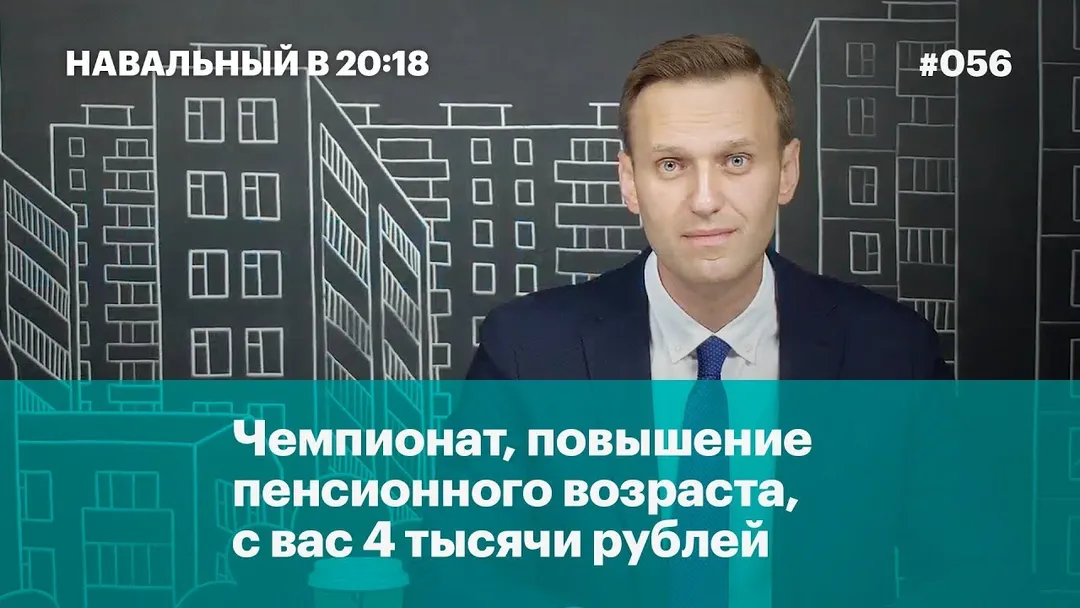
The World Cup, the retirement age hike, and 4,000 rubles from your pocket
[music]
he
Hello everyone, it's 8:18 p.m. in Moscow, in the studio.
Alexei Navalny, or the man with a 1, 2, 3 percent
approval rating, as Vladimir Putin called me
in an interview with Austrian
television, once again refusing to say
my last name. I'm incredibly, incredibly glad to be
back on the air after a month-long break.
Every Thursday I sat there in my cell and
sadly said, "Hello, Moscow, it's
8:18 p.m." I missed our broadcasts terribly.
Thank you so much.
Many thanks to my colleagues who hosted these broadcasts.
And huge thanks to all the viewers who
watched them—I hope
we'll see now that I haven't lost any
of my live broadcasting skills. I'm
terribly nervous and very happy to begin with
some great news and congratulate everyone on
the Russian national team's victory.
5-0—absolutely amazing. I didn't watch
the match, I was preparing for the broadcast, but I
knew perfectly well what the score was, because
we're sitting on the fifth floor, and after every goal
you could hear the roar from the street—people shouting.
That's really great. I'll drink this still
water to the victory of the Russian
team.
Of course, much more
difficult contests lie ahead, much more difficult
matches, but still, you have to admit,
it's great. I mean, obviously
there was plenty to mock the Russian
team for, to joke every time before every
match—it was just a whole set of absolutely
brilliant jokes, and there were—or rather,
there weren't—I didn't meet a single
person. But over the month I saw police officers
or detainees, and neither group thought
the Russian team would win even one
match. And it's great that they did manage it.
Just imagine what it would be like for us now
—we'd be making sad jokes again,
about how we'd failed again, how
awful it all was, how hopelessly clumsy we are,
and so on. But at least now we have
one guaranteed great
victory, and right now people are walking through the streets of Moscow
chanting, "Russia! Russia!" And
that really is very cool, very
wonderful. Congratulations to everyone, and I wish
our
team to keep playing this well.
The World Cup taking place right now
is always, of course, a very important
political and foreign policy
event for any country, and it's very
interesting to watch what's
happening in Russia right now. Yes, this is—
sorry, I'm smoothly moving on to less
joyful news than our team's
victory. For any country, it's always
a very significant foreign policy
event, and for Russia, of course, it's also a
foreign policy event—a chance to show
how great we are, to say that the boycott of
our football celebration failed. But
today it became clear just how much the World Cup
was planned by the authorities and
carried out by the authorities as, among other things,
a domestic political event, because
today two things happened that
will have enormous long-term
consequences for the whole country, for every one
of those watching this broadcast, and both of these
pieces of news
were slipped in today, during the day,
buried somewhere on pages two, three, four, five.
And after this 5-0 victory, the news won't
say anything about it at all.
First of all,
raising the retirement age. Second,
tax increases—raising VAT by 2
percentage points. This is very important; later
I'll explain why it's so important. And
notice: no discussion,
no debate—just cheering, 5-0,
Cheryshev, go! All of that is fine and
great, but
just appreciate this kind of trickery, this
meanness, you see.
To hide all this on the opening day of
the World Cup in Russia, on the day when
our national team is playing—this was all deliberately
designed so that it wouldn't be discussed
at all. But we will discuss it, and I
urge all of you to discuss it too,
to explain it to people. In fact, after
some time, people will of course
understand for themselves what's happening, and here it's very
important—important for each of us—to
explain why this happened and who
is to blame. There are a lot of questions.
Let me remind you that you can ask me
questions on Twitter using the hashtag #Navalny2018.
On this broadcast, we're continuing
to raise money. All of it will go toward
paying fines for those who were arrested for
participating in the May 5 rallies in
their cities. And we've now enabled
Super Chat. I don't even know how this
thing works myself—they turned it on while I
was under arrest. In short, there's some kind of
Super Chat. I don't know what people do with it, but
you'll probably figure something out yourselves.
There are a lot of questions about my
detention center, my arrest, and a lot of
questions because today I—well, it's not
that it was exactly planned, although yes, I had intended
it—I just didn't expect there to be such a
reaction. I'll make a little
sensation: I got out of the detention center, but
today, with the World Cup starting, I thought I'd write a quick
update, and I posted on Instagram about
how I'd gotten out, and the entire
detention center—and in fact the whole area for
those under arrest—had been completely transformed.
because of the World Cup, they would be
arresting foreigners, and so there
they redid everything. Well, I didn’t want to
completely deceive people; I understood that once it was out,
all sorts of outlets would start reprinting the story.
So I basically built into the story
what seemed to me completely obvious, and
well, these little clues showing that this
could never be true. For example, I
wrote that now there was a completely different
menu, and if the detainee wanted, a waiter would come in.
That “waiter” was supposedly a cadet from a police academy (militsiya, the former Soviet/Russian police).
They’re fed borscht, and
offered a choice of dessert, including
tiramisu. And it seemed to me that
a Russian jail cell
“Russian jail cell” and “tiramisu” are two phrases
that simply cannot exist,
in the same universe, and any person
would of course understand immediately. Still, just in case,
I thought maybe someone wouldn’t
pick up on the tiramisu part.
So I added a paragraph saying that now
in the special detention center, specially hired
female students from foreign-language institutes
dressed as flight attendants
came in to hand out
phrasebooks in foreign languages. Then I also
added a point saying that in every cell
they had installed a huge LCD
screen so detainees could watch
football.
Well, at that point it was already completely
obvious that this could never be true.
Nevertheless, a huge number of media outlets
published the story, saying that Navalny
had described how the special detention center had changed.
Some absolutely
respectable media outlets did it too. I apologize to everyone.
Just now, on my way to the broadcast, I found
that public radio—the main radio network in the U.S.—
had also carried it, quoting these
reports as if they were factual accounts.
The opposition leader described how the Russian
police had transformed the detention center.
I apologize to everyone. It seemed to me
that it was obvious, but apparently it was
only very obvious to those who have actually been
in a special detention center, or under arrest at all.
Anyone who has had that kind of negative experience in jail
understands that this could
never happen. There is no such thing as tiramisu
there, there cannot be, there simply cannot be
anything like that in those interiors,
or any girls from foreign-language
institutes.
Nevertheless, there were many news reports. It was all
made up from the first word to the last.
Fiction. There are no toilets—there are still holes in the
floor.
There’s no amazing food, no
TVs, no goals and balls in the
exercise yard, and no one is given
gifts after being released from detention.
That’s how I wrote it.
Sorry, guys—everyone who believed it, well,
that’s my own
little funny story about the World
Cup.
I served 30 days—30 days, longer than 25.
It was my longest arrest so far, and
as I said in today’s video with you,
which I already posted on the main
channel, yes, there was nothing good about it, but
again, nothing super-extremely
terrible happened to me. And if
that is the price that has to be paid
for telling the truth in Russia, then
I will pay that price. And I urge everyone
not to be afraid of it. There is nothing so horrible in
detention or arrest itself. What is frightening is
what is happening to our country right now.
What is frightening is when the retirement age
is raised the way it is being raised.
And of course I should also say that
quite a few of my colleagues
are still in detention centers—Kira Yarmysh,
my press secretary, is still there now, with a little
time left; she got 25 days, for the first time ever.
Also, we had an episode when in
Bashkiria (Bashkortostan), the head of our штаб, Lilia,
got 30 days. Kira got 25.
Usually women aren’t given that much time, but
times are changing. Ruslan Shaveddinov is in the same
detention center for 25 days, and Sergei
Boyko, I think, got 30 days.
He is also still serving time now. In
Irkutsk, Sergei Bespalov is in jail; the head
of our headquarters in Krasnoyarsk was just released today; in
Krasnoyarsk, Daniil Markin...
In St. Petersburg, our unfortunate
Denis Mikhailov, who is simply the head
of our St. Petersburg headquarters, walks outside
and they grab him and lock him up for 30 days. But in
St. Petersburg
and with the local authorities, we will wage
a fierce struggle, because this is
a gang of crooks and thieves, and the local
police—
they have effectively declared war on
our headquarters. But we accept the fight; they’ll
have a lot to answer for, and we will deal closely with the St. Petersburg
officials and the St. Petersburg police
and everyone else quite
intensively. So to all these
people who are still locked up, I send them
a virtual greeting. Of course they can’t
hear me—naturally, they have no access to
the internet. They’re doing great, and many
thanks to everyone who took part in the protests
on the fifth, and who also went through
these unpleasant moments involving
detentions. I can see the first
donations coming in—2,018 rubles have arrived
2,018 rubles have come in to pay the fines.
As for the World Cup, just to close this
topic: many people think the opposition is against
the World Cup, or that I am against the World Cup.
the world against it being held in
Russia because of the costs and all that.
No, I’m not against the FIFA World Cup
and I’m not against it being held in
Russia. It’s great that Russia is hosting this
football celebration. The only thing I don’t
understand is why it absolutely has to
cost you and me $14 billion
when presumably we would have played just as well against
Saudi Arabia even
if the total cost had come to
say, $8 billion, or
$6 billion, or $10 billion, but
some more reasonable amount. I’m
looking, for example, at the cost of this old
sporting event in other countries, and I
see figures like this: in 2002, $4 billion; in 2006,
$2.9 billion; in 2010, three and a
half billion dollars was the cost of
the FIFA World Cup in
2014. In Brazil, the World Cup
also cost a very
high amount—$14 billion, slightly
cheaper than ours, which is the most expensive.
But in Brazil, afterward there was a
massive scandal, because the whole
country came out—really, the whole country
took to the streets and said: you stole a large
part of that money. And as a result of those
unrest, the government ended up resigning.
The government resigned.
The president resigned too, and even in
Brazil this was one of the few
World Cups where the head of state
did not speak at the opening ceremony. Now,
today Putin spoke, and many people
were indignant: why is Putin speaking? But he
was supposed to speak—that’s the tradition.
The head of state speaks at the
World Cup. In Brazil, that didn’t happen.
They just released doves there, because
well, it was impossible
for anyone
to speak in a situation where the whole country
was going crazy. Just imagine:
Brazil, where everyone is obsessed with football, and
all those football-mad people
were coming out into the streets by the hundreds of thousands against
the FIFA World Cup because of
corruption, because of theft.
I would like the World Cup
to be held for some reasonable amount of money,
and for the remaining money saved
to be directed elsewhere.
For example, if we need the tournament for
tourism growth,
just imagine how great it would be if
we did everything, say, for a huge but still
much lower amount—$8 billion,
and then another $6 billion
could be used to make two regions—Kaliningrad and
Nizhny Novgorod Region—
ideal from the standpoint of
tourism, investing several billion in each
and simply lifting those regions up,
giving them new development, making it so
that hundreds of thousands of
tourists would go there because the airports are great,
renovated, and there are attractions,
leisure options, and everything else. But we
didn’t do that. Instead, we have
the same thing again. I’m already so tired of every
time talking about construction—I’ve already
told you all about Rotenberg and
Timchenko, but
still, what else is there to say?
Rotenberg and Timchenko made
tens of billions of rubles here
—“made” meaning, really, stole,
because the official amount of
money they earned in profit is
relatively
small—well, not small, but we
know that looking at the cost of this
construction, we understand perfectly well that
a significant part of it was simply
stolen, and these people became fabulously rich
off the FIFA World Cup.
That’s what I’m against, and I will never
agree with the idea that if you want a championship,
you have to accept whatever comes with it.
Like the saying goes: if you like sledding, you have to haul the sled too.
And Rotenberg and the kind of “sled” that
comes by default with any construction project
in Russia—send that to hell.
With or without your Rotenberg, could you
hold something at all? Besides, well,
of course, on some things I’m not a big
expert. In football, I don’t claim to be one.
Yes, people have laughed at me many times
when they asked me who I support
and I said Spartak. In fact,
I do support Spartak because I consider it
a real Moscow team, but honestly
I don’t know much about the internal
life of Spartak
or anything else. Yes, I’m not very
interested in football, but even to me it’s not
clear, and I really want an answer
to the question: why did we build a 45,000-seat
stadium in the city of Saransk?
I’ve been there—it’s a good city, good people, but
what possible use is a 45,000-seat stadium there, even
considering that when people start criticizing
Mutko and everyone else, they say, well, why the
hell did they build, in Saransk, a small city,
a 45,000-seat stadium? They say, well,
we’ll rebuild it later, reduce it, and it
will have 30,000 seats. Fine—but if I don’t
understand this stuff, I go online and look up
where in Russia we consistently get 30,000 people at
football matches.
And I see that Zenit can do that,
but even Spartak and CSKA can’t
boast those kinds of regular numbers—
30,000 in the stadium. So I understand that
30,000 is an enormous, colossal
capacity for a stadium, even in a city
In a city of over a million people, what do I do next?
Not being much of a football expert, I go to
the specialized website Sports.ru
and look at the attendance figures.
For football matches in the city of Saransk,
where we slapped together this fancy stadium for
many
billions, I see that in 2015 and 2016
the average attendance was 6,026
people, and in the 2016–17 season, after three matches,
the average attendance was
3,762 people—ten times less
than what they’ve built now can hold.
Sure, the assumption is, of course,
that this cool new stadium will become
a driver of growth, that it can be used for
other sports.
But tell me, what sports in Saransk
I’m not criticizing Saransk right now,
I’m just saying it’s still a relatively small
city. What sports, other than literally handing out
money from a helicopter, could attract 30,000
people in Saransk? None.
And even in Moscow, almost none can.
And yet they built it. And I don’t—
I don’t have an answer, and no one has an answer to
the question of what the hell this is for. Maintaining
this stadium will cost colossal
amounts of money. Maintaining this stadium will eat up
the entire budget of the city of Saransk. They’ll need
federal subsidies so it doesn’t
fall apart.
They’ll have to come up with special programs,
and, for all I know, they’ll start dragging in soldiers or
police officers by force so they
sit in those empty stands. At the same time,
in Krasnodar, where there’s a magnificent stadium
built with private money—this
stadium, just type “beautiful stadium
in Russia” into Google and you’ll see photos of
Krasnodar’s. I myself would really like to
go see that stadium—everyone praises it.
There’s also some amazing park in front of it.
Galitsky, the former owner of Magnit (a major Russian retail chain), built all of it.
He built it himself; he’s obsessed with football.
There’s also the Krasnodar youth academy, by the way.
And again, if we look at
the numbers, it ranks third in Russia for
attendance. So there is a new
great stadium that holds a lot of people,
but it wasn’t included in the World Cup program.
Why? Because they needed
to build a new stadium, because
construction is an opportunity for old hands like
Rotenberg, Timchenko, and the rest to steal
many, many billions from us. And I really
don’t see any problem with both
celebrating the Russian national team’s victories
and enjoying football in general,
enjoying the World Cup, supporting
the idea of the World Cup being held in Russia,
and at the same time being outraged by corruption. That’s
exactly how it should be. A true patriot of Russia, I
believe, should act that way.
He should ask our government
questions: the World Cup is great, but
let’s figure out why
this happened. Let me remind you that with
the hashtag #Navalny2018, you can
ask me questions. Go ahead, I’ll
answer them, and then we’ll move on to the next topic.
So, I see people are asking me—right now we have
1,500 people watching the stream.
They’re asking whether there will be a list
of the books I’ve read. Yes, there will be a list
of the books I’ve read. This time I actually
wrote everything down and added a short review,
because last time I let everyone down and
never made the reading list.
I got through a lot. Some books were
complete trash, some were very
good and I’d like to recommend them.
So yes, there will definitely be
a post like that on my blog. Makar asks:
“Hello from the headquarters in
Cheboksary—we’re watching
together with the volunteers. Hello to everyone.
We’re getting ready for the weekend.” Yes, we
really are currently organizing
a nationwide campaign, and our headquarters across
the country will be carrying out this weekend
an action through RosYama (an anti-pothole civic service), that is, we
through our RosYama service will be
documenting road surface problems, because
again, the World Cup is great, but
we mustn’t forget that roads in many of Russia’s
major cities are destroyed,
and we need to draw attention to that. Our
RosYama service does exactly that: it lets you
file complaints about damage to road surfaces,
because this isn’t just a pothole in the
road—incidentally, it’s actually
a legal violation over which the traffic police (GIBDD)
are supposed to draw up a report. Vorobyov asks
me—this just flashed by on the screen—
what I think about the detention
of a British LGBT activist who was standing
in a one-person protest. I think it’s
complete idiocy. I saw the photos—
there was this man standing there with a sign
about LGBT activists.
You should treat it as a one-person protest:
you read it, say “good for him,”
or say “not good for him, we don’t
agree,” and move on. He has every
right to stand there with that sign.
He isn’t bothering anyone, absolutely no one.
So his detention is an obvious
violation of rights. Is it normal that—also in
the same question— is it normal that in
Russia, human rights are being defended by
foreigners? First of all, it’s not only
foreigners—Russian citizens, too,
speak out on this issue.
By the way, today, to show the difference
between a Russian citizen and a foreigner—I don’t remember
the name, unfortunately—at lunchtime today, a man came out
with a sign near a monument.
So, Zhukov insisted on Manezhnaya Square (a central square in Moscow).
He was given 15 days of administrative arrest for a solo picket, but
foreigners were detained for the same thing, as I understand it,
and they’ll be released, but where foreigners were involved,
they just scolded them, while our guy got 15 days — but that is
obviously, of course, obviously unlawful
actions.
So, the next topic — and if it weren’t for
the triumphant, fantastic victory
of Russia over the Saudi Arabia national team,
this would undoubtedly, it seems to me, today be
the number one topic, despite the fact that it was
completely undeservedly overlooked
by many people. I see that economists, people
who understand this stuff, are writing about it,
they’re talking about it a lot, but ordinary people haven’t
really grasped it: VAT was raised from 18% to 20%.
Let’s listen to what
Dmitry Medvedev said when announcing that it would be
increased. I want to stress once again
that during these presidential elections
the Russian government, including
Medvedev, repeatedly said that
there were absolutely no plans to increase the tax
burden. Nevertheless, today, deliberately,
on a day when this would not really be
discussed, they raised it. Here is what
Medvedev said: the rate of the tax on
value added will be changed.
The basic VAT rate is currently 18%.
It is proposed to make it 20%.
So that this burden does not fall on people,
all VAT benefits
for essential socially significant
goods and key services will be
preserved.
These are reduced rates for
food,
children’s goods, medical goods, and
zero rates for domestic
interregional air travel.
And so an ordinary
normal person looks at this — someone who is not
a tax specialist, not
an economist — and thinks: well, what kind of
nonsense is this VAT thing?
I don’t pay any VAT. I’ve never
seen myself paying any VAT. That’s something
for legal entities, some kind of
VAT offsets, accounting tricks, whatever.
It doesn’t concern me at all. Some
factories will pay it, the average person thinks.
And then — it was 18%, now it’s 20% — also
some kind of nonsense. It was 18 kopecks, now it’s
20 kopecks, or it was 18 rubles,
now it’s 20 rubles — doesn’t affect me at all,
the average person thinks. Besides, as
Medvedev also said, the reduced VAT rate
for food and children’s goods will remain
as it is, no one will touch it, absolutely nothing
will change. Well,
it will change, of course, absolutely for sure. I’m
not going to go
into a long discussion now about the economic
nature of VAT. Vladimir Milov, in his
program today, talked about it,
and there will be a lot more said on this subject, a lot will
be written. The nature of VAT, the properties of this tax,
are such that
all goods will become 2% more expensive,
guaranteed. But let’s say you don’t
believe me — let’s believe this very
Russian government today.
The Russian government gave two figures.
This 2% VAT increase
— just two percent — will bring the Russian budget
first, they said, 2 trillion rubles,
according to the government’s estimate, and then
Finance Minister Siluanov gave the lowest
figure: 600 billion rubles. That is,
from 2 trillion
down to 600 billion. Let’s not even
discuss the 2 trillion, although I
think it will most likely be 2
trillion. Let’s discuss 600 billion. At the same time,
we understand that VAT is included in the price of the
final product, so those 600
billion will be paid by us, by you and me. 600
billion is 4,000 rubles from each of
us. So I guarantee you this is
inevitable: this year you will spend
4,000 rubles more, and next year you
will spend more too, because they say, well,
we only raised it a little.
And this is not my assumption — once again,
Medvedev said the tax would be raised, and
Siluanov said this is how much we will receive
as a result of implementing this
tax increase. In other words, we will pay more. You
will pay at least 4,000
rubles more. Is 4,000 rubles a year a lot
or a little?
The average salary in Russia,
according to official data, is 36,000
rubles. In reality, of course, it is
lower, but officially it is 36,000
rubles. So 4,000
— if we take annual income — is
almost 1% of annual income. One
percent of your annual income you will have
to pay — just like that. Notice:
there has been no public discussion at all. I mean,
a tax increase — that’s a big deal.
The right and the left should be battling over this.
There should be debate in the State
Duma, the Union of Industrialists and
Entrepreneurs should be saying one thing, experts
another, and the Communists should
come out — in theory, the Communists should
support higher taxes, while United
Russia, which by the way claims that
it is a right-wing party and defends
the interests of business, ought to be
against this tax. But there is nothing at all,
no discussion whatsoever.
That means each of us will pay at least
4,000 rubles, and most likely much
more — remember, up to 2 trillion rubles.
The upper estimate will be much higher.
paid
But we see no public
discussion. This was the fourth news item on the day of the opening
of the World Cup, so this is a very important
issue. They have already even said that
inflation will rise because of the increase
in pension—sorry, because of the
increase in VAT, that is, inflation
is rising, and we will pay 4,000 rubles more
and the overall economic
impact on our incomes, on our
situation, will be quite
substantial. And the poorer you are, excuse me,
the more significant that impact will be,
because, again, the nature of VAT is such
that poor citizens suffer from its
increase first and foremost.
The smaller your salary already is, the smaller
your family income is,
the more you—specifically you and your family—
will pay as a result of the VAT increase. What irritates me
is that no one is saying this.
Somehow, that is just how politics is arranged in
this country: no one discusses it, no one
discusses it. Well, I don't know—I devoted my
internet program to it, people said a lot on
the radio, something was said in the newspapers,
they wrote about it, but nowhere else. We have
a whole bunch of state TV channels,
billions of rubles are spent on them, yet on something that
will affect tens of millions, there is absolutely no
discussion at all. But we should be having this
discussion, and people need to have it
explained to them that when, following the rise in the price of
gasoline, gasoline gets more expensive because of VAT,
so will food products. And all that is a lie, what
Medvedev says—that food prices have
0% VAT or 10% VAT and therefore it will not
be affected. It will be affected, because that is simply how it
works: it is present everywhere, in every
product, and food will become more expensive. When
food gets more expensive, your grandmother
who voted for Putin will come and say,
"Grandson, somehow, well, bread
has gone up, cabbage, carrots..."
You need to explain to your grandmothers that
"Dear Grandma, this is specifically Medvedev and
Putin.
Despite what they promised, they made it so
that this year you, Grandma, lost
4,000 rubles
and got approximately zero in return,
except, dear Grandma, a stadium
30
and a quest in the city of Saransk. It is not easy
to explain, I agree. It is some kind of
construction that is not entirely obvious, but
please explain this to your grandmothers. It is
very important and will have very large
consequences. Well, since I am on this topic, I
see a question—"Cheburek..." wow, how do you
come up with these names? They are asking me specifically:
Ilya Yashin has submitted documents to Mosgorizbirkom (the Moscow City Election Commission).
Will there be support for Yashin?
Will Navalny's team help collect
signatures? Well, it is probably no secret to anyone
that we certainly support
Yashin. We supported the primaries.
The primaries did not take place. Dmitry Gudkov
was afraid to take part in them, despite the fact
that, as far as I know—I did not see those appeals myself,
I was under arrest—but I did read
newspaper articles about how Yashin appealed to
Gudkov, and Gudkov refused. We support him.
In the end, there will be support from us for him.
For him, from us. Well, right now, as I understand it,
he is still in a difficult situation. I
will talk about it in more detail a little later, when
I speak about the Moscow elections. But
Yashin does have a difficult situation after all.
He wanted some kind of unifying arrangement,
he wanted primaries.
His idea of taking part in the mayoral election was based on that,
because he would go to the primaries,
win the primaries,
but that arrangement, by and large, does not exist. Still,
we will see what decision he ultimately makes, but we
will of course support him, not only
because Yashin is an excellent
and decent person who is often unfairly criticized,
simply...
Yashin's interests coincide with ours.
We also wanted primaries,
we also wanted and still want a common united arrangement.
We will all die before reaching
retirement age. Well, rather,
of course, with the increase, all of us
will die before reaching retirement
age. But while I was sitting here, they brought me
a great statement,
from the Russian Confederation of Labour,
the largest independent trade union in Russia.
They put out a very good statement
about raising the retirement age
even before it was announced today
officially. And there is statistics there, and
it is statistics that everyone should know.
Remember this, please: 40
percent of men in Russia do not live to
retirement age. Twenty percent of women
currently living in Russia will not live
to retirement age. So this
decision is also astonishing, unbelievable.
The decision has been finalized, and today, on the
day the FIFA World Cup opened, a decision
was made that completely contradicts everything
Putin has been saying for 18 years, and how
categorically he said it. If you
remember, then on almost every
Direct Line with the President (Putin's annual televised Q&A), these
sorts of things they like to do,
he was always asked questions about
raising the retirement age. The setup
was always the same: they would say, "Well, Vladimir
Vladimirovich, there are these evil, evil
liberals in the government, Kudrin and
all the other scoundrels, those people..."
They want to raise the retirement age. What do you
think about that? And after all, he kept
saying all the time: no, I will never do that
as long as I am presi-
dent, this will not happen. No exaggeration—I
showed this clip in my video
today. Let's watch it here once again
and keep watching it until we're
blue in the face.
And let's show everyone this—one of
Putin's many statements—word for word, and
keep bringing it back up. Let's watch: "I am against raising
the retirement age, and as long as I am
president, such a decision will not be
made.
And in general, I believe that we have no
need to raise the age for
retirement."
Look at that—what a tough man,
true to his word: "I am against raising
the retirement age. As long as I am president,
this will not happen." And all the elderly women go,
"Oh my God, what a fine fellow, thank you, it's so
wonderful that our president Vladimir
Putin is like this." And now they went into the elections
thinking that too, saying, well, Putin has
been in power for 18 years, and for all 18 years
he has said the same thing: I am against raising
the retirement age, and he will never raise it.
And a month after the inauguration
had passed,
the World Cup flags were raised, the fireworks
went off, and then very quietly, very quietly, they announced: well,
the retirement age is being raised. And at that,
they chose the harshest possible scenario for raising
the retirement age. There were many
transitional options
where it would go up by six months, and then by another
six months—they wanted to stretch this out over
several years, and as far as I
understand, that was the preferred approach:
to spread it over several years so people wouldn't
get outraged.
Because, again, 40 percent
of men currently alive will not live long enough,
and they most likely know that they will not
make it.
And to put it bluntly, guys, in effect
they were told: you'll work until you die
and you'll never receive a pension. Forty
percent—if ten people are watching us
right now,
then for four of them, no
pension is coming. You work your whole life, and a pen-
sion—you won't get one.
That's what they told them, and
[music]
obviously they won't like that, so
that's why all this was done so briskly, precisely
on these days. And this is an absolutely outrageous
violation,
and it is a completely senseless and harmful
measure. Of course, some people will
say: that's populism, what you're saying.
The retirement age needs to be raised, and
United Russia (the ruling political party) will tell you that now, and already
look—even the
human rights ombudsman
has issued a statement saying how
right it is—she supports raising
the retirement age because it
apparently has a positive effect on the state of
human rights. Kudrin today—this is our
wonderful systemic liberal, Alexei
Kudrin—declared what a proper,
good measure this is, and that as a result people's
pensions will increase. Yet when we look
at the adopted decision, it says that
pensions will be increased, the retirement
age will be raised—but by what mechanism will
pensions increase?
From these documents, absolutely nothing
is clear. Something about
1,000 rubles a year (about US$11 a year)—1,000 rubles a year, as we
just discussed, while in the course of
the VAT increase we will spend far
more. So for now it's not clear how
pensions are supposed to rise.
But it is completely obvious that they have already
raised it—the reason for raising the retirement age is very
simple: the state has no money, and they
say so directly. The issue here is not
unemployment, or
whether there are many jobs, or whether we
need new labor resources, or any
other such reasons.
It's not as if the whole country is full of energetic retirees
who don't know what to do, going
out into the streets and doing—what's it called—
Swedish walking or Nordic walking
with poles, walking around like that.
You can't get away from them, these retirees,
they won't let you walk down the sidewalk, so
let's raise the retirement age and make them
go work. No, those are not the reasons being
given. There is only one reason: there isn't enough money. We
need to collect more money, so let's
pay out fewer pensions. That's also a raising of
the retirement age: we simply
won't pay pensions to several million people.
That's all. But if that's the case, then
let's save money by fighting corruption,
which is exactly what I talked about during my
election campaign. Guys, if there isn't enough
money in the budget, then by your own estimates
1 to 1.5 trillion rubles a year (about US$11-17 billion a year)
is stolen through public procurement alone. Let's
save money there. Let's look at what
crazy expenses we have, like these
projects costing two or even several times more than
they should—stadiums, for example, or enormous budgets for
state television, and so on
and so forth. If there is no money,
then let's look for it—but let's not make it so that
40 percent of men do not live long enough to reach
that pension. That cannot be done, it is
impossible. Besides, let's honestly
say—especially, probably, this will be
It’s obvious to older people there,
where are they supposed to find a job at 55?
A 55-year-old woman in Russia will not find
a job anywhere, ever.
Let’s be realistic, really
and face reality head-on.
Sorry for the tautology, but in fact
go right now, don’t wait,
listen to me, go to any job search website
to prove me wrong, and
look — everywhere it will say up to
40, everywhere it will say “up to 40 years old.” For
these people whose retirement age
has been raised to 65, and to 63 for women, there is nowhere
for them to get hired. The idea here is very simple:
it is simply about not paying them
a pension, that’s all. They cannot work.
Besides, I was asked a lot about this
during the election campaign, and we
will talk about it a lot, a great deal, precisely
because everyone got scared and is staying silent,
even the Communists. Look at the trade unions
— apart from the KTR (Confederation of Labor of Russia), everyone is silent. So we
will of course speak about it a lot, and
the Anti-Corruption Foundation, our party
Russia of the Future, our headquarters, will become
probably the main political force
that will oppose this
decision. And we have a great deal on this subject —
figures, all kinds of data.
But the healthcare system is such that
by the age of 60, people are already disabled — 30 percent
of them are disabled, they cannot work.
When Kudrin and all the others say, well,
65 years old — they imagine some kind of
these
sprightly people who work with them
in neighboring offices, with huge
salaries, an excellent standard of living,
great healthcare, low
stress levels, low alcohol consumption
or at least moderate
alcohol use. But these are people living in cities, with
higher education — everything is great for them, well
yes, they live to 75.
No question about it. But whether we like it or not,
our country is mostly made up of
very different people who live in it,
and for various reasons, historical
reasons,
if we are talking about 60-year-olds, they do not
have a good education, they have never
received in their lives
proper healthcare, they do not
eat very well, they very often
abuse them
alcohol, and life for them
is not exactly
let’s say, much less
cheerful than it is for Alexei Leonidovich
Kudrin. Not because — I just said
that they abuse
alcoholic drinks — not because they
abuse them
as a cause; very often the relationship is the other way around, and
they began abusing
alcohol because, well, life is like that. You
live in a city, even
in a regional capital, and your salary at work
is no more than 30,000 to 35,000 rubles a month (about $330–$385),
you can go work at a factory with hazardous
working conditions, even up to age 55,
and make 35,000–40,000 rubles (about $385–$440), but
if you want to work in normal
conditions, then fine — work for 22,000 rubles (about $240). That
is Russia.
And in this Russia, to raise the retirement
age now — we will not accept it, we will
oppose it however we can. So
you too, please — I know that my
program and my videos are watched by younger
people, and please do not
think that this somehow does not
concern you at all. It does concern you, it
will affect you, it will affect your
parents too. You see, the thing is,
it is all very tightly interconnected. If the government
deprives several million people of their pensions,
that means it will affect your
salary, your salary prospects,
your small business, medium-sized business, any business at all.
These things are interconnected. So they
are hitting you with measures like this — hitting
you specifically. And when
we hear all this talk that
United Russia (the ruling political party) will be pushing, saying,
“we will create a more balanced
pension system” — no.
The priorities should be different. I am
sure that if, in your city,
you look for the Pension Fund building, it
will be the most beautiful, the fanciest,
the most glass-covered building in your city.
Let’s at least sort out the Pension Fund’s spending
first, and only then
talk about raising the retirement age. I say this
as the head of the organization that released
an investigation into the apartment of the head
of the Pension Fund. I don’t remember anymore
how much it cost there on Patriarch’s Ponds (an elite neighborhood in Moscow),
something like a billion — no, half a billion
rubles a few years ago — but some kind of
100-room apartment that the head
of the Pension Fund, Drozdov, obtained
from who knows where, bought it or somehow
acquired it. So there have to be priorities.
And among those priorities, among the possible
courses of action,
raising the retirement age may be one option, but
it is far down the list.
First, let’s optimize Pension Fund spending.
Then let’s
try to reduce corruption. Then
let’s look at where we have unnecessary
government spending. Then let’s try
to make it possible for entrepreneurs to bring
their taxes out of the shadow economy, and help them do it,
and so on and so forth — and only then.
If nothing works, then we’ll start thinking about
raising the retirement age. Right now,
to raise it would be a direct
crime against citizens, without any
exaggeration. So please, guys,
help us spread the word about this, talk
about it. Alexei asks me
when the trips around the cities will resume. Kurgan
is still hoping for a meeting. Once again
I apologize to Kurgan.
It’s the only city I planned to visit
twice.
There were authorized rallies there, and
our volunteers were working there, but I didn’t make it
either the first or the second time. I really
want to get there, but the trips
around the cities will resume. You can see how
everything is set up now: you can’t even get out of
a special detention center. Over the last 12
months—if we don’t count by calendar years
but just take the last 12 calendar months—
I spent 75 days
under arrest in a special detention center,
which comes out to every fifth day. That’s a lot,
and it really, really affects my plans
because after serving 30 days,
I’ve got a whole bunch of plans that need to be
started
and finished here, and with the headquarters too.
I’d also like to go somewhere with my family,
take care of some things. All of that
has an impact, but I’m trying to do what I can and
I’ll keep doing it, especially with things like this
going on. “How did you celebrate your birthday?”
Elena asks me. I had
a cellmate—a great guy, by the way,
a very well-read person, even more
well-read than I am, and we really
spent 10 days together, just the two of us in the cell
for 10 days, because I was in a non-smoking cell.
Most of the people who end up
in the special detention center are smokers, so
there usually aren’t many people
in the non-smoking cells. Though by the end of my detention,
there were already four people in our five-
person cell. So yes, he was a very good,
wonderful person to end up with.
Very well-read. Our cell really
felt like a literary salon, and
it was all, “Have you read this? What do you think?”
“Well, this is what I think.” “Have you watched…”
“Did you manage to get through Joyce’s *Ulysses*? I couldn’t,”
I just couldn’t handle it.
“What about you?”
Those were the kinds of conversations we had—very
pleasant, really wonderful. It’s always
nice when an interesting person
ends up in a cell with you. So
I invited him to celebrate my birthday with me.
My wife brought me a care package—
well, some permitted food items,
cookies and things like that. We poured some tea,
clinked our cups of tea, and
he made a toast and wished me a happy birthday.
So yes, I celebrated it well—very well, in fact.
I know people came to the detention center
to congratulate me—many thanks to them.
A few people were even detained there,
in fact.
And now I’ve turned on my phone and I see lots
and lots of birthday messages. Thank you
very much. It’s a good place to celebrate
one birthday in your life—one is enough,
you don’t need more than that. Once, for contrast,
for a change of scenery, is very полезно.
Actually, I’ve said many times before,
and I’ll say it again: I would recommend that every person
end up under arrest once
for a short period—not for long,
10 days, 15 days at most—
in order to reassess many things in
life. It’s a great,
useful exercise: to be under arrest once.
But be careful not
to overdo it, because 15 days is
fine,
a year is bad, two years is bad, and beyond that it gets really
bad. So, Alexei asks:
“When is your brother getting out?” Well, speaking
of 30 days—I’m telling you these stories here
about 30 days of arrest, but he
has already been locked up for almost three and a half years.
He’s supposed to be released at the end of June.
My brother Oleg is currently in a PKT (cell-type facility within a prison),
but somehow
we all very much hope that he really will
be released at the end of the month, and that finally I’ll
see him again. He’ll return to his family,
to his two children, his wife,
his friends, and the rest of our relatives.
We’re all waiting for him very much. And by the way,
I’ve just gotten out, and they handed me a letter from him.
He sends his greetings to all of you as well.
Arkady Babchenko.
Well, I don’t know whether you’re interested in
discussing this. It seems to me that
Arkady Babchenko has already been discussed from every
possible angle.
And it was impossible not to discuss it,
of course. It was an absolutely shocking
story—personally, a shocking
story. I turned on the radio in the cell in the morning
and they were saying that someone had been killed,
some Arkady Barchenko or something, and I thought,
some nonsense journalists had made up
again.
Some Barchenko—who even is that?
And then they said “Arkady,” and I realized
it was Babchenko. I was just in
complete shock. I sat there on my bunk
and remembered how, at an FBK (Anti-Corruption Foundation) meeting,
I had talked about how, when he had just
emigrated to Ukraine,
saying that he was being threatened here, I
said, “What nonsense—he made it up and left,” and
of course no one was threatening him; who here
would even need him? Then he was killed. I simply
could not believe what was happening.
terrible and monstrous crimes, but also
we were all in shock, and then, by the way, I was saying
now I’ll watch Channel One with you, I
I read it, of course, I’ll watch it, you
the first time he saw it in the millions, and I
I’ve read this 100,000 times in newspapers, this
this is the episode when they brought him out at the
press conference, I asked them to turn on
the program, let’s watch it, there are a few
seconds of it, how, how it was a deep accompli—
and Arkady Babchenko
and I’ll be your work, I’m here for amusement, what
rules, and you, his homeland, your all that
you’ll find out in Syria, so they repeat after this
act, and they will bring in Arkady Babchenko
zero 3, happy birthday
[music]
Arkady, to the studio
[music]
honestly, this is the first time I’m watching the clip with
of course, well, I was sitting there, it was on the radio
some Echo of Moscow (a Russian radio station) program was playing in the background
they interrupt the broadcast, and then strange
news comes from Kyiv
Arkady Babchenko survived, and a few
seconds later
strange news comes in: Arkady
Babchenko—an explosion, and a few seconds later
again the broadcast says that Babchenko is taking
part in a press conference, so I mean
once again, sorry—you all went through this
a few weeks ago, all of this was
discussed, I’m sure, on Twitter and everywhere, I
it was especially much discussed, well
what can I say, it’s foolish, and even
to say that I’m glad Babchenko is alive
of course I’m glad Babchenko is alive, but I can’t
say that this story looks
very good; putting myself in the place of
Babchenko—by the way, I was followed for
some time, and these were such
obvious Chechen guys when they were tailing me
when police surveillance tails you
or the FSB (Russian security service), you can’t tell—they’re people who
at least try to hide, and it’s funny, they
change the license plates on their cars, whereas for
several months I was followed—it was
2012, I think—for several
months, it seems to me it was in 2012
they were just driving foreign cars
these shaggy-haired guys with distinctive
Beatles-style haircuts were driving around
not really hiding, BMWs and Audis and all
that sort of thing—it’s pretty unpleasant, and I
put myself in Babchenko’s place: some
representatives of the security services come to me and
say, listen, we have information that you
have been targeted, they want to kill you, and now
you have to cooperate with us if you don’t
want to get whacked, and on the one hand
there is a simple axiom
you must never trust representatives
of the security services, because they constantly, endlessly
lie—it’s part of their job. I’m not even
trying to offend
security service officers or insult them
and statistically get punished for some notes
about their activities
it’s simply a fact: disinformation, that is
lies and deceit, are their main tools
in their work, always. But of course, maybe
they’re lying—but what if they aren’t? So
the fact that, in principle,
Babchenko agreed to take part with them in
this operational game, this operational
experiment—that was the right thing. Another
matter is that
well, the way it was done, of course, all of it was not
very elegant, probably
it was staged with these theatrical effects
when Babchenko’s—I was shown
a printout—before this supposed death of his
he writes a post about his second
birthday, about how you never flew away on that
helicopter, the helicopter crashed, understanding that
tomorrow everyone would be writing, if you survive, that
Arkady wrote this before his death, we can see how
he felt—and then this appearance at the
press conference. But it’s obvious that these
dramatic devices, these theatrical
effects
probably played an even
bigger role in this than everything else. When
all this happened, we expected that there would be
some kind of explanation, some account of it, and that there would be
actual evidence
as you understand, I’m not a big
fan of the Russian security services—ask
me whether I believe that the Russian
security services carry out killings abroad
—one hundred percent. And do I believe
they killed Skripal? One hundred percent
that’s so. Do I believe they carry out
killings in Ukraine? Well, it’s kind of
pointless even to deny it. Voronenkov (Denis Voronenkov, a Russian ex-MP killed in Kyiv)
I absolutely do not rule it out, and I think
the Russian
security services were most likely involved
but what they showed us rather suggests
that you simply can’t trust anyone
you can’t trust the FSB for a second, but even less
can you trust this
SBU (Security Service of Ukraine), given that half of its
employees are undoubtedly some kind of
recruited FSB agents—well, that too
is just how history turned out. The fact that
they showed some chubby guy
who says, I
was both the client and also took part in
the operational game, and then this one—I
read an interview with this
alleged killer, who was also
part of this operational
experiment
well, ha-ha, hee-hee—none of this looks
serious or convincing at all
not in the least like some kind of mastermind, he
Putin—let’s carry out something brutal too
As a thought experiment, let's say we want
to kill Arkady Babchenko. We, as FSB officers,
want to kill Babchenko.
And do it in such a way that the blame falls on
some Ukrainians there, on Right Sector (a Ukrainian far-right nationalist group).
Well, we'd probably start by
recruiting, through some front people,
a crime boss who would
enter into some kind of relationship with Right
Sector. Right Sector would come in, or
this person would simply say: Arkady
Babchenko, you're writing posts there and
money is needed, and the price of a life there,
let's say, is $30,000. And then
two weeks later he would say: I've changed my mind,
give me back my thirty thousand dollars. But
Babchenko—well, not being a fool—would have long since
spent it. And then he would go and hire
some thugs and say: well, he doesn't want
to return the $30,000. They
would kill him, the murder would be solved, and
it would turn out that Arkady Babchenko was killed over
$30,000, some Right Sector people
and so on and so forth, Ukrainian crime.
And we'd be rubbing our hands with satisfaction, supposedly. But
would we really sit down and compile a list of
30 or 60 victims and hand it over
to some terribly strange, unhinged
fat guy who's somewhere out there
working, who then passed it on to someone else, and
then all of Ukraine
already knows who's supposedly killing whom?
Have you seen that cartoon, *The Italian Job*,
where a guy is walking along and
someone asks, Antonio, where are you going? I'm going to rob a bank.
To Roberto. Fine, I'll come with you. And so
he keeps walking, and gradually the whole town
knows that he's off to rob a bank.
Everyone supports him: Antonio, good for you,
you're going to rob a bank. That's what this is like.
This murder case is a very strange thing.
So once again,
I absolutely understand why Babchenko
cooperated with the SBU (Security Service of Ukraine); he had no
other option. But the fact that you cannot
believe a single word from the SBU, just as
you cannot believe a single word from the FSB,
is an absolute fact, and I don't think
that can be questioned. What we have now,
unfortunately, as a result,
is nothing good. Babchenko is alive, he stayed alive,
and that's the best part. But afterward,
what do we have? No links to the Kremlin were proven.
But next time, God forbid,
someone really is shot, and then for five days
instead of discussing how they were killed,
there will be jokes and snide comments about how
let's wait a bit—maybe he's actually alive
after all. That's exactly how it will be, you'll
see. That's why I'm very,
let's say, disappointed by the behavior of the authorities
in Ukraine, who staged this kind of
clown show, despite the fact that they undoubtedly
have sufficient grounds
to carry out this kind of work. All right, we're already
short on time; there are 1,200 people watching in 2018.
Still, I should say something
about the Moscow mayoral election, because
it was one of the two stories I was following.
First there was the tragic,
then strange story with Babchenko, and
then this completely surreal
story, really, with the nomination of a candidate
for the mayoral election by the Yabloko party (a Russian liberal political party).
Because hardly anyone
wrote about it in the newspapers; there was only a little about it. People
came to me defending it, and I was saying at night,
well, there are primaries going on there,
there's a contest between Mitrokhin and Yakubovich, and
Mitrokhin will win. Then bang—they tell me
Yakubovich won the primaries. Then Yakubovich,
who, if I'm not mistaken, is the head of the Tarsky district,
refuses to make use of his victory. What the hell?
Why did you run then? What was the point of any of this?
What new
circumstances could there possibly be? An hour earlier
you were saying: go ahead, support me,
I'm running for mayor. And now you're saying: I'm not ready.
Then he said that he had been
forced by the Yabloko party or something like that.
He stepped aside in favor of Mitrokhin. Mitrokhin
came in second, so obviously he should be nominated.
But the Yabloko party no longer wants
to nominate Mitrokhin; it wants to nominate Rusakova.
Fine—by the way, she's also an excellent candidate, just like
Mitrokhin. I like Mitrokhin, and Rusakova is
excellent too. But for some reason, the one
who came fourth in the primaries
is then approved by them at the Moscow conference.
They approve Rusakova, even though Mitrokhin wants it, and well—
that is, I understand that this is, on the one hand,
the life of insects,
and I think most of the people
watching this broadcast aren't interested
in politics; they don't even know about these
twists and turns. However you look at it, nobody cares.
But I do follow it,
because first of all it's the Yabloko party,
and second, whenever I go anywhere, people come to me
all the time with questions: let's unite,
and it's assumed that I
am supposed to unite, including with
the Yabloko party. So guys, tell me please,
how exactly can I unite with them?
I'm in favor of primaries, I want
primaries all the time.
But these people, first of all, held them inside
the party. In all these primaries,
fewer than 1,500 people took part in
a city of 10 million. And on top of that, damn it,
the winner withdrew, then the runner-up wasn't
approved, then they approved the fourth-place finisher, then didn't approve her either.
They did everything possible to drive
voters away from themselves. And of course we'll hear:
Alexei, give up your personal
ambitions, your egoism, your
narcissism, as Dmitry Peskov says
— Navalny is such a pathological narcissist, and...
Join forces with the Yabloko party? But they...
Democrats? What kind of democrats are they? I...
have a very good attitude toward them. I don't know Yakubovich,
he didn't seem very decent. He made
the right statements when there was one of
the rallies in support of us, but he really disappointed
me with his behavior. I know Mitrokhin
very well — he, he, he is a good man. I know Rusakova
fairly well too, she's excellent. But overall, this
structure...
What kind of democrats are they? How can anyone
join forces with them if they publicly tell their own
voters who took part in the primaries
to just go to hell,
that you're nobody to us, we don't care
about the result, and whatever you voted for — well,
if I join forces with them, then that means I too
am telling everyone to go to hell.
Those people will never support me. Why
would I need that? That's why I don't want
to unite — not with them, not with some
PARNAS either, which hasn't even nominated anyone at all,
and with Yavlinsky's people saying, basically, 'we're not going to
nominate anyone,' and with, pardon me,
God forgive me, Ksenia Sobchak.
Because they stay silent about the pension
age, they stay silent about VAT,
they supposedly want to take part in the mayoral election, but even then
they're participating in such a way that it looks
ridiculous. It only turns
voters away from us, and what mattered was
simply taking part.
Well, at one time, according to the official
figures, I got 27 percent;
in practice I got 30 percent. It would be possible
to come out strongly now and talk about
the Moscow mayoral election. But, sorry,
that once again I have to tell you the same
thing — it's basically a copy of what I
said during the presidential election. September 9 is the election,
and today is June 14. Which
of the candidates is actually fighting Moscow's mayor,
Sergei Sobyanin? Yashin, as I see it.
He's the only one who is. Who else? All the others
are doing God knows what.
I see one person. He's not in an easy position,
but he criticizes the authorities substantively,
he criticizes them on specific points, he
calls for primaries for a united
democratic candidate. So I see that he is the kind of
candidate who, despite being in the most difficult
position — he doesn't even have his own party, and
so on — while all these others do have parties,
registered or unregistered, money,
clearly more of everything — and they never do a damn thing.
Most importantly, they don't say a word against
Sobyanin, even though there's plenty to criticize him for.
You have to admit, criticizing Sobyanin — Sergei
Semyonovich — is exactly what they should be doing.
So, a huge number of
questions came in about the Moscow mayoral election.
What can I say, guys? Well, simply this:
since there will be no second round, you
need to go vote for
someone against Sobyanin, because no matter
who you vote for, if it's not for
Sobyanin, you lower his result. But
honestly, right now, from what
I see happening, there is no
real fight at all, except Yashin. If he
gets registered, then of course I will
actively support his
campaign. If he doesn't get registered, well,
okay then. I can't be more active
than the Moscow mayoral candidates themselves. They are silent,
they do nothing. I very much hope, and
that's partly why I'm speaking rather harshly
about them right now — in order to
push them toward some kind of active
work. Right now, after all, no one is
stopping you. Sure, there's the municipal filter and
so on, but no one is stopping you from making videos
against Sobyanin, exposing
his corruption, speaking out on this
issue, I don't know, latching onto those
curbs of his that another
6 billion rubles effectively went into
through procurement, looking at what's
happening with metro construction,
looking into and analyzing how
all these programs like *My Street* have actually worked.
Do that — that's what a candidate's job is.
But again, nobody does a damn thing.
Of course, that makes it look as though
I'm constantly criticizing everyone
because I think I'm the greatest,
that our team is the greatest, that we in Russia
of the Future, in the Party of Russia of the Future, are the greatest,
and everyone else is stupid. Well, that's
how it is — we are the best.
Because we work. We simply
do actual work. Look, I wasn't around for a month,
and videos were still coming out, investigations were still being
produced.
Across the whole country, the campaign with sails is
underway right now. We work, and that's why
we are the best. You're the best for watching
these broadcasts. Thank you very much. I've already gone
a little over time. One more
topic I haven't touched on but absolutely must
mention: of course, I've written about it,
but I want to say once again that I support
Oleg Sentsov's hunger strike. He must be
released immediately.
He is literally at death's door, and
it cannot be otherwise. Believe
me, when you're starving in a prison cell, it's
a completely different experience. Probably each of
you has tried not eating for a day or two
at home, refusing food. But
believe me, in a cell it's completely
different. So Sentsov is now alone
in his suffering, and he is dying, and we all must
demand
the immediate release of him and other
political prisoners, both Ukrainian and
Russian. Thank you very much for watching
this broadcast. See you next week.
for now
[music]
