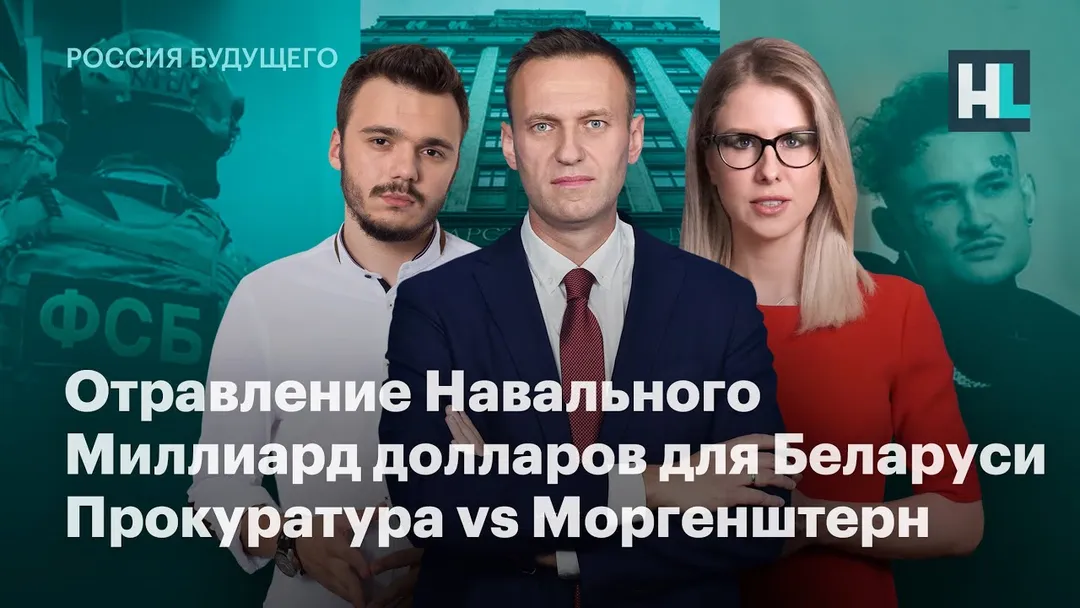
Navalny’s poisoning, a billion dollars for Belarus, prosecutors target Morgenshtern
[music]
Hello, dear YouTube viewers.
This is the Navalny Live channel.
Today is Thursday, 2020, which means that
we’re live with the program *Russia of the Future* today.
This is the last broadcast of this difficult, ending
year, 2020. I’m Lyubov Sobol, and we
will, as usual, discuss the main
political and social news
from the past week.
A little later, joining me live
via video link will be Alexei Navalny, and with him
we will, of course, discuss the news regarding
his poisoning, his conversation with
Kudryavtsev, the Kremlin’s reaction, and more.
That will be a bit later, but for now I
of course, as always at the start of our broadcast,
would like to urge you to subscribe to
our YouTube channel, everyone who hasn’t yet
done so, who watches our live streams
and our videos, and to become a sponsor
of our YouTube channel. You can do that
by following the link that
has just appeared on your screens, right
here, right here, where it has appeared
on the screen. You can also make donations
during the live broadcast with your own unique
message, make contributions—for that
you can go to the description below this broadcast,
follow the link, and make some
small donation, which of course
will go toward supporting our
channel, because as I have said many times,
we exist, we work,
we produce videos, do live broadcasts,
and reports from the field
only thanks to your support. We
can tell the truth, so if
you want to make a donation and
see some unique
message, a unique caption
shown on screen to other viewers
of our broadcast, then again, go to
the description, follow the link, and
become sponsors and donors
of our YouTube channel. Also, in our
last broadcast, we discussed with Ivan
Zhdanov that we are continuing to raise
funds to pay the claims
filed by Moscow City Hall structures and the Moscow
prosecutor’s office, which brought against
us—independent candidates for the Moscow
City Duma—after the protest summer
of 2019. It’s a long story now; these
lawsuits are still dragging on. Some of them
have already come into force, these rulings
are absolutely absurd and unjust, some
have not yet, but there is a very real prospect
of the accounts of Lyubov Sobol, Oleg Stepanov, Vladimir Milov, Alexei Minyaylo, and others being frozen
and of other people who fought for
the right of voters to see their representatives
in seats in the Moscow City Duma.
This absurdity is still continuing now,
so right now on your screens, right
here, right here, you can see the card number for
collecting donations. Many thanks to everyone
who has already made donations since the launch
of this account and card number. In the last
broadcast, Ivan Zhdanov and I announced it.
I have seen that you are helping very actively
the independent candidates for deputy seats
in the Moscow City Duma fight off all
these illegal, absurd claims. You
are sending money, but these are fairly
large penalties and sanctions,
so please keep doing it. Thank you
very much to everyone who supports us. Truly,
we can work only
thanks to you. And of course, the main topic
with which I will begin today’s broadcast is
the main topic—not just of the week,
but probably of the year: Navalny’s poisoning.
And this week, on Monday, there appeared
a new video: Navalny’s phone call to one of the
poisoners, Kudryavtsev, from the FSB’s Criminalistics Institute
During that conversation, Kudryavtsev
said that
he described the details of the poisoning itself—he
did describe them, yes—and he said how he
cleaned Navalny’s underwear, especially the fly area,
where the poisonous substance had been applied, and
in connection with this, many people now may
not yet have seen this investigation.
Be sure to watch this conversation and this
phone call—definitely watch it. It already has
more than 18 million
views.
Keep telling people about what happened—
your friends, your colleagues, those who may
not know, those who may be watching Russian
television and think that this really
was some kind of pancreatitis, diabetes, or
I don’t know, a drop in blood sugar. So
show this video to all your acquaintances and
friends, send it around—I don’t know—on WhatsApp,
so that people know the truth about what is happening.
Because during this phone call, one of the
people who took part in this
special operation to kill Navalny, in this
attempted murder of Navalny, he
really did simply, candidly
confess to everything. And the main thing, of course, from
this video is that Navalny
was, first of all, the target of an attempt to kill him;
this was not intimidation, not surveillance,
it was specifically an attempted murder.
From this video, that becomes
completely clear and understandable, and also that
the killing failed only thanks to
the quick reaction and work of the pilots,
the professionalism of the ambulance doctors, and the quick
reaction of the airplane crew, who
landed the plane in Omsk
when it was flying from Tomsk to Moscow. It
also becomes clear—yes, we had
these assumptions before—but now
it is simply confirmed by one
of the poisoners: they wanted to kill him, and only
because of the ambulance's quick response
and the very rapid emergency landing of the plane, the
murder attempt failed, and
Navalny managed to survive. On Monday
also on Monday, when the video was released on
the YouTube channel, and Navalny immediately had
that conversation with Kudryavtsev, I tried
to get a comment from Kudryavtsev, because
he lives in Moscow, on Suzdalskaya Street
building 38, block 2, entrance 2, apartment 38, on
the fourth floor. It was enough simply
to establish his home address and
I went there and tried, but
literally, as a journalist, to
get a comment. I wanted to ask him
what his motives were for taking part in
the crime of attempting to kill a person, who
gave the direct order, and
other questions as well. Kudryavtsev did not
want to speak with me. I have no doubt whatsoever
that at that moment he was inside
that apartment and was simply trembling with fear,
afraid even to open the door when the doorbell rang.
I could hear how
the people on the other side of the door
carefully crept up to the peephole.
I could see the light being blocked, I could hear rustling, I
was asking questions, trying
to make some kind of contact, but simply no one
answered, they did not even ask who was there,
nothing at all, just silence.
Silence, and someone on the other side of the door,
I assume it was
Kudryavtsev himself, standing there and
just shaking nervously and trembling with
fear because he had been exposed. The whole
country, indeed the whole world, knows that he
took part in the attempted murder of Navalny.
Everyone knows where he lives, everyone can
go there—journalists can come and ask him questions
directly. When I was going there, I thought that people
who committed crimes
naturally assumed that no one would
ever find out that they had participated,
that they were carrying out this unlawful
order to kill a person. I do not think
they expected they would ever be found, and here they were not only
found, but people even came to him
to ask him questions. And I came to him
before the investigation was published, and
when I was trying there to ask him questions,
yes, and afterward I was near the entrance, near
that building. I was sitting in a car because
there was a chance that they were about to
publish the excerpt from that video
of the phone call, and he might simply run out of
the house to flee, yes, because
that was it—everything had been exposed, everything that
possibly could be exposed, all of it had come out, everyone knew
everything he had blurted out, and now the whole world knew it.
And I was waiting in the car nearby, in the courtyard,
simply waiting for Kudryavtsev. I was not committing any
unlawful acts, of course,
I was just sitting in a rented car-sharing vehicle,
in a rented car, and then, after
10 minutes had passed since our video was released,
there really began some kind of
large-scale special operation to protect
Kudryavtsev. A car arrived
with police officers in it. They
immediately came up to my car, then they
went off, and then a second
car arrived, then a third—several cars came altogether.
Some of them were police cars,
some were civilian vehicles; there was a black
Toyota Camry
and inside it there were also officers,
some in uniform, some in plain clothes. Then
literally the entire courtyard was flooded
with police officers—they brought in
all sorts of people. The whole courtyard was effectively cordoned off,
literally. And right away, just 10
minutes after the investigation was released,
when the first police units arrived,
the first thing they did, of course, was go into
the entrance and start clearing out the entire stairwell
of the people who were there—
teenagers, and I do not know, whoever else,
whoever normally happens to be in an apartment entrance—someone
who came to visit someone, standing on
the stair landing talking, someone standing there
smoking in the entrance, or anyone else—they
drove everyone away immediately, simply so that no one
could get near apartment 38 at
38 Suzdalskaya Street, block 2.
And that is probably the best evidence that
this really does involve the FSB (Russia's Federal Security Service). Right now
we will talk about it a bit later, because they
say that it is fake,
that it was all made up, that it is a forgery. On Solovyov's
YouTube channel they say that
none of this is real, that it is some kind of fabrication, yes—
that the conversation never really happened at all.
In fact, the best proof that
the conversation was genuine is this very reaction—
this crazy, panicked reaction
from the police after we released our
investigation. They immediately
arrived, that is, and began protecting
the entrance, and flooded the whole area
with police officers.
When they later detained me, I think many people
saw the moment of my detention on
social media. It was absolutely unlawful,
because, as I said,
I had committed no unlawful acts whatsoever.
Later, they detained the people who
were in the same car with me—employees of
our YouTube channel, Navalny LIVE,
Olga Klyuchnikova and Timur Kerimov, who
were also simply sitting in the car at that
moment and likewise were not doing anything,
let alone obstructing police officers.
We were just sitting and waiting, and very much wanted
to speak with Kudryavtsev, to ask him
questions, in the capacity of, so to speak, quasi-
journalists. And then I was taken to
the police station.
And then again, when they tell us
that this is supposedly a fake after all, I mean,
or that this point is all untrue,
that the place in question does not exist at all,
that someone was there by accident, or just
that the chemist was not connected to it, and so on, it is very
important to show what the reaction to all this actually was,
that in reality it was not just some kind of fortress-style lockdown,
they declared some kind of
counterterrorist operation there, as if
a threat was hanging over the Novokosino district police department
they brought in a whole bunch of generals, they brought in
officers from the Moscow criminal investigation unit,
the famous MUR (Moscow Criminal Investigation Department), who
were trying to question me about something there,
they placed some kind of listening device nearby
and set it down there.
There was some kind of commotion going on there,
while I was just sitting in an office, bored,
with police officers who were constantly
being rotated in and out, sitting there to make sure I did not,
God forbid, call anyone, including my
lawyer. At that moment, my lawyer was simply
not allowed even onto the floor, and in the
next room—when I went out to the bathroom—I
saw that nearby there were just sitting
an enormous number of people, along with
those generals and all those stern-faced
officers and others, all frantically
trying to decide what on earth to do,
because how dare she come to
Kudryavtsev.
It was all quite clear, well, on the one hand,
it really was absurdly funny, of course,
because there I was, sitting alone, that is,
with, in my entire arsenal, only
a mobile phone, with which I could
film something or ask a few questions,
yes, and, I do not know, a bag with some
personal belongings, maybe a pen,
a passport, a tissue, something like that,
and around me there was just this
huge crowd of practically every possible
rank of official, and I have no idea
what exactly they were doing at that moment,
apparently trying to decide what to do, what
to do, like, how could this happen, what could they
possibly charge me with.
As for the criminal case, indeed,
that night at the police department, completely unlawfully,
they started questioning me—although
people are not supposed to be questioned at that hour—based on this
complaint that had allegedly been filed against me later,
claiming that I had supposedly entered
an apartment and done something illegal there.
Honestly, I do not know. Right now I will
ask the journalists whether a criminal case has been opened against
me or not, because I
to be honest,
have absolutely no idea, because when I
tried to clarify some things, like who
had filed the complaint against me, they
said that Kudryavtsev had filed a complaint against me, but on
what grounds exactly?
Because specifically, they said it was a
crime report.
But on such basic, specific questions
they told me nothing, and in the end they gave me
only a paper with my interview record to
sign, stating that I had been questioned, and there
the form itself was completely blank—right now
it is on your screen.
You can see that it does not say there
on whose complaint
my nighttime questioning was conducted. That is,
they should first write down for you that
there is a complaint from such-and-such a person regarding
such-and-such circumstances of the case, that
there are some indications of
some kind of offense. None of that
is there. It is simply obvious from the document itself that
it is a mess.
That is why I wrote, first of all,
that, of course, under the Constitution,
I always recommend that if
you somehow—I hope you never do—
encounter, but if you do encounter
law enforcement agencies,
then of course you should never trust them, and when
they try to talk to you and
say, “Just tell us about the weather, what kind of education you have,”
or ask you to explain something without a formal record,
saying, “This is not an interrogation,” and without
any protocol, “we are just having a chat,”
always respond with
the well-known phrase: “I invoke Article 51
of the Constitution of the Russian Federation.”
Because all these tricks,
all these manipulations, they will always
use them against you. I have no
doubt about that whatsoever, and you should not
trust anyone there,
none of those police officers.
You simply need to say, “I will exercise
my right under Article 51 of the Constitution
of the Russian Federation. I have that
right, and I am using it.” There is nothing
they could achieve, and by around two in the morning
after keeping me there for a very long time,
for many hours at the police department, they finally let me go.
At the very end, though, when I was already
signing that paper, they invited in
the lawyers who had been there all that time,
waiting in the Interior Ministry building, just downstairs on the first floor,
where they too had been unlawfully denied access.
Illegally, they kept trying
to get me talking, to find out
some details about what else I knew
about Kudryavtsev, whether I knew
or did not know any additional
details, but they of course
did not manage to get anything out of me.
There was simply nothing for them to do but release me.
I had been sitting in the car at the moment of the detention, and
they let me go, but they decided to take revenge and
still bring administrative charges
against my colleagues who
work for the Navalny LIVE channel.
My team is working, including at the campaign headquarters.
headquarters.
After all the commotion, they fined me, and the next
day I was unlawfully convicted and held at the
Interior Ministry police station all night. They would not take into account the fact that
I have a young child, and that I
was supposed to have been released within three hours
from the moment of my detention. Instead, they held me
much longer.
The others were actually kept overnight as well. They were
denied water, not given hot food,
and lawyers were only let in with great difficulty.
This is simply lawlessness from within the system.
We had to demand that our lawyer be allowed in, and
after the hearing, Olga
Klyuchnikova received a fine. Her post on social media is now
on your screens.
She was the head of the campaign headquarters for the
State Duma election.
And my colleague from Navalny LIVE
got seven days of arrest for absolutely nothing,
for no reason at all—just because she was sitting in
a car next to me, that was all.
At the building, in the courtyard of poisoner Kudryavtsev,
and also Akim Kerimov, the cameraman for our
Navalny LIVE team, also received seven
days. They are now serving them in
Special Detention Center No. 2.
If any of you live nearby,
bring a letter, pass along
a postcard or something else,
or a small care package—anyone who wants to can pass something along.
The guys are holding up well.
They called from the detention center and sent everyone
their best regards, thanking everyone for the support, and said that when they
get out, they will work even harder. I,
of course, in no way think that this
illegal detention and administrative
case frightened them.
People, of course, do not like seeing this kind of
outrage happening. That is why, after
the release of that video with Navalny’s call to
Kudryavtsev, people began
coming out for one-person pickets. They went to
Lubyanka, to the FSB building (Russia’s security service headquarters).
Director Vitaly Mansky came out not with
a placard, but literally with blue underwear—
probably one of the
main symbols, unfortunately, of 2020.
These notorious
blue underpants have already inspired a huge number of
viral images, and in general, around
these blue underpants—I saw how underwear stores were already
starting to hold
sales of blue underpants and all sorts of other things.
So Vitaly Mansky decided
to express his protest in this way against
the refusal to open a criminal case over
Navalny.
Apparently, he came out with those blue underpants and, as you know, the FSB
detained him simply because he
was standing near the FSB building
holding that item in his hands.
It was a fairly harmless object, yet he
was detained—again, absolutely unlawfully.
He did not even have a placard in his hands.
Later he was released under an obligation to appear.
Pickets also
took place in Omsk, Yekaterinburg,
Irkutsk, and Kaluga, and now people with underpants in the street
are being detained, as are people who are sitting
in an apartment, near a building, in a car—
in a car and outside the home of poisoner Kudryavtsev—
they are being detained and given arrests of seven
days.
whether one of the perpetrators poisoned him or not. I want
to bring him on now, and we will discuss
this news further, now directly
with Alexei Navalny, who is now
joining us live.
Let’s bring him in after a short
clip from the video of his call to
Kudryavtsev. Once again, I have information that
this was done on August 25.
And the second time—All right, tell me,
please, which item of clothing was
the main focus, which item of clothing was emphasized
as the most, most risky in theory?
Which item of clothing? Underpants.
And on what part of the underpants? The inner
seam, the outer seam? Well, imagine
a pair of underpants.
Yes, and, well, here are the underpants—on which part
is the most vulnerable area of the underpants?
[music]
Konstantin Borisovich,
Everyone is stunned. Hello, Alexei, thank you
very much for joining us—joining my live
broadcast on the Navalny LIVE channel. I wanted
to ask the first question: what is it like,
probably, to call the person you suspect
of poisoning you? Yes, good evening, everyone.
Hello, this is Alexei Navalny—or Maksim
Sergeyevich Ustinov, as the joke now goes,
apparently.
That joke will apparently follow me for a long time. I am very
glad to be on air again, and once again I want
to say that you did an amazing job.
Your, so to speak, heroic struggle with
Apartment No. 38 was, of course,
extremely important at that moment, and
in general, this whole development of events perfectly
confirmed that we are right. Because
it simply does not happen that you just ring
a stranger’s doorbell and then
all the police generals come rushing in, along with
arrests for
seven days, and OMON riot police arrive—and then everyone
understood perfectly well. Because otherwise
the person would simply have come out and said:
‘I am Kudryavtsev, listen
to my voice, and I am absolutely not the person
you think I am,’ and
that would have been it—I would have been left looking ridiculous. But
that did not happen, so everyone understands
that we are right. Everyone kept asking me, and when
I called—not only Kudryavtsev, after all,
but, in fact, others in this group of killers as well.
Kudryavtsev plays that kind of role,
like a cleaner—he comes in to clean things up.
There were two operations; he is undoubtedly one of the killers.
He is undoubtedly a member of that criminal group.
Well, there were these guys who were,
really, truly killers. I called them too, and
so we put together this kind of,
group, and everyone was looking at me with wide
eyes. Some of them I called as myself,
some I called as myself, when I said,
something like, “Hello, this is so-and-so,
Alexei Navalny is calling, I want
to find out why you wanted to kill me,” well, I mean,
obviously, all these conversations
lasted about 15 seconds, and then
people immediately hung up. But everyone
apparently was interested in reading something on my
face, to see whether there were any special emotions there.
But honestly, I wouldn’t say that I
felt any at all. The whole thing—well, somehow I
basically slept through all of it, all that
discussion. For me, those events were
on the plane, and then I blacked out, and then
I only fully came to my senses a month later.
And I can’t really say that all of this
is something I’m deeply reliving, and you know, when I talk to some
Alexandrov or Osipov or
whoever, or Kudryavtsev, I don’t feel
like I’m talking to a killer. Probably if
I were looking at a gun pointed
at my face, then I’d have that feeling. But as it is,
no. Well, maybe it will come
someday, I don’t know. So far it hasn’t.
Kira Yarmysh (Navalny’s spokeswoman), I think, said that
someone even recognized your voice—recognized it, but
I’m not going to say who, and I’m not going to say where.
I’ll say this: last time I was on air, and
by the way,
a technical announcement: Lyuba keeps forgetting
to mention the donation links that
are scrolling along the bottom of the screen. At this rate,
she’s going to bankrupt us, so please,
during the broadcast, use the links below to send donations
that are running across the bottom of the screen. So anyway,
yes, last time I really was on air,
and I was bursting, of course, just
because we were listening to Putin, and I
knew we had recorded Kudryavtsev, because
we recorded him that very same day, and
attentive viewers probably remember
that I was saying to Katya (likely the host) that
all we needed to prove now
was something that would refute Putin’s words
that “if they had wanted to kill him, they would have killed him,” and
even Grozev (likely Christo Grozev, investigative journalist) couldn’t hold back and in one of
his interviews or somewhere said that there was just one
thing left for us to prove, because
even before the first investigation came out, we
already had Kudryavtsev, and when he was telling us all this,
we were sitting there, of course, with
our jaws hanging open, because something like that
no one had dared hope for. And then for the whole week,
basically, we had to keep restraining
ourselves, because of course we wanted
to hit him right away with this—
with Kudryavtsev—but we waited. We waited for
Putin to lie and say something
that would make it convenient to answer him, and that was
just a huge gift for us, because
he went ahead and lied—lied precisely on
that very subject, saying, “Well, if they had wanted
to kill him, they would have killed him.” And we knew—we were only
debating whether to release it right away on Friday
or put it out on Monday—what
Kudryavtsev had told us. I’m not going to
go into details. We called
several people; with some of them
the conversations were short, with others
they were longer. Someone recognized me, but
I won’t give details, because this
story is clearly going to continue, and the Kremlin
has already gotten tangled up in its own lies—we can see that
perfectly well. Yes, they realized they had
trapped themselves in their own lies, because now
notice this—they’ve stopped lying
altogether. They’re not saying anything at all.
Only some minor lapdogs are talking, like
Vladimir Solovyov.
But the big, major liars are
staying away from this topic entirely, because
Channel One is posting recipes
for New Year’s salads.
Well yes, yes, yes, absolutely right, absolutely.
That’s right, all of them—I mean, as I said in the video,
we’ve backed them into a corner.
They don’t understand what else we have, they
don’t understand how to refute it, and
it’s impossible—impossible to refute all of it.
But just in case, for now I’ll
refrain from telling stories like that, including
because, of course, we saw an
interesting thing. I wanted to draw
our YouTube viewers’ attention to this: how
the FSB guys, on the one hand, are this kind of
political police working for
Putin—that’s their purpose, and right now
the whole point of their work is that
they help Putin stay in power—but
at the same time, of course, they set him up in a huge
way. Because we started making the calls
at 7 a.m. Moscow time,
and obviously the first
person who heard me say, “This is Navalny,”
“why did you want to kill me?”—well, he obviously
must have called some superior of his,
and in any case, after that
at seven in the morning,
when they burst into the apartment in Tomsk (the Siberian city where Navalny was poisoned), they
had to understand that something was happening,
something terrible. Then we publish
the video, and obviously, of course, the FSB guys
had listened to all the conversations I
had on that phone, and they knew
exactly
what I had talked about with Kudryavtsev, and they
knew for certain that Kudryavtsev hadn’t spilled everything,
but they didn’t tell Putin that. Why not?
Because they were protecting themselves.
And it’s funny how this works in that sense.
Our security services—I don’t know who exactly misled him,
Bortnikov himself, I think it was Bortnikov,
because they wanted to cover up their failure.
And they’re still trying to hide it, because
they’re spinning fairy tales saying that this is
completely fabricated, that the phone call was fake,
and all that sort of thing, because of course this is
a colossal humiliation for that entire structure,
which is forever puffing itself up,
constantly talking about its supposedly super-
professionalism, about how they catch
terrorists, while at the same time their most
secret unit—well, obviously,
a group of killers operating inside the FSB—and that very
secret
well, in general, supposedly some kind of
super-trained, ultra-mega
professional team—turned out, as I see it,
to be very professional indeed, right? Just think about it:
why did our conversation with Kudryavtsev
work out? Was he really the dumbest of them all?
People often ask on social media:
could they really be so stupid that they
tried to kill a man and didn’t recognize
his voice?
We had actually made a ranking, in our view,
of the dumbest guys, and he
turned out not to be it—the guys we had pegged as the dumbest,
the ones we had classified as extra-
stupid, were not actually all that
stupid. But possibly because of that
dramatic nonsense like, ‘Hello, this is Alexei
Navalny,’
‘what did you want to talk about?’ and so on,
we missed a lot of interesting information,
because I’m
sure that if I hadn’t used that
ridiculous story about Maksim Sergeyevich,
and had called everyone as Patrushev’s assistant,
then not only Kudryavtsev would have spoken
with me—not just Kudryavtsev would have talked to me,
because, first of all, we
really did know this whole thing very well,
I had known for seven months, in fact, in this
investigation we had been working on it, so
I was ready to have a detailed
conversation with them—where they went, what they did, everything.
By the way, Kudryavtsev himself least of all, because his
role was less clear. But probably if I
hadn’t said, ‘This is Alexei Navalny,’
then I would have had much better
results from the calls. Honestly speaking,
of course we didn’t expect such a
crazy thing to happen. We thought that
at most we’d manage to confirm that it was
Kudryavtsev, or at least that he knew
some names—well, at least something,
some minimal indirect
confirmation that on this phone
number there was a person with that
surname. That was the most we were hoping for.
And when we were sitting there,
at the place—actually, from 5 a.m.,
we started calling at 4 a.m.—we
had gathered there, all barely alive,
and I was sitting there in this kind of
improvised штаб (operations room) that we
had set up, saying, ‘Damn, we came here
at 4 in the morning, and it’s already obvious that
in 20 minutes it’ll all be over, because
no one is going to talk to me, CNN won’t
even be able to get into the building entrance, and everywhere
it’ll be a failure, nothing will work anywhere.’
But CNN did get in, first of all, and second,
I start making calls, and bang—Kudryavtsev, and he
at first was like, ‘What? Who is this?’
and then he started talking. And there’s a
very simple explanation for that: they’re
used to total impunity. Just look
at what’s happening now: yes, they
failed spectacularly, they chatted about super-
secret information right over the phone, and
did anything happen? Did the FSB director resign?
No. Were they sent to prison? No.
Absolutely nothing happens, and in
this situation, when they exist
completely outside the law, and any failures
that happen in the service do not lead
to any consequences for them, they
go on like this for years. And of course this leads
to degradation. Young people who
come into the FSB—and I know this from them
themselves—they say, ‘Damn, why should we
work? The bosses steal and provide cover for
someone or other here,
the working conditions are terrible, the pay is low,
everyone is constantly trying to undermine each other,
there are endless mutual inspections, it’s uninteresting,
bad work, and so in reality you can’t
build a normal career there
if you don’t have connections or
aren’t involved in some major
corruption scheme.’ The system, of course,
has degraded very, very badly, and they
are absolutely unpunished. So they traveled
sometimes on their own passports,
sometimes on other people’s passports, and while
carrying out a secret mission, killing people,
they just switch on their phones in order
to check something, to receive
text messages and so on, and that’s why on the phone
they chatter away—because at night,
what’s going to happen to you? Nothing.
So they talk. You mentioned that the FSB
said your conversation was fake.
We can probably show it on screen.
What exactly did the FSB say about your
video of the conversation with Kudryavtsev?
‘The video posted by Navalny on the internet,
the so-called investigation into actions allegedly
taken against him,
appears to be a pre-planned
provocation, and the video clip with the telephone
conversation is a fake.
The use of caller ID spoofing
is a well-known technique of foreign
intelligence services, previously tested many times in’
these Russian stocks—well, Kudryavtsev's
usually, a chemist doesn't cooperate with
Facebook, or whatever they have there, or he does
What do you think of this statement in general? It
is written in such a way that it says there
that it's all untrue, but everything about Berg is there, but
it also doesn't say what exactly they are denying, and
and of course this statement is not for us, it's
a statement for Putin, because experience
Putin
Putin was whipped with those blue underpants
Kudryavtsev whipped Putin with those blue
underpants
the whole phone conversation, because
Putin said at the press conference, well,
something like: if FSB officers (Russia's Federal Security Service) had wanted to
kill him, they would have killed him. And the FSB guys knew for several
days—they had known since Monday morning that
there was such a conversation, and they didn't tell their adored
national leader about it
so you can imagine what
was going on on Monday—there was screaming
all around, people shouting, what the hell is this, or something like that
damn it, you had this phone conversation
and we were right
and you didn't say anything about it, so
they're just saying: it's fake, it's
a fake—well, they came to Putin and said
they used, like, 'Vladimir Vladimirovich, this
wasn't us, we're not these awful, useless
good-for-nothings, it's all the Americans, it's all
fake, it's all nonsense'
Of course, it's not Navalny—it's the CIA behind him
because they simply cannot believe
that they can be deceived
with the help of a device costing $10
or rather, well, they can't even
grasp it—they know it, it's not that they simply don't
want everyone else to understand it
so that's why they go to Putin
and say it's all fake, but they
understand that if the conversation goes further
with follow-up questions
like, what's fake exactly, guys? Is Kudryavtsev not
real? Point us to the real
Kudryavtsev. Or maybe we'll show
you Kudryavtsev ourselves. Is the voice not real? We have
a phonoscopic expert analysis. Why don't you just
simply charge Navalny with
a criminal offense if this is
really a fake thing, slander against the FSB
What's not real here? That the call never happened?
The call exists, it's all real, but they
simply, of course,
their bosses, and that group
that is responsible for all these killings—they
are under enormous pressure, not just
from the Kremlin's political
leadership, but also from all the
other FSB people who
good Lord, there are thousands of people working there, and
not all of them are involved in
killings, and for the overwhelming majority
of employees, the existence of such a group
that kills people is a huge and, again,
quite likely unpleasant revelation, and they
are also saying: what the hell is going on here
in our service at all? And of course it's not just
about covering their own backsides and nothing more
Alexei, what about Peskov's words that
you have a persecution complex, a mania of
being persecuted? It's interesting that I actually
have never had any such mania
of persecution, unlike many people
I've never been particularly obsessed with this topic
like, they're following me, they're following me
someone's tailing me, surveillance is on me—I
could just see it, but I never would have thought in my life
that for four years I was being followed, being followed
by some people. We even made a bet with a friend
that I wouldn't laugh when he walked, when
he walked behind me in those yellow shorts
I laughed, I lost. By the way, at the
very beginning of the broadcast, Lyubov was raising
money to pay Georgy's fine—his
computers and everything else keep getting confiscated
constantly, precisely because of fines for
those protests from last year, so if
you take part in the fundraiser in any way
that would be wonderful. As for
the card number, it will be on the screen
It would be great if you helped make it possible
for Georgy to move around
our country with a computer and a phone
because otherwise they just take everything away
Commenting on Peskov is pointless
Well, he's simply in the
position of a person who cannot
remain completely silent because there are
literally journalists standing next to him, and he
holds briefings, so he has to
answer. But this is the kind of answer he gives
'I haven't seen this thing, but...'
'Navalny's fixation on underpants'
shows this and that—well, of course
he watched it, of course. They feel that once again
Kudryavtsev whipped them with his blue
underpants. Actually, not even Kudryavtsev, but
Bortnikov—this whole killer group
of course, through their stupidity and by
hiding this phone call, they
spectacularly humiliated the Kremlin
and now they're simply trying
to put a brave face on a bad situation
And really, it's astonishing how
they got themselves into this and then
ended up contradicting their own words, because
at Putin's press conference, Peskov
said that Navalny was being watched
and now he's talking about a persecution complex
He's contradicting himself. Let's look
at
for our viewers, a short excerpt from
Peskov's comments to journalists
The patient of the Berlin clinic
is receiving support from the special services while carrying out
in this case—and if, if that is
correct, well then that is interesting
Then, of course, the special services should be keeping an eye on him.
Watching him on the president’s orders—for some reason.
Why keep an eye on him?
Well, both Putin and Peskov were saying that
look into it, and then they say that
Navalny has a persecution complex.
It’s funny, isn’t it, how the Kremlin’s
experts of lower rank, and those a bit higher up,
stay silent, while the lower-tier ones start
rushing to justify Putin and his FSB, and I
wanted to show a video on our broadcast of how
Sergei Karnaukhov, an expert on
Solovyov’s channel (host Vladimir Solovyov), God forgive me, said that
all of this was done with a push, not
through development—it’s quite funny to watch him
build this up out of nothing. We’ll show it, of course.
There is a very simple explanation here
that closely correlates with
what happened now with this phone call
to the forensic specialist, the military chemist,
the FSB officer whom we will be
talking about today.
What happened was this: in order to
create a fake, from the standpoint of modern
technology, you absolutely need to have
a basic foundation in the form of facial footage, speech dynamics,
and the acoustic environment—this is
a special term—in the form of
voice samples, and not just samples
of the voice, but also intonation, the dependence
of intonation on specific phrases,
dialogue structures, and so on. In other words,
there are a great many particular features. All of this
is impossible without collecting samples. In
the process of collecting samples,
short interviews are used—that is,
it is enough to call or force your way into
the apartment of some person whom we
want to interview and
record—at least make a high-quality recording of—
at least his refusal to give an interview and
a couple or three phrases. That is
enough to feed all the information obtained
into very powerful
computers that are used only
at professional film studios. They
cost a great deal of money, and there, within the framework of
special technologies—technologies
that use neural networks—
self-learning neural networks,
work is carried out with this
digital material, from which later
one can create any
speech, any dialogue, and build any
verbal constructions. And what is very important is
that any subsequent analysis, if it
is not very in-depth, will not allow one
to distinguish the original from the fake.
So, what do you think, Alexei, very serious stuff,
quite a turn of phrase—very serious
computers, yes, and at film studios too. But
of course, it would be good if
some people of higher rank spoke out, because
Solovyov and Solovyov’s experts are
still, well, in the hierarchy of Kremlin
propagandists, basically gutter-level
vagrants. But note that even
these gutter-level vagrants—and those below them—do not deny
the basic premise itself. They do not deny that
there is an FSB officer, Kudryavtsev, a chemist. I
am not denying that they were following me. This is
actually a great stroke of luck, once again
thanks to the fact that the FSB so badly deceived and
set up Putin.
He blurted out a lot at the press conference, in
particular he slipped up—he confirmed that
FSB officers had been traveling around, keeping watch.
And when he said that, we already had in hand
the conversation with Kudryavtsev. We simply
uploaded it, and all of us here were simply
celebrating, because they had pretty much
buried themselves. It was
a super important moment, and now they have to
within the framework of inventing some kind of
new wounded narrative of lies, they
have to rely on certain things
that Putin has already said, that they supposedly obtained in
the collection: they were following him, watching him.
They can’t just erase Kudryavtsev now.
So that is why they are inventing some kind of
supercomputers and other things, because, well,
Bortnikov’s cowardice in not
admitting it, in not telling Putin about the conversation with
Kudryavtsev, and
Putin’s earlier statements
at the press conference left them very little
room to maneuver in constructing
their lies. But I think it will be
very interesting for us to watch how
they twist and squirm. But for that,
it is of course very important to continue
spreading it. The first video already has
20 million—well, 18 or 20 million already—but we need more, because they
are hoping for one thing:
let’s honestly admit it, we understand
they are waiting for the New Year, because no
news story really carries over through the New Year—
as if once New Year’s passes, everyone will
forget. It is extremely important not to—extremely
important not to forget, to continue
spreading it, to keep telling
friends and acquaintances about it. Everyone who has watched it
should keep discussing it, keep entering into
debate,
arguing the point, and so on. Then we will force
the Kremlin to talk about it. As I understand it,
their strategy right now is to claim
that everything is fake, that Western
intelligence services are behind it, that this is an escalation of
anti-Russian activity, and that of course
the West is to blame for everything. What we are seeing
right now is them constantly being dragged around by the tail,
the correspondence with the OPCW (Organisation for the Prohibition of Chemical Weapons): they say, yes, but
you didn’t answer us about something, and then you gave us
some kind of conclusion from the OPCW that wasn’t
the right conclusion—give us another one. And
let an OPCW delegation come, and then—well, no, we haven’t
agreed, and under the law they’ll come—but...
Let's add one more thing—here it all is.
Again, some kind of meaningless
long back-and-forth correspondence—just drop all of that.
because at the same time it undermines
trust in what you are saying, and in what
the laboratories are saying, and in the report released by
before your report, I would like to ask you about
the journal *The Lancet* and that article which
has just come out. We have published two posts on our blog
on this topic—that the world's leading
medical journal
is *The Lancet*, and then the article came out in which
doctors from the Charité clinic published
material about your poisoning, and
the article is titled "Poisoning with the nerve
agent Novichok, not an unexplained
metabolic disorder that somehow occurred,"
but specifically poisoning with the nerve agent
Novichok." What
Alexei, in your view, is the most important thing in
this article? The most important thing is that it was published at all,
really, because Putin
constantly
and the Russian Prosecutor's Office constantly
keep saying—not so much this nonsense about how
we supposedly haven't been given documents—that there is no
medical information on Navalny, which
is of course a complete lie. They have my entire
medical history and samples of my
blood from Omsk.
But as you quite rightly said, their
task is simply to throw out a million different versions
and just say out loud all sorts of
nonsense. They keep saying it even
now, even though all the main medical
information has not merely been handed over
in an envelope to the prosecutor's office in black and white—it has
simply been published in the world's leading
scientific journal, and medical journal at that. Well,
there are several important things there.
First, they state directly that the symptoms
of poisoning by these organophosphates
have been described since the 1950s, because
this is essentially poisoning that, across the whole
world, kills many people every year from
them, especially in Asia.
Poisoning by fertilizers is also a kind of
organophosphate poisoning, and therefore
the symptoms are known to absolutely everyone
in the field. So they state quite plainly that the doctors in Omsk could not
have failed to see that this was
poisoning.
Second, they describe everything in detail. And there is one more thing
which, you know, does not really
concern me directly, but it
struck me more than anything else in this article.
And not only me, by the way—I saw that
Russian doctors discussing
the article—and I wrote about it on my blog—
while the general public did not really pay attention to it,
Russian doctors did notice it.
And this is not about me; it is simply about the state of
Russian healthcare. So, when
I was lying in the hospital, around my room there were
some kind of extreme
medical safety measures. They were definitely
constantly changing gowns, and at first I
was not fully aware and could not understand what
was happening. When I started thinking clearly again
and asked, "What's going on?"—I mean,
it was obvious that by then I was no longer
poisonous or radioactive, so why was everyone
keeping away from me? And they told me,
"Because you had on you
from the Omsk hospital—you were simply covered
and teeming with bacteria that were highly resistant to
antibiotics, and here everyone
is terribly afraid that these bacteria
will spread throughout the entire hospital.
And this is a terrible thing, because in fact
a huge number of people can
die from these bacteria during
the course of treatment for their underlying illness.
And there were a lot of jokes there about
these "Siberian bacteria" and all the rest.
And in this article in *The Lancet*
it is also stated that at some stage they
had to fight this imported
flora that was teeming on me no less
than the consequences of Novichok itself.
And I read this and thought—and I read
the doctors' comments too—they were also drawing attention
to this, saying, "Yes, yes, this is
a hugely important problem for us.
This is why life expectancy is what it is here,
this is why people die.
Because they bring you to a Russian hospital,
they hook you up to this
machine, and through the machine you
end up getting these resistant
bacteria that cannot be treated with antibiotics.
These are so-called hospital-acquired bacteria; this is
a fairly
well-known phenomenon from which
tens of thousands of people die every year.
And of course this shows the monstrous,
truly monstrous state of Russian
healthcare, and that is what I wrote about
on my blog today. Sorry to those who have already
read it, but I will repeat it: the chief physician,
Murakhovsky, the chief physician of that emergency
care hospital—under him
the intensive care unit was in such a state that it
was teeming with terrible bacteria from which
patients can die—and now he has been
promoted and made Minister
of Health for the entire region.
Just imagine what he will do to the whole
healthcare system—it is, really,
monstrous. Well, that seemed to me
such an important point, although it does not have
a direct relation to me. But as for
me, the most important thing is that in the medical
discussion, a definitive full stop has been put.
Before, all normal, honest doctors understood everything,
understood it,
but nevertheless there were still these figures,
these people—this Dr. Tyoplykh, for example...
go to his Facebook and read it
he even has the nerve to link to
this journal and say, by the way, look,
you were mentioned there too, and so I’m
rejoicing. Look, *The Lancet* says
that at the Omsk hospital he was properly
treated right away — no big deal.
But that’s not the main issue. The main issue
is that you lied about the diagnosis.
You lied to everyone’s face, looked everyone in the eye and lied back then, and
you were also writing posts and insisting — you
knew you were lying, and you lied brazenly, and
now this journal says that all
those who kept talking about metabolic
disorders, some kind of diabetes, whatever else there was,
pancreatitis and everything else — they’re simply
liars, because any person with
medical training could not have failed to see
the symptoms of poisoning. That’s all. And by the way,
it specifically mentions there that one
of the reasons I survived and was in such good
physical condition — which is also a big
hello to everyone who was saying that I
was somehow, at that moment, damaged by
what happened there, practically dying — that’s the kind of thing
they say about alcoholics and drug addicts.
Yes, and I also wanted to say something about Maxim
Mironov, a very impressive mathematician,
who commented on the publication of this
article in *The Lancet* by saying that you can’t
compare an article in a medical journal
or in scientific journals in general
with a journalist’s article, because a
journalist can publish
some personal opinion there, some kind of
I don’t know, whatever,
whereas in a good scientific journal
the information is checked
literally thirty-three times before
publication.
And colleagues, reviewers, and the scientific
editor — yes, there is a huge
group of specialists in the field who, before
any article comes out, check the information ten times,
fact-check it, and so on. So
this is, of course, as thoroughly
documented as possible, and the story has been
checked from the standpoint of medical
specialists so extensively that it’s probably
impossible to verify it any further. When I was in the hospital, I
asked one of the professors there, I
said, why don’t you publish something,
everyone would be interested to know how, how
someone poisoned with Novichok was treated. He said,
well, probably a large team of us
will write an article. And I was like, okay, but when
will you publish it — in a week, in two? And
he just laughed in my face.
He said, that’s not how it works — these are scientific journals.
It will come out in a few months. Well,
that’s exactly what happened, because 14 people
were writing the article, and that article
really is examined under a
microscope, because it’s a scientific
article and everything is checked, and it
was prepared over several months, so
so in fact, to people who may not be
connected with medicine, it may seem like, well, *The Lancet*,
just some journal. But any
person who understands anything about medicine
of course knows that this is now simply
a huge slap in the face to those liars who
were talking about metabolism and
— and I repeat — throughout this whole discussion.
And if I may, I want to talk with you about
the deputies. Regional deputies
from several regions have demanded
an investigation and a review of
the information about your poisoning. Seven
deputies in the Tomsk City Duma, two deputies from
Yabloko (a Russian liberal political party) in the Pskov Regional Council,
deputies of the St. Petersburg Legislative Assembly,
St. Petersburg deputy Maxim Reznik again recently
spoke from the podium, raising the issue
of your poisoning and the need
to open a criminal case.
Yabloko deputies in the legislative
assembly of Karelia and 10 deputies of the
Novosibirsk City Council
— and not only the four deputies
from the opposition coalition
in Novosibirsk led by Sergei Boyko, but also
independent deputy Natalia
Pinus, and five members of the Communist Party faction, also
submitted a statement to the Prosecutor General
regarding your poisoning and
the need to conduct an official
investigation there and identify those responsible.
It was also officially sent by the head
of Moscow’s Krasnoselsky municipal district,
Ilya Yashin, and Moscow City Duma deputies
Yevgeny Stupin and Mikhail
Timonov, who were backed by Smart Voting
appealed to the head of the Investigative
Committee and demanded that a criminal case finally
be opened — something the so-called
law enforcement agencies have, since August 20,
still somehow failed to open.
And also a letter
to Bastrykin was written by the Yabloko faction in the
Moscow City Duma.
And yesterday there was a fairly interesting
discussion in the Moscow City Duma
as well: our own Maxim Kruglov introduced
a bill proposing that the Duma should be able
to conduct parliamentary investigations, and
the opposition supported this bill, while
United Russia members, of course, opposed it, essentially
refusing
their own additional
powers, functions, and
capabilities. And then the well-known city
madwoman of Moscow, who also happens to be a
United Russia deputy in the city
duma, Lyudmila Stebenkova,
even said that the group of deputies
who got into the Duma with the help of the
“Berlin patient” was simply out of line.
him, so that he won't be jailed. Let's
watch a short video with Stebenkova.
And after the speech, you asked me:
It became
For now, the one who got into the Duma, I think, with
the support of the Berlin patient (a sarcastic reference to Alexei Navalny) really
wants to conduct an investigation that would not
allow the Berlin patient
to be charged under a criminal article.
Then I will vote against it.
Alexei, why do you think United Russia members
are simply refusing to exercise their powers
to conduct parliamentary investigations, including
in this case?
The wonderful woman Lyudmila Stebenkova
— whom you call very funny —
Stebenkova is simply astonishing,
an astonishing woman. She is one of
the Moscow City Duma's most hellish
United Russia members, who literally
worked for the State Department: in the 1990s she
worked in India on national
projects, almost all of which were funded
by the State Department, and now she is a leading United Russia figure.
But first of all, I want to say: smart voting,
the strategy meant to knock
Stebenkova out of the city duma — we
were just a few votes short. There was
a special operation around that.
Yes, we released a video, and literally
just a tiny bit more — just a little —
and she managed to hold on to her seat.
And why they don't do this is obvious:
because any investigation, any
serious discussion of this topic will lead
to negative consequences for them, because
all right, she said they don't want
an investigation — they want to stage
an investigation to help this
Berlin patient avoid criminal
charges.
Then conduct an investigation that helps
open a criminal case against me — but
set up a commission. Let's have the commission
examine how I supposedly forged Kudryavtsev's voice.
Let's have the commission
look into the claim that I faked the fact that they were following me.
me.
Let's invite Kudryavtsev — Kudryavtsev
will come and tell us that all of this is
fake, that he wasn't at that
house that day, that no one called him by
phone.
Let's invite everyone.
Invite Bogdanov and the FSB forensic experts.
They don't want that, and
well, they simply cannot afford it
at all. That's why they are simply refusing
to use their powers.
And of course it is very, very important that
regional deputies are making these requests.
I am very grateful to all the Yabloko members
— many thanks — and not only Yabloko members:
in Moscow, Communists; A Just Russia members; in
Novosibirsk, it's great that a whole bunch of
Communists signed on. I am very
grateful, and of course I want to say that
this is not a question of personal feelings.
It's not about sympathy or antipathy
toward me. The point is that this situation has revealed
a complete failure of the state.
Again, setting me aside,
we learned that our president
orders murders,
that within the FSB there is a group that
carries out these murders, and then when they
botch them, they can easily
go to any police department and say,
"Give us the physical evidence."
And the police officer says, "All right, here you go."
They take the evidence,
as Kudryavtsev told us, wipe from it
whatever is on it, return it, and then do it a second
time. So the question is: all right, my case is high-profile, but
how many such
murders, and any other
crimes — theft, anything at all,
rape — have been covered up in exactly
this way? That would mean you can simply
bring a certain amount of money to the FSB,
and then they will come
to the police and say, "Please give us
all the evidence. Please give us this
axe." They'll take the axe, wash off the blood traces, and
that's it — that's what happens.
So the entire law enforcement system
doesn't work. The healthcare system doesn't work either.
I mean, there are doctors — you end up there with
I don't know, a hole in your head — and then
someone comes to them and says, "All right, guys, write 'metabolic disorder,'"
and that's what they do: they write it,
and everyone just throws up their hands. What nonsense —
what metabolic disorder? But they write 'metabolic
disorder' and just blink innocently
at all this. So of course I am very
grateful once again to these regional
deputies, and what they are doing is not
about Navalny. It is about the fact that we
must now inform the whole country and
demand an investigation into why
the state turned out to be absolutely
nonfunctional, why the state has turned
simply into an instrument of wrongdoing for
one particular thief. He wants to keep
stealing his billions together with his
friends, and in order for him to feel comfortable
stealing those billions,
so that no one would even criticize him, or even
try to elect to the State Duma those people
who criticize him, he says: well, kill
him. Didn't work? All right then,
go and wash his underpants
so no one can see that, in my view,
there was Novichok on them. I mean,
the whole state belongs to a madman.
A person — if you
stand up against him, your underpants may
end up being dealt with too. That's what these requests are about.
But I didn't want to make some kind of...
surprise for you, but I did end up preparing one for you.
A surprise: I've invited a guest from Novaya Zemlya (an Arctic Russian archipelago) to join us on air.
So that you could...
talk to him after a long absence.
After many months without any contact,
Ruslan Shaveddinov appeared before us again—he literally arrived yesterday.
He flew to Moscow after spending a year
there illegally, essentially in forced isolation.
After he was effectively sent off to Novaya Zemlya,
he has returned to Moscow and is now
here with us in the studio on Navalny Live.
Let's watch a short video
that Alexei and Ruslan filmed themselves
when he was at the court hearing, where Ruslan
talked about the conditions of his military service.
Ruslan, where are you living? — I live now
Please explain. I heard it's some kind of barrel?
In the literal sense.
An actual barrel, physically. There are a couple of
beds in it...
Like Diogenes, only not quite.
So your barrel really is a barrel?
Yes, it's literally a barrel. There's nothing there.
It's an old fuel-oil or kvass tank.
Basically, our barrel used to be a kvass tank.
They just cleaned it out quickly, and then...
put a couple of guys in there.
Around it, around the barrel,
there is absolutely nothing useful.
The sea.
No housing, no real facilities.
Really nothing at all.
Where do you get food from, and where do you get
water? — We get water by walking to a river two
kilometers (about 1.2 miles) away.
Every three days.
We take a large container with us,
go there, fill buckets,
and that's our drinking water.
You mean to say this is a barrel that stands
somewhere on the shore of Novaya Zemlya?
And what are the nearest populated places around it?
They're kilometers away.
And there are polar bears around too.
Quite often all four of us have to
stand together and guard the barrel.
The last 'survivor' challenge there was a bear.
It really started sniffing around.
We had fish there, and the smell of the fish attracted it.
It came for that.
As I understand it, this is a helipad, and
there are seven people there? — No, there are five of us.
Five people living in the barrel, and
a bear nearby, plus a dog named Persik.
She's my best friend, because everyone else...
And where do you get food? Once a month,
they drop supplies to us from above.
They don't land—they just keep up the tradition and
drop canned food, flour, sacks of things.
Explain why this is happening.
Why did they stick you out there?
They stuck me there where there's no connection.
There is no communication there at all, so that I couldn't
talk to anyone, keep in touch with you,
or continue any kind of activity.
In fact, they all understand this there.
All the officers, all the command staff—everyone
understands that this is a kind of forced exile.
They're like, well, we don't know. And I say, of course you do.
But there's no way out—they act on orders.
It's not a legal punishment, but...
They escort me, keep watch over where I am.
I didn't do anything to deserve this.
And these other four people there
in the barrel—they're ordinary conscripts, really.
They were sent there as punishment too.
How did you end up there, while there were 72 people...
There are other facilities there as well.
Those people had training.
They were prepared in advance,
knew where they would be sent, and for several
months they were trained for it, and then they
were sent there.
As for me, they came for me at 12,
told me: pack your things.
They took me to the helipad,
put me on board without saying where I'd be or what
I'd be doing—they just dumped me there.
And for the last four months,
there wasn't a single call, not a single letter from you
to your relatives, to anyone. Why? — But I do write.
I write letters regularly. I don't even know anymore
how many letters I've written there.
A whole stack of pages, if not more.
Whether they actually send them is another question,
because the process works like this:
I write a letter and hand it to the commander.
The commander gives it to the helicopter crew that
flew in; then the helicopter flies out and passes it to a plane.
That plane is supposed to take it onward.
And only after that does it enter the mail system.
But I think either some of the
letters are never sent at all,
or they don't deliver them. For example, many letters were sent to me too,
from different places, from friends and acquaintances,
but they arrived opened up—meaning they
check everything.
How are your relations with your fellow servicemen? How do you feel there?
Hello everyone, this is Ruslan Shaveddinov.
I've burst onto the air on Navalny Live and
I've missed everyone terribly. I'm very glad
to be here in our studio, to appear
on air again.
With all of you,
to say hello and talk—I really
missed it. Alexei, hi, I'm so glad to see you too.
Seeing you after my return for the first time...
I'm incredibly happy. — Hi, Ruslan. Well,
for now it's a kind of surrogate version of a meeting,
but I hope that quite soon
we'll see each other in person. What do they do there in the army?
Everyone coming out of the army looks
kind of alike, and that's why
you can tell right away that someone has just gotten out.
Even just by looking at him,
at his haircut. — No, do you think
you already look like a civilian? No, not yet.
You look like Izar didn't expect that...
It's already looking better, but in any case, soon
it'll all grow back. You look, you look
great, but you still look like
someone who just came back from the army. I wanted to
ask you one thing. Tell me,
please—you were stationed there, on Novaya Zemlya (an Arctic Russian archipelago),
are there any decent
patriotically minded officers there who
might one day, I don't know,
turn the barrels of their tanks toward the Kremlin?
But they have to be normal
guys, right? They understand—it all
happened right in front of me. They all perfectly
understand.
Well, what keeps them there is the very high
pay, because the conditions are harsh.
The high salaries there
are not the only thing holding it together, though.
They all understand. I came back with half my
phone book full of contacts, and all of them
want to talk as soon as their
contracts are over and they can
speak openly. For now, everyone's just
afraid, scared. And they're all from Arkhangelsk
Region, all locals—and those are very poor
areas. So they're all afraid of losing
a decent salary and some kind of meager
pension, so for now they keep quiet. But
overall, everyone understands everything. I was
actually pleasantly surprised that they all
watch the videos—or most of them do,
they watch the videos and are aware, including of
the work of our Anti-Corruption Foundation
and of what's going on in general.
Everyone understands everything, but for now they're a little
too scared to do anything or
to resist in any way. So, in your
opinion, Putin doesn't really have support
in the troops? But there must be some
completely unhinged guys who'll say
they're all in for Putin. Well, of course
there may be some like that, but I didn't
meet any. The people I talked to
said: yes, we understand everything.
They told us, basically, to keep an eye on you
and watch you, so that's what
we're doing. But the country is in complete
chaos—we can see it ourselves, from some, forgive me Lord,
[insert village name here], and in
Arkhangelsk Region people are very poor.
By local standards, 13,000 rubles is nothing, so we're here
to earn money. But as for
some ideological people who are ready
to charge at NATO tomorrow and destroy
our geopolitical enemies—there are no such people.
Simply because everyone, really everyone,
understands that it's one big, big
show. And everyone there, more or less,
everyone who's stationed there, is
eagerly waiting for this damn thing to end.
The people whose contracts still have a little
longer to run are also just sitting it out,
waiting for it all to end so they can
go do something else. So tell me,
they watch videos—was it even possible to watch
videos on Novaya Zemlya? Well, in my barrel, where
I spent practically the whole year, even
if you somehow managed to come to terms with the polar
bears, who weren't exactly sympathetic, and
run internet there, it would have been
problematic. So I personally didn't watch any
videos. Everyone who is, by local standards,
in 'civilization,' where there is
phone service—the internet there isn't
better than 2G either. So loading a video onto
YouTube is a whole feat. That's why everyone
waits for their leave, when they get their extra
vacation time for the harsh conditions, and
when they go on leave, they
download many, many terabytes
of videos from YouTube, and then
throughout the year, sitting in the barrel,
they watch them, for example. I'm very glad. I'm very
sad, of course, about the whole Navalny story, and I
found myself in it too. I'll tell you—right now I'm walking around kind of
a little lost, because everyone laughs
at me, because whatever topic they start
discussing, I look pretty ridiculous
because I immediately go, 'What? That can't be,'
or 'What is that?' But all this is still
new to me—I just need to adapt quickly.
I'll definitely catch up on everything in time.
Yes, yes, yes. I already even managed
to have a little laugh at you—I wrote about it on Twitter,
but I'll tell it here too. When Ruslan had just
flown in,
I called him, and we were with our—well,
I think everyone already knows that I
started the stream with Maxim Sergeyevich,
and Ruslan was like, 'Alexei? What jokes? What is this?
I don't understand what this is.' I
immediately realized: this is a person who has come back
from Novaya Zemlya and understands absolutely nothing
about anything, knows nothing. Then he watched the video, so
now I'm up to speed. It's just
a shock, of course, and I'm amazed by our team and the
investigations department and everyone involved who
helped with these investigations, working day and night.
Once again they showed that the coolest people are
the ones doing anti-corruption work.
Because the way you managed to
show them all, reveal their faces,
their phones, and simply tell the world
the names of all these ghouls—
that's really incredible. I'm still in shock from
what I watched this morning. As they say,
it's terrifying. It really
looks like a movie, and it's hard
to believe. But it's not that we're amazing—they're just
stupid. So the coolest people are
the ones who support the Foundation and do great work.
Our investigations department did a great job there,
our people there, including Pevchikh and Alburov,
who took part in the main part of the
investigation—there really was a lot of
work involved. I was just talking on the phone and
didn't do anything especially remarkable, but
We just happened to have a good chat.
So that's why I told you so much about it.
It's funny—does really nobody know?
I constantly see people saying things like this,
people who don't know what "bullshit" means. Don't you really
know that word?
No, maybe I just don't use it much.
Maybe it's some very outdated term.
Something old-fashioned, maybe slang of some kind.
Cut it off right now.
I've heard the word, but I probably couldn't
clearly explain what exactly
it means. It's familiar, but I'm afraid
to imagine the kind of situation where I'd use it.
It sort of popped up not only in everyday speech.
It became popular, turned into memes, and spread everywhere.
And I'm just incredibly
glad it reached so many people and that everyone is sharing
videos connected to the investigation into the people
who carried out the attack
and the poisoning. That's really great. I saw
the audience numbers there, I saw
everything people are writing online. It's great
that it makes everyone so angry, because it really can't provoke
any other emotion.
They were basically caught red-handed, and
it deserves coverage. Honestly, yes,
when we released it, I
understood there would be a huge reaction, but
something like a million views in an hour—
a million people watching in an hour—
I didn't expect that. And probably
the only explanation is that
people realized just how little of a real state we have,
how many systems
simply don't work at all. I mean,
some guy calls into the most super-mega-
secret FSB units (Russia's Federal Security Service), for God's sake, and they start talking.
And remember, he said that phrase there—
that it always worked; the only question was
how many people they had beaten, overall, and for
what reason. They were trying to kill people—that's pretty straightforward.
When I read the text,
and then looked into it, I realized
that all these years they had been traveling
around the country on regional trips,
and it turns out they were right there with us.
A whole little gang of FSB operatives
were trying to carry out their crimes, and
someone was even apparently going to wash
the fly of the underwear and other things. Alexei, that's
of course—meaning that for several years
they were literally traveling around with us. It was a real shock.
It's incredibly, incredibly infuriating to see what
our taxpayer money is actually being spent on.
A pack of idlers, a gang of killers.
They take our taxes so that
they can commit murders. That, of course,
is unbelievably enraging. All right, I've probably
talked your ears off, so I should probably move on
and let Ruslan tell us about his
adventures before you go. I think
you've really been wanting that.
Since this is our last live broadcast
before New Year, I'd like to поздравить the viewers—
the viewers of the channel—with the New Year. What would you
wish them? Because, after all,
we have a huge audience—more than 2
million subscribers. Reaching 2 million
subscribers was a milestone
that we hit in the difficult year of 2020. We also have
sponsors of the Navalny LIVE channel, and every
person watching the stream can
support our channel
financially. And I would like those people
who watch Alexei Navalny's investigations on
your channel, Alexei Navalny's channel, and who
watch our live broadcasts on Navalny LIVE,
to hear a few warm words from you. Atlas, thank you—
thank you very much. Just for everyone's information:
Lyubov is deliberately
trolling me, because she knows perfectly well that I
love recording all sorts of holiday messages
and things like that. But still,
what I really want to say is this:
everyone keeps endlessly discussing what an
awful year 2020 was, and for me too, this year
—
a number of very eventful things
happened. It will definitely stay with me
for a long time. I think all of us
will remember it. I don't know, of course, what
will happen to us next, but most likely
we will remember 2020 as one
of the most unusual years of our lives,
when we saw a pandemic, when we saw
images of everyone walking around in masks, when we
saw empty city streets—I mean,
some absolutely astonishing things. We
will remember this forever. But I simply want
to wish that we remember all of this
but that nothing so dramatic happens again in our lives,
and I
of course want to wish all of us that in
the coming year we achieve what we set out to do,
that we don't give up, don't get disappointed, and don't
let ourselves be overcome by those thoughts that so often
creep in—like, what's the point of all this?
Nothing can be achieved. A lot of people
asked me: now that you were almost
killed,
you were a hair's breadth from death—surely you
must admit now, Navalny, that
all of this was for nothing, that all of it
is useless, that you won't achieve anything, and so on.
But I—
I came out of intensive care, and on the contrary,
I'm telling everyone that I now have even more
optimism in me.
I am absolutely convinced that we will achieve
our goal. I believed before, I knew and understood
that you and I are fighting for a just cause.
And now there is, quite literally,
ironclad proof of that.
Millions of people have seen
that ironclad proof. So in
the coming year, let's believe in ourselves even more,
even if life squeezes us a little sometimes.
But we will be even stronger, so stay
healthy.
Stand your ground, believe in the rightness of your
ideas, and don’t give up. Thank you very much.
Everyone—looking at your joy and unity makes me happy.
Nice things are happening.
Right before New Year’s.
Many thanks, Alexei, from the viewers.
And from all our supporters as well.
Supporters.
Wishing you health, of course, and see you
in the New Year. Thank you for joining us
on our broadcast. For now—well, let me
just add a little: Alexei said something really great.
He said that even before this they had been trying to sell the idea
that, well, I, as someone who
missed a year, came back and was told
by the guys that there had been a whole lot of
searches connected with your channel, that on your
channel there had been tons of raids, and that really
is actually pretty
impressive and very cool. So everyone
who’s subscribed to my live channel—you’re amazing.
Well done. It’s only thanks to
the subscribers that all of this is going so well for you.
I understand the whole team, in short,
and all the wishes of all the subscribers—everyone
you’re the coolest.
Share the video that comes out here.
There’s endless great
content here. As someone who has only just
now
dived back into all this after a year,
I’m already bookmarking things I really need
to watch over the weekend—a whole bunch
of videos. So everyone,
and now let’s have you talk a little
more about your service in
the army, because it really was some kind of
super-unique experience.
Somewhere in Novaya Zemlya (an Arctic Russian archipelago), and I
remember we put out—I saw—
that video which we’re now
showing to our viewers. And
Milov(?) and the lawyer from the Anti-Corruption Foundation (FBK)
who
defended you in court and tried to get you out of there
or at least make sure that you
had contact with the outside world there, because
that is something all servicemen are entitled to.
But in practice, they cut that off for you.
And this was clearly unlawful.
That abduction and your time in the army
also made me note one very important thing for myself,
which I also talked about on air:
it seems to me that, yes, service in
the conditions of the Far North
should, in my view, be done
only by contract soldiers, because as I
understand it, there were also conscripts there with you.
I have no doubt that if they
offered good salaries to contract soldiers,
there would be people willing
to go there and serve there. I mean,
it’s such a straightforward thing—not just the food
and conditions, but also the fact that conscripts were there—
that’s just complete lawlessness.
Why they allow this is the eternal question.
To start with, first of all, the same
thing was happening exactly a year ago.
When everyone asks somehow
about how a year has passed, they all take as the starting point
the moment when I was abducted—that is,
the end of December.
But I want to refresh everyone’s
memory a little: in fact, the whole of 2019
was spent under pressure—not just for me, but for those close to me too.
All our colleagues, all of us, had
searches and interrogations, and personally I
had my accounts frozen and had to
spend a little time locked up in 2019. A whole lot of
things happened that could be called
pressure—all of it because
we launched successful Smart Voting
projects, and I’m glad that this year
despite everything, it all worked out well.
And in some regional
parliaments, a huge
number of independent deputies appeared, or
at least people who are ready
to speak from the podium and express opinions different
from the official line. So the point is,
I want to say from the outset that you shouldn’t think
that all of this happened somehow spontaneously.
Everything had been moving in this direction. I
roughly understand that all year they were trying
somehow to silence you,
me, and everyone else. And with me they decided to do this:
he’s young,
we’ll probably send him there, everyone
will forget about him, and he’ll shut up there himself,
he’ll get scared, and then the others
will get scared too—especially young people.
Exclusively
for the purpose of intimidating everyone else, a lot of
people, because we know that huge numbers of young people
come out to protests,
and they understand that this government is literally
stealing their future. So the fact that
they staged this kind of intimidation campaign
when there was a court hearing in Arkhangelsk
—thank you to everyone who came—news spread
that colleagues had flown in to support me in July,
to the place where I had been taken. Later they told us
many times that they regretted it.
And one of them said, it seems to me,
that you opened Pandora’s box, so let’s
just stop all this and put an end to it.
But it didn’t end there, and now across
the country the abductions of our
colleagues from the Anti-Corruption Foundation (FBK)
and our staff continue. In some
regions, because of this whole story, they are already grabbing people
and trying in one way or another to illegally
draft them. So it’s clear that the authorities have chosen
as one of their tools
of punishment and intimidation this
military conscription.
so that a person loses a year and perhaps
rethinks something about their future, and
he is, in effect, given this very direct message:
don't stick your neck out, and you'll have a more or less
decent life, at least while you're free. That's
answering the first part of the question,
a compliant instrument. Before Kazan, I
of course had absolutely no illusions. They
ground the Russian army into the dirt, and
so when TV starts talking
about its power and might, of course I would very much
like us to have a strong army. As
someone with patriotic views, I
of course hope that someday
we will have a strong army, but for now this is an army
that is feared most of all by our own
people of conscription age—that's who fears it.
The only ones who are actually afraid of it, in
reality, because apart from a shovel, they
don't really have any other tools,
or weapons. As for what I said about
that place, conditions there were even worse than in
the regular Russian army, but I had been sure of that
even before, and this year only further
convinced me that Russia needs
a professional army. Of course there should not
be this conscription system that pulls
huge numbers of young people out, and they
simply lose years of their lives, because what do we
gain there? No useful experience is acquired.
What kind of experience did I gain—running so I could
outrun bears, maybe? That's about it.
By the way, greetings to Alexei, and maybe now
we used to run on Saturdays—thank you very much
for that, because at least I learned to run fast
and now I can run away from bears
or, I don't know, from a thousand other things.
I can also cook some kind of porridge from grains,
sure, but there was also
this rather strange activity
of grating
laundry soap on a grater because
there was no washing powder. Why this
was happening—I don't know. Yes, that happened too. But these were just
living conditions, and they were pretty awful, even
though it's awkward to talk about. I
understand that maybe I shouldn't be the one
feeling awkward—really, the people who should feel awkward are
Sergei Shoigu and his subordinates, but if
you asked whether they have any
conscience left at all, the answer would probably be no.
It was all rather bleak, and there was no
washing powder, among other things. Not to mention
there wasn't even water. We melted chunks
of ice and snow so that later we could use that
water to wash, cook, brush
our teeth, and do everything else. And after this experience,
I've already seen propagandists
jump into the discussion and tell stories
about how, well, in the conditions
of war, what did you expect?
There won't be any washing powder—you should
be ready for that. But no, my dear
propagandists, that's not how it works.
If there is a war, we won't manage
If there is a war, these 18-year-old
boys sitting there—in the unit where I was,
there weren't even any weapons at all.
No one had even physically held an assault rifle
in their hands. In the event of war, as a rule,
they would simply be used as cannon fodder.
And there wasn't even a full set of equipment there—
there weren't enough rifles for the entire unit, meaning
how exactly
are they supposed to fight? So this
argument is fairly
empty—it just sounds nice, but in reality
it has nothing behind it. A contract-based
professional army is probably the only way out,
the path
Russia needs to take. There should be
a professional army. There should be
excellent conditions for the people who serve
under contract, there should be decent
pay, because this should be
a profession respected in society. This profession
and the people in it should be trained
to handle modern
military equipment, which, broadly speaking,
is the shield of our country's defense.
But the fact that several hundred
thousand conscripts are sent off every year
and spend their time digging through snow—
this really is sheer stupidity, and it needs
to stop. It's simply a huge loss for the economy.
The other day I read a study—Veronika,
I just got back and
I had a huge number of links saved over the months
in my Telegram channel to read through
everything I had missed over the year, and there was
an article by economists.
A very respected expert laid out that, in
fact,
every year Russia loses more than a trillion
rubles because if there were no
conscription, these people
of prime working age could instead
work and pay taxes to the state, and
it would actually be more beneficial if these people
were not in the army. It affects everything.
If we're talking about the army, my
position is this:
I have only become more convinced that Russia
needs a professional army. We must
move away from conscription, and I am very glad that in
our program—for the Russia of the Future party—
Russia of the Future,
conscription is considered something bad,
and that there is a clear task
to switch to a contract army. And at the same time,
Putin himself has in fact repeatedly
said many times that we need to move
to a contract army.
He was making statements like that as far back as
2002, constantly, over
the course of twenty years, he has always
said that we need a contract
army—a professional army—and yet in the end even now
On Novaya Zemlya, even conscripts serve in such
extremely harsh conditions, and our state
is not prepared to pay or provide for you.
Fully staffed? Where was any of that? It simply wasn’t there.
“Fully equipped”? We saw the photos.
When you’re swimming in a pool, and some
people are also spreading
propaganda, saying things like,
“Look at these excellent service conditions
in our Russian army.” Tell me,
please, what more could they say? But I saw it myself.
I saw the photos, and first of all, I
the minibus with the sign on it looked rather
ridiculous. They weren’t talking about minibuses at all.
They put people somewhere on the seventh... and then in the section with
the pool, I saw what they were publishing.
In fact, on the day when they
brought me there—this first impression, it
was located, was located not in some barrel but
at the military unit—they were constantly filming me
throughout the first months while I was there.
They were afraid of filming openly, but they kept following me.
First a sergeant, then a captain, and some
other service officers were walking around there,
following me and filming my every step. And then at one
point, one day, they told me,
“It’s the middle of the day, come out,” and I leave, and they say,
“You’re going to the sports complex.”
What kind of benefit? Some kind of sports event there.
They said, “According to your daily schedule,”
“you have physical training, we’ll handle it properly.”
They escort me, and it turns out that I’m not going
to any exercise session at all, but
to the canteen area—I got into the pool, and then the captain
who was escorting me there just stood there like this
filming on his phone.
And I asked, “Why are you filming, when I’m just here for myself?”
It was strange, yes, okay. And then somehow
once I got access to a phone, I was able
to make calls, I managed to call here.
And Meduza (independent Russian media outlet) told me that on
the internet there were photos of me in the pool.
At first I didn’t even understand what they were talking about.
That is, it had been done to stir things up,
so that some kind of paid
guys would write online that apparently it was my fault,
that I was some kind of privileged favorite there and had all
these luxury conditions.
That’s what all the talk was about, because, well, there were
a lot of lies. In reality, though,
there was a lot of that. And now I read the news
and understand that no one is definitely swimming
without supervision.
No, this is just an ordinary military unit, and the soldiers
usually bathe surrounded by trash and debris, because
that’s the Russian Arctic.
I may be revealing something to some people here, and it may be
surprising: Novaya Zemlya itself
is basically just one enormous dump.
There is a huge amount of scrap metal there, including radioactive material,
left behind after
the 1960s and 1970s, when there was a huge
number of scientists there conducting various
tests. It seemed to me there was an unbelievable amount of junk.
Later, contract soldiers who sympathized with me told me,
“You know, for about five
years they hauled many, many tons out of here,”
but in recent years that
practice stopped. So in fact, the garbage just
stays there, and we were basically told to deal with trash cleanup
for an hour—but even that barely exists now, because either
they gave up, since there’s so much garbage there that
no one really deals with it. And so I...
Sorry, I just got a little
carried away. I wanted to continue the thought that
as for what happened to me, it wasn’t even really
about conscription as such; it was simply
a demonstrative attempt to intimidate.
But everything that happened afterward with
the guys who went through it—that must not be forgotten.
And I’m incredibly grateful to everyone who wrote to me.
I brought back this gigantic
bag—if anyone saw the footage of me
arriving at the airport, I had this bag with me, and
everyone was surprised: how could someone come back from the army with a bag like that?
It was a bag full of letters—letters
from people who were worried about me there and
kept writing. I’m endlessly grateful, and I have
one huge request: please write
to political prisoners, please write to the guys
who have ended up in unjust situations,
who
have been deprived of their freedom simply because
they want to live with dignity, they want to have
a decent future, to live in a normal country.
It’s very important. It helps.
It helps you not feel alone and somehow, probably,
makes life easier. So I am endlessly
grateful to all of you—many thanks to everyone who
wrote and worried. I wrote replies to everyone. I’m
absolutely convinced of that.
A curious fact: perhaps we should
submit an application to the Guinness World Records, because I
am sure that this year no one in
Russia wrote more by hand than I did.
Given everything I wrote, we might even get in, despite the fact that I
have terrible handwriting. But it seems to me I’ve become like
Ded Moroz (the Slavic/New Year gift-giver, similar to Santa Claus)—who could
possibly compete with Ded Moroz again?
Honestly, it really felt like I was going around visiting people.
I mean, I really wrote hundreds
of letters in reply to those who sent them to me.
The most touching thing was that I received a postcard from our
compatriots in a faraway warm country.
They wrote something like: “We’re sending you
rays of sunshine,” while I’m sitting there in the polar night.
Two bears on the porch instead of bright sun,
a mailbox nearby—and I just tear up with envy.
Thinking of places where it’s warmer. In any case, thank you
so much to everyone who wrote and supported me.
Thanks to you.
Thank you very much as well.
Sorry for interrupting—those who joined the live stream
don’t forget:
there was a lot of support—there was even a Twitter
account, though I don’t know who ran it.
It really does seem like a mystery, and
someone wrote there every day about him.
How many days until he gets out of the army?
People were upset about this lawlessness for a very long time.
They asked questions and wrote letters, asking how...
You mentioned that there are these two colleagues of ours.
One of them is Aisa, a press secretary...
...and the doctors' spokesperson, Ivan Konovalov. We also had...
...someone who was quite literally abducted into the Russian army.
Artyom Ionov is there as well, and...
an employee of the Anti-Corruption Foundation.
He was officially supposed to have...
...a deferment from military service, yes, that is...
...someone who should not have been called up at all. Words matter a lot.
They matter greatly. I mean, when will he be able to...
I simply might not survive this, purely...
...physically, considering the coronavirus and considering...
...that I was already feeling unwell, and...
...she had health issues, and he had already...
...been kept in a hospital. There really is...
...simply a human being.
To shove someone, in the literal sense, into our...
...Russian army—well, that is now...
...being used as one of the instruments...
...of pressure, and it seems to me that this is maximally...
...shameful.
These are actions on the part of the Russian authorities...
...who, instead of making our Russian army...
...instead of trying to make it...
...look better and improve its image, are doing the exact opposite and ruining it.
I absolutely agree, of course we need...
...a strong and real army. But this—this is not it.
The way it is happening now is not normal.
It's shameful. You know, the people there...
...the ones with puffed-up cheeks, with fists, with...
...big stars on their shoulder boards—they, do they...
...understand what they are really doing? They are...
...being used as rather secondary...
...secondary characters. They are being turned into...
...nothing more than errand boys.
For the Presidential Administration, they are told...
...to keep an eye on these undesirable young...
...people, and that's it. Not even any perks—though...
...most likely there are none. It's simply the task they've been given.
I saw that for myself when...
...I was at the police station.
It was literally the middle of the night, on Monday...
I saw how ordinary officers, all the way up to...
...a general, were sitting in a separate room there...
...consulting about something, while rank-and-file officers...
...walked around me, guarding me, watching to make sure...
...I wouldn't use my phone...
...that I couldn't call a lawyer or do anything else.
And they were clearly just...
...you could see it plainly, all of it in their...
...eyes, and by the end they were simply...
...saying things like, "What the hell..."
"...why is she still sitting here?"
"They dragged us here, and our shift ended at 6..."
...o'clock.
"It was like 6 p.m., and now it's already...
...1 a.m." Yes, and they were talking among themselves...
...saying, "Tomorrow we'll do something there, tomorrow..."
...we'll deal with it tomorrow," and I said...
..."Tomorrow has already arrived."
Then they looked at the video recording, checked...
...the clock—in other words, they somehow...
...understand everything perfectly well. They do understand...
...that they are being used in these dirty...
...settlings of scores with people who in fact...
...have done nothing illegal at all.
I have one last question for you.
It's about your plans—not about how you'll spend New...
...Year's, but about what you are going to do in the...
...near future, as a public...
...figure, as someone who made...
...videos and worked at the Anti-Corruption Foundation.
You say they wanted to somehow use the army to...
up
...I don't know, set you on the path of adoring...
...Putin. Has your view changed at all after all this?
Did it somehow pull you in that direction? No.
I certainly did not become a supporter of Putin, but...
...it seems pointless to try to persuade me otherwise.
I understood perfectly well...
...what was happening to me, and it would have been...
...quite wrong on my part...
I myself don't understand how it could sound so...
...as if someone there had convinced me and...
...forced me to change my opinion.
About the Russian authorities. As for...
...my future plans, well, for now...
...I've decided that I will celebrate New Year's...
...with everyone else, and then, of course, if the world...
...doesn't fall apart, I'll get back to work.
The year 2021—I wish for all of you here that...
...it won't be as difficult as the last one.
I understand that right now it sounds like...
...everyone says 2021 will be hard too...
...and no easier, at least for now...
...in the political sphere, because there will be...
...an incredibly important election as well.
On December 31, everyone...
...won't suddenly develop herd immunity just because it's December 31.
Herd immunity will not magically appear for everyone...
...after that, so unfortunately the coronavirus...
...will carry over into the next year as well.
And the authorities will go on talking about events...
...making statements that very soon, in three...
...or six months, we...
...will finally defeat the coronavirus. Putin...
...announced in the summer that victory had already been achieved...
...over the coronavirus—run quickly...
...meaning: run quickly and vote for me...
...in the vote. You'll find out about that...
...a little later when you read the news.
So yes, both the coronavirus and the State...
...Duma (the lower house of Russia's parliament), and I think that any...
...people who have their own opinion, different...
...from that of the United Russia party, will continue...
...to matter. I think 2021 will be a very important...
...year both for us and for them, because they...
...believe that this will be an incredibly important election...
...and that they need to preserve the kind of Russia...
...that is important to Vladimir Putin.
Our task is to be as active as possible...
...to come together, resist, and believe...
...in ourselves. Most importantly, of course, without faith...
...in ourselves, nothing will work.
That applies to smart voting as well.
Support everything independent activists and politicians do.
The candidates who will undoubtedly
start appearing already now, at metro stations and in
various places, including Lyubov, who is sitting next to
me—support them in every possible
way, donate rubles, come out in support,
because being an independent candidate in
Russia in 2020
is quite a brave thing to do. To anyone—
to Svyashchenny, to you, to Ivan Zhdanov, and to all
our
friends and acquaintances who are now
planning to run for the State Duma (the lower house of Russia’s parliament)—
this will be a very important year, it will
possibly be a bit difficult; they will do things in such a way
that some people may
feel a little scared, but being afraid now
is simply pointless. Everyone understands
how this will all end. Our task
is to make sure that all of this ends as soon as possible
so that you and I can finally
get on with what we all really want to do—
make our country the most wonderful, the very
best. Yes, and we’ll talk more about that
later. Thank you all so much for writing
and supporting me. I’m glad—immensely glad—to be back.
Thank you very much. Support the Anti-Corruption Foundation (FBK)
and all independent politicians.
That is very, very
important. Not everyone has access to television,
but YouTube makes it possible to get information across,
so share all
the videos. Huge thanks to everyone.
With the New Year approaching, I want to say this:
Ivan Konovalov and
Artyom Ivanov, my colleagues from FBK,
are now in terrible conditions. If
each of you writes them a New Year’s
card, that would be great. It’s not hard for you,
and for the guys it would mean an incredible amount.
It feels so much better when you receive them. I really
got postcards sometime in March,
with New Year’s greetings from all of you, and I was
possibly the happiest person in the
Arctic, at least after the dog Persik ("Peach").
Because he was being fed tasty food, of course.
So thank you all so much, and basically that’s it.
Everything is only just beginning. Everything will be fine.
Thank you for your optimism.
As for the mailing details for postal
shipments to Artyom Ivanov,
you can easily google them—Navalny
published them on his blog.
Thank you very much, and we’ll probably
continue our stream—we’ve already been on air for an hour and a half,
and we still have some very important topics ahead.
After the break—well, if you assess
the work positively—
why did it fail, and what
needs to be done in the future so that none
of this happens again? Well,
a little longer—Konstantin Borisovich,
if the plane had flown just a little longer,
it was landed after 40 minutes; in principle, that
should have been taken into account when
planning the operation. They calculated
the probability and dosage incorrectly.
Ruslan said something very important on
air:
that there is no need to be afraid, because in
reality, the authorities—these poisoners,
the people involved in poisoning Navalny, Kudryavtsev and the rest—are afraid
far more than you might think.
They are genuinely trembling for their lives,
for the money they
make
illegally. All these United Russia party members,
all these poisoners, and so on—they
should be afraid, and in essence they are afraid.
We are people who live in this country and do not commit
crimes, who live according to the law,
so we have nothing to fear.
You must believe in yourselves and keep acting.
Move forward.
Among those who are very afraid right now,
you can single out the United Russia members, because
it’s obvious they are having something like a panic attack
ahead of the State Duma elections.
Just look at how many
tightening and prohibitive laws they
have already passed, and this week they will
keep passing more. I spoke about these laws
in the previous broadcast, and now I’ll briefly
say this: the “mad printer” (a Russian term for the parliament’s rapid passage of repressive laws)
has gone into overdrive.
And we need to understand why they are doing this:
because they are all very, very afraid
of you—personally afraid of the citizens of our
country. They are afraid of losing their power
and their seats in parliament, all those
I don’t know, those opportunities to avoid
criminal liability in the future
by being a State Duma deputy, and
so on and so forth. And I’ll briefly tell you about the law.
Briefly: the State Duma
—Ruslan, please, if you can hear me, don’t make noise behind the door right now
and let me continue
hosting the broadcast—the State Duma has passed
a law on individuals designated as “foreign agents.” Under this
law, people can be designated as foreign agents
if they are engaged in
political activity in Russia and at the same time
receive funds from foreign
sources—and not only
funds from foreign sources, but also
any financial, material, or
organizational and methodological assistance.
These individuals will have to report
every six months, and the media will have to
label articles and materials about them
with a notice that they are foreign
agents. And when I say that this law is, in essence,
“rubber” (meaning it can be stretched to apply to almost anyone), yes, that is what
specialists are saying—everyone who
has read this
bill says so—because essentially any
person can be declared a foreign
agent under it.
I have nothing abroad, nothing overseas, you know.
As for me, I do live in Russia,
I have spent my whole life here.
I was born and have lived in Russia. I have never had
a bank account abroad,
let alone any real estate overseas,
no residence permit, and certainly no
citizenship like the ones some of our
Russian officials and deputies have,
or propagandists. And yet they can calmly
make sweeping claims that this is
"organizational and methodological"—remember that?
It is an absolutely elastic term,
I mean, who knows—you helped someone get to the station,
cross the street, and told Lisa where
the Okhotny Ryad metro station is located,
or gave someone some kind of hint—
and that can be called "methodological assistance."
That is exactly the point: they deliberately write
these concepts in a way that allows them
to be interpreted as broadly as possible. It is clear
that they will not declare everyone in Russia
to be foreign agents. This law will most likely
be applied very
selectively, against people whom
United Russia fears the most.
So if you see that
someone has been designated a foreign agent,
know that this person is most likely
very seriously feared in the Kremlin, and by United
Russia and the state. At the same time, they
of course want to use this law to make life
more difficult.
Obviously, they will not throw you in prison right away, but
it will force you to file reports,
force you to label your materials with
a "foreign agent" disclaimer, to carry
badges and all the rest, and you will have
to keep saying, "I am a foreign agent." And then they can do
whatever they want. And if you do not
fulfill these obligations, this
bureaucratic reporting and all the rest,
then they can already put you in
prison, because for that they have also passed another
separate law— a law on
criminal liability for foreign
agents for evading compliance with
the foreign agents law. People
will face up to 2 years in prison, and
those who collect data in the area of military
and technical activities of the Russian
Federation—up to 5 years.
This is an amendment to the already existing Article 330
.1 of the Criminal Code, on malicious
evasion of duties established
by the laws on foreign agents.
In other words,
if you failed to file some form,
did not submit some document, that is it—they can
bring criminal charges and send you to prison. They are deliberately trying
to intimidate people. And again, it is very important to understand
that everywhere it says "engaging in
political activity." They
are passing these laws specifically for people—
for political activists. It is obvious that the
people who really work in the interests of the West are
in fact the very people who work in
United Russia, who are members of
United Russia—the people who steal
money from our country, steal from
the budget, and siphon it off for themselves abroad.
And then there are the propagandists—
people like Sergey Brilyov,
who has ties to the United Kingdom, or
Vladimir Solovyov, who has two villas on
Lake Como in Italy. I could
go on listing them for a very long time. But it is
political activists who will actually
be targeted under this law. Moreover,
a separate law on candidate
foreign agents is also being adopted. There are more and more
"foreign agents" in our lives, and now they are
writing up yet another one, specifically for candidates.
And of course I understood that when journalists
started ringing my phone off the hook and asking
me how I would comment on the bill,
it was because everyone understands that first and
foremost, the most prominent, the most
popular candidates for parliament
are the ones the state will try very hard
to target. So under the new law on
candidate foreign agents, and one
of those popular candidates is me.
They do not want to let me into the elections, but at the same time
they are not very eager to openly stick some label on me.
And although the deputies have not yet passed it completely,
the law on candidate
foreign agents has already passed its first reading. I have
no doubt that United Russia
is so afraid of popular
independent candidates who act in
the interests of the people, rather than in the interests of
their own personal wallets,
that they will pass it. And then there is the law on imprisonment
for libel, which could affect
everyone. So I want to talk about that separately.
In 2011, Dmitry Medvedev,
when he was president of our country, submitted
to the State Duma a bill to decriminalize
the article on libel.
It became only an administrative
offense. And in 2012, when he
left office and Putin returned to the presidency,
the libel article was returned to the Criminal Code.
But that article did not include punishment for
libel in the form of imprisonment.
That is, for libel they could only
impose a fine or mandatory
labor. I was asked about this, and when
Medvedev was asked about it, he said
that for libel, you should pay, but you should not
be jailed.
But now the valiant members of United Russia, who
in fact are the party headed by
Medvedev, have decided that ahead of
the 2021 State Duma elections, they need to...
So basically, they need to start jailing people for
defamation, and the new article provides for up to
two years in prison for defamation on the
internet, up to three years for defamation
committed using an official position, up to four years
for defamation alleging that a person has
a disease that poses a danger to
others, and up to five years for defamation
combined with accusing a person of committing
a crime against sexual
integrity and sexual freedom
of the individual, as well as a serious or especially
serious crime. So apparently
the journalists who spoke about
how Slutsky was grabbing people in his
office
could now end up getting
not just some kind of public apology,
or repentance from the deputy from
the State Duma (Russia's lower house of parliament), but up to five years for defamation.
I'd really like to know what
Dmitry Medvedev thinks about this, and I
would like journalists to call him up
and ask him, after all
he heads the United Russia party
because just a few
years ago he was saying that for defamation
people should not be jailed, only fined
financially. And now his own party
is adopting a bill under which
a person could get up to five years in prison
A law tightening the rules
for holding rallies as well. In other words,
it was already hard to hold rallies before
they were banned, and the opposition was even
denied any normal venues locally
applications were sent off practically to a cemetery
just to formally approve them, and really
any rally became unauthorized. Now they
are trying to choke even these formalities around
rallies and make it
even harder to hold them
They are adopting a special law
under which people will have to report
on spending for organizing
a rally, on donations for organizing it
you also won't be allowed to create an organization
that can accept money from foreigners, foreign
organizations, minors, or anonymous
donors. And then this law
was expanded further, including a list
of persons who are not allowed to donate. Everyone
understands perfectly well that
funding is usually raised
through public donation drives, and these
collections, of course, all these accounts are
monitored by our law enforcement officers
as closely as possible, always
under control. Everyone understands that
the money really isn't coming from somewhere
abroad, that it is really citizens of
Russia who are funding, say, a rally so that
they can set up a stage, arrange
decent sound, so that if a rally
is large, with 60,000 people
as happened, for example, in 2019, then everyone
who came could hear
what people were saying from the stage. And now this
will all just create extra work for officials,
because once again this
bureaucracy is being inserted into this
process. And also, very importantly, this
could affect a lot of people, I think
the law on blocking prohibited content
Social networks, by law, will have to prevent
their use
for committing criminally punishable
acts, for disclosing information constituting
legally protected
secrets, and also for the distribution of
materials promoting pornography
the cult of violence and cruelty, as well as
the distribution of materials containing
obscene language
The bit about obscene language is especially great
I just wish good luck to those who will be
tracking swearing from the stage and on social
media and trying to fight it. It will be funny
to watch
In short, they are trying to restrict politics
in general: any participation in political
activity can be declared
foreign-agent activity, and they will
regulate rallies, although
sorry, but this year, in 2020, there was that
struggle for Kushtau in Bashkortostan (a republic in Russia)
when people really understood that
enough was enough, stop destroying our native land
they came out and literally stayed there
set up a camp there, literally
and started fighting to defend their
mountain, Kushtau, in Bashkortostan, and the authorities
backed down. There were no approvals
for rallies there, no applications
no formal organizing committee
no legal entity collecting
donations, none of that, none of whatever else
none of it existed when people
simply reached the point where they understood everything had gone too far
that they had no strength left to endure it any longer. They
come out and defend their interests
So if I were United Russia, I would think about this
from the perspective of the ruling party members
If you regulate everything so much that
people simply stop filing applications at all
for venues and will come out only
when they want, where they want, and with whatever
demands they want
No matter how angry they get, even if they themselves
I don't know, put out some box there
people will chip in money anyway, and there is nothing
you will be able to do about it. So if you
want to regulate absolutely everything, then regulate
the impossible too: freedom on the internet
The internet is, in essence, freedom
of this kind. Of course there are drawbacks too
there are downsides, but in this form, I don't know,
some kind of schedule for pornography and—
I understand that social networks are actually fighting this,
you may not know where exactly on
Instagram to report a photo, and
any user can also send it
to the support service, and it is all
regulated in such a way that any
prohibited content there—some act of violence,
or other graphic material
that minors might see—would not
be shown; the platforms regulate this themselves.
Users and social networks monitor this,
and their reputation matters a great deal to them;
it is very important for them to have high-quality
content.
Every social network wants
to have decent, normal-quality content.
Under no circumstances do they want
pornography or anything like that. But our deputies
want to tighten the screws and have this kind of lever
of influence over all social networks.
That is exactly why this law on blocking
prohibited content appeared, and
so did the sanctions for censorship against Russian media.
That bill, too, is now before the
State Duma (the lower house of Russia’s parliament).
The law would apply, among others, to YouTube,
Twitter, and Facebook. Roskomnadzor (Russia’s media and internet regulator) would be able
to block, partially or completely,
these platforms.
It targets resources that restrict significant information
within Russia and discriminate against
materials from Russian media. In other words,
in the headlines of pro-government media outlets,
this law is being described as protection against censorship of
Russian media. Those are the kinds of fighters against
censorship we have in Roskomnadzor. They will
make sure that on Twitter and
Facebook no one in any way restricts
Solovyov and Simonyan (prominent pro-Kremlin media figures), or other Russian
propagandists, and that they are somehow
promoted and discussed there.
Not long ago, Roskomnadzor sent a letter
to YouTube asking it to promote Vladimir Solovyov
properly.
It was quite ridiculous by Russian standards.
Everyone laughed at it, but now they are also
passing a law about it.
God forbid that social networks
should limit the spread of information there.
Everyone understands that social networks
do not have some kind of person sitting there,
nine hours a day in California or
somewhere else, saying, “Don’t show Vladimir
Solovyov.”
“Hide him on Twitter and show him to no one.” No,
that is not how it works. There are certain
algorithms, either based on complaints or
on content popularity, that filter all this
and determine what is shown to users. Nobody
in California gives a damn about Vladimir
Solovyov or Margarita Simonyan; they simply
couldn’t care less about their accounts.
They do not care. But again, this law
will of course be used by Roskomnadzor
and by our Russian authorities in order to
put more pressure on these platforms and present themselves as
defenders against the West, people who
want to push their own Russian
content, even though it is obvious that in the interests of
ordinary users they do not act
and never will. Roskomnadzor will likewise
protect only
yet another batch of propagandists.
The law also lists—well, I keep listing them,
it is impossible to stop.
The “mad printer” (a Russian political expression for the parliament rapidly churning out repressive laws) has really started working
at full speed.
The law on concealing data about security-service personnel—
I want to speak about it separately, because
the State Duma passed it this week in
its third reading. The law will allow data to be hidden in
various registries about employees of
law enforcement and supervisory
agencies,
as well as other civil servants.
I will comment on it very simply: it is a
panicked attempt to prevent
journalists, public figures, and
the people from the Anti-Corruption Foundation (FBK) from
doing their investigations. Will they
manage to do that by adopting this
bill?
Of course not. As long as in our Russian
data systems there are such stupid and
foolish people working there as Kudryavtsev,
whom Navalny managed to identify,
and who ended up talking for more than 40 minutes,
someone will always let something slip.
They themselves are always leaking all the personal
data—about their colleagues and about other
people in Russia as well.
So this bill is, to me,
a marker of their panic and their desire to ban
the dissemination of certain information. But
they are unlikely to succeed, because
of the reasons I mentioned
earlier. And again, it is important for those
who think that after all
this kind of protection already existed in
the legislation: when there is a
direct threat to a person’s life or
health,
for those working in law enforcement and other agencies,
their information is concealed and not
released in response to requests.
So overall, they were already normally
protected if they were facing
some kind of danger; they were already
protected.
But now this is being introduced simply without
any real limitations, and indeed,
as Alexei Navalny has said,
the State Duma keeps adopting these
insane laws, and we need to make sure
that right now, when they are passing them because
they are afraid of losing their seats, we
make it so that they really do lose those seats
in 2021. To do that, there are several things we need to do.
a voting strategy that
will allow decent independent
and genuinely hard-working candidates for
parliament to get elected
and defeat United Russia
and break its monopoly. I’m very glad that
today, in the movement in Khabarovsk,
it was announced that next year he will run
my colleague Alexei Vorsin, who
heads Navalny’s штаб (campaign office) in
Khabarovsk Krai
He said that he will run for
the State Duma next year and will conduct
an active political campaign
He is truly a worthy and good
candidate
He has repeatedly proven his professionalism,
his competence, and of course he is
a candidate who will fight very
actively for our rights, because
he was not afraid of arrests; he took part in
various protest actions, including
in support of the arrested
popularly elected governor Sergei
Furgal
The court extended Sergei Furgal’s arrest until
March, and Alexei’s nomination is probably
also a response
to this lawlessness that is now
being carried out by our authorities
in Khabarovsk
Vorsin said that he will run
for the State Duma in the 69th
Khabarovsk district, and all the people who
are watching us now from Khabarovsk Krai,
I ask each of you to support him. If you
don’t even live in the 69th district and are just
somewhere nearby, you can still help
Funds are needed, volunteers are needed, the work
is enormous, because of course
it will be quite difficult for any independent candidate
to work in this very
toxic atmosphere that the authorities are creating
so that people will be afraid to run
for office. So
help Alexei Vasilov, help me too
I also announced that I will take part in
the State Duma election. In the description of this
video there are links to my campaign
platform and links to fundraising
for my election campaign, because
I do not receive any funds from abroad
I am running my campaign solely on
the support provided by the citizens
of our country
Go to the description and support it, and I
will be very grateful. Every ruble will
work against United Russia and
for our rights, so that I can
fight for a campaign platform,
for a positive agenda
which I have presented on my
website, sobol.ru. And now let’s
watch a short clip from Vorsin
the video in which he today
actually
announced this process
Hi, friends. Yesterday the Moscow City Court finally
extended Sergei Furgal’s arrest until March
of next year. Now we have all realized
that the Furgal case is political, and
that means we need to fight
using political methods. We need to
throw out the candidates from United Russia and
the LDPR (Liberal Democratic Party of Russia)
And to do that, we must nominate ourselves those
people who went out to the square. They did not
wait
for some parties or politicians to
do something for them
And in the end, I decided to put forward
my candidacy for deputy
to the State Duma in the 69th Khabarovsk
district, in order to represent in the State Duma
the interests of the residents of Russia’s most protest-active
region. Support Alexei
Vorsin and other independent, strong,
popular candidates, because
in the near future, from the start of the year, we will see
a great many statements from people who
will be running for the State
Duma. It is clear that the authorities will
oppose them as much as possible
put forward spoiler candidates, disqualify signatures,
and do other things, but we have
strength in numbers
We must unite, and if we
come together and pool our efforts,
then we will definitely
win with the Smart Voting strategy
I have not the slightest
doubt about that. United Russia supporters are simply a minority
Even according to official polls, they are supported by
less than a third of voters. That is,
people live in such
conditions that they are afraid to answer honestly
on the phone when someone calls and asks
whether they support Putin’s party or not
they don’t know
They know your phone number, they call you
at home and ask whether you support
Putin’s party or not. So it is clear
that they are not any kind of majority
The majority is with us
beyond the fences, among everyone who can watch our live
channel stream right now. So we just need
to believe
in ourselves, come out, and vote correctly
vote against United Russia, for
the strong candidate identified by
Smart Voting, because we choose from among
the best of those presented in this
electoral district. We are not choosing the ideal,
we are selecting the strongest
because that is also in our
interests. But there is one more candidate
there is one more candidate for
the State Duma this week
Yulia Galyamina has been convicted.
She is a municipal deputy, and I know her well.
I have known her personally for many years.
She is an excellent, young, energetic,
Moscow politician who truly
tried to run in Moscow.
In 2019, she
together with us there, together with me,
fought to secure the registration of all independent
candidates.
She too was denied registration on far-fetched grounds,
because if
she had been allowed onto the ballot,
then of course Muscovites would have supported her.
There is absolutely no doubt about that.
Yulia is quite popular in her
electoral district, in her neighborhood, and indeed
in Moscow in general. I have no doubt that
Yulia, in any district in
Moscow, would have won easily, and
in elections to the State Duma (the lower house of Russia’s parliament) as well,
including that. But now they have literally
fabricated a criminal case against her under
the so-called Dadin article (named after activist Ildar Dadin) for
violating the rules for holding rallies.
That is Article 212.1 of the Criminal Code.
On your screens now is Ildar Dadin —
the man after whom this
article is named, because he was the first person
to be convicted under this insane article, which
should not exist at all in our
Criminal Code. I just can’t
even put all of this into words. He was
convicted, but thank God he is now already
free. And now Yulia has been convicted.
She was given a two-year suspended sentence, and I understand
that the people who were worried about
Yulia, who followed this criminal
case and her completely
absurd trial, which took place in the Tverskoy
District Court of Moscow,
felt a bit of relief when they learned that it was
a suspended sentence.
But we understand that there is very little to celebrate in that,
because it is still a criminal
sentence.
It is still as if she had committed a criminal
offense, and that
of course makes this a heavy
verdict. In essence, it really
destroys a person’s political and public
life.
Yulia is currently a municipal deputy,
and she will have to be stripped of her mandate.
She will literally be barred from participating,
deprived of the right to take part in the next
elections to the State Duma and in any
other elections. It will be recorded that
Yulia is also a teacher,
she is engaged in teaching
as her profession. So truly, out of nowhere,
for active civic
engagement, for not being afraid
to express her own opinion, different from
the official line in Russia, she has now been slapped with a two-year
suspended sentence, and they will continue
trying in every possible way to push her out of politics. I
am sure this will not break Yulia — she is a very
strong,
courageous woman, and she will continue
to engage in both politics and public
activity, and to defend the rights of Muscovites.
I also wanted to say — we have already been on air for two hours,
so I would like to talk about whom
our authorities choose to support now,
and whom they are trying to squeeze out because of
their political activity, in general making it
hard for them to live. And whom does our
government support? Our government supports
Lukashenko. Not the people of Belgorod, not
Voronezh, not Bryansk, not Vladivostok,
not Lugansk — our authorities support
Lukashenko and believe that he should be given
a great deal of money.
Lukashenko is a man whom his own people do not want to see
in the post of president — his own people in
Belarus. It is clear that this is a man who
does not merely lack
majority support from the people of
Belarus — he has virtually no support at all,
except from the security forces, who are paid
salaries so that they will beat
peaceful protesters. In other words, our authorities
believe that this kind of
so-called last dictator
of Europe, as many call him — this is the kind of person
we now see in our neighboring
country, who, frankly, could probably be called
crazy after his stories about
conversations with Mike Pompeo and other
similarly absurd statements — this is the kind of person
the Russian leadership believes should be supported.
And the Russian government
has approved a draft agreement on
providing Belarus with
around $1 billion in financing.
This is stated in an order
signed by Russian Prime Minister
Mikhail Mishustin.
Meanwhile, hospitals in the Omsk region
— under Mishustin’s decree —
they are allocating a billion dollars, while we are told
there is no money even for something like $10,000.
But when it comes to Lukashenko — yes, Moscow
will provide Minsk with a loan in two
tranches of $500 million each in 2020
and 2021.
And in September, Russian President Vladimir
Putin, during a meeting with Alexander
Lukashenko in Sochi, promised to give Belarus
a loan of $1.5 billion. But
we need to understand what the priorities
of our state are: forgiving
debts to African countries, issuing
new loans,
and giving money to Lukashenko — a man whom
his own people simply do not want to see as president.
And yet this is what our government chooses to support.
the problems that exist in our regions
one could go on at length about healthcare and
industry, about terrible, broken roads, and even
about the appalling condition of our
Russian schools and kindergartens, where
the toilet is literally just a hole in the floor, where
in many schools and kindergartens there is no
hot water or heating in our country; everything
has been ruined, left in decay over the years
of Vladimir Putin's presidency, yet at the same time
the Russian government allocates billions of dollars
to somewhere, to somewhere abroad, to
a neighboring country, as if it believes that our
citizens do not need any of this. I also wanted
to tell you about the Russian TikTok
because it may seem like a funny
news story, but it is actually very revealing, and
that is because Gazprom-Media
is planning to launch a TikTok clone
— a service called Yappy, developed with
the support of the Innopraktika Foundation, which
is headed by
Putin's daughter, Katerina Tikhonova. The project
was developed with the support of the Innopraktika
Foundation, which, as reported, is headed by
Katerina Tikhonova, although Genre and
Innopraktika clarified that it did not invest in the project, but
provided expert assistance
so these are the kind of
innovators we have, these are the inventors
of social networks we have. Of course, none of this
is going to work; everyone understands that perfectly well.
There was a very
telling example of how all the money
was carved up, everything was looted, and it all collapsed
even though they announced that they were going to
create some kind of cool platform
that would supposedly become super
popular among Russians — that was the Sputnik search engine
No matter how many flattering articles there were
at launch from Russian propagandists,
saying, essentially, that we do not need anything from the West,
that we would now create our own Sputnik and
it would be wonderful — in the end, the whole idea failed.
The money was embezzled and stolen,
turned into who knows what — maybe
a yacht or something else — and it no longer
exists. And now our Russian
state has decided to step on the same
rake once again. This simply does not work
in reality. You cannot
just come up with some kind of
artificial, made-up, dull
thing by decree, that is,
as if Putin says to his daughter,
well, since you are younger than me, make some kind of
social network so that people there
do not sit on Twitter or Facebook, but instead
so that everything there can be carefully adjusted and
configured, so that the news is only about
me and nothing unfavorable comes up. Come on,
make something like that — you are
young, you understand all this better — and
so off it went, they started creating a Russian
TikTok clone. But that is not how it
works. What you need is to create
a normal entrepreneurial business environment
where different companies can
create their own products, including
in the IT sector,
compete, invent, and see
what works. There has to be real competition.
Out of that competition,
nine products may emerge, for all I know,
different things that get invented;
some of them will fail, and one of them will take off
and gain the support
of users, who will actually use it.
That is how apps develop;
that is how social networks
can be created — in a
competitive environment. But by directive,
to decide that now all
Russian citizens will once again
register on this Yappy service — brilliant.
But you cannot force people into it, you cannot just walk up
with a phone and say, I do not know,
install this app. Of course, they are now trying to get into our
phones, and here they have already
done that — they have already passed
a bill, and it is already law,
requiring apps to be pre-installed
on the phones of every
user who buys a
phone in Russia. But obviously, okay,
the state has gotten into your phone and
installed a specific
application, but you still cannot force anyone
to click on it and use it. That is simply
not how it works. But our officials,
those in the Kremlin, Putin and the rest,
that is how they think; they do not understand any of this.
He is an old man, a completely out-of-touch old man, who does not
understand
not just complex
information technologies,
but in general he probably cannot even use
a smartphone confidently.
That is why I am sure that this
TikTok clone made by Gazprom — as if
Gazprom had nothing better to do — while all the plans
to bring gas infrastructure to our Russian regions
have failed, and now they need to pour money into
creating a TikTok clone, the Yappy service.
Brilliant. It is an absolutely insane waste
of money; once again, someone will line their pockets,
and then they will say, you know, Google or someone else
was plotting against us, the West was scheming,
and that is why this Yappy service
is not being downloaded at all. But right now
they are using this topic for PR.
And to wrap up, one of the last topics there
is absolutely absurd, but also very
revealing, actually: the Koptevsky
District Court of St. Petersburg accepted
five claims from the prosecutor's office
seeking to ban several
Japanese anime series in Russia, and
Also, Morgenstern's song "I Ate My Grandpa".
I won't quote the lyrics of "I Ate My Grandpa" on air,
and I won't play it either. Actually,
pretty much everyone has heard it;
it's quite popular, and very few people haven't heard it.
So basically there's not much more
of interest there. The lyrics go something like, "I ate, yeah..."
"yeah, I ate my grandpa, very tasty grandpa."
Things happen. So all this fuss around it,
it seems like people in St. Petersburg have nothing better to do,
especially the prosecutor's office.
In one of their lawsuits, they were writing all sorts of nonsense instead of
actually listening to the song, and really, some kind of
so-called expert analysis.
Some people are engaged in this absurd activity
using our tax money to file a lawsuit,
a legal claim from the prosecutor's office
on behalf of the state to ban a song. Hardly likely
that Morgenstern and "I Ate My Grandpa"—I think we
would probably even pay some money for that,
because it's extra PR.
The song will only benefit from it. And even if they ban it, that doesn't mean
people won't listen to it if they want to.
They'll find a way.
They'll use VPNs and all that,
I don't know, some way around the blocks,
they'll still download it somehow, and even
if it is somehow
banned. Though really, it's just another piece of nonsense.
At the same time, a State Duma deputy
from A Just Russia (a Russian political party), Igor Malikov,
also criticized this song by Morgenstern,
"I Ate My Grandpa."
He said this during a session held as part of
the adoption of a bill to raise
requirements for specialists
conducting expert reviews
of information products for children. According to
the State Duma deputy,
Malikov, recently on one of the
main federal TV channels he saw
Morgenstern performing, where he
was singing, "I ate my grandpa, very tasty grandpa."
He really was singing that, clowning around, and a bunch of
young people awarded him the title of best
musician of 2020. I listened to all this,
and the prosecutor's office with its
lawsuits, and this State Duma deputy making such statements—
do they really have nothing better to do?
Are there really no other problems in our
country? Great. So you're not dealing with
healthcare, education, and
industry—yet somehow you can discuss from the
parliamentary podium and in court
this nonsense, burdening the courts, the prosecutor's office,
and who knows, maybe even dragging in the FSB (Russia's security service),
who knows who else, just so they can somehow
mobilize the entire Russian state apparatus
to fight a song. And today, well,
the song really is just one of those
funny, silly songs—there's nothing
particularly outrageous in it. I even saw
people writing on social media that one of the
theories as to why they're trying
to ban this song is that in our country, "grandpa"
is understood to mean a certain person, and the prosecutor's office
didn't like the idea that someone was supposedly going
to eat a person who has been around forever.
Constantly.
Jokes aside, though, this is what our
taxes are being spent on. While State Duma deputies
are busy with this kind of nonsense,
and discussing it seriously,
they are not dealing with the other things
they should be dealing with for their enormous
high salaries. So once again, toward
the end of our broadcast, of course I want to urge everyone
to register, to believe in yourselves,
and not to be afraid of anything. As Alexei said before,
these are my New Year's wishes.
Ruslan Shaveddinov, who was with us today
on our broadcast, I also want
to say a couple of warm words to you, because you
have gone through a very strange year, yes,
a really difficult year: coronavirus,
quarantine, restrictions. I think
many of you watching our
broadcast today
may have lost loved ones, friends,
relatives during this epidemic.
And this year there was, I don't know, the poisoning
of Navalny, which everyone was worried about.
In fact, there was a lot of other news too:
the State Duma's restrictive laws, various
administrative arrests, all this madness,
criminal cases being opened against people,
convictions—there was a lot of bad stuff
one could remember. But I don't think
we should dwell on that. No one
knows what 2021 will be like. Of course,
Russia is a very unpredictable country.
Back then, before the events in Crimea,
before the annexation of Crimea, no one even three months earlier
could have imagined that something like that
could happen. We really do live in a super-
unpredictable country, where
it's impossible to know what will happen in a month,
what kind of country we'll be living in, what
might happen. And it's not just
you or those of us on air who don't know that;
they don't know in the Kremlin either.
So any kind of forecasting here
is impossible. That's why we shouldn't fixate
on the bad—let's set ourselves up for
the good. And I'm sure that good is something
we ourselves can create together. Everything really depends
on us. So I wish you in the new year strength,
and faith in yourselves.
And don't be afraid of anything or anyone. Don't be
like the deputies from United Russia (the ruling Russian political party),
or the state officials who are afraid of everything
and keep trying to ban everything,
and who seem to be constantly having
panic attacks. I don't know—well, not even
be optimists, just be realists,
and understand that in reality everything truly
depends on us. Let's not
give up, and let's welcome the New Year.
well and with dignity, and together with
you we will spend the next year wonderfully. Watch
the War in Life channel. On behalf of all the members of our
team, I would like to express great
gratitude for supporting our
channel. Become a sponsor of our channel
and help share the broadcast videos
and the videos we put out. Come here—we work
very hard and try our very best
to tell the truth, to cover
this information, which they try
to suppress on the federal TV channels, and
I think we are doing an excellent job of it together with you
all. Wishing you all the best
and a pleasant evening.
Have a wonderful New Year celebration. See you in
2021.
[music]
[laughter]
[music]
[laughter]
[music]